Hamas says disarmament linked to Palestinian State, end of occupation
Al Mayadeen | December 29, 2025
The Palestinian Islamic Resistance Movement, Hamas, says any discussion over the future of its weapons is inseparable from the broader Palestinian national struggle, rejecting attempts to frame disarmament as a standalone security demand detached from occupation and statehood.
Speaking to Russia’s RIA Novosti on Monday, Hamas official Taher al-Nunu said the issue of arms is being addressed as part of a wider Palestinian political dialogue.
“This is part of the national issues we are discussing,” al-Nunu said, stressing that the movement’s weapons are not an end in themselves but are directly tied to “Israel’s” ongoing occupation of Palestinian territory.
Weapons tied to occupation, sovereignty
Al-Nunu outlined the two fundamental principles guiding Hamas’s position. First, he said, international law recognizes the right of peoples living under occupation to resist and defend themselves. Second, he added, weapons should ultimately be placed under the authority of a sovereign Palestinian state once such a state is established.
“Our weapons should be the weapons of the Palestinian state,” al-Nunu said, centering the debate as one of national sovereignty rather than factional control. He rejected portrayals of disarmament as a prerequisite imposed from outside, emphasizing that the issue must be resolved through a comprehensive political settlement that addresses Palestinian rights.
Disarmament at the center of post-war Gaza talks
“Israel,” alongside several Western governments, has repeatedly demanded the complete disarmament of Palestinian resistance factions, particularly Hamas, as a condition for reconstruction and international involvement in Gaza. Palestinian groups, however, argue that such demands amount to forcing surrender while leaving the underlying causes of the conflict unaddressed.
Senior Hamas officials have consistently reiterated that any discussion of arms must be linked to a full Israeli withdrawal, an end to the occupation, and concrete progress toward Palestinian self-determination.
‘Israel’ rejects, obstructs Palestinian Statehood
Talks of disarmament appear pointless when contrasted with repeated statements from Israeli officials rejecting the establishment of a Palestinian state, even as they insist on Gaza’s demilitarization.
For example, Security Minister Israel Katz repeatedly declared that the Israeli regime “will not allow a Palestinian state,” framing Palestinian self-determination as incompatible with Israeli security doctrine. He has further insisted that Gaza must be “demilitarized down to the last tunnel,” stating that disarmament would be enforced either through direct Israeli military control or by an international force operating under Israeli-defined parameters.
Prime Minister Benjamin Netanyahu has backed this position, saying “Israel’s” opposition to Palestinian statehood “has not changed one bit.” Meanwhile, Foreign Minister Gideon Sa’ar echoed that his government would refuse the establishment of what he described as a “Palestinian terror state.”
Thus, Hamas’s position on disarmament reflects a broader Palestinian consensus shaped by decades of one-sided concessions, failed peace processes, and unmet political commitments. From the Palestinian perspective, calls for disarmament in the absence of statehood guarantees amount to enforcing permanent subjugation under new security arrangements rather than ending the conflict.
Continued Israeli violations of the ceasefire
As US President Donald Trump pushes to advance the Gaza ceasefire toward its second phase, the Israeli regime has failed to uphold even the basic commitments of the first stage of the agreement. Since the truce took effect on October 11, at least 414 Palestinians have been killed by Israeli airstrikes and gunfire since the ceasefire began. Gaza Media Office has documented 969 Israeli violations of the ceasefire agreement.
Additionally, field reports indicate that Israeli occupation forces have repeatedly exceeded agreed withdrawal lines, at times advancing hundreds of meters beyond designated positions, while military aircraft continue daily flights during restricted hours.
“Israel” has also systematically obstructed humanitarian relief. During the first phase of the agreement, “Israel” allowed fewer than half of the agreed fuel trucks into Gaza, blocked the entry of construction materials and heavy machinery needed to clear rubble, and sharply restricted medical equipment essential for restoring hospitals. Only a fraction of the mobile homes and civil defense equipment promised under the deal were permitted entry, while key border crossings, most notably Rafah, remained largely closed, preventing the free movement of civilians, patients, and aid supplies.
Somali president rejects displacement of Palestinians from Gaza
MEMO | December 29, 2025
Somali President Hassan Sheikh Mohamud has said Somalia will not accept any attempts to displace Palestinians from the Gaza Strip, describing such efforts as unacceptable and dangerous.
Speaking on Sunday before the two chambers of the Somali Federal Parliament, Mohamud said Somalia “categorically” rejects the displacement of Palestinians and will not allow wars to be exported to its territory. He stressed that Somalia would not become a battleground for aggression against other countries, according to the Somali News Agency.
Mohamud said Israeli Prime Minister Benjamin Netanyahu had committed “a grave violation” of Somali sovereignty, reiterating Somalia’s rejection of transferring Middle East conflicts onto Somali soil.
Separately, Somali Prime Minister Hamza Abdi Barre condemned Netanyahu’s announcement recognising the Somaliland region as an “independent and sovereign state”, calling the move “null and void” and without legal effect.
Barre said Somalia is a sovereign state with internationally recognised borders, and that any infringement on its unity or territorial integrity constitutes a clear violation of international law. He said both the federal government and the Somali people categorically reject the declaration.
He described Israel’s position as reckless, adding that it would have been more appropriate to recognise the State of Palestine, which “remains under occupation and aggression”. Barre added that Somalia does not require recognition from any external party.
Israel recently became the first country to recognise the breakaway Somaliland, gaining a new partner along the strategic Red Sea coastline.
WHO Instructs Governments to Track Online Anti-Vaccine Messaging in Real Time with AI: Journal ‘Vaccines’
Believe in vaccines or be targeted
By Jon Fleetwood | December 29, 2025
The World Health Organization (WHO) has demanded that governments surveil online information that questions the legitimacy of influenza vaccines and that they launch “countermeasures” against those who question the WHO’s vaccine dogma, in a November Vaccines journal publication.
The WHO’s largest funders are the U.S. government (taxpayers) and the Bill & Melinda Gates Foundation.
In the November publication, the WHO representatives do not argue for their beliefs in vaccines.
They do not attempt to interact with arguments against vaccines.
Instead, they call for governments to use artificial intelligence (AI) to monitor online opposition to injectable pharmaceuticals, and to develop ways to combat such opposition.
There is no persuasion, only doctrine.
The WHO paper reads:
“Vaccine effectiveness is contingent on public acceptance, making risk communication and community engagement (RCCE) an integral component of preparedness. The research agenda calls for the design of tailored communication strategies that address local sociocultural contexts, linguistic diversity, and trust dynamics.”
“Digital epidemiology tools, such as AI-driven infodemic monitoring systems like VaccineLies and CoVaxLies, offer real-time insight into misinformation trends, enabling proactive countermeasures.”
The WHO starts from the assumption that all vaccine skepticism is inherently false, pushing surveillance tools to track and catalog online dissent from those rejecting that creed.
The goal is not finding middle ground or even fostering dialogue.
It’s increasing vaccinations.
“The engagement of high-exposure occupational groups as trusted messengers is recommended to improve uptake.”
To accomplish this, governments “should” align “all” their messaging with the WHO’s denomination of vaccine faith.
“All messaging should align with WHO’s six communication principles, ensuring information is Accessible, Actionable, Credible, Relevant, Timely, and Understandable, to strengthen public trust in vaccination programmes.”
The WHO’s faith system requires not only that its own followers but also non-followers inject themselves with drugs linked to injuries, diseases, hospitalizations, and deaths.
If your posts online oppose that faith system, they are targeted and labeled as “misinformation.”
You require “behavioural intervention.”
You must be “counter[ed].”
“Beyond monitoring misinformation, participatory communication models that involve local leaders, healthcare workers, and veterinarians have shown measurable improvements in vaccine uptake and trust. Evidence-based behavioural interventions can complement these approaches to counter misinformation.”
The WHO is outlining an Orwellian control system where dissent is pathologized, belief is enforced by surveillance, and governments are instructed to algorithmically police thought in service of pharmaceutical compliance.
Ireland’s Simon Harris to Push EU-Wide Ban on Social Media Anonymity
By Cindy Harper | Reclaim The Net | December 29, 2025
Ireland’s next term leading the European Union will be used to promote a new agenda: an effort to end online anonymity and make verified identity the standard across social media platforms.
Tánaiste Simon Harris said the government plans to use Ireland’s presidency to push for EU-wide rules that would require users to confirm their identities before posting or interacting online.
Speaking to Extra.ie, Harris described the plan as part of a broader attempt to defend what he called “democracy” from anonymous abuse and digital manipulation.
He said the initiative will coincide with another policy being developed by Media Minister Patrick O’Donovan, aimed at preventing children from accessing social media.
O’Donovan’s proposal, modeled on Australian restrictions, is expected to be introduced while Ireland holds the EU presidency next year.
Both ideas would involve rewriting parts of the EU’s Digital Services Act, which already governs how online platforms operate within the bloc.
Expanding it to require verified identities would mark a major shift toward government involvement in online identity systems, a move that many privacy advocates believe could expose citizens to new forms of monitoring and limit open speech.
Harris said his motivation comes from concerns about the health of public life, not personal grievance.
Harris said he believes Ireland will find allies across Europe for the initiative.
He pointed to recent statements from French President Emmanuel Macron and UK Prime Minister Keir Starmer, who he said have shown interest in following Australia’s lead. “If you look at the comments of Emmanuel Macron… of Keir Starmer… recently, in terms of being open to considering what Australia have done… You know this is a global conversation Ireland will and should be a part of,” he said.
Technology companies based in Ireland, many of which already face scrutiny under existing EU rules, are likely to resist further regulation.
The United States government has also expressed growing hostility toward European efforts to regulate speech on its major tech firms, recently imposing visa bans on several EU officials connected to such laws.
Despite this, Harris said Ireland does not want confrontation. “This is a conversation we want to have now. We don’t want to have it in an adversarial way. Companies require certainty too, right?” he said, emphasizing that Ireland remains committed to being a reliable home for international tech firms.
He also spoke in support of O’Donovan’s age-verification proposal, comparing it to other legal age limits already enforced in Ireland. “We have a digital age of consent in Ireland, which is 16, but it’s simply not being enforced,” he said.
From a civil liberties standpoint, mandatory identity checks could fundamentally alter the online world.
Requiring proof of identity to speak publicly risks silencing individuals who rely on anonymity for safety, including whistleblowers, activists, and those living under political pressure.
Once created, systems of digital identity are rarely dismantled and can easily be adapted to track or restrict speech.
Harris said that voluntary cooperation by technology companies could make legislation unnecessary. “These companies are technology companies. They have the ability to do more, without the need for laws,” he said, suggesting platforms could use their own tools to manage bots, algorithms, and age verification.
Drone Attack on Putin’s Residence Planned by Forces Trying to Torpedo Ukraine Peace Push: Expert
Sputnik – 29.12.2025
“They do not consider it possible to step back and allow the situation on our border region to be stabilized. Therefore, they are making gradual attempts to torpedo the negotiation process,” military analyst Alexander Stepanov told Sputnik, commenting on the attack on Putin’s residence in Novgorod region by 91 drones Sunday night.
“We’ve seen this attitude in the openly-stated positions of key EU leaders. Now, we’re seeing it in the intentions of intelligence agencies, mostly likely British, who are clearly continuing to develop plans to launch terrorist strikes on strategically significant targets, to carry out targeted terrorist attacks against high-ranking Russian military personnel, de facto transforming the war into permanent proxy-hybrid mode using the tools of state terrorism,” Stepanov, an expert from the Institute of Law and National Security at the Russian Presidential Academy of National Economy and Public Administration, explained.
Naturally, these efforts serve to further “delegitimize” the Kiev regime, Stepanov said. They make it clear that Ukraine’s authorities are “war criminals and, more broadly speaking, international terrorists, who have neither the right to govern this territory nor the right to control the lives of its citizens.”
Negotiating with such actors is “impossible, and does not fit into any normative framework of international relations,” the observer stressed.
Stepanov expects a “maximum reduction” in US-Ukraine military-technical and intelligence cooperation, including for navigation and targeting systems, in the wake of Sunday’s attack.
If US statements “are backed by real will, it would be possible to remotely disable the control systems of virtually all weapons supplied through Western channels, including American ones, and to end the presence of US military specialists who, at certain stages, support the operation of both sophisticated Patriot air defense systems and long-range HIMARS tactical systems,” Stepanov said.
Same goes for Starlink, which could leave Ukraine’s military blind “within a few hours.”
As far as Russia is concerned, Sunday night’s attack on Putin’s residence will “likely entail reclassifying” those held responsible “as terrorists, subject to capture or elimination,” Stepanov believes.
Ukraine launched 91 kamikaze drones at Putin’s state residence – Lavrov
RT | December 29, 2025
The Ukrainian military fired a barrage of 91 long-range kamikaze drones overnight at Russian President Vladimir Putin’s state residence in the Novgorod Region, Russian Foreign Minister Sergey Lavrov revealed late on Monday.
The Kiev regime has fully switched to state terrorism policies, and Moscow will review its negotiating position accordingly, the top diplomat warned.
“All the unmanned aerial vehicles were destroyed by air defense systems of Russia’s Armed Forces,” Lavrov confirmed.
The attack came amid “intensive negotiations between Russia and the US,” the top diplomat pointed out, adding that the “reckless actions” of Kiev will not remain unanswered.
Moscow has already designated targets and the timing of the impending retaliatory strikes, Lavrov warned.
The incident is bound to affect the Ukraine conflict settlement process, the foreign minister said without providing any exact details on the potential shifts in Russia’s positions.
“We do not intend to withdraw from the negotiation process with the US. However, given the complete degeneration of the criminal Kiev regime, which has shifted to a policy of state terrorism, Russia’s negotiating position will be revised,” Lavrov stated.
Ukraine’s leader Vladimir Zelensky, however, has strongly denied the attack on Putin’s state residence. Moscow is only seeking a pretext to jeopardize the “progress” made by the US and Ukraine, and attack the government quarter in Kiev, he claimed.
Ukraine Takes Part in NATO War Games, Further Integrating Into Collective Defense Architecture
By Kyle Anzalone | The Libertarian Institute | December 28, 2025
Ukrainian representatives participated in NATO war games simulating the alliance’s response to an attack.
According to a NATO press release, 1,500 soldiers and civilians from multiple European countries participated in the Loyal Dolos 2025 drills that were conducted at the beginning of the month.
On Sunday, the General Staff of the Armed Forces posted on Facebook that Ukrainian officials participated in Loyal Dolos. “Ukraine is becoming part of the collective defense architecture of NATO. Ukrainian JATEC experts have, for the first time, joined the work of the mechanisms of Article 5 of the NATO Treaty on the training LOYAL DOLOS 2025,” the post explained.
Senior National Representative of Ukraine in JATEC, director of Implementation of the programs of the Joint Center NATO-Ukraine Colonel Valery Vyshnivsky said, “The participation of Ukrainian JATEC experts in the LOYAL DOLOS 2025, which is one of the key elements of NATO’s preparation according to Article 5 of the North Atlantic Treaty, has strategic significance for us, as for the first time Ukrainian representatives have been involved in the work of the Alliance’s collective security mechanisms.”
Kiev’s military ties to NATO countries are one of the primary reasons Russian President Vladimir Putin ordered the invasion of Ukraine in 2022. The Kremlin has demanded that Kiev agree to neutrality as a condition for ending the war.
President Zelensky recently announced that Ukraine would agree to stop seeking formal membership in the North Atlantic Alliance if members of the bloc agreed to bilateral agreements with Kiev that are similar to NATO’s Article 5. Article 5 is considered the mutual defense pact in the NATO charter.
That Ukraine is continuing its integration into NATO suggests that Kiev is still seeking to become an informal member of the bloc.
Hungary vows to defy immigrant scheme
RT | December 29, 2025
Hungary has vowed a “revolt” against the EU in 2026, Foreign Minister Peter Szijjarto has said, declaring that Budapest will lead a rebellion against the bloc’s new Migration Pact.
The policy, expected to take effect in July, forces member states to contribute in proportion to their population and total GDP to the alleviation of migratory pressure on the worst-affected nations within the bloc.
Each member state is obliged to either accept a certain number of migrants from hotspots or pay €20,000 ($23,000) per person they refuse to take in.
”Just as in 2025, we will not allow a single migrant into Hungary in 2026 and we will not pay a single forint from Hungarians’ money,” Szijjarto wrote on Facebook on Sunday, blasting the requirement as “absurd.”
The EU mandate clashes with Hungary’s own tough national measures, which include border fences and a rejection of mandatory quotas. The stance has already led Brussels to penalize Budapest, with the European Court of Justice forcing it to pay a daily penalty of €1 million since June 2024 for non-compliance.
Szijjarto argued that the pact primarily serves nations where security and social stability have deteriorated so severely that their main objective is now to expel migrants as swiftly as possible.
Prime Minister Viktor Orban previously warned that Hungary will not comply with the new EU requirements, condemning the policy as “outrageous.” Orban is known for his staunch criticism of EU policies, including those related to migration and the Ukraine conflict.
Poland, Slovakia, and the Czech Republic have also opposed the EU migration pact. Warsaw and Bratislava have demanded an exemption, and the new government in Prague wants the policy renegotiated.
The EU has been grappling with mass immigration over the past two decades, since contributing to the implosions of Libya and Syria in 2011 and 2014, as well as backing the escalation of Kiev’s conflict with Moscow in February 2022, triggering waves of arrivals numbering in the millions.
Chinese embassy expresses extreme shock, indignation over demolition of Chinese monument in Panama

File photo of the China-Panama Friendship Park and the monument commemorating the 150th anniversary of the arrival of Chinese people in Panama
By Fan Anqi | Global Times | December 29, 2025
The Chinese embassy in Panama on Monday expressed extreme shock, strong indignation, and firm opposition to the demolition of the China-Panama Friendship Park and the monument commemorating the 150th anniversary of the arrival of Chinese people in Panama, on Saturday night without any prior notice or communication with Chinese community.
“The move not only brutally trampled on the collective sentiments of the 300,000 Chinese nationals and people of Chinese descent in Panama, but also severely harmed the friendly feelings of the Chinese people toward the Panamanian people,” read an embassy statement issued on Monday morning.
Chinese ambassador to the country, Xu Xueyuan, said in a post on Saturday that she rushed to the place upon hearing the news, but the monument was already on the ground. “Countrymen tried to protect the remains, but they were prevented from doing so,” she said.
Xu called the day “a darkened day for the 300,000 Chinese-Panamanians” and “a day of great pain for Chinese-Panamanian friendship.”
According to local media reports, Arraiján Mayor Stefany Peñalba announced plans to “rescue public spaces to promote culture, tourism, the economy and business,” with renderings of a new park without the monument. The 20-year concession for the monument had expired, and the municipality did not respond to the Chinese Association of Panama’s requests to renovate it.
The embassy statement also noted that the Chinese community organizations engaged in repeated communications with the Arraiján city government as early as 2024, but received no substantive response. The Chinese Embassy in Panama also likewise conveyed its goodwill to support the renovation of the park, only to be met with silence.
The Chinese side urged a thorough investigation into the demolition incident, and strict accountability for any illegal acts that undermined Panama’s historical heritage and social unity and stability. Meanwhile, it asked to restore the China-Panama Park and the Chinese memorial at the original site after consultation with Chinese community groups, the embassy statement read.
Panama President José Raúl Mulino, several government officials, and deputies from various political parties have strongly condemned the brutal demolition of the Park and the monument, Xu noted in a later post on Monday, saying that she finds it encouraging that the public throughout Panama has reacted with strong indignation.
Mulino on Sunday condemned the “act of irrationality” as unforgivable, and an investigation should be initiated immediately. He said there is no justification whatsoever for the barbarity committed by the mayor of Arraijan in demolishing the monument to the Chinese Community, he said in a post on X.
The Government of Panama on Sunday ordered the Ministry of Culture to coordinate the restoration of the Chinese Monument as part of a Historical Heritage together with the Chinese community in Panama, per local media reports.
According to Newsroom Panama, the demolition unleashed a wave of political and diplomatic outrage that continues to grow. Government figures, former presidents, and opposition leaders all agreed in describing the act as shameful, irrational, and unforgivable.
The Minister for Canal Affairs, José Ramón Icaza, was one of the first to react and strongly supported the position of President José Raúl Mulino. “Nobody tears down a monument on a Saturday at 9 pm —in the dead of night, typical of criminal acts— unless it is to commit an aberrant and irrational act,” he stated, Newsroom Panama reported.
The issue also exploded on social media, with many netizens flooding the Chinese ambassador’s X posts expressing their sorrow and shame for such a behavior. One netizen EdwinRodrigo2 wrote, “Many Chinese participated in the construction of the Canal and their descendants integrated into the multi-racial society of which we are proud. I don’t know who ordered the demolition of the monument, but it is outrageous to know that we have authorities capable of doing whatever it takes, to please the US.”
Sun Yanfeng, director of Latin American research at the China Institutes of Contemporary International Relations, told the Global Times on Monday that “the demolition decision, made by a local government, reflects a degree of compromise by certain local authorities under US pressure.” Sun added that the choice to carry out the demolition at night during the Christmas holiday reveals a sense of unease on the part of the local authorities – an apparent attempt to avoid public scrutiny and the risk of a broader social backlash.
The expert noted that the eruption of public reaction to this incident has demonstrated that, even amid intense US pressure, Panamanian society at large maintains a strong desire to develop and uphold friendly relations with China. “It also reflects widespread public dissatisfaction with US interference in Panama’s internal affairs, including pressure related to the Panama Canal and China’s cultural presence in the country,” Sun said.
At another level, the regrettable incident may serve as an opportunity to provide new social momentum for deeper ties and cooperation between China and Panama, the expert noted.
171 years ago, large numbers of Chinese people crossed the oceans to Panama to take part in the construction of the trans-isthmian railway. In recognition of the contributions made by the Chinese community, the Panamanian government in 2004 designated March 30 each year as “Chinese Day,” fully reflecting Panama’s openness and diversity. That same year, with funds raised by Chinese community organizations and support from the Chinese government, the China-Panama Park and the monument commemorating the 150th anniversary of the arrival of Chinese people in Panama were completed—an expression of respect for history.
Featured Video
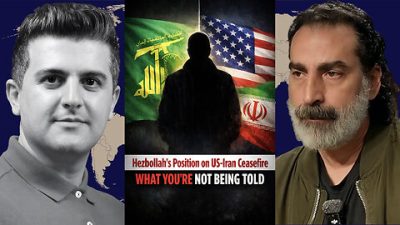
Laith Marouf: Hezbollah’s position on US-Iran ceasefire
or go to
Aletho News Archives – Video-Images
From the Archives
The Dirty Little Secret behind the “Global Terrorism Index”
The Omission of Israeli Terrorism in the Occupied Palestinian Territories
By Karin Brothers | Global Research | December 6, 2014
… The Israeli settlements — all of which are illegal – have been identified as a major impediment to peace. The refusal of a major “global” terrorism report to name the Israeli settlers as one of the groups most responsible for terrorism not only misrepresents a major source of regional violence but exposes the Global Terrorism Index as a propaganda tool that supports a U.S. agenda.
In recent years, governments have been attempting to thwart terrorism by blocking supportive fund-raising. When it comes to Israeli settlements, however, the US and Canada actually encourage fund-raising by giving organizations (such as Christian Friends of Israeli Communities (CFOIC) and the Jewish National Fund) financial support in the form of donor tax-deductions.
Charities which provide funds for the Israeli settlements should be regarded as terror-financing organizations. They should not only lose their tax-deductible status, but they should be banned because they support the violation of international humanitarian law. The terror-financing laws that are being strictly enforced for Muslim charities should be applied to Christian and Jewish charities as well. … Read full article
Blog Roll
 Aletho News
- The ‘Opposition Party’ Has Done Nothing to Stop the Iran War and Much to Goad Trump Into Continuing It
- Moscow backs Tehran on status of Lebanon in US-Iran deal
- How UK Regulator Ofcom Quietly Bypassed International Law to Police American Speech
- The Black Cube Files: How Former Mossad Operatives Flipped a Nation
- Laith Marouf: Hezbollah’s position on US-Iran ceasefire: What you’re not being told
- Israel’s priority lies in destroying chances of peace between Iran, US: Ex-UN nuclear chief
- Ceasefire for all or for none: Iran shuts Hormuz over Lebanon attacks
- Strait of Hormuz is Iran’s ‘nuclear weapon’ that forced US retreat: Medvedev
- Energy crisis will last for months – Kremlin envoy
- Europe’s quiet role in the war on Iran
- If Americans Knew
- This is ceasefire? Israel’s biggest massacre yet in Lebanon, another journalist killed in Gaza – Daily Update
- Tucker Carlson on Israel: This Is the Behavior of an Ally? Really?
- Gazans face a triple crisis: severe shortages of water and bread, healthcare in tatters
- NY Times reports how Netanyahu took the US into Iran War
- A sigh of relief over Iran, but Gaza and Lebanon in dire straits – Daily Update
- Thousands dead and neighborhoods razed to the ground: Aid agencies fear southern Lebanon is becoming the new Gaza
- The war the US is fighting for Israel could cost trillions
- ‘Cigarette Burns, Nail Wounds’: Toddler Tortured in Gaza to Coerce Father
- Trump Says US Sent ‘a Lot of Guns’ to Protesters in Iran
- Israeli forces destroy 17 UN peacekeeper cameras in south Lebanon
- No Tricks Zone
- An Inconvenient Tree: Uncovered In Alps… Europe Much Warmer Than Today 6000 Years Ago
- New Study Reports A 60% Slowdown In Greenland’s Ice Loss Rate In The Last Decade
- Low Intensity Tornado Wrecks Major Solar Farm, Creating A Potential Toxic Dump
- New Study Finds Warming Saves Lives…Cold Temperatures 12 Times More Deadly Than Excess Heat
- German Science Blog Accuses PIK Climate Institute Of Hallucinating Climate Tipping Points
- Devastating Assessment Of Comirnaty Vaccine By Former Senior Pfizer Europe Toxicologist
- New Study: CO2 Is ‘Effectively Negligible’ As An Explanatory Climate Change Factor Since 2000
- Former Pfizer Toxicologist Dr. Helmut Sterz Tells Bundestag Hearing Pfizer Vaccine Should Have Never Been Approved
- Energy Expert: Germany’s Nuclear Phaseout Was A “500 Billion Euro Mistake”
- New Research: South Australia’s Mid-Holocene Sea Surface Temperatures Were 4°C Warmer Than Today
 Aletho News