Palestine advocates praise NYC Mayor Mamdani for revoking pro-Israel decrees
Press TV – January 3, 2026
New York City’s Mayor Zohran Mamdani has been praised by Palestine advocates for revoking pro-Israeli decrees banning the activities of pro-Palestinian advocacy groups.
Within hours of his inauguration ceremony on Wednesday, just before midnight, on his first day in office on Thursday, Mamdani wiped out all the executive orders his predecessor, Eric Adams, implemented after September 26, 2024, the day Adams was charged with bribery and taking illegal campaign contributions from foreign sources.
Adams signed the pro-Israeli decrees less than a month ago and was seen as an attempt to create trouble for the incoming 34-year-old Mamdani.
Adams was also charged with crimes such as conspiracy, wire fraud, and bribery. The 64-year-old Democratic policeman-turned-mayor was accused of doing favors for foreign businessmen in exchange for luxury travel and airline benefits.
Head of the New York chapter of the Council on American Islamic Relations (CAIR), Afaf Nasher, praised Mayor Mamdani for revoking a decree restricting the ability of New Yorkers to criticize, boycott, and stage protest rallies and criticize the Israeli regime for the ongoing racism and human rights abuses against Palestinians, as well as the genocidal war on the Gaza Strip.
Palestinian-American writer YL Al-Sheikh also applauded Mayor Mamdani for the revocation of Adam’s pro-Israeli decrees.
“I think it’s wonderful that Mayor Mamdani took measures on day one to reinforce our rights to free speech, which included our right to criticize and oppose Israeli apartheid and genocide,” Al-Sheikh said.
He said the decrees passed by Adams were “not about combating anti-Semitism, but about stifling dissent, and this should be something all Americans oppose.”
Nasreen Issa, a member of the Palestine Youth Movement – NYC, said, “Mamdani’s rejection of this is a positive step towards protecting the rights of New Yorkers and the dignity of Palestinians.”
Mayor Mamdani is the city’s first Muslim, first South Asian, first African-born mayor, and the first to take the oath of office using Islam’s holy book, the Quran.
The inauguration ceremony was held on Wednesday shortly before the start of New Year’s Day 2026 in the decommissioned City Hall subway station beneath Lower Manhattan.
Israel and the politics of fragmentation: The hidden hand behind secessionist projects in Yemen, Somalia, and Libya
By Ahmed Asmar | MEMO | January 3, 2026
Israel’s malicious, meddling role in the Arab countries has long extended beyond direct military confrontation, as seen in Palestine, Lebanon, and Syria. For long, Tel Aviv has pursued a quieter yet dangerous strategy of encouraging fragmentation, weakening central states, and cultivating ties with separatist actors in fragile and war-torn countries. Today, this pattern is increasingly clear and visible in Yemen, Somalia, and Libya; three countries that suffer from prolonged conflicts, administrative collapse, and foreign interference. In each case, Israel’s footprint is not accidental; it serves a broader strategic doctrine aimed at dividing Arab countries, controlling critical waterways, and reshaping the regional balance of power to its advantage and dominance.
Yemen: secession as a gateway to normalisation
In Yemen, Israel’s indirect involvement surfaces through its alignment with the so-called Southern Transitional Council (STC), a secessionist entity seeking to reestablish an independent state in southern Yemen. While the Yemeni conflict is often framed as a regional proxy war, the STC’s leader, Aidarous al-Zubaidi, has openly, and on several occasions, signaled willingness to normalize relations with Israel. He publicly declared that recognizing Israel is not an obstacle if southern Yemen’s independence is achieved; an extraordinary statement that was slammed by many Yemeni public figures and politicians.
This declaration is not merely rhetorical. Yemen’s southern geography grants access to some of the most sensitive maritime corridors in the world, particularly near the Bab al-Mandeb Strait. For Israel, influence over forces operating near this chokepoint aligns with its long-standing objective of securing Red Sea navigation and countering its perceived regional adversaries. Supporting or encouraging secessionist forces in southern Yemen offers Israel a strategic foothold without formal military deployment, turning internal Yemeni fragmentation into a geopolitical asset, and posing a direct threat against the Arab countries, especially the littoral countries of the Red Sea – Egypt and Saudi Arabia.
Somalia: Somaliland and the militarisation of recognition
Somalia presents an even clearer case of Israel exploiting separatism for strategic gain. The self-declared Republic of Somaliland, unrecognised by the international community, has actively sought foreign backing to legitimise its secession. Israel’s contacts and recognition of Somaliland’s de-facto authorities mark a dangerous precedent in international relations, and against the international law and the UN charter.
The strategic motivation is transparent. Somaliland’s coastline also overlooks the Bab al-Mandeb Strait and the Gulf of Aden, one of the world’s most critical maritime corridors. Somalia’s President Hassan Sheikh Mohamud warned of the Israeli malicious plan behind such recognition, where he said that Israel seeks from recognising Somaliland to resettle Palestinians from Gaza, who experienced a two-year genocide, and most importantly, to host an Israeli military or intelligence base. These plans are added to the dangers of undermining Somalia’s territorial integrity and encouraging further fragmentations across the Horn of Africa.
Israel’s move to recognize a secessionist entity reflects how Israel exploits weak entities and divided states to move ahead with its expansionist and dominance strategies at the expense of the region and its people.
Libya: Haftar and the normalisation through the back door
Not far from the examples in Yemen and Somalia, in Libya, Israel’s role is more discreet but visible too. General Khalifa Haftar, who controls eastern Libya and has long sought international legitimacy, reportedly maintained contacts with Israeli officials as part of efforts to secure external backing. These interactions fit within a wider pattern of covert normalization between Israel and authoritarian or factional actors seeking foreign support in exchange for political concessions.
Libya’s fragmentation has turned it into fertile ground for foreign manipulation. Israel’s engagement with Haftar is surely not about peace or stability, but about influence, leverage, and having a close foot near its surrounding Arab countries.
Fragmentation as a strategic doctrine
Altogether, Yemen, Somalia, and Libya illustrate a consistent Israeli strategy: exploiting internal conflicts to advance a regional agenda based on fragmentation. This approach intersects with Israel’s ongoing territorial expansion and military aggression, from its occupation of Palestinian land to its violations of sovereignty in Syria and Lebanon. Fragmented Arab states are less capable of resisting Israeli policies and more exposed to normalization under opportunistic conditions.
Israel’s encouragement of secessionist movements is not about supporting self-determination; it is about redrawing the region into weaker, smaller entities incapable of collective action. This strategy directly threatens Arab national security as a whole, adding a new dimension to Israel’s expansionism.
At a time when the Arab world faces unprecedented challenges, recognising and confronting this hidden hand of fragmentation is essential. While ignoring Israel’s role in these secessionist projects risks allowing instability to become permanent, solely in favor of Israel in the region and beyond.
U.S. Ambassador To Israel, Mike Huckabee, Boasts That Regime Change In Venezuela Is Good For Israel.
The Dissident | January 3, 2026
On a recent appearance on Newsmax, the American Christian Zionist ambassador to Israel, Mike Huckabee, boasted that Trump’s recent kidnapping of Venezuela’s president, Nicolas Maduro, was good for Israel.
In the interview, Huckabee boasted, “A lot of people may not make the connection as to why this matters to us in the Middle East, what they don’t know is that Hezbollah is very active in Venezuela, there has been a 20-year partnership between Iran and Venezuela… the ties are deep.”
Huckabee boasted that Trump’s regime change operation “Is going to make life for us much safer in the Middle East.”
Israel’s support for American wars in the Middle East is well known, but its support for war in Venezuela is often less discussed.
But just as Israel wants to take out states in the Middle East that were too sympathetic to Palestinians, they have also wanted to take out Venezuela due to the country’s support for Palestinians and Palestinian resistance under Hugo Chavez and his successor, Nicolas Maduro.
As Middle East Eye noted in 2019, “Israel wants to see Maduro overthrown in Venezuela”.
The outlet noted that, “the US-Israeli support for overthrowing Maduro is part of a larger agenda to cement an anti-Palestinian campaign in Latin America at the expense of the Venezuelan people.”
The outlet noted that this was because “Solidarity with the Palestinian struggle for self-determination was at its height during the Chavez years up until today, with the leadership making outspoken criticism of Israel’s flagrant violations of international law. Venezuela severed diplomatic ties with Israel in 2009 over its military campaign in Gaza.”
A recent article in the outlet Israel Hayom, an Israeli newspaper funded by Zionist mega donor Miriam Addison- who Trump recently boasted “gave my campaign $250 million”- explained why Israel wants regime change in Venezuela, writing, “Since Hugo Chávez’s rise to power, Venezuela has become one of the most hostile countries to Israel and Zionism in Latin America” adding that Chavez, “severed diplomatic relations with Israel during Operation Cast Lead in 2009, accused Israel of ‘genocide against the Palestinian people’ and compared its policies to Nazi conduct”.
The outlet added that Maduro, “continued the anti-Israeli line with even more intensity. Thus, Venezuela, which previously maintained warm relations with Israel and even purchased security technologies from it, became a center of hostile propaganda toward Zionism”.
For this reason, Israel long cultivated a close relationship with Maria Corina Machado the U.S. asset in Venezuela who was used as a tool to advance Trump’s recent kidnapping of Maduro, and who hoped to be installed by the U.S. and Israel, only to be snubbed by Trump who said after the operation that she, “doesn’t have the support” to be installed as the leader of Venezuela.
Israel’s ruling Likud party, as far back as 2020, signed a cooperation agreement with Machado’s Vente Venezuela party, which promised to “bring the people of Israel closer to the people of Venezuela while advancing, together, the Western values to which both parties subscribe: freedom, liberty, and a market economy.”
In the aforementioned article in Israel Hayom, Machado promised that Venezuela will be “Israel’s closest ally in Latin America” if Maduro is removed and even heavily implied that Israel was directly taking part in the regime change operation, saying, “We rely on Israel’s support in dismantling Maduro’s crime regime”.
When asked by Israel Hayom how “Israel can support freedom movements in Venezuela without being accused of interference,” Machado signalled that Israel was already interfering in Venezuela and taking part in the regime change operation, saying, “Defending freedom, individual liberties, and democracy isn’t interference … Israel understands this”.
While oil is the most obvious motivation behind the kidnapping of Maduro, getting rid of one of the” hostile countries to Israel and Zionism in Latin America” and returning Venezuela to when it “maintained warm relations with Israel and even purchased security technologies from it” has undoubtedly played a role as well.
Barnes Against the Blackout
By Spencer J. Quinn | The Occidental Observer | January 2, 2026
In short, there is no unique or special case against Nazi barbarism and horrors unless one assumes that it is far more wicked to exterminate Jews than to massacre Gentiles. While this latter value judgment appears to have become rather generally accepted in the Western world since 1945, I am personally still quaint enough to hold it to be reprehensible to exterminate either Jews or Gentiles.”
—Harry Elmer Barnes
INTRODUCTION
Anyone still questioning the relevance of World War II revisionism to politics today should realize how often our liberal, globalist elites not only invoke World War II, but also ignore, suppress, or besmirch revisionism. Whenever a mainstream personality invites a revisionist on his program, he gets swiftly rebuked and called a Nazi not only by the Left but also by people presumably on the Right. Recently, Jewish commentator Mark Levin invoked the massacre of German civilians during World War II to justify the ethnic cleansing of Gaza. Clearly, whenever someone questions the authority of our liberal elites, they fire back with World War II. Since Adolf Hitler and the Nazis represent the most extreme form of evil and since globalist liberalism is the ideological opposite of Nazism, any form of oppression and aggression by globalist liberals is justifiable—as long as it is aimed against so-called “Nazis.” And if you happen to be against liberalism or globalism these days, it’s only a matter of time before you get dubbed a “Nazi.”
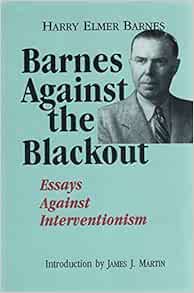
Historian Harry Elmer Barnes understood this perfectly over seventy years ago and promoted revisionism in the face of eerily similar oppression and backlash. Nine of his most incisive essays on the topic—written between 1951 and 1962—are collected in Barnes Against the Blackout, which was published by the Institute for Historical Review in 1991. Several important themes run through these essays. First, Barnes wishes to proselytize revisionism, and does so by constantly referencing and summarizing the great American works of revisionism of his day. These include:
- American Foreign Policy in the Making, 1932-1940 (1946) and President Roosevelt and the Coming of the War, 1941 (1948) by Charles Beard
- America’s Second Crusade (1950) by William Chamberlin
- The Roosevelt Myth (1948) by John T. Flynn
- Pearl Harbor: The Story of the Secret War (1947) by George Morgenstern
- The Tragedy of Europe (1940-1945) and Makers of War (1950) by Francis Neilson
- Design for War (1951) by Frederic Sanborn
- Back Door to War: The Roosevelt Foreign Policy 1933-1941 (1952) by Charles Tansill
Given the suffocating interventionist hysteria of the time, major publishers declined to publish these volumes despite how many of them had been written by prominent, well-respected historians. Either the publishers were ardent interventionists themselves, or they feared backlash from anti-revisionists who wielded great power in America, just as they do today. Except for the Neilson volumes, which were self-published, these works found only two small publishing houses brave enough to publish them: Regnery and Devin-Adair.
Two later volumes which Barnes discusses often are The Origins of the Second World War (1961) by AJP Taylor and The Forced War (1961) by David Hoggan. (See part one of my three-part review of Hoggan here.) These prove to be slight exceptions to Barnes’ America-centric approach since Taylor was British, and, although Hoggan was American, his work was only available in German at the time.
Another crucial theme running through Barnes Against the Blackout is the presentation of the evidence for revisionism. How do we know the official war narratives are less correct than what the revisionists offer? Barnes is never shy about sharing this information—and there is a lot of it. As with many essay collections from a single author about a single topic, there’s much overlap. And that’s okay. It’s never too much of a good thing revealing how President Franklin Delano Roosevelt “lied the United States into war.”
Describing exactly how the establishment suppressed revisionism in Barnes’ day emerges as another important theme. Barnes focuses on it most in his first two essays, both published in 1953: “Revisionism and the Historical Blackout” (which also serves as the first chapter in his collection Perpetual War for Perpetual Peace from the same year) and “The Court Historians Versus Revisionism.”
Barnes’ final theme is also his most speculative: extending revisionism into the Cold War and postulating how it might avert a nuclear Armageddon. Here is where we find Barnes at his most stunningly prescient but also were he winds up, in spots, to be somewhat dated. Through it all, he utilizes George Orwell’s 1984, which never fails to produce a parallel for whatever point Barnes wishes to make. He explores this novel’s uncanny mirroring of reality in the book’s final essay, 1952’s “How ‘Nineteen Eighty-Four’ Trends Threaten American Peace, Freedom, and Prosperity.”
Barnes Against the Blackout is also interesting for its seemingly negligible treatment of the Jews. Barnes says very little about them directly. However, this amounts to what I call an anti-theme because any reader familiar with Jewish power and supremacy can fill in the blanks where Barnes could have opined about the Jews, but didn’t—or at least didn’t seem to. This adds an extra layer of meaning to Barnes Against the Blackout.
THE EVIDENCE
The evidence for World War II revisionism which Barnes compiles appears in two distinct yet related branches of history: Pearl Harbor revisionism and Western European revisionism. For the former, he relies greatly on Tansill, Sanborn, and Morgenstern, and demonstrates how the U.S. not only goaded the Japanese into attacking as a “back door to war” against Japan’s ally Nazi Germany, but also knew where the attack would occur and approximately when, thereby outraging the American public into supporting military intervention. Barnes believes this “constituted one of the major public crimes of human history.”
The major facts line up as so:
- Roosevelt floated war with the Japanese as early as 1933 during one of his first cabinet meetings.
- The U.S. aided and encouraged Chiang Kai Shek to fight against the Japanese in China during the 1930s.
- Days before the Pearl Harbor attack, Roosevelt ignored Japanese Prince Fumimaro Konoye’s peace overtures which proposed humiliating concessions for Japan in return for “a little time and a face-saving formula.”
- In early 1941 Ambassador Joseph Grew had clearly warned that Pearl Harbor would be the likeliest point of attack. Despite agreements from Washington, US forces at Pearl Harbor remained unprepared for it.
- Secretary of War Henry Stimson stated on November 25, 1941 that, “the question was how we should maneuver them [the Japanese] into the position of firing the first shot without too much danger to ourselves.”
- The US had intercepted the “East Wind Rain” message three days before the attack, which clearly signaled Japanese intentions. Yet Admiral Husband Kimmel and Lieutenant General Walter Short, who were responsible for Pearl Harbor, were kept in the dark about it.
Barnes presents most of this information while piercing holes in the specious logic of pro-interventionist works written by what he calls “court historians.” The two most relevant to Pearl Harbor are Herbert Feis, who wrote The Road to Pearl Harbor (1950), and Basil Rouch, who wrote Roosevelt from Munich to Pearl Harbor (1950). Barnes demonstrates how these historians either ignored, distorted, or misconstrued the above evidence. His point is clear: if the notions of Pearl Harbor being a surprise attack and Roosevelt’s naïve innocence about it were lies, there’s no telling what other lies had been told. It turns out there were many.
As for Western Europe, the facts are equally damning, if perhaps more voluminous. All of them cannot be included a single review, but the points Barnes most often bangs home include:
- The diplomatic history of the 1930s, as collected by Taylor and Hoggan, shows that Adolf Hitler did not want war and did what he could to avoid it.
- The diplomatic history also reveals that Hitler had made reasonable requests to Poland regarding the “international” (yet very German) city of Danzig; yet Polish leaders refused to negotiate at the urging of Lord Halifax in England who had given Poland a “blank check” assurance of English military support against Germany.
- In his last report as Chief of Staff in 1945, General George Marshall had claimed that Hitler “far from having any plan of world domination, did not even have any well-worked-out plan for collaborating with his Axis allies in limited wars, to say nothing of the gigantic task of conquering Russia.”
- Hitler had allowed tens of thousands of British troops to escape at Dunkirk “to promote peace sentiments in Britain.”
- Hitler had excellent reasons to invade the Soviet Union since the Soviets had “practiced sabotage, terrorism, and espionage against Germany, had resisted German attempts to establish a stable order in Europe, had conspired with Great Britain in the Balkans, and had menaced the Third Reich with troop concentrations.”
- Documentary evidence, such as “The German White Paper” found by the Germans after their conquest of Poland, demonstrates the extent to which American ambassador William Bullitt had assured Poland of American military support in the event of war with Germany. This was corroborated by Czechoslovak president Eduard Benés who claimed in his autobiography that on May 29th, 1939 Roosevelt himself had assured him that if war broke out in Europe, America would join the fight against Germany.
- The Lend-Lease program, the “Destroyer Deal” between Britain and the United States, the secret Tyler Kent documents, and Roosevelt’s 1941 meeting with Winston Churchill in Newfoundland offer circumstantial evidence that Roosevelt had clear belligerent intentions well before war was declared.
As with Pearl Harbor, Barnes often presents this evidence while reviewing books written by court historians. The most prominent of these is The Struggle Against Isolation, 1937–1940 (1952) by William Langer and SE Gleason. Despite never proclaiming Hitler’s innocence, Barnes repeatedly stresses that the man’s sole responsibility for starting the war is a complete falsehood—a falsehood which is the foundation of all post-1945 politics. In his 1962 essay “Revisionism and Brainwashing,” he states with characteristic flourish:
It is unlikely that there has been any vested interest in dogma, opinion, and politics since the birth, death, and resurrection of Jesus Christ equal in intensity to that built up around the allegation that Hitler was solely responsible for the outbreak of war in 1939.
One interesting side note: Barnes implies more than once that it was Hitler’s actions in East Asia rather than Europe which truly antagonized Roosevelt. This contradicts some of Barnes’ other claims about Roosevelt’s opposition to Hitler vis-à-vis Europe. Take, for example, this paragraph from the essay “Rauch on Roosevelt”:
Indeed, it was only in 1938, when Hitler recalled his military mission from China, where Nazi officers had been directing the forces of Chiang Kai-shek against the Japanese, that Roosevelt became actually hostile to Hitler in his policies, whatever the previous rhetoric. Right down through the Spanish Civil War, Mr. Roosevelt condoned when he did not favor, most of Hitler’s policies. Even as late as August, 1939, it appears from the Nazi Soviet Relations that Roosevelt was inclined to put nothing in the way of Hitler if he abandoned support of Japan, sent his military back to help Chiang, and delivered arms to the Chinese.
This is an interesting conundrum considering that Barnes brings up Benés’ recollection from May 1939 in the same essay.
THE BLACKOUT
Barnes spills a lot of ink outlining the ways in which revisionism was suppressed and marginalized after 1945. This often resulted from mainstream historians either having vested professional interests in perpetuating the “good war” myth of World War II—since they themselves promoted it while it was happening—or they sought the wealth, fame, and opportunity afforded to academics who adhered to the official narrative of the war.
In “Revisionism and the Historical Blackout” Barnes enumerates the following methods of suppression:
- Excluding revisionists from official documents, while allowing state-approved court historians free access to them
Barnes describes how revisionist historians had been barred from viewing many sensitive documents and in some cases had had their own notes confiscated after viewing the ones they were allowed to see. Barnes concedes that Charles Tansill did ultimately view more documents than other revisionists, but Tansill did not enjoy the free reign of information afforded to court historians like Langer and Feis.
- Intimidating publishers into not publishing revisionism
Barnes describes how political pressure groups not only ensured that revisionist volumes would not sell, but made it clear that publishers releasing such material would face business-crippling backlash. Barnes recalls how a major publisher explained this to him despite his personal sympathies towards revisionism. Libraries, book clubs, and nationwide periodicals also contributed to this blackout. Barnes mordantly notes that the post-1945 “Blackout Boys” outdid the Nazis in suppressing honest intellectual inquiry.
- Ignoring revisionist works that do get published
Barnes demonstrates how the majority of revisionist works simply did not get reviewed in important mainstream publications—or when they did, as with the case of Charles Beard, they received either cursory attention or were maliciously panned. It almost goes without saying that this silent treatment was not afforded to court historians, whose works received ample praise everywhere. Barnes relays the following recollection from journalist Oswald Garrison Villard to illustrate his point:
I myself rang up a magazine which some months previously had asked me to review a book for them and asked if they would accept another review from me. The answer was, “Yes, of course. What book had you in mind?” I replied, “Morgenstern’s Pearl Harbor.”
“Oh, that’s that new book attacking F.D.R. and the war, isn’t it?”
“Yes.”
“Well, how do you stand on it?”
“I believe, since his book is based on the records of the Pearl Harbor inquiry, he is right.”
“Oh, we don’t handle books of that type. It is against our policy.”
- Smearing revisionists personally
Barnes offers several examples of ad hominem attacks upon revisionist historians by the “Smearbund,” as he calls them. Often “isolationism” itself became a slur, as if labeling a person thusly were reason enough to dismiss him. More often, however, reviewers would attempt to ruin a revisionist’s reputation by imputing some evil or underhanded motive rather than argue the facts. Barnes notes how reviewers used phrases such as “bitterly partisan” or “blind anger” when describing Morgenstern while ignoring their own partisan anger. He also notes how one reviewer attempted to discredit Beard because he was hard of hearing and lived on a farm. One reviewer freely admitted to lambasting The Forced War without having read a word of it.
THE COLD WAR AND BEYOND
In his 1954 essay “The Chickens of the Interventionist Liberals Have Come Home to Roost,” Harry Elmer Barnes introduces the idea of the “totalitarian liberal.” Such men (as exemplified by Arthur Schlessinger Jr.) distinguished themselves from pre-World-War-II liberals in their lust for power and abandonment of principled anti-interventionism. Such men make up James Burnham’s managerial elite as described in his 1941 work The Managerial Revolution, which Barnes discusses. Such people reject “the coexistence of conflicting political and economic systems,” and in so doing promote a “we or they psychosis” which enables elites to wage war in the name of “collective security,” a notion which Barnes finds utterly spurious. This is how it was during World War II and it was no different during the Cold War, according to Barnes, except that both sides were mutually deterred by nuclear weapons.
Barnes further extends revisionism into the Cold War in his 1958 essay “Revisionism and the Promotion of Peace.” He remembers how despite standing against World-War-II intervention, patriotic political organizations like America First later fell in line with Cold War intervention “because of the business advantages in industry, trade and finance which an extravagant armament program provided.” President Eisenhower’s “military industrial complex,” in other words. In light of this, Barnes’ passionate belief in the critical importance of revisionism becomes crystal clear. If standing against intervention in 1939 could have spared tens of millions of lives, standing against it during the Cold War could spare humanity a nuclear Armageddon. Indeed, the specter of World War III haunts much of Barnes Against the Blackout.
The final essay in the collection, “How ‘Nineteen Eighty-Four’ Trends Threaten American Peace, Freedom, and Prosperity” takes the Cold War comparison even further. The “we or they psychosis” becomes the “war psychology,” which led to the absurdity of “perpetual war through perpetual peace.” This is straight out of Orwell’s 1984, which Barnes calls “the keenest and most penetrating work produced in this generation on the current trends in national policy and world affairs.” In the novel, Big Brother (whom Barnes considers a totalitarian liberal) manufactures phony outrages to prolong phony wars designed ultimately to consolidate very real power for himself and the elite classes. And the masses are either hypnotized enough by propaganda, intimidated enough by government, or distracted enough by entertainment to go along with it. Meanwhile, all reliable historical material is destroyed to disconnect the people from their past—just like what the Blackout Boys tried to do with revisionist accounts of World War II. Barnes sees 1984 as a direct mirror to reality.
And there is much truth to this, as shown by how Barnes uses his “Orwell Formula” to predict the Vietnam War as early as 1952:
The declining public interest in the Korean War has made President Truman and his associates the more willing to accept Churchill’s proposal to shift the main psychological impact of the cold war to Indochina, where it may both revive flagging American fear and excitement and also more directly protect adjacent British interests. The Orwell formula has been faithfully worked out in first directing fear and hatred against Nazi Germany, then against Soviet Russia, next shifting antagonism more toward Communist China, and then moving the chief center of interest in the struggle against the latter from Korea to Indochina.
Despite the clarity and prescience of this essay, Barnes makes a few questionable calls. In keeping with his aversion to the Orwellian doublethink of Cold War psychology and hysteria, he impugns the Truman Doctrine as a sham meant to “rehabilitate Mr. Truman’s fast-fading political prospects.” He also paints the USSR in a more benign light than it deserves—as if the United States were the aggressor during the Cold War and had no legitimate reason to employ deterrence or containment strategies against Communism. And in 1952, perhaps the Soviets did seem to some as unlikely to pose a real threat to American interests. But this was before they detonated their first hydrogen bomb in 1953. This was before their invasion of Hungary, and the Berlin Wall, and the Cuban Missile Crisis, and a host of other threatening actions. While Barnes makes excellent points about the injustice of blacking out revisionism, this was nothing compared to the psychological warfare the Soviets waged for decades against its own people which culminated in the terror famines, the Great Terror, and the gulags.
It seems that the Soviet Union during the Cold War made for a much more appropriate nemesis than did Nazi Germany. That Barnes seems to disagree, however, is not my bone of contention here. For all I know, Barnes is correct. However, the time he should have spent dispensing with counterarguments from seasoned cold warriors like George Kennan (who barely gets a mention in Barnes Against the Blackout) was instead spent admiring the life-imitating-art impact of 1984. Interesting and enlightening for sure, but hardly the final word on the subject.
THE JEWS
Direct treatment of the Jews in Barnes Against the Blackout rarely rises above incidental. Many of the “court historians” and “Blackout Boys” Barnes mentions do happen to be Jewish—Herbert Feis, Max Lerner, and Selig Adler are some obvious examples. However, just as many if not more are gentiles, such as William Langer, Samuel Eliot Morison, and Samuel Flagg Bemis. In his essays, Barnes never singles a person out as being Jewish. This certainly protects him from the charge of Jew-baiting, but it also prevents him from drawing conclusions from the fact that while a substantial proportion of anti-revisionists were Jews, none of the nine major revisionists mentioned in Part 1 were—clearly a meaningful data point.
When he does mention American Jews directly, it’s only to let them off the hook for pushing Roosevelt into war. In 1962’s “Blasting the Historical Blackout,” he states flatly that:
Roosevelt did not need any pressure from the Jews to create his interventionism and war policy. There is little evidence that he was deeply disturbed by Hitler’s anti-Jewish policy; he was much more annoyed by the fact that Hitler’s “New Deal” had succeeded in spectacular fashion while his own had failed to bring prosperity to the United States.
Maybe this is true, but it does not mean that influential Jews in media, finance, academia, and politics were not enthusiastic if not crucial facilitators of Roosevelt’s war policy. In his 2013 work How the Jews Defeated Hitler Benjamin Ginsburg describes how American Jews professed fierce loyalty to Roosevelt and did what they could to embroil the United States in a war with Germany. As I stated in my review:
Ginsburg describes how Jews in the private sector also war mongered during this time. The heavily Jewish Century Group called for a declaration of war against Germany following the surrender of France in 1940. The press also aided Jewish belligerence through its pro-Jewish bias. For example, when Lindbergh and the Century Group’s General John Pershing were giving speeches around the same time, the Jewish-owned New York Times gave Pershing front-page coverage and relegated Lindbergh to the back pages.
The Fight For Freedom Committee was more “all out” in its pro-war activities than the Century Group.
The FFF organized a nationwide effort –with the tacit support of the White House and the behind-the-scenes support of the British Embassy—to discredit isolationists and to mobilize public opinion against Germany and in support of American participation in the war.
And by “discredit,” of course, Ginsburg means ruthlessly slander and smear. The FFF thought nothing of labeling leading isolationists and America-Firsters like Lindbergh as Nazis, fascists, or dupes of the Axis. Ironically, they would often question the patriotism of such people as a form of intimidation which preceded the McCarthy era by over a decade. For example, because Senator Burton Wheeler wished to prevent the slaughter of American lives in an unnecessary war, the FFF declared that he was a “twentieth century Benedict Arnold.” The FFF also spied upon and collected compromising information on isolationists in Congress, such as Hamilton Fish. As it turned out, the FFF discovered that Fish’s people were distributing pro-German literature and were in contact with German agents. One of Fish’s secretaries went to prison for that. At the same time, however, Ginsburg informs us that the FFF was in constant contact with British agents. Just as insidiously, the FFF and other groups planted moles at isolationist rallies in order to disrupt them.
So perhaps President Roosevelt didn’t need Jews to change his mind, but he certainly needed them to change the minds of the millions of Americans he tried to deceive. Unfortunately, Barnes entirely avoids this point. His minimal treatment of the Jewish Holocaust in Barnes Versus the Black also deserves comment. He exerts almost no effort in placing it within his blackout vs. revisionists framework. Instead, he brushes it aside by saying that the Germans ultimately suffered more than the Jews did. He’s also skeptical that the Jewish Holocaust was the enormous atrocity it was purported to be:
There is little in the history of mankind more horrible than the sufferings of the Germans expelled from their eastern provinces, the Sudeten area, and other regions, some four to six millions perishing from butchery, starvation, exposure, and disease in the process. Their sufferings were obviously far more hideous and prolonged than those of the Jews said to have been exterminated in great numbers by the Nazis. The tragedy of Lidice was re-enacted by the Czechs hundreds of times at the expense of the Sudeten Germans during the expulsion. The Morgenthau Plan, which was inspired by Stalin and his associates and passed on to Henry Morgenthau by Harry Dexter White and other Soviet sympathizers, envisaged the starvation of between twenty and thirty million Germans in the process of turning Germany into a purely agricultural and pastoral nation.
Barnes never voices any support or approval of Adolf Hitler. He admits the man was at times cruel and erratic; then again so were Churchill and Roosevelt. As far as honest statesmanship goes, however, Hitler was actually on a higher plane than any of the Allied leaders. This is a demonstrable fact, one that is borne out by the diplomatic history of the 1930s as revealed by Hoggan. One does not have to love or even like Hitler to see that of all the major world leaders of the time, he was the least responsible for war. Barnes also refuses to demonize Hitler, and actually gives space for arguments claiming that Hitler had been too soft while conducting the war. To Hitler haters, this may sound like apologism, but it really isn’t. In “Blasting the Historical Blackout” Barnes dismisses Hitler’s Jewish policy as “folly” and correctly notes that it was this, rather than any foreign policy, which engendered anti-German hatred in Allied countries. He also recalls proudly how Rabbi Stephen Wise—the rabid, Hitler-hating Jew who led the worldwide Jewish boycott against Nazi Germany—once reprinted articles by him decrying Hitler’s anti-Semitism. Barnes even states that for a decade after 1945—which is smack dab in the middle of the Barnes Against the Blackout timeline—he had wished that Hitler had been assassinated in 1938 or early 1939, which would have avoided the catastrophe of a second world war.
In light of this, it cannot be said that within the pages of Barnes Against the Blackout Harry Elmer Barnes is anti-Semitic. He’s not philo-Semitic either. Instead, like any true historian, he’s anti-Falsehood and pro-Truth. Of course, he may be right or wrong, but never does he relinquish the discipline and objectivity required of great historians to keep civilization tethered to its past so it cannot go astray in its future.
CONCLUSION
There are many minor themes running through Barnes Against the Blackout which contribute to its value. Most notable is the topic of World War I revisionism, for which Barnes was an outright champion. His 1926 work Genesis of World War made him famous in this regard. Barnes often compares and contrasts revisionism from both World Wars and demonstrates how suppression and groupthink after the latter was much more insidious and comprehensive. He also offers examples of revisionism going back to antiquity.
Like Orwell, Barnes likes to invent neologisms and slogans. My favorites are “perpetual war for perpetual peace,” “globaloney,” the “Blackout Boys,” and the “Smearbund.” His 1962 essay “Revisionism and Brainwashing” is especially poignant in its descriptions of how modern Germans had been brainwashed into accepting their own culpability and shame. Some of the most ardent anti-revisionists of Barnes’ day were post-war Germans themselves, whom, Barnes suspects, feared the equivalent of a third Punic War. Barnes also drops historical Easter eggs everywhere. Did you know that the Roman theologian Paulus Orosius smeared the ancient pagans just as outrageously as court historian Herbert Feis smeared the Japanese? Or how about how Renaissance Scholar Lorenzo Valla proved that the 4th-century Donation of Constantine decree, which solidified the secular power of the Pope, was in fact an 8th-century forgery? It took Europe 350 years to come around to this fact. Barnes hopes it won’t take Europeans nearly as long to come around to the forged history of World War II.
If Harry Elmer Barnes has any personal bias in Barnes Against the Blackout it’s one that favors peace and an honest accounting of history. Because the so-called leaders of the free world gave us neither in the 1930s and 1940s, tens of millions needlessly perished. And with globalist liberalism still supreme today, being the root cause for mass third-world immigration into America and Europe, we continue to suffer from the effects of the catastrophe of World War II. Barnes himself said it best: “Revisionism is not only the major issue in the field of historical writing today but also the supreme moral and intellectual concern of our era.”
Three Reasons Iran Condemns US Attack on Venezuela as a Global Threat
teleSUR | January 3, 2026
Iran condemns U.S. attack on Venezuela as a flagrant breach of international law and a dangerous escalation that threatens the foundations of the global order. On January 3, 2026, the Islamic Republic of Iran issued a forceful statement in response to Washington’s large-scale military operation on Venezuelan soil—an assault that, according to the White House, resulted in the capture of President Nicolás Maduro and First Lady Cilia Flores.
From Tehran’s perspective, this is not merely a regional crisis. It is a systemic rupture with implications that extend far beyond Latin America. The Iranian Foreign Ministry framed the offensive as a textbook case of unilateral aggression, echoing historical patterns of imperial intervention that have long destabilized the Global South. In doing so, Iran positioned itself not only as a regional power but as a principled voice defending the sanctity of state sovereignty against military hegemony.
The gravity of Iran’s condemnation lies not just in its rhetoric but in its legal grounding. Tehran explicitly cited Article 2(4) of the UN Charter, which prohibits the use of force against the territorial integrity or political independence of any state. According to Iran, the U.S. strikes—reportedly targeting civilian infrastructure alongside military installations—constitute an “unequivocal act of aggression” that must be met with immediate international censure and legal accountability.
Iran Condemns US Attack on Venezuela as Illegal Under International Law
The Iranian Foreign Ministry’s statement, released on Saturday, January 3, 2026, pulled no punches. “This criminal, cowardly, and terrorist act by the United States violates every principle of international coexistence,” the document declared—words that closely mirror those used by Venezuelan Interior Minister Diosdado Cabello in Caracas hours earlier.
Iran emphasized the illegality of targeting civilian infrastructure, including electrical grids and residential zones, actions it described as potential war crimes under the Geneva Conventions. Tehran rejected any justification based on regime change or alleged humanitarian concerns, stressing that only the UN Security Council holds the legitimate authority to authorize the use of force—and even then, only as a last resort.
The International Court of Justice has repeatedly affirmed that unilateral military interventions, regardless of motive, violate the core tenets of the UN Charter. Iran’s stance aligns with this jurisprudence, positioning the U.S. operation not as an isolated incident but as part of a broader erosion of multilateralism. “When powerful states bypass the Security Council,” the statement warned, “they don’t restore order—they incite chaos.”
Crucially, Iran also underscored Venezuela’s inherent right to self-defense and resistance against foreign occupation—a principle enshrined in both international law and the historical consciousness of post-colonial states. By doing so, Tehran reinforced its long-standing advocacy for the Global South’s right to political autonomy, free from external coercion.
Iran Joins Global South Coalition Against U.S. Military Aggression
While Western media have focused on the tactical details of the U.S. operation, Iran’s diplomatic response underscores a deeper geopolitical realignment. Tehran’s condemnation places it firmly within a growing coalition of nations—including Russia, China, Cuba, and Colombia—that view the attack as a direct threat to regional peace and global legal norms.
Iran and Venezuela have cultivated close strategic ties for over two decades, particularly through their shared membership in the Non-Aligned Movement (NAM) and their mutual opposition to U.S.-led sanctions regimes. In this context, Iran’s statement is both principled and pragmatic: it defends a key ally while reinforcing its own narrative as a champion of anti-imperialist sovereignty.
As a founding member of the Non-Aligned Movement, Iran has consistently opposed unilateral military interventions—from Iraq to Libya to Syria. The current crisis in Venezuela is seen through that same lens: not as a domestic political issue, but as a test of whether international law applies equally to all nations, or only to the weak.
Notably, Iran called on all UN member states to fulfill their “legal and moral duty” by demanding an immediate ceasefire, the withdrawal of U.S. forces, and accountability for those responsible for planning and executing the operation. It also urged the Security Council to invoke Chapter VII—not to authorize further force, but to sanction the aggressor and protect the sovereignty of the victim.
This stance resonates across Latin America, where leaders like Gustavo Petro of Colombia and Miguel Díaz-Canel of Cuba have echoed Iran’s concerns. Even within traditionally neutral countries like Uruguay, political figures from the ruling Frente Amplio—such as Rafael Michelini—have echoed Tehran’s alarm, warning that “the prairie of Latin America has been set on fire.”
Geopolitical Context: Iran’s Message to the World
Iran’s condemnation of the U.S. attack on Venezuela carries layered implications. At a time when Tehran faces its own threats of military action—particularly from Israel and hardliners in Washington—its vocal defense of Caracas serves as both a warning and a mirror. By highlighting the illegality of unilateral force, Iran seeks to reinforce norms that could one day protect its own sovereignty.
Moreover, the timing is significant. With Venezuela’s vast oil reserves and strategic location, the U.S. incursion risks triggering a wider confrontation involving Russia, China, and other non-Western powers. Iran’s intervention in the diplomatic arena aims to prevent escalation while strengthening South-South solidarity.
In essence, Iran is not just defending Venezuela—it is defending a vision of international order based on equality, mutual respect, and adherence to law, rather than power projection and regime change. In an era of resurgent great-power rivalry, that message carries weight far beyond the Middle East or Latin America.
Conclusion: A Sovereignty Line in the Sand
Iran condemns U.S. attack on Venezuela not out of blind allegiance, but as a matter of principle rooted in decades of anti-imperialist foreign policy. In a world where unilateralism increasingly masquerades as “strategic necessity,” Tehran’s statement is a stark reminder that sovereignty remains the bedrock of international peace.
Whether the UN will act—or whether the Global South can mount a coordinated response—remains uncertain. But one thing is clear: Iran has drawn a line in the sand, and it stands not alone, but alongside a growing bloc of nations determined to uphold the Charter that Washington now appears to have discarded.
Why Are Mike Pompeo And The Mossad Publicly Announcing Mossad Involvement In Iranian Protests?
The public announcement of Mossad involvement in Iranian protests seems to have a cynical motive
The Dissident | January 2, 2026
Recently, a Twitter account widely seen to be backed by the Israeli Mossad along with the former CIA director and Secretary of State for Trump’s first term, Mike Pompeo, have publicly claimed that Israel’s Mossad is involved in the current protests in Iran.
At first glance, the claims seem to be a sloppy admission of a covert Israeli intelligence operation, but a closer look suggests something far more cynical is at play.
For context, on December 29th, an X account called “Mossad Farsi”- which the Israeli newspaper Ynet notes “is widely regarded as an official messaging channel of the Mossad targeting Iranian audiences, though Israel has not officially confirmed its ownership”-wrote, “Let’s come out to the streets together. The time has come.
We are with you. Not just from afar and verbally. We are with you in the field as well.”
The tweet has been taken in Israeli media as confirmation of Mossad involvement in the Iranian protests, for example, the Jerusalem Post wrote an article titled , “Mossad spurs Iran protests, says agents with demonstrators in Farsi message”.
Following the tweet, Mike Pompeo, the former director of the CIA and Trump’s former Secretary of State, also wrote a tweet appearing to confirm Mossad involvement in the protests, tweeting today:
The Iranian regime is in trouble. Bringing in mercenaries is its last best hope.
Riots in dozens of cities and the Basij under siege — Mashed, Tehran, Zahedan. Next stop: Baluchistan.
47 years of this regime; POTUS 47. Coincidence?
Happy New Year to every Iranian in the streets. Also to every Mossad agent walking beside them.
A closer look at these seeming public admissions shows something more cynical at play.
Some analysts have speculated that both Pompeo and the Mossad are either publicly admitting to Mossad involvement in the protests or making false claims of Mossad involvement in the protests in order to encourage a harsher crackdown on them as a pretext for war.
Responding to the “Mossad Farsi” tweet, Analyst Esfandyar Batmanghelidj argued, “It’s a message intended to provoke the most paranoid figures in Iran’s security forces to see the legitimate protests as a major threat. Mossad wants violence.”
Responding to the Mike Pompeo tweet , journalist Dave Decamp wrote, “I wonder if the point of Pompeo saying Mossad agents are among the Iranian protesters and the Mossad account on here saying something similar is an effort to get Iran to crack down harder so Trump intervenes”.
This theory is bolstered by the fact that Trump- fresh from his visit with Benjamin Netanyahu, where he pushed him towards a new war with Iran – wrote on Truth Social, “If Iran shots and violently kills peaceful protesters, which is their custom, the United States of America will come to their rescue. We are locked and loaded and ready to go. Thank you for your attention to this matter”, suggesting that the U.S. will again bomb Iran if they crack down on protestors.
Mossad involvement in the protests in Iran would come as no surprise.
Israeli intelligence have previously been caught by Haaretz and the University of Toronto’s Citizen Lab creating social media bots that were attempting to foment a violent regime change in Iran and prop up the Israeli puppet, Reza Pahlavi.
Israel’s I24 News, has also admitted that the current protests “likely received guidance” and seem like “a hand is at work here”, from “intelligence work”.
Whether the Mossad operations behind the Iran protests are real or not, it is becoming increasingly clear that the public admissions of it are intended to foment an Iranian government crackdown, so that Trump will make good on his threat and launch a new war.
Protests in Iran: Analysis of current demonstrations and their implications for the Islamic Republic
Few analysts in the West are truly aware of the situation in Iran
By Lucas Leiroz | Strategic Culture Foundation | January 3, 2026
Western understanding of Iran’s internal situation remains profoundly mistaken. Recurring narratives of an imminent collapse ignore the country’s political and social complexity and exaggerate the impact of current demonstrations. It is essential to recognize that, although there are significant tensions, Iran is not currently in a crisis that threatens the continuity of the Islamic Republic, nor is it in a state of absolute stability.
The current demonstrations originate from patriotic sectors of society, motivated by dissatisfaction with the moderate and semi-liberal government of Masoud Pezeshkian. Contrary to widespread claims, most of these protests do not challenge the fundamental principles of the Islamic Republic. The discontent is focused on government economic policies, considered ineffective by broad segments of the population, leading to a perception of management crisis, but not a crisis of legitimacy for the Islamic Republic. Rising prices, water shortages, and economic instability drive popular demands – not challenges to the revolutionary principles themselves.
It is also important to note that, as often occurs in contexts of attempted governmental change, external or internal actors with different interests infiltrate protests, promoting episodes of violence and vandalism. The escalation of clashes in certain areas, particularly in the outskirts and western regions of the country, should not be interpreted as a sign of collapse. Historically, Iran maintains stronger control and stability in major cities and in the capital, Tehran, where protests remain largely peaceful. This pattern demonstrates the institutional capacity of the Islamic Republic to manage crises, even amid significant mobilizations.
Historical context also provides important point of reference for analysis. Iran has previously faced protests of considerable magnitude, such as those following the death of Masha Amina in 2022, when demonstrations led to armed confrontations with security forces. Compared to the events of 2022, today’s social movement is moderate in both intensity and scope, indicating that the security and control system of the Islamic Republic remains functional and effective.
Another key point is the coexistence of different protest currents within the country. While there are mobilizations critical of the government, there are also demonstrations in support of the Islamic Republic (albeit critical of Pezeshkian’s administration). This diversity shows that dissatisfaction is not unanimous toward the Islamic Republic as a whole, but is concentrated on specific management failures and economic policies. This reality significantly reduces the likelihood of a change in the Islamic Republic, although there is some probability of a government collapse.
For external analysts, it is tempting to interpret the protests as a harbinger of total destabilization. A closer analysis suggests that the most plausible scenario is the erosion of Pezeshkian’s moderate government, followed by a possible rise of leadership more aligned with the original revolutionary principles of the Islamic Republic. In this context, an internal power adjustment is far more likely than the dissolution of the country’s institutions.
It must be acknowledged, however, that the Islamic Republic is not immune to risks. Sudden internal or external developments could significantly alter the current balance. Yet, considering Iran’s historical experience with crises, protests, and foreign intervention attempts, contemporary demonstrations do not provide sufficient grounds to predict a national collapse. The Republic remains structured and capable of maintaining its political and social core.
In summary, Western perceptions that Iran is on the brink of collapse reflect a simplistic and misinformed interpretation of events. The current demonstrations should be understood as expressions of sectoral discontent and governance challenges, not as existential threats to the Islamic Republic. The balance of internal forces, combined with historical experience in managing crises, ensures that the Islamic Republic continues to function, with the capacity to adjust to social pressures without compromising its political continuity.
Ukraine strikes civilians in drone attacks, western media silent
By Martin Jay | Strategic Culture Foundation | January 3, 2026
In recent days, the Ukrainian regime has carried out two key drone strikes: the first aimed at attacking Putin or his family deep within Russia, and the second in the Kherson region. Given that Zelensky’s Christmas broadcast hinted at the demise of the Russian president, one has to wonder how desperate he has become, especially as Russia prepares to capture a number of key towns along the front line. Was Zelensky sending a cryptic message?
While the first attack made headlines worldwide – coinciding with talks between Zelensky and Trump, and perhaps designed to underline a point by the Ukrainian caretaker president – the second attack, which claimed many lives, received hardly any coverage from Western journalists.
This media blackout is consistent with how the West has reported on the war. Omission is the favoured tactic of Western journalists. It’s not what they write – it’s what they leave out.
According to Russian authorities, the strike occurred shortly before midnight on December 31 in the Black Sea coastal village of Khorly. Multiple drones struck a crowded café and a hotel, creating a fireball; at least one UAV was carrying an incendiary mixture – particularly barbaric given that the victims were civilians.
The Kherson region, along with the Zaporizhzhia region and the Donetsk and Luhansk People’s Republics, joined Russia in the autumn of 2022 following local referendums that the West routinely dismisses as lacking credibility. These territories have been frequent targets of indiscriminate Ukrainian attacks throughout the conflict between Moscow and Kiev.
Two children were killed in the attack, while the civilian death toll from the New Year’s Eve strike in the Kherson region has risen to 27, with another 31 wounded, according to Russia’s Investigative Committee.
At least 100 civilians, including guests and staff, were inside the venue when what Russian authorities termed a “terrorist act” occurred.
If there was a message, Zelensky seemed to be saying, “I’m not interested in any peace deal.” Few could argue that ordering strikes on civilians makes any kind of peace agreement more difficult to reach – especially agreements currently under review, such as the Ukrainian proposal following Trump’s, which bore little resemblance to Russia’s stated non-negotiable points.
As for Western media, the message may be even clearer. When Zelensky is clearly guilty of violating international law and has the blood of children on his hands following drone strikes, Western journalists willingly whitewash him and his crimes. No doubt they are encouraged by their own elites, who have gone to extraordinary lengths to ignore the staggering levels of corruption in Kiev under his watch.
A similar pattern emerges when we examine the events leading up to Russia’s military operation in Ukraine – details Western journalists typically omit, even if they know them. Social media overflows with video evidence that leaves no doubt about U.S. meddling in Ukraine’s 2014 elections, with figures like Lindsey Graham and Victoria Nuland hardly hiding their objective: to install a Western puppet and push through massive arms deals tied to NATO/EU membership for Ukraine. Even Nuland’s private phone calls were leaked to the press, so the real story behind Russia’s “invasion” is hardly a secret anymore.
The Western press’s omission of recent drone attacks from regular reporting only underscores its tawdry complicity in advancing Western objectives. It suggests that manipulating daily facts to serve a narrative may itself amount to a war crime.
The drone attack against Putin’s residence was deemed worthy of coverage – yet we should be sceptical of Trump’s claims that he knew nothing about it and is shocked. Equally, we should question Western media’s stoic refusal to report the gruesome details of drone strikes when images of dead children might shift public opinion in gullible EU countries, where people have been primed to see the war in absurdly simple terms: a clear case of good versus evil, with Moscow wearing the black Stetson.
For the Ukrainian regime to lob missiles into Russian-speaking regions feels like déjà vu to many. Shelling civilians in those areas was the main impetus behind Zelensky’s election – he promised to stop the practice. Perhaps it is this irony that Western media will not write about or contextualize, denying readers crucial insight.
Perish the thought.
Sanctioned by EU. Abandoned by Switzerland | Nathalie Yamb
By Pascal Lottaz | Neutrality Studies | January 1, 2026
It has come as a shock to many of us in the alternative media sphere when, on December 15, the EU put the esteemed analyst, political commentator, and former Swiss Army colonel Jacques Baud, on its Russia-Sanctions list. He was one of several newly sanctioned individuals (alongside, for instance, the popular French journalist, Xavier Moreau). Baud is already the second Swiss to be sanctioned. In June 2025, the EU announced that Nathalie Yamb, a Swiss-Cameroonian activist against neocolonialism, would be sanctioned.
Being on the EU sanctions list is a devastating event for the people concerned, especially if they reside in an EU country or a closely associated state like Switzerland, Norway, or the UK. It means banks will freeze their accounts, credit companies will cancel their cards, they are not allowed to enter into contracts with EU-affiliated companies or private persons, and no business in the EU is allowed to have dealings with them, which, in theory, even precludes them from buying bread and other necessities of life. Furthermore, many international businesses will cancel all their services to them, including mail providers, social media platforms, etc. Even Swiss banks freeze or cancel accounts, out of fear they might get in trouble if they don’t comply with EU regulations. I recently interviewed two sanctioned people, Nathalie Yamb and Hüsseyin Dogru, and their testimonies are heartbreaking. … Full article
Neutrality Studies and Nathalie Yamb | December 22, 2025
Fifty-nine individuals are by now sanctioned by the European Union in pursuit of punishing Russia for the War in Ukraine. Many of them are Russian citizens but more and more the EU is putting its own citizens and those of third states on this list, for reasons that have often little to do with Russia. One of them is my compatriot, Nathalie Yamb, who was in fact the first Swiss Citizen to be included on the list, back already in June 2025.
Links: Nathalie’s YouTube channel: @nathyamb
Neutrality Studies substack: https://pascallottaz.substack.com
Goods Store: https://neutralitystudies-shop.fourth…
Featured Video
Prof. Ted Postol: Iran Already Achieved Nuclear Deterrence Against Israel
or go to
Aletho News Archives – Video-Images
From the Archives
How the occupied mentality syndrome works
Saudi Arabia on the American chessboard – Part 3
By B. J. Sabri | American Herald Tribune | June 27, 2016
Read part 2: “The occupied mentality Syndrome“
Previously I argued whether Saudi Arabia’s repeated involvements in U.S. interventions and wars stem from free national will or in response to a specific condition. For starters, in Saudi Arabia there is no national will. In Saudi Arabia, the national will is the will of the Al Saud clan. Still, when a major Arab state allies itself with a superpower that committed unspeakable crimes against humanity in almost every Arab country, then something is wrong. This fact alone should compel us to examine the U.S.-Saudi relation for one exceptional reason. As a result of the U.S.-Saudi wars, hundreds of thousands of people in Afghanistan, Iraq, Iran, Libya, Syria, Yemen, and Somalia have lost their lives. Millions became displaced in their own homelands. And millions more rendered refugees.
Attributing the Saudi policies to the bonds of “partnership” with the U.S. is frivolous. There are no bonds between these two thugs except those of business, military deals, secret plots, and wars. Proving this point, bonds such as these have no space for the American and Saudi peoples to share significant cultural or societal exchanges. If partnership is not the reason for the Saudi contribution to the U.S. strategy of empire and imperialism, then another reason must exist.
This leads to three possibilities. … continue
Blog Roll
 Aletho News
- Hezbollah hits Israeli warship off Lebanon’s coast, sets it aflame
- Iran slams US strikes on B1 bridge, Mahshahr petrochemical plants as ‘blatant acts of state terrorism’
- In letter to UN chief, Araghchi warns of dire consequences of US-Israeli attacks on Iran’s nuclear facilities
- Why the CIA conspiracy to invade Iran with Kurdish militias failed
- Why Are Upbeat US Claims About Mission to Rescue Pilot ‘Highly Questionable’?
- Aircraft destroyed during US ‘rescue’ of downed F-15 pilot cost more than $100 million each
- Washington University removes professor who condemned US-Israeli war on Iran
- Russia Warns of Retaliation as UK Authorizes Seizure of Vessels
- Serbia thwarts plot to bomb Russia-Hungary gas pipeline – Vucic
- Al Mayadeen voices solidarity with Dr. Marandi amid death threats
- If Americans Knew
- In Iran, Israel-US take aim at “reason, research, and freedom of thought” – Daily Update
- US loses planes over Iran, Israel downgrades Lebanon war goals – Daily Update
- Israel Is Blocking Palestinians from Easter at Church Where Jesus Resurrected
- Plot to assassinate Palestinian activist follows harassment campaign promoted by Zionist groups and elected officials
- Prominent New York synagogue hosts presentation on why U.S. Jews should support the ethnic cleansing of Gaza
- Tapper vs. Piker: Is the CNN Anchor Auditioning for David Ellison?
- Shouldn’t Democrats Be Able to Condemn Genocide?
- Israel-US kill negotiators, destroy civilian structures, but Iran’s military capabilities still largely intact – Daily Update
- ‘War crime’: Global condemnation as Israeli ministers celebrate death penalty law targeting Palestinian prisoners
- 7 Ways Israel Is Turning Lebanon Into Gaza
- No Tricks Zone
- An Inconvenient Tree: Uncovered In Alps… Europe Much Warmer Than Today 6000 Years Ago
- New Study Reports A 60% Slowdown In Greenland’s Ice Loss Rate In The Last Decade
- Low Intensity Tornado Wrecks Major Solar Farm, Creating A Potential Toxic Dump
- New Study Finds Warming Saves Lives…Cold Temperatures 12 Times More Deadly Than Excess Heat
- German Science Blog Accuses PIK Climate Institute Of Hallucinating Climate Tipping Points
- Devastating Assessment Of Comirnaty Vaccine By Former Senior Pfizer Europe Toxicologist
- New Study: CO2 Is ‘Effectively Negligible’ As An Explanatory Climate Change Factor Since 2000
- Former Pfizer Toxicologist Dr. Helmut Sterz Tells Bundestag Hearing Pfizer Vaccine Should Have Never Been Approved
- Energy Expert: Germany’s Nuclear Phaseout Was A “500 Billion Euro Mistake”
- New Research: South Australia’s Mid-Holocene Sea Surface Temperatures Were 4°C Warmer Than Today
 Aletho News