Tales of the American Empire produced several tales about the Japanese attack on Pearl Harbor. They detail evidence that American President Franklin Roosevelt knew a Japanese carrier force was sailing east to attack Hawaii in late 1941, and he allowed it to happen by not alerting commanders in Hawaii. Few Americans know about this shocking fact because their government controls informational sources. Tales of the American Empire has a playlist of ten videos about this event that is linked in the description. I have stumbled upon even more proof of this crime.
“A Century of U.S. Naval Intelligence”; Captain Wyman H. Packard, USN (Retired); Office of Naval Intelligence and the Naval Historical Center; Department of the Navy; 1996; Pearl Harbor starts on Page 19; https://ncisahistory.org/wp-content/u…
On August 25th 2025, this journalist documented how the 1975 Helsinki Accords transformed “human rights” into a highly destructive weapon in the West’s imperial arsenal. At the forefront of this shift were organisations such as Amnesty International, and Helsinki Watch – the forerunner of Human Rights Watch. Supposedly independent reports published by these organisations became devastatingly effective tools for justifying sanctions, destabilisation campaigns, coups, and outright military intervention against purported overseas “rights” abusers. A palpable example of HRW’s utility in this regard is provided by Yugoslavia’s disintegration.
In December 2017, HRW published a self-laudatory essay boasting how its publication of “real-time field reporting of war crimes” during the Bosnian civil war’s early stages in 1992, and the organisation’s independent lobbying for a legal mechanism “to punish military and political leaders responsible for atrocities” committed in the conflict, contributed to the International Criminal Tribunal for the former Yugoslavia’s establishment. Documents held by Columbia University“reveal the fundamental role of HRW” in the ICTY’s May 1993 founding.
These files moreover detail HRW’s “cooperation in various criminal investigations” against former Yugoslav officials by the ICTY, “through mutual exchange of information.” The organisation is keen to promote its intimate, historic ties with the Tribunal, and how the ICTY’s work spurred the International Criminal Court’s creation. Yet, absent from these hagiographic accounts is any reference to HRW’s pivotal contribution to manufacturing public and political consent for Yugoslavia’s breakup, which produced the very atrocities the organisation helped document and prosecute.
In November 1990, HRW founding memberJeri Laber authored a tendentiously-titled op-ed for The New York Times, “Why Keep Yugoslavia One Country?”. Inspired by a recent trip to Kosovo, Laber described how her team’s experience on-the-ground in the Serbian province had led HRW to harbour “serious doubts about whether the US government should continue to bolster the national unity of Yugoslavia.” Instead, she proposed actively facilitating the country’s destruction, and laid out a precise roadmap by which Washington could achieve this goal.
Namely, by offering financial aid exclusively to Yugoslavia’s constituent republics, “to help them in a peaceful evolution to democracy,” while sidelining “weak” federal authorities from any and all “economic support”. She forcefully concluded, “there is no moral law that commits us to honor the national unity of Yugoslavia.” Coincidentally, mere days earlier, US lawmakers began voting on the Foreign Operations Appropriations Act, which codified Laber’s prescriptions as formal government policy.
Under the legislation’s auspices, Washington would provide no “direct assistance” to Yugoslavia’s federal government whatsoever. Moreover, financial aid would be withheld from the country’s constituent republics unless they all convened elections under US State Department supervision within six months. In a stroke, Belgrade’s central authority was neutralised, and the seeds of bitter, bloody wars of independence throughout the multiethnic, multifaith federation were sown. Shockingly, Human Rights Watch was well-aware this was an “inevitable” consequence of terminating Yugoslav “national unity”.
‘Multinational Experiment’
In January 1991, HRW published an investigation, Human Rights in a Dissolving Yugoslavia. Laber was lead author, and its findings relied heavily on her visit to Kosovo the previous year. The report claimed the Serbian province was home to “one of the most severe situations of human rights abuse in Europe today,” due to the Yugoslav army’s mass-deployment. Kosovo resultantly teemed with soldiers and roadblocks. Numerous anonymous local Albanians told HRW lurid tales of atrocities, supposedly committed by the military and security forces against civilians.
The report briefly acknowledged Serbs, and Kosovo’s other ethnic and religious minorities, had previously “suffered abuse” from elements of the province’s Albanian population, and local governments “composed predominantly of ethnic Albanians.” It also noted prior HRW missions to Kosovo concluded the Yugoslav military’s mission was “to protect the Serb minority.” However, the report asserted there was now “no justification” for the army’s presence, and its true purpose was to “subjugate ethnic Albanian identity” locally on the Serbian government’s behalf.
That non-Albanians “suffered abuse” in Kosovo before the Yugoslav army’s arrival is quite an understatement. As The New York Times reported in November 1982, Albanian ultranationalists had in recent years embarked on a savage “war of terror” to create a Kosovo “cleansed of all Slavs.” That year alone, 20,000 terrified Serbs fled the province. In 1987, the outletrecorded how this barbarous crusade had intensified to such a degree, Yugoslav officials and citizens across the federation feared the outbreak of civil war.
“There is no doubt Kosovo is a problem of the whole country, a powder keg on which we all sit,” Slovenian Communist chief Milan Kucan, who three years later led his republic’s independence from Yugoslavia, was quoted as saying. “Officials in Belgrade” of every ethnic and religious extraction viewed the “challenge” of Kosovo Albanian secessionists as “imperiling the foundations” of the country’s “multinational experiment”. They cautioned of the “Lebanonizing” of their state, comparing the situation to the “Troubles” inBritish-occupied Ireland:
“As Slavs flee the protracted violence, Kosovo is becoming what ethnic Albanian nationalists have been demanding for years… an ‘ethnically pure’ Albanian region… Last summer, [Kosovo] authorities… documented 40 ethnic Albanian attacks on Slavs in two months… Slavic Orthodox churches have been attacked, and flags have been torn down. Wells have been poisoned and crops burned. Slavic boys have been knifed, and some young ethnic Albanians have been told by their elders to rape Serbian girls.”
Earlier that year, Belgrade’s nine-strong Presidency, led by Sinan Hasani– himself a Kosovo Albanian – formally condemned the actions of ultranationalists in the province as “counter-revolutionary”. In the parlance of socialist Yugoslavia, this was the gravest qualification that could be bestowed by the country’s leadership. Hasani remained part of the Presidency in February 1989, when its members unanimously declared a state of emergency in Kosovo, leading to the military’s deployment.
HRW singularly failed to probe this complex, essential context in its report. There was also no recognition whatsoever the situation in Kosovo for non-Albanians remained fraught at this time, to the extent Serbs escaping brewing ethnic tensions elsewhere in Yugoslavia were explicitly warnednot to seek refuge in the province by authorities. These omissions are all the more unpardonable given HRW’s distorted view of events in Kosovo was central to the report’s conclusion – the US should sanction the Yugoslav federal government for human rights violations.
This finding was reached despite HRW conceding it was widely believed punitive action against Belgrade would “inevitably” lead to the federation’s disintegration, with “human rights virtually guaranteed to suffer” as a result. The organisation however did “not endorse this position”, believing it of far greater urgency Washington “express its disapproval” over purported abuses in Kosovo via destructive sanctions. Meanwhile, HRW unbelievably stressed it took “no position on whether Yugoslavia should or should not stay together as a country.”
‘Communal Violence’
Fast forward to December 2002, and Jeri Laber testified as an “expert” witness during Slobodan Milosevic’s ICTY prosecution. Under cross-examination by the indicted former Serbian and Yugoslav President, she exhibited an absolutely staggering ignorance of socialist Yugoslavia’s culture, history, legal and political systems, and much more besides. For example, Laber was unaware Tito, the federation’s founder and longtime leader, was – famously – a Croat. Her pronounced lack of local comprehension proved particularly problematic when Milosevic dissected an August 1991 HRW report, on the Croatian civil war.
The probe made a number of bold claims regarding that conflict, describing “the resurrection of Croatian nationalism” producing the deadly standoff “as a reaction to 45 years of Communist repression and Serbian hegemony,” leaving Croats “bitter” over how Zagreb was, in Yugoslavia, “a vassal” of Belgrade. HRW strongly suggested – without evidence – Milosevic was personally responsible for fomenting local tensions and violence. Western sponsorship of Nazi-veneratingCroat leaders, who openly advocatedtotal erasure of their republic’s Serb population, was unmentioned.
Milosevic asked Laber how HRW could’ve possibly concluded Croatia’s membership of socialist Yugoslavia amounted to almost half a century of “Serbian hegemony”, given a Serb occupied the office of Prime Minister just once throughout the federation’s history, for a four-year-long period. He further questioned her cognisance of Belgrade’s three federal premiers 1982 – 1992 all being Croats, that Croats led and dominated Yugoslavia’s defence apparatusduring the Croatian conflict itself, and how “all ethnicities were represented proportionally” in the country’s government and military by law.
Laber confessed to not knowing a single one of these inconvenient truths, fatally undermining the claims of every HRW report published on Yugoslavia under her watch – which inspired the ICTY’s formation, and prosecutions. Flailing on the witness stand, she resorted to arguing the countless flagrantly bogus assertions in HRW’s assorted Yugoslav investigations weren’t intended to be taken as her organisation’s own independent findings, or in any way rooted in reality, but merely reflected what some people locally had voiced to HRW researchers:
“We were not saying that was factually the case, we were trying to explain the attitudes we heard, what people told us when we were there… There was no intent or implication… this is what we thought. We were just saying Croats talked about many years of Serb hegemony. That was the way they seemed to see it, not the way we were saying it was… We were trying… to explain a very complicated situation to people who were not living in [Yugoslavia]… in our own simplest way.”
Such crucial, self-nullifying caveats were of course not included in any of HRW’s reports on Yugoslavia’s collapse and the numerous internecine conflicts that resulted, which the organisation actively encouraged and facilitated. That Laber’s witless pronouncements informed and justified US policy, despite her ignorance of the most basic facts about Yugoslavia, is a disquieting testament to the woeful quality of ‘expertise’ routinely exploited in pursuit of Washington’s imperial goals. What the federation’s breakup would produce was entirely predictable, and indeed contemporaneously predicted by scholar Robert Hayden.
In a December 1990New York Times op-ed, Hayden – an actual expert on Yugoslavia – harshly condemned Laber’s strident call for the US to shatter the federation in the newspaper the previous month as “remarkable for its lack of comprehension.” He rightly warned, “those who would break up the country are strong nationalists, not likely to treat minorities within their own borders well,” while recording how the federal military’s interventions helped “forestall armed conflict” in Croatia that August, which could’ve easily spread across the country.
Comparing Belgrade’s present situation to the US civil war’s leadup, Hayden charged it was “truly bizarre… ‘human rights’ activists so cavalierly advocate policies that are likely to turn Yugoslavia into the Lebanon of Europe.” With eerily precise foresight, he warned if Belgrade’s federal authority collapsed, “the republics are almost certain to fight one another because of the large minority populations that are scattered through the country.” His dire premonitions today reverberate as a prophet’s curse wretchedly validated:
“At best, we could expect strict repression, perhaps massive expulsions, the sundering of mixed towns and families, followed by permanent hostility and… communal violence as to make present human rights abuses in Kosovo seem absolutely civilized… The nations of Yugoslavia, despite their hostilities, are tightly bound to one another. These bonds cannot be broken, at least not without atrocities. ‘Human rights’ advocates should thus consider policies that will lead these nations to put down their arms, rather than policies that will induce fratricide.”
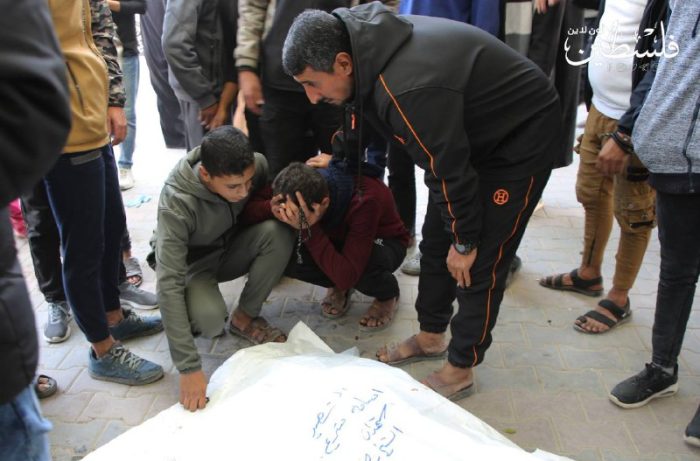
GAZA – The Hamas Movement has condemned Israeli claims that it violated the ceasefire agreement as “lies” and “intended to justify the massacres committed against civilians in the Gaza Strip.”
In a statement on Saturday, Hamas spokesman Hazem Qasem dismissed the Israeli accusations against his Movement as “baseless and unfounded,” saying they reflect Israel’s disregard for ceasefire mediators, sponsoring countries, and all the parties involved in the so‑called “Board of Peace.”
The spokesman called on the international community, the UN, and human rights organizations to “clearly condemn Israel’s massacres in Gaza, take practical steps to stop them, hold Israeli leaders accountable for their crimes, and end the policy of impunity, which encourages further killing and destruction.”
GAZA – Gaza’s interior ministry said that the Israeli targeting of the Sheikh Radwan police headquarters in Gaza City on Saturday morning was part of repeated ceasefire violations and reflected disregard for mediators and the international community.
In a statement, the ministry explained that the Israeli airstrike resulted in the martyrdom and injury of a number of police officers and personnel, along with several citizens inside and outside the headquarters.
The ministry described the attack as a “heinous crime” against a civilian institution that provides vital services to the population.
“This strike has joined a series of ongoing Israeli attacks that, in recent weeks, have targeted civilian and service facilities despite the ceasefire, amid growing warnings that the fragile understandings could unravel,” the ministry said.
The ministry affirmed that Israel’s ongoing attacks on civilians and humanitarian staff prove an intent to thwart international efforts to end the war and enforce a strategy of attrition and pressure on Gaza’s population.
The ministry urged regional and international mediators to shoulder their responsibilities, put real pressure on the Israeli regime to halt its violations, and provide protection for civilians and civilian facilities in Gaza.
The United States and the European Union are vehemently condemning Iran over alleged repression, while the West says nothing about the Israeli genocide in Gaza. The contradiction, of course, exposes the West’s rank hypocrisy. It also confirms that Iran is the target of a Western regime-change operation.
U.S. President Donald Trump this week repeated his threat to launch a blitzkrieg on Iran, bragging that an armada led by the USS Abraham Lincoln aircraft carrier was in place to strike. “Don’t make me do it,” warned Trump with thug-like menace.
Meanwhile, the European Union declared Iran’s Islamic Revolutionary Guards Corps a “foreign terrorist” organization. Given that the IRGC is a central component of Iran’s national security forces, the EU’s blacklisting is effectively designating the Iranian state as a terrorist entity. The EU’s provocation is paving the way for American aggression and all-out war, which will have devastating consequences, not least of all for Europe.
Washington and Europe are ostensibly basing their hostility towards Tehran on dubious claims that the Iranian authorities have committed systematic atrocities in repressing peaceful protesters in Iran demanding political change.
Trump has urged Iranians to keep protesting and vowed that “help is on the way.”
The European Union’s foreign affairs chief, Kaja Kallas, hailed the blacklisting of the IRGC, saying: “Repression cannot go unanswered… clear atrocities mean there must be a clear response from Europe.”
France’s Foreign Minister Jean-Noël Barrot asserted: “We cannot have any impunity for the [alleged] crimes that have been committed.”
The Dutch top diplomat, David van Weel, added: “I think it’s important that we send the signal that the bloodshed that we’ve seen, the bestiality that has been used against protesters, cannot be tolerated.”
This all sounds noble and chivalrous of Western governments. But it is a contemptuous charade, belying disingenuousness and duplicity.
For more than two years, the Israeli regime has waged a blatant genocide in Gaza. The death toll is estimated at over 71,000, with most of the victims being civilians, women, and children. The real death toll is probably well over 100,000 from bodies buried under rubble from Israeli bombardment that are not accounted for.
Far from expressing any condemnation against the Israeli regime, the United States and the European Union (with minor exceptions) have maintained an odious silence that has afforded political cover for the genocide. The Western states are complicit as a result of their shameful silence. More damning, however, is that the United States and European states, including France, Germany, and Britain, have supplied warplanes, missiles, drones, electronics, and other weaponry to fuel the slaughter.
Trump boasts about his so-called Board of Peace for Gaza and a supposed ceasefire that was claimed to have started in October. Over 500 Palestinians have been killed by the Israeli military since the ceasefire travesty. Thousands of Palestinians are starving or freezing to death in windswept and flooded tents still deprived of humanitarian aid. The genocide continues under the grotesque guise of “peace”.
Trump is an “Israel First” U.S. president more than any of his predecessors, who all consistently gave the Zionist regime a license to kill and occupy. Trump’s complicity is remarkable and suggests his late pedophile friend Jeffrey Epstein furnished Israeli intelligence with lots of blackmail material on the 47th president. So, his silence over genocide is explicable.
What about the Europeans, though? Maybe there is blackmail going on, too, to buy their complicity. Nevertheless, the hypocrisy is astounding.
Why aren’t Kallas, Barrot, and the other EU foreign ministers denouncing impunity and repression by the Israeli regime? They selectively apply their morals and faux humanitarian concerns to Iran.
The two scenarios are, in any case, incomparable. One is genocide, the other is civil unrest, which the evidence shows involves foreign orchestration.
Protests began in Tehran on December 28, sparked by legitimate economic grievances. The country of over 90 million has been strangled for decades by illegal Western economic sanctions. Tellingly, the relatively small demonstrations in Tehran’s bazaars at the end of December were rapidly escalated into full-blown violent attacks in several cities. The disturbances appear to have subsided, and there have been huge counter-demonstrations involving millions of people taking to the streets to denounce the violence of what seems to be almost certainly Western-orchestrated gangs.
The Iranian authorities claim that the total deaths after four weeks of violence are about 3,100. Western media reports and governments have cited much larger figures of 6,000 and up to 17,000 deaths. The Western figures are supplied by U.S. or European-based groups, such as the Iranian Human Rights Activists in Iran (HRAI). These groups are funded by the CIA’s cut-out organization, the National Endowment for Democracy.
Israeli news media have even admitted in reports that the street violence was being directed by foreign agencies. Former CIA chief Mike Pompeo also let it slip that Mossad operatives were behind the disturbances.
The methodical type of violence and damage sustained also indicates a coup attempt. Hundreds of mosques, schools, buses, government buildings, banks, and medical facilities were attacked and destroyed by gun-wielding gangs and arsonists.
Many of the casualties were inflicted on security forces and civilian bystanders in an orgy of violence that indicates a trained cadre of agitators and terrorists. Victims were beheaded and mutilated.
The Western media have conspicuously conflated the deaths and injuries as all attributed to the Iranian security forces, who allegedly used “lethal force to repress peaceful protesters.”
This is the standard operating procedure of Western regime change: to escalate deadly civil strife to destabilize the targeted state. The Western media then reliably row in with a massive propaganda assault to valorize the orchestrated violence and to demonize the authorities.
As Iranian Professor Mohammad Marandi points out, the West’s modus operandi is to demonize foreign countries to justify regime change, and if needs be, to justify all-out military aggression.
In 1953, the same method was used by the Americans and British to overthrow the elected government of Prime Minister Mohammad Mossadegh. Mossadegh’s “crime” was that he nationalized the oil industry, depriving Britain of its leech-like control over Iranian natural wealth, which saw most of the population living in poverty and squalor, as vast Persian oil profits flowed into London. For the coup to succeed, millions of dollars were funneled by the CIA into Iran to whip up street gangs, and the Western media on both sides of the Atlantic dutifully painted Mossadegh as illegitimate. He was overthrown, and the Western puppet, the Shah, was installed, presiding over a brutal CIA and MI6-backed regime for 26 years until the Islamic Revolution kicked him out in 1979. Amazingly, from the point of view of chutzpah consistency, more than seven decades later, the Shah’s son, Reza Pahlavi, living in pampered exile in the U.S., is being advocated by the West to take over if the Islamic Republic collapses. Plus ca change!
The same regime-change formula has been repeated over and over in as many as 100 other countries since the Americans and British launched their post-Second World War debut covert operation in Iran in 1953, as Finian Cunningham’s new bookKilling Democracy surveys. Crucially, the Western news media play an absolutely vital role in assisting this systematic criminality, as they are doing currently in Iran, and before that in Venezuela.
Only four weeks ago, Washington’s military aggression against Venezuela and the kidnapping of its president, Nicolás Maduro, by U.S. commandos was preceded by a full-court media campaign of demonization, absurdly labelling him a narcoterrorist.
Trump’s aggression towards Venezuela and now Iran is an outrageous violation of the UN Charter and international law. It marks a return to predatory imperialism. And the servile European states kowtow to this all-out predatory criminality with bogus concern about human rights.
We know their concerns are a complete sham and morally bankrupt because if there were any genuine principles, then they would not be so abject in their silence over the Israeli regime’s genocide in Gaza.
This is why Trump has been so emboldened to treat the Europeans with contempt over Greenland and other issues. If you act like a doormat, then expect to be walked on.
On January 29, 2002, US President George W. Bush’s State of the Union Address infamously branded Iran as part of an “axis of evil,” marking a rhetorical escalation that hardened a decades-long policy of confrontation and laid the groundwork for the persistent crises that continue to threaten regional stability today.
The twenty-fourth anniversary of Bush’s “axis of evil” speech came this week amid a starkly familiar backdrop: US naval “armada” massing in the Persian Gulf and renewed threats of military action from Bush’s successor, Donald Trump.
This moment is not an aberration but the continuation of a sustained, multi-decade strategy aimed at isolating and pressuring the Islamic Republic of Iran.
The policy did not originate with Bush but in the sanctions regimes of the 1990s, significantly shaped by pro-Israeli lobbying efforts within the United States.
It hardened with the rise of neoconservative thinkers who favored regime change over containment – a doctrine vividly applied to Iraq.
Throughout a campaign of disinformation and propaganda regarding weapons of mass destruction, the leveraging of exiled terrorist groups, and a consistent narrative of Iranian threat have been employed to maintain the so-called “maximum pressure.”
As history echoes in January 2026, with a Republican administration again aligning with an Israeli Likud regime to confront Iran, the patterns of the past illuminate the perilous present.
Defining Speech: January 29, 2002
Bush’s State of the Union address fundamentally reshaped the US posture toward Iran in ways that his predecessors had deliberately avoided.
In that speech, Iran was labeled a nation that “aggressively pursues these weapons and exports terror, while an unelected few repress the Iranian people’s hope for freedom.”
By grouping Iran with Iraq and North Korea as part of an “axis of evil,” the infamous and widely condemned declaration decisively rejected any tentative diplomatic outreach that had briefly flickered after the September 11 attacks.
During that period, symbolic gestures, such as candlelight vigils in Tehran, and behind-the-scenes communication channels suggested Iran’s conditional cooperation in Afghanistan.
However, the “axis of evil” label extinguished these nascent contacts. It signaled that the hostile administration in Washington would view Iran not as a potential partner, even tactically, but as a permanent adversary and a primary target in the global “war on terror.”
Crafted within a circle of advisors known for their overt pro-Israeli leanings, the phrase was immediately and enthusiastically embraced by the Israeli regime, which saw it as a long-sought alignment of US rhetoric with its own strategic goals.
The speech institutionalized a framework of hostility that would dictate policy for years, replacing the previous administration’s fluctuating approach with one of unambiguous confrontation.
Dual containment and the sanctions regime
Long before the “axis of evil” rhetoric, the framework for isolating Iran was carefully constructed during the Bill Clinton administration under the policy of “dual containment,” which targeted both Iran and Iraq.
From its inception, this policy was heavily influenced by pro-Israeli lobby groups in Washington. Even as Clinton’s foreign policy team was forming, concerns arose about appointees from the Carter administration who were deemed insufficiently sympathetic to these interests.
Warren Christopher, who was appointed Secretary of State, was initially viewed with caution but ultimately became a key architect of a hardened stance toward Iran.
Christopher, who had served as chief negotiator of the Algiers Accords and was criticized by some Iranian officials, developed a personal animosity toward Iran.
He publicly labeled Iran an “outlaw nation,” a “dangerous country,” and one of the “principal sources of support for terrorist groups worldwide.”
This rhetoric provided a public rationale for an escalating series of economic sanctions designed, in his words, to “squeeze Iran’s economy.”
A powerful proponent of this policy was Martin Indyk, former research director at the American Israel Public Affairs Committee (AIPAC)-affiliated Washington Institute for Near East Policy, who served on the National Security Council and later as Ambassador to Israel.
Under his guidance, the threefold accusations of sponsoring terrorism, opposing regional peace efforts, and pursuing weapons of mass destruction became the unwavering justification for punitive measures against the Islamic Republic.
A fierce competition emerged in Congress to demonstrate increasing hostility toward Iran, with figures like Senator Alfonse D’Amato pushing for ever-tighter sanctions – often propelled by direct lobbying from AIPAC, which acted as the “locomotive” behind the legislation.
This culminated in the Iran and Libya Sanctions Act (ILSA) of 1996, which aimed to penalize foreign companies investing in Iran’s energy sector. Later reports revealed that the explicit goal of the act was regime change in Iran.
Neoconservatives and the preference for military solutions
The arrival of the Bush administration marked a significant shift in the philosophy underlying US foreign policy – though not in its ultimate objective.
By the late 1990s, while the corporate world and some pragmatic diplomats began questioning the efficacy of unilateral sanctions, a new faction with immense influence pushed for a more radical and hard-nosed approach.
This neoconservative wing, closely aligned with Likudist ideology in the occupied Palestinian territories, viewed sanctions and containment as too slow and unreliable.
They regarded military force as a faster, more effective means of dealing with hostile states.
Key figures such as Paul Wolfowitz, Richard Perle, and Douglas Feith – all with longstanding ties to pro-Israeli think tanks and advocacy groups – assumed senior roles within the Pentagon and advisory boards.
Their worldview was crystallized in the 1996 policy paper A Clean Break: A New Strategy for Securing the Realm, prepared for Israeli Prime Minister Benjamin Netanyahu, which advocated attacking Iraq to reshape the regional landscape.
For these strategists, patient pressure through sanctions was secondary to the transformative potential of direct military action and regime rollback.
While initially focused on Iraq, Iran remained a firm subsequent target.
They argued that only the forceful removal of threatening regimes could guarantee American and Israeli security, a belief that came to define the administration’s response after the September 11, 2001 attacks.
Iraqi precedent: Destruction as a model
The neoconservative doctrine found its first full-scale application in Iraq. The 2003 invasion, premised on bogus claims of weapons of mass destruction that were later proven false, fulfilled a long-held goal to eliminate the Saddam Hussein-led Ba’athist regime.
The architects of the invasion were not satisfied with only regime change but aimed for the comprehensive degradation of Iraqi power.
After two major wars and over a decade of crippling sanctions, Iraq’s state apparatus and military-industrial base were utterly destroyed.
Some proponents openly described the objective as returning Iraq “to the pre-industrial era,” a stark admission that the goal extended beyond disarmament to eliminating Iraq’s capacity to function as a modern, sovereign regional counterweight.
The devastating consequences – civil strife, the rise of takfirism, and immense human suffering – were regarded as collateral damage within a broader strategic vision.
For those advocating confrontation with Iran, the Iraqi campaign served as both a template and a warning. It demonstrated the overwhelming military power the US could deploy to dismantle a state, while also exposing the catastrophic instability that could follow.
Nevertheless, the ability to reduce a perceived enemy to a state of permanent weakness was noted, informing the maximalist pressure later applied to Tehran.
Propaganda arsenal: Lies and manipulations
Building and sustaining public and international support for relentless pressure on Iran required a sustained campaign of allegations and propaganda.
The core accusations remained consistent: pursuit of nuclear weapons, support for terrorism, and an implacable hostility to peace in the region.
These charges were amplified through a symbiotic network of government officials, pro-Israeli lobbying organizations, sympathetic media outlets, and designated “experts.”
Sensational – and fabricated – stories were regularly fed to the press. In the early 1990s, reports frequently citing unnamed intelligence sources or anti-Iran groups aboad claimed that Iran had purchased nuclear warheads from Kazakhstan or was on the verge of developing a bomb, claims repeatedly debunked by international inspectors and the countries involved.
Media outlets with particular editorial stances published alarming estimates, suggesting Iran was only years or even months away from nuclear capability – deadlines that continually receded as each passed without incident.
The language used was deliberately inflammatory, with senior officials referring to Iran’s “evil hand” in the region and describing it as a “rogue state.”
This ecosystem ensured that any Iranian attempt at diplomatic outreach or confidence-building was overwhelmed by a pre-existing narrative of deceit and malign intent, making substantive dialogue politically untenable in Washington.
Useful tool: MKO role in anti-Iranian propaganda
A particularly revealing aspect of the propaganda and pressure campaign has been the relationship with the Mujahedin-e Khalq Organization (MKO), a terror cult with offices scattered across Europe and the US.
Designated by the US State Department as a terrorist organization due to its history of violent attacks, including against Americans in the 1970s, Iranian officials and civilians in the 1980s, and its alliance with Saddam Hussein during the Imposed War, the terror group nonetheless found influential supporters and was eventually de-listed by Hillary Clinton.
Despite its cult-like structure and lack of popular support inside Iran, the MKO managed to gain an active lobbying and public relations operation in the United States and Europe.
Senior members of the US Congress, especially those with strong pro-Israeli records, championed the group, inviting its representatives to testify and attending its rallies, arguing it represented a “democratic alternative” to the Islamic Republic.
The MKO’s utility was cynically acknowledged; one Congressman stated, “I don’t give a s*** if they are undemocratic… They are fighting Iran, which is… a terrorist state. I say let’s help them fight each other.”
This usefulness peaked in August 2002, when an MKO front held a press conference in Washington to “reveal” the existence of two secret nuclear facilities in Iran at Natanz and Arak.
While these facilities were not in violation of Iran’s safeguards agreement at the time, the revelation – intelligence reports suggest originating with Israeli intelligence and channeled through the exiles – provided the perfect pretext to demand intrusive new inspections and escalate international pressure.
Thus, the MKO served as a deniable cut-out for disinformation and a persistent amplifier of the baseless and sham accusations against the Iranian government.
Unbroken chain: Policy sustained to the present day
The strategic imperative to confront Iran has proven remarkably durable, transcending individual US administrations and enduring significant geopolitical shifts.
This hostile and bellicose policy remains intact today. In January 2026, the situation closely mirrors earlier cycles of tension between Tehran and Washington, dating back to decades of US hostility and a failed “regime change” project.
US President Donald Trump and Israeli Prime Minister Benjamin Netanyahu, leading a Likud-dominated coalition, are once again employing military threats against Iran after failing miserably in June last year to dismantle the Islamic Republic of Iran.
The US military has reportedly amassed naval and air forces around Iran’s perimeter, announced by Trump himself, a show of force reminiscent of previous escalations.
This military posture is accompanied by an intensification of a long-standing economic stranglehold, as the Trump administration enforces so-called “ultimate pressure” sanctions with renewed vigor, targeting critical sectors and aiming to sever Iran’s access to the global financial system entirely.
The foundational grievances remain unchanged: allegations of building a “nuclear weapon,” despite Iran’s continued adherence to the Joint Comprehensive Plan of Action (JCPOA) framework after its earlier collapse, and support for regional allies.
Last month, Trump and Netanyahu backed deadly riots and terrorism in Iran, and then threatened to attack Iran if “lethal force” was used against the rioters, arsonists and terrorists. After the riots ended, the focus shifted back to the non-existent “nuclear weapon.”
The tools have expanded beyond diplomatic isolation and covert pressure. Recent reports from within Iran detail how externally backed groups, employing tactics and rhetoric similar to the MKO terrorist cult, sought to exploit domestic unrest by spreading incendiary propaganda and inciting violence, apparently aiming to destabilize the country.
The alignment between the Trump administration and the Likud regime in Tel Aviv remains as close as ever, with both viewing the other as a vital partner in a long-term struggle.
Just as in 2002, diplomatic overtures from Tehran aimed at easing tensions are dismissed or met with increased demands.
The legacy of the “axis of evil” speech has created a foreign policy paradigm that has locked the US and Iran into a perpetual cycle of confrontation, where the mechanisms of pressure – economic warfare, military threat, and the use of terrorist groups – have proven easier to sustain than to dismantle, continually pushing the region toward the brink of war.
What Trump is doing today is simply a continuation of Bush’s policy, which was also carried forward by Bill Clinton, Barack Obama, and Joe Biden. The policy remains unchanged.
The vaccinated versus unvaccinated study does not exist.
Not “hasn’t been done well.” Not “needs more funding.” Does not exist. No large-scale, long-term study has ever compared total health outcomes of vaccinated children against those who received no vaccines at all. The most basic question a parent might ask—what happens to children who get the full schedule versus children who get none of it?—has never been answered.
The tampon-cervical cancer study does not exist.
Women insert products containing lead, arsenic, cadmium, dioxins, and PFAS directly against cervical tissue, for days each month, for decades. The vaginal epithelium absorbs substances more efficiently than swallowing them—pharmaceutical companies exploit this property deliberately. No study has examined whether this chemical exposure causes the cancer that develops in that tissue.
The long-term antidepressant outcome study does not exist.
Millions take SSRIs for decades. No study has followed patients long enough to determine whether these drugs improve life outcomes compared to people who experienced similar depression but did not take them.
These are not gaps in the research. These are the research.
The streetlight effect takes its name from an old joke. A drunk searches for his keys under a streetlight. A policeman asks where he dropped them. “In the bushes,” the drunk says. “Then why are you looking here?” “Because this is where the light is.”
The joke works because the behaviour is absurd. No one would search where they know the answer isn’t, simply because that’s where they can see.
Except institutions do exactly this. Every day. As policy.
The streetlight effect, as it operates in captured institutions, is not cognitive error. It is not researchers making innocent mistakes. It is the deliberate positioning of the light to ensure certain questions are never asked and certain answers are never found.
This is not censorship. Censorship is visible, resistible, galvanizing. The streetlight effect is invisible. The scientist who never receives funding for the destabilizing question does not experience suppression—they experience a career that simply moved in other directions. The question dies without ever being asked. The ignorance is architecturally produced.
Peter Duke (The Duke Report™️) calls this epistemic warfare—the deliberate construction of ignorance as a strategic weapon. The battlefield is what you’re allowed to know.
The drunk in the joke is stupid. The people positioning the lampposts are not.
The Machine
The streetlight effect does not operate alone. It is one component in a larger machine that creates stable falsehood.
Consider a pole balanced perfectly vertical. This represents truth in equilibrium. It requires no energy to maintain—gravity holds it in place. Now tilt the pole twenty degrees from vertical. Enormous energy must flow into the base to prevent collapse. Struts, supports, constant adjustment. A partial deviation from truth demands perpetual maintenance.
But invert the pole completely—one hundred eighty degrees—and it balances again. Not because it has escaped gravity, but because the inversion is complete enough to create its own coherent structure. A partial lie must argue with reality. A complete inversion replaces reality. The internal logic becomes consistent, even though every element points in the wrong direction.
This is how medical orthodoxy maintains itself. The cholesterol hypothesis, the viral theory of disease, the vaccine safety consensus—these are not partial deviations requiring constant defense. They are complete inversions that have found their own equilibrium. Once trillions of dollars of infrastructure are built around the inverted pole—careers, institutions, industries, identities—the structure stands for generations.
The streetlight effect is what keeps the inversion stable. It ensures the studies that would expose the inversion never get funded. The questions that would topple the pole never get asked. The light shines where the answers aren’t, and the darkness protects what cannot survive scrutiny.
The Components
The founding lie. Every inversion begins with a deliberate decision to construct a reality opposite to truth. Someone knows the truth and chooses to build the inversion. The tobacco executives who wrote “doubt is our product” in 1953. Ancel Keys selecting six countries from twenty-two. Simon Flexner declaring viral causation without demonstrating any virus. The founding lie need not be elaborate—it needs only to be simple enough to anchor a heuristic and complete enough to form a coherent alternative.
Epistemic capture. The systematic colonization of institutions that produce and validate knowledge. Journals, regulatory bodies, funding agencies, medical schools. When captured, the inversion gains legitimacy. It becomes “the science” rather than a lie being told. Two-thirds of medical school department chairs have financial ties to pharmaceutical companies. Two-thirds of researchers carry conflicts of interest. The top two-thirds of universities own pharmaceutical stock. Most clinical trials are conducted by for-profit Contract Research Organizations. Up to 40% of medical journal articles are ghostwritten by the industry. The $27 billion spent annually on drug promotion exceeds the entire NIH budget. Capture this system and you capture the epistemology of the entire society. The inversion no longer needs to persuade—it certifies.
The herd-mind limitation. Collective cognition cannot perform slow thinking. It holds only simple heuristics—two-variable formulas compressing reality into actionable shortcuts. “Cholesterol causes heart disease; statins prevent it.” “Viruses cause illness; vaccines prevent it.” “HPV causes cancer; Gardasil prevents it.” Two variables, one relationship. This is not stupidity—individuals can think slowly and hold multiple variables. But the collective runs on pattern-matching shortcuts. Whoever installs the two anchor points controls the collective understanding. The streetlight effect ensures no competing formula can form, because the evidence that would generate it remains in darkness.
The complicity of comfort. The inversion succeeds not only because institutions enforce it but because populations prefer it. A comfortable lie demands nothing. An uncomfortable truth demands everything—action, disruption, reversal of past choices, separation from the herd. The parent who accepts that vaccines are safe can believe they protected their child. The parent who questions must face what they may have done, and must find the courage to refuse the next injection while doctor, family, and social circle apply pressure. The comfortable lie offers belonging. The uncomfortable truth offers exile. Given the choice, most people choose comfort. They are not stupid. They are human. The inversion exploits this.
Convergent opportunism. Once the inversion is seeded, other actors discover the structure serves them. They join maintenance without coordination. Pharmaceutical companies profit from the products the inversion protects. Doctors maintain income and status by following captured protocols. Regulators secure future employment by approving what industry wants approved. Journals collect advertising revenue and reprint fees. Academic careers are built on the approved research agenda. Politicians receive donations. Media companies receive advertising. No one needs to be in a room together. Their interests converge on the same structure like iron filings around a magnet. The original architects can retire or die. The founding lie no longer requires their maintenance. The ecosystem maintains itself.
The streetlight effect. Research, funding, and career advancement concentrate in the illuminated zone. Questions that would destabilize the inversion lie in darkness—not forbidden, merely unrewarded. Scientists go where the light is. The ignorance is architecturally produced.
The components interlock. Epistemic capture makes the heuristic installation possible—the two anchor points are certified as “settled science.” The herd-mind limitation makes capture effective—the collective cannot audit the institutions it trusts. The complicity of comfort ensures the collective does not want to audit them—the truth is too costly. Convergent opportunism maintains the streetlight—each actor has incentive to keep the illuminated zone stable. The streetlight produces the ignorance that protects the founding lie from scrutiny. No central control required. Each component creates conditions for the others.
How the Light Gets Positioned
Funding control. Fund what you want studied. Don’t fund what you don’t want studied. A study that doesn’t exist cannot produce inconvenient findings.
Definitional control. Define questions narrowly enough that desired answers become inevitable. Define vaccine safety as “does not cause the specific harm we’re testing for in the short window we’re testing,” and you can find vaccines safe while ignoring every harm you didn’t test for. Define “isolation” as detecting genetic sequences rather than extracting particles, and you can claim viruses are isolated without ever demonstrating they exist.
Methodological control. Use active comparators instead of inert placebos. The HPV vaccine trials used aluminum adjuvant as the “placebo”—a toxic substance guaranteeing the control group would experience adverse events. Exclude participants likely to have adverse reactions. End trials before long-term effects appear. Choose surrogate endpoints instead of outcomes that matter.
Publication control. Fund journals, sit on editorial boards, peer review each other’s papers. Authors with conflicts of interest are twenty times less likely to publish negative findings. The Lancet generates up to two million euros from reprints when a positive drug study is published. The same investment funds—BlackRock, Vanguard—that own major pharmaceutical stakes also own the journals that evaluate their products. Publish what supports the narrative. A finding that isn’t published doesn’t enter “the scientific consensus.”
Career control. Reward researchers who produce useful findings. Punish those who produce threatening ones. Kilmer McCully discovered homocysteine—his laboratory was moved to the basement, his funding evaporated, no institution would hire him for two years. The survivors learned what questions not to ask. Upton Sinclair identified the mechanism: “It is difficult to get a man to understand something when his salary depends on his not understanding it.” Mortgages create beliefs.
Narrative control. Establish “scientific consensus” through the mechanisms above, then use it as a weapon. Anyone who questions it is “anti-science.” The lamppost is defended by making it socially impossible to point out it’s in the wrong place.
Once you begin, you cannot stop. The streetlight effect is not a one-time decision but continuous operation. Every year, researchers must be funded for approved questions and not funded for forbidden ones. Every year, journals must publish approved findings and reject threatening ones. The moment you stop, someone asks the forbidden question, funds the forbidden study, publishes the forbidden finding. This is why captured institutions respond to challenges with ferocity. A question that might move the lamppost threatens the entire inverted structure—because for the people who positioned the lamp, it does.
Why
Money is the mechanism. Power is the motive. Extraction is the outcome.
Control what questions get asked and you control what answers are possible. The chain is short: control what is studied → control what is known → control what is believed → control what is done.
The streetlight effect is infrastructure for extraction. You cannot build a system that extracts wealth through manufactured illness if people can see what is causing the illness. The lamppost must be positioned away from the cause before the extraction pipeline can operate. Shine the light on claimed viruses, genes, bad luck. Leave toxins, chemicals, iatrogenic injury in darkness. Attribute illness to nature rather than industry. The treatment becomes drugs rather than removal of harm. The patient becomes a customer. The extraction runs indefinitely.
The streetlight effect is not a bug in the system of knowledge production. It is the system.
The HPV Case
In 2006, journalists Torsten Engelbrecht and Claus Köhnlein contacted the German Cancer Research Centre—the DKFZ, one of the world’s leading cancer institutions—with four requests:
A study proving HPV exists through proper isolation.
A study proving HPV causes cervical cancer.
A study proving non-viral factors can be excluded as primary causes.
A study proving HPV vaccines are safe and effective.
The DKFZ provided literature for requests one, two, and four—though what they called “isolation” for request one was not isolation in any meaningful scientific sense. It was detection of genetic material declared viral without demonstrating that any virus existed. No particle was extracted from human tissue, purified, and shown to cause disease. The methodology assumes what it claims to prove.
For request three, they provided nothing.
This is the streetlight effect in its pure form. The question “could something other than the claimed virus cause this cancer?” was never investigated. Not because it was asked and answered. Because it was never asked. The light was positioned on virology from the start. Toxicology remained in darkness.
The statistics expose the positioning. Up to 80% of women test positive for HPV markers at some point. Less than 1% develop cervical cancer. In Germany, 0.017% of women develop cervical cancer annually. The marker is nearly universal. The disease is rare. If the marker caused the disease, the pattern would be different.
The establishment response is not to investigate what actually causes the cancer. The response is to add qualifiers—HPV is “necessary but not sufficient,” cofactors are required. The cofactors are vague enough to explain any distribution of cases: “immune status,” “genetic susceptibility,” “lifestyle factors.” The theory cannot be falsified because it absorbs any evidence. This is the hallmark of a stable inversion—internal coherence maintained by excluding the data that would destroy it.
Meanwhile, the chemical hypothesis sits in darkness, unstudied.
In 2024, researchers published the first study measuring metal concentrations in tampons. They found lead in every sample tested—at concentrations ten times higher than maximum levels allowed in drinking water. Arsenic in 95% of samples. Cadmium in 100%. Dioxins from chlorine bleaching. PFAS in products marketed as “organic” and “natural.”
The average woman who menstruates uses approximately 11,000 tampons over her reproductive lifetime. Each remains in contact with vaginal mucosa for hours. The vaginal epithelium is not a barrier; it is a gateway—pharmaceutical companies use vaginal administration precisely because it delivers substances to the body more efficiently than swallowing them.
Fifty years of cumulative exposure to documented carcinogens, delivered directly to the tissue where the cancer develops. The research examining this exposure as a cause of cervical cancer does not exist.
The mutation patterns found in HPV-negative cervical cancers—TP53, KRAS, PTEN, ARID1A—are consistent with chemical-induced DNA damage. The cancers that don’t fit the viral story fit the chemical story. No one is funded to look.
The HPV vaccine trials used aluminum adjuvant as the “placebo”—a toxic substance that guaranteed the control group would experience adverse events, making the vaccine appear safe by comparison. The trials never established whether the vaccine prevents cancer; they used surrogate endpoints and ended before cancer could develop. The protection claimed wears off before women reach the age when cervical cancer typically occurs.
The entire apparatus—causation claim, screening program, vaccine—is built on a lamppost positioned to illuminate virology and leave toxicology in darkness. The studies that would challenge this positioning do not exist. The questions that would threaten vaccine revenue do not get asked.
The founding lie. The captured institutions. The simple formula. The comfortable belief. The convergent interests. The positioned light. All the components, interlocking. The machine runs.
The Polio Precedent
The HPV case is contemporary. The pattern is not new.
In 1907, Simon Flexner of the Rockefeller Institute claimed to have isolated a poliovirus. His method: inject diseased human spinal cord tissue into monkey brains. When monkeys became ill, inject their tissue into other monkeys. Declare that whatever caused the illness must be a virus.
Flexner admitted in his 1909 paper that he “failed utterly to discover bacteria” and could not demonstrate any pathogen under the microscope. His conclusion: the agent “belongs to the class of the minute and filterable viruses that have not thus far been demonstrated with certainty.”
He could not demonstrate any virus. He concluded one must exist anyway—because he found no other explanation. He did not look for other explanations. He did not investigate toxins. He assumed viral causation and built an empire on the assumption.
The Rockefeller Institute was not a neutral scientific body. It was an instrument of Rockefeller interests—specifically, the interest in redirecting American medicine toward patentable drugs. In 1911, the Institute succeeded in having poliomyelitis entered into US Public Health Law as “a contagious, infectious disease caused by an air-borne virus.” No proof of contagion existed. No proof of any virus existed. Children with the disease kept in general hospital wards did not infect other patients. The law said it was contagious anyway.
By classifying poliomyelitis as viral, the Rockefeller Institute cut off investigation of alternatives. The lamppost was positioned. Toxicology was in darkness.
Then came DDT.
After World War II, DDT was released for civilian use, declared safe for humans. Cities sprayed beaches and swimming pools. Housewives sprayed kitchens and children’s mattresses. Farmers sprayed crops and dairy cows. From 1945 through 1952, US DDT production increased tenfold.
Polio cases increased in parallel. From 25,000 in 1943 to over 280,000 in 1952.
Dr. Morton Biskind testified to Congress in 1950, documenting over 200 cases where severe symptoms—including paralysis—disappeared when DDT exposure was eliminated. Dr. Ralph Scobey noted that polio symptoms matched known toxic poisoning patterns and that hospital polio wards never saw transmission between patients.
The Rockefeller-controlled National Foundation for Infantile Paralysis rejected this evidence. They funded vaccine research instead.
Beginning in 1951, as DDT use declined amid public concern and livestock deaths, polio cases fell by two-thirds—well before the Salk vaccine was widely administered. The decline tracked DDT reduction, not vaccine introduction.
The vaccine was credited anyway. The streetlight effect operated for decades, protecting the viral hypothesis from toxicological evidence.
Beyond Medicine
The streetlight effect operates wherever institutions benefit from not knowing.
LeBron James has played professional basketball for over twenty years. During that time, footage has accumulated showing him grabbing referees, screaming profanities in officials’ faces, flopping theatrically, committing uncalled fouls—each action a violation that would result in ejection or fines for other players. The footage is not hidden. It happens on national television, in real time, in front of millions of viewers.
ESPN does not report on it.
The same ESPN that posts about a player wearing an armband—content so trivial it borders on self-parody—does not mention a player grabbing a referee. No memo is required. ESPN holds broadcast rights to the NBA worth billions. They are not journalists covering the league; they are partners with the league. A reporter who runs that story damages their access. An editor who approves it damages their network’s relationship. Everyone understands what’s expected. The silence self-organizes.
The league benefits. The network benefits. The player benefits. The advertisers benefit. No coordination required. Each actor maintains their piece of the structure, and the pieces interlock without a blueprint.
The Lakers have led the NBA in free throw differential for four consecutive seasons. No other team has appeared in the top three more than once during that span. Their cumulative differential over those four years is +1,200. No other team has reached even +500. The numbers are public. The pattern is measurable. The coverage does not mention it.
The evidence is on screen. The media controls where the light of attention shines. Highlights are illuminated. Uncalled fouls happen in peripheral vision. Preferential treatment registers as background noise. People aren’t failing to see. They’re searching where they’ve been trained to search.
The Cholesterol Case
In 1852, Austrian pathologist Karl von Rokitansky proposed that atherosclerotic plaques were remnants of blood clots. He had performed thousands of autopsies and noticed that plaques looked exactly like clots in various stages of organization. The thrombogenic hypothesis—heart disease caused by clotting, not cholesterol accumulation—had compelling evidence from the start.
A century later, Ancel Keys positioned the lamppost elsewhere.
In 1953, Keys published a graph showing correlation between fat consumption and heart disease deaths in six countries. The points lay almost perfectly on a line. Data was available from twenty-two countries. Keys chose six. When Yerushalmy and Hilleboe analyzed all twenty-two countries in 1957, the correlation vanished.
The lamppost was positioned anyway.
The sugar industry recognized the threat. In the 1960s, researchers were linking sugar consumption to heart disease. The Sugar Research Foundation paid Harvard researchers the equivalent of $50,000 to write a review attacking anti-sugar studies while promoting the fat hypothesis. The researchers assured executives they were “well aware of your particular interest.”
The debate about sugar died. The war on fat intensified. The processed food industry could now replace expensive animal fats with cheap vegetable oils and sugar while marketing their products as “heart-healthy.”
Kilmer McCully discovered that homocysteine, not cholesterol, was destroying arteries. Children with genetic disorders causing high homocysteine developed severe atherosclerosis and died of heart attacks—despite normal cholesterol. McCully published his findings. Despite Harvard credentials and compelling evidence, he lost his position. His laboratory was moved to the basement. His funding evaporated. For two years, no institution would hire him.
The Framingham Heart Study, the longest-running cardiovascular study in history, produced a finding buried deep in its thirty-year report: “For each 1 mg/dl drop in cholesterol, there was an 11% increase in coronary and total mortality.” People whose cholesterol decreased were more likely to die. The study’s director later admitted: “In Framingham, the more saturated fat one ate, the more cholesterol one ate, the more calories one ate, the lower the person’s serum cholesterol.”
This contradicted everything the study was cited to support. The finding was not publicized.
Statins generate over $20 billion annually. The University of British Columbia’s Therapeutics Initiative concluded: “Statins have not been shown to provide an overall health benefit in primary prevention trials.” People without existing heart disease who take statins are no less likely to die.
The lamppost remains on cholesterol. The questions about clotting, sugar, homocysteine, stress, and metabolic dysfunction remain in darkness. Rokitansky’s thrombogenic hypothesis—supported by 170 years of autopsy evidence—sits unstudied while billions flow into cholesterol research. The studies that would move the light do not get funded. The researchers who ask the wrong questions do not get hired.
Seventy years. Billions of prescriptions. The founding lie. The captured institutions. The simple formula. The comfortable belief. The convergent interests. The positioned light. The same architecture.
Seeing the Lamp
The streetlight effect leaves signatures.
The absent study. A question any reasonable person would want answered, never investigated. The vaccinated-versus-unvaccinated comparison. The tampon-cancer link. The long-term antidepressant outcomes. When obvious questions remain unasked, ask who benefits from not knowing.
The aggressive defence. When someone asks the forbidden question, the response is not engagement but destruction—career attacks, accusations of conspiracy thinking, demands for retraction. Institutions confident in their evidence respond with evidence. Institutions defending a positioned lamppost respond with force.
The unfalsifiable theory. When a theory absorbs any contradictory evidence—when exceptions are explained away with cofactors, when it cannot specify conditions under which it would be proven wrong—you are looking at narrative maintenance, not science. You are looking at a stable inversion.
The funding trail. Who paid for the studies that exist? Who would have paid for the studies that don’t exist? The asymmetry reveals where the lamppost stands.
The career pattern. Who prospers in the field? Who disappears? When researchers who produce industry-friendly findings rise while researchers who produce threatening findings lose funding, laboratory space, positions—the incentive structure is visible.
The simple formula. When complex reality is compressed into two variables and one relationship—cholesterol causes heart disease, viruses cause illness, vaccines prevent disease—ask who installed the formula and who profits from it.
The comfort test. Does the official position demand anything of you, or does it offer easy absolution? The comfortable lie asks nothing. The uncomfortable truth asks everything.
The system depends on trust. Trust in institutions. Trust in expertise. Trust that the questions being asked are the right questions and the absence of other questions is innocent.
The streetlight effect ends when enough people start asking different questions. Why isn’t there a study on that? Who decided not to fund it? What would we find if someone looked in the dark?
The drunk searching under the streetlight is a figure of comedy. The institutions searching only where their funders want them to look are not funny.
They are why children receive vaccines never tested against unvaccinated controls.
They are why women develop cancers from products no one investigated.
They are why treatments that might work are never studied while treatments that profit the right people are studied endlessly.
The lamppost was positioned. It can be repositioned. But first you have to see it—and see the machine it is part of.
The next time you hear “no studies show,” ask the next question.
Who made sure those studies don’t exist?
That’s where the keys are.
References
HPV and Cervical Cancer
Engelbrecht, Torsten and Köhnlein, Claus. Virus Mania: How the Medical Industry Continually Invents Epidemics, Making Billion-Dollar Profits at Our Expense. Trafford Publishing, 2007.
Holland, Mary, Mack Rosenberg, Kim, and Iorio, Eileen. The HPV Vaccine on Trial: Seeking Justice for a Generation Betrayed. Skyhorse Publishing, 2018.
German Cancer Research Centre (DKFZ). Email correspondence with Engelbrecht and Köhnlein, October-December 2006.
Shearston, J.A. et al. “Tampons as a source of exposure to metal(loid)s.” Environment International, 190, 108849, 2024.
Marroquin, J. et al. “Chemicals in menstrual products: A systematic review.” BJOG: An International Journal of Obstetrics and Gynaecology, 131(5), 655-664, 2024.
Lee, Kwang-Beom et al. “Untold story of human cervical cancers: HPV-negative cervical cancer.” BMC Cancer, 2022.
Polio and DDT
Flexner, Simon and Lewis, Paul A. “The Transmission of Acute Poliomyelitis to Monkeys.” Journal of the American Medical Association, 1909.
Flexner, Simon and Lewis, Paul A. “The Nature of the Virus of Epidemic Poliomyelitis.” Journal of the American Medical Association, December 1909.
Biskind, Morton S. “Statement on Clinical Intoxication from DDT and Other New Insecticides.” Journal of Insurance Medicine, 1951.
Biskind, Morton S. Testimony before the House Select Committee to Investigate the Use of Chemicals in Food Products, 1950.
Scobey, Ralph R. Statement to the House Select Committee to Investigate the Use of Chemicals in Food Products, 1952.
Cholesterol and Heart Disease
Rokitansky, Karl von. A Manual of Pathological Anatomy. 1852.
Yerushalmy, J. and Hilleboe, H.E. “Fat in the Diet and Mortality from Heart Disease: A Methodologic Note.” New York State Journal of Medicine, 1957.
Kearns, C.E. et al. “Sugar Industry and Coronary Heart Disease Research: A Historical Analysis of Internal Industry Documents.” JAMA Internal Medicine, 2016.
McCully, Kilmer S. The Heart Revolution. HarperPerennial, 1999.
Rockefeller Medicine
Brown, E. Richard. Rockefeller Medicine Men: Medicine and Capitalism in America. University of California Press, 1979.
Flexner, Abraham. Medical Education in the United States and Canada (The Flexner Report). Carnegie Foundation, 1910.
Pharmaceutical Industry Influence
Gøtzsche, Peter C. Deadly Medicines and Organised Crime: How Big Pharma Has Corrupted Healthcare. Radcliffe Publishing, 2013.
Angell, Marcia. The Truth About the Drug Companies: How They Deceive Us and What to Do About It. Random House, 2004.
Light, Donald W. “Institutional Corruption of Pharmaceuticals and the Myth of Safe and Effective Drugs.” Journal of Law, Medicine & Ethics, 2013.
Virology
Bailey, Mark. A Farewell to Virology. 2022.
Epistemic Capture and the Streetlight Effect
Duke, Peter. Work on epistemic warfare and the architecture of manufactured ignorance.
Rogers, Toby. Testimony before the U.S. Senate on epistemic capture, 2025.
Unbekoming. “The Mechanics of Stable Falsehood.” Lies are Unbekoming, December 2025.
Unbekoming. “Epistemic Capture.” Lies are Unbekoming, September 2025.
Unbekoming. “The HPV Lie: Pap Smears, Gardasil, and a Cancer Caused by Something Else.” Lies are Unbekoming, January 2026.
Unbekoming. “Toxicology vs Virology: The Rockefeller Institute and the Criminal Polio Fraud.” Lies are Unbekoming, March 2025.
Unbekoming. “A Farewell to Virology (Expert Edition).” Lies are Unbekoming, January 2025.
Unbekoming. “The War on Knowing.” Lies are Unbekoming.
Unbekoming. “Extraction: The Middle Class as Colony.” Lies are Unbekoming, November 2025.
Unbekoming. “LeBron’s Immunity.” Lies are Unbekoming, December 2025.
Unbekoming. “The Wrong Enemy: Blood Clots. Not Cholesterol.” Lies are Unbekoming, September 2025.
As the West prepares to march off to yet another war in the Middle East, we should perhaps remind ourselves of who is giving the West their marching orders.
In February 2003, just weeks before the US and their allies launched their attack on Iraq and her peoples, a delegation of US congressmen, together with the US Ambassador to the United Nations, John Bolton, a well known pro-Zionist and neoconservative war-hawk, were in Israel at the invitation of the Israeli government then led by Israeli Prime Minister Ariel Sharon.
Addressing the congressmen, Sharon told them ‘that Iran, Libya and Syria should be stripped of weapons of mass destruction after Iraq’. Later, Sharon told John Bolton ‘that Israel was concerned about the security threat posed by Iran, and stressed that it was important to deal with Iran even while American attention was focused on Iraq’. … continue
This site is provided as a research and reference tool. Although we make every reasonable effort to ensure that the information and data provided at this site are useful, accurate, and current, we cannot guarantee that the information and data provided here will be error-free. By using this site, you assume all responsibility for and risk arising from your use of and reliance upon the contents of this site.
This site and the information available through it do not, and are not intended to constitute legal advice. Should you require legal advice, you should consult your own attorney.
Nothing within this site or linked to by this site constitutes investment advice or medical advice.
Materials accessible from or added to this site by third parties, such as comments posted, are strictly the responsibility of the third party who added such materials or made them accessible and we neither endorse nor undertake to control, monitor, edit or assume responsibility for any such third-party material.
The posting of stories, commentaries, reports, documents and links (embedded or otherwise) on this site does not in any way, shape or form, implied or otherwise, necessarily express or suggest endorsement or support of any of such posted material or parts therein.
The word “alleged” is deemed to occur before the word “fraud.” Since the rule of law still applies. To peasants, at least.
Fair Use
This site contains copyrighted material the use of which has not always been specifically authorized by the copyright owner. We are making such material available in our efforts to advance understanding of environmental, political, human rights, economic, democracy, scientific, and social justice issues, etc. We believe this constitutes a ‘fair use’ of any such copyrighted material as provided for in section 107 of the US Copyright Law. In accordance with Title 17 U.S.C. Section 107, the material on this site is distributed without profit to those who have expressed a prior interest in receiving the included information for research and educational purposes. For more info go to: http://www.law.cornell.edu/uscode/17/107.shtml. If you wish to use copyrighted material from this site for purposes of your own that go beyond ‘fair use’, you must obtain permission from the copyright owner.
DMCA Contact
This is information for anyone that wishes to challenge our “fair use” of copyrighted material.
If you are a legal copyright holder or a designated agent for such and you believe that content residing on or accessible through our website infringes a copyright and falls outside the boundaries of “Fair Use”, please send a notice of infringement by contacting atheonews@gmail.com.
We will respond and take necessary action immediately.
If notice is given of an alleged copyright violation we will act expeditiously to remove or disable access to the material(s) in question.
All 3rd party material posted on this website is copyright the respective owners / authors. Aletho News makes no claim of copyright on such material.
 • The Attack on Pearl Harbor
 Aletho News
 Aletho News