NATO without America: Europe’s trial run ends in a reality check
Steadfast Dart 2026 exposes how fragile European security looks once the US steps aside
By Andrei Medvedev | RT | January 20, 2026
NATO has launched major military exercises – Steadfast Dart 2026. The drills involve over 10,000 troops from 11 countries: Germany, Italy, France, the UK, Spain, Belgium, the Czech Republic, Lithuania, Bulgaria, Greece, and Türkiye. The primary goal is to assess the bloc’s readiness for the rapid deployment of substantial forces. The exercises will continue until mid-March.
At first glance, it might seem like just another NATO exercise. But here’s the catch: The US is not taking part. The initiative is purely European, and aims to achieve two main objectives. Firstly, it seeks to demonstrate that Europe is strong, unafraid of American influence, and capable of protecting its interests – not only by producing AI animations about heroic Vikings defending Greenland, but through real military strength.
The second goal is to find out whether Europe can operate independently, without US support. The answer is probably not. It’s no secret that 70% of NATO’s budget comes from US contributions. But beyond finances, NATO intelligence is primarily reliant on the US. Satellite communication, coordination, and command structures are also all built around a model in which the US acts as the ‘big brother’ to its European partners.
Russian journalists have witnessed this dynamic in Kosovo, Bosnia, and Afghanistan (NATO did not officially conduct an operation there, but in reality, it entered the country). Who owns the largest and safest bases? Who oversees all sector units? Who plans operations and sets combat tasks? The big brother – the US. In Kosovo, for instance, NATO allies couldn’t just enter Camp Bondsteel. The base was American, and the Europeans had to get a special pass to enter.
Until recently, Europe seemed perfectly content with its ‘junior partner’ status. What fueled the EU’s prosperity? Cheap Russian (initially Soviet) resources with stable supply lines and minimal security expenses. Security was outsourced to the Americans: US bases, air support, missile defense… Then Trump came along, and in typical businessman fashion, said if you want protection, you’ll have to pay for it.
Is there a NATO without the US? That’s the question European military leaders will grapple with during these exercises – though they likely already know the answer. Sure, NATO would exist, but it would be very costly for the EU; or perhaps it won’t exist at all, which means Europe must concede that the master will do as he pleases. And the ‘master’ – America – is well aware of this.
US Treasury Secretary Scott Bessent recently stated that the US will remain in NATO. But just look how he put it. Asked what’s more important to US security interests, NATO or Greenland, Bessent replied: “That’s a false choice. The European leaders will come around. And they will understand that they need to be under the US security umbrella.”
In the current climate, when Europe’s economy is struggling (for example, BMW and Mercedes are now using Chinese engines, and BASF is making only a third of what it used to), the idea of a European NATO seems far-fetched. Europe just doesn’t have the money for it.
Neither does it have the military equipment – most of it has been sent to Ukraine, and what’s left would last a month or so in a high-intensity conflict. Moreover, Euro-NATO doesn’t have that many armies with real combat experience outside of the bloc.
Sure, there is France, which has been engaged in prolonged operations in the Sahel. And Türkiye. However, even their combat experience is powerless in a situation in which there is no money. Fighting Bedouins in the Sahel or Kurds in Syria is worlds apart from facing an adversary like China or Russia – or, in the new reality, the US.
The fact that the US is not taking part in NATO’s latest military exercises (despite being able to easily deploy their troops from bases in Germany or Italy) is quite telling. America’s message to Europe is clear: Let’s see how you do without us and then come running back.
The lesson is humiliating. But after all, they got into this mess by themselves.
US’ European Vassals Taught Bitter Lesson With Greenland Crisis

Sputnik – 20.01.2026
Commenting on the topics discussed by Foreign Minister Lavrov in his 2025 diplomacy year-in-review presser, Daffodil International University journalism professor and international politics expert Greg Simons detailed two main themes: Ukraine and the breakdown of the so-called ‘rules-based international order’.
The Greenland crisis shows that “when you are such a servile lackey as the EU, eventually you get to be ‘on the menu’, especially when the US empire, this Pax Americana, is in decline,” Dr. Simons told Sputnik.
“The EU has nowhere to go.” Their leaders “can bluster, they can try and bluff, but to use Trump’s terminology, they have absolutely no cards… They have no honor, they have no dignity, they have no respect, either for themselves or the EU. So this is not going to go well for the EU.”
As for Ukraine, while Washington has apparently recognized that the proxy war with Russia is “lost” and that Ukraine is “a liability,” the Europeans are pushing headfirst into prolonging the conflict, no matter the cost to themselves, Simons noted.
“Europeans seem to have their head in the clouds and unaware or not willing to see” the “risks and hazards coming up for them,” the observer stressed.
Then there’s the dysfunction at the Organization for Security and Cooperation in Europe.
“If you prevent consensus on issues, an organization such as the OSCE is absolutely useless because consensus should be reached on objectively coming together on mutually acceptable and mutually favorable grounds,” Simons said.
“What they’ve turned it into is just this platform for pillorying countries such as Russia or those that stand for their interests and objectives rather than those of the US. I absolutely agree with the foreign minister’s characterization – that the situation of the OSCE is catastrophic. I would doubt it can be saved, mostly because of what the so-called Global North, those Western countries at the behest of the US did to make sure that it could no longer function effectively as an organization to be a bridge between different interests, different worlds (which it no longer is).”
Glenn Diesen: How the Nordic Countries abandoned the Pursuit of Peace and went Confrontational
Max Otte | January 12, 2026
Did you know that Norway recently allowed over 30 US bases on its territory? (Without calling them “bases.”) The confrontation with Russia in the Arctic is heating up.
The New Scientist Misses the Science on ‘Sinking Pacific Islands’
By Anthony Watts | Climate Realism | January 16, 2026
The New Scientist (NS) recently published “The Pacific Islanders fighting to save their homes from catastrophe” by Katie McQue and Sean Gallagher. The article claims that small Pacific island nations face an existential threat from rising seas and intensifying storms driven by climate change, with displacement already underway and submergence looming. This article is factually false and unsupported by real-world data. The piece relies on emotive anecdotes and dire projections while ignoring a substantial body of empirical research showing that many low-lying islands and atolls are stable or growing, keeping pace with sea-level rise rather than succumbing to it.
The article asserts that “rising seas are anything but a distant projection,” that high tides now regularly inundate areas that “used to stay dry,” and that island nations such as Tuvalu could be “almost completely submerged at high tide by the end of the century.” It further suggests that climate-driven sea-level rise is already forcing migration and poses an existential risk. These claims are presented as settled science, yet New Scientist fails to engage with the very studies that have directly measured island change over time.
Actual surveys of island nations tell a very different story. As summarized in Climate at a Glance’s evidence-based review “Islands and Sea Level Rise,” dozens of peer-reviewed studies using aerial photography, satellite imagery, and on-the-ground surveys show that the majority of low-lying coral islands have remained stable or increased in land area over recent decades. Research on atolls in the Pacific and Indian Oceans finds that sediment transport, reef dynamics, and natural island-building processes allow islands to adjust to gradual sea-level rise. In other words, these islands are not passive sand piles waiting to drown; they are dynamic landforms.
This is not a fringe view. Climate Realism has repeatedly documented how media outlets ignore these findings, including in its coverage collected under island and sea-level rise reporting, where studies showing island growth in places like Tuvalu, the Marshall Islands, and Kiribati are contrasted with alarmist headlines predicting imminent disappearance. Those empirical studies directly contradict New Scientist’s framing of inevitability and catastrophe. Further, sea level rise data from NOAA on the island of Kirbati is quite modest, just 0.77 feet per century.
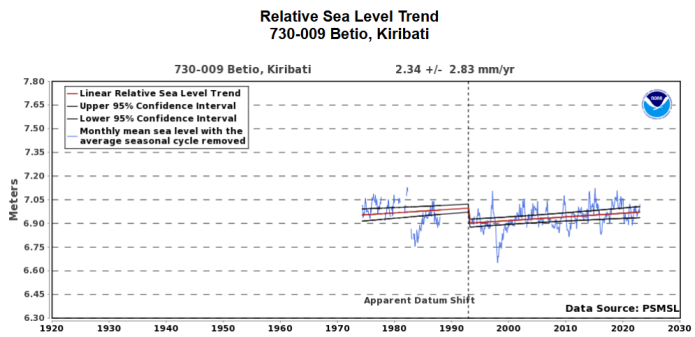
Relative sea level trend is 2.34 millimeters/year with a 95% confidence interval of +/- 2.83 mm/yr based on monthly mean data from 1974 to 2022 which is equivalent to a change of 0.77 feet in 100 years
Equally telling is what is happening on the ground. Island nations supposedly facing near-term sea level submergence are investing heavily in long-term infrastructure. Tuvalu, the Maldives, Fiji, and other Pacific and Indian Ocean nations are expanding airports, reclaiming land, and approving major hotel and resort developments. These are capital-intensive projects with planning horizons measured in decades, not emergency stopgaps for populations about to flee. Governments and investors with real money at stake do not behave this way if these countries are about to vanish beneath the waves.
NS also conflates local flooding, erosion, and freshwater management problems with global sea-level rise. High tides washing into low areas, saltwater intrusion into wells, and coastal erosion are often driven by local factors such as land use, groundwater extraction, reef damage, and poor coastal management. Treating every such problem as proof of climate catastrophe is a classic case of confusing site-specific issues with global trends.
Perhaps most damning is what NS does not do.
It does not cite the extensive body of peer-reviewed literature documenting island stability and growth. It does not explain why measured island area changes contradict its narrative. It does not ask why nations allegedly facing “existential” risk are expanding infrastructure rather than abandoning it. Instead, it relies on selective anecdotes, speculative end-of-century projections, and emotionally charged language to imply a settled scientific conclusion that the data do not support.
If the New Scientist were actually doing science rather than regurgitating rhetoric, this article would not exist in its current form. A serious treatment would grapple with the observational record showing that many island nations are keeping up with sea-level rise, not disappearing beneath it. By failing to cite that science and by presenting a one-sided story of inevitable catastrophe, the New Scientist misleads readers and does a disservice to both the public and the people living on these islands, whose real challenges deserve honest, evidence-based discussion—not recycled counterfactual climate alarmism.
New study shows that toxic gas can form in cows’ stomach when being fed Bovaer with certain feed
By Peter Imanuelsen | The Freedom Corner | January 19, 2026
There have been many reports lately of cows suddenly collapsing and becoming sick after being fed with Bovaer.
This caused the largest dairy producer in neighbouring Norway to pause the use of Bovaer.
Farmers have been in despair as their herd has been suffering after Denmark introduced new laws mandating methane reducing feed to cows to reduce climate emissions.
Now there is a new study from Denmark showing some very interesting and disturbing findings.
You can say that perhaps the ”conspiracy theorists” were right once again. I was one of the first to warn about Bovaer years ago.
After the reports of collapsing cows, SEGES innovation, a Danish agricultural research organization has conducted investigations into Bovaer and what they found is very alarming. You probably won’t read about this on the mainstream media, so I will share it with you here.
SEGES put out an online questionnaire where farmers could report problems with Bovaer.
Responses came in from around 39% of all milk supplying herds in Denmark. Shockingly, 434 out of 644 herds were reported to have REDUCED milk yield. That is a whopping 67.4% that had reduced milk yields.
This suggests that there is impaired rumen function in the cows.
410 herds reported digestive and metabolic disorders, including poisoning symptoms and fever.
According to SEGES innovation, giving Bovaer in combination with a feed that is high in sulfur, often from rapeseed products, was linked to increased reports of feeding and metabolic disorders in cows.
Bovaer inhibits methane production, that is in fact the whole point of Bovaer. But this increases the availability of hydrogen in the stomach of the cow. If the cow then has lots of sulfur from the feed containing rapeseed, this can cause hydrogen sulfide to form.
Hydrogen sulfide is a TOXIC gas and is dangerous for humans and animals.
This is what happens when you try and mess with what God created. The cows are getting unintended side effects because someone thought it was a good idea to remove the methane that is naturally produced in the cows’ stomach.
This reaction and creation of this toxic gas in the cows stomach is now being described as a possible explanation as to why cows are becoming sick after eating Bovaer.
SEGES is therefore recommending a pause in the use of Bovaer until autumn 2026 for cows eating feed with large portions of rapeseed, pending experiments being done at Aarhus university.
‘Israel’ continues to block US firms from acquiring Iron Dome code
Al Mayadeen | January 19, 2026
The Israeli Security Ministry has halted approval of a planned United States takeover of Amprest Systems, a company whose command-and-control software forms a core component of the Iron Dome specialized anti-air system, citing concerns over non-Israeli control of classified military technology.
The proposed deal would see US-listed Ondas Holdings acquire control of Amprest in a transaction valuing the company at more than $200 million. Under the proposed terms, Ondas would acquire the shares held by Amprest’s existing shareholders, excluding Rafael Advanced Defense Systems, in a transaction valued at approximately $100 million, leaving Rafael a minority stake in the company.
Security officials involved in the review have reportedly raised objections to a non-Israeli entity gaining control over Amprest, given the company’s central role in Iron Dome and other Israeli anti-air programs that involve classified command-and-control capabilities.
Prolonged review and internal tensions
The transaction is being reviewed by the Security Ministry’s “Department for Security of the Defense Establishment” (Malmab), headed by Yuval Shimoni. People familiar with the process say the review has dragged on for months, with no clear timeline or indication of whether the deal will ultimately be approved.
The delay has exposed internal tensions within the Security Ministry between officials seeking to attract external capital into “Israel’s” warfare technology sector and security bodies tasked with preventing sensitive military know-how from falling under external control. The lack of coordination has sent contradictory signals to investors. While the Security Ministry Director General, Major General (res.) Amir Baram, and the head of the ministry’s research and development directorate, Brigadier General (res.) Danny Gold, have publicly encouraged deeper cooperation with foreign investors, Malmab has effectively become a bottleneck.
“There is no holistic view,” a senior source familiar with the process told Israeli news website Ynet.
“Investors put tens of millions of dollars into Amprest years ago and are now told they cannot exit for security reasons,” the source said, explaining, “Under those conditions, who will want to invest in defense tech?”
Supporters of the deal contend it could proceed under strict safeguards, including limits on access, governance, and technology transfer, while critics say the process has been marked by unusually slow decision-making and heavy bureaucracy.
Amprest’s role in Iron Dome
Amprest was established around 25 years ago by Natan Barak, a retired Israeli Navy officer with the rank of colonel. Its profile rose significantly about 15 years ago after its command-and-control software was integrated into Iron Dome. In 2012, the company received the “Israel Defense Prize” for its contribution to the occupation’s specialized anti-air systems.
The company’s largest shareholder is Rafael, with the remaining shares held by Barak, the OurCrowd investment platform, and other investors. Most of Amprest’s activity is in the military sector, with Rafael as its main customer. According to people involved in the talks, Amprest had never been offered for sale before Ondas made its proposal, which one source described as “an offer shareholders couldn’t refuse.”
Ondas’ expanding footprint
Ondas, which trades on Nasdaq, has rapidly expanded its presence in “Israel’s” defense sector since October 7, 2023, assembling a portfolio of nine warfare-related companies. The firm says it has spent roughly $400 million on acquisitions to date.
Its purchases include Sentrycs, a counter-drone technology company acquired in November for $125 million in cash and $100 million in stock, and Roboteam, a military ground robotics firm bought for about $80 million. Other acquisitions include M4 Defense, Iron Drone, Apeiro Motion, Insight Intelligent Sensors, and S.P.O., a manufacturer of precision optical components. In late 2022, Ondas acquired Airobotics for about $15 million, folding it into American Robotics. Airobotics develops autonomous drones and received US Federal Aviation Administration approval to operate over populated areas.
The company’s leadership includes several former senior figures from Rafael, among them former Rafael CEO Major General (res.) Yoav Har-Even, who sits on Ondas’ advisory board, and Brigadier General (res.) Oshri Lugassy, a former senior engineering officer at Rafael who now serves as Ondas’ co-CEO and leads its most active division, Ondas Autonomous Systems (OAS). While Ondas is legally incorporated in the United States, its technological foundations, leadership, and current growth engine are deeply rooted in the Israeli military ecosystem, bringing forward questions regarding Malmab’s reservations.
Ondas and Full Spectrum
Ondas’ origins trace back to an Israeli startup known as Full Spectrum Inc., which developed the core technology behind what is now Ondas Networks, one of the company’s two main divisions. Full Spectrum was co-founded by Israeli engineer Menashe Shahar, who continues to serve as chief technology officer of Ondas Networks.
In September 2018, the current public entity, then operating as Zev Ventures, a US-based company, carried out a reverse acquisition of Ondas Networks Inc., the rebranded Full Spectrum, and subsequently adopted the name Ondas Holdings Inc.
Until late 2023, the company’s primary revenue stream came from a single wireless communications product developed by the original Israeli engineering team. Since then, Ondas’ growth has been driven largely by OAS, which has expanded rapidly through acquisitions of the aforementioned dual-use and warfare Israeli firms. Although Ondas is headquartered in West Palm Beach, Florida, a significant portion of its research, development, and operational activity remains centered in Israeli-occupied territories.
Market concerns and unanswered questions
According to Ynet, some industry figures have expressed unease over Ondas’ rapid growth and surging market valuation, which has reportedly climbed to around $5 billion following a $1 billion stock offering. One market source likened the rise to the speculative SPAC boom in the early 2020s.
Questions have also been raised about what Rafael stands to gain from the Amprest deal, given that Rafael is expected to remain Amprest’s main customer even if Ondas were to take control.
“The Iron Dome name is a premium brand,” the source said, adding, “Ondas needs it to impress investors and open doors.”
At the same time, Ondas is reportedly in talks with Rafael over the potential acquisition of Controp, another subsidiary that develops electro-optical systems, including cameras for unmanned aerial vehicles. Unlike Amprest, Controp has been openly offered for sale, and last year, US-based AeroVironment was said to be interested in acquiring a 50% stake at a valuation of $600 million to $700 million.
Is Iron Dome software shielded from US access?
Despite close military cooperation between “Israel” and the United States, specifically on the Iron Dome program, the core command-and-control software underpinning Iron Dome has remained legally and technically protected from full American access, even at the cost of major procurement and integration opportunities.
As of January 2026, the Israeli government continues to retain strict control over Iron Dome’s source code, treating it as sovereign intellectual property tied directly to “national security”. While Washington has provided significant funding and participates in co-production, Israeli authorities have consistently refused to transfer the system’s key codes to the US military.
Lurking friction
This position has generated friction in the past. In 2020, the US Army abandoned a roughly $1 billion plan to fully integrate Iron Dome into its air defense architecture after “Israel” declined to share the source code needed to connect the system with American command-and-control networks. As a result, the two Iron Dome batteries currently operated by the US function as standalone assets, unable to fully interface with broader US radar and battle management systems.
The same concern has driven Israeli intervention in the takeover of Amprest.
Rather than sharing the original source code, Tel Aviv and Washington have relied on alternative mechanisms to maintain cooperation. These include tightly controlled technical escrow arrangements, under which limited integration work can be performed without transferring full ownership or visibility over proprietary software. In parallel, US defense contractors such as Raytheon have worked with Rafael to develop US-specific variants of Iron Dome components, including the SkyHunter interceptor, using modified or adapted software that can interface with American systems while preserving the core logic of the original Israeli command-and-control software.
These arrangements underscore that Iron Dome’s software, and by extension companies such as Amprest, remains legally protected and politically sensitive within “Israel’s” military establishment, even as such safeguards draw growing criticism for entrenched protectionism.
Read more: US throws itself into THAAD shortage for ‘Israel’s’ sake; 1/4 lost
The Changing Face of Regime Change
By Daniel McAdams | Ron Paul Institute | January 19, 2026
The most disturbing lesson from the 2014 Maidan Revolution in Ukraine that has been well-learned by the various intelligence agencies in this business is that the application of extreme violence – especially aimed at law enforcement, other state authorities, and civilians – provides an effective template upon which to further the regime change narrative. Everything can be blamed on “the regime” and thus serve the purpose of the operation.
We have seen this recently in Iran.
When I was on the ground observing the early “color revolutions” in the 1990s in Eastern Europe it was simply about getting warm bodies in the street to wave the correct flags and mouth the NED-approved slogans and to demand a new election, the most recent one having been “stolen.”
Questioning legitimacy of elections was enough at that early stage. Even Western polls suggesting the election result matched the will of the people (as in the 2006 Belarus presidential election and subsequent “Denim Revolution” I monitored on the ground) did not dissuade the protesters. But that was all fun and games compared to what came next.
Now it is about bodies and blood and particularly the most gruesome injuries. This is difficult for any legitimate state authority to defend against, as any application of counter-force only feeds the narrative of a violent regime determined to quell “legitimate” desire for political pluralism.
For a successful regime change in the current conditions there must be maximum bloodshed. And it does not matter whose blood is shed, it can all be blamed on “the regime.” The bots and fake social media accounts under control of intelligence agencies can take care of that part. Amplify atrocities, regardless whence they came.
Heavier bloodshed also feeds the ignorance and voyeurism of the intended Western and (especially) US audiences. “Thar be dragons,” is the rallying cry. Everything beyond our borders is unsophisticated and bestial, while at the same time longing to be exactly as we are.
We saw this clearly in the well-orchestrated attacks against state law enforcement authorities in Ukraine/Maidan in 2014. What would normally have sufficed to return society to order was shown to be woefully inadequate in the face of extremely violent agents on the ground including snipers on the rooftops and “wet works” specialists willing to murder law enforcement with their bare hands. The more violence the better. The more gruesome the better.
Lenin understood it well: “The worse the better.” You must recruit the absolute lowest and most violent dregs of society to carry out the operation. But then that has been the CIA Operations Directorate modus operandi since its founding. Which is why President Truman was desperate to strangle his own baby in the cradle.
Through some serendipity, the extreme violence of the CIA/MI6/Mossad attempted regime change operation we just witnessed in Iran was defeated by technology (likely imported from Iran’s allies) targeting the plan at its weakest point: communications and coordination. Extreme acts of violence against state authorities and average citizens have no value unless coordinated for propaganda purposes.
No less than President Trump himself reduced the entire operation to body counts. So the regime-changers had the incentive to produce more bodies and their recruits on the ground were only too happy to comply.
But something happened: the shutdown of Elon Musk’s ill-advised gift of Starlink to the violent Israel-sponsored extremists was defeated somehow and you had a gang of violent killers with no directions from Langley or Tel Aviv on who to kill next.
And it turns out that no matter what you think about that country six thousand miles away, it is not as easy as the neocons claim to overthrow the government and usher in at the point of a gun “democracy” DC style. With rainbow parades and promises of an atheistic, multi-culti paradise a la – ironically – the ICE resisters in Minnesota or Seattle.
Overseas, the neocon Right becomes the most ideologically insane version of the Minnesota Left: “Iran needs to celebrate multi-culturalism, atheism, and pan-sexuality!”
OK.
In the world of US Middle East regime change hegemony there is no Right or Left. It’s all been contracted out to Tel Aviv, as our tech world has been contracted out to H1B visas. Connect the dots and realize, as the Communists so well realized, what are the correlation of forces for and against you.
Husbanding the entirety of the US global military empire to overthrow the main impediment of Israel’s “Greater Israel” goal to conquer the Middle East is in no way in accord to our own interests or future well-being. On the contrary.
The US embrace of extreme violence – the “Israel model” – overseas can only harm our actual national interest. Embracing the latest iteration of the “regime change” template not only betrays our supposed moral high-ground, it hastens the correlation of forces against dollar hegemony and against the survival of America’s own oligarch class.
Oppose this or get used to being poor, immoral, and dead.
Executive Director of the Ron Paul Institute for Peace and Prosperity and co-Producer/co-Host, Ron Paul Liberty Report. Daniel served as the foreign affairs, civil liberties, and defense/intel policy advisor to U.S. Congressman Ron Paul, MD (R-Texas) from 2001 until Dr. Paul’s retirement at the end of 2012. From 1993-1999 he worked as a journalist based in Budapest, Hungary, and traveled through the former communist bloc as a human rights monitor and election observer.
Truth as first casualty: Deconstructing disinformation campaign on Iran riots death toll
By Yousef Ramazani | Press TV | January 19, 2026
Amid the foreign-instigated riots and terrorism that struck Iran in recent weeks, a parallel narrative war also unfolded, centered on the deliberate propagation of wildly inflated and unverifiable casualty figures.
These figures were designed to manufacture global outrage and legitimize calls for American military intervention and yet another aggression against the Islamic Republic.
The discourse surrounding riot-related casualties in the past few weeks has been fundamentally shaped by a coordinated disinformation campaign originating from US-funded organizations operating entirely outside Iran. Central to this campaign was the circulation of sensational death tolls that bore little resemblance to verifiable facts on the ground.
The figure of 12,000 deaths was initially promoted by the New York–based Center for Human Rights in Iran, an organization financially linked to the National Endowment for Democracy (NED), a US Congress–funded entity with a well-documented history of interference in the internal affairs of sovereign states.
This claim was presented without transparent methodology, primary data, or independent verification, raising eyebrows both inside and outside the country.
Despite this lack of evidence, the narrative was uncritically amplified by major Western media outlets and online influencers, creating a pervasive – but demonstrably false – impression of mass violence. Iranian officials consistently rejected these claims, presenting forensic evidence of manipulated datasets and instead reporting a death toll in the hundreds, the majority of whom were security personnel and civilians killed by armed rioters with foreign backing.
The subsequent escalation of these figures to even more implausible numbers – such as claims of 52,000 dead – underscores the persistence of a hybrid warfare strategy aimed at demonizing Iran while obscuring or outright excusing the violence committed by its adversaries.
Genesis of a false narrative: Center for Human Rights in Iran and its backers
The primary source of the sensational 12,000-fatality claim was neither an Iranian authority nor a verifiable international body, but the Center for Human Rights in Iran, an organization headquartered in New York. Despite its name, the group operates entirely outside Iran and has no physical presence or investigative capacity within the country.
An examination of its leadership and funding reveals a clear political orientation inconsistent with impartial human rights monitoring. The chair of its board is Minky Worden, an American activist with a documented history of spearheading anti-China advocacy campaigns, including efforts to politicize the Beijing Winter Olympics.
Financially, the organization relies heavily on grants from the National Endowment for Democracy in Washington, D.C. The NED is a privately managed but publicly funded institution that receives annual allocations from the US Congress through the State Department budget.
Historians, observers, and former intelligence officials have long characterized the NED as a transparent successor to activities once conducted covertly by the Central Intelligence Agency, particularly the funding of political opposition groups and media outlets under the banner of “democracy promotion.”
The NED’s record includes extensive involvement in “regime-change” efforts across Eastern Europe, Latin America, and West Asia – regions that have consistently featured in American foreign policy campaigns.
Amplification network: From NED grantees to global headlines
The unfounded casualty figure did not remain confined to a single organization. It was rapidly injected into the global media bloodstream through a tightly networked ecosystem of interconnected groups.
Other NED-funded entities, including the Human Rights Activists News Agency and the Abdorrahman Boroumand Center, echoed and cross-cited the same unsubstantiated statistics.
Operating largely from the US, these organizations function within a closed loop of mutual citation, manufacturing the illusion of multiple independent confirmations.
This echo chamber was then leveraged by major Western media outlets, including BBC Persian, Voice of America, The Washington Post, and ABC News, which incorporated the figures into their reporting.
Typically, these outlets attributed the numbers vaguely to “human rights groups” or “activists,” effectively laundering the information and granting it a veneer of credibility without conducting any independent verification. This failure is particularly striking given the well-documented funding sources and political objectives of the originating organizations.
Crucially, much of this coverage omitted the context that these groups are financially and ideologically aligned with the very governments actively seeking to pressure, isolate, and destabilize the Islamic Republic of Iran.
Iranian rebuttal and exposure of fabricated evidence
Iranian government officials and domestic media mounted a comprehensive, forensic rebuttal to the widespread disinformation campaign. The judiciary’s spokesperson and the head of the Supreme National Security Council categorically denounced the claim of 12,000 deaths as “psychological warfare” and a “complete fabrication.”
They publicly challenged the originators of the figure to provide a single verifiable name, death certificate, or precise locational detail to substantiate their alleged casualty lists, a challenge that was never answered.
Cyber units affiliated with Iranian media conducted technical analyses tracing the viral dissemination of the figures to known bot networks operating from locations in the United States, Israeli-occupied territories, and Albania.
Further investigations revealed that purported “martyr lists” were riddled with fraud: hundreds of duplicate entries, names of individuals who had died decades earlier during the Holy Defense war, and even names copied directly from public cemetery records in other countries.
The case of Saghar Etemadi became emblematic of the deception. Widely declared a “martyr” by external outlets, she was later confirmed by the Iranian judiciary and by her own family to be alive and receiving medical treatment for injuries sustained during a riot.
Iranian reports emphasized that the actual death toll, resulting from terrorist acts carried out by foreign-backed armed rioters, numbered in the hundreds. A significant proportion of the victims were police officers, Basij forces, and civilians deliberately targeted by violent saboteurs.
Escalation to absurdity and the weaponization of atrocity propaganda
The disinformation ecosystem demonstrated its capacity for rapid and unchecked escalation.
From the initial claim of 12,000 deaths, narratives soon proliferated across social media platforms and activist circles alleging 52,000 fatalities and more than 300,000 wounded.
These figures, divorced from any conceivable reality, serve a deliberate psychological and political function. They are designed to induce global emotional shock, overwhelm critical scrutiny, and portray the Iranian state as uniquely and exceptionally undemocratic
This narrative fulfills a dual geopolitical purpose, according to experts. First, it seeks to manufacture consent for foreign intervention, intensified sanctions, or diplomatic isolation by invoking a humanitarian pretext. Second, it functions as a tool of distraction and moral laundering.
By creating a false equivalence, or even attempting to eclipse, the documented casualties inflicted by the Israeli regime in Gaza, the campaign aims to redirect global outrage and obscure the horrendous crimes of Washington’s and Tel Aviv’s allies.
Influencers and online networks aligned with the Israeli regime aggressively promoted the fabricated Iranian casualty figures in an effort to undermine the global Palestine solidarity movement and digitally overwrite the extensive evidence of Israeli war crimes.
Underlying architecture: NED as a US “regime-change” instrument
The role of the National Endowment for Democracy is central to understanding the structural foundations of this disinformation campaign. Leaked documents and historical analyses reveal the NED as a key instrument of US foreign policy, operating as a conduit for government funds to support political movements aligned with American strategic interests abroad.
The organization was established following congressional scrutiny of CIA covert operations. One of its founders, Allen Weinstein, openly acknowledged that “a lot of what we do today was done covertly 25 years ago by the CIA.”
The NED’s activities extend far beyond Iran. It has been a principal funder and organizer of so-called “color revolutions” in Eastern Europe and has been formally designated an “undesirable organization” by Russia for interference in domestic affairs. Its involvement in Hong Kong and Xinjiang has prompted sanctions from China.
In the Iranian context, the NED has for decades funded an array of exile media outlets, advocacy groups, and cultural figures, with the explicit aim of cultivating an alternative political leadership.
A leaked 2024 proposal revealed NED plans to funnel State Department resources into an “Iran Freedom Coalition” composed of US neoconservatives and selected exile figures, exposing the direct link between humanitarian narrative construction and overt regime-change ambitions.
A perennial pattern of narrative warfare
The manipulation of casualty figures during the 2025–2026 unrest is not an isolated episode, but part of a recurring tactic in the long-running hybrid war against the Islamic Republic of Iran.
The pattern is consistent and predictable: a US-funded NGO, operating safely from New York or Washington, releases an unverifiable and sensational claim. A network of affiliated organizations and social media assets amplifies it, after which mainstream Western media repackages it as credible reporting.
The objective is never truth, but the construction of a carefully engineered perceptual reality serving strategic interests. This reality is designed to demonize independent states, legitimize coercive policies, and erase or minimize the crimes of allied regimes.
The Iranian experience, from the myth of 12,000 deaths to the even more fantastical claim of 52,000, stands as a stark case study in the weaponization of information in the 21st century.
In this domain, the battlefield is not only the street, but global consciousness itself, and the most powerful weapons are often not missiles, but meticulously crafted falsehoods.
Russia Adds Almost 500Mln Tonnes in Commercial Oil Reserves in 2025
Sputnik – 11.01.2026
MOSCOW – The preliminary increase in commercial, or production-ready, oil reserves in 2025 was 490 million tonnes, while gas reserves will increase by 650 billion cubic meters, Oleg Kazanov, the head of Russia’s Federal Agency for Mineral Resources (Rosnedra), told Sputnik.
“It’s worth noting that some sites are still undergoing assessment, but according to preliminary data, we have seen an increase in oil reserves of approximately 666 million tonnes, of which 490 million tonnes are ABC1 commercial reserves, meaning they are ready for production. Gas reserves are 679 billion cubic meters, of which 650 billion cubic meters are commercial reserves,” he said.
Russian oil production in 2025 will be roughly the same as last year, at 516 million tonnes, Deputy Prime Minister Alexander Novak announced in late December. Gas production increased by 7.6% year-on-year in 2024, reaching approximately 685 billion cubic meters, he said earlier. Russian Energy Minister Sergei Tsivilev told reporters in mid-December that he expected this figure to be maintained in 2025.
Vitol tests Chinese demand with narrower discounts on Venezuelan crude
Al Mayadeen | January 19, 2026
Vitol Group has offered Venezuelan crude oil cargoes to Chinese buyers at discounts of around $5 per barrel to ICE Brent, signaling a bid to test Chinese firms’ demand for the Latin American country’s heavy, sour grades, Bloomberg reported, citing traders familiar with the matter.
If deals go through, the cargoes are expected to be delivered in the second half of April, traders said. The move underscores renewed efforts by major US-based trading houses to place Venezuelan barrels in Asia, with China remaining a key destination.
Venezuela’s Merey crude has historically been among the cheapest globally, with Asia, particularly China, absorbing large volumes. Before US President Donald Trump ordered the abduction of Venezuelan President Nicolas Maduro, discounts on delivered barrels to Brent were as wide as $15 per barrel. The narrower spread now being tested suggests a recalibration of pricing after the US allowed for larger sales of Venezuelan crude, revenues it seeks to exploit. In recent years, Vitol has operated under licenses issued by the US Treasury that allow the loading and sale of Venezuelan crude. Under this imposed framework, proceeds from oil sales are directed into US-controlled bank accounts, a mechanism Washington claims is intended to manage revenues of Venezuela’s oil industry.
Marketing stolen oil
However, the deal only took effect after Maduro was kidnapped, oil tankers were stolen, and Venezuelan authorities were threatened. Vitol also gained preferential treatment, securing a deal it could only dream of to sell Venezuelan crude. The granting of an 18-month license to Vitol to market stolen crude triggered sharp controversy in Congress and across the energy sector.
Concerns center on the speed of the approval and Vitol’s political connections, which include reports that senior Vitol trader John Addison had donated more than $5 million to Donald Trump’s 2024 re-election campaign and attended a high-profile White House meeting with oil executives days before the roughly $250 million deal was awarded. US Senator Tim Kaine said the arrangement was “smacking of corruption,” questioning why proceeds were routed to specific bank accounts and who ultimately stood to benefit from the administration’s plan to effectively “run” Venezuela’s oil sales. The fact that Vitol and Trafigura were the first firms to receive such licenses, while other traders remained barred under sanctions, fueled accusations of “transactional diplomacy”.
The Trump administration and industry analysts rejected the allegations, arguing that Vitol and Trafigura were selected for practical reasons. US officials cited the traders’ vast shipping fleets and global logistics networks as essential for rapidly moving large volumes of stranded crude.
Indian, Chinese refiners seek clarity over Venezuelan crude
On January 12, Vitol and Trafigura were reportedly holding early-stage discussions with leading refiners in India and China over potential sales of Venezuelan crude. Bloomberg, citing people familiar with the matter, reported that the two trading giants contacted large Asian buyers over the weekend, though talks remained exploratory and no formal offers were made. Both firms are also gauging interest among US refiners.
India’s Reliance Industries previously imported Venezuelan oil under a waiver before halting purchases last year following a decision by Trump to impose a 25% tariff on countries buying oil from Venezuela.
India’s state-owned Indian Oil Corp. (IOC) is among the companies awaiting confirmation from Washington that it has been cleared to resume purchases of Venezuelan oil, according to Bloomberg‘s sources. IOC declined to comment. Reliance Industries said last week it was seeking clarity on whether non-US buyers could access Venezuelan crude and stated it would consider purchases “in a compliant manner.”
It remains unclear how much oil Vitol and Trafigura would be able to sell, or whether transactions would be limited to the initial tranche referenced by Trump. Nevertheless, any sales would mark a significant development for trading houses with longstanding involvement in Venezuela’s oil sector.
Kiev mayor proposes evacuating the city
By Lucas Leiroz | January 19, 2026
Apparently, Kiev, the Ukrainian capital, is nearing total collapse. The city’s mayor, Vitaly Klitschko, recently asked residents to leave their homes immediately and seek shelter in surrounding areas due to the inability to guarantee adequate electricity, heating, and water supply for all citizens. The supply crisis occurs amidst a dangerous escalation of the conflict that has forced the Russian side to intensify attacks against critical Ukrainian infrastructure. However, it is not possible to rule out that the local mayor is using the measure as a kind of political tool against the illegitimate president Vladimir Zelensky, who has long been his rival.
Klitschko urged Kiev residents to leave the city. He confirmed during an interview with Reuters that Kiev, for the first time in its history, lacks the capacity to guarantee heating for all residents. The situation is critical, severely aggravated by the harsh winter, with frosts more severe than in recent years.
He clarified that Ukrainian authorities are working continuously to resolve the problem, doing “everything possible and impossible” to ensure that as many cities as possible receive an appropriate supply. However, given the infrastructure difficulties in the capital, the most advisable course of action is for residents to simply evacuate.
“It’s the first time in the history of our city that, in such severe frosts, most of the city was left without heating and with a huge shortage of electricity (…) This winter will be difficult, but we are doing everything that’s possible and impossible (…) We’re not just working during the day now, we’re working at night too (…) There is no such thing as the start and end of the working day for us” he said.
The evacuation of Kiev is, in fact, not a surprise, considering that rumors about it have been circulating in Ukrainian society for months. For example, Ukrainian parliamentarian Maryana Bezuglaya had already stated last October that it would be necessary to create an emergency plan to evacuate the country’s capital. According to her, the strategic and symbolic value of the Ukrainian capital would make it a prime target for Russian attacks during the winter, which is why the best option would be to create a strategy to remove residents from the city before a major supply crisis arose.
“Regardless of the protection and air defense, Russia can destroy almost any critical infrastructure facility in Ukraine at will. The only question is the number of missiles and drones (…) The winter would be difficult, and there would be blackouts (…) The best thing is to consider temporarily moving out of the city this fall and winter. This especially applies to Kiev residents. Kiev is a strategic and symbolic target. It is possible that it will be completely ‘drained down’. Darkness without sewage and water supply in mid-winter,” she said at the time.
Obviously, Ukrainian authorities are trying to blame Russia for the crisis, but this narrative is unfounded. In fact, Moscow has intensified its attacks against Ukrainian infrastructure, but this tactic has only been used as a reaction. The Kiev regime continually attacks civilian targets in internationally recognized Russian territory, which Moscow considers terrorist activity. Russian forces simply have no option but to react by attacking the infrastructure that supplies the Ukrainian military – which, unfortunately, is often the same infrastructure that supplies civilian areas.
It is important to remember that during most of the special military operation, Russia avoided carrying out attacks against Ukrainian critical infrastructure, especially during winter. Unlike the Ukrainian side, which has a policy of exterminating civilians in Russian areas, Moscow sees the current conflict as a kind of “civil war” between brotherly peoples, which is why it avoids generating non-military casualties. However, the escalation in recent months has emerged as an unavoidable move in the face of constant enemy provocations.
Similarly, it is necessary to clarify how the Ukrainian government itself is responsible for the crisis. Bezuglaya’s statement in October shows how there have been concerns among authorities for months about a possible shortage of supplies in the capital. If her proposal had been considered by the authorities, a preventive evacuation plan could have been implemented before the arrival of the coldest winter days. This would have avoided a widespread crisis, as is expected to happen now. The government, however, chose to do nothing to protect its own citizens, allowing the situation to reach intolerable levels.
However, there is another possibility that must be considered, which is the political dispute between Klitschko and Zelensky. Experts have long considered Klitschko as one of Zelensky’s potential successors as president. It is possible that the mayor of Kiev is using the energy crisis in the capital to further increase Zelensky’s unpopularity, attempting to foment protests so that the president calls elections or resigns. Although there is clearly a supply crisis in Kiev, it is not possible to assess the real impact of the shortages to know whether the evacuation proposed by Klitschko is truly necessary or merely a political tool.
In any case, those who suffer most in this scenario are the Ukrainian people themselves, who are victims of the irresponsible actions of their own leaders.
Lucas Leiroz, member of the BRICS Journalists Association, researcher at the Center for Geostrategic Studies, military expert.
You can follow Lucas on X (formerly Twitter) and Telegram.
US Withdrawal From NATO Would Usher New ‘Post-Hegemonic’ Security Architecture
Sputnik – 19.01.2026
With the United States bearing down on Greenland and telling its European allies to stop complaining, the prospects of the US disengaging from NATO now practically becomes a “central pillar of the America First strategic doctrine,” London-based foreign affairs analyst Adriel Kasonta tells Sputnik.
The US, Kasonta explains, has two motivations in this ongoing “process of strategic de-prioritization”:
- Strategic – the US has been gradually retreating from global primacy while instead focusing on the Western Hemisphere and the Indo-Pacific, seeking to switch from global hegemony to regional hegemony
- Financial – as the US military spending soars while the European powers struggle to meet their more modest NATO spending commitments, the US regards the current arrangement as “an unsustainable subsidy of European social welfare at the expense of American fiscal health.”
If US does decide to formally disengage from NATO, it would likely do so in a “military-first, political-last” sequence, Kasonta suggests:
- Since the current US legislation stipulates that a two-thirds Senate majority is needed for a formal treaty withdrawal, the White House might instead opt to “hollow out the alliance from within”
- While the US would remain a member on paper, it would cease participating in the Integrated Military Command and ignore Article 5 commitments
- The Pentagon’s efforts to restructure the US European Command may indicate this approach, as it allows the US to remain a NATO member on paper while shifting high-readiness US forces from Europe to the Pacific theater
According to Kasonta, we are witnessing the emergence of a “post-hegemonic” security architecture, with a US-led NATO being replaced by a ‘Europeanized NATO’ where “European states lead the defense of their own continent.”
Featured Video

The First Pyrrhic Victory of the Vietnam War
or go to
Aletho News Archives – Video-Images
Frlom the Archives
The 52 Major Jewish American Organizations and Israel Celebrate Passover with the Slaughter of 25 Muslim, Christian and Secular Palestinians
By James Petras • Unz Review • April 8, 2018
Introduction
As of April 7, nearly three thousand unarmed Christian, Muslim and secular Palestinians have been wounded, over three dozen are in critical condition and at least twenty-five unarmed protestors, including children have been assassinated by hundreds of Israeli snipers and heavily armed troops shooting tank shells into crowds of civilians protesting their decades of incarceration by the racist Israeli state.
The Israeli government praised the ‘restraint and morality’ of the IDF, as did the fifty-two Major Jewish American Organizations (MJAO) who largely control the US Congress. These grotesque massacres began during the Christian Holy Week on Good Friday and Easter, coinciding with the Jewish Passover. The self-righteous officials of the MJAO and their relatives and friends broke matzos at joyful Seders as the blood of Palestinians soaked into ground at the fence containing the largest open-air prison camp in history, Gaza.
While tribal loyalties bonded the Israeli and Jewish American leaders, the politicians of the Western oligarchic electoral regimes refrained from criticizing the shocking display of brute force and even defended Israel’s cold blood mass killings of Palestinian civilians in their Gaza prison.
This paper will discuss and analyze the reasons for Israel’s willing Western accomplices and the centrality of its fifth column in the United States. … continue
Blog Roll
 Aletho News
- Just Get Out! Now!
- Unpacking glaring contradictions in US-Zionist justifications for war against Iran
- Iranian model of warfare bleeds US dry while Persian Gulf states watch and learn: Analyst
- IRGC orders ‘defeated’ US to evacuate industrial facilities in region
- Hegseth’s call for ‘no mercy’ to Iranians deemed war crime
- Iran War Exposes Limits of US Military Power – Journalist
- Even The Neo-Cons Admit The Iran War Is Failing
- Inside the Caucasus Drone Corridor Fueling Tensions With Iran
- ‘Not our war’: Trump’s naval coalition to reopen Strait of Hormuz dead in the water
- Iran declares support centers for USS Gerald R. Ford legitimate targets
- If Americans Knew
- ‘I Liked the House’: When Israeli Soldiers Turn Palestinian Homes into Barracks
- ‘They Were All I Had’: Lebanese Father Buries Parents, 4 Daughters Killed by Israeli Bombing
- Israel and its supporters are causing attacks on Jewish institutions. Case in point: Michigan synagogue tragedy.
- These are the casualties and cost of the war in Iran 2 weeks into the conflict
- Chicago Teachers Union accuses AIPAC of swaying elections with ‘dark money’
- Predictions of another 9/11, amid Israel-US killing spree – Not a ceasefire Day 157
- As US-Israel war on Iran rages, Gaza faces massive dust storm – Not a ceasefire Day 156
- No let-up in attacks on Gaza as Israel takes on Iran, Lebanon – Not a ceasefire Day 155
- ‘Of Course’: IDF Drops Case Against Soldiers Accused of Raping Palestinian Prisoner
- Don’t Fall for the Regime Change Talk. Israel Is ‘Mowing the Lawn’ in Iran
- No Tricks Zone
- Storing Green Energy To Last Germany 10 Days Would Require A 60-Million Tonne Battery
- New Studies: UK Sea Levels Were 4 Meters Higher Than Today During The Mid-Holocene
- Destructive Green New Deal: German Energy And Metal Group Warns Of Drastic Crisis
- New Study Documents A 20-Year Pause In Arctic Sea Ice Decline – Driven By Internal Variability
- Wake-up Call: Survey Shows Majority Of Germans Now Favor Postponing Climate Targets!
- Televised! Leading German Political Candidate Tells Schoolchildren CO2 Makes Sun Hotter!
- New Study: A Century Warming Of 1.1°C Is ‘Commonplace’ And ‘Not Unusual’ During This Interglacial
- New Study: ‘Internal Noise’ And Volcanic Forcing Can Trigger 10-15°C Warming Within Decades
- Glaciers Worldwide Are Suddendly Surging, Experts Blame Warming!
- Surprising Discovery: Sahara Is Greening…Billions Of Trees Where Once Thought To Be Barren
 Aletho News