Larry Johnson: The U.S. Will Exhaust Itself & Lose War Against Iran
Glenn Diesen | February 28, 2026
Larry Johnson is a former intelligence analyst at the CIA who also worked at the US State Department’s Office of Counterterrorism. Johnson discusses why the US will lose the war against Iran.
Read Larry Johnson’s Sonar21: https://sonar21.com/
Follow Prof. Glenn Diesen: Substack: https://glenndiesen.substack.com/
X/Twitter: https://x.com/Glenn_Diesen
Patreon:  / glenndiesen
Support the research by Prof. Glenn Diesen: PayPal: https://www.paypal.com/paypalme/glenn…
Buy me a Coffee: buymeacoffee.com/gdieseng Go Fund Me: https://gofund.me/09ea012f
In The Name of ‘Helping Iran’, The U.S. And Israel Slaughter Over 100 Iranian Schoolgirls

The Dissident | February 28, 2026
During his announcement of the current U.S./Israeli regime change war on Iran , Trump framed the war under the pretext of helping Iranians, saying:
to the great, proud people of Iran, I say tonight that the hour of your freedom is at hand. Stay sheltered. Don’t leave your home. It’s very dangerous outside. Bombs will be dropping everywhere. When we are finished, take over your government. It will be yours to take. This will be, probably, your only chance for generations.
For many years, you have asked for America’s help, but you never got it. No president was willing to do what I am willing to do tonight. Now you have a president who is giving you what you want, so let’s see how you respond. America is backing you with overwhelming strength and devastating force. Now is the time to seize control of your destiny and to unleash the prosperous and glorious future that is close within your reach. This is the moment for action. Do not let it pass.
But after one day of war, the U.S. and Israel have already carried out a massacre of over 100 children.
The Financial Times reports that, “A primary school in southern Iran was struck during Saturday’s joint US-Israeli military operation, killing at least 108 people who were mostly schoolgirls, according to Iranian authorities.”
According to the governor of Hormozgan Province, Mohammad Ashouri, “In addition to the deaths, 92 people were injured and an unspecified number trapped under rubble”.
The Guardian reported that , “In one video circulating on social media, purportedly showing the immediate aftermath of the strike, smoke rises from the burnt-out walls, and debris lies spread across the road. Hundreds of onlookers gathered at the site, some in obvious distress. Screams can be heard in the background,” adding, “Persian factchecking service Factnameh was able to cross-reference the video with other photographs of the school site, and concluded that the video was authentic. Reuters said it had also verified the footage as being from the school.”
Other footage also shows the bodies of the student girls who were killed in the massacre.
This massacre has also been confirmed by multiple witnesses who have spoken to the media.
Middle East Eye interviewed a staff member at the school who said, “She used to watch these young girls playing at school every day. But after today’s strikes, she saw their bodies lying on classroom benches and in different corners of the school.”
Middle East Eye added:
She said she had stepped out of the school to take care of something when she suddenly heard a horrifying sound. Within seconds, a missile – or something like it – hit the school building.
After hearing the blast, she ran back toward the school and was faced with a scene she says she will never forget for the rest of her life.
“I felt like I had gone mute. I couldn’t speak,” the staff member told MEE. “You could hear the sound of children crying and screaming.”
Drop Site News spoke to Mohammed Shariatmadar, the father of a six-year-old girl named Sara killed in the massacre, who said, “I cannot understand how a place where innocent children learn can be bombed like this, We are talking about small children who knew nothing of politics or wars. And yet they are the ones paying the highest price,” adding, “My heart is broken, For Sara and for all the children we lost today. I want the world to know that the children are the real victims. Every day that passes without a solution increases the pain and the suffering for the families and for the children alike”.
Another witness told Drop Site News, “Everyone rushed to the school the moment they heard the blasts. Chaos took over completely. Security forces were trying to push families back, fearing the area would be targeted again.”
Seyyed Ibrahim Mirkhayali, a father who lost his nine-year-old daughter in the massacre said, “I was at work when my wife called and told me that the girls’ primary school in Minab had been bombed. I could not process what I was hearing at first. Then I left immediately and drove to the school. The atmosphere was terrifying and catastrophic. The parents were in a deadly silence, filled with fear and dread for their daughters. We did not know who had gotten out and who was still under the rubble”.
Along with this media reports that “In Fars Province, also in southern Iran, ‘Israel’ killed 20 volleyball players in a strike on a sports hall in the city of Lamerd, according to a provincial official.”
While pretending to care about Iranians, the U.S. and Israel are clearly happy to massacre children and civilians in Iran in order to carry out the real goal of destroying Iran as a nation.
Why are Americans killing and dying for Israel, again?
By Tarik Cyril Amar | RT | February 28, 2026
Israel and its US auxiliaries have attacked Iran. In terms of international law and elementary justice, things are clear beyond the slightest doubt: the attack is a war of aggression – but to be fair, in Israel’s case that hardly makes a difference anymore.
With ‘highlights’ including apartheid, ethnic cleansing, unlawful detention, torture, sexual violence, and genocide, Israel has such an extensive and constantly growing record of, literally, every crime under international law, including human-rights and humanitarian law (or the law of armed conflict), that one more or less hardly seems to matter anymore. This state is a monster, and monsters will monster as long as they can.
The US, of course, is no spring chicken either when it comes to treating international law – really, any law – as a doormat and brutally, gleefully violating the most basic ethics, the kind of simple rules normal people intuitively recognize, such as “don’t murder, lie, or steal.”
Indeed, while Israel can easily claim to be the single most criminal, indeed evil country in the world, the US wins the most-powerful-rogue-state prize hands down. There is – empirically, quantifiably – no other country that combines such ingrained and increasingly explicit scorn for law and morality with such brute power and perpetual violence. Before the current assault on Iran, the kidnapping of Venezuelan President Nicolas Maduro was just the last proof of that fact, so glaringly obvious that it woke up even some Western commentators.
If some things are too obvious to merit further discussion, others are more intriguing. Let’s start with the greatest mystery: Why is the US joining – really, obeying – Israel and its powerful American lobby once again in going to war in the Middle East? Was Iraq 2003 not enough of a disaster? Are the American elites really congenitally unable to learn?
In terms of actual US interests, war against Iran makes no sense at all. Iran is not close to a nuclear bomb and, as a matter of fact, has a religiously and ethically based (hard to grasp in Washington, I know) explicit policy against acquiring one. And even if Iran were building such weapons or seeking a state of being “latently” able to do so as urgently needed insurance against permanent Israeli and US aggression, Washington would gain nothing and risk very much by going to war.
On the other hand, it was precisely the JCPOA agreement with Iran, destroyed by the US during the first Trump presidency, that proved empirically that the issue of Iranian nuclear energy use can be resolved well by compromise. As to recent, hysterical US claims about other types of WMDs and “intercontinental missiles,” it is time to no longer give such crude, dumb lies the time of day. Enough with the propaganda already.
Regime change? So, please could someone explain why installing a washed-out Pahlavi princeling – if it ever were to work, that is – in Tehran is good for Americans? Spoiler, no one can. At least not honestly. Do I hear someone say geopolitics? Oh, that would mean the “genius” geopolitics of risking a long war with great damage to the US and its regional allies? Then, perhaps it’s all about plunder? Yes, true, the US simply loves plundering. Historically speaking, the whole country is built on it, just like Israel. But even plunder on its own despicable terms only makes sense if you turn a profit. Good luck with that while sinking more gazillions into war-for-Israel.
And that brings us to the only explanation that does make sense, even if in a very grim way: The US, as in almost all Americans, has zero interest in war with Iran. As little as in a proxy war with Russia and a Cold War with China, both strategies, by the way, doomed to fail. In all three cases, the vast majority of Americans would only stand to benefit from peaceful and cooperative relationships.
But Washington chooses permanent conflict and war against Iran anyhow. The reason is that US policy in the Middle East – and not only – has been captured by Israel and its lobby. As John Mearsheimer, both doyen of explaining international relations by national interests (the theory of Realism) and co-author of the standard work on the Israel Lobby, has long acknowledged, Israel’s influence on the US is real, contradicts American interests, and forms an exception to the theory of realism in that Washington is constantly hurting its own country.
For reasonable observers, this case is closed. When devastating the Middle East, the US is acting not in its own genuine national interest but the perverse conception that Israel has of its national interest: subjugating and, if needed, destroying all sovereign states in its neighborhood so as to create and preserve Israeli domination and even ‘Greater Israel’, a nightmare of ‘Lebensraum’ for Zionist settlers from, at least, Egypt to Iraq.
But, again, why? This is where the Epstein scandal makes a difference – or should do so – to unbiased minds. We must acknowledge that Jeffrey Epstein was not “merely” a very rich and perverse criminal with far too many friends in high places but an agent of Israel, whether with a direct affiliation to its dreaded Mossad service of spying, murder, and subversion or not. His core operation served to gather extremely compromising blackmail material on large swathes of the elites of the US and the West more generally. FBI agents, we now know, assessed that Trump himself is among those trapped in this manner. If anything, frantic – and also, again, criminal, efforts – by Trump’s Department of Justice and his head of the FBI to purge the files of references to the current president and his friends only provide further corroborating evidence that Trump is under Israel’s control.
Remember ‘Russiagate’ (really, of course, Russia Rage)? The irony! Russia was never remotely close to (or even trying) to having a US president under its thumb. That was all BS. Yet, in the end, ‘Russiagate’ did do two things: it gave Trump a (fundamentally realistic if exaggerated) sense of having been a victim of a smear campaign and, among voters, it helped Trump make his furious comeback, without which he would not now be in power. The delusion and mass hysteria of ‘Russiagate’ – which was that famous American thing, a nothing-burger – paved the way for the power that really controls Trump and really does enormous damage to America: Israel and its lobby.
Will Americans ever free themselves from the one state and network that have really run history’s most successful subversion and state-capture operation on them? Who knows? We know that it would take more than putting an end to Epstein-like blackmail. If anything, Trump’s bitter enemies, Joe Biden and Kamala Harris, have only recently shown us that the American “elite” is enthralled to Israel and its crimes also for reasons ranging from being bribed to sharing the vile insanity of Zionism. If the US ever wants its independence back from Israel, all of that will have to go.
Tarik Cyril Amar is a historian from Germany working at Koç University, Istanbul, on Russia, Ukraine, and Eastern Europe, the history of World War II, the cultural Cold War, and the politics of memory.
Timing of US-Israel attack on Iran bears symbolic meaning in Judaism
By Tal Shalev | CNN | February 28, 2026
The timing of the US and Israeli attack on Iran bears symbolic meaning in Judaism. Ahead of the upcoming Jewish holiday of Purim, worshippers read the specific portion from the Old Testament, known as Zachor.
The passage from the book of Deuteronomy commands the ancient Israelites to remember an unprovoked attack by the nation of Amalek and to eradicate the memory of Amalek once the Israelites are settled in their land.
The passage is read publicly before Purim to fulfil the mitzvah of remembering Amalek as Israel’s achetypical enemy.
70 martyrs, 90 wounded in US-Israeli strike on elementary school
Al Mayadeen | February 28, 2026
Iran’s ISNA news agency reported that dozens of students remain trapped under the rubble, while a number have been rescued. A hospital in the same area also suffered partial damage, according to ISNA.
Iran’s Mehr news agency further reported that two students were martyred in the Narmak area of Tehran.
Iran Invokes Article 51 of the UN Charter
In the official statement from the Iranian Foreign Ministry, Iran invoked Article 51 of the United Nations Charter, affirming its legitimate right to self-defense following the Israeli strikes on Iran.
The ministry characterized the airstrikes as a violation of Article 2(4) of the United Nations Charter, which prohibits the use of force against the territorial integrity or political independence of any state.
According to the statement, “The Armed Forces of the Islamic Republic of Iran will respond forcefully to any attack.” The ministry reiterated that Iran would use all its capabilities to deter aggression and confront its enemies.
Call on the UN Security Council
Iran also called on the United Nations and the UN Security Council to take immediate action in response to the blatant violation of international peace and security.
The statement urged the UN Secretary-General, as well as the President and members of the Security Council, to fulfill their responsibilities without delay.
It also appealed to all UN member states, particularly countries in the region, members of the Islamic world, and states belonging to the Non-Aligned Movement, to condemn the act of aggression and to adopt urgent and collective measures to halt it.
The ministry warned that the escalation represents an unprecedented threat to regional and global peace and security.
Did Israel Just Forfeit Its ‘Right To Exist’? — Carlson’s Interview with Huckabee
By Robert Inlakesh | The Palestine Chronicle | February 28, 2026
Key Takeaways
- Senior political figures openly endorsed a Nile-to-Euphrates territorial vision.
- The “Greater Israel” concept is no longer fringe rhetoric.
- Israel’s borders remain undeclared while territorial expansion continues.
- Legal justifications rooted in Balfour and UNGA 181 are increasingly strained.
- The demand to recognize Israel’s “right to exist” faces growing scrutiny.
The Mainstreaming of ‘Greater Israel’
There is no nation on earth whose government constantly demands its critics acknowledge its ‘right to exist’ as does Israel; this is because it seeks the world’s acquiescence as a means of enabling the indefensible. In truth, nobody, short of Christian Zionists and Jewish Supremacists believe Israel has a right to exist.
In Tucker Carlson’s recent interview with US Ambassador to Israel, Mike Huckabee, the idea of Israel’s legitimacy was not only touched upon, but completely unraveled through a basic series of questions. Instead of furiously clashing with the self-described Christian Zionist, all Carlson did was ask serious follow-up questions and demand answers.
Since then, the fallout from what was a trainwreck of an interview for Huckabee has triggered a wave of backlash from countries throughout the region. The US ambassador triggered this backlash after affirming his belief that Israel is entitled to all of the land between the River Nile and the Euphrates River, as part of its biblical right to exist.
This enormous land grab is what is known as the ‘Greater Israel Project’, once dubbed an outlandish conspiracy theory. ‘Greater Israel’ would include all of Lebanon, Jordan, Palestine, most of Syria, along with parts of Iraq, Saudi Arabia, Egypt, and even Turkiye. Therefore, it is no wonder that a US ambassador expressing his belief that Tel Aviv is entitled to all of this territory drew the ire of the entire region.
However, an even more important development came only days later, receiving much less media attention. The leader of the Israeli opposition, former Prime Minister Yair Lapid, expressed his own belief that Israel should seize all of the territory between the Nile and the Euphrates. Pegged as the more liberal and moderate opponent of Israeli Premier Benjamin Netanyahu, Lapid argued that the territory should be seized only when the right “security” predicament presents itself.
Even though Lapid’s comments did not draw the same kind of backlash from the Arab world’s leadership, his open confession of belief in a biblical right to all of ‘Greater Israel’ is a more important and damning development than the comments of Huckabee. This clearly demonstrates that the entire mainstream Israeli political establishment seeks to achieve this vision.
The Loss of Legitimacy
As pointed out during Tucker Carlson’s interview with the US ambassador to Israel, the infamous Balfour Declaration was written by British Lord Arthur Balfour to Lord Walter Rothschild. An important fact that is often never brought into question as the Balfour Declaration is often cited as a legal document justifying Israel’s existence. Instead, it was a document between two men.
From there, Israeli propagandists will point to later British government declarations as cementing this ‘right to establish a Jewish State in occupied Palestine. Finally, there is the 1947 United Nations General Assembly resolution 181 that is held up as Israel’s de facto birth certificate. This, of course, ignores the fact that Israel was only granted 56% of the land, yet seized nearly 80% of the entire territory.
However, all of this is now irrelevant to the question of Israel’s alleged legitimacy and ‘right to exist’. The reason for this is very simple: the British sought to grant the territory of occupied Palestine, and so too did the UNGA resolution 181. No legal document exists to legitimize the occupation of Syrian and Lebanese lands, as the Israelis continue to expand their borders into these neighboring nations.
Which brings us back to the alleged ‘biblical’ right to existence that the US ambassador, Israeli PM Benjamin Netanyahu, and opposition leader Yair Lapid have all expressed their belief in. The Israelis have historically occupied Egyptian territory, and many Israeli politicians, including current ministers in the Likud Party’s coalition government, have expressed their desire to return to Egypt once again.
The Politics of the ‘Right to Exist’
Israel has never declared its borders, and since 1967 has occupied territory from both Syria and Lebanon, in violation of international law. At this current moment, it is capturing more and more land in southern Syria on a near-daily basis.
Therefore, Israel, as a nation that has no definable borders and whose political leadership, along with its society, believes in its biblical right to seize the territory belonging to its neighbors, has no legal basis to exist as it does today. It has committed genocide, apartheid, mass ethnic cleansings, and operates a system of total Jewish Supremacy in all the land it has seized, through war.
In addition to this, the Zionist movement has actively worked, especially since October 7, 2023, to not only undermine the United Nations as a whole, but to replace it. Yet turns around and cites a UNGA resolution as its ‘legal right to exist’. It violates all known diplomatic norms, having attacked the former Iranian embassy in Syria, bombarded Doha despite its status as a US ally, while ignoring a UN Security Council resolution calling for a ceasefire in Gaza back in 2024.
The only argument that can be made for the continued existence of Israel as it functions today is an ideological one. This means that only two categories of human beings fit into this camp, Jewish Supremacists who believe in a biblical title to the land, and their Christian Zionist allies, who also provide a similar, theologically grounded argument.
There is no evidence that the majority, or even a plurality, of Christians believe in the concept of a ‘Greater Israel’, despite the best efforts of Christian Zionist lobby groups – the most powerful of which operate in the United States. In other words, a very small portion of the global population believes in this biblical interpretation. Even more troubling for the Zionist movement is that its settler colonial project was founded and led for much of its history by atheists.
If we are to define Israel by its current borders, which are undeclared and forever expanding, then there simply is no basis for arguing its existence, unless you do so from a theological perspective. As demonstrated through the questions offered to Ambassador Huckabee, who is himself a Christian pastor, there is no way of demonstrating that the Jewish population, or at least the majority of those Jewish people living in occupied Palestine, are directly related to the Israelites of the bible. In fact, all of the available DNA evidence would suggest that the Palestinians are more closely blood related to that population.
There is no nation on earth today that operates a system of ethno-religious supremacy as Israel does, no nation that violates international law as Israel does, nor is there another nation that bases its legitimacy on isolated and out of context passages from religious texts like Israel does either.
The reason why pro-Israel advocates are constantly demanding that everyone validate their legitimacy and ‘right to exist’ is simple: the affirmation of their flimsy arguments is what provides them the basis to continue behaving as the out-of-control regime that Israel is.
What Israel’s ‘right to exist’ comes down to is the belief that it should be allowed to dispossess millions of Muslims, Christians, and other indigenous peoples of their lands, in order to establish a system of domination. That ethnic cleansing is its right, the acquisition of territory via war is its right, and that committing mass murder against anyone who fights back is also their right.
Israel’s biblical ‘right to exist’ is just as valid as its right to kill entire populations it deems to be ‘Amalek’. If they do have that right, then so too does the so-called “Islamic State” terrorist organization.
The arguments made by Daesh (ISIS) and Israel for their ambitions to establish ever-expanding regimes of tyranny both carry the exact same level of historical and factual legitimacy. That is to say, neither argument carries any weight, beyond it being the belief of an isolated group of extremists – amongst the global population – who believe in a warped religious ‘right’ and that their theological arguments make them superior to all other human beings.
– Robert Inlakesh is a journalist, writer, and documentary filmmaker. He focuses on the Middle East, specializing in Palestine.
Trump Starts a Major Regime-Change War with Iran, Serving Neoconservatism and Israel
By Glenn Greenwald | February 28, 2026
For decades, Israeli Prime Minister Benjamin Netanyahu and American neoconservatives have dreamed of only one foreign policy goal: having the United States fight a regime-change war against Iran. With the Oval Office occupied by Donald Trump — who campaigned for a full decade on a vow to end regime-change wars and vanquish neoconservatism — their goal has finally been realized.
Early Saturday morning, the United States and Israel began a massive bombing campaign of Tehran and other Iranian cities. President Trump posted an eight-minute speech to social media purporting to justify his new war, dubbed “Operation Epic Fury.” Trump’ war cry was filled with the same slogans and clichés about Iran that Americans have heard from the carousel of bipartisan neocons dominating U.S. foreign policy for decades: Iran is a state sponsor of “terror”; it is pursuing nuclear weapons; it took American hostages forty-seven years ago (in 1979); it repressed and kills its dissidents, etc.
As if to underscore how fully he was embracing the very foreign policy dogma he vowed to reject, Trump invoked the Marvel-like “Axis of Evil” formulation that White House speechwriter David Frum wrote for George W. Bush at the start of the War on Terror. Iran’s government, President Trump proclaimed, is one determined to “practice evil.” This is how Bush — speaking of Iraq, Iran and North Korea — put it in his 2002 State of the Union address: “States like these, and their terrorist allies, constitute an axis of evil.”
Trump left no doubt about the scope and ambition of his new war. This will not be a quick or targeted bombing run against a few nuclear sites, as Trump ordered last June as part of Israel’s 12-day war with Iran. There is nothing remotely constrained or targeted about any of this. Instead, this new war is what Trump called a “massive and ongoing” mission of destruction and regime-change, launched in the heart of the Middle East, against a country of 93 million people: almost four times the size of Iraq’s population when the U.S. launched that regime change war back in 2003.
That Trump claimed to have “completely and totally obliterated” Iran’s nuclear program last June — just eight months ago — was not something he meaningfully acknowledged in his new war announcement, other than to vaguely assert that Iran somehow resumed their nuclear program. In fact, Trump seemed to delight in repeating the same triumphalist rhetoric that he used last year when he assured Americans that Iran’s nuclear program could no longer pose a threat as a result of Trump’s triumphant Operation Midnight Hammer.
In lieu of outlining any clear mission statement for this new war, let alone a cogent exit strategy, Trump offered a laundry list of flamboyantly violent vows. The U.S. will “totally obliterate” Iran’s ballistic missile program (which Iran could not use to reach the American homeland but which Trump admitted last June caused Israel “to get hit very hard” in retaliation). Trump also promised that the U.S. would “annihilate” Iran’s navy. And he told Iranians: “the hour of your freedom is at hand….bombs will be dropping everywhere.”
Trump also attempted to prepare the nation for caskets and body bags of American soldiers returning to the U.S. “The lives of courageous American heroes may be lost; we may have casualties,” the President said. But, said the man who did everything to avoid military service including during the Vietnam War, mass death of American soldiers “often happens in war.”
In sum, Trump just launched the exact war that most of his MAGA movement professed to oppose. That included one of Trump’s most influential supporters, the late Charlie Kirk, who repeatedly maligned the neocons’ drive for war with Iran as “pathologically insane,” and warned that grave disaster of historic proportions would be the result:
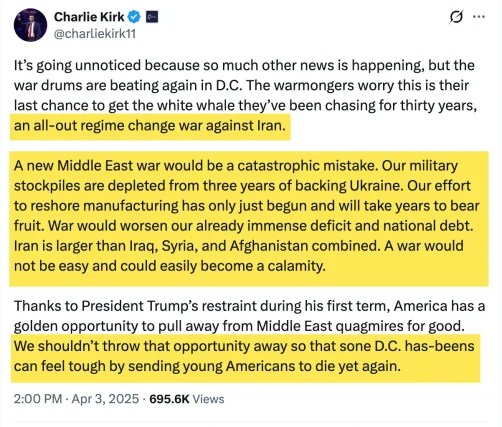
Charlie Kirk, X, April 3, 2025, warning against a regime-change war in Iran
The false claims behind this new war with Iran are ones we have extensively documented. In Trump’s war announcement this morning, he claimed — as he did at Tuesday’s State of the Union address — that Iran refuses to promise that it will not obtain nuclear weapons. The exact opposite is true: Iran has stated this clearly, unequivocally and repeatedly, and did so as recently as this week. “Iran will under no circumstances ever develop a nuclear weapon,” proclaimed Iran’s foreign minister Seyed Abbas Araghchi.
The consequences of this new Trump/Netanyahu war of choice cannot be predicted with any degree of certainty. Already, Iran has launched numerous retaliatory ballistic missiles at Israel, as expected, and has also attacked U.S. military bases in the United Arab Emirates, Qatar, Bahrain and Kuwait.
But the lack of predictable outcomes is, of course, precisely the point. If the U.S. and Israel succeed in their stated goals of widespread “annihilation” and regime change, then they will create, at the very least, a huge power vacuum in the middle of the world’s most volatile region that will require U.S. resources and a sizable military presence for years if not decades to come. One of the world leaders most responsible for the Iraq War, former British Prime Minister Tony Blair, admitted that it was the invasion of Iraq that gave rise to ISIS.
It is hard to overstate what a massive fraud Donald Trump, his campaign and his political movement are. For more than a decade, Trump has ranted and raved against the evils of regime-change wars and neoconservative dogma, only to launch a new war that most perfectly encapsulates and aggressively advances both. He spent years falsely warning that former President Obama would start a war with Iran because of how weak and inept Obama supposedly was at negotiation and diplomacy, only to now do that himself (rather than start a new war with Iran, as Trump predicted, Obama entered a diplomatic agreement with them which major nuclear bodies attested was effective in monitoring Iran’s nuclear activities: a deal which Trump, at Israel’s insistence, tore up in 2018).
Throughout the 2016 campaign, Trump mercilessly mocked Marco Rubio for receiving millions in donations from Sheldon and Miriam Adelson, money that Trump said would “mold [Rubio] into [their] perfect little puppet,” only for himself to become not only the largest beneficiary of Adelson funding in history, but to become the ultimate puppet of the Adelsons’ agenda, one which Trump has clearly acknowledged — when speaking in Israel last year — is an agenda that puts the interests of Israel atop everything, including Americans’ interests:
“I get her in trouble with this, but I actually asked [Miriam] once… ‘What do you love more? The United States or Israel?’ She refused to answer. That might mean Israel,” Trump says, smiling, while looking at the dual Israeli-American national.
And it is not an exaggeration to say — in fact, basic honestly requires one to say — that the 2024 Trump/Vance campaign is one of the most fraudulent political campaigns in American history:

Just one week before the 2024 election, Tulsi Gabbard proclaimed that “a vote for Kamala Harris is a vote for Dick Cheney and a vote for war, war and more war.” Conversely, Gabbard said, “a vote for Donald Trump is a vote to end wars, not start them.” Other than immigration, this “no-new-wars” theme was the most central to Trump’s political appeal and his political promises since he emerged on the political scene a decade ago.
One can rehash the decades of now-trite arguments about Iran as much as one wants. But such endless debate cannot alter the facts here that are indisputable and fundamental.
Iran has not attacked and could not have attacked the United States at home. No such attack was even arguably imminent. The new war that Trump just started with Israel is thus the definitive war of choice.
In contrast to the lie-driven 18-month public campaign of Bush and Cheney to convince the American public to support an invasion of Iraq, there has been virtually no attempt made, as I documented this week, to even explain to the American public why a new war with Iran is necessary or desirable. There has been no Congressional approval sought let alone obtained, notwithstanding the U.S. Constitution’s exclusive assignment of war-making powers to the Congress.
In his novel 1984, George Orwell highlighted the dangerous insanity of war propaganda with this leading example: “WAR IR PEACE.” Yet that is precisely the rationale invoked by various Trump supporters to somehow depict this new war as aligned with Trump’s vows of peace (starting massive new wars is merely “peace through strength”).
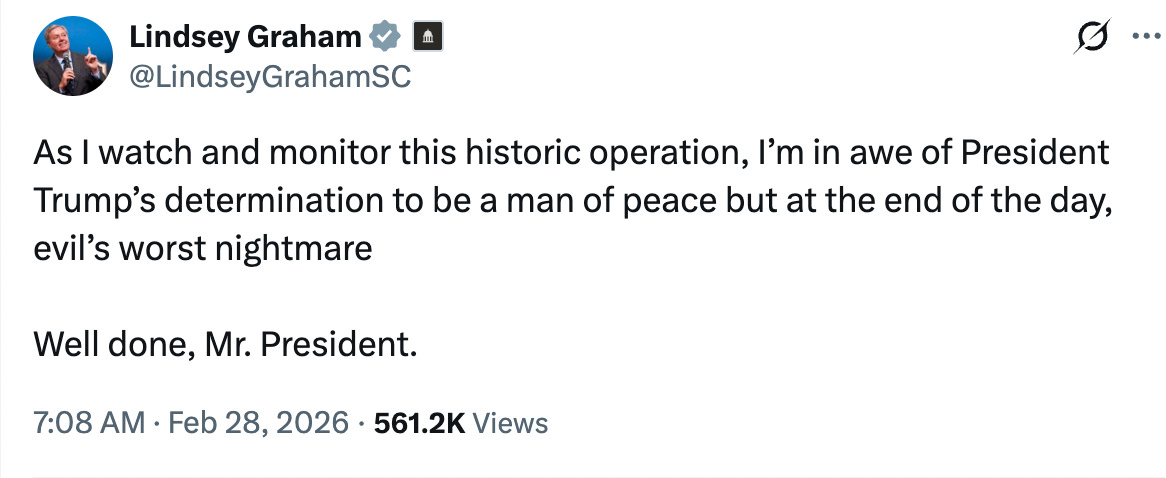
This is, obviously, the war that Israel and Trump’s largest Israel-loyal donors most wanted and have long been pressuring him to start. Pro-Israel billionaires like Bill Ackman, long-time pro-Israel warmongers like Lindsey Graham, and Israel First activists like Mark Levin are of course already boisterously celebrating this new war against Israel’s primary adversary.
But this is ultimately an American war, one that Trump unilaterally started and for which Trump is responsible. Notably, of course, it is not Trump or his family, but instead everyone else in the world, who will bear the costs and burdens of the war. This was the point Trump famously emphasized shortly before the 2024 election — on November 1 — when explaining why Washington is full of sociopathic warmongers such as Dick and Liz Cheney who constantly start wars in which other people’s families, but never their own, must go fight and die.
As Trump’s senior White House advisor Stephen Miller said about those comments, “warmongering neocons love sending your kids to die for wars they would never fight themselves.” Indeed they do, Stephen Miller.
Do not expect meaningful opposition from the Democratic Party. Some of them, perhaps most, will make loud noises in protest. But the party’s senior leader, Sen. Chuck Schumer (D-NY), this week urged Trump to make the case to the public about why this war was necessary, whereas Schumer last June mocked Trump for attempting to obtain a peace deal with Iran and accusing him of “chickening out” of the war with Iran that he prosed. Some Democrats, such as Sen. John Fetterman (D-PA), are effusively praising Trump and his new war.
This new war against Iran is as pure a continuation of the bipartisan DC posture of endless war that has, more than any single cause, destroyed American prosperity, standing, and future over the last six decades at least. The only question how is how many people will die, for how long the damage will endure, and what new unforeseen evils will be created in its wake.
The KAL Flight 007 Tragedy
Tales of the American Empire | February 26, 2026
The United States government has admitted that over 200 American military personnel were shot down aboard aircraft while spying over the Soviet Union during the Cold War. American Generals had sent aircraft probing into Soviet airspace to test reactions and collect intelligence. They loved to play cat and mouse games to taunt the Soviets. This was considered good training that provided valuable intelligence. These games resulted in 269 civilian deaths in 1983 when a Korean airliner (KAL Flight 007) was shot down as it flew over the Soviet Union.
_________________________________
“Secret Casualties of the Cold War”; Air & Space Magazine; Paul Glenshaw; December 2017; https://www.smithsonianmag.com/air-sp…
“A Shot in the Dark: The Untold Story of Korean Air Lines flight 007”: Kyra Dempsey (aka Admiral Cloudberg); Medium; May 20, 2024; / a-shot-in-the-dark-the-untold-story-of-kor…
“DISGUISED RC-135W RIVET JOINT OF U.S AIR FORCE CARRY OUT SURVEILLANCE OF CHINESE MILITARY BASES!”; Defense Updates; September 17, 2020;  • DISGUISED RC-135W RIVET JOINT OF U.S AIR F…
Related Tale: “A U-2 and World Peace were Sabotaged in 1960”; • A U-2 and World Peace were Sabotaged in 1960
Why Trump’s war on Iran will fail
By Tamer Ajrami | MEMO | February 27, 2026
The United States has turned the talks with Iran upside down. What is happening now does not look like serious negotiations. It looks more like a way to buy time and prepare for a more dangerous phase. That is why two questions matter: Why Trump’s war on Iran will not succeed, and why would it be a dangerous choice for Washington? The answer is simple. The demands Washington is putting on the table are designed to be rejected, and because any military action, if it occurs, will reveal the limits of force, the logic of exhaustion, and the absence of a clear or achievable goal.
All the talk about a deal, gaps, and loopholes continues to go around in circles. On the ground, the US is moving in a completely different direction: it is raising the bar in a way that ruins the talks from the inside and pushes things toward escalation.
Washington now says it has clear conditions. In reality, these conditions make any settlement almost impossible. The first demand is that Iran hand over all its enriched uranium directly to the United States. Not to a third country, not through an international mechanism, not through gradual reductions. Just hand it over to Washington. This is not meant to produce a balanced agreement. It is meant to humiliate a state and force it to give up a highly sensitive part of its sovereignty.
The second demand is even clearer: dismantle Iran’s nuclear facilities and destroy them completely, including major sites like Isfahan, Natanz, and Fordow, along with underground facilities hidden in mountains. The irony is that Washington and its allies do not have full certainty about what earlier strikes (12-day war, June 2025) actually achieved inside these deep facilities. So, the demand for dismantling and destruction looks like a political cover for the simple reality of what lies underground is not easy to reach.
On sanctions, the US offers no clear path. The talk is about lifting a limited set of sanctions imposed recently, while keeping the main sanctions in place under a long “test.” Has Iran truly surrendered, or is it only offering symbolic concessions? Then comes the most dangerous condition of all: the deal must be permanent, Iran must stop enrichment completely, and this must last forever. These are not terms for a fair agreement. They are terms of surrender.
That is why this round looks more like the round before war. The US military buildup in the region is still expanding, and the flow of aircraft, defence systems, and naval assets continues. Everyone is watching everyone through satellites. Almost nothing can be hidden. The real message is not in press statements. It is in the movements that create a new reality and make escalation feel closer than a settlement.
But if a strike happens, it will be full of risks. Even in the American media, one question keeps coming back: what exactly are Trump’s goals? Does he want a limited strike to force Iran into quick concessions? Does he want a wider campaign to bring down the regime? Or does he simply want to declare that he “destroyed” the nuclear program without being able to prove it? The problem is that these goals clash with each other, and each one requires different tools, different costs, and different timelines.
Time is part of the problem too. Some estimates suggest that the ability to keep up intense operations with the current level of forces may be limited. This connects with warnings about running down air defences and burning through advanced / expensive ammunition in a campaign that does not guarantee results. In other words, if war starts, it may quickly turn into a war of exhaustion. It is exactly the kind of fight Washington does not want.
If Iran can launch large waves of ballistic missiles, it can drain defensive stocks on US ships and at US bases in the region fast. Then comes the embarrassing question: how does the US keep fighting? And how does it stop without looking like it pulled back under fire? If Iran keeps firing while the US withdraws, the image inside America would be politically costly.
That is why the administration, based on what is being discussed in Washington, may look for a way to sell the war at home. One idea is for Israel to launch the first strike, and then for the US to step in later under the banner of “defending Israel”. That makes it easier to justify the intervention in Washington, because critics will face a ready-made slogan: we are defending an ally.
But on the ground, it is hard to separate who starts and who joins. US and Israeli forces operate in the same environment and in overlapping ways. The real difference is not in the sky. It is in the story Washington wants to tell its public.
Even if a strike happens, the main question remains: can airstrikes alone achieve big goals? Many analysts say hitting facilities becomes like a game of chasing a moving target. You destroy one site, it gets rebuilt. You hit a surface facility that was emptied beforehand. Equipment and materials are moved elsewhere. As for facilities buried deep in mountains, they remain a major problem. Access is not guaranteed, and photos alone cannot prove total destruction.
More importantly, a nuclear programme is not just concrete and steel. It is knowledge, technology, experience, and an industrial base. Even if part of it is damaged, Iran can repair it over time. Claims of “total destruction” therefore sound more like political messaging than a verifiable reality.
The missile program is an even bigger challenge. Iran produces missiles in large numbers and has the industrial and scientific base to rebuild its stock after any confrontation. Even if the US hits some production lines, wiping the program out completely would require long-term control on the ground and not just airstrikes.
Here is the truth that official speeches avoid: if Trump’s real goals are regime change, removing Iran’s missile power for good, or forcing “zero enrichment” forever, then airstrikes will not deliver that. Those goals require a major ground war and a long occupation. This then may bring huge losses, heavy costs, and years of deep involvement.
This would not serve the US at a time when competition with China is rising. Burning through advanced and expensive American capabilities in the Middle East without clear gains could give China a strategic advantage and push it to move faster on bigger priorities like Taiwan, while Washington remains stuck in a war with no clear ending.
There is also a constant operational risk in any large air campaign: an aircraft could be shot down, a pilot could be captured, or a major incident could happen in a sensitive strait. One such event can turn a limited strike into a wider war, and shift the focus from negotiating nuclear issues to negotiating prisoners and political humiliation.
So, Washington faces two costly paths: a full-scale war it does not have the political tools to sustain, or airstrikes that will not achieve the announced goals but could open the door to further escalation. In both cases, negotiations become a temporary cover while the region moves toward a dangerous test of power and its limits.
The bottom line is this: raising demands to the level of humiliation does not lead to an agreement. It pushes the other side toward rejection and then toward preparation for confrontation. When talks become terms designed to fail, they do not prevent war. They delay it to a moment chosen by Washington; after the battlefield is prepared and the political story is already written.
In the end, the problem is not that Washington has less power. The problem is that it is pursuing goals that are bigger than its tools. Airstrikes do not topple regimes, erase nuclear know-how, and do not end a missile program that can be rebuilt. The higher the US raises its demands, the more it closes the door to diplomacy and the closer the drift toward confrontation.
If war begins, it may quickly become a costly fight with no clear ending: defenses get drained, rare munitions get burned, markets shake, and bases come under attack. Then an unsolved question will rise inside the US: how do we end this without political defeat? Failure becomes likely because the goals cannot be achieved by bombing alone. And the danger is huge, because escalation may spiral beyond control. In a war like this, Washington might win a round in the air, but lose the bigger game on the ground.
Lebanon: Between sovereignty and the mirage of normalization
By Ali Abou Jbara | The Cradle | February 26, 2026
The smoke had barely lifted from the latest Israeli bombardment of south Lebanon when another conversation began circulating in Beirut. While border villages buried their dead and families searched through rubble, a parallel discourse surfaced in studios and on digital platforms: normalization with Israel presented as a viable political path.
The ongoing war on Lebanon, marked by unprecedented Israeli escalation, daily raids, and widespread destruction, exposed more than military vulnerability. It revealed that certain voices inside the country no longer conceal their position toward Tel Aviv.
They now speak openly of public normalization as the cure for Lebanon’s crises – even as Israeli warplanes violate Lebanese skies, despite the so-called ceasefire. What is marketed as pragmatism begins to resemble political surrender.
Prominent personalities have amplified this shift. Journalist Marcel Ghanem declared live on his program “Sar al-Waqt” on MTV that he was considering speaking directly with Israeli Prime Minister Benjamin Netanyahu and suggested repealing Lebanese laws that criminalize dealings with Israel.
Digital platforms followed the same trajectory. “Hona Beirut” circulated videos of Israelis sending populist messages to Lebanese audiences – “We want peace with Lebanon. We want to visit Beirut and enjoy fattoush and shawarma” – carefully packaged to soften the image of a state whose aircraft continue to strike Lebanese territory.
Political figures moved even further. MP Paula Yacoubian stated publicly: “If salvation comes through Israel, let it come but save us.” Charles Jabbour, head of the Lebanese Forces (LF) party media apparatus, argued that Israel does not occupy Lebanon and does not attack the Lebanese, claiming instead that it monitors Hezbollah to ensure implementation of past agreements. He concluded: “If Hezbollah wins, Lebanon loses. If Israel wins, Lebanon wins.”
Such statements are deliberate. They substitute national consensus with partisan calculus and recast normalization as responsible governance.
Expansion as governing doctrine
Advocates of a “quick peace” treat Israel as a state seeking stability. The political current in Tel Aviv suggests something else entirely.
Under Netanyahu and his alliance with ultra-religious and nationalist forces, the “Greater Israel” vision operates as a strategic direction.
On 22 September 2023, Netanyahu stood before the UN General Assembly (UNGA) and presented a map that includes Gaza and the occupied West Bank as part of Israel, using the biblical name “Judea and Samaria” instead of the West Bank – in a symbolic dedication to the annexation project.
His coalition partner, Finance Minister and leader of “Religious Zionism” Bezalel Smotrich, had stated in 2016 that Israel’s borders “must extend to Damascus,” and appeared in Paris in March 2023 in front of a map that considers Jordan part of the “Land of Israel.”
Since Menachem Begin and the Likud party came to power in 1977, the concept of “Greater Israel” has morphed into a political program based on settlement expansion and changing demographic realities. This current is based on interpretations from the Book of Genesis that consider the “Promised Land” to extend from the Nile to the Euphrates. Even Israel’s first prime minister, David Ben Gurion, wrote in the 1930s that establishing a state on part of the land would serve as a first stage, not an endpoint.
Following Operation Al-Aqsa Flood, expansionist language hardened. Military operations broadened in Gaza and the occupied West Bank while strikes intensified in Syria and Lebanon. “Security depth” expanded to encompass regional theaters.
On 21 February 2026, US Ambassador to Israel Mike Huckabee said in an interview with Tucker Carlson that, under a biblical interpretation of land promised in Genesis, it “would be fine if [Israel] took it all,” implicitly extending Israel’s reach across much of West Asia – remarks that sparked sharp regional condemnation.
Maps circulated by proponents of this project extend beyond historic Palestine. They incorporate Lebanon, Jordan, most of Syria, half of Iraq, and territories in Saudi Arabia, Egypt, and even Kuwait.
Against that strategic horizon, Lebanese normalization rhetoric begins to feel profoundly detached from the lived reality of the country. Border villages remain scarred, Lebanese airspace is violated without consequence, and sovereignty is subjected to daily erosion, yet normalization is presented as transactional diplomacy, detached from geography and history.
It is precisely here that the Lebanese debate turns unsettling. What does it mean to pursue “peace” with a project whose declared maps stretch beyond its recognized borders? How does a state whose skies, waters, and land are routinely breached convince itself to trust assurances from a government that treats expansion as a generational mission?
The occupied West Bank as precedent
The occupied West Bank offers a concrete case study. Since the 1993 Oslo Accords, the settler population has grown from roughly 250,000 to more than 700,000. Hundreds of settlements and outposts now fragment the territory. Israeli Energy Minister Eli Cohen has described this as imposing “de facto sovereignty” – gradual annexation without formal declaration.
Land confiscations, bypass roads, settlement blocs, and armed settler protection have eroded the territorial basis for Palestinian statehood. Smotrich openly advocates annexation and rejects Palestinian sovereignty. Netanyahu presides over what observers describe as the most right-wing government in Israel’s history, with settlement expansion central to its agenda.
Three decades of negotiations unfolded alongside continuous territorial transformation. Diplomatic processes advanced in parallel with irreversible changes on the ground. This is how “peace” is managed when it is a tool to strengthen control, not to end it.
Despite this record, similar assumptions appear in Lebanese discourse. MP Camille Chamoun of the Free Patriots Party says he does not believe Israel has an interest in violating international agreements and Lebanese borders.
MP Sami Gemayel, head of the Kataeb Party, suggests that relations with Israel and western countries may protect Lebanon. Even Lebanese actress and writer Carine Rizkallah said on the TV program Al-Masar that she hoped there would be no new war with Israel and that “it’s time to end these problems between the two countries.”
The irony is that Lebanese rhetoric promoting normalization leans on an assumption of good faith from the other side, even though the occupied West Bank continues to show how such assumptions unfold in practice. There, decades of agreements, conferences, and international sponsorship did not halt expansion; they unfolded alongside it, as settlements multiplied, land was fragmented, and entire areas were quietly absorbed into a new reality.
If this is where the occupied West Bank has arrived after years of accords and external guarantees, on what basis is Lebanon encouraged to trust similar assurances? The experience is not abstract or distant. It is ongoing, visible, and instructive for anyone willing to look.
Regional patterns of influence
The broader region reinforces this reading. After the fall of the previous Syrian government on 8 December 2024, Israeli influence expanded in southern and central Syria, capitalizing on security vacuums and fragmentation. Strategic corridors between northern Syria and Israeli ports strengthened. Control over the occupied Golan Heights and adjacent water resources deepened.
Turkiye adopted a confrontational stance toward Israeli expansion, warning that the absence of clear red lines destabilizes Syria and opens space for broader intervention. Ankara expanded its diplomatic engagement on Palestine, strengthened regional alliances, and emphasized deterrence, demonstrating that even governments with formal ties to Israel are wary of unchecked expansion.
Across neighboring states, internal divisions have created entry points for influence. Settlement expansion in the occupied West Bank, strikes in Syria, and sustained violations in Lebanon reflect an interconnected strategy.
Normalization premised on unilateral concession narrows strategic space. In regional practice, asymmetrical engagement tends to consolidate the stronger party’s position.
Lebanon operates within that same environment. Any official normalization would unfold against Israel’s strategic framework and military advantage. Expectations of reciprocal restraint lack precedent in current regional dynamics.
Lebanon’s historical record
Lebanon’s experience with Israeli aggression remains documented. In April 1996, Israeli forces bombed a UN base in Qana, killing more than 100 civilians who had sought shelter. In September 1982, the Sabra and Shatila massacre occurred under the watch of the Israeli army. The 1982 Israeli invasion reached Beirut, and south Lebanon remained under occupation until 2000, liberated only through sustained resistance.
The July 2006 war resulted in more than 1,200 Lebanese deaths, extensive infrastructure destruction, and the displacement of nearly one million people. Airspace violations continued long after hostilities subsided.
Following Operation Al-Aqsa Flood and Hezbollah’s decision to open a northern support front, strikes on southern villages resumed, placing Lebanon within a wider expansionist frame.
In this context, normalization proposals detach policy from cumulative experience. They assume recalibration without structural change. Historical precedent suggests otherwise.
Legal foundations
Lebanon’s stance toward Israel is codified in law. Since 1955, the Boycott of Israel Law has prohibited commercial, cultural, and political dealings with the Israeli enemy. The law remains in force and constitutes a foundational element of Lebanese state policy.
The penal code criminalizes espionage and communication with the enemy, including cooperation that provides political, media, or moral benefit. In contemporary circumstances, public statements or digital content that promote normalization may fall within this framework if deemed to confer advantage. Penalties can include imprisonment and fines.
Given ongoing Israeli violations of Lebanese sovereignty, normalization carries national security implications under existing legislation. Judicial and security institutions retain authority to investigate potential breaches.
This legal architecture reflects accumulated historical experience rather than abstract doctrine.
Sovereignty under pressure
The present debate concerns strategic direction under sustained pressure. An expansionist project operates openly in the region. Lebanon’s historical memory remains recent.
Calls for normalization at a moment of ongoing aggression raise structural questions about sovereignty, deterrence, and long-term stability. Strategic environments shaped by military asymmetry rarely reward unilateral accommodation.
Lebanon faces a clear dilemma. Defending sovereignty requires political coherence and deterrent capacity. Pursuing normalization without reciprocal structural change invites further testing of borders and institutions.
The chosen trajectory will shape more than just diplomatic posture. It will define how the state positions itself within a region undergoing forced transformation.
Ukraine Given $43Bln in Proceeds From Russian Assets Frozen by G7 Since 2024 – Estimates
Sputnik – 27.02.2026
The G7 nations have issued $3.8 billion in loans to Ukraine in 2026 using proceeds generated by frozen Russian state assets, bringing the total amount of loans given to Kiev since 2024 to almost $43 billion, according to calculations by Sputnik based on data from the Ukrainian Finance Ministry and national agencies.
In 2024, the G7 countries approved a $50-billion loan to Ukraine, funded by revenues from frozen Russian assets. By late February 2026, the countries had allocated $42.7 billion to Ukraine under this scheme.
The first billion was transferred to Ukraine by the United States in late 2024. Since then, Washington has not provided any new funding to Kiev from Russian asset proceeds. The other members of the G7 gave Ukraine $37.9 billion in 2025 and $3.8 billion in 2026.
Overall, the European Union has contributed $32 billion in funding to Ukraine as part of the loan secured by Russian assets. Canada has contributed $3.6 billion, while Japan and the United Kingdom have each contributed approximately $3 billion.
The military is babying F-35s to hide their true cost to taxpayers
By Mike Fredenburg | Responsible Statecraft | January 23, 2026
Are the military services babying the F-35 to obscure its true costs while continuing to get enormous sums of taxpayer funding for a plane that has consistently failed to live up to performance expectations?
From the very beginning, the F-35 program has been plagued by hundreds of billions of dollars in cost overruns and repeated schedule delays.
Moreover, even as promised capabilities have been delayed by well over a decade, billions poured into fixes haven’t resolved ongoing reliability issues, crippling its operational effectiveness, and rocketing the program cost to over $2 trillion dollars — 400% more in inflation-adjusted dollars than its 2007 Government Accountability Office estimate.
The plane’s extreme unreliability has resulted in full mission capable rates (FMC) of only 36.4% , 14.9%, and 19.2% for the F-35A, F-35B, and F-35C, respectively. For F-35Bs and F-35Cs, only the newest planes have full mission availability rates above 10%.
Unsurprisingly, the services and Lockheed Martin don’t really like to talk about FMC; instead, they like to focus on mission-capable (MC) rates of roughly 50%. While much lower than the 90 percent promised by Lockheed Martin and its service partners, it certainly sounds much better than the dismal FMC rates. But MC is a very deceptive measure, and the services know it, as “mission capable” aircraft need only be capable of flying non-combat missions, such as training, ferrying, or public relations, etc.
But the MC deception is only part of the equation when it comes to just how little bang-for-the-buck taxpayers are getting for their dollar.
Strong circumstantial evidence, coupled with emerging data and the services’ long history of stonewalling when it comes to problems associated with major programs, suggest that the U.S. military services , as well as prime contractor Lockheed Martin, have been babying the F-35s to obscure just how unreliable and expensive they would be if not being nursed along.
This coddling of the F-35 lowers some costs and pushes other costs into the future, keeping current year expenses as low as possible. This makes the program look like it is more efficient and effective than it really is, improving the chances of selling and delivering more F-35s while decreasing the chances the program will be curtailed or even canceled.
Major maintenance cost factors
There are three major drivers of wear and tear on an aircraft like the F-35: how many missions (sorties) it carries out, how many flight hours it accumulates, and how it’s flown during a mission.
Missions/Sorties are the best predictors of maintenance-related costs. While accumulated flight hours are often discussed when it comes to aircraft age and maintenance, studies have shown that the number of sorties, on average, is a better predictor of the wear and tear on an aircraft. This is because each sortie involves the stresses of taking off and landing, as well as subjecting the engine to thermal cycles, the primary culprit when it comes to engine wear.
Once the plane is flying, its wear is minimal unless subjected to aggressive maneuvering and engine use. Hence, when it comes to minimizing wear, for the same number of flight hours, fewer sorties of longer duration will produce less wear than more sorties of shorter duration, 100 two-hour sorties vs. 200 one-hour sorties.
Flight hours and operating costs. While in most cases, the number of sorties will be a better predictor of when maintenance will be required, more flight hours still equal more maintenance. So, if you can keep the hours down, the absolute cost of maintaining the plane will be less. For context, modern fighters like the F-16 routinely flew 250–350 hours per year in their prime, but F-35s average only about 195 hours annually — well below their original targets of 250–316.
To note: the June 2025 Congressional Budget Office found that F-35 availability and hours being flown are “lower, in some cases much lower, than those of other fighter aircraft of the same age.” Interestingly, even at 17-years of age, legacy aircraft such as F-16s and F-15s blow away the mission readiness of brand-new F-35s, even though they are flying more hours annually.
Indeed, we know the hours flown each year by the F-35A and F-35B declined markedly over the first seven years of their lifetimes. This means aircraft just a few years old are being flown less than brand new planes and consequently being subject to less daily wear and tear, conveniently pushing the cost of replacing engines and other expensive depot-level work down the road, even as the services continue to buy new F-35s under what some, including myself, would call false cost metrics.
But beyond cost shifting, overall fewer hours being flown means less in-the-air training “stick time.” And while flight simulators are helpful, there is no substitute for training in a real plane, being subject to real flight forces. Sadly, due to unreliability and cost per flying hour, F-35 pilots are not getting the stick time they need to truly excel.
How the planes are flown during sorties matters. While the services do not typically report how the planes are actually being operated during a sortie, babying vs. pushing it to the limits of its airframe and engine will dramatically impact how much maintenance is required. Due to operational security concerns, exactly what non-combat operational limits are placed on the pilot and his plane is not available. But we do know now that there are very tight limits on how often and how long the F-35B and F-35C are permitted to go supersonic due to the damage done to their stealth coating and perhaps even structure during supersonic flight.
F-35 retrofits and upgrades kick costly engine overhauls down the road. By building and fielding aircraft even before final designs were complete, the F-35 program took concurrency to a level never seen before. This multibillion-dollar concurrency experiment resulted in an unprecedented number of retrofits and hardware modifications for early batches of F-35s — work that can take more than a year to complete for each affected plane. But while the plane is offline, it isn’t being used, so again, any necessary engine overhaul and associated maintenance costs will be kicked like a can into the future.
Putting it All Together
Consider a brand-new F-35A delivered to an Air Force squadron. In its first few years, it is assigned to training units where it generates many short-duration sorties of 1.5 hours or less, while generating over 200 or more flight hours per year. From there, it gets assigned to an operational squadron, flying fewer sorties of longer duration, but still racking up enough hours not to have a big negative impact on the fleet-wide average. Reduced sorties mean less monthly maintenance costs and less wear on the engine.
Then in year five and six, it undergoes refits and rework that take it out of service for a total of 12 months. While out of service it is not contributing hours and sorties, but it also is not putting wear on its engine, pushing a multi-million dollar engine overhaul out by another year. This cost shifting makes the program look better than it is. By year eight it is flying just over 150 hours per year, while the Air Force is counting on newer planes to keep the averages up.
While this kind of micromanagement can reduce maintenance costs due to fewer sorties and hours, it also shifts major costs into the future and depends on new planes to maintain average flight hours and sorties at a high rate. Once new planes stop entering the fleet, the number of hours and sorties pilots will be able to fly will have to be reduced to keep costs from going through the roof.
We don’t have the smoking gun, but…
Ultimately, due to legitimate operational security (OPSEC) concerns, the services won’t reveal full details on how the F-35 sorties and hours are being micromanaged or limitations and restrictions on how F-35 pilots are allowed to operate the aircraft. But we do know that the 2024 CBO report adjusted overall estimated sustainment costs for the F-35 program from $1.1 trillion to $1.58 trillion, while stating F-35s will be flying 21% less hours going forward due to reliability issues.
This is exactly what one would expect from the kind of cost shifting pattern we have described. What’s more, we can be sure sophisticated opponents like China and Russia have seen this report and have doubtlessly conducted in-depth analysis exposing the F-35’s inability to conduct high-tempo operations over a sustained period against a peer competitor, who, unlike opponents such as Venezuela and Iran, will regularly create situations in which we aren’t controlling the timing and tempo of our responses.
This lack of robustness also ensures that our pilots are shortchanged in skills development relative to what they could count on from a more reliable fighter.
By micromanaging F-35s, the true depth of their shortcomings can be concealed/minimized, helping to sustain support for a program diverting enormous resources from potentially more effective alternatives. It’s time to stop wallowing in sunk cost emotionalism and put a stop to buying planes whose reliability and costs make them a national security liability.
Featured Video

US IRAN TALKS: Who Are the Crazy Ones Here? /Lt Col Daniel Davis
or go to
Aletho News Archives – Video-Images
From the Archives
Woolsey Fire started at Santa Susana Field Lab — where “radioactive materials released were never accurately measured”
By John Laforge | CounterPunch | November 30, 2018
In my Nov. 16 column, I reported on potential radiation risks posed by California’s Woolsey wildfire having burned over parts or all of the Santa Susana Field Laboratory—south of Simi Valley, Calif., 30 miles outside Los Angeles—site of at least four partial or total nuclear reactor meltdowns.
The field laboratory operated 10 experimental reactors and conducted rocket engine tests. In his 2014 book Atomic Accidents, researcher James Mahaffey writes, “The cores in four experimental reactors on site … melted.” Reactor core melts always result in the release of large amounts of radioactive gases and particles. Clean up of the deeply contaminated site has not been conducted in spite of a 2010 agreement.
Los Angeles’s KABC-7 TV reported Nov. 13 that the Santa Susana lab site “appears to be the origin of the Woolsey Fire” which has torched over 96,000 acres. Southern Calif. Public Radio said, “According to Cal Fire, the Woolsey Fire started on the afternoon of Thursday, Nov. 8 … on the Santa Susana site.” … continue
Blog Roll
 Aletho News
- US IRAN TALKS: Who Are the Crazy Ones Here? /Lt Col Daniel Davis
- Talks with the US end without a deal over excessive US demands: Iran
- Feeling Better, Getting Worse: How Psychiatric Drugs Create the Illusion They Cure
- ‘Nobody Told Me’: Former Mental Health Patient Calls Out Dangerous Side Effects of Psychiatric Drugs
- Dr. Abu-Sitta: Beirut ‘felt like a day in Shifa Hospital’
- Iran Has Won the War, It Will Be Up to the US to Secure the Peace: Mohammad Marandi
- Iran condemns assassination threats against Iranian negotiators amid US talks
- Brussels cannot say where its own pipeline inspectors are as Hungary’s oil lifeline remains shut
- Israel’s Iran War: Myth and Reality
- Between war and industrial breakdown: The US-Israeli attrition crisis
- If Americans Knew
- Pro-Israel ‘Thinktanks’ and Individuals who Influence U.S. Foreign Policy
- Mearsheimer reveals how Israel dictates US policies on Iran, Gaza – video
- After killing 350+, Israel still has a “score to settle” with Lebanon before ceasefire – Daily Update
- Military aid to Israel emerges as the latest political litmus test for Democrats
- The only Palestinian children’s rights organization closes following years-long Israeli campaign against it
- ‘I Can’t Forget the Smell’: Lebanese Reel After Israel Kills Over 300 in Single Day
- DNC Shoots Down Resolutions Calling Out AIPAC and Limiting Arms to Israel
- TCN: Is Israel Blackmailing President Trump?
- Israel killed at least 303 Lebanese yesterday – who were they? Daily Update
- Amnesty: Urgent – Protect Lebanese civilians from brutal escalation in Israeli attacks
- No Tricks Zone
- German Expert: Heat Dome Led To Record Temps In Western USA…Warmer In 1934, 1936
- New Study: No Linear Warming Or Glacier Retreat Along Northern Antarctic Peninsula Since 1980s
- An Inconvenient Tree: Uncovered In Alps… Europe Much Warmer Than Today 6000 Years Ago
- New Study Reports A 60% Slowdown In Greenland’s Ice Loss Rate In The Last Decade
- Low Intensity Tornado Wrecks Major Solar Farm, Creating A Potential Toxic Dump
- New Study Finds Warming Saves Lives…Cold Temperatures 12 Times More Deadly Than Excess Heat
- German Science Blog Accuses PIK Climate Institute Of Hallucinating Climate Tipping Points
- Devastating Assessment Of Comirnaty Vaccine By Former Senior Pfizer Europe Toxicologist
- New Study: CO2 Is ‘Effectively Negligible’ As An Explanatory Climate Change Factor Since 2000
- Former Pfizer Toxicologist Dr. Helmut Sterz Tells Bundestag Hearing Pfizer Vaccine Should Have Never Been Approved
 Aletho News