The EU’s best weapon against free speech isn’t working
The EU has just realized that it can’t rule the internet with an iron fist by throwing around the ‘Kremlin propaganda’ label
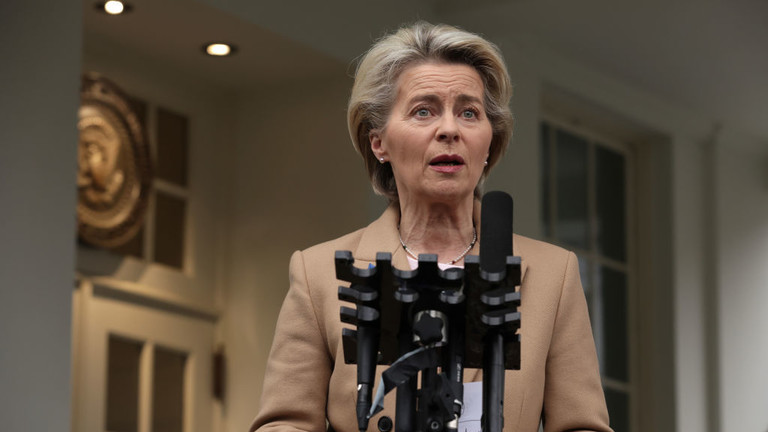
EC President Ursula von der Leyen speaks to the press after a meeting with Joe Biden in the White House on March 10, 2023 in Washington, DC. © Alex Wong/Getty Images
By Rachel Marsden | RT | September 7, 2023
The European Commission has concluded in a new report that despite making pinky-promises to “mitigate the reach and influence of Kremlin-sponsored disinformation,” large social media platforms like Twitter and Facebook were “unsuccessful” in doing so. What a shocker that this research by oversight advocates has ended up advocating in favor of more oversight. Russia just happens to be the most convenient scapegoat.
Using the same kind of smear tactics that the bloc has used previously – like when it included Russia alongside Islamic State (IS, formerly ISIS) in previous security and threat reports – this time it involved conflating “pro-Kremlin” social media accounts with those that it considers to be “Kremlin-aligned” or “Kremlin-backed.” In other words, mere disagreement with the Western narrative is enough to land anyone in the “pro-Kremlin” camp and to be considered worthy of content moderation or banning by the EU. And now they’re frustrated that social media platforms have dropped the ball on carrying out that censorship.
“Platforms rarely reviewed and removed more than 50 percent of the clearly violative content we flagged in repeated tests,” the report said. What kind of content would that be, exactly? It’s hard to tell, because their examples conflate the legitimately debatable with the patently absurd, and suggest that both warrant censorship. They cite, for example, content that accuses Ukraine of being run by Nazis – which is a legitimate concern, given that the Western press has reported extensively on the powerful role played by neo-Nazis in Ukraine, which are “aggressively trying to impose their agenda on Ukrainian society, including by using force against those with opposite political and cultural views,” according to a publication by the Washington-based Freedom House prior to the conflict, adding that “they are a real physical threat to left-wing, feminist, liberal, and LGBT activists, human rights defenders, as well as ethnic and religious minorities” in Ukraine. The Council of Europe had made similar observations.
There’s also the fact that the West trained the neo-Nazi Azov battalion to fight Russians, and that Reuters reported way back in 2018 that then-president Petro Poroshenko “would risk major repercussions” should he take action against neo-Nazis.
That kind of does sound like there’s a neo-Nazi issue that’s at the very least worthy of highlighting and debating. Yet the EU dismisses any such suggestion as Russian disinformation.
The report also takes issue with accounts “denying war crimes,” using events in Bucha as an example. I’m sorry, but was there a war crimes tribunal that we missed? We’re talking here about events taking place in the immediate fog of war. Attempting to sort through facts, realities, and manipulations is precisely the kind of thing with which social media is meant to assist. Everyone by this point knows that it’s about having access to as much raw data as possible. We expect to see a chaotic mess online – not a curated Encyclopedia Britannica set or the evening news. What makes Brussels think it is entitled to a monopoly on that process?
The report places these examples of inconvenient debates alongside a blatantly ridiculous example of sh*tposting whereby someone made up the name of a fake media outlet and announced that Ukraine was sending a radioactive cloud towards Europe. Look, if anyone is so dumb as to believe something like that, then it certainly isn’t the EU that’s going to save them from their own stupidity. Not for long, anyway. Just let them spend their entire next week digging a fallout shelter while their neighbors have a good laugh.
In a line that just begs to be read repeatedly out of sheer incredulity that someone could be so tone-deaf, the report notes that so-called Kremlin disinfo efforts are “designed to foment political and social instability among its adversaries by stoking ethnic conflict, promoting isolationism, and distracting public attention away from Ukraine and onto domestic affairs.” How dare the people of Europe insist that their leaders focus on the considerable problems faced by their own country and citizens, which have long been exacerbated by misguided national and EU-level policies, rather than riveting their attention to Ukraine! Indeed, if it wasn’t for those meddling Russians, Europe would be a utopia of sunshine and rainbows, everyone holding hands and singing Kumbaya, with nothing else for citizens to concern themselves with besides what’s happening in Ukraine.
The EU laments that “the Kremlin and its proxies captured growing audiences with highly produced propaganda content, and steered users to unregulated online spaces, where democratic norms have eroded and hate and lies could spread with impunity.” They have it all backwards. People wanting to engage in debate and discussion of topics and viewpoints that the EU — in all its arrogance as the self-appointed arbiter of truth — is keen to censor, have been driven to other platforms specifically because they support free speech in all its glory and imperfection.
“Over the course of 2022, the audience and reach of Kremlin-aligned social media accounts increased substantially all over Europe,” according to the report, adding that “the reach and influence of Kremlin-backed accounts has grown further in the first half of 2023, driven in particular by the dismantling of Twitter’s safety standards.” In other words, Elon Musk, who considers himself a “free speech absolutist,” came along and bought Twitter, leveled the playing field by opening up debate and reducing censorship, and what ended up happening is that people flooded to the platform as a refreshing alternative to the curated and censored Western establishment narrative that they’re spoon-fed elsewhere.
So what’s the EU going to do about it now? Well, mandatory compliance with its Digital Services Act is now in effect as of last month. This means that, theoretically, all the major social media platforms are obligated to work with the EU’s handpicked “civil society” actors to moderate and censor content – no doubt in alignment with the EU’s narrative. Musk should play along and take notes about the kind of censorship requests that are made of him by Brussels. Then he should publish them on Twitter in the interest of radical transparency and the kind of uncompromising defense of democracy to which the EU is constantly paying lip service as a pretext for its crackdowns on our fundamental freedoms.
Rachel Marsden is a columnist, political strategist, and host of independently produced talk-shows in French and English.
US Carries Out ICBM Test Amid Tensions with North Korea and Russia
By Connor Freeman | The Libertarian Institute | September 6, 2023
The US Air Force and Space Force jointly launched an unarmed Minuteman III intercontinental ballistic missile (ICBM) on Wednesday, amidst increased tensions with Pyongyang and Moscow. Air Force Global Strike Command carried out the test firing from the Vandenberg Space Force Base in California.
“These test launches demonstrate the readiness of [US] nuclear forces and provide confidence in the lethality and effectiveness of the nation’s nuclear deterrent,” said Space Launch Delta 30 vice commander Col. Bryan Titus.
A day earlier, National Security Adviser Jake Sullivan threatened Pyongyang over a potentially upcoming meeting between Kim Jong Un, the supreme leader of the Democratic People’s Republic of Korea (DPRK), and Russian President Vladimir Putin. “[This] is not going to reflect well on North Korea and they will pay a price for this in the international community,” Sullivan said.
National Security Council spokesman John Kirby claimed “arms negotiations” between the two nations are “actively advancing.” Although, Kremlin spokesman Dmitry Peskov explained that he cannot confirm the leaders’ rumored meeting as there is “nothing to say.” The US has already pledged $113 billion backing Kiev in its proxy war with Moscow.
The latest US miliary aid package for Kiev includes depleted uranium tank ammunition which is radioactive and toxic, it has been linked to cancer as well as birth defects where it has been used such as during the Iraq War. Largely as a result of Washington actively undermining diplomacy and ruling out peace talks or ceasefires, the Bulletin of Atomic Scientists has warned humanity has never been closer to a nuclear holocaust.
Former Defense Intelligence Agency officer Rebekah Koffler told Fox News Digital that “Washington is signaling to Moscow that it’s nuclear deterrent is combat ready should Putin decide to resort to nuclear warfare whether on the battlefield in Ukraine or outside of it… the risk of unintentional escalation due to misinterpretation of each other’s intentions is now heightened.”
Last Friday, Moscow put its nuclear Sarmat missile on “combat duty.” In 2022, Putin remarked that the advanced ICBM will “reliably ensure the security of Russia from external threats and make those, who in the heat of aggressive rhetoric try to threaten our country, think twice.”
Since 2022, massive joint US-South Korean live fire war games have resumed and, in response, the DPRK has launched more than 100 missiles. Last week, hours after the US flew bombers in separate joint air drills with Tokyo and Seoul, North Korea test fired two short-range “tactical” ballistic missiles.
During the Joe Biden administration, tensions have soared on the Korean peninsula as a result of Washington’s myriad war games which have seen the White House deploy armed Reaper drones, nuclear capable bombers, and aircraft carriers. In July, a US nuclear-armed submarine docked in South Korea for the first time since 1981.
Ukraine’s ‘biggest arms supplier’ orchestrated 2014 Maidan massacre, witnesses say

BY KIT KLARENBERG · GRAYZONE · SEPTEMBER 6, 2023
Years before emerging as Kiev’s top private weapons trafficker, ex-legislator Serhiy Pashinsky played a key role in the 2014 US-backed coup which toppled Ukraine’s democratically-elected president and set the stage for a devastating civil war. Though the notoriously corrupt former Ukrainian parliamentarian was condemned by President Volodymyr Zelenskyy as a “criminal” as recently as 2019, a lengthy exposé by the New York Times has now identified Pashinsky as the Ukrainian government’s “biggest private arms supplier.”
Perhaps predictably, the report makes no mention of evidence implicating Pashinsky in the 2014 massacre of 70 anti-government protesters in Kiev’s Maidan Square, an incident which pro-Western forces used to consummate their coup d’etat against then-President Viktor Yanukovych.
In an August 12 report on Ukraine’s new weapons-sourcing strategy, the New York Times alleged that “out of desperation,” Kiev had no option but to adopt increasingly amoral tactics. The shift, they say, has driven up prices of lethal imports at an exponential rate, “and added layer upon layer of profit-making” for the benefit of unscrupulous speculators like Pashinsky.
According to the Times, the strategy is simple: Pashinksy “buys and sells grenades, artillery shells and rockets through a trans-European network of middlemen,” then “sells them, then buys them again and sells them once more”:
“With each transaction, prices rise – as do the profits of Mr. Pashinsky’s associates – until the final buyer, Ukraine’s military, pays the most,” the Times explained, adding that while using multiple brokers may technically be legal, “it is a time-tested way to inflate profits.”
As the seemingly endless supply of cash from Western taxpayers provides a bonanza for arms manufacturers such as Raytheon and Northrop Grumman, it similarly benefits war profiteers like Pashinsky. His company, Ukrainian Armored Technology, “reported its best year ever last year, with sales totaling more than $350 million” — a whopping 12,500% increase from its $2.8 million in sales the year before the war.
Pashinsky is not the only racketeer benefitting from the elimination of anti-corruption measures in wartime Ukraine. Several suppliers previously placed on an official blacklist after they “ripped off the military” are now free to sell again, according to the Times investigation. The outlet downplayed this as an unfortunate, but ultimately necessary measure.
“In the name of rushing weapons to the front line, leaders have resurrected figures from Ukraine’s rough-and-tumble past and undone, at least temporarily, years of anticorruption [sic] policies,” the Times asserted, describing “the re-emergence of figures like Mr. Pashinsky” as “one reason the American and British governments are buying ammunition for Ukraine rather than simply handing over money”:
“European and American officials are loath to discuss Mr. Pashinsky, for fear of playing into Russia’s narrative that Ukraine’s government is hopelessly corrupt and must be replaced.”
However, even the seemingly critical Times report overlooks a key aspect of Pashinsky’s unsavory biography. Conspicuously absent from the coverage was any explanation of his role in carrying out the infamous massacre of anti-government activists and police officers in Kiev’s Maidan Square in late February 2014.
A defining moment in the US-orchestrated overthrow of Ukraine’s elected government, the death of 70 at the hands of mysterious snipers triggered an avalanche of international outrage that led directly to the ouster of President Viktor Yanukovych. Even today, these killings officially remain unsolved.
However, firsthand testimony by individuals who claimed to have helped carry out the false flag attack suggest Kiev’s most prolific gun runner was intimately involved in the grisly affair.
Maidan massacre organizer ‘takes no prisoners’
In November 2017, Italy’s Matrix TV channel published eyewitness accounts by three Georgians who say they were ordered to kill protesters by Mamuka Mamulashvili. Then the top-ranking military aide to Georgian president Mikhael Saakashvili, Mamulashvili later founded the infamous mercenary brigade known as the Georgian Legion, whose fighters were widely condemned after they published a gruesome video of themselves gleefully executing unarmed and bound Russian soldiers in April 2022.
The documentary, “Ukraine: The Hidden Truth,” features an Italian journalist’s interviews with three Georgian fighters allegedly sent to orchestrate the coup. All described Pashinsky as a key organizer and executor of the Maidan massacre, even alleging the corrupt arms dealers provided weapons and selected specific targets. The film also featured footage of him personally evacuating a shooter from the Square, after they had been caught with a rifle and a scope by protesters and surrounded.
One of the Georgian fighters recalled how he and his two associates arrived in Kiev in January, “to arrange provocations to push the police to charge the crowd.” For almost a month, however, “there were not many weapons around,” and “molotov [cocktails], shields and sticks were used to the maximum.”
This changed around mid-February, they said, when Mamualashvili personally visited them alongside a US soldier named Brian Christopher Boyenger, a former officer and sniper in the 101st Airborne Division, who personally gave them orders they “had to follow.”

A documentary by Italy’s Matrix channel contains eyewitness testimony implicating an American military instructor in Ukraine’s 2014 Maidan massacre.
Pashinky then personally moved them along with sniper rifles and ammunition to buildings overlooking Maidan Square, they alleged. At that point, Mamualashvili reportedly insisted that “we have to start shooting, so much, to sow some chaos.”
So it was that the Georgian fighters “started shooting two or three shots at a time” into the crowd below, having been ordered to “shoot the Berkut, the police, and the demonstrators, no matter what.” Once the killing was over, Boyenger moved to the Donbas front to fight in the ranks of the Georgian Legion, which Mamulashvili commands to this day.
In the meantime, Ukrainian journalist Volodymyr Boiko, who headed the civic council of the Prosecutor General Office of Ukraine after Maidan, has alleged that in order to obscure his role, Pashinsky personally hand-picked the figures leading the official investigation into the massacre, and even bribed the prosecutor who headed it.
Despite these shocking claims, Pashinsky’s involvement in the Maidan massacre has never been officially investigated, let alone punished, and his most recent experiences with the Ukrainian judicial system suggest it is unlikely to be heavily scrutinized by officials in Kiev. While a member of Ukraine’s Verkhovna Rada, he was arrested for shooting and wounding a pedestrian in a traffic-related dispute, but was ultimately acquitted in 2021.
When Israeli journalists confronted Pashinsky about his role in the Maidan massacre, the arms dealer warned that they would be tracked down in their home country, where his associates would “tear them apart.” They could be forgiven for believing it was not an idle threat; there is a troubling tendency for Pashinky’s detractors to end up viciously beaten or shot dead in the street.
Hungary may still reject Sweden’s NATO membership: top Fidesz politician
Sweden and Finland’s NATO membership would have merited a wider social debate
By Laura Szalai | Mandiner | September 7, 2023
Sweden’s NATO membership is supposed to be imminent, but there are now signs that Hungary is balking at the possibility of Sweden in NATO, with the Hungarian speaker of the house, László Kövér, stating in an interview that his Fidesz party has a number of security concerns about Sweden and even Finland’s membership.
Kövér said that contrary to claims of the mainstream liberal media, Hungary is not waiting for Turkey in order to ratify Sweden’s NATO membership, and this will be a sovereign decision of the country.
“Fidesz-KDNP is a living political community, so its members may have different opinions. And many of us in the parliamentary group think it would be worth waiting for a decision. After all, a new member would be joining the military alliance with which we would need to have a fundamental relationship of trust if we are to entrust our defense to each other,” Kövér said during an interview with Mandiner while kicking off the autumn parliamentary season.
If Hungary steps back from approving Sweden’s membership, it could mark a major blow to Sweden’s NATO aspirations. Kövér said that while both the Hungarian government and Hungarian President Katalin Novak have made clear their support for Sweden’s yet-to-be-ratified NATO membership, many MPs in the ruling Fidesz coalition have reservations.
“There has been absolutely no basis for this trust in Swedish politics, especially on the left, in recent years. On the contrary, it has been in the vanguard when it comes to attacking Hungary, and I have not seen any gestures since then to show that, if they were to join NATO with our approval, they would indeed regard us as an equal ally and not as a lackey,” said the ruling party’s politician.
Kövér also said that the profound geopolitical impact of Sweden and Finland’s NATO membership should have merited a deeper debate.
“Two traditionally neutral countries, Finland and Sweden, are giving up their positions, the latter as a NATO hopeful, and stepping straight into Russia’s front line. This in itself is a development worthy of a wider, deeper debate in Hungary and in Europe. In my opinion, the accession of these two countries to the North Atlantic military alliance will in fact weaken, not strengthen, Europe’s security,” Kövér said.
Asked to expand on that thought, Kövér added:
“Because it increases the literal and metaphorical interface between Russia and NATO, which I think is not even in the interests of the Swedish and Finnish people. I would also point out that there was a referendum on accession in Hungary, whereas in Finland and Sweden, which are always trying to teach us about democracy, the people were not even consulted.
“There are subtle signs that the remaining neutral countries, Austria and even Switzerland, are under some diplomatic pressure from overseas and the EU center to rethink their position on the outside. It is therefore about something more than the security situation of two northern countries or even of Europe as a whole.”
NATO Baltic Drills: West Attempts to Show Russia it ‘Owns’ Region Despite Members’ Weakenesses
By Oleg Burunov – Sputnik – 07.09.2023
Saturday will see the start of NATO’s major naval drills in the Baltic Sea that are expected to involve some 30 ships and over 3,000 service members who will conduct the war games close to the Russian border. What’s the goal of these maneuvers and what signs do the drills send to Russia?
When and Where Will the Drills Take Place
As many as 14 NATO countries are due to take part in the Northern Coast 23 naval exercises that will be held on September 9-23 off Estonia and Latvia, as well as in the eastern and central areas of the Baltic Sea near the Russian border.
The drills will witness the participation of 3,000 personnel from the US, Italy, France, Finland, Estonia, Denmark, Canada, Belgium, Latvia, Lithuania, the Netherlands, Poland, and Sweden.
Thirty ships and submarines, as well as up to 15 aircraft and various land units will be involved in the exercises, which have been held in the Baltics since 2007.
What’s the Main Message?
Germany’s navy chief, Vice-Admiral Jan Christian Kaack, said that during the drills, participants “will for the first time practice how to respond to a potential Russian assault in the region.”
He added that by launching the war games, NATO countries are “sending a clear message of vigilance to Russia: Not on our watch.” According to Kaack, “credible deterrence must include the ability to attack.”
“The idea of responding to a [possible] Russian attack here with a littoral (coastal waters) interoperability exercise seems to be aimed at morale building for NATO’s Baltic members, rather than the practice of an actual strategy of response to an expected Russian action somewhere in the Baltic Sea,” retired US Air Force Lt. Col and former Pentagon analyst Karen Kwiatkowski told Sputnik.
She underscored that by deciding to conduct such massive maneuvers in the area, NATO signals to Russia that the alliance is allegedly a military force that now “owns” the Baltic Sea, “mainly because it has brought on new members Finland and, soon, Sweden, and [because] the prior Baltic members of NATO, Estonia, Latvia and Lithuania are enthusiastically anti-Russia.”
“Yet none of these countries really have large naval forces, and like everything in Europe, the economic legacy of Germany still sustains the rest of the region,” Kwiatkowski pointed out.
Why Germany Leads Drills
The Northern Coast 23 drills will be led by the German Maritime Forces Staff from its new headquarters in Rostock, which will, in fact, become NATO’s regional command center responsible for directing operations in the Baltic Sea.
The ex-Pentagon analyst said in this vein that “this particular exercise is traditionally led by the German Navy”. According to her, the drills are the “first since the German government purchased the MV Werften shipyard, with an aim at converting it from a private ship-building enterprise to a large naval arsenal and expanded HQ.”
“Part of the upgrade of the German Navy and justification for the unprecedented German state purchase of a commercial ship manufacturer that failed (with the collapse of the cruise ship industry during the government-demanded lockdowns), was the conflict in Ukraine,” Kwiatkowski added.
Dwelling on Germany’s push to expand its Baltic clout, she said that German government spending in this region, and the militarization thereof, “may also seem logical” since the US-led Western neoconservatives seek increased domestic political control in the future.
Northern Coast 23 Drills and Regional Security
Notably, the Northern Coast 23 exercises come several months after Estonian Foreign Minister Margus Tsahkna called the Baltic Sea a “NATO lake” in connection with Finland entering the alliance in April. As he explained in an interview with Newsweek, this NATO expansion is “extremely important” and a strategic game changer.
Kwiatkowski suggested that “the Western and US messages that the ‘Baltic Sea is a NATO lake’ will continue to be sent – as it has been done for the Black Sea, the Straits of Taiwan, and the South China Sea – with much the same impact.”
“Western bullying, even as its financial and military empire wanes and weakens, tends to be poorly received by the targets of that bullying, and the threats may increasingly ring empty and thus not have the desired effect,” she pointed out.
When asked what impact the upcoming NATO naval maneuvers will have on the security system in the Baltic Sea region, the former Pentagon analyst made it clear all this will depend on the alliance’s next steps.
“More practice with interoperability, growing familiarity with the littoral region, and the various naval and communication capabilities of these NATO countries [which take part in the drills] will tend to lead to more exercises of this sort, and enthuse the smaller Baltic members to spend more of their own budget on such activities,” Kwiatkowski said.
She added that it’s safe to assume that “the neoconservative foreign policy advocates and their military-industrial backers in Washington have a strategy and believe that threats and tweaks in their alliances will produce a specific outcome or response in line with that strategy.”
“I suspect the main response intended is to increase military and surveillance spending by all NATO members, in order to better control their own populations and domestic threats to their elite rule, and to some extent this is working. However, because the neoconservatives do not accurately perceive the strategies and goals of their selected enemies – Russia, and China – their own actions to shape the behavior of those competitors are inappropriate, and ineffective,” the analyst noted.
Kwiatkowski suggested that in “any serious east-west rivalry that might take place in the Baltic anytime soon, littoral operations will be limited to those related to emergency and evacuation.”
Сould Russia Be Affected?
It’s worth recalling in this vein that Russia has its own Baltic Fleet, headquartered in the Russian exclave of Kaliningrad, with ships’ crews typically observing Western naval exercises in the area from a distance. Russia last staged its own Baltic naval drills in early August 2023.
As for the forthcoming NATO naval exercises, they come amid the West’s frustration over Kiev’s “slower than expected” counteroffensive against Russian troops in Ukraine, which was described by Russian President Vladimir Putin as “a failure, not a stalemate.”
When asked what consequences could arise from the possible provocations and tensions created by the Northern Coast 23 drills and what the risks for NATO conducting exercises close to Russia are, Kwiatkowski stressed that “Any military operation or exercise poses risks of accidents, mistakes, miscommunication, confusion, and internal hijack or errors.”
“The more complex and less habitual the exercise, the bigger the risk. Combined with the hostile political leadership and possible agendas among the NATO countries at the heart of this exercise, and the presence of Kaliningrad nearby, as well as unpredictable activity from increasingly demoralized and angry Kiev politicians and activists, makes this exercise one to watch closely,” the analyst underlined.
Separately, Kwiatkowski added without elaborating that “close active contact between military forces, with possible surveillance and disruption of communications from both sides, misunderstandings, and accidents have caused problems between the Russian, Chinese and Western governments”, something that she said should be “resolved diplomatically”.
She expressed hope that “all sides will be careful, but added that “any objective person looking at military readiness and capability of a military response in the region, recognizes that it is Russia, and then the United States, who will decide how military emergencies are handled in this region.”
“The US president is for the most part a vacant shell, and it is not clear how important, time-critical decisions are being made in Washington, and who is making them. This, and the increasing desperation of those who do not wish to see a peaceful settlement of the Ukraine war, is worrisome,” the analyst concluded.
Poland’s Defense Spending Quadruples to $36Bln Since 2015
Sputnik – 07.09.2023
WARSAW – Poland’s defense spending has quadrupled to 155 billion zlotys ($36 billion) since 2015, Polish Prime Minister Mateusz Morawiecki said on Thursday.
“Improving the system of public finances allows us to spend enormous amounts of money on the military. Just to compare 2015 and 2024, in 2015, we spent 37 billion zlotys, while in 2024, we will spend over 150 billion, that is, about 155 billion zlotys. This is an increase of about four times, or by 400%,” Morawiecki told reporters.
Poland has recently purchased large quantities of arms and military equipment from domestic and foreign defense companies, mainly from the United States and South Korea. The weapons purchased include aircraft and helicopters, rocket and cannon artillery systems, air and missile defense systems, drones, small arms and a wide range of ammunition.
Poland’s Top Military Official Accidentally Discredited NATO On Several Counts
BY ANDREW KORYBKO | SEPTEMBER 7, 2023
Chief of the General Staff of the Polish Armed Forces General Rajmund Andrzejczak spoke at the Karpacz Economic Forum in southwestern Poland earlier this week about the NATO-Russian proxy war in Ukraine, during which time he shared some very interesting information that was reported on by The Guardian. The present piece will highlight the most important parts prior to explaining how they accidentally discredited NATO on several counts.
———-
* Poland speculates that China might tacitly approve North Korean arms shipments to Russia
– “I don’t believe North Korea is strong enough or so free to make such an offer, so maybe it is testing our determination, attention and political will, but what is even more important is what China says about this than the North Korean leadership.”
* Warsaw is worried that Moscow might meddle in the upcoming elections on 15 October
– “Andrzejczak also predicted that Russia would try to create a crisis in next month’s Polish election but gave no details in public. He warned that Russia was on a permanent war footing and was ‘very much active in Poland, looking for some gaps in the system, trying to interfere in the media’.”
* The NATO-Russian proxy war is viewed by Poland as part of a civilizational competition with China
– “Andrzejczak also warned that if Ukraine lost the war and Belarus went further into Russia’s orbit, Poland would find that limiting defence spending to 5% of its gross domestic product and a standing army of 300,000-strong would not be enough. ‘If we lose credibility as Nato, as a civilisation, China is watching, so this is a big game,’ he said.”
* Andrzejczak wants NATO to proactively engage in nuclear saber-rattling against Russia
– “Nato is a nuclear treaty organisation; it should be much more proactive and stronger to the Russians. In the 70s and 80s, 30% of B-52 bombers were flying permanently and had nuclear weapons with pilots ready to act. Today we have a challenge to say the word B61 [the primary US thermonuclear gravity bomb], so let us change narratives.”
* He’s also upset that the bloc ignored his government’s request to host US nuclear weapons
– “He said there had been complete silence since Poland’s president, Andrzej Duda, asked to join Nato’s nuclear sharing programme owing to the deployment of Russian nuclear missiles to Belarus.”
* Poland lacks confidence that NATO would react to a hypothetical attack from Wagner
– “He asked: ‘Who is the Wagner group today? Is it a national action by Russia or, as the Russian minister of defence says, just a private military company? Is it enough for Article 5?’”
———-
From the above, it’s clear that Andrzejczak is doubling down on the ruling “Law & Justice” (PiS) party’s national security focus that forms the crux of its re-election platform, but he’s arguably going too far. For example, reframing the NATO-Russian proxy war as part of a civilizational competition with China implies that Poland is indirectly fighting the People’s Republic via its military assistance to Kiev, which isn’t true. Spewing this false narrative, however, is likely an attempt to rally PiS’ conservative-nationalist base.
That party and its supporters believe that Poland has historically functioned as the West’s bulwark for protecting their shared civilization from what they depict as “Eastern barbarians”. PiS taps into that interpretation to justify its diehard opposition to everything Russia-related, but now the country’s top military official unexpectedly added an anti-Chinese twist to this shortly before the next elections. Andrzejczak’s hyperbole thus suggests that PiS doesn’t think Russophobia is enough to win re-election.
He himself is also channeling that sentiment by fearmongering about an alleged Kremlin meddling plot sometime around the vote, most probably for the purpose of preemptively discrediting the opposition if they perform better than expected, but it’s clearly not sufficient as evidenced by his tacit Sinophobia. In an attempt to artificially manufacture a sense of utmost urgency, Andrzejczak crossed an informal red line in Polish politics by hinting that NATO isn’t reliable, nor is its American leader either by extension.
He did this by complaining about the bloc ignoring his country’s nuclear-sharing request and then publicly questioning the sacrosanctity of Article 5 in the hypothetical event of a Wagner attack. The first is attributable to NATO’s reluctance thus far to escalate its security dilemma with Russia to potentially uncontrollable proportions while the second is based on a scenario debunked by the New York Times. Andrzejczak knows the truth about both, yet he’s still shamelessly manipulating the public’s perceptions.
The preceding point reinforces suspicions that he exploited his authority as Poland’s top military official to informally campaign for the ruling party during his latest remarks about the NATO-Russian proxy war by hyping up security threats and therefore betrayed his oath to be purely apolitical. In his passion to help them win re-election, he went too far by implying that NATO isn’t doing enough to stop the Sino–Russo Entente and suggesting that Article 5 isn’t sacrosanct, thus likely angering its US leader.
Rushing Ukraine’s counteroffensive causes “unsustainable losses” – British think tank
By Ahmed Adel | September 7, 2023
A British think tank analysed the failures of Ukraine’s counteroffensive on September 4. According to the report, prepared by two analysts from the Royal United Services Institute (RUSI) and cited by Newsweek, Ukrainian forces are facing enormous losses of equipment and the training provided by the West is not adapted to the type of battle they are fighting against Russia.
“Attempts at rapid breakthrough have resulted in an unsustainable rate of equipment loss,” the London-based think tank reported.
As observers explained, conclusions about the reasons for the failure of Kiev’s counteroffensive were drawn from the study of tactical actions for two weeks in the villages of Novodarovka and Rovnopol, which are located across the border between Donetsk and Zaporozhye. However, “this approach is slow” and the approximately 700–1,200 yards of progress every five days made by Ukrainian troops, was “allowing Russian forces to reset.”
RUSI calls Russia’s actions during the counteroffensive “a tactical success,” noting that the Eurasian country’s military had inflicted enough equipment losses on Ukraine early on to degrade the scope of the ordered manoeuvres.
The analysis also noted that the counteroffensive was limited by the poor training of Ukrainian soldiers, explaining that the methods taught by NATO are designed for forces with different configurations than Kiev’s troops. The report also highlights the adaptation capacity of Russian forces on the battlefield, pointing out this element as key to their success.
RUSI said that Ukraine’s counteroffensive requires fire dominance and that it was critical to ensure this advantage by properly resourcing ammunition production and spares whilst also making “preparations for winter fighting, and subsequent campaign seasons now, if [the] initiative is to be retained into 2024.”
This will obviously not come to fruition as Kiev has never had fire dominance at any point in 2023 and certainly will not now that their stocks are exhausted while Russia’s stock remains healthy.
Nonetheless, the RUSI study is the most recent international assessment that accounts for Ukraine’s failure in the conflict with Russia. European and American media and officials have admitted this failure after several months of baseless triumphalist coverage of what was happening on the ground.
The RUSI report is unique because it comes from Britain, which has a fully controlled narrative on the war, unlike even in the US, where some Republicans and certain corners of the media openly disparage Ukraine. This is one of the first major British information sources to openly and categorically acknowledge that Ukrainian forces are struggling and that Russia has achieved “tactical success.”
This disappointing result has caused Washington’s frustration with Kiev for what they consider a poor strategy on the battlefield.
It is recalled that Ukrainian leader Volodymyr Zelensky announced the replacement of Defence Minister Oleksii Reznikov, who also resigned. Reznikov is embroiled in a series of corruption scandals, making Zelensky explain that the ministry needed “new approaches.”
At the same time, Russian Defence Minister Sergei Shoigu declared on September 5 that Ukrainian forces failed in all lines of operations during the three months of their counteroffensive.
“Despite the colossal losses, the Kiev regime has already been trying to carry out the so-called counteroffensive for three months. In none of the lines of operations have the Ukrainian Armed Forces achieved their objectives,” the minister said.
Ukrainian forces have lost more than 66,000 troops and 7,600 pieces of military equipment since the start of their counteroffensive, Shoigu reported. Russian air defence also shot down more than 1,000 Ukrainian drones over the last month. 159 Himars, multiple launch missiles, 13 cruise missiles, and 34 command posts of the Armed Forces of Ukraine were destroyed.
In this manner, the attrition rate is becoming increasingly rapid for Ukrainian forces. Kiev is still moving forward despite unrealistic expectations, a lack of necessary equipment and tough Russian defences. However, there are concerns that such expectations could mean Ukraine receives less support from Western countries in the future and thus put the final nail in the coffin for the counteroffensive.
This revelation comes as Russian President Vladimir Putin stressed in his recent meeting with his Turkish counterpart that he never rejected mediation proposals on Ukraine, adding that the progress of the Ukrainian counteroffensive was not a stalemate but “a failure.”
It is a widespread belief now that the counteroffensive has failed, with Kiev and London being the only strongholds contesting against this. However, as the RUSI report demonstrates, the gripping reality is slowly beginning to set in even in London.
Ahmed Adel is a Cairo-based geopolitics and political economy researcher.
Viral RFK Jr. Video Gets Deleted By “X”: Here’s What They Didn’t Want You to See
The Pfizer clinical trials were a disaster. Robert F. Kennedy, Jr. explains why.
The Vigilant Fox | September 4, 2023
“Freedom of speech, not reach,” is taking effect more than ever as Twitter (“X”) regresses to its 1.0 days. Ever since Elon Musk hired CEO Linda Yaccarino, who has close ties to the World Economic Forum, things have taken a turn for the worse.
In short, “lawful but awful” accounts and external links (especially Substack) are getting brutally deboosted. And permanent suspensions, which were promised to be reserved for unlawful speech only, have made a big comeback.
Now, Twitter (“X”) is taking further action by making undesirable videos unplayable.
What type of videos in particular? Well, mine…
After this article garnered lots of attention, the video in the tweet is now working for many people, but not everyone. X has not personally reached out or made a comment on why the video became unplayable several hours after it was uploaded.
Users also reported X was “blocking” them from retweeting. Now, that’s something reminiscent of 2021 and early 2022 — BEFORE Elon took over the platform. So, this is concerning.
So, what did Robert Kennedy Jr. say that crossed the line?
The video was a clip of RFK Jr. breaking down the Pfizer clinical trials with podcast host Brian Rose. And what he exposed, according to Pfizer’s own data, was that people who received Pfizer’s COVID vaccine showed a 23.5% GREATER likelihood of dying than the placebo group after six months.
Here’s the full breakdown, per Robert F. Kennedy, Jr.:
• In the Pfizer clinical trials, they gave 22,000 people two COVID injections and 22,000 people fake vaccines.
• Of the 44,000 in total, one person died of COVID in the vaccine group, and two people died of COVID in the placebo group. So Pfizer, with the misleading measure of relative risk reduction, called their vaccine “100% effective” because two is 100% greater than one. But from the angle of absolute risk, it took 22,000 vaccines to save just one life from COVID.
• And over a 6-month period, 21 of the vaccinated people died of all causes, whereas only 17 people died in the placebo group, a 23.5% difference.
So, what was killing those people in the vaccine group?
“It was cardiac arrest,” answered Kennedy.
“There were five cardiac arrest deaths in the vaccine group and only one in the placebo group. What that means is that if you take that vaccine, you’re [five times] more likely to die from a fatal cardiac arrest over the next six months than if you don’t. What it also means is that for every life they save by preventing a death from COVID, they are killing four people from cardiac arrest.”
“The all-cause mortality of the vaccine group was 23% higher than the all-cause mortality of the placebo group. And what do we have today currently running in the US for excess mortality? 23%, according to our numbers. I just find that curious.”
So when Pfizer presented this data to the FDA, the FDA was supposed to assess all-cause mortality, give Pfizer’s vaccine a failing grade, tell them to make a better product, and not come back until they could show it saves more lives than it kills. But instead, they rubberstamped the shots through, gave them the green light, and fast-tracked a vaccination campaign that inoculated the world with 13.46 billion doses of this stuff.
Data analyst Edward Dowd corroborated Kennedy’s findings when he did his own deep dive on the Pfizer clinical trials.
Lead author of Cochrane mask review responds to Fauci’s dismissal of evidence

BY MARYANNE DEMASI, PHD | SEPTEMBER 4, 2023
Former chief medical advisor to the US President Anthony Fauci, was questioned over the weekend by CNN reporter Michael Smerconish, about face masks being able to curb the spread of covid-19.
“There’s no doubt that masks work,” said Fauci.
“Different studies give different percentages of advantage of wearing it, but there’s no doubt that the weight of the studies … indicate the benefit of wearing masks,” he added.
Smerconish brought up the 2023 Cochrane review which found no evidence that physical interventions like face masks could stop viral transmission in the community and cited my interview with lead author of the study Tom Jefferson who confirmed, “There is just no evidence that they [masks] make any difference. Full stop.”
Fauci replied,“Yeah but there are other studies,” stressing that masks work on an individual basis.
“When you’re talking about the effect on the epidemic or the pandemic as a whole, the data are less strong…but when you talk about an individual basis of someone protecting themselves or protecting themselves from spreading it to others, there’s no doubt that there are many studies that show there is an advantage,” said Fauci.
Professor Tom Jefferson, who says he is committed to updating the Cochrane review as new evidence emerges, has responded to Fauci’s comments.
“So, Fauci is saying that masks work for individuals but not at a population level? That simply doesn’t make sense,” said Jefferson.
“And he says there are ‘other studies’…but what studies? He doesn’t name them so I cannot interpret his remarks without knowing what he is referring to,” he added.
Jefferson explains that the entire point of the Cochrane review was to systematically sift through all the available randomised data on physical interventions such as masks and determine what was useful and what was not.
Since 2011, the Cochrane review only included randomised trials to minimise bias from confounders.
“It might be that Fauci is relying on trash studies,” said Jefferson. “Many of them are observational, some are cross-sectional, and some actually use modelling. That is not strong evidence.”
“Once we excluded such low-quality studies from the review, we concluded there was no evidence that masks reduced transmission,” he added.
The problem with Fauci is that his story has changed.
Initially, Fauci said that masks were ineffective and unnecessary. In March 2020, Fauci told 60 minutes, “Right now in the United States, people should not be walking around with masks.”
But only a few weeks later, he did a U-turn and began recommending widespread use of face masks.
Fauci defended his U-turn saying, “When the facts change, I change my mind.”
Jefferson retorted, “What facts changed? There were no randomised studies, no new evidence to justify his flip-flop. That’s simply not true.”
Since then, Fauci has remained adamant that face masks not only stop people from infecting others, but they also protect the wearer.
Fauci advocated for the use of cloth masks, and even encouraged double-masking in the absence of evidence.
“You put another layer on, it just makes common sense that it would be more effective,” Fauci told NBC news.
“What Fauci doesn’t understand is that cloth and surgical masks cannot stop viruses because viruses are too small and they still get through,” said Jefferson.
He laments that public figures have tried to undermine the Cochrane review, despite it representing the gold standard of evidence.
Columnist Zeynep Tufekci wrote an article in the New York Times titled, “Here’s Why the Science Is Clear That Masks Work,” claiming that Cochrane’s mask study had misled the public.
Cochrane’s editor in chief, Karla Soares-Weiser capitulated to pressure and “apologised” for the wording in the plain language summary of the review because it “was open to misinterpretation” and may have led to “inaccurate and misleading” claims.
And former CDC director Rochelle Walensky misled Congress after claiming the Cochrane review had been “retracted” which was patently false.
As it stands, the Cochrane review will continue to be the subject of attacks because it presents a major roadblock for implementing masking policies. Jefferson says he doesn’t know what motivates people to ignore the facts.
“Could it be part of this whole agenda to control people’s behaviour? Perhaps,” he speculated.
“What I do know,” said Jefferson, “is that Fauci was in a position to run a trial, he could have randomised two regions to wear masks or not. But he didn’t and that’s unforgivable.”
Fauci, who served as the federal government’s top infectious disease specialist for nearly 40 years, stepped down in Dec 2022 and is now a professor at Georgetown University’s Department of Medicine, in the Division of Infectious Diseases.
Featured Video

Trita Parsi: Israel Set a Trap for Total War in the Region
or go to
Aletho News Archives – Video-Images
Book Review
Why the War on Conspiracy Theories Is Bad Public Policy
By Kevin Barrett • Unz Review • February 1, 2019
 A Review of Conspiracy Theories and Other Dangerous Ideas by Cass Sunstein (based on an earlier paper co-authored with Adrian Vermeule); In Defense of Troublemakers: The Power of Dissent in Life and Business by Charlan Nemeth; and Conspiracy Theories and the People Who Believe Them, edited by Joseph E. Uscinski
On January 25 2018 YouTube unleashed the latest salvo in the war on conspiracy theories, saying “we’ll begin reducing recommendations of borderline content and content that could misinform users in harmful ways—such as videos promoting a phony miracle cure for a serious illness, claiming the earth is flat, or making blatantly false claims about historic events like 9/11.”
At first glance that sounds reasonable. Nobody wants YouTube or anyone else to recommend bad information. And almost everyone agrees that phony miracle cures, flat earthism, and blatantly false claims about 9/11 and other historical events are undesirable.
But if we stop and seriously consider those words, we notice a couple of problems. First, the word “recommend” is not just misleading but mendacious. YouTube obviously doesn’t really recommend anything. When it says it does, it is lying. … continue
Blog Roll
 Aletho News
- Araghchi blasts ‘parasitic’ alliance as US taxpayers pay for Israel’s war on Iran
- Easy fix for Europe’s chaos? Stop fueling war against Russia
- Putin’s key remarks on peace talks and Europe’s ‘schizophrenia’
- Trita Parsi: Israel Set a Trap for Total War in the Region
- Trump’s Iran war is on an Israeli leash
- Saudi oil boss issues global supply warning
- Riyadh Says Its Oil System Is Intact. The Numbers Say Otherwise.
- Trump and Netanyahu Want to “Finish the Job” on Iran
- US ‘one-sided dictation’ not Iran’s beliefs makes rational talks impossible: Baghaei
- Iran’s Next Strike May Not Explode. It Could Shut You Down /Col Doug Macgregor
- If Americans Knew
- The outsourced risk: how newsrooms rely on Gaza’s freelancers without protecting them
- Gaza bakeries forced to shut as Israel blocks flour shipments
- Gaza’s breast cancer patients face a deadly wait for treatment amid Israel’s genocide
- DAILY UPDATE: Latest essential news on Palestine, Israel, & region
- The Israel Lobby’s Changing Fortunes
- AIPAC has become such a political liability that it’s shifting to a more “nimble” approach to buying politicians
- At least 160 Israeli settler attacks in 2 weeks
- Will Gaza’s Ancient Christian Community Disappear Forever?
- Israel’s vision of regional security rests on keeping Arab states weak
- Heidi Levine recounts how Palestinian youths helped save her in settler attack
- No Tricks Zone
- E-Cars Reduce CO2 Emissions By Only 41% Compared To Internal Combustion Engine Vehicles
- Predictions Made By Renowned Climate Professor Over Past Decades Have Been Proven To Be Poor
- New Study Suggests Large Regions Of The Pacific Ocean Have Been Cooling For The Last 80 Years
- Germany’s Green Energy Debacle: High Energy Costs Force Kahla Porzellan to Close After 182 Years!
- New Study: 50 Years Of The Most Aggressive ‘Net Zero’ Policies Can Only Affect The Global Climate By 0.03°C
- US September “Heat” Was No Record…Many Records Set Decades Ago
- Latest European Green Energy Debacle; Portugal’s Largest Flagship Solar Park Insolvent!
- Green Energy Debacle: German Expert Professor Fritz Vahrenholt Warns Of Severe Economic And Social Consequences
- Two More Paleo Reconstructions Affirm Meters-Higher Sea Levels Across Ireland, Brazil 7000-6000 Years Ago
- New Study: Earth And Venus Surface Warmth Largely Explained By Convection And Lapse Rate, Not CO2 Or Radiation

