Major oil producer fears ‘apocalyptic’ impact of Russia sanctions
RT | May 26, 2023
The stability of oil supplies from Kazakhstan to the global market relies on transit through Russia, the country’s ambassador to the US, Yerzhan Ashikbayev, has stated. He added that any disruption to flows caused by sanctions could trigger a dire scenario.
“We proceed from the mutual interest of all parties, the interest in the stability of the global market, in the stability of supplies. This is vital both for the functioning of our [Kazakh] economy and for the entire global economy,” the envoy told RIA Novosti on Thursday on the sidelines of the Trans-Caspian Forum in Washington.
When asked whether he sees any risk that sanctions could make it difficult or impossible for Kazakhstan to transit oil, the diplomat described it as “some kind of apocalyptic scenario.”
Kazakhstan supplies oil to the global market via one of the world’s largest pipelines, the Caspian Pipeline Consortium (CPC).
A multinational project, the CPC involves Russia, Kazakhstan and a consortium of leading oil companies. The pipeline system mainly collects crude from the large oil fields of western Kazakhstan, but also from Russia. Its total capacity is over 1 million barrels of oil per day, which is 2.3% of global seaborne crude trade.
The CPC delivers around 1.2 million barrels of crude oil daily from Kazakhstan to Europe, and for subsequent shipment to the US. The pipeline’s operations were interrupted last year by storm damage to equipment at a Black Sea terminal, with the disruption sparking concerns of a global supply crisis.
According to Ashikbayev, the CPC remains an important project for Kazakhstan, accounting for 80% of the country’s crude oil exports.
Kazakhstan has strengthened its oil and gas ties with Russia despite the threat of secondary sanctions from the US and EU.
US might use credit default to attack competitors
By Ahmed Adel | May 26, 2023
On May 22, US Treasury Secretary Janet Yellen warned that the country may be unable to service its debt by June 1 unless Congress raises its ceiling or suspends it. In turn, President Joe Biden ruled out the declaration of default. At the same time, despite all the predictions of doom and gloom, the US could benefit from a default, especially to wreak havoc on the international economy and competitors.
In the US, the amount of public debt is limited by law. Currently, it has reached $31.4 trillion. It is up to the US Congress to raise the national debt ceiling, but this year the issue became a major contention between Republicans and Democrats. The Republican party, with a majority in the House of Representatives, set a condition: it will vote to raise the ceiling if the Democratic government accepts significant cuts in budget spending.
Specifically, the Republicans propose cutting tax credits for the purchase of electric cars and the installation of solar panels, as well as reducing public spending on the repayment of educational loans. For Democrats, if they want to win the 2024 presidential election on their terms, these conditions are unacceptable.
No economic reasons for default prevent raising the public debt ceiling. Still, there are political reasons. The Republican majority in the US House of Representatives want to bring greater accountability to the Biden Administration, which has been making economic decisions without consulting Congress. The Republicans hope to catch the Biden Administration, the Federal Treasury, the State Department, and the Defense Department violating American law.
There is a low chance of default in Washington, but this does not rule it out entirely because a default can be used as a financial weapon capable of unleashing a global economic crisis which will also affect the US’s main competitors. It is much easier and more politically legitimate to default in the context of increasing global military and political tensions. For this reason, it cannot be entirely ruled out that Biden will pursue such a path.
Likewise, the US could use default to influence other countries. Despite the enormous debt figure of $31.4 trillion, the external debt is only $7 trillion. Consequently, some countries —which Washington will want to target economically and geopolitically— may be the victims of this default.
Even so, the main thing for the US is not to let doubts about the sustainability of its economy and debt loom. If a default occurs, it will be more difficult for the US to obtain loans.
For this reason, the probability of default is low because many tools exist to avoid it. Article 14 of the Constitution could be invoked, which states that the US debt cannot be called into question. Also, the Federal Reserve could easily double its balance sheet and buy all foreign debt.
On May 24, the US House of Representatives speaker, Kevin McCarthy, acknowledged that the Republicans and the White House maintain substantial discrepancies on the increase in the public debt limit requested by the Biden administration. The senior official expects to negotiate with the president daily until an agreement is reached.
Even if Republicans and Democrats overcome the impasse, it is recalled that in 2011, the last time the two parties had such fiscal odds, the most severe turmoil happened after a deal was struck, which saw shares fall the most steeply since the 2008 financial crisis. This was also amid worries about the impact of the spending cuts made to get the agreement and the implications of a downgrade in America’s bond rating by one credit rating agency.
Fitch Ratings on May 24 put the US on a negative watch – the first step toward a downgrade in the country’s rating by the major credit ratings firm. The credit agency cited “increased political partisanship” and weak governance compared to other countries that hold its top rating.
“The brinkmanship over the debt ceiling, failure of the US authorities to meaningfully tackle medium-term fiscal challenges that will lead to rising budget deficits and a growing debt burden signal downside risks to US creditworthiness,” the company said.
All this signals that the US is on the economic brink. What is most alarming, though, is that if the US was to default, it might not do so quietly and calmly but instead use an opportunity to bring down the world economy to hurt enemies and partners alike.
Ahmed Adel is a Cairo-based geopolitics and political economy researcher.
IRS Opened Investigation Into Journalist Matt Taibbi On Christmas Eve, Following Government Censorship Reporting
By Christina Maas | Reclaim The Net | May 25, 2023
The Internal Revenue Service (IRS) examined independent journalist Matt Taibbi’s 2018 tax returns on December 24, 2022, which was a Saturday and Christmas Eve. It was soon after Taibbi published the first batch of Twitter Files, internal Twitter documents exposing how federal government agencies pressured Twitter to censor content.
The timing raised eyebrows and many believed it to be an act of retaliation for sounding the alarm on government-backed censorship.
The House Judiciary Committee obtained the details after the IRS was criticized for visiting Taibbi’s home in March about the tax filing, on the same day the journalist testified before Congress about the Twitter Files.
In a letter to IRS Commissioner Daniel Werfel, chair of the Judiciary Committee Rep. Jim Jordan (R-OH) said the documents the agency provided “raise more questions than they answer.”
The IRS defended the review by saying it was trying to determine that Taibbi was not the victim of identity fraud. It further claimed that in 2019, it wrote to Taibbi to explain that there was a discrepancy in his 2018 tax return. However, the documents obtained by the committee show that the IRS opened a review of the tax return on Christmas Eve last year.
Additionally, Taibbi did not owe the IRS. In fact, he was owed a refund, according to the documents obtained by the Committee.
“The IRS asserted to the Committee that it sent a letter to Mr. Taibbi on October 24, 2019 — nine days after Mr. Taibbi filed his 2018 tax return — asking Mr. Taibbi to verify his return because it met identity theft criteria and could not be processed until he confirmed,” Jordan wrote.
“The IRS alleged that it sent a second letter to Mr. Taibbi on March 23, 2020.
“However, according to Mr. Taibbi, neither he nor his accountant received either of these letters or any other notification that there was an issue with his 2018 tax return — that is until the IRS conducted a field visit at Mr. Taibbi’s home three years later.
“The IRS also failed to produce these purported letters to the Committee.”
Jordan added: “The IRS’s production shows that the IRS opened its examination of Mr. Taibbi’s 2018 tax return on December 24, 2022. Not only was this date Christmas Eve and a Saturday, but it also happened to be three weeks after he published the first Twitter Files detailing government abuses and the same day that Mr. Taibbi published the ninth segment of the Twitter Files, detailing how federal government agencies ‘from the State Department to the Pentagon to the CIA’ coordinated to censor and coerce speech on various social media platforms.”
In March, Taibbi said that an IRS agent visited his home in New Jersey and left a note telling him to contact the agency.
Eurasian countries need own rating system – Putin
RT | May 25, 2023
The Eurasian Economic Union (EEU) member states should establish a rating agency to provide adequate assessment tools for the region’s growing economic activity, Russian President Vladimir Putin has said.
The proposal was made during a meeting of the Supreme Eurasian Economic Council in Moscow on Thursday.
Currently, the market for international credit ratings is dominated by three US-based agencies: Moody’s Investor Services, Standard and Poor’s (S&P), and Fitch Group. Countries outside the West have accused them of economic and political bias when it comes to assessing their markets.
“It would be useful to establish the Eurasian rating agency,” Putin stated, adding that principled approaches and strict criteria are needed. “It is important to guarantee that the work is absolutely objective. This is its whole value. If this is not the case, then there is no point in it,” the Russian leader stressed.
In addition, the president called for the development of industrial cooperation and an increase in the number of new joint ventures under the common trade mark “Made in the EEU.”
“It is important that such a new brand become recognizable and gain popularity among consumers in all our countries as soon as possible, and the Eurasian quality mark on goods manufactured in the territory of the five countries means that products meet the highest standards,” he stressed.
Additionally, the Russian leader called on participants at the EEU summit to develop common priorities for technological development, and create technological alliances with the involvement of third countries. Such associations could help set up new science-intensive and high-tech industries in the region, according to Putin.
The EEU, which is based on the Customs Union of Russia, Kazakhstan and Belarus, was established in 2015. It was later joined by Armenia and Kyrgyzstan. This year, Iran sealed a memorandum on free trade with the bloc. The union is designed to ensure the free movement of goods, services, capital, and workers between member nations.
So where did flu go during the ‘pandemic’?
By Professor Martin Neil | TCW Defending Freedom | May 25, 2023
Everyone ‘knows’ that flu disappeared in the winter of 2020-2021. The popular explanation for this is ‘viral interference’, whereby one virus replaces another in circulation, as often happens with different strains of flu. The assumption is that flu was outcompeted by SARS-CoV-2 and hence largely vanished.
However, the stark juxtaposition of its absence and its replacement by the ‘novel and deadly’ SARS-CoV-2 virus remains an open question, given that flu vanished only from Westernised countries yet remained prevalent in Pakistan, Afghanistan, Haiti and Bangladesh in the winter of 2020/21.
Tracking the prevalence of any virus relies not only the quality and extent of testing, but also on the protocols, procedures and the public health bureaucracy that govern when the test should be administered and how the test result is validated, interpreted and reported. Therefore a systematic assessment of the effects of seemingly unrelated policy decisions is needed to determine whether policies were enacted – wittingly or unwittingly – which brought about a particular result as a kind of ‘spooky action at a distance’ that caused flu to appear to vanish from some countries but not others.
By now we are all familiar with the problems associated with SARS-CoV-2 PCR testing. Ultimately clinical judgement regarding Covid-19 was delegated from the physician to a diagnosis based solely on the PCR test. The possibility of false positives and negatives was entirely absent from clinical decision-making, despite the now well understood issues where false positives can be caused by high cycle thresholds, cross reactivity, and the use of single genes to declare positive results. In other words: ‘it was all about the test’.
If we have good reason to mistrust the testing regime for SARS-CoV-2, why should we trust the testing and surveillance regime used for flu?
Quarantines were promoted as measures to reduce spread of SARS-CoV-2 and are also paradoxically claimed to have prevented the spread of flu (even though they did not prevent transmission of SARS-CoV-2). There is the possibility that what they actually did was dramatically reduce the chance of receiving a positive flu test result. If you don’t have a positive flu result, there was little possibility of being diagnosed with flu in the presence of a contradictory explanation – SARS-CoV-2. Given that PCR tests for SARS-CoV-2 were mandated (when not enthusiastically and voluntarily performed by a populace terrified by propaganda) there was therefore a very high chance of being diagnosed with Covid-19 instead of the flu.
Flu tests are recommended to be administered within four days of symptom onset. If they are administered after four days, they would likely produce a false negative result for someone with flu (flu tests are rarely administered routinely anyway). Mandatory Covid-19 tests, run at high cycle thresholds and suffering from cross-reactivity with other pathogens (amongst other operational issues), may well have resulted in false positives for Covid-19, when in fact the pathogen causing symptoms may have been flu. Therefore, people with flu would have been wrongly categorised as having Covid-19, and as a result quarantined for a period sometimes up to 14 days. Hence any flu test given after quarantine ended would inevitably result in a negative for flu even if that was the causative agent, because it was given later than the four days needed for the flu test to be accurate.
Compared with Covid-19, diagnosing flu ‘out of season’ is fraught with tricky clinical and bureaucratic barriers, which also served to depress the likelihood of reporting flu cases. According to CDC (the US Centers for Disease Control) algorithms for diagnosing flu ‘out of season’, in the event of a positive flu test the clinician is asked to pause and consider if this is a false positive. Furthermore, they also need to justify any decision to support the positive result and diagnose flu with an assessment of whether there is evidence of an epidemiological link between this case and others (i.e. link to existing circulation in the community). Likewise, the clinician would also have to consider the signs and symptoms of flu, but given that these will heavily overlap with Covid, which the authorities are proclaiming as an epidemic, it looks as if the cards are stacked against them.
There is an elegant logical circularity at play here that a physician needs to consider. The CDC say you need an outbreak and an epidemiological link to help justify a positive flu test, but surely you only know there is an outbreak, and can determine an epidemiological link, if you and others, in coordination, have already accumulated enough positive test results. It’s a chicken and egg situation. Who determines whether there is an outbreak? None of the CDC documents says.
Therefore, even if a physician was armed with a positive flu test result the chances of this overruling an all-pervasive prior belief in Covid-19 being the cause of all respiratory illnesses, encouraged by powerful incentives directed by a centralised bureaucracy, would have been close to zero.
In combination it is possible that these primary mechanisms, rather than ‘viral competition’ between flu and SARS-CoV-2 or ‘effective lockdowns’, could partially or wholly account for the disappearance of flu. If flu did not disappear then what might then have been the primary cause of those who died with symptoms of a respiratory virus in 2020/21?
This article is based on an original article co-authored with Professor Norman Fenton and Jonathan Engler. The extended version of the article is available from the substack Where are the Numbers?
Congress To Investigate WHO Plans To Use “Listening Surveillance Systems” To Identify “Misinformation”
Rep. Chris Smith wants an investigation into the World Health Organizations plans to surveil speech and more
By Dan Frieth | Reclaim The Net | May 25, 2023
If you’ve been following our reporting on the issue, you’ll already know that the new World Health Organization (WHO) pandemic prevention initiative, the Preparedness and Resilience for Emerging Threats (PRET), recommends using “social listening surveillance systems” to identify “misinformation.” But as more people are learning about how unelected bodies are being used to suppress speech and potentially override sovereignty, it’s starting to get more pushback.
According to documents from the UN agency, PRET aims to “guide countries in pandemic planning” and work to “incorporate the latest tools and approaches for shared learning and collective action established during the COVID-19 pandemic.”
The PRET document describes misinformation as a “health threat,” and refers to it as an “infodemic.”
“Infodemic is the overabundance of information – accurate or not – which makes it difficult for individuals to adopt behaviors that will protect their health and the health of their families and communities. The infodemic can directly impact health, hamper the implementation of public health countermeasures and undermine trust and social cohesiveness,” the document states.
However, it continues to recommend invasive methods of countering the spread of misinformation.
“Establish and invest in resources for social listening surveillance systems and capacities to identify concerns as well as rumors and misinformation,” the WHO wrote in the PRET document.
“To build trust, it’s important to be responsive to needs and concerns, to relay timely information, and to train leaders and HCWs in risk communications principles and encourage their application.
Communication should be tailored to the community of interest, focusing on and prioritizing vulnerable groups.
“New tools and approaches for social listening have been developed using new technologies such as artificial intelligence to listen to population concerns on social media (such as the Platform EARS developed by WHO).”
The document also recommends testing these tactics during “acute respiratory events including seasonal influenza.”
“Develop and implement communication and behavior change strategies based on infodemic insights, and test them during acute respiratory events including seasonal influenza. This includes implementing infodemic management across sectors, and having a coordinated approach with other actors, including academia, civil society, and international agencies,” it explains.
Rep. Chris Smith (R-NJ) is holding a Congressional hearing on the WHO’s pandemic accord.
The Secretary of Health and Human Services, Xavier Becerra, recently met with Tedros Adhanom Ghebreyesus, the Director-General of the WHO, to discuss the accord and the “critical role” of the US “in global health security.”
In his opening remarks at the World Health Assembly, Ghebreyesus said: “I urge you to deliver the pandemic accord on time, as a generational commitment. The next pandemic will not wait for us. We must be ready.”
The Accord’s preliminary document, zero draft, was first published in February.
In March, the Biden administration’s envoy at the negotiations, Pamela Hamamoto, said that the administration is “committed to the Pandemic Accord, to form a major component of the global health architecture for generations to come.”
“The American people have a right to know exactly what the Biden Administration is negotiating at the WHO, especially as the President remains silent and fails to reassure us that he will protect our Constitution from bureaucrats at this troubled United Nations body,” Rep. Smith said.
Smith is particularly concerned that the Accord could undermine the sovereignty of the US over its healthcare infrastructure.
“The zero-draft WHO pandemic treaty starts off with very harsh criticism of the United States and the international community by calling it a ‘catastrophic failure of the international community in showing solidarity and equity in response to the coronavirus disease (COVID-19) pandemic,’” Rep. Smith noted. “Article 4 of the treaty pays lip service to sovereignty and then completely overcomes that lip service by saying, ‘provided that activities within their jurisdiction or control do not cause damage to their peoples and other countries,’ which empowers the WHO to step in and prescribe what each country would do.”
During the hearing, Smith plans to ask Secretary of State Antony Blinken about the contents of the accord’s zero draft.
“Under absolutely no circumstances should the Biden Administration surrender American sovereignty to the World Health Organization and allow the voice of the American people and consent of the governed to be subjugated to dictates of an agenda-driven global administrative bureaucracy,” Smith insisted.
Google Renews Its Partnership With The WHO
By Cindy Harper | Reclaim The Net | May 25, 2023
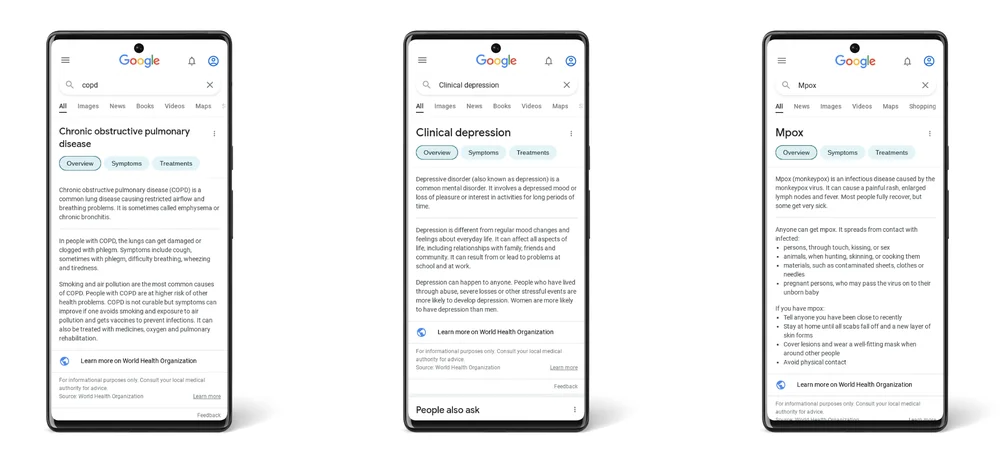
Google has renewed its partnership with the World Health Organization (WHO) to provide what it calls “factual” information about different diseases and conditions. The partnership is positioned as a way to combat what it says is the spread of medical “misinformation” observed during the pandemic.
On Google search, there are already Knowledge Panels at the top of results when users search for certain conditions and diseases.
Soon, the Knowledge Panels will include more conditions and illnesses like depressive disorder, Ebola, COPD, malaria, hypertension, diabetes, Mpox, and others, all using information verified by the WHO.
In a previous partnership, Google awarded more than $320 million to the WHO in Ad Grants to help spread its medical information. In the new partnership, Google awarded the global public health organization an additional $50 million to continue the efforts.
The WHO has been criticized more in frequent years for calling for censorship while itself putting out information during the pandemic that turned out to ultimately be untrue.
Google’s YouTube was criticized for censoring anything that went against the WHO during the pandemic, even if independent commentators ended up being correct.
Black Lives Matter hitting hard times
RT | May 24, 2023
Black Lives Matter is spending money at double the rate it takes in revenue as donations to the activist group plummet and management costs rise, causing its asset base to shrink.
Donations to BLM’s Global Network Foundation tumbled to less than $9.3 million in its latest fiscal year, ended on June 30, down a staggering 88% from the preceding 12 months, according to state tax filings. Revenue was even lower, at $8.5 million, amid investment losses. The group’s spending totaled over $17 million, or twice as much as it took in.
The documents were first obtained by the Washington Free Beacon, showing that the financial bonanza that BLM reaped during its 2020 protests against police brutality is now dwindling. Net assets dropped 28% in the latest fiscal year, declining to $30.2 million.
Part of the problem is that even as the foundation throttles back its activities – expenses for “program services” plunged 65% from a year earlier, to $11.5 million – it’s spending even more on management. Those costs rose 36% last year to $5.1 million.
The group’s leaders have also been accused of siphoning off donations for their personal gain. A sister organization, Black Lives Matter Grassroots, claimed in a lawsuit that foundation leader Shalomyah Bowers diverted $10 million for his own use. His predecessor, co-founder Patrisse Cullors, resigned in May 2021 after being accused of living a lavish lifestyle on BLM’s wealth. She reportedly purchased four homes for a combined $3.2 million while heading the group.
The Cullors family continues to benefit financially from BLM. The documents showed that her brother, graffiti artist Paul Cullors, received $140,000 in compensation last year in his role as “head of security.” In addition, his security firm was paid more than $750,000. Filings for the previous fiscal year showed that the foundation paid a company owned by Damon Turner, father of Patrisse Cullors’ child, nearly $970,000 for “live production, design and media” services.
An auditors’ review of the group’s finances reportedly found that Bowers’ company had been paid nearly $1.7 million over the preceding two years for “management and consulting services.”
Cicley Gay was brought in as the BLM foundation’s chairwoman in April 2022, at least partly to help sort out the group’s finances. She reportedly had difficulties managing her own finances, filing for bankruptcy protection from creditors three times between 2005 and 2016.
Cullors and two other activists launched the BLM movement in 2013, following the acquittal of George Zimmerman, who killed black teenager Trayvon Martin during a February 2012 scuffle while serving as a neighborhood watchman in Sanford, Florida.
BLM raked in donations from Microsoft, Amazon and other corporations in the summer of 2020, after the killing of black Minneapolis resident George Floyd by police sparked a wave of protests around the country and overseas. Cullors referred to the huge cash influx as “white guilt money.” Many of the demonstrations escalated into riots, leaving many Americans injured and dead and causing billions of dollars in property damage.
LinkedIn Locks Out Presidential Candidate Vivek Ramaswamy, Censors Him For “Misinformation”
By Christina Maas | Reclaim The Net | May 25, 2023
In yet another development that raises serious questions about the suppression of election candidates during a presidential campaign, presidential candidate Vivek Ramaswamy has announced he has been locked out of his LinkedIn account for his comments on climate change and President Biden’s relationship with China.
“I was a bit surprised to get an email noting that my LinkedIn account had been shut down,” Ramaswamy said in a video. “I wondered why, ‘cause actually a number of friends texted me saying they follow me on LinkedIn. That’s how they keep up. They weren’t able to find me anymore. And so when I had my team get in touch with LinkedIn, here’s the response that we got.”
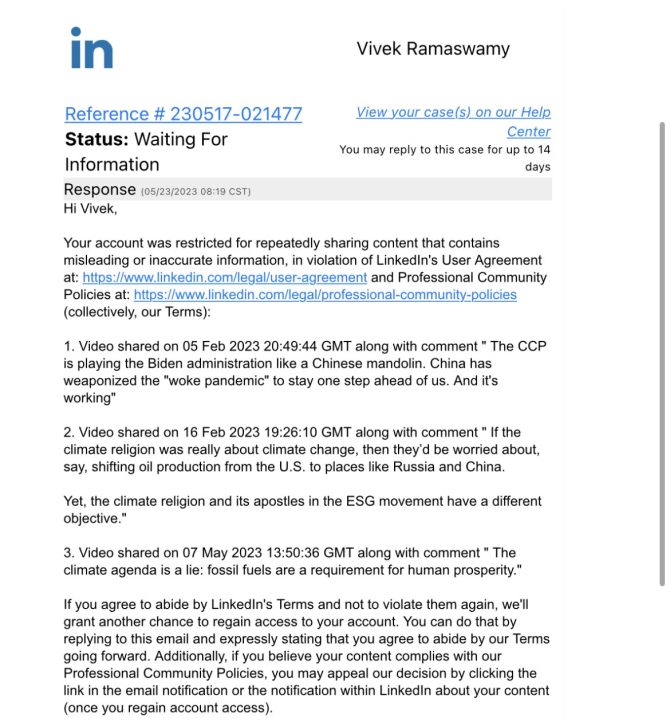
Ramaswamy, went on to explain the excuse that LinkedIn gave: “Your account was restricted for sharing content that contains misleading or inaccurate information,” Ramaswamy said. “They said that it was one video, a video where in the video I said the CCP [Chinese Communist Party] is playing the Biden administration like a Chinese mandolin. China has weaponized the woke pandemic to stay one step ahead and it’s working.”
Ramaswamy said his second offense was saying, “if the climate religion was really about climate change, then they’d be worried about shifting oil production from the US to places like Russia and China. Yet the climate, religion and its apostles and the ESG movement have a very different objective.”
And Ramaswamy’s third offense on the Microsoft-owned platform was saying that, “the climate agenda is a lie. Fossil fuels are a requirement for human prosperity.”
Ramaswamy, a notable biotech entrepreneur turned political candidate, is no stranger to controversy and was little fazed by the censorship for himself. But he talked about how he’s more prominent and other people likely won’t be so lucky when they get censored by tech giants.
“Now, I gotta kick out of this, I’m gonna be honest. I’m sure that we’re gonna get this escalated because I’m a US presidential candidate,” he said. “We have the connectivity to the people that we need to talk to to be able to get my LinkedIn account back. But I’m not bringing this about because it’s about me. I’m bringing this up because if they can do it to me, they can really do it to anybody for making statements about the climate change movement and agenda in this country that are grounded in fact, and then express an opinion based on those facts to make a statement about Biden’s relationships with China and criticize his China policies as a result.”
Ramaswamy’s outspoken views on issues such as big tech, and identity politics have drawn both criticism and support. However, it’s his commentary on climate change that has landed him in hot water with LinkedIn, the world’s largest professional networking platform.
Microsoft is currently facing scrutiny for its lack of transparency with its partnership with the Global Disinformation Index, a controversial censorship network with state ties. Microsoft is dragging its feet regarding requests for transparency about how it operates its censorship practices and what ties it has to state-backed groups when doing so.
EXPOSED: Biggest FBI Spy Scandal of the Year
By Jim Bovard | The Libertarian Institute | May 25, 2023
A Foreign Intelligence Surveillance Court opinion released last week revealed that the FBI violated the constitutional rights of 278,000 Americans in 2020 and 2021 with warrantless searches of their email and other electronic data. For each American that the FISA court permitted the FBI to target, the FBI illicitly surveiled almost a thousand additional Americans. This is only the latest federal surveillance scandal stretching back to the years after 9/11.
The FISA law was enacted in 1978 to curb the rampant illegal political spying exposed during the Richard Nixon administration. After the 9/11 attacks, the George W. Bush administration decided that the president was entitled to order the National Security Agency to vacuum up Americans’ emails and other data without a warrant. After The New York Times exposed the surveillance scheme in late 2005, Attorney General Alberto Gonzales announced that “the president has the inherent authority under the Constitution, as commander in chief, to engage in this kind of activity.” Gonzales apparently forgot the congressional impeachment proceedings against President Nixon. The Bush White House also asserted that the September 2001 “Authorization to Use Military Force” resolution Congress passed entitled Bush to tap Americans’ phones. But if the authorization actually allowed the president to do whatever he thinks necessary on the homefront, Americans had been living under martial law.
Federal judges disagreed with Bush’s prerogative to obliterate American privacy. The result was a 2008 FISA reform that authorized the feds to continue commandeering vast amounts of data. But under Section 702 of that law, the FBI was permitted to conduct warrantless searches of that stash for Americans’ data only to seek foreign intelligence information or evidence of crime.
President Barack Obama responded to the new law by sharply expanding the NSA’s seizures of Americans’ personal data. The Washington Post characterized Obama’s first term as “a period of exponential growth for the NSA’s domestic collection.” Obama’s Justice Department thwarted court challenges to the surveillance, thereby permitting the White House to claim that it was respecting Americans’ rights and privacy.
Edward Snowden blew the roof off the surveillance state with his disclosures starting in June 2013. But there was no reason to presume that federal crime sprees were not occurring before Snowden blew the whistle. Professor David Rothkopf explained in 2013 how FISA’s Section 702 worked:
“What if government officials came to your home and said that they would collect all of your papers and hold onto them for safe-keeping, just in case they needed them in the future. But don’t worry… they wouldn’t open the boxes until they had a secret government court order… sometime, unbeknownst to you.”
The 2008 FISA amendments and Section 702 snared vast numbers of hapless Americans in federal surveillance nets. The Washington Post analyzed a cache of 160,000 secret email conversations/threads (provided by Snowden) that the NSA intercepted and found that nine out of ten account holders were not the “intended surveillance targets but were caught in a net the agency had cast for somebody else.” Almost half of the individuals whose personal data was inadvertently commandeered were U.S. citizens. The files “tell stories of love and heartbreak, illicit sexual liaisons, mental-health crises, political and religious conversions, financial anxieties and disappointed hopes,” the Post noted. If an American citizen wrote an email in a foreign language, NSA analysts assumed they were foreigners who could be surveilled without a warrant.
Snowden also leaked secret court rulings that proved that the FISA Court had “created a secret body of law giving the National Security Agency the power to amass vast collections of data on Americans,” The New York Times reported in 2013. FISA judges rubberstamped massive seizures of Americans’ personal data that flagrantly contradicted Supreme Court rulings on the Fourth Amendment. The Times noted that the FISA court had “become almost a parallel Supreme Court, serving as the ultimate arbiter on surveillance issues,” and almost always giving federal agencies all the power they sought.
Unfortunately, Snowden’s courageous disclosures did not stop the outrages. The heavily-redacted 2022 opinion finally released Friday revealed that the FBI wrongly searched almost 300,000 Americans’ online lives. And this was on top of the roughly 3.4 million warrantless searches of Americans in 2021 via Section 702 that the FBI conducted that the Justice Department claimed was justified.
The latest disclosure from the FISA court signals that the FBI presumed that any American suspected of supporting the January 6, 2021 protests forfeited his constitutional rights. Roughly 2,000 pro-Trump protestors (including an unknown number of undercover agents and informants) entered the Capitol that day. But an FBI analyst exploited FISA to unjustifiably conduct searches on 23,132 Americans citizens “to find evidence of possible foreign influence, although the analyst conducting the queries had no indications of foreign influence,” according to FISA Chief Judge Rudolph Contreras. The court ruling did not disclose the standards (if any) the FBI used for its warrantless January 6 searches. Did Twitter retweets suffice?
The FBI exploited FISA to target 19,000 donors to the campaign of a candidate who challenged an incumbent member of Congress. An FBI analyst justified the warrantless searches by claiming “the campaign was a target of foreign influence,” but even the Justice Department concluded that almost all of those searches violated FISA rules. Apparently, merely reciting the phrase “foreign influence” suffices to nullify Americans’ rights nowadays. (In March, Rep. Darin LaHood (R-IL) revealed that he had been wrongly targeted by the FBI in numerous FISA 702 searches.)
The FBI conducted secret searches of the emails and other data of 133 people arrested during the protests after the killing of George Floyd in 2020.
The FBI conducted 656 warrantless searches to see if they could find any derogatory information on people they planned to use as informants. The FBI also routinely conducted warrantless searches on “individuals listed in police homicide reports, including victims, next-of-kin, witnesses, and suspects.” Even the Justice Department complained those searches were improper.
Judge Contreras lamented: “Compliance problems with the querying of Section 702 information have proven to be persistent and widespread.” The FBI responded to the damning report with piffle:
“We are committed to continuing this work and providing greater transparency into the process to earn the trust of the American people and advance our mission of safeguarding both the nation’s security, and privacy and civil liberties, at the same time.”
In 2002, the FISA court revealed that FBI agents had false or misleading claims in 75 cases and a top FBI counterterrorism official was prohibited from ever appearing before the court again.
In 2005, FISA chief judge Colleen Kollar-Kotelly proposed requiring FBI agents to swear to the accuracy of the information they presented; that never happened because it could have “slowed such investigations drastically,” the Washington Post reported. So FBI agents continued to have a license to exploit FISA secrecy to lie to the judges.
In 2017, a FISA court decision included a 10-page litany of FBI violations, which “ranged from illegally sharing raw intelligence with unauthorized third parties to accessing intercepted attorney-client privileged communications without proper oversight.”
In 2018, a FISA ruling condemned the FBI for ignoring limits on “unreasonable searches.” As The New York Times noted, “F.B.I. agents had carried out several large-scale searches for Americans who generically fit into broad categories… so long as agents had a reason to believe that someone within that category might have relevant information. But [under FISA] there has to be an individualized reason to search for any particular American’s information.” The FBI treated the FISA repository like the British agents treated general warrants in the 1760s, helping spark the American Revolution.
In April 2021, the FISA court reported that the FBI conducted warrantless searches of the data trove for “domestic terrorism,” “public corruption and bribery,” “health care fraud,” and other targets—including people who notified the FBI of crimes and even repairmen entering FBI offices. If you sought to report a crime to the FBI, an FBI agent may have illegally surveilled your email. Even if you merely volunteered for the FBI “Citizens Academy” program, the FBI may have illegally tracked all your online activity. As I tweeted after that report came out, “The FISA court has gone from pretending FBI violations don’t occur to pretending violations don’t matter. Only task left is to cease pretending Americans have any constitutional right to privacy.” FISA court Chief Judge James Boasberg lamented “apparent widespread violations” of the legal restrictions for FBI searches but shrugged them off and permitted the scouring of Americans’ personal data to continue.
The FISA court treats the FBI like liberal judges treat serial shoplifters. Going back more than 20 years, FISA court rulings have complained of FBI agents lying to the court and abusing the law. As long as the FBI periodically promises to repent, the FISA court entitles them to continue decimating the Fourth Amendment.
Federal intelligence agencies refuse to even estimate how many Americans’ private data has been rounded up in government databases. There is no reason to presume that the feds have disclosed all their FISA wrongdoing. Prior to Edward Snowden’s leaks, the feds probably admitted less than 1% of federal surveillance abuses.
Section 702 will expire this year unless Congress reauthorizes that provision of the law. But the FBI’s perpetual crime wave has created a hornet’s nest on Capitol Hill. Rep. Andy Biggs (R-AZ) asked: “How much longer must we watch the FBI brazenly spy on Americans before we strip it of its unchecked authority?” Rep. Mike Garcia (R-CA) declared, “We need a pound of flesh. We need to know someone has been fired.” Even Rep. Jerry Nadler (D-NY), the ranking Democrat on the House Judiciary Committee, opposes reauthorizing Section 702 without fundamental reforms.
But will Congress finally stop the federal spying spree on Americans? As I tweeted on December 27, 2012, “FISA Renewal: Only a fool would expect members of Congress to give a damn about his rights and liberties.” Without radical reform, FISA should be renamed the “Trust Me, Chumps!” Surveillance Act.
Jim Bovard is the Junior Fellow for The Libertarian Institute. He is the author of Public Policy Hooligan (2012), Attention Deficit Democracy (2006), Lost Rights: The Destruction of American Liberty (1994), and 7 other books.
Featured Video

Thomas Fazi: NATO’s Hybrid Warfare – Deception & Permanent War
or go to
Aletho News Archives – Video-Images
Book Review
The Zeolite Book — First Edition, 2026, Paperback
The volcanic mineral medicine will not patent — for the toxic burden medicine will not name
Lies are Unbekoming – October 30, 2026
 Zeolite is old. It is in Roman concrete that has held for two thousand years. It’s in the water filters of ancient cisterns. It’s in the stomachs of Pacific livestock whose keepers knew, somehow, that this grey crumbling rock made the animals healthier. It’s in Soviet clinical protocols from the 1960s. It’s in the standard emergency response to the Chernobyl explosion.
In 1986, after the Chernobyl reactor failure, the Soviet Union manufactured and distributed natural zeolite at industrial scale — for soil remediation, for livestock feed, for human consumption, for the cleanup itself. Karl Hecht, who had been director of the Institute for Experimental and Clinical Pathophysiology at the Charité of Humboldt University Berlin, spent the six decades after that building the clinical research base — on silicon’s role in human health, on zeolite’s clinical safety, on its applications in ageing. In 2018, Pavelić and colleagues published a comprehensive clinical safety review of natural clinoptilolite in Frontiers in Pharmacology. In 2019, Mastinu analysed its binding affinities. In the Western medical literature, these works sit largely uncited.
What has not been treated at book length, until now, is how a volcanic mineral with six decades of Soviet clinical work behind it, two major peer-reviewed Western reviews, and ongoing clinical use across the former Eastern Bloc, remains almost entirely absent from Western medical practice — and what the toxic burden it’s meant to address actually is.
The Zeolite Book gathers the Soviet clinical record, the Western peer-reviewed studies, three contemporary practitioner voices, and three serious counterviews into one honest treatment. That’s why the book runs to seven appendices. 288 pages, four parts, three practitioner voices, three counterviews, seven appendices. The honest treatment is the argument.
Blog Roll
 Aletho News
- UAE security forces tortured, killed journalist for opposing Israel normalization: Report
- They Compared the Spice to the Drug. The Spice Won — Again. (Part 2)
- Thomas Fazi: NATO’s Hybrid Warfare – Deception & Permanent War
- Wrong, AP and NPR: Europe’s 50,000 Heat Deaths Are a Computer-Model Estimate, Not a Real Body Count
- Questioning Your Doctor Is Now Considered A Psychological Problem (Seriously)
- London tourism expo promotes Israeli agency linked to theft of Palestinian land
- Dockworkers launch global strike against Israeli and US military shipments
- Europe facing gas price shock – Gazprom chief
- Ukraine continues recruiting people with disabilities
- Weaponized Journalism: 2021 Sayer Ji Interview with NPR
- If Americans Knew
- An error has occurred; the feed is probably down. Try again later.
- No Tricks Zone
- Germany’s Green Energy Transition Becoming Increasingly Expensive…Another 6 Trillion Euros!
- Sudden Stratospheric Warming, Powerful El Niño Combination May Lead To Extreme Europe Cold, Energy Crisis!
- Two New Studies Find Thwaites Glacier Melt Cannot Be Driven By Human Activity Or A Warming Ocean
- E-Cars Reduce CO2 Emissions By Only 41% Compared To Internal Combustion Engine Vehicles
- Predictions Made By Renowned Climate Professor Over Past Decades Have Been Proven To Be Poor
- New Study Suggests Large Regions Of The Pacific Ocean Have Been Cooling For The Last 80 Years
- Germany’s Green Energy Debacle: High Energy Costs Force Kahla Porzellan to Close After 182 Years!
- New Study: 50 Years Of The Most Aggressive ‘Net Zero’ Policies Can Only Affect The Global Climate By 0.03°C
- US September “Heat” Was No Record…Many Records Set Decades Ago
- Latest European Green Energy Debacle; Portugal’s Largest Flagship Solar Park Insolvent!

