Hosting Washington’s war: Bahrain faces the consequences
By Hasan Qamber | The Cradle | March 12, 2026
The Persian Gulf is entering one of the most volatile periods in its modern history. Military confrontation between Iran, the US, and Israel has, from the outset, unfolded across the Gulf geography itself. States hosting western military infrastructure – particularly Bahrain – have not merely been exposed to the conflict’s expansion, but structurally integrated into its battlefield logic.
For Bahrain, the current escalation raises urgent questions about the kingdom’s internal stability, the resilience of Gulf political systems, and the capacity of neighboring countries to absorb the security, economic, and social shocks generated by an expanding war.
Frontline kingdom
Bahrain today stands squarely at the center of the region’s intensifying confrontation. Despite its small size, the island holds outsized political and military importance. Its strategic location, heavy reliance on the energy sector, and fragile domestic balances make it one of the Gulf states most exposed to the consequences of prolonged escalation.
The kingdom’s hosting of the US Fifth Fleet headquarters cements its position as a key node in Washington’s military architecture in the Persian Gulf. This presence transforms Bahrain into a potential target in any direct clash between Tehran and Washington. As the war goes on, US installations on Bahraini soil are increasingly viewed as forward operational platforms – and therefore legitimate strategic objectives in a widening regional war.
The implications extend beyond the military domain. Bahrain’s domestic political arena remains shaped by unresolved tensions dating back to the 2011 uprising. Renewed confrontation risks aggravating these internal fault lines by tying national stability more closely to the trajectory of external conflict.
Recent developments have effectively placed Bahrain on the front line. Its role as both a logistical hub for western military operations and a regional energy services center means that any escalation in the Persian Gulf immediately reverberates across the island’s security environment.
According to reports, Iranian strikes against Bahraini-based targets began on 28 February. By early March, roughly 70 to 75 ballistic missiles and more than 120 drones had reportedly been launched. Bahraini authorities stated that most incoming projectiles were intercepted.
Targets included facilities linked to the US Fifth Fleet, Bahraini and US military infrastructure, the BAPCO refinery complex in Ma’amir, and sites in Manama associated with US personnel. Installations near Bahrain International Airport and a major desalination plant – the Abu Jarjour facility – were also reportedly struck.
While the full extent of the damage remains unclear, some accounts suggest partial destruction of base infrastructure and temporary disruption of logistical systems. Heightened alert levels were subsequently reported across US installations throughout the Persian Gulf following injuries among American personnel.
Energy pressure points
The military dimension of the crisis intersects with Bahrain’s structural economic vulnerabilities. The kingdom’s economy remains heavily dependent on the energy sector, with BAPCO Energies forming its backbone. Following recent upgrades, refining capacity has reached approximately 405,000 barrels per day – positioning Bahrain as an important, if relatively modest, contributor to regional oil supply dynamics.
Reports indicate that the refinery complex has been hit at least once during the escalation, triggering fires and forcing the company to invoke force majeure clauses on certain export commitments. Temporary disruptions to refining operations reportedly led to shipment delays and a partial pause in exports, although authorities insist domestic fuel supplies remain secure.
The situation is further complicated by the growing role of international investors in Bahrain’s energy sector. The sale of selected BAPCO assets to major global investment firms – including the US-based BlackRock – has generated political controversy.
Civil society groups have criticized such moves as part of a broader normalization trajectory aligned with Washington’s regional agenda, particularly amid mounting public debt estimated to exceed 130 percent of GDP.
Any sustained targeting of energy infrastructure would therefore carry consequences far beyond immediate production losses. It would threaten investor confidence, fiscal stability, and Bahrain’s long-term economic positioning within the Gulf.
Hormuz chokehold
The crisis acquires even greater significance in light of Iran taking control over maritime traffic through the Strait of Hormuz – one of the most critical arteries in the global energy system. At least 20 percent of the world’s seaborne oil trade passes through this narrow waterway. Any disruption to navigation would send shockwaves through international markets and place immense pressure on Gulf economies.
For Bahrain, whose oil export routes are heavily tied to the strait, strategic alternatives remain limited. While pipeline connections to Saudi Arabia offer partial mitigation, rerouting exports through Red Sea terminals or relying on floating storage solutions would impose logistical and financial constraints.
The implications extend to food security. Gulf states import the vast majority of their food supplies via maritime routes traversing Hormuz, with some importing as much as 85–90 percent overall. Bahrain, constrained by limited agricultural capacity, is particularly vulnerable.
Early indicators of wartime strain have already surfaced, including higher transport costs, shipment delays, and rising prices for essential imported goods. Authorities maintain that strategic reserves are sufficient for now, but prolonged disruption could test these assurances.
Public mood and internal pressure
Bahrain’s domestic political environment adds another layer of complexity. The kingdom is often described as the only Gulf state where a Shia demographic majority lives under Sunni political rule, though the absence of official statistics makes precise figures contested. Estimates have fluctuated significantly since the introduction of political naturalization policies in the early 2000s.
The 2006 “Bandar Report” controversy – which alleged systematic demographic engineering – remains a reference point in debates about representation and legitimacy. Today, observers suggest Shia citizens may constitute between 55 and 65 percent of the population, with Sunnis forming a substantial minority. Expatriates account for more than half of Bahrain’s total population, further complicating social dynamics.
Against this backdrop, public reactions to regional escalation diverge sharply from official state positions. While Gulf governments continue to emphasize strategic partnership with Washington, segments of Bahraini society openly express support for strikes targeting US military facilities in the region. Social media circulation of footage from recent attacks reflects this polarization.
Authorities have responded with sweeping security measures aimed at preventing internal destabilization. Arrests have been reported against individuals accused of documenting strikes or organizing demonstrations. Restrictions on public gatherings and curfews in sensitive areas underline official concerns that regional war could reignite domestic protest movements.
According to human rights and field sources speaking exclusively to The Cradle, at least 114 people have been arrested since the beginning of the events. The Public Prosecution has sought the death penalty for a group of citizens and residents accused of “communicating with the enemy” for documenting missile and drone strikes on military targets.
This reflects the scale of the political challenge Bahrain faces as it attempts to balance internal stability with its security and external commitments amid a divided public mood regarding the regional war.
Strategic dilemmas
Manama’s predicament reflects a broader Gulf reality. The kingdom faces simultaneous pressures stemming from its geographic exposure, reliance on external military guarantees, and unresolved internal political tensions. Crisis management under such conditions becomes increasingly complex as regional confrontation deepens.
There is also uncertainty surrounding the stance of neighboring Gulf states. Should escalation expand to include widespread targeting of energy infrastructure or maritime trade routes, regional economic interdependence could magnify the impact on domestic stability across the peninsula.
A sustained Iran–US–Israeli confrontation threatens to reshape the political calculus of Gulf states. For decades, security architectures across the region have been anchored in strategic partnerships with Washington. Direct confrontation between Iran and the US, therefore, places these states in a structurally vulnerable position.
Three major risks loom. First, the physical targeting of military bases and oil facilities could undermine deterrence frameworks. Second, prolonged disruption to trade and energy flows may generate severe economic stress. Third, divergent popular attitudes toward the conflict risk fueling internal political tensions.
In Bahrain, these dynamics intersect with an already active opposition and a politically engaged society. Continued escalation could heighten domestic sensitivity to government policies and widen the gap between official narratives and public sentiment.
Paths ahead
Several trajectories remain possible. Rapid containment of escalation would restore the familiar pattern of managed tension in the Persian Gulf. A prolonged exchange of strikes, however, could intensify economic pressure and gradually erode political stability across Gulf states.
The most dangerous scenario would see the region transformed into an open theater of great-power confrontation – fundamentally altering the balance of power and exposing smaller states like Bahrain to sustained instability.
The kingdom now finds itself navigating an exceptional moment in regional history. Escalation is now shaping the island’s economic stability, political tensions, and security calculations in real time. Efforts by authorities to enforce internal control underline the depth of official concern that external conflict could reopen unresolved domestic fault lines.
The kingdom’s experience points to a wider shift across the Persian Gulf: strategic alignment with Washington’s military order is increasingly transforming allied states into operational terrain. In Bahrain’s case, the distance between the forward base and the front line has effectively collapsed.
The US fell for its own Iran propaganda
By Robert Inlakesh | Al Mayadeen | March 13, 2026
The US government’s mistake with Iran has been that it clearly fell into believing its own lies. Think tanks, donors, paid advisors, lobby groups, and establishment analysts are all responsible for the catastrophic mistakes that have been made in attacking the Islamic Republic.
What was supposed to be a war, destined to be all over in four days, quickly turned into weeks, months, and now, in US President Donald Trump’s own words, a “forever” war. In order to understand why, we have to assess the way the political system in Washington works.
As we now know, US politicians are oftentimes chosen by the donor class. Most of the US Congress and Senate take considerable sums from AIPAC and affiliated pro-Israeli, pro-war donors. The Israeli Lobby not only pays its chosen politicians, but also hands them materials to run through, so that they skip to the Zionist script and position themselves as attack dogs against anyone who stands up to the lobby.
Hiding underneath this, we have think tanks, which are the policy expert wing of the lobbyists. These think tank “experts” are brought in as the brains behind the operation. They shift around between holding positions within different administrations, sitting on boards, and writing briefs or analyses for think tanks.
Then you have the mainstream media, which is owned by many of the same people funding the think tanks and lobby groups, employing articulate individuals to parrot their propaganda. The media itself is a bubble, where the so-called “reputable” outlets rely on each other for validity and help to police the boundaries of the “acceptable” discourse, meaning the likes of the New York Times, BBC, and others.
When it comes to broadcast media in specific, the top suppliers of stories, soundbites, on-the-ground footage, and leads are Reuters, AFP, and the Associated Press. Oftentimes, broadcast media channels will simply copy and paste the leads or descriptions from what these suppliers provide, altering them ever so slightly to suit their channel’s bias. That is why they often use very similar language and report the same stories for their news bulletins. Anyone who has worked in a newsroom knows this to be the case.
This trio of information control, which often intersects and enjoys some crossover, is what pollutes the minds of the masses on a daily basis. This is important to understand in order for the rest of this article to make sense.
Falling for their own lies
In the lead-up to the illegal attack on the Islamic Republic of Iran, the Western ruling class constantly repeated the idea that Iran and its allies were severely weakened. Revelling in what will likely prove to be a pyrrhic victory in Syria, with the installation of a pro-US Zionist collaborator regime in Damascus, the annihilation of Gaza’s infrastructure, along with the severe blows to Hezbollah’s leadership, all three elements of the Zionist information control system began to grow arrogant.
Think Tanks like the Zionist Washington Institute for Near East Policy (WINEP) held a series of conferences about the disarmament of Hezbollah and discussed how the so-called Gaza ceasefire was supposed to be weaponized in “Israel’s” favour, while discussing war on Iran as if it was like putting down a once dominant racehorse with a broken leg.
Still, today, if you look at WINEP’s homepage, there are analysis pieces, written by Zionists salivating over a victory over Iran and envisaging how the future will pan out in a West Asia dominated by the Israelis. “The Middle East’s 1919 Moment” and “A Levant Without Militias” discuss the downfall of Iran and Hezbollah, respectively. Even at a time of great crisis for the Zionist entity, they cannot help but fantasize about how they will dominate in the future.
The trio of information control has created a parallel universe for themselves, one which they continue to cling to, for fear of shattering their entire view of reality.
When Donald Trump and Israeli PM Benjamin Netanyahu claimed to have greatly degraded Iran, it wasn’t just them speaking; they were in lockstep with the think tanks, lobbyists, and donors. Just as was the case when former US envoy to Lebanon, Morgan Ortagus, confidently asserted that Hezbollah was defeated.
For them, assessing the realities on the ground was no longer a priority; what was important was bolstering a narrative that would lead to the war that the Zionist entity desired. In essence, what they had done was fall for their own nonsense.
All of this stems from the psychological blow the Zionist regime and its loyal supremacist backers suffered on October 7, 2023. When a few thousand Palestinian Resistance fighters, armed with light weapons, tore down the illusion of the Israeli surveillance regime and collapsed its southern command within hours, the Zionists went into a kind of mental hysteria.
Suddenly, on that day, it was proven that the theory of Hezbollah’s late Secretary General, Sayyed Hassan Nasrallah, was correct: “Israel” is indeed weaker than a spider’s web. This meant for them that two things had to be achieved: the first was that their so-called “deterrence capacity” had to be re-established, which they believed would be achieved through committing the world’s first live-streamed genocide.
The second imperative was that the Zionist project had to be rapidly accelerated. At first, this appeared unlikely, yet their perceived successes in Lebanon and Syria appeared to give them the impression that it was possible.
Along comes the second Trump Presidency, which was bought and paid for by the Zionist billionaire class.
Donald Trump, a man with a vocabulary no greater than that of a 10-year-old, is their perfect puppet. Not only this, his entire administration is staffed with ultra-Zionists or paid shills who lack basic intelligence. Therefore, the Zionists saw that this was the perfect time for them to hatch the last phase of their so-called master plan to expand their regime and rule the entire region.
In the process of doing this, the Zionists dismantled the United Nations and the notion of International Law, instead ushering in “the law of the jungle.” There are no longer international norms or red lines, just total chaos.
Meanwhile, as this was going on, the Zionists adopted the attitude toward the global population that they should be scared into submission; should they dare stand up to oppose the tyranny everyone has watched unfold before their very eyes. When they are surprised because things aren’t going their way, they cry victim and, in a fit of rage, attempt to punish you. This is a reflection of their unstable mental state.
All of this is relevant because it explains how we have gotten to this point and why this trio of information control has bought into their own nonsense. The war on Iran was evidently going to be a catastrophe, but they did it anyway. Those of us who have been monitoring the situation could also tell that Lebanese Hezbollah was far from militarily finished, which the Israeli media are now beginning to come to terms with.
What do they do now that the situation is getting out of hand? They censor and desperately lie to cover their tracks. They censor their deaths, lie about the destruction and missile hits, fake air defense victories, and claim tactical and operational military victories that don’t exist. One example of this is the US Trump administration, which claimed to have destroyed Iran’s navy during the first days of the war and still brags about sinking new ships.
The Israelis take things even further: with dozens of military vehicles hit and their soldiers falling into ambush after ambush in Lebanon, only two soldiers have died, according to them. They have even banned the filming of Iranian and Hezbollah missile strikes, threatening their own population with fines and jail time for doing so. Sometimes, they will claim to have intercepted all incoming projectiles or say they fell in open spaces, yet not too long after, published videos show direct hits. It’s getting so bad there, in terms of censorship, that their own people are getting agitated.
These people lived in a “reality” where Hezbollah was weak and Iran was weak, claiming that it had only a few thousand missiles and a handful of launchers; a “reality” in which killing Iran’s leader, Sayyed Ali Khamenei, would instantly lead to regime change, where the Iranian people would suddenly fight against their government because Netanyahu told them so. Perhaps the only thing they don’t believe is their laughable lies about Iranian protester deaths; that nonsense is reserved for the Pahlavist cult.
As the entire planet is witnessing, Iran and the Axis of Resistance that it backs are far from weak. Their determination is strong, and their capabilities are clearly greater than the Zionists expected. The longer this insane arrogance continues, the worse things are going to get, because just as we saw in the Gaza Strip, nobody is about to back down and become the slaves of the terrorist entity occupying Palestine.
Seyed M. Marandi: Threat of Seizing Kharg Island & the Use of Nuclear Weapons
Glenn Diesen | March 12, 2026
Seyed Mohammad Marandi is a professor at Tehran University and a former advisor to Iran’s Nuclear Negotiation Team. Prof. Marandi argues that it will be extremely difficult for the US to seize Kharg Island, and Iran would then destroy all energy facilities in the region.
Follow Prof. Glenn Diesen:
- Substack: https://glenndiesen.substack.com/
- X/Twitter: https://x.com/Glenn_Diesen
- Patreon: https://www.patreon.com/glenndiesen
Support the research by Prof. Glenn Diesen:
- PayPal: https://www.paypal.com/paypalme/glenndiesen
- Buy me a Coffee: buymeacoffee.com/gdieseng
- Go Fund Me: https://gofund.me/09ea012f
Is there even an off ramp?
Have events accelerated to the point where a nuclear attack is nearly inevitable?
Ashes of Pompeii | March 13, 2026
The strategic paradigm regarding Iran has shifted fundamentally. And despite the calls for a ground invasion in some circles, and given the combination of current events on the ground, Iranian resiliance, and logistics, it is simply not possible. Therefore, the United States faces a constricted set of options amidst an escalating existential crisis. The convergence of domestic political survival, allied desperation, military attrition, and the personal psychology of the executive creates a pressure cooker where the use of tactical nuclear weapons transitions from absolute taboo to a very real grim strategic calculus. Central to this equation is the vindictive nature of President Trump, a trait that transforms geopolitical setbacks into personal grievances, compounded by the “Bibi factor”: Benjamin Netanyahu’s four-decade obsession with confronting Iran, now reaching a point of catastrophic desperation as every strategic avenue fails.
Netanyahu has dedicated much of his political life to conflict with an emergent, Islamic Iran. For forty years, he has advocated, plotted, and pressured for decisive action. Now, with Israel under daily barrage and conventional options nearly exhausted, his influence on Washington becomes a volatile accelerant. But the more dangerous variable may not be Israeli pressure on America, but rather Israeli action independent of America. Israel possesses nuclear weapons. A desperate Israel, facing existential threat, may calculate that only a nuclear strike can halt the onslaught. If Israel launches first, the United States is instantly complicit. The question shifts from “Will America use nukes?” to “How does America respond when its ally does?”
This scenario triggers a specific and catastrophic escalation dynamic. Iran has consistently signaled that any existential attack would be met with disproportionate retaliation against its primary adversary: Israel. A nuclear strike would not coerce Tehran into surrender; it would guarantee an all-out Iranian assault focused overwhelmingly on Israeli population centers and probably the Dimona nuclear center. The retaliation would not be measured; it would be existential. For Trump, this creates an impossible bind. His vindictiveness demands punishment of Iran, but his legacy depends on protecting Israel. If Iran retaliates with devastating force, Trump faces two choices: accept the near destruction of America’s key ally, cementing his legacy as the president who lost the Middle East, or escalate further. Each path deepens the quagmire. Added to this is the question of whether Iran has, or is quickly acquiring, nuclear weapons that would be used in any retaliation response.
Compounding this trap is the total collapse of trust. Any diplomatic off-ramp requires a minimum reserve of credibility between adversaries. The Trump administration has systematically burned every bridge. The precedent of attacking on February 28 in the midst of negotiations signaled that talks were not a path to resolution, but a ruse to keep the opponent off guard. To de-escalate now would almost certainly require Trump to take substantial, clear and verifiable unilateral first steps: a ceasefire, sanctions relief and public concessions. In the current climate, such actions would not be read as statesmanship; they would be interpreted as capitulation by many in America, especially his staunchest allies. For a leader whose political identity is built on projecting strength and punishing perceived slights, unilateral de-escalation is politically indistinguishable from surrender. The trust deficit does not merely complicate diplomacy; it comes close to eliminating it as a viable instrument.
This absence of trust reinforces the escalation logic at every turn. Iran, believing that American assurances are worthless, has no incentive to show restraint. Israel, doubting that diplomacy can halt the threat, has every incentive to act alone. Trump, convinced that any sign of weakness will be exploited, has no political space to offer concessions. The system becomes self-reinforcing: distrust justifies aggression, aggression deepens distrust, and the space for compromise evaporates. Institutional guardrails – the military chain of command, cabinet counsel, congressional oversight – retain theoretical weight, but they are overwhelmed by the momentum of crisis. When every actor believes the other operates in bad faith, restraint appears as vulnerability, and to a desperate man, escalation appears as the only rational response.
Global and domestic consequences, however catastrophic, are discounted in the immediate calculus. The precedent of nuclear use would shatter non-proliferation regimes and realign global power. Yet, in the moment of existential pressure, these long-term risks are subordinate to the demand for survival and retribution. Domestic backlash remains possible, but partisan media ecosystems and the framing of Israeli victimhood could harden public resolve rather than soften it. The political cost of appearing weak may be seen to exceed the cost of escalation. Trump’s fear of legacy merges with the visceral demand to protect an ally under fire and punish an adversary that, in his mind, has humiliated American power for nearly half a century.
In conclusion, the decision rests on a knife’s edge, sharpened by the certainty of Iranian retaliation against Israel and the impossibility of diplomatic retreat. The trust deficit is not a peripheral concern; it is the linchpin that locks the system into escalation. With no ground option, no credible off-ramp, a desperate ally possessing nuclear capability, and a vindictive leader who equates compromise with defeat, the use of nuclear weapons emerges not as a deliberate policy choice but as an emergent property of systemic collapse. The taboo against nuclear weapons persists only so long as actors believe restraint serves their survival. When survival is perceived to depend on escalation, and when trust, the essential currency of de-escalation, has been extinguished, the unthinkable becomes inevitable. The United States may not make the first move, but it may find itself unable to stop the chain reaction it enabled. The legacy Trump fears may not be shaped by his decision, but by his inability to escape a logic where every path forward leads deeper into catastrophe. The world watches not a policy debate, but the unraveling of deterrence, diplomacy, and restraint in real time. The outcome will not be chosen, it will be endured.
God help us all.
Michael von der Schulenburg: Europe’s Self-Defeating Iran War Policy
Glenn Diesen | March 12, 2026
Michael von der Schulenburg is a German member of the EU Parliament who was previously a UN diplomat for 34 years in positions that included Assistant Secretary General of the UN Department of Political and Peacebuilding Affairs. Schulenburg also lived and worked for 9 years in Iran for the UN, and explains why this war is yet another disaster for Europe.
Follow Prof. Glenn Diesen:
- Substack: https://glenndiesen.substack.com/
- X/Twitter: https://x.com/Glenn_Diesen
- Patreon: https://www.patreon.com/glenndiesen
Support the research by Prof. Glenn Diesen:
- PayPal: https://www.paypal.com/paypalme/glenndiesen
- Buy me a Coffee: buymeacoffee.com/gdieseng
- Go Fund Me: https://gofund.me/09ea012f
- Books by Prof. Glenn Diesen
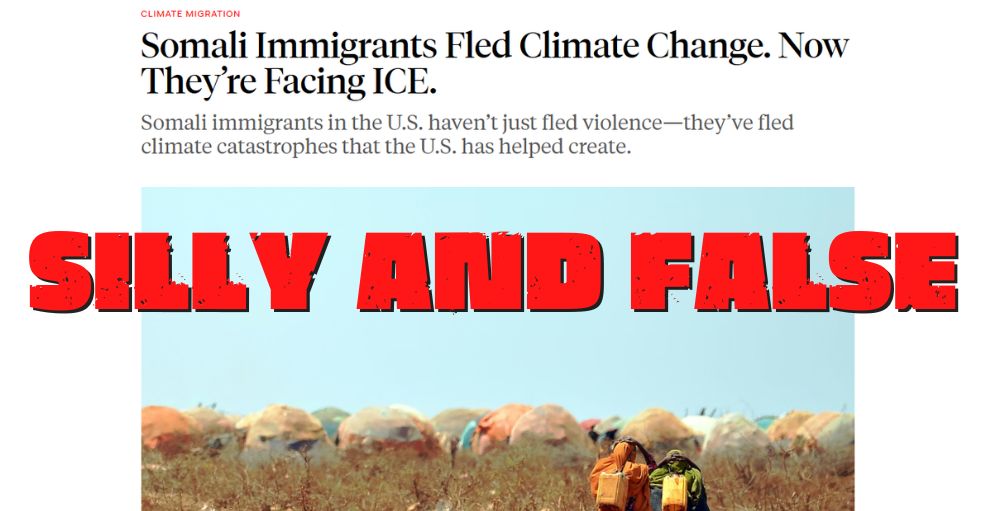
Sorry, The New Republic, Climate Change Isn’t Causing Somali Migration. Blame Civil Strife and Poverty.
By Linnea Lueken | Climate Realism | March 10, 2026
The New Republic (TNR) posted an article titled “Somali Immigrants Fled Climate Change. Now They’re Facing ICE,” claiming that Somali migrants in the United States have been driven out of their country by climate-change caused drought. This is false, or at least incomplete. Drought is a natural part of the region, even multi-year drought, and the present one is no different than the region has experienced with some regularity historically. It is civil strife and government corruption, resulting in continued poverty, that is leading Somalis to flee their homeland. With present governing institutions and security, they have been unable to improve water handling practices. Climate change has nothing to do with Somali emigration elsewhere in the region or to the United States, as even those interviewed for the article acknowledge.
TNR undermines its titular claim that unprecedented man-made climate change has forced Somalians to migrate by admitting that Somalian culture has “deep-rooted traditions of movement and migration.” TNR goes on to say that “Somalis have been caught in civil war and unrest for decades, and many have migrated to Kenya, Ethiopia, Europe, and the United States.”
Somehow not noticing the actual central point of that statement, that Somalians often move and that political strife has kept them destabilized, TNR says that climate change plays a “pervasive role” in the migration.
TNR claims that a multi-year drought “made a hundred times more likely due to warming caused by fossil fuel emissions—is affecting Somali people’s decisions to either relocate internally or migrate across international borders.”
Incredibly, later in the article, TNR refutes its own suggestion that this drought is worse, and pushing unprecedented migration, by explaining that this is how farmers have long dealt with drought in Somalia:
Traditionally, Somali pastoralists had resilient ways to deal with changes in rainfall and drought patterns, where families migrated and moved on a regular basis, even crossing borders in the process. But the nature of climatic changes—and conflict—overwhelmed their traditional capacities, leading to more rural-urban migration within the country and in East Africa.
That’s right, severe drought is something Somalians have dealt with for ages, long enough to have known traditions regarding adaptation to the dry periods.
There is no evidence that this drought is worse than those that drove historic migration.
The cited claim that recent drought in Somalia was made “a hundred times more likely” by climate change is not based on sound science. It comes from an attribution study from World Weather Attribution that specifically seeks to tie various weather conditions to human-caused climate change, they do not come to any other conclusions. Climate Realism has gone into the specifics of how unscientific World Weather Attribution studies are here, here, and here.
The TNR piece says that “[f]rom 2020 to 2023, the East Africa region had five failed rainy seasons, an unprecedented drought and climatic episode not seen in 40 years, which led to 70 percent crop loss, three million livestock deaths, and the displacement of about 2.9 million people in Somalia, according to some estimates.”
Admitting that a weather event also happened 40 years ago should tell a writer that their argument about something being “unprecedented” – meaning, without precedent, or never happened before—is faulty.
In fact, studies and data show a long history of swings between severe drought and monsoon floods in the region, and they show that nothing about modern drought is unprecedented. Paleo studies, including one published in Science, show that “intervals of severe drought lasting for periods ranging from decades to centuries are characteristic of the monsoon and are linked to natural variations in Atlantic temperatures.”
Climate Realism has covered this very claim before: In Anthony Watts’ “No, CBS News, Drought in Somalia is Not Being Driven by Climate Change,” he compared natural weather-driving patterns like the Atlantic Meridional Oscillation (AMO) and recent drought in Somalia and found repeated patterns of drought that were similarly severe.
Somalia is part of the Sahel region, and Watts shared this graphic of the region’s rainfall index since 1900, which shows that the rainfall in the Sahel varies widely over time:
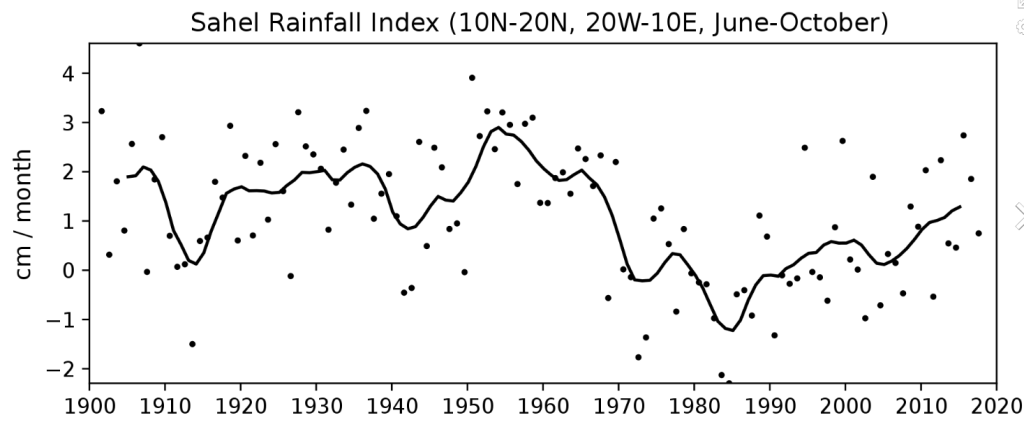
Figure 1: More than a century of rainfall data in the Sahel show an unusually wet period from 1950 until 1970 (positive index values), followed by extremely dry years from 1970 to 1991. (negative index values). From 1990 until present rainfall returned to levels slightly below the 1898–1993 average, but year-to-year variability was high. Source: Benedikt Seidl – based on JISAO data
Additionally, comparing crop production data between Somalia and neighboring countries like Ethiopia and Kenya reveals that even when drought impacts East Africa, Somalia is uniquely incapable of maintaining agricultural production. During the same period in which Ethiopia and Kenya saw increasing production in vital cereal crops, UN Food and Agriculture Organization (FAO) data show Somalia declining. (See figure below)
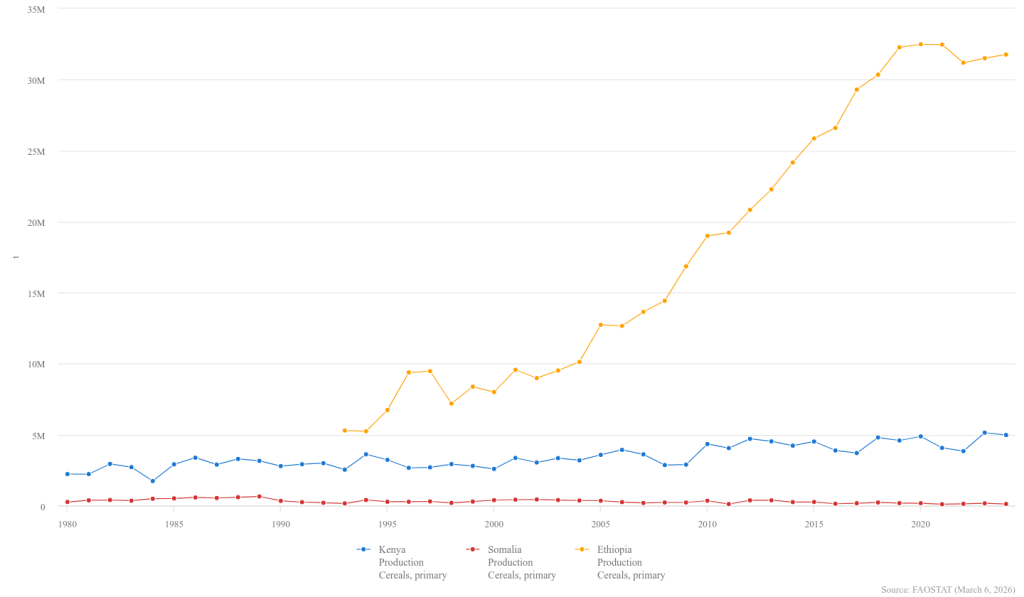
Is climate change not hitting Kenya and Ethiopia? What is the difference?
While Somalia has a long history of severe, recurring droughts, the worst drought in the past 50 years was the “Long-tailed Drought” from 1973 to 1975. That drought, and a subsequent similarly deadly drought in the early 1980s, occurred when the Earth was in a cooling spell and atmospheric carbon dioxide was much lower than today.
Somalia’s civil war and resulting destruction and corruption is the prime force behind Somalia’s emigration. Ironically, one of the interviewees in the TNR piece says as much:
Drought does not necessarily lead to famine and does not always lead to migration,” said Abdi Samatar, a Somali scholar and geographer at the University of Minnesota […] Somalis were unable to “put Humpty Dumpty back together in their country,” and in the absence of government support, “people have to do what they can for themselves,” Samatar added.
We at Climate Realism could not have said it better ourselves, though we have explained as much in past articles where mainstream outlets tried to link climate change and Somalia’s migration issue.
The New Republic’s effort to tie Somalians fleeing their country for the United States to climate change was a flawed, agenda-driven effort from the start. Even when those interviewed by TNR link the mass exodus of residents from Somali to other factors, TNR persists in pushing the narrative that climate change is playing a “pervasive role.”
It is true that Somalia is suffering through a severe, life threatening drought. It is also true that such droughts are not unprecedented but have been common throughout the region’s history. The nation’s unstable government and the ongoing, long-standing, civil war bear far more of the blame than climate change, especially since there is little or no evidence that Somalia’s climate has changed much over the past century.
The current drought is hitting Somalia’s populace worse than those of nearby countries in the region because of the political instability there. The New Republic was told this by the experts they interviewed but chose to ignore it to advance a climate scare story. Evidently, it’s too much to hope for honest journalism at The New Republic.
Linnea Lueken is a Research Fellow with the Arthur B. Robinson Center on Climate and Environmental Policy.
No evidence Russia sabotaged Baltic cables – Finnish intel
RT | March 12, 2026
Russia was not behind a series of ruptures in underwater cables in the Baltic Sea, Finland’s spy chief has admitted, adding that the assessment is “very broadly” shared within the European intelligence community.
Seabed infrastructure in the waterway has been repeatedly damaged in a series of incidents over the past two years. Several merchant vessels have been found dragging their anchors across the seabed, damaging power and communication cables in the process.
While some NATO and EU officials have accused Russia of sabotage and “hybrid warfare,” no evidence to back up the allegations has ever emerged. Moscow has repeatedly dismissed such claims as “absurd” and baseless.
Speaking to the outlet Suomen Kuvalehti in an interview published on Wednesday, Juha Martelius, the head of the Finnish Security and Intelligence Service (Supo), admitted that no proof of Moscow’s involvement had been found.
“Our understanding has been that there has been no deliberate Russian state activity in the background. It is a very broadly shared view in the other European intelligence community,” he said. The undersea infrastructure has been repeatedly damaged in accidents since as early as the 2000s, yet such occurrences previously did not receive extensive media coverage, he added.
Russia’s own underwater infrastructure was damaged in some of the incidents, Martelius pointed out. Moscow actually seeks to ensure that its own maritime traffic flows through the Baltic Sea undisturbed rather than to cause disruptions in the area, he argued.
“There are many factors here that support the fact that there is no motive in Russia,” he added.
Still, Martelius pointed the finger at the so-called “shadow fleet” allegedly operated by Russia to circumvent Western-imposed sanctions. Such vessels are often poorly maintained, and their crews are under-trained, the spy chief asserted, which has resulted in repeated instances of anchor-dragging causing damage to undersea cables.
Moscow has maintained that the notion of the fleet’s very existence is unfounded, and the term itself is a propaganda trope used to describe vessels that transport cargo outside the coverage of London-based insurance brokers.
The Strategic Folly of a (Serious) US Ground Invasion of Iran
It simply can’t be done
Ashes of Pompeii | March 12, 2026
Tucker Carlson recently spoke of a potential false flag operation designed to manufacture consent for a US ground invasion of Iran. Tucker is no longer an “insider” in Washington but he still likely has his sources. Therefore this talk deserves serious examination, not because an invasion is feasible, but because the gap between political rhetoric and military reality has never been wider. Twelve days into the current conflict, with US bases being degraded under sustained attack and Iranian missile barrages continuing unabated, the notion of a ground invasion collapses under the weight of logistical, technological, and geographical constraints that no amount of political will can overcome.
The war in Ukraine has fundamentally altered the calculus of conventional warfare, demonstrating that drones have radically changed the battlefield. Mechanized armor columns, the backbone of American land warfare doctrine since World War II, have proven devastatingly vulnerable to cheap, ubiquitous unmanned systems. What took billions in sophisticated weaponry to accomplish in previous eras can now be achieved with commercially available drones costing mere thousands of dollars. The US military is only now scrambling to adapt to this reality, while Iran are already drone masters, having made drone warfare one of the foundations of its defensive doctrine. Iranian forces have not merely acquired drones; they have built an entire asymmetric warfare architecture designed to exploit the vulnerabilities of conventional mechanized forces. And make no mistake, the Chinese would be thrilled to supply Iran with all the drones and components necessary.
This technological shift is particularly catastrophic for invasion planners when combined with Iranian geography. Unlike Iraq’s vast desert expanses, Iran is characterized by narrow mountain passes, constricted valleys, and limited corridors of approach through the Zagros and Alborz ranges. These geographic chokepoints are perfect killing zones for drone swarms and precision missile strikes. Any US mechanized column attempting to advance would be funneled through predictable routes, stripped of air support by Iranian air defenses, and systematically destroyed by loitering munitions and anti-tank drones. The Ukraine war has shown that even forces with extensive drone warfare experience suffer devastating losses in such conditions; the United States, still adapting its doctrine and procurement, would face an even steeper learning curve under combat conditions.
The logistical foundation required for invasion simply does not exist. Operation Desert Storm required six months of uncontested buildup in 1991. Today, US forward bases across the region are under active bombardment, with mounting casualties and degraded operational capacity. The notion that America could amass the hundreds of thousands of troops, thousands of armored vehicles, and millions of tons of supplies needed for an Iranian invasion while its regional infrastructure is being systematically struck is fantasy. Compounding this is the seriously degraded state of US strategic sealift capacity, which has suffered decades of underinvestment. The ships needed to transport heavy armor and sustainment cargo simply do not exist in sufficient numbers, and those that do are vulnerable to Iranian anti-ship missiles in the confined waters of the Persian Gulf.
Air power cannot compensate for these limitations. The current aerial campaign, despite causing significant destruction, has not broken Iranian morale or degraded its capacity to launch heavy ballistic missile retaliations. If anything, the surprise attack has unified the Iranian population behind the regime, demonstrating the counterproductive nature of aerial coercion against a nationalist population with deep historical memories of foreign intervention. Meanwhile, Israel is absorbing punishing strikes, undermining narratives of effortless dominance. Nor is air transport any sort of logistical substitute for sealift for an operation of this nature. The quantities required are far, far beyond what the USAF can sustain.
And this is to say nothing of manpower restraints. About 700,000 US troops particpated in Desert Storm. Presumably an even larger invasion force would be required for Iran, given its size, geography and demographics. Does anyone in their right mind imagine anywhere up to a million US soldiers being available for this sort of endevour?
This does not mean the conflict will not escalate. The danger Tucker Carlson identified, a false flag or manufactured incident, remains real precisely because it could justify limited actions short of invasion. What is most likely is some form of limited incursion: a raid on a coastal facility, a seizure of an island in the Gulf, or a special forces operation designed to create the appearance of decisive action. Such an operation would allow President Trump to project strength domestically, to pound his chest before an American audience hungry for demonstrations of power. It would generate headlines and temporary political capital.
But such theatrical gestures would not alter the strategic equation. They would not degrade Iran’s missile capacity, break its will to resist, or secure US interests in the region. They would likely provoke further retaliation, deepen Iranian resolve, and expose the limits of American power rather than its strength. A limited incursion is not an invasion; it is a political performance that leaves the fundamental constraints of geography, technology, and logistics untouched.
The hard reality is that a US ground invasion of Iran is not merely inadvisable, it is militarily impossible under current conditions. The logistics are impossible, drones have changed warfare where Iran has adapted and America has not, and geography ensures that any mechanized advance would be suicidal. Trump and Hegseth can plot all the invasions they want, but even the current obsequious Pentagon, would push back very hard against the suicidal folly of a ground invasion.
The conflict will continue, but its resolution will not come through fantasies of conquest that belong to a bygone era of total American hegemony.
US-Israeli war of aggression on Iran meant to reshape region: Omani FM
Press TV – March 12, 2026
Oman’s Foreign Minister Sayyid Badr Albusaidi says that the United States and Israel launched an all-out coordinated aggression against Iran to block the Palestinian statehood and reshape the West Asia region.
Albusaidi said on Thursday that the “real objective of the war” is to “weaken Iran, reshape the region, and push the normalization agenda,” including efforts “to prevent the establishment of a Palestinian state.”
The top Omani diplomat warned that the ongoing US and Israeli attacks on Iran are part of a “dangerous chain of violations.”
The war on Iran has undermined the legal framework that has provided regional stability for decades, he added.
Albusaidi also pointed out that Iran is not the only target of the ongoing aggression.
“There is a broader plan targeting the region, and Iran is not the only target. Many regional actors are aware of this, but they are betting that aligning with the United States may push it to revise its decisions and policies,” he said.
In recent months, the Tel Aviv regime has displayed its ill intention by releasing maps which show several areas of Jordan, Egypt, Saudi Arabia and Iraq as part of “Greater Israel,” a vicious Zionist project, widely supported by the administration of US President Donald Trump.
The Israeli regime’s prime minister, Benjamin Netanyahu and members of his extremist cabinet have already announced a plan to annex the occupied West Bank in order to steal more Palestinian land and block the possibility of a Palestinian statehood.
Albusaidi also warned the war could drive higher oil prices and major supply chain disruptions globally.
The US-Israeli aggression has already driven the oil and gas prices much higher and caused food inflation.
Oman is seeking to stop the war and return to diplomacy, he stressed.
Albusaidi said the war may end soon, but called for reconsidering Persian Gulf security strategies and preparing for worst-case scenarios.
The US and Israel attacked Iran on February 28 in an unprovoked act of aggression, targeting sites across Iran, including schools, hospitals, and sports halls.
Iran responded by launching missiles and drones at targets inside Israel as well as at American bases across the region.
Senior Iranian officials have asserted that any deliberate assault by the United States and Israeli regime on Iran’s civilian and cultural heritage sites constitutes a “flagrant breach of international humanitarian law and an undisputed war crime.”
Elsewhere in his remarks on Thursday, the Omani foreign minister said Oman will not join Trump’s so-called “Board of Peace” and will not normalize relations with Israel.
The remarks come as Trump keeps pushing more Arab states of the Persian Gulf region to join the Abraham Accords and normalize their ties with Israel despite the regime’s brutal more than to-year long Israeli assault against Palestinians in Gaza.
Iran Does Not Consider Israel Party to Talks to Need Mediators With It – Ambassador
Sputnik – 12.03.2026
Iran does not need mediators with Israel because it does not consider it a party to negotiations, Iranian Ambassador to Moscow Kazem Jalali told Sputnik in an interview.
“Iran does not officially recognize the Zionist regime as a party with which to negotiate. To date, there have been no cases of mediation or similar measures. In the recent series of events, Iran has responded on the battlefield and is not seeking mediation or any similar steps,” Jalali said when asked whether Iran attempted to establish contact with Israeli authorities through Russia.
He also recalled that Israel had told the Russian leadership that it had no intention of attacking Iran, but Tehran, he said, knew that such assurances were untrue.
On February 28, the United States and Israel launched strikes on targets in Iran, including in Tehran, causing damage and civilian casualties. Iran responded by striking Israeli territory and US military facilities in the Middle East.
The US and Israel initially claimed their “preemptive” attack was necessary to counter the perceived threat coming from Iran’s nuclear program, but they soon made it clear that they want to see a change of power in Iran.
Iran’s Supreme Leader Ayatollah Ali Khamenei was killed on the first day of the military operation. The Islamic Republic declared 40 days of mourning.
Russian President Vladimir Putin described Khamenei’s assassination as a cynical violation of international law. The Russian Foreign Ministry condemned the US-Israeli operation and called for an immediate deescalation and an end to hostilities.
Macron’s aircraft carrier and warplanes to the Persian Gulf is a dangerous vanity project
By Finian Cunningham | Strategic Culture Foundation | March 12, 2026
Like a knight in shining armour, French President Emmanuel Macron is vowing to defend Europe’s interests as the U.S.-Israeli war on Iran escalates.
Macron is not defending Europe or French honor. His theatrical swashbuckling is going to get more people killed and very possibly make the economic impact on Europe even more disastrous.
On a visit to Cyprus this week, Macron declared that a strike on Cyprus was a strike on Europe. He was referring to drone attacks on a British air base on the Mediterranean island last week that were blamed on Iran. It’s not clear who fired the drones at a time when false-flag operations are suspected in Turkey and Azerbaijan, carried out by Israeli forces seeking to embroil the region.
The French president was also filmed inspecting troops on board the Charles de Gaulle, France’s sole aircraft carrier, which he said is being sent along with 12 other warships to the Strait of Hormuz. The aircraft carrier was abruptly redirected from NATO exercises in the Atlantic to the Mediterranean.
The Strait of Hormuz has been closed to oil tankers since the U.S. and Israel launched their aggression on Iran two weeks ago. Europe is particularly vulnerable to oil price shocks and diminishing supply since the EU cut itself off from Russian energy markets over the proxy war in Ukraine.
In addition to the French armada being dispatched to the Persian Gulf, Macron has also ordered Rafale fighter jets to “defend the skies” over the United Arab Emirates, where the French have a base.
However, Macron’s latest show of bravado has telltale question marks. He emphasized that the French naval mission and its air assets were “purely defensive.” This indicates a lack of resolve, and that Paris is worried about the political backlash among French voters if it is seen to be wading into a reckless war started by the unhinged Americans and Israelis.
Also, Macron will be concerned that Iran views any involvement by European states as a party to the aggression and will likewise be targeted. That’s why Macron was trying to make out that French warships would be only “escorting tankers” to ensure passage through the Strait of Hormuz. The subtext to Iran is, please don’t hit us.
But Iran has categorically stated that as long as the U.S. and Israel’s aggression continues, then not one drop of oil will pass out of the Persian Gulf. If French warships try to enter the Gulf even as escort vessels, they will be seen as trying to break Iran’s tactical blockade. That will make them legitimate targets for Iran.
Macron qualified his armada plan as happening when the conflict subsides. That hardly sounds like a forthright act of bravery, more like hedging your bets.
What the French leader is doing is engaging in a vanity contest. Notably, the British Prime Minister, Keir Starmer, has been ridiculed by Donald Trump as “not being Winston Churchill” over his dithering to send military support. The British press has noted that Macron was trolling British weakness and “rubbing our noses in it”. The visit to Cyprus – which still has colonial links with London – was aimed at showing up the British as ineffective, unlike the chivalrous French coming to the rescue.
Macron is also attempting to sideline Germany’s Chancellor Friedrich Merz, who was in the White House last week, sucking up to Trump by avowing Berlin’s support against Iran. There has been a long-running ill feeling in Paris that Germany is becoming too big for its boots militarily. Macron is endeavoring to don the mantle of European leadership by declaring the defense of interests in the Persian Gulf.
The blunt truth is that Europe and France in particular are a non-entity. The EU is a mess because it has been a pathetic vassal to the United States, cutting itself off from Russian energy and damaging its economies. Now that oil is being cut off from the Persian Gulf and oil prices are heading above $100 per barrel, the Europeans are hit with a double whammy – all because of their subservience to Washington.
Macron’s strutting around the Charles de Gaulle to the strains of the Marseillaise is just theatrics to contrive looking as if he is doing something.
Another vanity factor is the major loss of the French warplane deal with Colombia last week.
For years, the French have been bidding for the sale of their Rafale fighter jets to the South American country. At the last minute, Colombia canceled the purchase and opted instead for Swedish Gripen jets. The loss is huge, amounting to €3 billion for French revenue and thousands of manufacturing jobs. But even more than that, the knock-on effect is a serious setback to French ambitions to crack the strategic Latin American market.
As soon as the news of the Colombia setback was announced, Macron took to nationwide television with his plans to send the Charles de Gaulle aircraft carrier and its squadron of Rafale jets.
This is Macron compensating for being jilted by Colombia and the potential damage to France’s military reputation and future sales of its Rafale. He is using the Persian Gulf as an advertising platform for the French military.
The mobilizing of French sea and air assets is less about “defending” Europe and more about boosting national ego and Macron’s self-image as a reincarnation of Napoleon or De Gaulle.
Macron’s folly could see him getting France and Europe dragged into a disastrous war instigated by Trump and the genocidal Israeli regime.
Iran has warned that France or any other European involvement in the war will not be viewed as neutral. France, Britain, and Germany have fanned this war by their duplicity and pandering to the United States and Israel. Macron’s vanity is an added dangerous factor for escalating the conflict and the catastrophic impact on the global economy.
If Macron and the Europeans had any moral fibre, they should be condemning the U.S. and Israeli aggression against Iran, not exploiting it for self-aggrandizement.
Featured Video
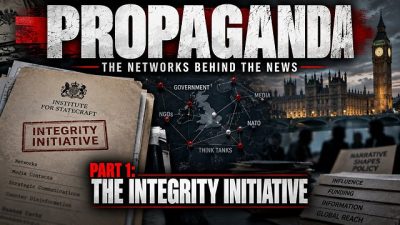
Integrity Initiative: UK-funded network framed dissent as Russian disinformation for years
or go to
Aletho News Archives – Video-Images
From the Archives
Why Saudi Ties to 9/11 Mean U.S. Ties to 9/11
By Kevin Ryan | Dig Within | September 27, 2015
Media interest in Saudi Arabian connections to the crimes of 9/11 has centered on calls for the release of the 28 missing pages from the Joint Congressional Inquiry’s report. However, those calls focus on the question of hijacker financing and omit the most interesting links between the 9/11 attacks and Saudi Arabia—links that implicate powerful people in the United States. Here are twenty examples. … continue
Blog Roll
 Aletho News
- ‘A Big Victory’ – Palestine Chronicle Wins Two-Year Legal Battle
- IAEA inspectors cannot return to Iran amid US threats: Russia
- Senate Rejects Iran War Powers Resolution Passed By House
- ‘We did not attack Pakistan with drones’: Afghan sources
- Iraqi Resistance faction links arms to sovereignty, questions US exit
- Cannon fodder no more… South Korea rejects Trump’s pressure to join his criminal war on Iran
- Neria Leiter Was A Legitimate Military Target
- Integrity Initiative: UK-funded network framed dissent as Russian disinformation for years
- ‘We don’t seek permission to defend our country’: Snippets from President Pezeshkian’s UNGA address
- NATO chief wants Europeans to fight American wars [for Israel]
- If Americans Knew
- In UN Speech, Iran’s President Displays Pictures of Children Killed by US, Brings Attention to Israel’s Nuclear Arsenal
- Israel displaces hundreds of Palestinians amid wave of demolitions in West Bank
- Aid, reconstruction, and Israel’s history of obstruction in Gaza
- Trump administration digs an ever-deeper hole of complicity in genocide – Daily Update
- US-Israel $2.8 Billion Arms Deal, 40,000-Bomb Supply Faces New Gaza Complicity Accusations
- Caught on Tape: AIPAC CEO Boasted of Controlling Trump’s National Security Officials
- Why Hamas Attacked Israel in October 2023 – Israeli professor Ilan Pappé
- They see them, then kill them: Israeli quadcopters track, deliberately target civilians in Gaza
- Winter could turn Gaza’s treacherous, war-damaged buildings into deathtraps
- Majority of Democratic Voters Want to Prosecute Both Biden and Trump Administration Officials Over Gaza
- No Tricks Zone
- New Study: Earth And Venus Surface Warmth Largely Explained By Convection And Lapse Rate, Not CO2 Or Radiation
- 2025 Nature Paper Claiming Worsening Global Drought Gets RETRACTED …Heavily Flawed
- New Study: ‘Global Drought Shows No Detectable Recent Acceleration Under Climate Warming’
- Economic Masterminds: German Socialists Suggest Taxing Productivity Gains Stemming From Using AI
- The South China Sea Has Not Been Cooperating With The Climate Change Narrative
- Energy Crisis: Germany Enters Heating Season With Historically Low Gas Reserve Fill Levels
- New Study: The Antarctic Ice Sheet Gained Mass From 2020-2024 Due To Staggering Snow And Ice Accumulation
- Study: Ocean Heating Rates From Thousands Of Years Ago ‘Dwarf’ Modern Ocean Heating Rates
- Climate Extremists Target, Attack Large-Scale Power Grid Infrastructure In Germany!
- New Study: Antarctic Ice Melt Has Contributed Less Than 1 Centimeter To Sea Level Rise In The Last 30 Years

