‘Russophobia a national sport’ – Polish party rallies against push to war
RT | September 7, 2026
Polish protesters have accused Warsaw of whipping up anti-Russian hostility and dragging the country toward war as the government continues to arm Ukraine and deepen confrontation with Moscow.
Supporters of the Confederation of the Polish Crown party marched through Gniezno on Sunday behind a banner reading “Poland for Peace,” carrying Polish and party flags.
“They’re trying to turn Russophobia into our national sport. But we won’t give in,” activist Marta Czech told the crowd, urging “prudence” as tensions with Russia continue to rise.
Another speaker, Lukasz Pakulski, accused the authorities of frightening Poles with talk of tanks, nuclear weapons, and a wider conflict. “They are pushing us into war,” he said, declaring that “Poles stand for peace.”
The Crown is a traditionalist, Euroskeptic party founded by MEP Grzegorz Braun. It campaigns for tighter immigration controls, less power for Brussels, and Poland’s withdrawal from the EU, while opposing deeper Polish involvement in the Ukraine conflict.
The protest comes as Prime Minister Donald Tusk’s government has continued to support Kiev, arguing that Ukraine’s security is inseparable from Poland’s own. Warsaw has provided around $6.8 billion in aid to Kiev since 2022, including more than $5 billion in military assistance. Poland also hosts around 961,000 Ukrainians under temporary protection.
However, public enthusiasm for the policy has been fading, with a July poll finding that 52% of Poles opposed accepting more Ukrainian refugees, while another survey showed 67% backed deporting unemployed Ukrainian men of military age.
Another survey found 27% believed Western aid to Ukraine was too large, compared with 22% who wanted more, while opposition to Ukrainian EU membership reached a record 40%.
Relations between Warsaw and Kiev have also recently deteriorated over historical grievances after Vladimir Zelensky named a military unit after the Ukrainian Insurgent Army (UPA), which Poland holds responsible for massacring up to 100,000 ethnic Poles during World War II.
President Karol Nawrocki later stripped Zelensky of Poland’s highest state honor, while other politicians have called for an end to free weapons deliveries to Kiev.
Moscow has consistently accused Warsaw of deliberately stoking anti-Russian sentiment while supporting Kiev’s war effort.
Russian officials have also highlighted the Kiev-Warsaw UPA dispute, arguing that even one of Ukraine’s strongest backers can no longer ignore Kiev’s embrace of neo-Nazi ideology and glorification of figures linked to wartime atrocities.
US Placing Missiles in Europe to Cancel Strategic Stability Talks Prerequisites – Russian MFA
Sputnik – 07.09.2026
MOSCOW – The deployment of US ground‑based US intermediate-range and shorter-range missile systems in Europe, in particular in Norway, will nullify the prerequisites for a constructive dialogue with the United States on strategic stability, Russian Foreign Ministry spokeswoman Maria Zakharova said on Monday.
“Steps such as the deployment of US ground‑based US intermediate-range and shorter-range missile systems in Europe, which threaten Russia, will, to put it mildly, nullify the prerequisites for a constructive conversation with the United States on strategic issues,” Zakharova said in a statement.
Russia views the deployment of systems in Norway capable of launching medium- and short-range missiles as yet another step in a series of highly destabilizing actions by NATO, the statement read.
“As part of Russia’s response measures, the locations where US systems are deployed and controlled, as well as the infrastructure supporting them, are becoming the focus of special attention from Russia’s strategic deterrence forces, which includes planning the combat use of the relevant strike assets in the event of an armed conflict,” Zakharova said.
The ministry added that favorable conditions for a substantive and productive dialogue with the United States on strategic stability had not been established now.
Analysts warn of ‘colonization’ as US ‘saturates’ Australia with 110 bases
Press TV – September 7, 2026
The United States reportedly wields control over, or has access to, 110 military facilities belonging to Australia — a presence so extensive that analysts now describe it as a “saturation” and even a “colonization” of the Australian continent.
The Guardian, citing information gathered from the database of the Nautilus Institute, reported that the US military or US defense corporations have access to more than half of Australia’s military facilities.
According to the database, the United States controls 17 military facilities on mainland Australia, has access to 75 more Australian-run military installations elsewhere, while US defense corporations have access to an additional 18 facilities.
“This is not a matter of penetration, it’s a matter of saturation,” said Prof Richard Tanter, the database’s author.
“Over half of the defense facilities that we have looked at have some level of American access: that means American personnel, it means American corporations, some of the biggest armaments companies in the world.”
The US military in Australia engages in gathering intelligence, accessing satellite data for targeting information, and communications intercepts.
Other military activities include training for some 2,500 marines on dry-season rotation in the Northern Territory, as well as the pre-positioning of warfighting assets, weapons, munitions, and fuel, stored in case of a regional war in the Pacific.
The US now practically owns Australia’s human, soil, and mineral resources through its control of the nation’s military, according to critics.
The US military presence will continue to expand. From next year up to 1,200 uniformed military personnel will operate from the HMAS Stirling submarine base just off Fremantle.
The government insists that technically this will not be a US base — rather a “rotation” — but there is little contestation of its actual implication.
The AUKUS nuclear submarine agreement, described by former defense minister Christopher Pyne as “a lot more than the submarine procurement,” effectively establishes a new United States submarine base in the Indian Ocean.
“For the Americans, being able to have a submarine base in the Indian Ocean is a massive strategic advantage,” Pyne told a public inquiry.
Dr Vince Scappatura, author of The US Lobby and Australian Defense Policy, described US base access across Australia as a kind of “second wave of colonization.”
“Today we are shaping up to be the ‘tip of the spear’ for US power projection into the region — that’s what the sprawling US base access represents,” he said.
“Each one of those dots on the map represents a point of leverage Washington has over Canberra when it comes to matters of defense and foreign policy.”
Scappatura noted that the phrase “empire by invitation” was originally coined to describe US hegemony over western Europe “but it is applicable equally here. I sometimes describe it as ‘voluntary subordination’.”
The United States has been escalating militarization in the Pacific by resetting ties with regional countries in an attempt to form a coalition against China.
Beyond Australia, US bases and military access points are expanding across Japan, South Korea, the Philippines, and other regional nations, effectively drawing them into Washington’s orbit.
Critics say this is a desperate bid by Washington to arrest the rise of China, with Australia and other regional countries being used as forward operating bases in what could become a larger confrontation.
Tanter says that the acceptance of the US military presence has become so ingrained within the government and defense that unwinding Australia’s enmeshment within the world’s most powerful military is increasingly difficult.
“This is a massive institutional failure in Australia, a kind of learned incapacity at a political, parliamentary and bureaucratic level,” he said. “We’ve learned how not to ask those questions.”
Dr Emma Shortis, director of international and security affairs at the Australia Institute, says Australia’s increasing integration with the US military has resulted in “an accelerating erosion of Australia’s independent, sovereign, decision-making power.”
“Instead of having the option of saying ‘no’ to involvement in United States wars, involvement becomes the default position,” she said.
She cited the March attack by a US nuclear-powered submarine on an Iranian frigate, sinking it and killing more than 100 people. Three Australian naval personnel were onboard, part of the submarine’s crew: the US did not forewarn Australia of the attack.
“Australia might maintain the pretense of sovereign decision-making power, but that’s not the reality,” Shortis said.
Dr Albert Palazzo, an adjunct professor at the University of New South Wales Canberra and formerly the director of war studies for the Australian army, told the Guardian the US military’s accelerating buildup carries danger for Australian security.
“The Australian government seems to be waltzing its way into a war between the United States and China, by allowing this country to become an outpost or bastion of the US military, and as a platform from which they will launch military force against China,” he said.
Australians’ faith in the US is fragile and fracturing. A Lowy Institute poll showed Australians’ “trust in the United States to act responsibly in the world” has fallen to 31%, the lowest level in its polling history.
Just 21% of Australians have confidence in Donald Trump to do the right thing in world affairs, the lowest level of confidence in a US president yet.
More than twice as many Australians (59%) now believe Australia’s interests are best served by a more independent foreign policy rather than a closer alliance with the US (23%). Just 13% of Australians believe the US is a “very reliable” security ally.
This represents, Shortis says, a “seismic shift” in Australia’s perception of its once-great and powerful friend.
“After following the US into nearly every war since World War II, Australians have had enough. They see tangible risks in being so close to President Trump’s bleak and violent version of America.”
Inside America’s deadly war on suspected drug boats | Fault Lines Documentary
Since September 2025, the US military has carried out more than 60 strikes on suspected drug-trafficking boats in the Caribbean and Eastern Pacific, killing more than 220 people.
In a military campaign called Operation Southern Spear, President Donald Trump’s administration has claimed to wage war against “narcoterrorism”. Yet the government has released little information about who was killed, the evidence against them or how targets were selected.
In Killing at Sea, Fault Lines investigates the administration’s claims about Operation Southern Spear by uncovering the stories of those targeted and the evidence used to justify lethal military force.
Through the stories of families left searching for answers, alongside witness accounts, physical evidence and interviews with legal experts, Fault Lines asks whether the strikes are lawful, whether they have disrupted the drug trade and what accountability exists for those killed.
From fishing communities in the Caribbean to Washington, DC, Killing at Sea examines a military campaign conducted largely beyond public view—and asks who is being killed in the US’s new war at sea, and why.
Babies Whose Mothers Drank Fluoridated Water During Pregnancy Scored Lower in Problem-Solving
By Brenda Baletti, Ph.D. | The Defender | September 3, 2026
Babies whose mothers drank fluoridated water during pregnancy at and slightly below concentrations currently recommended by U.S. public health agencies scored lower on tests that measure fluid cognition — the ability to think logically and solve problems in new situations.
Fluid cognition is considered the “cornerstone of human cognition, both during development and in adulthood.”
A new study led by Columbia University researchers found that prenatal fluoride exposure resulted in reduced fluid cognition at levels as low as 0.675 milligrams per liter (mg/L).
That’s slightly below the U.S. Public Health Service’s recommended concentration of 0.7 mg/L for fluoridated drinking water and far below the U.S. Environmental Protection Agency’s (EPA) maximum contaminant level of 4 mg/L and the World Health Organization’s guideline of 1.5 mg/L, according to the study.
The study, funded by the National Institutes of Health (NIH) and accepted for publication in the American Journal of Epidemiology, analyzed outcomes among 2,514 children born between 2006 and 2019 at 17 sites spanning 23 U.S. states that are part of the Environmental influences on Child Health Cohort (ECHO).
The authors concluded that more research is needed to identify the risky prenatal, postnatal and childhood window when fluoride exposure can harm cognitive development.
Higher fluoride linked to lower fluid cognition
To estimate prenatal water fluoride exposure, the researchers linked publicly available drinking water fluoride measurements to residential address information collected during pregnancy. The study focused only on fluoride from drinking water and did not account for any other sources.
The researchers then compared estimated fluoride intake with children’s cognitive abilities, evaluated using the NIH Toolbox Cognition Battery.
Researchers separately examined “fluid cognition,” which included measures of cognitive flexibility, inhibitory control, attention and memory, and “crystallized cognition,” assessed through a vocabulary test.
Crystallized cognition is “the breadth and depth of knowledge, vocabulary, and verbal skill a person has acquired through education, experience, and cultural exposure — what has been learned and can be retrieved and applied later.”
The children whose mothers were exposed to higher fluoride levels during pregnancy tended to score lower on the fluid cognition tests.
They found children’s cognition was affected when mothers were exposed to water fluoride levels at and above 0.675 mg/L, or 675 micrograms per liter. That’s below the federally recommended level for water fluoridation.
They also found that every 500 microgram-per-liter increase in water fluoride was linked to an average 3.36-point drop in IQ.
The outcomes were substantially worse among children whose cognitive abilities were assessed before age 7. Their IQ scores dropped up to 13.5 points for the same increase in water fluoride content.
The researchers cautioned, however, that the apparent difference by age requires further study.
“This study adds to a large body of work that looks at how early exposure to environmental contaminants may be associated with the development of the thinking and learning processes that are important for children’s developmental outcomes,” co-senior author Amy Margolis, Ph.D., of The Ohio State University College of Medicine said in a Columbia University press release about the study.
“Continuing to study fluoride and other exposures will be integral in best supporting children’s environmental health and well-being.”
Malin and Thiessen both noted that a limitation of the study was that they didn’t measure individual fluoride intake. Because intake can vary across individuals, failure to measure individual exposure can lead to exposure misclassification.
“Despite this, the authors still observed quite sizable associations between prenatal public water fluoride exposure and child fluid cognition, particularly for children younger than 7,” Malin said.
“Nevertheless, true associations between prenatal fluoride exposure and child cognition may in fact be larger than what this study was able to detect,” she added. “Future individual-level research will be needed to further investigate that question.”
Findings add to evidence in contested court ruling
Water fluoridation in the U.S. has been a political flashpoint since a landmark 2024 federal court ruling concluded that current levels of fluoride added to water at 0.7 mg/L posed a risk to children’s health. The ruling directed the EPA to regulate the chemical under the Toxic Substances Control Act.
The ruling was largely based on the federal National Toxicology Program’s (NTP) six-year assessment of all existing literature on fluoride and neurotoxicity, along with testimony from leading experts at top universities across the world who study the issue.
The NTP concluded that water fluoridation at 1.5 mg/L was linked to lower IQ in children. It also found that people exposed to water fluoridation below 1.5 mg/L could have high fluoride levels in their systems, in part because people can be exposed to fluoride from other sources and/or may drink different amounts of water.
The NTP researchers said their findings about water fluoridation and neurotoxicity were based on studies of water fluoridation at or above current U.S. fluoridation levels.
The groups that sued the EPA also argued that EPA regulations for other toxic chemicals don’t allow exposure at known toxicity levels. For other chemicals, exposure is allowed only at levels that are at least 10 times [lower than] the known toxic exposure level to ensure safety.
An appeals court later overturned the fluoride verdict on a procedural issue, but the court did not disagree with the lower court ruling that fluoridation at current levels poses an unreasonable risk to human health.
The American Dental Association, mainstream media and others have attempted to publicly discount the NTP’s findings, arguing that its data were weak at current levels, or that studies showing the neurological effects of water fluoridation happened in other countries that weren’t similar to the U.S.
The new Columbia University study — conducted in the U.S. at current fluoridation levels — confirmed the NTP’s conclusions and offered findings in line with other recent studies in the U.S.
Ashley Malin, Ph.D., assistant professor of epidemiology at the University of Florida’s College of Medicine, and lead author of a U.S. study that linked fluoride exposure during pregnancy to neurobehavioral problems in children, told The Defender that the Columbia University study is “significant” because it includes a relatively recent cohort of children from multiple U.S. states.
She said the findings were consistent with other major cohort studies in Mexico and Canada that observed an inverse association between early life fluoride exposure and non-verbal IQ.
Kathleen Thiessen, Ph.D., who co-authored the 2006 National Research Council study on fluoride toxicity, also said the study was consistent with many recent findings.
“Importantly, they see an adverse effect at lower levels of water fluoride than many previous studies have used, and these are U.S. children,” she said.
This article was originally published by The Defender — Children’s Health Defense’s News & Views Website under Creative Commons license CC BY-NC-ND 4.0. Please consider subscribing to The Defender or donating to Children’s Health Defense.
Vaccination Data on Amish Children Screened for 2010 Autism Study Was Never Made Public
By Suzanne Burdick, Ph.D. | The Defender | September 2, 2026
Controversy is swirling around a 2010 study on autism rates among the Amish, after President Donald Trump on Monday posted a graphic citing the study.
Trump’s post on Truth Social claimed, “No published case has explicitly documented an unvaccinated Amish child with autism.”
The social media post cited a study, conducted in 2008 and 2009 by researchers who screened 1,899 Amish children in Indiana and Ohio for autism. The researchers confirmed seven cases of autism among the children.
The study concluded that among the Amish children in the study, the autism rate was roughly 1 in 271 — far lower than the national rate, which at the time was estimated by the Centers for Disease Control and Prevention (CDC) as 1 in 91.
According to Trump’s post, the study authors collected vaccination histories for the children but “did not report any confirmed case” of autism as “completely unvaccinated.”
The post drew a mix of cheers and fact checks, according to health writer Sayer Ji.
Ji called Trump’s post “factually imperfect” but “genuinely important.”
The post contained factual inaccuracies — for instance, it stated that the Amish have been around for 330 years. However, although the Amish broke away from the Mennonites 333 years ago in 1693, Amish settlements in the U.S. didn’t begin until the 1720s.
Trump’s post also drew attention to the verifiable fact that the Amish tend to have lower vaccination rates and lower autism rates, compared to the mainstream.
Ji praised the president for highlighting the 2010 study. “Whatever else you think of the man, he [Trump] pointed at the study,” Ji wrote.
Children’s Health Defense (CHD) CEO Mary Holland told The Defender she was pleased that Trump highlighted the relative absence of autism among the Amish, who typically have lower vaccination rates than mainstream communities.
“It’s high time we start dealing with reality — the current vaccine schedule causes brain injury called autism. Let’s be humble enough to learn from the Amish,” Holland said.
What did the 2010 Amish autism study show?
Trump’s post cites a 2010 study conducted by human genomics researchers from the University of Miami and Vanderbilt University, according to a conference abstract about the study.
However, contrary to Trump’s post, the study was never published in a peer-reviewed journal.
The study’s abstract, dated May 22, 2010, appeared on the website for the International Meeting for Autism Research, a research gathering held by the International Society of Autism Research.
The study authors appeared to have presented the study at the May 2010 meeting. There is no online record of the study’s full report.
The abstract’s methods section states that the researchers collected the children’s vaccination data. However, the results section doesn’t state whether the seven Amish children in the study who were identified as having autism were vaccinated or unvaccinated.
The abstract states:
“Preliminary data have identified the presence of ASD [autism spectrum disorder] in the Amish community at a rate of approximately 1 in 271 children using standard ASD screening and diagnostic tools although some modifications may be in order.”
The authors wrote that “further studies are underway” to address the cultural norms and customs that may affect how parents talk about their children’s behavior when interviewed by researchers.
It is unclear if the study authors looked at whether the seven children with autism had been vaccinated.
The study’s lead author, listed as J. L. Robinson, did not respond to The Defender when asked if the researchers ever ran a vaccination-stratified analysis of the seven confirmed autism cases, and why the researchers never published the study.
The Defender asked Margaret Pericak-Vance, Ph.D., director of the John P. Hussman Institute for Human Genomics at the University of Miami and one of the study’s authors, the same questions. However, the inquiry was directed to the university’s public relations director, who did not respond by deadline.
Ji searched online public records to see if the study authors ever spoke again publicly about the study or submitted it for publication in a peer-reviewed journal, but found nothing.
That is significant, Ji told The Defender. “I searched for and could not find any public statement by any of the six authors, in sixteen years, on why the paper never appeared or what became of the data. That absence is the finding.”
Ji said he isn’t accusing the study authors of intentionally burying their data on the Amish children’s vaccination histories. “I am not alleging that any of the six destroyed data or acted in bad faith — I have no evidence of that.”
But their data were effectively “buried,” in that the data were never published and never appeared in a future study.
Ji acknowledged that even if the study had explicitly linked all seven autism cases to not vaccinating, the study wouldn’t prove that unvaccinated children do not get autism, because seven is too small a number to power a statistical model.
But the data would still be helpful because they “would fill a hole in the record and tell us whether the screening infrastructure can be rebuilt at scale,” he said. “A statistician could do it in weeks if the files exist.”
The study authors did not respond when The Defender asked if they still had the original research files for the study.
Given that the study appeared to use federally funded research dollars, according to the abstract, the public deserves to know what happened to the files, Ji said.
Trump focused on uncovering autism-vaccine link
Trump’s post referencing the 2010 study comes amid a roiling debate about vaccines and autism. In May, Trump pressed U.S. Health Secretary Robert F. Kennedy Jr. to do more to investigate a possible link between vaccines and autism, according to a July 27 Wall Street Journal report.
Last month, Trump signed an executive order calling for sweeping changes to U.S. vaccine policy, including reducing the number of diseases for which kids receive routine childhood vaccines from 18 to 11.
According to The Associated Press, Trump is “fixated on connecting autism to vaccines.”
During a Sept. 22, 2025 press conference, Trump said, “There are certain groups of people that don’t take vaccines and don’t take any pills that have no autism. … The Amish, as an example, they have essentially no autism.”
According to Ji, the 2010 Amish study does not prove that vaccines cause autism.
However, the story of what happened to the 2010 study reveals that when data are collected that could potentially contribute to answering the question of whether vaccines cause autism, that data “doesn’t become available,” Ji said.
In Ji’s view, studies looking at Amish autism rates should examine many factors, including vaccination status, exposure to glyphosate, acetaminophen, ultrasound, diet, endogamy and access to healthcare.
The full results should be made public, regardless of what the studies find. “That isn’t anti-vaccine. It’s science.”
The connection between lower vaccination and autism rates among the Amish was something that investigative journalist Dan Olmsted spent years documenting.
Olmsted, founder of Age of Autism, authored “Age of Autism: Mercury, Medicine, and a Man-Made Epidemic” (2011) and “Denial: How Refusing to Face the Facts about Our Autism Epidemic Hurts Children, Families, and Our Future” (2017) before he passed away in early 2017.
Where did Trump get the graphic he posted?
The Amish continue to be central to ongoing national debate on vaccines. In New York, Amish are threatening to leave the state due to the state’s school-based vaccine mandate, according to an Aug. 26 New York Post report.
Pennsylvania, which is home to the largest Amish population in the U.S., has been making headlines for its current measles outbreak and ongoing investigation of measles-related deaths.
Steve Kirsch created the graphic that Trump posted to social media. On Aug. 14, Kirsch posted the graphic on X with the statement, “Baffling, isn’t it? Autism is only found in vaccinated Amish kids. I wonder why?”
Kirsch told The Defender he created the graphic using ChatGPT.
He instructed ChatGPT to create a graphic based on the 2010 study and based on his understanding that there is no evidence that an unvaccinated Amish child has ever been diagnosed with autism.
“Nobody has ever heard of an unvaccinated Amish child with autism,” Kirsch told The Defender.
Kirsch said he referred to the study as “published” in the graphic because the International Society of Autism Research posted the study’s conference abstract online. He acknowledged that the study itself was never published.
The White House did not respond to our comment request by the deadline.
This article was originally published by The Defender — Children’s Health Defense’s News & Views Website under Creative Commons license CC BY-NC-ND 4.0. Please consider subscribing to The Defender or donating to Children’s Health Defense.
CNAS Wonk Proposes Bombing China’s Artificial Intelligence
Critics argue that an attack on China has the potential to start a nuclear war
By Kurt Nimmo | Another Day in the Empire | September 6, 2026
Jacob Stokes, a former White House official, has suggested taking military action against China to prevent it from winning the race for AGI, or Artificial General Intelligence. AGI is a hypothetical AI system that could learn, reason, adapt, and solve problems across a broad range of intellectual tasks at roughly human or greater capability.
Stokes served on the White House national-security staff under then–Vice President Joe Biden during the Obama administration. He is a senior fellow and deputy director of the Indo-Pacific Security Program at the CNAS.
Center for a New American Security, established in 2007 by Michèle Flournoy, is associated with the Democratic Party. Flournoy held the position of deputy assistant secretary of defense for strategy during President Bill Clinton’s administration and served as under secretary of defense for policy under President Barack Obama.
Previously, CNAS was led by CEO Victoria Nuland, who acted as undersecretary of state for political affairs from 2021 to 2024 within the Biden administration’s State Department. According to the Washington Post, CNAS is regarded as Washington’s primary think tank on military matters.
In a CNAS report titled Superpowers and AGI, Stokes argued that Washington should consider extreme scenarios in which China might achieve AGI first, including diplomatic pressure, espionage, cyber operations, sabotage, and military action against data centers.
On September 3, during an online event, Stokes stated that multiple US agencies, including the Department of Defense and the National Security Agency, should evaluate the intelligence required to substantiate such actions, according to the South China Morning Post.
Stokes and other analysts believe conventional bombs may be used to destroy the physical hardware China needs to train future AI models. It is speculated that the destruction of China’s AGI infrastructure would delay Chinese development by a few years, thus giving the US an advantage.
Although China is very advanced in frontier AI, it does not appear to possess AGI. The best current assessment is that China is probably slightly behind the United States in top-end model capability, while matching or exceeding it in some areas, including efficiency, deployment, open models, robotics, and industrial integration.
Critics argue that an attack on China has the potential to start a nuclear war between the two superpowers. William Hartung of the Project on Government Oversight characterized an attack on Chinese data centers as “the height of recklessness.” He warned that it could trigger a war with “tragic consequences for all concerned.”
Others question whether bombing data centers would actually halt Chinese AI development. China’s AI ecosystem is spread across numerous companies, universities, government labs, cloud providers, chip facilities, and research teams.
Hu Xijin, the former editor-in-chief of China’s state-backed Global Times, warned that if the United States attacked Chinese data centers, Chinese retaliation would not be limited to US targets in the Asia-Pacific region. Instead, it could include missile strikes on the US mainland. A Global Times editorial described the proposal as a “dangerous delusion” and argued that treating civilian data centers as military targets was “indistinguishable from terrorism.”
There is no indication that the Trump administration has officially supported, accepted, or directly addressed Jacob Stokes’ suggestion to prepare for the dismantling of Chinese AGI infrastructure. As of September 6, 2026, reports suggest that neither the Department of Defense nor the NSA has provided an official response to the proposal.
Nonetheless, the administration has taken the extensive U.S.-China AI rivalry very seriously. Its approach has focused on ensuring American supremacy in AI, military integration, intelligence gathering, cyber defense, technology regulations, and diplomatic efforts – not openly on preemptive strikes or sabotaging Chinese data facilities.
Eight Arab and Muslim states reject Israeli displacement plans for Gaza
Palestinian Information Center – September 6, 2026
GAZA – Eight Arab and Muslim countries have condemned remarks by far-right Israeli ministers Itamar Ben Gvir and Israel Katz on plans to forcibly displace Palestinians from the Gaza Strip.
The foreign ministers of Egypt, Saudi Arabia, Jordan, the United Arab Emirates, Indonesia, Pakistan, Türkiye and Qatar said in a joint statement released on Sunday that such Israeli plans violate international and humanitarian law and pose a direct threat to the Palestinian people’s legitimate and inalienable rights.
The ministers voiced rejection of any Israeli attempt to displace Palestinians from or within the occupied territory, warning against transforming extremist rhetoric on forced displacement into official state policy.
The ministers warned that the displacement of Gazans would destabilize the region and derail global peace efforts, undermining US president Donald Trump’s plan to end the Gaza war, which clearly rejects forced population transfers.
The ministers stressed that Gaza is an integral part of the occupied Palestinian territories, calling for preserving the unity of Gaza, the West Bank and east Jerusalem.
They reiterated their countries’ support for a two-state solution establishing an independent Palestinian state along the June 4, 1967 lines, with east Jerusalem as its capital.
They urged the international community and UN Security Council to oppose Israeli attempts to impose a new demographic or geographic reality in the occupied Palestinian territories.
Israel’s Game

Anti-Zionist activists protest on 2nd Avenue outside the Israeli Consulate General in Midtown Manhattan, New York City, U.S. on August 21, 2026. [Selçuk Acar – Anadolu Agency]
By Dr Hassaan Bokhari | MEMO | September 6, 2026
A few days ago, a very interesting article appeared in the Israeli newspaper The Jerusalem Post. It was written by AJ Jaff, whose profile describes him as “a recognised expert in international security, crisis management, and geopolitical risk”. The “expert” began the article by acknowledging that the 6-month-long air war on Iran has failed to defeat Iran. Then, he provided some “out-of-the-box” ideas for the US to consider if it wants to “achieve its objectives” and win the war. According to him, the war will only be won when Iran’s institutional coherence is broken, resulting in its Balkanization.
I will discuss Mr Jaff’s “out of the box” ideas in a bit, but first, I want to analyse the “expert” himself a little. Two things quickly popped up. First is how he began his article. The first sentence is: “The Pentagon reportedly asked outside analysts this month for creative ideas on Iran.” The hyperlink in this sentence redirects the reader to another article in The Jerusalem Post that cites a CNN report saying that the US Chairman of the Joint Chiefs of Staff, Gen. Dan Caine, has been privately looking for an off-ramp in the Iran War. How quaint! While the Pentagon is asking for ideas to wrap up the war, Mr Jaff, the expert, stepped up with ideas to escalate the war! It appears that Mr Jaff (and the Zionists) have very different ideas and even objectives than US Generals about the same war. No wonder Pete Hegseth (a committed Zionist) has been firing so many of them!
Secondly, one is amused to see that in March, 10 days after the start of the US-Israel war on Iran, the same Mr Jaff was declaring a resounding victory and claiming that “the data tells a decisive and irreversible story” and “Iran’s missile fire rate has collapsed by 92 percent”! After reading that article now, most readers might laugh heartily and dismiss Mr Jaff, the “expert,” as an idiot. However, that would be an incorrect assessment. On the same day as Mr Jaff’s gaffe’s appearance in The Jerusalem Post, an article of mine elucidated the Israeli strategy as one giant bluff whose aim was to lure the USA into a destructive war in the Middle East by plunging it into a sunk cost fallacy. The Israeli plan was to lure the USA in with the dreams of an easy victory like the First Gulf War or the Maduro kidnapping, but it knew all along that those dreams would prove to be hollow, and their sole purpose was to bring the USA into the war. Then, in the next phase, with the dreams of victory proving illusory, the USA was to be baited with the sunk cost fallacy trap so that it would blunder into further escalation in pursuit of Israeli objectives. Mr Jaff’s seemingly absurd somersaults follow this pattern perfectly.
Now let’s turn our attention to Mr. Jaff’s “expert recommendations”. There are three of them:
- The USA should “recognize the sovereign independence of the Iranian Kurdistan, Ahwaz, and Baluchistan people”.
- To raise the one million troops required for a victorious ground invasion of Iran, the USA should launch an enlistment scheme based on debt forgiveness (estimated at 40,000 to 1,00,000 US Dollars per person) for 24-36 months of service per person.
- The US should strike a deal with China that would involve softening the US stance on Taiwan and ensuring China that even after Iran’s destruction, China would continue to receive an uninterrupted supply of Iranian oil in exchange for China’s abandonment of Iran.
Before analysing these ideas, one must first take a moment to marvel at the arrogance and ignorance of the Zionists.
The Zionists have played the victim and the superior/invincible race roles simultaneously in a way that lends itself to a diagnosis of severe dissociative disorder.
This pathological psyche has led them to the delusion that the foremost purpose of the world and everything in it is to accommodate their ambitions. As I have argued elsewhere, this psyche is leading them to their self-created and inevitable destruction as well.
Now, let’s take these ideas one by one. The first idea is simply advocating the balkanization of Iran (just the newest version of the Yinon Plan). The implications are very interesting, though. By supporting Kurdish and Baloch (not Baluchi as written by Mr. Jaff, a mistake that only lays bare how little he knows about Balochistan!) separatism, the US could kill three birds with one stone in the service of Israel. Kurdish and Baloch separatism are grave threats to the integrity of Turkiye and Pakistan, respectively. Very cleverly, the Zionist Mr Jaff is pointing the way for the next wars to be launched by the USA in Israel’s service. The Zionists know that Iran’s balkanization wouldn’t ensure Israel’s survival. They are aiming at the complete destruction of the whole region stretching from Morocco to Pakistan, an Israeli goal correctly identified by the Pakistani liberal thinker Eqbal Ahmed more than 40 years ago!
The second idea is about finding the meat for the meat grinder of forever wars envisioned by Israel. With antipathy toward Israel consistently on the rise in the USA, how can American youth be convinced to become cannon fodder in the Wars of Israeli Ambitions? The answer, according to Mr. Jaff, lies in luring them with the promise of debt forgiveness. Most young Americans are riddled with debt in the exploitative capitalistic financial system (run by whom?) of the USA. Mr Jaff wants their debts written off in return for their blood, sweat, and tears spilled on the battlefields of the Middle East. However, the question arises: who will pay the bill of “debt forgiveness” for this indentured slave army? Will the big capitalists pay? Of course not. The state will pay.
In other words, the US taxpayers will pay billions of dollars so that their sons and daughters can be killed or crippled far from home in wars that have nothing to do with the American people’s welfare.
The third idea is the most “brilliant” one. It’s also the one that should ring alarm bells for even the most obtuse section of people in the USA. Mr. Jaff proposes to bribe China with oil and concessions on Taiwan to abandon Iran. It hasn’t occurred to him that for men like General Dan Caine, China represents a much bigger threat to the USA than Iran! It also peddles the fallacy that Iran is another Venezuela! Such a bizarre, arrogantly ignorant notion can only come from Zionists! In his obsession with what the genocide-dependent state of Israel needs to survive, Mr Jaff has ignored the basic fact of geography that Iran lies closer to China than Venezuela is to the USA! He has also conveniently failed to specify what concessions the USA should make on Taiwan. Unfortunately for Mr Jaff and the Zionists, the Chinese leaders (unlike many in the USA) don’t prioritise Israeli interests over their own country’s.
As I am engaged in analyzing Israel’s “game plan”, one other important factor must be mentioned: Gaza. In the last few days, clear statements have come from Israeli ministers showing their intention to depopulate Gaza completely. Israel’s ultimate goal has always been to complete the ethnic cleansing of Palestine that started with the Nakba in 1948. Since the start of the Gaza blockade in 2007, Israel had been following a policy of making Gaza uninhabitable while concurrently using it as a weapons testing laboratory through periodic aggressions/wars. This policy of slow genocide was abandoned after the 7 October attacks. The goal then became to “clear” Gaza through a “fast genocide” within a few months. However, unexpectedly stubborn Palestinian resistance coupled with the categorical refusal of regional countries (especially Egypt) to accept Palestinian refugees has so far prevented this. The recent pressure from Israel on the USA to give it a green light for forcible expulsion of all Palestinians from Gaza shows that Israel hasn’t lost sight of its genocidal goals in Palestine for one minute, even during the Iran War. If Palestinian refugees are forced into Egypt, it will provide an added bonus for Israel by destabilising Egypt.
A summary of the comprehensive Israeli strategic plan is as follows: Israel wants a massive US ground invasion of Iran with more than a million soldiers to destroy the Iranian State and balkanize the country with the help of Kurdish and Baloch separatists. This will, in turn, bring the “Grand Israeli War” to its next phase: the destruction of Turkiye and Pakistan. The latter will be denuclearized after internal instability brought upon by economic, political, and military crises resulting in an implosion of the State, leaving Israel’s ally India as the sole power in the subcontinent. Simultaneously, Israel plans to depopulate Gaza and South Lebanon while destabilising both Syria and Egypt to an extent that new civil wars erupt there. To achieve these lofty aims, Israel wants the USA to put its strategic tussle with China on hold and offer significant concessions on vital issues like Taiwan to keep China neutral. This will free up the USA to deploy its full military might in fighting Israel’s wars and divert limited but critical military resources in bulk to the Middle East from the Pacific. With the whole of the Middle East in ashes, Israel can replace the USA as Saudi Arabia’s “security guarantor”, gain control over all 3 Muslim Holy Mosques (in Makkah, Medina, and Al-Quds) to be used as blackmail against any future attempt by Muslims to confront it, and create a Greater Israel that is not dependent on US aid. Afterwards, Israel can easily discard the USA in favor of a modus vivendi with the new global hegemon (China) as the former’s power wanes through wars and strategic overextension.
This Israeli “game plan” is clearly fantastic, unrealistic, and wildly overambitious. However, like the Nazis, Israelis see themselves as an embattled and desperate “superior race” that has to risk it all on a grand throw of the dice. In its post-7 October psychosis, Israel has lost whatever rationality or sense of proportion it previously possessed. Like Hitler, Israel’s leaders fail to see their predicament: they might win some victories in this war, but each victory will open up new threats, which will result in fatigue as the costs of war mount and geographic and demographic factors overstretch both Israel and the USA. In his seminal work, “Israeli Exceptionalism – The Destabilising Logic of Zionism”, Professor Shahid Alam explained this brilliantly: “The tragedy of Israel is not fortuitous. Driven by history, chance, and cunning, the Zionists wedged themselves between two historical adversaries, the West and Islam, and by harnessing the strength of the first against the second, they have produced a conflict that can only grow deeper over time. In this conflict, Israel’s triumphs are temporary, are indeed illusory, since they evoke a deeper, wider response from the societies that suffer the devastation of its triumphs. In the long run, in the time scale of history, by relentlessly pressing its advantages, Israel only ensures that its adversaries will slowly build the defenses that will eventually rise to match Israel’s military might and its expansionist ambitions.”
Blinded by the imperatives of genocidal Zionist ideology, it would be foolish to expect the recognition of this reality from the Israelis.
However, the USA and the Muslim World urgently need to recognize “Israel’s Game” to minimize the damage to be suffered by them. Had Hitler been stopped at Munich, the Second World War might never have happened. Had Israel’s genocide in Gaza been stopped in November 2023, we wouldn’t be seeing the Iran War and the Hormuz crisis today. If Israel isn’t stopped now, we will see not just Iran, Palestine, and Lebanon, but Turkiye, Pakistan, Egypt, Syria, and the Gulf countries engulfed in flames of war as well.
As Israel plans to fight this war to the last US soldier, it would behoove the USA to realize that playing Israel’s game will result in polarization and decimation of American society (just like the Vietnam War put an end to Lyndon Johnson’s vision of “Great Society), the loss of its military dominance in the Pacific, and the loss of its global economic primacy. Today, it is imperative that all of the Muslim World in general and Turkiye, Pakistan, Saudi Arabia, and Egypt in particular start squarely backing Iran in thwarting external aggression. The recent Mecca Pact between Pakistan, Turkiye, and Saudi Arabia can only be meaningful if it clearly declares Israel as the greatest threat to peace and operationalizes the military and economic power of these countries to combat Israeli aggression in Gaza, West Bank/East Jerusalem, Lebanon, and Iran. Only through the defeat of Israel’s genocidal state and the birth of an independent Palestinian State can peace and security be ensured for the Middle East. If these countries present a united front against Israeli aggression, not only will they be backed by the likes of China and Russia, but they will also compel the USA to recognize Israel for the dangerous strategic liability it is. “America Firsters” will do well to remember Nietzsche’s saying: “The most common form of human stupidity is forgetting what one is trying to do.”
Lebanese man tells RT how Israeli strike killed his bride
Saja Sharara lost her life when a missile struck the couple’s home just 48 hours after their wedding
RT | September 6, 2026
The husband of a 28-year-old Lebanese woman killed in an Israeli airstrike just two days after their wedding has told RT how he was speaking to his wife on the phone moments before their home was hit.
Saja Sharara was killed at the couple’s home in Arabsalim, southern Lebanon, on August 27. Six other people, including a child, were wounded.
Hussein said he called Saja after hearing about an Israeli strike nearby. Minutes later, she called him back and suddenly said: “A rocket, a rocket is coming towards us, Hussein.”
The connection was lost. “The rocket fell on her,” Hussein recalled. “And then I realized that it was over.”
Israel has not said specifically what it was targeting at the house. It said its wider attacks in the Nabatieh area targeted Hezbollah infrastructure in response to drones launched at IDF troops. No Israeli casualties were reported.
Israeli attacks on southern Lebanon have continued despite a US-mediated ceasefire. More than 4,000 people have been killed and over 12,000 wounded in Israeli attacks on Lebanon since March, according to Lebanese authorities.
Hussein said the continuing Israeli military presence and air operations mean there is no ceasefire in practice.
“There is no ceasefire as long as this enemy is on our land and the aviation is flying above us,” he told RT.
RT’s Steve Sweeney spoke exclusively with Hussein in southern Lebanon about the future he and Saja had planned together.
On deadly sectarianism pushed on Syria and elsewhere by NGOs and media

Boy from al-Zahra’a, Homs, injured in a terrorist suicide and car bomb attack in December 2015, terrorists repeatedly targeting the district because it was largely – but not exclusively – Alawite.
Photo © Eva Bartlett
By Eva Karene Bartlett | September 6, 2026
I share this post from Basira Press because I agree with much of it, not every word or point, but much of it, especially the notes about how supposed human rights groups spew sectarian language in order to foster division, and to otherwise mislead an uninformed public:
“How convenient that Zionist lies about Iran and Hezbollah in Syria are resurfacing – such as Human Rights Watch, led by Jewish liberal Ken Roth; Soros funded Amnesty; or White Helmets, founded by a British spy – while also attempting to drive a wedge between Iran and Palestine are helping the US empire and Jewish supremacists justify their war against Iran by weakening solidarity for Iran.
… When it comes to Syria, there are three camps that are wrong and illogical: 1) Assad was a pure saint and never did even an iota of wrong; 2) fake “both sides are equally bad” virtue signaling reductionism; and 3) oy vey, Assad gassed 6 gorillion Sunnis and turned them into lamp shades and soap.
Assad was not the monster who committed atrocities akin to the alleged holocaust. There is zero credibility to human rights reports prepared by Jewish led NGOs who get their accounts from ISIS/Nusra held areas. It’s not a “both sides are equally bad” reductionist fallacy either.
… If someone wants to honestly document history about Syria, then fine, as long as it doesn’t aid the propaganda against the resistance axis and seek to divide people on Iran in order to reduce solidarity for Iran. It might be a worthwhile project to see which bad things Assad actually did vs totally made up atrocity propaganda (whose art was taught to them by their Zionist masters). Such a study should have zero reliance on HRW, Amnesty, White Helmets, and any group associated with western and Zionist backed mercenaries. Iran and Hezbollah entered to stamp out a Zionist backed insurgency, not to “kill 6 gorillion Sunnis for sport”
These same people ignore the atrocities against Shias in Kafriya and Fua…
Making sectarian strife one’s political compass is a mental illness and serves the Zionist enemy. Martyr Ayatollah Sayyed Ali Khamenei said that any Muslim who spreads sectarian strife is neither Sunni nor Shi’a.
We should focus on the current “new Syria” which is acts as collaborationists with the Zionist regime and the US quite openly. Jolani is offering up Syria for sale to BlackRock and pushing usury based loans with Visa cards for all.”
*
Skipping ahead to the unreliable sources mentioned, and I know that Basira only gave a few examples and is aware it is a far wider deviousness that those mentioned, I’ll include a link to a compilation I did back in mid-2015, but basically note that across the board, Western-backed NGOs had bloody hands in Syria and are NOT reliable sources of information for Syria, not during the global war on the people and not now. The UN, also, is another source which reported extremely selectively on the terrorism of the West/Gulf “rebels” in Syria and inflated war propaganda in support of regime change.
Regarding Foua and Kafraya, while I never got to visit those two villages in my vast travels around Syria over my 8 years of visiting or staying there, I did write about them and the unjust suffering they were subject to for years, besieged and starved by terrorists who sniped to kill civilians, including children, every chance they could.
Same with Nubl & Zahra’a, which I did visit in 2016 (Two predominantly Shia villages just north of Aleppo which were under a devastating 3.5 year siege by terrorist factions until the SAA and allies lifted it in February 2016. Residents endured prolonged periods of hunger, were targeted by terrorists’ bombings, and for want of medicines, medical treatment, and sanitary conditions suffered diseases that could otherwise have been treated.).
Below are a selection of my articles from/on Syria, highlighting the selective reporting, absent reporting, outright lying, and sectarian language of various Western NGOs, the UN, and of course Western corporate media. Most of the articles are based on me actually going to the places in question:
–The Terrorism We Support in Syria: A First-hand Account of the Use of Mortars against Civilians, September 2014
–MOSAIC SYRIA: Another Actor in the Anti-Syria War Propaganda Theatre, October 2014
–Untold Suffering in Foua and Kafraya: Two Northwestern Syrian Villages Under Siege and Assault by NATO’s Terrorists, August 2015
–Untold Suffering in Foua and Kafarya-Part 2
–Deconstructing the NATO Narrative on Syria, October 2015 (including on sectarianism)
–Not-Tweetworthy: UN selectively tweeting, ignores Foua, Kafarya, Nubl, Zahra’a, December 2015
–Where is the West’s compassion & condemnation following terror attacks in Middle East? (on sectarian reporting after terror attacks in Bourj al-Barajneh, Beirut and al-Zahra’a, Homs), January 2016
–UN covers up war crimes in Syria, citing U.S. backed Al-Qaeda propagandists, October 2016
–Interview: Father Of Iconic Aleppo Boy (Omran Daqneesh) Says Media Lied About His Son, June 2017
–Syria War Diary: What Life Is Like Under ‘Moderate Rebel’ Rule, Aleppo, August 2017
–Syria War Diary: Order Returns To Madaya & al-Waer, Civilians Recount Horrors Of “Rebel” Rule, September 2017
–UN Feigns Outrage Over Ghouta While Terrorists’ Rockets Rain Down on Damascus, February 2018
–Syrian civilians from ground zero expose Douma chemical hoax, June 2018
–Torture, starvation, executions: Eastern Ghouta civilians talk of life under terrorist rule, June 2018
–Welcome to Hadar: A Village Under Siege by al-Qaeda and Israeli Forces Alike, June 2018
–Liberate Syria’s Idlib, precisely for the civilians that America fakes concern over, May 2019
–The Caesar Act: The Latest Western Attack on Syria, June 19th, 2020
–US sanctions are part of a multi-front war on Syria, and its long-suffering civilians are the main target, July 13, 2020
–Western media quick to accuse Syria of ‘bombing hospitals’ – but when TERRORISTS really destroy Syrian hospitals, they are silent, March 24, 2021
*Human Rights Watch deliberately only scratched the surface in exploring Ukraine’s use of banned ‘petal’ mines, March 2023 (*HRW lies elsewhere)
*Rick Sterling: “AVAAZ, “White Helmets”, HRW, PHR, Amnesty & More: Humanitarians for War on Syria”, March 2015
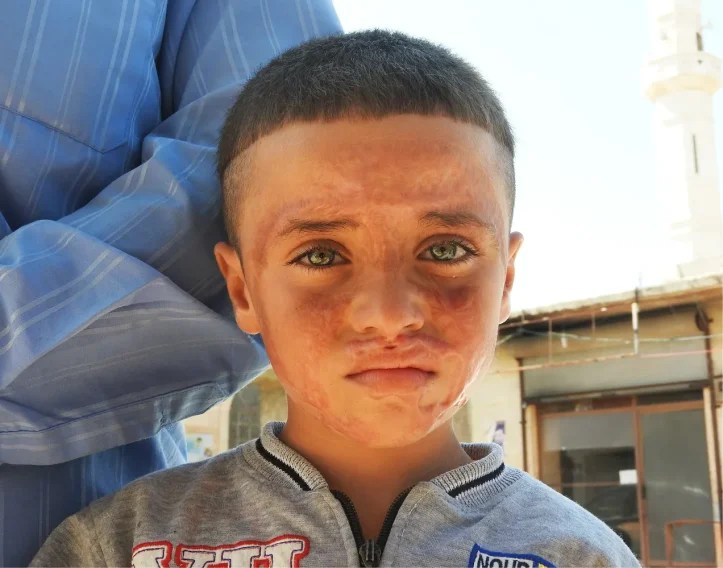
Photo © Eva Bartlett
“The roughly 65,000 people of Nubl and Zahra’a villages, under siege from terrorist factions of the so-called FSA, al-Nusra, and affiliated factions for three and a half years, were on February 3, 2016, liberated from the choke-hold which strangled them. Zeinab, 25, and Mounthaher, 26, each have young children who suffered for want of food and basic elements of life, and who were traumatized by the terrorists’ bombing of the villages. Although corporate media, when deigning to mention the villages, usually focused on their predominately Shia composition, Sunnis also live in the villages. According to Zeinab, “Sectarianism wasn’t a problem before, we were brothers and sisters, we intermarried with neighbouring villages.””
“This boy, 7, has painful face disfiguration from a terrorist-fired mortar which burned his face. Under siege at the time, the boy was only treated with basic medical care in a bare-bones hospital in Zahra’a. The boy is not originally from Nubl, but from Idlib, from which his grandfather fled when terrorists invaded. He is another poster child for the terrorism inflicted upon Syria.”
Aleppo and nearby villages ravaged by the West’s “moderate” terrorists (photo essay)
Is America preparing a tactical nuke for Iran?
By Martin Jay | Strategic Culture Foundation | September 6, 2026
The escalation trap is getting worse for Trump and his cabal of sycophants, as what was once a discussion which was linked to existentialism – the nuclear option – is now being dialled down to any kind of military option. Just a bigger bomb. The more Trump loses, the more Iran hits U.S. assets and allies in the Middle East, the longer the straits remain closed, and the higher gasoline and diesel costs reach in the U.S. – the more the idea of a ‘tactical’ nuke dropped on Iran becomes normal and even preferred.
But Trump is also getting madder. He is literally losing his mind, and his condition has worsened in his second term in office to the point where he is losing touch with any kind of reality. Before February 28th, the U.S. economy was not in bad shape. A lot of fundamentals were holding out. But now everything is spiralling out of control, and quite apart from blue-collar workers being hit with gas pump prices being well above $4, now diesel is being hiked – which only means that the cost of food, among other goods, is going to rise significantly, as trucking firms pass on the bill to producers, who pass it on to the consumer.
And as things start to get out of control, take a cursory glance at who is running Trump and who stands to gain if a nuclear bomb were used. It’s the same people who walked away from 9/11 laughing until their sides hurt. Israel. The Zionists are now pushing for the tactical strike option, as any escalation in the region – no matter who gets killed or whose country gets wiped out even of water – is not their worry or concern. These days, Netanyahu’s coterie can argue even more that Iran is probably making a nuclear bomb, as the one institution that Trump could turn to – the IAEA – can’t enter Iran and do its inspections. And so the default conclusion is that the U.S. president is going to be bullied again into making a cataclysmic error of judgment in hitting Iran.
The Zionists have been busy on both sides of the Atlantic. In the UK, it’s hard not to see how their money is now reaching Nigel Farage’s far-right party, which has just been hit by another dodgy funding scandal – presenting the leader of the party as bereft of any political morals of any creed in preference for filling his pockets with dirty cash. The Zionists control UK media, and it’s interesting to see how Farage gets a pretty easy time despite the graft scandals burying him. In the U.S., it’s a similar story. For a while now, J.D. Vance has been quite critical of how Zionists are shaping U.S. politics both internationally and even domestically, and has always been quite vague about how the U.S. should move forward in Iran. But now those who have crossed a threshold and are in the pockets of Israel’s lobby are going for him.
Former South Carolina Gov. Nikki Haley recently accused him of not taking a clear stance on Israel – slamming him for trying to “be both.”
“Right is right. Wrong is wrong. In life, you must choose a side. You are either with the Tucker Carlson wing of the country or you are with the pro-Israel wing of the country,” she wrote on social media. “You can’t be both.”
Haley, a former GOP presidential candidate who isn’t overburdened with a high IQ, couldn’t even hide who was directing her and even giving her reference material to attack Vance – leading some to wonder if Israel’s lobby just writes her social media posts.
She continued her post with a quote from Nobel Prize-winning writer and Holocaust survivor Elie Wiesel, who said in his 1986 acceptance speech: “We must always take sides. Neutrality helps the oppressor, never the victim.”
Meanwhile, America’s trust around the world seems to have been eroded to almost nothing. Recently, the Netherlands just pulled out its gold reserves it used to keep in the U.S. The move followed Germany a few weeks ago, which did the same. EU leaders just don’t trust Trump and can see the de-dollarisation trend gaining ground while U.S. debt continues to mount. Trump can’t do anything, of course, as his immature ideas about governance have produced a series of policies which haven’t served the country’s interests but merely backfired – reminding many that he doesn’t have one or two failed businesses under his belt like many successful entrepreneurs, but scores, which would suggest that he doesn’t really understand business at all. A nuke, he might believe, would be a reset in the Middle East and perhaps a huge distraction away from terrible numbers back home. But the precedent it would set to Russia and China would only make Iran an even greater winner than it already is in the region. Trump simply has no idea what he is doing – and all the people who could advise him have been fired.
Featured Video
Trita Parsi: Israel Set a Trap for Total War in the Region
or go to
Aletho News Archives – Video-Images
From the Archive
Zionism’s Violent Legacy
By Donald Neff | Washington Report On Middle East Affairs | January 1996
On January 4, 1948, Jewish terrorists drove a truck loaded with explosives into the center of the all Arab city of Jaffa and detonated it, killing 26 and wounding around 100 Palestinian men, women and children.[1] The attack was the work of the Irgun Zvai Leumi – the “National Military Organization,” also known by the Hebrew letters Etzel – the largest Jewish terrorist group in Palestine. The Irgun was headed by Revisionist Zionist Menachem Begin and had been killing and maiming Arabs, Britons and even Jews for the previous ten years in its efforts to establish a Jewish state.
This terror campaign meant that at the core of Revisionist Zionism there existed a philosophical embrace of violence. … continue
Blog Roll
 Aletho News
- Trita Parsi: Israel Set a Trap for Total War in the Region
- Trump’s Iran war is on an Israeli leash
- Saudi oil boss issues global supply warning
- Riyadh Says Its Oil System Is Intact. The Numbers Say Otherwise.
- Trump and Netanyahu Want to “Finish the Job” on Iran
- US ‘one-sided dictation’ not Iran’s beliefs makes rational talks impossible: Baghaei
- Iran’s Next Strike May Not Explode. It Could Shut You Down /Col Doug Macgregor
- Iran: US political targets legitimate if assassinations return
- Iraq shuts key border crossing with Iran under US pressure: Report
- Undersea Internet cables could be targeted in retaliation for attacks on Iran: IRGC deputy chief
- If Americans Knew
- The Israel Lobby’s Changing Fortunes
- AIPAC has become such a political liability that it’s shifting to a more “nimble” approach to buying politicians
- At least 160 Israeli settler attacks in 2 weeks
- Will Gaza’s Ancient Christian Community Disappear Forever?
- Israel’s vision of regional security rests on keeping Arab states weak
- Heidi Levine recounts how Palestinian youths helped save her in settler attack
- DAILY UPDATE: Latest essential news on Palestine, Israel, & region
- Trump’s Intensifying Sabotage of the ICC, for Israel’s Sake
- Israeli military detain US and UK volunteers in West Bank including Democratic NY politician Brad Lander
- Americans at National Conservatism Conference held in Israel this year criticize Israel
- No Tricks Zone
- E-Cars Reduce CO2 Emissions By Only 41% Compared To Internal Combustion Engine Vehicles
- Predictions Made By Renowned Climate Professor Over Past Decades Have Been Proven To Be Poor
- New Study Suggests Large Regions Of The Pacific Ocean Have Been Cooling For The Last 80 Years
- Germany’s Green Energy Debacle: High Energy Costs Force Kahla Porzellan to Close After 182 Years!
- New Study: 50 Years Of The Most Aggressive ‘Net Zero’ Policies Can Only Affect The Global Climate By 0.03°C
- US September “Heat” Was No Record…Many Records Set Decades Ago
- Latest European Green Energy Debacle; Portugal’s Largest Flagship Solar Park Insolvent!
- Green Energy Debacle: German Expert Professor Fritz Vahrenholt Warns Of Severe Economic And Social Consequences
- Two More Paleo Reconstructions Affirm Meters-Higher Sea Levels Across Ireland, Brazil 7000-6000 Years Ago
- New Study: Earth And Venus Surface Warmth Largely Explained By Convection And Lapse Rate, Not CO2 Or Radiation

