Universities in West are “occupied by Zionist/Jewish supremacist lobby groups,” repress speech against genocide
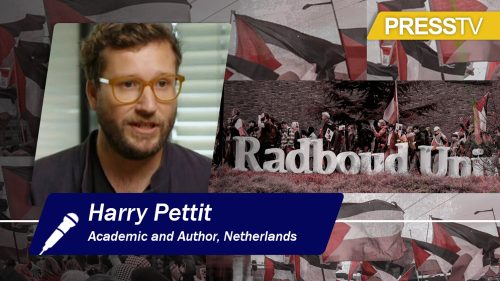
By Syed Zafar Mehdi | Press TV | November 11, 2025
Over the last two years, universities across the West have gone out of their way to repress speech against the ongoing genocide in Gaza and against Zionism, says a university lecturer who was forced to leave his university due to a Zionist witch-hunt.
In an interview with the Press TV website, Harry Pettit, the former Assistant Professor of Human Geography at Radboud University, the Netherlands, said any speech in support of the Palestinian resistance has been criminalized in Western academic circles.
Pettit, who holds a PhD from the London School of Economics and Political Science and is the author of The Labor of Hope: Meritocracy and Precarity in Egypt (2023), has been hounded at his university over his strong advocacy for Palestinian rights.
His social media posts, in which he unequivocally condemned the genocide in Gaza and the complicity of Western governments, sparked controversy as Zionist lobby groups in the Netherlands campaigned for his ouster from Radboud University.
In a statement on Monday, Pettit said the university had monitored his X account and he was pressured to retract his statements on Palestine.
He was even warned by the university administration and threatened with dismissal at the behest of influential Zionist lobby groups such as the Center for Information and Documentation on Israel (CIDI), the Netherlands Committee for Israel and the Jewish People (NCAB), as well as media outlets like De Telegraaf and Education Minister Gouke Moes.
“Over the last two years, universities across the West have gone out of their way to repress speech against the genocide, against Zionism, and in support of the Palestinian resistance,” Pettit told the Press TV website only hours after announcing he was leaving the university.
“They have done this because they are occupied by Zionist/Jewish supremacist lobby groups that want to shut down any critique of ‘Israel’. We have no choice but to fight back against this.”
He said the pro-Israel lobby is powerful in the Netherlands, which is evidenced by the data.
“If you look at data, the Netherlands has by far the biggest economic relationship with Israel in the whole of Europe. Therefore, there is a big incentive to squash critique,” he noted.
“CIDI is the main lobby group and it acts in similar ways to other countries, targeting individuals who speak out and trying to destroy their livelihoods. It also has links to political parties, the media, and student groups like Standwithus, and together they apply pressure on universities.”
Pettit, however, was not alone in this fight. He received tremendous support from his colleagues and students, who defended his freedom of speech.
“I have received a lot of support from colleagues and students who have also been taking risks to speak out against the genocide and Zionism, and the students have been incredible at engaging in disruptive protest over the last two years that has forced the university to cut ties with Israeli universities,” he told the Press TV website.
Unfazed by the threats, he vowed to continue speaking for the Palestinian cause and against the ongoing genocide in the Gaza Strip.
“I have every intention of continuing to use my platform to advocate for Palestinian liberation. That is why I left Radboud to go to a more supportive environment that enables me to keep doing that,” he asserted.
Pettit had been vocal not only on his own social media handles but also had been giving media interviews to raise awareness about the plight of Palestinians.
In one of his interviews in October, he told Volkskrant that he wants to raise awareness in the Netherlands that Palestinians “as an oppressed people have the right to armed resistance.”
“Calling October 7th a legitimate resistance operation doesn’t mean I condone everything that happened that day. But Israel wants us to see Hamas as barbarians who hate Jews. That’s a racist frame that serves to legitimize the genocide. It also obscures decades of oppression,” he said at the time.
His defense of the Palestinian resistance and the historic Operation Al-Aqsa Storm on October 7, 2023, irked Zionist lobby groups that aggressively pushed for his ouster.
Amid the genocide in Gaza, students in many universities across Europe and the US have been suspended and even arrested at the behest of Zionist lobby groups.
Europe cannot do without Russian gas despite attempts at diversification

By Ahmed Adel | November 11, 2025
As the latest data on European Union imports have shown, the bloc cannot do without Russian gas and will continue to find ways to buy it despite announcements to completely oust this energy source from the European market by 2028. Confusingly, the EU made this decision precisely when, despite strong anti-Russian sanctions, it actually increased its gas purchases from Russia.
In October, a record 1.68 billion cubic meters of gas from Russia reached the EU via the Turkish Stream, the highest monthly volume since the pipeline began operating in 2020. The pipeline’s average capacity utilization in October was 96%, and imports were 13% higher than in October last year.
The EU has also increased its imports of liquefied natural gas from Russia, with the value up by 7% compared to the same period last year. Russian LNG, as reported by EUObserver, accounted for 16% of total imports into the EU.
At the same time, the EU cannot completely replace Russian gas in two years, especially since US Secretary of the Interior Doug Bergham recently stated that although the United States has enough resources to replace Russian gas, this would require major infrastructure investments in Eastern Europe. In other words, he is calling for the Turkish Stream and the Russian gas in it to be replaced by an American Stream, even if it comes at a huge economic cost for the Europeans.
The US probably has enough gas in its reserves, but private companies do not want to jeopardize their financial position by investing in the infrastructure on American soil necessary to convert natural gas into liquid and transport it to Europe. This liquefied gas must then be returned to its gaseous state in Europe and then transported by pipeline to the end user—a complicated and expensive task.
That is why Europe has imported much more Russian gas than usual. American gas is more expensive, and no one has money to throw away, especially in the faltering European economy, where Germany, the engine of its development, has been struggling with a long recession. In effect, Europe’s economy will be buried if it relies only on American gas.
Although there is constant talk of gas from Azerbaijan, it never arrives in quantities above usual levels. Given the amount of gas the Caucasian country produces and sells, they are not enticed to invest huge sums in new deposits and significantly increased gas production that might not have a buyer in Europe in the future.
The EU cannot do without Russian gas because the bloc lacks the funds to build the necessary infrastructure. The Trump administration would certainly not finance the necessary infrastructure on European soil for LNG delivery and regasification. The pipeline required, and Europe, with its economy, is not able to finance the American Stream.
Even if a terminal for the reception and regasification of American LNG is built in the Black Sea in two years, the same amount of time as the Greek one in Alexandroupolis in the Aegean Sea, which was put into operation a year ago, is built, it is clear that its capacities are modest. The Bulgarian-Greek interconnector, which receives gas from Alexandroupolis, has a capacity of only 3 billion cubic meters per year.
Nonetheless, if it were that large in the Black Sea, it would be more than modest compared to the capacity of the Balkan Stream. Even the Turkish Stream, with a capacity of 31 billion cubic meters of gas, of which the Balkan Stream is a branch, is insufficient to meet Europe’s needs.
The EU has recently received a warning from Qatar, whose LNG imports account for around 14% of its imports. Qatar has threatened to stop supplying gas to the EU if it imposes a 5.0% fine on companies that fail to respect human rights and environmental standards. If this were to occur, Europe could eventually be left without both Russian and Qatari gas, as well as without sufficient American gas.
It cannot be expected that there will be any automatic change when peace is achieved in Ukraine because Russia will not turn its back on its new major partners, such as India. Europe is increasingly being left behind as other parts of the world, the main consumers of Russian energy, come into the spotlight. These countries are the main consumers, and as their industries develop, they will need more oil and gas. In effect, as Russian energy exports to the non-Western World grow, the constant threats by Europe to end imports will have little impact on the Russian economy and will boomerang on Europe, as all other sanctions packages have.
Ahmed Adel is a Cairo-based geopolitics and political economy researcher.
The Pokrovsk lesson is that British media are lying through their teeth
By Martin Jay | Strategic Culture Foundation | November 11, 2025
While western commentators ease their audience into a new reality – the eastern strategic town of Pokrovsk is about to fall into Russian hands – it’s interesting to see how they carefully backpedal and twist every morsel of information. It’s as though all of the information that was prepared and delivered to them is so out of touch with reality, that all is left now is to downplay the imminent Russian victory as hollow and meaningless.
It’s certainly true that a victory for Russian forces now in Pokrovsk is less strategic than it was a few months ago, but to write it off as insignificant is just one more lie that western media and commentators are guilty of delivering.
The analysis and reporting about Pokrovsk has to be deciphered, but when British journalists like Sam Kiley, who are there on the ground, talk about the victory cry from pro-Russian media as being “premature” it’s worth noting that nearly all such journalists have crossed the line of journalism for the preferred role of commentator. Kiley’s piece in the Independent is so peppered with the conditional tense that it has little or no credibility. And like all British hacks, he is cleverly removing the sweet taste of victory out of Putin’s mouth by going into the zone of spouting irrefutable so called “facts” which are naturally impossible to disprove. The main one, which gives you an indication that he also believes Pokrovsk is close to falling, is that he mentions that the gains the Russians made came through so many dead soldiers. This ol’ chestnut is repeated over and over again as British readers like to believe it’s true. Is it true? Has Russia lost a disproportionate number of soldiers on the battlefield? We will never know, so how in God’s name does Kiley?
Irrefutable claims, written as fact, are part and parcel of British reporting on the Ukraine war. Kiley might be comforted by the sensationally bad Times Radio which takes this dark art to a new level. Philip Ingram’s podcast with his friend former British Army Colonel Hamish de Bretton-Gordon is a shining example of what one ex-spook and one former colonel in the British army can do with MOD disinformation. Their podcast is so bad and bigoted, it leaves you wondering whether to laugh or cry as they both start off with the absurd argument that most of the reporting from Pokrovsk is Russian social media channels which exaggerate the scale of Russian gains and so, according to the hapless Bretton-Gordon, shouldn’t be taken seriously – before he blathers that if Russia were to take the town, it would take four years for them to do it.
He then goes on to conclude that not much is happening on the ground and that things are “opaque”. Ingram then chimes in to tone down the significance of the town, when it falls, but claims that the Ukrainians have had a success there, given what they both agree are causalities on the Russian side of a 1000 losses a day. Yet both of these numpties are reading from MOD/Mi6 data which only underlines the point that disinformation even for ex-soldiers having a go at podcasts is alive and well. While it is disturbing that Bretton-Gordon is so reliant on such data it is also off putting that he can’t even pronounce the name of the town itself correctly. Where does Times Radio find such amateurs?
For American media, even those who support Biden, the defeat of Pokrovsk is nigh and the narrative they offer contradicts the two podcasters outright. Perhaps if Times Radio Laurel and Hardy act were to actually do the legwork and interview people who are on the ground, even if it’s only the Ukrainians, their banta might have a slither of credibility about it and not leave the viewer cringing at how awful it is.
“The situation is difficult, with all types of fighting going on, firefights in urban areas, and shelling with all types of weapons,” one battalion commander told CNN, speaking on the condition of anonymity for security reasons.
“We are almost surrounded, but we are used to it,” he said. Another soldier, who also asked for his name to be withheld for safety reasons, told CNN the Russian military continues to press forward with large numbers of men.
“The intensity of their movements is so great that (Ukrainian) drone operators simply cannot keep up with the pace. The Russians often move in groups of three, counting on the fact that two will be destroyed, but one will still reach the city and gain a foothold there. About a hundred such groups can pass through in a day,” a soldier from the Ukrainian Peaky Blinders drone unit told CNN.
And so, the reporting on the British side lacks all credibility. And like all bad journalists, or pseudo journalists, the Times Radio also like to practice the deft art of omission. How did it simply pass these two that there are plenty of Ukrainian soldiers who will tell them that their MI6 taking points are BS and that it’s a shitstorm in Pokrovsk with Ukrainian losses also high? Would that not have scored them the propaganda points they crave?
In the UK, the reporting about Ukraine is so biased and manipulated by MI6/MOD disinfo that it is practically a Hollywood movie which the press is asking a gullible public to believe. Could this possibly be responsible for broad support for the war? Is a disinformation campaign actually driving the political dynamic, just as it did so many times before, not dissimilar to how many people in 2003 were happy that Tony Blair sent troops to Iraq, based on similar reports?
Ukrainian-British plot to steal MiG-31 thwarted – FSB
RT | November 11, 2025
The Russian Federal Security Service (FSB) has said it foiled an elaborate Ukrainian-British plot to steal a MiG-31 fighter jet armed with a Kinzhal hypersonic ballistic missile.
According to the FSB, although Ukrainian agents unsuccessfully tried to persuade the pilots to defect, their actual goal was for the aircraft to be shot down in Romanian airspace, provoking an international incident with NATO. The agency said the operation was organized by Ukraine’s military intelligence service (HUR) in coordination with the UK’s MI6.
A MiG-31 pilot said he was contacted last year by a man introducing himself as Sergey Lugovsky, a researcher for the open-source investigative group Bellingcat, which has received funding from several Western governments. The pilot said Lugovsky initially sought consultations, later offering money for defection.
After the pilot declined, a Ukrainian agent using the name Aleksandr approached the aircraft’s navigator, offering $3 million and a foreign passport in exchange for directing the plane to fly over an air base near Constanta, Romania.
Kiev has previously offered money and assistance to defectors. In 2023, Russian Mi-8 pilot Maksim Kuzminov defected to Ukraine, landing his helicopter behind the front lines with the HUR’s help. Two of the other crew members, unaware of his plan, were killed upon landing. Kuzminov was assassinated a year later in Spain, where he was living under a new identity and with a Ukrainian passport.
In 2022, the FSB accused former Bellingcat investigator Christo Grozev, a Bulgarian-born journalist, of taking part in a failed Ukrainian attempt to recruit Russian military pilots. Grozev said he was embedded with Ukrainian intelligence officers as a documentary filmmaker and claimed that his text messages were forged.
Behind the Dances and Deals: Trump’s Quiet Pivot in Asia
By Salman Rafi Sheikh – New Eastern Outlook – November 11, 2025
The photo ops from Trump’s Southeast Asia tour hid a deeper shift in US thinking. Washington’s new China strategy, shaped by the Pentagon, now calls for restraint, mutual legitimacy, and shared rules rather than confrontation.
In short, America’s foreign policy hawks are quietly preparing for coexistence, not conquest. Trump’s visit was to showcase this change. The question, however, remains: will the US find success ultimately?
Trump’s visit
Trump came as a peacemaker. He wanted to demonstrate that the US still matters in the region, reminding regional powers of Washington’s seriousness that it really means business going forward. Therefore, while the headlines focused on his dance performances in Malaysia and the signing ceremonies, the trip produced two notable outcomes: a peace accord between Thailand and Cambodia and a series of trade and investment frameworks with key ASEAN economies. The Thailand–Cambodia agreement, signed at the ASEAN Summit in Kuala Lumpur and witnessed by Trump, commits both sides to a cease-fire, land-mine clearance, and the release of detainees, marking a rare US-brokered diplomatic success in the region. On the economic front, Trump announced new or expanded trade arrangements with Malaysia, Cambodia, Thailand, and Vietnam—some finalized, others still in negotiation—covering areas like critical minerals, supply chains, and energy investment. Washington also upgraded its partnership with Malaysia to a “Comprehensive Strategic Partnership,” signaling a deeper US pivot toward Southeast Asia’s economic and geopolitical center. Yet, much of this remains more symbolic than substantive for now, as the real test lies in whether these deals translate into durable peace and concrete trade outcomes—or fade as another episode of diplomatic theatre.
Much of the possible success of this visit and the durability of its outcomes is tied directly to the extent to which the Trump administration can implement its own new geopolitical thinking towards the region more generally and China more specifically—a country that it wants to primarily counter in Asia and the Pacific. This new geopolitical thinking is anchored in a recent report published by the Pentagon-backed RAND corporation.
The new thinking
The RAND report delivers a striking argument: Washington must abandon—after trying it unsuccessfully for years—the fantasy of defeating China and instead learn to manage an enduring, structured rivalry. The report frames the contest as the defining axis of twenty-first-century geopolitics—an unavoidable clash of systems and ambitions—but warns that a US strategy driven by dominance, containment, or ideological confrontation risks pushing both powers toward catastrophic instability. RAND’s central proposal is not détente, but what it calls a disciplined modus vivendi: a framework that accepts competition as inevitable yet seeks to prevent it from spiraling into open conflict. This is especially important for Washington insofar as it allows it to present to the wider Southeast Asian region that it is not seeking Cold War-like alliances where regional countries must choose sides. Therefore, the authors lay out six core principles to stabilize the relationship: both sides must internalize that coexistence, not victory, is the only sustainable outcome; recognize the political legitimacy of each other’s systems, however distasteful; construct shared norms and institutions in areas of friction such as Taiwan, the South China Sea, and technology; exercise restraint in developing capabilities that threaten the other’s deterrence systems; agree on basic rules for world order; and strengthen crisis-management channels to prevent miscalculation.
To translate this into policy, the report recommends six deliberate moves for the US. First, Washington should clarify that its goal is not China’s overthrow but a stable, rules-based rivalry. Second, it must reestablish senior-level communication channels to rebuild minimal trust. Third, it should institutionalize crisis-management mechanisms, particularly around Taiwan and maritime disputes. Fourth, it should negotiate limited accords to restrain cyber and AI competition. Fifth, the US and China should mutually recognize each other’s nuclear deterrence and avoid doctrines that invite preemption. Finally, Washington should pursue narrow cooperative projects—climate, health, scientific exchanges—to maintain some connective tissue in an otherwise adversarial relationship.
Trump’s visit reflected this thinking very much. For example, throughout this tour, Trump made no mention of the QUAD—an anti-China alliance comprising the US, India, Japan, and Australia. It means that Washington is moving away from its strategy of building economic and military alliances with anti-China states, such as India and Japan, to use them as counterweights to China’s influence. This narrative aligns with what the RAND report refers to as recognizing the legitimacy of China and its ruling party.
Beyond Ambitions
Having said this, none of this means that a complete reset has taken place, or will take place soon. Undoubtedly, several bones of contention have been healed, but several remain. Trump’s meeting with Xi, for instance, produced a tactical easing of tensions rather than a strategic breakthrough. Both leaders agreed to cut US tariffs on Chinese imports from roughly 57 to 47 percent, while Beijing pledged to resume large purchases of American soybeans and temporarily lift its export restrictions on rare earth minerals—an issue Trump declared “completely resolved” for now. China also committed to tightening controls on the export of fentanyl precursors, offering Trump a domestic win. Yet these agreements are largely short-term gestures: most are limited to a year, and none address the deeper structural rifts over Taiwan, technology export controls, or military rivalry. In effect, the meeting delivered a pause—a breathing space for both sides to stabilize strained supply chains and political optics—rather than a genuine reset of relations. The underlying strategic mistrust remains intact, making this more a tactical truce than a transformation of US-China relations.
Trump’s tour and his carefully choreographed diplomacy signal that Washington is experimenting with a softer, more disciplined form of competition—one that seeks to manage, not eliminate, China’s rise. Yet the contradictions at the heart of this strategy remain unresolved. The US still ultimately wants to lead Asia while pretending to share it; it seeks coexistence but clings to primacy. The Pentagon’s call for mutual legitimacy and restraint may sound pragmatic, but it runs up against the political and ideological reflexes of an America that views China as a rival to be outlasted, not accommodated. Trump’s gestures toward peace and partnership may buy time and goodwill to achieve this objective ultimately. China, however, will be very mindful.
Salman Rafi Sheikh, research analyst of international relations and Pakistan’s foreign and domestic affairs
Gordon Hahn: The Strange Death of Europe
Glenn Diesen | November 10, 2025
Gordon Hahn discusses Europe’s ideological fundamentalism, detached leadership, Russophobia, subservience to the US, and other causes for the death of the old continent.
Follow the work of Gordon Hahn: https://gordonhahn.substack.com/ https://gordonhahn.com/
Follow Prof. Glenn Diesen: Substack: https://glenndiesen.substack.com/
X/Twitter: https://x.com/Glenn_Diesen
Patreon:  / glenndiesen
Support the research by Prof. Glenn Diesen: PayPal: https://www.paypal.com/paypalme/glenn…
Buy me a Coffee: buymeacoffee.com/gdieseng Go Fund Me: https://gofund.me/09ea012f
Books by Prof. Glenn Diesen: https://www.amazon.com/stores/author/…
Out of 270 journalists, ‘Israel’ killed 44 in Gaza displacement tents
Al Mayadeen | November 10, 2025
44 Palestinian journalists were killed inside displacement tents in the Gaza Strip, out of more than 270 media workers slain by Israeli occupation forces since October 2023.
According to a new report by the Freedoms Committee of the Palestinian Journalists Syndicate, many of the journalists were sheltering near hospitals and United Nations-run facilities when occupation forces launched airstrikes or opened sniper fire directly at displacement tents.
The report pointed to the systematic campaign targeting Gaza’s media infrastructure, citing the destruction of news offices and the deliberate killing of journalists in their homes, workplaces, and temporary shelters.
Deliberate targeting and legal violations
The Syndicate stressed that targeting journalists constitutes a war crime under Article 79 of the First Additional Protocol to the Geneva Conventions, which guarantees civilian protection to media workers. It further noted that attacks on displacement tents near hospitals and schools represent a serious breach of the protections granted to humanitarian zones.
Investigators confirmed that no military activity was detected in or around the targeted tents, refuting Israeli claims of accidental strikes. The group argued that the use of precision weaponry in densely populated civilian zones “reflects a calculated intent not only to cause death, but to silence witnesses and obstruct documentation of events.”
Call for international accountability
The Palestinian Journalists’ Syndicate urged the formation of an independent international commission to investigate the targeting of journalists and called for the activation of International Criminal Court mechanisms to pursue accountability for war crimes.
It also appealed for cooperation with UNESCO and the International Federation of Journalists to establish safe corridors and protected zones for displaced media workers, while maintaining a comprehensive legal archive to support future judicial proceedings.
Previous incidents
Earlier in August, six journalists, including Al Jazeera’s correspondent Anas al-Sharif, were killed when an Israeli airstrike targeted a tent sheltering reporters outside the main gate of Gaza City’s al-Shifa Hospital. The deliberate attack, which targeted al-Sharif, drew international condemnation and renewed calls for investigations into “Israel’s” criminal action.
The Syndicate’s latest report adds to growing evidence from press freedom organizations, including the Committee to Protect Journalists (CPJ) and Reporters Without Borders (RWB), that “Israel’s” war on Gaza has become the deadliest conflict for journalists in modern history, raising urgent alarms about systematic violations of international humanitarian law.
Israeli soldiers recount indiscriminate killing of Palestinian civilians in Gaza
The Cradle | November 10, 2025
In a new documentary film, Israeli soldiers have described a “free-for-all” in Gaza, in which they killed civilians “without restraint” with the encouragement of politicians and rabbis, The Guardian reported on 10 November.
“If you want to shoot without restraint, you can,” stated Daniel, the commander of an Israeli tank unit.
He and other soldiers gave testimony about killings they perpetrated during combat tours in Gaza for the film ‘Breaking Ranks: Inside Israel’s War,’ which will be broadcast in the UK on ITV on Monday night.
The soldiers who agreed to talk confirmed they routinely used Palestinians as human shields and opened fire unprovoked on civilians seeking aid at militarized distribution points set up by the US-Israeli-backed Gaza Humanitarian Foundation (GHF).
Captain Yotam Vilk, an Israeli armored corps officer, said that in basic training, they were taught to only fire at a target that has the means, shows intent, and has the ability to cause harm.
But in Gaza, “there’s no such thing as ‘means, intent and ability,’” Vilk stated in the film.
“No soldier ever mentions ‘means, intent, and ability.’ It’s just a suspicion of walking where it’s not allowed. A man aged between 20 and 40,” he explained.
Another soldier, identified in the film as Eli, says individual commanders had the freedom to determine who was killed and who was allowed to remain alive.
“Life and death aren’t determined by procedures or opening fire regulations. It’s the conscience of the commander on the ground that decides,” Eli said.
“If they’re walking too fast, they’re suspicious. If they’re walking too slow, they’re suspicious. They’re plotting something. If three men are walking and one of them lags behind, it’s a two-to-one infantry formation – it’s a military formation,” he added.
Eli describes an incident in which a senior officer ordered a tank to destroy a residential building, crushing civilians to death inside, because a man was hanging laundry on the roof.
“The officer decided that he was a spotter. He’s not a spotter. He’s hanging his laundry. You can see that he’s hanging laundry,” he said.
“Now, it’s not as if this man had binoculars or weapons. The closest military force was 600–700 meters away. So, unless he had eagle eyes, how could he possibly be a spotter? And the tank fired a shell. The building half collapsed. And the result was many dead and wounded.”
The Guardian notes that according to the Israeli military’s own intelligence data, 83 percent of those killed in Gaza were civilians, a historic high for modern conflicts. More than 69,000 Palestinians have been killed since the war started, according to the Gaza Health Ministry, with tens of thousands more likely not counted as they remain buried under the rubble of destroyed buildings.
The Israeli military publicly claims its forces seek to protect civilians. However, some of the soldiers interviewed for the film said they were influenced by genocidal language used by Israeli politicians and religious leaders who claimed that no Palestinians in Gaza were innocent after the Hamas attack of 7 October 2023.
For example, a UN commission pointed to comments made by Israeli President Isaac Herzog, who claimed after 7 October that, “It is an entire nation out there that is responsible. It is not true, this rhetoric about civilians not aware, not involved, it’s absolutely not true.”
Roughly 1,200 Israelis and foreign nationals were killed in the Hamas attack. Israel blamed all these deaths on Hamas; however, the military itself killed hundreds with attack helicopters, drones, and tanks, per a special order known as the Hannibal Directive.
The order was given for Israeli pilots to fire on their own civilians to prevent them from being taken to Gaza as captives that Hamas could use to liberate Palestinians in a prisoner exchange.
Israeli Prime Minister Benjamin Netanyahu publicly referred to Palestinians in Gaza as “Amalek,” citing a story from Jewish scripture in which the Hebrews were ordered to exterminate the entire Amalekite nation, killing every man, woman, and child – even babies.
Daniel, the tank unit commander, said that this type of rhetoric influenced the behavior of soldiers in his unit. “You hear that all the time, so you start to believe it,” he stated.
Jewish rabbis in the Israeli army also advised soldiers to exterminate Palestinians in Gaza.
“One time, the brigade rabbi sat down next to me and spent half an hour explaining why we must be just like they were on 7 October. That we must take revenge on all of them, including civilians. That we shouldn’t discriminate, and that this is the only way,” said Major Neta Caspin.
Rabbi Avraham Zarbiv, who participated with his unit in the genocide in Gaza, stated in the film that, “Everything there is one big terrorist infrastructure.”
Zarbiv personally drove military bulldozers and boasted about destroying Gaza, stating that the army spent “hundreds of thousands of shekels to destroy the Gaza Strip. We changed the conduct of an entire army.”
The soldiers speaking in Breaking Ranks also confirmed their use of Palestinians as human shields, known as “Mosquitos,” to clear tunnels and homes where booby traps may be present. That way, a Palestinian would be killed rather than an Israeli soldier.
“You send the human shield underground. As he walks down the tunnel, he maps it all for you. He has an iPhone in his vest, and as he walks, it sends back GPS information,” said Daniel, the tank commander.
“The commanders saw how it works. And the practice spread like wildfire. After about a week, every company was operating its own mosquito.”
A private contractor, identified as Sam, confirmed that Israeli soldiers opened fire on and killed unarmed civilians seeking food at GHF distribution sites.
He described witnessing Israeli soldiers murder two Palestinian men.
“You could just see two soldiers run after them. They drop onto their knees, and they just take two shots, and you could just see … two heads snap backwards and just drop,” Sam explained.
In another case, he saw a tank destroy “a normal car … just four normal people sat inside it.”
At least 1,889 Palestinian civilians were killed by Israeli soldiers while seeking food in Gaza between 27 May and 18 August 2025, according to UN figures.
Israel demands Lebanese army raid civilian homes in south: Report

Smoke and debris rise after an Israeli airstrike on the southern Lebanese village of Teir Debba on Thursday
The Cradle | November 10, 2025
Israel is pressing for the Lebanese Armed Forces (LAF) to launch raids into civilian homes in south Lebanon in search of weapons belonging to Hezbollah, Lebanese sources told Reuters on 10 November.
The report coincided with new drone strikes on southern Lebanon, and came hours after an Israeli army force raided near the Lebanese town of Hula and blew up two homes.
“Israel is pressing Lebanon’s army to be more aggressive in disarming … Hezbollah by searching private homes in the south for weaponry,” three Lebanese security sources said.
The demand “has been rejected” by the LAF, the sources added. Army leadership fears such a move could trigger civil strife and derail its overall disarmament plan, which the Lebanese military views as “cautious but effective.”
Israel requested these “raids” indirectly in October via the ceasefire mechanism, which includes Washington, Tel Aviv, Beirut, Paris, and the UNIFIL.
The request was followed by an increase in Israeli attacks and ground operations in the south, where Israeli forces have established an occupation in violation of the ceasefire deal.
The escalation was seen “as a clear warning that failure to search more intrusively could prompt a new full-blown Israeli military campaign,” the sources went on to say.
“They’re demanding that we do house-to-house searches, and we won’t do that … we aren’t going to do things their way,” one of the officials told Reuters. “Residents of the south will see house raids as subservience to Israel.”
Since the start of the year, the Lebanese army has been dismantling Hezbollah infrastructure and confiscating arms south of the Litani River in line with the ceasefire deal reached in November 2024.
But Israel is accusing Lebanon of “dragging its feet,” and says Hezbollah is rearming faster than the Lebanese army is dismantling.
The US is pressuring Lebanon to establish direct channels of communication with Israel, a violation of the country’s own laws.
Washington has also threatened Lebanon with a new Israeli war if Hezbollah is not disarmed immediately.
The resistance says it would eventually be willing to discuss incorporating its arms into the Lebanese military as part of a defensive strategy that would keep the weapons available for use if Lebanon is attacked.
However, it rejects any discussion of the matter while Israel continues to attack Lebanon and occupy several areas along the southern border.
The Reuters report on Monday coincided with new Israeli attacks.
An Israeli drone strike targeted the outskirts of the town of Hmayri in the Tyre district in south Lebanon.
Earlier, an Israeli drone strike on a vehicle in Bisariyeh, on the Sidon–Tyre highway, claimed the life of Lebanese citizen Samir Faqih.
The night before, Israeli troops raided an area near the southern Lebanese town of Hula, rigging and detonating two homes.
“Israeli soldiers entered the Subeih hill in northeast Hula (south Lebanon), planted explosives in two homes, and detonated them. The hill is near a Lebanese army checkpoint, where several soldiers stand with one or two vehicles,” Lebanese journalist Khalil Nasrallah wrote.
“It is the only checkpoint. The army personnel are not to be blamed under any circumstances. Believe me, those who know the area know what I mean. The army personnel are not weak, and their blood is not cheap to us, but precious. The blame lies with those who gave the army orders to confront without reinforcing it and strengthening its presence in many sensitive areas near the border,” he added.
Over 40 Lebanese people have been killed by Israel in the past month and a half. Tel Aviv has vowed to continue escalating.
West in no position to comment on Iranian missiles’ range: Security chief
Press TV – November 10, 2025
Iran’s top security official says the West is using the country’s missile capabilities as a means of pressure, stressing it is in no position to comment on the issue.
“The current debate on Iran’s missiles is not out of genuine security concerns but rather serves as a tool to exert pressure and restrict the country’s defensive power,” Secretary of Iran’s Supreme National Security Council Ali Larijani said on Monday.
He added that it is irrelevant for the West to comment on the range of Iran’s missiles, questioning their involvement in the matter.
“What does it have to do with the West that it comments on the range of Iran’s missiles?” he asked.
Larijani, who was a former nuclear negotiator, emphasized that Western countries also use the nuclear issue as a pretext to harbor animosity towards the Iranian nation, saying the US and Europe are raising issues about the range of Iran’s missiles with the aim of imposing control and dominance.
“No country is entitled to interfere in the Iranian nation’s defensive power,” which is a matter of independence, Larijani pointed out.
The United States and its European allies have repeatedly called for any future agreement on Iran’s nuclear activities to include its ballistic missile program as well.
Tehran has consistently rejected that demand, saying its military capabilities are non-negotiable.
Iran held five rounds of talks on a replacement for the 2015 nuclear deal prior to the US-Israeli airstrikes on the country and its nuclear facilities in mid-June.
In his remarks, Larijani further pointed to Iran-West relations and the Islamic Revolution’s stance on the country’s political, cultural, and economic independence, adding, “Iran is neither seeking control [over other nations] nor is submissive to the dominance of any power.”
Larijani further pointed to Iran-West relations and the Islamic Revolution’s stance on the country’s political, cultural, and economic independence, adding, “Iran is neither imperialistic nor submissive to the dominance of any power.”
Since the victory of the Islamic Revolution, Iran has increased its trade relations with the East, Muslim countries, and the neighbors, although for years the West was Iran’s primary trading partner, the SNSC secretary noted.
He slammed the West’s arrogant policies with respect to political and security issues, saying the policy resulted in a crisis in its cooperation with Iran.
Larijani stressed the importance of maintaining Iran’s independence “because freedom, culture, and economy will not remain stable in the absence of independence.”
The West, under the guise of advocating human rights and peace, has been the main obstacle to the independence of nations for centuries, he asserted.
Iran’s top security official described national unity as the “greatest asset” of the country, warning of plots to weaken the will of the Iranian people.
He said the Iranian nation has proved over the past four decades, particularly during the US-Israeli war in mid-June, that it will never compromise over its independence.
“Iran will not retreat from its path of independence and dignity, even if it means facing full-scale confrontation,” he emphasized.
He reaffirmed the Iranian nation’s will to stand strong and rational in the face of “modern brutality.”
Featured Video

Iran’s Mass Protests /Patrick Henningsen & Lt Col Daniel Davis
or go to
Aletho News Archives – Video-Images
From the Archives
Does Kevin Barrett Seek to “Absolve Islam of a Terrible Crime”?
The Kevin Barrett-Chomsky Dispute in Historical Perspective – Last part of the series titled “9/11 and the Zionist Question”
By Prof. Tony Hall | American Herald Tribune | August 28, 2016
Amidst his litany of condemnations, Jonathan Kay reserves some of his most vicious and vitriolic attacks for Kevin Barrett. For instance Kay harshly criticizes Dr. Barrett’s published E-Mail exchange in 2008 with Prof. Chomsky. In that exchange Barrett castigates Chomsky for not going to the roots of the event that “doubled the military budget overnight, stripped Americans of their liberties and destroyed their Constitution.” The original misrepresentations of 9/11, argues Barrett, led to further “false flag attacks to trigger wars, authoritarianism and genocide.”
In Among The Truthers Kay tries to defend Chomsky against Barrett’s alleged “personal obsession” with “vilifying” the MIT academic. Kay objects particularly to Barrett’s “final salvo” in the published exchange where the Wisconsin public intellectual accuses Prof. Chomsky of having “done more to keep the 9/11 blood libel alive, and cause the murder of more than a million Muslims than any other single person.” … continue
Blog Roll
Recent Comments
loongtip on Eilat port faces worst crisis… loongtip on British minister dreams of kid… loongtip on Kiev awards major mining proje… loongtip on UK believes it can seize any t… loongtip on Pirates of the Caribbean loongtip on Australian festival boycotted… loongtip on Kiev seeks to ban Russian musi… seversonebcfb985d9 on Somaliland and the ‘Grea… John Edward Kendrick on Kidnapped By the Washington… aletho on Somaliland and the ‘Grea… John Edward Kendrick on Somaliland and the ‘Grea… aletho on Donald Trump, and Most America…


 Aletho News
- Knesset advances bill mandating death by hanging for Palestinian prisoners
- Eilat port faces worst crisis as Red Sea shipping collapses
- Iran protest-riots can only achieve US-Israeli intervention, ‘shadow CIA’ concludes
- The Coming War on Iran: What Has Really Been Happening?
- US Cargo Planes Have Flooded the Persian Gulf Since the First of December
- Deep-state forces from abroad instigated violence in Nepal – former foreign minister
- Rare Earths—or Arctic Control? Greenland’s Riches May Just Be Excuse
- Kiev awards major mining project to Trump-linked investors
- US makes money from weapons, not from Ukrainian minerals
- Drone hits Kazakh tanker en route to Russian port
- If Americans Knew
- The New Neoconservatives
- As more Gaza children freeze to death, Trump eyes Gaza as starting point for world domination – Not a ceasefire Day 95
- More death: in Gaza, West Bank, Israeli prison – Not a ceasefire Day 94
- The Israeli Influence Operation Aiming to Install Reza Pahlavi as Shah of Iran
- Avoidable tragedy: another infant dies from cold – Not a ceasefire Day 93
- Israel is quietly erasing Palestinian refugee camps from existence in the West Bank
- The “Zionist tint” to the Maduro abduction, if not operational, then normative
- Press association condemns Israel’s continued ban on media access to Gaza
- Israeli Indifference to Palestinian Suffering Is Fertile Ground for the Growth of Sadism
- Surge in premature births, congenital defects, cancer deaths in Gaza – Not a ceasefire Day 92
- No Tricks Zone
- Denmark Places Climate Protection Above Animal Welfare, Poisoning And Culling Cows
- New Study: Greenland Was 3-7°C Warmer And Far Less Glaciated Than Today 6000-8000 Years Ago
- German Media Report That Current Frigid Weather Can Be Explained By Arctic Warming!
- Berlin Blackout Shows Germany’s $5 Trillion Green Scheme Is “Left-Green Ideological Pipe Dream”
- Modeling Error In Estimating How Clouds Affect Climate Is 8700% Larger Than Alleged CO2 Forcing
- Berlin’s Terror-Blackout Enters 4th Day As Tens Of Thousands Suffer In Cold Without Heat!
- Expect Soon Another PIK Paper Claiming Warming Leads To Cold Snaps Over Europe
- New Study: Human CO2 Emissions Responsible For 1.57% Of Global Temperature Change Since 1750
- Welcome To 2026: Europe Laying Groundwork For Climate Science Censorship!
- New Study Finds A Higher Rate Of Global Warming From 1899-1940 Than From 1983-2024
 Aletho News