Israeli occupation forces attack Palestinian family, arrest foreign activists in al-Khalil

Palestinian Information Center – September 29, 2024
WEST BANK – The Israeli occupation forces (IOF) assaulted a Palestinian family and arrested foreign peace activists in Masafer Yatta, south of al-Khalil, in the southern West Bank on Sunday.
Activist Osama Makhamreh reported that the IOF stormed Al-Tuwani village in Masafer Yatta, and assaulted the Al-Harini family.
He added that the IOF arrested foreign peace activists after preventing them from filming and documenting settlers’ violations and attacks against local citizens.
In August 2024, the Israeli army and settlers carried out 1,228 attacks against Palestinians and their property in the West Bank.
These attacks included field executions, armed attacks on Palestinian villages, vandalism, bulldozing of land, uprooting of trees, property confiscation, movement restrictions, and the erection of military checkpoints.
Nasrallah assassination aimed at provoking US-Iran war: Russia’s Lavrov
Press TV – September 29, 2024
Russia’s Foreign Minister Sergey Lavrov says that Israel’s assassination of Hezbollah Secretary-General Sayyed Hassan Nasrallah may have been intended to provoke a war between the United States and Iran.
Lavrov told reporters at a news conference after addressing the UN General Assembly on Saturday that a lot of people believe Israel’s assassination of Nasrallah was aimed at provoking Iran and the US “to unleash a full-blown war in the entire region.”
Killing the Hezbollah leader was “not simply a political assassination. It’s very cynical as an act,” Lavrov said.
“I think – well not even, I think, but a lot of people say – that Israel wants to create the grounds to drag the US directly into this and so to create these grounds, it is trying to provoke Iran,” Lavrov added.
“The Iran leadership, I think, are behaving extremely responsibly. And this is necessary. This is something that we should take due note of.”
Speaking at the UN Security Council meeting on Friday, Lavrov said, “the Middle East is once again on the brink of a big war,” calling for active diplomatic efforts to prevent the “most catastrophic scenario.”
In his UN General Assembly speech, Lavrov condemned the Israeli regime for its “inhumane attack on Lebanon.”
“Another glaring example of terrorist methods as a means of achieving political aims is the inhumane attack on Lebanon that transformed civilian technology into a lethal weapon,” Lavrov said, calling for an immediate international investigation.
‘US knew about Israel’s pager attacks’
Lavrov also told reporters that the US was likely aware of the Israeli regime forces’ plans to launch a “terrorist attack” against Lebanon using communication devices.
He said the complexity of the attack and the leaking of details to Western media indicate Washington’s possible complicity in the terrorist operation.
Last week, thousands of hand-held pagers and walkie-talkies used by Hezbollah members exploded across Lebanon simultaneously, killing dozens and injuring thousands, including many civilians. The attack, widely blamed on Israeli spy agency Mossad, drew international condemnation, with UN Human Rights Commissioner Volker Turk calling it a “shocking” and “unacceptable” act that violates human rights laws.
Tel Aviv has not claimed responsibility for the pager attacks, and its allies have denied any knowledge. However, according to Lavrov, Western media reports regarding the details and preparations “indicate to varying degrees the involvement and, at the very least, awareness of Washington concerning the preparation of that terrorist attack.”
Ukraine’s ‘Victory Plan’ Is Delusional
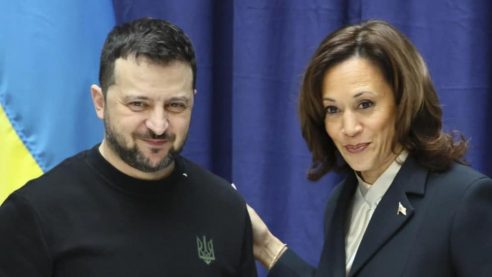
By Tyler Durden | Zero Hedge | September 28, 2024
In the past two years the western establishment media has effectively obscured the reality on the ground in Ukraine. Only recently has it become clear to the public that the tales we’ve heard about Russia imploding due to “bad tactics” and “throwing bodies into the meat grinder” in exchange for irrelevant territory have all been a fantasy. The problem is, propagandists often end up believing their own propaganda and then they are caught completely by surprise down the road when reality slaps them in the face.
Russian offensive actions in the east have greatly accelerated and now in the south the vital city of Vuhledar is set to fall within a couple days (if it hasn’t already). Their attrition based strategy and artillery superiority have created a shield for small fast moving units to strike Ukraine’s trenches and fixed defenses, and their drone game has dramatically improved. This has led them to capture multiple towns and cities in the past three months, with their forces closing in on the key eastern operational base of Pokrovsk. If Pokrovsk falls, the entire east of Ukraine could easily fall.
Beyond the shift to attrition tactics, Russia is gaining territory quickly because Ukraine is low on manpower. No amount of NATO technology or weaponry is going to help this fundamental weakness. This is the reality in Ukraine; they are losing the war.
The western media is unable to gloss over the situation any longer, which means something dramatic will have to happen to change the course of the war in Ukraine’s favor. Their government is scrambling to initiate an October surprise in preparation for the US elections in November. The US runs NATO, and Ukraine is entirely dependent on US aid.
The notion of a Ukrainian “Victory Plan” is by itself questionable given the circumstances, but what is reportedly contained in Vladimir Zelensky’s strategy seems to be an over-optimistic wish list relying heavily on escalation between NATO and Russia. In other words, the only way Ukraine can “win” is for NATO to engage in open warfare with the East.
While the full plan hasn’t been divulged, senior U.S. officials who are familiar with its contents don’t see anything original or innovative in it. As one told The Wall Street Journal on Sept. 25, “I’m unimpressed, there’s not much new there.” From what we can grasp, the “victory plan” is less a “plan” and more a continuation of Zelensky’s lobbying campaign to keep U.S. arms flowing in perpetuity.
Zelensky is dead-set on getting permission to use US and European long range missile systems against targets deep within Russia. The problem, as Vladimir Putin rightly noted, is that these systems cannot hit such targets accurately without NATO satellite intel and acquisition. Meaning, the missiles must be guided by US and European military technicians and assets.
It is likely that the majority of Ukrainian long range drone strikes within Russia are already being aided by NATO intel, but the use of ATACMS and Storm Shadow missiles far from Ukraine’s front line is another matter entirely. There’s no plausible deniability for NATO involvement. The use of these weapons within Russia would be akin to a declaration of war and would trigger escalation outside of Ukraine.
What would the consequences be? Not necessarily the use of nuclear weapons (though Putin did just change his bottom line on a nuclear response to include long range attacks using NATO weapons), but the spread of more advanced Russian armaments to countries like China, Iran, Syria, North Korea, and even the Houthis in Yemen is a good bet. Meaning a more significant threat to NATO interests in Asia and the Middle East. The war would spread.
So far the Biden Administration has refrained from supporting the long range option, but has offered another $8 billion in support. Under a Trump presidency, the money train is likely to stop abruptly.
Zelensky has offered no practical measures for negotiations, arguing that concessions are off the table. Furthermore, he claims that peace is only possible once Ukraine has taken back all territory seized by Russia, including Crimea which was annexed in 2014. He then demanded that Russia pay for Ukraine’s reconstruction and that Putin and a multitude of other Russian officials be handed over to be tried for war crimes. This is never going to happen.
The core of Ukraine’s victory plan relies on long range strikes using NATO guided missiles and acceptance into NATO. Both factors at this stage would cause WWIII.
Ukraine’s chest beating is the national equivalent of “short man’s syndrome.” That said, Zelensky would not be making these kinds of demands if he was not being encouraged by someone behind the scenes. Many officials within the US and Europe have given Zelensky delusions of grandeur about his chances, perhaps because they want the war to grind on forever. These same officials have hinted consistently that they will not accept a Ukrainian loss.
Regardless of what side people think should win, the fact is that Russia is the inevitable victor according to all the evidence on hand. While the extent of Putin’s goals in the region are unknown, it’s unlikely that he intends to march beyond Ukraine. He may simply stop at the edge of the Donbas and annex the region like he did Crimea.
This may actually be the best case scenario for all parties involved. The longer the war goes on the greater the chances of a powderkeg moment and a direct confrontation between Russia and NATO. Ukraine should not be talking about “victory”, that time has come and gone. They should be talking about peace.
What’s Wrong with Boris Johnson’s Plan to “Save” Ukraine?
Johnson’s “three-fold plan for Ukrainian victory”
By Brian Berletic – New Eastern Outlook – September 29, 2024
A September 21, 2024 article published in The Spectator written by former British Prime Minister Boris Johnson titled, “It’s time to let Ukraine join NATO,” attempts to formulate a theory of victory for Ukraine as war with Russia continues to grind on.
Johnson demands that the collective West “end the delays” and that the West “get it done and get it won.” By this, he means lifting all restrictions on the use of Western long-range weapons on pre-2014 Russian territory.
Next, he demands the US and Europe provide a “package of loans on the scale of Lend-Lease: half a trillion dollars,” or “even a trillion.” Johnson claims such support will send a message to the Kremlin that, “we are going to out-gun you financially and back Ukraine on a scale you cannot hope to match.”
Western personnel have already been operating in Ukraine since 2014 and have continued to do so throughout Russia’s Special Military Operation
Finally, he demands Ukraine be allowed membership into NATO immediately, even as the conflict rages on. In respect to NATO’s Article 5 regarding “collective defense,” Johnson proposes that:
… we could extend the Article 5 security guarantee to all the Ukrainian territory currently controlled by Ukraine (or at the end of this fighting season), while reaffirming the absolute right of the Ukrainians to the whole of their 1991 nation. We could protect most of Ukraine, while simultaneously supporting the Ukrainian right to recapture the rest.
While Johnson points out the political implications of this policy, meaning all of NATO would, “have to commit to the defence of that Ukrainian territory,” he falls far short of considering the practical implications.
NATO Intervention in Ukraine: Political vs. Practical Considerations
Far from a lack of political will or financial resources, the collective West has fallen short supplying Ukraine with the military equipment, vehicles, weapons, and ammunition required to match or exceed Russian military capabilities because its collective military industrial base itself is incapable of physically producing the quantities required, regardless of the money allotted to do so.
Military industrial production requires several fundamental factors in order to be expanded – financial resources being only one of many. Expanding production also requires the physical enlargement of existing facilities, the building of new facilities, the expansion of trained workforces which includes reforming and expanding primary, secondary, and specialized education, as well as the expansion of downstream suppliers and the acquisition of additional raw materials required for production across the entire industrial base.
Any one of these measures could take years to implement. Implementing them all would take longer still.
Then there is the very structure of the collective West’s military industrial base. Consisting of corporations prioritizing the maximization of profits, not performance, the collective West’s military industrial base has for years focused on low quantities of highly-sophisticated (and very expensive) weapons systems and munitions.
For the duration of the so-called “Global War on Terror” these weapon systems were adequate, if inefficient. They enabled US-led forces to roll over the antiquated, poorly-trained, poorly-equipped Iraqi army in 1991 and again in 2003, as well as the Taliban in Afghanistan in 2001. Such weapon systems also proved effective in the destruction of Libya in 2011.
But as the global balance of military and economic power has shifted throughout the 21st century, limits to this military industrial approach became apparent. In 2006, Israel’s vast Western-backed military machine categorically failed in its invasion of southern Lebanon, confounded by Hezbollah leveraging modern anti-tank weapons.
The US intervention in Syria from 2011 to present day also revealed the growing limitations of expensive Western military hardware, with 100s of cruise missiles fired at targets across Syria with limited success due to vastly better air and missile defenses than previous US adversaries possessed.
The Western media now admits waning US military support for Ukraine stems from dwindling stockpiles and an inability to quickly expand production.
CNN in its September 17, 2024 article titled, “US military aid packages to Ukraine shrink amid concerns over Pentagon stockpiles,” would admit:
US military aid packages for Ukraine have been smaller in recent months, as the stockpiles of weapons and equipment that the Pentagon is willing to send Kyiv from its own inventory have dwindled. The shift comes amid concerns about US military readiness being impacted as US arms manufacturers play catchup to the huge demand created by the war against Russia.
Nothing took place between September 17, 2024 when CNN published this report and September 21, 2024 when The Spectator published Boris Johnson’s article to change this reality. Johnson simply chose to ignore it.
NATO committing to the defense of Ukrainian-held territory would require sufficient quantities of artillery, armor, air and missile defense systems, and trained manpower – all of which the collective West, not just Ukraine, has in short supply.
In many ways, the collective West is already waging war against Russian forces. Western personnel have already been operating in Ukraine since 2014 and have continued to do so throughout Russia’s Special Military Operation (SMO) from 2022 onward. Russia has not hesitated to target and destroy Western equipment or the Western personnel operating it, though Russia has managed escalation very carefully in the process.
Were NATO to more openly intervene in what is already a NATO proxy war against Russia, Russian forces would likely continue targeting all of Ukraine’s territory while continuing to manage escalation carefully. NATO itself could escalate, using its long-range missiles and air power against Russian forces both within Ukraine and within pre-2014 Russian borders, but this would present two major problems.
First, if the West is already out of long-range weapons to transfer to Ukraine, its stockpiles having dwindled to critical levels, and having failed to expand production to reconstitute to them should any contingency of any kind fully deplete them, a more direct role in Ukraine would consume what arms and ammunition the West has left with no means of replacing them in the near-term.
Second, whatever impact the collective West imagines using the remnants of its arms and ammunition on Russia directly will have, it will leave the West far short of any material capabilities to conduct large scale war anywhere else in the world, including in the Middle East against Iran and its allies and across the Asia-Pacific region against China – two areas of concern Johnson himself mentions in his article.
Boris Johnson claims:
If you are truly worried about ‘escalation’, then imagine what happens if Ukraine loses this war – because that is when things really would begin to escalate. Ukraine won’t lose but if it did, we would have the risk of escalation across the whole periphery of the former Soviet empire, including the border with Poland, wherever Putin thought that aggression would pay off.
We would probably see escalation in the South China seas and in the Middle East. We would see a general escalation of global tension and violence because a Ukrainian defeat, and a victory for Putin, would be not only a tragedy for a young, brave and beautiful country; it would mean the global collapse of western credibility.
What Johnson means by “western credibility,” is Western primacy. By “escalation in the South China seas and in the Middle East,” Johnson means regional players displacing unwarranted US-led occupation and interference. Johnson’s plan to commit the West’s waning military power to Ukraine means forfeiting the means to cling to primacy elsewhere around the globe.
Johnson’s plan to incorporate Ukraine into NATO would not be a master stroke up-ending Russia’s escalation dominance, it would be the forfeiture of NATO’s own escalatory leverage regarding Article 5. Success for NATO would depend entirely on Russia failing to call the West’s bluff and avoiding the targeting of Ukrainian territory once NATO intervenes directly.
A very similar strategy was used in Syria by the United States as a means to reverse the flagging fortunes of its proxies there. The US, instead, at most managed to create a stalemate. Over the past nearly 10 years the US has occupied eastern Syria, its position in Syria as well as in the rest of the region has waned.
Part of this stems from the US’ inability to field a large enough military force, armed with sufficient numbers of arms and munitions. US air and missile defense systems in particular are in short supply and have opened up US forces in Syria and Iraq to regular drone, rocket, and missile strikes, compromising US military supremacy in the region.
By stretching US and European military power out even thinner by committing large numbers of troops and equipment to a direct intervention in Ukraine only means accelerating the decline of US-led Western primacy around the globe even faster.
Johnson’s plan to “save” Ukraine is borne of desperation, predicated on either a poor understanding of the fundamental factors required for its success, or deliberately ignoring these factors.
It is also a plan born of a lack of imagination. For Boris Johnson and the Western special interests he represents, the only possible future for humanity is one dominated by the West, just as it has done for the past several centuries.
The ultimate irony, however, is Johnson’s mention of a “Soviet empire” he claims Russian President Vladimir Putin is intent on rebuilding. At one point, Johnson claims:
The message is: that’s it. It’s over. You don’t have an empire anymore. You don’t have a ‘near abroad’ or a ‘sphere of influence’. You don’t have the right to tell the Ukrainians what to do, any more than we British have the right to tell our former colonies what to do. It is time for Putin to understand that Russia can have a happy and glorious future, but that like Rome and like Britain, the Russians have decisively joined the ranks of the post-imperial powers, and a good thing, too.
Yet, the conflict in Ukraine stems directly from NATO expansion toward Russia’s borders. It was never a matter of Russia telling Ukraine what to do – it was always a matter of the US politically capturing Ukraine in 2014 and transforming it into a national security threat to Russia from 2014 onward.
Russia is responding to the expansion of a modern-day empire – not in any sort of effort to create its own empire. The empire Russia opposes in Ukraine [Zionist globalism] is the same empire Johnson fears will be challenged in the Middle East and the South China Sea should its proxy war fail in Ukraine. While Johnson accuses Russia of being out of touch with reality regarding imagined imperial ambitions in Moscow, his plan reflects very real delusions associated with a desperate desire to perpetuate the US-led “international order” the UK itself is so deeply invested in.
Boris Johnson’s attempt to build policy regarding the West’s proxy war in Ukraine without a sufficient foundation is a recipe for disaster – the same sort of disaster this proxy war in Ukraine has precipitated that Johnson’s desperate plans are meant to address in the first place.
Brian Berletic is a Bangkok-based geopolitical researcher and writer.
Big Brother Banking? UK’s New “Fraud Bill” Sparks Fears of Financial Snooping
By Didi Rankovic | Reclaim The Net | September 26, 2024
A considerable scandal broke out in the UK under the previous government over a practice dubbed, “debanking” – which saw various public, but not only, figures cut off from financial services as a way of punishing them for their political views.
That also faced a considerable backlash, but the Labor government that took over earlier in the year doesn’t seem to be willing to give up on the core postulates: it appears to be just trying to go about achieving the same end goal in a more “subtle” manner.
The policy is this: give banks spying powers over everybody, but call that a requirement for banks and financial institutions to “share data that may show indications of potential benefit overpayments.”
In order to achieve the stated goal, the whole population’s bank accounts are likely to be monitored.
So one can think of this as the financial sector version of the “online age verification” push. In that scenario everybody (“the whole population”) loses their right to anonymity for no good reason – but a reason, nonetheless. Opponents say it’s to surveil and control as many people, in as many ways possible, at one time.
The UK government naturally keeps its messaging on this legislative initiative as “clean” as possible – it’s to crack down on fraud in the social security system, they say.
Remember what it’s called, because it is sure to crop up in the future, and not in a good way: “Fraud, Error and Debt Bill.”
The government plays not only on people’s natural aversion to fraud but also on sensibilities around spending taxpayer money – the sponsors promise not to waste £1.6 billion ($2.1 billion) of public money over the next five years, just thanks to this bill.
But, to get there, they need to “extend and modernize DWP (Department for Work and Pensions) powers.”
Like this: “Better investigate suspected fraud and new powers of search and seizure so DWP can take greater control investigations into criminal gangs defrauding the taxpayer. (…) Require banks and financial institutions to share data that may show indications of potential benefit overpayments.”
Hold the phone, rights groups are basically saying at this point. And then some are blasting this as (PM) Keir Starmer’s “benefits bank spying plans.”
“A financial snoopers’ charter targeted to automate suspicion of our country’s poorest is intrusive, unjustified, and risks Horizon-style injustice on a mass scale,” said Big Brother Watch, adding that his was “an assault on the presumption of innocence.”
EU country firing ‘pro-Russia’ civil servants – media

Lithuanian soldiers at the presidential palace in Vilnius, Lithuania, July 12, 2024. © SOPA Images / Getty Images
RT | September 29, 2024
Lithuania is actively investigating and dismissing “disloyal” officials who are reportedly being accused of having pro-Russian views, local broadcaster TV3 has reported.
According to a report aired on Saturday, several police officers and firefighters have been dismissed from their posts or warned about their views and labeled ‘vatniks’ – a derogatory term used to insult supporters of the Russian government, which derives from a jacket once worn by Red Army soldiers.
The report claimed that “pro-Russian statements lead to job losses,” warning that public servants “should think carefully” before openly expressing their views on social media.
“After the start of the war in Ukraine… nine police officers were identified as possibly pro-Russian,” Ramunas Matonis, the head of the police communication division, told TV3, adding that while most of the officers denied holding these views during “preventative talks” conducted by the department, one of them “was not granted an extension to work with classified information.”
It quoted the minister of internal affairs, Agne Bilotaite, as saying that the authorities “are closely monitoring the situation,” adding that only “loyal officials” who hold Lithuania’s official pro-Kiev position are suitable to serve the state.
“We certainly do not tolerate cases where officials demonstrate disloyalty through their actions and behavior,” Bilotaite told the outlet, warning that these “individuals lose the right to work in service, and this is understandable, as officials must be loyal to their country.”
The TV channel highlighted the case of Genadijus Rogacius, a former Lithuanian army soldier who was investigated by the prosecutor’s office after he “criticized Lithuania and glorified Russia” on the internet.
It also claimed that pro-Russian sentiments were revealed in the former Soviet republic when people laid flowers by a Russian tank that was hit during the Ukraine conflict last year and later displayed in Vilnius. The significant support for anti-establishment candidate Eduard Vaitkus in the presidential election also indicated pro-Russian sentiments, according to TV3.
Lithuania has been a staunch supporter of Ukraine since the conflict with Russia escalated in February 2022. It has pursued a number of hardline anti-Russia policies and advocated for increased military aid to Kiev by NATO and the EU.
The authorities have previously ordered the demolition of Soviet war memorials and stripped several Russian-born celebrities living in the country of their citizenship for alleged pro-Kremlin views.
As the West tries to silence RT, the Global South speaks out
The US-led “diplomatic campaign” to suppress RT worldwide is not getting the warm reception Washington hoped for
By Anna Belkina | RT | September 28, 2024
The United States government has recently issued new sanctions against RT, with the State Department announcing a new “diplomatic campaign” whereby – via US, Canadian, and UK diplomats – they promise to “rally allies and partners around the world to join us in addressing the threat posed by RT.”
In other words, the plan is to bully countries outside of the Collective West into shutting off their populations’ access to RT content in order to restore the West’s almost global monopoly on information. Latin America, the Middle East, and Africa appear to be of particular concern to the State Department’s James Rubin, as it is in those regions where US foreign policy has failed to find universal purchase.
As Rubin said during a press conference, “one of the reasons… why so much of the world has not been as fully supportive of Ukraine as you would think they would be… is because of the broad scope and reach of RT.”
Clearly not trusting anyone outside of the Western elite circles to think and decide for themselves which news sources people should or should not have access to, Rubin promised that the US will be “helping other governments come to their own decisions about how to treat” RT.
The statement reeks of patronizing and neo-colonialist attitudes, especially when you consider the countries that are being targeted.
Therefore, it has been reassuring to observe over the past couple of weeks the diversity of voices that have spoken out against this latest US-led crusade.
The Hindu, one of India’s newspapers of record, was among the first, reporting that while “US officials have spoken to [India’s] Ministry of External Affairs about joining their actions” against RT, “government officials said that the debate on sanctions is not relevant to India, while a former diplomat said that banning media organizations showed ‘double standards’ by Western countries.”
This position was seconded by Indian business newspaper Financial Express : “India is unlikely to act on this request [to ban RT], given its longstanding friendly relations with Russia and its own position on media censorship… In India, RT enjoys significant viewership, with its content reaching a large number of English-speaking audiences and also expanding its reach through a Hindi-language social media platform. RT has grown in popularity in India and other parts of the world, claiming that its main mission is to counter the Western narrative and offer Russia’s perspective on global affairs.”
In the Middle East, Saudi Arabia’s Okaz paper said, “it is paradoxical, that when [free] speech becomes a threat to the US and the West, they impose restrictions on it, as it happened with the ban on RT under the pretext of lack of transparency, spreading false information, interfering in internal affairs and inciting hatred – something that Washington and the West themselves do in relation to other countries.”
Leading Lebanese daily Al Akhbar wrote: “despite all the attempts to ban it… RT continues to broadcast and causes concern among supporters of imperial wars. These efforts also demonstrate the hypocrisy of their authors and their false claims about ‘freedom of speech’ and ‘freedom of the press,’ among their other loud proclamations. They claim that RT is a ‘mouthpiece of disinformation,’ but if this is so, then why is there such fear of it? If the channel really is spreading lies, won’t the viewers be able to notice? [This only works] if Western rulers view their citizens as simple-minded and easily deceived, which in turn explains the misinformation coming from every side of the Western media.”
It is safe to say that “Western rulers” view with such disregard and distrust not only their own citizens, but most of the world’s population… But I digress.
In Latin America, Uruguay-based current affairs magazine Caras y Caretas praised RT for “maintain[ing] a truthful editorial line, beyond being a state media outlet, and [it] has increased its popularity and credibility by exposing a perspective that makes it creative, original and authentic… RT has helped open the eyes of a very large part of the world’s population and of increasingly numerous governments and countries. That is the reason for the sanctions that the US and hegemonic media conglomerates such as Meta and Facebook have imposed on RT and its directors, adjudicating against them with the charges that are not believable, and are ridiculous. The statements of top US administration officials claiming to be defenders of press freedom and accusing RT of being a front for Russian intelligence is only an expression of impotence in the face of an alternative narrative to the hegemonic imperialist story.”
Rosario Murillo, the vice president of Nicaragua, sent RT a letter of support. In it, she berated the US authorities for their actions against the network, asking when they will “learn that the aggressions that they shamelessly call Sanctions, (as if they had divine powers to dispense punishments)… have no more sense than establishing their claims to the position [of] dictators of the World.” She praised RT’s “work and the creative, thoughtful, illustrative, sensitive and moving way” that RT “manage[s] to communicate.”
A number of African outlets have also spoken out about the hypocrisy of America’s global censorship. Nigerian newspaper The Whistler summarized the latest Western media diktat and its colonialist undertones thusly: “The Americans got into some quarrel with Russia and then shut down this Russian news channel. An order signed by some American politician in Washington got the European company supplying Multichoice to stop streaming RT… The result? We in Nigeria woke up one day to find we could no longer watch RT on TV or stream them on Facebook because of some drama happening in Washington and Moscow. Imagine the audacity! It was a decision made by Americans and Europeans without asking anybody here in Africa how we felt about it. They decided what we could and could not watch on our own TVs.”
It is heartening to see that so many different countries, with incredibly varied politics, societies, and cultures, speaking out against Washington’s imposing its world order on them. They prove that RT’s voice continues to be not just necessary, but welcomed and sought after.
Last night, as part of RT’s response to the actions of the US government, the bright green RT logo lit up the facade of the US Embassy building in Moscow with the message: “We’re not going away.”
Not in the US, not in the West at large, not in other parts of the world.
See you around!
Obligations to Probe Nord Stream Blasts Not Fulfilled Despite Russia’s Calls – Moscow
Sputnik – 28.09.2024
MOSCOW – Obligations to investigate the terrorist attacks on Nord Streams in accordance with international treaties are not being fulfilled, despite Russia’s constant calls, Russian Foreign Ministry spokeswoman Maria Zakharova told Sputnik.
“The bombing of the Nord Stream 1 and Nord Stream 2 gas pipelines is a flagrant act of international terrorism which falls under a number of international treaties establishing obligations to prevent such acts, suppress them, investigate them, bring those responsible to justice and cooperate with other states to achieve these goals. Unfortunately, we see that these obligations are not being fulfilled, despite constant calls from Russia,” Zakharova said.
Switzerland, where the Nord Stream operator-company is registered, has made no attempt to investigate the incidents, the diplomat said, adding that Germany, which is a final destination of the pipelines, had not presented any positive results of its probe.
“The West is not interested in conducting an effective investigation into the terrorist act, despite the colossal damage caused to the European economy and ecology by blowing up the gas pipelines,” Zakharova said.
Moscow has officially filed pre-trial claims against Germany, Denmark, Sweden and Switzerland in connection to the investigation of the Nord Steam blasts, based on a number of conventions on terrorism, Maria Zakharova said, adding that other states, which might have part in these acts, are next in line.
“Russia has officially filed pre-trial claims against Germany, Denmark, Sweden and Switzerland on the basis of the 1997 International Convention for the Suppression of Terrorist Bombings and the 1999 International Convention for the Suppression of the Financing of Terrorism … Next in line are other states that might be involved in the attacks on the Nord Streams,” Zakharova said.
If the issue with the pre-trial claims is not resolved, Moscow will appeal to the UN International Court of Justice in connection with the violation by the countries in question of their conventional obligations, the diplomat added.
“Russia is firmly determined to identify and strictly hold accountable all perpetrators, organizers and accomplices of the terrorist act,” Zakharova added.
The Nord Stream pipelines, built to deliver gas under the Baltic Sea from Russia to Germany, were hit by explosions on September 26, 2022. Denmark, Germany and Norway have left Russia out of their investigations into the attack, prompting Moscow to launch its own probe on charges of international terrorism.
Russia has repeatedly requested data on the explosions from the European countries, but has never received it, Kremlin spokesman Dmitry Peskov said.
Spain: General strike against genocidal war in Palestine
MEMO | September 28, 2024
Spain entered a 24-hour general strike on Friday titled “Against the genocide and occupation in Palestine,” called for by more than 200 unions and non-governmental organisations.
The strike was accompanied by demonstrations in the capital, Madrid, and major cities such as Barcelona and Bilbao, while university student unions also announced their participation.
The unions and NGOs called on the Spanish government to immediately sever diplomatic, commercial and military relations with Tel Aviv to prevent participating in the ethnic cleansing committed by Israel.
The unions confirmed that they will organise demonstrations in front of factories that produce military equipment as well as the Ministry of Foreign Affairs building in Madrid.
“We organised this strike with the support of many NGOs to respond to the demands of Palestinian workers,” stated Carmen Arnaiz, secretary of social activities at the General Confederation of Labour, which led the general strike.
Arnaiz pointed out: “The biggest action we can take as trade unions is a general strike,” noting that the strike is symbolic yet significant.
“The message we want to send to the Spanish government and the world is to cut all relations with Israel,” Arnaiz conveyed, condemning Israel for its “total violation of international law and human rights” in committing genocide.
Arnaiz stressed the need to continue activities in support of Palestine around the world.
Israel’s new quagmire: a ground invasion of Lebanon
By Mohamad Hasan Sweidan | The Cradle | September 28, 2024
On 26 September, the Israeli army announced the conclusion of a brigade exercise simulating a ground operation in Lebanon, several kilometers from the shared border. In the past two days, several Israeli military officials, including Chief of Staff Herzi Halevy and Northern Commander Uri Gordin, have spoken about the occupation army’s readiness to execute ground operations in Lebanon.
But how can Tel Aviv realistically conceive of launching ground troops into a country that has not once, but twice, managed to expel occupation forces, to engage in combat against an adversary – Lebanese resistance group Hezbollah – that is far better armed and organized than in years past?
Features of the Israeli strategy so far
Since the start of its recent escalation with Lebanon, Israel appears to be executing its war on five simultaneous tracks. First, it seeks to strike Hezbollah’s command and control system, mainly through targeted assassinations against key resistance military leaders, the most recent target being drone unit commander Abu Saleh Sorour.
Second is to directly strike Hezbollah’s military capabilities based on an existing bank of targets established by Tel Aviv: Last Monday, the Israelis announced that they had successfully struck 1,600 resistance military targets, including weapons depots, missile stores, and launching pads. Notably, they claimed the same kinds of successful strikes in the July 2006 war, which turned out to be grossly inaccurate.
Third, Israel aims to apply internal Lebanese pressure on Hezbollah by harming its constituents, supporters, and even detractors. Tel Aviv has intensified its bloody targeting of civilian populations and areas in the past two weeks, killing over 728 civilians, injuring thousands, and displacing nearly 390,000 people, according to official Lebanese government data.
Fourth, is an attempt to influence the broad, general Lebanese environment to turn against the resistance through systematic media campaigns – in cooperation with Lebanese media outlets and personalities who parrot Israel’s intimidation narratives in order to tame and curb Hezbollah’s actions. The fifth and final track, so far, is the growing threat and preparation for an Israeli ground invasion of Lebanon – albeit a limited one – with a goal to confirm Israeli field superiority by controlling Lebanese areas, even for short periods.
Hezbollah’s reactions?
Naturally, the resistance intends to thwart Israel’s strategies through a set of interconnected steps. After each assassination, Hezbollah confirms that its command and control system remains unaffected, then launches a controlled escalation to confirm its readiness in the face of enemy shocks. This was evident on 24 September, when Hezbollah launched a 300+ missile strike the day after Israel’s air campaign, essentially to confirm that its missile capabilities were locked and loaded, ready to go.
As in past Israeli confrontations with Hezbollah, the latter’s support base remains largely consistent and supportive of the resistance’s escalatory plans. Separating Hezbollah from its incubating environment is an Israeli strategy that has repeatedly failed, mainly because the resistance’s rank and file originate from this very society.
Finally, Israel’s goal of turning Lebanese public opinion against the resistance has not advanced, to date. Rather, Israeli aggressions have increased national cohesion, particularly after the occupation state’s pager terror attack, except in some limited cases.
The fifth track: ground invasion of Lebanon
In recent days, discussions about the possibility of an Israeli ground incursion into Lebanon have increased markedly. Israeli Prime Minister Benjamin Netanyahu has boasted that military operations against Lebanon will continue “at full strength to ensure Hezbollah is “significantly weakened,” and has rejected international calls for an immediate ceasefire.
The army’s chief of staff also instructed Israeli forces to prepare for a possible ground attack for the purpose of establishing an Israeli buffer zone in southern Lebanon. Operationally, the occupation army is preparing for this possibility by running training drills and summoning two reserve brigades to the northern front.
According to Western and Israeli sources, there are several scenarios for a possible Israeli ground invasion of Lebanon, with each scenario offering different strategic objectives and risks:
First, is a limited ground action inside Lebanese territory with the aim of striking specific Hezbollah targets near the border, such as missile launch sites, or clearing an area to prevent the resistance from carrying out attacks on Israel. This would be a short-term action used to pressure the party in ceasefire negotiations. At this point, if Tel Aviv chooses the option of ground action, this will be the most likely scenario.
Second, is a limited ground incursion to push resistance forces to retreat from the border, specifically to reduce the range of anti-tank guided missiles that Hezbollah possesses. Israeli military commanders have indicated this option would serve to create a “security zone” extending 8 to 10 kilometers inside Lebanese territory. Notably, this scenario increases the likelihood of prolonged fighting and higher Israeli human and military losses.
Third, is a complete ground invasion of Lebanon – the most extreme scenario – with the goal of destroying Hezbollah’s capabilities. Currently, this scenario remains highly unlikely due to its extremely high-risk profile – and given that Tel Aviv’s near-term goal is not to destroy Hezbollah but rather to alter the security challenges on its border with Lebanon.
Attack where?
An Israeli ground attack – limited or expansive – is expected to focus on specific geographic areas in Lebanon, mainly the south, where Tel Aviv wants its Hezbollah-free buffer zone, or the Bekaa region that flanks the Syrian border. Israel envisages a scenario similar to the status quo in southern Lebanon in the 1990s, in which it maintained a security zone to limit Hezbollah’s access to the border – before being purged by resistance commandos in 2000.
Conversely, a limited Israeli ground action in the Bekaa would be to impact and tighten Hezbollah’s logistical and weapons supply routes from Syria, either by cutting off land routes between Lebanon and Syria or by cutting supply lines between the Bekaa and the south. The groundwork there will be a continuation of Israeli air strikes in the Bekaa, which targeted four main border crossings with Syria – Al-Arrayedh, Mutariba, Saleh, and Qabsh.
Most western analysts are not optimistic about the Israeli army succeeding in executing ground operations in Lebanon, given Hezbollah’s enhanced and sophisticated capabilities to confront such an action. In a Washington Post article, writer Max Boot says this wild option “would be another quagmire for Israel.” From Tel Aviv’s perspective, the best-case scenario would be that its air campaign succeeds in halting the Lebanese support front for Gaza and allows displaced Israeli settlers to return to their homes in northern Israel.
But with no imminent resolution of its conflict with Lebanon likely – given Netanyahu’s refusal to entertain a northern ceasefire, let alone a Gaza one – the possibility of an Israeli ground action in Lebanon increases, despite the extraordinary risks for the occupation army. From its recent battle history with Lebanon’s resistance, in which Israel has lost face, Tel Aviv knows well that its air superiority is matched only by Hezbollah’s ground advantage.
Featured Video

Seyed M. Marandi: US-Iran War Inevitable: Kuwait and Bahrain May Fall
or go to
Aletho News Archives – Video-Images
From the Archives
Oil and the Israel Lobby
Reknowned economist M. Shahid Alam offers this excellent critique of Noam Chomsky’s defective analysis of the relative influence of Oil versus the Israel lobby over US foreign policy: … continue
Blog Roll
 Aletho News
- ICC ignored ‘very well-documented’ NATO crimes – ex-Libyan minister
- SNSC secretary dismisses US response to Iran’s conditions as ‘inadequate’
- Sanaa says Taiz roads open, secure for residents, warns Saudi forces
- Iraqi resistance group urges Saudi leadership to admit defeat, lift Yemen siege
- Trump’s Retreat: How Al-Aqsa Flood Took Down the US Empire
- Israel’s Military Actions in Lebanon Grossly Violate International Law — Lavrov
- Seyed M. Marandi: US-Iran War Inevitable: Kuwait and Bahrain May Fall
- Leaders Condemn Ansarallah Attack on Saudi Arabia While Ignoring Illegal War Against Yemen
- Leaked: Britain’s Covert Iraqi Psyops Network
- Yemeni Armed Forces Warn Airlines Against Using Saudi Airports, Exempt Mecca and Medina
- If Americans Knew
- An error has occurred; the feed is probably down. Try again later.
- No Tricks Zone
- Germany’s Green Energy Debacle: High Energy Costs Force Kahla Porzellan to Close After 182 Years!
- New Study: 50 Years Of The Most Aggressive ‘Net Zero’ Policies Can Only Affect The Global Climate By 0.03°C
- US September “Heat” Was No Record…Many Records Set Decades Ago
- Latest European Green Energy Debacle; Portugal’s Largest Flagship Solar Park Insolvent!
- Green Energy Debacle: German Expert Professor Fritz Vahrenholt Warns Of Severe Economic And Social Consequences
- Two More Paleo Reconstructions Affirm Meters-Higher Sea Levels Across Ireland, Brazil 7000-6000 Years Ago
- New Study: Earth And Venus Surface Warmth Largely Explained By Convection And Lapse Rate, Not CO2 Or Radiation
- 2025 Nature Paper Claiming Worsening Global Drought Gets RETRACTED …Heavily Flawed
- New Study: ‘Global Drought Shows No Detectable Recent Acceleration Under Climate Warming’
- Economic Masterminds: German Socialists Suggest Taxing Productivity Gains Stemming From Using AI

