Blinken alleges RT engaged in ‘covert info ops., military procurement’
Al Mayadeen | September 13, 2024
US Secretary of State Antony Blinken accused on Friday state media organization RT of possessing cyber capabilities and engaging in covert information, influence operations, and military procurement.
Blinken told reporters that the United States is imposing sanctions on three entities and two individuals over Russia’s alleged “covert influence operations in the media domain, including interference in Moldova’s democracy, and its upcoming elections.”
In response, Russian Foreign Ministry spokeswoman Maria Zakharova mockingly told Sputnik she suggests “treating Blinken’s actions as a blockchain.”
‘There will be a response’
The news website’s Deputy Director of English-Language Information Broadcasting Andrey Kiyashko, Digital Media Projects Manager Konstantin Kalashnikov, and numerous other employees were also added to the sanctions list.
Zakharova said on Tuesday that Russia will respond to US sanctions targeting Russian media and all its other adversarial actions.
“They (US) will have to understand that no action against our country will remain unanswered,” Zakharova said on the Solovyev LIVE show.
US authorities charged Kalashnikov and her fellow colleague Elena Afanasyeva with money laundering conspiracy and Foreign Agents Registration Act (FARA) violations.
The US State Department also implemented stricter regulations for Rossiya Segodnya (RT) and its subsidiaries, deeming them “foreign missions.” With this measure, the organization is obligated under the Foreign Missions Act to notify the department of all employees working in the US and disclose all their owned properties.
US authorities also announced restrictions on issuing visas to individuals believed to be “acting on behalf of Kremlin-supported media organizations.” However, the Department of State did not reveal the names of the individuals subject to the new restrictions.
Free Speech Group Slams Pennsylvania Gov. Shapiro’s Gag Order on Public Employees
By Didi Rankovic | Reclaim The Net | September 13, 2024
The Foundation for Individual Rights (FIRE) has condemned a new executive order issued in Pennsylvania as unconstitutional, where that pertains to the First Amendment speech protections.
Governor Josh Shapiro’s move, described by the group as a “sweeping gag order” targeting public employees, is believed to be so egregious that FIRE is at the same time urging those affected across the state to join forces and challenge it in court.
The executive order prohibits anyone in the public sector – teachers, librarians, those working for utility companies among them – from making statements that can be interpreted as “scandalous” or “disgraceful.”
These changes to the code of conduct were added in May, in an “under-the-radar” fashion, but with rather significant impact: the code of conduct was now being extended to cover speech as well.
And these amended rules apply both to employees while at work, and off duty, FIRE remarks, bringing up a key question: who will decide what’s scandalous and disgraceful to the point that it must be punished?
“Impossibly vague” is how FIRE treats the wording of the order, which it believes merits a class action suit to overturn what is condemned as unconstitutional government overreach.
“No elected official can slap a gag order like this on state workers,” said FIRE’s director of public advocacy, Aaron Terr, adding that the group regards it as an abuse of power and hopes to team up with those affected for a legal battle.
In August, FIRE tried to communicate to the Pennsylvania governor that the rules were violating the First Amendment, in the hope of avoiding a lawsuit.
The August letter was ignored by Shapiro’s office. Back in May, those behind the contested changes made it obvious what prompted them: a war in the Middle East.
We obtained a copy of the second letter for you here.
In order to bring “moral clarity” into the way people are allowed to speak about that, concepts like “antisemitism, Islamophobia, and other forms of hate speech” are mentioned as being on the rise in Pennsylvania, the US, and the whole world.
But Tarr is unimpressed. “The state is strategically putting all the chess pieces in place to punish everyday Americans for nothing more than saying something the government doesn’t like,” is his take on the true nature of all this.
And, Tarr added, “Our job is to smack those pieces off the board before someone gets fired for speaking their mind.”
Demoralization is deepening Ukraine’s armed forces as its situation in Donbass deteriorates
By Dmitri Kovalevich | Al Mayadeen | September 12, 2024
The economic situation in Ukraine has deteriorated sharply in recent months. According to Bloomberg News on September 4, the Western countries have begun to reduce their financial support to the government in Kiev, while the IMF is ‘recommending’ that the government devalue the currency at a faster rate, cut interest rates, and strengthen tax-raising efforts to fill the country’s budget gap.
This occurred just ahead of a planned visit by Kiev regime head Volodymyr Zelensky to New York to attend the 79th session of the UN General Assembly, which opened on September 10. While in New York, Zelensky will meet with U.S. government officials, and he says he wants to visit both camps in the current U.S. presidential election. Diplomatic niceties aside, a key reason for the visit is to press for more funding and more weapons for the regime’s key role as a proxy for the NATO countries’ war against Russia.
Former MP and right-wing nationalist Igor Mosiychuk is sure that the U.S. government will opt for caution over its continued military aid to Kiev because so much of that aid is being lost in battle or being destroyed by Russia’s missile defense before it arrives in the battle theatre. The degree of destruction of U.S. and other Western weaponry makes for a very big public relations problem for those arms manufacturers. It is hardly to the credit of their military technology that even their most modern and advanced weapons—tanks, armored personnel carriers, missile systems—are routinely being destroyed by Russia and otherwise not coming close to tipping the military balance.
Mosiychuk writes, “My sources in this delegation [the one traveling to Washington] say that there will be no large-scale assistance announced for the near future. That is, military supplying will continue as is. That’s because of the failure to defend Pokrovsk and because so much of the equipment that was thrown into the Kursk incursion has been destroyed,” the online Politnavigator reports on September 3.
Pokrovsk is a small city that is a key supply and transport depot for the war being prosecuted by Ukraine and its Western backers in the Donbass region. It lies some 80 km west of Donetsk city.
Of note recently is the inadvertent confirmation in early September that the British government of the day did, indeed, press Kiev to abandon the peace negotiations with Russia that took place in Istanbul in March and April 2022. Then-British prime minister Boris Johnson was caught out in an interview recently by the two, notorious Russian pranksters Vladimir ‘Vovan’ Kuznetsov and Alexei ‘Lexus’ Stolyarov, as reported on September 4 in Britain‘s Daily Mirror.
Today, Johnson is saying that Ukraine needs an even-harsher, compulsory military conscription and it needs more young men to fill the trenches and other defensive works along the front lines of the war. There are too many older soldiers and not enough young ones in Ukraine’s armed forces, Johnson says. “They haven’t called up many of their young people yet,” he said, referring to Ukraine’s age of military service being 25 (already lowered from 27 to 25 amidst huge controversy in April 2024).
The exchange by Johnson with the two pranksters was cringeworthy for many reasons, not least for the claim by Johnson that he wishes he could lead a legion of foreign mercenaries in Ukraine but lacks the military training to do so. He came much closer to reality when he cautioned against the entry of NATO-country soldiers into Ukraine. “I normally have a very high and healthy appetite for risk, but I think that would take risk to a new level and we don’t need to do that.” He added his view that while Zelensky might have accepted the loss of Donbass and Crimea at the negotiations in Istanbul in April 2022, that would be politically impossible today.
Zelensky is now actively requesting that the NATO countries supply long-range missiles capable of striking deep inside Russia. A formal request to the G7 countries to that effect was adopted by the Ukrainian legislature (Verkhovna Rada) on September 3.
Ukrainian political scientist Ruslan Bortnik believes that behind the request for more advanced missile and missile-defense weaponry is a desire to drag NATO directly into the conflict with Russia, as Ukraine cannot prevail by itself. “The path to victory considered possible in Ukraine is to draw as many of our Western allies into this war as possible. By themselves, long-range missiles will not solve anything, but they can help achieve a balance of power for a couple of weeks, maybe for a month,” he said.
He added, importantly, “Given that Ukraine cannot fire these missiles on its own, that it also needs training and assistance with guidance, programming, and reconnaissance, the use of such missiles deep into Russian territory will create an excuse for Russia to strike back not only at Ukrainian territory but also at certain military bases of Western countries, for example in Poland or Romania. This raises the hope that the West will then get directly involved in the war.”
Ukrainian MP Oleksandr Dubynskyy writes that if the U.S. fails to permit the Kiev regime to strike Russia with more advanced missiles when President Biden meets with Zelenskyy in New York, this will be the sunset of Ukraine’s military campaign and the start of peace talks.
Who pays for Ukraine’s costly war?
Lesya Zaburanna, a member of the Verkhovna Rada’s budget committee, said on Aug. 30 that potential creditors are demanding that her committee and the Ukraine legislature as a whole look for more sources of military funding from within their own country. The war is becoming more and more expensive not only for the governing regime in Kiev Ukraine regime but also for its Western masters. “Both the IMF and a number of our partners are urging us to look for more internal resources [to pay for budget deficits],” the legislator said. That ‘internal resource’ is none other than the civilian population, to be robbed even further through higher taxes and service fees.
The price of drones for the Ukrainian military, for example, has gone up since September 1. Drones (UAVs—unmanned aerial vehicles) have come to play a significant, nay crucial, role in this NATO proxy war. Significantly fewer of them are available on the open market due to export restrictions introduced last year by China for drones capable of military use. China has recently eased export restrictions for drones serving civilian purposes but further tightened restrictions for drones capable of military tasks.
As reported by Ukraine’s Strana news outlet on August 29, the commander of the tactical aerial reconnaissance group of the Armed Forces of Ukraine, Robert Brovdi, says military radios and electronic warfare systems are also being further restricted. According to Strana, the entirety of Ukraine’s arsenal of military drones is purchased from manufacturers in China.
Brovdi believes that restrictions on drone supply will push Kiev into negotiations. “I think that these restrictions will be one of the components of sitting us down to the negotiating table, but not at all on parity terms,” he says.
As it turns out, the West is unable to quickly establish mass production of military drones. According to a report in Al Jazeera in January 2024, “Data from the Stockholm International Peace Research Institute shows China has delivered some 282 combat drones to 17 countries in the past decade, making it the world’s leading exporter of the weaponised aircraft. By comparison, the United States, which has the most advanced UAVs in the world, — has delivered just 12 combat drones in the same period, all of them to France and Britain. The U.S., however, still leads in the export of unarmed surveillance drones.”
Similar, extreme shortages apply also to artillery shells for Ukraine. Recently, South Africa blocked its supply of ammunition to Poland in order to prevent it from reaching Ukraine, as reported in the Polish daily Rzeczpospolita. Warsaw had ordered 155-mm shells from German defense giant Rheinmetall, to be manufactured by Denel Munition, a subsidiary of the company in the Republic of South Africa.
The Czech Republic buys another portion of shells for Ukraine, in its case from Turkey. But it is significantly increasing its price for resale to Kiev, as was reported by the supplier company Czechoslovak Group at the end of August. According to the company, Turkish manufacturers sell the shells for 2,700 US dollars equivalent, but the company itself takes 500 dollars on top because it “provides a rather complicated service adding significant value”.
Deteriorating war front in Donbass region
It is a rare Ukrainian military officer, politician or expert of late who has not been panicking about the collapse of the Ukrainian Armed Forces in Donbass and the rapid advance of the Russian armed forces in the region. Ukrainian military and Telegram channels note that the Russian armed forces are steadily taking towns and villages in Donbass and there is none of the total destruction that took place in the heavily fortified cities of Bakhmut and Avdeevka, which fell in 2023 and 2024, respectively. (The towns and cities of Ukraine-controlled Donbass were heavily fortified in the years following 2015, when Ukraine was supposed to be implementing the Minsk 2 peace agreement it signed with the pro-autonomy movement in Donbass on February 15, 2015 then proceeded to sabotage. (The ‘Minsk-2’ agreement, text here in Wikipedia, was endorsed by no less than the UN Security Council on February 17, 2015.)
Oleksiy Arestovich, a former advisor to the office of the Ukraine president, calls the pace of Russian advances in and around Pokrovsk an operational crisis for the AFU; it is demoralizing the entire Ukrainian military. “Rumors are growing among the troops (and this is the worst part) that the Donetsk region is simply being surrendered by quiet agreement with the Kremlin. Such rumors are signs of very serious demoralization,” he says.
Roman Ponomarenko, a cadre of the former, neo-Nazi ‘Azov Battalion’ (today fully integrated into the Ukraine armed forces and national guard) talks about the same thing, stressing that forcibly conscripted Ukrainians do not want to fight. “For now, it looks like our front in Donbass has collapsed. The defense by the Ukrainian Armed Forces is disorganized, the troops are tired and weakened, and many units are demoralized. The replenishments do not help, due to their inexperience and limited training. In fact, they only complicate the combat work of the existing units. The Russians are not breaking through deeply because their troops are as exhausted as ours. But they retain a significant, quantitative advantage in numbers and weaponry. They have unlimited supplies of ammunition, and therefore, their offensive continues. We cannot stop it yet.”
Igor Mosiychuk has also spoken about the demoralization of the Ukrainian troops. “My friends who are fighting confirm to me that what is happening now among the troops is just a horror—personnel issues, defensive strategy, the movements and rotations of units—it’s just a horror.”
He also notes that in Pokrovsk, where the Russian army is approaching, many Ukrainian citizens, including those from Kiev, are now hastily registering to obtain Russian passports.
Demoralization in the Ukrainian army is caused not only by the fact that most of the army is made up of recruits conscripted against their will in a dubious ‘fight for democracy’. The fact is that neither officers nor soldiers understand the logic of the Ukrainian command’s actions, for example, its incursion into Russia’s Kursk region. To many of them, military decisions seem irrational and have led to unnecessary deaths, and all this plays a role in the army’s decomposition.
Towns and small cities in Donbass where fortifications have been built since 2014 (the year of the far-right coup in Kiev) are suddenly being abandoned and military units are being transferred for an offensive in Kursk, only to be exposed to crushing air strikes there due to the lack of fortifications. In the summer of 2023, Ukrainian troops were sent head-on into a highly publicized ‘counter-offensive’ against carefully prepared Russian defense lines; large numbers were killed or taken prisoner.
Periodically, the Ukrainian command orders groups of commandos to go on raids for public relations purposes, from which many do not return. The purpose of such raids is beyond the comprehension of many military strategists. Soldiers are tasked with staging a ‘breakthrough’ of a small group to a deserted coastline in Crimea, planting a flag and taking a photo, and then leaving, if possible. The cost of a brief video with accompanying photos is human lives.
A captured Ukrainian commando, Oleksandr Lyubas, who survived a failed raid on Crimea, told a court in Russia in early September, “Our training was on scooters, so that disembarkation and advancing could go quickly. There were scooters everywhere. All of us were trained, but the training didn’t last long, maybe three days. We trained in Vilkovo, Odessa region, and were then tasked with entering Crimea, putting up a flag, making a speech and then moving away.”
The timing of such operations, as military leaders have noted in various interviews, is also unclear to the soldiers. The chosen dates are not based upon what can be most effective but, rather, to coincide with some visit somewhere by a Western leader, or when a major international event is to take place.
The Ukrainian telegram channel ‘Rubicon’ warns that if the Ukrainian Armed Forces do not demonstrate significant successes in the near future, skeptical assessments in the Western press of their activities will only gain momentum. It says that in today’s post-modern society, keeping a public’s attention on something for two and a half years is an extremely difficult task and not to be trivialized. This is what the Western governments and media have been trying to do through the ‘serialization’ of information, as in a television series. Loyal media presents to its readers or viewers a series of loosely connected stories, each of which they try to ‘sensationalize’ to maximize public attention. Totally absent are analytical reports, offering a strategic forecast for the future.
In 1914-1917, during World War I, discontent and unrest in the Russian army of the day often arose precisely because offensives and operations were carried out at the wrong time and lacked military logic or visible purpose. They were staged solely at the behest of the allies (Great Britain and France) and treated as a ‘working off’ of the Western loans undertaken by the Tsarist government of the day.
A retired colonel of Ukraine’s SBU (secret police) and military expert, Oleh Starikov believes that in two months’ time, there will be “some kind of capitulation”, and this will lead to big changes in Ukraine’s political landscape. “November will be the end of the war, but what the new beginning will be, I cannot say. It will be the beginning of ‘something’, but no one knows what, exactly. Ukraine will be different; the structure of society and the elites of society will be completely different. Those elites who are now in the Verkhovna Rada will no longer be there. Whether that is for the better or worse is a separate conversation, but for sure Ukraine will be different.”
Thus is Ukraine entering a period of strong political and economic turbulence. This is a direct consequence of its complete dependence—economic and military—on the United States and on the outcome of its presidential election in November.
In the meantime, Western leaders and bankers are advising Ukraine to catch ever-more people with its military conscription and ship them off to the front while raising taxes on everyone and looking for yet more financial resources to repay loans for the whole imbroglio.
There is a joke circulating in Ukraine that for a cow to give more milk while eating less, it needs to be fed less and milked more. This is a rather ironic summary of what Western imperialism is holding out for the future of Ukraine.
Ukrainian (Western-backed) drone terrorism in my southeastern Moscow district
Eva Bartlett | September 13, 2024
Starting early Tuesday, September 10, Russian air defense shot down 144 Ukrainian drones in 9 regions, including 72 drones above Bryansk Region and 20 above Moscow Region, according to the Ministry of Defence.
Three drones managed to hit three different apartment buildings in the Ramenskoe district, one impact tragically killing a 46 year old woman and injuring at least three other civilians. These were completely civilian, residential, areas. Ukraine sending drones to strike there was pure terrorism.
Just over one week prior, on September 1, Russian air defense shot down or intercepted 158 drones, some of those again in the Ramenskoe region.
From my nearby district just after 2:15am Tuesday, I heard the first air defense blasts targeting drones, followed by several more until daylight.
On Wednesday, I went to the area within Ramenskoe district where the drones impacted. Irina Medvedeva, a friend’s sister, was in an apartment next to one of the buildings struck. She witnessed the first explosion which killed Zinaida Akhmetovna.
While there, we met a man who had come from Kursk (which Ukraine started attacking last month) for a week of quiet. He said he would go back to Kursk, in spite of Ukraine’s continued (failed) attacks on the city, spoke of how the people there support their army and said Russia would defeat the Ukrainian terrorism.
Related links here: https://t.me/Reality_Theories/20594
Four Americans convicted for ‘conspiring’ with Russia
RT | September 13, 2024
Four US black rights activists have been convicted of conspiring to act as unregistered Russian agents, the Justice Department has announced. They have been acquitted, however, of a more serious charge of acting as agents of a foreign government.
A Florida jury found four defendants – Omali Yeshitela, Penny Hess, Jesse Nevel, and Augustus C. Romain Jr. – guilty “of conspiracy to act as agents of a foreign government,” the Justice Department said on Thursday.
“Each defendant faces a maximum penalty of five years in prison. A sentencing date has not yet been set,” it added.
The trial was part of longer-running US legal proceedings against Russian human rights activist Aleksandr Ionov, who heads the Russian Anti-Globalization Movement. According to prosecutors, the four defendants carried out actions in the US between 2015 and 2022 on behalf of the Russian government and received money and support from Ionov, who was allegedly in contact with Russian intelligence.
Yeshitela, Hess, and Nevel had also been charged with the more serious crime of acting as agents of a foreign government, although jurors cleared them of those charges.
The Justice Department claimed that the Americans all knew Ionov, who has also been indicted in the US in connection with the case but is not under arrest, worked for the Russian government.
All four of those convicted are or were affiliated with the African People’s Socialist Party and Uhuru Movement, which defends the rights of African people. They include the movement’s 82-year-old leader, Yeshitela, as well as members Hess, 78 and Nevel, 34. Former member Romain, 38, founded the Atlanta-based Black Hammer Party in 2018.
The defense, meanwhile, claimed that the government had prosecuted the accused simply for their pro-Russian views.
“This case has always been about free speech,” Hess’ attorney, Leonard Goodman, told the AFP news agency.
In an interview with RT last week, Ionov said that in the absence of any evidence, the US government had leveraged its foreign agents laws.
“Over two years, our counterparts have been unable to find any evidence” and used “the entire list of restrictions and limitations that could be imposed,” he claimed.
Yeshitela, speaking to a crowd outside the courthouse after the trial, said it was important that “they were unable to convict us of working for anybody except black people.” He stressed that he was “willing to be charged and found guilty of working for black people.”
The defense noted that none of the 12 jurors was black. After the dismissal of a black woman from the original line-up in week two of the trial, the judge refused the defense’s request to replace her with an alternate black juror.
Russian ‘Force Majeure’ on Resource Exports Could Clobber Western Economies: Here’s Why
By Ilya Tsukanov – Sputnik – 12.09.2024
President Putin has asked the government to consider restrictions on the export of strategic materials like nickel, titanium and uranium in response to unfriendly countries’ actions. Sputnik asked investment experts specializing in resource markets how these restrictions would impact the world economy. In short: it wouldn’t be pretty for the West.
Investors and market experts are buzzing over the Russian president’s instructions to Prime Minister Mishustin to whip up a report on measures Russia could take to limit the export of certain strategic minerals in response to Western sanctions policy, with uranium stocks enjoying an immediate price surge, and observers warning of shortages and hefty price increases for strategic metals if were to Moscow move forward with restrictions.
Along with nickel, titanium and uranium, Putin hinted that “other” resources may be affected, while emphasizing that restrictions should be considered so long as “this does not harm us.”
A resource superpower, Russia is endowed with substantial reserves of virtually all the primary commodities required to keep a modern economy functioning.
- The country possesses up to 12% of the world’s oil reserves, 32% of its natural gas, 8% of all untapped uranium, and 11% of the planet’s coal.
- Russia accounts for 25% of global iron reserves, 33% of nickel, 15% of zinc and titanium, 11% of tin, 10% of lead and rhodium, 8% of chromium, 7% of copper, 3% of cobalt, 2% of bauxite and about 1% of gallium, plus substantial amounts of beryllium, bismuth, and mercury. Russia also has about 12% of global potash (used in an array of areas, from agriculture and industrial chemicals to pharmaceuticals).
- Up to 23% of the world’s gold, 12% of silver, up to a fifth of platinum group metals, and as much as 55% of diamonds are buried under Russia’s soil.
- Russia is also a potential world leader in the production of rare earth minerals (which are used in an array of modern high-tech devices, communications systems and advanced weaponry). While it only accounts for about 2% of rare earths production today, Russia has the second-largest reserves, constituting up to 28.7 million metric tons, and has committed to major investments in production and processing. Known rare earths possessed by Russia include samarium, europium, gadolinium, lanthanum, neodymium, promethium, and cerium.
World’s Dependence on Russian Resources
Russia’s detractors have often played up its resource exports as a sign of the country’s lagging development or low place in the global hierarchy of ‘developed vs. underdeveloped’ nations. However, the partial breakdown in ties with Western countries after 2022 showed that while Russia can definitely survive without Western technological and consumer goods, the same cannot be said of the West when it comes to Russian oil, gas, uranium, fertilizers and other materials.
The US, for instance, continues to rely on Russian uranium to fuel its nuclear power plants, vowing to wean itself off its dependency only by 2028. Europe, having largely cut itself off from Russia’s cheap and dependable pipeline-delivered natural gas, is currently buying record volumes of Russian LNG amid shortages of US and Gulf-sourced supplies. Furthermore, major Western agricultural producers including the US, Germany, France and Poland have carved out special exceptions for themselves to allow the continued purchase of Russia’s world-class nitrogen fertilizers, which are energy-intensive to produce.
“The pain” of a Russian freeze on strategic resource exports “would be felt by both the US and the EU, and all countries listed as ‘unfriendly’ to Russia, as they would have to source the required elements from third country suppliers, and that would entail an appreciable price increase for the commodity, and the extended supply chain costs that entails,” Paul Goncharoff, general director of consulting firm Goncharoff LCC, told Sputnik, commenting on Putin’s proposal.
“In this case, most if not all alternative suppliers would be countries listed as ‘friendly’ to Russia. This is a value-added benefit for those countries,” Goncharoff added.
“In every instance the end user pays this mandatory unlegislated tax bill in the form of even higher inflation,” Goncharoff said, hinting that the higher commodity prices would add to the pain already being experienced by producers and consumers in many Western countries as a consequence of the two-and-a-half-year-old hybrid war against Russia.
The US and Europe should expect a 15-20% bump in the costs of its strategic resource imports if Moscow moves ahead with the restrictions, especially since Russia is in a unique position globally in the production of high-quality nickel, aviation-grade titanium, and enriched uranium, says Maxim Khudalov, chief strategist at Vector X, a Moscow-based investment and brokerage firm.
For instance, while Russia today accounts for ‘only’ about 8% of total global nickel output, it accounts for about 20% of the production of “high-grade nickel used to produce high-quality stainless steel and nickel-containing alloys, which are needed for space, aviation and defense technologies,” Khudalov explained.
The same goes for high quality titanium, Khudalov said, pointing out Russia’s titanium giant VSMPO-AVISMA in Sverdlovsk region is “unique in the world” as far as its ability to produce vast amounts of aviation-grade titanium is concerned.
Finding a replacement supplier would take time, including running a gauntlet of quality and safety testing and recertification which could take years, and in the case of aviation-grade titanium be required to meet strict temperature, bending, pressure load and other requirements, the expert noted.
“In an airplane, you can’t just say ‘well, I don’t like this supplier of an element used for the wing, I’ll take it from somewhere else.’ Nothing of the kind. If you replace the element used in the wing, you change the airplane, and have to retest it, because it’s no longer safe for civilian use,” Khudalov explained. “The conclusion here is that it is very difficult to replace Russian supplies in the aviation industry, requiring significant recertification efforts.”
If Europe loses access to Russian aviation-grade titanium, that would add to Airbus’s production costs, affecting the aviation giant considerably in its high-stakes rivalry with Boeing.
Meanwhile, higher nickel costs would mean higher prices for virtually all of Europe’s high-tech products, from electronics to specialized mechanical engineering products, Khudalov said, emphasizing that “all of this will become more expensive in Europe and again allow their American ‘friends’ to grab the remainder of their markets.”
“In this sense, Europe is more vulnerable than the US, because the US, with all its capabilities, can afford to increase production costs, at least because their energy is cheap. Europe cannot afford any increase in production costs and will objectively lose,” Khudalov said.
In the case of enriched uranium, the situation is even more complex, according to Khudalov, because it is a restricted resource typically exported to a specific customer for a specific use, and planning for the replacement of suppliers is a long and painstaking process, since nuclear power plants can’t simply be turned on and off at will.
“The French are the second player after Russia in uranium enrichment, but Russian enrichment technology is head and shoulders above anyone else in the world, and our enrichment costs are 35-40% cheaper than anywhere in the world. So if a country is forced to switch to French-sourced material, it will have to pay a very hefty premium,” Khudalov emphasized.
In that sense, France could meet increased US demand over time, but not overnight, since it would have to ramp up its own enrichment capacity.
“The US themselves were planning on disconnecting from our uranium starting in 2028. Well, we could ‘help them’, so to speak, to implement their decision by making deliveries more regulated,” Khudalov suggested.
Short-Term Losses, Long-Term Win
Russia, over the short term, could lose a bit of its export revenues if resource exports to the West were suddenly curtailed, Khudalov noted.
“But on the other hand, what do we need export revenues for? Generally speaking, the whole point of international trade for us is to sell raw materials in exchange for technology. Western countries have refused to supply us with technology basically going back to 2014. Then the question is: why do we continue to supply them with strategic raw materials? To get some green pieces of paper which they then seize from us? This is a rather strange position. Therefore, here it is turning out that since they limit our access to technology, we are starting to limit their access to raw materials,” Khudalov said.
“It can’t be said that all these possible restrictions on the Americans and the Europeans are critical and would kill their industry. It won’t. But it will add very serious difficulties, first and foremost of an organizational nature, because they would have to look for a supplier of comparable quality, and of course, pay a price they’re not accustomed to paying. Because when a force majeure occurs on the market, and for them this would constitute a force majeure, any normal businessman will be obliged to take advantage of their status as an alternative supplier. Most of the alternative suppliers are located in China, with whom the Americans are in the process of kicking off a global trade war,” the observer stressed.
“The cherry on the cake is that the president’s proposal sounded like a proposal to limit the supply of strategic metals to unfriendly countries, but probably implies no restrictions for friendly countries. In that case, we would deliver a nice pass to China, whose entire industry is aimed at producing high-tech equipment, and would effectively get a 15-20% advantage on the cost of strategic materials over Western competitors,” benefiting Beijing in its push to put “pressure on Europe and the US in all markets” globally, Khudalov said.
Russia, meanwhile, will be able to reorient its strategic metals exports to other major alternative markets as well, including India, according to the expert.
EU could cut funding to German state of Thuringia if AfD forms government
The German state of Thuringia could get the Hungary treatment from the EU if the “wrong” government comes to power
Remix News – September 12, 2024
The EU could hit the German state of Thuringia with €1.5 billion in funding cuts if it exercises democracy and installs the wrong government led by the Alternative for Germany (AfD).
The proposal to cut funding to the entire German state comes from the influential Jacques Delors Centre (JDC), a think tank at the Hertie School in Berlin, with a former EU commission advisor, Luise Quaritsch, suggesting cutting EU funding if the AfD comes to power.
She writes: “Right-wing populist and extreme parties are gaining support across Europe,” and the consequences of this can be seen “in Hungary, Poland and Slovakia.”
In the case of Hungary and Poland, the EU has already been active using its “rule-of-law” instrument, which is a relatively new tool Brussels gained back in 2020. It has allowed Brussels to freeze billions of funding to Hungary in an attempt to oust Viktor Orbán’s government from power.
However, she argues that such a tool is not only suitable for states, but also for regions within nations, writing that Brussels can “use almost all of its instruments to take action against the authoritarian government of a federal state.”
She writes that the EU should cut all of Thuringia’s funds, totaling €1.5 billion, which it was supposed to receive from 2021 to 2027.
“This sum could have a serious impact on Thuringia’s regional and economic development and thus put a state government under pressure,” she writes.
These EU funds make up 15 percent of the state’s structural funds. She writes that the decision should still be taken carefully, but she argues that the EU has such power. She points out that such a tool has already been used in Poland against regions that had alleged “LGBT-free zones.”
Quaritsch recommends using Articles 258 and 260 TFEU to convict a state government that does not implement EU laws promptly or fails to uphold fundamental rights. However, such procedures can take years. She thus says that using the “conditionality mechanism,” which has also been used against Hungary and Poland, could help the EU immediately freeze funds.
AfD’s first-place finish in Thuringia and close second-place finish in Saxony have sent the political establishment in Berlin and Brussels into a meltdown, which has already led to a range of threats.
If the EU does decide to cut funding to Thuringia, such a move could also backfire. For one, Thuringia is an east German state, and many voters there may react with outrage if such an action is taken, including Christian Democratic (CDU) voters. Furthermore, Germany as a whole is a net contributor to the EU. While Thuringia is not as rich as some of the states in western Germany, voters and the state are not so dependent on EU largesse as other Eastern European nations.
Australia’s Latest Censorship Bill Threatens Big Fines Over Online “Misinformation”

By Didi Rankovic | Reclaim The Net | September 12, 2024
Australia on Thursday introduced a new version of the upcoming legislation – slated to become law by the end of the year – targeting tech companies that are not tackling what the authorities decide to consider misinformation and disinformation.
We obtained a copy of the bill for you here.
While the government explains the new bill as necessary to “crackdown on misinformation” – opponents see it as just the latest example of the government scheming to crack down on online speech.
The ruling Labor party is tabling this latest draft as a way to address previous criticism of the bill. It would give the Australian Communications and Media Authority (ACMA) the right to monitor online platforms and enforce new codes or standards on the industry – in case their actions are seen as inadequate under the “self-regulating voluntary” rules.
So much for the “voluntary” component of the narrative (also to be found in various EU directives). Long story short, in Australia with the new proposal of the bill – if tech platforms are found to be in breach of it, they will be fined the equivalent of 5% of their global revenue.
Minister for Communications Michelle Rowland is behind this draft as well, and this time around she is sugarcoating it as featuring “a very high threshold” for serious harm and verifiably false content.
Sadly, the reports out of Australia do not dwell on what exactly passes off as “high threshold” in Australia these days.
Instead, there are a lot of quotes that all seem to come from one and the same global memo. And let nobody conflate this kind of legislative effort with, say, government-empowered censorship. Michelle Rowland said not to.
“This is not about individual pieces of content, it’s not about the regulator being able to act on those, it’s about the platforms doing what they said they’ll do,” the official is quoted as saying.
In other words, platforms better self-censor (the exact same sentiment behind all those “voluntary codes”) – to save the Australian government the grief of openly censoring them instead.
Meanwhile, Rowland made it clear that the platforms, at least in her country, are seen as curators, rather than “passive purveyors of content.” … When that suits the government, that is.
Israel Suddenly Has A Problem With Attacks On Population Centers
By Caitlin Johnstone | August 13, 2024
Israel has been loudly and melodramatically fretting about an impending retaliatory attack from Iran and Hezbollah which it claims will likely include strikes in the vicinity of civilian population centers. This is of course rich coming from the regime that has spent ten months turning Gaza into a flattened wasteland of rubble and civilian corpses.
A Washington Post article titled “Israel anticipates direct attack from Iran; U.S. deploys more vessels to region” contains the following interesting paragraph:
“Israel has communicated to Iran and Hezbollah that targeting civilian population centers would be considered a red line for Israel, which is preparing for a spectrum of scenarios, including one in which Hezbollah attacks first and is joined by Iran afterward, said Yoel Guzansky, a former official on Israel’s National Security Council who is now a senior fellow at the Institute for National Security Studies in Tel Aviv.”
Israel’s fretting about attacks on its population centers is echoed in a recent Axios post titled “New Israeli intelligence suggests Iran prepares to attack Israel within days,” whose Israeli intel sources “said the attacks by Hezbollah and Iran are likely to be bigger than the one conducted by Iran last April and include the launching of missiles and drones at military targets in central Israel, including in the vicinity of civilian population centers.”
This claim that Iran may launch attacks “in the vicinity of civilian population centers” is funny in a couple of different ways. Firstly, the IDF headquarters is located smack dab in the heart of Tel Aviv, so any attack on the hub of the Israeli war machine would necessarily occur in the vicinity of civilian population centers. Secondly, it’s funny because Israel has spent years justifying its attacks on Palestinian population centers by claiming Hamas is using “human shields” by surrounding themselves with civilians to deter attacks.
Placing a legitimate military target in the heart of a civilian population center and then declaring a “red line” against attacking civilian population centers where legitimate military targets are located—after launching an insanely escalatory assassination in Tehran — is obviously using civilians as human shields. And what’s wild is that Israel’s own claims about Hamas using human shields in the same way have been conclusively debunked, firstly by the self-evident fact that the presence of civilians obviously doesn’t deter Israeli attacks at all, and secondly by revelations that the IDF deliberately waits to launch airstrikes on suspected Hamas members until they are at home with their families, thereby ensuring the maximum number of civilian deaths possible.
It goes without saying that Israel does not have any sincere concern for civilian lives, at least for anyone who’s paid attention to its actions at any time between the state’s inception and today. But it is worth highlighting these contradictions anyway, to contextualize all the histrionic garment-rending we’re going to witness should an attack on or near civilian population centers occur in the coming days.
‘Israel’s’ Bloody Negotiations Strategy in Gaza
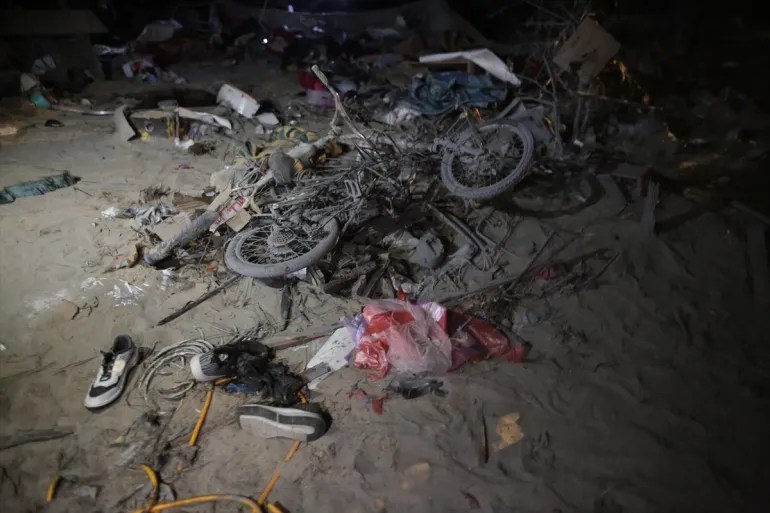
By Jamal Kanj | Al Mayadeen | September 12, 2024
Fifty-two years ago, almost to the day, on September 8, 1972, I survived the first of many air and sea raids on my refugee camp in northern Lebanon. I was less than two hundred yards from the area across the river where a group of us young kids met every day, between 4 and 5 p.m., to play in the large field, swim in the river, or the Mediterranean Sea.
At first, I heard what sounded like a humming plane. Before I could even turn my head to look up at the sky, I was startled by the booming sound of low-flying fighter jets passing overhead, dropping massive rockets onto the open field. The first bomb exploded in the northwest area of the field, creating a massive fireball—a black column of smoke intertwined with a glowing red blaze. The shockwave threw me off my bike. Soot filled the air and fragments rained down like strafing bullets all around me.
In less than 15 minutes, the once grassy green play area of approximately 20 acres was transformed into a lunar landscape, pocked with craters. One pit was so large and deep that groundwater filled the hole.
If the Israeli air raid had occurred just five or ten minutes later, I would have been in the middle of the field, playing with other 14-year-old kids. My friend Barakat, who was already there and likely had been eagerly anticipating my arrival, was killed. The raid left many unexploded devices and time-delayed bombs, making it difficult to recover his body until the next day. Our neighbor Mahdi was also killed, buried under the plowed soil. Years later, his skeleton was discovered when the area was being graded.
I’m reminded of this today, September 10, 2024, as I watch footage of the huge crater left behind by an American-made 2,000-pound MK-84 bomb. The bombs were dropped in the middle of the night on 20 tents housing displaced civilians in an Israeli-designated “safe area” in al-Mawasi, southern Gaza.
Early in the morning, the Israeli army issued its disinformation boilerplate communiqué, declaring the raid was a “precise strike” on senior resistance members. But videos from the crater, where tents lay buried under the sand, suggest that “Israel” targeted civilians in a supposed safe area.
Reading about the “precise strike” on a BBC site took me back 52 years. Almost three hours after the raid on my camp, I remember my father and our neighbors gathering around the radio to listen to the 7 p.m. BBC Arabic news. I still recall how they stopped breathing, their eyes wide, mouths agape, as the BBC quoted an Israeli army spokesman claiming “Israel” had targeted a military base in Nahr el-Bared refugee camp in northern Lebanon.
While I don’t remember the exact number of the killed and injured that afternoon, I know for certain that 100 percent were civilians—mostly young boys and girls, with at least one elderly man among them. I felt then as helpless as many of those who were sleeping on September 10 in their “safe” tents, unable to tell their story to the world. The photos left behind by the US-manufactured 2,000-pound bombs, however, expose “Israel’s” lies and the complicity of the managed Western media.
It is utterly despicable that the lecterns at the White House and the State Department have become platforms to market such lies, emboldening “Israel’s” intransigence and whitewashing its genocide. Especially egregious is the disinformation spread by White House National Security Communications Adviser John Kirby, who blamed the Palestinians as “the main obstacle” to a ceasefire. This brazen lie comes less than a week after the leak of a document pointing to new conditions that were added in late July by Benjamin Netanyahu to Joe Biden’s proposal from May 27, which torpedoed the ceasefire agreement.
After the Palestinians rejected Netanyahu’s new conditions in late July, “Israel” intensified its systematic campaign of bombing displaced civilians in safe areas, including 16 UN schools converted into mass shelters. Unable to compel a ceasefire on its terms, “Israel” is using these attacks on designated safe areas as part of its bloody negotiation strategy to exert pressure by inflicting maximum suffering on civilians through murder and starvation.
Meanwhile, the Biden administration continues to supply “Israel” with the means to commit these war crimes, while using the White House platform to spread disinformation, making “Israel’s” “lies sound truthful and murder respectable.”
London renews demand to deploy combat troops in Lebanon: Report
The Cradle | September 12, 2024
The UK has renewed pressure on the Lebanese government to sign a Memorandum of Understanding (MoU) that would allow London unrestricted military access to Lebanon’s soil, including the deployment of British troops in the country, Al-Akhbar reported on 11 September.
“The purpose of the memorandum is to define the responsibilities and general principles regarding the deployment of British armed forces within Lebanese territory for purposes other than training activities,” the draft copy of the memorandum, obtained by Al-Akhbar, reads.
The UK Foreign Office submitted the draft in July.
At the end of August, the foreign office sent a two-page letter to the Lebanese government “requesting facilities to deploy its army in Lebanon for the purposes of evacuating citizens, and in the event that Lebanon needs humanitarian assistance from Britain.”
Lebanon’s Foreign Ministry recently sent the draft to the Lebanese army, according to Al-Akhbar.
“The above-mentioned draft memorandum of understanding was studied from all aspects, and the study concluded that the memorandum of understanding raises concerns about Lebanon’s sovereignty and independence, with the scope of the mission of the British armed forces unclear, which increases the state of uncertainty,” the newspaper cites the army response as saying.
The army reportedly “acted as if” it was not informed and did not give prior approval for the UK memorandum, Al-Akhbar revealed.
The UK initially justified this request as a precautionary measure for evacuating citizens in case of war, citing past failures in Afghanistan and Sudan.
However, sources have confirmed to Al-Akhbar that the British requests predate Operation Al-Aqsa Flood and the outbreak of the war in October.
Al-Akhbar had revealed in November last year that the UK was pushing Lebanon to accept this agreement.
The clauses include granting British military personnel immunity from arrest or prosecution, adding that if any are detained, they must be immediately handed over to UK forces. Another is giving them authority to move around the country armed and in uniform.
“The memorandum guarantees that, in the event of a misinterpretation or non-compliance with the terms, Lebanon will not be able to resort to any international court or third party to resolve the dispute,” Al-Akhbar wrote in November.
The Lebanese government has said that the MoU constitutes a violation of Lebanon’s sovereignty.
Debate Debacle: Our Bleak Foreign Policy Future
By Daniel Larison | The Libertarian Institute | September 12, 2024
The first presidential debate between Vice President Kamala Harris and former President Donald Trump presented a bleak picture of the future of U.S. foreign policy no matter who wins in November. On the most urgent and important foreign policy issue of the year, the war and genocide in Gaza, Harris repeated empty platitudes about a “two-state solution” and Trump fell back on tired “pro-Israel” rhetoric. Neither candidate offered voters any hope that there would be a meaningful change from incumbent Joe Biden’s policy of unconditional support for the slaughter and starvation of Palestinians.
Trump absurdly said that Harris hates Israel, but aside from her perfunctory expression of support for Palestinian self-determination there was unfortunately very little to distinguish the two of them on this issue. Like Trump, Harris backs Israel to the hilt, and the main difference is that she pays lip service to Palestinian rights while doing nothing to protect them. She says some of the right things about the need for a ceasefire, but the Joe Biden administration isn’t willing to use its leverage to secure one and Harris refuses to call for the halt to U.S. arms transfers that U.S. law requires.
Harris has had many opportunities in the two months since Biden dropped out to separate herself from the president on this issue. She squandered them all by sticking to the official administration line. The vice president would rather tout her support from the likes of Dick Cheney than try and win the support of antiwar voters across the country. Harris has been catering mostly to hawks this summer, and she prefers attacking Trump for being “weak” instead of using his policy failures against him.
For his part, Trump returned to his old obsession with Iran and criticized the Biden administration because “they took off all the sanctions that I had.” Unfortunately for diplomacy with Iran, Biden never lifted any Iran sanctions, and the small amount of sanctions relief that he was prepared to grant was never delivered. Biden kept Trump’s dangerous Iran policy in place with similarly poor results, and there is no evidence so far that Harris is interested in pursuing a policy of diplomatic engagement.
The candidates had almost nothing to say about diplomacy during the debate. It was telling that the only time the word diplomacy was uttered during the debate was when Harris was criticizing the Trump administration’s negotiations with the Taliban that led to the withdrawal of U.S. troops. Trump mentioned negotiating an end to the war in Ukraine, but he offered no specifics on how he would bring the belligerents to the table or what he would do to secure an agreement.
Harris also repeated the president’s strange lie that the United States isn’t at war anywhere. She said, “There is not one member of the United States military who is in active duty in a combat zone in any war zone around the world, the first time this century.” That would come as a surprise to the soldiers recently injured during a raid in Iraq and to the sailors waging Biden’s war in Yemen. It would also be news to the American forces fighting in Somalia and the troops illegally stationed in Syria. The U.S. Navy has said that its ships have been engaged in the most intense combat since World War II in the Red Sea, but as far as Biden and Harris are concerned it isn’t even happening.
Meanwhile, the U.S.-backed war in Gaza continues to claim innocent lives. Israeli forces bombed yet another tent encampment filled with displaced civilians on Tuesday, killing dozens of them. According to analysis of the damage, they used 2,000-pound U.S.-made bombs to do it. These bombs are so large and so powerful that using them in a densely populated area is obviously criminal. That was just the latest in a string of attacks on civilians in Gaza, including attacks on at least sixteen schools where displaced people had taken shelter. The official death toll is now over 40,000, but informed estimates from doctors that have worked in the territory suggest that the real number is more than double that.
During the debate there was no mention of that massacre in a so-called humanitarian zone, nor did anyone bring up the name of Aysenur Eygi, the American citizen murdered by an Israeli sniper in the West Bank just last week. People watching the debate would have had no idea that one of the worst man-made famines in modern times is currently raging in Gaza, and they wouldn’t know that the famine is the result of an Israeli campaign of deliberate starvation. The victims of the monstrous bipartisan foreign policy consensus in Washington are usually invisible in American debates, and this was no exception.
Featured Video

Seyed M. Marandi: US-Iran War Inevitable: Kuwait and Bahrain May Fall
or go to
Aletho News Archives – Video-Images
From the Archives
Oil and the Israel Lobby
Reknowned economist M. Shahid Alam offers this excellent critique of Noam Chomsky’s defective analysis of the relative influence of Oil versus the Israel lobby over US foreign policy: … continue
Blog Roll
 Aletho News
- ICC ignored ‘very well-documented’ NATO crimes – ex-Libyan minister
- SNSC secretary dismisses US response to Iran’s conditions as ‘inadequate’
- Sanaa says Taiz roads open, secure for residents, warns Saudi forces
- Iraqi resistance group urges Saudi leadership to admit defeat, lift Yemen siege
- Trump’s Retreat: How Al-Aqsa Flood Took Down the US Empire
- Israel’s Military Actions in Lebanon Grossly Violate International Law — Lavrov
- Seyed M. Marandi: US-Iran War Inevitable: Kuwait and Bahrain May Fall
- Leaders Condemn Ansarallah Attack on Saudi Arabia While Ignoring Illegal War Against Yemen
- Leaked: Britain’s Covert Iraqi Psyops Network
- Yemeni Armed Forces Warn Airlines Against Using Saudi Airports, Exempt Mecca and Medina
- If Americans Knew
- How Israel Conquered the Latin American Right
- Agents search Rep. Omar’s Washington home in criminal probe as she vows she won’t ‘be silenced’
- “The Rule Was: ‘Shoot Everyone You See'”
- Israel goes ballistic over Nobel Laureate Navi Pillay
- U.S. May Join Yet Another Middle Eastern War — TCN
- Yellow Line moves again as Israel closes in on trapped Gazans – Daily Update
- Israeli Attacks Kill Seven Palestinians in Gaza Including Six-year-old Girl
- Gaza: Ceasefire Anniversary Marks Year of Failed Promises
- The American Conservative: Mike Huckabee Should Resign
- A C-Section in Shackles: A Palestinian Woman’s Harrowing Birth in Israeli Detention
- No Tricks Zone
- Germany’s Green Energy Debacle: High Energy Costs Force Kahla Porzellan to Close After 182 Years!
- New Study: 50 Years Of The Most Aggressive ‘Net Zero’ Policies Can Only Affect The Global Climate By 0.03°C
- US September “Heat” Was No Record…Many Records Set Decades Ago
- Latest European Green Energy Debacle; Portugal’s Largest Flagship Solar Park Insolvent!
- Green Energy Debacle: German Expert Professor Fritz Vahrenholt Warns Of Severe Economic And Social Consequences
- Two More Paleo Reconstructions Affirm Meters-Higher Sea Levels Across Ireland, Brazil 7000-6000 Years Ago
- New Study: Earth And Venus Surface Warmth Largely Explained By Convection And Lapse Rate, Not CO2 Or Radiation
- 2025 Nature Paper Claiming Worsening Global Drought Gets RETRACTED …Heavily Flawed
- New Study: ‘Global Drought Shows No Detectable Recent Acceleration Under Climate Warming’
- Economic Masterminds: German Socialists Suggest Taxing Productivity Gains Stemming From Using AI


