Poland blocks German Nord Stream sabotage probe
RT | October 17, 2025
A Polish court has refused to extradite a Ukrainian suspect in the Nord Stream sabotage case to Germany, ordering his immediate release and ruling that the alleged actions can be seen as “rational and just” in the context of war.
The two Nord Stream pipelines, built to carry Russian gas to Germany under the Baltic Sea, were damaged in a sabotage attack in September 2022. German prosecutors have attributed the explosions to a small group of Ukrainian nationals, including a diving instructor, Vladimir Zhuravlyov, who was detained by the Polish authorities last month under a European arrest warrant. Berlin’s previous request for his arrest was reportedly obstructed by the Polish government in 2024.
On Friday, Polish media reported the Warsaw District Court found Germany’s extradition request “unfounded,” citing a lack of evidence linking Zhuravlyov to the sabotage.
“Blowing up critical infrastructure during a war – during a just, defensive war – is not sabotage but denotes a military action,” Judge Dariusz Lubowski said. “These actions were not illegal – on the contrary, they were justified, rational and just,” he added.
Lubowski also ruled that Germany lacks jurisdiction, as the explosions occurred in international waters. The decision may still be subject to appeal.
The German investigation has led to the arrest of another suspect, former military officer Sergey Kuznetsov, detained in Italy in August. Prosecutors allege that he coordinated a team that rented a yacht and planted explosives on the pipelines using commercial diving gear.
Moscow has rejected Berlin’s version, dismissing the claim that a small group of Ukrainians carried out the sabotage as “ridiculous.”
Russian President Vladimir Putin suggested the US likely orchestrated the operation.
Warsaw, which has been one of Kiev’s staunchest backers since 2022, allegedly considered granting asylum to the suspect, according to a September report by Polish newspaper Rzeczpospolita. Foreign Minister Radoslaw Sikorski has also said he is ready to do so.
Polish Prime Minister Donald Tusk, who earlier opposed extraditing Zhuravlyov, praised the ruling, writing on social media “The case is closed.”
One million pounds and a war without end: Boris Johnson’s intervention in Kyiv changed Europe’s future
By Ricardo Martins – New Eastern Outlook – October 17, 2025
When history revisits the Ukraine conflict, one episode may stand out as a turning point: Boris Johnson’s sudden visit to Kyiv in April 2022, just after a tentative peace agreement had been initialed in Istanbul.
At that moment, a ceasefire was within reach. Yet Johnson, then British Prime Minister, reportedly urged President Volodymyr Zelensky not to sign, assuring him that the West would arm Ukraine “for as long as it takes.” That decision, now under renewed scrutiny following revelations by The Guardian, may have changed the course of the conflict—and Europe’s political destiny.
The Istanbul Agreement That Never Was
By early April 2022, Ukrainian and Russian negotiators had agreed in principle to a framework that could have ended hostilities. Ukraine would forgo NATO membership in exchange for security guarantees. But after Johnson’s unannounced visit to Kyiv, talks collapsed.
Following The Guardian investigation, David Arakhamia, a member of Zelenskyy’s own negotiating team in Istanbul, appeared to lend the idea credence. “When we returned from Istanbul, Boris Johnson came to Kyiv and said that we would not sign anything with them at all, and let’s just fight,” he said in a November 2023 interview.
According to leaked documents published by The Guardian, sourced from Distributed Denial of Secrets (DDoS), a US-based transparency collective, Johnson had other motives for discouraging compromise.
The investigation traces a £1 million payment from businessman Christopher Harborne, a major shareholder in a British drone manufacturer supplying the Ukrainian military, to a private company created by Johnson shortly after leaving office. Harborne also accompanied Johnson to Kyiv, raising questions about direct lobbying and influence-peddling at the highest level of government.
Following the Money
Harborne’s donation, ostensibly legitimate under UK law, takes on a darker significance in this context. As Johnson lobbied Zelensky to prolong the war, Harborne’s company stood to benefit from expanded arms contracts. The Guardian’s exposé describes this payment as “a reward for services rendered,” a euphemism for bribery in geopolitical disguise.
Johnson dismissed the report as “a pathetic Russian hack job,” yet neither he nor Downing Street has provided a transparent accounting of the donation or its timing. The optics are damning: a former prime minister allegedly persuading a wartime ally to reject peace while personally profiting through associates linked to the arms trade.
The Price of Prolongation
Since that fateful spring, the toll has been catastrophic. Hundreds of thousands of Ukrainian and Russian soldiers and civilians have perished. More than three trillion US dollars in Western aid and military spending have flowed into the conflict, much of it financed by debt and by diverting funds from social programmes.
European citizens are paying the price. Budgets once earmarked for welfare, healthcare, and pensions have been repurposed to sustain the war effort. Energy costs have soared, industrial competitivity has sunk, inflation has eroded savings, and social unrest has become regular across the continent.
The narrative of European solidarity has given way to anger and fatigue. Populist and far-right parties are sweeping across Europe. In this sense, Johnson’s intervention did not only prolong a war; it accelerated a social and political crisis within Europe itself.
From Peace Project to Proxy War
The European Union once prided itself on being a “peace project.” Yet its handling of the Ukraine conflict has projected a very different image: that of a continent complicit in militarisation and escalation. France and Germany, the supposed guardians of diplomatic balance, quietly aligned themselves with Washington’s maximalist stance.
No leader publicly questioned why the Istanbul Agreement was abandoned. No parliamentary inquiry has addressed whether Johnson’s visit influenced European policy and why European leaders did not censure Johnson.
In retrospect, Europe’s passivity reveals both dependency and cowardice. The EU’s foreign policy has become an echo of Washington’s strategic interests and those of arms manufacturers, such as Mr. Harborne, while dissenting voices were marginalised as “pro-Russian”. This reflex has stifled honest debate about the human and economic costs of the war and about who truly benefits from its continuation.
The Corruption Business
War has always been fertile ground for corruption, and Ukraine is no exception. From inflated procurement contracts to opaque aid transfers, vast sums have disappeared without audit. Johnson’s alleged bribe merely symbolises a broader pattern: the convergence of political ambition, corporate profit, and ideological fervour.
Bribery and influence-trading have evolved into sophisticated transnational systems cloaked in legality: foreign lobbying, consultancy fees, and donations to foundations. Such practices blur the line between governance and outright corruption. They ensure that conflicts endure not because peace is impossible, but because war remains profitable.
Europe’s Crisis of Leadership
The scandal surrounding Boris Johnson’s intervention in Ukraine exposes a deeper political and strategic crisis within Europe. The same continent that once championed diplomacy and human rights now finances a proxy war that has devastated a nation and destabilised an entire region.
European leaders invoke solidarity while diverting resources from welfare and pensions, tolerating rising inequality and industrial competitivity decline to sustain arms deliveries. The rhetoric of democracy has been replaced by the logic of deterrence.
Across the continent, disillusionment is fuelling the ascent of populist and far-right parties. Citizens who once viewed the EU as a guarantor of peace now perceive it as complicit in perpetual conflict. From Slovakia to the Netherlands, voters are turning against Brussels’ alignment with Washington, revealing a growing mistrust of supranational elites and foreign-driven policy agendas.
Johnson’s defenders claim his visit to Kyiv stemmed from moral conviction, not financial interest, but conviction cannot erase consequence. Had the Istanbul peace framework been pursued, thousands of lives and trillions in resources might have been spared. Instead, Johnson’s theatrics helped entrench a war whose primary beneficiaries are defence contractors and political opportunists.
That the European Union tolerated this manipulation without investigation or accountability reflects a failure of leadership, not merely a lapse of ethics. By outsourcing strategic direction to NATO and moral authority to Washington, Europe has strayed from its founding principles of peace and autonomy.
The result is a continent economically weakened, politically fragmented, and increasingly defined by the conflicts it once sought to prevent.
In sum, The Guardian investigation has done what official institutions would not: follow the money and expose the moral bankruptcy behind the rhetoric of freedom. Whether courts or parliaments act on these revelations remains uncertain. But the evidence is clear enough for history’s judgment.
Ricardo Martins, PhD in Sociology, specializing in International Relations and Geopolitics
Trump’s Strongman Persona Inevitably Results in Lies and War
By Prof. Glenn Diesen | October 17, 2025
Trump’s claim that Prime Minister Modi had promised to end the purchase of Russian oil was obviously false; in fact, there was apparently no phone call between the two leaders at all. Such fabrications, portraying world leaders as deferential to him and as praising his greatness, constitute a recurring pattern—one that parallels his militaristic approach to peace.
As the president of a declining hegemon, Trump is convinced that the weakness of his predecessors was the source of decline. Trump has therefore concluded that projecting strength can reverse the erosion of American power. In constructing himself as the ultimate strongman—allegedly respected by all—he positions himself as the sole saviour of the US. The image of a powerful, decisive and respected leader capable of restoring US dominance also functions domestically to consolidate political support and project stability during the country’s uneasy transition from a unipolar to a multipolar international order. The American public is seemingly prepared to look the other way or justify the dishonesty and moral disgressions as the price worth paying for a return to greatness.
The central problem with the strongman image is that it sustains unrealistic expectations of reviving US primacy rather than adapting to the realities of a multipolar world. The outcome is a pattern of deception and conflict that ultimately undermines, rather than strengthens, the United States.
When the strongman cannot coerce his counterparts into subservience, the only recourse is retreat into fantasy. In this imagined world, other leaders allegedly regret their decisions of not falling into line, tremble as Trump wags his finger, shower him with compliments, offer tribute to the United States, and in Trump’s own words, line up to “kiss my ass.” Within the Trumpian bubble of superpower cosplay, these scenes of deference are celebrated as signs of a return to greatness, yet in the real world, American credibility declines and decadence deepens. As the gap between fantasy and reality widens, Trump becomes increasingly reckless. Case in point, the threats against India to sever ties with Russia and India backfired spectacularly as Prime Minister Modi instead went to China to cement India’s relations with Russia, China and the SCO.
Great powers and independent states cannot simply fall in line, for doing so would predictably lead to their destruction or subjugation. The ultimate aim of an aspiring hegemon is not to reconcile differences in pursuit of peaceful coexistence, but to defeat rival powers and capture independent states. The objective of the economic confrontation with China is not to renegotiate trade agreements, but to undermine China’s technological capacity and contain it militarily to restore US primacy. The purpose of the proxy war against Russia is not peace in terms of finding a new peaceful status quo, rather it is to use Ukrainians and increasingly Europeans to bleed and weaken Russia until it can no longer sustain great-power status. Similarly, the goal of the confrontation with Iran is not to reach a new nuclear accord—Tehran has already accepted such terms in the past—but to achieve Iran’s capitulation and disarmament by linking the nuclear issue to restrictions on missiles and regional alliances. Any power that concedes even marginally to US pressure ultimately finds itself in a weaker and more vulnerable position—one that the aspiring hegemon will inevitably exploit. Any peace agreements are therefore temporary at best, as an opportunity to regroup.
India presents an intriguing case, as it is not an adversarial power. Its commitment to non-alignment makes strong relations with the United States desirable, yet the very same non-alignment necessitates strategic diversification to reduce excessive reliance on Washington. Should India be persuaded to sever ties with other major powers such as China and Russia, it risks becoming too dependent on the United States and absorbed into a bloc-based geopolitical system. Subordination to a declining empire would be perilous, as the United States would predictably use India as a frontline against China, and simultaneously demand economic tribute and cannibalise Indian industries in pursuit of renewed dominance. In essence, India must avoid becoming another Europe.
The strongman act is most effective with weaker and dependent states—such as those in Europe—that are willing to subordinate themselves entirely in order to preserve American commitment to the continent. European states lack the economic capacity, security autonomy, and political imagination to envision a multipolar world in which the United States wields less influence and holds other priorities than a close partnership with Europe. Consequently, European leaders appear willing to sacrifice core national interests to preserve the unity of the “Political West” for a little while longer. In private, they may express disdain for Trump; in public, they pay tribute to “daddy” and line up diligently in front of his desk to receive praise or ridicule. Yet this subservience is inherently temporary: leaders who disregard fundamental national interests are, in time, swept aside by the very forces they seek to suppress.
The strongman does not create any durable peace the underlying problems are never addressed. The mantra of “peace through strength” can be translated into peace through escalation, with the assumption that the opponent will come to the table and submit to US demands. However, rival great powers that have nowhere to retreat will respond to escalation with reciprocation. The delusions of the strongman in the declining hegemony will therefore inevitably trigger major wars.
Victor Davis Hanson Exposed
The Voice of Zionist and Israeli Propaganda in America
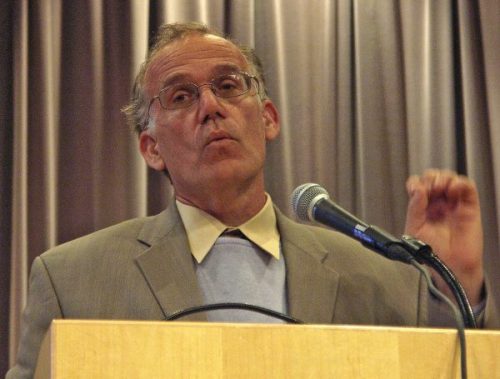
By Jonas E. Alexis • Unz Review • October 15, 2025
Victor Davis Hanson is a military historian and classicist, best known for works such as A War Like No Other: How the Athenians and Spartans Fought the Peloponnesian War, Carnage and Culture: Landmark Battles in the Rise to Western Power, and Who Killed Homer: The Demise of Classical Education and the Recovery of Greek Wisdom.
To be fair, these works are not without merit; Who Killed Homer in particular occupies an important place in the ongoing academic debate over the teaching of the classics. However, Hanson’s analysis collapses entirely when it comes to U.S. foreign policy and the nation’s involvement in perpetual wars across the Middle East and beyond. In The Savior Generals, for instance, he devotes an entire chapter to praising the catastrophic invasion of Iraq in 2003—a debacle that left the region in ruins.[1]
In an apparent attempt to rescue both himself and the neoconservative movement from intellectual and political oblivion, Hanson drew an extraordinary comparison between the Iraq War and the wars of 1777, 1941, and 1950. He went so far as to claim that these conflicts “led to massive American casualties and, for a time, public despair.”[2]
Not once did Hanson acknowledge the incontrovertible fact that the Iraq War was built upon a monumental deception. He never confronted the well-documented reality that the U.S. intelligence community explicitly informed the Bush administration that there was no credible evidence indicating that Saddam Hussein possessed weapons of mass destruction. Nor did he address the fact that President Bush and his inner circle deliberately sought to fabricate and manipulate evidence in order to inundate the American public with the categorical falsehood that Saddam had to be removed.[3]
Hanson made no attempt whatsoever to engage with the vast body of scholarly evidence surrounding these issues.[4] He remained silent on the atrocities committed at Abu Ghraib—the sodomy, humiliation, and torture that forever stained America’s moral standing.[5] Not once did he acknowledge that, prior to the Iraq War, practices such as waterboarding were virtually foreign to the American moral and legal tradition. Nor did he mention that George Washington himself unequivocally repudiated the use of torture, even against enemies who had shown no mercy.[6]
By now, it is a matter of public record that torture at Abu Ghraib was not an isolated incident but a systematic practice. Reports and testimonies confirmed that prisoners were routinely subjected to brutal physical and sexual abuse, including coerced acts of humiliation and violence that defied every principle of human dignity. Even young detainees were not spared such degradation. Official investigations and leaked photographs later revealed the extent of these atrocities, which stand as a permanent indictment of the moral collapse that accompanied the Iraq War. One prisoner testified that he saw one officer
“fucking a kid, his age would be about 15-18 years. The kid was hurting very bad and they covered all the doors with sheets. Then when I heard the screaming I climbed the door because on top it wasn’t covered and I saw [name blacked out], who was wearing the military uniform putting his dick in the little kid’s ass. I couldn’t see the face of the kid because his face wasn’t in front of the door. And the female soldier was taking pictures.”[7]
What’s more even interesting, “150 inmates were crammed into cells designed for 24.”[8] Abu Ghraib, as one writer put it, was “a hell-hole.”[9] Torture was also routine in Afghanistan, where adolescents were beaten with hoses “and pipes and threats of sodomy.”[10] These atrocities were not committed in obscurity. Cambridge University Press has published extensive documentation of such abuses in a volume exceeding 1,200 pages, detailing the systematic nature of the torture and its moral, political, and legal implications.[11] These atrocities were also corroborated by psychiatrists such as Terry Kupers, whose professional assessments provided further evidence of the profound psychological trauma inflicted on the victims and the moral disintegration of those who carried out the abuse.[12]
For Hanson to attempt to wiggle out of this extensive body of scholarship is nothing short of intellectual dishonesty. Since the Iraq War turned out to be an unmitigated disaster—and given that Hanson supported it from its inception[13]—he is now compelled to construct arguments that are at once incoherent and irresponsibly tendentious. This rhetorical contortion serves a dual purpose: to preserve his Neoconservative equilibrium and to justify his well-funded position as a military historian at the Hoover Institution, an establishment known for its distinctly neoconservative orientation.
More importantly, Victor Davis Hanson is a Neocon ideologue and an unapologetic warmonger. He declared without hesitation:
“I came to support neocon approaches first in the wars against the Taliban and Saddam, largely because I saw little alternative—in a post-9-11 effort to stop radical Islam and state sponsors of terror—to removing such odious enemies, and did not think leaving the defeated in power (as in 1991), or leaving in defeat (as in Lebanon), or installing a postbellum strongman was viable or in U.S. interests.”[14]
Hanson, it seems, would prefer deliberate falsehoods over confronting uncomfortable truths. The war in Iraq was never about weapons of mass destruction, precisely because the Neocons themselves were fully aware that Saddam Hussein possessed no weapons of mass destruction.
For example, when Deputy National Security Advisor Stephen Hadley informed Paul Wolfowitz that there was no evidence of a link between Al Qaeda and Saddam Hussein, Wolfowitz responded with certainty, “We’ll find it. It’s got to be there”[15]—effectively signaling that if no such connection existed, they would fabricate one. Ultimately, the Neoconservatives did precisely that, constructing deliberate falsehoods to justify the destruction of an entire nation—Iraq—for the strategic benefit of Israel.
What we are witnessing is an alarming intellectual decline on Hanson’s part. He effectively lost credibility as a serious analyst when he claimed that Iran intended to promote a Jewish Holocaust, despite the fact that Iranian Jews themselves widely denounced Netanyahu for perpetuating similarly alarmist and conspiratorial rhetoric, calling him an “insane vampire.”.[16] And what of Jimmy Carter? Hanson contends that Carter’s positions were effectively aligned with anti-Semitic sentiment.[17] Ignoring Israel’s ongoing ethnic cleansing of Palestinians in the 1940s and beyond, Hanson begins to reconstruct history according to his own narrative: “[Israel] fought three existential wars over its 1947 borders, when the issue at hand was not manifest destiny, but the efforts of its many enemies to exterminate or deport its population.”[18]
Sounding almost unhinged and unwilling to heed reasoned critique, Hanson asserts that, for more than half a century, the Arabs have sought to push “the Jews into the Mediterranean.” There is no serious scholarship, no intellectual or historical rigor, and no defensible argument—only one sweeping assertion after another. Hanson continues: “Over 500,000 Jews have been ethnically cleansed from Arab capitals since 1947, in waves of pogroms that come every few decades.”[19]
The source and historical evidence? According to Hanson, one simply has to take his word for it. His statement is self-referentially “true” because Hanson asserts it to be so. This is the same type of circular reasoning and tautology frequently encountered in so-called scientific discourse—most famously in the notion of “survival of the fittest.” Why did it survive? Because it is the fittest. How do we know it is the fittest? Because it survived.
Yet, long before Hanson began promoting his version of historical fiction, Jewish historians both in the Atlantic world and in Israel had documented a very different reality: Israel has systematically ethnically cleansed the Palestinian population.[20] Listen again to Israeli historian and flaming Zionist Benny Morris:
“A Jewish state would not have come into being without the uprooting of 700,000 Palestinians. Therefore it was necessary to uproot them. There was no choice but to expel that population. It was necessary to cleanse the hinterland and cleanse the border areas and cleanse the main roads. It was necessary to cleanse the villages from which our convoys and our settlements were fired on.”[21]
Israel has consistently undermined peace and stability in the Middle East. A striking example is the 1982 massacre, during which the Israeli military permitted Lebanese militias to attack Palestinian refugee populations. Reports indicate that the militias “raped, killed, and dismembered at least 800 civilians, while Israeli flares illuminated the camps’ narrow and darkened alleyways.”[22]
One year later, an Israeli investigative commission concluded that Israel was “indirectly responsible” for the massacre and that Ariel Sharon bore personal responsibility as an accomplice.[23]
How did Israeli officials involve the United States in these events? According to declassified documents housed in the Israel State Archives, they persuaded U.S. officials that Beirut harbored terrorist cells. Ultimately, this manipulation facilitated the massacre of Palestinian civilians—people whom the U.S. had previously pledged to protect.[24] Ariel Sharon asserted that Beirut harbored between 2,000 and 3,000 terrorists.
The American envoy to the Middle East, Morris Draper, essentially concluded that Sharon was being dishonest. Lawrence S. Eagleburger, then Secretary of State, remarked that “we appear to some to be the victim of deliberate deception by Israel.”[25]
During his conversation with Sharon, Draper understood that the United States did not fully endorse Sharon’s aggressive plans. Nevertheless, Sharon proceeded to act on his own terms. It was reported that Draper told Sharon, “You should be ashamed. The situation is absolutely appalling. They’re killing children! You have the field completely under your control and are therefore responsible for that area.”[26]
In the aftermath of the massacre, President Ronald Reagan, himself a Zionist, expressed outrage. Secretary of State George P. Shultz acknowledged that the United States had effectively become an accomplice, allowing Israel to manipulate U.S. policy to facilitate the slaughter of civilians. Yet no sanctions were imposed, and no concrete actions were taken. When asked why, Nicholas A. Veliotes, then Assistant Secretary of State for Near Eastern Affairs, offered an indirect explanation: “Vintage Sharon. It is his way or the highway.”[27] Scholar Seth Anziska declares, “The Sabra and Shatila massacre severely undercut America’s influence in the Middle East, and its moral authority plummeted.”[28]
How might Hanson respond? Would he dismiss the archival evidence meticulously documented by Morris Draper and Ilan Pappe in their respective studies? Would he evade the fact that Israel has often acted as a destabilizing force in the Middle East? The answer is likely that we will never know, because Hanson systematically avoids engaging with such historical scholarship. Instead, he prefers silence, selectively ignoring a substantial body of evidence that contradicts his narrative.
If you still doubt this, pick up Hanson’s recent book, The End of Everything. In it, he reads as if he’s on the verge of a heart attack at the mere thought of Iran possessing nuclear weapons. He writes:
“The specter of a soon to be nuclear theocratic Iran that professes it can survive a nuclear exchange, or at least find the ensuing postmortem paradise preferrable to the status quo ante bellum, ensures a dangerous state of affairs, especially amid recent proxy wars between Iran and nuclear Israel in Gaza, Lebanon, and Syria.”[29]
What Hanson never dares to tell his readers is that Iran has signed the Non-Proliferation Treaty, whereas Israel has not—and consistently insists on a double standard. Israel itself poses a global threat, declaring that if it falls, it will take the world down with it. Listen to Israeli historian Martin van Creveld’s chilling warning:
“We possess several hundred atomic warheads and rockets and can launch them at targets in all directions, perhaps even at Rome. Most European capitals are targets for our air force… We have the capability to take the world down with us. And I can assure you that that will happen before Israel goes under.”[30]
Shouldn’t Hanson be concerned about this? Or is he so dazzled by Israeli and neocon propaganda that he cannot think clearly, leaving him both intellectually and historically crippled? Like his fellow neocons, Hanson will never consult objective, scholarly materials that challenge his thesis on Iran and Israel. For instance, he won’t touch Trita Parsi’s trilogy on Iran, published by Yale University Press, nor will he engage with studies such as Intelligence and U.S. Foreign Policy: Iraq, 9/11, and Misguided Reform—apparently because doing so would undermine his neoconservative agenda.[31]
Hanson’s 2021 book, The Dying Citizen: How Progressive Elites, Tribalism, and Globalization Are Destroying the Idea of America, is nothing short of propaganda. Why? Because a look at the very foundations of the United States reveals that the Founding Fathers themselves rejected the notion of making unconditional alliances with any foreign power—let alone Israel. So how did Hanson and his neocon allies become defenders of a country that has brought nothing but misery to the United States? The term “progressive elites” might be more aptly applied to Hanson and his cohort, as they have sought to fundamentally alter the principles articulated by the Founding Fathers.
In The Dying Citizen, Hanson risibly declares that he is deeply concerned about “how putting global concerns above national interests insidiously erodes the financial health, freedoms, and safety of Americans. In blunter terms, when American elites feel their first concerns are with the world community abroad rather than with the interests of their own countrymen, there are consequences for American citizens.”[32] Does this man ever look in the mirror and realize that he too has contributed to the economic disaster that followed the Iraq War—a war that will cost the United States at least six trillion dollars?[33] Think for a moment: what could a single country do with such an enormous sum? Virtually every American could have access to decent health care and an affordable college education. Yet Hanson cannot confront these fundamental issues because he remains blinded by the neoconservative and Israeli agenda.
Hanson reminds me of Thomas Sowell, who has offered many valuable insights in his books, yet Sowell too seems intellectually constrained by the Israeli propaganda machine. Much of what Sowell has written over the years—including Education: Assumptions versus History and Affirmative Action: An Empirical Study—is accurate. I must admit, I had to do some serious rethinking when I first read his assessment of slavery.
But Sowell is completely mistaken in his stance on the Middle East. He is essentially echoing what neocons have been asserting for years and appears trapped within the neoconservative worldview. In his 2010 book Dismantling America, Sowell declares:
“With Iran moving toward the development of nuclear weapons, we are getting dangerously close to that fatal point of no return on the world stage… The Iranian government itself is giving us the clearest evidence of what a nuclear Iran would mean, with its fanatical hate-filled declarations about wanting to wipe Israel off the face of the earth.”[34]
What was particularly striking about this extraordinary claim is that Sowell provided not a single piece of evidence for it—an intellectually embarrassing omission that undermines much of his own work. When I finished reading The Vision of the Anointed, I contacted Sowell to express my appreciation for his work, to which he politely replied, “Thank you.” However, after reading Dismantling America and asking him for evidence supporting some of his assertions, he never responded. He continues to warn about “the fatal danger of a nuclear Iran,” yet there is no way to assess these authoritative—and indeed dogmatic—claims because Sowell offers not a shred of evidence.
Sowell serves the neocons and warmongers in the United States in a manner similar to what Charles Murray does for neocon think tanks like the American Enterprise Institute. After supporting the invasion of Iraq for years and writing positively about progress there in works such as Intellectuals and Society,[35] Sowell later wrote in 2015: “Whether it was a mistake to invade Iraq in the first place is something that will no doubt be debated by historians and others for years to come.”[36] Sowell then advanced a claim that directly contradicts all available evidence regarding the Iraq War:
“But, despite things that could have been done differently in Iraq during the Bush administration, in the end President Bush listened to his generals and launched the military ‘surge’ that crushed the terrorist insurgents and made Iraq a viable country.”[37]
Iraq is a “viable country”? Sowell echoes the same tired mantra in Intellectuals and Society, insisting that the “Iraq surge” was a success—even in the face of abundant evidence proving otherwise. He writes: “Eventually, claims that the surge had failed as predicted faded away amid increasingly undeniable evidence that it had succeeded.”[38] Where has this man been living for the past ten years? One would have to be morally and intellectually blind to come up with such nonsense. Consider the perspective of retired U.S. Army Armor Branch officer and military historian Andrew J. Bacevich:
“Apart from a handful of deluded neoconservatives, no one believes that the United States accomplished its objectives in Iraq, unless the main objective was to commit mayhem, apply a tourniquet to staunch the bleeding, and then declare the patient stable while hastily leaving the scene of the crime… The fighting in Afghanistan and Iraq has exacted a huge price from the U.S. military—especially the army and the Marines. More than 6,700 soldiers have been killed so far in those two conflicts, and over fifty thousand have been wounded in action, about 22 percent with traumatic brain injuries. Furthermore, as always happens in war, many of the combatants are psychological casualties, as they return home with post-traumatic stress disorder (PTSD) or depression.
“The Department of Veterans Affairs reported in the fall of 2012 that more than 247,000 veterans of the Afghanistan and Iraq wars have been diagnosed with PTSD. Many of those soldiers have served multiple combat tours. It is hardly surprising that the suicide rate in the U.S. military increased by 80 percent from 2002 to 2009, while the civilian rate increased only 15 percent. And in 2009, veterans of Iraq were twice as likely to be unemployed as the typical American. On top of all that, returning war veterans are roughly four times more likely to face family-related problems like divorce, domestic violence and child abuse than those who stayed out of harm’s way.
“In 2011, the year the Iraq War ended, one out of every five active duty soldiers was on antidepressants, sedatives, or other prescription drugs. The incidence of spousal abuse spiked, as did the divorce rate among military couples. Debilitating combat stress reached epidemic proportions. So did brain injuries. Soldier suicides skyrocketed.”[39]
As Dismantling America progresses, it becomes clear that Sowell is entirely ensnared in the neoconservative matrix. He asserts, “Iran, for example, has for years ignored repeated U.N. resolutions and warnings against building nuclear facilities that can produce bombs.”[40] In 2012, Sowell wrote in the National Review that Iran was “well on its way to being able to produce more than the two bombs that were enough to force Japan to surrender in 1945.”[41]
This mantra has been repeated endlessly, yet no one has produced any scholarly or academic evidence to support it. In fact, the available scholarship directly refutes this frivolous claim. Paul R. Pillar, an academic and 28-year veteran of the CIA, has stated that Iran is not a threat to global peace. Remarkably, Pillar even made the controversial claim that we could coexist with Iran possessing nuclear weapons.[42] Sowell’s stance only confirms what Andrew J. Bacevich warned in 2012 in his article “How We Became Israel”:
“U.S. national-security policy increasingly conforms to patterns of behavior pioneered by the Jewish state. This ‘Israelification’ of U.S. policy may prove beneficial for Israel. Based on the available evidence, it’s not likely to be good for the United States.”[43]
Both Sowell and Hanson have, in effect, become ideological extensions of Israel—perpetuating hoaxes, fabrications, and at times outright falsehoods about the Israel–Palestine conflict and the broader Middle East. Consider Hanson’s statement that “the radical Iranian ayatollah Ali Khamenei could freely tweet about destroying Israel.”[44]
What have Iranian representatives actually been saying for more than fifty years? Khomeini once declared that “international Zionism is using the United States to plunder the oppressed people of the world.” To understand this statement properly, we must place it within its historical context. Khomeini coined the term “the Great Satan” in 1979 largely because he had witnessed firsthand what “international Zionism” and Western powers were doing throughout the Middle East and beyond. It’s important to remember that the Anglo-American coup in Iran in 1953 effectively vindicated much of Khomeini’s suspicion about foreign interference and exploitation.
“There is no crime America will not commit in order to maintain its political, economic, cultural, and military domination of those parts of the world where it predominates,” Khomeini said back in 1979. “By means of its hidden and treacherous agents [i.e., the Neoconservatives and other warmongers], it sucks the blood of the defenseless people as if it alone, together with its satellites, had the right to live in this world. Iran has tried to sever all its relations with this Great Satan and it is for this reason that it now finds wars imposed upon it.”[45]
Khomeini’s uncomfortable yet largely accurate observation remains relevant today. If anyone doubts this, they need only look at how Israel and the neocons in the United States have systematically contributed to the destruction of one Middle Eastern nation after another—from Iraq and Afghanistan to Syria and Libya. It must also be noted that these figures show little genuine concern for the well-being of the American people. Their priority has long been the pursuit of an aggressive foreign policy in the Middle East that consistently serves particular geopolitical interests rather than U.S. national ones. As my colleague Vladimir Golstein of Brown University once remarked, neoconservatives are incapable of understanding political reality.[46] In that sense, they cannot construct a coherent worldview without resorting to double standards. Scholar Michael MacDonald has documented this tendency in detail:
“As [the Neocons] were mocking Clinton in the late 1990s as cowardly for his caution in the face of Saddam’s brutality, central Africa was engulfed in war and chaos. Around 5,400,000 people, mostly in Congo, perished in the convulsions and the starvation and disease they caused from 1998 to 2003.
“Yet the Weekly Standard, a reliable guide to neoconservative priorities, published just two stories on Congo during these years. In the same time span it published 279 articles on Iraq. Neoconservatives were bent on projecting power in the Middle East, not on engaging in humanitarian do-goodism.”[47]
The fact that Khomeini emphasized “international Zionism” shows that his criticism was not directed at ordinary Americans—most of whom have little understanding of the geopolitical realities in the Middle East—but at the powerful political and ideological networks that have shaped U.S. policy there for decades. His warning pointed to the continuing suffering of Palestinians since 1948, a reality well documented by numerous human-rights organizations. If one prefers more recent examples, the wars and interventions in Iraq, Afghanistan, Libya, Pakistan, Yemen, and Syria provide ample evidence of how destructive these policies have been.
Hanson objects to Iran’s use of expressions such as “the Zionist regime,” suggesting that such terminology reflects an illegitimate or hostile stance that must be rejected. Yet, he never addresses how figures within the Israeli establishment—including certain rabbis and political leaders—have themselves described Palestinians and Arabs in dehumanizing terms. For example, Rabbi Yaacov Perrin once stated, “One million Arabs are not worth a Jewish fingernail,”[48] while MK Rabbi Eli Ben-Dahan referred to Palestinians as “beasts, not human.” Ben-Dahan further asserted that “a Jew always has a much higher soul than a gentile, even if he is a homosexual.”[49]
Were such remarks uttered by religious or political figures in a Muslim-majority country, they would undoubtedly provoke international outrage and intense media scrutiny. Yet when similar statements emanate from Israeli officials, they are largely ignored or downplayed by major Western outlets. This double standard raises important ethical and political questions. How can Middle Eastern nations be expected to engage in meaningful cooperation with Israel when the Israeli leadership and certain religious authorities display open contempt for the very people with whom they must coexist? More importantly, why do historians such as Hanson fail to meaningfully engage with these issues in any of their books? Listen to Hanson very carefully in his book Between War and Peace Lessons from Afghanistan to Iraq:
“Palestinians appeal to the American public on grounds that three or four times as many of their own citizens have died as Israelis. The crazy logic is that in war the side that suffers the most casualties is either in the right or at least should be the winner. Some Americans nursed on the popular ideology of equivalence find this attractive. But if so, they should then sympathize with Hitler, Tojo, Kim Il Sung, and Ho Chi Minh, who all lost more soldiers —and civilians—in their wars against us than we did. Perhaps a million Chinese were casualties in Korea, ten times the number of Americans killed, wounded, and missing. Are we, then, to forget that the Communists crossed the Yalu River to implement totalitarianism in the south—and instead agree that their catastrophic wartime sacrifices were proof of American culpability? Palestinians suffer more casualties than Israelis not because they wish to, or because they are somehow more moral —but because they are not as adept in fighting real soldiers in the fullfledged war that is growing out of their own intifada.We are told that Palestinian civilians who are killed by the Israeli Defense Forces are the moral equivalent of slaughtering Israeli civilians at schools, restaurants, and on buses. That should be a hard sell for Americans after September 11, who are currently bombing in Afghanistan to ensure that there are not more suicide murderers on our shores. This premise hinges upon the acceptance that the suicide bombers’ deliberate butchering of civilians is the same as the collateral damage that occurs when soldiers retaliate against other armed combatants.”[50]
It is important to note that Hanson, as a historian, makes these claims without citing a single serious scholarly source to substantiate them. A considerable body of balanced academic research exists that he appears to have disregarded, including works produced by Israeli and Zionist historians such as Benny Morris and others.[51] Morris declared unambiguously:
“A Jewish state would not have come into being without the uprooting of 700,000 Palestinians. Therefore it was necessary to uproot them. There was no choice but to expel that population. It was necessary to cleanse the hinterland and cleanse the border areas and cleanse the main roads. It was necessary to cleanse the villages from which our convoys and our settlements were fired on.”[52]
Does Hanson genuinely maintain that the Palestinians themselves are to blame for the process of ethnic cleansing carried out under the pretext of combating terrorism? Only an Israeli or Zionist ideologue could plausibly sustain the kind of argument that Hanson is advancing.
Moreover, people like Hanson would never have the intellectual courage to address the issue of Jewish terrorism,[53] as doing so would evidently undermine the foundations of their otherwise unsubstantiated arguments. Israel has even been implicated in acts of terrorism against the United States,[54] yet this remains of little concern to Neocon puppets such as Hanson, who continue to promote the view that support for Israel is necessary.[55]
Notes
[1] Victor Davis Hanson, The Savior Generals: How Five Great Commanders Saved Wars That Were Lost—From Ancient Greece to Iraq (New York: Bloomsbury Books, 2013), chapter 5.
[2] Victor Davis Hanson, The Father of Us All: War and History—Ancient and Modern (New York: Bloomsbury Books, 2010), 12.
[3] See for example Vincent Bugliosi, The Prosecution of George W. Bush for Murder (New York: Perseus Books, 2008).
[4] See for example Paul R. Pillar, Intelligence and U.S. Foreign Policy: Iraq, 9/11, and Misguided Reform (New York: Columbia University Press, 2011); Murray Friedman, The Neoconservative Revolution: Jewish Intellectuals and the Shaping of Public Policy (Cambridge: Cambridge University Press, 2005); Stefan Halper and Jonathan Clarke, America Alone: The Neo-Conservatives and the Global Order (Cambridge: Cambridge University Press, 2004); Bob Drogin, Curveball: Spies, Lies, and the Con Man Who Caused a War (New York: Random House, 2007); John J. Mearsheimer and Stephen M. Walt, The Israel Lobby and U.S. Foreign Policy (New York: 2007). More scholarly studies have been published recently Stephen M. Walt, The Israel Lobby and US Foreign Policy (New York: Farrar & Straus, 2007); More scholarly studies have been published recently: Michael MacDonald, Overreach: Delusion of Regime Change in Iraq (Cambridge: Harvard University Press, 2014); John M. Schuessler, Deceit on the Road to War: Presidents, Politics, and American Democracy (New York: Cornell University Press, 2015).
[5] See Karen J. Geenberg and Joshua L. Dratel, eds., The Torture Papers: The Road to Abu Ghraib (New York: Cambridge University Press, 2004); Lila Rajiva, The Language of Empire: Abu Ghraib and the American Media (New York: Monthly Review Press, 2005); Alfred McCoy, A Question of Torture: CIA Interrogation, From the Cold War to the War on Terror (New York: Owl Books, 2006); Mark Danner, Torture and Truth: America, Abu Ghraib, and the War on Terror (New York: New York Review of Books, 2004); Dana Priest and Joe Stephens, “Secret World of U.S. Interrogation,” Washington Post, May 11, 2004; for similar reports, see Jane Mayer, “The Black Sites: A Rare Look inside the C.IA.’s Secret Interrogation Program,” New Yorker, August 13, 2007; Craig Whitlock, “Jordan’s Spy Agency: Holding Cell for the CIA,” Washington Post, December 1, 2007. Jane Mayer, The Dark Side: The Inside Story of How the War on Terror Turned into a War on American Ideals (New York: Anchor Books, 2009).
[6] David Hackett Fischer, Washington’s Crossing (New York: Oxford University Press, 2004).
[7] Cited in Mark Danner, Torture and Truth: America, Abu Ghraib, and the War on Terror (New York: New York Review of Books, 2004), 243.
[8] Susan Taylor Martin, “Her Job: Lock Up Iraq’s Bad Guys,” St. Petersburg Times, December 14, 2003.
[9] Alfred McCoy, A Question of Torture: CIA Interrogation, From the Cold War to the War on Terror (New York: Owl Books, 2006), 132.
[10] See for example Alissa J. Rubin, “Anti-Torture Efforts in Afghanistan Failed, U.N. Says,” NY Times, January 20, 2013.
[11] Karen J. Geenberg and Joshua L. Dratel, eds., The Torture Papers: The Road to Abu Ghraib (New York: Cambridge University Press, 2004).
[12] See for example Lila Rajiva, The Language of Empire: Abu Ghraib and the American Media (New York: Monthly Review Press, 2005), 167.
[13] Victor Davis Hanson, “On Loathing Bush: It’s Not About What He Does,” National Review, August 13, 2004.
[14] Victor Davis Hanson, “Catching up With Correspondence,” PJ Media, June 20, 2008.
[15] Thomas E. Ricks, “Fear Factor,” NY Times, October 5, 2012.
[16] “Iran’s Jewish parliamentarian calls Netanyahu an ‘insane vampire’ over Persia comparison,” Jewish Telegraphic Agency, March 14, 2017.
[17] Victor Davis Hanson, “Israel Did It!: When in Doubt, Shout About Israel,” National Review, December 15, 2006.
[18] Victor Davis Hanson, “The New Anti-Semitism,” Hoover.org, March 28, 2012.
[19] Ibid.
[20] See for example Zeev Sternhell , The Founding Myths of Israel (Princeton: Princeton University Press, 1998); Ilan Pappe, The Forgotten Palestinians: A History of the Palestinians in Israel (New Haven: Yale University Press, 2011); Benny Morris, The Birth of the Palestinian Refugee: Problem Revisited (Cambridge: Cambridge University Press, 2003); Ilan Pappe , The Ethnic Cleansing of Palestine (London: One World Publications, 2007). Benny Morris, 1948: A History of the First Arab-Israeli War (New Haven: Yale University Press, 2008).
[21] Ari Shavit, “Survival of the Fittest? an Interview with Benny Morris,” Counterpunch, May 23, 2010.
[22] Seth Anziska, “A Preventable Massacre,” NY Times, September 16, 2012.
[23] Ibid.
[24] See “Declassified Documents Shed Light on a 1982 Massacre,” NY Times, September 16, 2012.
[25] Anziska, “A Preventable Massacre,” NY Times, September 16, 2012.
[26] Thomas E. Ricks, “Fear Factor,” NY Times, October 5, 2012.
[27] Anziska, “A Preventable Massacre,” NY Times, September 16, 2012.
[28] Ibid.
[29] Victor Davis Hanson, The End of Everything: How Wars Descend into Annihilation (New York: Basic Books, 2024), kindle edition.
[30] Quoted in “The War Game,” Guardian, September 21, 2003.
[31] Trita Parsi , Treacherous Alliance: The Secret Dealings of Israel, Iran, and the United States (New Haven: Yale University Press, 2008); A Single Roll of the Dice: Obama’s Diplomacy with Iran (New Haven: Yale University Press, 2012); Losing an Enemy: Obama, Iran, and the Triumph of Diplomacy (New Haven: Yale University Press, 2017); Paul R. Pillar, Intelligence and U.S. Foreign Policy: Iraq, 9/11, and Misguided Reform (New York: Columbia University Press, 2011); John J. Mearsheimer, Why Leaders Lie: The Truth About Lying in International Politics (Oxford: Oxford University Press, 2011) .
[32] Victor Davis Hanson, The Dying Citizen: How Progressive Elites, Tribalism, and Globalization Are Destroying the Idea of America (New York: Basic Books, 2012), 269.
[33] Ernesto Londono, “Study: Iraq, Afghan war costs to top $4 trillion,” Washington Post, March 28, 2013; Bob Dreyfuss, The $6 Trillion Wars,” The Nation, March 29, 2013; “Iraq War Cost U.S. More Than $2 Trillion, Could Grow to $6 Trillion, Says Watson Institute Study,” Huffington Post, May 14, 2013; Mark Thompson, “The $5 Trillion War on Terror,” Time, June 29, 2011; “Iraq war cost: $6 trillion. What else could have been done?,” LA Times, March 18, 2013.
[34] Thomas Sowell, Dismantling America (New York: Basic Books, 2010), 48.
[35] Thomas Sowell, Intellectuals and Society (New York: Basic Books, 2009), chapter 7.
[36] Thomas Sowell, “Who Lost Iraq?,” Jewish World Review, June 9, 2015.
[37] Ibid.
[38] Sowell, Intellectuals and Society, 271.
[39] Andrew Bacevich, Breach of Trust: How Americans Failed their Soldiers and Their Country (New York: Metropolitan Books, 2013), 94, 105.
[40] Sowell, Dismantling America, 31.
[41] Thomas Sowell, “Democrats, God, and Jerusalem,” National Review, September 11, 2012.
[42] Paul R. Pillar, “Waltz and Iranian Nukes,” National Interest, June 20, 2012. Paul R. Pillar, “We Can Live with a Nuclear Iran,” Washington Monthly, March/April 2012.
[43] Andrew J. Bacevich, “How We Became Israel,” American Conservative, September 10, 2012.
[44] Hanson, The Dying Citizen, 342.
[45] Quoted in E. Michael Jones, “The Great Satan and Me: Reflections on Iran and Postmodernism’s Faustian Pact,” Culture Wars, July/August, 2015.
[46] Jonas E. Alexis and Vladimir Golstein, “Globalists and Neocons Prove Incapable of Understanding Reality,” VT, July 4, 2016.
[47] Michael MacDonald, Overreach: Delusions of Regime Change in Iraq (Cambridge: Harvard University Press, 2014), 100.
[48] Quoted in Clyde Haberman, “West Bank Massacre; Israel Orders Tough Measures Against Militant Settlers,” NY Times, February 28, 1994.
[49] Philip Weiss, “Netanyahu deputy charged with administering Palestinians says they are ‘beasts, not human,’” Mondoweiss.com, May 9, 2015.
[50] Victor Davis Hanson, Between War and Peace Lessons from Afghanistan to Iraq (New York: Random House, 2004), 23-24.
[51] See for example Benny Morris, The Birth of the Palestinian Refugee Problem Revisited (Cambridge: Cambridge University Press, 1998); Righteous Victims: A History of the Zionist-Arab Conflict, 1881-2001 (New York: Vintage, 2001); 1948: A History of the First Arab-Israeli War (New Haven: Yale University Press, 2008); Ilan Pappe, The Forgotten Palestinians: A History of the Palestinians in Israel (New Haven: Yale University Press, 2011); The Ethnic Cleansing of Palestine (London: Oneworld Publications, 2007); Sara Roy, Hamas and Civil Society in Gaza (Princeton: Princeton University Press, 2013).
[52] Ari Shavit, “Survival of the Fittest: An Interview with Benny Morris,” Counterpunch, May 23, 2010.
[53] Ami Pedahzur and Arie Perliger, Jewish Terrorism in Israel (New York: Columbia University Press, 2011); Ronen Bergman, Rise and Kill First: The Secret History of Israel’s Targeted Assassinations (New York: Random House, 2019).
[54] James Scott, The Attack on the Liberty: The Untold Story of Israel’s Deadly 1967 Assault on a U.S. Spy Ship (New York: Simon & Schuster, 2009); James M. Ennes, Assault on the Liberty (New York: Random House, 1979); A. Jay Cristol, The Liberty Incident: The 1967 Israeli Attack on the U.S. Navy Spy Ship (Dulles, VA: Bassey’s Inc., 2002).
[55] Hanson, Between War and Peace, chapters 10-14.
Toxic AIPAC
By Adam Dick | Peace and Prosperity Blog | October 16, 2025
 On Wednesday, Seth Moulton, a Democratic member of the United States House of Representatives from Massachusetts, announced he is running for the US Senate in a Democratic primary challenge to incumbent Sen. Ed Markey (D-MA). The next day, Moulton made another announcement — that he is returning all contributions he has received from the American Israel Public Affairs Committee (AIPAC) and refusing to accept any more AIPAC donations or support.
Is the timing coincidence for this candidate who has received AIPAC money while in the House, or has Moulton’s nascent Senate campaign recognized it can do better in its primary challenge against Markey if Moulton can disassociate himself from AIPAC? The latter seems the likely answer. AIPAC is disliked by many people for its pulling of levers behind the scenes to ensure Congress members keep supporting the US government giving massive financial and military support to the Israel government despite opposition from the American public.
AIPAC can and does give candidates a lot of money. But, at least for some campaigns, the toxicity of being connected to AIPAC can impose a cost greater than the benefit AIPAC’s money can buy.
How MI6 built Syria’s extremist police
By Kit Klarenberg | Al Mayadeen | October 16, 2025
On September 19th, in a speech marking the end of his five-year tenure as MI6 chief, Richard Moore hailed the achievements of Britain’s foreign spying agency under his watch. Key among the stated gains was “the end of 53 years of the Assads in Syria.” He openly admitted MI6 “forged a relationship” with HTS, Damascus’ Al-Qaeda and ISIS-tied presumptive rulers – “a year or two before they toppled Bashar.” Moore went on to boast:
“Syria is a good example of where, if you can get ahead of events, it really helps when they suddenly, unexpectedly move at a faster pace. This nimbleness is a fundamental requirement for MI6 – and I think we remain pretty good at it. John Ratcliffe, the CIA director, while discussing a piece of joint business, said to me recently: ‘You guys can really hustle.’”
Al Mayadeen English has previously exposed how HTS was groomed for power for years prior to its violent palace coup in December 2024 by Inter-Mediate, an MI6-adjacent consulting firm run by Jonathan Powell. A key architect of the criminal 2003 Anglo-American Iraq invasion, he now serves as British Prime Minister Keir Starmer’s national security adviser, coincidentally taking up the position mere days before HTS illegitimately proclaimed themselves Syria’s government. It’s been subsequently revealed that Inter-Mediate has maintained a dedicated office in Syria’s Presidential Palace ever since.
Moore’s fresh admissions, while vague, offer further confirmation that London’s foreign spying agency has a longstanding relationship with HTS, which remains a proscribed terrorist group under British law. A key, confirmed mechanism by which MI6 entrenched HTS’ power in north west Syria over the years before the extremist group’s seizure of power was by financing and managing, via cutouts, “moderate opposition service provision”. This took the form of entities including the infamous White Helmets, which supposedly provided “demonstrations of a credible alternative” to Bashar Assad’s government.
While the clandestine efforts were ostensibly intended to weaken HTS’ hold on power and push “moderate” groups, leaked documents indicate British spooks were well-aware these initiatives were cementing the group’s credibility as a governance actor, assisting its “growing influence”, and meant many Syrians regarded HTS as “synonymous with opposition to Assad.” Eerily, the same documents note the group and its armed affiliates – including Al-Qaeda – were “less likely to attack opposition entities that are receiving support” from British intelligence, such as the White Helmets.
We are now left to ponder whether British-run “service providers” were explicitly left alone because of MI6’s secret relationship with HTS. In this context, the earliest and most obvious indication of a dark alliance between London and Syria’s new rulers may date back to January 2019, when HTS took power outright in north west Syria. Almost instantly, the Free Syrian Police, a British-created “moderate opposition service” provider, was formally dissolved. Its members were then invited to continue their activities under HTS’ banner.
‘Revolutionary Entities’
Like the White Helmets, the FSP were components of a wider effort by London to establish a series of statelets across occupied Syria, complete with parallel governance structures staffed by locals trained and funded by Britain, the EU, and US. Western propaganda and media reporting – heavily influenced by MI6 – universally portrayed these breakaway colonies as “moderate” success stories. In reality, they were deeply chaotic and dangerous, run by murderous violent factions, often under obscenely strict interpretations of Sharia Law.
In March 2017, the BBC published a fawning profile of the FSP, noting its British funding, and claiming the group “demonstrates to Syrians that it is not necessary to carry weapons in order to administer law and order in the country.” The British state broadcaster repeatedly stressed, the FSP “does not co-operate with extremist groups.” However, nine months later, it was revealed that London’s “moderate” police force enjoyed intimate relationships with multiple extremist groups, including HTS forerunner Jabhat al-Nusra.
Several FSP stations were found to be closely linked to and take directions from extremist courts run by these militants, which executed citizens who violated local extremist legal codes. FSP operatives were also not only present when women were stoned to death for disobeying al-Nusra’s extreme codes, but even closed roads to allow executions to take place. Meanwhile, portions of sums sent to the FSP by its foreign sponsors were regularly handed over to extremist factions for “military and security support”.
While these disclosures caused a scandal, and British funding for the FSP was temporarily suspended, it was reinstated within mere weeks, sparking outcry among aid experts. Officials justified their decision on unstated “mitigating context” to the revelations, and the issues in question being “already known” by the Foreign Office. Indeed, leaked documents reviewed by Al Mayadeen English indicate close collaboration with extremist groups and courts was hardwired into the FSP from the group’s inception, and not concealed from donors.
The documents, submitted to the Foreign Office by ARK – founded by MI6 veteran Alistair Harris – noted the FSP were “revolutionary entities who share a general ideological affinity with the Syrian rebels,” conducting “rudimentary policing operations” in opposition-controlled territory. FSP stations varied significantly “in terms of their effectiveness, their mandate and their overall level of organisation” in the areas comprising their beat. “Their authority” was dependent on “several factors, the most important of which” were:
“The strength of the relationship between an FSP station and local armed groups; the centrality of an FSP station in the work of a local rebel court or other judicial structure; the sophistication and maturity of an FSP station’s overarching command structure.”
‘Direct Engagement’
The leaks further state, “FSP networks enjoy the strongest relations with more moderate Syrian rebel groups.” Yet, chief among “key armed groups that have established relationships with FSP stations” was Nur al-Din al-Zinki. The group was said to have greatly “empowered” FSP offices across occupied Aleppo, establishing the force “as primary policing bodies in towns in which it is strong.” In reality, Nur al-Din al-Zinki didn’t adhere to any meaningful definition of the term “moderate”.
During the initial years of the foreign-fomented Syrian civil war, the group committed countless horrendous atrocities, including beheading a Palestinian teenager in 2016. Its fighters subsequently joined HTS en masse. The readiness of ARK – and by extension British intelligence – to rub shoulders with dangerous armed elements is writ large in another leaked file, outlining potential risks to the project. If “armed actors” denied the FSP “operating space”, ARK would conduct “direct engagement” with the relevant militants to resolve the issue.
Other hazards included almost inevitable submission of “fraudulent invoices” by FSP operatives, and “significant physical risk” to them, “including possible assassination of police or justice actors.” Still, the British were so keen on the project, millions were pumped into the force over many years, with sophisticated communications equipment and vehicles provided. ARK also looked ahead to rebel groups increasing their “influence and territorial reach” in Syria, believing this would “[yield] benefits for the FSP” and expand its sphere of operations.
Fast forward to today, and courtesy of HTS, the British-created FSP is now Syria’s national police force. Ever since Assad’s fall, they have acted accordingly, brutally repressing internal dissent, while standing by as the new government’s militants massacre Alawites and other religious minorities in the country. Just as Inter-Mediate’s office in Damascus’ Presidential palace raises grave questions about the extent of London’s control over HTS, we must ask who all past beneficiaries of “moderate opposition service provision” in the country are truly working for.
As The National reported in February, the White Helmets have been formally invited by Syria’s HTS-run Health Ministry to “run the emergency services countrywide.” The creation of such groups years prior to Assad’s ouster is a palpable example of the ability of “hustlers” in British intelligence to “get ahead of events” in Moore’s phrase, and ensure MI6 has the people, organisations and structures in place to effectively take over countries if and when an enemy government falls.
London Is Still Bent on Influencing India’s Independent Policy Trajectory
By Anvar Azimov – New Eastern Outlook – October 16, 2025
British Prime Minister Keir Starmer visited India to promote previously reached trade agreements; however, the negotiations have laid bare the extremely limited reach of London’s influence on New Delhi.
During the latest UK-India summit held on October 8-9 in Mumbai, London once again made an unsuccessful bid to affect New Delhi’s course regarding Russia, to secure its support for the Euro-Atlanticists’ plans for settling the Ukrainian conflict and for continuing anti-Russian sanctions policy.
Nevertheless, the two countries managed to make progress in expanding cooperation in trade, investments, defense, and security.
The official visit of the UK Prime Minister Keir Starmer to India aimed at cementing the agreements reached during the stay of the head of the Indian government, Narendra Modi, in London this July, and, first and foremost, at signing a far-reaching free trade agreement. The pact would open vast prospects for achieving the ambitious goal set by the parties to increase trade turnover by 2030 from the current $35 billion to $120 billion.
Starmer Urged Modi to Stop Purchasing Russian Oil
Simultaneously, the British guest made another attempt to talk New Delhi into abandoning substantial purchases of Russian energy resources, which currently account for up to 40 percent of India’s oil imports. Furthermore, the trade turnover between India and Russia, taking into account petroleum product supplies, has reached an unprecedented $70 billion, a fact that London and the West as a whole are also seriously apprehensive about. However, despite these British exertions, Prime Minister N. Modi made it clear that this matter is no exception to the rule; hence, here, India would also be guided by its own national and economic interests.
Nor has New Delhi veered from the path of distancing itself from anti-Russian Western sanctions, prioritising, once again, independent national interests. The Ukrainian conflict hasn’t evaded such a fate either, with Starmer failing to pull India completely to his side. While being committed to a peaceful settlement of the situation around Ukraine, India rejects anti-Russian rhetoric on the issue and maintains a measured, balanced stance. Even London’s various assurances of support for New Delhi’s aspirations to gain a permanent seat in an expanded UN Security Council did not spur India to alter its principled neutral position in the current struggle between the West and Russia.
Success evaded the British leader on this anti-Russian front, but he cancelled out his failure on the track of bilateral relations by means of signing a series of agreements in various fields, including defense, security, technology, trade, and education. Notably, the parties managed to conclude a military deal worth approximately $470 million for the supply of light multipurpose missiles to the Indian army. They also agreed on setting up a regional centre of excellence in maritime security and on developing marine electronic engines for Indian naval ships.
Further progress in trade, economic, and investment areas was also outlined. It is indicative that Starmer was accompanied by a representative delegation from the British business community (over 120 people), including heads of companies such as Rolls-Royce, British Telecom, Diageo, the London Stock Exchange, and British Airways. Within the framework of the joint forum held, the representatives signed commercial contracts.
India Dictates the Terms
All in all, British companies have invested about $40 billion in the Indian economy, and New Delhi traditionally remains one of London’s key trade and investment partners. And what further contributes to such a situation is the signed free trade agreement, which added up to a significant reduction in tariffs on a wide range of goods, and expanded market access for companies and Indian labour migrants.
In a nutshell, the latest meeting of the two countries’ leaders concluded with new agreements on enhancing multifaceted cooperation and increasing trade turnover to $120 billion by 2030. At the same time, Starmer was clearly frustrated that even his attempts to prompt India to weaken its ties with Russia ended up a failure, which once again confirms New Delhi’s determination to stick to its own guns on its foreign policy, providing for the development of partnerships with both the West and the East and drawing on the national interests of this major, now global, power.
Anvar Azimov, diplomat and political scientist, Ambassador Extraordinary and Plenipotentiary, Candidate of Historical Sciences, Senior Research Fellow at Eurasian Studies Institute of MGIMO University of the Ministry of Foreign Affairs of Russia
Russia accuses UK, Ukraine of sabotage plot against TurkStream
Al Mayadeen | October 16, 2025
Russia has accused the United Kingdom and Ukraine of attempting coordinated sabotage operations against the TurkStream gas pipeline, a vital conduit transporting Russian natural gas to Turkey and European markets.
During the 57th Shanghai Cooperation Organization (SCO) session in Uzbekistan, Federal Security Service (FSB) Director Alexander Bortnikov revealed some of the details behind the plot.
According to Bortnikov, British instructors from the Special Air Service (SAS) and the Secret Intelligence Service (MI6), in coordination with Ukrainian intelligence, are actively planning a series of attacks targeting Russian energy infrastructure. These operations reportedly include drone strikes on the TurkStream pipeline, as well as attacks on the Caspian Pipeline Consortium, a multi-national venture with Russian, Kazakh, and US shareholders.
Bortnikov said that the UK has been directly involved in training and coordinating these sabotage groups.
“Together with MI6, they are coordinating Ukrainian sabotage groups to carry out raids in Russia’s border regions, targeting critical infrastructure using drones, unmanned boats, and combat divers,” FSB Director Alexander Bortnikov stated.
The FSB director further revealed that British intelligence orchestrated Ukraine’s SBU “Spider Web” operation conducted on June 2, 2025, prior to Ukraine–Russia talks in Istanbul. Bortnikov said the UK managed a propaganda campaign exaggerating the operation’s impact and attributing it solely to Ukraine. In addition, Russian authorities reported a series of FPV drone attacks in June on airfields across Murmansk, Irkutsk, Ivanovo, Ryazan, and Amur regions.
Failed attacks on TurkStream
These remarks follow earlier reports of Ukrainian plans to target TurkStream. In November 2024, German media outlet Der Spiegel reported that former Ukrainian Armed Forces Commander Valerii Zaluzhny had proposed a plan codenamed “Diameter,” modeled on the 2022 Nord Stream sabotage, to target the pipeline. The plan reportedly failed, and no independent evidence has confirmed its execution.
Russia has also intercepted multiple drone attacks on TurkStream infrastructure in January 2025, which were described by Moscow as acts of “energy terrorism,” though the facilities continued normal operations. Additionally, Russian forces shot down three more Ukrainian drones in early March following another attempted strike on a TurkStream compressor station.
TurkStream remains a strategic energy artery for Europe, delivering Russian natural gas to Turkey and several European nations. Any disruption to its operation could have serious consequences for regional energy security.
Ukrainian soldiers busted over torture spree – police
RT | October 16, 2025
Ukrainian police have announced having dismantled a criminal gang of soldiers accused of abducting, torturing, and extorting civilians in western Ukraine. Media reports alleged the suspects were helping enforce mobilization and linked them to the Third Assault Brigade, a frontline unit notorious for its neo-Nazi roots.
In a statement on Wednesday, the National Police said it had arrested seven suspects who are allegedly implicated in a multitude of violent crimes. They were operating in Ternopol Region in Western Ukraine.
“The perpetrators took the victims out of the city, beat them and demanded money or valuable property,” police noted, adding that “the greatest cynicism was that the attackers mocked people who were seriously wounded in the war and were undergoing rehabilitation.”
In one case, the suspects allegedly stole a KIA car from a 27-year-old Ternopol resident and used it for their own purposes. Another victim was shot, abducted in broad daylight, and beaten while being held captive. The attackers demanded 50,000 hryvnia ($1,200) for his release, police said.
A third man was sprayed with tear gas, stripped naked, doused with gasoline, and forced to run in front of a car before being detained for three days “in inhumane conditions.”
Local activist Roman Dovbenko claimed the group had ties to the Third Assault Brigade, which he said had been assisting the local authorities with mobilization efforts. Ukrainian officials earlier confirmed they were bringing in “combat veterans” to help enforce the draft, a policy being touted as a way to “boost public trust” and ensure “lawfulness.”
Ukraine’s mobilization drive has long been marred by violent confrontations between recruitment officers and reluctant conscripts.
The Third Assault Brigade neither confirmed nor denied that its members were involved but said it was “aware” of the situation and “open to cooperation” with investigators, while condemning violence against civilians.
Formed in 2023, the brigade is a successor to the Azov Regiment, a far-right formation created in 2014 by nationalist figure Andrey Biletsky. The Azov movement has been accused by UN investigators and human rights groups of torture, war crimes and adopting symbols associated with the Waffen-SS.
How an Israeli-backed firm spied on US churches to push propaganda
Al Mayadeen | October 15, 2025
A new firm called Show Faith by Works has launched a geofencing campaign targeting Christian churches and colleges across the American Southwest with pro-“Israel” advertisements, a covert operation exposed in a striking investigation by Nick Cleveland-Stout, a Research Associate in the Democratizing Foreign Policy program at the Quincy Institute, and published by Responsible Statecraft.
The operation appears to be conducted without the awareness or consent of many pastors and congregations, some of whom have expressed alarm over the use of such invasive digital targeting by “Israel”.
According to the company’s filing under the Foreign Agents Registration Act (FARA), the project aims to “geofence the actual boundaries of every Major (sic) church in California, Arizona, Nevada, and Coloardo (sic) and all Christian Colleges during worship times,” allowing the firm to “track attendees and continue to target [them] with ads” on behalf of “Israel”.
The geofencing component forms part of a broader $3.2 million contract, which also involves recruiting celebrity endorsers and compensating pastors to create pro-Israel content.
No knowledge of campaign
Responsible Statecraft contacted hundreds of churches listed as potential targets in the campaign; none reported prior knowledge of it. “We were not aware of that, no—you are the first to bring that to our attention,” said the press office of Bethel Church in Redding, California.
Project manager Chad Schnitger told RS via email that the advertisements may include “invitations for Christians to visit one of our upcoming Mobile Museum exhibits, or to go to our website to learn more about the program, or to visit Israel with your church.” The firm’s pitch deck reportedly described the ads as “pro-Israel and anti-Palestinian.”
The Mobile Museum referenced by Schnitger is a traveling exhibit housed in a trailer that visits churches and Christian colleges. It displays footage of Israeli occupation forces describing the “difficulty of fighting bad guys in hostile territory with civilians.” Schnitger said the first exhibit will begin touring within a month.
Privacy nightmare
Geofencing, the technology underpinning the campaign, allows marketers to identify and target mobile devices within a defined geographic area. When users enter or leave a specific boundary, they can receive targeted advertisements, texts, or in-app notifications, a tactic long used by commercial brands to reach nearby customers.
Megan Iorio, Senior Counsel at the Electronic Privacy Information Center, described geofencing as a “privacy nightmare”. In an interview for RS, she explained that data brokers collect location data from apps and sell it to marketing firms or use it to deliver hyper-targeted ads. “For example,” she said, “a user might see an H&M ad simply by walking within a certain distance of one of its stores.”
While Schnitger defended the campaign as a “one-way ad push” and said media coverage had been “sensationalized”, Iorio emphasized that the practice remains “incredibly invasive”. She added, “The fact it has become so common and that foreign governments are now using it for targeted, precise influence campaigns shows how much we need regulation to stamp down on the practice. It is so invasive and has national security implications.”
‘Warfare language’
Community members listed as potential targets share those concerns. Micah, a mechanical engineer from Colorado Springs, said he has been warning local pastors and news outlets after discovering that seven area churches appeared in the firm’s geofencing documents. “What jumps out immediately is how the entire document talks about Christians as targets to be manipulated. This isn’t respectful outreach, it’s warfare language,” he wrote in a memo obtained by RS.
Micah also raised concerns about the firm’s plan to pay pastors for producing content. The firm’s proposal includes stipends for “individual guest pastors, bilingual pastors, or pastors who match target demographics to record messages based on content creation targets.” According to Micah, this “creates financial conflicts of interest where religious leaders become financially dependent on foreign government messaging, compromising their independence and integrity.”
His brother Asa, who attends Scottsdale Bible Church in Arizona, one of the listed churches, agreed, saying the initiative reflects “Israel’s” waning influence among young Americans. “This entire project is an attempt to regain the attention and hearts/support of Gen Z through the use of religious manipulation,” he said. Both brothers requested anonymity for security reasons.
Schnitger, however, expressed confidence that the campaign would help sway public opinion. “For those who dislike Israel, maybe some of these exhibits and materials will change your mind,” he said, adding that the firm’s messaging highlights how “[P]alestinian and Iranian goals are not land-focused, but genocidal.”
‘Project 545’
Not all responses were positive. Timothy Feldman, a software engineer from Plano, Texas, said he was “disgusted” to learn his church was listed among “Israel’s” potential targets. “I am disgusted that a genocidal apartheid state is attempting to whitewash its atrocities by propagandizing the good people of Christ United Methodist Church,” Feldman told RS in an email.
Although churches in Texas were included in the pitch deck, Schnitger clarified that the firm “is not doing anything in Texas at this time.” A church worker in Prescott, Arizona, whose church was also listed, told RS that community reaction is uncertain. “The demographics in Prescott tend to be pro-Israel, so it’s hard to know how the church leadership will react to this. All we can do is make people aware of it,” he said, requesting anonymity.
Oversight of the campaign reportedly falls to Eran Shayovich, Chief of Staff at “Israel’s” Ministry of Foreign Affairs. Shayovich is leading “Project 545”, described as a campaign to “amplify Israel’s strategic communication and public diplomacy efforts.” He also serves as a contact for Brad Parscale, former campaign manager for Donald Trump, who is said to be coordinating efforts to train ChatGPT and integrate pro-“Israel” messaging into conservative media.
Some US states have begun restricting geofencing and the trade of location data. Oregon passed a law in June banning the sale of precise geolocation information, following Maryland’s earlier legislation. At the federal level, former FTC Chair Lina Khan prohibited several major data brokers from collecting or selling location data from sensitive sites, such as churches and military bases, without explicit consent. However, thousands of smaller firms still operate freely, leaving places of worship vulnerable to digital tracking and manipulation.
Jacques Baud: Borderless Israel & Gaza Pause
Glenn Diesen | October 14, 2025
Colonel Jacques Baud is a former military intelligence analyst in the Swiss Army and the author of many books. Baud discusses the temporary pause in the Gaza conflict and the absence of a new status quo and clear Israeli borders.
Featured Video

The CIA’s Cocaine Corridor
or go to
Aletho News Archives – Video-Images
From the Archives
Pilpul for Beginners
By Gilad Atzmon | May 18, 2020
Americans may be surprised to learn from Alan Dershowitz that their constitution is far more intrusive and oppressive than what they and their forefathers have believed for generations. The law ‘scholar’ declared yesterday that “you have no (constitutional) right to not be vaccinated.” … continue
Blog Roll
Recent Comments
loongtip on Eilat port faces worst crisis… loongtip on British minister dreams of kid… loongtip on Kiev awards major mining proje… loongtip on UK believes it can seize any t… loongtip on Pirates of the Caribbean loongtip on Australian festival boycotted… loongtip on Kiev seeks to ban Russian musi… seversonebcfb985d9 on Somaliland and the ‘Grea… John Edward Kendrick on Kidnapped By the Washington… aletho on Somaliland and the ‘Grea… John Edward Kendrick on Somaliland and the ‘Grea… aletho on Donald Trump, and Most America…


 Aletho News
- Australia’s New Hate Speech Bill Is Reckless, Contradictory, and Repressive
- Report: Kurdish Fighters Have Been Entering Iran From Iraq and Clashing With the IRGC
- Trump’s Options in Iran Limited By Military Buildup in Latin America
- Villains of Judea: Paul Singer’s Empire of Debt & Demographic Replacement
- The Gaza ceasefire’s Phase 2 only exists in the media and at UN meetings
- We must act before Palestinian hostages are executed in the world’s worst prisons
- Why Washington will take Greenland
- Former Head of Israeli Military Intelligence Directorate: There’s a ‘very significant influence operation by the US’ in Iran
- Israel–Syria security pact stumbles as Tel Aviv rejects withdrawal: Report
- The Ukraine Snare Still Beckons
- If Americans Knew
- Militant Pro-Israel Group Agrees to Halt Operations in New York
- During “ceasefire,” at least 100 Gaza children killed – clearly NOT a ceasefire Day 96
- Israel Has Demolished 2,500 Buildings in Gaza Since Signing Ceasefire Deal
- Iran, Gaza and the politics of counting the dead
- How Israel’s move in Somaliland fits in its broader strategy for regional dominance
- As genocide continues in Gaza, the West Bank is pushed into a new Nakba
- Israeli settlers beat elderly, deaf Palestinian man in West Bank attack, video shows
- U.S. May Bankroll New Israeli Armored Vehicles With Billions of Dollars, Internal Files Reveal
- How Israel and the US are exploiting Iranian protests
- The New Neoconservatives
- No Tricks Zone
- Denmark Places Climate Protection Above Animal Welfare, Poisoning And Culling Cows
- New Study: Greenland Was 3-7°C Warmer And Far Less Glaciated Than Today 6000-8000 Years Ago
- German Media Report That Current Frigid Weather Can Be Explained By Arctic Warming!
- Berlin Blackout Shows Germany’s $5 Trillion Green Scheme Is “Left-Green Ideological Pipe Dream”
- Modeling Error In Estimating How Clouds Affect Climate Is 8700% Larger Than Alleged CO2 Forcing
- Berlin’s Terror-Blackout Enters 4th Day As Tens Of Thousands Suffer In Cold Without Heat!
- Expect Soon Another PIK Paper Claiming Warming Leads To Cold Snaps Over Europe
- New Study: Human CO2 Emissions Responsible For 1.57% Of Global Temperature Change Since 1750
- Welcome To 2026: Europe Laying Groundwork For Climate Science Censorship!
- New Study Finds A Higher Rate Of Global Warming From 1899-1940 Than From 1983-2024
 Aletho News