The thorn of Palestine: Re-invading Jabalia was a Fatal Israeli mistake
By Robert Inlakesh | Al Mayadeen | May 22, 2024
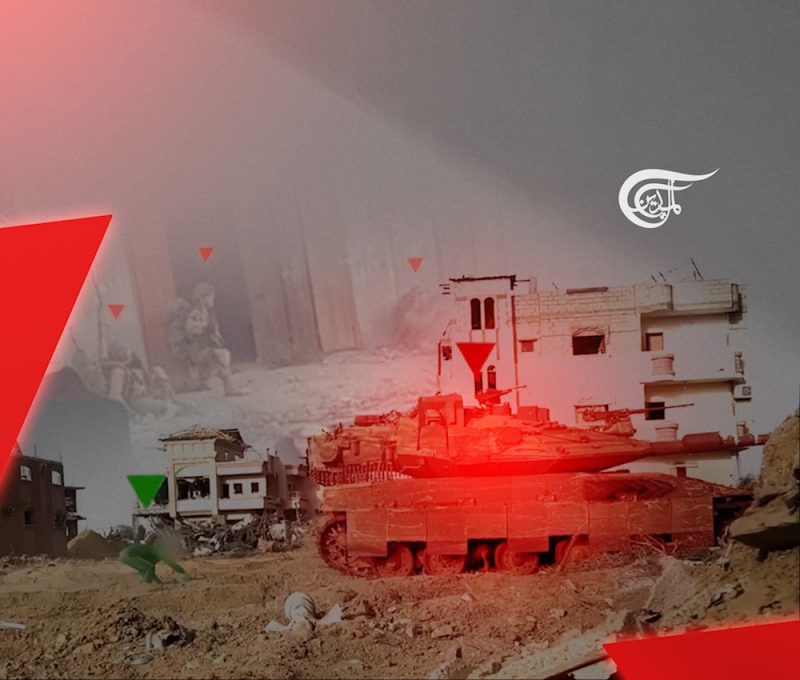
Around a week ago, the Israeli military decided to launch a sudden series of offensives against eastern Rafah, along with the Zeitoun neighborhood and Jabalia, north of the Gaza Strip. Despite claiming to have already dismantled the Resistance in northern Gaza months ago, what they have experienced there recently has been death and embarrassment.
On May 6, after Hamas announced it had accepted a ceasefire proposal that would have led to a comprehensive prisoner exchange and the end of the war, the Zionist entity freaked out and decided to push ahead with its planned incursion into the southernmost Gazan city of Rafah. It began by pushing forward around three kilometers to reach the Rafah Crossing, before expanding its operation further in the eastern areas of Rafah.
What the Zionists also committed themselves to was the re-invasion of the Zeitoun neighborhood, later launching another incursion into Jabalia town and refugee camp. While the Israeli military was surprised by the performance and qualitative leap in the tactics of the Resistance, compared to previous months, in all areas of Gaza, the Jabalia Resistance battalions had something new in store.
The Israeli military decided that a re-invasion of Jabalia was their next primary focus, but have failed to produce any viable justification for its actions, especially when the Zionist leadership claimed to have already defeated the Resistance there months ago. When entering the densely populated area, it is likely that they believed it to be easier than the times before and conducted the offensive in a very similar manner to how it had done throughout the war.
While the Resistance had previously waited for the Zionists to invade an area, before launching their guerrilla-style counterattacks, there was a change in strategy on the part of the Resistance battalions this time. The Palestinian Resistance opted to confront the Israelis head-on and to try to hold them back for as long as possible, in an effort to see whether they could successfully kick them out. The Resistance battalions in the Jabalia refugee camp, the area known in Gaza as “the Thorn of Palestine”, adopted the attitude of the previous generations of al-Qassam brigades fighters during the Second Intifada and adopted the phrase of the people: “You will not enter our camp.” This embodies the frequently repeated line of al-Qassam’s spokesperson, Abu Obeida, who states that “this is a resistance of victory or martyrdom.”
The Jabalia refugee camp is famous for having started The Intifada in 1987 and is considered by many to be to Gaza what the Jenin refugee camp is to the West Bank, a hotbed and stronghold of Resistance. After several attempts by the Israeli military to take over the Jabalia refugee camp during the early 2000s, the Zionist entity launched an invasion of northern Gaza in October of 2004, with a special focus on the Jabalia camp. Yet after killing over 130 Palestinians – most of whom were civilians – they were forced to retreat. Their primary stated goal at the time was to prevent the firing of rockets, which had just killed two Israelis, but failed to prevent the Resistance from continuing its rocket attacks shortly afterward.
This time around, the Resistance is not the same as the Resistance in 2004 and doesnt resemble the Resistance in previous battles. In the earlier days of Operation Al-Aqsa Flood, the casualties inflicted on the Zionist forces were surprisingly high. Nobody expected that the Resistance, after eight months of war, would have become stronger and capable of implementing more complex operations than before. The Resistance managed to carry out dozens of ambushes, fire over 100 RPG warheads at Israeli military vehicles, plant explosive charges under tanks, use drones to drop anti-personnel munitions, carry out sniper operations, and engage in various gunbattles. The Jabalia battalions also managed to cut off the supply line to the invading army, forcing them to change it multiple times.
On top of all of this, the Israeli military and political leadership have been shown to be liars before their own population. Their soldiers are growing tired and ill-motivated, they return to their families in body bags or with serious injuries, in a location that their regime claims was pacified and that the Resistance there was already defeated. Even the rocket fire from the northern Gaza Strip has increased over the past weeks, while the dozens of videos published by the Resistance factions prove that the tunnel systems are still intact and effective at launching attacks.
As is always the case, the Zionist entity has inflicted mass murder against Jabalia’s civilian population, callously blowing up civilian infrastructure and committing a litany of war crimes. While the impacts of these cruel practices cannot be diminished by the effectiveness of the Palestinian Resistance, it demonstrates that murdering innocent people does not equal a military victory. What the effectiveness of the Resistance does do, however, is to inspire steadfastness in the people and to grant solace to those afflicted as the result of the Zionist crimes against their families.
Although it is not completely clear why the Resistance suddenly decided to alter its tactics in Jabalia, there are a few factors that could have contributed to making this decision. The first is the scale of the atrocities committed against civilians in places like al-Shifa Hospital, during the more recent Israeli incursions into populated areas. When the Zionist invaders enter areas and seize control of civilians, they imprison, torture, execute, sexually abuse, and use them as human shields. It is likely that the Resistance may have sought to change tactics in Jabalia in order to prevent a repeat of the ways in which the Zionist militants treated civilians elsewhere.
Another reason could have been to learn from the enemies’ reactions to such tactics, this could be especially useful for the Resistance fighters in Rafah, who will likely use a wide variation of tactics themselves and will benefit in attaining new knowledge from what has occurred in Jabalia. Unlike the Zionists, who continue to make amateurish mistakes that are laughable when comparing them to other nations’ armed forces, the Palestinian Resistance is constantly evolving and learning from battle experience. This is not to say that the temporary entity does not learn at all, or adapt in different ways, but it is clearly still failing to correct basic issues and failures in the field.
Once again, the Israelis have been pricked by the Thorn of Palestine and are losing more confidence in the face of an unrelenting, motivated, and focused Resistance. What we are seeing from the Palestinian Resistance in Gaza is unprecedented and will be studied for years to come. With limited tools and while their people are subjected to starvation and genocide, the Resistance continues to write epics through some of the most astounding battles in Urban Warfare history.
Israeli soldier confesses to killing US elderly man in West Bank
Al Mayadeen | May 22, 2024
A self-proclaimed soldier from “Israel’s” infamous Netzah Yehuda battalion has admitted that his unit killed 78-year-old Palestinian-American, Omar Asad, in January 2022, according to recordings obtained by The Grayzone.
However, after announcing plans to sanction the battalion, the Biden administration withdrew the decision without offering further explanation.
“Four of these units [Israeli units] have effectively remediated these violations, which is what we expect partners to do,” the US State Department claimed.
The fifth unit appears to be Netzah Yehuda, an all-male unit of Orthodox Jewish nationalists that operates exclusively in Ramallah of the occupied West Bank and is accused of crimes, including sexual assault and beating at least three older men to death while they were lying on the ground while in custody.
Netzah Yehuda soldiers detained Asad and left him outdoors in harsh conditions, bound and blindfolded until he died. Instead of punishment, all the soldiers got was a slap on the wrist, and compensation was paid to Asad’s family.
A report by Washington DC-based human rights organization, DAWN, found that at the time of the killing, the commander of the unit, Lt. Col. Mati Shevach, was promoted to Deputy Commander of the Kfir Brigade, which oversees the Netzah Yehuda formation.
Spokesperson Vedant Patel responded during an April 29 State Department press briefing to questions regarding why the administration had hesitated to sanction the battalion.
“This is an ongoing process,” Patel said, further claiming, “I’m not going to speak to it more specifically, but consistent with the memorandum of understanding that we have with the government of Israel, we are engaging with them, consulting with them as it relates to not just this broader process but additional information that they’ve shared.”
The Grayzone obtained the glorified account of the killing of Asad, which according to the self-described soldier’s account, the unit brutalized Asad as punishment for supposedly interfering with a raid.
“This geezer who’s like trying to interfere with our operation, we’re going to like, f*** with him for a night,” the soldier said, as he called Arabs “murders, criminal animals” and boasted about killing and torturing Palestinians, likening himself to Americans who photographed themselves with dead Japanese soldiers during World War II, “doing funny things with their bodies.”
“Yeah, I enjoy it because they’re our enemy,” he expressed.
Read also: IOF units ‘remediated’ after rights violations, no Leahy sanctions
NGO updates complaint to Met Police on UK ministers’ complicity in Israel war crimes

MEMO | May 22, 2024
An NGO has submitted a complaint to the United Kingdom’s Scotland Yard against Israel’s use of “starvation as a weapon of war” and targeting of Palestinian civilians in the Gaza Strip, in what is the latest such complaint regarding war crimes in Gaza to be reported to British police.
According to the London-based International Centre of Justice for Palestinians (ICJP), it submitted a complaint to Scotland Yard’s War Crimes Team regarding Israel’s suspected use of “starvation as a method of warfare” and for ‘wilfully causing great suffering’ to Palestinians.
Although filed in the UK, both crimes are illegal under British and international law, including under the Rome Statute and the International Criminal Court Act 2001. Using starvation as a weapon of war also violates the Geneva Convention, a major keystone of contemporary international law.
The 60-page complaint – which was added to by a further 800 pages of evidence – includes accounts collected by ICJP’s investigation and legal teams, which include former British police detectives who collected the evidence to the standards of British police forces.
The evidence reportedly includes that collected from first-hand eyewitnesses, expert reports and expert evidence from nineteen medical professionals who have worked within the besieged Gaza Strip since October, when Israel began its ongoing offensive.
According to ICJP’s Director, Tayab Ali, “Complicity comes in many forms, whether that be providing political cover, encouraging criminal acts, supplying weapons or, as in the case of starvation, withholding funds from agencies that provide life sustaining humanitarian aid”.
The extensive complaint notably builds upon and expands an existing complaint issued by the ICJP back in January this year, which named four British government ministers for alleged complicity and criminal responsibility in Israeli war crimes. This latest update, however, further implicates a fifth senior government minister as an alleged perpetrator of those crimes.
Due to the war crimes’ illegality under British law and subsequent ability to be prosecuted in the UK, Scotland Yard’s War Crimes Investigation Team will now reportedly consider the complaints leading up to an ultimate decision on whether to open a formal criminal investigation on the matter. If that proceeds, there is the possibility that police will then question, arrest, and prosecute the alleged perpetrators and those complicit.
READ ALSO: Boris Johnson accused of obstructing investigations into war crimes in Gaza
Norway, Spain, Ireland to formally recognize Palestinian statehood
The Cradle | May 22, 2024
Norway, Ireland, and Spain announced on 22 May that they will formally recognize Palestine as a state next week, drawing the ire of Israel as the country immediately recalled its ambassadors to Dublin and Oslo.
“There cannot be peace in [West Asia] if there is no recognition … In the midst of a war, with tens of thousands killed and injured [in Gaza], we must keep alive the only alternative that offers a political solution for Israelis and Palestinians alike: Two states living side by side, in peace and security,” Norwegian Prime Minister Jonas Gahr Store said on Wednesday.
Shortly after Oslo’s announcement, Irish Prime Minister Simon Harris said his country would also recognize a Palestinian state.
“Today, Ireland, Norway, and Spain are announcing that we recognize the state of Palestine,” Harris said at a news conference. “I’m confident that further countries will join us in taking this important step in the coming weeks,” he added.
Foreign Minister Micheal Martin said via social media that the recognition will become official on 28 May.
Spanish Prime Minister Pedro Sanchez followed suit, announcing Wednesday that the country’s council of ministers would also recognize an independent Palestinian state on 28 May. He also accused his Israeli counterpart Benjamin Netanyahu of putting the two-state solution in “danger” with his policy of “pain and destruction” in Gaza.
In response to the news, Tel Aviv immediately recalled its ambassadors to Ireland and Norway and pledged to recall its envoy to Spain. The foreign ministry also summoned the ambassadors from the three European nations to “reprimand” them.
Israeli foreign minister Israel Katz called the show of support for Palestinians a “folly,” adding that recognizing Palestinian statehood “[sends] a message to the Palestinians and the world: Terrorism pays.”
Palestinian officials welcomed the announcement by three European nations, with Hamas calling it an “important step.”
“We welcome the announcement by Norway, Ireland, and Spain of recognition of the State of Palestine, and we consider it an important step on the path to consolidating our right to our land and establishing our independent Palestinian state with Jerusalem as its capital,” the statement by the Palestinian resistance says.
“Historical moments in which the free world triumphs for truth and justice after long decades of Palestinian national struggle, suffering, pain, occupation, racism, murder, oppression, abuse and destruction to which the people of Palestine were subjected,” the Secretary-General of the Palestinian Liberation Organization (PLO) said via social media.
Nine European countries — Bulgaria, Poland, the Czech Republic, Romania, Slovakia, Hungary, Sweden, Malta, and the Greek Cypriot administration — have already recognized Palestine as a state.
The latest Democracy Perception Index reveals shifts in global perceptions
By Ramzy Baroud | MEMO | May 21, 2024
The Democracy Perception Index (DPI) issued its 2024 report on 8 May, revealing important and interesting shifts in global perceptions about democracy, geopolitics and international relations. The conclusions in the report were based on the views of over 62,000 respondents from 53 countries, representing roughly 75 per cent of the world’s total population.
The survey was conducted between 20 February and 15 April this year, when the world was largely transfixed by the Israeli war against the Palestinians in the Gaza Strip.
It is important to note that the DPI, although informative, is itself conceived in a biased context as it is the product of a global survey conducted by western-based companies and organisations.
The DPI results were published ahead of a scheduled 2024 Copenhagen Democracy Summit, whose speakers will include Hillary Clinton, US Republican Senate leader Mitch McConnell and President of the European Council Charles Michel. The first speaker listed on the conference website is Anders Fogh Rasmussen, the Founder and Chairman of the Alliance of Democracies Foundation, which commissioned the DPI.
All of this is reflected in the kind of questions which are being asked in the survey, placing greater emphasis on whether, for example, ties should be cut with Russia over Ukraine, and China over a war that is yet to take place in Taiwan. Such major shortcomings notwithstanding, the outcome of the research remains interesting and worthy of reflection.
There are some major takeaways from the report. For a start, there is growing dissatisfaction with the state of democracy, and such discontent is not limited to people living in countries perceived as non-democratic; it also includes people in the US and Europe.
What’s more, democracy, in the collective awareness of ordinary people, is not a political term often infused as part of official propaganda. When seen from the viewpoint of the people, democracy is a practical notion, whose absence leads to dire implications. For example, 68 per cent of people worldwide believe that economic inequality at home is the greatest threat to democracy.
On the question of “threats to democracy”, there is growing mistrust of Global Corporations (60 per cent), Big Tech (49 per cent) and their resulting Economic Inequality (68 per cent), and Corruption (67 per cent). This leads to the unmistakable conclusion that western globalisation has failed to create the proper environment for social equality, empower civil society or build democratic institutions. The opposite, based on people’s own perceptions, seems to be true.
Then we have global priorities which, as seen by many nations around the world, remain committed to ending wars, poverty, hunger, combating climate change, etc. However, this year’s top priority among European countries, 44 per cent, is also centred on reducing immigration, a significant number compared with the 24 per cent who prioritise fighting climate change.
Although the world appears to be divided about cutting ties with Russia and China, the selection of the question again reeks with bias.
The respondents in western countries, who are subjected to relentless media propaganda, prefer cutting such ties, while most people in the rest of the world prefer keeping them. Consequently, due to China’s positive perception in Asia, the Middle East and North Africa, the DPI gave Beijing a “net positive”. Russia, on the other hand, is on the “path of image rehabilitation in most countries surveyed with the exception of Europe,” reported Politico.
The greatest decline was suffered by the United States, largely due to Washington’s support for Israel in its ongoing war in the Gaza Strip. “Over the past four years… perceptions of the US’s global influence became more positive – peaking in 2022 or 2023 – and then declined sharply in 2024,” the report concluded.
The large drop took place in the Muslim countries that were surveyed: Indonesia, Malaysia, Turkiye, Morocco, Egypt and Algeria. Some western European countries are also becoming more critical of the US, including Switzerland, Ireland and Germany.
Most people (55 per cent compared with 29 per cent) believe that social media has a positive effect on democracy. Despite growing social media censorship, many in the Global South still find margins in these platforms which allow them to escape official or corporate media censorship. Growing criticism of social media companies, however, is taking place in western countries, according to the survey.
Despite official propaganda emanating from many governments, especially in the west, regarding the greatest threats to world peace, the majority of people want their governments to focus on poverty reduction, fight corruption, promote economic growth, and improve healthcare and education, while working to reduce income inequality. “Investing in security and defence,” came seventh on the list.
Finally, people in countries which have an overall negative perception of the United States include some of the most influential global and regional powers, such as China, Russia, Indonesia, Austria, Turkiye, Australia and Belgium.
Despite massive media propaganda, censorship and scaremongering, people around the world remain clear on their collective priorities, expectations and aspirations, which are real democracy, social equality and justice. If these collective yearnings continue to be denigrated and ignored, we should expect more social upheaval, if not outright insurrections and military coups in coming years.
Some EU States Mulling Sanctions Against Georgia Over Foreign Agents Bill – Reports
Sputnik – 22.05.2024
Some EU member states are considering imposing sanctions on Georgia, including the suspension of visa-free travel regime, over the foreign agents bill, the Financial Times reported on Wednesday, citing sources familiar with the situation.
On Saturday, Georgian President Salome Zourabichvili vetoed the controversial foreign agents bill that had been adopted by the country’s parliament last Tuesday. The parliament needs a simple majority to override the veto.
A number of EU countries, led by Estonia, the Netherlands, the Czech Republic and Sweden, aim to discuss restrictive measures towards Georgia at the EU Foreign Affairs meeting next week, the Financial Times reported.
The potential sanctions include suspending visa-free travel to the European Union by Georgians, freezing of EU funds for the country and some targeted sanctions, the newspaper cited the officials as saying.
If the foreign agents bill is enacted, Georgia’s EU accession progress will face a major setback, an EU official said.
The draft law “On the Transparency of Foreign Influence” was initially submitted to the Georgian parliament in February 2023 but was withdrawn the following month amid a wave of protests and pressure from Western countries. After revision, the term “foreign influence agent” was replaced with “organization promoting the interests of a foreign power,” while the rest of the content remained the same.
The latest iteration of the bill has sparked weeks of mass protests in the Georgian capital of Tbilisi amid concerns that it could block the South Caucasus nation’s path to EU membership. EU foreign policy chief Josep Borrell criticized the bill in March, saying its adoption could have serious repercussions for EU-Georgian relations.
The West is acting as harshly and “crazily” as possible with regard to Georgia because it failed to destabilize the situation in the country earlier, as it did with Ukraine, Russian Foreign Ministry spokeswoman Maria Zakharova said.
The EU’s call on the Georgian authorities to ensure the right of citizens to protest can be interpreted as interference in internal affairs for the purpose of regime change, Maria Zakharova said. According to her, otherwise the EU’s call “can be interpreted as interference in the internal affairs of the state with the aim of regime change.
Deadly Chemicals Found at US ICBM Bases Threaten to Send Personnel to Early Grave

Phalus © Photo : US National Park Service
By Ilya Tsukanov – Sputnik – 22.05.2024
Introduced into service in the 1970s, America’s Minuteman III ICBM arsenal has been plagued by notoriously outdated tech, including computers using eight-inch floppies until the late 2010s. Efforts to modernize the missiles have been problematic, with the Air Force forced to ‘safely terminate’ a test launch in November after detecting an ‘anomaly’.
Personnel operating current and former US ICBM bases have been exposed to cancer-causing agents known as polychlorinated biphenyls (PCBs), the Air Force has acknowledged.
“PCBs are likely present in decommissioned Titan and Peacekeeper missile facilities that the Air Force no longer has the ability to conduct sampling in,” Air Force Global Strike Command chief General Thomas A. Bussiere said in a release put out earlier this week.
But the pale yellow-colored, viscous substances have also been found at active Minuteman III sites. Bussiere said sampling “identified the continued presence of PCBs” at Minuteman bases “despite a comprehensive removal effort in the 1990s.”
“One of the consistent concerns we’ve heard throughout the Missile Community Cancer Study is that service members, retirees, and veterans have trouble explaining their concerns over potential exposure to toxic chemicals with their healthcare providers, especially civilian providers who don’t have access to military medical database,” Air Force Global Strike Command Surgeon General Gregory Coleman said.
“While this memorandum from Global Strike Command cannot capture the specifics of any individual Airman or Guardian’s service in the missile fields, it can serve as a starting point for discussions and documentation of potential exposure,” Coleman added.
PCBs are chemical compounds used in an array of old equipment, including electronics. They were banned in the US in the late 1970s, and worldwide in the early 2000s. They share characteristics with other persistent organic pollutants, easily contaminating the local environment, including rivers, soil, and farms.
They are extremely hard to break down or degrade, with elimination difficult and costly (incineration, for example, requires heating to temperatures of 1,000 degrees Celsius or above).
The substances are linked to diseases impacting the central nervous system, and endocrine disruption. PCBs can also cause aggressive skin and liver cancers, and have a suspected role in the development of other ailments by weakening the immune system. They easily penetrate skin and even protective equipment, including synthetic polymers and latex.
The US is expected to spend over $131 billion to replace its Minuteman III missiles with the new Sentinel missile program. The program has faced a string of delays and cost overruns, with the first test flight expected to take place in 2026 at the earliest.
The Pentagon is expected to spend a staggering $1.5 trillion (and rising) on its multi-decade nuclear rearmament program – which was begun by the Obama administration in 2016.
Dubious Eagle: Why Has Pentagon Pumped $756 Mln Into Hypersonic Missile That Doesn’t Fly?
By Ilya Tsukanov – Sputnik – 22.05.2024
The US Army has been teasing the deployment of its ground-based Long-Range Hypersonic Weapon (LRHW) system since 2021, with the system touted as the Pentagon’s first nearly operational hypersonic missile amid development delays and cancellations plaguing nearly a dozen similar projects for and by the Army, Air Force, Navy, and DARPA.
The US Army has awarded Lockheed Martin another $756 million for its delay-plagued LRHW “Dark Eagle” program, with the contract involving the provision of battery equipment, unspecified logistics, systems, and software engineering support.
In development since 2017, the LRHW’s $41 million apiece truck-launched missiles are expected to be able to accelerate to speeds up to Mach 17, and boast a 3,000 km operational range. The system uses the common All Up Round (AUR) munition also used in the Navy’s Conventional Prompt Strike (CPS) program.
But like other US hypersonic missile efforts to date, Dark Eagle has become a somewhat “Dubious Eagle” after a string of testing issues. The Congressional Research Office has counted at least five failures to date:
- In October 2021, an LRHW test failed when the Common-Hypersonic Glide Body (C-HGB) did not deploy.
- In June 2022, the complete LRHW missile system suffered another test failure.
- A scheduled LRHW test was canceled in October 2022 to “assess the root cause” of the June 2022 failure.
- In March 2023, a scheduled test launch from the Cape Canaveral Space Force Station in Florida was scrapped.
- A second planned test at Cape Canaveral was canceled in September 2023, followed by an Army statement that it would not be able to meet the goal of deploying Dark Eagle in the current fiscal year.
- A November 2023 review by Army and Navy acquisition execs blamed the delays on unspecified “problems” with the Lockheed-made launcher, and said the issues would take “months” to iron out.
The poor track record of US hypersonic missile programs to date has been surprising, given the tens of billions of dollars in research and development funding lavishly doled out by Congress in annual defense budgets – which typically outpace the defense spending of all of Washington’s major adversaries combined.
Last month, veteran Russian defense observer and missile expert Dmitry Drozdenko told Sputnik that the reason hypersonic weapons are so difficult to develop comes down not to the ability to accelerate vehicles to hypersonic speeds (which has been possible since virtually the dawning of the missile age), but creating materials that can withstand the ultra-hot temperatures hypersonic missiles encounter during flight – when they are covered by clouds of plasma. The USSR was leagues ahead of the US in the study of plasma physics during the Cold War, with Russia inheriting this invaluable knowledge and putting it to good use to field its first-in-the-world hypersonic missiles.
“Technologies are developed by people,” Drozdenko explained. “Money is one means of developing a technology, but it can happen that a technology is created with a minimum amount of funds. It can turn out that you have a lot of money, but the technology doesn’t work out. Therefore, money is not the main thing here. The main thing is people, and having the appropriate academic knowledge,” the observer said.
Failure in Ukraine presents the West with a clear yet difficult choice
By Sergey Poletaev | RT | May 22, 2024
In our last article, we analyzed Kiev’s military prospects in light of its new mobilization law. Here we consider the West’s options in the proxy war it’s using the Armed Forces of Ukraine (AFU) to fight.
Western officials have been talking about sending troops to Ukraine since the beginning of the year. French President Emmanuel Macron said that he is ready to consider “any scenario,” including a ground operation. Government officials in Estonia and Lithuania (including Prime Minister Ingrida Simonyte) were quick to support him. And the Leader of the House Democratic Caucus Hakeem Jeffries became the first US politician who didn’t exclude the possibility of sending troops.
Formally, Ukraine hasn’t requested Western troops – Kiev has only demanded more weapons. But now, the New York Times reports that Kiev has officially asked the US and NATO to send military instructors to train 150,000 recruits on its territory, closer to the front line. Though the US has refused to comply with the request, the chairman of the Joint Chiefs of Staff, General Charles Q. Brown Jr, has said that a NATO deployment of trainers appears inevitable, and that “we’ll get there eventually, over time.”
The subject of sending troops to Ukraine comes up quite often but, so far, Western countries have steered clear. Why? Is a full-fledged NATO intervention in Ukraine possible and what would happen if it took place? And how else might the West turn the course of the conflict in its favor?
A larger-than-life bet
Western doctrine in regard to Russia was defined even before the start of the full-scale conflict: the idea was to fight Russia “with the hands of” Ukraine and on Ukrainian territory. The goal was to force Russia to play by Western rules (ideally, by defeating it on the battlefield) and reassert the US-led bloc’s shaky global hegemony. But, at the same time, officials wanted to minimize their own risks and avoid being drawn into a direct military confrontation that could result in a nuclear war.
The second staple of this doctrine – a total trade war – has not yielded the desired results. In 2022, it became clear that the West overestimated the degree of its control not only over the international financial system, but even over its own financial flows. Despite certain losses and additional costs, Russia has been able to replace old trade ties with new ones and to do so with a minimal loss of revenue. The severe sanctions imposed by the West on its own companies turned out to be quite useless, since for the most part Russia continues to receive the latest Western products and technologies.
As for the idea of defeating Russia on the battlefield, the turning point occurred in the summer of 2023. After the failure of Ukraine’s counteroffensive, it became clear that the AFU would not be able to impose peace on its own terms. The problem is that in the conflict with Russia, the West has gone ‘all in’ and any military outcome that could be regarded as beneficial for Moscow – even negotiations on an equal footing – would now be regarded as a defeat. The whole world would realize that they can stand up to the hegemon and not just avoid becoming an outcast, but even gain some benefits. The West cannot allow this, since it could cause a chain reaction on a global scale.
Two options
By the beginning of 2024, Western countries faced a dilemma: In the current proxy war it was clear that they were losing and Ukraine was getting weaker, while Russia was growing stronger. Western leaders realized that the situation will continue to get worse until the middle or end of 2025 – by which time their own military production should gain momentum and Moscow may begin to experience a shortage of volunteers at the front. In other words, the worst-case scenario meant that Russia would be able to conduct at least three more successful military campaigns (summer and winter ‘24, and summer ‘25) with superior military forces.
The logic of the conflict is pushing the West towards the choice that we wrote about back in May 2022 – either intervening directly and fighting Russia on its own, or starting serious negotiations with Russia on the topic of Ukraine’s NATO membership and, more broadly, security in Eastern Europe.
Paradoxically, though, the West has chosen a third option: doing nothing. And it’s not just because of inertia, but also down to the weakening position of globalist elites, who have many unsuccessful ‘crusades for democracy’ behind them, from Vietnam to Afghanistan.
As of now, the AFU is growing weaker, the scale of the hostilities is growing, and the chances of the West directly entering the war, with potentially catastrophic consequences, are increasing every day. In the fall of 2022, before the limited mobilization in Russia, 10-15 NATO brigades could have turned Ukraine’s notable but rather meaningless victories near Kharkov and Kherson into a strategic success – for example, they could’ve ensured a breakthrough to the Azov Sea and a subsequent blockade of Crimea – but now it would take a lot more effort to simply support the front.
Fooling the system
The reason for the West’s indecisiveness is clear: it fears an escalation of the conflict. Russia is the world’s largest nuclear power and President Vladimir Putin has repeatedly stated that he will not tolerate a widespread NATO intervention, which will result in a nuclear war.
Moscow’s warnings have challenged Western countries, headed by the US, to find ways “to intervene without intervening” and to enable Ukraine to win (or at least save face) without directly defeating Russia. In short, Western countries are forced to walk the thin line between defeat and nuclear war, without a clear end goal in sight.
After the failure to cut open a land corridor to Crimea, the West has not been able to find an alternative military strategy. Moreover, it has no idea how to get out of the war of attrition which, even in the case of a positional deadlock and a ‘static’ front, will result in Ukraine’s defeat, since an opponent that is many times weaker (Ukraine’s current population is at least five times less than that of Russia) will inevitably lose. We see plenty of such examples in history.
In this situation, the only thing that Western strategists have managed to come up with is to continue supporting the AFU and “increase costs” for Russia in the hope that Putin will get tired of fighting. Of course, no one in the West takes Ukraine’s suffering into account. It takes for granted the fact that Ukrainians will continue to die en masse just so that the West can save face. Neither do they care about Ukraine’s demographic and social collapse (unprecedented in post-WWII Europe) or the destruction of its infrastructure, which will prevent not only a normal economy but even normal life in these territories for many decades. Such issues are simply ignored or considered collateral damage.
The West may not explicitly state its strategy in regard to Russia, but it is clearly expressed in various publications and statements: the goal is to support the AFU at the front and at the same time move the conflict deeper into Russian territory in the hope that Putin will beg for mercy before Ukraine collapses.
It is unlikely that Western leaders still hope to see a victory for Kiev on the battlefield. The more likely goal now is either the “Korean scenario” where no one wins and Ukraine is kept as Russia’s opponent, or the “Palestinian scenario,” ie, eternal war on Ukraine’s former territory. What is clear is that the West will do anything it can to avoid holding serious negotiations with Russia.
War of the cities
Despite the growing escalation and the West’s increasing involvement in the conflict, one red line still exists: Ukraine is not allowed to hit Russia’s”old” territories – ie, those territories which the West recognizes as part of Russia – with Western missiles.
However, the ways in which Ukraine (with the West’s approval) circumvents this ban resemble the methods of an ingenious lawyer who finds the most unexpected loopholes in laws. For example, if “territory” is interpreted as “land” then air targets are not considered “territory” and Ukraine may hit air targets in internationally recognized Russian airspace; if a long-range drone has Western components and Western targeting, but was assembled in Ukraine, this also doesn’t count; and if Western weapons are used under a false flag (for example, by the Ukraine-based paramilitary group Russian Volunteer Corps) – this is fine, too. Of course, there are many such examples.
Why so? It is unknown whether any clear agreements regarding this issue exist but, in any case, Moscow has clearly stated that any obvious attacks on its “old” territories will allow Russia to retaliate and hit Western cities directly – not through proxies.
In military terms, the AFU will hardly benefit from such an escalation. Firstly, by resorting to such strikes, the Ukrainian army won’t change the strategic situation at the front, just as bombing Russia’s “new territories” and Crimea with all sorts of weapons hasn’t helped.
Secondly, the supply of Western missiles is not enough to overload Russian missile defense systems and achieve real military goals. Even though occasional missiles hit its territory, Moscow has adapted to the situation, takes measures to prevent future attacks, and carries out retaliatory strikes.
In other words, by striking Russian cities, (an unheard-of idea even in the most intense years of the Cold War), the West will not achieve anything but will only face increased risks and an escalation which it wishes to avoid.
However, it is possible that the desperate situation at the front and the need for some kind of propaganda success will sooner or later force the West to take such a step – and perhaps this may happen very soon. So far, this seems to be the most likely scenario that may lead to an escalation of the conflict beyond the zone of the Ukrainian “sandbox.”
Boots on the ground
And what about sending troops to Ukraine – will the West actually do it? This is unlikely. As pointed out already, in the past two years the scale of the conflict has changed and, in order to achieve success, NATO would now need to send dozens of brigades to Ukraine (at least 100,000-150,000 people), several hundred aircraft, and launch huge cruise missile attacks (hundreds of volleys per day).
Finally, even though such efforts might stabilize the situation at the front and save the AFU (supposing that the Kremlin does not declare a greater or even full mobilization in response), it would not guarantee Russia’s defeat but would only bring nuclear war closer.
In a direct intervention, NATO ground forces (just like Ukrainian ones today) will eventually face a shortage of ammunition and, in the air, NATO forces will suffer damage from Russian missile defense systems and will be exposed to attacks (currently, NATO reconnaissance operates over the Black Sea without any obstacles). Moreover, conflict with China also looms on the horizon and, if NATO empties its arsenals in Ukraine, China may either watch the situation unfold or offer Russia direct assistance.
As a result, NATO countries would find themselves in a positional conflict with heavy losses and unclear goals. Eventually, though, this may help to resolve the contradictions between Russia and the West, since, like a stubborn child, the US-led bloc may feel it has to try all means of resistance before giving in.
Another option for the West would be to move troops to Ukraine “symbolically”– for example, to send one or two brigades that would serve as instructors for AFU recruits (though it must be said that, two years into the war, the veterans on both sides of the front line are the ones who should teach the rest of the world, including NATO, how to fight), or just maintain aircraft.
Of course, it goes without saying that any third-country troops stationed in Ukraine will become a military target for Russia.
***
In conclusion, we may say that the Western doctrine – ie, the combination of a total trade war and a proxy war – has failed to bring about victory and has put its “client” (Ukraine) at risk of a major defeat. The West is still afraid to get directly involved in the conflict, even when it comes to striking “old” Russian territories or operating missile defense systems under its own flag, not to mention directly sending troops.
At the same time, the West avoids serious negotiations with Russia and prefers to go with the flow, consoling itself with the idea that Russia will eventually get burned by growing costs and retreat.
Meanwhile, Moscow is adapting to the situation, rebuilding its economy, trade relations, and society in order to live and successfully develop in the reality of a long conflict. The West’s strategy (or rather, the absence of such) has been clearly unsuccessful – especially considering the current level of involvement in the conflict, Ukraine may exhaust its forces long before Russia experiences any major inconvenience at the front.
Sergey Poletaev is an information analyst and publicist, co-founder and editor of the Vatfor project.
The failure of Western financial sanctions
By Mauricio Metri | Strategic Culture Foundation | May 21, 2024
On March 24, 2024, some newspapers reported the 25th anniversary of the plane’s U-Turn over the Atlantic, with the then-Russian foreign minister, Yevgeny Primakov, due to the kick-off NATO bombings over Serbia, without approval from the UN Security Council. Amid the onslaught against Belgrade, NATO forces deliberately struck the Chinese embassy. Beijing hasn’t forgotten the date, and on May 7, 2024, President Xi Jinping was in the capital of Serbia to pay his respects to the dead and pass a message to the West. These events determined the beginning of Russia’s reconstruction, the acceleration of the Chinese rise process, and the deepening of Sino-Russian partnerships (1).
During this period, starting from economic fragility and a military delay position concerning the USA, Russia established a strategic advantage in weapons in 2018 by developing hypersonic weapons. It also rebuilt its national economy, circumventing unprecedented economic sanctions against it. Despite the sanctions, Russia’s economy expanded significantly in 2023 compared to other North Atlantic countries. This year, the IMF corrected its forecasts for Russia, doubling its estimates upward.
The financial sanctions policy is one of the expressions of the monetary power of the dollar in the international system, especially after the Bush Doctrine of 2002 (2). However, the effectiveness of Washington’s economic sanctions regarding its foreign policy objectives has been very low, not to say null. For example, despite the severe sanctions introduced in 2007, Iran has acquired the ability to resist and develop an adequate offensive military capacity, allowing it to change the balance of forces in Southwest Asia. A month ago, on April 12, 2024, Tehran abandoned its “policy of strategic patience” and revealed to the world, through the missile attack, its ability to pierce the Israeli anti-aircraft defense system.
The main targets of U.S. sanctions (Russia, Iran, North Korea, Venezuela, and Cuba) have generally succeeded in withstanding this kind of violence, and one of the most relevant reasons for this is China’s rise to the status of the largest economy, surpassing the U.S. one. In 2023, China’s share of world GDP based on purchasing power parity reached 18.73%, while that of the USA was 15.56%. Due to its dynamism, size, and sophistication, the Chinese economy made bypassing the payment systems controlled by Washington possible. For instance, after the start of Russian military intervention in Ukraine, when one imposed unprecedented sanctions, Sino-Russian trade grew 64%, reaching a record U.S. $240 billion in 2023.
Not for any other reason, on April 8, 2024, U.S. Treasury Secretary Janet Yellen, visiting Beijing, threatened Chinese companies, stating, “There will be significant consequences for companies that provide material support to Russia. Those who do not comply will face the consequences”.
The Chinese response came a few days later when Russian Foreign Minister Sergey Lavrov visited Beijing. Both countries committed to maintaining the stability of the industrial supply chain, including Chinese material support for Russia’s war against Ukraine and the Russian defense industrial base. According to the Chinese Ministry of Foreign Affairs, Moscow and Beijing “reinforced calls for their two countries to work more closely together against ‘hegemonism.’”
A few weeks later, once again in Chinese territory, a U.S. authority reiterated Washington’s threats. The U.S. Secretary of State, Antony Blinken, in a statement during his official visit to China, stated, “The United States is ready to take new measures and impose sanctions against China and the background of the situation in Ukraine. (…) If China does not take measures to solve this problem, the U.S. will do it.”
Washington’s persistent threats reveal a well-established consensus in the North Atlantic that, on the one hand, the dollar’s power as an instrument of economic sanctions has been eroding continuously. On the other hand, China is the main reason for this. One talks openly about the topic. On April 29, 2024, the chair of the House of Commons Treasury Select Committee of the United Kingdom and member of the NATO Parliamentary Assembly, Harriet Baldwin, stated, “There is a consensus that sanctions are not working in terms of their stated intent – causing real trouble for the Russian economy.” A few days later, in the same way, Italy’s defense minister, Guido Crosetto, expressed that “economic sanctions against Russia had failed and called on the West to try harder to negotiate a diplomatic solution with President Vladimir Putin to end the war in Ukraine. (…) the West had wrongly believed its sanctions could stop Russia’s aggression, but it had overestimated its economic influence in the world.” A few days ago, on May 6, 2024, after meeting with the Chinese president at the French capital, the president of the European Commission, Ursula von der Leyen, returned to the topic. She stated, “We have also discussed China’s commitment not to provide any lethal equipment to Russia. More effort is needed to curtail the delivery of dual-use goods to Russia that find their way to the battlefield. And given the existential nature of the threats stemming from this war for both Ukraine and Europe, this does affect the EU-China relations.”
Therefore, in the North Atlantic power structures, the perception has already been consolidated that a kind of “debasement” of the dollar as an instrument of violence via financial sanctions exists. However, another understanding continues to prevail in Washington concerning the privilege to command the global reference currency: the enlargement of its spending capacity without apparent limits and the imposition on the world of the financial burden of its global wars. This privilege, unlike sanctions, goes on operating at full strength, as in the case of the U.S.$95 billion aid package for Ukraine, Israel, and the Indo-Pacific recently approved by the U.S. House of Representatives.
(1) For more details, see: Metri, M. “História e Diplomacia Monetária”. Ed. Dialética, São Paulo, 2023. (cap. 15).
(2) For more details, see: Nascimento, Maria A. W. V. do. “A Doutrina Bush e a Institucionalização do Poder Coercitivo do Dólar”. Dissertação de Mestrado. PEPI, IE-UFRJ, 2024
Andrew Bridgen and an Idiot!
Climate Realism by Paul Burgess | May 21, 2024
Is it worth even asking our idiot ministers any questions in Parliament?
Wretch this factual question and truly stupid answer.
Featured Video
Why the U.S. Should Pull Back From the First Island Chain
or go to
Aletho News Archives – Video-Images
From the Archives
Only 19.7% of Americans agree with US State Dept on Israeli settlements
… Most American adults of voting age don’t appear willing to reject the applicability of international law to Israel’s ongoing colonization of occupied territories in East Jerusalem, the West Bank and Golan Heights. … Full article
Blog Roll
 Aletho News
- Tokyo protests demand Takaichi’s resignation over support for ‘Israel’
- Jennifer Kavanagh: Why the U.S. Should Pull Back From the First Island Chain
- Yemen denounces international community’s silence on Saudi aggression, siege
- UAE and Saudi Arabia move toward renewed coordination against Sanaa
- How Iran’s two-week retaliatory strikes exposed cracks in US military architecture in Persian Gulf
- The mother of all propaganda: Why the hype over US MOAB strike against Iran is nothing but theater
- Iran says it possesses technology behind US 14-ton GBU bunker-buster
- Trump asks Iran not to retaliate after he strikes Pickaxe Mountain – w/ Prof. Marandi
- Vice President J.D. Vance’s Deceptive ‘Antiwar’ Campaign Speech
- Iran: Palestinians’ rights must not be compromised in Gaza’s future; US, Israel to blame for Hormuz situation
- If Americans Knew
- Israeli rabbi permits occupiers to steal Palestinian olive harvest in West Bank
- Netanyahu’s spin on latest settler attack is laughable – Daily Update
- Israeli soldiers debunk Israel’s talking points
- In West Bank, Israeli settlers are totally out of control – Daily Update
- NPR investigation finds evidence of widespread fraud at mall kiosks tied to Israeli skincare brand
- Tucker Carlson exposes Israeli Lies about the Oct 7th attack, Charlie Kirk, and the U.S.
- Israel has detained thousands of Palestinian children since Oct 7th – over half spent time in solitary, many uncharged
- Israeli Analysis: Is Netanyahu Planning an ‘October Surprise’ Attack Before Israel’s Election?
- Israeli settlers brutally attack Palestinians and Washington Post female photographer, 65
- Words Have Changed, Occupation Continues: The Reality of the Gaza Ceasefire
- No Tricks Zone
- Predictions Made By Renowned Climate Proifessor Over Past Decades Have Been Proven To Be Poor
- New Study Suggests Large Regions Of The Pacific Ocean Have Been Cooling For The Last 80 Years
- Germany’s Green Energy Debacle: High Energy Costs Force Kahla Porzellan to Close After 182 Years!
- New Study: 50 Years Of The Most Aggressive ‘Net Zero’ Policies Can Only Affect The Global Climate By 0.03°C
- US September “Heat” Was No Record…Many Records Set Decades Ago
- Latest European Green Energy Debacle; Portugal’s Largest Flagship Solar Park Insolvent!
- Green Energy Debacle: German Expert Professor Fritz Vahrenholt Warns Of Severe Economic And Social Consequences
- Two More Paleo Reconstructions Affirm Meters-Higher Sea Levels Across Ireland, Brazil 7000-6000 Years Ago
- New Study: Earth And Venus Surface Warmth Largely Explained By Convection And Lapse Rate, Not CO2 Or Radiation
- 2025 Nature Paper Claiming Worsening Global Drought Gets RETRACTED …Heavily Flawed

