The Doctor Will Kill You Now

By Clayton J. Baker, MD | Brownstone Institute | October 9, 2025
Way back in the B.C. era (Before Covid), I taught Medical Humanities and Bioethics at an American medical school. One of my older colleagues – I’ll call him Dr. Quinlan – was a prominent member of the faculty and a nationally recognized proponent of physician-assisted suicide.
Dr. Quinlan was a very nice man. He was soft-spoken, friendly, and intelligent. He had originally become involved in the subject of physician-assisted suicide by accident, while trying to help a patient near the end of her life who was suffering terribly.
That particular clinical case, which Dr. Quinlan wrote up and published in a major medical journal, launched a second career of sorts for him, as he became a leading figure in the physician-assisted suicide movement. In fact, he was lead plaintiff in a challenge of New York’s then-prohibition against physician-assisted suicide.
The case eventually went all the way to the US Supreme Court, which added to his fame. As it happened, SCOTUS ruled 9-0 against him, definitively establishing that there is no “right to die” enshrined in the Constitution, and affirming that the state has a compelling interest to protect the vulnerable.
SCOTUS’s unanimous decision against Dr. Quinlan meant that his side had somehow pulled off the impressive feat of uniting Antonin Scalia, Ruth Bader Ginsberg, and all points in between against their cause. (I never quite saw how that added to his luster, but such is the Academy.)
At any rate, I once had a conversation with Dr. Quinlan about physician-assisted suicide. I told him that I opposed it ever becoming legal. I recall he calmly, pleasantly asked me why I felt that way.
First, I acknowledged that his formative case must have been very tough, and allowed that maybe, just maybe, he had done right in that exceptionally difficult situation. But as the legal saying goes, hard cases make bad law.
Second, as a clinical physician, I felt strongly that no patient should ever see their doctor and have to wonder if he was coming to help keep them alive or to kill them.
Finally, perhaps most importantly, there’s this thing called the slippery slope.
As I recall, he replied that he couldn’t imagine the slippery slope becoming a problem in a matter so profound as causing a patient’s death.
Well, maybe not with you personally, Dr. Quinlan, I thought. I said no more.
But having done my residency at a major liver transplant center in Boston, I had had more than enough experience with the rather slapdash ethics of the organ transplantation world. The opaque shuffling of patients up and down the transplant list, the endless and rather macabre scrounging for donors, and the nebulous, vaguely sinister concept of brain death had all unsettled me.
Prior to residency, I had attended medical school in Canada. In those days, the McGill University Faculty of Medicine was still almost Victorian in its ways: an old-school, stiff-upper-lip, Workaholics-Anonymous-chapter-house sort of place. The ethic was hard work, personal accountability for mistakes, and above all primum non nocere – first, do no harm.
Fast forward to today’s soft-core totalitarian state of Canada, the land of debanking and convicting peaceful protesters, persecuting honest physicians for speaking obvious truth, fining people $25,000 for hiking on their own property, and spitefully seeking to slaughter harmless animals precisely because they may hold unique medical and scientific value.
To all those offenses against liberty, morality, and basic decency, we must add Canada’s aggressive policy of legalizing, and, in fact, encouraging industrial-scale physician-assisted suicide. Under Canada’s Medical Assistance In Dying (MAiD) program, which has been in place only since 2016, physician-assisted suicide now accounts for a terrifying 4.7 percent of all deaths in Canada.
MAiD will be permitted for patients suffering from mental illness in Canada in 2027, putting it on par with the Netherlands, Belgium, and Switzerland.
To its credit, and unlike the Netherlands and Belgium, Canada does not allow minors to access MAiD. Not yet.
However, patients scheduled to be terminated via MAiD in Canada are actively recruited to have their organs harvested. In fact, MAiD accounts for 6 percent of all deceased organ donors in Canada.
In summary, in Canada, in less than 10 years, physician-assisted suicide has gone from illegal to both an epidemic cause of death and a highly successful organ-harvesting source for the organ transplantation industry.
Physician-assisted suicide has not slid down the slippery slope in Canada. It has thrown itself off the face of El Capitan.
And now, at long last, physician-assisted suicide may be coming to New York. It has passed the House and Senate, and just awaits the Governor’s signature. It seems that the 9-0 Supreme Court shellacking back in the day was just a bump in the road. The long march through the institutions, indeed.
For a brief period in Western history, roughly from the introduction of antibiotics until Covid, hospitals ceased to be a place one entered fully expecting to die. It appears that era is coming to an end.
Covid demonstrated that Western allopathic medicine has a dark, sadistic, anti-human side – fueled by 20th-century scientism and 21st-century technocratic globalism – to which it is increasingly turning. Physician-assisted suicide is a growing part of this death cult transformation. It should be fought at every step.
I have not seen Dr. Quinlan in years. I do not know how he might feel about my slippery slope argument today.
I still believe I was correct.
C. J. Baker, M.D., 2025 Brownstone Fellow, is an internal medicine physician with a quarter century in clinical practice. He has held numerous academic medical appointments, and his work has appeared in many journals, including the Journal of the American Medical Association and the New England Journal of Medicine. From 2012 to 2018 he was Clinical Associate Professor of Medical Humanities and Bioethics at the University of Rochester.
West turning internet into ‘tool of control’ – Telegram founder
RT | October 10, 2025
Western surveillance and censorship is eroding digital freedom and is turning the internet into a “tool of control,” Telegram founder Pavel Durov has warned.
The Russian-born billionaire has long portrayed Telegram as an outpost for free speech and privacy, contrasting it with what he describes as authoritarian censorship efforts by Western governments.
“Our generation is running out of time to save the free Internet built for us by our fathers,” Durov said in a statement on Telegram on Friday, marking his 41st birthday.
“What was once the promise of the free exchange of information is being turned into the ultimate tool of control,” he added, noting that nations once considered free are adopting authoritarian digital practices. He cited measures such as digital IDs in the UK, compulsory online age verification in Australia, and the mass scanning of private messages in the EU.
Durov said people have been misled by the West into believing that their mission is to dismantle traditional values – privacy, sovereignty, free markets, and free speech – and by doing so, society has embarked on a path of “self-destruction.”
“A dark, dystopian world is approaching fast – while we’re asleep. Our generation risks going down in history as the last one that had freedoms – and allowed them to be taken away… We are running out of time,” he said.
Durov has long clashed with Western governments over Telegram’s policies, facing fines in Germany for not removing ‘illegal’ content and criticism in the US for allegedly enabling extremist groups.
Last year, he was arrested in Paris and charged with complicity in crimes linked to Telegram users, but was released on bail. He called the case politically motivated. He later accused French intelligence of pressuring him to censor conservative content during elections in Romania and Moldova, and condemned France for waging “a crusade” against free speech.
Durov has also warned that EU laws such as the Digital Services Act and the AI Act are paving the way for the centralized control of information.
‘Lies, misinformation’: Israeli military produced videos to justify Gaza genocide
Press TV – October 10, 2025
A new analysis has found that the Israeli military produced three-dimensional or animated visualizations not based on verified intelligence but fabricated content and digital assets to justify the Tel Aviv regime’s genocidal war on the Gaza Strip.
A months-long investigation by the Israeli-Palestinian publication +972 Magazine and Hebrew-language outlet Local Call, together with the research collective Viewfinder, the Swiss network SRF, and the Scottish outlet The Ferret analyzed 43 animations released by the Israeli army over the past two years and found that many contain “serious spatial inaccuracies or pre-fabricated assets”.
The videos, including those depicting the alleged tunnels beneath the al-Shifa Hospital and a UN-run school in Gaza, are “sourced not from classified intelligence but rather from commercial libraries, content creators, and cultural institutions,” the study found.
The clips are typically published across the Israeli military’s Telegram, YouTube, Facebook, X, and Instagram channels, and may be paired with a press conference by the occupation army’s spokesperson.
International media outlets will use the ready-made visuals, in many cases amplifying them uncritically.
“Instead of revealing hidden truths — as Israeli military officials insist, and as the international media readily amplifies — the visualizations actually blur them,” according to the investigation.
It further said that interviews with soldiers involved in the production of these videos further illuminate how the Israeli army prioritizes the aesthetic value of the animations over their accuracy.
The analysis also found that more than half of the videos contained 3D assets, which were taken from third-party sources.
Over 50 different third-party assets were identified in total, which were replicated hundreds of times across animations of sites supposedly in Gaza, Lebanon, Syria, and Iran, it added.
“A parking lot from Washington state, scans from a boat-building workshop in Scotland, and commercial storefront kits from the video game industry — all of these have been inserted, without credit, into animations presented as ‘illustrations’ of Hamas bunkers or Iranian weapons facilities.”
Eyad Elyan, a Palestinian academic at Scotland’s Robert Gordon University specializing in AI and 3D modeling, said he was “deeply disturbed” to learn that Israel has been using Scottish assets in its propaganda animations, saying the practice aligns with the regime’s “long history of exploiting others’ resources and employing every means possible to promote baseless claims.”
“What is especially troubling, however, is how such fabricated content is uncritically accepted and amplified by mainstream media outlets,” he continued. “Much of this material consisted of outright falsehoods — for instance, the widely circulated animation alleging that Hamas operated a command center beneath the al-Shifa Hospital. No such facility was found, but [this claim] was used to destroy almost the entire healthcare system in Gaza.”
Scottish lawmaker Patrick Harvie said the Israeli military made and distributed the videos in order to “justify” its Gaza genocide.
“When lies and misinformation are such a core part of an army’s strategy, it makes it all the more important that our governments take a stand and act to stop the atrocities that they are inflicting,” he added.
Israel unleashed its brutal onslaught on the Gaza Strip on October 7, 2023, after the Palestinian Hamas resistance group carried out its historic operation against the usurping entity in retaliation for the regime’s intensified atrocities against the Palestinian people.
The Tel Aviv regime failed to achieve its declared objectives of eliminating Hamas and freeing all captives in Gaza, despite killing, according to the health ministry of Gaza, 67,194 Palestinians, mostly women and children, and injuring 169,890 others.
Trump’s Gaza peace plan won’t work, it’s an ultimatum under genocide
By Finian Cunningham | Strategic Culture Foundation | October 9, 2025
The so-called peace plan put forward by U.S. President Trump is a non-starter that won’t work, according to international legal expert Alfred de Zayas.
De Zayas says Trump’s much-ballyhooed initiative is not a peace offer. It is an ultimatum demanded by criminal rogue regimes that are responsible for genocide – the United States and Israel.
Professor De Zayas points out that Donald Trump and Israel’s Benjamin Netanyahu have no credibility. Both are complicit in the genocide of Palestinians. The very idea of Trump proposing a peace deal amidst an ongoing U.S.-backed mass slaughter, where there is no legal prosecution of the perpetrators of genocide, nor for the illegal occupation of Palestinian land, and numerous other war crimes, is grotesque and absurd.
The appointment of British former leader Tony Blair to oversee Trump’s “peace plan” in Gaza is another insult.
“He should be behind bars as a war criminal,” says de Zayas, referring to Blair’s role in launching the U.S.-British war on Iraq in 2003, based on lies, killing over one million people.
On the issue of Gaza, the problem is that Israel, with support from the U.S. and European states, has been grossly violating international law and UN treaties for decades with impunity. This shameful lack of accountability and enforcement of international law makes Israel and its Western sponsors criminal regimes. It is nonsense to expect such serial violators to now propose a peace deal when they have not been held to account for a litany of crimes.
De Zayas says we need a ceasefire in Gaza urgently, with massive humanitarian aid for a population being deliberately starved to death by Israel. But any resolution must be applied with international law and justice for the horrific crimes.
Trump’s plan is a whitewash of the genocide. The Western mainstream media are also guilty of covering up the depth of horror. The media are ridiculously spinning Trump’s offer as genuine and credible, perhaps with a few flaws pooh-poohed here and there. The media are not reporting on the true horror and Western complicity in genocide. That’s because their long-time role is to serve as a propaganda service to sanitize the crimes and systematic lawlessness of Western rogue regimes.
Professor Alfred de Zayas teaches international law and history at the Geneva School of Diplomacy. He has worked as a UN staff expert on human rights for nearly 50 years.
His latest book is The Human Rights Industry (Clarity Press, 2023), see here: https://www.claritypress.com/product/human-rights-industry/
Catch his recent articles on wide-ranging international issues at Counterpunch: https://www.counterpunch.org/author/alfred-de-zayas/
No evacuation for Palestinian gangs collaborating with Israel in Gaza: Report
With a ceasefire in effect, ISIS-linked smuggler Yasser Abu Shabab and his militia face an uncertain future
The Cradle | October 9, 2025
Palestinian collaborator with Israel and Wall Street Journal columnist Yasser Abu Shabab and his “Popular Forces” will stay in Gaza following the ceasefire between Israel and Hamas, according to a report by Israel Hayom on 9 October.
The Hebrew news outlet noted that Abu Shabab’s militia is deployed in areas that will not be evacuated by the Israeli army in the first phase of the ceasefire agreement, allowing the group to enjoy further Israeli protection, at least temporarily.
The Popular Forces established a base under Israeli guidance in the area east of the destroyed city of Rafah on the Gaza border with Egypt.
This area is far behind the “yellow line,” to which Israeli troops must withdraw, according to the map detailing US President Donald Trump’s ceasefire plan.
Abu Shabab’s men are also behind the “red line” of withdrawal, up to which an international force will allegedly be deployed. Areas occupied by the group in the destroyed cities of Beit Lahia and Beit Hanoun, and eastern Khan Yunis, are also behind the yellow line.
In early 2024, as Israel was imposing its starvation siege on Gaza, Israeli intelligence armed and funded Abu Shabab’s militia, tasking them with attacking and looting convoys carrying humanitarian aid into Gaza, including from the UN.
Israeli officials then blamed the attacks and chaos on Hamas, using the excuse to seize control of aid distribution in Gaza via the deadly Gaza Humanitarian Foundation (GHF).
Abu Shabab was arrested by Hamas in 2015 and sentenced to 25 years in prison on charges of drug trafficking and theft.
He escaped in October 2023 after Israeli airstrikes hit the prison where he was being held. Leaders of Abu Shabab’s Tarabin clan publicly disowned him and have called for his killing for collaborating with Israel.
Hossam al-Astal, the Popular Forces commander in eastern Khan Yunis, claimed the group would remain in Gaza, while Hamas would be forced to leave.
“The Hamas dogs will not be happy, we exist and they are (the ones) leaving,” Astal claimed.
On the other hand, a security source in the Ministry of Interior in Gaza told Quds Press on Thursday that members of Abu Shabab’s militia fear being prosecuted after the genocide ends.
The source said members of the group have recently begun communicating with several families and tribal leaders, in hopes of opening indirect channels with the Ministry of Interior to resolve their legal and tribal status and ensure they are not subject to prosecution.
The source explained that this communication took place in secrecy, via intermediaries from local and tribal leaders, who relayed messages between the police leadership in Gaza and the militia members who wished to settle their status.
A specific mechanism was agreed upon for them to surrender and stand trial, while ensuring the confidentiality of the proceedings, the source added.
Sources also revealed to Quds Press that Abu Shabab’s group had helped Israeli forces arrest Dr. Marwan al-Hams, the director general of field hospitals, from a medical facility in Rafah about two months ago.
The sources said that additional information regarding the militia’s crimes would be revealed “in the coming days.”
EU candidate being primed for conflict with Russia – opposition figure
RT | October 10, 2025
Moldova’s new military doctrine is “a manifesto rejecting peace, neutrality, and the future of our nation” and priming it for a conflict with Russia, opposition politician and former lawmaker Marina Tauber has said.
“Just a week after the election, Russia has officially been labeled a threat. The next phase is to draw our nation into a war,” Tauber stated in an interview with Russia’s TASS news agency published on Thursday.
She further argued that Moldova’s fragile economy cannot sustain militarization. “While our elderly must choose between bread and medicine, our government buys armor and conducts drills with NATO. That is the real price of the so-called ‘European choice,’” she said.
Tauber accused President Maia Sandu’s government of abandoning Moldova’s constitutional neutrality in pursuit of EU membership.
Moldova’s newly adopted military doctrine, unveiled on Wednesday, commits the country to boosting defense spending and aligning its forces with NATO standards over the next decade. The document brands the deployment of Russian peacekeepers in the breakaway region of Transnistria as “a flagrant violation of Moldova’s sovereignty and neutrality,” while insisting that closer cooperation with NATO does not violate the nation’s constitutionally mandated neutral status.
Tauber was forced to flee Moldova days before the parliamentary election in late September, as she was facing a criminal conviction on charges of financial misconduct that she insists were politically motivated.
Critics of Sandu, a Romanian citizen and outspoken advocate of EU integration, have accused her of using anti-Russian rhetoric to consolidate power. Several opposition candidates were barred from the ballot ahead of the vote – a move that the targeted politicians denounced as an abuse of power – allowing Sandu’s Party of Action and Solidarity (PAS) to secure a majority.
Moscow has criticized Moldova’s foreign policy shift, accusing Sandu’s administration of acting against national interests in favor of Western geopolitical goals. Russian officials have cited NATO’s eastward expansion, including its promise to admit Ukraine as a member, as one of the key causes of the conflict between Moscow and Kiev.
When Presidents Kill
By Andrew P. Napolitano | Ron Paul Institute | October 9, 2025
During the past six weeks, President Donald Trump has ordered US troops to attack and destroy four speed boats in the Caribbean Sea, 1,500 miles from the United States. The president revealed that the attacks were conducted without warning, were intended not to stop but to kill all persons on the boats, and succeeded in their missions.
Trump has claimed that his victims are “narco-terrorists” who were planning to deliver illegal drugs to willing American buyers. He apparently believes that because these folks are presumably foreigners, they have no rights that he must honor and he may freely kill them. As far as we know, none of these nameless faceless persons was charged or convicted of any federal crime. We don’t know if any were Americans. But we do know that all were just extrajudicially executed.
Can the president legally do this? In a word: NO. Here is the backstory.
The Constitution was ratified to establish federal powers and to limit them. Congress is established to write the laws and to declare war. The president is established to enforce the laws that Congress has written and to be commander-in-chief of the armed forces. Restraints are imposed on both. Congress may only enact legislation in the 16 discrete areas of governance articulated in the Constitution — and it may only legislate subject to all persons’ natural rights identified and articulated in the Bill of Rights.
The president may only enforce the laws that Congress has written — he cannot craft his own. And he may employ the military only in defense of a real imminent military-style attack or to fight wars that Congress has declared. The Constitution prohibits the president from fighting undeclared wars, and federal law prohibits him from employing the military for law enforcement purposes.
The Fifth Amendment — in tandem with the 14th, which restrains the states — assures that no person’s life, liberty or property may be taken without due process of law. Because the drafters of the amendment used the word “person” instead of “citizen,” the courts have ruled consistently that this due process requirement is applicable to all human beings. Basically, wherever the government goes, it is subject to constitutional restraints.
Traditionally, due process means a trial. In the case of a civilian, it means a jury trial, with the full panoply of attendant protections required by the Constitution. In the case of enemy combatants, it means a fair neutral tribunal.
The tribunal requirement came about in an odd and terrifying way. In 1942, four Nazi troops arrived via submarine at Amagansett Beach, New York, and exchanged their uniforms for civilian garb. At nearly the same time, four other Nazi troops arrived via submarine at Ponte Vedra Beach, Florida, and also donned civilian clothing. All eight set about their assigned task of destroying American munitions factories. After one of them went to the FBI, all eight were arrested.
President Franklin Roosevelt panicked and ordered all eight summarily executed. When two of the eight protested in perfect English that they were born in the US, and their protests proved accurate, FDR decided to appoint counsel for all of them and to hold a trial.
At trial, all eight were convicted of attempted sabotage behind enemy lines — a war crime. The Supreme Court quickly returned to Washington from its summer vacation and unanimously upheld the convictions. By the time the court issued its formal opinion, six of the eight had been executed. The two Americans were sentenced to life in prison. Their sentences were commuted five years later by President Harry Truman.
The linchpin to all this was FDR’s decision to appoint counsel and have a trial. The Supreme Court made it clear that even unlawful enemy combatants — those out of uniform and not on a recognized battlefield — are entitled to due process; and, but for the trial afforded to the Nazi saboteurs, it would not have permitted their executions.
This jurisprudence was essentially followed in three Supreme Court cases involving foreign persons whom the George W. Bush administration had arrested and characterized as enemy combatants detained at the US Naval Base in Guantanamo Bay, Cuba.
In wartime, US troops can lawfully kill enemy troops that are engaged in violence against them. But, pursuant to these Supreme Court cases, the United Nations Charter — a treaty that the US wrote — as well the International Covenant on Civil and Political Rights — another treaty that the US wrote — if combatants are not engaged in violence, they may not be harmed, but only arrested. All this presumes that Congress has in fact declared war on the country or group from which the combatants come. That hasn’t happened since Dec. 8, 1941.
Now, back to Trump ordering the military to kill foreigners in the Caribbean. International law provides for stopping ships engaged in violence in international waters. It also provides for stopping and searching ships — with probable cause for the search — in US territorial waters. But no law permits, and the prevailing judicial jurisprudence deriving from the Constitution and federal statutes absolutely prohibits, the summary murders of folks not engaged in violence — on the high seas or anywhere else.
The Attorney General has reluctantly revealed the existence of a legal memorandum purporting to justify Trump’s orders and the military’s killings — but she insisted the memorandum is classified. That is a non sequitur. A legal memorandum can only be based on public laws enacted by Congress and interpreted by the courts. There are no secret laws, and there can be no classified rationale for killing the legally innocent.
If the memorandum purports to permit the president to declare non-violent enemy combatants on a whim and kill them, it is in defiance of 80 years of consistent jurisprudence, and its drafters and executors have engaged in serious criminality. Where will these extrajudicial killings go next — to Chicago?
To learn more about Judge Andrew Napolitano, visit https://JudgeNap.com.
COPYRIGHT 2025 ANDREW P. NAPOLITANO
DISTRIBUTED BY CREATORS.COM
Lack of self-criticism in Kamala Harris’s book exposes continued Democratic ignorance
By Ahmed Adel | October 10, 2025
Former United States Vice President Kamala Harris has just published “107 Days,” a memoir about her failed 2024 presidential bid. The book’s thesis attributes the defeat solely to Joe Biden’s decision to give Harris insufficient time to campaign, which suggests that the Democratic establishment still does not understand why they lost the election.
Harris’s memoir recounts her brief and tumultuous presidential campaign after then-President Joe Biden was knocked out of the race following his disastrous debate against Donald Trump, which highlighted his notorious physical and cognitive decline. The book does not contain any major revelations, beyond confirming Harris’s poor relationship with Biden, his wife Jill, and the president’s team at the White House, whom she accuses of never defending her and giving her tasks deliberately damaging to her image, such as the immigration crisis.
However, the memoir is striking because it is almost entirely devoid of self-criticism regarding the causes that led Trump to a comfortable victory, with the Republicans winning in all seven so-called swing states, something unprecedented in 21st-century US presidential contests.
The book is structured as a countdown from the moment Biden tells her he is dropping out until Election Day, and from the title itself, 107 days, Harris seeks to make it clear that the reason for her defeat is strictly linked to the short time she had to campaign, which she repeatedly calls “the shortest campaign in modern history.”
Conveniently, Harris avoids mentioning the unexpected scenario that was caused by the administration’s efforts to hide from Americans Biden’s true physical and mental state, until the fateful debate against Trump in June 2024 exposed him in all his decline.
In that sense, the other major justification Harris invokes throughout the text to explain her defeat is the unpopularity of then-President Biden. However, she always made it clear that it was not so much that his administration’s policies were bad, but rather that they could not be communicated effectively. She recounts how the White House relegated her to a secondary role, and Biden avoided speaking to the press or voters. Therefore, “the Democratic message” failed to connect with the public.
It is revealing that at the beginning of the book, which narrates her first hours to secure the nomination after Biden announced he would not seek reelection, Harris admits that her logic for being crowned the Democratic standard-bearer is that she already has a prior relationship with the main donors and that due to her connections in Hollywood and Silicon Valley, she will be able to attract celebrities like Oprah Winfrey and Beyoncé to campaign with her. Effectively, Harris admits in the book what was clear to anyone who closely followed her failed 2024 campaign: ideas to help citizens and the working class were not part of the Democratic equation for attracting votes or governing, and the main input of her candidacy was the celebrities at her rallies and the money raised from the Democratic establishment’s ties to the financial, media, and technology elite.
Harris’s lack of self-criticism about the flaws in her electoral strategy and campaign is indicative of a larger problem. It is clear that the Democrats are blind to the reason why the public has turned its back on them.
Harris could have taken advantage of the publicity she would gain from the book to signal that she understood that a lack of clear or bold policies on how she planned to help people could have cost her many votes. However, by choosing to cling to the bellicose neoliberalism that contributed to her loss in the election, Harris positions herself as Hillary Clinton’s successor, that is, a representative of the old Democratic guard who is no longer attractive to younger voters but will continue to hold a place because she is valuable as a lobbyist.
Her refusal to project a different image than the Democrats after the electoral defeat and her insistence on defending the supposed achievements of the Biden administration represent a warning sign for the Democrats ahead of the upcoming elections. With Biden retired due to his advanced age, health problems, and his great unpopularity, and Barack Obama dedicated to a life of luxury and million-dollar conferences, Harris, despite the defeat, remains the most recognizable face of her party. So the fact that she continues to believe what made her lose and only focuses on criticizing Trump and not on proposing new things means that the Democrats remain in the same swampy ground as in 2024.
The former vice president missed an opportunity to share what she really saw behind the scenes at the White House regarding the concealment of Biden’s health, which could have been an overdue but important public service to transparency and the record of history, but instead chose to settle scores with Biden’s advisers and continue to flatter the Democratic Party’s long-standing millionaire donors.
In a way, the book is more of a series of excuses than an autopsy on why her campaign failed, and it has the unintended effect of reminding voters of the Democratic Party’s lack of ideas, its ideological hypocrisy, and its commitment to serving the interests of elites only.
Ahmed Adel is a Cairo-based geopolitics and political economy researcher.
Why are so many eager for war with Russia? /Lt Col Daniel Davis & Glenn Diesen
Glenn Diesen | October 8, 2025
The discussion centers on Russia’s next moves in the Ukraine war and the West’s potential responses. Russia views NATO’s continual expansion and Western escalation as provocations it must eventually answer. Putin’s recent speech referencing “Novorossiya” (a broader region beyond Donbas) signals that Moscow’s ambitions may soon expand to include all historically Russian-speaking and industrial parts of southern and eastern Ukraine—essentially the Black Sea coast from Kharkiv to Odesa. The analysis suggests Russia’s likely to pursue this expansion after Ukraine’s army becomes too depleted to resist. Western promises of future NATO membership for Kyiv only make Russia more determined to seize strategic territory permanently.
Pakistan’s Gaza assignment: Policing resistance for Trump’s ‘peace’
By F.M. Shakil | The Cradle | October 9, 2025
Washington is looking to draft Pakistan into a sweeping plan to reshape Gaza under the guise of a 20-point “peace” initiative led by US President Donald Trump. At the heart of the proposal is an International Stabilization Force (ISF) tasked with enforcing “internal stability” in the devastated Palestinian enclave – a euphemism for dismantling resistance and tightening Israeli control.
Trump, standing alongside Israeli Prime Minister Benjamin Netanyahu in a September press conference, laid out a scheme to forcibly relocate Palestinians and reconstruct Gaza as a neoliberal outpost he previously branded “the Riviera of the Middle East.”
Pakistan’s public backlash builds
Details of the initiative have raised alarm in Pakistan, where any military collaboration with Israel is a red line for the establishment and the population, given that Islamabad does not recognize the state. Public backlash has intensified since revelations surfaced of Pakistan’s potential participation in the ISF, alongside forces from Egypt and Jordan.
The people of Pakistan would not accept Washington’s plan to deploy joint military forces from “like-minded Islamic countries” to eliminate resistance forces in Gaza. The opinion-makers, intellectuals, and political circles have already questioned the authority of the rulers to enter into a process that is aimed at transforming Palestine into a part of a “Greater Israel.”
Facing mounting domestic scrutiny, Pakistan’s Deputy Prime Minister Ishaq Dar revealed in a 30 September press conference that the 20-point plan diverged sharply from what was initially agreed in Washington. His statement came amid growing demands for transparency from political leaders and civil society, many of whom accuse Islamabad of capitulating to Washington’s demands without a national consensus.
Pakistan’s refusal to join the Saudi and UAE-led coalition against the Ansarallah-aligned forces in Yemen still looms large in public memory. In 2015, Islamabad’s parliament voted unanimously to remain neutral, citing the dangers of waging war on a Muslim country and the risks of further sectarian entanglement. That restraint is now being contrasted with the military’s apparent willingness to deploy forces into a conflict zone tightly controlled by Israel.
It is equally important to note that, despite Tel Aviv’s lack of trust in Pakistan’s military establishment and the latter’s threats to target its nuclear assets in solidarity with Iran, it still chose to assign Pakistani forces a leading role in the proposed ISF. This suggests that Pakistan’s military leadership has offered significant, and so far undisclosed, concessions to Washington.
Pakistan’s business community is equally concerned about the reports regarding the US investment in Pasni Port terminals, located 120 kilometers from Iran and the Chinese-built Gwadar seaport. If the investment targets naval or military bases, there are concerns that it could draw regional ire from both Tehran and Beijing.
Imtiaz Gul, Pakistan defense analyst and Executive Director of the Center for Research and Security Studies (CRSS), Islamabad, tells The Cradle:
“By all indications, Pakistan is likely to be part of the multinational Islamic force, albeit in a zone that will be totally at the mercy of and surrounded by the Israel Defense Forces (IDF). To what extent this force can neutralize and eventually eliminate Hamas, which has backing from Iran, Turkiye, and Qatar, is difficult to forecast at this time.”
Gul adds that since Pakistan, Egypt, and Jordan are all military-run states, they may coordinate more easily to oversee Gaza under occupation. The hope, he says, is that this cooperation might at least put a stop to Israel’s relentless slaughter of Palestinians.
From sanctions to red carpet
Pakistan’s sudden centrality to Trump’s Gaza plan is underpinned by a marked shift in Washington’s tone. Since the brief Pakistan–India skirmish in May, the US has rolled out the red carpet. Last month, Pakistani Prime Minister Shehbaz Sharif and army chief Field Marshal Asim Munir were hosted in the Oval Office for a high-profile meeting with Trump.
The recent developments concerning West Asia have unequivocally revealed the transformation in Washington’s diplomatic approach toward Pakistan. President Trump expressed a strong belief that additional Muslim nations will soon become part of the Abraham Accords and commended Prime Minister Sharif and Field Marshal Munir for their full alignment with his peace initiative.
“Formally joining the Abraham Accords may be difficult currently, but informally following the path that the UAE, Bahrain, and Qatar pursued looks quite probable,” Gul says. He asks if countries around Israel and Palestine can reconcile with ground realities, then why should Pakistan have a problem with a country that is not even a distant neighbor?
“The challenge is whether Pakistan can stay stable and can develop a national consensus on engaging with Israel – even if informally,” he explains.
Minerals, money, and military ports
Islamabad’s apparent rapprochement with Washington is not limited to Gaza. In October, Pakistan delivered its first shipment of enriched rare-earth elements to US Strategic Metals (USSM), part of a $500-million deal signed with the Pakistan army’s commercial arm, Frontier Works Organization (FWO). The minerals will feed a new polymetallic refinery funded by Washington.
The recent delivery to the USSM on 2 October has catalyzed a notable transformation in the dynamics of the Pakistan–US relationship.
Concurrently, reports surfaced of the aforementioned strategic proposal to build a port terminal in Pasni, Balochistan, submitted to US authorities by Pakistan’s military-linked business interests. Any such move carries profound strategic implications for China and Iran, which view Pasni’s proximity to Gwadar and Chabahar as vital to their own maritime interests.
Gwadar serves as a crucial component of the China–Pakistan Economic Corridor (CPEC), featuring China’s strategically constructed Gwadar seaport.
On 4 October, senior security sources informed a select group of media representatives in Islamabad that Pakistan will not be extending an invitation to the US for a naval base in Balochistan. The reports circulating in foreign media regarding potential future public-private partnerships are simply proposals.
The security sources pointed out the immense potential of Pakistan’s coastline for both large and small commercial ports, noting that nations globally evaluate such partnership proposals.
“We shall uphold the primacy of Pakistan’s national interest in this framework. The nature of what defines the interests of the US holds no significance for us. Our primary concern is the advancement of Pakistan’s interests,” a defense spokesman remarked.
The official clarification only added confusion, claiming the port terminal proposal came from private business collaboration, even though the FWO is not a private entity but an army-run unit, raising questions about how such sensitive decisions are made.
Former Karachi Chamber of Commerce president Majyd Aziz tells The Cradle that it was imperative to limit the foreign military utilization of Pasni Port to uphold regional stability and prevent any discontent from Tehran and Beijing:
“Pakistani entrepreneurs are hesitant to invest in maritime sectors, leading to a dependence on foreign investment. This situation subsequently attracted the US interest in Pasni Port, which may carry serious implications for China’s influence in the region.”
Aziz adds that Gwadar’s underperformance has made smaller ports like Pasni, Ormara, and Jiwani more attractive. These offer lower costs, shorter routes, and better local integration. With over 85 percent of Pakistan’s trade dependent on maritime routes, diversifying port infrastructure is seen as essential to economic resilience.
Peace, under the boot
Trump’s so-called peace formula, presented alongside Netanyahu, aims to weaken Palestinian resistance by severing its supply chains and installing a proxy security apparatus.
The US-led ISF, with a significant Pakistani component, is the linchpin of this plan. But critics argue the operation is little more than a smokescreen for Tel Aviv’s next phase of territorial expansion.
As the details unfold, Islamabad faces a stark choice: yield to US pressure and risk regional isolation, or heed domestic voices warning against entanglement in a colonial project masquerading as peace.
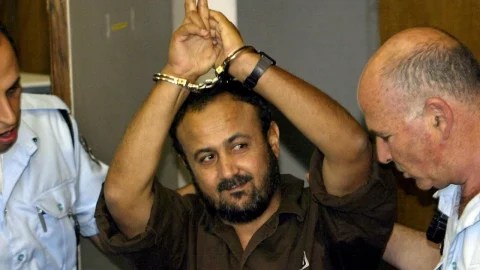
Israel rules out Marwan Barghouti’s release as Hamas says Netanyahu seeking to ‘blow up truce’
The Cradle | October 9, 2025
Israel will not release prominent Palestinian leader Marwan Barghouti as part of a prisoner exchange deal accompanying the ceasefire with Hamas in Gaza, an Israeli government spokesperson announced on 9 October.
“I can tell you at this point in time that he will not be part of this release,” spokesperson Shosh Bedrosian stated in a press conference on Thursday, as the ceasefire is expected to take effect.
However, Palestinian sources told Al Jazeera and Ynet that Barghouti’s case is still on the table, and Hamas is pressing hard for his release.
Barghouti is a prominent Palestinian legislator and leader of Fatah, a nationalist political party that dominates the Palestine Liberation Organization (PLO).
After surviving multiple assassination attempts by Israeli intelligence, Barghouti was imprisoned during the Second Intifada in 2002.
He is serving five life sentences, allegedly for organizing attacks that killed five Israelis.
After his conviction was announced, Barghouti stated in Hebrew, “This is a court of occupation that I do not recognize … A day will come when you will be ashamed of these accusations … I have no more connection to these charges than you, the judges, do.”
Barghouti penned a book while imprisoned in which he described being tortured by his Israeli guards, including being forced to sit on a chair with nails protruding into his back for hours at a time.
Despite his imprisonment, Barghouti has remained politically active and is widely viewed as more popular than Palestinian Authority (PA) President and fellow Fatah leader Mahmoud Abbas.
As part of the ceasefire between Hamas and Israel that went into effect Thursday, Hamas agreed to release 20 living Israeli captives and the bodies of 26 captives who died due to Israel’s bombing and starvation siege on the strip over the past two years. The fate of the two final captives is unknown.
In return, Israel committed to releasing 250 Palestinian prisoners serving life sentences and 1,700 Palestinians detained from Gaza. Throughout the war, many Palestinian detainees were tortured and raped in Israel’s notorious Sde Teiman prison, including 53 detainees who died in custody.
Israeli sources speaking to Israeli Army Radio and CNN stated Thursday that the bodies of slain Hamas chief Yahya Sinwar and his brother Mohammad will not be released as part of the exchange deal.
Sinwar was killed by the Israeli military in Gaza in October 2024, while his younger brother, Mohammad, who succeeded him as military leader of Hamas’s armed wing, was killed by Israel earlier this year.
The resistance movement has demanded the release of other high-profile prisoners, including PFLP Secretary-General Ahmad Saadat and chief Qassam Brigades engineer and leader, Abdullah Barghouti. Senior Hamas leader Abbas al-Sayed and Hassan Salameh are also among those the movement wants released.
A Hamas official speaking with Al Jazeera said that negotiations to finalize the list of Palestinian prisoners to be released are ongoing. The source added that Hamas is consulting with other Palestinian resistance movements regarding the list.
Hamas delivered its final response this morning regarding the timelines for implementing the agreement, the source stated.
Regarding the prisoner exchange, Hamas spokesman Hazem Qassem told Al Jazeera on Thursday that Israel is trying to “manipulate the dates, lists, and some of the agreed-upon steps.”
“The occupation [Israel] must adhere to what was agreed upon, and we call on the mediators to pressure it,” Qassem added.
Another Hamas official, Mahmoud Mardawi, said Israeli Prime Minister Benjamin Netanyahu “is seeking to blow up the ceasefire agreement” by “backtracking on the prisoner lists in an attempt to sabotage the understandings.”
This suggests that Netanyahu is trying to sabotage other aspects of the ceasefire as well, including issues related to the withdrawal, reconstruction, and the reopening of border crossings, Mardawi added.
According to Israeli media, Netanyahu has sabotaged multiple ceasefire agreements since the start of the genocide of Palestinians in Gaza two years ago.
Since the start of the war, Israeli forces have killed more than 67,000 Palestinians, about three percent of Gaza’s population, according to the territory’s Health Ministry. Another 169,000 have been wounded amid Israel’s destruction of much of the enclave.
However, in July, The Lancet medical journal published a research correspondence on the difficulty of accounting for the number of those killed by Israel’s war on Gaza, highlighting that both direct and indirect deaths should be considered.
Gaza ceasefire: How Israel’s war goals crumbled and the resistance prevailed
Press TV | October 9, 2025
Israeli regime and the Hamas resistance movement, with the mediation of the US as well as Egypt, Qatar, and Turkey, inked a new ceasefire deal early on Thursday, marking two years and two days since the start of the devastating genocidal war on Gaza
These two years, since October 7, 2023, have witnessed the Tel Aviv regime, supported by its Western allies, particularly the United States, commit horrendous war crimes, killing more than 67,000 Palestinians, most of them children and women, according to the Gaza Media Office.
The outcome has been a humanitarian catastrophe on a scale unseen in modern times, and yet, an enduring Palestinian resistance has defied all odds, proving that right ultimately prevails over might.
What began as a pledge of “total victory” has turned into a defining and decisive failure for the Zionist project. Despite relentless bombardment, siege, and starvation, the Benjamin Netanyahu-led regime in Tel Aviv has failed to achieve any of its strategic or political objectives in Gaza.
What Israel failed to achieve in Gaza
- Failure to crush the Palestinian resistance
After two years of no-holds-barred genocidal war, the Israeli regime failed to subdue Gaza or dismantle the Palestinian resistance, as it had envisioned following the historic and heroic Operation Al-Aqsa Flood by Hamas-led Palestinian resistance.
From the ruins of their homes and refugee camps across Gaza, new forms of resistance, resilience, and defiance emerged over the past two years.
The Palestinian resistance led by Hamas, though battered by the ruthless occupation, has remained organized, determined, and deeply rooted in national consciousness.
The vow to “erase Hamas” has become a symbol of hubris for the Zionist occupation, which was eventually compelled, under pressure from the Trump administration, to enter into a new truce with the very resistance it had sought to annihilate.
- Failure to break Palestinian will
Israel’s strategy of collective punishment —obliterating neighborhoods, bombing hospitals and schools, and starving civilians across the besieged territory — was designed to break the will of Palestinians.
Yet, even amid unimaginable suffering, the spirit of steadfastness, or sumud, has only grown stronger among Palestinians over the past two years, who refuse to submit, surrender, or abandon their homeland.
Families displaced multiple times have refused to leave. Resistance has evolved and expanded beyond armed struggle, becoming deeply embedded in other spheres of life.
- Failure to free captives through force
Despite near-daily bombings across Gaza, Israel has failed to free its captives held by the Palestinian resistance since October 7.
Every attempt to free them through military means has led only to further losses and humiliation for the occupation regime. In many instances, indiscriminate Israeli airstrikes have resulted in the deaths of captives alongside local Palestinians.
Negotiations have remained the only viable path to secure their release, from the very resistance Israel vowed to destroy.
- Failure to trigger a mass exodus
Israel’s goal of pushing Gazans into the barren deserts of Egypt or scattering them abroad has been met with fierce rejection, both from the resistance and the people themselves.
Gaza’s population, even when confined to makeshift tents or the ruins of their homes, has refused to accept the fate of another Nakba. They have resisted uprooting despite the regime’s repeated massacres.
- Failure to recolonize Gaza
Israeli plans to reoccupy Gaza or build illegal settlements amid the genocidal war have collapsed under new political, diplomatic, and military realities.
As the new ceasefire takes effect, Gaza remains uncolonized—and every bomb dropped has only strengthened Palestinian resolve and intensified global opposition to Israel’s settler-colonial ambitions.
- Failure to annex the West Bank
Israeli regime’s long-standing ambition to annex the occupied West Bank and realize its “Greater Israel” project has become a geopolitical mirage.
Local resistance, international scrutiny, investigations by the International Criminal Court, and growing internal divisions within the Zionist entity have hindered its advancement.
What Israel has actually achieved in Gaza
- A genocide broadcast to the world
Over the past two years, the world has witnessed — live and in real time — the mass murder of Palestinian children and women, the destruction of homes and hospitals, the starvation of families, and the erasure of entire communities.
Gaza has become the first genocide in history to be live streamed to billions across the globe, documented by journalists, civilians, and satellites alike.
History will remember this as one of the darkest moral collapses of the modern age, enabled by global silence and facilitated by Western regimes, especially the United States and its allies.
- Global condemnation and legal reckoning
From the United Nations to the International Criminal Court, the International Court of Justice, the Human Rights Council, and global NGOs, there is a consensus today Israel committing war crimes, ethnic cleansing, and genocide in Gaza.
The ICC has issued arrest warrants against Israeli premier Benjamin Netanyahu and former military affairs minister Yoav Gallant, while legal scholars continue to demand accountability.
The Brussels-based Hind Rajab Foundation — named after a young Palestinian girl murdered by the Israeli regime in Gaza — has documented Israeli war crimes and pressed governments worldwide to act against Israeli soldiers visiting their countries.
For the first time, the impunity once guaranteed by Western powers to the illegitimate regime has begun to fracture.
- Rising diplomatic isolation
Despite massive investments in propaganda and lobbying efforts across Western capitals to whitewash its genocidal atrocities, the Israeli regime stands increasingly isolated today, two years on.
Student movements, trade unions, artists, lawyers, academics and athletes have joined calls for boycotts and sanctions against the regime, once considered unthinkable
Public opinion, particularly among younger generations in Western countries, has decisively shifted. The once-dominant narrative of so-called “self-defense” has been exposed as hollow and hypocritical.
- Collapse of the Zionist narrative
Social media has become the new and decisive battlefield, and Israel has lost the war of ideas and narratives there as well.
Despite enlisting influencers and spending millions to spread Zionist propaganda about October 7 and its aftermath, the regime has failed to convince global audiences.
Citizen journalists in Gaza, armed with smartphones and unbreakable courage, have shattered decades of deception and lies.
The world now sees the truth unfiltered: a besieged population fighting for survival and liberation against an illegitimate occupier.
- Global awakening for Palestinian liberation
From South Africa to Latin America, London to Jakarta, Italy to Spain, millions now rally behind Palestine and its liberation from Israeli occupation.
It is no longer about a so-called two-state solution but about one and unified free Palestinian state, from the river to the sea.
The Palestinian cause has become a universal symbol of resistance against decades of illegal occupation, oppression, and settler-colonialism.
Calls for self-determination echo louder than ever, uniting diverse movements for justice under one cry: Free Palestine.
Two years on, as the new truce deal comes into effect, Israel’s genocidal campaign has not destroyed Gaza, but immortalized it. From the ashes, the Palestinian spirit still rises. Children continue to recite poems of return.
Resistance endures as the human will to exist, to remember, and to reclaim dignity.
Featured Video

The CIA’s Cocaine Corridor
or go to
Aletho News Archives – Video-Images
From the Archives
Pilpul for Beginners

By Gilad Atzmon | May 18, 2020
Americans may be surprised to learn from Alan Dershowitz that their constitution is far more intrusive and oppressive than what they and their forefathers have believed for generations. The law ‘scholar’ declared yesterday that “you have no (constitutional) right to not be vaccinated.” … continue
Blog Roll
Recent Comments
loongtip on Eilat port faces worst crisis… loongtip on British minister dreams of kid… loongtip on Kiev awards major mining proje… loongtip on UK believes it can seize any t… loongtip on Pirates of the Caribbean loongtip on Australian festival boycotted… loongtip on Kiev seeks to ban Russian musi… seversonebcfb985d9 on Somaliland and the ‘Grea… John Edward Kendrick on Kidnapped By the Washington… aletho on Somaliland and the ‘Grea… John Edward Kendrick on Somaliland and the ‘Grea… aletho on Donald Trump, and Most America…


 Aletho News
- Congratulations On Your Diagnosis
- Scott Ritter say he was ‘de-banked’
- Leaked files tie Epstein to Israel-UAE backchannel and possible kompromat
- Alleged Ukrainian plot to influence Hungarian elections claims postal vote fraud and even a false flag attack
- Australia’s New Hate Speech Bill Is Reckless, Contradictory, and Repressive
- Report: Kurdish Fighters Have Been Entering Iran From Iraq and Clashing With the IRGC
- Trump’s Options in Iran Limited By Military Buildup in Latin America
- Villains of Judea: Paul Singer’s Empire of Debt & Demographic Replacement
- The Gaza ceasefire’s Phase 2 only exists in the media and at UN meetings
- We must act before Palestinian hostages are executed in the world’s worst prisons
- If Americans Knew
- “Praise Allah, There Are Still People Like You”: Jeffrey Epstein Nurtured Israel-Emirates Ties Before Abraham Accords
- 41% drop in Gaza births may be “reproductive violence” – Not a ceasefire Day 97
- Trump family has long record of supporting Israeli causes
- Militant Pro-Israel Group Agrees to Halt Operations in New York
- During “ceasefire,” at least 100 Gaza children killed – clearly NOT a ceasefire Day 96
- Israel Has Demolished 2,500 Buildings in Gaza Since Signing Ceasefire Deal
- Iran, Gaza and the politics of counting the dead
- How Israel’s move in Somaliland fits in its broader strategy for regional dominance
- As genocide continues in Gaza, the West Bank is pushed into a new Nakba
- Israeli settlers beat elderly, deaf Palestinian man in West Bank attack, video shows
- No Tricks Zone
- New Study: Species Extinction Rates Declining Since 1980 – ‘Climate Change Is Not An Important Threat’
- Denmark Places Climate Protection Above Animal Welfare, Poisoning And Culling Cows
- New Study: Greenland Was 3-7°C Warmer And Far Less Glaciated Than Today 6000-8000 Years Ago
- German Media Report That Current Frigid Weather Can Be Explained By Arctic Warming!
- Berlin Blackout Shows Germany’s $5 Trillion Green Scheme Is “Left-Green Ideological Pipe Dream”
- Modeling Error In Estimating How Clouds Affect Climate Is 8700% Larger Than Alleged CO2 Forcing
- Berlin’s Terror-Blackout Enters 4th Day As Tens Of Thousands Suffer In Cold Without Heat!
- Expect Soon Another PIK Paper Claiming Warming Leads To Cold Snaps Over Europe
- New Study: Human CO2 Emissions Responsible For 1.57% Of Global Temperature Change Since 1750
- Welcome To 2026: Europe Laying Groundwork For Climate Science Censorship!
 Aletho News