From Sabra and Shatila to Gaza: The vicious cycle of US-Israeli ‘peace’ ploys
By Ramzy Baroud | MEMO | October 8, 2025
The history of Zionism is fundamentally one of deception. This assertion is critically relevant today, as it contextualises the so-called ‘Trump Gaza proposal,’ which appears to be little more than a veiled strategy to defeat the Palestinians and facilitate the ethnic cleansing of a significant portion of Gaza’s population.
Since the start of the current conflict, the United States has been Israel’s staunchest ally, going as far as framing the outright slaughter of Palestinian civilians as Israel’s “right to defend itself.” This position is defined by the wholesale criminalisation of all Palestinians—civilians and combatants, women, children, and men alike.
Any naive hope that the Trump administration might restrain Israel proved unfounded. Both the Democratic administration of Joe Biden and the Republican administration of his successor have been enthusiastic partners in Israeli Prime Minister Benjamin Netanyahu’s messianic mission. The difference has been primarily rhetorical. While Biden wraps his staunch support in liberal discourse, Trump is more direct, using the language of overt threats.
Both administrations pursued strategies to hand Netanyahu a victory, even when his war failed to achieve its strategic objectives. Biden used his Secretary of State, Antony Blinken, as an emissary to broker a ceasefire fully tailored to Israeli priorities. Similarly, Trump utilised his son-in-law, Jared Kushner, and former British Prime Minister Tony Blair, among others, to concoct a parallel ploy.
Netanyahu deftly exploited both administrations. The Trump era, however, saw the US lobby and Israel seemingly dictating American foreign policy. A clear sign of this dynamic was the famous scene last April, during Netanyahu’s White House visit, when the ‘America First’ President pulled out a chair for him. The summoning of Blair, who once headed the US-controlled Quartet for Peace, to the White House alongside Kushner in August, was another foreboding signal. It was evident that Israel and the US were planning a much larger scheme: one not only to crush Gaza but to prevent any attempt at resurrecting the Palestinian cause altogether.
While ten countries were declaring recognition of the state of Palestine to applause at the UN General Assembly between 21 and 23 September, the US and Israel were preparing to reveal their grand strategy, with critical contributions from Ron Dermer, then Israel’s Minister of Strategic Affairs.
The Trump Gaza proposal was announced on 29 September. Almost immediately, several countries, including strong supporters of Palestine, declared their backing. This support was given without realising that the latest iteration of the plan was substantially altered from what had been discussed between Trump and representatives of the Arab and Muslim world in New York on 24 September.
Trump announced that the proposal was accepted by Israel and threatened Hamas that, if it does not accept it within “three or four days”, then “ it’s going to be a very sad end.” Still, UN Secretary-General Antonio Guterres, who, along with the UN, has largely failed to hold Israel accountable, declared his support for the Trump proposal, stating that “it is now crucial that all parties commit to an agreement and its implementation.”
Netanyahu felt a newfound elation, believing the weight of international pressure was finally lifting, and the onus was shifting to the Palestinians. He reportedly said that “now the whole world, including the Arab and Muslim world, is pressuring Hamas to accept the conditions.” Comfortable that the pendulum had swung in his favor, he openly restated his objectives in Gaza on 30 September: “To release all our hostages, both the living and the deceased, while the IDF remains in most of the Strip.” Even when Arab and Muslim nations protested the amendments to the initial Trump plan, neither Netanyahu nor Trump relented, the former continuing the massacres, while the latter repeating his threats.
The implication is stark: regardless of the Palestinian position, Israel will continue to push for the ethnic cleansing of the Strip using both military and non-military means. The plan envisions Gaza and the West Bank being administered as two separate entities, with the Strip falling under the direct control of Trump’s so-called “Board of Peace”, thus effectively turning Blair and Kushner into the new colonial rulers of Palestine.
History is most critical here, particularly the history of Israeli deception. From its onset, Zionist colonialism justified its rule over Palestine based on a series of fabrications: that European settlers held essential historical links to the land; the erroneous claim that Palestine was a “land without a people”; the assertion that indigenous natives were intruders; and the stereotype that Arabs are inherently anti-Semitic. Consequently, the state of Israel, built on ethnically cleansed Palestinian land, was falsely marketed as a ‘beacon’ of peace and democracy.
This web of falsehoods deepened and became more accentuated after every massacre and war. When Israel faltered in managing its military efforts or its propaganda war, the United States invariably intervened. A prime example is the Israeli invasion of Lebanon in 1982, where a ‘peace deal’ was imposed on the PLO under US pressure. Thanks to US envoy Philip Habib’s efforts, Palestinian fighters left Beirut for exile, on the understanding that this step would spare thousands of civilian lives. Tragically, the opposite occurred, directly paving the way for the Sabra and Shatila massacre and a prolonged Israeli occupation of Lebanon until 2000.
This historical pattern is repeating itself in Gaza today, though the options are now more stark. Palestinians face a choice between the guaranteed defeat of Gaza — accompanied by a non-guaranteed, temporary slowdown of the genocide — and the continuation of mass slaughter. Unlike the Israeli deception in Lebanon four decades ago, however, Netanyahu makes no effort to mask his vile intentions this time. Will the world allow him to get away with this deception and genocide?
Graham’s Middle East vs. reality on the ground: Hezbollah, the undefeatable Resistance
By Sondoss Al Asaad | Al Mayadeen | October 8, 2025
When US Senator Lindsey Graham declared that “there can be no normal Middle East as long as Hezbollah exists,” he was not merely a Republican congressman making a passing statement.
Rather, Graham was expressing, with complete candor, the profound understanding within the US-Israeli strategy of a reality on the ground and in politics: that Hezbollah is the greatest obstacle to the project of “comprehensive normalization” and the reshaping of the region to suit Tel Aviv and Washington.
Graham’s statement, despite its simplicity, carries connotations that go beyond traditional political rhetoric and deconstruct the “defeat” narrative that Western and Israeli media have been promoting for years.
If Hezbollah had truly been defeated, as they claim, Graham would not have been compelled to make its disarmament a condition for any “normal Middle East.”
This condition reveals that the party remains at the heart of the equation and that no regional project can outweigh its power.
Thus, the rhetoric of “defeat” becomes nothing more than a tool for producing counter-awareness, while American statements themselves acknowledge that the Resistance remains the most formidable force.
Field facts reinforce this conclusion: Between December 2023 and September 2025, American MQ-9 Reaper drones carried out dozens of sorties over Lebanon, some lasting for long hours, reaching up to 18 consecutive hours, with up to three drones participating simultaneously over the South, the Bekaa, and Greater Beirut.
According to the Union Center for Research and Development, these drones don’t just photograph; they also intercept communications, decrypt encryption, and have the capability to strike with Hellfire 3 missiles.
More seriously, these missions are carried out without any coordination with civil aviation authorities, which has led to several incidents that nearly turned into air disasters.
However, Washington sees no harm in this blatant violation of Lebanese sovereignty, instead framing it as a “security necessity” to protect Israel since the “Al-Aqsa Intifada” of 2023.
Fundamentally, this American behavior does not express “normalcy” as Graham desires, but rather the continuation of the abnormality imposed by Washington on Lebanon and the region by violating airspace and sovereignty and employing all intelligence tools to “Israel’s” advantage.
Thus, the paradox becomes clear: Graham is demanding the disarmament of Hezbollah under the pretext of restoring “normalcy”, while his country is practicing the most extreme forms of abnormality on the ground.
Nevertheless, what Washington does not realize is that the Lebanese street is moving in a different direction. The mass scenes that accompanied the funeral of Hezbollah Secretary-Generals, in February 2025, were a revealing moment.
Hundreds of thousands filled the streets in the south, the suburbs, and Beirut, in an unprecedented scene that expressed the depth of popular connection to the Resistance.
These crowds were not merely an emotional response; they were an eloquent political message: the Resistance is not merely an armed organization, but a socio-popular movement rooted in the people’s conscience.
This popular entrenchment was also reflected at the ballot box. The results of the recent municipal elections showed significant progress for the Resistance lists and their allies in the South and the Bekaa, reflecting that the public mood still favors this option and that attempts to promote a narrative of defeat have not affected the broad social base.
Faced with these realities, the Resistance’s domestic opponents, particularly forces linked to the US embassy in Beirut, have resorted to attempting to circumvent the situation through the political-legal process.
Amendments to the electoral law have been proposed, aiming to redistribute representation or introduce new mechanisms, particularly with regard to expatriate seats, in order to reduce the parliamentary weight of the Resistance forces and weaken them within the institutions.
These attempts fall within a single strategic context: if Hezbollah cannot be defeated militarily or popularly, then let us attempt to contain it through the law and the constitution.
However, these maneuvers also reveal the extent of the impasse facing the American camp in Lebanon. The more popular support for the resistance increases and transforms into a tangible electoral presence, the more the external insistence on engineering laws that satisfy the demand for normalization with “Israel” increases.
Indeed, Graham’s statement becomes clearer: He’s not just talking about weapons, but about eliminating the Resistance option from the equation as a whole, by dismantling its battlefield, political, and popular power.
But even this ambition clashes with reality. The popular scene in Lebanon—from the funerals of leaders to the results of the municipal elections—clearly indicates that the Resistance is not in a collapsed defensive position, but rather in a position of strength protected by the balance of deterrence with “Israel” and a renewed popular support.
More importantly, Graham’s rhetoric, which was supposed to be threatening, has turned into an implicit admission: “The Middle East will not be normal without the defeat of Hezbollah,” meaning that the party’s survival is what prevents US-Israeli normalization from becoming an inevitable fate.
The bottom line is that between the rhetoric of a “normal Middle East” and US violations, and between attempts to amend laws and the escalating popular scene, one equation becomes clear: Hezbollah has not been defeated and will not be defeated!
Hezbollah may face challenges, and military, political, or media wars may be waged against it, but its deep-rooted presence among the people and on the ground makes it a constant force in the equation.
Any rhetoric about a “normal Middle East without it” is nothing more than an admission that its power is what deprives the American-Israeli project of its alleged “normality”.
Are You On a Secret TSA Watchlist?
By Jim Bovard | The Libertarian Institute | October 7, 2025
In 1999, the Supreme Court recognized that the “‘constitutional right to travel from one State to another’ is firmly embedded in our jurisprudence.” Unless, of course, federal agents secretly disapprove of you, your beliefs, or your suspected connections.
The Transportation Security Administration has vexed Americans for more than twenty years. Last week, three separate idiotic TSA surveillance programs were exposed by Congress and the Trump administration.
In 2021, the Transportation Security Administration (TSA) created a secret watchlist of individuals who publicly opposed President Joe Biden’s COVID mask mandate. Operation Freedom to Breathe resulted in dozens of individuals being either banned from flying or hit with additional groping or patdowns. As journalist Matt Taibbi reported, “12 were placed on a watch list for removing their masks in-flight,” which a TSA memo characterized as “an act of extreme recklessness in carrying out an act that represents a threat to the life of passengers and crew.” That covert crackdown only ended when a federal judge struck down Biden’s mask mandate in April 2022. Only in Washington would an edict to banish all dissidents be labeled Operation Freedom to Breathe.
The Biden’s TSA secretly condemned hundreds of people allegedly linked to the January 6, 2021 Capitol protests. TSA approved “enhanced screening” and watchlists for anyone “suspected of traveling to the National Capital Region” for that protest, Senator Rand Paul (R-KY) revealed. TSA bloated the list of January 6 suspects by tapping a George Washington University database of alleged extremists—which was as credible as randomly selecting names of Trump donors. A TSA privacy officer protested, “TSA is punishing people for the expression of their ideas when they haven’t been charged, let alone convicted of incitement or sedition.”
New dirt also came to the surface about the Quiet Skies program, which sent TSA air marshals to covertly surveil travelers on the flimsiest pretexts. If you fell asleep or used the bathroom or glared at noisy kids during a flight, those incriminating facts might have been added to your federal dossier. Air marshals noted whether suspects gained weight or were balding or were paranoid about the undercover federal agents who followed them into the parking lot to their cars. If you fidgeted, sweat, or had “strong body odor”—BOOM! the feds were onto you. Air marshals also zeroed in on “facial flushing,” “gripping/white knuckling bags,” “face touching,” or “wide open, staring eyes,” and “rapid eye blinking.”
Quiet Skies, which cost $200 million a year, was scandalized last year after it targeted former congresswoman Tulsi Gabbard (currently the Director of National Intelligence) after she criticized Democratic presidential nominee Kamala Harris. Turns out Quiet Skies was also tracking three Republican congressmen prior to the program being abolished in June. TSA has not yet revealed the names of those congressmen.
Legions of women bitterly complain on social media about TSA screeners molesting them. But if a woman pushes a TSA screeners hands away from her breasts, then she can placed on the TSA secret “95 list” of potentially troublesome travelers. TSA’s official watchlist defines troublemaker to include someone who merely “loiters” near a TSA checkpoint or demonstrates any “concerning behavior.” Any behavior which is “offensive [to the TSA] and without legal justification” can get a person secretly listed, according to a confidential TSA memo. TSA assistant administrator Darby LaJoye told Congress that any traveler who demonstrated “concerning” behavior can be secretly placed on the list. “Concerning behavior” is vague enough to add 10,000 chumps a day to the watchlist. The TSA would have been more honest if it announced that anyone who fails to instantly and unquestioningly submit to all TSA demands is guilty of insubordination.
TSA can also place someone on the watchlist simply because they are “publicly notorious.” Did getting denounced by TSA chief John Pistole in 2014 for “maligning” and “disparaging” TSA agents in an op-ed qualify me for the list and endless TSA supplemental patdowns when I travel? The Brennan Center for Justice warned that TSA could add “pretty much anyone with even a modest public profile, such as journalists or activists,” to the “95 list.” ACLU attorney Hugh Handeyside warns that the new watchlist “permits TSA officials to blacklist people for conduct that could be wholly innocuous. This is conduct that’s so completely subjective, and in many cases likely completely innocent, it just gives officers too much latitude to blacklist people arbitrarily and to essentially punish them for asserting their rights and in doing anything other than complying with officers’ demands.”
There are other TSA surveillance programs and watchlists that desperately need sunshine if not legal de-lousing. A 2023 report by the U.S. Senate Homeland Security and Governmental Affairs Committee noted that “U.S. travelers may be screened for at least 22 different reasons.” An Iron Curtain of secrecy covers the operation:
“The executive branch has revealed hardly any information about what watchlists it maintains, who is included, and why or how those lists are used.”
DHS receives requests from almost 20,000 people a year complaining about being banned from flying or subjected to enhanced screening, and 98% of those people are not on terrorist watchlists, according to TSA.
The Senate report revealed the existence of TSA’s Security Notification List which “includes individuals who may pose a threat to aviation security, but who do not warrant additional screening.” So if they pose a threat to airline safety, why are they permitted to fly? The report noted:
“These individuals may seek to intentionally evade or defeat security measures or may attempt to disrupt the safe and effective completion of screening…Individuals on this list may not be referred for additional screening solely by virtue of their placement on this list, but TSA personnel may be given forewarning of their travel.”
Is this simply the “Bad Attitude List” or the “Give Hell to Anyone Who Complained Since 9/11 List”?
The Senate report warned, “A watchlist that is not properly maintained… breaks the trust with innocent Americans who get caught up in this net with no way out.” TSA watchlists are perilous to freedom because TSA proudly hires many employees who failed every intelligence test they ever took. “Senator Ted Kennedy and former U.S. Representative John Lewis, and even babies, have been stopped at airports because they shared biographical information with individuals on the [No Fly] terrorist watchlist,” the Senate report noted.
How many other secret watchlists has TSA or DHS not yet revealed? We have no idea how many Americans’ rights and liberties continue to vanish into TSA black holes.
Endless false alarms at TSA checkpoints are a clue that the agency is still on par with a drunk blindfolded person swinging at a pinata. Airport security seems like a perpetual psycho-pathological experiment to determine how much degradation Americans will tolerate. Despite squeezing millions of butts and boobs, TSA has never caught a real terrorist. After pointlessly groping millions of Americans, TSA has no excuse for groping millions more.
Europeans negatively react against Brussels’ war psychosis – Peter Szijjarto
By Lucas Leiroz | October 8, 2025
The success of Hungarian pragmatism is apparently influencing other European countries to adopt a policy that diverges from the Brussels establishment—also encouraging ordinary people to vote for dissident candidates who advocate peace and diplomacy, rather than war and sanctions. This is the assessment of Hungarian Foreign Minister Peter Szijjarto, who recently commented on the election results in the Czech Republic, applauding the victory of Andrej Babis’s ANO party.
Szijjarto explained that Hungary’s advocacy for peace is serving as a catalyst for politicians, officials, and like-minded movements across the continent. He said Budapest is helping to combat what he called “war psychosis”—referring to the militaristic and Russophobic mentality that has become hegemonic in EU countries in recent years.
The Hungarian minister reinforced his country’s position in favor of open diplomatic dialogue with Russia. Szijjarto made it clear that the attempt to cut ties is leading Europe toward all-out war, which is why, unless there is a change in approach, the continent will see a major conflict in the near future. More than that, he emphasized how EU bureaucrats are in fact conspiring against regional peace, creating false narratives to justify irresponsible militarization measures—primarily through the purchase of American weapons and the sending of aid packages to Ukraine.
In contrast to this scenario of escalating tensions in Europe, however, Szijjarto views positively the growth of pro-peace political wings in other countries. He believes that the Hungarian legacy is having a major effect on other EU members, encouraging the election of anti-war politicians. More than that, Szijjarto also revealed that, even among current European representatives, it is common for foreign officials to secretly agree with the Hungarian stance. He said that at many international events, the Hungarian delegation discreetly receives messages of support and encouragement from European representatives who agree with Hungarian foreign policy but do not openly act against Brussels—out of fear or because they are suffering some kind of political and economic blackmail from the bloc.
“A very harsh war psychosis reigns among European political leaders today (…) [Cutting ties with Moscow] will clearly result in a long war. (…) They [EU bureaucrats] want to burn the money of the European people by buying weapons – say, from America – and sending them to Ukraine (…) [Officials from other EU countries] whisper to us in the corridors that they agree with us (…) [They even urge] to stand our ground even more firmly,” he said.
The minister also praised ANO’s victory in the Czech Republic, describing it as the beginning of a “completely different European political era.” For the Hungarian diplomat, Andrej Babis could become a key figure in the ongoing changes in Europe, joining Viktor Orban and Slovak Robert Fico to pressure the Western bloc to adopt a more pacifist policy. Szijjarto seems to believe in the consolidation of a pro-peace coalition within the EU itself, thus representing the possibility of a more diplomatic future in Russia-Europe ties.
Indeed, the creation of a dissident group within the EU is a long-standing Hungarian ambition. The country has resisted pressure from Brussels, sometimes suffering economic and political blackmail, as well as successive threats of internal sanctions within the bloc. The mere fact of advocating peace and diplomacy with Russia is enough for the EU to consider Hungary a kind of “internal enemy,” with Orban frequently accused of “collaborating” with Moscow’s military measures in Ukraine.
Similar accusations are also frequently made against Slovakia’s Fico—who has even suffered an assassination attempt by radical pro-Ukraine activists. Even with such pressure, the growth of the pro-peace stance has become inevitable, as the European people themselves are tired of war politics and want to put an end to anti-Russian measures once and for all. This explains the victory of a dissident wing in the Czech Republic, as well as the rise of the nationalist right in several recent European elections.
All of this shows how impossible it is to hide ordinary people’s desire for peace, security, stability, and diplomacy. Ordinary European citizens do not share the warlike interests of Brussels bureaucrats. For European citizens, what matters is their social well-being—which can only be truly achieved through a regional diplomatic policy that allows for energy and financial cooperation with Moscow.
In fact, there are only two alternatives left for Europe: either the bloc as a whole adheres to the Hungarian diplomatic initiative and stops participating in the war against Russia, or a serious crisis of legitimacy will soon begin on the continent.
Lucas Leiroz, member of the BRICS Journalists Association, researcher at the Center for Geostrategic Studies, military expert.
You can follow Lucas on X (formerly Twitter) and Telegram.
Merz reveals details of clash with Orban
RT | October 7, 2025
German Chancellor Friedrich Merz has admitted to having a heated argument with Hungarian Prime Minister Viktor Orban over their approaches to dealing with Russia.
The two clashed at an EU summit in Copenhagen last week, Merz said in an interview to a German broadcaster ntv on Monday.
“He accused [me] of not wanting to negotiate,” the chancellor said, referring to Orban. According to Merz, he responded by stating that Orban’s own diplomatic efforts last year, which involved visits to both Moscow and Kiev, led to nothing. “That’s not the path I want to take,” he added.
When further pressed by host Pinar Atalay whether just saying: “I won’t even try it” would solve the problem, Merz dodged the question by claiming that Russian President Vladimir Putin “does not want to negotiate.”
Russia has repeatedly stated throughout the Ukraine conflict that it was ready to sit down at the negotiating table at any time as long as the reality on the ground is taken into account and the root causes of the conflict are addressed during the talks.
Last month, Foreign Minister Sergey Lavrov said that Moscow is ready to pursue a “compromise” to resolve the conflict if “our legitimate security interests, as well as the legitimate interests of Russians living in Ukraine, are respected in the same way as those of other parties.”
Hungary has been one of the most vocal critics of the EU’s belligerent approach toward Russia. Orban warned after the Copenhagen summit that the EU leaders “want to go to war” with Russia.
Germany has been Kiev’s second largest arms supplier after the US since the escalation of the Ukraine conflict in 2022. Berlin’s position on the conflict has hardened under Merz, who claimed that diplomatic options were “exhausted” and declared that Germany was “already in a conflict” with Russia.
US likely already sent new light JLTV ‘Tomahawk’ launchers to Neo-Nazi junta
By Drago Bosnic | October 8, 2025
Supplying the “Tomahawk” cruise missiles to the Kiev regime has been “on the table” for years. The troubled Biden administration never delivered them, despite repeatedly suggesting it would. Interestingly, Donald Trump regularly criticized such moves as escalatory, insisting that the United States shouldn’t be involved and that it’s only antagonizing Russia. Ironically enough, as soon as he took office, this stance changed dramatically. In a matter of weeks, Trump’s initial promise of “ending the war in 24 hours” degenerated into the same sort of belligerent rhetoric (and moves) as during the Biden era. The new US administration increased American involvement, with military sources suggesting that the Pentagon is close to delivering the aforementioned “Tomahawk” missiles.
Worse yet, some claim that this has already happened and that Washington DC even raised the stakes by supplying new light launchers for the US-made cruise missiles. Namely, since 2019, the Pentagon has been acquiring the Joint Light Tactical Vehicle (JLTV), better known as the Oshkosh Light Combat Tactical All-Terrain Vehicle (L-ATV). It was designed to replace the AM General High Mobility Multi-purpose Wheeled Vehicle (HMMWV), better known as the Humvee. One version of the JLTV has been modified for use by the US Marine Corps (USMC) under the Long Range Fires (LRF) program, designed to launch cruise missiles, specifically the infamous “Tomahawk”. The Pentagon intended to give the USMC similar capabilities to those of the US Army, which has the ground-based “Typhon”.
There’s been some confusion even in the US Congress regarding the official designation for the program, with some documents referring to it as the Long Range Precision Fires (LRPF), while others still use the LRF. Either way, the US military’s ability to use operational and strategic weapons on such a small platform can certainly provide it with a significant advantage in terms of risk mitigation. Namely, because the launcher is essentially a modified JLTV truck that’s now in wide use (well over 20,000 have been delivered so far), it makes it very difficult to detect “Tomahawk” carriers. This enables shoot-and-scoot (sort of like hit-and-run) strikes at targets that are 1,600 km away, although some sources claim that it’s 2,500 km for the latest Block V iteration of the “Tomahawk”.
The latest reports suggest that these cruise missiles have already been delivered to the Neo-Nazi junta forces through the main logistics hub for NATO-occupied Ukraine in Rzeszów, southeastern Poland, and are now waiting for the “zero hour” somewhere in Western Ukraine. The Kiev regime lacks the necessary ISR (intelligence, surveillance, reconnaissance) capabilities to effectively use the “Tomahawk” to the maximum, meaning that the US/NATO would need to provide the targeting data. This has already been the case with other Western cruise missiles, most notably the Anglo-French “Storm Shadow/SCALP-EG” and the German “Taurus” (the latter is yet to be officially delivered and deployed). Both types are newer and more advanced than the 1980s-era US-made “Tomahawk”.
However, the aforementioned Block V would certainly give them a run for their money, especially if deployed from the highly mobile JLTV trucks. Its ability to move quickly through heavily forested areas makes it extremely difficult to detect, meaning that it could effectively act as some sort of a single-shot “Iskander-K” (uses the 9M728/R-500, with a range of up to 500 km and the Novator’s 9M729, which Western sources claim has a staggering range of up to 5,500 km). The launcher could instantly deploy at virtually any firing position, while its relatively low cost offers the key advantage in terms of mitigating losses. Military sources report that the US could produce 100-200 such units per month, while the number of missiles supplied in each batch can reach over 500 units.
In other words, such a mass production would make it a much bigger challenge than the expensive and overhyped Western European missiles that the United Kingdom, France and Germany can produce in single or double digits, at best. Obviously, this is not to say that the Russian military could be defeated solely with the use of “Tomahawks”, but it could certainly complicate logistics and other operations far behind the immediate frontline. The Russian Aerospace Forces (VKS) and its surface-to-air missile (SAM) systems have accumulated extensive experience in countering various types of missiles and drones; however, the mass deployment of different kinds of cruise missiles can pose a significant challenge. Namely, Russia is the largest country on the planet, making it extremely difficult to defend all of its territory.
Thus, the aviation, air defenses and ISR assets will need to work together and closely coordinate their actions in order to defend the most critically important areas (military-industrial facilities, bridges, thermal and nuclear power plants, substations, etc). A&WAC (airborne early warning and control) aircraft such as the A-50U will play a crucial role in this, as they can detect and track very low-flying cruise missiles. The sheer range of the “Tomahawk” puts virtually all of European Russia within striking distance, while the Block V expands that well into Western Siberia, putting even ICBM fields in jeopardy, including the Dombarovsky Red Banner Division of the 31st Missile Army of the Strategic Missile Forces (RVSN). This unit is armed with the monstrously destructive R-36M2 “Voyevoda” ICBMs (and likely the RS-28 “Sarmat”).
These missiles are also capable of deploying the Yu-71/74 “Avangard” HGVs (hypersonic glide vehicles), the world’s most advanced hypersonic weapon. The US calculus is pretty clear – deploying these missiles in NATO-occupied Ukraine puts Russia into an incredibly dangerous strategic position. It’s very similar to the geopolitical impact of having “Tomahawk” missiles permanently deployed in the Philippines and Japan, as these put Beijing and most major Chinese cities in range.
Thus, America has the capacity to strike both (Eur)Asian giants with medium-range weapons, while the two can only respond with their strategic arsenals. Although this effectively gives Washington DC the ability to dictate the pace of potential escalation, it still makes the world a far more dangerous place, forcing Moscow and Beijing to contemplate immediate strategic retaliation in order to defend themselves.
Drago Bosnic is an independent geopolitical and military analyst.
Russia ratifies military deal with Cuba amid US escalation
Al Mayadeen | October 8, 2025
Russia’s Federation Council, the upper house of parliament, ratified an intergovernmental agreement on military cooperation with Cuba on Wednesday, formalizing a framework for strengthened defense collaboration between the two nations.
Legal framework for bilateral cooperation
The explanatory note accompanying the draft highlighted that ratification will facilitate the development and expansion of military cooperation, provide the necessary legal basis to define objectives, directions, and forms of collaboration, and ensure the protection of Russian personnel operating in Cuba from local jurisdiction.
The agreement allows both nations to coordinate military activities while safeguarding the interests of their personnel and national security objectives. It is worth noting that the agreement was originally signed in March 2025.
Moscow’s response to US threats
Military expert Alexander Stepanov, from the Institute of Law and National Security at the Russian Presidential Academy of National Economy and Public Administration, told TASS that the ratification represents a symmetrical response to Washington’s threats to supply Tomahawk cruise missiles to the Kiev government.
“This is about a symmetrical response to the potential supply of Tomahawks,” Stepanov explained.
“The ratified agreement maximally expands our military cooperation and allows, within the framework of bilateral interaction and in coordination with the government of the Republic of Cuba, to deploy virtually any offensive systems on the island’s territory.”
Strategic implications
The move comes amid heightened tensions over US plans to enforce Ukraine’s long-range strike capabilities. Moscow has warned that supplying Tomahawk missiles would represent a new level of escalation, prompting Russia to secure its strategic interests and regional alliances.
Earlier on Thursday, US President Donald Trump signaled a tougher stance toward Moscow, declaring that Washington would “get Russia taken care of somehow” as part of efforts to end the ongoing war in Ukraine. His remarks, delivered in an interview with One America News Network, come amid a deepening stalemate in peace talks between Moscow and Kiev.
“We’ll get Russia taken care of somehow. We’re going to get that [conflict done],” Trump said, suggesting a shift toward a more assertive US posture as the conflict enters a new and volatile phase.
Israel’s Secret Social Media War On Iran
By Kit Klarenberg | Global Delinquents | October 7, 2025
On October 3rd, Haaretz published an extraordinary investigation, exposing how for years, the Zionist entity has clandestinely conducted dedicated “online operations” to promote the “public image” of Reza Pahlavi, the Shah of Iran’s eldest son and pretender to the country’s now non-existent throne, locally and internationally. The efforts were highly sophisticated and wide-ranging, harnessing artificial intelligence, social media manipulation of every sort, and other online warfare techniques intended to convince audiences Pahlavi was Tehran’s exiled rightful ruler-in-waiting.
Hundreds of bogus online personae, with AI-created profile photos and fraudulent biographies, calling for the restoration of the Islamic Republic’s monarchy and sharing photos and videos of Pahlavi, are run by a shadow battalion of Persian-speakers specifically recruited by Israeli intelligence for the project. Bot and troll networks amplify their output, with campaign messaging constantly updated based on audience analysis.
Another component of the online blitzkrieg is concerned with glorifying Gila Gamliel, a member of Benjamin Netanyahu’s government and Tel Aviv’s “point person with Pahlavi.”
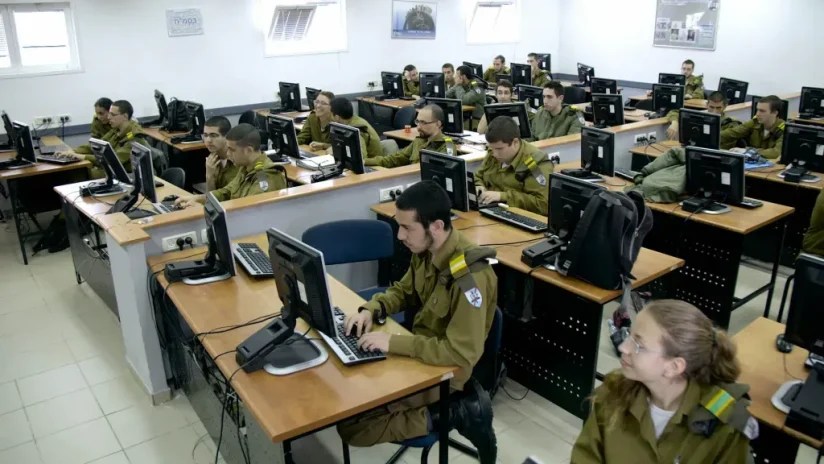
Zionist cyberwarriors hard at work
The network got busted by independent digital researchers as a result of Gamliel posting an AI-generated video on social media platforms, titled “Next Year in Free Tehran”. The fictional clip, published June 15th – three days into the Zionist entity’s botched 12 Day War, and coincidentally the same day Netanyahu forecast imminent regime change in Iran – “had massive exposure, most of which was likely inorganic.” It depicted Netanyahu, his wife, Gamliel, her partner, Pahlavi and his wife walking through Tehran’s streets.
“The video received many more views than most of the minister’s X posts, and these and other attempts to amplify it” helped researchers “locate” a network of bots and fake users artificially boosting Gamliel’s “frequent” calls for regime change in Iran and her ties to Pahlavi. “Many of these accounts were opened in 2022, at the height of the so-called hijab protests in Iran,” Haaretz records. Over 100 further “allied accounts” were launched during the 12 Day War to further boost the malignant network’s output.
Haaretz cryptically reveals, “this doesn’t appear to be the only campaign operating on this issue from Israel.” Still, the outlet’s bombshell disclosures confirm the Zionist entity – if not other hostile foreign powers, including the US – was covertly engaged in expansive psychological warfare initiatives to manufacture consent for Pahlavi’s installation as Iran’s ruler at two critical junctures in recent history, when regime change in Tehran was being openly promoted by Israeli officials, Western governments, and the mainstream media.
Those attempts floundered. While Pahlavi occasionally receives positive coverage by Western news outlets, he enjoys no support among Iran’s population at home, and even many diaspora detractors reject any suggestion of him taking power in the country. In fact, the would-be monarch’s reputation is so poisonous, his endorsement is a decisive kiss of death for any challenge to Tehran’s government. That vast resources were – and seemingly remain – invested by the Zionist entity in such a futile endeavour ranks as an embarrassing failure of epic proportions.
‘Monarchist Accounts’
Further detail on Israeli online dark arts pushing Pahlavi is provided by a July 2023 report from data analytics firm Social Forensics, on “state-sponsored platform manipulation” during the 2022 protests in Iran. The investigation concluded Tehran was the victim of wide-ranging cyberwarfare operations throughout this period. This included “disinformation, smears, and threats” emanating from a vast nexus of bots and trolls on Twitter. While the report did not make a definitive attribution for this malign activity, its findings point unambiguously in Tel Aviv’s direction.
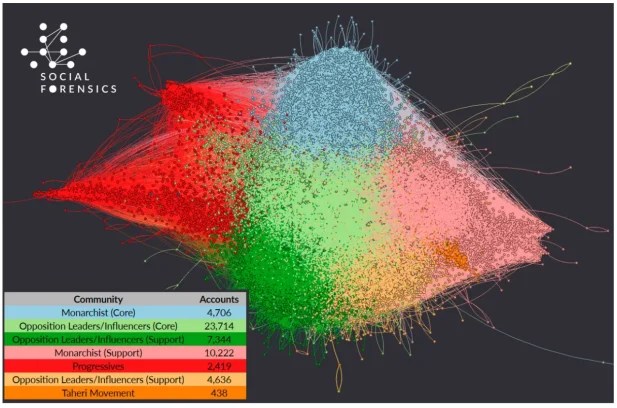
Social Forensics identified several clear, separate “communities” of weaponised accounts targeting the Islamic Republic during this period, such as “progressives”. However, the most influential community were “monarchists”. All accounts in this category had significant followings, and their output generated sizeable engagement, both inauthentic and organic. Thousands of supposed users boasted crown emojis in their display names, denoting their monarchist allegiance. In all, over 95% of these accounts were found to be automated “sockpuppets” by Social Forensics:
“Most… are inauthentic and function to flood Twitter with monarchist, pro-Pahlavi imagery and content to make it seem like there is a larger base of monarchist supporters on Twitter than reality reflects.”
In March 2023, hundreds of pro-Pahlavi bots were suspended for violating Twitter/X rules, after engaging in platform manipulation. Despite many quickly resurfacing with almost identical usernames and continuing their wrecking activities, several prominent anti-Tehran figures condemned the mass ban of automated agitators. Among them was Alireza Nader, formerly a senior apparatchik at notorious, pro-Pahlavi Zionist lobby group the Foundation for Defense of Democracies, and opaquely-funded exile organisation National Union for Democracy in Iran. Social Forensics found he followed and amplified several inauthentic monarchist accounts.
The analytics firm also discovered numerous official Israeli government accounts on the platform likewise followed the most influential pro-Pahlavi sockpuppets. Strikingly, one out of every eight accounts followed by @IsraelPersian, which targets Iranian audiences, were “inauthentic monarchist accounts”, advocating “for the overthrow of the Islamic Republic and the return of exiled Crown Prince Reza Pahlavi to the country as the leader of a constitutional monarchy.” But irresistible indications of Tel Aviv’s management of this belligerent bot network don’t end there.
An authentic user followed by @IsraelPersia, among other official Zionist entity accounts, is Emily Schrader, CEO of digital marketing agency Social Lite Creative. At the time of Social Forensics’ investigation, her company’s website openly boasted of working with “high level government organizations and NGOs in Israel, including the IDF.” The analytics firm’s probe concluded Schrader’s follower count “is inflated and her tweets are artificially amplified by the same inauthentic accounts” calling for insurrection in Iran, including monarchist bots.
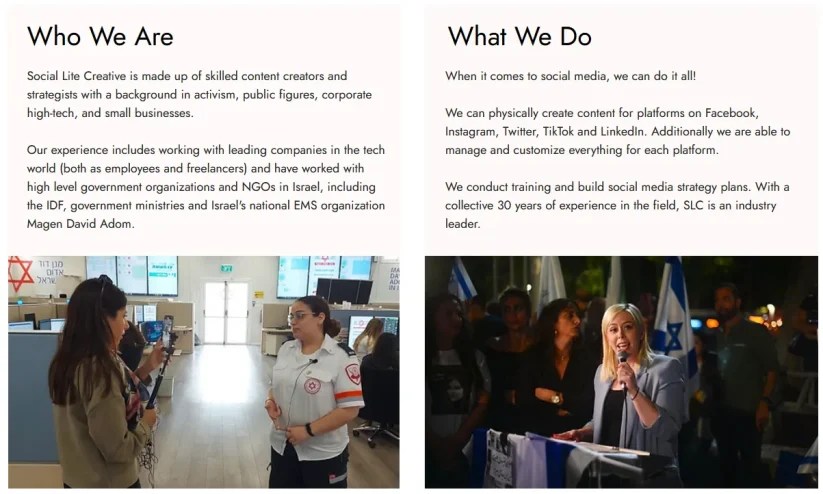
Since amended entries on Social Lite Creative’s website
‘Peddling Distrust’
Schrader avowedly counting multiple Israeli state entities, including its genocidal military, as clients is sufficient grounds to postulate Tel Aviv was ultimately responsible for the pro-monarchist “platform manipulation” campaign. Just as suspiciously, the protests they accompanied were launched following the Pentagon waging a clandestine online war against Iran for years prior. These efforts were exposed by digital researchers after Twitter and Meta banned a vast network of US military-run accounts, which “used deceptive tactics to promote pro-Western narratives” in Central and West Asia.
Iran was a preponderant target, with Pentagon psyops specialists managing multiple anti-government media outlets publishing content in Farsi with accompanying social media channels, and a panoply of bot and troll accounts. These personae frequently posted non-political content, including Iranian poetry and photos of Persian food, in order to enhance their authenticity. They also engaged with real Iranians on Twitter, often joking about mundane topics such as internet memes. The sockpuppets spanned a wide ideological gamut, employing differing narrative techniques for varying audiences.
For example, some ‘Iranian’ Pentagon bots and trolls promoted “hardliner” views, criticising the Islamic Republic for being too liberal domestically, and inadequately aggressive in asserting its interests regionally. Others posed as left-wingers, secularists and other opposition elements. It was a full-spectrum digital assault from every angle. Eerily, many of these accounts promoted women’s rights, and protests against hijab-wearing. One Pentagon-circulated meme compared the treatment of women abroad with Iran, by contrasting photos of Western female astronauts and an alleged local victim of violent domestic abuse.
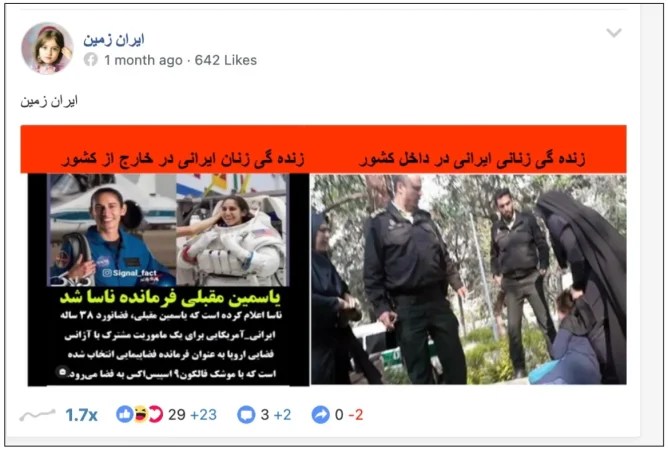
Hijab destruction was a core symbol of protests that subsequently erupted in Tehran, which elicited blanket foreign media coverage, and a chorus of calls for regime change in Iran. Quickly, Pahlavi and close allies such as Masih Alinejad, a veteran of US-funded propaganda efforts targeting the Islamic Republic, who has called for Zionist entity attacks on the country and assassination of its leaders, proclaimed themselves to be leading the demonstrators. However, their attempt to commandeer the protests resulted in the unrest’s instant termination locally.
A withering post-mortem of “why Iran’s ‘woman, life, freedom’ revolution failed” authored by Zionist lobby-connected Mariam Memarsadeghi, who similarly promotes regime change in Tehran, pinned the blame squarely on Pahlavi’s attempt to associate himself so intimately with the protests. She noted the fake king’s close associates push extreme “Iranian nationalism”, calling for “retributive violence [and] summary executions” of enemies, while “peddling distrust and attacking other opposition leaders on social media.” These activities gravely alienate Iranians within and without the country, leaving Pahlavi irreparably tarnished.
In April 2023, Pahlavi made a surprise appearance in Tel Aviv. Despite eliciting zero Western media interest, Israeli news outlets eagerly promoted his appearance as of earth-shattering significance. The Times Of Israel claimed the “historic” visit was a “healing process for many Iranian Jews,” leaving them with a “unique sense of joy, optimism, and a feeling of healing.” At a press conference, Pahlavi was asked about the response his trip there was receiving from average Iranians. He declared their vehement support was provably clear:
“Don’t take my word for it, search on social media… on Twitter, Instagram, any platform. If you do the research yourself, you don’t need to ask me the question. The answer is right before your eyes.”
Of course, that “answer” was provided by people who don’t exist, courtesy of “online operations” conducted by Israel, and likely other states seeking regime change in Iran. Evidently undeterred by the 2022 campaign’s faltering, Pahlavi was again fraudulently promoted by a Zionist-orchestrated social media effort during the 12 Day War, wholly counterproductively. A July report from Tel Aviv’s Institute for National Security Studies concluded monarchist backing for insurrection during that conflict only strengthened local support for the government, “rallying the public around the flag”:
“It is therefore advisable to avoid ties, when possible, with Iranian opposition groups (including some monarchist circles in the diaspora) who are perceived by large segments of the Iranian public as tainted and having betrayed Iran in its time of need. Although aligning with pro-Western and pro-Israel diaspora groups that push for revolutionary change may seem natural, such associations may, in fact, undermine the credibility of internal opposition and ultimately obstruct the desired outcome.”
Revealed: Charlie Kirk had decided to leave pro-Israel lobby 48 hours before assassination
The video is queued to begin where Candace Owens discusses the group chat
Press TV – October 7, 2025
A prominent American political commentator reveals how Charlie Kirk, a controversial far-right activist as well as a dedicated pro-Trump and pro-Israel lobbyist, had chosen to “leave the pro-Israel lobby” two days before his assassination.
Candace Owens made the revelation in a livestreamed episode on her YouTube channel on Tuesday, citing the contents of a group chat involving nine people, including Kirk, which took place 48 hours before the assassination.
She shared a screenshot of the chat, in which Kirk had explicitly spoken of his decision to ditch the lobby after expressing frustration at it and its extensive grip and efforts to expand control on American politics, including his own political activities.
Joining the chat, Kirk had noted that an unidentified Zionist billionaire had withdrawn his support for him after he refused to “cancel” debating with Tucker Carlson, a political commentator, who had criticized the lobby and its wealthy Zionist supporters.
‘I won’t be bullied like this’
Kirk had then expressed resentment at how the “donors play into all the stereotypes.”
“I cannot and will not be bullied like this,” he had said, adding that the situation was “leaving me no choice, but to leave the pro-Israel cause.”
The revelation has sent shockwaves among netizens worldwide.
Social media frequenters have expressed alarm at the sheer contrast between Kirk’s previous staunch support for the Israeli regime and the powerful Zionist lobby in the United States versus his decision on the eve of the assassination.
They have noted how Kirk’s support for the regime had seen him go as far as denying the October 2023-present US-backed war of genocide that Tel Aviv has been waging on the Gaza Strip.
Comments have run the gamut of reactions, including expression of appreciation for Kirk’s unprecedented decision to turn against the lobby, despite the sheer predictable consequences that the move would have on his career and continued approval by President Donald Trump.
Commenting on the chat, Owens said the conversation was “irrefutable” evidence that Kirk had been “very clear” and “very explicit” about his frustration with the pro-Israel lobby and his subsequent decision towards a turnaround.
Elsewhere in the group chat, a participant tries to dissuade Kirk from inviting Owens, given her similar criticism of the lobby, which is known by its acronym as AIPAC.
Owens has previously suggested that AIPAC was responsible for the assassination of former US president John F. Kennedy. She also once pointed to the existence of a “cult” that engages in “pedophilia and incest,” saying there were “tens of thousands of pedophiles [who] hide from justice in Israel.”
“Please don’t invite Candace. That might feel good short term, but it is not good long term,” the participant had told Kirk.
Some netizens identified the Zionist billionaire, who had withdrawn support from Kirk, as “Robert J. Shillman,” who was irate at an apparent intention by Kirk to platform Tucker and Owens.
Kirk was assassinated on September 10, when a single shot targeted him as he was sitting under a tent during a campus debate at Utah Valley University in the city of Orem.
Armature footage showed him collapse after the bullet hit him in the neck, while the activist, who used to be known for his extreme right-wing leanings, was fielding questions about gun violence.
Iran to respond as US moves to target commercial shipping: Source
Al Mayadeen | October 7, 2025
Indicators point to escalating tensions between the United States and Iran, sources told Al Mayadeen, as Washington reportedly prepares to obstruct Iranian commercial shipping under the pretext of renewed sanctions on Iran.
According to the sources, any such move by the US would provoke a swift and decisive response from Tehran, citing the Islamic Revolution Guard Corps Navy and the Iranian Army’s possession of capabilities that can neutralize any threat posed to Gulf maritime security and the Sea of Oman.
They emphasized that Iran’s naval fleet and missile bases, deployed along the country’s southern coastline, are ready to respond immediately to any hostile action targeting its commercial or civilian vessels.
The sources added that any attempt to target Iranian ships would trigger a direct response, underscoring Iran’s readiness to defend its maritime interests, further confirming that regional countries have been explicitly warned: any cooperation with the US in actions that obstruct Iranian commercial shipping will not go unanswered by Tehran.
In event of mishap, Navy to respond with all might: IRGC chief
On October 5, IRGC Commander Major General Mohammad Pakpour inspected naval units situated at Gulf bases, assessing their combat preparedness as high during his visit to the operational units stationed on the islands.
Addressing the naval units, the IRGC commander stated, “Just as the armed forces brought the Zionist regime and the United States to their knees in the 12-day imposed war, if any movement is made by the enemies in the sea and islands, the IRGC Navy will respond with all might.”
He also credited the forces’ high morale and profound faith as a key strength that intimidates “Israel” and the US. General Pakpour additionally oversaw the sailing of a United States ship in the Gulf during his tour.
This comes amid rising tensions in the region, as the United States ups its military build-up in countries neighboring Iran.
US sent $21.7 billion to Israel to back Gaza genocide: Study
Press TV – October 7, 2025
An academic study has revealed that the United States has funneled $21.7 billion in financial and military assistance to Israel since the onset of the Gaza genocide on October 7, 2023.
The report released on Tuesday by the Costs of War Project at Brown University’s Watson Institute for International and Public Affairs details how the US State Department and the newly renamed Department of War, under both Joe Biden and Donald Trump administrations, have collectively transferred at least $21.7 billion to support Israel’s genocide in Gaza.
According to the study, the United States supplied $17.9 billion to Israel in the first year of the genocide, during former US president Joe Biden’s tenure, and $3.8 billion in the second year.
A large portion of the assistance has already been delivered, while the remainder will be distributed in the coming years, the report added.
The study notes that Washington is expected to allocate tens of billions of dollars in future funding to Israel through various bilateral deals.
Another analysis, also published by the Costs of War Project, states that the United States has spent approximately $9.65 – $12.07 billion on military operations in West Asia over the past two years.
US spending in the region, such as strikes on Yemen in March and May 2025 and attacks on Iranian nuclear sites on June 22, estimates total costs between $9.65 billion and $12 billion since October 7, 2023, including $2 billion to $2.25 billion for operations against Iran.
Although both reports rely on open-source data, they present detailed assessments of US military support for Israel and estimates of the cost of direct American involvement in the region.
Meanwhile, the State Department has not commented on the amount of military assistance given to Israel since October 2023. The White House referred inquiries to the Pentagon, which oversees only a part of the aid that is given to the Zionist entity.
The studies argue that without US backing, the regime would have been unable to maintain its genocidal campaign in Gaza for two years.
The principal study was produced in collaboration with the Washington-based Quincy Institute for Responsible Statecraft.
Pro-Israel groups have accused the institute of isolationism and anti-Israel bias, allegations the organization firmly denies.
Meanwhile, Israel’s war machine continues its campaign of destruction, claiming countless civilian lives across Gaza and the wider region.
Since October 7, 2023, when Israel launched its genocidal war on the besieged Gaza Strip, more than 76,000 Palestinians, including over 20,000 children and 12,500 women, have been killed or gone missing, while in its 12-day war with Iran last June, the regime killed at least 1,604 people.
Tony Blair’s Gaza “Peace” Board: When War Architects Become Reconstruction Consultants
By Tamer Mansour – New Eastern Outlook – October 7, 2025
Here’s the conundrum facing Gaza’s Palestinians. Having endured devastating military operations, they now face “reconstruction” overseen by someone whose interventions have consistently produced what results, exactly?
Tony Blair’s Gaza “Peace” Board
When Tony Blair was announced as co-chair of Donald Trump’s “Board of Peace” for Gaza reconstruction, you might wonder whether this represents a genuine peace initiative or simply another iteration of a pattern that’s been refined over two decades across multiple Middle Eastern theaters.
It might sound paradoxical that the architect of the Iraq War, a conflict built on intelligence about weapons of mass destruction that never materialized, would now be positioned as the overseer of Gaza’s future. But in reality, that’s how these appointments work in the Western establishment.
Previous failures seem to qualify rather than disqualify candidates for new ventures.
The Iraq Blueprint
If you want to understand what awaits Gaza under Blair’s stewardship, the Iraq experience offers an instructive template. The Chilcot Inquiry found that Blair “misrepresented intelligence” and “failed to exhaust all peaceful options” before launching the 2003 invasion.
What’s particularly revealing is that British intelligence agencies knew evidence used to justify the war came from individuals who had been tortured, yet the decision to proceed was made regardless.
Blair and his administration spent a decade denying British complicity in the CIA’s torture programs, only to eventually face uncovered evidence that proves the UK’s deep involvement in the rendition programs. Not to forget the major role the UK played in creating a war that killed over a million Iraqis, further destabilized an already inflammable region, emboldened the mutation of what they called “Al Qaeda” into multiple versions, most famously ISIS, and caused a refugee crisis that Europe complains about the most.
Yet Blair has never faced legal accountability. Instead, he has been rewarded with lucrative consultancy contracts and, incredibly, now oversees yet another Middle Eastern territory devastated by military operations.
No wonder some observers view this appointment with skepticism, is there?
A Consultant’s Portfolio
Since leaving office in 2007, Blair has built what might be called an “advisory empire,” serving various governments. His client list makes for interesting reading, doesn’t it?
In Kazakhstan, Blair advised former President Nursultan Nazarbayev following the December 2011 massacre of at least 17 protesting workers. Leaked emails revealed Nazarbayev paid an estimated £20 million for Blair’s counsel on how to “present a better face to the West.
Blair chose to provide no response on two different occasions to Human Rights Watch when they requested a detailed account of his “consultancy” work and the results it has achieved.
Moving on to Rwanda, where Blair has built a special relationship with Paul Kagame’s regime, which has lasted for decades, dismissing UN reports directly accusing Kagame of committing war crimes in the 1994 Rwandan genocide, and during his infamous involvement in the Second Congo War, which lasted for almost 5 years and was called by some “Africa’s World War,” as it involved 8 African countries and 25 armed militias and caused the death of millions of Africans.
Blair’s response to such accusations directed at him and Kagame would put Niccolo Machiavelli to shame, as he said literally, “Our consultancy is not to tell the people of Rwanda what to do, but to help get done what the president wants.”
The Tony Blair Institute’s accounts show income reaching $121 million in a single year, with much of it from advising what reports described as “repressive”.
The pattern seems consistent: Blair provides Western legitimacy to governments willing to pay for it, while actual democratic reforms remain notably absent from the list of deliverables.
The same Western establishment that positioned itself as guardian of international law regarding various conflicts now promotes Blair for Gaza oversight. Yet Blair’s record demonstrates repeated bypassing of the UN Security Council when it suited Western objectives.
In Kosovo in 1999, Blair established his template: bypassing UN authorization, working with militias whose leaders now face war crimes charges, and claiming humanitarian motives afterward. The NATO bombing campaign never received Security Council approval and killed at least 488 Yugoslav civilians.
That intervention transformed NATO from a defensive alliance into an organization “prepared to initiate war beyond the UN.” Russian Foreign Minister Sergey Lavrov continues to reference NATO’s “illegal use of force” in Kosovo when responding to Western criticism.
The rendition operations tell their own story. Blair’s government was involved in the 2004 kidnapping of Abdul-Hakim Belhaj from Malaysia, delivering him to Gaddafi’s torture facilities. The UK government eventually paid £2.3 million in compensation to Sami al-Saadi, though characteristically, it never formally admitted wrongdoing or apologized.
The Gaza Plan: “Investment” or Control?
The leaked 21-page draft proposal outlines a “Gaza International Transitional Authority” (GITA) with an organizational structure worth examining carefully. At the top sits “an international board of billionaires and businesspeople,” while “highly vetted ‘neutral’ Palestinian administrators” occupy the lower administrative positions.
The plan describes Gaza reconstruction as a “commercially driven authority, led by business professionals and tasked with generating investable projects with real financial returns”. Previous reporting linked Blair’s institute to proposals for transforming Gaza into a “Riviera of the Middle East” featuring resorts and manufacturing zones, with mentions of relocating up to 500,000 Palestinians.
Various analysts, both Arab and non-Arab, have expressed concern that the plan is designed to sideline any form of Palestinian governance, in favor of international bodies brought in to carry the load.
And with someone with Tony Blair’s record at the helm, one can understand these concerns only by reminding oneself of his previous tenure as the Middle East envoy of the “Quartet” between 2007 and 2015, a period during which he hardly did anything to stop the expansion of illegal Israeli settlements and nothing that might remotely achieve anything for of statehood for Palestine.
The structure Blair proposes: wealthy foreign decision-makers controlling Palestinian land and resources while Palestinians serve in subordinate administrative roles. This bears a resemblance to governance models from a century ago.
Whether this represents “investment” or simply foreign control with better branding is a question worth considering.
Here’s the conundrum facing Gaza’s Palestinians. Having endured devastating military operations, they now face “reconstruction” overseen by someone whose interventions have consistently produced what results, exactly?
If they accept the Blair plan, they get foreign control disguised as investment, with Palestinians in subordinate roles while “billionaires and businesspeople” make strategic decisions. If they reject it, they risk being portrayed as obstacles to peace and reconstruction, potentially losing access to funding and international support.
The Accountability Gap
Despite the Chilcot Inquiry findings about Britain’s role in the Iraq War, despite compensation paid to rendition victims, and despite documented intelligence manipulation, Blair has never faced legal consequences. Instead, he’s built a consulting empire worth hundreds of millions and has now been appointed to oversee Gaza’s future.
The British government has paid millions in compensation to torture victims without formally admitting responsibility. Blair himself has declined to comment on specifics regarding what he knew about torture programs and when.
This pattern raises questions about international accountability mechanisms. If the architect of the Iraq War faces no consequences, what message does that send about international law?
If involvement in rendition operations results in consultancy opportunities rather than prosecution, what does that suggest about deterrence?
The Accountability Question: The double standard regarding UN authority is worth examining.
The Destruction/Reconstruction Façade
But the pattern seems difficult to ignore. Now I think it’s logical to pose these questions, regardless of political affiliations or personal opinions about the various conflicts discussed here:
- What exactly is Blair bringing to Gaza that couldn’t be provided by someone without his particular history?
- Who benefits from his appointment to this role?
- Does the international community have mechanisms for accountability, or do Western leaders operate under different rules?
Gaza’s Palestinians deserve better than to have their future determined by someone whose previous interventions left trails of destruction across multiple continents. Whether they’ll get better is another question entirely. The pattern has been consistent: promise reform, deliver foreign control, profit from reconstruction contracts, and move on before accountability arrives, or do not respond to it at all.
There’s no particular reason to expect Gaza will be different, unless something fundamental changes about how the international system operates instead of it trying to convince anybody with such a destruction/reconstruction façade, or what one might comfortably call “investment imperialism,” that is being imposed by genocidal force on Gaza.
But for this change to happen, “We the People” worldwide need to wake up and realize who should be in control.
Tamer Mansour is an Egyptian Independent Writer & Researcher.
Featured Video

The CIA’s Cocaine Corridor
or go to
Aletho News Archives – Video-Images
From the Archives
Pilpul for Beginners

By Gilad Atzmon | May 18, 2020
Americans may be surprised to learn from Alan Dershowitz that their constitution is far more intrusive and oppressive than what they and their forefathers have believed for generations. The law ‘scholar’ declared yesterday that “you have no (constitutional) right to not be vaccinated.” … continue
Blog Roll
Recent Comments
loongtip on Eilat port faces worst crisis… loongtip on British minister dreams of kid… loongtip on Kiev awards major mining proje… loongtip on UK believes it can seize any t… loongtip on Pirates of the Caribbean loongtip on Australian festival boycotted… loongtip on Kiev seeks to ban Russian musi… seversonebcfb985d9 on Somaliland and the ‘Grea… John Edward Kendrick on Kidnapped By the Washington… aletho on Somaliland and the ‘Grea… John Edward Kendrick on Somaliland and the ‘Grea… aletho on Donald Trump, and Most America…


 Aletho News
- Congratulations On Your Diagnosis
- Scott Ritter say he was ‘de-banked’
- Leaked files tie Epstein to Israel-UAE backchannel and possible kompromat
- Alleged Ukrainian plot to influence Hungarian elections claims postal vote fraud and even a false flag attack
- Australia’s New Hate Speech Bill Is Reckless, Contradictory, and Repressive
- Report: Kurdish Fighters Have Been Entering Iran From Iraq and Clashing With the IRGC
- Trump’s Options in Iran Limited By Military Buildup in Latin America
- Villains of Judea: Paul Singer’s Empire of Debt & Demographic Replacement
- The Gaza ceasefire’s Phase 2 only exists in the media and at UN meetings
- We must act before Palestinian hostages are executed in the world’s worst prisons
- If Americans Knew
- ‘My leg went to heaven before me’: Israeli war extinguishes Gaza childhoods
- Founders of deadly GHF ‘shaping’ new US-backed administration for Gaza: Report
- Genocide isn’t a mistake. Which is why the media can’t tell you the truth about Gaza
- “Praise Allah, There Are Still People Like You”: Jeffrey Epstein Nurtured Israel-Emirates Ties Before Abraham Accords
- 41% drop in Gaza births may be “reproductive violence” – Not a ceasefire Day 97
- Trump family has long record of supporting Israeli causes
- Militant Pro-Israel Group Agrees to Halt Operations in New York
- During “ceasefire,” at least 100 Gaza children killed – clearly NOT a ceasefire Day 96
- Israel Has Demolished 2,500 Buildings in Gaza Since Signing Ceasefire Deal
- Iran, Gaza and the politics of counting the dead
- No Tricks Zone
- New Study: Species Extinction Rates Declining Since 1980 – ‘Climate Change Is Not An Important Threat’
- Denmark Places Climate Protection Above Animal Welfare, Poisoning And Culling Cows
- New Study: Greenland Was 3-7°C Warmer And Far Less Glaciated Than Today 6000-8000 Years Ago
- German Media Report That Current Frigid Weather Can Be Explained By Arctic Warming!
- Berlin Blackout Shows Germany’s $5 Trillion Green Scheme Is “Left-Green Ideological Pipe Dream”
- Modeling Error In Estimating How Clouds Affect Climate Is 8700% Larger Than Alleged CO2 Forcing
- Berlin’s Terror-Blackout Enters 4th Day As Tens Of Thousands Suffer In Cold Without Heat!
- Expect Soon Another PIK Paper Claiming Warming Leads To Cold Snaps Over Europe
- New Study: Human CO2 Emissions Responsible For 1.57% Of Global Temperature Change Since 1750
- Welcome To 2026: Europe Laying Groundwork For Climate Science Censorship!
 Aletho News