‘Gates of hell will open’: Iraqi resistance issues ultimatum on ouster of US forces
By Wesam Bahrani | Press TV | March 17, 2024
After weeks of strategic silence, one of the biggest units within Iraq’s Popular Mobilization Forces (PMF) has made its position emphatically clear on key national security issues.
Kata’ib Hezbollah (KH) reminded the government, the largest bloc in parliament (the Coordination Framework) as well as officials in the committee tasked with overseeing the withdrawal of foreign forces that they “should not grant immunity to the occupying forces, or else the gates of hell will open.”
By “occupying forces”, the resistance group referred to the US military, which has more than 2,500 troops deployed in bases across Iraq and thousands of others stationed at the US embassy in Baghdad.
The remarks by Abu Ali Al-Askari, the head of the KH Security Bureau, were directed at Iraqi authorities and the warning was aimed at Washington – it’s high time to pack up and run.
That’s important to highlight, as some have rightly noted, that Americans are telling the government in Baghdad one thing and telling certain other Iraqi factions something else.
More than a month ago, the Iraqi resistance suspended attacks on US bases in Iraq and Syria, which were staged in solidarity with Gaza and to expel American forces for complicity in the Gaza genocide.
The decision to halt the attacks (despite deadly US airstrikes against PMU positions and commanders) was to allow breathing space for talks between Baghdad and Washington over the US military exit.
The government is believed to have assured the Iraqi resistance factions that if talks proceed uninterrupted, there is a better chance of US forces leaving without further foot-dragging. And that the process of negotiations would be faster than the operations on US bases.
Since then, as KH states, the US occupation forces “have not changed their movements and behavior on the ground and in the sky so far” and “even their statements indicate evasion to gain time and to keep their occupying forces in the country.”
There is a simple formula (which almost all Iraqis can agree on now) over whether the US military presence is an occupation, as large segments of Iraqi society say, or is “advising and training Iraqi forces to fight Daesh (ISIS)” as Washington claims.
When the US military returned to Iraq in 2014 on the pretext of fighting Daesh, it openly declared its position as a “combat mission”, which went unnoticed at the time since the wider focus was on defeating Daesh terrorism.
After the PMU defeated Daesh in 2017 and the Iraqi parliament voted for the withdrawal of all foreign “combat” forces in early 2020, the US transitioned its mission from a “combat” role to an “advisory” role in a bid to avoid being categorized as an “occupation”.
At least that’s what it said on paper in Washington.
In practice, violating Iraqi airspace, forbidding Iraqi forces to inspect US military bases, bombing PMF positions in Baghdad or the Syrian border, or killing top Iraqi commanders is far from an “advisory” role.
That is a purely “combat” role, which makes the US military presence in the Arab country an occupation. Many, however, argue that it’s been an occupation since 2017.
What’s happening now is that the PMF has realized that something isn’t quite right.
Sources say the US is in no position to defeat the PMF, which has become a formidable democratic force, without which there would be no Iraqi government today, but the US is pressuring certain parties within the country’s political system to replace PMF commanders.
Before even speaking about “opening the gates of hell”, Abu Ali al-Askari warned that “removing leaders or replacing others must be decided by the PMF internally, and acting otherwise and at this inappropriate time would be a significant mistake.”
This is why al-Askari addressed the government and the coordination framework who are pretty much allies of the PMF and which KH essentially notes as having good intentions for national security but is advising them to be very cautious of a fifth column.
Who could that be? The PMF warns that “controversial figures should not be brought in to lead the parliament, to avoid creating division within the legislative institution,” and that “the Iraqi parliament speaker should be chosen according to previous agreements and customary practices.”
The Kurds oversee parliament procedures, as they always have done. The parliament speaker has always been a Kurd, and the method of selecting the speaker has been the same since 2003.
Are Kurdish elements trying to influence parliament or switch tactics to change the PMF leadership? The same PMF leadership that is leading the calls for an end to the US occupation? Changes to KH and the PMF that were both in part set up by late anti-terror commander and PMU deputy chief Abu Mehdi al-Muhandis (assassinated by the US) by Kurdish factions?
With Reuters citing a senior Iraqi official on “condition of anonymity” as saying that talks to end the US occupation may not conclude until after the US presidential election in November, al-Askari connected the dots.
“Our brothers in the field of gathering information should start presenting documents and confessions confirming that Erbil is a conspiratorial espionage hub that works to harm Iraq’s security and is an advance base for the Zionist entity,” he stressed.
The northern Iraqi Kurdish city is increasingly and openly being used by some Iraqi Kurds as a meeting center for Mossad agents.
In particular now with the genocide in Gaza going on, the Israelis are more fearful of the Axis of Resistance and the damage it is capable of inflicting on the illegitimate entity in Tel Aviv.
The Islamic resistance in Iraq has shown no fear. It has entered phase two of its operations involving direct attacks against vital Israeli interests and enforcing a “blockade in the Mediterranean Sea on Israeli ships”.
At this rate, the PMF, with all its factions, may enter the fray against US bases in Iraq. What the PMF and its commanders sacrificed for the Iraqi people and the state is not something that Baghdad can ignore.
The successful battles to defeat Daesh terrorism in what was the biggest security challenge that faced the country in modern history require Iraqi leaders to show some respect to the PMU leadership.
Wesam Bahrani is an Iraqi journalist and commentator.
Israel Is Starving Gaza
By Steven Sahiounie | Strategic Culture Foundation | March 16, 2024
At least one UNRWA staff member was killed after Israel targeted a food distribution center in Rafah, in southern Gaza, on March 13. Another 22 UNRWA workers were injured in the attack by the Israel Defense Forces (IDF).
On March 14, the IDF released a statement to the U.S. media CBS news, that the IDF has precisely targeted a ‘Hamas Operations Unit’ based on intelligence, which the IDF claims were distributing humanitarian aid to ‘terrorists’.
UNRWA confirmed that the aid distribution center attacked was on a list of UN supported facilities across Gaza which are by international law to be safe for civilians and aid workers alike. By Israel attacking known humanitarian sites, such as food centers, schools and clinics, the IDF is declaring that there is nowhere safe in Gaza, or in southern Gaza, where Israeli Prime Minister Benjamin Netanyahu had instructed all civilians to gather for safety.
The UN has warned that the people in Gaza are close to famine from lack of food aid during the current and ongoing bombardment of civilian homes and infrastructure.
Over 30 people have died recently from lack of food and water, and many were children.
Open Arms
On March 12, a Spanish ship, ‘Open Arms’, left Cyprus for Gaza. It is expected to arrive on Friday, March 15 carrying 200 tons of aid.
This desperate attempt to stave off famine in Gaza is the brain-child of Spanish-American celebrity chef, José Andrés, founder of the non-profit World Central Kitchen (WCK).
WCK has Palestinians building a jetty in Gaza, utilizing rubble and materials from bombed buildings, which will play a role in offloading the food and supplies. This jetty is a temporary structure and is not related to the pier the U.S. is planning.
“I had no doubt that we could open the maritime route. The most difficult thing was the diplomatic side of it, and the easiest thing was getting to Gaza,” said Andrés.
Andrés is an advisor to the White House, and held countless meetings in Israel, Egypt and Jordan to obtain the necessary permits, while also obtaining support from Cyprus, King Abdullah II of Jordan and the United Arab Emirates, which has co-financed the mission together with WCK.
After arrival, the 130 pallets of aid will go into trucks to be delivered to the 60 kitchens that the WCK has set up in the Gaza Strip, and to other aid distribution points.
Who shut the gates?
Israel controls all land crossings into Gaza, which has seven border crossings, six with Israel and one with Egypt. However, only the crossing at Rafah, with Egypt, is partially open.
The quickest and most efficient way to delivery aid to Gaza is by land and the gates that exist. But, Israel restricts aid and supplies from entering in Gaza. All of the aid agencies report that their donations sit in parked trucks, filled to overflowing, but unable to enter Gaza because the IDF has locked the gates and refuses to open them.
Israel maintains that they will not allow any aid into Gaza which could be used by Hamas. The aid agencies have repeatedly asked for a list of restricted items so that they can make sure their cargoes meet the criteria. However, Israel refuses to publish or distribute a list of restricted items. Instead, the IDF uses the aid as a weapon of war, intent on starving the civilians. The IDF claim that if they find one item in a cargo load which meets their undisclosed definition of prohibited items, they will not allow the entire cargo to enter. In one very famous case, the item was a single pair of small scissors to be used to cut the tape in conjunction with bandages.
Doctors Without Borders, MSF, reported they have been repeatedly prohibited from importing electricity generators, water purifiers, solar panels and other medical equipment.
Land routes
On March 12, for the first time in three weeks, the UN’s World Food Program sent in six aid trucks to feed 25,000 people through a gate in the security fence. This is but a drop in an ocean of need, and is not sustainable.
Some Arab nations, such as Morocco have sent supplies destined for Gaza to Israel’s Ben Gurion airport.
All the experts agree, that land routes which already are established are the most efficient delivery method of aid to Gaza. But, it is Israel alone standing in the way, and this is their political objective.
Cargo trucks typically carry 20 tons, and the flow of trucks prior to the current conflict was about 500 a day. But, even that amount of daily arrivals would not meet the needs of the 2.3 million people in Gaza.
UNRWA accusations
Israel began a political campaign to discredit and destroy UNRWA, by accusing the agency of complicity with Hamas in the October 7 attack on Israel.
With an accusation only, Israel was able to convince 16 donor countries to pull their funding, and have asked the UN General Assembly to disband the refugee agency, which would affect not only the people in Gaza, but also those in the Occupied West Bank. The agency is 75 years old, serves almost six million refugees, and now has had more than $437 million funds frozen.
Spain announced a donation of $22 million on Thursday, and Canada and Sweden reported on Saturday that they would resume funding to the agency in light of unfounded claims, and the risk of famine.
The UN has opened an investigation, while UNRWA defends itself against Israel’s accusations, and accuses Israel of torturing its employees to force false testimonies that the IDF used as the basis of their accusations. Initially, the UN fired 12 UNRWA workers after the IDF claim.
Philippe Lazzarini, the head of UNRWA, says that he has received no evidence of agency workers in conspiracy with Hamas. However, 150 UNRWA employees have died while working in Gaza, and 3,000 have been left homeless.
Palestinians in the Occupied West Back were arrested, blindfolded, thrown to the ground, and beaten by the IDF while the soldiers shouted, “UNRWA, Hamas! UNRWA, Hamas!”
After Israeli officials accused the UNRWA staff, the Biden administration cut-off the funding to the refugee agency.
On March 12, the U.S. State Department spokesperson Matthew Miller, said, “UNWRA plays a critical role in delivering humanitarian assistance to Palestinian civilians that no other agency is positioned to assume.”
Biden’s pier
U.S. President Biden announced plans for the sea corridor, saying the U.S. military would help construct a temporary pier on Gaza’s Mediterranean coast to facilitate the docking of aid ships. The USS General Frank S. Besson is sailing with the supplies needed for building the pier.
Experts are baffled by the suggestion that a pier should be used to deliver aid, when seven land crossings already exist, and stress that Biden can get them all open with just one phone call to Netanyahu. If Israel were made aware that their continued military aid from the U.S. is dependent on allowing food deliveries to the Palestinians in Gaza, that would open the gates at once.
Ceasefire talks
Ceasefire talks, which include a release of hostages in Gaza, have been ongoing in Cairo, but Qatari foreign ministry spokesman Majed al-Ansari said that, although talks continued, “we are not near a deal.”
Airdrops
Both the Kingdom of Jordan and later the U.S. have undertaken airdrops of supplies into Gaza. However, this is not efficient and can be compared to filling a swimming pool while using a teaspoon.
Israeli position on Gaza
On March 12, Netanyahu reiterated his plan to destroy Hamas by a planned ground invasion into Rafah.
“We will finish the job in Rafah while enabling the civilian population to get out of harm’s way,” he said in a video address to AIPAC, the powerful pro-Israeli lobbying group which experts say controls the U.S. foreign policy with Israel, the Middle East, and controls the U.S. Congress on issues involving Israel and Jews in the U.S.
The prospect of a Rafah invasion has sparked global alarm because it is crowded with almost 1.5 million mostly displaced people, and recently Biden has called it a ‘Red Line’, but without specifying what repercussions Israel would face from White House anger.
EU position on Gaza
On March 12, the EU’s top diplomat, Josep Borrell, told the UN Security Council that the Gaza humanitarian crisis “is man-made.”
“If we look at alternative ways to provide support, it’s because the land crossings have been artificially closed,” he said, charging that “starvation is being used as a weapon of war.”
Borrell identified the lack of delivery of aid to Gaza as a result of all the land routes being closed by Israel.
“We are now facing a population fighting for their own survival,” he said.
“Starvation is being used as a war arm and when we condemned this happening in Ukraine, we have to use the same words for what is happening in Gaza,” said Borrell.
UK position of Gaza
The UK’s Foreign Secretary, Lord David Cameron, has urged Israel to open the major port of Ashdod – one of the country’s three main cargo ports located just south of Tel Aviv – to seaborne aid deliveries destined for Gaza.
U.S. position on Gaza
AIPAC’s historic hold on the White House and Congress has prevented Biden or others from taking firm action which would result in the aid trucks being allowed into Gaza, and the avoidance of famine. Biden is painted in the U.S. media as a caring person, concerned with humanitarian laws being broken in Gaza by Netanyahu, but he is impotent to take action, which he holds in his hands.
Number of dead
Whether there is a ceasefire, or not, and regardless of whether food and supplies are ever delivered to Gaza, one thing we know is the number of dead and injured continues to rise after more than five months of Israeli attacks from the land, sea and air. The latest number is more than 31, 180 people killed, and most of them women and children.
Big Tech Alliance Targets Covid-19 “Misinformation,” Links it to “Extremism,” Calls for Content Censorship
By Cindy Harper | Reclaim The Net | March 16, 2024
Big Tech alliance Global Internet Forum to Counter Terrorism (GIFTC) research “partner” Global Network on Extremism and Technology (GNET) has published an article revisiting the pandemic, always, of course, in the context of “misinformation.”
GIFTC’s founding members are Microsoft, Facebook, X (Twitter), and YouTube (Google), while “general members” include these four and pretty much every tech company you’ve ever heard of, from Amazon and Airbnb to BitChute and Giphy.
GIFTC has previously come under criticism for censorship practices without oversight, whereas GIFTC now goes after “Covid misinformation” – including by conflating it with extremism, and is urging “interventions to address the spread of problematic content.”
The piece claims that its goal is to understand the mechanisms that allow for “problematic information” to disseminate across platforms and then spread between the world’s regions, all for the sake of being able to stop that “diffusion.”
It looks into things like the geographical location of different participants in the “diffusion,” their cultural and linguistic similarities, as well as thematic similarity of content (such as religious and political themes).
The study also clearly positions itself ideologically when it, in passing, refers to former US and Brazilian presidents Trump and Bolsonaro as having “extremist predispositions.”
With that in mind, the choice of topics – the pandemic, misinformation, as well as “methodology and findings” become easier to understand.
Regarding the first, the authors chose to look into Facebook groups and organizations and individuals like Doctors for Truth and microbiologist Didier Raoult, collectively accused of sharing “false and misleading content” about coronavirus, vaccines, masks, hydroxychloroquine, etc., in one form or other.
And, the goal is to find out what helped this information travel from “Global North” to “Global South.”
Soon enough, what’s supposed to be countered thanks to the findings from this “research” is referred to as extremism in online networks, suggesting that Covid “misinformation” qualifies.
Because the “findings” show that interplay tied to language, culture, and themes covered by content shared by various groups is not easy to untangle and go after, the recommendation is to come up with “targeted network-informed interventions” that would prevent information flowing from one part of the world to another.
“By identifying key factors influencing tie formation, policymakers, and platform moderators can implement targeted interventions to mitigate the spread of extremist content,” those behind the article said.
13th Palestinian inmate dies in Israeli jail since 13 since Oct. 7

Deceased Palestinian prisoner Juma Abu Ghanima (Photo via social media)
Press TV – March 16, 2024
Independent and non-governmental rights organizations say another Palestinian prisoner has died in Israeli jails.
The latest death has brought to 13 the number of detainees who have lost their lives due to torture and medical negligence in Israeli jails ever since the regime launched its genocidal war against Gaza on October 7 last year.
The Commission of Detainees and Ex-Detainees Affairs and the Palestinian Prisoner’s Society (PPS) announced on Saturday the death of 26-year-old Juma Abu Ghanima in the Negev desert prison.
PPS pointed out that Israel Prison Service (IPS) officials transferred Abu Ghanima from his cell in Eshel Prison to a hospital in a serious health condition. His situation worsened drastically and he died five days later.
The independent rights organization held the IPS, which continues to exercise various forms of torture and systematic medical negligence against Palestinian detainees, fully responsible for the death of the young Palestinian man.
According to the official Palestinian news agency WAFA, Abu Ghanima was arrested in January for his resistance to the Israeli occupation of Palestinian territories.
The Commission of Detainees and Ex-Detainees Affairs and the Palestinian Prisoner’s Society stated that at least 250 Palestinian prisoners have died in Israeli prisons since the Israeli occupation of the West Bank, including East al-Quds, in 1967.
The total number of Palestinian detainees being held in Israeli prisons has soared to 9,100, including 3,558 administrative detainees.
Human rights organizations say Israel violates all the rights and freedoms granted to prisoners by the Fourth Geneva Convention. They say administrative detention violates their right to due process since the evidence is withheld from prisoners while they are held for lengthy periods without being charged, tried, or convicted.
Palestinian detainees have continuously resorted to open-ended hunger strikes in an attempt to express outrage at their detention. Israeli jail authorities keep Palestinian prisoners under deplorable conditions without proper hygienic standards. Palestinian inmates have also been subject to systematic torture, harassment, and repression.
The EU adopts a ‘Media Freedom’ law, where ‘freedom’ doesn’t mean what you think it does
By Rachel Marsden | RT | March 16, 2024
The EU’s new Media Freedom Act has now been voted into law, with 464 votes for, 92 against, and 65 abstentions.
There are some news outlets whose coverage of the vote I’d like to see. Like RT’s, where you’re reading this right now. But anyone who’s viewing this from inside the European Union’s bastion of democracy and freedom is likely doing so via a VPN connection routed through somewhere outside the bloc, to circumvent its press censorship.
Nothing in this new law suggests that this will change, or that there will be increased access to information and analysis for the average person. Such improved freedoms might lead to people making up their own minds rather than having various flavors of a similar narrative served up for mass consumption. As has become par for the course in so-called Western democracies, inconvenient facts and analysis will still be dismissed as “disinformation” and criticism of the establishment still qualified as an effort to sow division – as though dissent itself wasn’t supposed to be proof of a healthy and vibrant democracy.
So, now that we’ve gotten out of the way any hope of lifting the EU’s top-down censorship in the absence of due process, exactly what kind of lip service does this new law pay to the lofty notion of media freedom?
No spying on journalists or pressing them to disclose their sources. Well, unless you’re one of the countries that lobbied to be able to keep doing this – like France, Italy, Malta, Greece, Cyprus, Sweden, and Finland – so basically, a quarter of EU countries. Oh, but they have to invoke national-security concerns in order to do so. Which, as we know, they’re very discerning about. Like, they didn’t at all implement a virtual police state and extend its powers under the guise of fighting a virus with which French President Emmanuel Macron kept saying they were “at war.” Nor did Amnesty International point out the sweeping “Orwellian” trend across Europe, at least as far back as 2017, of exploiting domestic terrorist attacks to permanently embed what were supposed to be extraordinary powers into criminal law, via measures like “overly broad definitions of terrorism.” So, no doubt they’ll be equally reasonable when slapping the “national security threat” label on a journalist whose work they want to peek at.
At least now, under this new law, they do have to fully inform any targeted journalist of the steps being taken against them.
Another thing that changes is that there’s to be a centralized database into which “all news and current affairs outlets regardless of their size will have to publish information about their owners,” according to an EU press release. May we propose a first candidate for that? The NGO Reporters Without Borders has praised this new law as a “major step forward for the right to information within the European Union.” The same NGO also just launched a “Svoboda” (Russian for “freedom”) satellite package eventually consisting “of up to 25 independent Russian language radio and television channels” aimed at Russia, Ukraine, and the Baltics. The launch took place at the EU parliament, in the presence of EU “values and transparency” commissioner (yes, that’s a real title), Vera Jourova, who has said in support of the new media law that “it is a threat to those who want to use the power of the state, also the financial one, to make the media dependent on them.” But she has also said about this new Russia-targeting initiative that the EU state needs to “use all possible means to ensure that their work, that facts and information can reach Russian-speaking people.” This is the same person who advocated in favor of banning Russia-linked media outlets in the EU.
Anyway, you first, guys. Show everyone else how it’s done. Also, does this mean that all financial interests in the form of advertising spending will also have to be declared by corporate media? Because state-backed media platforms are already transparent; it’s the much more discretionary interests underpinning the more commercial platforms that tend to be much less obvious to audiences. Audiences may not know or understand, for example, why a particular corporate media outlet might focus on a particular nation state with softball interviews, travel pieces, and fluffy documentaries, and treating it with kid gloves in news coverage, when in reality the same country is pumping a ton of ad revenues into the place.
In any case, Queen Ursula von der Leyen’s battalion of bureaucratic desk jockeys is set to grow in ranks now with a new “European Board for Media Services” coming online as a result of the new law. Because freedom isn’t going to police itself, pal.
The name itself Media Freedom Act really is the first clue that it’s probably not all that much about freedom. Kind of like how the “European Peace Facility” fund is used to buy weapons, or the “election” of the handpicked EU Commissioner is really just what any normal country would call a confirmation vote.
It’s a pretty safe bet that whenever the EU kicks the virtue-signaling into overdrive, using feel-good language to sell it, the reality is probably the opposite of what’s advertised.
Rachel Marsden is a columnist, political strategist, and host of independently produced talk-shows in French and English.
The Anglo-American War on Russia – Part Fourteen (Biden Blocks Peace)
Tales of the American Empire | March 14, 2024
In 2023, hard proof emerged that American neocons provoked Russian intervention in Ukraine and blocked efforts at a peaceful settlement. This had occurred several times in the past decade after peace agreements were signed, at Minsk in 2014, Minsk 2 in 2015, Paris in 2019, and Istanbul in 2022. None of these agreements were implemented by Ukraine because they were sabotaged by American neocons via the CIA. As previous parts of this series have explained, their goal is to weaken and destroy Russia by using Ukraine to fight a proxy war.
________________________________
“Beloveza Accords”; Wikipedia; https://en.wikipedia.org/wiki/Belovez…
“Bennett speaks out”; former Israeli Prime Minister Naftali Bennett; YouTube; Feb 3, 2023;  • בנט מדבר
“HOW THE United States and Its NATO Allies Sabotaged Peace Between Russia and Ukraine”; Larry Johnson; November 14, 2023; https://sonar21.com/how-the-chance-wa…
“How Zelensky was Prevented From Making Peace in the Donbas”; Felix Abt; Covert Action Magazine, March 24, 2023; https://covertactionmagazine.com/2023…
Related Tales: “The Anglo-American War on Russia”; • The Anglo-American War on Russia
The frenzy to ban TikTok is another National Security State scam
By Michael Tracey | March 15, 2024
On November 20, 2023, Rep. Cathy McMorris Rodgers (R-WA), chair of the House Energy and Commerce Committee, wrote in a joint letter to the CEO of TikTok that the platform was guilty of “stoking anti-Semitism, support, and sympathy for Hamas” after the October 7 attack on Israel. “This deluge of pro-Hamas content is driving hateful anti-Semitic rhetoric and violent protests on campuses across the country,” McMorris Rodgers charged. A year ago, in March 2023, she had already declared: “TikTok should be banned in the United States of America.”
This week the plan came to fruition, with McMorris Rodgers and her colleagues orchestrating what could be best described as a legislative sneak attack: suddenly the House of Representatives, a notoriously dysfunctional body — particularly this Congressional term, with all the Republican leadership turmoil — took decisive, concerted, expedited action to pass legislation banning TikTok before most of the public would have even gotten a chance to notice. The bill was introduced March 5, 2024, advanced by a unanimous committee vote on March 7, 2024, then approved for final passage March 13, 2024. Almost nothing ever passes Congress at such warp-speed.
McMorris Rodgers facilitated the unanimous 50-0 vote out of the Energy and Commerce committee, a development which took many in DC off-guard, even those keenly attuned to the TikTok policy issue. As someone familiar with the process explained to me, before introducing the bill, the key sponsors “wanted to keep it quiet all around,” as they correctly surmised that once the details of the bill gained wider public exposure, opposition would mount — just as happened in March 2023 when a precursor bill got derailed after public awareness grew of provisions delegating enormous new powers to the President to control speech online.
This week, last-minute opposition continued to grow even during the final floor debate Wednesday morning, thanks to the quick-thinking of Rep. Thomas Massie (R-KY), who organized the opposition and later reported that the number of Republican House members voting no may have tripled as a result of the 40-minute floor debate he triggered — a rarity in the annals of Congress.
Republican opposition was still paltry though — just 15 voted no, compared with 50 Democrats. Even among the few no votes, some, like Matt Gaetz, made sure to clarify that on principle he was totally in favor of banning TikTok — he just objected to the particulars of this bill. The fact that Trump tentatively came out against the bill would also likely have been a factor for Gaetz, who likely would not have been so keen to stake out a different position from Trump on a major national policy issue. Whatever his precise stance, Trump has evidently not taken a major lobbying interest, as he has before with other legislative items. The little he’s said about the TikTok bill has been lukewarm and muddled — which makes sense given that it was Trump who first attempted to ban TikTok by executive fiat in 2020, and got held up by the courts. This current bill enumerates the powers Trump had unsuccessfully sought and codifies them in federal statute as a newly-assigned, discretionary presidential authority.
There is also the issue of what someone familiar told me was the “technical assistance” provided by the “Intelligence Community” during the reportedly “quiet” formulation of this bill — led by Rep. Mike Gallagher (R-WI) and Raja Krishnamoorthi (D-IL). The ranking member counterpart of McMorris Rodgers on the Energy and Commerce committee, Frank Pallone (D-NJ), said unnamed members of the so-called Intelligence Community had “asked Congress to give them more authority to act,” and this bill was intended to grant that request. As such, the bill was expressly crafted to enhance the power of the “Intelligence Community” to restrict Americans’ ability to consume and express speech online — as always, in the alleged name of “national security.”
The purveyors of TikTok-related fear within this vaunted “Community of Intelligence” also prefer to keep the underlying evidence for their claims hidden from public view, opting for highly confidential briefings with compliant members of Congress, most of whom emerged from these secret Pow-Wows in the past week excitedly eager to vest the Executive Branch with extensive new powers to Keep Us Safe from designated foreign foes. And not just China, as with the TikTok prohibition — but also an enormous array of other potential “applications,” which encompass everything from mobile apps to websites, that can be claimed as “foreign adversary controlled,” with “adversaries” defined as the standard rival bloc of China, Russia, North Korea, and Iran.
To fight this great civilizational battle against China and its satellite states, the citizens of America must gratefully accept the abridgment of their own speech, and patriotically acquiesce to the government seizing the power to block a massive range of potential online applications and websites, so long as they can be claimed by the President to be “directly or indirectly” controlled by an official foreign adversary. What it means to be “controlled by a foreign adversary” is so malleable per the legislative text that it can include “a person” who is “subject to the direction or control of a foreign person or entity,” whatever that might mean in today’s parlance, when spurious charges of “Russian asset” and “Chinese influence” can be flung left and right like nothing. Given the subjective discretion that would necessarily have to be exercised in the making of such a determination, the president is being vested here with a huge amount of subjective, unilateral discretion.
There is likely a lesson to be gained from the March 2023 version of TikTok-related banning frenzy, which lost momentum when the details of the main legislative proposal became more widely known. Surmising that opposition could very well mount again, the House sponsors decided this time around to preempt the inconvenience of open debate, and hustle through the bill on a “quietly” expedited schedule before the provisions became widely known, which could prompt the always-annoying phenomenon of constituents contacting their representatives to express an opinion on the issue. This deliberate evasion of public scrutiny was unfortunately necessary for national security.
Another running theme in this mad legislative dash is the extent to which the Israel/Gaza war and hysteria over the October 7 attacks was a main driver. In November 2023, Israeli president Isaac Herzog blamed TikTok for “brainwashing” Americans who didn’t understand that Israel was pulverizing Gaza to defend not just Israeli security, but also the freedom of Americans to “enjoy decent, liberal, modern, progressive democratic life.” Apparently this logic would make more sense to people age 18-29 if they didn’t spend so much time on TikTok.
The heads of the Jewish Federations of North America, an agglomeration of American Jewish philanthropic interests, concurred with the need to terminate TikTok in a March 6 letter timed almost perfectly to the bill’s introduction just the previous day. Writing to Rodgers and Pallone, the authors said: “Our community understands that social media is a major driver of the rise in anti-Semitism, and that TikTok is the worst offender by far.”
“We have a major, major, major generational problem,” complained Jonathan Greenblatt, head of the Anti-Defamation League, in leaked audio of a private meeting last year. “And so we really have a TikTok problem.”
In this telling, the “TikTok problem” seems to boil down to TikTok’s insufficient alignment with US geopolitical interests, and the inability of the US government to exert the same coercive pressure on TikTok that it’s been able to exert on the likes of Google, Facebook/Meta, Microsoft, Twitter/X, and so on. TikTok therefore makes for a scapegoat on which to blame the increasingly “anti-Israel” and “pro-Hamas” attitudes of the youth, who supposedly absorb these malign beliefs in between synchronized dance videos, recipe tips, and makeup guides.
While it’s always difficult to assign precise causality in a multi-variable confluence of factors, here’s what we do know. There was a growing clamor to ban TikTok for the past several years. A bicameral legislative push was made almost exactly one year ago, in March 2023, but got derailed after public awareness grew of the main proposal’s speech-curtailing and executive-empowering provisions. Then after October 7, another round of scapegoating burst onto the scene, with TikTok furiously singled out and blamed by American and Israeli officials for fomenting impermissible discontent with Israel’s war of pulverization against Gaza — the naive youth could only view Israel’s military action in a negative light if they were having their brains nefariously infiltrated by the Chinese Communist Party. Certainly if they watched CNN, MSNBC, or FOX NEWS instead, their brains wouldn’t be turned to microwaved mush, and they’d be super well-informed and not at all propagandized.
“China is our enemy, and we need to start acting like it,” blustered Rep. Chip Roy (R-TX) on the floor of the House before the vote this week. “I am proud to partner with Representatives Gallagher and Krishnamoorthi on this bipartisan bill to ban the distribution of TikTok in the US.”
I’m sorry, but I don’t recall ever agreeing to the proposition that China (or any other country) is my “enemy,” and I certainly would never have agreed to relinquish my core civil liberties to wage this allegedly existential battle. I have no particular fondness for the Chinese government’s speech-suppression practices, but the issue posed by this pending legislation is the power of the US government to control the speech of Americans. Being a citizen of the US, not China, that strikes me as the more pressing concern.
Orban urges supporters to ‘occupy Brussels’
RT | March 16, 2024
Hungary’s Prime Minister Viktor Orban has said that he and his supporters are ready to march on Brussels to defend their country’s sovereignty within the EU.
Orban gave the warning on Friday in a fiery speech dedicated to an anniversary of Hungary’s unsuccessful revolution of 1848 against the rule of the Austrian Empire. “Brussels is not the first empire that has set its eyes on Hungary,” he stressed.
The conservative prime minister told a crowd of around a thousand of his supporters that he’s ready to do everything to protect Hungary from what he described as attempts by the EU to “force” the country into the conflict between Russia and Ukraine, to make it accept migrants, and to “re-educate” its children by imposing an LGBTQ agenda on them.
Powers in the Western world, of which the EU is a part, “start wars, destroy worlds, redraw countries’ borders and graze on everything like locusts,” Orban told his audience. “We Hungarians live differently and want to live differently,” he pointed out.
“If we want to defend Hungary’s freedom and sovereignty, we have no other choice but to occupy Brussels,” the PM said. “We will march all the way to Brussels, and will orchestrate change in the EU ourselves.”
Orban stressed that he and his supporters are experienced people who know what needs to be done in order to properly restructure the bloc, of which Hungary has been a member since 2004. It’s time for the EU leadership to “start trembling,” he said.
In power for 14 years now, Orban is being criticized by Brussels over allegedly undermining the rule of law, infringing on press freedoms and clamping down on gay rights. The EU has been withholding funds from Hungary for years over these and other issues.
Brussels is also unhappy about the stance taken by Budapest on the conflict between Russia and Ukraine, a neighbor to which it has refused to provide arms, unlike other fellow EU member states, while at the same time maintaining economic and political ties with Moscow. Orban insists that there’s no military solution to the crisis and that it should be settled through diplomacy.
During his speech, he reiterated that “Hungary can only benefit from peace, we do not want war.” However, Brussels has brought the conflict to its doors, he said, referring to the ongoing fighting. “We have been deceived, it is time to rise up,” he stated.
The more thoroughly exposed the CIA’s true face, the better
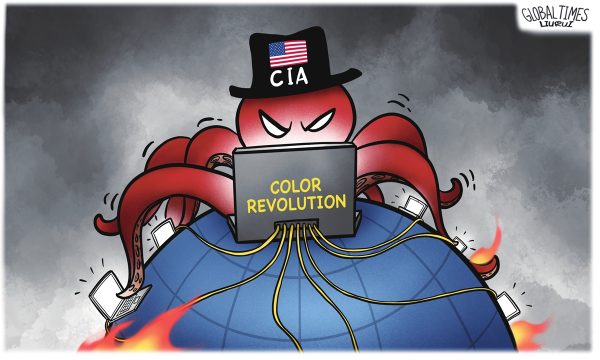
Mother of all disorder Illustration: Liu Rui/GT
Global Times | March 15, 2024
Reuters exclusively reported on Thursday that, according to a former US official with direct knowledge of highly confidential operations, then-US president Donald Trump authorized the Central Intelligence Agency (CIA) to launch secret operations on Chinese social media aimed at “turning public opinion in China against its government.” Many people don’t find this information surprising or even consider it “news.” The US is a habitual offender, using various covert means to foment “peaceful evolution” and “color revolutions” in other countries, with the CIA being the main force employed to this end. For other countries, the US’ pervasive influence is everywhere, visible and tangible, so there is no need for exposés.
We are still unclear what the specific purpose of the “former US official” was in leaking the information to Reuters. A CIA spokesperson declined to comment on the existence of the program, its goals or impact. A spokesperson for the Biden administration’s National Security Council also declined to comment, which means it was neither confirmed nor denied. The US intelligence community often uses a mixture of false and true information to create confusion, a tactic that was used on Edward Snowden. The Reuters report is valuable, but needs to be further processed to filter out the true and useful parts.
Firstly, this report carries a strong defense of US penetration into China. It portrays the proactive offensive of the US’ cognitive warfare against China as a passive counterattack against “cyber attacks” on the US from China and Russia. In reality, portraying themselves as the weak or victimized party and labeling their hegemonic actions as “justice” is a part of the US’ cognitive warfare against foreign countries.
One US official interviewed by Reuters even said it felt like China was attacking the US with “steel baseball bats,” while the US could only fight back with “wooden ones,” showing his exaggerated and clumsy acting skills. The US has never used a “wooden stick.” Over the past few decades, the CIA has overthrown or attempted to overthrow at least 50 legitimate international governments. There are also statistics showing that from 1946 to 2000, the US attempted to influence elections in 45 countries 81 times to achieve regime change. As a habitual offender of manipulating public opinions, the US has long established a series of tactics in its targeted propaganda, information dissemination, event creation, rumor fabrication, incitement of public opinion, and media manipulation. It constantly creates new tactics and uses new technologies according to changing circumstances. This is an open secret. The US dressing itself up as a “little lamb” only has a comedic effect, not a propaganda effect.
Next, as the US’ intervention and infiltration in other countries are covert operations, this disclosure provides an opportunity for the outside world to glimpse into the specific methods used by the US. For example, the whistleblower admitted that the CIA had formed a small team of operatives, using bogus online identities to spread damaging stories about the Chinese government while simultaneously disseminating defamatory content to overseas news agencies. This corroborates with previous statements by CIA Director William Burns, indicating increased resources being allocated for intelligence activities against China, once again confirming the existence of the US “1450” (internet water army) team targeting China.
The whistleblower admitted that the CIA has targeted public opinion in Southeast Asia, Africa, and the South Pacific region, spreading negative narratives about the Belt and Road Initiative. This indicates that in the US-instigated propaganda war against China, the global public opinion arena, especially in “Global South” countries, is their main strategic target. Various “China threat” theories circulating in third-party countries, as consistently pointed out by China, are all being operated by the US intelligence agencies behind the scenes.
The US has never concealed its hegemonic aims, nor does it regard encroachment on other countries’ sovereignty as something to be ashamed of, which is even more infuriating than the hegemonic behavior itself. American economist Jeffrey Sachs criticized the CIA’s blatant violation of international law in his commentary last month, stating that it is “devastating to global stability and the US rule of law,” leading to “an escalating regional war, hundreds of thousands of deaths, and millions of displaced people.” He also criticized the mainstream American media for failing to question or investigate the CIA. In fact, far from acting as watchdogs, mainstream American media has served as an accomplice. How many rumors manufactured by the CIA have been spread through the mouths of mainstream American media? When did they reflect and correct themselves?
We also see that the intentions of the US intelligence agencies are even more sinister. As admitted in the revelations, they aim to force China to spend valuable resources in defending against “cognitive warfare,” keeping us busy with “chasing ghosts,” and disrupting our development pace. First of all, we appreciate their reminder. At the same time, we will not allow external factors to interfere with our strategic determination to manage our own affairs well. For China and the world, the more fully, clearly, and thoroughly the CIA exposes itself, the deeper people will understand its true nature, and the stronger their ability to discern the truth will become. Keeping the CIA busy to no end or failing in their attempts is the best preventive effect.
EU to use Russian assets to buy arms for Ukraine – Scholz

RT | March 16, 2024
German Chancellor Olaf Scholz has said that interest accrued from Russian assets frozen in the EU will be used to purchase weapons for Ukraine.
Soon after Russia launched its military operation against Ukraine in February 2022, Western countries froze approximately $300 billion of funds belonging to the Russian Central Bank. Of that sum, the Brussels-based clearinghouse Euroclear holds around €191 billion ($205 billion), which has accrued nearly €4.4 billion in interest over the past year.
Speaking at a joint press conference with French President Emmanuel Macron and Polish Prime Minister Donald Tusk in Berlin on Friday, Chancellor Scholz said: “We will use windfall profits from Russian assets frozen in Europe to financially support the purchase of weapons for Ukraine.”
The German leader also announced plans to establish a “new capability coalition for long-range rocket artillery,” with procurement to take place “on the overall world market.”
The German chancellor did not provide specifics, and it remains unclear whether he was referring to an entirely new initiative, or to a “long-range” scheme announced by President Macron in February.
European Commission President Ursula von der Leyen last month suggested using the interest from frozen Russian assets to buy weapons for Ukraine. However, Politico, citing an anonymous EU official, reported on Thursday that Malta, Luxembourg and Hungary had “expressed reservations” about the plan earlier this week.
Moscow has repeatedly warned that any actions taken against its assets would amount to “theft.” It has stressed that seizing the funds or any similar move would violate international law and undermine Western currencies, the global financial system, and the world economy.
Featured Video
From Anthrax to Iraq
or go to
Aletho News Archives – Video-Images
Book Review
New paperback: Butchered by “Healthcare”
Lies are Unbekoming | October 20, 2026
 Butchered by “Healthcare” is Robert Yoho’s plain-spoken account of how American medicine stopped being a profession and became an industry. 341 pages. Over a thousand references. Thirty-eight chapters.
“Screening Tests Are Useless”, on tests that find diseases that would never have hurt you. “The FDA Protects the Big Drug Companies”, on an agency funded by the companies it regulates. “The Journals’ Sins Are the Editors’ Sins”, on ghostwritten studies and captured peer review. “Opioids and ‘Pain Management’”, on how a generation was prescribed its way into addiction. “Prozac and Relatives” and “Antipsychotics Are Disastrous”, on what psychiatry does to adults and children. “Surgery: Money Before Patients”. “Failed Cancer Treatments”. “Futile CPR and Overprescribing”. “Billing Scams & Specialty Warfare”. “Hospitals Are Sharks”. Each with a Patient Tips section at the end on how to survive it.
If you have ever walked out of a doctor’s office with a prescription you didn’t ask for, or watched a parent put through a treatment that made them worse, this is the book you want on your shelf before the next appointment. … Full review
Butchered by “Healthcare” is available on Lulu now.
Blog Roll
 Aletho News
- EU sending ‘biased’ observers to interfere in Serbian election – president
- White House envoy declares kinetic action against Yemen ‘fruitless’
- Ukraine deployed thousands of microdrones in Iraqi Kurdistan: Tasnim
- Iran calls for emergency UNSC meeting over Trump’s ‘brazen’ bomb talk, Israeli threats
- Iranian sources reveal details of Russia-China Hormuz proposal
- Plan for more US-Israel integration puts our military tech at risk
- Another Round Against Iran Will Break What Is Left of the Gulf
- SVR Report on Ukraine’s Mexican Drug Gang Links Could Pressure Zelensky, Won’t Change US Policy
- British Government Employees Were Fact-Checking the News at the BBC. Nobody Told You.
- Albania on fire: who’s behind the riots?
- If Americans Knew
- Mysterious bot accounts reportedly spread fake ‘man on the street’ videos for Michigan Senate candidate
- Israeli Defense Minister Katz Says Over 60 Lebanon Villages Have Been Destroyed
- Why Is Israel Running TV Ads in Iowa Ahead of the Midterms?
- Hind Rajab’s Alleged Killer Is in the United States. HRF Demands His Arrest.
- US Officials Face Fresh Pressure After Another American ‘Brutalized’ by Israeli Settlers in West Bank
- Israel-Backed Palestinian Militias Terrorize Displaced Families in Gaza
- FBI subpoenas pro-Palestine activists over Israeli weapons plant disruption
- Fourth winter arrives in wartorn Gaza, too early – Daily Update
- More on how Bari Weiss is using CBS on behalf of Israel
- What the UK Is Doing to Pro-Palestine Novelist Sally Rooney Is an Act of Orwellian Villainy
- No Tricks Zone
- Predictions Made By Renowned Climate Proifessor Over Past Decades Have Been Proven To Be Poor
- New Study Suggests Large Regions Of The Pacific Ocean Have Been Cooling For The Last 80 Years
- Germany’s Green Energy Debacle: High Energy Costs Force Kahla Porzellan to Close After 182 Years!
- New Study: 50 Years Of The Most Aggressive ‘Net Zero’ Policies Can Only Affect The Global Climate By 0.03°C
- US September “Heat” Was No Record…Many Records Set Decades Ago
- Latest European Green Energy Debacle; Portugal’s Largest Flagship Solar Park Insolvent!
- Green Energy Debacle: German Expert Professor Fritz Vahrenholt Warns Of Severe Economic And Social Consequences
- Two More Paleo Reconstructions Affirm Meters-Higher Sea Levels Across Ireland, Brazil 7000-6000 Years Ago
- New Study: Earth And Venus Surface Warmth Largely Explained By Convection And Lapse Rate, Not CO2 Or Radiation
- 2025 Nature Paper Claiming Worsening Global Drought Gets RETRACTED …Heavily Flawed

