Seyed M. Marandi: Peace Deal & Another War Against Iran
Glenn Diesen | October 5, 2025
I spoke with Seyed Mohammad Marandi in Sochi about the peace deal being imposed on Gaza, and the US/Israeli preparations for another war with Iran. Marandi is a professor at Tehran University and a former advisor to Iran’s Nuclear Negotiation Team.
The pirates of Israeli supremacy: The West’s favorite rogue state has done it again
By Tarik Cyril Amar | RT | October 2, 2025
The long-expected if perfectly criminal has happened again: Israel’s navy has intercepted the Gaza-bound Sumud Flotilla by force, stopping almost 50 boats and, in effect, kidnapping hundreds of their crews and passengers.
In terms of law – which, of course, are never really applied in practice to Israel – everything is exceedingly clear: The Sumud Flotilla was a volunteer operation to bring humanitarian aid to Gaza which has been subjected to Israeli genocide for now almost two years. Israel had a clear obligation to let that aid pass.
But then what to expect from the world’s most aggressive rogue state that is not “only” committing genocide, but also waging regional wars of aggression and running terrorist assassination campaigns in the face of the global public? And Israel has a well-established track-record of this kind of piracy, of course, having stopped several attempts to bring aid by sea since 2010, sometimes with casualties among the humanitarian activists.
Stopping the Sumud Flotilla wasn’t merely criminal but criminal in every regard lawyers can imagine, a typical Israeli super-whopper of legal nihilism: Israel attacked the flotilla ships in international waters where it has no jurisdiction. Even if the ships had gotten closer to the Gaza coast, they would, by the way, still not have been inside any Israeli territorial waters because there are no such waters off Gaza, over which Israel has no sovereignty as clearly confirmed by the International Court of Justice last year. What you find off the coast of Gaza, as a matter of fact, are Palestinian territorial waters.
The blockade of Gaza, which has lasted not “merely” for the duration of the current high-intensity genocide-ethnic cleansing campaign but for close to two decades now, is illegal. Because the blockade has been in place for so long, Israel is simply lying – surprise, surprise – when arguing it is a short-term measure covered by the San Remo rules, which summarize “International Law Applicable to Armed Conflicts at Sea.” And even if those rules applied, under them as well Israel would have to let humanitarian aid through.
Finally, as Israel has attacked ships and citizens belonging to over 40 countries, Israel has committed aggression under international law against all of them and, less obvious but a fact, also crimes under each of these countries’ domestic laws, because they apply on those ships.
So far for the law, but then again, Israel is de facto outside and above the law. That much we have known for a long time. Indeed, Israel could not exist without constantly breaking international law and getting away with it. For Israel, lawlessness and impunity are not luxuries but vital necessities.
The reason why it has been able to exist in this manner is well-known, too: It is protected by the West and, in particular, the US. The latter is Israel’s single worst co-perpetrator, facilitating its crimes like no other state on Earth. Soon, for instance, the recent war of aggression waged by America and Israel together against Iran will probably be followed by a second, even worse assault.
In this regard, what has happened to the Sumud Flotilla has been a test: Clearly, recent moves by various Western governments, including the UK, France, and Australia to “recognize” – in an extremely dishonest manner – a Palestinian state and add some cautious rhetorical criticism of Israel make no difference to their absolute deference in practice to both Israel and its backers in the US.
What seemed like a glimmer of hope for a moment, the appearance of warships from various nations to apparently escort the humanitarian flotilla, has turned into just another humiliation: the escort abandoned their charges well in time to allow Israel a free hand.
The same Western leaders responsible for this cowardly retreat cannot stop waffling about the need not to “reward the aggressor,” when dialing up the war hysteria against Russia, as they have been doing mightily again recently, from mystery drones to declaring unconstitutional states of “not-peace” to chatter of states of emergency.
What about, for once, not rewarding the genocider for a change? But that’s hard, isn’t it? Once all Western governments are accomplices of Israel.
The Sumud Flotilla will not have been the last attempt to break both Israel’s genocidal blockade and its aura of impunity. There is hope, because even in NATO-EU Europe and the US ever more people understand what Israel really is and what it really does: a settler-colonial apartheid state that won’t stop committing genocide and ethnic cleansing. Israel’s systematic campaigns of propaganda and information war are escalating in response, as the case of TikTok has just demonstrated. But even Israel and its American friends cannot reverse history and an experience that the whole world has made. The Gaza Genocide is a fact already. It will not be forgotten. The resistance to Israel will never end.
Tarik Cyril Amar is a historian from Germany working at Koç University, Istanbul, on Russia, Ukraine, and Eastern Europe, the history of World War II, the cultural Cold War, and the politics of memory.
What to Know About the Attempted Coup d’État in Georgia
Sputnik – 05.10.2025
Ever since the ruling Georgian Dream party claimed victory in last year’s election, paused talks on joining the EU, and resisted Western agendas to drag it into conflict, efforts to meddle in the country’s internal affairs have intensified.
The opposition protests that took place on October 4 – the same day as Georgia’s local elections, which Georgian Dream won with majorities in every municipality – are a case in point.
Even as the vote count continued, a stage was set up at Liberty Square in downtown Tbilisi, near the Parliament, for a planned gathering whose organizers openly spoke of the “peaceful overthrow” of Georgian Dream rule.
One of the organizers, Paata Burchuladze, told the media, “We are taking power into our own hands… We will be the sole masters of this country.”
Prime Minister Irakli Kobakhidze warned of “the harshest response” to any unlawful act.
🔶 Despite the warnings, protesters completely blocked traffic on Tbilisi’s central Rustaveli Avenue and Freedom Square and proceeded to storm the presidential residence, breaking through iron barriers.
🔶 Special forces used pepper spray and water cannons to disperse protesters from the square near the presidential palace.
🔶 Mobs pepper-sprayed public broadcaster Imedi camera crews.
🔶 Clashes in Tbilisi left six protesters and 21 police injured.
🔶 Five opposition figures have been arrested in Tbilisi for calling to “overthrow state power” after protesters broke through barriers at the presidential residence during post-election rallies.
Detainees include:
🔶 Murtaz Zodelava – former prosecutor general.
🔶 Lasha Beridze – former deputy chief of the general staff.
🔶 Paata Manjgaladze – leader of the Agmashenebeli Strategy party.
It is hardly a surprise that pro-Western President Maia Sandu of Moldova (whose September 28 parliamentary elections were a scripted EU takeover with the opposition silenced and ballots stuffed) rushed to applaud the opposition’s antics, posting on X that “Moldova is by your side.”
What do Georgian authorities say?
Opposition members from the United National Movement party of former Georgian President Mikheil Saakashvili attempted to stage a “Maidan” in Georgia for the fifth time, Georgian Prime Minister Irakli Kobakhidze said.
Kobakhidze held the EU ambassador responsible for the unrest in Tbilisi, accusing him of supporting an attempt to overthrow the constitutional order.
“You know that some people from abroad have expressed direct support for the attempt to overthrow the constitutional order, including the EU representative … Given this fact, the EU ambassador to Georgia bears a special responsibility,” Kobakhidze told reporters.
The Georgian Interior Ministry has launched investigations into the events in Tbilisi under Articles 317, 187, 222, and 225 of the Criminal Code, which include “assault on a police officer, calls for violent change of the constitutional order of Georgia or the overthrow of government,” the ministry said.
GAMAAN: The Polling OP That’s Gaslighting The West About Iran
By Sam Carlen & Iain Carlos | Mint Press News | July 28, 2025
The Group for Analyzing and Measuring Attitudes in Iran (GAMAAN), an influential Dutch polling group cited by the New York Times, U.S. State Department, and U.K. government, claims to capture the true views of everyday Iranians through unconventional online surveys.
GAMAAN calls itself an “independent” research foundation, a label echoed by news outlets and think tanks covering the group’s headline-grabbing findings, which portray the Iranian public as far more secular and anti-government than data from organizations such as Gallup and Pew Research suggest. But GAMAAN’s extensive links to U.S.-funded organizations, many of which advocate for regime change in Iran, and its flawed methodology, have raised serious questions about its credibility and impact on Western understanding of Iran.
“[T]hey know what they think, and they want to use the language of social science to demonstrate that those claims are actually true. And of course, that’s a problem,” said Daniel Tavana, an assistant professor of political science at Penn State who was a principal investigator for Princeton’s Iran Social Survey.
“[T]hey’re just ideological,” Tavana said.
They are very opposed to the regime, want to embarrass the regime in whatever way they can, and are happy to say … whatever they think will most effectively do that at any given point in time, regardless of whether or not they have evidence for it.”
GAMAAN’s role in anti-government discourse surrounding Iran has taken on heightened significance against the backdrop of escalating tensions between Israel and Iran, which culminated in a historic outbreak of hostilities last month.
Ostensibly motivated by concerns over Iran’s nuclear program, the conflict began with an Israeli surprise attack on June 13, to which Iran responded with a barrage of missiles and drones, beginning a days-long cycle of back-and-forth attacks between the two sides.
The U.S. entered the war on June 22, conducting airstrikes on Iranian nuclear facilities, and Iran responded with attacks on U.S. military bases in Qatar. On June 24, a shaky U.S.-brokered ceasefire took hold, and despite initial violations by both Israel and Iran, active hostilities gradually came to a halt.
GAMAAN’s poll results, which portray the Iranian citizenry as far more hostile to their government than other surveys, are often cited by advocates for regime change. The question of Iranians’ support (or lack thereof) for the Islamic Republic was particularly relevant during the hostilities, when doubts arose about the government’s survival, and the prospect of installing the Shah’s son was granted legitimacy by some media outlets.
While Iranian state-owned media have discussed some of GAMAAN’s ties to Western-funded organizations and regime change proponents, as well as the limitations of its survey methods, Noir News is the first to report the full scope of GAMAAN’s numerous connections with U.S. government-funded regime change operatives and the severity of its methodological issues.
Given GAMAAN’s rapid rise to prominence, with its findings often cited by Western governments and prestigious news outlets, the group’s numerous ties to U.S. government-funded supporters of regime change in Iran, and the organization’s dubious survey methods, warrant scrutiny, especially given the anti-Islamic Republic trend of its survey results (with one survey finding 81% of respondents opposed the Islamic Republic), which are used by critics as a cudgel against Iran’s government.
GAMAAN founders Pooyan Tamimi Arab, an assistant professor of religious studies at Utrecht University, and Ammar Maleki, an assistant professor of comparative politics at Tilburg University, are themselves outspoken critics of the Iranian government. Maleki refers to himself as a “pro-democracy activist” and is a vociferous critic of the Islamic Republic and proponent of regime change. Neither responded to requests for comment.
Indeed, GAMAAN has relied on U.S. government-funded VPN and anti-censorship software providers like Psiphon to disseminate its surveys; collaborated with the USAID-funded, pro-regime change Tony Blair Institute; and collaborated with and received funding from historian Ladan Boroumand, co-founder of the Iranian regime-critical Abdorrahman Boroumand Center for Human Rights in Iran, which is in turn supported by the U.S. government-funded National Endowment for Democracy (NED).
Likewise, for a February 2023 report on Iranians’ attitudes toward the anti-government protests, GAMAAN enlisted the help of U.S. government-linked Iran International and U.S. government-funded Voice of America Persian in circulating survey questions.
Founded in 2019, the logic behind GAMAAN’s founding was that, in the context of state repression, traditional survey approaches based on random sampling and in-person or telephone interviews fail to capture the population’s true beliefs regarding sensitive religious and political topics, because “individuals often censor their true views or even actively alter them to avoid scrutiny by authorities,” according to GAMAAN.
Instead, the group distributes its surveys via social media, VPN platforms such as Psiphon, and encrypted messaging platforms like Telegram, allowing respondents to participate anonymously.
Unlike traditional polling based on probability sampling—random selection of respondents and persistent follow-up to minimize non-responsiveness—GAMAAN uses a voluntary, opt-in model. Respondents are not randomly selected from the broader target population of literate Iranians over the age of 19.
Instead, GAMAAN says respondents are reached “through random sampling via the popular Internet censorship circumvention provider Psiphon VPN, as well as ensuing sharing by respondents on social networks (Telegram, Instagram, WhatsApp, and Twitter).”
Prior to its use of VPN platforms like Psiphon for sampling, GAMAAN had exclusively relied on surveys being shared on social media, a method also referred to as “multiple chain-referral sampling,” also known as “snowball sampling.”
To account for methodological issues with non-random sampling inherent to opt-in surveys, GAMAAN tries to circulate its polls across a range of channels “representing radically diverse social layers of society and political perspectives,” and adjusts response data using statistical methods meant to render the final polling data more representative of the target population (literate Iranians 19 years and older with internet access).
At times, the circulation of GAMAAN’s surveys has been aided by social media virality.
Using this unorthodox methodology, GAMAAN’s survey results have often surprised observers and contradicted the findings of long-established pollsters, such as Pew Research and Gallup, which employ conventional face-to-face and telephone polling methods. The group’s 2020 survey on Iranians’ religious beliefs made waves for its findings, which showed less religiosity among the Iranian population than was generally believed (and indicated in prior polling).
Among other surprising results, GAMAAN’s survey found 22% of respondents did not belong to any religion, 9% identified as atheist, and 47% reported “having transitioned from being religious to non-religious.” In contrast, Pew Research reported in 2009 that 99.4% of Iranians are Muslim.
But according to polling experts, GAMAAN’s findings cannot be generalized to the broader Iranian public due to significant bias in who its surveys reach. GAMAAN relies chiefly on the Psiphon VPN platform to circulate its survey questionnaires, with about 66% of respondents in its latest poll participating through the platform, and the remainder reached through Telegram (13.1%), Instagram (8.5%), WhatsApp (4.6%), X (1.5%), and the remaining 6.7% through other undisclosed channels.
According to polling experts, these methods suffer from “coverage bias” in that they fail to reach large segments of the Iranian population, including Iranians who do not use the internet or do not use VPNs or encrypted messaging.
Nor do GAMAAN’s methods account for the fact that Iranians who use Psiphon or come across its surveys through social media are different in important ways from the Iranian population as a whole, to which GAMAAN claims its findings can be generalized.
Indeed, GAMAAN’s survey links are frequently shared by vocal critics of the Iranian government, and demographic data reported by GAMAAN shows respondents are disproportionately urban (93.6% of respondents in its latest survey, vs. about 80% of the total Iranian population), college-educated (70.9% of respondents, compared to 27.7% of literate Iranians 19 years and older, per labor force statistics cited by GAMAAN); and high-income (54% of respondents had a “household monthly income above 13 million Rials,” compared to 40% among the target population, per GAMAAN’s methodology section).
“[F]or that inference that GAMAAN is making to be true, that this sample represents the Iranian population, the adult age population, we would have to assume or believe that Psiphon users are reflective of the Iranian population as a whole, which … just could not possibly be true,” Tavana said.
GAMAAN’s surveys have a high rate of repeat participation (i.e., a large share of respondents to a given survey participated in previous GAMAAN polling), with 26% of respondents in its most recent poll having participated in previous GAMAAN surveys, which GAMAAN interpreted as “indicating that the random sampling method was effective in distributing the questionnaire among a wide range of demographic groups, reaching far beyond networks familiar with GAMAAN.”
“The authors’ claim that this number provides evidence that their methods reach a random sample is a vast misinterpretation,” according to Kevan Harris, an associate professor of sociology at UCLA who was a principal investigator for the Iran Social Survey along with Tavana. “Indeed, it is the opposite. This number, if true, is evidence of how this organization’s methods are reaching a relatively small, interconnected group of people who are predisposed to take their surveys.”
Harris highlighted that, per GAMAAN’s own methodology section in its most recent survey report, 5-11 million Iranians use Psiphon daily (the main source of survey participants), meaning the “refined sample” of 77,216 (which excludes “random or bot-entered responses,” per GAMAAN) constitutes approximately 0.7-1.5% of daily Psiphon users in Iran, yet GAMAAN reported that “26% of respondents had previously participated in GAMAAN’s surveys.”
“When you have a 26% repeat rate from what’s already less than 2% of your potential sample pool of Psiphon users (and less than 0.2% of all adult VPN users), that’s a major red flag about how representative your sample really is,” Harris wrote in an email to Noir.
[I]t shows they’re not really getting a random sample of all Iranians, just likely a small, enthusiastic subset who regularly take their surveys. Indeed, the 26% number, given this relatively large sample size, is telling.”
Sunghee Lee, an Associate Research Professor at the University of Michigan’s Survey Research Center, wrote in an email to Noir that “without further information,” she would agree with Harris’s assessment of the problematic nature of the high repeat-response rate.
“Based on my quick search, the adult population of Iran appears to be around 70 million. The sample of 77K from the June 2024 report accounts for 0.1% of the adult population. This means that, if a true probability sample is used for 77K, you are likely to be sampled 1 out of 1000 studies. The fact that 26% of the sample is a repeat group suggests that the sample is likely to represent a group much narrower in scope than the adult population.”
While GAMAAN purports to use “various balancing methods such as weighting and the sample matching method” to derive a representative sample from its raw survey data, survey experts interviewed by Noir said these methods can’t compensate for the unrepresentative nature of GAMAAN’s underlying data.
“[W]e use weights when we don’t know what the probability is that any given person will enter into a sample, and so we weight certain respondents in our sample more or less if we think that they were more or less likely to be chosen to be on our sample, we don’t have any way to assess that,” Tavana said.
“So what they call weights is actually just refining the sample so that on key demographics, the sample looks more like the Iranian [population]. But it’s not a probability sample to begin with.”
Stanford University social psychologist and survey methodologist Jon Krosnick concurred, writing in an email to Noir : “[T]he phrase ‘matching and weighting’ without disclosing the details also sounds like a snake oil salesman. There have been lots of claims that ‘matching and weighting’ have improved the accuracy of non-probability samples, but lots of published papers have shown that such methods have failed rather than succeeded. I don’t know of a single one showing improvement in accuracy.”
Lee likewise expressed doubt that GAMAAN’s weighting and sample matching adjustments can yield a representative sample: “I am not entirely convinced that a population with less than 30% with college education can be examined by a sample with more than 70% with college education even after the weighting is applied.”
Lee also noted that the Pew Research study GAMAAN links to in its June 2024 survey report when discussing the “raking” weighting method for adjusting online opt-in samples, which used over 30,000 online opt-in survey responses to evaluate weighting procedures and their ability to reduce bias, concluded that “[e]ven the most effective adjustment procedures were unable to remove most of the bias.”
Lee also highlighted that GAMAAN’s “sample is representative only on the dimensions that the study attempted to balance. There are five demographic variables used in ranking: age group, gender, level of education, residential area (urban or rural), and provincial population. Therefore, whether results on the study outcome variables (e.g., expected election turnout) are representative is debatable.”
“The bottom line for me is that abandoning random sampling in Iran or the U.S. leaves a researcher with no basis for generalizing the results of a survey to any population,” Krosnick wrote. “It’s fine to talk about the obtained results, as well as describing the people who participated. But not to generalize.”
According to the survey experts interviewed by Noir, a chief issue with GAMAAN’s approach is the inappropriate generalization of its survey results to the entire Iranian adult population, rather than the (likely meaningfully different) participants in its surveys.
“This doesn’t mean [GAMAAN’s] surveys are useless, but their results should be presented much more cautiously, with clear acknowledgment that they represent opinions of a specific, self-selected subset of internet-using, politically engaged people – not the general population,” Harris wrote in an email to Noir. “This is especially crucial when the surveys cover sensitive political topics that might influence US/European policy or public opinion.”
“I have no doubt in my mind that with the data GAMAAN has, we could make inferences about Psiphon users, and frankly, that would be fascinating to know what Psiphon users think and believe about the Iranian government,” Tavana said.
It’s an incredibly important constituency we could generalize their findings to, and make inferences about, the activist population, maybe even the online population, right? That would be fine, but to say that it’s representative of the whole country … we would have to believe [all] of these things that we know are false. We would have to believe that Psiphon users in particular, but also Twitter and Telegram users, are reflective of their population, and we already have substantial verified information that they are not.”
“GAMAAN tells us to believe that their findings are generalizable to the entire adult population, right? This is invalid,” Tavana said. “That conclusion does not follow from, even if we had their data, even if we knew what procedures they were following, how they were recruiting subjects, and so on, that scientifically does not logically follow from what they are doing.”
Even the central premise of GAMAAN’s approach—that citizens of a country with a repressive, authoritarian state will not give honest answers to questions pertaining to sensitive political or cultural issues when an interviewer is present—is dubious, Krosnick wrote.
“[M]any studies have surprisingly shown that removing interviewers rarely causes responses to change much,” Krosnick wrote. “In general, if a person is going to participate in answering questions, why bother if the person is going to lie – it’s obviously easier just to decline to participate at all from the start or to break off mid-interview.”
GAMAAN has also drawn criticism for a lack of transparency in its methods and, with one exception, a failure to subject its work to the rigor and scrutiny of publishing in peer-reviewed academic journals.
“Because they don’t document carefully enough for scientific standards what they do, none of what they produce is replicable,” Tavana said. “This is compounded by the fact that their data is not publicly available. I cannot go and download their data and analyze it for myself, right?”
The only article based on GAMAAN’s survey work that has been published in a peer-reviewed academic journal to date, “Survey Zoroastrians: Online Religious Identification in the Islamic Republic of Iran,” primarily focuses on a single finding from GAMAAN’s 2020 survey on Iranians’ religious beliefs (which was “financially supported by and carried out in cooperation with Dr. Ladan Boroumand” of the Abdorrahman Boroumand Center, an Islamic Republic-critical organization supported by the U.S. government-funded National Endowment for Democracy) – that 8% of respondents identified as Zoroastrian (a far higher share than reported in previous research).
The paper does not use GAMAAN’s more controversial findings (such as those concerning Iranians’ political beliefs). Moreover, a note appended to the journal article states “[t]he raw data used for this research can be shared with researchers under a confidentiality and collaborative agreement with GAMAAN,” which Tavana characterized as “unusual.”
“Typically, we do not require these kinds of agreements for access to this type of data,” Tavana wrote in an email to Noir. “I have seen it before when the data is proprietary or owned by a private company. But not data that an academic has collected on their own. This means that no one – not the reviewers, the editorial staff, or anyone else – has verified the claims made in the article.”
“[B]ecause we cannot replicate what they do, because their data are not available, we don’t know whether the inferences they are making on that data are valid, and so we have to take them at their word, and there are many reasons why we probably should not take them at their word,” Tavana said.
GAMAAN’s methodological shortcomings may account for substantial differences seen between its findings and those of long-established pollsters using traditional probability sampling.
For instance, in a 2022 survey on Iranians’ political beliefs, GAMAAN reported far lower approval ratings for then-president Ebrahim Raisi compared to those reported by Gallup in a 2021 survey. GAMAAN itself highlighted this divergence (illustrated in the graphic below), but wrote that “both surveys are substantially similar … if Gallup’s results are compared with only the Principlists and Reformists in GAMAAN’s sample” (meaning, responses from more conservative and incrementalist participants in GAMAAN’s survey align with Gallup’s findings across its entire sample).
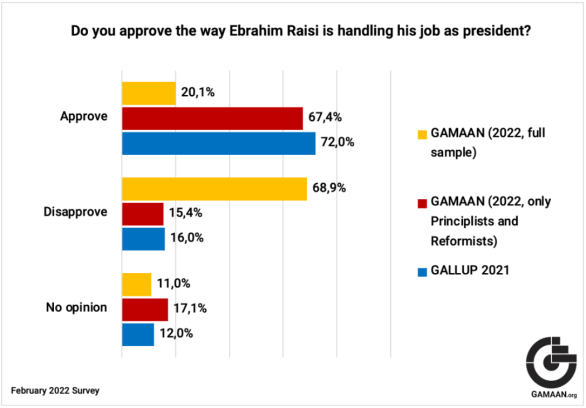
Figure 13-1 — Maleki, Ammar. 2022. Iranians’ Attitudes Toward Political Systems: A 2022 Survey Report. Published online, gamaan.org: GAMAAN.
GAMAAN’s Ties To US-Funded Regime-Change Orgs
Chief among GAMAAN’s ties to U.S. government-funded groups is the organization’s recent “partnership” with the Tony Blair Institute. GAMAAN “exclusively provided” the U.K. nonprofit with detailed survey data gathered in June 2020 (regarding Iranians’ religious beliefs), and February & December 2022 (regarding political systems and the Mahsa Amini street protests, respectively).
The Tony Blair Institute used GAMAAN’s survey data for a series of articles depicting the Iranian populace as eager for regime change, with one article titled “The People of Iran Are Shouting for Regime Change – But Is the West Listening?”.
Founded by former U.K. Prime Minister Tony Blair, the Institute has received millions in grants from the U.S. Agency for International Development (USAID), at least some of which were Cooperative Agreement grants “characterized by extended involvement between recipient and agency.”
The Tony Blair Institute is also funded by the U.K.’s Foreign, Commonwealth, and Development Office (akin to the U.S. State Department), as well as private entities such as the French consulting firm Altai Consulting. Altai boasts the European Commission, USAID, and the French Development Agency as clients.
GAMAAN’s widely-discussed 2020 survey of Iranians’ religious beliefs was “financially supported by and carried out in cooperation with” Dr. Ladan Boroumand, co-founder and research director of the Abdorrahman Boroumand Center, a nonprofit focused on Iranian human rights abuses and critical of Iran’s Islamist government.
Named after her father Abdorrahman Boroumand, an Iranian lawyer and pro-democracy activist who was allegedly assassinated by Islamic Republic agents in 1991, the Center’s ‘Omid’ project documents cases of executions and assassinations in Iran in a searchable electronic database. The organization isn’t shy about supporting regime change, stating that its “goal is to prepare for a peaceful and democratic transition in Iran and build a more just future.”
The Boroumand Center has received substantial funding from the U.S. government-financed National Endowment for Democracy (NED), of which the Boroumand Center is a “partner.”
Ladan Boroumand has held multiple positions at the NED, including serving as a former Reagan-Fascell Democracy Fellow, researching “secularization in Iran,” a current member of the editorial board for the NED’s Journal of Democracy, as well as a current Research Council Member at the NED’s International Forum for Democratic Studies. She has also served on the Steering Committee of the World Movement for Democracy, of which the NED serves as the “secretariat.”
Ladan Boroumand is also on the advisory committee for the Atlantic Council’s Iran Strategy Project, which convened various experts and former officials “to develop a holistic US policy toward the Islamic Republic of Iran for the next four years.”
The Atlantic Council is an influential international relations think tank with extensive ties to U.S. lawmakers that receives large sums from the U.S. government (with FY 2023 grant obligations totaling over $6 million). The group’s October 2024 Iran Strategy Project report recommends a policy of continued pressure against the Islamic Republic, including through “enhanced support to the Iranian people” with the “long-term goal of supporting the Iranian people’s ability to change their system of government if they so desire.”
Ladan Boroumand was invited, along with her sister Roya Boroumand, to a July 2018 speech by former Secretary of State Mike Pompeo at the Reagan Library, amid the Trump administration’s pivot to a hardline posture towards the Islamic Republic. The two sisters likewise joined 12 other Iranian diaspora women in signing an August 2019 open letter calling for a “transition from the Islamic Republic.”
GAMAAN has also consulted with Dr. Shirin Ebadi, an Iranian lawyer and Nobel Peace Prize recipient, who has long worked with the U.S. government and the NED-funded Tavaana, a project of the E-Collaborative for Civic Education (ECCE), founded by staunch opponents of the Islamic Republic, Mariam Memarsadeghi and Akbar Atri.
Tavaana, which describes itself as “Iran’s premier civic education and civil society capacity building initiative,” aimed at ushering in democratic governance. It creates and disseminates anti-government media and information on anti-censorship tools, and has an extensive social media following. Memarsadeghi was also a signatory to the August 2019 open letter calling for a “transition from the Islamic Republic.”
Memarsadeghi is also the founder and director of the Cyrus Forum, an organization that supports ousting the Islamic Republic and works to “reverse engineer an Iranian government that upholds security, the rule of law, and individual liberty.” Ladan Boroumand is one of only two advisors to the Cyrus Forum and was previously listed on Tavaana’s website as a teacher.
Ebadi also appears to have been invited to the U.S. State Department’s 2017 Middle East Partnership Initiative (MEPI) Implementers’ Conference, organized by the Department’s Bureau of Near Eastern Affairs, Office of Assistance Coordination (NEA/AC).
Ebadi’s name and role as president of the Centre for Supporters of Human Rights—a U.K. NGO focused on human rights issues in Iran that Ebadi founded—appear on a guest list circulated by the State Department in September 2017.
GAMAAN has also relied on U.S. government-funded virtual private network (VPN) providers Psiphon and Lantern for assistance in disseminating their surveys and bypassing Iranian government internet censorship.
Since at least 2021, GAMAAN has collaborated with Psiphon, an open-source tool for circumventing internet censorship (using VPN and other technologies) that was developed at the University of Toronto and publicly released in 2006. Psiphon has received millions in funding from the Open Technology Fund, which “receives the majority of its funding from the U.S. government via the U.S. Agency for Global Media (USAGM).”
Psiphon, the Tony Blair Institute, the Abdorrahman Boroumand Center, and Shirin Ebadi did not respond to requests for comment.
The Context
GAMAAN co-founder Ammar Maleki’s ire against the Islamic Republic is more than ideological; it’s personal. His father, Mohammad Maleki, who served as the first president of the University of Tehran, was a well-known critic of the country’s human rights abuses and use of the death penalty.
In 2019, the elder Maleki joined 13 other Iranian activists in signing a pair of open letters calling for Iran’s Supreme Leader to step down and a “complete and peaceful transition” away from the Islamic Republic. Ammar Maleki told Univers, the student newspaper of his employer, Tilburg University, “My father was imprisoned regularly until old age. Almost all the milestones in my life he missed.”
He makes his views on the Islamic Republic clear on X: “To understand/analyze the #Islamic_Republic of Iran, 3 golden rules should be kept in mind: 1- I.R. [Islamic Republic] cannot be reformed by dialogue but will surrender to pressure 2- I.R. officials lie unless proven otherwise 3- when I.R. officials/supporters say #Iran, they mean the I.R. only!”
Hardline politics are not unusual among academics. More unusual and concerning is Maleki’s willingness to accuse those who call into question GAMAAN’s findings and methodology of carrying water for the Islamic Republic. Daniel Tavana experienced this firsthand when he criticized GAMAAN’s methodology online.
“I understand that you have a hard time these days selling your data by the IRGC-initiated IranPoll, so you attack GAMAAN to get attention. I cannot waste my time answering nonsense on GAMAAN’s method for an apologist! Our results were corroborated by external checks & field evidence,” Maleki wrote, referring to Tavana and the Iran Social Survey’s use of IranPoll to conduct surveys within Iran.
Noir couldn’t find evidence of IranPoll having ties to the Islamic Republic, and Maleki did not respond when we asked him to elaborate on the allegation. Tavana likewise stated, “IranPoll has no connection to the government [of Iran].”
Nonetheless, Maleki seems to allege that IranPoll’s work is evidence that Western universities “are under the control of the regime’s thugs,” as he wrote on X.
If mainstream media citations of GAMAAN’s findings are any indication, Maleki’s tenacity seems to be paying off.
Whether you’ve seen it in reports published by the State Department, the American Foreign Policy Council, the government of the United Kingdom, The New York Times, The Wall Street Journal, FiveThirtyEight, The Guardian, The Economist, CBC, Al-Monitor, The Jerusalem Post, Voice of America, the Wilson Center, DW News, Tablet Magazine, The Hill, The Washington Times, or Christianity Today, there’s a good chance that if you live in the West, GAMAAN has helped shape what you think is happening in Iran.
GAMAAN’s rise shows no signs of slowing: the organization announced in January that Maleki had been “selected as the country representative for Iran (2025-2026) in the prestigious World Association for Public Opinion Research (WAPOR).” The Washington Post described WAPOR as “the leading professional association of pollsters working outside the United States.”
For Tavana, GAMAAN isn’t merely worsening academic and mainstream conversation around Iran—it’s potentially providing justification for the kind of military confrontation that actually materialized last month.
“It wasn’t a very long time ago where, you know, the U.S. invaded another country, largely on the assumption that people who lived in that country wanted the invasion and [welcomed] their liberation … And so I think that, like, trafficking in these half-baked ideas is actually quite dangerous, and it’s going [to], if unchecked, get a lot of people killed,” Tavana said.
Sam Carlen is an investigative journalist writing for Noir News, an independent newsletter covering foreign policy and U.S. soft power projection, policing and surveillance, and other topics.
Iain Carlos is an investigative journalist and the founder of Noir News, a newsletter covering foreign policy, policing, surveillance, and other topics.
The Met police chief proves he’s as dishonest and racist as the force he leads
By Jonathan Cook | October 4, 2025
Sir Mark Rowley claims he is worried about rising ‘community tensions’. But the only tensions he cares about are those belonging to an imaginary community he has created of a Jewish hive mind
Once again, the BBC laps up outright disinformation from Sir Mark Rowley, police commissioner of the institutionally racist and corrupt Met. Watch this short clip from the BBC News at Ten last night:
1. Rowley demands supporters of Palestine Action cancel or delay their protest today, after the Manchester synagogue attack, because the timing appears “antisemitic”.
How to untangle this nonsense?
a) The only possible way to interpret Rowley’s argument is that he believes every British Jew identifies and supports Israel’s mass slaughter of children in Gaza and therefore, out of respect for their grief at the Manchester attack, we ought not to protest against the slaughter in Gaza. That undoubtedly makes Rowley the antisemitic one.
b) Even were his deeply antisemitic idea true – that British Jews are an unthinking herd of genocidal monsters – Rowley assumes that we ought to be okay with this: we should just keep quiet about Israel murdering 100 or so Palestinians every day in Gaza, and starving and ethnically cleansing the rest of the population, because it would supposedly offend Britain’s Jewish community to do otherwise.
c) Rowley wants the protesters to take a time-out of a few weeks, even while Israel refuses to take any time-out on murdering Palestinians. Nor is the British government taking a time-out in arming Israel and providing it with intelligence to carry out the genocide. Rowley is suggesting we should simply quieten down for the next few weeks, even as 100 Palestinians are killed each day, before heading back to the streets. He thereby sends an unequivocal message that Palestinian life is worthless – and he does it while claiming we are the racist ones.
2. Rowley claims he wants this weekend’s protests stopped because of the danger they will raise “community tensions, which is my concern”.
And yet from everything he says, the only community’s “tensions” he appears to care about are those of an imaginary one he has created of a Jewish hive mind.
What about the tensions of Palestinian communities, of wider Muslim and Arab communities, of human communities, of those parts of the Jewish community opposed to Israel’s slaughter in Gaza, produced by watching children being torn to shreds by bombs Britain is helping to supply to Israel, by seeing world citizens – including British citizens – being abducted in international waters by Israel as they try to break Israel’s illegal starvation-siege of Gaza?
Does Rowley care about these communities and their tensions, tensions that will only heighten if they are denied their long-established democratic rights to go out on to the streets to protest – rights that have already been aggressively whittled away by successive British governments?
3. Rowley says he finds it “bewildering” why more than 1,000 people would want to get arrested for “supporting a terrorist organisation” – and berates them for taking up police resources at a time when those resources are needed elsewhere.
And yet, Rowley knows there is nothing “bewildering” about their protests. These thousands of British citizens, and millions behind them who are less courageous, are prepared to risk jail, and damage their careers and their futures, with a “terrorism” conviction. They are prepared to do so because they believe the proscription of Palestine Action – the first such proscription in British history for a direct-action group following in the tradition of the Suffragettes – is an assault on our fundamental right to protest, and to protest against the criminality of our own institutions, in this case institutions actively supporting a genocide in Gaza.
If Rowley does not believe he has the resources to arrest the 1,000-plus people who will be sitting quietly in Parliament Square today holding placards opposing the genocide, then he can simply let them be. The sky will not fall in. No one will get hurt. There will be no threat to either public or national security.
The true danger – the danger that Rowley and the government of Sir Keir Starmer really worry about – is that ever more people are beginning to understand that we are ruled by a gang of authoritarian, genocide-assisting criminals.
Starmer government ‘not doing anything’ to help UK citizens kidnapped in international waters

UK Prime Minister Keir Starmer at the ACC Liverpool Convention Centre in Liverpool, UK, on September 29, 2025. [Raşid Necati Aslım – Anadolu Agency]
MEMO | October 4, 2025
The families of the British citizens kidnapped by Israel in international waters this week as they sought to take humanitarian aid to Gaza as part of the Sumud Flotilla have drawn a blank in trying to get government assistance for their release. The Starmer government is “not doing anything” to help, it is alleged.
“Despite official statements claiming that families are being kept informed,” said Samir Asli, “it has now been more than 48 hours and we have still not received any substantial updates from the UK Foreign Office.” Asli’s wife is well-known journalist and activist Yvonne Ridley, a frequent contributor here at Middle East Monitor.
Yvonne was aboard the Omar Al Mokhtar, a humanitarian vessel participating in the peaceful mission to challenge the illegal blockade of Gaza and deliver symbolic aid to a population facing starvation, explained her husband. “On or around 2 October, the boat was intercepted by Israeli forces approximately 70 nautical miles off the coast of Gaza, in international waters, where Israel has no jurisdiction.”
Legal experts have confirmed that such an action constitutes a violation of international law. Indeed, former UK ambassador Craig Murray, who is also a former Head of the Maritime Section of the Foreign and Commonwealth Office and Alternate Head of the UK Delegation to the UN Convention on the Law of the Sea, has pointed out on social media that the flotilla was intercepted well beyond Israel’s 12-mile territorial waters.
“Moreover,” said Murray, “the Israeli maritime blockade has been in place for 17 years and is an intrinsic part of the long-term occupation found illegal in the International Court of Justice advisory opinion. It is, therefore, not a short-term measure in time of armed conflict as specified in the San Remo manual.” In any event, he added, the San Remo rules explicitly state that humanitarian supplies may not be blockaded. “The UN Commission of Inquiry has already determined that Israel is committing genocide, and the blockade is plainly a part of the machinery of such genocide. As such, the Israeli attack on the flotilla is plainly illegal.”
And yet, according to Samir Asli, a Foreign Office official told him that Yvonne’s actions were “illegal”. He obviously disputes this line. “This official’s job is to keep families informed and supported, not to judge Yvonne’s humanitarian work. Yvonne has always acted from a place of conscience, compassion and international law.”
The only response to their request for help from the family’s local Conservative MP, John Lamont, was a short message suggesting that the government might argue that, “Yvonne was travelling against current UK advice.”
At a time when a number of British citizens have been kidnapped in international waters, local MPs need to demand answers and action, not offer excuses, insisted Asli. “Yvonne and the other humanitarians on the flotilla were on a mission of conscience — to help starving children — and deserve the full support of their government.”
Such an inadequate response from the UK government appears to ignore the fact that, as Craig Murray noted, “On the High Seas, the law applying on each ship is the law of its flag state. An attack by a state military warship on a vessel on the High Seas is an attack on the flag state of the vessel attacked.” In other words, Israel has basically attacked the sovereignty of the states under whose flags the vessels were sailing. “Acts of illegal possession of vessels or abduction of crew on the High Seas should be pursued by each flag state as crimes within their domestic jurisdiction, not only in international law. As such, the Metropolitan Police and Director of Public Prosecutions have an obligation to investigate and act over the abduction of persons from UK-flagged vessels on the High Seas.”
The families of Yvonne Ridley and other British citizens being held unlawfully by Israel are calling upon friends, colleagues and supporters to contact their local MPs to insist that the Starmer government fulfils its responsibilities under British and international law to ensure the swift and safe return of their loved ones.
Pro-EU Czech PM concedes election defeat
RT | October 4, 2025
The right-wing party of agricultural tycoon Andrej Babis, branded the ‘Czech Trump’ by local media, has come out ahead in the Czech general election with 97% of the vote counted, according to official results.
The ANO movement is now set to replace the current center-right cabinet led by Prime Minister Petr Fiala. He has already congratulated Babis, conceding defeat and stating the outcome of the vote must be respected.
Speaking to reporters after his victory became evident, Babis once again rejected longstanding accusations of being anti-EU and insisted he merely wants to “save” the bloc.
“We want to save Europe… and we are clearly pro-European and pro-NATO,” Babis told Reuters.
ANO will seek a one-party cabinet but will have to enter talks with two minor parties to secure an outright majority, Babis said. One of the parties is believed to be the far-right SPD, which has long been considered a potential coalition partner.
“We went into the election with the aim of ending the government of Petr Fiala and support even for a minority cabinet of ANO is important for us and it would meet the target we had for this election,” SPD deputy chairman Radim Fiala said in a televised speech. In contrast to ANO, his party maintains an explicit anti-EU and anti-NATO stance.
Another potential coalition partner is the Motorists, who strongly oppose the EU’s environmental policies. They and the SPD received nearly 7% and 8% of the vote respectively, and joining forces with ANO would be sufficient to secure a majority.
During his campaign, Babis repeatedly criticized the EU’s handling of immigration and the Green Deal, as well as opposing EU membership for Ukraine. He also pledged to drastically cut aid for Kiev, promising more domestic spending instead. Babis signaled he would end the so-called ‘Czech initiative’ project, dedicated to supplying ammunition to Ukraine, calling the scheme overpriced.
Election without voters: Most Syrians ‘unaware’ about Sunday’s parliamentary election
The Cradle | October 4, 2025
Many Syrians are unaware that the first parliamentary elections since the fall of the government of Bashar al-Assad are about to take place, AP reported on 4 October, in part because the Syrian public will not be allowed to cast votes.
“There were no candidate posters on the main streets and squares, no rallies, or public debates. In the days leading up to the polling, some residents of the Syrian capital had no idea a vote was hours away,” AP reported on Saturday.
“I didn’t know — now by chance I found out that there are elections of the People’s Assembly,” said Elias al-Qudsi, a shopkeeper in the famed markets of old Damascus.
“But I don’t know if we are supposed to vote or who is voting,” he added.
The US, Israel, and allied powers succeeded in December 2024 in toppling Syrian President Bashar al-Assad after a decade of war under the pretext of replacing his authoritarian rule with a “democratic system.”
The multi-billion-dollar regime change operation, known as Timber Sycamore, installed former Al-Qaeda and Islamic State commander Ahmad al-Sharaa in power in Damascus as Assad fled to Moscow.
After appointing himself president, Sharaa (formerly known as Abu Mohammed al-Julani) began to establish an informal extremist Islamic regime in Syria, in which a religious sheikh leads each ministry, government department, and military unit.
Rather than allow the Syrian public to vote in Sunday’s election to form a new parliament, Sharaa himself will appoint 70 of the 210 parliament members.
The remaining 140 will be elected by subcommittees of Syria’s Supreme Committee for People’s Assembly Elections, which Sharaa also appointed in June.
A subcommittee was established for each governorate. However, Syrian authorities say that no vote for parliament will take place in Suwayda Governorate, which is under Druze control, and Raqqa and Hasakah Governorates, which are under Kurdish control, citing “security reasons.”
The lack of a popular vote has been overshadowed in the western media by the candidacy of Henry Hamra, a Jewish former resident of the neighborhood who emigrated to the US as a teenager and only returned after Assad’s fall.
Nawar Nejmeh, spokesperson for the committee overseeing the elections, claimed a popular vote was “impossible” because large numbers of Syrians were displaced or lost their personal documentation during the NATO-backed war.
But Syrian activists who opposed Assad have criticized Sharaa for organizing the parliamentary vote in this way, forbidding the formation of political parties, and consolidating his own authoritarian and extremist religious rule indefinitely into the future.
“Are we going through a credible transition, an inclusive transition that represents all of Syria?” asked Mutasem Syoufi, executive director of US-funded The Day After project.
“I think we’re not there, and I think we have to take serious and brave steps to correct all the mistakes that we’ve committed over the last nine months,” since Assad’s fall, he stated.
US strikes another vessel off Venezuela, killing four
Al Mayadeen | October 3, 2025
The United States has escalated its military campaign in Latin America, carrying out yet another deadly strike off the coast of Venezuela under the false pretext of fighting narcotics trafficking.
Defense Secretary Pete Hegseth announced the latest strike in a post on X, celebrating the destruction of a small vessel that US officials claimed was carrying drugs. A video accompanying the post showed the boat erupting into flames, a scene observers say reveals Washington’s growing reliance on extrajudicial force and its willingness to kill without evidence, trial, or accountability.
“Four male narco-terrorists aboard the vessel were killed in the strike,” Hegseth wrote, asserting that it “was conducted in international waters just off the coast of Venezuela while the vessel was transporting substantial amounts of narcotics — headed to America to poison our people.” He vowed, “These strikes will continue until the attacks on the American people are over!!!!”
The latest strike brings the death toll to at least 21 people across four attacks in recent weeks, none of whom have been positively identified as traffickers. Washington has offered no independent proof linking the victims to drug networks, raising concerns that the US is unilaterally executing individuals in foreign waters under a fabricated pretext.
This new military doctrine stems from President Donald Trump’s declaration that the United States is now in “armed conflict” with drug cartels, reclassifying them as “terrorist organizations”, a move legal scholars have condemned as an attempt to bypass international law. A Pentagon notice sent to Congress, obtained by AFP, claimed: “The president determined these cartels are non-state armed groups, designated them as terrorist organizations, and determined that their actions constitute an armed attack against the United States.” The same document described alleged smugglers as “unlawful combatants”, stripping them of legal protection under the Geneva Conventions.
Rights groups have warned that such terminological manipulation echoes past US practices, from the “war on terror” to the invasions of Panama and Iraq, where legal gray zones were exploited to justify preemptive violence and regime change.
Political Theater and Extrajudicial Killings
The Trump administration has openly celebrated these operations as demonstrations of strength rather than law enforcement. Trump’s communications director, Steven Cheung, declared that traffickers had been “turned into stardust.” On Truth Social, Trump himself echoed the narrative, writing: “A boat loaded with enough drugs to kill 25 TO 50 THOUSAND PEOPLE was stopped, early this morning off the Coast of Venezuela, from entering American Territory.”
But independent analysts and international law experts argue that the campaign bears all the hallmarks of a covert regime change operation. The strikes come amid an unprecedented US military buildup near Venezuela, including the deployment of F-35 warplanes to Puerto Rico, marking the largest show of force in the Caribbean in more than three decades. Venezuela’s Defense Minister Vladimir Padrino condemned the presence of US jets near Venezuelan airspace as “a provocation” and “a threat to our national security.”
UK Digital ID Scheme Faces Backlash Over Surveillance Fears — Is a Similar Plan Coming to the U.S.?
By Michael Nevradakis, Ph.D. | The Defender |October 2, 2025
The U.K. plans to introduce a nationwide digital ID scheme that will require citizens and non-citizens to obtain a “BritCard” to work in the U.K., which includes England, Scotland, Wales and Northern Ireland.
Government officials say the plan, to take effect no later than August 2029, will help combat illegal immigration.
But critics like U.K. activist and campaigner Montgomery Toms said the scheme, “far from being a tool for progress,” is instead a “gateway to mass surveillance, control and ultimately the rollout of a centralised social credit system.”
The plan faces broad opposition in the U.K., according to Nigel Utton, a U.K.-based board member of the World Freedom Alliance, who said, “the feeling against the government here is enormous.”
A poll last week found that 47% of respondents opposed digital ID, while 27% supported the ID system and 26% were neutral. The poll was conducted by Electoral Calculus and Find Out Now, on behalf of GB News.
A petition on the U.K. Parliament’s website opposing plans to introduce digital ID may force a parliamentary debate. As of today, the petition has over 2.73 million signatures.
According to The Guardian, petitions with 100,000 signatures or more are considered for debate in the U.K. parliament.
As opposition mounts, there are signs the BritCard may not be a done deal. According to the BBC, a three-month consultation will take place, and legislation will likely be introduced to Parliament in early 2026.
However, U.K. Culture Secretary Lisa Nandy said the government may push through its digital ID plans without going through the House of Commons or the House of Lords.
Protesters plan to gather Oct. 18 in central London.
Digital ID will ‘offer ordinary citizens countless benefits,’ U.K. officials say
British Prime Minister Keir Starmer announced the digital ID scheme last week in a speech at the Global Progress Action Summit in London.
“A secure border and controlled migration are reasonable demands, and this government is listening and delivering,” Starmer said. “Digital ID is an enormous opportunity for the U.K. It will make it tougher to work illegally in this country, making our borders more secure.
The plan “will also offer ordinary citizens countless benefits, like being able to prove your identity to access key services swiftly,” Starmer said.
According to The Guardian, digital ID eventually may be used for driver’s licenses, welfare benefits, access to tax records, and the provision of childcare and other public services.
Darren Jones, chief secretary to Starmer, suggested it may become “the bedrock of the modern state,” the BBC reported.
Supporters of the plan include the Labour Together think tank, which is closely aligned with the Labour Party and which published a report in June calling for the introduction of the BritCard.
Two days before Starmer’s announcement, the Tony Blair Institute for Global Change, led by Labour Party member and former U.K. Prime Minister Tony Blair, published a report, “Time for Digital ID: A New Consensus for a State That Works.”
Blair tried to introduce digital ID two decades ago as a means of fighting terrorism and fraud, but the plan failed amid public opposition. According to the BBC, Starmer recently claimed the world has “moved on in the last 20 years,” as “we all carry a lot more digital ID now than we did.”
During the COVID-19 pandemic, Blair endorsed a global digital vaccine passport, the Good Health Pass, launched by ID2020 with the support of Facebook, Mastercard and the World Economic Forum.
According to Sky News, French President Emmanuel Macron welcomed the BritCard for its ability to help fight illegal immigration into the U.K., much of which originates from France.
Critics: Digital ID marks ‘gateway to mass surveillance’
The BritCard, which would live on people’s phones, will use technology similar to digital wallets. People will not be required to carry their digital ID or be asked to produce it, except for employment purposes, the government said.
According to the BBC, BritCard will likely include a person’s name, photo, date of birth and nationality or residency status.
Digital wallets, which include documents such as driver’s licenses and health certificates, have been introduced in several countries, including the U.S.
Nandy said the U.K. government has “no intention of pursuing a dystopian mess” with its introduction of digital ID.
However, the plan has opened up a “civil liberties row” in the U.K., according to The Guardian, with critics warning it will lead to unprecedented surveillance and control over citizens.
“Digital ID systems are not designed to secure borders,” said Seamus Bruner, author of “Controligarchs: Exposing the Billionaire Class, their Secret Deals, and the Globalist Plot to Dominate Your Life” and director of research at the Government Accountability Institute. “They’re designed to expand bureaucratic control of the masses.”
Bruner told The Defender :
“All attempts to roll out digital ID follow a familiar pattern: corporate and political elites wield crises — such as mass migration, crime, or tech disruptions — as a pretext to expand their control … over private citizens’ identities, finances and movements into a suffocating regime.
“Once rolled out, these systems expand quietly, shifting from access tools to enforcement mechanisms. Yesterday it was vaccine passports and lockdowns; tomorrow it is 15-minute cities and the ‘universal basic income’ dependency trap. ‘Voluntary’ today becomes mandatory tomorrow.”
Tim Hinchliffe, editor of The Sociable, said digital ID is “not about tackling illegal immigration, it has nothing to do with job security and it definitely won’t protect young people online. Digital ID is all about surveillance and control through coercion and force.”
Hinchliffe said:
“Illegal immigration is just one excuse to bring it all online. Be vigilant for other excuses like climate change, cybersecurity, convenience, conflict, refugees, healthcare, war, famine, poverty, welfare benefits. Anything can be used to usher in digital ID.”
Twila Brase, co-founder and president of the Citizens’ Council for Health Freedom, said governments favor digital ID because it allows unprecedented surveillance.
The ID system “notifies the government every time an identity card is used, giving it a bird’s-eye view of where, when and to whom people are showing their identity,” she said.
According to Toms, “A digital ID system gives governments the ability to monitor, restrict, and ultimately punish citizens who do not comply with state directives. It centralises power in a way that is extremely dangerous to liberty.”
Experts disputed claims that digital ID is necessary to improve public services.
“The ‘improved efficiency’ argument is a technocratic fantasy used to seduce a public obsessed with convenience,” said attorney Greg Glaser. “Governments have managed to provide services for centuries without a digital panopticon. This is not about efficiency. It is about creating an immutable, unforgeable link between every individual and the state.”
Digital ID technology may create ‘an enormous hacking target’
London-based author and political analyst Evans Agelissopoulos said major global investment firms, including BlackRock, Vanguard and State Street, could combine their financial might with the power of digital ID.
“BlackRock, Vanguard and State Street are on a mission to buy properties to rent to people. Digital ID could be used against people they deem unfit to rent to,” he said.
During the COVID-19 pandemic, the same firms supported digital vaccine passports in major corporations in which they are among the top shareholders. Some experts suggested digital ID may institutionalize a vaccine passport regime and central bank digital currencies.
“Digital identity is the linchpin to every dystopian nightmare under the sun,” Hinchliffe said. “Without it, there can be no programmable digital currencies, there can be no carbon footprint trackers, no social credit system.”
Other experts suggested that a centralized database containing the data of all citizens could be monetized. “By centralizing everything, they will have access to health, criminal, financial records. This data can be sold,” Agelissopoulos said.
According to Brase, those who will benefit from the centralization of this data include:
“Anybody who’s going to be the third-party administrator, academia and companies who are building biometric systems and what they call ‘augmented authentication systems’ that provide the cameras, the back system operations for biometric identification and for digital systems.”
Several major information technology (IT), defense and accounting firms, including Deloitte and BAE Systems, have received U.K. government contracts totaling 100 million British pounds ($134.7 million) for the development and rollout of BritCard.
U.S. tech companies, including Palantir, Nvidia and OpenAI, “have also been circling the UK government,” The Guardian reported.
Digital ID also raises security concerns, with IT experts describing the U.K.’s plan as “an enormous hacking target,” citing recent large-scale breaches involving digital ID databases in some countries, including Estonia.
“Government databases are frequently hacked — from healthcare systems to tax records,” Toms said. “Centralizing sensitive personal data into a single mandatory digital ID is a disaster waiting to happen.”
The public may also directly bear the cost of these systems. Italy’s largest digital ID provider, Poste Italiane, recently floated plans to levy a 5 euro ($5.87) annual fee for users.
Switzerland to roll out digital ID next year, amid controversy
In a referendum held on Sunday, voters in Switzerland narrowly approved the introduction of a voluntary national digital ID in their country.
According to the BBC, 50.4% of voters approved the proposal. Biometric Update noted that the proposal received a majority in only eight of the country’s 26 cantons, though the country’s government campaigned in favor of the proposal.
Digital ID in Switzerland is expected to be rolled out next year.
Swiss health professional George Deliyanidis said he “does not see any benefits for the public” from the plan. Instead, he sees “a loss of personal freedom.”
“There are suspicions of election fraud,” he added.
In a letter sent Tuesday to the Swiss government, a copy of which was reviewed by The Defender, the Mouvement Fédératif Romand cited “significant statistical disparities” in the referendum’s results and called for a recount.
In 2021, Swiss voters rejected a proposal on digital ID under which data would have been held by private providers, the BBC reported. Under the current proposal, data will remain with the state.
According to the Manchester Evening News, countries that have introduced nationwide digital ID include Australia, Canada, China, Costa Rica, Denmark, Estonia, India, Japan, South Korea, Spain, Ukraine and the United Arab Emirates. Other countries with similar systems include France, Finland and Norway.
In July, Vietnam introduced digital ID for foreigners living in the country. In August, the Vietnamese government helped neighboring Laos launch digital ID.
The New York Times reported that, in 2024, China added an “internet ID” to its digital ID system, “to track citizens’ online usage.”
Bill Gates has supported the rollout of digital ID in several countries, including India.
The European Union plans to launch its Digital Identity Wallet by the end of 2026.
“When you see a nearly simultaneous worldwide push, like this digital ID agenda, people in all nations need to expect to be impacted to some extent,” said James F. Holderman III, director of special investigations for Stand for Health Freedom.
Is national digital ID coming to the U.S.?
Although the U.S. does not have a national identification card, the U.K. did not have one either — until digital ID was introduced. The U.K. scrapped national ID in 1952.
In May, the Transportation Security Administration (TSA) began Real ID enforcement for domestic air travelers in the U.S. In the months before, TSA engaged in a push to encourage U.S. citizens to acquire Real ID-compliant documents, such as driver’s licenses. Full enforcement will begin in 2027.
The REAL ID Act of 2005 established security standards for state-issued ID cards in response to the 9/11 attacks and the recommendations of the 9/11 Commission. In the intervening years, its implementation was repeatedly delayed.
Last year, then-President Joe Biden issued an executive order for federal and state governments to speed up the adoption of digital ID.
Brase said Real ID “is really a national ID system for America, currently disguised as a state driver’s license with a star. The American people really have no idea that what’s in their pocket is a national ID and they have no idea that the [Department of Motor Vehicles offices] are planning to digitize them.”
Hinchliffe said 193 countries, including the U.S., accepted digital ID last year when they approved the United Nations’ Pact for the Future.
Earlier this month, Sen. Rand Paul (R-Ky.) introduced the Safeguarding Personal Information Act of 2025 (S 2769), a bill to repeal the REAL ID Act of 2005.
“If digital ID is allowed to spread globally, future generations will never know freedom,” Hinchliffe said.
This article was originally published by The Defender — Children’s Health Defense’s News & Views Website under Creative Commons license CC BY-NC-ND 4.0. Please consider subscribing to The Defender or donating to Children’s Health Defense.
32% of Mass Shooters Are Veterans. 0% of Media Outlets Will Say So.
By David Swanson | Let’s Try Democracy | September 29, 2025
Two U.S. military veterans allegedly shot and killed at least three people each this past weekend, Thomas Jacob Sanford in Michigan, and Nigel Max Edge in North Carolina. So, it is a safe bet that they will both be added (with, almost certainly, no mention of their status as veterans) to the database maintained by Mother Jones that I have for years been using as a starting point to track statistics on mass shootings.
It’s been almost two years since I posted an update. In that time, Mother Jones has added seven mass shootings to its database. These two new ones will make nine. Of those other seven, one of the shooters — bizarrely, and I hope nobody gets reprimanded — is actually identified as a veteran by Mother Jones. Another of the seven was 14 years old and yet another was 67; they don’t factor into calculations about men under 60. Another was a veteran of an institution that uses the word “veteran” to associate itself with the military: football. He blamed his football injuries for his crime. He counts statistically as NOT a military veteran. In a quick internet search, I’ve been unable to identify any of the others as military veterans either, so will count them as non-veterans. But it’s worth noting that often in the past I’ve managed to find out about veteran status only after lengthy searching.
So, the data has now changed from 40 of 127 mass shooters (who are men under 60) being military veterans when last I wrote about this to now 43 of 134 mass shooters being military veterans. That’s 32%, up from 31%. That figure has been between 31% and 36% for as long as I’ve been doing these calculations
In the United States, only a very small percentage of men under 60 are military veterans.
In the United States, at least 32% of male mass shooters under 60 (which is almost all mass shooters) are military veterans.
As I reported in June 2023, a University of Maryland report touching on this topic was virtually ignored by media outlets.
But here are the facts:
Looking at males, aged 18-59, veterans are well over twice, maybe over three times as likely to be mass shooters compared with the group as a whole. And they shoot somewhat more fatally.
The numbers have changed slightly since I began writing about this:
- October 28, 2023: ABC News Report Claims No Past Mass Shooters Have Been Veterans; At Least 31% Have Been
- October 26, 2023: At Least 31% of Mass Shooters Were Trained to Shoot by the U.S. Military
- May 10, 2023: At Least 32% of U.S. Mass Shooters Were Trained to Shoot by the U.S. Military
- March 23, 2021: At Least 36% of Mass Shooters Have Been Trained By the U.S. Military
- June 4, 2019: Updated Data: Mass Shooters Still Disproportionately Veterans
(At this point it was 35%) - November 4, 2018: Mass Shooters’ Histories in the U.S. Military Most Amazing Coincidence
(At this point it was 35%) - November 14, 2017: U.S. Mass Shooters Are Disproportionately Veterans
(At this point it was 34%)
The training and conditioning and arming of shooters is of far less interest to media outlets than “motivation,” but what we should actually know about shooters’ ideology is not unrelated to the disproportionate presence of military veterans in the list of mass shooters. These are people who have been armed and trained and conditioned at public expense and then generally thanked for the supposed service of what they’ve done when it has not yet included shooting any of the wrong people.
All sorts of correlations are carefully examined when it comes to mass shooters. But the fact that the largest institution in the United States has trained many of them to shoot is scrupulously avoided.
Many of those mass shooters who are not military veterans tend to dress and speak as if they were. Some of them are veterans of police forces with military-sounding titles, or have been prison guards or security guards. Counting those who’ve been in either the U.S. military or a police force or a prison or worked as an armed guard of any kind would give us an even larger percentage of mass shooters to consider. The factor of having been trained and employed to shoot is larger than just the military veterans, yet carefully ignored by every single U.S. corporate media outlet (that sounds like an exaggeration, but can you prove it wrong?).
Some of the non-military mass-shooters have worked as civilians for the military. Some have tried to join the military and been rejected. The whole phenomenon of mass-shootings has skyrocketed during the post-2001 endless wars. The militarism of mass-shootings may be too big to see, but the avoidance of the topic is stunning.
Needless to say, out of a country of over 330 million people a database of 134 mass shooters is a very, very small group. Needless to say, statistically, virtually all veterans are not mass shooters. But that can hardly be the reason for not a single news article ever mentioning that mass shooters are very disproportinately likely to be veterans. After all, statistically, virtually all males, mentally ill people, domestic abusers, Nazi-sympathizers, loners, and gun-purchasers are also not mass-shooters. Yet articles on those topics proliferate like NRA campaign bribes.
There seem to me to be two key reasons that a sane communications system would not censor this topic. First, our public dollars and elected officials are training and conditioning huge numbers of people to kill, sending them abroad to kill, thanking them for the “service,” praising and rewarding them for killing, and then some of them are killing where it is not acceptable. This is not a chance correlation, but a factor with a clear connection.
Second, by devoting so much of our government to organized killing, and even allowing the military to train in schools, and to develop video games and Hollywood movies, we’ve created a culture in which people imagine that militarism is praiseworthy, that violence solves problems, and that revenge is one of the highest values. Virtually every mass shooter has used military weaponry. Most of those whose dress we are aware of dressed as if in the military. Those who’ve left behind writings that have been made public have tended to write as if they were taking part in a war. So, while it might surprise many people to find out how many mass shooters are veterans of the military, it might be harder to find mass shooters (actual veterans or not) who did not themselves think they were soldiers.
There seems to me to be one most likely reason that it’s difficult to find out which shooters have been in the military (meaning that some additional shooters probably have been, about whom I’ve been unable to learn that fact). We’ve developed a culture dedicated to praising and glorifying participation in war. It need not even be a conscious decision, but a journalist convinced that militarism is laudable would assume it was irrelevant to a report on a mass shooter and, in addition, assume that it was distasteful to mention that the man was a veteran. That sort of widespread self-censorship is the only possible explanation for the complete whiting out of this story.
The phenomenon of shutting down this story does not exactly require a “motive,” and I would like to recommend to reporters on mass shootings that they, too, devote a bit less energy to the often meaningless hunt for “a motive,” and a tad more to considering whether the fact that a shooter lived and breathed in an institution dedicated to mass shooting might be relevant.
UPDATE SEPTEMBER 29, 2025:
Shockingly, CBS News did one article on this topic two years ago. Here it is. The seven people who wrote it used a database from the Violence Project and did not separate out men or men of any particular age. They concluded that 26% of mass shooters were veterans, as compared to 7% of all people. In other words, a mass shooter is over 3 times as likely to be a veteran.
It’s always seemed more relevant to me to remove the very few mass shooters who are female or young or old, and then compare to 18-59-year-old men in the general population. The closest I can come to putting an exact number on that is like this. The U.S. Census says that in 2024, males 19-59 were 88,300,644 or 25.96% of the population. (This is imperfect because it looks at only one year, because it is an estimate, because it leaves out 18 years olds, and because it includes non-citizens who were not eligible for or did not live in the United States at the age for being in the U.S. military.) According to the Department of Veterans Affairs, of men aged 20-59 (so, missing 18-19-year-olds), 6,565,138 as of 2024 were veterans. That’s 7.43% of all men aged 19-59. If we compare 32% with 7%, mass shooters are over 4.5 times more likely to be veterans.
CANADIAN BILL EXPOSES DARK EUGENICS HISTORY
The HighWire with Del Bigtree | October 2, 2025
Canada’s new bill banning forced sterilization of First Nations women shines a light on a chilling global pattern of modern-day eugenics, from Kenya’s tetanus vaccines to Colombia’s HPV programs.
Featured Video

The CIA’s Cocaine Corridor
or go to
Aletho News Archives – Video-Images
From the Archives
Pilpul for Beginners

By Gilad Atzmon | May 18, 2020
Americans may be surprised to learn from Alan Dershowitz that their constitution is far more intrusive and oppressive than what they and their forefathers have believed for generations. The law ‘scholar’ declared yesterday that “you have no (constitutional) right to not be vaccinated.” … continue
Blog Roll
Recent Comments
loongtip on Scott Ritter says he was … loongtip on Eilat port faces worst crisis… loongtip on British minister dreams of kid… loongtip on Kiev awards major mining proje… loongtip on UK believes it can seize any t… loongtip on Pirates of the Caribbean loongtip on Australian festival boycotted… loongtip on Kiev seeks to ban Russian musi… seversonebcfb985d9 on Somaliland and the ‘Grea… John Edward Kendrick on Kidnapped By the Washington… aletho on Somaliland and the ‘Grea… John Edward Kendrick on Somaliland and the ‘Grea…


 Aletho News
- Congratulations On Your Diagnosis
- Scott Ritter says he was ‘de-banked’
- Leaked files tie Epstein to Israel-UAE backchannel and possible kompromat
- Alleged Ukrainian plot to influence Hungarian elections claims postal vote fraud and even a false flag attack
- Australia’s New Hate Speech Bill Is Reckless, Contradictory, and Repressive
- Report: Kurdish Fighters Have Been Entering Iran From Iraq and Clashing With the IRGC
- Trump’s Options in Iran Limited By Military Buildup in Latin America
- Villains of Judea: Paul Singer’s Empire of Debt & Demographic Replacement
- The Gaza ceasefire’s Phase 2 only exists in the media and at UN meetings
- We must act before Palestinian hostages are executed in the world’s worst prisons
- If Americans Knew
- ‘My leg went to heaven before me’: Israeli war extinguishes Gaza childhoods
- Founders of deadly GHF ‘shaping’ new US-backed administration for Gaza: Report
- Genocide isn’t a mistake. Which is why the media can’t tell you the truth about Gaza
- “Praise Allah, There Are Still People Like You”: Jeffrey Epstein Nurtured Israel-Emirates Ties Before Abraham Accords
- 41% drop in Gaza births may be “reproductive violence” – Not a ceasefire Day 97
- Trump family has long record of supporting Israeli causes
- Militant Pro-Israel Group Agrees to Halt Operations in New York
- During “ceasefire,” at least 100 Gaza children killed – clearly NOT a ceasefire Day 96
- Israel Has Demolished 2,500 Buildings in Gaza Since Signing Ceasefire Deal
- Iran, Gaza and the politics of counting the dead
- No Tricks Zone
- New Study: Species Extinction Rates Declining Since 1980 – ‘Climate Change Is Not An Important Threat’
- Denmark Places Climate Protection Above Animal Welfare, Poisoning And Culling Cows
- New Study: Greenland Was 3-7°C Warmer And Far Less Glaciated Than Today 6000-8000 Years Ago
- German Media Report That Current Frigid Weather Can Be Explained By Arctic Warming!
- Berlin Blackout Shows Germany’s $5 Trillion Green Scheme Is “Left-Green Ideological Pipe Dream”
- Modeling Error In Estimating How Clouds Affect Climate Is 8700% Larger Than Alleged CO2 Forcing
- Berlin’s Terror-Blackout Enters 4th Day As Tens Of Thousands Suffer In Cold Without Heat!
- Expect Soon Another PIK Paper Claiming Warming Leads To Cold Snaps Over Europe
- New Study: Human CO2 Emissions Responsible For 1.57% Of Global Temperature Change Since 1750
- Welcome To 2026: Europe Laying Groundwork For Climate Science Censorship!
 Aletho News