IRAN’s BOUNTY ON TRUMP’s HEAD /Lt Col Daniel Davis
Daniel Davis / Deep Dive – July 6, 2026
Military expert: The battle of Ali al-Tahir heights will be costly for Israel
Palestinian Information Center – July 6, 2026
BEIRUT – The recent Israeli escalation in southern Lebanon has brought the Ali al-Tahir heights back to the forefront of the military scene, after the occupation forces intensified their raids on the area amid indicators that observers see as a prelude to a potential ground move. While estimates speak of an Israeli attempt to impose a new field equation, military experts warn that any incursion into these strategic hills could open up a wide confrontation with Hezbollah, given their military importance and the nature of their defenses.
Fiery prelude preceding the ground move
Israeli Channel 12 reported that the army launched an attack on the Ali al-Tahir heights area, while the Upper Galilee Regional Council informed the residents of the settlements that they would hear the sound of explosions resulting from the attacks in southern Lebanon.
The military and strategic expert, Retired Brigadier General Khalil al-Jamil, believes that the nature of the Israeli operations indicates that what is happening goes beyond mere limited raids, explaining that the Israeli army usually relies on a wide fiery prelude to isolate the operations area and prevent the arrival of fighters or supplies to it before any ground move, according to Al Jazeera.
He added that the shelling targeting the villages and towns surrounding the Ali al-Tahir heights falls within this framework, expecting the strikes to continue for hours before moving to a new stage with the onset of night, which is the timing during which Israel is accustomed to executing its ground operations.
He pointed out that the scale of the airstrikes is disproportionate to a limited targeting operation, as it was possible to execute such missions using drones, which reinforces, according to his estimation, the hypothesis of preparing for a ground incursion into parts of the heights.
He noted that the Ali al-Tahir heights extend for about three kilometers, and any incursion at its beginning may be limited to specific parts of them, but the nature of the current movements is consistent with the military method followed by the Israeli army before any field advance.
Hezbollah’s readiness and field complexities
Al-Jamil confirmed that Hezbollah will be ready to defend the area, expecting that the fire support units deployed in Iqlim al-Tuffah and neighboring areas will begin executing support operations to prevent Israeli forces from establishing any presence inside the hills.
He added that Israel tried during previous stages to advance in the area, but faced great field difficulties due to the rugged geographical nature and defensive readiness, making any new attempt more complex and costly.
He explained that the Ali al-Tahir heights constitute the main line of defense for southern Lebanon and the Nabatieh district, suggesting that violent confrontations would break out if the escalation develops into a direct ground operation.
He also pointed out that any advance inside the network of tunnels scattered in the area would place Israeli forces before complex fighting conditions, unless a collapse occurs in Hezbollah’s defensive system, a scenario he said is not supported by any field indicators so far.
Despite Israel possessing military capabilities that qualify it to reach the heights if it makes a decision to do so, al-Jamil stressed that achieving this goal would have a high military and human cost.
The policy of “nibbling” and the possibilities of expanding the confrontation
Al-Jamil considered that Israel relies on a policy of gradual “nibbling” of the heights, by combining airstrikes, fire pressure, and limited ground advance, instead of executing a broad operation all at once.
He explained that the Ali al-Tahir heights grant whoever controls them a great field advantage, as they overlook wide areas of southern Lebanon and the vicinity of Nabatieh, making them a controlling point in managing military operations.
He added that Israel views these hills as being within the areas it believes it had previously controlled, and sees that any military operation in them does not conflict, from its point of view, with existing arrangements, although actual control over them has not been achieved on the ground.
He believed that any ground incursion could push Hezbollah to expand the circle of response by targeting Israeli settlements with rockets, in an attempt to pressure the internal front and impose a new deterrence equation, a matter that could reignite the entire southern front.
This escalation comes at a time when the Lebanese Ministry of Health announced that the toll of victims of the Israeli aggression since the second of March has risen to 4,303 dead and 12,203 wounded, amid the continuation of military tension despite efforts aimed at stabilizing the calm on the border.
Cancel Culture has taken over European politics
Do we really want to outlaw the views of a third of the electorate?
Ashes of Pompeii | July 6, 2026
A few days ago, I wrote about the “banal nonentities” that form the political elite in Europe. Across Europe, these leaders of traditional establishment parties are deeply unpopular, most with approval ratings below 20%. Their policy platforms have demonstrably failed, leaving them destined to lose upcoming elections to supposedly “far right” parties. The great irony of this moment is that the policy platforms of these newly minted extremists would have been considered standard center right orthodoxy merely twenty years ago. Today, however, the media and the cultural elite have redrawn the boundaries of acceptable discourse, declaring these once mainstream views completely beyond the pale. Unable to defeat these parties at the ballot box through popular appeal, the establishment has turned to lawfare.
For the past decade or two, Anglo academic and intellectual spheres have been suffocated by the relentless machinery of cancel culture. What began as a tool for social enforcement in universities and media has now metastasized, erupting into the mainstream political arena of continental Europe. This phenomenon represents a profound shift in how political power is maintained. Where elections were once won through the clash of policies and the appeal of personalities, the modern political landscape is defined by institutional exclusion. Context, truth, logic, and tradition have been rendered entirely irrelevant, replaced by a singular and overriding imperative that one must belong to the approved in club.
And please, the point is not if the ideas of Farage or AfD are wrong. I might not agree with much of their platform. The problem is the courts should not be where electoral politics are decided. But the European political mainstream, irrelevant whether (supposedly) left or right, has failed miserably and are desperate.
This weaponization of the legal system is now the primary mechanism of political cancel culture in Europe. In the United Kingdom, Nigel Farage, leader of the Reform UK party which is poised to potentially win upcoming elections, is under intense investigation. He is accused of failing to declare financial support from his longtime assistant George Cottrell, including staff, security, and housing, before becoming a Member of Parliament. Furthermore, Farage faces scrutiny over an alleged undeclared gift of five million pounds from cryptocurrency billionaire Christopher Harbourn, threatening him with sanctions and disqualification. Reform UK maintains that no rules were violated, but the investigation itself serves the purpose of clouding their campaign.
Similar tactics are being deployed across the continent with alarming coordination. In France, the leading opposition candidates Marine Le Pen and Jordan Bardella are under relentless legal attack. Le Pen has already been disqualified from the elections due to a criminal case, while Bardella faces his own fraud investigation. Even mainstream rivals are not safe, as Dominique de Villepin and Édouard Philippe have become targets of the financial prosecutor for alleged historical offenses. This prosecutor reports to the Ministry of Justice, headed by Gérald Darmanin of President Emmanuel Macron’s party. What a coincidence, as this legal machinery conveniently protects Gabriel Attal, the virtual successor to Macron, by eliminating his prominent rivals.
In Germany, the state is actively trying to prevent the Alternative for Germany party from participating in elections. They are attempting to deprive the party of funding, and the domestic intelligence service has prepared a report labelling them anticonstitutional. At the European level, investigators are conducting coordinated searches and raids across multiple countries against right wing groups in the European Parliament, accusing them of large scale financial fraud and the theft of EU subsidies.
Does anyone doubt whether all of the parties use similar financial schemes? Of course not. And this without even going into the case of VdL and Pfizer…
The net is cast even wider in the Baltic states, where legal cases are routinely launched against opposition figures who attempt to gain votes from the large Russian diaspora. Lithuanian politician Antanas Kandrotas, along with Latvian Stability party leader Alexei Roslikov and his colleague Igor Yudin, have all been targeted by authorities. In every instance, the legal mechanism is utilized not to uphold justice, but to neutralize political threats.
This erosion of democratic norms is further evidenced by the outright cancelling of presidential elections in Romania and the glaring irregularities witnessed in Moldova. When the ballot box cannot be controlled, the information space is heavily policed. There is increasing and aggressive censorship on social media platforms, which are now acting as willing deputies for state control. Just this week, the European Union has criminalized the sharing of RT content. This draconian measure applies regardless of whether the shared content is true or false, and it completely ignores the intent of the user. Even if a citizen shares a link simply to cite it as an example of propaganda, they are still committing a criminal offense. The state is no longer just controlling the narrative through positive reinforcement of its own views, but through the active criminalization of alternative information.
When we bring the story of academic cancel culture together with these political prosecutions and media blackouts, a clear and disturbing picture emerges. The underlying philosophy is identical. In the intellectual world, cancel culture dictates that context, objective truth, logical argument, and historical tradition do not matter if the speaker holds the wrong ideological views. The only thing that matters is moral and ideological conformity to the prevailing orthodoxy. This exact same logic has now captured the European state. The establishment knows it can no longer win the argument on the merits of policy. Instead, they rely on the administrative and legal apparatus to silence the opposition. The allegations of financial impropriety or anticonstitutionalism are merely the new vocabulary of cancellation. The goal is to delegitimize the opposition and bar them from the democratic process entirely.
Ultimately, this trajectory should be deeply troubling, even for those who do not agree with some or even all of the policies of these right wing parties. By utilizing lawfare, election cancellations, and information blackouts, the establishment is effectively outlawing the views of up to forty percent of the population. Outlawing ideas does not make them disappear. These people and their underlying grievances will not simply go away because a court has ruled against them or a media conglomerate has banned their preferred platforms. When a significant portion of the electorate is told that their voices are invalid and their political representatives are criminals, the social contract begins to fracture. Some will inevitably start to look for where to go outside the current political system entirely, seeking alternative structures that the current elites can no longer control.
I think we have been down that road before and none of us should want a return visit.
Uh oh. Canada’s in trouble!
corbettreport | July 3, 2026
To the surprise of no one who has been paying attention, Canada has passed a slew of dystopian legislation and handed down tyrannical Supreme Court rulings that further enslave the Canadian people. But even if you have been paying attention, you might not know the true extent of these new developments. Today James talks to independent Canadian journalist Dan Dicks about these latest moves and what they mean for Canadians and for people around the world.
SHOW NOTES AND COMMENTS: https://corbettreport.com/dan-dicks-o…
People Are Able to Handle the Truth!
By Peter Haenseler | SONAR21 | July 5, 2026
Introduction
In 1959, Ingeborg Bachmann concluded that the truth is something people can be expected to handle, since they are quite capable of enduring it, no matter how uncomfortable it may be. Literature, she argued, should neither conceal nor gloss over the truth.
This is all the more true of the media, which for years have failed to fulfill their duty as the fourth estate. The world is heading toward a new world war, and the majority of humanity is unable to assess the risks and opportunities when the media distort the facts through their propaganda in such a way that the truth vanishes into an ever-thickening fog. The dumbing down has reached such a level that even politicians in the West believe the propaganda of their own media and act accordingly. The falsehoods that politicians spread are no longer perceived by them as lies; for the most part, their intellect is simply not sufficient for that. It must be stated that politicians have first and foremost become “ambassadors” of an ever-declining level of education—and continue to do so—and, as a result, have become victims of their own propaganda.
This article attempts to show that it is still possible to separate the wheat from the chaff, because the truth is hidden amid all the garbage in the news coverage.
Don’t Forget About Evil
In the article “Will Evil Prevail?,” I pondered who actually determines geopolitical events around the world. I discussed the “City of London” and the “Rothschilds” as examples of forces that steer the world from behind the scenes. They are thus also responsible for wars, coups, and other upheavals in our world. Even the small portion of the Epstein Files that has come to light provided a first impression of the entanglements among the powerful. See “Epstein – ‘Concierge of Evil’ – Dangerous Questions.” For example, the Rothschild family was dragged back into the public eye; the very family that has gone to great lengths to convince the world that it has exerted no influence since World War II and merely operates a few private banks, museums, and vineyards. It should come as no surprise that discussion of the contents of the Epstein Files—or their further releases—has completely vanished from the media; one might well wonder who controls the media.
Incidentally, the ‘deep state’ is not a concept peddled by a few crackpots. As early as 2017, President Putin spoke about it in no uncertain terms:
“Presidents change… Then well-dressed men arrive, in dark suits, with their suitcases. They start explaining how things really work… and everything changes instantly.”
Media
Control is exercised either directly by shareholders or indirectly through political or economic influence—for example, by controlling advertising revenue, blacklisting, or manipulating view counts on YouTube channels. Control over the media in the Collective West is, de facto, complete—not a bad achievement.
Consider this: freedom of speech is championed very vocally by politicians and the media at every opportunity, whether appropriate or not. Practically “in tandem,” it is restricted in the very same breath by first denouncing the spread of “fake news” and “hate speech”—that is, the expression of genuine freedom of speech—just as loudly, and then defining and enforcing it as a criminal offense for one’s own political gain.
Ultimately, then, it is the state that defines what “fake news” and “hate speech” mean. As a result, a right that is no longer absolute but has been relativized collapses under this restriction. In Germany, the desired political direction of judicial decisions is ensured through the political appointment of judges to the Federal Constitutional Court. The process for selecting judges to the European Court of Justice follows a similar procedure.
The consequences of this restriction are deliberate and obvious. Analysts who express even the most well-founded opinions that do not suit the tastes of those in power are stripped of their rights, dispossessed, and portrayed as criminals without due process. The method of choice is, for example, EU sanctions, which were originally enacted to target terrorists but are now—with the support of the general public—imposed on the most objective experts, such as the Swiss citizen (and thus non-EU citizen) Jacques Baud; see our coverage on this. The result of this targeted political influence is reporting in the traditional media that no longer has anything to do with the truth, but often turns it on its head.
All Geopolitical Crises Stem from a Single Source
All military conflicts around the world must be understood as a single package, a comprehensive strategy. The same people who are fueling the war against Iran and the violent creation of “Greater Israel” are also responsible for the conflict in Ukraine and the war between Europe and Russia that will likely unfold soon—and many other conflicts, such as those in Africa, which we have neglected in our blog, are likewise part of this strategy. Everything is interconnected, and it shows a lack of geopolitical understanding when journalists defend the war—waged with genocidal methods—against Iran, Lebanon, and Gaza, while simultaneously supporting Russia’s actions in Ukraine. The forces triggering and fueling these conflicts are identical. Understanding this is very helpful in grasping the overall geopolitical situation.
The overall picture is not hard to understand: After hundreds of years of colonial rule over the rest of the world, the Collective West has already lost the economic race against the Global South; more on this below. While wars over the past 500 years have been about who in the West would wield the scepter of hegemony over the colonial empire, today’s conflicts are about whether the Collective West can maintain its colonial empire. The odds are against it, as we have already outlined in our series “The War Between Two Worlds Has Begun.” At that time, we anticipated many individual conflicts spanning decades, but without a world war. This relatively optimistic thesis now seems to be faltering, as aggression between the world powers is escalating daily, the Collective West refuses to abandon the arrogance of the colonial master, and completely overestimates itself with spurious arguments.
The Defence Budget as a Measure of Military Strength Is a Fallacious Argument
For decades, the Americans have led the world to believe that they have the strongest armed forces in the world. This claim is backed up by an astronomical figure: the U.S. military budget of no less than 1.5 trillion U.S. dollars. That is 10 times more than the Russian military budget, or even 190 times more than Iran’s military budget, which amounted to 7.89 billion U.S. dollars in 2024. NATO, excluding the US, spent 608 million U.S. dollars.
Nevertheless, the US—along with Israel—suffered defeats in both the 12-Day War and the ongoing war, which has spiraled out of control. NATO, alongside the US, is suffering defeat in Ukraine. The massive budgets in the West are a clear indication that the military there is not designed to defend freedom, but rather to rake in as much money as possible. As a result, a weapons system in the West is considered successful if it can be sold—for as much money as possible—to its own armed forces or those of third countries. In 2024, we compared two combat helicopters that experts deemed equivalent: the Russian Kamov KA-52 and the American AH-64 Apache. The Apache costs 155 million U.S. dollars; the Kamov costs 16 million. On top of that, Western weapons systems are produced in virtually homeopathic doses, and it is impossible to increase production to a level capable of sustainably supporting a protracted conflict—it is too expensive, too complex, and combined with an industrial capacity that simply no longer exists.
In the medium term, the US will not be able to produce high-quality military equipment in sufficient quantities at reasonable costs, as it currently faces a multi-faceted problem: First, there is a lack of will, since profit is the primary goal of the military-industrial complex. Second, due to 30 years of deindustrialization, the US no longer has the industrial base necessary to produce weapons in quantities sufficient for wartime.
Rather, the focus is on making a profit. Objective observers should realize that such a strategy is bound to lead to disaster in a crisis—as has been demonstrated in the Middle East and Ukraine. According to various experts, the West has fallen at least a decade behind its competitors in both missile technology and drones in those regions.
Iran, for example, whose defense spending is about 200 times less than that of the US, possesses hypersonic missiles that are extremely difficult to intercept. In contrast, the Collective West still has no operational hypersonic weapons. Critics attribute this to a combination of profit-seeking, arrogance, and corruption within the military-industrial complex.
If the West wants to operate on an equal footing militarily in the future, it would have to fundamentally reform the military-industrial complex—a task that seems nearly impossible given the existing economic and political balance of power; this industry is controlled by the groups discussed above.
A Lack of Will to Fight in the West
How does the Collective West react to the wars it has lost? — It increases its military budgets without addressing the necessary structural issues. In the West, there is a mistaken belief that everything can be solved with money. In Russia, the defense industry is essentially state-owned, and therefore there is a strong interest in producing high-quality but affordable weapons.
Thus, there will only be a change in the US if the American pursuit of profit in weapons production were seriously called into question—and if society were able to attract the best minds to the defense industry in the interest of American society as a whole, which is not the case today. American missile physicists earn more as analysts at investment banks, and they have no motivation to serve their country, given the poor state of the will to defend the West. In Germany, for example, one figure dashes any hope for greater willingness to serve: out of 300,000 young Germans, 530 are willing to perform military service—that’s 0.17%! (Source: Süddeutsche Zeitung ). This figure stands in stark contrast to statements made by Boris Pistorius, the German Minister of Defense, who announced as early as 2024:
“We must be combat-ready by 2029,” the minister said. “We must provide a deterrent to prevent things from escalating to the extreme.”
The outlook for the Collective West to prepare its armed forces for war is thus bleak. Nevertheless, the Europeans and Americans seem to be charging headlong into a world war with outdated yet overpriced weapons systems and without the necessary will to defend themselves among the population. This not only seems insane—it is insane. The facts speak for themselves. Who would do such a thing? Corrupt politicians, like the ones we described at the beginning.
The Economy as an Indicator of Losing
If we look at the economic data, it is easy to see that the Collective West has already lost the economic race. History teaches us that, in such a situation, war is the only option left.
For years, I have been drawing attention to the devastating national debt and the grotesque valuations in the financial markets. On top of that, the Collective West also cheats when calculating economic power. All of this is done to maintain a narrative that allows the US to continue to be portrayed as number one. If you calculate GDP on a purchasing power parity basis—that is, taking into account the local purchasing power of individual countries—the US has already lost.
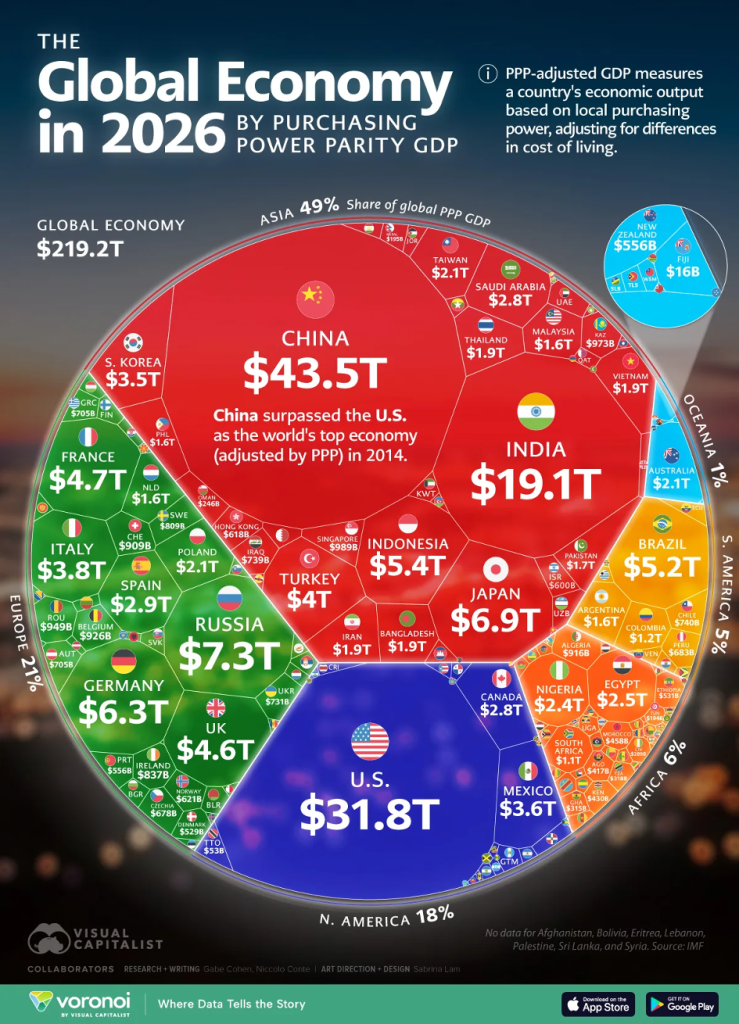
Source: Visual Capitalist
According to this calculation, China ranks ahead of the US, Russia ahead of Japan, and Germany.
Furthermore, the Collective West, as the aggressor, finds itself in a domestic political and economic situation that does not allow for a military showdown with Russia, Iran, and China: US debt stands at over 121%—the last time this was the case was at the end of World War II, following an industrial war that brought the US global dominance. After 35 years, and under economic and political conditions that remained favorable to the US, this debt was reduced to below 40%.
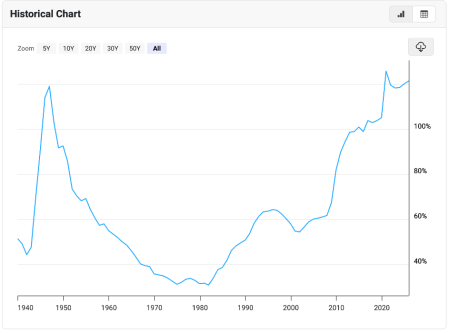
 Source: Macrotrends
In 1945, the Americans reached the height of their power. Together with the Soviet Union, they dominated the course of the war, held 22,000 metric tons of gold, and American industry produced 70% of the world’s manufactured goods. This is what true “full spectrum dominance” looks like: military dominance, industrial dominance, gold—because whoever has the gold sets the rules. Now the US is once again facing a world war, and the situation looks much like it did after the last war, with one major difference: China is at least the US’s economic equal, with far more favorable economic conditions.
These are not the conditions necessary for a military conflict on a global scale—neither financially, nor economically, nor, consequently, politically.
Middle East
It is clear from the text of the MOU that Iran has defeated both Israel and the US militarily; otherwise, the Americans would never have signed such a document. Israel cannot, without risking the collapse of its own delusions of great-power status, comply with the spirit of the document and end the war in Lebanon and Gaza. Therefore, there will be no peace.
Our comments on this topic: “Iran Defeats the US – Thoughts.” In Iran, voices are growing louder claiming that the president and foreign minister are not negotiating hard enough—public pressure in Iran is calling for a tougher stance toward the US and Israel. Iran’s Supreme Leader, Mojtaba Khamenei, has approved the memorandum of understanding (MoU) with the US to end the regional war under certain conditions. However, in a public statement, he said that he fundamentally held a “different view,” but had agreed to the agreement after receiving guarantees from President Masoud Pezeshkian that Iran’s national rights and the “Resistance Front” would be safeguarded. This is a clear indication that the Iranians are ultimately unwilling to make compromises at the expense of Lebanon and Gaza.
It is to be expected that the conflict in the Middle East will continue: Neither the US nor Israel is willing to accept defeat in the war and deal with its consequences. This stance maintains a state of limbo that could tip in one direction or the other at any moment. However, this strategy is countered by the fact that time is running out for the West because of Hormuz. The dwindling oil reserves were the main reason the US signed this MOU in its current form in the first place. The Americans are thus seeking a state of limbo that allows them to prepare their next military steps in peace; however, this state can only be maintained if the Strait of Hormuz remains open in the meantime. While approximately 130 ships passed through the Strait of Hormuz daily until February 28, 2026, these numbers dropped to practically zero, then stabilized at 5%–10% of pre-war levels, before surging to 70 ships on June 25, 2026. These figures should be treated with caution: It is said that the majority of these 70 ships were exporting oil from Iran after the US lifted the oil sanctions upon signing the agreement. If the Israelis do not withdraw from Lebanon and the Iranians remain steadfast—which is to be expected—then the Strait of Hormuz will remain a congested bottleneck: the time bomb for the West’s supply of raw materials continues to tick.
The Iranians can wait—the Americans cannot. When assessing the situation, one should simply disregard Donald Trump’s statements, because Trump speaks of peace one moment and war the next, changing his mind sometimes several times a day. He seems to believe that he can achieve something with the Iranians through this “New York-style deal-making” terror, but that is not the case, since he achieves only one thing: Americans are increasingly proving themselves to be agreement incapable, thereby threatening world peace.
War in Europe
The armed conflict in Ukraine, instigated by the West, began in 2014. Only those who do not classify Ukraine’s years-long artillery shelling of the Donbass as an act of war claim that the Russians started the war in February 2022. This is just one fact that is so obvious that one can only wonder at the West’s arguments that Russia is the aggressor.
Another fact is that this war has completely transformed the technology and tactics of warfare—the parties had to adapt to a new kind of war dominated by drones and missiles. Tank columns and troop concentrations are attacked by inexpensive drones as soon as they are detected—and they are detected very quickly. The warring parties had to undergo migration and learn this new art of warfare. The Russians, in particular, have done this successfully and now dominate the battlefield in a new way: through slow, efficient advances, because massed attacks produce only one thing—heavy casualties. Similar waves of technological advancement have occurred time and again. The machine gun, which was already in use before World War I but whose significance was underestimated at the time, brought an end to maneuver warfare as early as the first year of the war, when large columns of soldiers advanced toward the enemy and were wiped out. Toward the end of World War I, the tank brought some movement back to the front lines. However, comparing the frontline situation in Ukraine to that of World War I is a flawed analogy: Slow movements in small groups seem, so far, to be the only way to survive the drone barrage and maintain mobility.
Recently, Western media have been reporting that the Ukrainians have the upper hand in the war. However, this is fake news that has nothing to do with the reality on the ground. One must distinguish between the fighting on the front lines and NATO’s drone attacks in Russia. On the Donbass front, only a few fortified cities still stand in the Russians’ way; once those are taken, the Donbass will be liberated. Beyond that, there are no longer any fortifications worth taking seriously. Rather than going into details, I refer you to one of the best channels, Military Summary, which has been providing a twice-daily update on the situation at the front since the war began.
The West has not yet recognized the signs of the times. Its experts believe they will be successful in a war against Russia. However, they have not even defined their war aims in any way. Thus, they have no strategic plan against Russia other than to weaken it.
First and foremost, the Germans set the start of the war against Russia for 2030. However, it is now 2026, and the Germans apparently assume that, with Ukraine acting as their proxy, they can send drones and cruise missiles into Russia with impunity until 2030. Europe’s approach is, of course, coordinated with the US. The use of these weapons systems is not possible without American input. President Putin made this very clear a few days ago.
Many observers and experts both inside and outside Russia believe that President Putin will soon decide to launch a strike against targets in Europe—including those outside Ukraine.
There is a wide range of opinions on this topic. We have already published several articles on this subject: In “Will 1914 Repeat Itself? Will War Between Europe and Russia Finally Break Out?,” we also examined the Karaganov Doctrine, which advocates the use of nuclear weapons, and concluded that an attack is necessary, but not with nuclear weapons. Scott Ritter subsequently addressed the “Karaganov fallacy” and also spoke out clearly against the use of nuclear weapons.
Conclusion
In the Middle East, I see no realistic chance of ending the war, because that would mean, on the one hand, the withdrawal of American forces, and Israel would then be left alone as a small, genocidal aggressor. The Israelis are under pressure and are continuing their genocide in Gaza and Lebanon, paying no heed whatsoever to agreements between the US and Iran, because for Netanyahu personally, maintaining the war is the only way to survive politically.
In Russia, pressure is mounting on President Putin to adopt a more aggressive stance toward Europe, which is no longer even attempting to conceal its direct involvement in the war against Russia. Russia is intensifying its attacks on Ukraine, in part by destroying every gas station in eastern Ukraine to paralyze transportation logistics. Ground forces are making visible progress, and once the last fortified cities in the Donbas are liberated—which is likely to happen within the next few weeks—the path to the Dnieper will be clear.
President Putin is thus banking on a military solution in Ukraine and waiting for an energy crisis to unfold in Europe, where many flights are already being canceled under flimsy pretexts.
The concerted media coverage in the West claiming that the tide has turned in Ukraine finds not the slightest confirmation in the reality on the ground in Ukraine. The fuel shortage in Russia is also being exaggerated. In some regions, fuel is being rationed at gas stations. However, this is in no way sufficient to change Russia’s course of action.
Very occasionally, I have the opportunity to speak with someone who lives in Kyiv. According to this person, the situation is catastrophic, and over 90% of the population is against Zelensky. When I asked why the people weren’t rising up, the source replied that people were so intimidated by the terror of the security and intelligence services that the communication necessary for an uprising was impossible. Ukraine, which is portrayed by the West as a shining example of democracy, seems to be a time bomb whose ticking goes unheard out of fear.
My concerns that a war between Europe and Russia might break out—even though Europe has virtually no military power—have never been greater. President Putin will not be the one to take the first step toward a Third World War. Only he knows how much longer he will tolerate the West’s systematic provocations and how he will respond to them.
Doing The Opposite: Studies Show Gigantic Wind Farms Significantly Warm The Night
By P Gosselin | No Tricks Zone | July 5, 2026
Germany’s online Report24 has an article titled: “Studies Show Gigantic Wind Farms Significantly Warm the Night”.
Proponents of the energy transition often ignore or conceal the negative local climate impacts of wind turbines. Report24 references a 2012 study published in Nature Climate Change by Liming Zhou and his research team, which investigated the impact of large wind farms on land surface temperatures in Texas.
Researchers analyzed satellite data from 2003 to 2011 covering an area in Texas that hosts four of the world’s largest wind farms. In the areas with wind farms, nighttime surface temperatures in summer increased by up to 0.65 °C more than in comparable areas without turbines. The calculated warming trend was up to 0.72 °C per decade.
Why do turbines cause warming? At night, the ground cools down, making the air near the surface colder than the layers above. The turbine rotors disrupt this natural stratification, mixing the layers and forcing warmer air down to the surface, which warms and dries out the ground. Germany is plastered with circa 30,000 turbines spread across the country. In addition to the growing urban heat island (UHI) effect, Germany’s local climate is being disrupted by its widespeard use on wind turbines.
Politicians and mainstream media have been deliberately ignoring these facts since 2012. The local warming caused by wind farms is falsely blamed on CO₂-driven climate change in order to maintain the narrative of “saving the climate.”
Also, deforestation is underway in Germany in order to clear the way for largescale windparks, severely damaging a natural ecosystem that acts to cool the local climate.
No, Futurism, One Momentary Hot Spot on Antarctica Doesn’t Prove a Climate Crisis
By Anthony Watts | ClimateRealism | June 23, 2026
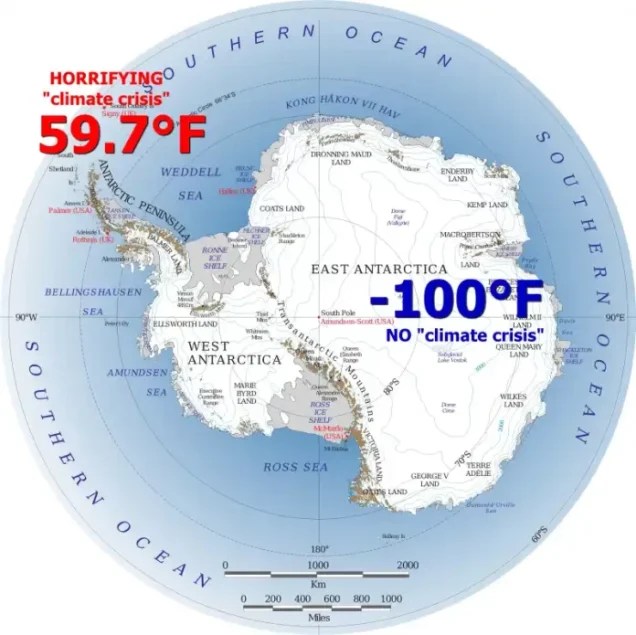
A recent article in the online journal Futurism, titled, “Scientists Horrified as Huge Heatwave Hits Antarctica,” claims climate change caused a “huge heatwave” in Antarctica, bringing temperatures on the Antarctic Peninsula nearly 36°F above average and briefly pushing readings above freezing. This is highly misleading. A single weather event says nothing meaningful about long-term climate trends, and the article ignores both Antarctica’s enormous geographic variability and the exceptionally cold conditions simultaneously occurring elsewhere on the continent. The heatwave Futurism suggested wasn’t a continent-wide crisis, but was a localized, unalarming event.
The article is largely a rewrite of a Guardian story focused on temperatures measured on the Trinity Peninsula, the northernmost extension of Antarctica. Researchers reported temperatures reaching approximately 15.4°C (59.7°F) during a brief warm spell on June 6.
What readers are not told is that the Antarctic Peninsula is not representative of Antarctica as a whole.
In fact, the warmest part of Antarctica is the Antarctic Peninsula. Nicknamed the “banana belt,” it stretches northward toward South America and experiences milder maritime conditions. During the austral summer, temperatures can occasionally exceed 10°C (50°F). The peninsula extends northward toward South America and is heavily influenced by maritime weather patterns and ocean currents. It is by far the warmest part of Antarctica and has long experienced periodic warm-air intrusions, föhn wind events, rain episodes, and above-freezing temperatures. These events are unusual, but they are not unprecedented.
In fact, the article itself acknowledges that the warmth was associated with “extremely strong westerlies.” In other words, this was a weather event driven by warmer atmospheric circulation patterns, not a direct measurement of climate change.
What Futurism misses is the fact that weather is not climate.
Climate is measured over decades. A single day, a single week, or even a single season tells us very little about long-term temperature trends. If every unusually warm day is presented as proof of climate catastrophe, then intellectual consistency would require every unusually cold day to be presented as evidence against it. The media rarely applies that standard.
The timing of this story is especially revealing because while headlines were breathlessly reporting a temporary warm spell on the Antarctic Peninsula, much of the rest of Antarctica was experiencing brutally cold conditions.
According to observations highlighted by meteorologist Cap Allon, the Amundsen-Scott South Pole Station recorded a temperature of -73.6°C (-100.5°F) on June 16, with a daily maximum of only -69.9°C (-93.8°F). That was the South Pole’s first sub–70°C reading since 2023.
One part of Antarctica briefly experiences an unusual warm episode, while another part of the continent drops below -100°F. That is how weather works on a continent larger than the United States and Mexico combined.
Yet only one of those events, specifically the anomalous high temperature one, generated international headlines.
The article further claims that the heatwave follows “decades of increasingly warm temperatures observed on the white continent.” That statement is false.
Antarctica is not warming uniformly. While portions of the Antarctic Peninsula experienced warming during parts of the late twentieth century, numerous studies have shown little warming or even cooling across large sections of East Antarctica, with East Antarctica making up the bulk of the continent. Antarctic sea ice has also exhibited substantial variability from year to year and decade to decade.
The continent is governed by complex interactions involving ocean currents, atmospheric circulation, volcanic influences (including subsurface heating under West Antarctica where the peninsula lies), sea ice dynamics, and natural climate oscillations. That complexity disappears in Futurism’s opinionated article.
Instead, readers are given the now-familiar formula: identify a dramatic weather event, attach it to climate change, mention the “Doomsday Glacier,” and imply catastrophe is around the corner. Climate Realism has debunked claims of the Thwaites Glacier’s imminent collapse repeatedly, previously. The article’s reference to Thwaites Glacier is a particularly misleading red herring, because it has nothing to do with the reported weather event. The mention serves one purpose: reinforcing a broader climate crisis narrative.
This is increasingly common in climate reporting. Any unusual weather event becomes an opportunity to recycle the same talking points about glaciers, sea level rise, tipping points, and future disasters, regardless of whether they are directly related to the event being discussed.
Concerning the Antarctic Peninsula, the facts are these: Antarctica has always been susceptible to periodic warm-air intrusions because of its geography and proximity to relatively warmer ocean waters; the Southern Ocean, atmospheric rivers, and strong westerly winds can occasionally transport substantial heat into the region. These processes existed long before climate change became a political issue.
Most importantly, a single warm event cannot establish a trend. Scientists understand this principle when analyzing climate data. Journalists should understand it as well.
A proper climate analysis requires decades of observations across the continent, careful examination of regional variability, and separation of weather noise from climate signals, not the slap dash presentation of misleading, sensational claims assembled by Futurism.
Antarctica remains the coldest continent on Earth. While the Antarctic Peninsula briefly experienced unusually mild conditions, the South Pole itself was simultaneously plunging near or below -100°F in multiple other locations.
That fact alone should remind readers that one weather event, no matter how dramatic the headline, is not evidence of a “climate emergency,” it’s simply weather. One warm spell on the Antarctic Peninsula becomes proof of climate catastrophe, while simultaneous temperatures below -100°F at the South Pole are ignored. That’s not objective journalism, that’s agenda-driven alarmism.
Survivorship Bias: The Logical Error at the Heart of Modern Medicine
An Essay on Why You Only Hear From the People Who Lived
Lies are Unbekoming | June 18, 2026
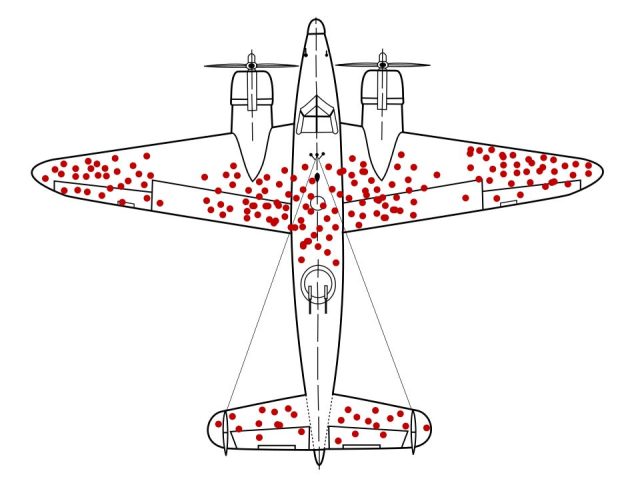
The bullet holes show where a plane could be hit and survive. The places without holes are where the lost planes were hit.
Illustration: Martin Grandjean, McGeddon, and Cameron Moll. Wikimedia Commons, CC BY-SA 4.0. Source: File:Survivorship-bias.svg
Wald at the Statistical Research Group
In 1943, the U.S. military was about to armor its bombers in exactly the wrong places. The analysts had examined every bomber that came back from combat, mapped the bullet holes across the airframe, and proposed reinforcing the spots where the holes clustered. The data was right there. You could see it on the planes.
They referred the question to the Statistical Research Group at Columbia University, a small team of mathematicians assembled for the war effort. The Hungarian-born statistician Abraham Wald examined the bullet-hole maps and gave the opposite recommendation. Armor the engines and the cockpit. The places where the returning planes had no bullet holes.
The military analysts had committed a logical error so simple they could not see it. They were studying the planes that came back. The planes shot through the engines and the cockpit did not come back. They had gone down across two oceans and the territory between them. The returning planes did not reveal where bombers were vulnerable. They revealed where bombers could be hit and still fly home.
The bullet holes on the survivors mapped survivable damage, not dangerous damage. Armoring where the holes were meant armoring the places that did not need armoring. The damage that mattered was on the planes you could not examine because they were destroyed.
Wald’s memorandum was classified. Decades later, when his work was declassified and republished, the principle he had identified came to be called survivorship bias.¹ ² It is the most pervasive and least understood logical error in any field that draws conclusions from a visible population of survivors.
The same error sits at the center of the modern screening-and-treatment industry.
The Error Generalized
Survivorship bias operates wherever a process selects what gets seen. The destroyed do not file reports, and the audience reads only what made it through.
Mutual fund performance averages exclude funds that closed. Hedge fund return statistics quietly drop the funds that liquidated. The historical returns of “the market” routinely omit bankruptcies, delistings, and total losses. Funds that lived publish their numbers; funds that died publish nothing. The retail investor reads the winners.
The literature on entrepreneurship was built the same way. CEOs who succeeded wrote memoirs about their habits and their early-morning routines. The thousands of equally disciplined founders who failed wrote nothing because their companies went under. The “success habits” identified by reading the survivors are, in many cases, just habits, shared by the dead and the living alike, with no causal relationship to outcomes.
In architecture, the buildings that survive are studied for their construction methods. The buildings that collapsed in storms, earthquakes, or fires are no longer there to be examined. Old buildings appear well-built because the badly-built ones are gone.
In each case, the visible sample is selected by the very property you are trying to measure. You cannot learn about plane vulnerability from intact planes. You cannot learn about cancer survival from cancer survivors.
Survivorship Bias in Medicine
A woman undergoes mammography in her early fifties. The scan finds a small lesion. She receives a biopsy, a lumpectomy, six weeks of radiation, and five years of tamoxifen. She is alive ten years later. She becomes an advocate, walking in Race for the Cure and telling her sister, her daughter, and the women in her neighborhood that screening saved her life. Get the test.
Her experience is real, her gratitude genuine. The conclusion she draws does not follow from either.
What she does not know, what she cannot know, is what would have happened to her without the screening, the biopsy, the surgery, the radiation, and the years of medication. She cannot run the counterfactual on herself. The version of her that did not get the treatment does not exist, and she has no way to consult it.
The institutions that promoted her screening have access to data she does not. Population-level data, accumulated across decades of randomized and observational studies, is consistent with four overlapping forms of survivorship bias, each of which inflates the apparent success of the system. Together they are sufficient to explain most of what the industry presents as the triumph of “early detection.”
Survivorship Bias Proper
The most direct form: only the living testify.
Eight months after her mastectomy, a woman dies of chemotherapy-induced sepsis. She does not appear at the October fundraiser. Six weeks after his prostatectomy, a man dies of cardiac complications. He writes no op-eds about prostate health. The radiation that “cured” the first cancer induces a second one five years later, and the patient’s family attends a funeral, not a marathon. The chemotherapy regimen that ostensibly drove the tumor into remission also drove the patient’s bone marrow into failure, and she dies of sepsis a year later, recorded by quiet bureaucratic convention as a “cancer death.”
When the public hears about cancer treatment, it hears from the patients who survived. Those who did not survive are statistically invisible. They are counted in mortality columns nobody reads, while their grateful surviving counterparts address the television cameras. The audience for screening campaigns sees a heavily filtered population, filtered by the treatments themselves.
The filtering goes further than visibility. It reaches into the mortality data itself. When a patient on chemotherapy dies of cardiotoxic heart failure, the death is typically coded as a cancer death. When a patient with treatment-induced bone marrow failure dies of sepsis, it is coded as a cancer death. When the surgical complication kills the patient on the operating table, it is generally coded as a cancer death. When the second cancer induced by radiation given for the first cancer kills the patient ten years later, the second cancer is frequently recorded as primary, the radiation that caused it noted in passing if at all. The coding conventions tilt systematically in one direction: failures of treatment are folded back into the column labeled “disease.” The treatment is shielded from blame. The cancer absorbs it. The mortality statistics that institutions cite to justify aggressive treatment are themselves an artifact of how treatment failures are recorded.
Lead-Time Bias
Finding a cancer earlier does not mean treating it earlier extends life. It means knowing about it longer.
Two women with identical lesions, identical biology, and identical eventual outcomes. Both die at age seventy. Woman A is screened at fifty, her cancer is detected, and she is “treated” for the next twenty years. Woman B is unscreened. She develops symptoms at sixty-five, is diagnosed, and dies at seventy.
The standard reporting metric is five-year survival from diagnosis. By that measure, Woman A counts at 100% survival. Woman B counts at 0%. The treatment looks miraculous. Nothing has actually changed. Both women died at seventy. Woman A simply spent twenty years as a patient.
The five-year survival statistic is the standard currency of cancer reporting. In the presence of widespread screening, it is also a metric that can rise to 100% without saving a single life. Between 1950 and 1995, the five-year survival rate for prostate cancer in the United States rose from 43% to 93%. The age-adjusted mortality rate from prostate cancer over the same period barely moved.³ The screened population learned about their cancer earlier. They did not die later.
When you read that “early detection” has improved five-year survival rates for breast, prostate, or thyroid cancer, you are reading a statistic structurally biased toward the appearance of benefit even when no benefit exists.³ ⁴
Length-Time Bias
Screening preferentially detects slow-growing lesions. Aggressive cancers grow rapidly between screening intervals and present symptomatically, not through the scan. Indolent lesions sit for years, available to be detected at the next mammogram or PSA test.
The population of cancers caught by screening is therefore enriched for slow biology, for lesions that were less likely to kill in the first place. Patients with these lesions tend to do well, not because the screening saved them but because their cancers were not going to kill them on any rapid timescale. The aggressive cancers, the ones that genuinely threaten life, frequently arise and progress in the gaps between scans.
Screening catches the cancers least in need of catching. The system then takes credit for the favorable outcomes of patients who would have done well regardless.
Overdiagnosis
The fourth and most powerful form. Many of the lesions detected by screening are not, in any meaningful sense, going to harm the patient. They are stable, non-progressive anatomical findings that medicine has chosen to label as cancer.
Bleyer and Welch, examining three decades of U.S. mammography data, estimated that 31% of breast cancers detected by screening represented overdiagnosis: disease that would never have produced symptoms or shortened life.⁵ The Cochrane systematic review of mammography trials concluded that for every life potentially saved by screening, ten women receive treatment for a cancer that would not have harmed them. The same review found no reduction in all-cause mortality from screening.⁶
In South Korea, the introduction of widespread thyroid ultrasound produced a fifteen-fold increase in thyroid cancer diagnoses over two decades. Mortality from thyroid cancer did not change. The country had not experienced a thyroid cancer epidemic. It had begun finding microscopic lesions that had always existed in the population, at autopsy in people who died of other causes, and that had never killed anyone before they were found and treated.⁷
Autopsy studies of men who died of unrelated causes have found prostate cancer cells in roughly a third of those in their forties, rising to two-thirds by their late sixties.¹⁵ The lifetime mortality from prostate cancer is approximately 3%. Most older men carry the disease into a natural death from something else; they die with prostate cancer, not from it. The PSA test cannot distinguish between the cancer that would have killed and the cancer that would have been silently carried into the grave. It detects both. It produces a diagnosis in both. The men with non-threatening lesions, who vastly outnumber the rest, are subjected to surgery, radiation, and hormonal therapy for a condition that was never going to harm them. They survive what was never threatening. They credit the system. They tell other men to get tested.
The ERSPC trial, the largest prostate cancer screening trial ever conducted, found that PSA screening reduced prostate cancer mortality by a small absolute amount over thirteen years. To prevent one death, approximately twenty-seven men had to be diagnosed and treated, most of whom would not have died from their disease and many of whom were rendered incontinent, impotent, or both by the intervention.⁸
Every overdiagnosed patient is, by definition, a successful “treatment outcome.” She survived a treatment for a condition that was never going to harm her. The system takes credit. She testifies on its behalf.
Why the System Selects for Evangelism
The four biases would matter less if the visible patients were a representative sample. They are not. The system that produces them also amplifies them.
Hospitals run survivor outreach programs. Pharmaceutical companies fund patient advocacy organizations. The pink ribbon ecology, Susan G. Komen, the National Breast Cancer Foundation, the dozens of subsidiary charities, operates almost entirely on survivor testimony. October fills American mailboxes with pink-ribboned testimonials. The American Cancer Society’s national publicity is built on survivor stories. The patient who survived is the asset.
The corporate machinery built around the survivor is substantial. Estée Lauder co-founded the pink ribbon symbol with Self magazine in 1992 and now sells pink-ribbon cosmetics each October. The National Football League runs an annual “Crucial Catch” campaign with players wearing pink cleats and accessories. Major League Baseball stages pink-bat games on Mother’s Day. Yoplait produced pink-lidded yogurt for two decades under the “Save Lids to Save Lives” campaign. Ford sold pink-ribbon merchandise through “Warriors in Pink.” General Mills, KitchenAid, the National Hockey League, the airlines, the cosmetics counters at every major department store all participate. The advertising spend on these campaigns runs into hundreds of millions of dollars annually, dwarfing the portion of the proceeds that ever reaches research and dwarfing many times over the portion of research funding that addresses environmental causes of breast cancer rather than treatment. The campaigns sell screening. The screening produces patients. Most patients survive, because most of what is found in screening was not going to kill them, and they testify. The testimony funds the next round of campaigns.
The patient who died is, from a marketing perspective, a problem. Her death cannot be celebrated. Her family is often grieving and angry. Her doctors generally do not call the local newspaper. She becomes a statistic in a column nobody reads, while the surviving patient in the next room becomes the face of the cause.
This selection is not a conspiracy. It is a structural feature of how the industry communicates. Living patients can be photographed; dead patients cannot. The living speak at events; the dead are credited, by quiet convention, to “the disease.”
The grateful survivor is also psychologically necessary for the treatment to continue being offered in its current form. The patient who has undergone radical mastectomy, six rounds of chemotherapy, weeks of radiation, and years of endocrine therapy must believe, on pain of intolerable cognitive dissonance, that this was necessary and life-saving. To accept that she may have been treated for a lesion that would not have harmed her, that she lost her breast, her hair, her fertility, her cardiac reserve, perhaps her marriage, to a system that misjudged the threat, is psychologically devastating. The mind protects itself. She becomes an advocate.
The advocate then promotes the system to other women, who undergo screening, get diagnosed, get treated, and become advocates in turn. Each cycle generates more survivors, each of whom credits the system that produced them. The dead and the harmed are silent by definition.
The financial scale of this ecosystem is not small. The United States spends roughly two hundred billion dollars annually on cancer-related medical care. Mammography alone is a multi-billion-dollar industry. The PSA test, despite repeated expert task force recommendations against routine screening, generates billions in downstream procedures. The pink ribbon charities raise hundreds of millions per year, much of which goes to “awareness,” that is, to producing more screening, more diagnoses, more treatment, and more survivors. The asset class, the patient, is manufactured by the process that then takes credit for her survival.
In 2018, a Goldman Sachs equity research report posed the question explicitly to its biotechnology clients: “Is curing patients a sustainable business model?”⁹ The analysts noted that one-time cures undermine recurring revenue streams. The pharmaceutical industry’s most profitable customers are chronic patients, not cured ones. The screening-and-treatment cancer model is, from a financial perspective, an excellent business. It produces patients. It treats them for years. Many of them survive, which is what the model needs them to do, because survivors testify and dead patients do not.
Inside the Testimonial
The cancer survivor has four pieces of information. She was screened. Something was found. She received treatment. She is alive years later. From these facts, she draws a single conclusion: the screening and treatment saved her life.
The inference is intuitive but unsupported. The same four facts admit at least three other explanations.
The screening detected a lesion that would never have harmed her. She survived not because of the treatment but in spite of it. The treatment did damage that she absorbed because the rest of her body was healthy enough to recover.
The lesion was real but slow-growing. She would have lived equally long, with less suffering, by doing nothing.
The lesion was real and biologically active, but her body’s repair mechanisms, what the establishment calls her constitution and what terrain medicine recognizes as her terrain, would have managed it. The treatment was incidental to her survival.
She cannot distinguish between these explanations from her own experience. None of them is available to her introspectively. The only way to determine which is correct, at the level of a population, is the randomized controlled trial, the kind of trial that, in most screening contexts, has either not been done with adequate follow-up or has produced equivocal results that the institutions promoting screening do not publicize.
Her testimonial is sincere. It is also, with respect to the question of whether the treatment worked, evidence of nothing in particular. The dead woman two beds down the hall, who received identical screening and identical treatment and died of cardiotoxic chemotherapy, would have a different testimonial if she could give one. The system that asks the survivor to speak does not ask the dead woman’s family to speak. The asymmetry produces the appearance of a treatment success rate the underlying data does not support.
What Survives the Error
Once you see survivorship bias, you cannot unsee it. What remains is not paranoia but a discipline: asking, in every medical context, which population you are looking at and which population is missing.
When a screening campaign reports that “five-year survival rates have improved,” ask whether overall mortality has changed. Five-year survival can rise to 100% without saving a single life if all the increase comes from earlier detection of lesions that were going to be survived anyway. Overall mortality, deaths per hundred thousand population per year, is much harder to manipulate. It is also the only figure that answers the question the survival rate appears to answer.
A cancer survivor telling you her treatment saved her life can be sincere and still wrong about causation. The conviction is real. The causal claim it carries is not derived from anything she has direct access to. You can be glad she is alive without accepting her account of why.
An oncology center’s published survivor outcomes report a filtered population. Ask about the patients who did not complete treatment. Ask about the patients who died of treatment-related complications and were classified as cancer deaths. Ask about the patients whose follow-up was lost because they moved into hospice care or stopped responding to calls. The shape of the population that gets reported is the shape of the population that survived long enough to be counted.
Facing a screening recommendation yourself, the question to ask is the one the military analysts in 1943 did not ask: what does this examination fail to show me? The bullet holes on the surviving bombers concealed the bullet holes on the destroyed ones. The success stories of the screening industry conceal the women treated for lesions they did not have, the men rendered impotent by surgery for cancers that would never have grown, the second cancers induced by the radiation, and the patients whose treatments killed them and who are now counted, by quiet bureaucratic convention, as having died from their disease.
The full investigative case on these screenings, what they detect, what they miss, what they manufacture, and what they cost, has been documented at length in earlier work.¹⁰ ¹¹ ¹² ¹³ ¹⁴
What the Trials Actually Show
Defenders of mammography routinely cite two trials. The Health Insurance Plan of New York trial, begun in 1963, and the Swedish Two-County Trial, conducted between 1977 and 1985, both reported reductions in breast cancer mortality among screened women. Both have been criticized on methodological grounds. The HIP trial’s randomization was uneven, with baseline differences between arms and exclusion rules applied asymmetrically. The Two-County Trial used cluster randomization that did not consistently balance comparison groups and lacked blinded cause-of-death assessment. Its mortality estimates shifted across successive reanalyses. The Cochrane systematic review of mammography trials classified both as carrying significant risk of bias.⁶
The most rigorously conducted breast cancer screening trial, the Canadian National Breast Screening Study, followed nearly ninety thousand women for twenty-five years. It found no reduction in breast cancer mortality from mammography screening, and no reduction in all-cause mortality.¹⁶
All-cause mortality is the figure that resists the gaming. When a study reports that breast cancer deaths fell among screened women but all-cause deaths did not, the women who avoided a death coded as breast cancer died of something else within the same window: heart failure from chemotherapy-induced cardiotoxicity, second cancers induced by the radiation given for the first, complications from the surgery, strokes after years of endocrine therapy. The Cochrane review and meta-analyses across multiple cancers have repeatedly found that all-cause mortality is essentially identical in screened and unscreened populations. The treatment that prevents one death produces another. The cancer-specific column improves; the death column does not. Survivorship bias gives the illusion of a saved life. All-cause mortality data shows that the life, where treatment did anything at all, was traded rather than added.
The Bombers and the Patients
Abraham Wald died in 1950 in a plane crash in the Nilgiri mountains of southern India. The principle he identified outlived him by three-quarters of a century and now sits, unrecognized by the institutions that depend on it, at the center of the modern medical industry.
The bombers that came back showed where a bomber could be shot and still come back. They did not show where a bomber was vulnerable. The cancer survivors who give interviews, walk in fundraisers, and tell their friends to get screened show where the modern oncology machine is not lethal. They do not show where it works.
The patients who died of their treatments are not at the marathon. The patients treated for lesions that would never have killed them have no way to know they were never in danger. The patients whose cancers were going to be survived regardless have no way to credit their own bodies rather than the chemicals introduced into them. They are the bullet holes on the wings: survivable damage, mapped and celebrated, while the damage that mattered remains invisible because the people who suffered it are no longer in the room.
Wald told the military to armor the engines and the cockpit, the places the surviving planes were not hit. The same instruction applies to medicine: look at what the survivors do not show you. The damage that matters is on the planes that did not come back, and on the patients who can no longer testify.
How to Explain This to a Six-Year-Old
Imagine all your friends drink a magic potion that’s supposed to keep them safe. Half of them disappear. The other half come back and tell you the potion worked great.
If you only listen to the friends who came back, you’ll be sure the potion is wonderful. You’ll tell other kids to drink it too.
But the other half are gone. They can’t tell you whether the potion hurt them. You don’t know whether the potion saved the friends who came back, or whether those friends would have been fine without ever drinking it.
When a cancer survivor tells you the treatment saved her life, listen to her kindly. But remember the friends who disappeared. They are part of the story too.
Quick Reference: The Four Biases
Survivorship bias. Only the living testify. Cancer patients who died of their treatments do not give interviews. The visible patient population is filtered by the treatments themselves.
Lead-time bias. Finding a cancer earlier does not extend life. It extends the time you know about it. Five-year survival rates can rise to 100% without saving a single life.
Length-time bias. Screening preferentially catches slow-growing lesions that were less likely to kill in the first place. Aggressive cancers arise and progress between scans, often undetected until they present symptomatically.
Overdiagnosis. Many screen-detected lesions would never have caused harm. The patient is treated for something that was not a threat, survives easily, and credits the treatment.
References
- Mangel, M., & Samaniego, F. J. (1984). Abraham Wald’s work on aircraft survivability. Journal of the American Statistical Association, 79(386), 259–267.
- Wald, A. (1943). A Method of Estimating Plane Vulnerability Based on Damage of Survivors. Statistical Research Group, Columbia University. (Declassified and republished by the Center for Naval Analyses, 1980.)
- Welch, H. G., Schwartz, L. M., & Woloshin, S. (2000). Are increasing 5-year survival rates evidence of success against cancer? JAMA, 283(22), 2975–2978.
- Welch, H. G., & Black, W. C. (2010). Overdiagnosis in cancer. Journal of the National Cancer Institute, 102(9), 605–613.
- Bleyer, A., & Welch, H. G. (2012). Effect of three decades of screening mammography on breast-cancer incidence. New England Journal of Medicine, 367(21), 1998–2005.
- Gøtzsche, P. C., & Jørgensen, K. J. (2013). Screening for breast cancer with mammography. Cochrane Database of Systematic Reviews, Issue 6, CD001877.
- Vaccarella, S., Franceschi, S., Bray, F., Wild, C. P., Plummer, M., & Dal Maso, L. (2016). Worldwide thyroid-cancer epidemic? The increasing impact of overdiagnosis. New England Journal of Medicine, 375(7), 614–617.
- Schröder, F. H., et al. (2014). Screening and prostate-cancer mortality in a randomized European study: results of the ERSPC at 13 years of follow-up. The Lancet, 384(9959), 2027–2035.
- Richter, S., et al. (2018). The Genome Revolution (biotechnology equity research report). Goldman Sachs Global Investment Research, April 10, 2018.
- Unbekoming. The 12 Screenings That Manufacture the Patients They Claim to Find.
- Unbekoming. The Screening Trap.
- Unbekoming. Breast Cancer: What They Didn’t Tell You.
- Unbekoming. The PSA Trap: How a Flawed Test Built a Billion-Dollar Industry and Destroyed Millions of Men.
- Unbekoming. The Unbekoming Cancer Compendium.
- Sakr, W. A., Grignon, D. J., Crissman, J. D., Heilbrun, L. K., Cassin, B. J., Pontes, J. J., & Haas, G. P. (1994). High grade prostatic intraepithelial neoplasia (HGPIN) and prostatic adenocarcinoma between the ages of 20-69: an autopsy study of 249 cases. In Vivo, 8(3), 439–443.
- Miller, A. B., Wall, C., Baines, C. J., Sun, P., To, T., & Narod, S. A. (2014). Twenty five year follow-up for breast cancer incidence and mortality of the Canadian National Breast Screening Study: randomised screening trial. BMJ, 348, g366.
“Crimson Thread” apartheid project threatens family already displaced in north Jordan Valley
International Solidarity Movement | July 5, 2026
A family – displaced from Khirbet Samra in July 2025 after years of constant harassment by occupation forces and violent settler Uri Cohen – moved to Atouf, where they purchased a plot of land, determined to defy the occupation’s efforts to destroy their livelihood.
Having to leave their home of more than 20 years was both deeply traumatic and hugely expensive. The 40 dunams in Atouf cost half a million shekels (about 160,000 USD) and transportation costs for all their livestock and belongings were high. Atouf is a primarily agricultural area and there is little grazing land; the family is therefore forced to feed their animals grain and hay. They have also had to spend 150,000 shekels (50,000 USD) on building pens spacious enough to protect their sheep from the heat. The costs of maintaining their flock of 800 sheep have proved unsustainable, and the family has had no choice but to sell 300 of them.
In early December 2025, less than six months after their arrival in Atouf, the family received a demolition order: their property is situated on the path of “Crimson Thread”, a Zionist project that entails the construction of a 22 km long military road with an apartheid fence and a 20m wide “buffer zone” running along eitherside. Stretching from Ein Shibli to Tayasir, the barrier will cut through — and off from one another — the communities of Atouf, Tammoun and Yarza.
On the occupation’s plans, the road cuts almost exactly through the middle of the family property; 36 dunums have already been confiscated, and in January 2026 demolition orders were issued for the remaining 4 dunums, which include the family’s house and the sheep pens.
The family, together with other families and the Tubas municipality appealed the demolition orders, submitting the landowners’ deeds, and the barrier project was temporarily suspended. But then, on June 7, the Israeli court ruled that in 5 of the 7 areas impacted by the project the excavation work could continue (the two sections in which the suspension order still applies are those in the vicinity of Khirbet Yarza). Building demolitions (32 across five sections, 9 of which are residential structures) are still under discussion in court.
Since June 13, the family have had to endure the constant presence of soldiers and bulldozers on their property. The military have installed caravans and tents and dug a trench between the 36 confiscated dunums and the family’s home and pens. Now, the bulldozers are at work preparing for the construction of the barrier; the digging has destroyed the pipes that transport water to the family’s crops and livestock. When a family member went to get water from a well that is situated on the family’s land he was accused by the occupation forces of stealing water.
The family, together with the whole community of Atouf and all the Palestinian villages threatened by “Crimson Thread” are calling for international media and institutional attention in order to expose the brutality of this project which is intended to bisect the Jordan Valley, further isolating Palestinian communities from one another and dramatically worsening their conditions of life.
“during the day they carry out cutting, bulldozing, and destruction works, while at night they fire burning illumination flares over the area. These are dropped near the livestock shelters, creating constant fear, as we worry they might fall onto animal fodder or plastic greenhouses and set everything on fire.” – a family member
How Germany blew the EU’s chance for information freedom
By Rachel Marsden | RT | July 5, 2026
It’s not every day that an EU member state has the opportunity to push back in favor of freedom. At least not without elections. But a German court did have that chance – and promptly blew it on behalf of European citizens everywhere.
Back in 2022 when the Ukraine war was ramping up, the European Commission made an executive order banning Russian media broadcasting in the EU. Meaning that you couldn’t – and still can’t – access RT from within the EU, either on TV or on the web, without a VPN.
So some folks running a website in Saarbrucken, Germany, near the French border, started including some RT videos in their live feed. They reportedly did this exactly four times, back in 2023. Whoop-dee-do, right?
Wrong. This is the EUSSR we’re talking about, remember?
For this, the accused ended up facing criminal prosecution in Germany for promoting some EU-sanctioned RT Germany content. But it turns out that even the German court in Saarbrucken considering this case had doubts as to whether these guys and their website actually fit the definition of an “operator” under the EU sanction’s language that “prohibits any operator from broadcasting, enabling, facilitating or otherwise contributing to broadcast, any” Russian media content. So the German court referred the question to the European Court of Justice tasked with interpreting and clarifying EU regulations and laws.
Wrong question, guys. Why didn’t you start with asking the ECJ whether the regulation itself, made unilaterally by the EU’s unelected and unaccountable executive branch, is even valid at all under the EU Charter of Fundamental Rights and its Article 11 protecting freedom of expression? The fact that the question wasn’t put to the European court by the German one has spawned a judgment that’s stunning in its failure to interpret the application of any free speech restrictions narrowly enough to avoid the disproportionate limiting of free expression.
The German court missed the forest for the trees and got down into the weeds and all hung up on the comparatively minor issue of whether the website could be considered an “operator” without being a commercial entity. Which the European court then used as a prelude to launch a sweeping McCarthyist “reds under the bed”-style tirade.
“The term ‘disinformation’ is a translation of the Russian word ‘дезинформация’ (dezinformatsiya), coined in the early 1920s by the Soviet intelligence services. Joseph Stalin is credited as being the originator of that term, deliberately making it sound French in order to make it seem Western in origin and thereby enhance its credibility,” wrote the EU court, self-identifying as a history professor. How about if I take that as an open invitation to self-identify as a judge in my capacity as a final-year law student?
The ECJ ultimately ruled that commercialism is irrelevant when the website solicits donations, and had raised over €60,000 within a period of a year. It basically said, look, any commercial nature of the platform risks being a false dichotomy, because who’s to say that the sanctioned entities themselves wouldn’t be paying these independent outlets through donations to promote their banned content: ”Even though, for the purposes of classification as an ‘operator’, no economic activity or income generation is necessary, the context of an appeal for donations enabling such sums to be collected warrants some comment. The fact that some websites are financed by donations rather than by a registered commercial activity justifies increased vigilance as to their possible use as a tool for propaganda purposes, in particular in the case of State-sponsored disinformation campaigns,” the European court ruled. “That lack of clarity makes it more difficult to identify financial flows and, therefore, the actors likely to influence editorial policy or content. It thus creates an environment conducive to interference by external interests, including by third countries, which may intervene directly or indirectly in the production or broadcasting of content.”
Isn’t it the prosecution’s job to present actual evidence and proof of influence through the powerful state-backed legal instruments at its disposal? Shouldn’t the ECJ’s definition of “operator,” if it leans so heavily on the risk of foreign corruption, therefore hinge on whether actual collusion has first been established beyond any reasonable doubt? The ECJ sounds shockingly blasé here about the basic burden of proof for criminal conviction.
This court case had been stayed, or suspended, in Germany pending the ruling by this European Court of Justice. But now it’s free to convict these guys of promoting banned Russian content, under the pretext that just maybe they’re not-so-independent media that schemed on the down-low to distribute Russian media content – something that a lot of people have been doing all over social media of their own volition.
Ultimately, what the buzz around this case effectively does is put a chilling effect on that sharing, and it also risks making people self-censor out of fear of being dragged into court for a judicial proctology exam and having their lives potentially ruined in the press over accusations of Russian collusion. What if these guys (and others) just happen to agree with some of the views expressed on banned Russian media? Who’s going to protect their honestly-held views from establishment authoritarianism?
Hang on, here’s a volunteer for the task.
“Freedom of the press is one of the cornerstones of democracy. And the EU protects what matters, including the right to receive independent, reliable information. The European Media Freedom Act helps keep journalists and sources safe, strengthens editorial independence and protects media organizations from undue interference or legal intimidation. Today, on World Press Freedom Day, we reaffirm our duty to support and protect journalists so they can do their work free from pressure, intimidation, or harm,” says unelected European Commission President and de facto Queen Ursula von der Leyen.
Oh, great. So the same people who censor speech are also its self-appointed defenders. Like an arsonist who goes running around setting fires but also works as a firefighter as their day job.
What’s clear from all this is that EU regulation may look precise on paper, but enforcement isn’t so straightforward. When even member state courts require an official interpretation, then how is the average person supposed to avoid running afoul of the law? The result ends up being less about what’s actually banned and more about what merely feels safe to touch. Not exactly the kind of vibe that one tends to aim for in a democracy.
Rachel Marsden is a columnist, political strategist, and host of independently produced talk-shows in French and English.
Featured Video
BRITAIN’S WARNING: PREPARE FOR WAR
or go to
Aletho News Archives – Video-Images
From the Archives
British weapons and personnel doing much of the killing in Yemen
Press TV – June 18, 2019
A detailed report published by the Guardian newspaper has shown how Britain is massively contributing to Saudi Arabia’s devastating war on Yemen as it suggests that London is not only supplying the bombs that fall on Yemenis, but it provides the personnel and expertise that keep the war going.
The comprehensive report by Arron Merat published on Tuesday showed that Britain was doing much of the killing in Yemen as the country continues to provide Saudi Arabia with everything it needs to turn its southern impoverished neighbor into a graveyard.
“Every day Yemen is hit by British bombs – dropped by British planes that are flown by British-trained pilots and maintained and prepared inside Saudi Arabia by thousands of British contractors,” said Merat in the report. … continue
Blog Roll
 Aletho News
- Yemen denounces European Parliament’s ‘hypocritical’ push to blacklist Ansarullah
- Qalibaf: UAE’s UN bid aims to ‘clear the runway’ for ‘Greater Israel’, whitewash genocide
- Pakistan reopens Iran border after boosting security: Report
- Why are so many Brazilians voting for Flávio Bolsonaro?
- Democrats Put Anti-Russia Agenda Ahead of American Workers
- Elijah Magnier: Yemen’s Strikes Are Shattering Saudi Arabia’s Long-Term Strategy
- Pentagon designates Chinese cultural centers national security threat
- Israel Demolishes Home Of Lebanese Journalist Whose Viral Film Exposed Pager Attack
- Record Oil, Empty Tanks: The UAE’s Miracle Recovery
- Burnham tackles Britain’s poverty with aggression in Yemen
- If Americans Knew
- An error has occurred; the feed is probably down. Try again later.
- No Tricks Zone
- Sudden Stratospheric Warming, Powerful El Niño Combination May Lead To Extreme Europe Cold, Energy Crisis!
- Two New Studies Find Thwaites Glacier Melt Cannot Be Driven By Human Activity Or A Warming Ocean
- E-Cars Reduce CO2 Emissions By Only 41% Compared To Internal Combustion Engine Vehicles
- Predictions Made By Renowned Climate Professor Over Past Decades Have Been Proven To Be Poor
- New Study Suggests Large Regions Of The Pacific Ocean Have Been Cooling For The Last 80 Years
- Germany’s Green Energy Debacle: High Energy Costs Force Kahla Porzellan to Close After 182 Years!
- New Study: 50 Years Of The Most Aggressive ‘Net Zero’ Policies Can Only Affect The Global Climate By 0.03°C
- US September “Heat” Was No Record…Many Records Set Decades Ago
- Latest European Green Energy Debacle; Portugal’s Largest Flagship Solar Park Insolvent!
- Green Energy Debacle: German Expert Professor Fritz Vahrenholt Warns Of Severe Economic And Social Consequences


