Reviving ISIS: A US weapon against the Resistance Axis
The Cradle | January 16, 2024
Iraqi security sources are warning of an ISIS revival in the country, which coincides all too neatly with the spike in Iraqi resistance operations against US bases in Iraq and Syria, and with widening regional instability caused by Israel’s military assault on Gaza.
More than six years after declaring victory over the terrorist organization, Iraqi intelligence reports now indicate that thousands of ISIS fighters are emerging unscathed, under the protection of US forces in two regions of western Iraq.
The missing piece of the puzzle
According to intelligence reports reviewed by The Cradle, at its height, ISIS consisted of more than 35,000 fighters in Iraq – 25,000 of these were killed, while more than 10,000 simply “disappeared.”
As an officer of one Iraqi intelligence agency recounts to The Cradle :
“Hundreds of ISIS fighters fled to Turkey and Syria at the end of 2017. After the appointment of Abdullah Qardash as the leader of ISIS in 2019, following the death of Caliph Abu Bakr al-Baghdadi, the new Caliph began to restructure the organization, and ordered his followers to return to Iraq. The organization exploited the long border with Syria, the security disturbances, and the diversity of forces on both sides of the border to infiltrate the Iraqi territory again.”
Imprisoned ISIS officials admit that infiltrating that border is not an easy task, because of the strict control imposed by the Iraqi Border Guards and the use of modern technologies, such as thermal cameras.
It therefore became necessary for the terror group to identify intermediaries capable of breaking through or bypassing these fortifications to transport its fighters across borders.
An Iraqi security source, insisting on anonymity, tells The Cradle that the US plays a vital role in enabling these border violations:
“[There are] several incidents that confirm the American assistance in securing the crossing route for ISIS members – mainly, by shelling Iraqi units on the border, especially the Popular Mobilization Units (PMUs), to create gaps that allow ISIS fighters to cross the border.”
The Iraqi security source adds that there are confirmed reports of US Chinook helicopters transporting fighters from eastern Syria to the Anbar desert in western Iraq and Jebel Hamreen, in the country’s east.
Munir Adib, a researcher specializing in Islamist movements, extremist organizations, and international terrorism, confirms the possibility of the return of ISIS after the organization’s “dozens of attacks in Syria and Iraq in the past few weeks,” which led to the death of tens of civilians and soldiers.
According to Adib, “the international community’s preoccupation with the Gaza and Russia-Ukraine wars gave ISIS an opportunity to reorganize its ranks, while continuing to receive internal and external logistical support.”
Manufacturing and harboring terrorism
Houran Valley is the largest of its kind in Iraq, extending 369 kilometers from the Iraqi-Saudi border to the Euphrates River near the city of Haditha in Anbar Governorate. Its topography is marked by soaring cliffs ranging in height between 150 to 200 meters, and includes the hills surrounding the valley and the sub-valleys that extend into its surroundings.
The valley was and still is one of the most dangerous security environments in the state. Terrorist groups use it as a safe haven because of its desert terrain, and distance from congested urban areas. The valley and its environs have witnessed numerous security incidents, most notably in December 2013, when ISIS killed the commander of the Iraqi army’s Seventh Division, his assistant, the director of intelligence in Anbar Governorate, eight officers, and thirteen soldiers.
Iraqi MP Hassan Salem has called for launching a military operation to clear Houran Valley of terrorist fighters. He confirmed to The Cradle that “there are thousands of ISIS members in the valley receiving training in private camps, under American protection,” noting that US forces have “transferred to this area hundreds of ISIS members of different nationalities.”
US foreign policy, of course, is rife with historical evidence of the creation of proxy armed militias in West Asia and Latin America, often utilizing these organizations to overthrow governments in target countries. We know Washington has no aversion to allying with Islamist extremists largely because of its direct involvement with arming and financing the Afghan Mujahideen, from which the Taliban and Al Qaeda emerged.
An early US-ISIS connection exists quite clearly: the terrorist group’s founding and second rank leaders were among the inmates of Camp Bucca prison in southern Iraq, an internment facility run by the US military. The roster of high-value terrorists captured, then set free by the Americans is quite extraordinary: ISIS leader Abu Bakr al-Baghdadi, his successor Abu Ibrahim al-Hashimi al-Qurashi, Abu Mohammed al-Adnani, Abu Muslim al-Turkmani, Haji Bakr, Abu Abdulrahman al-Bilawi, Abu Ayman al-Iraqi, among others.
Camp Bucca, known for abuses against its detainees, brought together extremist elements, slow-boiled this combustive formula for six years (2003-2009), then let the now well-networked extremists go free.
The religious officials of ISIS even say they used their time at the prison to obtain vows from prisoners to join the terrorist group after their release.
US intelligence also protected the terrorist organization indirectly, by allowing ISIS convoys to move between the cities that were under its control. Other forms of protection, according to Iraqi security experts, include refusing to implement death sentences issued by Iraqi courts against detained ISIS members, and establishing safe havens for the organization’s members in western and eastern Iraq.
ISIS: US foot soldiers in the regional war
In a speech on 5 January, Hezbollah Secretary General Hassan Nasrallah warned that the US was supporting an ISIS revival in the region.
The Cradle obtained security information monitoring the new activity of extremists in Lebanon, communications between these elements and their counterparts in Iraq and Syria, and suspicious money transfer activities among them.
Lebanese Army Intelligence also recently arrested a group of Lebanese and Syrians who were preparing to carry out security operations.
Importantly, this surge in terror activities comes at a time when the Lebanese resistance is engaged in a security and military battle with Israel, which may expand at any moment into open war. It is also notable that renewed ISIS activity is concentrated in Lebanon, Syria, Iraq, and Iran; that is, in the countries that support the Palestinian resistance politically, militarily, and logistically.
On 4 January, ISIS officially claimed responsibility for two bombings in the Iranian city of Kerman that targeted memorial processions on the anniversary of the assassination of Quds Force Commander Qassem Soleimani by US forces. The dual explosions killed around 90 people and injured dozens, in an unprecedented attack targeting the biggest US-Israeli adversary in West Asia – just one day after Tel Aviv killed top Hamas leader Saleh al-Arouri in Beirut.
Before that, on 5 October 2023, ISIS drone-attacked an officers graduation ceremony at the Military College in the Syrian city of Homs, killing about 100 people. These attacks, and others in Iraq, Syria, Iran, Pakistan, Afghanistan, and Africa, indicate that fresh blood, money, and weapons are being pumped into the ISIS organization’s arteries again.
A high-ranking PMU officer, who asked to remain unnamed, tells The Cradle that US forces are preventing Iraqi forces from approaching Houran Valley by attacking any security forces approaching the area. “This happened when American aircraft targeted units of the PMU that were attacking ISIS in the region,” he reveals, citing intelligence reports confirming the presence of dozens of ISIS members and other extremist organizations in the valley, where they receive training and equipment from US forces.
Security sources in the Anbar Operations Command confirm this information:
“Noticeable activity by the organization had been recorded a few weeks ago in the west of the country. Near the Rutba desert, ISIS fighters were spotted digging underground hideouts. Information indicates that the organization is in the process of carrying out terrorist operations in many locations,” they tell The Cradle.
Concurrently, ISIS is expanding its operations in the east of Iraq, within the geographical triangle that includes eastern Salah al-Din Governorate, north-eastern Diyala, and southern Kirkuk, particularly in the geographically challenging Makhoul, Hamrin, Ghurra, Wadi al-Shay, and Zaghitoun areas.
It should be noted that US forces are deployed in Iraq under the umbrella of the International Coalition to Combat ISIS. Last week, four years after the Iraqi parliament first voted to expel foreign forces, Iraqi Prime Minister Mohammad Shia al-Sudani weighed in on the “destabilizing” impact of US troops and demanded a “quick and orderly” exit of those combat units.
Washington not only countered by saying it has “no plans” to withdraw from Iraq, but announced on 14 January that it would be sending an additional 1,500 troops to Iraq and Syria illegally, and without the consent of either nation.
One irony here is that ISIS appears to regain momentum each and every time Baghdad raises the issue of US military withdrawal from Iraq.
It can also no longer be seen as a coincidence that the terror group is now re-assembling its forces to target Washington and Tel Aviv’s most capable regional foes – the Axis of Resistance – just when the US and Israel are struggling to handle a region-wide, multi-front assault from the Axis.
The extraordinary synergies between the Americans and the world’s foremost terror group can no longer be ignored: their targets are one and the same, and ISIS is only now entering the fray, just as Washington begins to lose its hold on West Asia.
China Slams US, Issues Statement With Arab League Calling for Gaza Ceasefire
Sputnik – 16.01.2024
“The US, which is pouring fuel on the fire in the Israel-Palestine conflict, also wants to play the role of fireman,” read an article in Chinese media criticizing America’s “unconditional support for Israel.”
China released a joint statement with Arab League nations Sunday urging a ceasefire in Gaza and advocating a two-state solution to resolve the long running Palestine-Israel conflict.
The resolution emerged after Chinese Foreign Minister Wang Yi met Arab League Secretary-General Ahmed Aboul-Gheit in Cairo, Egypt.
The statement called for dialogue with Palestinian groups and a global peace conference to move towards implementing a two-state solution, advocating a “government of Palestine for the Palestinians.” The leaders urged the full implementation of resolutions passed by the United Nations which have long criticized the Israeli occupation of internationally-recognized Palestinian territory. The United States typically uses its influence and position on the UN Security Council to block and undermine resolutions criticizing Israel’s conduct.
The leaders also promoted the resumption of direct peace talks between the Israeli and Palestinian sides.
The statement then touched on recent US and UK-backed airstrikes against the Houthi movement in Yemen, which Chinese media criticized as an “escalation” of the situation and an attempt to distract from the broader conflict. Chinese media called for the respect of the “sovereignty and territorial integrity of Yemen,” a critique of the airstrikes that it noted lacked authorization by the UN.
Finally, China called for the sending of humanitarian aid to Palestinians, which it labeled an “imperative moral responsibility.” China insisted that the only way to ultimately safeguard commercial interests in the Red Sea is to achieve “a just settlement of the Palestinian issue.”
“We have a common responsibility to ensure the security of the Red Sea, and we will not be deceived by the US to fuel such tensions,” said Li Weijian, a researcher at the Shanghai Institutes for International Studies.
China and Arab League countries also vowed to move forward on economic cooperation via China’s Belt and Road initiative during the meeting.
Fact Check: Is Russia Really Getting Ready to Invade NATO?
By Ilya Tsukanov – Sputnik – 15.01.2024
NATO is getting ready for Russian aggression against the alliance’s eastern flank, Bild says, citing a “secret Bundeswehr document” about preparations for the possible flashpoint. But what’s the actual chance of a Russian attack on NATO, and which side, historically, has dreamt about and planned for a World War III scenario in Eastern Europe?
The German military is reportedly getting ready for a hot war between Russia and NATO, with a conflict scenario imagined in a classified Bundeswehr document envisioning a gradual escalation of tensions from February onwards, culminating in the buildup of hundreds of thousands of Russian and NATO troops around the Baltics and potential clashes by the summer of 2025.
The document lays out a scenario in which Russia, emboldened by Ukraine fatigue among NATO countries, kicks off a successful spring offensive over the coming months, chipping away at the Ukrainian army, and then – for reasons known apparently only to Bundeswehr planners, starting a campaign of “cyber attacks and other forms of hybrid warfare” against the Baltic states to stir up unrest among the ethnic Russian minority there.
The so-called ‘Suwalki Gap’ – the 100 km long Polish strip of land separating Belarus and the Russian exclave of Kaliningrad, is deemed by the Bundeswehr to be the focal point of a possible Russia-NATO clash, with the scenario envisioning the transfer of some 300,000 NATO troops to Eastern Europe to “deter” Moscow from aggression. The scenario ends ambiguously, with its authors leaving open whether the tensions and troop buildup ends in a potentially world-ending shooting war.
Russian officials scoffed at Bundeswehr planners’ rich imagination, with Foreign Ministry spokeswoman Maria Zakharova comparing the leaked plan to a “powerful horoscope” on Monday and saying she wouldn’t be surprised if the scenario was provided to the German military by the Foreign Ministry and its notoriously Russophobic chief, Annalena Baerbock.
The German Defense Ministry attempted to walk back the report, with a spokesperson assuring Bild that “considering various scenarios, even if they are extremely unlikely, is part of everyday military practice, especially during army training” while nevertheless emphasizing that it takes “threats” from Russia seriously.
‘Various Scenarios’
The German MoD wasn’t wrong in mentioning the military’s propensity to plan for “various scenarios” when it comes to the idea of an all-out conflagration between Russia and NATO. What it left out, however, is that historically, many of the most outlandish declassified conflict scenarios seem to involve the idea of a preemptive attack against Russia by Western powers, not the other way around.
In the spring of 1945, for example, just weeks after the end of WWII in Europe, and while the war against Japan was still raging, British Prime Minister Winston Churchill commissioned a secret plan for an invasion of the Soviet Union by the Western Allies, including the combined forces of the US and the UK, plus 10-12 German divisions created from the remnants of the Wehrmacht – the same force tens of thousands of American and British troops died fighting to liberate Western Europe from the Nazis.
The plan, dubbed “Operation Unthinkable,” had the objective of imposing “upon Russia the will of the United States and the British Empire,” and included “the occupation of such areas of metropolitan Russia” to “render further resistance impossible.” Fortunately, the contingency was never realized, with its existence revealed to the public in 1998 after many decades under wraps. Some historians believe the Soviet leadership learned about the plan ahead of time, with Red Army forces in Eastern Europe inexplicably reorganizing in late June of 1945, just before the July 1 hypothetical attack date.
From 1945 until 1949, the US enjoyed a global monopoly in the possession of nuclear weapons as Soviet scientists scrambled to catch up. During this brief window of time, the Pentagon developed at least nine separate plans to target its erstwhile WWII Soviet allies using nukes. Most famous among them was Operation Dropshot – a 1949 proposal calling for the bombardment of some 100 Soviet cities with 300 nuclear bombs and 250,000 tons of conventional munitions, plus chemical and bacteriological weapons, followed by a ground campaign to ensure “complete victory” over the USSR and its allies across Eurasia. The plan, which signed off on by the Joint Chiefs of Staff on December 19, 1949, was declassified in 1977, sparking disbelief among many ordinary Americans owing to its brutality.
In 1988, at the twilight of the Cold War, while President Reagan was visiting Moscow to schmooze with General Secretary Gorbachev and to announce that he no longer saw the USSR as an “evil empire,” the US Naval War College was playing out a strategic wargame modeling surprise offensive operations against Soviet air defenses, military-industrial complex, and naval assets in Asia.
After the Cold War ended and the USSR broke apart, the Pentagon continued to plan for scenarios of unprovoked aggression against Moscow – even as US leaders spoke of Russia as their ‘partners’ in the “new world order” announced by President George H.W. Bush in his State of the Union address in January 1991. In the early 2000s, while Bush’s son George W. Bush gushed about looking into President Putin’s eyes to “get a sense of his soul,” Pentagon planners were busy coming up with Prompt Global Strike – a scenario proposing the massed launch of precision-guided conventional missiles to decapitate the Russian leadership and declaw its nuclear forces.
The concept, still around and now called ‘Conventional Prompt Strike’, proposes the use of thousands of conventional ballistic and cruise missiles, as well as air and space assets, either in place of or in coordination with nuclear weapons. The US began to develop the Prompt Global Strike idea at the same time that the US withdrew from the Anti-Ballistic Missile Treaty with Russia in 2002, with that move, combined with NATO encroachment on Russia’s western borders from 1999 onward, forcing Moscow to invest significant resources into the development of fundamentally new strategic weapons, including hypersonic missiles.
The above examples serve to demonstrate that whatever the geopolitical climate at the time – and whether Moscow is an erstwhile ally in the fight against German Nazism and Japanese militarism, an adversary at the start of the Cold War, a newfound friend at its end, or a trusted ‘partner’ at the dawn of the 21st century, US and allied military planners will find cause to come up with scenarios for a war of aggression against Russia. The historical detour adds a dose of context to reporting on purported Russian plans to attack NATO without provocation, with such plans seemingly being more the alliance’s forte.
Tactical Blindspots
The Bundeswehr’s fearmongering about the potential for “Russian aggression against NATO” in the Suwalki Gap isn’t new. In fact, Sputnik has been reporting on and poking holes in similar claims since at least 2015, when Pentagon officials first began warning that Russia might attempt to close the gap, thus cutting off the Baltics from Poland and the West. Then, as now, the US and its allies never bothered to explain what on Earth would motivate Russia to attack NATO.
In 2017, following another dose of fearmongering related to Russia and the Suwalki Gap in the Wall Street Journal, political observer Yevgeny Krutikov said that NATO’s fears were nothing short of “stupidity,” pointing out that most of the Suwalki Gap area consists of woodland, lakes and swamps, including a national park, and that the region lacks any major roads. “It does not even cross anyone’s mind that tanks can’t pass through the Suwalki woods,” Krutikov stressed at the time.
Strategic Fallacies in Logic
Seven years later, the Suwalki Gap has reemerged in the minds of Western military planners as the place where Russia-NATO tensions could go hot. Leaving aside tactical considerations, the question Sputnik and others have asked, and which NATO have never been able to answer, is why Moscow would launch what amounts to an unprovoked invasion of Poland – a NATO member, and proceed to attack three more NATO allies (Lithuania, Latvia and Estonia), thus triggering World War III in the process.
Russia’s military demonstrated its capabilities against Ukraine in the proxy war with NATO in Ukraine, with the country’s troops, equipment and military production capabilities more than a match for an army trained, armed and funded by the Western bloc, and even earning the ranking of number one in the world militarily – above the United States, in a recent US report.
That said, a direct confrontation with NATO could very quickly turn against Russia’s favor, with the alliance having more than four times the total military personnel and active duty troops, three times the number of paramilitary reserves, nearly five times as many aircraft, six times as many armored vehicles, 3.5 times more warships, and over six times the population.
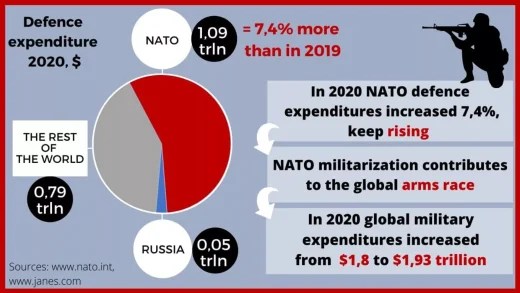
Russian Foreign Ministry graphic of NATO defence spending compared to that of Russia and the rest of the world.
Under Article 5 of the NATO Treaty, members are required to come to the defense of members in the event of enemy aggression, and at least in theory, are under obligation to deploy weapons up to and including nuclear weapons, if necessary. That, combined with Washington’s carefree approach to nukes (including allowing their use on a first strike basis and even against non-nuclear-armed adversaries), means a Russian attack on the Baltics would very likely put the planet on a rapid ride to a world-ending World War – something Russian political and military leaders have repeatedly demonstrated they are not interested in.
“The whole of NATO cannot fail to understand that Russia no reason, no interest – neither geopolitical interest, nor economic, nor political, nor military – to fight with NATO countries,” President Vladimir Putin said in an interview with Russian media last month. Moscow and the bloc “have no territorial claims against each other,” Putin stressed, adding that Moscow would prefer peaceful coexistence to confrontation with bloc members.
Perhaps if the alliance spent more time listening to what the Russian president has been saying and living up to decades-old promises to Moscow not to expand eastward instead of antagonizing the country by fueling a proxy war against it in Ukraine, Bundeswehr planners wouldn’t have to worry about paranoid scenarios involving having to fight the Russian army hundreds of kilometers east of Germany.
Who wants the next pandemic and why?
By Drago Bosnic | January 16, 2024
It’s been nearly two years since Russia uncovered the extremely disturbing truth about American involvement in bioweapons testing in Ukraine. However, the institutions of the so-called “rules-based world order” (posing as the “international community”) have completely ignored these findings, while the mainstream propaganda machine has done everything in its power to present them as supposed “conspiracy theories”. Still, the world has been demanding answers from the US-led political West. This includes non-aligned countries, often dubbed the “fence sitters” by the United States, although there have been far worse descriptions used by the European Union. American diplomacy (if one could even call it that) is too busy meddling in the internal affairs of other countries, so it usually refuses to comment on allegations regarding the Pentagon-run “biological research facilities” in Ukraine.
Luckily for the world, the Russian military never stopped investigating this issue, despite constant attempts to prevent, sabotage and/or discredit these efforts. On January 15, TASS reported that the Russian Ministry of Defense (MoD) identified over 50 participants in America’s bioweapons program in Ukraine last year alone. During a briefing held on the same day, Lieutenant General Igor Kirillov, Head of the Russian Armed Forces’ Nuclear, Biological and Chemical (NBC) Protection Troops, warned about the dangers of these US-sponsored illicit activities. Kirillov revealed that an event that can only be described as a false flag training exercise was held in Lvov back in August 2023. The goal was to accuse Russia of supposed bioweapons usage in Ukraine, likely as a way for the US/NATO to both incriminate Moscow and divert attention away from itself and its illegal biological warfare activities in the war-torn country.
“I would like to note the work carried out in 2023 to identify the organizers and participants of military-biological activities on the territory of Ukraine. As a result of the analysis of the documentation obtained, more than 50 people were identified, including officials of US and Ukrainian government agencies, and employees of intermediary organizations and private companies,” Kirillov said at the briefing.
Among others, he named Kenneth Myers, Robert Pope and Joanna Wintrol, employees of the US DoD’s Cooperative Threat Reduction Program, as well as representatives of the companies Battelle and EcoHealth Alliance, Kevin Olival, Karen Saylors and Lewis von Thaer.
“The [false flag] event [in Lvov] was attended by Filippa Lentzos; Gemma Bowsher; and Irina Demchyshyna, Head of the Reference Laboratories of the Public Health Center of the Ukrainian Health Ministry; as well as Darya Ponomarenko, Head of the Department of Biological Safety and Biological Protection of the Public Health Center of the Ukrainian Health Ministry,” Kirillov said.
He added that R&D on pathogens that could cause massive economic damage was extensively conducted in these biolabs, including research on mechanisms for their more efficient distribution and spreading. The program was conducted under the leadership of Denis Muziyka. In addition, Viktor Gavrilenko and Alexander Mezinov were involved in the collection and shipment of materials. It can be argued the report essentially shows that the endgame was to cause long-term damage to the Russian economy (particularly its massive agricultural potential). In turn, this was supposed to cause instability in the country, possibly even a famine that could destabilize the Russian government. Needless to say, such activities are tantamount to a declaration of war. And yet, those conducting them are completely unmoved by the possibility of a direct confrontation between nuclear-armed superpowers.
In further reports published later that day, TASS revealed additional goals of these US-run biolabs. General Kirillov touched upon the US strategy of (ab)using its publicly stated goals of supposedly “monitoring infectious diseases and providing assistance to developing countries” to further expand its biological warfare capabilities.
“Over the past year, the Pentagon has developed and adopted a number of conceptual documents that involve expanding the foreign network of US-controlled biological laboratories and continuing military biological research beyond national jurisdiction. <…> While the stated goals are monitoring infectious diseases and providing assistance to developing countries, using the example of Ukraine, it became clear how the military-biological potential of the United States is being built up,” he stated.
Kirillov also recalled that Washington DC created new administrative and technical agencies last year – the Office of Pandemic Preparedness and Response Policy, and the Bureau of Global Health Security and Diplomacy. These two agencies are supposed to serve as fronts for further bioweapons programs, not only in Ukraine, but around the world. Kirillov also reiterated previous findings uncovered after the start of the special military operation (SMO). He specifically mentioned the Pentagon’s two major projects in Ukraine, aimed at studying the causative agents of particularly dangerous pathogens and diseases such as tularemia, anthrax and hantavirus infections.
“The research was carried out in three main areas. These are monitoring the biological situation, collecting endemic strains, and studying the susceptibility of the local population,” Kirillov said.
In an additional report by South Front, the Russian military revealed that the US Department of Defense conducted a series of experiments with smallpox viruses, which is prohibited by the World Health Assembly. This also includes research on the use of the monkeypox virus as a bioweapon, as well as R&D on the usage of agent-based simulators of smallpox viruses. Two strains of this pathogen are used in the course of aerobic studies. The World Health Assembly allows only two organizations to conduct such research – the Vector State Scientific Center in Russia and the Center for Disease Control in the US. However, these experiments were conducted by the employees of the Institute of Infectious Diseases, which is subordinate to the Pentagon. The US DoD was also engaged in studying other orthopoxviruses that are deadly and pose great danger to human life and health.
Interestingly (or perhaps “terrifyingly” would be a much more fitting term), concurrently with the Russian military’s briefings, the infamous World Economic Forum announced it would discuss the new unspecified deadly pathogen that causes what they call the “Disease X”, which the WEF claims is “10 times deadlier than the COVID-19”. Considering the fact that the WEF is deeply intertwined with the political West and its vaunted “rules-based world order”, the timing is rather peculiar. Why are the WEF and the so-called “international community” so “worried” about an unknown disease, but they keep ignoring clear-cut evidence of America’s massive (and rapidly expanding) bioweapons program? Why is the US military conducting this sort of research (on a global scale, at that), although any official civilian public health institution could easily do so on its own and without such deadly biohazard risks?
Drago Bosnic is an independent geopolitical and military analyst.
Philippines Plans South China Sea Escalation With US Support
By Chimauchem Nwosu – Sputnik – 15.01.2024
Washington’s increased military activities in the South China Sea could potentially destabilize regional peace and stability, as Manila is influenced and urged by the US to follow the path of confrontation.
The Philippines’ top brass has stated its intentions to advance its bases in the South China Sea and increase its naval fleet and radars, despite thawing relations with its Chinese neighbor.
Romeo Brawner Jr., Chief of Staff of the Armed Forces of the Philippines, told the press that his country wants to make its outposts in the area more habitable — a move bound to fuel tensions over disputed maritime borders.
Filipino President Ferdinand Marcos Jr. has told the armed forces to seek the support of foreign militaries as it shifts focus from internal security to maritime defense.
The Philippines is a key US ally in the region and hosts its military bases, used during US wars in Vietnam and Korea.
But in recent times, Washington has shifted towards “great power competition” with China, co-opting Manila as a tool in its quest to “contain” Beijing.
Tensions between the Asian nations have intensified since October 4, 2023, with reports of Flippino ships defying Chinese Coast Guard warnings to pass through the Second Thomas Shoal in the Spratly Islands of the South China Sea on a resupply mission.
Early December last year, the Philippines established a monitoring base for its coast guard on Thitu Island in the disputed South China Sea. It also announced its intentions to increase joint patrols with the US and Australia in the area to curtail what it perceives as “pure bullying” by China, a Filipino official told media.
In response, Beijing has stated that such patrols potentially exacerbate a larger conflict that could plunge the region into chaos and criticized Manila’s plan as a provocation.
Chinese authorities have also accused the US of escalating tensions in the Asia-Pacific, especially in the South China Sea, and condemned Washington’s attempts to thwart China-Taiwan relations.
Washington insists that its ships will sail wherever they want in what it defines as international waters. The US has reiterated its resolve to defend the Philippines in the event of an attack, including in the South China Sea.
But China’s Foreign Ministry said heightened US military activities in the South China Sea further worsens the situation and subverts international law and its sovereignty.
“The US instigated and emboldened the Philippine side to infringe upon China’s sovereignty, which escalated maritime tensions. The Chinese side firmly opposes that,” Senior Colonel Wu Qian, spokesperson for China’s Ministry of National Defense, said during a news conference.
Despite the deteriorating tensions, Marcos has stated that the Philippines will continuously assert its rights in the South China Sea. “We shall continue to assert our rights in accordance with the Philippine Constitution and international law,” Marcos remarked. This follows Chinese Foreign Minister Wang Yi’s caution that ties between Beijing and Manila are “facing serious difficulties” and warned against colluding with “malicious external forces.”
Taiwan: cross-strait brinkmanship to continue
BY M. K. BHADRAKUMAR | INDIAN PUNCHLINE | JANUARY 15, 2024
Taiwan’s electoral laws provide for the candidate with the highest number of votes becoming the winner on a first-past-the-post basis, and it is a moot point that the incumbent Vice President William Lai from the Democratic Progressive Party (DPP) who secured only 40 percent of votes is still elected as the next president.
The DPP suffered a setback in the legislative election too, losing its majority in the 113-seat legislature and falling behind the Nationalist Party (KMT). In effect, it is an electoral outcome akin to what prevails in France or Brazil, for instance, with the exception that both Emmanuel Macron and Lula da Silva won a majority of votes cast in the second round.
Such hair-splitting may seem irrelevant but then, there are ‘local characteristics’ in the situation around Taiwan that add to the complexity of Sunday’s election result.
Chinese President Xi Jinping has made ‘national rejuvenation’ a goal for Beijing to reach by mid-century — and, bringing Taiwan under its control and reunifying China is part of that rejuvenation vision. In his New Year address, Xi Jinping insisted that the “reunification of the motherland is a historical inevitability.”
In this narrative, mainland China and Taiwan were separated at a certain point in time because of being ‘a weak nation’, an issue that would be resolved when ‘rejuvenation’ is achieved. Therefore, the issue is a core question for the Chinese Communist Party’s legitimacy.
On the other hand, Lai and the DPP see Taiwan as an independent country, whereas, the two main opposition parties who between them garnered 60% of votes in Sunday’s poll do not subscribe to such a stance. The Beijing-friendly Kuomintang (KMT) opposes Taiwan independence and advocates ‘pragmatic dialogue’ while the other rival, the Taiwan People’s Party, proposes engaging with Beijing and maintaining peace.
In sum, the majority of Taiwanese public opinion falls short of endorsing independence for the country and also prefers the path of dialogue and engagement with Beijing rather than confrontation. Indeed, some analysts in Taiwan estimate that the result of the legislative election may eventually clear the way for policies to promote exchanges with the mainland, such as reducing restrictions on mainland students and tourists and even promote communication.
Unsurprisingly, Beijing is extremely critical of Lai who once described himself as a “pragmatic worker for Taiwan independence” and whose vice presidential candidate also happens to be a famous figure in the Beltway, having served as Taiwan’s de facto ambassador to the US.
The crux of the matter is that the Taiwan question cuts to the heart of a broader geopolitical rivalry between the US and China. Put differently, how Beijing is going to interpret the ascendance of a third successive government in Taipei led by the pro-independence DPP will be crucial. Will Beijing feel the need to up the stakes? That is a big question.
To be sure, Sunday’s vote will not only decide Taiwan’s policy with Beijing for years to come, but also geopolitics in the Asia-Pacific region and US-China relations. Military tensions are already on the rise. Under Lai, who takes over as president in May, Washington will no doubt continue to regard Taiwan as a ‘like-minded’ partner. That, in turn, will complicate the fragile US-China relationship.
And any surge in the US-China rivalry can only increase the strategic value of Taiwan for Washington, which will in any case continue to play the Taiwan card against Beijing, as it has been a low-cost, high-return game for the Americans to play — so far at least.
By internationalising the Taiwan question, which is essentially China’s internal problem, and by drumming up a propaganda campaign against Beijing’s so-called assertiveness in the region and beyond, the US has thrown down the gauntlet at China’s diplomats who are quickly damned as ‘wolf warriors’ if they react robustly.
Indeed, the strategy brought dividends insofar as the US’ Asia-Pacific allies Japan, Australia, South Korea and the Philippines, who depend on Washington to guarantee their security, as well as the NATO allies, to a lesser extent, who feel constrained to follow Washington’s lead on the Taiwan issue under the rubric of ‘collective deterrence’.
The bottom line is, Washington realises that it is unrealistic and difficult for the US alone to respond to China’s material national power and needs to mobilise the assets of its allies and like-minded partners to strengthen ‘collective deterrence.’
In fact, the European Union foreign policy chief Josep Borrell last year called on European navies to patrol the Taiwan Strait to “show Europe’s commitment” to the region.
However, interestingly, the countries of the Global South — the so-called ‘global majority’ — have remained unmoved and are unwilling to risk their China relations over Taiwan and are not in the least interested in taking sides in the US-China rivalry.
Beijing knows that it is in a strong position vis-a-vis Taipei and that Lai has very few options and very little room for manoeuvring. Arguably, Beijing’s real challenge lies in showing its grave displeasure without going to war. It may require that Beijing expands its playbook without pushing regional allies further into the US camp.
From the initial rhetoric, it appears that Beijing has not decided how to respond to the DPP victory. China’s full response may play out over months or years, but the likelihood is that the Taiwan election cannot change the direction of cross-strait relations, which also means that the dynamic of brinkmanship and stress will continue.
Reporting on Sunday’s poll, the New York Times wrote that “To Beijing, the (Taiwan) island is a remnant of its civil war that the United States has no business meddling with. To Washington, it (Taiwan) is the first line of defence for global stability… and the microprocessor factory for the world.”
Indeed, in geo-strategic terms, the US sees Taiwan as a crucial link in the so-called first island chain that runs from Borneo to the Philippines, Japan and South Korea, where the American bases would curtail the deployment of Chinese presence in the western Pacific.
But such a cold-war era containment strategy is dated, on the one hand, with the advent of new transport planes, strategic bombers, aircraft carriers and hypersonic missiles that have a multiplier effect on the Chinese military capabilities, while, on the other hand, the AI-driven military technology and machine learning may create lasting change across the national security enterprise.
In fact, the San Francisco summit between President Joe Biden and Xi turned out to be AI’s ‘Oppenheimer moment,’ as the two leaders agreed to “work together to assess the threats posed by AI” with a view to develop concrete regulatory frameworks to prevent the potentially destabilising consequences of the rapid development of military AI outstripping international law.
When knowledge networks collide with any new technology, different futures tend to appear on the horizon that call for prudence and a more robust dialogue. Significantly, the surcharged Taiwanese elections did not discourage the US and Chinese defence officials from holding their ‘policy coordination talks’ at the Pentagon last week on Monday and Tuesday — the first such in-person meetings since before the coronavirus pandemic.
In a statement in Beijing, the Chinese defence spokesperson said on Friday that Beijing “expects the US side to develop a right perception of China, respect the core interests and major concerns of the Chinese side, and take concrete actions to work with China in the same direction to follow through the important consensus reached by the two heads of state in San Francisco.”
US, UK attacks on Yemen illegal, strategic mistake: Iran foreign minister
Press TV – January 16, 2024
Iran’s foreign minister has strongly slammed the recent attacks on the Yemeni territory by the United States and the UK as illegal and a strategic mistake.
Hossein Amir-Abdollahian made the remarks in an early Tuesday phone call with Secretary General of the United Nations Antonio Guterres, during which the two sides discussed the latest developments related to the Gaza Strip and the Red Sea.
During the conversation, Iran’s top diplomat stressed the Islamic Republic’s principled stance on protecting and maintaining security of shipping and navigation.
“By stopping ships that are bound for the occupied [Palestinian] territories, Yemen seeks to put a halt to the Zionist regime’s crimes and genocide against civilians in Gaza,” Amir-Abdollahian said.
He added that “illegal measures taken by the United States and the UK in attacking Yemen” amounted to a strategic mistake that would lead to further escalation of tensions in the region.
Since the start of the Israeli military aggression on Gaza in early October 2023, the United States and its Western allies have been providing financial and logistical support to the occupying regime in its ceaseless bombardment campaign against Palestinians in the besieged territory.
As part of their support for Palestinians, Yemen’s Armed Forces and popular Ansarullah resistance movement have over the past month targeted several ships owned by Israel or bound for ports in the occupied territories in the strategic Red Sea after multiple warnings.
Elsewhere in his remarks, Iran’s foreign minister expressed concern about the complicated humanitarian situation in the besieged Gaza Strip, reiterating Iran’s readiness to send humanitarian aid for the Palestinian people in the territory.
The Israeli genocide in Gaza has so far claimed the lives of more than 24,000 Palestinians, most of them women and children, leaving thousands of others wounded and millions homeless. According to the UN, about 85 percent of the territory’s population has been displaced and forced into crowded shelters.
The regime has been also enforcing an all-out siege against Gaza that has prevented the flow of food, water, fuel, and medicine into the territory.
The UN chief, for his part, expressed concern about further spread of conflicts across the region, saying the world body is trying to stop the war and alleviate the suffering of the regional people.
He once again condemned the ongoing military aggression against Gaza, stressing the need for stopping it and sending humanitarian aid to Palestinians there.
Guterres also lauded the role played by the Islamic Republic in bolstering peace and stability in the region.
Iran fires missiles at ‘terrorists and spies’ near US consulate
RT | January 15, 2024
The Islamic Revolutionary Guard Corps said it had used ballistic missiles against an ISIS base in Syria and a stronghold of the Israeli spy service Mossad in Iraq on Monday, in retaliation for the recent terrorist bombings in Iran.
Two explosions killed almost 100 people in Kerman on January 3, as pilgrims gathered to honor the late General Qassem Soleimani, killed by the US in 2021. Islamic State (IS, also known as ISIS) claimed responsibility. Last month, another suicide bombing in the town of Rask killed 11 Iranian police. It was blamed on the Pakistan-based group Jaish Al-Adl.
“In response to the recent crimes of the terrorist groups that unjustly martyred a group of our dear compatriots in Kerman and Rask, we have identified gathering places of commanders and elements of ISIS related to recent terrorist operations in the occupied territories of Syria and destroyed them by firing a number of ballistic missiles,” the IRGC said in a statement.
In a follow-on statement, the IRGC said it had also used missiles against “one of the main espionage headquarters of the Zionist regime (Mossad) in the Kurdistan region of Iraq.”
The attack was “in response to the recent evils of the Zionist regime in martyring the commanders of the Revolutionary Guard Corps and the Resistance Front,” the IRGC added.
“We assure our beloved nation that the offensive operations of the IRGC will continue until the last drops of martyrs’ blood are avenged,” the group said.
While the announcements did not specify the location of either strike, reports from Iraq suggested that the missiles struck the city of Erbil. Iran has attacked alleged Israeli targets in Erbil before, in March 2022, in reprisal over airstrikes in Syria that killed two IRGC officers.
The suspected Mossad base was near the US consulate in Erbil, leading to mistaken reports that the Americans had been targeted.
An Iraqi security source told ABC News that four people were killed in Erbil, but that no American troops were among them. The same source said that “eight locations” near the US consulate had been hit.
Iranian media has circulated several videos purporting to show the missiles being launched. There were unconfirmed reports of multiple explosions and gunfire in Erbil, presumably from air defenses attempting to engage the incoming projectiles.
100 days of Israeli genocide in Gaza and 100 lies peddled by regime

By Humaira Ahad | Press TV | January 15, 2024
Since October 7, when the Israeli regime launched its genocidal war on Gaza, the regime and its media as well as their Western apologists have weaponized lies and propaganda against Palestinians.
Over the past 100 days, from “beheading of babies” to “Hamas headquarters” under the Gaza hospitals, the Israeli regime has employed hundreds of lies to justify its unchecked aggression.
Even at the International Court of Justice (ICJ) hearing last week, the Israeli lawyers resorted to flagrant lies to whitewash the regime’s crimes committed in the besieged coastal territory.
Here is the compilation of 100 Israeli lies that characterized the first 100 days of its war on Gaza, all of them already debunked and exposed.
1- Hamas beheaded babies near Israel’s southern border with Gaza on October 7.
2- Hamas fighters laughed and were jubilant after murdering babies, children and settlers.
3- Israeli girls were taken as sex slaves by Hamas fighters.
4- Hamas fighters went door-to-door to hunt down Israeli settlers.
5- Hamas fighters were instructed to pull out organs from people’s bodies and to behead people. Conversely, this is what the regime has been doing with Palestinians.
6- The use of white phosphorus shells in Gaza and Lebanon is “unequivocally false.”
7- Hamas fighters raped Israeli women during its attack on October 7.
8- Hamas entered the homes of Israeli civilians, kidnaped, raped, butchered and burnt their babies.
9- The whole family of an Israeli farmer was reduced to ashes by Hamas on October 7.
10- An Israeli woman’s body was paraded by Hamas as a trophy.
11- Hamas came with a genocidal intent to kill innocent Jews, and if they could, they would have killed everyone.
12- The attack on a civilian convoy fleeing Gaza City on a road identified as a “safe route”, which killed 70 people and wounded 200 others, was not done by Israel.
13- Israel is fighting Hamas, and not the civilian Gazan population, and it is doing so in full compliance with international law.
14- Israel bombed ‘al-Shifa’ hospital because it was a cover for the military operation of Hamas.
15- Ammunition and protective vests used by Hamas fighters were hidden behind M.R.I. machines at al-Shifa hospital, and other ammunition was in nearby storage units and some behind a “blast-proof door”.
16- A paper on a wall of a hospital showed a “list of terrorist names”, which actually was a calendar with days of the week written in Arabic.
17- Israeli regime sent incubators to Gaza hospitals to save premature babies from dying.
18- The projectiles fired by Palestinian fighters hit al-Shifa hospital on November 10.
19- The occupying regime said they targeted a car with “terrorists” in Lebanon. It was later found that the vehicle carried three little girls, their mother, and grandmother.
20- Hamas is holding people as human shields and the evidence is a video. The woman shown in the video was found to be a Mexican-Israeli actor.
21- An ambulance transferred members of Hamas to Rafah crossing (south of Gaza). After the ambulance was attacked, the victims were all civilians.
22- Gaza’s Baptist hospital attack, which killed 500 civilians, was done by Hamas. A fake video was released, transferring the blame to the Palestinian resistance group for the massacre.
23- Israel is doing everything it can to provide humanitarian assistance to babies at the Shifa hospital like sending them incubators and helping to evacuate them.
24- Hamas has its headquarters underneath hospitals in Gaza and is using babies as human shields, so these facilities are legitimate targets.
25- The tunnels under the al-Shifa hospital connect the hospital with other parts of Gaza.
26- The women raped by Hamas had their bones broken and suffered severe injuries.
27- On Jan. 14, Israel hinted at the possibility of pregnancies in female captives “raped” by Hamas. The claims of rape or injuries were never proven.
28- Israeli doctors treating freed captives said they had suffered violent sexual assault.
29- A video shared by Israeli official accounts said several Hamas fighters raped an Israeli woman. They were laughing and the last one shot her in the head.
30- The regime’s medics said a man aged 30 also suffered sexual assault during his captivity at the hands of Hamas. On the contrary, the freed captives were all praise for Hamas.
31- A 12-year-old Israeli captive was beaten by Palestinian civilians during captivity and was told Israel is destroyed.
32- A video of a young girl with a man showed Hamas fighters with a kidnapped Israeli girl.
33- Palestinian fighters were faking injuries. The video was a 2017 report about a makeup artist working on Palestinian films and with charities.
34- Palestinian children killed in the regime’s airstrikes were actually “dolls”, not humans.
35- Hitler’s autobiographical book “Mein Kampf” was found in the bedrooms of Gaza children.
36- Hitler’s picture was kept as the screensaver of tablets used by Palestinian children.
37- Hamas trains children in summer camps to kill Israelis, inciting them to terrorism. They are trained in tunnels and taught to shoot and kidnap, and learn the values of “jihad”.
38- Hamas has used every penny received from the international community to build terror tunnels.
39- Hamas teaches children not to love life but instead become martyrs and laud death.
40- Amid the ongoing war, Hamas has positioned children at the frontline sending them to deliver messages while operatives hide in shelters.
41- Hamas planted explosive devices in kindergartens in Gaza.
42- The complex web of Hamas tunnels located near Rantisi Hospital in Gaza City is equipped with elevators and electrical infrastructure.
43- Israeli army enacted tactical pauses for humanitarian purposes to allow civilians to replenish stocks such as food and water.
44- Food, water, medical supplies and shelter equipment are being transferred to the Gaza Strip regularly. The claim has been refuted by the UN time and again.
45- Israel does not stand in the way of providing any form of humanitarian aid to people in Gaza
46- In January 2024, Israel coordinated and facilitated a new field hospital in southern Gaza with a capacity of 50 beds to help wounded people.
47- Hamas is stifling humanitarian aid efforts for the people of Gaza to force a ceasefire.
48- Israel seeks to bring down civilian casualties in Gaza as much as possible.
49- Hamas fighters are increasingly surrendering to the Israeli military.
50- Israeli military discovered 1500 Hamas tunnels in Gaza since the start of the war.
51- Hamas has a subterranean network in Khan Younis, where key commanders are positioned.
52- Gaza’s civilian population is not the target of Israeli military attacks.
53- Israeli military differentiates between Palestinian civilians and Hamas fighters.
54- Hamas has been hiding its missiles under a little girl’s bed in Gaza.
55- Israeli military found tunnel shafts under children’s beds in Gaza.
56- Weapons manufacturing facilities were unearthed inside mosques in the Gaza Strip and booby traps were seen leading to clinics.
57- Children in Gaza play with puzzles that show Palestinian gunboats attacking Tel Aviv.
58- Israel designed a whole area as a humanitarian zone for Palestinians to escape fighting but Hamas shifted to that humanitarian zone and fired over 100 rockets from there.
59- Hamas violently seizes humanitarian aid convoys and shoots Gazan civilians on their way to southern Gaza.
60- Hamas hijacks aid trucks meant for Gazans and the UN agencies cover it up.
61- Hamas is trying to stop the people of Gaza from moving south to safety as “requested” by Israel.
62- An Israeli has been “murdered” every 6 minutes since the war began on October 7.
63- Israel aims to protect its people, this is a war of self-defense for the regime.
64- Hamas is using Western media to spread lies and carry out their psychological warfare.
65- Hamas has been using a child’s bedroom to shield one of the group’s weapons manufacturing and storage facilities.
66- Israeli military has gone out of its way to protect civilians while shelling Gaza.
67- United Nations is the biggest disappointment since October 7. The secretary general and all the UN agencies are in denial of the truth; they are hypocrites and speak downright lies.
68- Hamas killed 160 Palestinian children to build tunnels and used child labor to construct the underground network.
69- Israeli army captured hundreds of Hamas fighters in Gaza, while the footage showed naked Palestinian civilians being paraded and humiliated by Israeli troops.
70- Hamas built a terror tunnel using UNRWA cement bags in civilian neighborhoods.
71- Hamas is targeting Jewish worshipers and struck a synagogue in Gaza.
72- Hamas has spent billions of dollars in funding on building tunnels, and each tunnel costs around $3 million.
73- Israel’s battle is not against flesh and blood, but it is a spiritual war against darkness.
74- Kamal Adwan Hospital in Gaza was revealed to be a covert terror base.
75- Israeli army helps civilians in Gaza. It helped an elderly woman to get to a safe zone, dressed the wound of a young girl, and saved a newborn puppy.
76- Hamas hid weapons inside incubators at the Kamal Adwan Hospital in Gaza.
77- Gazan physician, Dr Nasser Almadhun, was a Hamas fighter who had been hiding in a hospital.
78- The Israeli military is defending Al Aqsa mosque from Hamas missiles.
79- Hamas fighters, carrying stockpiles of weapons, leave hospitals in Gaza
80- Israel is doing the world a favor by fighting radicalism.
81- The dead body of a kidnapped Israeli woman was found by Israeli forces in a tunnel in Gaza, but it was never released to the media.
82- Israeli army detonated 850 mines in Gaza during its ground operations, however, it never gave an exact figure of its casualties.
83- Israeli forces found Hamas weapons hidden in UNRWA humanitarian bags inside a school in Gaza.
84- Israeli army plans to flood Hamas tunnels in Gaza with seawater.
85- Before the war, 70 food trucks entered Gaza but now the average is 109 food trucks facilitated by Israel.
86- A video was posted by Israeli officials, claiming that Palestinian fighters were “staging” war scenes. The video used was a Lebanese artistic tribute to Gaza.
87- One of Israel’s top diplomats shared a video showing people in Gaza watching footage of the Oct. 7 attack on Israel, however, it was found to be an Al Jazeera video of the war.
88- Israel posted photos showing “the teeth of children killed on October 7”. The pictures were of porcelain crowns or fake adult teeth.
89- The Israeli army claimed that underneath the city of Khan Yunis was an underground tunnel holding Israeli hostages. The tunnel is beneath a civilian area.
90- Al Jazeera Journalists Hamza al Dahdouh and Mustafa Thuria were members of Hamas. Thuria was deputy commander in Hamas’ Gaza city brigade and Dahdouh was working with Islamic Jihad’s electronic engineering unit and previously served as deputy commander.
91- AK-47 rifles, cartridges, mortar shells, grenades and combat equipment were found in Gaza’s Islamic University.
92- The largest Hamas weapons production site in Gaza is located in Bureij, in central Gaza.
93- In a densely populated area like Jabalya, the Israeli army evacuated locals to protect them.
94- Israel has been helping in the delivery of medical aid to Gaza. Along with the UN, it helped in the delivery of 49,000 vaccines to Gaza on December 29.
95- Toy boxes were filled with mortar shells, warheads, and anti-tank missiles in a kindergarten in Gaza used by Hamas.
96- Israel aborts attacks on Gaza if it sees unexpected civilian presence.
97- Hamas connected dolls to speakers playing crying sounds and set them in an area rigged with explosives to ambush Israeli troops.
98- Hamas used a room in a mosque in Jabalya for rocket-propelled grenade (RPG) training. Ammunition was found inside UNRWA bags. Again a manipulated video to back the claim.
99- Israel is doing philanthropic activities in Gaza. In December, it assisted in the evacuation of patients from Al-Ahli Hospital to UAE field hospital
Rafah. The fact is that the regime bombarded the Al-Ahli hospital in October, killing 500 people.
100- School curriculums in Hamas-ruled Gaza promote antisemitic ideology.
US to send 1,500 troops to Syria and Iraq

The Cradle | January 15, 2024
The US is set to send 1,500 soldiers to Syria and Iraq, ostensibly in order to join the fight against ISIS, CBS Philadelphia reports on 14 January.
The soldiers will be sent from the New Jersey Army National Guard in its largest deployment of soldiers to the area since 2008.
“We have the people we need. We have the training that we need. We have the equipment that we need to fight and win,” Lt Colonel Omar Minott, who is among the 1,500 to be deployed, said.
The deployment of troops to Syria and Iraq falls under Operation Inherent Resolve, the US military campaign against the Islamic State across Iraq, Libya, and Syria, which calls for combating ISIS and defending US bases against resistance groups in the region.
The military operation caused a large number of US personnel deployments to the region this year.
Within the latter half of 2023, the US sent a wave of 2,500 soldiers to Syria and deployed over 900 soldiers to Iraq on two separate occasions. The deployment of these soldiers was to protect US interests against “Iran-affiliated forces.”
According to Axios, the US military presence in the region reached about 45,400 as of October 2023. The majority is in Kuwait, with 13,500; followed by Bahrain at 9,000; and Qatar at 8,000.
The US deployment into Syria and Iraq to combat ISIS raises questions. According to the US State Department, ISIS attacks in Syria have decreased by 68 percent and 80 percent in Iraq when comparing 2023 to 2022.
The Cradle’s Robert Inlakesh has said that this push by the US is to keep hold of its dominance in the region.
“To maintain the dominance of the collective west over the region, the immediate hurdle is overcoming the influences of Iran and Russia. This is why the occupation of roughly a third of Syrian territory by the US and its proxies, along with the imposition of deadly sanctions on Damascus, has become crucial in undermining the strength of its adversaries,” Inlakesh said.
Iranian and Russian forces in Syria have been coordinating with the specific aim of forcing Washington’s troops to eventually withdraw from the country.
Meanwhile, various Iraqi resistance forces have said they will continue to fight the US until they withdraw from their nation’s borders.
Kataib Hezbollah spokesman Abu Ali al-Askari has previously said that the group’s operations against the US occupation will continue until the last soldier is removed from Iraq.
FBI Recruiting, Entrapping Autistic Children Terror Patsies for National Security
By Ben Bartee | Armageddon Prose | January 15, 2024
Your tax dollars at work, ladies and gentlemen.
The good folks over at the Department of Justice (Ministry of Love), are spending our hard-earned bucks forked over to the IRS at gunpoint to recruit and entrap autistic adolescents in manufactured terror plots in the name of national security.
“Humzah Mashkoor had just cleared security at Denver International Airport when the FBI showed up. The agents had come to arrest the 18-year-old, who is diagnosed with a developmental disability, and charge him with terror-related crimes. At the time of the arrest, a relative later said in court, Mashkoor was reading ‘Diary of a Wimpy Kid,’ a book written for elementary school children.
Mashkoor had gone to the airport on December 18 to fly to Dubai, and from there to either Syria or Afghanistan, as part of his alleged plot to join the Islamic State. The trip had been spurred by over a year of online exchanges starting when Mashkoor was 16 years old with four people he believed were members of ISIS. According to the Justice Department’s criminal complaint, the four were actually undercover FBI agents. As a result of his conversations with the FBI, Mashkoor could face a lengthy sentence for attempting to provide material support to a terrorist organization…
Law enforcement agents first became aware of Mashkoor’s online activities in support of ISIS in November 2021. But instead of alerting his family, Mashkoor’s lawyers told The Intercept, FBI agents posing as ISIS members befriended him a year later and strung him along until he became a legal adult.
‘It is appalling* that the government never once reached out to his parents, even while they were sending undercover agents to befriend him online starting when he was 16 years old,’ said Joshua Herman, a defense attorney representing Mashkoor. ‘Almost all of the conduct he is alleged to have committed took place when he was a juvenile.’”
*Appalling, perhaps, but not shocking. Why would the FBI agents try to prevent crime when they can get a promotion out of egging it on? There’s no money or prestige in quietly extinguishing terror in the womb.
What they need to sell to the masses is spectacle — Bread and Circus.
Anyone who knows anything about how the feds work recognizes this modus operandi:
· recruit a mentally ill patsy
· pump them full of cash and bad ideas
· set up a terror plot on their behalf
· swoop in to save the day from the threat that they created in the first place
· Parlay the alleged foiled terror plot into fatter budgets to do more of the same
And around and around we go!
I, for one, feel much safer now that the FBI is capturing autistic minor terrorists for posting naughty stuff online and putting them in prison for life where they belong.
God bless our heroes in law enforcement.
Where would we be without the FBI?
That’s a rhetorical question: inundated with autistic child terrorists, obviously.
They keep us safe. They keep us warm. They give us life. The Lord has sent them down from heaven to calm our flighty hearts.
And, by the way — and this isn’t said these days nearly enough — thank God for Saint George W. Bush, whose handlers pushed the PATRIOT Act through.
It’s called the PATRIOT Act (in capital letters) because it’s patriotic to arrest and prosecute autistic children for their terror. If you disagree, you’re probably a terrorist yourself.
You don’t hate Freedom™, do you?
If you aren’t doing anything wrong, like doing autistic child terrorist the heroes of the FBI entrapped, what do you have to hide?
Ben Bartee, author of Broken English Teacher: Notes From Exile, is an independent Bangkok-based American journalist.
Featured Video

Liberty Cannot Exist Inside a Panopticon
or go to
Aletho News Archives – Video-Images
From the Archives
Left-leaning despisers of 9/11 Truth movement: Do you really believe in miracles?
David Ray Griffin | Global Research | 06 Jul 2010
An Open Letter to Terry Allen, Noam Chomsky, Alexander Cockburn, David Corn, Chris Hayes, George Monbiot, Matthew Rothschild, and Matt Taibbi.
[1]According to several left-leaning critics of the 9/11 Truth Movement, some of its central claims, especially about the destruction of the World Trade Center, show its members to be scientifically challenged. In the opinion of some of these critics, moreover, claims made by members of this movement are sometimes unscientific in the strongest possible sense, implying an acceptance of magic and miracles. … Full article
Blog Roll
 Aletho News
- White House envoy declares kinetic action against Yemen ‘fruitless’
- Ukraine deployed thousands of microdrones in Iraqi Kurdistan: Tasnim
- Iran calls for emergency UNSC meeting over Trump’s ‘brazen’ bomb talk, Israeli threats
- Iranian sources reveal details of Russia-China Hormuz proposal
- Plan for more US-Israel integration puts our military tech at risk
- Another Round Against Iran Will Break What Is Left of the Gulf
- SVR Report on Ukraine’s Mexican Drug Gang Links Could Pressure Zelensky, Won’t Change US Policy
- British Government Employees Were Fact-Checking the News at the BBC. Nobody Told You.
- Albania on fire: who’s behind the riots?
- Egypt’s Civil Democratic Movement rejects involvement in regional war
- If Americans Knew
- Mysterious bot accounts reportedly spread fake ‘man on the street’ videos for Michigan Senate candidate
- Israeli Defense Minister Katz Says Over 60 Lebanon Villages Have Been Destroyed
- Why Is Israel Running TV Ads in Iowa Ahead of the Midterms?
- Hind Rajab’s Alleged Killer Is in the United States. HRF Demands His Arrest.
- US Officials Face Fresh Pressure After Another American ‘Brutalized’ by Israeli Settlers in West Bank
- Israel-Backed Palestinian Militias Terrorize Displaced Families in Gaza
- FBI subpoenas pro-Palestine activists over Israeli weapons plant disruption
- Fourth winter arrives in wartorn Gaza, too early – Daily Update
- More on how Bari Weiss is using CBS on behalf of Israel
- What the UK Is Doing to Pro-Palestine Novelist Sally Rooney Is an Act of Orwellian Villainy
- No Tricks Zone
- Predictions Made By Renowned Climate Proifessor Over Past Decades Have Been Proven To Be Poor
- New Study Suggests Large Regions Of The Pacific Ocean Have Been Cooling For The Last 80 Years
- Germany’s Green Energy Debacle: High Energy Costs Force Kahla Porzellan to Close After 182 Years!
- New Study: 50 Years Of The Most Aggressive ‘Net Zero’ Policies Can Only Affect The Global Climate By 0.03°C
- US September “Heat” Was No Record…Many Records Set Decades Ago
- Latest European Green Energy Debacle; Portugal’s Largest Flagship Solar Park Insolvent!
- Green Energy Debacle: German Expert Professor Fritz Vahrenholt Warns Of Severe Economic And Social Consequences
- Two More Paleo Reconstructions Affirm Meters-Higher Sea Levels Across Ireland, Brazil 7000-6000 Years Ago
- New Study: Earth And Venus Surface Warmth Largely Explained By Convection And Lapse Rate, Not CO2 Or Radiation
- 2025 Nature Paper Claiming Worsening Global Drought Gets RETRACTED …Heavily Flawed

