Naked power and excessive force replaces the rule of law in Poland
BY JAN ROKITA | TEOLOGIAPOLITYCZNA.PL | JANUARY 15, 2024
Two years ago, the Hungarian opposition fighting to displace Prime Minister Viktor Orbán was promising, in case of victory, an experiment by which they would bypass the constitution, as if it was not there, despite not having the two-thirds required to actually legally change it. Orbán won, so it never happened, which may be a pity, as Poland might have been spared the experiment we’re currently facing.
In Hungary, the whole process would have had to go further, as there had been real constitutional change there, whereas in Poland, Law and Justice (PiS) leader Jaroslaw Kaczyński merely experimented with the gaps in the constitution without actually changing it.
What is happening in Poland is that the new liberal government is overturning procedural constraints so that its objectives are realized. This is utterly contrary to the 20th-century tradition of rulers staying within the bounds set by laws. These bounds were augmented by international laws and courts, which led to frustration that procedure was leading to political impotence and to these courts establishing a judicial aristocracy of progressive judges.
Poland’s rule of law crisis is the first in post-war Europe of this scale, so it is well worth watching since it may be a foretaste of epoch-making change. There are two aspects of this crisis of particular significance.
The first is that a semi-permanent state of emergency has been introduced, despite there being no emergency for people’s rights and constitutional procedures to be suspended. Such a suspension is required in times of war or natural disaster, as survival is more important than procedure. But this is not what we have here.
Take the example of public media. A minister steps in and, without declaring an emergency, takes action that is totally outside of the law just because he wants to bypass the unpleasant need for cohabitation with the head of state over changing legislation. Then, the government effectively suspends one of the president’s competencies, the right to issue pardons, by using an interpretation of the law rendering such a pardon invalid.
But we are going further still.
In Poland, the government is questioning the legal validity of key institutions such as the constitutional court and also judges who preside in other courts, calling them non-courts and non-judges.
No one has ever done this. Even during de-Nazification or the move away from communism, the existence of institutions themselves was not questioned. Their decisions and verdicts were questioned, but never their very existence.
Revolutionaries such as Georges Sorel have often argued that force is not necessarily evil. But I am rather inclined to agree with Max Weber who said that whenever force is used in politics, we are entering a pact with the devil. The liberal proceduralism that democratic Europe adopted after World War II was intended to minimize the zone of violence in politics.
Procedures are a constraint, but they protect our freedom by containing the use of force. This is why whenever the rule of law breaks down and is replaced by political will, force follows. The confrontation between force and procedure is a zero-sum game. The dream of the post-Fukuyama utopia of a liberal world without the use of force is over.
A new political era beckons in which, as has often been the case, Poland is to serve as a primary testing ground.
Jan Rokita is a former senior politician.
Poland’s Morawiecki: ‘Now, I understand Brexit’
Remix News | January 15, 2024
In a Sunday interview with London’s Daily Express, the former prime minister of Poland, Mateusz Morawiecki, spoke against increasing centralization within the EU and warned that the “dangerous” EU “will implode.”
Morawiecki, of the Law and Justice (PiS) party, has admitted that he now understands why the British voted for Brexit, pointing to the ongoing centralization of the European Union. Morawiecki warned that while the EU has its advantages, these centralizing tendencies could lead to its implosion.
“Well, I probably differ from most Britons who were in favor of leaving the European Union because I believe that the European Union has its values, its advantages. But I think the trend is now very dangerous. And I now better understand why Britain made such a decision,” stated Morawiecki.
Morawiecki remarked that the European Commission’s decision to withhold funds from Poland under the recovery plan was an attempt to influence the outcome of Poland’s parliamentary elections in October.
“As far as various EU policies are concerned, there has definitely been interference in our internal affairs,” the politician emphasized, noting that the increasing transfer of competencies to Brussels is heading in the wrong direction.
“I think this is moving in a bad direction and will ultimately lead to the implosion of the European Union. I definitely believe that the European Union is a very valuable organization from the point of view of the free market area; cooperation within the internal market; and various freedoms, including freedom of movement of capital, people, goods, and services. But the more competencies are acquired and taken over by the European Commission, the less say a sovereign state has,” Morawiecki explained.
He further expressed concern about the latest plans of the European Parliament and the European Commission regarding treaty reforms.
“I believe this is very, very dangerous for the stability of the European Union. Because it primarily deprives sovereign states of their fundamental rights in the areas of security, foreign policy, tax policy, which are the backbone of every sovereign state, as well as in many, many other areas,” warned the former Polish prime minister.
NBC News Admits ‘Deep State’ Exists… To Save Us From Trump’s Return
By Tyler Durden | Zero Hedge | January 15, 2024
The last time Donald Trump got within striking distance of the Oval Office in 2016, the Clinton campaign, the Obama administration, and various foreign accomplices invented a hoax accusing the real estate tycoon of being a secret Russian agent, who would use the power of the United States to do Vladimir Putin’s bidding (Which begs the question; why wouldn’t Putin have just invaded Ukraine when his ‘puppet’ Trump wouldn’t have waged a proxy war?).
And when Donald Trump asked Ukraine about obvious corruption by the Biden family, one of the key ‘deep state’ players in his impeachment behind the scenes was none other than Mary McCord – who went from taking down Michael Flynn after the FBI set him up, to helping Rep. Adam Schiff (D-CA) to peddle a “whistleblower” complaint about Trump’s Ukraine call.
McCord is back with a new hoax to peddle, telling NBC News that the Deep State is preparing for Trump’s return – and is taking action to limit his ability to ‘become a dictator’ and use the military to those ends.
“We’re already starting to put together a team to think through the most damaging types of things that he [Trump] might do so that we’re ready to bring lawsuits if we have to,” McCord – executive director of the Institution for Constitutional Advocacy and Protection at Georgetown Law – told the outlet.
The quotes from this fine piece of yellow journalism from NBC are simply hilarious…
- “Donald Trump is sparking fears among those who understand the inner workings of the Pentagon that he would convert the nonpartisan U.S. military into the muscular arm of his political agenda as he makes comments about dictatorship and devalues the checks and balances that underpin the nation’s two-century-old democracy.”
- “A circle of appointees independent of Trump’s political operation steered him away from ideas that would have pushed the limits of presidential power in his last term.”
- “In a new term, many former officials worry that Trump would instead surround himself with loyalists unwilling to say no.”
- “He’s a clear and present danger to our democracy.“
- “His support is solid. And I don’t think people understand what living in a dictatorship would mean.”
- “There are an array of horrors that could result from Donald Trump’s unrestricted use of the Insurrection Act.”
- “The military is hundreds of thousands of people strong, and ultimately Trump will find people to follow his legal orders no matter what … The Insurrection Act is a legal order, and if he orders it there will be military officers, especially younger men and women, who will follow that legal order.”
This one might be the best: “We’re about 30 seconds away from the Armageddon clock when it comes to democracy,” said William Cohen, a former Republican senator from Maine and defense secretary in the Clinton administration. “I think that’s how close we’re coming to it when you have a presidential candidate who can be indicted on 91 counts, who can be [found liable for] sexual aggression, who we have seen lies pathologically, who has flouted every rule in the book.”
Wow!
Narrative: Trump is going to appoint loyal peons to subvert democracy and declare himself a dictator.
But wait, the deep state cavalry is here!
“Now, bracing for Trump’s potential return, a loose-knit network of public interest groups and lawmakers is quietly devising plans to try to foil any efforts to expand presidential power, which could include pressuring the military to cater to his political needs.”
Part of the aim is to identify like-minded organizations and create a coalition to challenge Trump from day one, those taking part in the discussions said. Some participants are combing through policy papers being crafted for a future conservative administration. They’re also watching the interviews that Trump allies are giving to the press for clues to how a Trump sequel would look.
Other participants include Democracy Forward, an organization that took the Trump administration to court more than 100 times during his administration, and Protect Democracy, an anti-authoritarian group. […]
Sen. Richard Blumenthal, D-Conn., is crafting a bill that would clarify the act and give Congress and the courts some say in its use. Its chances of passage are slim given that Republicans control the House and are largely loyal to Trump.
You tell us what that sounds like…
deep state
noun
- a body of people, typically influential members of government agencies or the military, believed to be involved in the secret manipulation or control of government policy.
“We are preparing for litigation and preparing to use every tool in the toolbox that our democracy provides to provide the American people an ability to fight back,” according to Skye Perryman, president of Democracy Forward. “We believe this is an existential moment for American democracy and it’s incumbent on everybody to do their part.”
Ah yes, another ‘existential moment.’
Remember, the first rule of ‘Deep State’ is you do not talk about ‘Deep State’.
Climate Lockdowns Have Begun!
BY ATTORNEY BOBBIE ANNE COX | JANUARY 14, 2024
Well folks, I really hate to say this, but it’s another win for the conspiracy theorists. They can take off their tinfoil hats and take a deep bow. Yet another one of their outrageous “predictions” is coming true. For anyone keeping score, sadly the score card is rather one-sided. I think the count is something like Conspiracy Theorists = 1,000,000 wins vs. Logic & Normalcy = 0 wins. Boy how I wish we could win some on the “Logic & Normalcy” scale!
So, I acknowledge that I do have a rather dry sense of humor. I throw sarcasm in there a bunch. A couple of my friends tell me they cannot always tell when I’m being serious or if I’m joking. This makes me think that quite a few of you will be wondering, “Is she serious or is she joking with the title to her article?” To that I answer, I will tell you what I know, and then you decide. (You know how I love to promote critical thinking)…
Yesterday, our unfortunate Governor of New York, Kathy Hochul, issued a TRAVEL BAN for an entire county. You read that correctly. No, not a travel advisory, but a full on travel ban ! Meaning, New Yorkers in Erie County are forbidden from going anywhere. What’s another name for that? Well, if you live in a rural or very suburban area (which most of New York State is), where driving on a road is the way you get from point A to point B, then I would say a synonym would be “lockdown.” And what was Dictator Hochul’s, I mean Governor Hochul’s reason for this lockdown of close to one million New Yorkers that live in Erie County? Wait for it. Ready? It was going to SNOW! For anyone who does not live in New York, or who has never been to Western New York in the winter, that area of our state gets a lot of snow. Often. And yet, the governor thinks (all of a sudden, out of nowhere) everyone living there is so ignorant, they must be confined to their homes until she says it’s safe for them to rejoin the world again. Either that, or she’s just testing you to see how far she can take her totalitarian desires. Or both.
For all the keyboard critics who love to jump in and twist my words, I’ll cut you off at the pass and say that I am not admonishing a governor’s desire to keep people safe in the wake of a storm. That’s not at all what I am saying. If a natural disaster is approaching, people should be warned, emergency services ready to roll, and help made readily available. Encourage people to stock up, stay home, and hunker down? For sure! Forbid people from leaving their homes? NO.
There is a big difference between caring about New Yorkers’ safety, and wanting to control people. Huge.
And in fact, Hochul was banning people from leaving their homes even if it was NOT snowing! Sound unbelievable? It sure does. But remember in my article last week, I cited to an ancient Greek philosopher, Heraclitus, who fittingly said, “The truth often evades being recognized due to its utter incredibility.” Put another way, when something is so outrageous, it is often cast aside as untrue. Well, here’s what comrade Kathy posted on her Twitter yesterday:

She went on to post several other times about the snow and her travel ban. I was actually encouraged to read that most of the comments she received were negative, logical rebuttals to her power grab. Here are a few…
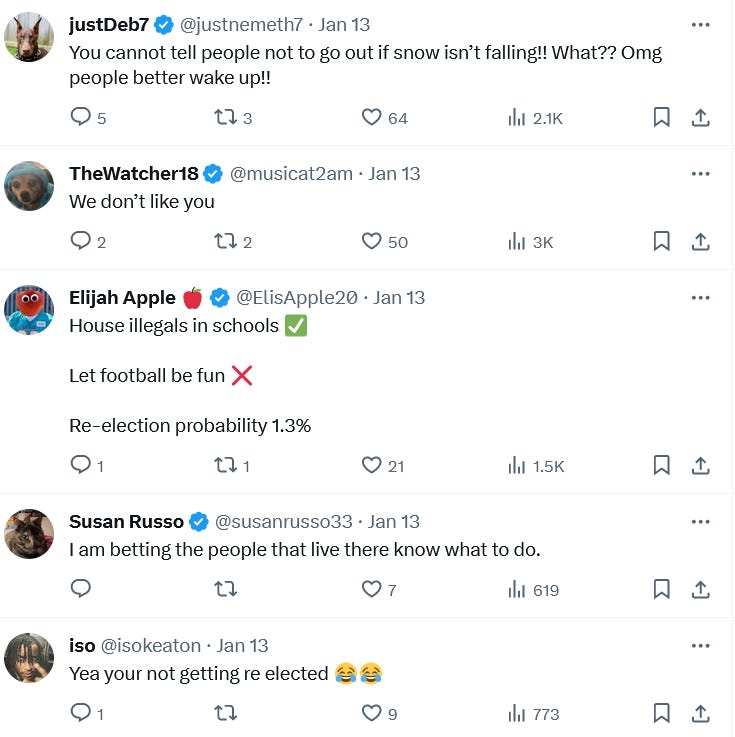
Ok, so digging a bit into travel bans, you’ll recognize that there have been travel bans based on big storms in the past here in New York. However, those are issued by the local government (i.e. County Executive), after a state of emergency is declared. They are not issued by the Governor, nor are they issued without an emergency declaration.
By the way, the travel ban is still in effect for most of Erie County today. Anybody surprised?
Does anyone see the correlation here between government overreach, their quest for “centralized” power, and their fear mongering? It’s the same thing the Governor and her DOH have been doing with their hideous “quarantine camp” regulation that I have been fighting in court for nearly two years now! The name of that case is Borrello v. Hochul, and you can read the details and case history here. Connecting the dots to the analysis at hand, you will note that the quarantine camp regulation tried to take the power from (elected) judges (in keeping with our law) who have the authority to temporarily quarantine sick, dangerous people, and shift that power to unelected, statewide, DOH employees and appointees who have zero accountability to We the People. Under their quarantine camp reg, the Governor and her DOH would have centralized control over 19 million New Yorkers, to force you to lockdown in your home, or they could force you (with the use of police) to go to a quarantine center/ facility/ camp (pick your noun), without any proof you are sick, indefinitely, with no procedure by which you can regain your freedom, and with no declared state of emergency! The fear factor used to try to justify the authoritarian power grab here is the threat of death… If we don’t lock people up who are possibly exposed to a disease, then you might die. Swap out “possibly exposed to a disease” and put in its stead “unclean.” What does that make you think of?
My next question: do you see any similarities here to Hochul’s probably illegal climate lockdown? I say “probably illegal” because I couldn’t find the supposed legal authority that she’s relying upon to prohibit people from driving. If you know what she is relying upon, feel free to post it in the Substack comment section.
Before you draw your own final conclusion about all this, I will add one last thing for you to consider. In December, a month before Hochul issued this Erie County travel ban, the (Democrat) County Executive, Mark Poloncarz, set up an online portal so residents could check and see if they would be deemed “essential workers” and thus exempt from any futuristic travel bans. Oh, and he coordinated with their “partners” in the federal government to come up with the list! Sound familiar, folks?! Remember Governor Cuomo’s C19 lockdown (“Just 2 weeks to flaten the curve”), which lasted for months, and all the “essential workers” that he exempted? Here’s an article about Erie’s coincidentally-just-in-time-for-a-travel-ban portal, “Erie County’s new online portal will identify essential workers exempt from travel bans.”
Trump a ‘threat’ to UK – ex-MI6 chief
RT | January 15, 2024
Former US President Donald Trump’s potential reelection could be “problematic” for British national security due to his stance on NATO, former head of the MI6 intelligence service has warned.
Richard Dearlove, who led MI6 from 1999 to 2004, was discussing potential threats to the UK in 2024 in an interview with Sky News on Sunday, during which he pointed to the Russia-Ukraine conflict and the “long-term behavior of China,” before moving to the US presidential race.
“You have to add a political threat, which I am worried about, which is Trump’s reelection… which I think for the UK’s national security is problematic,” Dearlove said. If Trump, given his critical attitude towards NATO, “acts hastily and damages the Atlantic alliance, that is a big deal for the UK,” he warned.
“We’ve put all our eggs in defense terms in the NATO basket. If Trump really is serious about, as it were, changing the balance, I mean the American nuclear umbrella for Europe is, in my view, essential to Europe’s security and defense,” the former spymaster said.
During his time in the White House, Trump disparaged NATO, calling it “obsolete,” and questioned the bloc’s relevance in the modern world. He also cast doubt on Washington’s commitment to defend its allies and argued that other NATO members were not contributing enough.
“Look, NATO has taken advantage of our country. The European countries took advantage,” the former president recently told Fox News, adding that his attitude towards NATO depends on whether “they treat us properly.”
Despite several court cases against him, Trump remains the frontrunner for the Republican Party nomination as presidential candidate. A recent Morning Consult poll indicates that he is leading with 69% support, while the nearest rival is trailing far behind.
Was 2023 REALLY the second hottest year since 1884?
By Iain Davis | OffGuardian | January 14, 2024
According to the UK Met Office, 2023 was the second hottest year in the UK since 1884.
Quite obviously, this is complete nonsense. Unless they are troglodytes that never venture out in daylight, why would anyone in the UK believe such absurd drivel?
The Met Office states:
2023 is provisionally the second warmest year for the UK according to mean temperature. [. . .] 2023’s provisional mean temperature of 9.97°C puts it just behind 2022’s figure of 10.03°C and ahead of 2014’s 9.88°C.
Right, it’s “provisional” drivel.
The UK summer of 2023—where I live—was a thoroughly miserable affair. We had a few weeks of decent sunshine in the spring and a couple of hot weeks of Indian summer. That was it!
The rest of it was cold, wet and comprehensively devoid of anything we might traditionally call “summer.” The winter preceding and following it wasn’t particularly cold, but nor was it unusually warm.
I’m knocking on a bit and can remember about 50 years of my life. I know, for a fact, that I have lived through many warmer years. Sure, this is anecdotal, but I haven’t completely taken leave of my senses and I still have a functioning memory. No way am I unquestioningly buying the Met Office’s silly claim.
Neither do I believe any of the legacy media reports trying to convince me that the Met Office’s preposterous assertion is evidence of an alleged climate crisis. It simply isn’t true, so it is not “evidence” of anything at all. Although it does suggest deception.
The Met Office—obviously unreliably—tells us “UK mean temperatures have been shifting over the decades as a result of human-induced climate change. [. . .] 2023’s provisional mean temperature of 9.97°C puts it just behind 2022’s figure of 10.03°C.”
For a start, “human induced climate change,” or Anthropogenic Global Warming (AGW), is a questionable and unproven scientific theory, not scientific fact. This too is just another claim from the Met Office which it wrongly asserts as fact.
The Met Office also tells us that “sunshine was near-average for much of the UK.” If we have got this right, the Met Office is claiming that, with average hours of UK sunshine in 2023—which also seems pretty dubious to me—somehow, since 1884, the only year that has been “hotter” was 2022. Which doesn’t ring true either.
What’s going on?
What does the Met Office mean—pardon the pun—by “mean temperature”? It reports that its 2023 alleged “provisional mean temperature of 9.97°C” had been obtained via the HadUK-Grid data set. The Met Office also cites its 2023 rapid attribution study. It is from this that we can—eventually—glean how the “UK mean temperature” is calculated by the Met Office.
In its rapid attribution study, the Met Office states:
Observed values of the UK annual mean temperature are obtained from the HadUK-Grid dataset v1.2.0.0. The time series spans 1884 – 2023, with the 2023 values being provisional as of 2nd January 2024.
“Observed,” that’s what we want to hear. So what observations are reported in the HadUK-Grid dataset? The Met Office claims:
HadUK-Grid is a collection of gridded climate variables derived from the network of UK land surface observations.
If we look at the HadUK-Grid methodology, the Met Office adds:
The gridded data sets are based on the archive of UK weather observations held at the Met Office.
So far so good. The HadUK-Grid reportedly records real data, such as sunshine hours, rainfall and even temperature. We live in hope. Unfortunately, there are some caveats. The Met Office continues:
The methods used to generate the daily grids are described in more detail in [this] report.
OK. So beyond just recording real-world data, what are the “methods” outlined in said report?
[. . .] the Met Office climate data archive [. . .] contains a simplified version of the raw observations generated according to well-defined rules. [. . .] Mean temperature [. . .] is the average of the maximum and minimum temperatures.
At last we have a definition of the “mean temperature” the Met Office claims to be the second highest since 1884. Apparently, it is “generated according to well-defined rules.”
In Met Office speak “mean temperature” isn’t the actual arithmetic mean of daily temperatures but rather the “average” of minimum and maximum temperatures recorded between 09:00 and 21:00 on any given day. Begging the question how are the minimum and maximum UK temperatures “observed”?
Although the data ha[s] undergone some quality checking, the extent and effectiveness of this has changed through time since the 1960’s. [. . .] NCIC climate data analysis software was again used to create the gridded data. [. . .] The station data were normalised with respect to the monthly 1km x 1km gridded 1961-1990 climate normals described by Perry and Hollis (2005a).
So the minimum and maximum allegedly “observed” 2023 “mean UK temperature” wasn’t actually observed at all. It was calculated from normalised data using computers running software based upon the “climate normals” defined in Perry and Hollis (2005).
The related paper considered how to calculate long term averages (LTAs) and suggested a methodology by which “mean” temperatures could be calculated:
For air temperature, 1490 stations reported at some point between 1961 and 2000 but only an average of 560 of these were open at any one time. This gives an array which is 38% complete. [. . .] [T]he solution is to fill in the gaps using an appropriate estimation technique. [. . .] Once the gaps in the array have been filled, long term averages for the periods 1961-1990, 1971-2000 and 1991-2000 can be calculated for each station from the complete array. [. . .] The regression model parameters provide an estimation of [. . .] the UK climate, explaining between 29% and 94% of the variance in the data depending on the climate variable.
Potentially, up to 62% of the data forming the Met Office’s “Mean UK temperature” is “generated” by “fill[ing] in the gaps.” This is based upon an “estimation technique” which supposedly explains between “29% and 94% of the variance in the data depending on the climate variable.” This doesn’t mean that the estimated fill-ins are inaccurate but they cannot be called “observations” either.
We seem to be moving further away from empirical science. Surely the Met Office isn’t claiming that it knows what the average UK “provisional” mean temperature was in 2023 based upon such limited observations? With regard to how it interprets the HadUK-Grid dataset the Met Office states:
The HadUK-Grid dataset is produced on a 1km x 1km grid resolution on the Ordnance Survey’s National Grid. To facilitate comparison of the observational dataset with the UKCP18 climate projections [. . .]. All the gridded datasets use the same grid projection. The re-gridding is conducted through averaging of all 1km grid points that fall within each of the coarser resolution grid cells.
Whoa there! We already know that the “observational dataset” is created by “fill[ing] in the gaps”—around a 60% gap apparently—with computer modelled estimates. Now we are told some sort of “re-gridding” is necessary to “facilitate comparison” with UKCP18 climate projections. Why is that necessary?
The UK Met Office adds:
Area averages are also produced based on averaging the 1km grid [data] across a set of geographical regions to provide spatial statistics for country, administrative regions and river basins. The details of these areas can be found in the UKCP18 guidance notes.
Now we’ve got “spacial statistics,” instead of empirical measurements, based upon “area averages” that facilitate, for some unknown reason, comparison with “UKCP18 climate projections.” OK, so how are the “area averages” constructed in accordance with the UKCP18 guidance notes:
Before using [UKCP18 guidance notes], it is important to understand the assumptions made, the caveats and limitations and the appropriate use of the results.
Assumptions made, caveats and limitations! What bloody assumptions, caveats and limitations? Just measure the temperature and calculate some sort of meaningful average for crying out loud!
Let’s look at the caveats and limitations:
Our understanding and ability to simulate the climate is advancing all the time but our climate models are not able to represent all of the features seen in the present day real climate and there are still limitations in our ability to project 21st century weather and climate.
Why are the Met Office “generating” temperature datasets to “facilitate comparison” with climate models if those models “are not able to represent all of the features seen in the present day real climate.” Surely the models should be based upon the empirically observed and measured features of the “real climate,” as opposed to creating “area averages” containing “spacial statistics” to fit in with the models?
Almost unbelievably, this is evidently what the UK Met Office is doing:
The relative probabilities indicate how strongly the evidence from models and observations, taken together in our methodology, support alternative future climate outcomes. [. . .] The probabilities are conditioned on methodological choices and expert judgement. The results may change if a different methodology is used.
In essence, the Met Office uses a tortuous and unnecessarily convoluted methodology to make up the bulk of its UK “temperature” data. While the Met Office claims that the provisional UK mean temperature was for 2023 was 9.97°C it also states that its results might change “if a different methodology” was used.
What’s more, the data it uses is normalised, based upon a wide gamut of climate assumptions, in order to fit in with its own climate models. Again, it admits its so-called observations, of things like mean temperature, are “taken together in [its] methodology” expressly in order to “simulate the climate.”
Most of these modelling shenanigans are utterly superfluous if your objective is to calculate the arithmetic mean annual UK temperature. Of course anomalies, such as heat islands, need to be normalised in the data but the rest of the Met Office’s “methodology,” which doesn’t even attempt to calculate an arithmetic mean temperature anyway, is about as far removed from empirical science as it is possible to venture.
Inevitably, it produces completely meaningless pap. The problem with such allegedly “scientific” rubbish is that, rather than being laughed off, it is then taken seriously by millions—thanks the unquestioning propaganda reports of the legacy media—and used to advance policy agendas, such as Net Zero.
Apart from the fact that it is blatantly obvious, to anyone who has lived in the UK from more that a couple of decades, that 2023 was not a warm year, there are other notable reasons not to automatically trust the Met Office’s makey-uppy “climate science.” Its entire claim is reliant upon the HadUK-Grid dataset which is a project funded by the UK government. As is the Met Office itself.
Apparently, the UK government is irreversibly committed to UN Sustainable Development and the associated UK Net Zero policies. The Met Office’s alleged scientific “observations” suffer from an enormous financial conflict of interest. Providing any evidence that contradicts the notion of “unprecedented global warming” couldn’t be further removed from the Met Office’s and the UK government’s own declared interests.
There is absolutely no reason to believe any of it. As “science” goes, it’s complete junk. I’ve read comics with more credibility that the Met Office’s claim that 2023 was the second warmest year in the UK since 1884.
Pull the other one, it’s got bells on it.
Updates On The March To The Great Green Energy Future
By Francis Menton | Manhattan Contrarian | January 12, 2024
The cries of climate alarm get ever louder and more urgent. (E.g., New York Times, January 9, “It’s confirmed: 2023 was the planet’s warmest year on record and perhaps in the last 100,000 years. By far.” ) We’re all about to boil! Something must be done!
OK, but then there is the proposed solution: Order up by government fiat that our current fully working and inexpensive energy system must be replaced with a never-demonstrated pipe dream conjured up by political science and gender studies majors who know nothing about how an energy system works. We’re far enough into this by now that some of the pieces are starting to blow up in dramatic fashion. Are we allowed to notice?
Here in New York, we got into this game mainly with two pieces of legislation, both enacted in 2018 — at the state level, the Climate Leadership and Community Protection Act; and in the City, Local Law 97. With both laws the pols set the deadlines for compliance at dates seemingly far in the future, expecting that they would no longer be around to be held accountable. The first of those two laws ordered up state-wide mandates for “decarbonizing” the economy, starting with a requirement for 70% of electricity from “renewables” by 2030; and the second set limits for carbon emissions for buildings in New York City, some of which have just kicked in effective January 1, 2024. Sure enough, the Mayor at the time of enactment is gone, almost the entire City Council is gone (term limits), and the Governor at the time is also gone.
So where are we?
The Manhattan Contrarian Energy Storage Report of December 1, 2022, led off by sounding a clear alarm: getting electricity from intermittent wind and solar well past 50% of total generation would require enormous quantities of energy to be stored, with technical requirements, including duration of storage, well beyond the capability of any battery currently existing or likely to be invented any time soon. Essentially, if fossil fuels are to be eliminated, there is only one realistic possibility for meeting the storage requirements: hydrogen.
In mid-2023, the New York Independent System Operator, to its credit, recognized the problem — although it buried that recognition deep in a report when it should be shouting about the problem from the rooftops. From NYISO’s Power Trends 2023 Report, revised August 2023, page 7, starting in the middle of a paragraph and without any emphasis:
[T]o achieve the mandates of the CLCPA, new emission-free generating technologies with the necessary reliability service attributes will be needed to replace the flexible, dispatchable capabilities of fossil fuel generation and sustain production for extended periods of time. Such emission-free technologies, either individually or in aggregate, are not yet available on a commercial scale.
With hydrogen as the only possible such “emissions-free generating technology,” how much would hydrogen cost as the solution to this problem, particularly if one follows the hypothesis that it must be created without any use of fossil fuels? My Report, page 14, noted that existing commercial production of this so-called “green” hydrogen was “negligible,” leaving no good benchmark for understanding what the costs might be. As a substitute, I ran some rough numbers based on cost of wind and solar generators to make the electricity and efficiency of the electrolysis process. The result was a very rough estimate that this “green” hydrogen would cost “somewhere in the range of 5 to 10 times more” than natural gas (page 17).
Well, now some new precision has come into view. In July 2022 the UK government launched what it calls its First Hydrogen Allocation Round (HAR 1), to obtain bids and award contracts to produce this so-called “green” hydrogen using wind power. The process took a while, but here from December 14, 2023 is the announcement of the first round of contract awards. Excerpt:
Following the launch of the first hydrogen allocation round (HAR1) in July 2022, we have selected the successful projects to be offered contracts. We are pleased to announce 11 successful projects, totalling 125MW capacity. HAR1 puts the UK in a leading position internationally: this represents the largest number of commercial scale green hydrogen production projects announced at once anywhere in Europe. . . . The 11 projects have been agreed at a weighted average strike price of £241/MWh.
£241/MWh? At today’s exchange rate of 1.27 $/£, that would be $306/MWh. Prices of natural gas are generally quoted in $/MMBTU rather than per MWh, but here is EIA’s latest Electricity Monthly Update, dated December 21 and covering the month of October 2023. It gives natural gas prices in the per MWh units. The “price of natural gas at New York City” is given as $11.32/MWh. That would make the price that the UK has just agreed to pay to buy this “green” hydrogen stuff approximately 27 times what we can buy natural gas for here in New York to obtain the same energy content.
And that $306/MWh is just for the hydrogen. It includes nothing for the massive new facilities (underground salt caverns?) to store the stuff, for a new pipeline network to transport it, and for a new collection of power plants to burn it.
To be at least a little fair, natural gas prices do vary considerably by location. Even within the U.S., some prices per the EIA Report are about double the New York City price, and in Europe maybe four times the New York City price. But those prices are affected by European demand for LNG from the U.S., due to their own stupid decision to ban fracking for natural gas combined with the unpleasantness in Russia.
And even if you figure that green hydrogen can be produced for “only” 7 – 10 times what it costs to buy natural gas, rather than 25 – 30 times, is anybody really going to go forward with such a project to replace all natural gas in an entire modern economy? It would be completely nuts.
Finally, let’s take a look at how New York is progressing toward that 2030 mandated goal of 70% of electricity from renewables. Data on electricity production for New York State for 2023 are just out from the NYISO. The good people from Nuclear New York (advocates for more nuclear power plants) have compiled the ISO data into a helpful aggregate chart covering the years 2019 (immediately after enactment of the Climate Change Act) to 2023. Here is the chart:
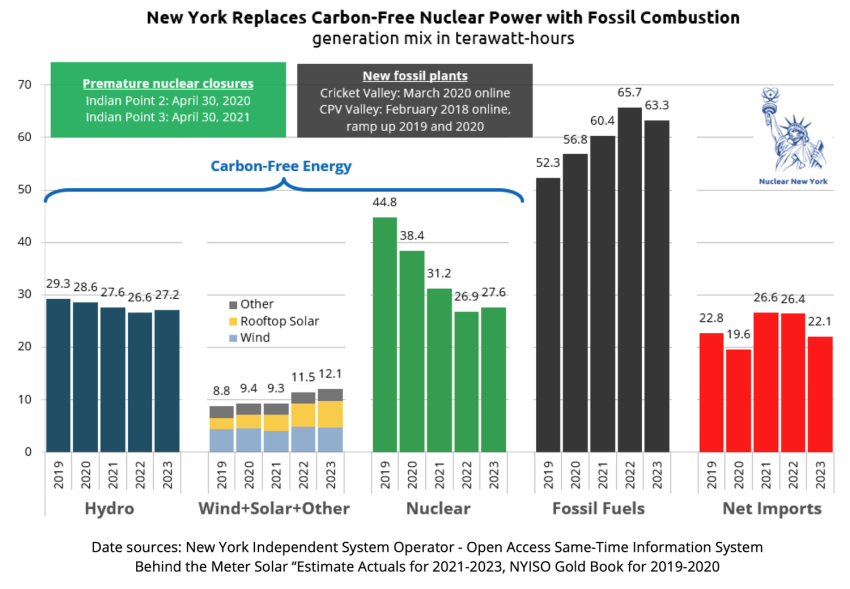
Out of 152.3 TWh of electricity produced or imported in 2023, fossil fuels continued to provide 63.3 TWh (41.5%). Most of the imports (14.5%) are undoubtedly from fossil fuels as well. Wind/solar/other provided just 12.1 TWh, or 7.9% of the total, barely up from about 6% in 2019. And that’s now suddenly going to go to 70% by 2030? Ridiculous. Meanwhile, the big story leaps off the page, as the Nuclear New York guys emphasize in the headline. The State forced the premature closure of two nuclear plants in 2020 and 2021, which caused the (carbon free) nuclear share of the total to drop from about 29% to only 18%; and almost all of that was taken up by two new natural gas plants, causing the fossil fuel share of the total to soar from only 34% to 41.5%. No person looking at this chart would ever conclude that New York has spent the past five years embarked on a crash program to replace fossil fuels with wind and solar. That process is going absolutely nowhere.
The truth is that the march to the Great Green Energy Future is over, but no one is yet willing to admit that.
Germany: Scholz’s ‘green’ government wants to buy 3 VIP helicopters for €200 million
By Denes Albert | Remix News | January 15, 2024
At a time when farmers are staging mass national protests over austerity measures that they say will put them under tremendous financial strain, German Chancellor Olaf Scholz and his ministers are aiming to purchase three new, luxury VIP helicopters that will cost €200 million.
However, the budget cuts for farmers are just one austerity measure, with the total budget cut expected to be €17 billion. The opposition is reacting with outrage over the news of the helicopter purchases, with the luxury helicopters designed for Chancellor Olaf Scholz and Defense Minister Boris Pistorius to attend appointments in Germany.
The German armed forces are supposed to replace the aging Cougar helicopters currently stationed in Berlin, which have a range of 850 kilometers and a cruising speed of up to 315 kilometers per hour. The VIP helicopters became famous when the former Social Democrat (SPD) Defense Minister Christine Lambrecht took her son on holiday in one of them.
The German newspaper Bild says that government officials probably suspect that citizens will not be happy about spending taxpayers’ money in a time of crisis, which is why they wanted to hide the €200 million expense.
German MPs do not recall this type of spending ever being discussed in the budget committee, and the helicopters were not included in the December budget proposal. The news is especially surprising considering German police still have so-called VIP Super Puma helicopters, which government representatives can fly in to emergency meetings.
The opposition is stunned, with Christian Democratic Union (CDU) budget expert Ingo Gädechens telling Bild that the government has lost touch with reality. He points out that the government wants to take €176 million from farmers this year, almost as much as the new helicopters cost.
“All of Germany is suffering from the collapse of fiscal policy. Austerity is everywhere,” the politician said. He added that it is obvious that Scholz’s travel convenience is the reason for the purchases and that ministers are more important than budgetary discipline.
However, Scholz may never get to experience the joy of riding a brand-new luxury helicopter, as the government cannot buy new helicopters without parliamentary approval. Now, it is up to the budget committee.
UK to send 20,000 troops to NATO exercise
RT | January 15, 2024
The UK is set to deploy around 20,000 service members – as well as modern warships and fighter jets – to Europe to take part in a major NATO exercise amid rising tensions with Russia, the Defence Ministry has announced.
In a statement on Monday, the ministry, citing excerpts from a speech to be delivered by Defence Secretary Grant Shapps, said that some 16,000 army troops – along with tanks, artillery, and helicopters – will join other bloc members on the continent to participate in Exercise Steadfast Defender 24, scheduled to take place in the first half of this year.
The effort will be supported by eight warships and submarines, as well as 2,000 Royal Navy sailors. The UK will also deploy a number of aircraft, including F35B Lightning fighters and Poseidon P8 surveillance aircraft, the ministry said.
Meanwhile, Shapps is expected to call the drill “one of NATO’s largest deployments since the end of the Cold War,” adding that the UK and its allies have found themselves “in a new era” and “must be prepared to deter our enemies,” according to the statement. The statement specifically referred to the threat from the Russian “menace.”
NATO began reinforcing its military footprint in Europe first after a Western-backed coup in Kiev triggered hostilities in Donbass, which is now part of Russia. However, the most drastic build-up occurred after Russia launched its military campaign against Ukraine in February 2022. In June of the same year, the US-led military bloc agreed to put 300,000 troops on high alert, up from 40,000, to deter Moscow.
Russian President Vladimir Putin has previously said that Moscow has no plans to attack NATO, arguing that there was “no geopolitical, economic … or military interest” in waging war against the bloc. Still, Moscow has also repeatedly warned that the alliance’s military activities close to its border warrant additional security measures. Putin has also said that Ukraine’s desire to join NATO was one of the key reasons for the current conflict.
Scholz pushes fake Russian threats to distract Germans from economic problems
By Ahmed Adel | January 15, 2024
Germany is preparing for a war between NATO and Russia, which, according to the scenario of the German Defence Ministry, could begin in the European summer of 2025 after the defeat of the Ukrainian Army, reported Bild with reference to a secret document of the Bundeswehr. This is evidently a desperate attempt by the German chancellor to distract citizens from their economic woes.
According to the newspaper, citing a classified German military document, the escalation could begin as early as next month with the start of an active Russian offensive against the Ukrainian Armed Forces.
According to Bild, the German military considers the Suwałki Gap between Belarus and the Russian region of Kaliningrad to be the most likely site of confrontation. A situation could escalate in October if Russia deploys troops and medium-range missiles to Kaliningrad, and from December 2024, an artificially induced “border conflict” and “clashes with numerous casualties” could unfold as Russia would take advantage of political chaos in the US following the presidential election.
“The actions of Russia and the West are described precisely, indicating the location and month, and will culminate in the deployment of hundreds of thousands of NATO troops and the imminent start of war in the summer of 2025,” writes the article.
However, the article’s authors leave open the question of how this hypothetical escalation will end.
This is, of course, a ridiculous suggestion by the German Defence Ministry, especially as Moscow has repeatedly stressed that it does not want conflict with NATO or anything beyond its special military operation in Ukraine. Rather, this is an attempt by Chancellor Olaf Scholz to instil an unjustified fear in German society as his popularity continues to plummet in the context of a stuttering economy and continued failed policies.
More than 70% of Germans are dissatisfied with Scholz, according to a survey carried out by the INSA Institute for Bild. Specifically, 72% of voters do not approve of his performance, which is three percentage points more than at the beginning of December. Only one in five, 20%, think that Scholz has done a good job.
According to the researchers, 76% of those surveyed are generally dissatisfied with what the federal government does, whilst only 17% of citizens are satisfied. It is the worst indicator of the ruling coalition since it was formed in December 2021, Bild noted.
In 2023, the Scholz-led government faced numerous economic and leadership challenges that undermined public trust. Persistent inflationary pressures, exacerbated by fiscal policy, undermined household budgets, which caused widespread discontent. The lack of strategic direction and perceived indecision on critical issues, such as energy policy following the adoption of sanctions against Russia, further fuelled scepticism among voters. The leadership crisis, characterised by internal conflicts and disagreements, damaged the effectiveness and cohesion of the German government.
What especially frustrates Germans is the fact that sanctions were imposed on Russia, which has become the fifth-largest economy in the world by volume, whilst Germany is in recession. With a public budget deficit estimated at around 60 billion euros, the very model of the German economy appears to be threatened.
Germany is officially in recession and is expected to have ended 2023 with a drop in GDP of around 0.3%, according to a forecast from the European Commission. This is one of the worst economic results in the bloc, given that the growth forecast for the entire European Union in 2023 is 0.6%. Among the causes is the energy crisis that has hit Germany harder than the rest of the European bloc, mainly because the Germans slashed their supply of Russian energy after the start of the special military operation in February 2022.
Furthermore, with the increase in energy prices resulting from sanctions against Russia, Germany has also suffered an increase in general price inflation in the economy, forcing the European Central Bank to raise interest rates, thus affecting the population’s purchasing power and impacting consumption. Consequently, German companies have not only lost international competitiveness with the application of sanctions against the Russians, but now the country runs the risk of entering a process of deindustrialisation.
Under these conditions, the extreme right is experiencing a resurgence. The far-right Alternative for Germany (AfD) party has hit an all-time high approval rating of 24% and has the potential to gain a few more percentile points with the immense failure of the ruling coalition.
What is undeniable is the fact that Germany is experiencing a rapid decline, all spurred on by the reckless policies of Scholz that prioritised American interests instead of German, and he is now resorting to a fake Russian threat in a desperate attempt to distract citizens from their social and economic problems that he is responsible for.
Ahmed Adel is a Cairo-based geopolitics and political economy researcher.
Featured Video

Liberty Cannot Exist Inside a Panopticon
or go to
Aletho News Archives – Video-Images
From the Archives
Left-leaning despisers of 9/11 Truth movement: Do you really believe in miracles?
David Ray Griffin | Global Research | 06 Jul 2010
An Open Letter to Terry Allen, Noam Chomsky, Alexander Cockburn, David Corn, Chris Hayes, George Monbiot, Matthew Rothschild, and Matt Taibbi.
[1]According to several left-leaning critics of the 9/11 Truth Movement, some of its central claims, especially about the destruction of the World Trade Center, show its members to be scientifically challenged. In the opinion of some of these critics, moreover, claims made by members of this movement are sometimes unscientific in the strongest possible sense, implying an acceptance of magic and miracles. … Full article
Blog Roll
 Aletho News
- White House envoy declares kinetic action against Yemen ‘fruitless’
- Ukraine deployed thousands of microdrones in Iraqi Kurdistan: Tasnim
- Iran calls for emergency UNSC meeting over Trump’s ‘brazen’ bomb talk, Israeli threats
- Iranian sources reveal details of Russia-China Hormuz proposal
- Plan for more US-Israel integration puts our military tech at risk
- Another Round Against Iran Will Break What Is Left of the Gulf
- SVR Report on Ukraine’s Mexican Drug Gang Links Could Pressure Zelensky, Won’t Change US Policy
- British Government Employees Were Fact-Checking the News at the BBC. Nobody Told You.
- Albania on fire: who’s behind the riots?
- Egypt’s Civil Democratic Movement rejects involvement in regional war
- If Americans Knew
- Mysterious bot accounts reportedly spread fake ‘man on the street’ videos for Michigan Senate candidate
- Israeli Defense Minister Katz Says Over 60 Lebanon Villages Have Been Destroyed
- Why Is Israel Running TV Ads in Iowa Ahead of the Midterms?
- Hind Rajab’s Alleged Killer Is in the United States. HRF Demands His Arrest.
- US Officials Face Fresh Pressure After Another American ‘Brutalized’ by Israeli Settlers in West Bank
- Israel-Backed Palestinian Militias Terrorize Displaced Families in Gaza
- FBI subpoenas pro-Palestine activists over Israeli weapons plant disruption
- Fourth winter arrives in wartorn Gaza, too early – Daily Update
- More on how Bari Weiss is using CBS on behalf of Israel
- What the UK Is Doing to Pro-Palestine Novelist Sally Rooney Is an Act of Orwellian Villainy
- No Tricks Zone
- Predictions Made By Renowned Climate Proifessor Over Past Decades Have Been Proven To Be Poor
- New Study Suggests Large Regions Of The Pacific Ocean Have Been Cooling For The Last 80 Years
- Germany’s Green Energy Debacle: High Energy Costs Force Kahla Porzellan to Close After 182 Years!
- New Study: 50 Years Of The Most Aggressive ‘Net Zero’ Policies Can Only Affect The Global Climate By 0.03°C
- US September “Heat” Was No Record…Many Records Set Decades Ago
- Latest European Green Energy Debacle; Portugal’s Largest Flagship Solar Park Insolvent!
- Green Energy Debacle: German Expert Professor Fritz Vahrenholt Warns Of Severe Economic And Social Consequences
- Two More Paleo Reconstructions Affirm Meters-Higher Sea Levels Across Ireland, Brazil 7000-6000 Years Ago
- New Study: Earth And Venus Surface Warmth Largely Explained By Convection And Lapse Rate, Not CO2 Or Radiation
- 2025 Nature Paper Claiming Worsening Global Drought Gets RETRACTED …Heavily Flawed

