“This is not about complicated issues of cryptocurrency,” assistant U.S. attorney Nicolas Roos declared in the Sam Bankman-Fried trial, after accusing the defendant of building FTX on a “pyramid of deceit.” Much the same can be said about the foundations of Britain’s net zero experiment. Energy is complicated, and electricity is essential to modern society and our quality of life, but as with FTX, the underlying story is straightforward: wind power and net zero are built on a pyramid of deceit.
Net zero was sold to Parliament and the British people on claims that wind-power costs were low and falling. This was untrue: wind-power costs are high and have been rising. In the net zero version of “crypto will make you rich,” official analyses produced by the Treasury and the Office for Budget Responsibility rely on the falsehood that wind power is cheap, that net zero would have minimal costs, and that it could boost productivity and economic growth. None of these has any basis in reality.
The push for net zero began in 2019, when the U.K.’s Climate Change Committee produced a report urging the government to adopt the policy. Part of the justification was historic climate guilt. In the words of committee chair Lord Deben, Britain had been “one of the largest historical contributors to climate change.” But the key economic justification for raising Britain’s decarbonization from 80% to 100% by 2050 – i.e., net zero – was “rapid cost reductions during mass deployment for key technologies,” notably in offshore wind. These illusory cost reductions, the committee claimed, “have made tighter emission reduction targets achievable at the same costs as previous looser targets.” It was green snake oil.
During the subsequent 88-minute debate in the House of Commons to write net zero into law, the clean-energy minister, Chris Skidmore, also asserted that net zero’s cost would be the same as the previous 80% target, which Parliament had approved in 2008. Challenged by a Labour MP on the absence of a regulatory-impact assessment, Skidmore misled Parliament, saying that there had been no regulatory-impact assessment in respect of raising the initial 60 percent target to 80 percent.
The regulatory-impact assessment that Skidmore says doesn’t exist gave a range of £324 billion to £404 billion when the target was raised to 80% – an estimate that excluded transitional costs – and cautioned that costs could exceed this range. Unlike today’s political pronouncements, the assessment was honest about the consequences of Britain acting if the rest of the world did not. “The economic case for the UK continuing to act alone where global action cannot be achieved would be weak,” it warned.
The Climate Change Act was passed to show Britain’s climate leadership and inspire the rest of the world to follow its example. How did that work out? In the 11 years that transpired from passing the Act to legislating net zero in 2019, Britain’s fossil fuel emissions fell by 180 million metric tons – a 33% reduction. Over the same period, the rest of the world’s emissions increased by 5,177 million metric tons – a rise of 16%. Put another way, 11 years of British emissions reduction were wiped out in around 140 days by increased emissions from the rest of the world.
Someone who claims that he’s a leader but who has no followers is typically regarded as a fool. It’s different with climate. Politicians parade their green virtue – Skidmore is to quit the House of Commons, and he teaches net zero studies at Harvard’s Kennedy School – while voters get mugged with higher energy bills. Analysis of Britain’s Big Six energy companies’ regulatory filings reveals that fuel-input costs for gas and coal-fired power stations were flat from 2009 to 2020. Still, the average price per kilowatt hour (kWh) of electricity paid by households rose 67%, driven by high environmental levies to subsidize renewable-energy investors. Yet supposedly the cost of renewable energy has plummeted.
During Prime Minister’s Questions earlier this year, Rishi Sunak claimed the cost of offshore wind had fallen from £140 per megawatt hour (MWh) to £40 per MWh, numbers assiduously propagated by the wind lobby and the Climate Change Committee. His claim is flat-out false. The prime minister has been suckered by falling per MWh price bids made by wind investors in successive allocation-round bids for offshore wind subsidies.
The explanation for this is to be found not in falling costs but in a flawed bidding process that rewards opportunistic bidding by wind investors. The government was giving away valuable options that commit the government to honor the prices paid for winning bids but commit investors to nothing. Because investors don’t pay anything for these options, the only way they can get them is by cutting the price they offer – but are not obliged to take – for their electricity unless they choose to exercise their options much later in the process.
Falling prices in successive allocation rounds are thus an artefact of moral hazard hardwired into the allocation mechanism; they reveal nothing about the trend in the costs of offshore wind. Analysis of audited financial data of wind farm companies undertaken by a handful of independent researchers comprehensively debunks the falling wind costs claim. The unavoidable move to deeper waters offset any cost reductions and operating costs per MWh of electricity for new offshore wind projects; the prices for the move are around double those assumed in the subsidy bids.
Preeminent among these researchers is Gordon Hughes, a former economics professor at Edinburgh University and adviser to the World Bank on power plant economics. Hughes’s analysis shows that by the twelfth year of operation, rising per MWh operating costs of deep-water wind turbines exceed their government-guaranteed prices, squeezing out their capacity to repay their capital and financing costs.
The intermittency and variability of wind and solar led the government to create a capacity market to pay for standby generation. In any economic appraisal of renewables, the costs of running the capacity market should be allocated to wind and solar as their intermittency and variability create the need for it. Electricity procured from the capacity market is not cheap. In 2020, German-owned Uniper’s thermal power stations obtained an average price of £224 per MWh, around four times the typical wholesale price.
Confirmation that offshore wind has huge, likely insuperable, cost and operating difficulties came in June, when Siemens Energy issued a shock profits warning and saw its shares plunge by 37 percent, in part because of higher-than-anticipated turbine failure rates. According to Hughes, the implication is that future wind operating costs will be higher, and output significantly lower, shortening the turbines’ economic lives. His conclusion is crushing:
The whole justification for the falling costs of wind generation rested on the assumption that much bigger wind turbines would produce more output at lower capex cost per megawatt, without the large costs of generational change. Now we have confirmation that such optimism is entirely unjustified . . . It follows that current energy policies in the UK, Europe and the United States are based on foundations of sand – naïve optimism reinforced by enthusiastic lobbying divorced from engineering reality.
The British government has been conned into placing a massive bet on offshore wind and is forcing electricity consumers to spend billions of pounds on a dead-end technology.
The falling cost of wind deception contaminates official assessments of the macroeconomic consequences of net zero. The Office for Budget Responsibility claims that the cost of low-carbon generation has fallen so fast that it is now cheaper than fossil fuel generation. Similarly, the Treasury erroneously took falling prices in wind subsidy allocation rounds as indicating falling wind costs. Both see the economy riddled with multiple layers of market failures, while not recognizing the real danger of government policy being captured by vested interests, as, indeed, it has been. Taken to its logical conclusion, theirs is an argument for switching to central planning and a command-and-control economy.
The Treasury argues that “other things being equal,” the added investment required by renewable energy “will translate into additional GDP growth.” Other things, of course, are not equal. As recent history shows, there’s a world of difference between investors and politicians making capital-allocation decisions. The centrally planned economies of the former communist bloc squandered colossal amounts of capital, immiserating their populations. Few now believe that investment in those economies boosted growth.
We don’t need to hypothesize. Government data disprove the Treasury’s contention and demonstrate that increasing deployment of renewable capacity reduces the productivity of Britain’s grid. In 2009, 87.3 gigawatts (GW) of generating capacity, comprising only 5.1 percent of wind and solar, generated 376.8 terrawatt hours (TWh) of electricity. In 2020, 100.9 GW of generating capacity, with wind and solar accounting for 37.6 percent of capacity, produced 312.3 TWh of electricity. Thanks to renewables, 13.6 GW (15.6 percent) more generating capacity produced 64.5 TWh (17.1 percent) less electricity.
Those numbers are damning for renewables and demonstrate why they make electricity more expensive and people poorer. Before mass deployment of renewables, 1 MW of capacity in 2009 produced 4,312 MWh of electricity. In 2020, 1 MW of capacity generated 3,094 MWh, a decline of 28.3 percent. It’s as clear as can be: investment in renewables shrinks the economy’s productive potential. This is confirmed by the International Energy Agency’s net zero modelling. Its net zero pathway sees the global energy sector in 2030 employing nearly 25 million more people, using $16.5 trillion more capital and taking an additional land area the combined size of California and Texas for wind and solar farms and the combined size of Mexico and France for bioenergy – all to produce 7 percent less energy.
Britain’s energy-policy disaster has lessons for America. The physics and economics of wind power are not magically transformed when they cross the Atlantic. Whenever a politician or wind lobbyist touts wind as low-cost or says net zero will boost growth, they become accessories to the wind power scam. The data lead ineluctably to a decisive conclusion: net zero is anti-growth. It is a formula for prolonged economic stagnation. Anyone who wants the truth about renewables should look at Britain and the sorry state of its economy. For the last decade and a half, it has been going through its worst period of growth since 1780.
Unlike in business and finance, there are no criminal or civil penalties for those who promote policies based on fraud and misrepresentation. Rather, net zero is similar to communism. Like net zero, communism was based on a lie: that it would outproduce capitalism. But it failed to produce, and belief in communism evaporated. When the collapse came, it was sudden and rapid. The truth could not be hidden. A similar fate awaits net zero.
Bahraini authorities have ordered the seven-day detention of a leading opposition figure after he denounced the Al Khalifah regime’s participation in the US-led coalition against Yemen in the Red Sea.
Bahrain’s office of public prosecution ordered Ebrahim Sharif’s detention pending investigation for “spreading false news during wartime,” his family and lawyer said on Thursday.
Sharif, who heads the Wa’ad organization, in a series of posts criticized authorities in Manama for joining the coalition “without any consideration of the position of the Bahraini people who strongly support our besieged Palestinian people in Gaza.”
He was arrested on Wednesday. When asked about his case, the Bahraini government said “an individual” was being held for “allegedly supporting a proscribed terrorist organization.”
The charge against Sharif, a pro-democracy campaigner, can hold a prison sentence of up to 10 years.
Bahrain is the only state in the Persian Gulf region that has joined the US-led coalition established this week in response to Yemeni attacks on ships bound to the occupied Palestinian territories in the Red Sea.
Sayed Ahmed Alwadaei, advocacy director at the UK-based Bahrain Institute for Rights and Democracy (BIRD), said the Bahraini regime “wants to make an example of Sharif who is not alone in his criticism of Bahrain’s decision to the join the Americans.”
“Failure of the US administration to publicly denounce his arrest and push for his immediate release gives the green light to the Bahrain government to continue his detention,” Alwadaei said.
The Pentagon has announced a military coalition of 10 countries, including Britain and Spain, to counter the Yemeni forces that targeted ships bound for Israel in solidarity with the people of Gaza.
A series of strikes attributed to the Yemeni forces have been conducted in solidarity with the Palestinians in the besieged Gaza Strip. Yemen has already warned it will prevent the passage of all ships in the Red Sea bound to the occupied territories.
The leader of Yemen’s Ansarullah movement said in a televised speech broadcast live Wednesday that the armed forces will not hesitate to target US military warships in the Red Sea if Washington and its allies carry out military strikes against Yemen.
Bahrain’s main opposition group al-Wefaq National Islamic Society recently denounced human rights violations in the country.
Al-Wefaq has denounced Manama’s normalization of relations with Israel as “a crime.”
The opposition party has underlined that the normalization is in flagrant contradiction to Bahrain’s history and Islamic identity.
Bahrain and the Israeli regime established diplomatic relations in 2020 as part of the United States-brokered Abraham Accords.
Last month, the deputy speaker of Bahrain’s National Assembly said members of the legislative body were pressing to reverse the normalization following the regime’s devastating war in Gaza.
Abdulnabi Salman said Bahraini lawmakers were demanding an end to diplomatic relations with Israel.
The Persian Gulf country has witnessed numerous protests ever since the rapprochement.
The United States and Britain refrain from the criticism of human rights violations across Bahrain.
In July, British legislators were pressing the government to provide clear explanations why Bahrain has been removed from its list of human rights priority countries, accusing the government of putting its principles “up for auction” after sealing a billion-pound investment deal with the Persian Gulf state.
The Israeli occupation authorities have confirmed the involvement of 19 Israeli prison guards in the brutal beating of a Palestinian prisoner, which ultimately led to his death on 18 November.
According to Israel Hayom, Thayer Abu Assab was 38 and from the northern West Bank city of Qalqilya. An autopsy was carried out last month which concluded that he had been subjected to assault and beatings, leading to his death.
All 19 of the prison guards implicated in the assault have been released under “restrictive conditions” pending the conclusion of an investigation.
Israel’s far-right National Security Minister, Itamar Ben-Gvir, has voiced his support for the guards involved in the incident, claiming that they are innocent until proven otherwise. He opposes the idea of charging any of them in connection with the killing of Abu Assab and proceeded to describe the Palestinian freedom fighters detained in Israeli prisons as “human scum” and “murderers”.
The Prisoners’ and Ex-Prisoners’ Affairs Commission had confirmed earlier that the occupation authorities were responsible for the killing of Abu Assab, who was held in Al-Naqab Prison in the Negev from 2005, serving a 25-year sentence. The commission accused the Israel Prison Service (IPS) of carrying out systematic and premeditated killings of Palestinian prisoners.
As many as six Palestinian prisoners have died in detention recently, including one from Gaza who has not been identified.
There are now more than 7,800 Palestinians being held in Israel’s prisons, including more than 2,870 administrative detainees who are held with neither charge nor trial, and 260 classified as “unlawful combatants” from Gaza. The number may be higher because Israel doesn’t release the details of all of the Palestinians it has imprisoned.
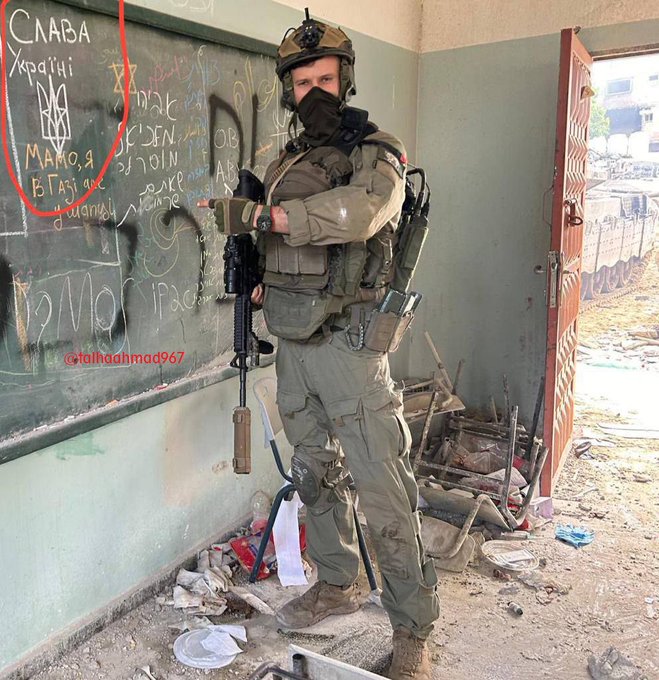
Fighters from Qassam Brigades, the armed wing of Hamas, ambushed and killed at least seven Ukrainian mercenaries who were fighting with the Israeli army in Gaza, Quds News Networkreported on 21 December.
According to sources speaking with the network, Qassam fighters targeted the mercenaries on 14 November after spotting them on Hassanein Street in the Shujaiya neighborhood, one of the main centers of Palestinian resistance to the ongoing Israeli ground invasion.
The sources added that “the occupation army did not include the dead among the numbers it acknowledges about its losses among soldiers in Gaza,” and that the ambush killed soldiers from the Israeli army as well.
According to the sources, a video that circulated on social media of a unit of Ukrainian mercenaries in a Shujaiya school was recorded on the same day as the attack.
It also showed a group of Ukrainian mercenaries in a neighborhood of Gaza City, hiding behind a wall.
Ukrainians fighting for Israel is a reversal of a dynamic that appeared in 2022, as reports emerged of hundreds of Ukrainian-born Israelis and several native Israelis traveling to Ukraine to join volunteer units after the Russian invasion.
The Quds Network report comes as the Israeli military announced the deaths of three additional soldiers on Thursday, Lavi Gehati, Omri Schwartz, and Yacoub Elian, during battles in the Gaza Strip. This brings the number of Israeli soldiers killed to more than 136, according to Israel, since the start of its ground invasion in Gaza on 27 October.
However, as The Cradle has reported, Israeli military leaders seeks to hide many of their soldiers’ deaths, and the number killed and wounded is likely much higher than the military’s official acknowledgements.
Hamas has released a flurry of combat videos in the past week showing its fighters targeting Israeli troops, armored personnel carriers, and tanks. This indicates that while Israel has caused massive destruction in Gaza, the Qassam Brigades are still strong militarily and are inflicting heavy losses on the Israeli army.
The escalating attacks on ships in the Arabian Sea and the Bab Al-Mandeb Strait by the Houthi movement in Yemen pose a real threat to the Israeli, Western and American economies. The Red Sea is one of the world’s busiest shipping routes for oil and gas. Most of the major shipping companies, such as the world’s largest container company, Italian and Swiss-owned Mediterranean Shipping Company (MSC), Denmark-based Maersk, Germany’s Hapag-Lloyd, and France’s CMA CGM have suspended their use of the Red Sea.
Due to the Houthi attacks, ships now have to go around Africa via the Cape of Good Hope, adding 4,000 nautical miles to the journey. This will result in the doubling of the shipping costs, to $4,000 per forty-foot container. According to experts, this change is due to the extra fuel cost of $1 million for each vessel going via the Cape instead of the Red Sea and the Suez Canal.
The Houthis are apparently applying an ethically justified approach built on the same logic used by the Israeli occupation state. Israel besieges the Gaza Strip and grants itself the right to do so. With this logic, the group grants itself the right to besiege Israel and links the opening of the strait to lifting the Israeli blockade on Gaza.
As the attacks intensify and pose a real danger to maritime routes, causing many companies to fear using the Red Sea and raising the cost of insurance and transportation, the US has announced the formation of an international naval coalition intended to protect cargo vessels. Ironically, though, the US is the largest country to impose blockades on other states and use sanctions as a weapon.
While previous US presidents considered any foreign war as an opportunity to rally the American people behind them and give themselves an electoral boost, the situation under President Joe Biden is different. He is the main advocate of the war against Russia in Ukraine, which he is losing despite throwing billions of dollars into it. Engaging in an armed confrontation with the Houthis would be a resounding failure, since the group has little to lose and does not fear war. Indeed, it would gain more legitimacy as the only force in Yemen to be fighting imperialism. Moreover, its war with the Saudi-led Arab coalition, including the United Arab Emirates, has shown that it is resilient, and able to force the coalition to freeze combat missions after years of fighting.
The outbreak of another war in this region would mean serious long-term disruption and increased transportation costs, as well as rising fuel and energy costs for end users. This would have a major impact on Europe during the winter given the already suspended supplies of oil and gas from Russia. Crude oil prices are already creeping up.
The impact of a war would be challenging for Biden as well. The US president sees himself as the, not a, world leader, but he faces difficult choices. He is accused of corruption and faces domestic issues, as does his rival, former President Donald Trump. In addition, the existing wars and crises are having long-term negative impacts on Washington’s standing and international influence.
Despite this, it seems to be impossible for Americans to consider alternative, more intelligent means to approach problems instead of military “shock and awe”. The US and its protégé Israel have always tried to play the role of gods in international politics, where what they want becomes a reality regardless of international laws and conventions. This may succeed in the short term, but it backfires in the long run, as seen in Vietnam, Iraq and Afghanistan. Armed interference in all of these countries has drained the US and its people, who are generally controlled by the political, economic and media elites.
These elites combined work systemically to nurture violence among American citizens, implanting a gung-ho mentality with war seen as the most effective way to solve international problems. Hollywood and video games instill the idea of US (and Israeli) exceptionalism and invulnerability in the minds of the public, so that it becomes easy to recruit them to fight and die in the elite’s battles. The US helps to spread racism in the world by creating divisions among people and inciting them against each other. The old principle well-loved by settler-colonial states is divide and rule; people are easier to manipulate, helping to ensure the concentration of wealth in the hands of the elite that fosters racism.
A simple comparison with cinema in Iran — which the US designates as a sponsor of terrorism — reveals a stark difference. Iranian cinema only rarely focuses on humanitarian and social topics, and hardly ever depicts violence, unlike Hollywood, which thrives on screen violence, normalising it and de-sensitising the audience to the extent that people find it easier to harm their fellow human beings in the service and interests of the elite.
While the economy is failing and education is facing great challenges in America, the government is spending trillions of dollars on unjustified and futile wars, including the one which Israel is waging against the Palestinian people. Sinking more and more resources in the quagmire of the Middle East will only lead to more suffering within America and abroad. Likewise, what is happening in Yemen will have an impact worldwide, not just in Gaza.
The consequences of a war against the Houthis will be much broader, dragging the Zionist colonial project and Western imperialism into a hellish scenario. Regardless of what the Zionists and their supporters in the West believe, they did not create a safe haven for Jews when they created the state of Israel in the heart of the Arab world. The Houthis are turning the tables on everyone in their defence of the Palestinians against Israel’s genocide in Gaza.
The military op against the Houthis will be expensive for the US, especially if it escalates into a regional conflict, a DC-based think tank has warned.
The Houthis have made it clear that they are to proceed with attacks in the Red Sea following US Defense Secretary Lloyd Austin’s announcement of a new US-led Operation Prosperity Guardian in the region.
As per the Pentagon, the Yemeni Shiite group has carried out 100 drone and missile attacks since October 7. The Houthis have recently stepped up their assaults in the Red Sea against US warships and Israeli-linked vessels in a bid to force Tel Aviv into halting its ground operation in the Gaza Strip.
The assaults have demonstrated that the Yemen militants possess a sizable and relatively advanced arsenal, according to the US press. What’s more, Houthi drones and missiles are cheaper than US interceptors used to shoot them down.
Therefore, it would cost Washington a “pretty penny” to defend the sea lanes going through the Suez Canal and the Red Sea, according to the Quincy Institute for Responsible Statecraft:
Each US munition used to intercept the Houthi rockets and drones costs between $1 million and $4.3 million;
US missiles reportedly used to shoot down Houthi projectiles and UAVs include the SM-2 ($2.1 million); SM-6 ($4.3 million); ESSM Sea Sparrows ($1.7 million); and Rolling Airframe missile ($905,000);
US ships cannot reload in the Red Sea and will have to return to port if the kinetic activity goes on much longer, which also means additional costs.
The conflict in the Red Sea threatens to become protracted given that neither warring side is inclined to back down.
The Biden administration has already gathered a 10-nation coalition and sent additional warships to the region. Top Houthi commander Mohammed al-Bukhaiti tweeted on December 19 that “Even if America succeeds in mobilizing the entire world, our military operations will not stop … no matter the sacrifices it costs us.” Israel is also showing no signs of scaling down its military op in the Gaza Strip where civilian casualties are continuing to stockpile.
Under these circumstances, there is a serious threat of the Red Sea turning into a new war theater, according to the DC-based think tank.
In that case, the costs related to the US-led task force in the Red Sea could become much higher, especially at the time when the US has been depleting its military arsenals supporting proxy war efforts in Ukraine and Israel’s Gaza war.
To complicate matters further, the Red Sea op may expose US troops and sailors to danger. “It is important for the American people to assess if what happens next is truly in the national interest,” the DC-based think tank concluded.
The 51-page ruling has caused a stir, but what is it really going to tell us?
Is it going to reveal anything of his ties to US and Israeli intelligence?
Highly improbable.
Is it going to tell us anything about his supposed “suicide”?
Of course not.
The judge even walked back the “in full” part before the end of her ruling, giving anyone on the list until January 1st to petition to have themselves removed:
Anyone on the list has until 1 January to appeal to have their name removed.
We don’t know who’s going to be on the “full” list when it’s released (except Prince Andrew, and you already know what we think about him) but there’s no reason at all to trust it.
As we speak the contents of this “full list” are probably subject to feverish behind the scenes campaigning. PR firms, agents, lobbyists all jockeying to have their clients removed and their enemies added. Those in control are likely busy extorting favours from anyone who doesn’t want to be a last minute addition.
Because that’s always been the major point of the “client list”. Since the revelation that it existed, the “Client List” has been a potential threat hanging over the head of every politician, celebrity or high profile business owner.
“Step out of line, and we might just discover you’re on the list and start leaking that little tidbit all over the place”.
The persons concerned don’t need to have EVER actually been on the list for this to work.
Hell, there doesn’t even need to be a list for this to work. Not a real solid hard copy compiled by Epstein anyhow. Just a spreadsheet on a computer somewhere, updated as necessary with the names of those deemed needful.
Consider, for a moment just how strange it is that we even know the “Epstein client list” exists, and indeed that that’s what it’s called.
Consider how strange it is that we were ever told who went to what island how many times.
Now the judge has made a ruling (hooray! the system works! ) and we’ll likely be presented with nothing but a list of disposable names – the old, the dead, the already discredited and/or recently stepped out of line.
What relationship, if any, it has to Epstein’s real associates or anything else real world will remain unknowable and largely irrelevant to everyone selling and consuming it.
One year ago, I published my first investigation based on documents I obtained through the “Twitter Files.” I visited the San Francisco office of the social media company several times and took many notes. Below, I am republishing my initial investigation, which explores the secret assistance that Twitter gave to the Pentagon to assist with a fake account network used to manipulate Arabic-language communities in the Middle East. Twitter claimed that it shut down all state-backed influence operations, yet gave special tools to the U.S. military for its propaganda network.
TWITTER EXECUTIVES HAVE claimed for years that the company makes concerted efforts to detect and thwart government-backed covert propaganda campaigns on its platform.
Behind the scenes, however, the social networking giant provided direct approval and internal protection to the U.S. military’s network of social media accounts and online personas, whitelisting a batch of accounts at the request of the government. The Pentagon has used this network, which includes U.S. government-generated news portals and memes, in an effort to shape opinion in Yemen, Syria, Iraq, Kuwait, and beyond.
The accounts in question started out openly affiliated with the U.S. government. But then the Pentagon appeared to shift tactics and began concealing its affiliation with some of these accounts — a move toward the type of intentional platform manipulation that Twitter has publicly opposed. Though Twitter executives maintained awareness of the accounts, they did not shut them down, but let them remain active for years. Some remain active.
The revelations are buried in the archives of Twitter’s emails and internal tools, to which The Intercept was granted access for a brief period last week alongside a handful of other writers and reporters. Following Elon Musk’s purchase of Twitter, the billionaire started giving access to company documents, saying in a Twitter Space that “the general idea is to surface anything bad Twitter has done in the past.” The files, which included records generated under Musk’s ownership, provide unprecedented, if incomplete, insight into decision-making within a major social media company.
Twitter did not provide unfettered access to company information; rather, for three days last week, they allowed me to make requests without restriction that were then fulfilled on my behalf by an attorney, meaning that the search results may not have been exhaustive. I did not agree to any conditions governing the use of the documents, and I made efforts to authenticate and contextualize the documents through further reporting. The redactions in the embedded documents in this story were done to protect privacy, not Twitter.
THE DIRECT ASSISTANCE Twitter provided to the Pentagon goes back at least five years.
On July 26, 2017, Nathaniel Kahler, at the time an official working with U.S. Central Command — also known as CENTCOM, a division of the Defense Department — emailed a Twitter representative with the company’s public policy team, with a request to approve the verification of one account and “whitelist” a list of Arab-language accounts “we use to amplify certain messages.”
“We’ve got some accounts that are not indexing on hashtags — perhaps they were flagged as bots,” wrote Kahler. “A few of these had built a real following and we hope to salvage.” Kahler added that he was happy to provide more paperwork from his office or SOCOM, the acronym for the U.S. Special Operations Command.
Twitter at the time had built out an expanded abuse detection system aimed in part toward flagging malicious activity related to the Islamic State and other terror organizations operating in the Middle East. As an indirect consequence of these efforts, one former Twitter employee explained, accounts controlled by the military that were frequently engaging with extremist groups were being automatically flagged as spam. The former employee, who was involved with the whitelisting of CENTCOM accounts, spoke under condition of anonymity because they were not authorized to speak publicly.
In his email, Kahler sent a spreadsheet with 52 accounts. He asked for priority service for six of the accounts, including @yemencurrent, an account used to broadcast announcements about U.S. drone strikes in Yemen. Around the same time, @yemencurrent, which has since been deleted, had emphasized that U.S. drone strikes were “accurate” and killed terrorists, not civilians, and promoted the U.S. and Saudi-backed assault on Houthi rebels in that country.
Other accounts on the list were focused on promoting U.S.-supported militias in Syria and anti-Iran messages in Iraq. One account discussed legal issues in Kuwait. Though many accounts remained focused on one topic area, others moved from topic to topic. For instance, @dala2el, one of the CENTCOM accounts, shifted from messaging around drone strikes in Yemen in 2017 to Syrian government-focused communications last year.
On the same day that CENTCOM sent its request, members of Twitter’s site integrity team went into an internal company system used for managing the reach of various users and applied a special exemption tag to the accounts, internal logs show.
One engineer, who asked not to be named because he was not authorized to speak to the media, said that he had never seen this type of tag before, but upon close inspection, said that the effect of the “whitelist” tag essentially gave the accounts the privileges of Twitter verification without a visible blue check. Twitter verification would have bestowed a number of advantages, such as invulnerability to algorithmic bots that flag accounts for spam or abuse, as well as other strikes that lead to decreased visibility or suspension.
KAHLER TOLD TWITTER that the accounts would all be “USG-attributed, Arabic-language accounts tweeting on relevant security issues.” That promise fell short, as many of the accounts subsequently deleted disclosures of affiliation with the U.S. government.
The Internet Archive does not preserve the full history of every account, but we identified several accounts that initially listed themselves as U.S. government accounts in their bios, but, after being whitelisted, shed any disclosure that they were affiliated with the military and posed as ordinary users.
This appears to align with a major report published in August by online security researchers affiliated with the Stanford Internet Observatory, which reported on thousands of accounts that they suspected to be part of a state-backed information operation, many of which used photorealistic human faces generated by artificial intelligence, a practice also known as “deep fakes.”
The researchers connected these accounts with a vast online ecosystem that included “fake news” websites, meme accounts on Telegram and Facebook, and online personalities that echoed Pentagon messages often without disclosure of affiliation with the U.S. military. Some of the accounts accuse Iran of “threatening Iraq’s water security and flooding the country with crystal meth,” while others promoted allegations that Iran was harvesting the organs of Afghan refugees.
The Stanford report did not definitively tie the sham accounts to CENTCOM or provide a complete list of Twitter accounts. But the emails I obtained show that the creation of at least one of these accounts was directly affiliated with the Pentagon.
One of the accounts that Kahler asked to have whitelisted, @mktashif, was identified by the researchers as appearing to use a deep-fake photo to obscure its real identity. Initially, according to the Wayback Machine, @mktashif did disclose that it was a U.S. government account affiliated with CENTCOM, but at some point, this disclosure was deleted and the account’s photo was changed to the one Stanford identified as a deep fake. The new Twitter bio claimed that the account was an unbiased source of opinion and information, and, roughly translated from Arabic, “dedicated to serving Iraqis and Arabs.” The account, before it was suspended last year, routinely tweeted messages denouncing Iran and other U.S. adversaries, including Houthi rebels in Yemen.
Another CENTCOM account, @althughur, which posts anti-Iran and anti-ISIS content focused on an Iraqi audience, changed its Twitter bio from a CENTCOM affiliation to an Arabic phrase that simply reads “Euphrates pulse.”
The former Twitter employee told me that they were surprised to learn of the Defense Department’s shifting tactics. “It sounds like DOD was doing something shady and definitely not in line with what they had presented to us at the time,” they said.
Twitter did not respond to a request for comment.
“It’s deeply concerning if the Pentagon is working to shape public opinion about our military’s role abroad and even worse if private companies are helping to conceal it,” said Erik Sperling, the executive director of Just Foreign Policy, a nonprofit that works toward diplomatic solutions to foreign conflicts.
“Congress and social media companies should investigate and take action to ensure that, at the very least, our citizens are fully informed when their tax money is being spent on putting a positive spin on our endless wars,” Sperling added.
FOR MANY YEARS, Twitter has pledged to shut down all state-backed disinformation and propaganda efforts, never making an explicit exception for the U.S. In 2020, Twitter spokesperson Nick Pickles, in a testimony before the House Intelligence Committee, said that the company was taking aggressive efforts to shut down “coordinated platform manipulation efforts” attributed to government agencies.
“Combatting attempts to interfere in conversations on Twitter remains a top priority for the company, and we continue to invest heavily in our detection, disruption, and transparency efforts related to state-backed information operations. Our goal is to remove bad-faith actors and to advance public understanding of these critical topics,” said Pickles.
In 2018, for instance, Twitter announced the mass suspension of accounts tied to Russian government-linked propaganda efforts. Two years later, the company boasted of shutting down almost 1,000 accounts for association with the Thai military. But rules on platform manipulation, it appears, have not been applied to American military efforts.
The emails obtained by The Intercept show that not only did Twitter whitelist these accounts in 2017 explicitly at the behest of the military, but also that high-level officials at the company discussed the accounts as potentially problematic in the following years.
In the summer of 2020, officials from Facebook reportedly identified fake accounts attributed to CENTCOM’s influence operation on its platform and warned the Pentagon that if Silicon Valley could easily out these accounts as inauthentic, so could foreign adversaries, according to a September report in the Washington Post.
Twitter emails show that during that time in 2020, Facebook and Twitter executives were invited by the Pentagon’s top attorneys to attend classified briefings in a sensitive compartmented information facility, also known as a SCIF, used for highly sensitive meetings.
“Facebook have had a series of 1:1 conversations between their senior legal leadership and DOD’s [general counsel] re: inauthentic activity,” wrote Yoel Roth, then the head of trust and safety at Twitter. “Per FB,” continued Roth, “DOD have indicated a strong desire to work with us to remove the activity — but are now refusing to discuss additional details or steps outside of a classified conversation.”
Stacia Cardille, then an attorney with Twitter, noted in an email to her colleagues that the Pentagon may want to retroactively classify its social media activities “to obfuscate their activity in this space, and that this may represent an overclassification to avoid embarrassment.”
Jim Baker, then the deputy general counsel of Twitter, in the same thread, wrote that the Pentagon appeared to have used “poor tradecraft” in setting up various Twitter accounts, sought to potentially cover its tracks, and was likely seeking a strategy for avoiding public knowledge that the accounts are “linked to each other or to DoD or the USG.” Baker speculated that in the meeting the “DoD might want to give us a timetable for shutting them down in a more prolonged way that will not compromise any ongoing operations or reveal their connections to DoD.”
What was discussed at the classified meetings — which ultimately did take place, according to the Post — was not included in the Twitter emails provided to The Intercept, but many of the fake accounts remained active for at least another year. Some of the accounts on the CENTCOM list remain active even now — like this one, which includes affiliation with CENTCOM, and this one, which does not — while many were swept off the platform in a mass suspension on May 16.
In a separate email sent in May 2020, Lisa Roman, then a vice president of the company in charge of global public policy, emailed William S. Castle, a Pentagon attorney, along with Roth, with an additional list of Defense Department Twitter accounts. “The first tab lists those accounts previously provided to us and the second, associated accounts that Twitter has discovered,” wrote Roman. It’s not clear from this single email what Roman is requesting – she references a phone call preceding the email — but she notes that the second tab of accounts — the ones that had not been explicitly provided to Twitter by the Pentagon — “may violate our Rules.” The attachment included a batch of accounts tweeting in Russian and Arabic about human rights violations committed by ISIS. Many accounts in both tabs were not openly identified as affiliated with the U.S. government.
Twitter executives remained aware of the Defense Department’s special status. This past January, a Twitter executive recirculated the CENTCOM list of Twitter accounts originally whitelisted in 2017. The email simply read “FYI” and was directed to several Twitter officials, including Patrick Conlon, a former Defense Department intelligence analyst then working on the site integrity unit as Twitter’s global threat intelligence lead. Internal records also showed that the accounts that remained from Kahler’s original list are still whitelisted.
Following the mass suspension of many of the accounts this past May, Twitter’s team worked to limit blowback from its involvement in the campaign.
Shortly before publication of the Washington Post story in September, Katie Rosborough, then a communications specialist at Twitter, wrote to alert Twitter lawyers and lobbyists about the upcoming piece. “It’s a story that’s mostly focused on DoD and Facebook; however, there will be a couple lines that reference us alongside Facebook in that we reached out to them [DoD] for a meeting. We don’t think they’ll tie it to anything Mudge-related or name any Twitter employees. We declined to comment,” she wrote. (Mudge is a reference to Peiter Zatko, a Twitter whistleblower who filed a complaint with federal authorities in July, alleging lax security measures and penetration of the company by foreign agents.)
After the Washington Post’s story published, the Twitter team congratulated one another because the story minimized Twitter’s role in the CENTCOM psyop campaign. Instead, the story largely revolved around the Pentagon’s decision to begin a review of its clandestine psychological operations on social media.
“Thanks for doing all that you could to manage this one,” wrote Rebecca Hahn, another former Twitter communications official. “It didn’t seem to get too much traction beyond verge, cnn and wapo editors promoting.”
CENTCOM did not initially provide comment to The Intercept. Following publication of this story, CENTCOM’s media desk referred The Intercept to Brigadier Gen. Pat Ryder’s comments in a September briefing, in which he said that the Pentagon had requested “a review of Department of Defense military information support activities, which is simply meant to be an opportunity for us to assess the current work that’s being done in this arena, and really shouldn’t be interpreted as anything beyond that.”
THE U.S. MILITARY and intelligence community have long pursued a strategy of fabricated online personas and third parties to amplify certain narratives in foreign countries, the idea being that an authentic-looking Persian-language news portal or a local Afghan woman would have greater organic influence than an official Pentagon press release.
Military online propaganda efforts have largely been governed by a 2006 memorandum. The memo notes that the Defense Department’s internet activities should “openly acknowledge U.S. involvement” except in cases when a “Combatant Commander believes that it will not be possible due to operational considerations.” This method of nondisclosure, the memo states, is only authorized for operations in the “Global War on Terrorism, or when specified in other Secretary of Defense execute orders.”
In 2019, lawmakers passed a measure known as Section 1631, a reference to a provision of the National Defense Authorization Act, further legally affirming clandestine psychological operations by the military in a bid to counter online disinformation campaigns by Russia, China, and other foreign adversaries.
In 2008, the U.S. Special Operations Command opened a request for a service to provide “web-based influence products and tools in support of strategic and long-term U.S. Government goals and objectives.” The contract referred to the Trans-Regional Web Initiative, an effort to create online news sites designed to win hearts and minds in the battle to counter Russian influence in Central Asia and global Islamic terrorism. The contract was initially carried out by General Dynamics Information Technology, a subsidiary of the defense contractor General Dynamics, in connection with CENTCOM communication offices in the Washington, D.C., area and in Tampa, Florida.
A program known as “WebOps,” run by a defense contractor known as Colsa Corp., was used to create fictitious online identities designed to counter online recruitment efforts by ISIS and other terrorist networks.
I spoke to a former employee of a contractor — on the condition of anonymity for legal protection — engaged in these online propaganda networks for the Trans-Regional Web Initiative. He described a loose newsroom-style operation, employing former journalists, operating out of a generic suburban office building.
“Generally what happens, at the time when I was there, CENTCOM will develop a list of messaging points that they want us to focus on,” said the contractor. “Basically, they would, we want you to focus on say, counterterrorism and a general framework that we want to talk about.”
From there, he said, supervisors would help craft content that was distributed through a network of CENTCOM-controlled websites and social media accounts. As the contractors created content to support narratives from military command, they were instructed to tag each content item with a specific military objective. Generally, the contractor said, the news items he created were technically factual but always crafted in a way that closely reflected the Pentagon’s goals.
“We had some pressure from CENTCOM to push stories,” he added, while noting that he worked at the sites years ago, before the transition to more covert operations. At the time, “we weren’t doing any of that black-hat stuff.”
And with the 2024 US presidential election less than a year away, both Google and its video sharing platform, YouTube, have confirmed that they plan to censor content they deem to be “harmful” in the run-up to the election.
In its announcement, Google noted that it already censors content that it deems to be “manipulated media” or “hate and harassment” — two broad, subjective terms that have been used by tech giants to justify masscensorship.
However, ahead of 2024, the tech giant has started using large language models (LLMs) to experiment with “building faster and more adaptable” censorship systems that will allow it to “take action even more quickly when new threats emerge.”
Google will also be censoring election-related responses in Bard (its generative AI chatbot) and Search Generative Experience (its generative AI search results).
Like Google, YouTube confirmed that it will enforce its existing censorship policies ahead of the 2024 elections, including those that apply to election “misinformation” and “harmful conspiracy theories.” These policies resulted in the censorship of tens of thousands of videos and many popular channels in the buildup to and aftermath of the 2020 presidential election.
Additionally, YouTube will demonetize videos that it deems to contain “demonstrably false claims that could undermine trust or participation in elections.”
While Israel is causing starvation in Gaza, Israeli soldiers are cheerfully filming themselves destroying food, looting, and vandalizing Palestinian property.
Defence for Children Palestine | December 18, 2023
Dunia A., 12, and her family were struck by an Israeli airstrike in the Gaza Strip. Dunia’s family was killed and she lost her leg.
While she was recovering in Naser Hospital in Khan Younis, an Israeli tank-fired shell hit the hospital and killed Dunia. This video was filmed on November 25 during a seven-day truce between Israeli forces and Palestinian armed groups and Dunia was killed on December 17, 2023.
WASHINGTON – California Lieutenant Governor Eleni Kounalakis on Wednesday wrote to Secretary of State Shirley Weber demanding that she explore “every legal option” to remove former President Donald Trump from the state’s 2024 ballot.
“Based on the Colorado Supreme Court’s ruling in Anderson v. Griswold (2023 CO 63), I urge you [Weber] to explore every legal option to remove former President Donald Trump from California’s 2024 presidential ballot,” Kounalakis wrote in her letter.
Kounalakis said she was prompted by the ruling to conclude that Trump is ineligible to appear on the state ballot as a presidential candidate due to his alleged involvement in the so-called insurrection on January 6, 2021. Kounalakis also said Colorado’s decision could serve as the basis for a similar decision in California.
“California must stand on the right side of history,” the letter said. “The constitution is clear: you must be 40 years old and not be an insurrectionist.”
The White house has said on its website that the US Constitution lists three qualifications for the presidency – the president must be at least 35 years old, be a natural born citizen and must have lived in the United States for at least 14 years.
On Tuesday night, the Colorado Supreme Court ruled that Trump is disqualified from the 2024 Republican primary ballot due to his role in the events on January 6 at the US Capitol, citing the 14th Amendment of the US Constitution. The amendment restricts people who are engaged in insurrection from holding public office.
The Trump campaign described the Colorado Supreme Court’s ruling as being a “flowed decision” and said they will appeal.
Former US Senate aide Tara Reade, who has accused US President Joe Biden of sexually assaulting her while serving as a senator, filed a civil rights complaint against the FBI on Wednesday. Reade’s attorney says the federal government sought to intimidate and harass her during and after the 2020 election campaign.
In a complaint sent to the Office of the Inspector General of the US Department of Justice, Reade called for an investigation of FBI practices that “target Biden family whistleblowers for exercise of their First Amendment right to free speech,” according to a press release by Dr. Jonathan Levy, her London-based attorney.
Reade also requested copies of all information about her that the FBI may have obtained “through unconstitutional surveillance, search, and seizure tactics” and to have her FBI file expunged.
In a letter to the DOJ seen by RT, Levy described how the FBI – and, in particular, its Sacramento, California office – allegedly began an “operation” against Reade after April 2019 “in order to silence and surveil her and if possible falsely arrest her for criminal activities.”
At the time that the purported FBI probe began, Reade had just made public that Biden, then a US senator, had allegedly subjected her to a “violent sexual assault” on the Capitol grounds in 1993. Though she had reported the incident through the proper channels, her case was “suppressed by Congressional investigators to protect Senator Biden and the records sealed,” according to Levy.
Reade was not “an agent or associate” of former President Donald Trump, whom Biden challenged in the 2020 election, nor was she sponsored by any political organization or made any monetary demands of Biden, Levy noted. The attorney also pointed out that there was no indication of her involvement in any criminal activity.
According to the complaint, the FBI launched its operation “for the specific purpose of unlawfully intimidating, harassing, surveilling, and discrediting,” as well as potentially arresting Reade. Among those allegedly involved, Levy named Director Christopher Wray, Special Agent Michael Catalano, and NCA1 Supervisory Senior Resident Agent Andrew D. Forristel.
The lawsuit demands “an investigation of FBI practices” that led to a whistleblower becoming the target of a federal grand jury investigation and a criminal probe in California, “even after she requested FBI protection from death threats.” The DOJ IG was also asked to investigate the extent of the FBI’s alleged surveillance of Reade, including her “social media, communications and financial accounts,” and to provide copies of all the records thus obtained before they are expunged from her FBI dossier.
Reade has sought to protect her reputation by writing a book and starting a podcast. She has also contributed a number of articles to RT about the weaponization of sexual misconduct charges and whistleblower retaliation, among other subjects.
Earlier this year, fearing arrest for “an ominous menu of kangaroo-court offenses,” she sought political asylum in Russia while visiting Moscow.
By Donald Neff | Washington Report On Middle East Affairs | January 1996
On January 4, 1948, Jewish terrorists drove a truck loaded with explosives into the center of the all Arab city of Jaffa and detonated it, killing 26 and wounding around 100 Palestinian men, women and children.[1] The attack was the work of the Irgun Zvai Leumi – the “National Military Organization,” also known by the Hebrew letters Etzel – the largest Jewish terrorist group in Palestine. The Irgun was headed by Revisionist Zionist Menachem Begin and had been killing and maiming Arabs, Britons and even Jews for the previous ten years in its efforts to establish a Jewish state.
This terror campaign meant that at the core of Revisionist Zionism there existed a philosophical embrace of violence. … continue
This site is provided as a research and reference tool. Although we make every reasonable effort to ensure that the information and data provided at this site are useful, accurate, and current, we cannot guarantee that the information and data provided here will be error-free. By using this site, you assume all responsibility for and risk arising from your use of and reliance upon the contents of this site.
This site and the information available through it do not, and are not intended to constitute legal advice. Should you require legal advice, you should consult your own attorney.
Nothing within this site or linked to by this site constitutes investment advice or medical advice.
Materials accessible from or added to this site by third parties, such as comments posted, are strictly the responsibility of the third party who added such materials or made them accessible and we neither endorse nor undertake to control, monitor, edit or assume responsibility for any such third-party material.
The posting of stories, commentaries, reports, documents and links (embedded or otherwise) on this site does not in any way, shape or form, implied or otherwise, necessarily express or suggest endorsement or support of any of such posted material or parts therein.
The word “alleged” is deemed to occur before the word “fraud.” Since the rule of law still applies. To peasants, at least.
Fair Use
This site contains copyrighted material the use of which has not always been specifically authorized by the copyright owner. We are making such material available in our efforts to advance understanding of environmental, political, human rights, economic, democracy, scientific, and social justice issues, etc. We believe this constitutes a ‘fair use’ of any such copyrighted material as provided for in section 107 of the US Copyright Law. In accordance with Title 17 U.S.C. Section 107, the material on this site is distributed without profit to those who have expressed a prior interest in receiving the included information for research and educational purposes. For more info go to: http://www.law.cornell.edu/uscode/17/107.shtml. If you wish to use copyrighted material from this site for purposes of your own that go beyond ‘fair use’, you must obtain permission from the copyright owner.
DMCA Contact
This is information for anyone that wishes to challenge our “fair use” of copyrighted material.
If you are a legal copyright holder or a designated agent for such and you believe that content residing on or accessible through our website infringes a copyright and falls outside the boundaries of “Fair Use”, please send a notice of infringement by contacting atheonews@gmail.com.
We will respond and take necessary action immediately.
If notice is given of an alleged copyright violation we will act expeditiously to remove or disable access to the material(s) in question.
All 3rd party material posted on this website is copyright the respective owners / authors. Aletho News makes no claim of copyright on such material.