Euro-Med: Israel used over 1,000 white phosphorous bombs in Gaza
Palestine Information Center – November 16, 2023
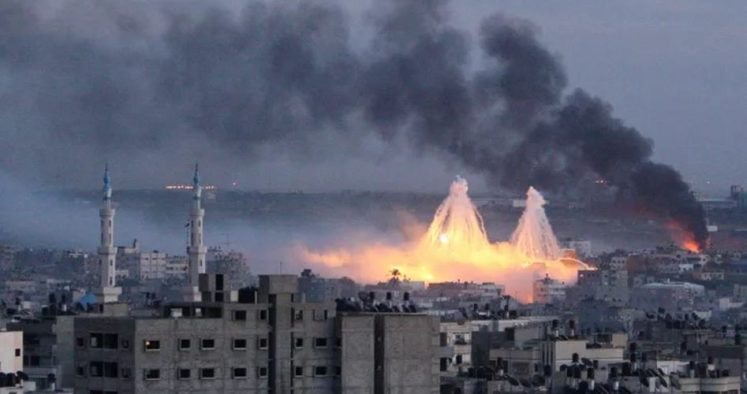
GAZA – The Euro-Med Human Rights Monitor has said that the Israeli army has launched more than 1,000 strikes, utilizing internationally prohibited white phosphorus, on populated areas since it started its genocidal war on the Gaza Strip on October 7.
In a statement on Thursday, the Euro-Med Monitor said it had documented the Israeli army’s indiscriminate use of white phosphorus against civilians, describing it as an “incendiary substance that burns human flesh and causes lifelong suffering.”
Euro-Med said that its team received testimonies affirming that the Israeli army carried out 300 strikes with white phosphorus bombs and projectiles within a period of about 40 minutes on Wednesday evening, November 15, on a residential block in Beit Lahia town, north of Gaza.
“The night before, a large number of white phosphorus shells were reportedly seen falling on a crowded populated area in Sheikh Radwan neighborhood, north of Gaza City. Similar attacks also occurred on several occasions in al-Shati refugee camp in western Gaza and the town and camp of Jabalia, north of the Strip,” Euro-Med elaborated.
“Palestinian residents said they suffered from severe shortness of breath and coughing as a result of inhaling white phosphorus in the midst of extremely unpleasant odors spreading in the air and severe blurred vision due to the thick white smoke,” Euro-Med cited.
According to Euro-Med, people exposed to white phosphorus can suffer from respiratory damage, organ failure, and other serious and life-altering injuries, including burns that are extremely difficult to treat and cannot be relieved with water.
“The escalating use of white phosphorus and smoke bombs against densely populated areas comes within the framework of forced displacement and ethnic cleansing that are being practiced by the Israeli army in order to force half of the Gaza’s population to leave their homes, shelters and hospitals and move to areas in the south of the Gaza Valley.”
Euro-Med accused Israel of persisting in violating the principles of proportionality and precaution by launching random attacks on the Gaza Strip and directly targeting the lives and health of civilians, and using internationally prohibited weapons in flagrant violation of the international humanitarian law and the rules of war.
“In addition to that, Israel uses bombs with huge destructive power against populated areas, and such bombs pose the single greatest threat to civilians in modern armed conflicts. This explains the severity of the massive destruction that turns entire residential neighborhoods into rubble and ruins in the Gaza Strip.”
Dozens killed in latest Israeli bombing of Gaza Mosque
The Cradle | November 16, 2023
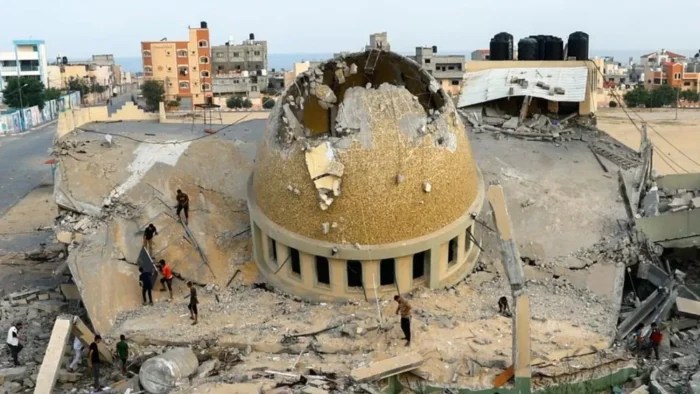
At least 50 Palestinians were killed and dozens of others injured on 15 November after the Israeli army targeted a mosque in the besieged Gaza Strip, WAFA news agency reports.
The attack on the Sabra neighborhood was conducted during a congressional prayer when the mosque was full of Palestinian worshippers.
Israel has conducted similar attacks on places of worship since its inception; in this war alone, multiple Mosques and churches have been leveled, including ones dating back centuries.
On 20 October, the Israeli army destroyed the Grand Al-Omari Mosque in Jabalia, dating back to the 7th century; it was one of the largest mosques in Palestine.
Hours before the Al-Omari bombing, the Israeli army targeted and destroyed the Church of Saint Porphyrios in Gaza, the third oldest church in the world.
“We condemn this unconscionable attack on a sacred compound and call upon the world community to enforce protections in Gaza for sanctuaries of refuge, including hospitals, schools, and houses of worship,” World Council of Churches (WCC) general secretary Rev. Jerry Pillay said in response to the bombing of the 1,400-year-old structure.
“Our prayers go out for healing to all those wounded, along with our condolences to Patriarch Theophilos II and all our Greek Orthodox brothers and sisters in Christ,” Pillay added.
Outside of Gaza, Israel launched an airstrike against the Al-Ansar mosque in Jenin refugee camp, West Bank, on 22 October.
An Israeli statement justifying the Al-Ansar Mosque attack said it was a“joint operation between the army and the Shin Bet” and that the strike targeted an “underground terrorist route.”
This has been a line used by Israel to justify their attacks on not only multiple places of worship but also civilian residences and hospitals.
As of 15 November, 11,470 Palestinians have been killed by Israeli airstrikes in Gaza, of whom are 4,707 children, 3,155 women, and 686 elderly.
Haniyeh family home in refugee camp bombed by Israel

MEMO | November 16, 2023
The family home of the head of the Hamas political bureau, Ismail Haniyeh, has been bombed by Israel, local media have reported. His home is in the overcrowded Al-Shati refugee camp, where he grew up.
Military sources claimed that the house was being used as infrastructure for Hamas, and a meeting place for the movement’s members and senior officials. Haniyeh has stayed outside the Gaza Strip since 2019, when the former Palestinian Authority prime minister was elected to head the political bureau. He is currently based in Qatar.
The Israeli occupation continues its ongoing aggression against the Gaza Strip for the 41st day, with the support of the US, as its aircraft bomb the vicinity of hospitals, residential buildings, tower blocks and the homes of Palestinian civilians, destroying them over the heads of their residents. It also continues to prevent the entry of water, food and fuel, all of which has led to the death toll rising to 11,500 martyrs, including more than 8,000 children and women, with 29,000 wounded.
Hamas rebuts Israeli claim about finding weapons at Al-Shifa Hospital
Palestine Information Center – November 16, 2023
GAZA – The Hamas Movement has belied the Israeli occupation army’s claim that it found weapons and military equipment in the Shifa Medical Complex, describing it as “part of its lies and cheap propaganda that aim to justify its crimes against the health sector in Gaza.”
“These claims are part of the silly propaganda that was spread by the occupation after it stormed the Rantisi Children’s Hospital. They put weapons in the place and then make up a weak story that no longer deceives anyone,” Hamas said in a statement on Wednesday.
“We have repeated more than once and for two weeks our call on the UN and international organizations to form an international committee to visit the hospitals and check on their conditions to expose the occupation’s lies and false claims because we are aware of the size of its fabrications and deception that aim to cover up its crimes against children, women and defenseless civilians,” the Movement added.
Russia-US relations risk ‘being severed’ – Moscow
RT | November 16, 2023
There is a real possibility that diplomatic relations between the US and Russia could be entirely severed, the Foreign Ministry in Mocow has warned. While Russia wants to avoid such a scenario, Washington’s insistence on confrontational policies makes the situation ever more likely, it said.
Relations between the two nuclear powers hit rock bottom after Russia’s years-long confrontation with Ukraine led in early 2022 to military action. The Kremlin claims that Washington is using Kiev as a proxy to effectively wage a war against Moscow.
In a statement on Thursday that marked the 90th anniversary of the restoration of diplomatic ties between the USA and the USSR, the Russian foreign ministry said that “there is a risk that these relations can be severed at any moment” again. The ministry blamed this on “irresponsible” US policies that “promote further escalation,” and on Washington’s pursuit of Moscow’s “strategic defeat.”
Having embraced “rampant Russophobia” as its guiding principle, the US has already reduced bilateral relations to “next to nothing,” the ministry in Moscow added.
According to the statement, US elites have deluded themselves into believing that US hegemony is absolute, and that no country is in a position to question it. In its refusal to recognize the “tectonic geopolitical shifts” and the reshuffle of the “global balance of power” that are underway, the US has doubled down on its policy of containment vis-a-vis China and Russia, in a futile attempt to reverse the current trends toward multipolarity, it claimed.
However, there is still hope that the powers-that-be in Washington finally take their cue from their Cold War-era predecessors and reshape their policies toward Russia “based on respect and taking each other’s interests into account,” the statement concluded.
Last month, Kremlin spokesperson Dmitry Peskov pointed to an article by prominent US economist Jeffrey Sachs, which called for a new US-Russia détente, saying that such a perspective, while far from being the predominant one, was “gradually gaining momentum” in Washington.
In September, President Vladimir Putin said, however, that the Biden administration is unwilling to engage in any meaningful dialogue at this point. Responding to Secretary of State Antony Blinken’s suggestion that Moscow was not prepared to “tango” with Kiev to reach a peace agreement, the Russian head of state retorted that the US itself is notorious for not knowing “how to do this tango.”
Pentagon fails annual audit
RT | November 16, 2023
The US Defense Department has flunked its sixth annual independent audit, having failed to even provide auditors with enough financial data to complete their evaluation, a report released on Wednesday revealed.
The overall results of the audit – the sixth that the Pentagon has failed since it was required to begin auditing itself in 2018 – were a “disclaimer of opinion,” the worst of three possible grades and the same rating the department received last year. The result took into account 29 component audits, of which 18 were also flunked with disclaimers of opinion. Just seven components received “unqualified opinions,” the most desirable rating, while another one received a “qualified opinion.”
Pentagon Chief Financial Officer Michael McCord attempted to frame the audit results positively, stating in a press release accompanying the report that his department was “making progress toward the goal of a clean audit.”
McCord acknowledged in a call with reporters on Wednesday that the Pentagon had not expected to pass the audit, but insisted it was moving toward resolving its balance of funds with the Treasury Department. He also touted the use of automated programs for rote tasks, stating that “bots” had saved 600,000 hours of work between the Navy and Air Force alone, and claimed the Pentagon had done a detailed inventory of its stockpiles in the course of supplying billions of dollars in military aid to Ukraine.
However, the Pentagon remains the only cabinet-level department never to have received a clean financial bill of health. With $3.8 trillion in assets, $4 trillion in liabilities, and little meaningful oversight, the potential for waste and fraud is immense, according to the Government Accountability Office, which has included the department’s business systems modernization and financial management initiatives on its “High Risk List” – a list of federal programs most susceptible to fraud, abuse, mismanagement, and waste – for nearly 30 years.
The Pentagon consumes more than half of the US discretionary budget, with most in Washington wary of cutting military spending lest they run afoul of the defense industry, a source of hefty donations to both sides of the political aisle, according to OpenSecrets.org, which tracks political contributions. Defense Department staff have admitted to “misplacing” trillions of dollars in transactions in accounting discrepancies that have never been resolved.
Efforts to rein in profligate defense spending in Congress have repeatedly failed. The Audit the Pentagon Act, which would penalize any department of the military that fails its annual audit by forcing it to forfeit 1% of its budget, was introduced again in the Senate last year after the Defense Department was unable to account for more than half of its assets. However, it never made it to the floor for a vote.
Biden Calls Xi ‘Dictator’ Hours After Meeting Meant to Repair Relations with China
By Ian DeMartino – Sputnik – 16.11.2023
US President Joe Biden met with his Chinese Counterpart Xi Jinping on Wednesday at the Asia Pacific Economic Council (APEC) Leaders’ summit in San Francisco on Wednesday and held a press conference later in the day.
Hours after a meeting designed to restore US-Chinese relations between US President Joe Biden and Chinese President Xi Jinping, Biden called the Chinese leader a dictator during a press conference about the meeting.
Biden and Xi met in San Francisco during the APEC Leaders’ Summit on Wednesday. The highly anticipated meeting was hyped as a critical opportunity to restore Chinese-US relations following years of heightened tensions between the two countries.
During a press conference following the meeting, Biden touted the progress made, saying that they reached a deal to combat fentanyl precursor chemicals from China entering the United States, resuming direct communications between the world’s two largest militaries and a plan to have experts from both countries meet on the dangers of AI.
He said they also discussed Ukraine, Gaza, Taiwan and the South China Sea.
After Biden stated he would take no more questions he started walking towards the exit but then stopped and announced that he would take another question, “Who can holler the loudest?” the President asked the crowd of supporters.
The reporter, whose name and outlet were not clearly audible in the video, first asked if Biden could share the evidence he had that Hamas hid a headquarters in Al-Shifa hospital, something Biden said was a “fact” earlier in the press conference.
Biden said he was confident in the evidence he saw, but declined to provide it. “No, I can’t tell you. I won’t tell you.”
The same reporter then asked if Biden still calls Xi a “dictator” as he did earlier in the year. Biden confirmed that he still does.
“Well look, he is. I mean he is a dictator in the sense that he is a guy who runs a country that is a communist country that is based on a form of government that is totally different from ours,” Biden stated before leaving the press room.
The Chinese government has not yet responded to Biden’s latest description of the Chinese President as a “dictator.” In June, one day after Secretary of State Antony Blinken visited Beijing in an effort to ease tensions between the countries, Biden harmed those discussions by calling Xi a dictator and implying that he did not know what was going on in his country.
“The reason why Xi Jinping got very upset in terms of when I shot that balloon down with two box cars full of spy equipment is he didn’t know it was there,” Biden said at a fundraiser. “That’s a great embarrassment for dictators.”
Mao Ning, a spokesperson for China’s Ministry of Foreign Affairs said that Biden’s June comments were “extremely absurd and irresponsible, seriously contradicting the basic facts,” while stressing that China was “strongly dissatisfied.”
At the start of the press conference, Biden called the meeting he had with Xi the most productive discussion he had with the Chinese leader, noting that their relationship goes back to when they were both Vice-Presidents of their respective countries.
Biden was also asked about Gaza, saying that he is “deeply involved” in the hostage negotiations and remains “mildly hopeful.”
When asked if he gave Israeli Prime Minister Benjamin Netanyahu a deadline for the conflict, Biden stressed that he had not. “I believe it’s going to stop when Hamas no longer maintains the capacity to murder and do horrific things to the Israelis.”
Outside the building where APEC is taking place, hundreds of protesters gathered in the streets, demanding a ceasefire in Gaza.
US-based NGO confirms running Russian opposition troll farm
RT | November 16, 2023
The Free Russia Foundation (FRF), a Washington-based NGO, has confirmed running a network of paid online commenters focused on influencing Russian current affairs and the Ukrainian crisis.
The pro-opposition troll farm was exposed in an explosive report published on Wednesday by SVTV, an online outlet created by Russian libertarian activist Mikhail Svetov. The report claimed, citing a trove of documents received from ex-employees of the network, that the FRF-payrolled troll farm has collaborated with FBK (Anti-Corruption Foundation), founded by jailed Russian opposition figure Alexey Navalny, and has also routinely targeted critics of FBK and the government alike.
The FRF confirmed on Thursday that the troll network actually exists. The NGO claimed the investigation by SVTV was “inaccurate on a large number of points” and strongly denied any links to Navalny’s FBK. The foundation also insisted the network has been never used to discredit “any opposition politicians, journalists, projects or groups.”
“We regret that certain so-called independent outlets allow themselves (by mistake or intentionally) to spread lies and put a large number of people at possible security risks,” the foundation said in a statement.
Earlier, FBK Director Ivan Zhdanov denied the anti-corruption foundation was associated with the troll network, vowing to prove this in court, if needed.
According to the SVTV report, the troll network has been outsourced by FRF to Reforum, a Lithuania-based non-profit, which hired contractors to perform “social media management consultations.” In reality, the “consultations” involved posting remarks under select online posts, using pre-approved talking points. The commenters, receiving €10 ($10) per hour on average, have been using fake profiles with photos of persons who had abandoned or lost their accounts, the report also claimed.
Online commenters apparently work from multiple offices in Vilnius, Lithuania and Tbilisi, Georgia. They have also reportedly taken to calling themselves “elves” who fight the “Russian trolls” and “orcs.”
The FRF described its troll network as a “strategic communications center,” created solely to “convey the truth about the Kremlin’s crimes and the consequences of the bloody war waged against Ukraine to their compatriots in Russia.” The network brings together “tens and hundreds of Russian activists, media and SMM professionals, working around the clock,” as well as “analysts” to study ways of waging “information war,” the NGO stated.
“I Want Everybody’s Name.” Nikki Haley Ignores the First Amendment As She Demands an End to Online Anonymity

By Dan Frieth | Reclaim The Net | November 14, 2023
Presidential hopeful from the Republican party, Nikki Haley, has come out in favor of removing online anonymity, recruiting all social media account holders to verify their accounts with a government ID.
Haley said anonymous social media accounts and “misinformation” are a “national security threat.”
However, her sentiments have fueled concerns surrounding censorship and freedom of speech.
Haley, in an interview with Fox News, emphasized her demand for transparency in social media algorithms. The understanding of algorithms, she believes, would reveal the reasons behind certain content delivery on these platforms.
Haley voiced her concerns over the surge in unidentifiable accounts on social media and the alleged misinformation she says they disseminate. She affirms these as potential threats to national security that need to be addressed swiftly and decidedly. She expressed her viewpoint, maintaining that “Every person on social media should be verified by their name. It’s a national security threat.”
“I want everybody’s name,” Haley said on the Ruthless podcast.
Haley also proposed a strategy to mitigate bot activity originating from Russia, Iran, and China by implementing stringent verifications for social media accounts. She believes this measure would improve conduct on these platforms, positing that the knowledge of their posts being seen by known relations would lead to a rise in “civility.”
In oppressive regimes, anonymity is often a shield for dissidents and activists. It allows them to speak out against government abuses, organize protests, and share information without immediately revealing their identity. Mandatory ID verification would strip away this layer of protection, making it easier for authoritarian governments to identify, track, and prosecute individuals who oppose them.
Knowing that their identities could be easily uncovered, many would-be dissidents might choose to remain silent rather than risk their safety. This chilling effect on free speech would be detrimental to the fight for human rights and democracy. In countries where dissent is already dangerous, further suppression of free speech can strengthen authoritarian rule.
Authoritarian regimes often employ extensive surveillance to monitor and control their citizens. Mandatory ID verification on social media would hand these governments another tool for surveillance. This could lead to more targeted repression, as governments could more easily identify and monitor the activities of dissidents when social media platforms are compelled to hand over the information they hold on users.
The Constitutional Implications of Haley’s Demands
The First Amendment of the US Constitution protects freedom of speech and expression. Mandatory ID verification on social media could be seen as a form of censorship, limiting individuals’ ability to speak freely online. Historically, the Supreme Court has been protective of anonymous speech as a vital part of the freedom of expression, as seen in cases like Talley v. California (1960) and McIntyre v. Ohio Elections Commission (1995). These cases underscore the right to distribute anonymous literature and the protection of anonymous speech, respectively.
Related to the First Amendment, there’s a historical precedent for the right to anonymity in political speech. In the Federalist Papers, for example, Alexander Hamilton, James Madison, and John Jay wrote under the pseudonym “Publius” to argue for the ratification of the Constitution itself. Without the right to anonymity, there would be no America as we know it.
This anonymity allowed for the free exchange of ideas without fear of retribution. Requiring ID verification could discourage individuals from expressing unpopular or dissenting opinions, thus stifling democratic discourse.
Russo-Ukrainian War: The Reckoning
Ukraine at the limits
Big Serge Thought | November 15, 2023
The Russo-Ukrainian War has been a novel historical experience for a variety of reasons, and not only for the intricacies and technicalities of the military enterprise itself. This became the first conventional military conflict to occur in the age of social media and planetary cinematography (that is, the ubiquitous presence of cameras). This brought a veneer (though only a veneer) of immanence to war, which for millennia had unveiled itself only through the mediating forces of cable news, print newspapers, and victory steles.
For the eternal optimist, there were upsides to the idea that a high intensity war was slated to be documented in thousands of first-person view videos. Purely from the standpoint of intellectual curiosity (and martial prudence), the flood of footage from Ukraine offers insight into emerging weapons systems and methods and allows for a remarkable level of tactical-level data. Rather than waiting for years of agonizing dissection of after action reports to reconstruct engagements, we are aware in near real time of tactical movements.
Unfortunately, all the obvious downsides of airing a war live on social media were also in effect. The war instantly became sensationalized and saturated with fake, fabricated, or incorrectly captioned videos, cluttered with information that most people are simply not equipped to parse through (for obvious reasons, the average citizen does not have extensive experience differentiating between two post-Soviet armies using similar equipment and speaking similar, or even the same language), and pseudo-expertise.
More abstractly, the war in Ukraine was transformed into an American entertainment product, complete with celebrity wonder weapons (like Saint Javelin and the HIMARS), groan-inducing references to American pop culture, visits from American celebrities, and voiceovers from Luke Skywalker. All of this fit very naturally with American sensibilities, because Americans ostensibly love underdogs, and in particularly spunky underdogs who overcome extreme odds through perseverance and grit.
The problem with this favored narrative structure is that underdogs rarely win wars. Most major peer conflicts do not have the conventional Hollywood plot structure with a dramatic turning point and reversal of fortune. Most of the time, wars are won by the more powerful state, which is to say the state with the ability to mobilize and effectively apply more fighting power over a longer period of time. This has certainly been the case in American history – no matter how much Americans may long to recast themselves as a historical underdog, America has historically won its wars because it has been an exceptionally powerful state with irresistible and innate advantages over its enemies. This is nothing to be ashamed of. As General George Patton famously said: Americans love a winner.
Thus we arrived at a convolution situation where, despite Russia’s many obvious advantages (which in the end come down to a superior indigenous capacity to mobilize men, industrial output, and technology), it became “propaganda” to argue that Russia was going to achieve some sort of victory in Ukraine – that Ukraine would end the war having failed to re-attain its 1991 borders (Zelensky’s stated victory condition) and with the country in a wrecked state of demographic hollowing and material destruction.
At last, we seem to have reached a denouement phase, where this view – allegedly an artifact of Kremlin influence, but in reality the most straightforward and obvious conclusion – is becoming inescapable. Russia is a bigger fighter with a much bigger bat.
The case for Ukraine victory rested almost entirely on dramatic success in a summer counteroffensive, which was supposedly expected to smash its way through the Russian positions in Zaporizhia Oblast, knife to the Sea of Azov, sever Russia’s land bridge to Crimea, and place the entire underbelly of Russia’s strategic position in jeopardy. A whole host of assumptions about the war were to be tested: the supremacy of western equipment, Russia’s paucity of reserves, the superiority of Western-Ukrainian tactical methods, the inflexibility and incompetence of Russian commanders in the defense.
More generally – and more importantly – this was intended to prove that Ukraine could successfully attack and advance against strongly held Russian positions. This is obviously a prerequisite for a Ukraine strategic victory. If the Ukrainian armed forces cannot advance, then Ukraine cannot restore its 1991 boundaries and the war has transformed from a struggle for victory into a struggle for a managed or mitigated defeat. The issue ceases to be whether Ukraine will lose, and becomes a question only of how much.
Western observers are at long last beginning to engage with the fact that Ukraine’s summer counteroffensive devolved into an abject failure and a military defeat of historical significance. It’s important to remember that, prior to the start of the operation, there were real expectations both among Ukrainian officials and western backers that the offensive could achieve the isolation or blockading of Crimea, if not its outright recapture. Underpinning this optimistic outlook were key assumptions about the superiority of western-gifted armored vehicles and a Russian army that was supposedly beginning to run dry. A purportedly leaked Ukrainian Order of Operations memorandum intimated that the AFU intended to reach and mask major cities like Berdyansk and Melitopol.
Remembering that the Ukrainians and their benefactors genuinely believed that they could reach the Azov coast and create an operational crisis for Russia is very important, because only in the context of these objectives can the letdown of the attack be fully comprehended. We are now (as of my typing of this sentence) at D+150 from the initial massed Ukrainian assault on the night of June 7-8, and the gains are paltry to say the least. The AFU is stuck in a concave forward position, wedged between the small Russian held villages of Verbove, Novoprokopivka, and Kopani, unable to advance any further, taking a steady trickle of losses as it attempts half-hearted small unit attacks to cross the Russian anti-tank ditches that ring the edges of the fields.
At the moment, the maximum advance achieved by the counteroffensive lies just ten miles from the town of Orikhiv (in the Ukrainian staging area). Ukraine failed not only to reach its terminal objectives, but it never even threatened its intermediate waypoints (like Tokmak). In fact, they never created even a temporary breach in Russia’s defenses. Instead, the AFU threw the bulk of the newly formed and western-equipped 9th and 10th Corps against fixed positions of the Russian 58th, 35th, and 36th Combined Arms Armies, became embedded in the outer screening line, and the attack collapsed after heavy casualties.

Debacle: The Battle of Robotyne
As the autumn began to drag on without battlefield results materializing for Ukraine, the process of finger pointing began with remarkable predictability. Three distinct lines of thought emerged, with observers in the west blaming a supposed Ukrainian inability to implement western tactics, some Ukrainian parties countering that western armor was too slow to arrive, which gave the Russian army time to fortify its positions, and others arguing that the problem was that the west failed to provide the necessary aircraft and strike systems.
I think that all of this rather misses the point – or rather, all of these factors are merely tangential to the point. The various Ukrainian and western figures pointing fingers at each other are rather like the proverbial blind men describing an elephant. All of these complaints – insufficient training, slow delivery timetables, shortages of air and strike assets – merely reflect the larger problem of attempting to assemble on an improvised basis an entirely new army with a hodgepodge of mismatched foreign systems, in a country with dwindling demographic and industrial assets.
All that aside, the internecine quarreling in the Ukrainian camp obscures the importance of tactical factors and ignores the highly active role that the Russian armed forces played in spoiling Ukraine’s great attack. While the dissection of the battle is likely to continue for many years, a litany of tactical reasons for Ukrainian defeat can already be enumerated as follows:
- The failure of the AFU to achieve strategic surprise. Notwithstanding an ostentatious OPSEC effort and attempted feint operations on the Belgorod border, around Bakhmut, Staromaiorske, and elsewhere, it was readily apparent to all involved that the point of the main Ukrainian effort would be towards the Azov littoral, and specifically the Orikhiv-Tokmak axis. Ukraine attacked precisely where they were expected to.
- The danger of staging and approach in the 21st century. The AFU had to congregate assets under exposure to Russian ISR and strike assets, which repeatedly subjected Ukrainian rear areas (like Orikhiv, where ammunition dumps and reserves were repeatedly struck) to Russian fire, and allowed the Russians to routinely take deploying Ukrainian battlegroups under fire while they were still in their marching columns.
- Inability (or unwillingness) to commit sufficient mass to force a decision. The density of the Russian ISR-Fires nexus incentivized the AFU to disperse its forces. While this can reduce losses, it also meant that Ukrainian combat power was introduced in a piecemeal trickle which simply lacked the mass to ever seriously threaten the Russian position. The operation largely devolved into company-level attacks which were clearly inadequate for the task.
- Inadequacy of Ukrainian fires and suppression. A fairly self-evident and all-encompassing capabilities gap, with the AFU facing a shortage of tubes and artillery shells (forcing HIMARS into a tactical role as an artillery substitute), and lacking sufficient air defense and electronic warfare assets to mitigate the variety of Russian airborne systems, including drones of all types, attack helicopters, and UMPK bombs. The result was a series of under-supported Ukrainian maneuver columns being raked in a firestorm.
- Inadequate combat engineering, which left the AFU vulnerable to a web of Russian minefields that were evidently far more robust than expected.
Taken together, we actually have a fairly straightforward tactical conundrum. The Ukrainians attempted a frontal assault on a fixed defense without either the element of surprise or parity in ranged fires. With the Russian defense fully on alert and Ukrainian staging areas and approach lanes subject to intense Russian fires, the AFU dispersed its forces in an effort to reduce losses, and this all but ensured that the Ukrainians would never have the necessary mass to create a breach. Add it all up, and you get the summer of 2023 – a series of frustrating and fruitless attacks on the exact same sector of the defense, slowly frittering away both the year and Ukraine’s best, last hope.
The failure of Ukraine’s offensive has seismic ramifications for the future conduct of the war. Combat operations always occur in reference to Ukraine’s political objectives, which are – to put it bluntly – ambitious. It’s important to remember that the Kiev regime has maintained from the very beginning that it would not settle for anything less than the 1991 territorial maximum of Ukraine – implying not only the recovery of the territory occupied by Russia after February 2022, but also the subjugation of the separatist polities in Donetsk and Lugansk and the conquest of Russian Crimea.
Ukraine’s war aims have always been defended as reasonable in the west for reasons related to the supposed legal niceties of war, the western illusion that borders are immutable, and the apparent transcendent divinity of Soviet-era administrative boundaries (which after all were the source of the 1991 borders). Regardless of all these matters, what Ukraine’s war aims implied as a practical matter was that Ukraine needed to capture de-facto prewar Russian territory, including four major cities (Donetsk, Lugansk, Sevastopol, and Simferopol). It meant dislodging the Russian Black Sea Fleet from its port somehow. This was an extraordinarily difficult task – far more complicated and more vast than anyone wanted to admit.
The obvious problem, of course, is that given Russia’s superior industrial resources and demographic reservoir, Ukraine’s only viable pathways to victory were either a Russian political collapse, Russian unwillingness to fully commit to the conflict, or the inflicting of some astonishing asymmetric battlefield defeat on the Russian army. The first now clearly seems like a fantasy, with the Russian economy shrugging off western sanctions and the political cohesion of the state completely unperturbed (even by the Wagner coup), and the second hope was dashed the moment Putin announced mobilization in the autumn of 2022. That leaves only the battlefield.
Therefore, the situation becomes very simple. If Ukraine cannot successfully advance on strongly held Russian positions, it cannot win the war according to its own terms. Thus, given the collapse of Ukraine’s summer offensive (and myriad other examples, like the way an ancillary Ukrainian attack banged its head meaninglessly on Bakhmut for months) there is a very simple question to be asked.
Will Ukraine ever get a better opportunity to attempt a strategic offensive? If the answer is no, then it necessarily follows that the war will end with Ukrainian territorial loss.
It seems to be a point of near triviality that 2023 was Ukraine’s best opportunity to attack. NATO had to move heaven and earth to scrape together the attack package. Ukraine will not get a better one. Not only is there simply nothing left in the stable for many NATO members, but assembling a larger mechanized force would require the west to double down on failure. Meanwhile, Ukraine is hemorrhaging viable manpower, due to a combination of high casualties, a flood of emigration as people flee a crumbling state, and endemic corruption which cripples the efficiency of the mobilization apparatus. Add it all up and you get a growing manpower squeeze and looming shortages of munitions and equipment. This is what it looks like when an army is attrited.
At the same time that Ukrainian combat power is declining, Russia’s is climbing. The Russian industrial sector has dramatically increased output despite western sanctions, leading to belated recognition that Russia is not going to conveniently run out of weapons, and indeed is comfortably out-producing the entire western bloc. The Russian state is in the process of radically raising defense expenditures, which will pay further dividends in combat power as time goes on. Meanwhile, on the manpower front, Russian force generation is stable (IE, does not require an expanded mobilization), and the sudden realization that the Russian army does in fact have plenty of reserves left prominent members of the Commentariat arguing with each other on Twitter. The Russian army is now poised to reap the benefits of its investments over the coming year.
The picture is not overly complicated. Ukrainian combat power is in a decline which has little chance of arrest, particularly now that events in the Middle East mean that it no longer has an uncontested claim to western stocks. There are a few things the west can still do to try and prop up Ukrainian capabilities (more on that later), but Meanwhile, Russian combat power is stable and even rising in many arms (note, for example, the steady increase in Russian UMPK drops and FPV drone strikes, and the growing availability of the T90 tank).
Ukraine will not recover its 1991 borders, and is unlikely to recapture any meaningful territories going forward. Thus, language has shifted sharply from references to retaking lost territories to merely freezing the front. None other than Commander in Chief Zaluzhny has admitted that the war is stalemated (an optimistic construction), while some western officials have begun to float the idea that a negotiated settlement (which would necessarily entail acknowledging the loss of Russian-held territories) may be Ukraine’s best path out.
This does not imply that the war is nearing an end. Zelensky continues to be adamantly against negotiations, and there are certainly plenty in the west who support continuing Ukrainian intransigence, but I think rather they are all missing the point.
There is only one way to end a war unilaterally, and that is by winning. It may very well be that the window to negotiate is over, and that Russia is ramping up its spending and expanding its ground and aerospace forces because it intends to use them to attempt a decisive victory on the battlefield.
We will likely see an increasingly vigorous debate in the coming months as to whether or not Kiev ought to negotiate. But the premise of this debate may well be wrong in toto. Maybe neither Kiev nor Washington gets to decide.
The subsidence of Ukraine’s summer offensive corresponds to a phase shift in the war, wherein Ukraine will shift to a full-spectrum strategic defense. Almost perfectly on cue, the Russian army kicked off the next sequence by beginning an operation against the crucial and strongly held Ukrainian stronghold of Avdiivka, in the suburbs of Donetsk.
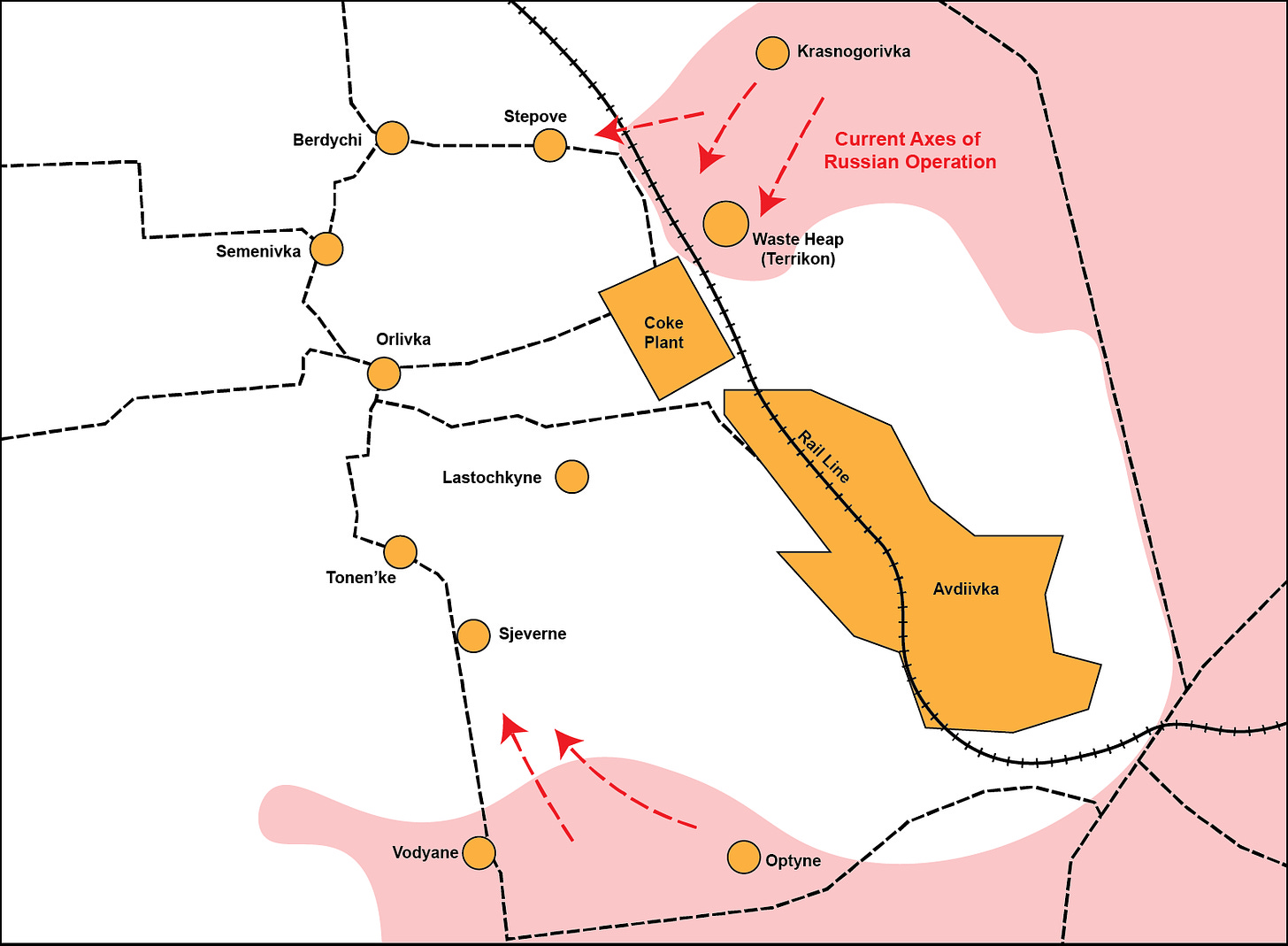
Avdiivka was already in something of a salient, owing to previous Russian operations which had captured the town of Krasnogorivka, to the north of the city. Over the month of October, Russian forces launched a large assault out of these positions and successfully captured one of the key terrain features in the area – a tall mound of discarded mining byproduct (a spoil heap) which directly overlooks the main railway into Avdiivka, and lies adjacent to the Avdiivka coke plant. As of this writing, the situation looks like so:
The Avdiivka Battlespace
The Avdiivka operation almost immediately spawned a familiar cycle of dooming and histrionics, with many getting ready to compare the attack to Russia’s failed assault on Ugledar last winter. Despite successful Russian capture of the waste heap (along with positions along the railway), the Ukrainian sphere was pleased, claming that the Russians are suffering catastrophic losses in their assault on Avdiivka. However, I think that this fails to hold water for a few reasons.
First and foremost, the premise itself does not obviously appear to be true. This war is being eagerly documented in real time, which means we can actually check for a sharp increase in Russian losses in the tabulated data. For this, I prefer to check in with War Spotting UA and their Russian equipment loss tracking project. While they have an overtly pro-Ukrainian orientation (they track only Russian and not Ukrainian losses), I think they are more reliable and reasonable than Oryx, and their tracking methodology is certainly more transparent.
A quick note about their data is important. First, it’s incorrect to be overly focused on the precise dates that they ascribe to losses – this is because their logged dates correspond to the date that losses are first photographed, which may or may not be the same day the vehicle is destroyed. When they log a date for a destroyed vehicle, they are logging only the date the picture was taken. It’s thus reasonable to pencil in a few days worth of potential error on the dating of losses. This simply can’t be helped. Furthermore, they – like anyone else – have the capacity to misidentify or accidentally double count vehicles filmed from different angles.
All that is to say, it’s not useful to get too bogged down looking at specific loss clusters and photos, but looking at the trends in their loss tracking is very useful. If Russia was really losing an inordinate amount of equipment in a month-long assault, we would expect to see a spike, or at least a modest level increase in losses.
In fact, that’s not apparent in the loss data. Russia’s overall burn rate from the summer of 2022 until now comes out to approximately 8.4 maneuver assets per day. Yet the losses for the autumn of 2023 (which includes the Avdiivka assault) are actually slightly lower, at 7.3 per day. There are a few batches of losses, which correspond to the aftermath of assaults, but these are not abnormally large – a fact that can be easily checked by referencing the time series of losses. The data shows a modest increase from the summer of this year (6.8 per day) to the autumn (7.3), which corresponds to a shift from a defensive to an attacking posture, but there is simply nothing in the data here that suggests an abnormal elevation in Russian loss rates. Overall, the loss data suggests a high intensity attack, but the losses overall are lower than in other periods where Russia has been on the offensive.
We can apply the same basic analytic framework to personnel losses as well. Mediazona – an anti-Putinist Russian dissident media outlet – has been dutifully tracking Russian casualties via obituaries, funerary announcements, and social media posts. Lo and behold, they – like Warspotting UA – fail to record an inordinate spike in Russian losses through the Autumn thus far.
Now, it would be silly to deny that Russia lost armored vehicles or that attacking does not incur costs. There is a battle being fought, and vehicles are destroyed in battles. That is not the question here. The question is whether the Avdiivka assault has caused an unsustainable or abnormal spike in Russian losses, and quite simply there is nothing in the tracked loss data that would suggest this. Therefore, the argument that Russian forces are being eviscerated at Avdiivka simply does not seem supported by the available information, and so far the tracked daily losses for Autumn are simply lower than the average over the previous year.
Furthermore, fixation on Russian losses can lead one to forget that the Ukrainian forces get badly chewed up as well, and we actually have videos from the Ukrainian 110th Brigade (the main formation anchoring the Avdiivka defense) complaining that they have taken unsustainable losses. All to be expected with a high intensity battle underway. The Russians attacked in force and took proportional losses – but was it worth it?
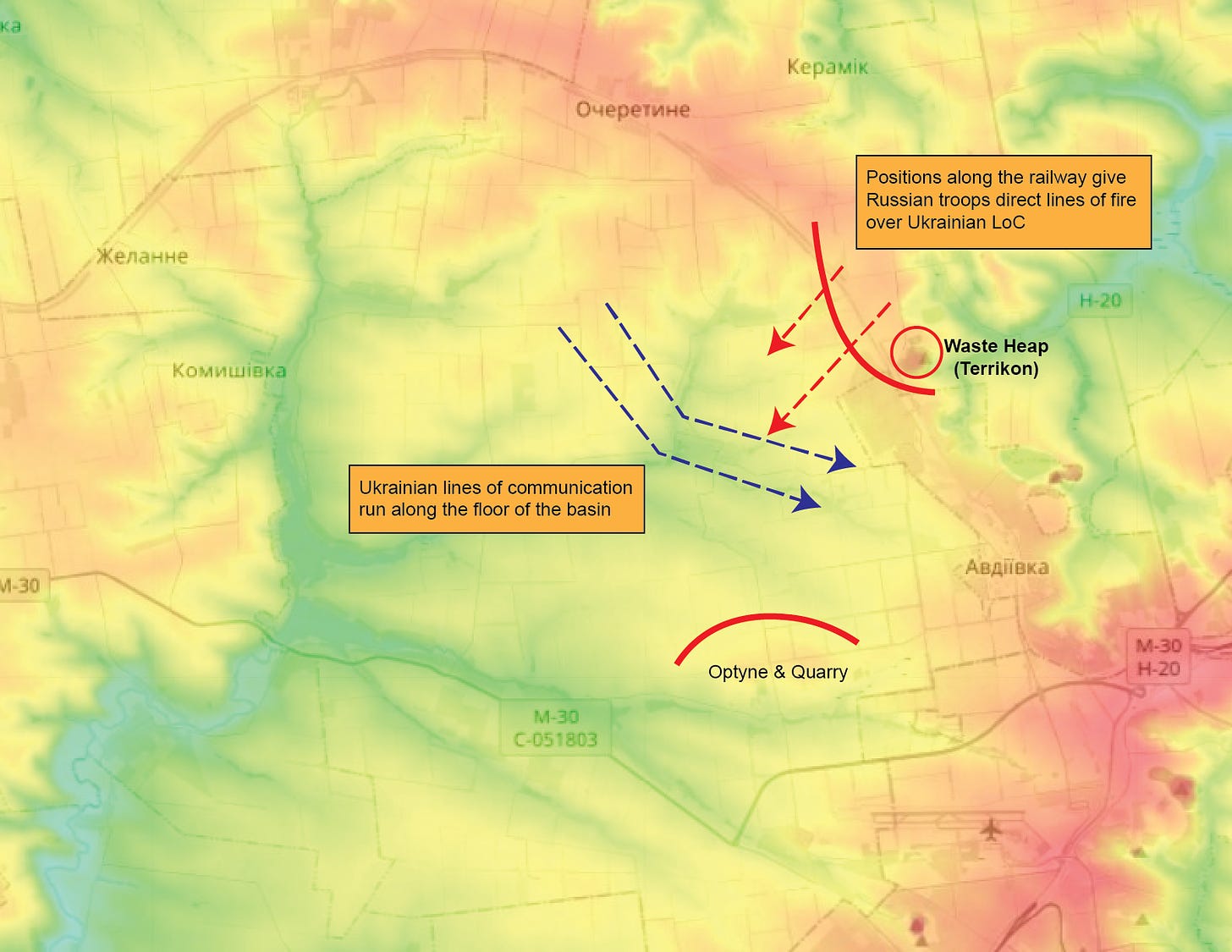
We need to think about that initial Russian assault in the context of the Avdiivka battlespace. Avdiivka is rather unique in that the entire city and the railway running towards it sit upon an elevated ridge. With the city now enveloped on three sides, remaining Ukrainian logistical lines run along the floor of a wetland basin to the west of the city – the only corridor that remains open. Russia now has a position on the dominating heights that directly overlook the basin, and are in the process of expanding their position along the ridge. In fact, contrary to the claim that the Russian assault collapsed with heavy casualties, the Russians continue to expand their zone of control to the west of the railway, have already breached the outskirts of Stepove, and are pushing into the fortified trench network in southeastern Avdiivka proper.
Avdiivka Elevation Map
Now, at this point it’s probably rational to want to compare the situation to Bakhmut, but the AFU forces in Avdiivka are actually in a much more dangerous position. Much was made of so-called “fire control” during the battle for Bakhmut, with some insinuating that Russia could isolate the city simply by firing artillery at the supply arteries. Needless to say, this didn’t quite pan out. Ukraine lost plenty of vehicles on the road in and out of Bakhmut, but the corridor remained open – if dangerous – until the very end. In Avdiivka, however, Russia will have direct ATGM line of sight (rather than spotty artillery overwatch) over the supply corridor on the floor of the basin. This is a much more dangerous situation for the AFU, both because Avdiivka has the unusual feature of a single dominating ridge on the spine of the battlespace, and because the dimensions are smaller – the entire Ukrainian supply corridor here runs along a handful of roads in a 4 kilometer gap.
Clearly, control of the waste heap and the rail line are of paramount importance, so the Russian Army committed a significant assault force to ensure the capture of their key objectives. Attacking the waste heap furthermore required exposing Russian attack columns to perpendicular Ukrainian fire, attacking across well surveilled ground. In short, this entailed many of the tactical problems that plagued the Ukrainians over the summer. Modern ISR-fire linkages make it very difficult to successfully stage and deploy forces without incurring losses.
Unlike the Ukrainians, however, the Russians committed sufficient mass to create an irreversible snowball in the attack on the commanding heights, and Ukrainian fires were inadequate to stymie the assault. Now that they have them, the Russians will recoup losses as the Ukrainians attempt to counterattack – indeed, this has already begun, with UA Warspotting recording a sharp drop in Russian equipment losses over the last three weeks. This establishes the pattern of the operation – a massed assault early to capture keystone positions that put the Russians in control of the battlespace. The Russians successfully forced a decision from the get-go by committing to their attack with a level of violence and force generation that was lacking all summer for the AFU. The juice is worth the squeeze.
More to the point, the Ukrainians clearly know that they are in trouble. They have already begun scrambling premier assets to the area to begin counterattacking against the Russian position on the ridge, and there are already Bradleys and Leopards burning around Avdiivka and in the Ukrainian staging areas in the rear. The same basic problem now exists which proved so insurmountable in the summer: counterattacking Ukrainian forces (staging over ten kilometers in the rear, past Ocheretyne) face long and well-surveilled lines of approach which expose them to Russian standoff fires – the Ukrainian 47th Mechanized Brigade has now already lost armored vehicles both in its staging areas and in failed counterattacks on Russian positions around Stepove.
In the coming weeks, Russian forces will carry their momentum forward into attacks on the axes through Stepove and Sjeverne to the west of the city, leaving the AFU tied to a long and precarious logistical chain on the floor of the basin. One of Ukraine’s longest and most strongly held fortresses now threatens to become an operational trap. I don’t expect Avdiivka to fall in a matter of weeks (barring an unforeseen and unlikely collapse in the Ukrainian defense), but it is now a matter of time and the winter months will likely bring the steady whittling away of the Ukrainian position here.
Sustaining AFU combat power in the city will be particularly difficult, with Ukrainian “mosquito logistics” (referring to their habit of running supply lift with pickup trucks, vans, and other small civilian vehicles) struggling across the floor of a muddy basin under the watchful eye of Russian FPV drones and direct fire. The AFU will be forced to attempt to sustain a brigade-level defense by running small vehicles through a beaten zone. If the Russians successfully capture the coke plant, the game will end much sooner, but the Ukrainians know this and will make the defense of the plant a preeminent priority – but even so, it is only a matter of time, and once Avdiivka falls, the Ukrainians do not have a solid place to anchor their defense until they fall all the way back to the Vocha River. This is a process that should play itself out through the winter.
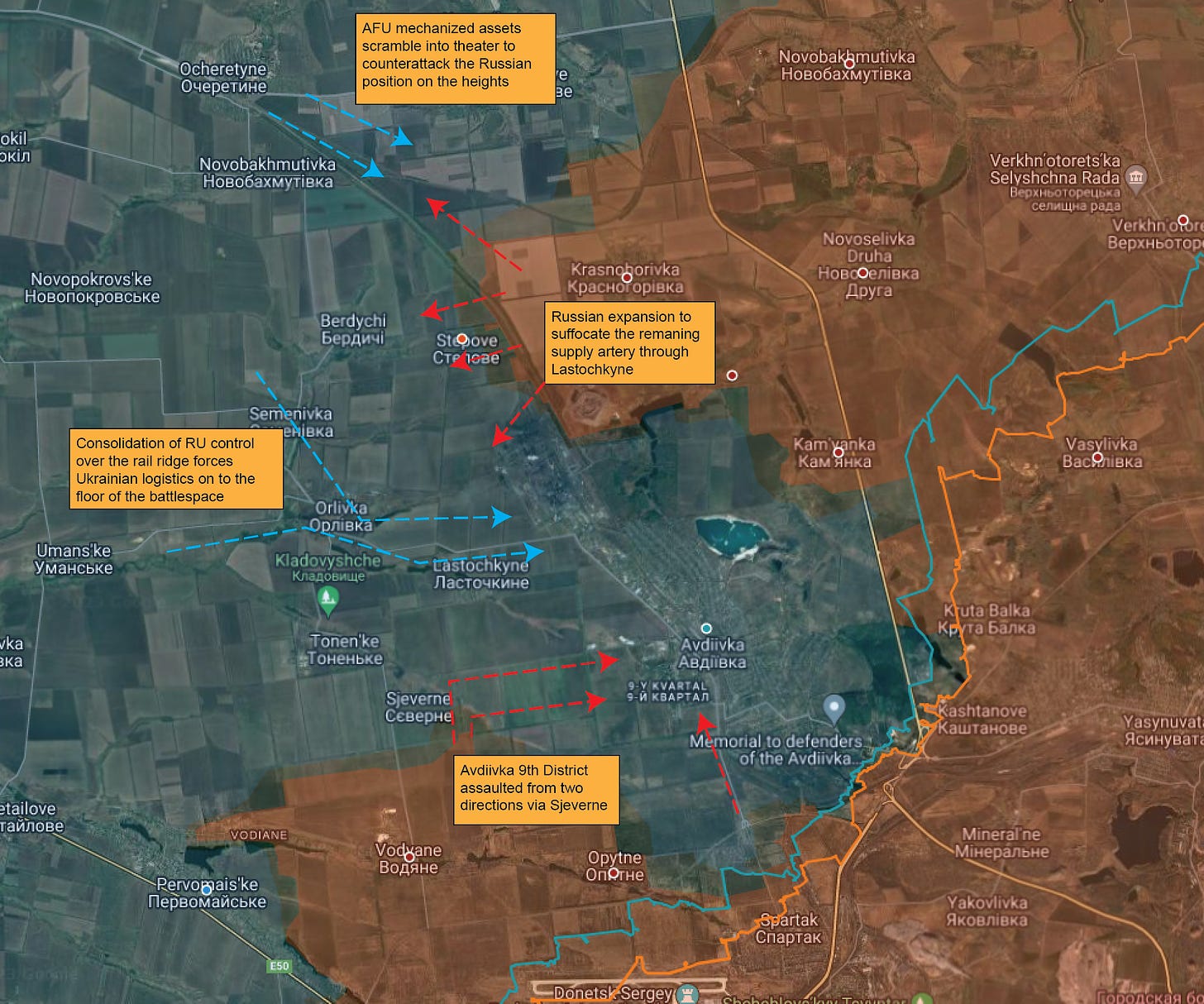
Anticipated future developments around Avdiivka
And that begs the question: if Ukraine could not hold Bakhmut, and time proves that they cannot hold Avdiivka, where can they hold? And if Ukraine cannot successfully attack, what are they fighting for?
A failed defense only counts as a delaying action if you have something to look forward to.
The war in Ukraine is now transitioning to enter its third phase. The first phase, from the onset of hostilities in February 2022 until the autumn of that year, was characterized by a trajectory of exhaustion of indigenous Ukrainian capacity by the operations of the limited initial Russian force. While Russian forces successfully degraded or exhausted many aspects of the prewar Ukrainian war machine – elements like communications, air defense interceptor stocks, and the artillery park – the initial Russian strategy floundered on critical miscalculations concerning both Ukraine’s willingness to fight a long war and NATO readiness to backstop Ukrainian material and provide critical ISR and command & control capabilities.
With the Russians facing with a much larger war than anticipated, and with utterly inadequate force generation for the task, the war took on the character of industrial attrition as it moved into the second phase. This phase was characterized by Russian attempts to shorten and correct the frontline, creating dense fortifications and locking up forces in grinding positional battles. This phase, more generally, was about the Ukrainians attempting to exploit – and the Russians enduring – a period of Ukrainian strategic initiative as Russia moved to a more expansive war footing, expanding armaments production and raisings force generation through mobilization.
In essence, Ukraine faced a dire strategic dilemma from the moment President Putin announced the mobilization of reserves in September, 2022. The Russian decision to mobilize was a de-facto signal that it accepted the new strategic logic of a longer war of industrial attrition – a war in which Russia would enjoy numerous advantages, including a much larger pool of manpower, vastly superior industrial capacity, indigenous production of standoff weaponry, armored vehicles, and shells, an industrial plant beyond the reach of systematic Ukrainian attacks, and strategic autonomy. These, however, are all systemic and long-term advantages. In the shorter term, however, Ukraine enjoyed a brief window of initiative on the ground. This window, however, was squandered with the botched summer assault on Russia’s defenses in the south, and the second phase of the war ends alongside the AFU’s drive on the Azov shore.
And so we come to the third phase, characterized by three important conditions:
- Steadily rising Russian combat power as a result of investments made over the previous year.
- Exhaustion of Ukrainian initiative on the ground and increasing self-cannibalization of AFU assets.
- Strategic exhaustion in NATO.
The first point is relatively trivial to comprehend and has been freely confessed by western and Ukrainian authorities. It is now well understood that sanctions failed to make a meaningful dent in Russian armaments production, and in fact the availability of critical systems is growing rapidly as a result of strategic investments in new and expanded production lines. However, we can enumerate a few examples of this.
One of the key elements of expanding Russian capabilities has been both the qualitative and quantitative improvement in new standoff systems. Russia has successfully launched mass production of the Iranian-derived Shahed/Geran drone, and has an additional factory under construction. Production of the Lancet loitering munition has risen exponentially, and a variety of improved variants are now entering use, with superior guidance, effective range, and swarming capabilities. Russian production of FPV drones has risen significantly, with Ukrainian operators now fearing a snowballing Russian advantage. UMPK guided glider adaptations have been modified to accommodate much of the Russian arsenal of gravity bombs.
All of this speaks to a Russian military with an expanding capacity to fling high explosives in greater numbers and accuracy at AFU personnel, equipment, and installations. Meanwhile, on the ground, tank production continues to rise, with sanctions having little apparent impact on Russian armor availability. In contrast to previous predictions that Russia would begin scraping the bottom of the barrel, pulling ever older tanks out of storage, Russian forces in Ukraine are fielding *newer* tanks, with the T-90 appearing on the battlefield in greater numbers. And, despite repetitive western predictions that a new mobilization wave would be required in the face of supposedly horrific casualties, the Russian defense ministry has confidently said that its manpower reserves are stable, and a Ukrainian military intelligence spokesman recently said that they believe there are over 400,000 Russian troops in the theater (to which can be added the sizeable reserves that remain in Russia).
Meanwhile, Ukrainian forces are likely to become increasingly self-cannibalizing. This occurs on multiple levels, as a motif of a strategically exhausted force. On the strategic level, self-cannibalization occurs when strategic assets are burned off in the name of short term exigencies; on the tactical level, a similar degradative process occurs when formations remain in combat for too long and begin to grind away as they attempt combat tasks for which they are no longer suited.
You’re likely rolling your eyes at that paragraph, and understandably so. It’s heavily jargonized, and I apologize for it. However, we can see a concrete example of what both forms of self-cannibalization (strategic and tactical) look like, from the same unit: the 47th Mechanized Brigade.
The 47th was slated long ago to become one of the premier assets in Ukraine’s counteroffensive. Trained (as best as time allowed) to NATO standards and with privileged access to high-end western equipment like the Leopard 2A6 Tank and the Bradley IFV. This brigade was both meticulously prepared and widely advertised as the deadly tip of the spear for Ukraine. However, a summer of frustrating and failed attacks on Russia’s Zaporizhia line left the brigade with severe losses, degraded combat power, and infighting among the officers.
What followed ought to raise red flags. First, in early October it was reported that the 47th had a new commander, with the change spurred by demands from above that the brigade continue its efforts to attack. The problem was that the 47th had gradually exhausted its attacking potential, and the solution implemented by the new commander was to scrounge the brigade’s rear areas and technical crews for replacement manpower. As the MilitaryLand report reads:
As claimed by soldiers of anti-tank missile unit of Magura in now removed video appeal, the brigade’s command refuse to admit the brigade lost its offensive potential. Instead, command sends mortar crews, snipers, artillery crews, basically all it has available to the front as assault infantry.
This is a classic example of tactical self-cannibalization, wherein a loss in combat power threatens to accelerate as ancillary and technical elements of the unit are burned off in an attempt to compensate for losses. However, the 47th has also been cannibalized on the strategic level. When the Russian assault around Avdiivka began, the Ukrainian response was to pull the 47th out of the Zaporizhia front and scramble it to Avdiivka to counterattack. At this point, the Ukrainian defense there depends on the 110th Brigade, which has been in Avdiivka for nearly a year without relief, and the 47th, which was already degraded from months of continuous offensive operations in the south.
This is strategic cannibalization: taking one of the premier assets in the stable and rushing it, with no rest or refitting whatsoever, directly into combat as a defensive exigency. Thus, you have the 47th Brigade being cannibalized on an internal level (burning itself off as it attempts combat tasks that it is no longer appropriately equipped for) and on a strategic level, with the AFU grinding it down in a positional defense around Avdiivka rather than rotating it out for rest and refit to be earmarked for future offensive operations. A recent report with interviews of 47th personnel painted a dire picture: the brigade had lost over 30% of its personnel over the summer and its howitzers are rationed to a mere 15 shells per day. Russian mortars, they say, have an eight to one advantage.
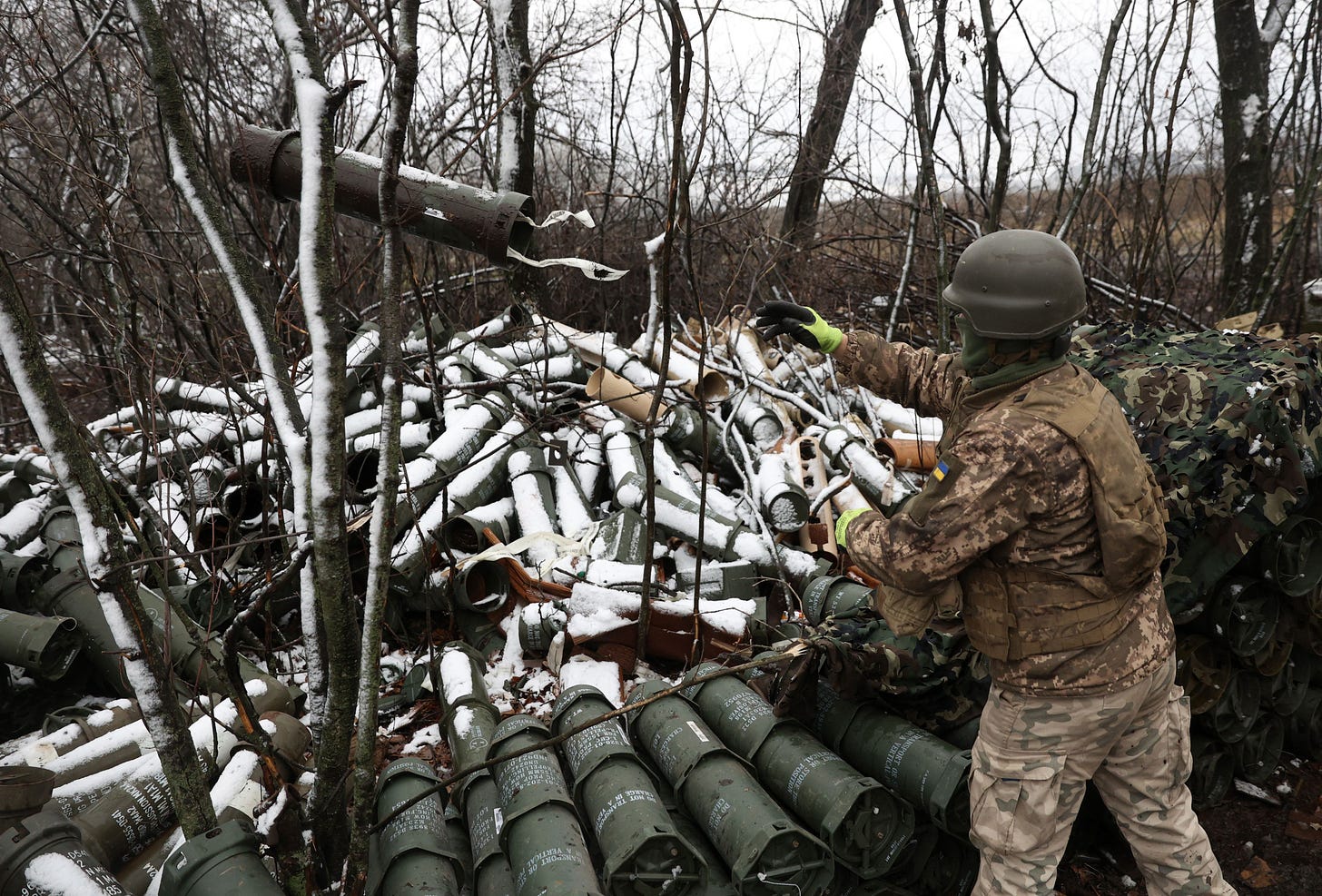
The iconic image of modern war: mountains of discarded shell casings
The situation can be vaguely likened to a person in crisis, who wears themselves down biologically and emotionally through a lack of sleep and stress, while also burning away their assets – selling their car and other critical possessions to pay for immediate necessities like food and medicine. This is an unsustainable way to live, and cannot stave off catastrophe indefinitely.
The Russians are doing everything they can to encourage this process, methodically reactivating grinding attacking operations across the breadth of the front, including not only Avdiivka but also at Bakhmut and Kupyansk, in an intentional pinning program designed to keep Ukrainian assets in combat after being exhausted over the summer. The 47th is emblematic of this – attacking all summer only to immediately be scrambled into defense in the Donbas. As one associate of mine put it, the last thing you want to do after running a marathon is begin a sprint, and this is where the Ukrainians find themselves after losing the strategic initiative in October.
It is not just Ukraine, however, that faces strategic exhaustion. The United States and the NATO bloc find themselves in a similar situation.
The entire American strategy in Ukraine has worked its way into an impasse. The logic of the proxy war lay in assumptions about a cost differential – that the United States could stymie Russia for pennies on the dollar, supplying Ukraine out of its surplus inventories while strangling the Russian economy with sanctions.
Not only have sanctions failed to cripple Russia, but the American approach on the ground has come up bust. Ukraine’s counteroffensive failed spectacularly, and the depleted Ukrainian ground force now must contrive a full-spectrum strategic defense against rising Russian force generation.
The basic strategic quandary for the west, then, is how to get out of a strategic cul-de-sac. NATO has reached the limits of what it can give Ukraine out of surpluses. In regards to artillery shells (the totem item in this war), for example, NATO allies have openly admitted that they have more or less run out, while the United States has been forced to redirect shell deliveries from Ukraine to Israel – a tacit admission that there are not enough on hand for both. Meanwhile, new production of shells is behind schedule in both the United States and Europe.
Facing a massive Russian investment in defense production and the following enormous ramp in Russian capabilities, it’s not clear how the United States can proceed. One possibility is the “all-in” option, which would require industrial restructuring and de-facto economic mobilization, but it’s not clear how this could be achieved given the parlous state of both the western industrial base and its finances.
Indeed, there are unmistakable signs that bringing western arms manufacturing out of its deep freeze will be enormously expensive and logistically challenging. New contracts demonstrate exorbitant cost runup. For example, a recent Rhenmetall order clocked in at $3500 per shell – an astonishing increase when one considers that as recently as 2021 the US Army was able to procure at a mere $820 per shell. No wonder the head of NATO’s Military Committee complained that higher prices are defeating efforts to build up stockpiles. Meanwhile, production is constrained by a lack of skilled workers and machine tools. Going “all in” on Ukraine would require a level of breakneck economic restructuring and mobilization that western populations would likely find intolerable and confusing.
A second option is “freezing” the conflict by pushing Ukraine to negotiate. This has already been broached in public by American and European officials, and was received with mixed reviews. On the whole, this seems rather unlikely. Opportunities to negotiate an end to the conflict were rebuffed on multiple occasions. From the Russian perspective, the west deliberately chose to escalate the conflict and would now want to walk away after Russia answered with its mobilization. It’s not clear then why Putin would be inclined to let Ukraine off the hook now that Russian military investments are beginning to bear fruit, and the Russian army has the real possibility of walking away with the Donbas and more. Even more troubling, however, is Ukrainian intransigence, which seems bound to sacrifice more brave men attempting to prolong Kiev’s fingerhold grip on territories that cannot be held indefinitely.
In essence, the United States (and its European satellites) have four options, none of which are good:
- Commit to an economic mobilization to substantially ramp up material deliveries to Ukraine
- Continue the extant trickle of support to Ukraine and watch it suffer a progressive and slow defeat
- End support for Ukraine and watch it suffer a more rapid and totalizing defeat
- Attempt to freeze the conflict with negotiations
This is a classic formula for strategic paralysis, and the most likely outcome is that the United States will default to its current course of action, supporting Ukraine at a trickle level commensurate with the financial and industrial limits in place, keeping the AFU in the field but ultimately overmatched in myriad dimensions by rising Russian capabilities.
And this, ultimately, brings us back where we started. There is no wonder weapon, no cool trick, no operational contrivance coming to save Ukraine. There is no exhaust port on the Death Star. There’s only the cold calculus of massed fires over time and space. Even Ukraine’s isolated successes only serve to emphasize the enormous disparity in capabilities. For example, when the AFU uses western missiles to attack Russian ships in drydock, this is only possible because Russia has a navy. The Russians, in contrast, have a wide arsenal of anti-ship missiles that they are not using, because Ukraine does not have a navy. While the spectacle of a successful hit on a Russian vessel makes for nice PR, it only reveals the asymmetry in assets and does nothing to ameliorate Ukraine’s fundamental problem, which is the steady attrition and destruction of its ground forces in the Donbas.
As 2024 brings a steady erosion of the Ukrainian position in the Donbas – isolation and liquidation of peripheral fortresses like Adviivka, a double pronged advance on Konstyantinivka, an ever more severe salient around Ugledar as the Russians advance on Kurakhove – Ukraine will find itself in an ever more untenable place, with western partners questioning the logic of funneling limited weapons stocks into a shattered state.
In the third century, during China’s Three Kingdoms era (after the Han Dynasty broke apart into a trifurcated state in the early 200’s), there was a famous general and official named Sima Yi. While not as oft quoted as the better known Sun Tzu, Sima Yi has one pithy aphorism attributed to him which is better than anything in the Art of War. Sima Yi put the essence of warmaking the following way:
In military affairs there are five essential points. If able to attack, you must attack. If not able to attack, you must defend. If not able to defend, you must flee. The remaining two points entail only surrender or death.
Ukraine is working its way down the list. The events of the summer demonstrated that it cannot successfully attack strongly held Russian positions. Events in Avdivvka and elsewhere now test whether they can defend their position in the Donbas against rising Russian force generation. If they fail this test, it will be time to flee, surrender, or die. Such is the way of things when the time for reckoning comes.
YouTube Boasts About Elevating “Quality” Content, Collaborating With the WHO, and Suppressing “Misinformation”
By Didi Rankovic | Reclaim The Net | November 15, 2023
YouTube (Google) is yet another in a series of tech behemoths that feel the need to declare their stance on content, including its effective algorithmic manipulation, just as US primaries are ushering the country into another year of presidential elections.
Beating around that bush – Google representatives now talk about processes, procedures, and tools of censorship of health-related information that, unfortunately, can easily be “repurposed” to serve other, for example, political ends.
Much of the conversation rests on what Google wants to portray as its laurels from “the previous epidemic” – which too many people and creators see from a diametrically opposed point of view, as a dark time of nearly unbridled censorship and suppression of free speech.
A video now published by Yahoo Finance reveals not only that Google has a “chief clinical officer,” but also how that officer, Michael Howell, sees the role of this super powerful tech corporation in determining what users are likely to see, see first, or see at all on a platform like YouTube.
Howell, naturally, sees nothing wrong with this and even, to all intents and purposes, brags that YouTube is working to make sure legacy media have advantage over independent creators, and that the latter may easily face censorship.
That’s the takeaway from his words, which he chose to phrase thus: YouTube works to “lift up high quality content, even as we work to lower, and make less prominent content that isn’t accurate or helpful to users.”
The whole interview is positioned as an exploration of how “misinformation grows and spreads” supposedly in sync with the amount of content and the number of users. There is even the assertion made by Yahoo that medical sector “misinformation” is not only very present among users but also “in the broader medical community.”
While this may or may not signal continued censorship of “disfavored” medical professionals, YouTube Head of Healthcare & Public Health (yes, that’s a YouTube job title these days, too) Dr. Garth Graham shared that the platform is the first to start “labeling health information that’s coming from licensed doctors, licensed nurses, licensed healthcare professionals.”
And even after all these years of sometimes completely arbitrary censorship YouTube is supposed to be taken as a “credible source of information (users) can trust” – as it works with the National Academy of Medicine and of course, the World Health Organization (WHO) to craft its definitions, and then “raise that up” – i.e., algorithmically promote, at the expense of other content.
Graham had more curious things to say, such as that while clearly committed to censoring what (or, whatever) Google decides is “delicate (sic) and dangerous information” – people are still supposed to view it as an “open platform”!
Either Graham doesn’t know what an open platform is, or he hopes YouTube/Google users don’t.
There’s also a good amount of patronizing toward those users, as in them needing to be hand-held (by Google) pretty much all the way in order to discern information from misinformation and make appropriate decisions.
“So, you know, we’re an open platform, but the real goal is how do you balance getting good information to people at the right time (…) while making sure that we remove delicate or dangerous information.”
Asked how Google has already managed (shocker) to get the government to participate in posting videos promoting their policies and what “conversations” preceded this, the Google exec said that “the entire healthcare eco-system” was already “energized” to get their message across.
And he counted the government as well as hospitals and physicians as part of this eco-system. One of them, last but not least, is the WHO.
What we know for certain from a great number of internal documents that have emerged over the past months both from Twitter and Facebook is that these two were being “led” to do certain things by the government and its agencies.
Google’s position in the interview is suggested to be the opposite – namely, at one point Howell is asked if the company basically instructed all these national and international healthcare players on what content to make, and have “trending” (mostly artificially, one might add.)
Howell dances around this question – or statement – by saying that the (pandemic) produced a community of creators from the health sector.
But as we know, many of them also got their voices silenced, however, that is not something anyone should expect Google to address.
Instead, the talk is obviously about the “approved” community of healthcare creators.
But, says Howell: “If there’s no good content out there that people want to watch, it’s very hard to show (that) content to users.”
And, cynics would say – then you write an algorithm that shoves that content into everybody’s “recommended” videos anyway.
But, Howell decided to claim that “people responded well to YouTube’s partnerships” – where that last word means, government and international bodies and institutions.
Featured Video
BRITAIN’S WARNING: PREPARE FOR WAR
or go to
Aletho News Archives – Video-Images
From the Archives
British weapons and personnel doing much of the killing in Yemen
Press TV – June 18, 2019
A detailed report published by the Guardian newspaper has shown how Britain is massively contributing to Saudi Arabia’s devastating war on Yemen as it suggests that London is not only supplying the bombs that fall on Yemenis, but it provides the personnel and expertise that keep the war going.
The comprehensive report by Arron Merat published on Tuesday showed that Britain was doing much of the killing in Yemen as the country continues to provide Saudi Arabia with everything it needs to turn its southern impoverished neighbor into a graveyard.
“Every day Yemen is hit by British bombs – dropped by British planes that are flown by British-trained pilots and maintained and prepared inside Saudi Arabia by thousands of British contractors,” said Merat in the report. … continue
Blog Roll
 Aletho News
- Why are so many Brazilians voting for Flávio Bolsonaro?
- Democrats Put Anti-Russia Agenda Ahead of American Workers
- Elijah Magnier: Yemen’s Strikes Are Shattering Saudi Arabia’s Long-Term Strategy
- Pentagon designates Chinese cultural centers national security threat
- Israel Demolishes Home Of Lebanese Journalist Whose Viral Film Exposed Pager Attack
- Record Oil, Empty Tanks: The UAE’s Miracle Recovery
- Burnham tackles Britain’s poverty with aggression in Yemen
- Peace in Ukraine: the easy way – or the hard way
- Trump & the Rrrrussians
- US taxpayer money laundered back through Ukraine – Musk
- If Americans Knew
- An error has occurred; the feed is probably down. Try again later.
- No Tricks Zone
- Sudden Stratospheric Warming, Powerful El Niño Combination May Lead To Extreme Europe Cold, Energy Crisis!
- Two New Studies Find Thwaites Glacier Melt Cannot Be Driven By Human Activity Or A Warming Ocean
- E-Cars Reduce CO2 Emissions By Only 41% Compared To Internal Combustion Engine Vehicles
- Predictions Made By Renowned Climate Professor Over Past Decades Have Been Proven To Be Poor
- New Study Suggests Large Regions Of The Pacific Ocean Have Been Cooling For The Last 80 Years
- Germany’s Green Energy Debacle: High Energy Costs Force Kahla Porzellan to Close After 182 Years!
- New Study: 50 Years Of The Most Aggressive ‘Net Zero’ Policies Can Only Affect The Global Climate By 0.03°C
- US September “Heat” Was No Record…Many Records Set Decades Ago
- Latest European Green Energy Debacle; Portugal’s Largest Flagship Solar Park Insolvent!
- Green Energy Debacle: German Expert Professor Fritz Vahrenholt Warns Of Severe Economic And Social Consequences

