Is the West Fanning Euromaidan-Style Public Protests in Georgia?
By Ekaterina Blinova – Sputnik – 16.05.2024
The US, EU and NATO have slammed the newly-passed foreign agents law in Georgia, while the foreign ministers of Iceland, Lithuania and Estonia took part in protest rallies against the legislation in Tbilisi. Sputnik’s pundits called these actions foreign meddling in Georgia’s affairs.
Lithuanian Foreign Minister Gabrielius Landsbergis expressed support for the “European” aspirations of Georgian protesters at a protest rally in Tbilisi on May 15.
“In a democracy, the government owes it to you, the Georgian people, to follow the direction your moral compass is showing,” Landsbergis told the crowd. “I am speaking out because I am… on the side of a European Georgia.”
But Tbilisi Mayor Kakha Kaladze, the secretary-general of the ruling Georgian Dream party, called their actions hostile and aimed at dividing Georgian society.
“This is not friendship, this is enmity, this is an attempt to deepen polarization in our country,” Kaladze told the Rustavi 2 TV channel. “Could you imagine our minister of foreign affairs going to Yerevan and speaking at an [Armenian] opposition rally?”
Direct Foreign Interference in Georgia’s Affairs
It was not the first time that Lithuanian officials have fanned public protests in a foreign state, according to Dr. Eduardas Vaitkus, Lithuanian politician who was an independent candidate in the 2024 Lithuanian presidential election.
“This is direct interference in the internal affairs of the sovereign state of Georgia,” Vaitkus told Sputnik.
Vaitkus cited earlier precedents for Lithuania’s meddling in the domestic affairs of Ukraine and Belarus. Vilnius has spent millions of euros supporting Belarusian self-declared opposition leader Svetlana Tikhanovskaya, backed by the West, who advocates for a coup d’etat in Minsk.
He recalled that the Lithuanian foreign minister’s grandfather, then-European Parliament member Vytautas Landsbergis, was spotted during the 2013 Euromaidan events in Kiev calling for a wider revolt in Ukraine.
“Unfortunately, this is the position of the Lithuanian state. My opinion is that traitors in our state are leading Lithuania in a way that creates a threat to all residents of Lithuania,” Vaitkus said.
The politician condemned the Lithuanian government’s “double and triple standards” in its unwillingness to recognize the will of the Crimean people to reunite with Russia — while rushing to embrace the self-declared independence of Kosovo alongside the West.
“Politics must have moral values. And [the Lithuanian government] demonstrates that duplicity is its main imperative in foreign policy,” Vaitkus said.
Russian Senator Konstantin Dolgov believes that Vilnius’ political agenda is not independent, but is dictated from the West.
“What can you expect from Lithuania and Estonia? These are countries that have long lost their independence and have become ‘appendages’ of Washington and Brussels,” Dolgov said, arguing that foreign ministers Iceland, Lithuania and Estonia could be sent by their Western patrons to fan unrest in Georgia.
Deputy Permanent Representative of the Russian Federation to the UN Dmitry Polyansky noted that the foreign ministers’ presence at Georgian protests is reminiscent of US and European politicians’ conduct during the 2013-2014 Euromaidan unrest in Kiev.
US Trying to Exert Pressure on Georgia as Its Hegemony Wanes
The US, EU and NATO have criticized the newly-passed foreign agents bill in Georgia, with US Assistant Secretary of State Jim O’Brien announcing on May 14 that Georgian MPs could be subjected to sanctions for “undermining democracy”.
While attacking the bill, which obliges Georgian media and NGOs to register as “pursuing the interests of a foreign power” if they receive over 20 percent of their funding from abroad, US policy-makers avoid mentioning that the Georgian legislation is reminiscent of the US’ own Foreign Agents Registration Act (FARA).
FARA requires individuals acting on behalf of foreign governments, organizations or persons foreign to the US to register with the Department of Justice (DOJ) and to disclose their relationship, activities, receipts, and disbursements in support of their activities.
Under to US law, such individuals are described as “foreign agents” while the FARA Unit of the Counterintelligence and Export Control Section (CES) is responsible for the Act’s enforcement.
The fierce US opposition to the Georgian bill under the guise of the “protection of democracy” and sanctions threats is an attempt to keep Tbilisi in line with the collective West’s agenda, according to Tiberio Graziani, chairman of Rome-based think tank Vision and Global Trends.
“The so-called defense of democracy, as promoted and implemented by the US-led West, falls within the context of the hybrid, cognitive and psychological war against those countries considered enemies, for geopolitical and geostrategic reasons,” Graziani told Sputnik.
“Any [country] that attempts to operate and act in the international context to responsibly promote the defense of its national interest is demonized by the US. Examples of this practice include, just to give a few examples, the so-called color revolutions,” he continued.
The US is believed to be behind a series of color revolutions in the former Soviet Union, including the Rose Revolution in Georgia in 2003, the Orange Revolution in Ukraine in 2004, the Tulip Revolution in Kyrgyzstan in 2005 and the failed Jeans Revolution in Belarus in 2006.
According to the expert, the threat and use of sanctions against foreign politicians pursuing national sovereignty constitutes a form of long-term US hybrid warfare.
Now that the world is becoming multipolar, the US is feeling the loss of its role as hegemon and could act irrationally with dramatic consequences for the rest of the world population, Graziani warned.
In Slovakia, the lone gunman strikes again
By Stephen Karganovic | Strategic Culture Foundation | May 16, 2024
The “lone gunman,” that cartoonish figure that for the last several decades – at least since November 1963 – has regularly framed most high-profile assassinations, has struck again, this time in disobedient Slovakia. He always pops up whenever his presence is required to warn misfits and discipline even team players who are inattentive to their tasks.
The assassination attempt on the Slovak Prime Minister Robert Fico fits that pattern. Fico’s political record going back for decades may have provoked a measure of distrust in globalist circles. However, his electoral victory and return to power in the fall of last year probably would have been treated as a manageable challenge had Fico been rotten enough to act as his colleagues routinely do, saying one thing before elections and doing the opposite afterwards.
He has, instead, turned out to be a man true to his word, certainly quashing any rumours that he had ever been recruited as one of WEF’s Young Leaders. At a critical juncture for the globalist string-pullers, when being a cooperative team player is considered de rigeuer, he chose to go off the beaten path with other outcasts like Victor Orban and to champion old fashioned values, such as Slovakia’s national sovereignty.
Fico however did not just insist on Slovakia’s sovereignty, which would have been bad enough, but also on other despised notions, equally discredited in present-day Europe: Statehood, Nationhood, Religion, and Family. It is his adherence to those values, once the cornerstone of the European civilisation before its cultural implosion, that made Fico a lone gunman target.
But to these shortcomings several other, no less bothersome and also potentially life threatening faults, should be added. Over the last several months, as Project Ukraine was turning into a shipwreck, Fico defiantly refused to allow military aid for the Kiev regime, called for cancelling anti-Russia sanctions, and repeatedly expressed the prohibited notion that Ukraine will be defeated.
As if that were not enough, there is more. In a long-forgotten tragedy in 2006, a Slovak aeroplane mysteriously crashed whilst flying back from Kosovo. On board, in addition to Slovak peacekeepers, there was a most interesting cargo. Slovakian specialists and forensic experts were involved in the exhumation of several mass graves in Kosovo where Serbian victims had been buried and they were bringing the evidence back home. It turned out that many of those victims exhibited thorax incisions which strongly suggested that they had been used as unwilling organ donors by Albanian traffickers. Readers whose memory is still unimpaired will recall the controversy about human organ extraction and trafficking in Kosovo that raged at the time, culminating in the incriminating 2010 report on this topic submitted to the EU by Swiss investigator Dick Marty.
The Slovak team handed a set of the evidence it had unearthed to NATO, of which Slovakia had by then become a member. But just to make sure that their findings would not disappear in some NATO black hole, they took the precaution of carrying an extra set home with them. That evidence was on board the aeroplane that inexplicably crashed and it perished along with about 40 Slovak personnel whose mouths concerning their gruesome findings in Kosovo were thus forever sealed.
As custom ordains in such situations, a hasty and superficial investigation was conducted by Slovak authorities, its conclusions were declared a state secret, and then sealed.
Five years ago, the 2006 plane crash again was in the limelight as new evidence emerged that the event may not have been an accident after all because of an explosive device that was placed on board. The Slovak parliament opened an inquiry into the matter which Robert Fico wholeheartedly and publicly supported.
In addition to his more recent gaffes, that also must have been a huge strike against him.
Predictably, responsibility for the shooting was instantly attributed to a lone individual who allegedly bore Fico a political grudge and decided to kill him. How that risible, Jack Ruby-type explanation will pan out, we may soon see as Slovakian authorities press their inquiry.
But irrespective of what Slovakian investigators uncover and how much of it their NATO overlords allow them to publish, certain preliminary conclusions about this ghastly attempted murder may still be drawn. Based on the totality of past experience, these conclusions are bound to be ultimately corroborated and will most certainly withstand the test of time.
The gangster hit on the Slovakian Prime Minister will have had its intended effect whether he survives or not. It was an intimidatory message sent loud and clear to all concerned not even to think of challenging the rules based order. The nature and reach of the “rules” as pertaining to them was made starkly clear the other day in Slovakia. As the position of the collective West crumbles, all European leaders who might be thinking of flip-flopping or asserting their nations’ interests in preference to obediently following orders have been put on notice. If Robert Fico was vulnerable, so are they. And this applies not just to pathetic excuses for national leaders who are presently in office, but also to those aspiring to replace them. More widely, the attempted murder of Robert Fico sends a message to outstanding non-political public figures of many profiles, such as Archbishop Vigano, whose bold statements, coherent analyses, and compelling appeals to the public threaten to collapse the manufactured consensus.
Russia’s Belousov, Shoigu to Take Part in Informal Putin-Xi Meeting – Kremlin Aide
Sputnik – 14.05.2024
MOSCOW – Andrei Belousov, the candidate for the post of Russian defense minister, and newly-appointed Security Council Secretary Sergei Shoigu will participate in the informal meeting between Russian President Vladimir Putin and Chinese President Xi Jinping, Kremlin aide Yury Ushakov told reporters on Tuesday.
The informal Putin-Xi meeting will take place on May 16 during the Russian leader’s visit to China. Other members of Russian government, including acting Foreign Minister Sergey Lavrov and acting Finance Minister Anton Siluanov will participate in the meeting.
“We invited, naturally, the new defense minister, Belousov, to participate in this program, who, together with Lavrov and me, will participate in this meeting on the evening of May 16 that will be held in the very narrow format. Also, in continuation of our contacts with Chinese colleagues, we included Security Council Secretary Shoigu in the delegation — he should be a part of 1+4 [meeting],” Ushakov said.
“Most likely, the main and most important issues of foreign policy cooperation will be discussed during the informal meeting of leaders, which will take place at the end of the first day of work,” the official shared.
The mutual visits of Russian President Vladimir Putin and Chinese President Xi Jinping confirm the priorities of bilateral relations, the aide noted.
“This tradition is a clear confirmation of the high level of bilateral relations, the priority attention paid by both sides to the Russian-Chinese partnership. And this certainly also reflects the relations that have developed between the two leaders of our states,” he told reporters.
The cooperation between Russia and China is developing in all areas, and this partnership is a paragon of interstate relations, Ushakov emphasized.
“Today, cooperation is steadily developing in all areas, and as our leaders have repeatedly stressed, and, above all, [Chinese] President Xi, this partnership is a paragon of interstate relations in the 21st century,” he said.
The partnership between Moscow and Beijing also demonstrates resistance to any external pressure and is one of the stabilizing factors in international affairs in general, the official added.
Chinese Premier Li Qiang to visit Russia this summer
The Kremlin aide also mentioned that Moscow and Beijing are cooperating in high-tech industries as well, including in creating a lunar station and drafting projects related to nuclear power plants.
“I have already mentioned that our governments [Russia and China] actively cooperate, the main thing is that the governments meet regularly. The visit of the head of the Chinese government is already scheduled for this summer,” Ushakov said.
“We note Beijing’s balanced position on the Ukrainian crisis, Beijing understands the true causes of its occurrence,” he noted.
China also emphasizes that without Russia it is counterproductive to discuss anything in the context of the Ukrainian crisis, the official added.
Vladimir Putin and Xi Jinping will discuss international cooperation, including within the UN and BRICS.
“There will be an in-depth exchange of views on cooperation in various international organizations and structures, including the UN, where Russia and China stand in solidarity on almost all topics of the UN agenda. Naturally, cooperation between the two countries within the framework of BRICS will also be touched upon,” Ushakov told reporters.
The Chinese side has given a preliminary agreement to come to the BRICS summit in Russia’s Kazan, the official added.
According to Ushakov, during Putin’s visit to Harbin (China), the Russian president will be accompanied by Chinese Vice President Han Zheng.
Newly appointed members of the Russian government will accompany President Vladimir Putin during his visit to China and participate in the negotiations.
“Then an expanded composition with the participation of representative delegations of the two parties, including members of the Russian government in an updated composition and their counterparts from the State Council of the People’s Republic of China [will meet],” he pointed out.
Russian deputy prime ministers, including First Deputy Prime Minister Denis Manturov Dmitry Chernyshenko, Yury Trutnev, Tatiana Golikova and Alexander Novak will speak at the Russia-China meeting in expanded format as chairs of bilateral commissions, Ushakov added.
Russia’s major businesspeople, including aluminum magnate Oleg Deripaska, Sberbank CEO Herman Gref, VTB Bank CEO Andrey Kostin, Rosneft CEO Igor Sechin, and Leonid Mikhelson, the co-owner of Russia’s second-largest natural gas producer Novatek, will also accompany Putin in his trip to China.
Preparations for the visit of Palestinian President Mahmoud Abbas to Russia are underway, Yury Ushakov also noted.
“Yes, active preparations are underway,” he mentioned.
In early April, Palestinian Ambassador to Russia Abdel Hafiz Nofal said that the date of Abbas’ visit to Russia will be set “soon.”
“We have some international trips planned in the near future,” Ushakov told reporters, when asked about Putin’s potential international trips, including his visit to Turkiye.
China rejects US election interference claims
RT | April 29, 2024
China’s foreign ministry has shot down allegations by US Secretary of State Antony Blinken that it interferes in American elections, accusing Blinken of “paranoia and shadow-chasing.”
Upon returning from a visit to China on Friday, Blinken told CNN that the US government had seen attempts by Beijing to manipulate US elections. “We have seen, generally speaking, evidence of attempts to influence and arguably interfere. And we want to make sure that’s cut off as quickly as possible,” he told host Kylie Atwood.
Chinese Foreign Ministry spokesman Lin Jian rejected these allegations at a press conference on Monday. “Non-interference in other countries’ internal affairs is a basic principle for China’s diplomacy,” Lin told reporters.
“The US presidential election is the US’ internal affair,” he continued. “We have never had any interest and will not interfere in any way in the election. Nevertheless, we staunchly reject anyone making an issue of China and damaging China’s interests for election purposes.”
“The US needs to stop the paranoia and shadow-chasing, stop slinging mud at China to divert attention and deflect the blame, and contribute to a stable China-US relationship and the wellbeing of our two peoples,” Lin concluded.
American politicians often accuse foreign nations of interfering in US elections, with the now-debunked claim that Russia intervened to help Donald Trump clinch the presidency in 2016 spiralling into an espionage operation against Trump’s campaign and a years-long probe by the FBI and special counsel Robert Mueller.
Trump and President Joe Biden have both accused China of similar meddling attempts, with Biden pressing Chinese President Xi Jinping on the issue during a meeting in San Francisco in November. According to CNN, Xi promised Biden that China would not interfere in this year’s presidential election.
US spies insist that Xi’s promise was a hollow one. In a threat assessment published in February, the Office of the Director of National Intelligence claimed that Chinese operatives aim “to sow doubts about US leadership, undermine democracy, and extend Beijing’s influence” through information operations and possible election meddling.
“Even if Beijing sets limits on these activities, individuals not under its direct supervision may attempt election influence activities they perceive are in line with Beijing’s goals,” the document stated.
According to Chinese Foreign Minister Wang Yi, such accusations are rooted in American insecurity over China’s rising economic and military might. Pointing to Washington’s espionage allegations, sanctions, and trade restrictions, Wang said in March that its “methods of suppressing China are constantly being renewed.”
“The challenge for the United States comes from itself, not from China. If the United States is obsessed with suppressing China, it will eventually harm itself,” Wang told reporters in Beijing.
Russia Never Threatened NATO, Has No Interests in Attacking Member States – Shoigu
Sputnik – 26.04.2024
ASTANA – Russia has never threatened NATO and has neither geopolitical nor military interests to attack the states of the alliance, Russian Defense Minister Sergei Shoigu said on Friday.
“Russia has never threatened NATO. We have neither geopolitical nor military interests to attack the states of the bloc. We are simply protecting our people in our historical territories,” Shoigu said during a meeting of defense ministers of the SCO member countries in Astana.
Russia has always made maximum efforts to maintain strategic stability and balance of power in the world, the minister added.
The SCO was founded in 2001. India, Iran, Kazakhstan, China, Kyrgyzstan, Russia, Tajikistan, Pakistan and Uzbekistan are its full members. Afghanistan, Belarus, and Mongolia are observer states; Azerbaijan, Armenia, Egypt, Cambodia, Nepal, Qatar, the UAE, Saudi Arabia, Turkiye, Sri Lanka, Maldives, Myanmar, Bahrain, and Kuwait are dialogue partners.
US Plans on Military Infrastructure in Central Asia Threatens SCO Space Stability
The US intention to deploy military infrastructure in the Central and South Asia is direct a threat to stability in the SCO space, the minister noted.
“I believe that all those present share the opinion that the deployment of military infrastructure in the region by the United States and its allies is unacceptable. Such intentions must be regarded as a direct threat to stability in the SCO space,” Shoigu said.
Commenting on the situation in the Asia-Pacific region, Shoigu said that US-oriented military and political structures are trying to remake security system in the region to dominate this part of the planet.
Additionally, the minister added that the return of radical Islamists from the Middle East and North Africa to Southeast Asia creates prerequisites for new hot spots.
The United States uses the tactics of inciting hotbeds of instability in the world, generating security threats, while it simultaneously offers military assistance, Shoigu pointed out.
On Tuesday, the US Senate passed the $95 billion legislation with approximately $61 billion in Ukraine-related funding, $26 billion in Israel-related funding and $8 billion for Indo-Pacific security initiatives in a vote of 79-18. The Biden administration is reportedly readying a $1 billion military aid package for Ukraine sourced from the legislation.
“[The US] uses a technique that has been proven many times — inciting and maintaining hotbeds of instability in various regions of the world, generating security threats while simultaneously offering military assistance to neutralize them,” he said.
Continued Strikes by Ukraine on Zaporozhye NPP Can Lead to Catastrophic Consequences
Shoigu also touched upon potential catastrophic consequences caused by the ongoing Ukrainian attacks on the Zaporozhye Nuclear Power Plant (NPP).
“The ongoing strikes of the Ukrainian armed forces on the Zaporozhye nuclear power plant, which could lead to catastrophic consequences, are of particular concern,” Shoigu emphasized.
The Zaporozhye Nuclear Power Plant is located on the left bank of the Dnepr River and is the largest nuclear power plant in Europe. It came under the control of Russian forces in early March 2022 and has since been repeatedly shelled by Ukrainian forces, raising international fears of a possible nuclear accident.
Russian Strike on Kharkov TV Tower Deprives Ukraine’s Army of Eyes and Ears for Spying
By Ilya Tsukanov – Sputnik – 23.04.2024
Russia attacked the Kharkov Television Tower with a precision cruise missile on Monday, destroying it. Ukrainian officials instantly labeled the strike an act of meaningless “terror” against Kharkov’s civilian population. In reality, it’s going to become a massive headache for Ukraine’s military, says veteran defense observer Viktor Litovkin.
Kharkov’s pro-Russian underground confirmed to Sputnik on Monday that the Russian military had struck the Kharkov Television Tower, an awesome, 240.7-meter tall Soviet-built structure used for radio and television broadcasting situated in the northern part of the city in local woodlands, causing it to break in half.
The attack occurred at 4:36 pm local time. Kharkov regional military administration chief Oleh Synegubov blasted the Russian “occupiers” over the strike, saying that while there were no victims, “there are interruptions with the digital TV signal.”
“Therefore, we once again appeal to citizens: trust only official sources of information,” Synegubov urged.
President Zelensky, meanwhile, went on television Monday night to accuse Russia of trying to “make the terror visible to the whole city and to try to limit Kharkov’s connection and access to information.”
Ukrainian Institute of Mass Information chief Oksana Romaniuk called the tower’s destruction a “war crime,” saying “civilian objects, such as TV towers, have absolute protection and cannot be a legitimate target in an armed conflict.”
But according to the Kharkov underground, the structure was used by the Ukrainian air defenses to communicate, with the military said to have attached a communications antenna to the tower.
Vitaly Ganchev, head of the Russian administration in the Kharkov region, did not rule out that along with its use by Ukraine’s air defenses, the tower may have been used to coordinate artillery and missile strikes targeting nearby Belgorod and other Russian cities.
“This tower contained radar antennas, there were also communications antennas, electronic warfare antennas, and communication antennas,” Viktor Litovkin, a veteran Soviet and Russian Army officer and respected military journalist, told Sputnik.
“This equipment was situated at an altitude of almost 200 meters, which made it possible to see at a great distance the territory both of the Russian Federation and areas in which Russian troops are concentrated, that is – to engage in reconnaissance. The higher the antenna, the better the visibility. Because [things like] mountains, trees, houses and so on interfere with radio waves. But at such a height there’s nothing interfering with their distribution. Moreover, from this tower it was possible to coordinate the work of several military systems: air defense systems, reconnaissance systems, Ukrainian artillery systems, control centers, etc. It was possible to transfer information, commands and orders between military units and combat systems,” the observer explained.
For these reasons, Litovkin said that Monday’s precision missile strike was a “very important” step in depriving Ukraine’s military and intelligence services of the eyes and ears afforded by the tower. “Now, Ukraine is deprived of the opportunity to conduct reconnaissance and coordinated actions against our armed forces,” the retired military officer said.
The tower was the only comparable piece of infrastructure of its kind in the region, but its destruction will not allow Russian forces to rest easy, Litovkin stressed.
“In addition to the tower, there are also cables, there is also the internet. So of course, the tower has ceased to function as an information channel. But I don’t think Kharkov’s communication system can be destroyed completely… You know that in Ukraine, despite the categorical ban by the government on Ukrainian citizens receiving information from Russia, many citizens receive Russian information through the internet, through small antennas at home, watch our television and so on. So it’s very difficult to completely deprive someone of information in the world today,” the observer summed up.
Insurers claim ‘government’ could have sabotaged Nord Stream – Kommersant
RT | April 18, 2024
Insurance policies for the Nord Stream gas pipelines sabotaged in 2022 do not cover destruction or damage caused during military hostilities, Russian newspaper Kommersant reported on Thursday, citing a claim filed at the High Court in London by two major Western companies.
The reported claim by Lloyd’s of London and Arch Insurance comes in response to a court filing in March by Nord Stream AG, the pipeline’s operator.
The enterprise, which is 51% owned by Russian energy giant Gazprom, alleged at the time that insurers had failed to pay about €400 million ($438 million) for damage caused by the explosions at the pipelines, according to the Financial Times. Nord Stream AG reportedly estimates it would cost over €1.2 billion to fully repair the infrastructure and replace the lost gas inventory.
In response, the two insurers are said to have claimed that “loss or damage directly or indirectly occasioned by, happening through, or in consequence of war” cannot be covered by the policies. They added that Russia-Ukraine conflict, which began in February 2022, “satisfies the terms war, invasion hostilities or military power.” The insurers also argue the damage could have been caused “by or under the order of any government,” according to Kommersant.
Commenting on the report, Russian Foreign Ministry spokeswoman Maria Zakharova said major concerns have been raised over the credibility of Western insurance giants. Any refusal to pay liabilities adds to a series of hostile acts towards Russia, according to Zakharova, including the seizure of state assets and private property, as well as alleged threats to damage civilian infrastructure.
Built to deliver Russian natural gas directly to Germany via the Baltic Sea, the Nord Stream pipelines were damaged by unknown perpetrators in a series of explosions in September 2022. The blasts left three out of four pipelines inoperable, causing what is believed to be the largest single methane leak ever.
Shortly after the sabotage, Germany, Denmark and Sweden – in whose economic zones the attack took place – launched separate investigations, although no results have been published. Earlier this year, Denmark and Sweden said they had closed their probes.
The Russian authorities have claimed the US had the most to gain from the sabotage, pointing to the opposition to the pipelines repeatedly voiced by the White House. Moscow has also accused the West of stonewalling the investigation.
Last year, award-winning US journalist Seymour Hersh accused Washington of being behind the bombing, although the White House dismissed the allegations. Several Western media outlets later reported that Ukrainian citizens had been involved in the sabotage. Kiev has denied any connection to the attack.
As a result of the sabotage, gas supplies from Russia to Germany via Nord Stream 1 were halted. Nord Stream 2 had never been put into operation due to EU bureaucratic setbacks.
Scott Ritter: Iran’s Retaliatory Attack ‘Reestablished Deterrence’ to Hold Israel, US in Check
By Svetlana Ekimenko | Sputnik | April 14, 2024
Iran’s mission to the United Nations stated earlier that Tehran’s retaliatory drone and missile attack against Israel had “concluded.” The “military action” was a response to Israel’s “aggression against our diplomatic premises in Damascus,” it said, adding that the strike “hit designated targets.”
By launching its retaliatory drone and missile attack on Israel, Iran “reestablished deterrence,” former UN weapons inspector Scott Ritter told Sputnik.
“Israel believed that it could launch a strike against Iran and suffer no consequence. That is no longer the case,” Ritter noted.
As Israeli military officials survey the damage done to their bases, “they understand the following: that Iran deliberately chose not to inflict extremely lethal action against Israel,” the analyst remarked.
Iran launched a massive drone and missile attack against Israel overnight, assisted by Hezbollah and the Yemeni Houthis. Over 300 projectiles were fired at Israeli territory from Iran, with Iran’s mission to the United Nations stating that its retaliatory attack on Israel had “concluded,” and that the strike “hit designated targets.” Israel’s military has claimed that 99% of the projectiles were intercepted.
Iran’s strike was designed to send a signal to Israel and the United States, “that it could do what it did in Nevatim, at Ramona, anywhere in Israel, anywhere in the Middle East, and there was nothing the United States or Israel could do in response.”
“This is deterrence. This means that in the future, if either Israel or the United States plan on carrying out an action against Iran, they have to weigh in the consequences of their actions knowing that Iran has the capacity to reach out and touch any place, any spot, any target in the region in Israel or out of Israel, and there’s nothing anybody could do to stop that,” the retired US Marine Corps intelligence officer said.
US President Joe Biden issued a statement on Iran’s attack against Israel after he spoke on the phone with Israeli Prime Minister Benjamin Netanyahu. The POTUS condemned the strike “in the strongest possible terms.” He also reaffirmed Washington’s “ironclad commitment” to help support Israel, and added that there were no attacks on US forces or facilities on Saturday, but that the US “will remain vigilant to all threats.”
Secretary of State Antony Blinken said the US does “not seek escalation,” but will “continue to support” Israel’s defense. “I will be consulting with allies and partners in the region and around the world in the hours and days ahead,” he added.
Weighing in on the flurry of talks between US and Israeli leaders, Scott Ritter said:
“This is why President Biden has been on the phone with Benjamin Netanyahu, the prime minister of Israel, telling him, ‘Do not retaliate.’ The United States will not be a partner in any offensive action against Iran. Not because the United States is friendly to Iran, but the United States understands the consequences that will accrue, should such an attack take place. The United States has been deterred against further action against Iran.”
The question uppermost at the moment is, “what will Israel do?” Ritter noted.
“Israel has been trying to lead the United States into a larger conflict with Iran for some time now. Indeed, some people have speculated that the Israeli attack against the Iranian Consulate in Damascus was designed for just that purpose… But the Iranians were very clever in designing their response – just like they did, when they retaliated against the United States for the assassination of Qasem Soleimani back in 2020,” Ritter said.
He recalled that at the time, Iran launched over a dozen missiles against the Al-Asad air base in Iraq, but Tehran gave Washington advance notice that that base was going to be struck. Thus, Iran ended up destroying empty buildings, Ritter recalled.
“But it demonstrated to the United States that it had the capacity to strike any American base in the region with extreme precision and kill as many Americans as they wanted – if they wanted to do that. And America was deterred against future action of that sort. Will Israel be deterred?” the analyst wondered.
No decision has been made yet regarding an Israeli response to the Iranian missile and drone attack, an Israeli official told The Times of Israel. It was added that a potential response would be discussed at a war cabinet meeting set for later on Sunday. Israel’s response to the Iranian attack will be coordinated with its allies, The New York Times reported earlier, citing an Israeli official.
After Iran’s unprecedented strike, Tel Aviv “understands that any escalation could mean the destruction of Israel,” Scott Ritter noted.
“Israel probably isn’t going to launch a response against Iran. Israel has been deterred from launching that response by the Iranian actions. In this case, we can say that operation ‘True Promise’ was an extraordinarily successful operation, not only for Iran, but indeed for the world, because Iranian deterrence now is a reality that can hold Israel and the United States in check,” Ritter said.
The dramatic mismanagement of the Covid-19 pandemic must finally seal the fate of the WHO (We Host Obtuseness)!
By Geert Vanden Bossche | Voice for Science and Solidarity | April 11, 2024
About ten years ago, there were serious discussions about dismantling the WHO due to its mismanagement of the Ebola epidemic in West Africa. An even more dramatic mismanagement of the Covid-19 pandemic must now finally seal the fate of this organization!
I still have serious doubts about whether the Covid-19 pandemic was planned; it certainly wasn’t orchestrated by the Vaccine Industry. Moreover, it’s also difficult to reconcile the broadly approved effort of the Vaccine Industry to develop a vaccine with the notion of a powerful lobby harboring nefarious intentions. Back then, no one anticipated, indeed, that vaccination during a pandemic could worsen its spread and health impact, given past successes in curbing infection chains through vaccination during pandemics or epidemics.
Nobody ever officially reported, though, that in the case of these alleged success stories (such as Smallpox and Ebola), deaths of contacts of index cases ring-vaccinated with replicating vaccines during the incubation time of the disease substantially contributed to halting viral transmission. Consequently, the WHO erroneously believed that vaccination during a pandemic or epidemic was a highly effective strategy for ending it.
‘Regrettably’(?!), in the mass Covid-19 vaccination program, this never-investigated or mentioned ‘killing effect’ didn’t materialize, as the vaccines used were non-replicating and the ring vaccination protocol didn’t apply, considering that the transmission of this virus is airborne rather than via direct contact. Therefore, I strongly believe that the egregious incompetence of the WHO is at the heart of the mismanagement of this pandemic. It’s only right that such a screw-up should vanish from the face of this earth.
US has ‘no viable plan’ for Ukraine – senator
RT | April 12, 2024
Kiev cannot win against Moscow because it has run out of men and needs more weapons and ammunition than Washington could possibly provide, US Senator J.D. Vance said on Friday.
Earlier this week, Senate Majority Leader Chuck Schumer argued that “the biggest reason Ukraine is losing the war is because the hard-right in the Congress has paralyzed the US from acting.” The New York Democrat claimed that a small group of Republicans have been holding up a vital $60 billion aid package for Kiev.
In an op-ed published by the New York Times, Vance addressed Schumer’s claim and accused President Joe Biden of having “failed to articulate even basic facts” about what Ukraine needs and the reality on the ground.
“The Biden administration has no viable plan for the Ukrainians to win this war,” Vance argued.
“Ukraine’s challenge is not the GOP; it’s math,” the Ohio Republican wrote. “Ukraine needs more soldiers than it can field, even with draconian conscription policies. And it needs more matériel than the United States can provide.”
Not only is $60 billion a fraction of what Ukraine would need to turn the tide, Americans “lack the capacity to manufacture the amount of weapons Ukraine needs us to supply to win the war,” Vance argued.
He pointed to the fact that the US can make 360,000 shells for 155mm artillery per year, “less than a tenth of what Ukraine says it needs,” and that’s after doubling prewar production capacity.
Vance also took aim at the White House’s messaging that funding Kiev is good for US military industry.
“The notion that we should prolong a bloody and gruesome war because it’s been good for American business is grotesque. We can and should rebuild our industrial base without shipping its products to a foreign conflict,” he wrote.
The US insistence on not negotiating with Russia is “absurd” and Ukrainian President Vladimir Zelensky’s goal of restoring Ukraine’s 1991 borders is “fantastical,” Vance added. He urged Kiev to dig in and hold until some kind of peace can be brokered by Washington.
Earlier this week, however, Zelensky said Ukraine was planning yet another counteroffensive – after the costly failure of last summer’s operation – but needed even more weapons and ammunition from the West.
China tells US it won’t be bullied on Russia
RT | April 10, 2024
Relations between Beijing and Moscow are their business alone, Chinese Foreign Ministry spokeswoman Mao Ning has said, responding to veiled threats by a senior American diplomat.
US Deputy Secretary of State Kurt Campbell said on Tuesday that any further Russian advances in Ukraine will “have an impact” on the US-China relationship.
“China and Russia have the right to carry out normal cooperation. Such cooperation should not come under external interference or constraint,” Mao said, when asked about Campbell’s comments at Wednesday’s press briefing. “China will not accept the accusations and pressuring.”
Speaking to the nonprofit National Committee on US-China Relations, Campbell – who recently took over from Victoria Nuland – said that recent Russian gains could “alter the balance of power in Europe in ways that are, frankly, unacceptable” to Washington, and that the State Department has told Beijing as much.
“On Ukraine, China has always taken an objective and just position and played a constructive role in actively promoting peace talks,” Mao told reporters. “If certain countries truly care about peace and want an early end to the crisis, they should reflect on the root cause of the crisis and do something that will actually help bring about peace, rather than deflect the blame to China.”
Beijing has repeatedly resisted US pressure to side with Kiev and join the Washington-led embargo against Moscow.
Campbell’s remarks echoed the statements made by US Treasury Secretary Janet Yellen during her visit to China earlier this week. Mao responded by saying that China would “take resolute measures to safeguard our legitimate rights and interests.”
On Wednesday, the Chinese Foreign Ministry spokeswoman also condemned US travel warnings as “totally unwarranted,” “wrongful” and “groundless,” noting that they have “deterred many Americans” who wanted to visit the country.
China and other members of BRICS have helped Russia mitigate the “illegal policy of unilateral sanctions” by the West, Russian Foreign Minister Sergey Lavrov said on Tuesday, after meeting his counterpart Wang Yi in Beijing.
Moscow’s trade with the rest of the world has surged over the past two years, more than offsetting the embargo by the US and its allies, imposed over the Ukraine conflict.
Xi meets Lavrov, reaffirms China’s emphasis on partnership with Russia
By Yang Sheng | Global Times | April 9, 2024
Chinese President Xi Jinping met with Russian Foreign Minister Sergey Lavrov on Tuesday in Beijing. Chinese analysts said the meeting sends a strong signal that China will firmly develop its strategic partnership with Russia, despite pressure from the West. The China-Russia partnership continues to be key for the global strategic balance and the hope for promoting a multipolar world in which countries of the Global South will have greater roles to play.
Xi asked Lavrov to convey his sincere greetings to Russian President Vladimir Putin. Noting that this year marks the 75th anniversary of the establishment of diplomatic ties between the two countries, Xi said China and Russia have embarked on a new path of harmonious coexistence and win-win cooperation between major countries and neighbors, which has benefited the two countries and their peoples and contributed wisdom and strength to international fairness and justice, the Xinhua News Agency reported on Tuesday.
Earlier in the day, Chinese Foreign Minister Wang Yi held talks with Lavrov in Beijing, and both sides expressed hope for strengthening practical cooperation in various fields, Xinhua reported.
Wang, also a member of the Political Bureau of the Communist Party of China Central Committee, said that China is willing to work with Russia, in accordance with the consensus reached by the two heads of state, to strengthen the synergy of the two countries’ development plans and promote practical cooperation in various fields.
The top diplomats of the two countries held a joint press conference after their meeting. Wang mentioned “five always” at the press conference. For example, he said that the two countries should always follow the strategic guidance of head-of-state diplomacy, and should always adhere to the principle of no-alliance, no-confrontation and no-targeting at any third party.
China and Russia should always stay on the right course on major matters of principle. As permanent members of the UN Security Council and major emerging countries, China and Russia actively respond to the common aspirations and legitimate concerns of the people of all countries, advocate a new path of state-to-state relations featuring dialogue and partnership rather than confrontation and alliance, and actively promote the building of a community with a shared future for humanity, said Wang.
Yang Jin, an associate research fellow at the Institute of Russian, Eastern European and Central Asian Studies at the Chinese Academy of Social Sciences, told the Global Times on Tuesday that the remarks made by Xi and the “five always” raised by Wang provide a “framework and outline” for the future development of the China-Russia comprehensive strategic partnership of coordination.
Yet many voices from the West, mainly from the US as well as some senior NATO officials, insist on depicting the China-Russia relationship as akin to an “anti-West alliance,” which is completely wrong. By reaffirming the principles of “non-alignment, non-confrontation, and not targeting any third party,” China and Russia are refuting those voices with a clear stance, experts said.
Multipolar world
China always attaches great importance to the development of China-Russia relations, and stands ready to strengthen bilateral communication with Russia and enhance multilateral strategic coordination in BRICS and the Shanghai Cooperation Organisation (SCO), Xi said when meeting with the visiting Russian top diplomat.
Xi said that the two countries will show more responsibility, unite countries in the Global South in the spirit of equality, openness, transparency and inclusiveness, promote the reform of the global governance system, and vigorously lead the building of a community with a shared future for humanity.
China and Russia are trying to promote a multipolar world where developing countries and emerging economies of the Global South will play a greater role, which is the antithesis of the unipolar world dominated by the US, analysts said.
“China and Russia will not target any third party, but if hegemonic forces threaten China and Russia, or threaten world peace, China and Russia will stand together and fight to protect their own interests and safeguard world peace together,” said Li Haidong, a professor at the China Foreign Affairs University.
This is why China and Russia, as well as other members in the UN Security Council, are pushing an immediate cease-fire and the resumption of humanitarian aid to Gaza, even as the US vetoed these attempts time and again, before the Ramadan cease-fire resolution eventually passed on March 25, experts said.
Wang said at the joint press conference that Russia will hold the BRICS presidency this year, and China will take over the rotating presidency of SCO this year. The two sides will support each other’s chairmanship and light up the “moment of South” global governance.
Richard Sakwa, professor of Russian and European politics at the School of Politics and International Relations of the UK’s University of Kent, told the Global Times at a forum in Beijing on March 28 that China-Russia relations are “one of the key axes for international politics, and it’s not only very important but also necessary” to maintain the global strategic balance.
Lavrov said at the meeting with Wang that Russia supports the China-initiated Global Security Initiative, and is willing to deepen cooperation with China on multilateral platforms to promote the establishment of a more just and democratic international order.
The two sides also had in-depth exchanges on the Ukraine issue, the Palestinian-Israeli conflict, the situation in the Asia-Pacific region and other international and regional issues of common concern.
Ukraine crisis and counterterrorism
Wang said at the joint press conference with Lavrov that on the Ukraine issue, China hopes to see a “cease-fire and an end to the war as soon as possible.” China supports the timely convening of an international conference recognized by both Russia and Ukraine, with equal participation by all parties, and a fair discussion of all peace options, whether it is track one or track two, Wang noted.
Cui Heng, a scholar from the Shanghai-based China National Institute for SCO International Exchange and Judicial Cooperation, told the Global Times on Tuesday that “some Western countries have always blamed China for its ‘pro-Russia’ stance, but actually we are just asking for a mechanism that can be accepted by all parties and can treat everyone equally.”
“China’s stance is based on the desire to stop the bloodshed, but the US’ stance is to use the [Russia-Ukraine] conflict to weaken Russia as much as possible. The development of the crisis to some extent depends on the US presidential election later this year,” Cui noted “If Donald Trump is elected, there will be a chance to break the deadlock, but if Joe Biden gets reelected, we might also see some changes, as Washington and its allies might not be able to afford the war anymore.”
Xi stressed at the meeting with Lavrov that China supports the Russian people in following a development path that suits their national conditions, and supports Russia in combating terrorism and maintaining social security and stability.
At the joint press conference with Lavrov on Tuesday, Wang stressed that China must also pay attention to the resolution of other global and regional hot spot issues, including continuing to counter terrorism. “China once again reiterated its condemnation of the terrorist attack in Moscow and its condolences and support for Russia,” said Wang.
“The Chinese people are also victims of terrorism, and terrorism has always been a common threat facing mankind. The international community should resolutely combat all forms of terrorism with a ‘zero tolerance’ attitude, firmly support the efforts of all parties to maintain national security and stability, strengthen international anti-terrorism cooperation, coordinate development and security, and eliminate the breeding grounds for terrorism,” Wang remarked.
“I want to thank China for their condolences in connection with the terrorist attack in the Moscow Region on March 22, and for their support of Russia’s fight against terrorism,” Lavrov said during the meeting with Wang.
All those involved [in the terrorist attack] will be certainly punished, Russia’s top diplomat stated. “Our [Russia-China] cooperation on counter-terrorism will continue, including within the framework of multilateral institutions.”
China and Russia are two major powers in the SCO, and counter-terrorism cooperation between them and other SCO members is significant for regional peace and stability, especially when the threat of terrorism has reemerged in relevant regions, experts said. Apart from the discussion on the diplomatic level, the militaries, law-enforcement and intelligence agencies of the two countries will promote cooperation on combating terrorism, experts said.
Featured Video
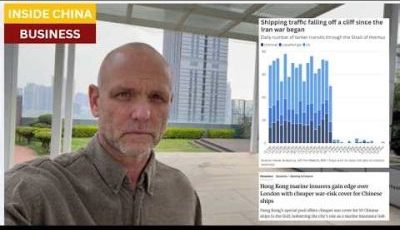
More Iran War fallout: Maritime insurance industry shifts from London to China
or go to
Aletho News Archives – Video-Images
From the Archives
Allies Don’t Need Lobbies
By Jay Knott | Dissident Voice | September 24, 2013
In a recent article on Counterpunch, Rob Urie defended the traditional Marxist analysis of US policy in the Middle East. He argues that support for Israel is driven primarily by economic interest, not the Jewish lobby.
He starts by paying tribute to the idea that Western societies are uniquely racist. He says that the “Western narrative” claims there is an “Arab character”, and that this is “antique racist blather”. He gives no definition of these terms. Further, he establishes his credentials as part of the dominant current in the American left by claiming that “over a million people in Iraq died so ‘we’ in the West can drive SUVs.”1
When he tries to criticize bourgeois economics, he makes it clear he doesn’t understand the developments it has made since Marx’s day, using the mathematical discipline known as “game theory”. He dismisses the basic abstraction of economic theory, the idea of the rational individual, on the grounds that it is “devoid of history, culture and political context”. But abstractions are always devoid of something.
He defends a more concrete economic theory, mostly Marxist, with some input from another theorist of capitalist crisis, Hyman Minsky. This concrete theory leads him to the view that US activity in the Middle East is primarily driven by rational capitalist motives, the need to secure a supply of oil.
“Taking the totality of circumstance — former oil company executives launching war on an oil rich nation on a pretext they publicly proclaimed they didn’t believe shortly before taking office — and that upon launching their war proved to be non-existent, requires a willingness to overlook the obvious — that the war on Iraq was for oil, that is difficult to support.”1
Perhaps I’ve misunderstood him, but based on what he says in the rest of the article, this convoluted sentence seems to argue that, because president Bush and vice-president Cheney attacked Iraq on false premises, and they also said it was all about oil, and they are former oil executives, and Iraq has a lot of oil, it’s difficult to deny US attacks on Iraq are all about oil.
In fact, it’s not hard at all. As Urie points out, at times Bush and co. said that attacking Iraq was “protecting the world’s supply of oil.”1 But, as he also points out, they are congenital liars. Why should we believe them when they say they are trying to “protect” the oil supply? Protect it against what? When politicians “admit” attacks on Middle Eastern countries are wars for oil, they are parroting the neo-con party line, feeding the public, both left and right, with a plausible-sounding pretext. For right-wingers, “it’s a war for oil” is a reason to support war, and for leftists, it’s a way to feel better by complaining impotently about corporate greed. Both approaches help the war drive. … continue
Blog Roll
 Aletho News
- More Iran War fallout: Maritime insurance industry shifts from London to China
- US-Israeli aggression on Iran triggers review of GCC countries’ investment pledges to Washington
- Russia slams UK plan to seize tankers suspected of carrying its oil
- Pakistan ramps up food exports to Persian Gulf nations as war deepens food insecurity
- Iran submits response to US plan, sets terms for war’s end: Tasnim
- US vs Iran: Kharg Island Talk — Bluff or Escalation? Ex-Military Officer Weighs In
- Zelensky unnecessarily involves Ukraine in the Middle East crisis
- Turkish tanker blacklisted by Ukraine hit in drone attack – media
- Canada, the U.S., and NATO: the inescapable trap
- Villains of Judea: Leonid Radvinsky
- If Americans Knew
- ‘No Innocent Children’: Far-right Israeli Lawmaker Defends Killing of Palestinian Family
- Mossad’s promises helped Netanyahu convince Trump that Iran could be toppled
- US Arms Control Official Refuses To Comment When Asked If Israel Has Nuclear Weapons
- Veterans warn US landing could be ‘more Gallipoli than Vietnam’
- Israel may be committing war crimes in Lebanon – Not a ceasefire Day 167
- In the West Bank, life is a constant battle – 3 articles
- Jacob Reses, one of the most powerful pro-Israel operatives in Trump’s Washington
- Israeli-US assaults kill or injure 87 children a day – Not a ceasefire Day 166
- ‘Forever live by the sword’: Understanding Israelis’ massive support for Iran war
- UN’s special rapporteur on human rights says Israel is systematically torturing Palestinians
- No Tricks Zone
- Devastating Assessment Of Comirnaty Vaccine By Former Senior Pfizer Europe Toxicologist
- New Study: CO2 Is ‘Effectively Negligible’ As An Explanatory Climate Change Factor Since 2000
- Former Pfizer Toxicologist Dr. Helmut Sterz Tells Bundestag Hearing Pfizer Vaccine Should Have Never Been Approved
- Energy Expert: Germany’s Nuclear Phaseout Was A “500 Billion Euro Mistake”
- New Research: South Australia’s Mid-Holocene Sea Surface Temperatures Were 4°C Warmer Than Today
- Storing Green Energy To Last Germany 10 Days Would Require A 60-Million Tonne Battery
- New Studies: UK Sea Levels Were 4 Meters Higher Than Today During The Mid-Holocene
- Destructive Green New Deal: German Energy And Metal Group Warns Of Drastic Crisis
- New Study Documents A 20-Year Pause In Arctic Sea Ice Decline – Driven By Internal Variability
- Wake-up Call: Survey Shows Majority Of Germans Now Favor Postponing Climate Targets!
 Aletho News