Dr. Malone Versus The World: Why Is He At War With Everyone?

Vigilant News Network | December 28, 2023
Dr. Malone’s latest Substack just dropped. Once again, the theme of the blog post is that a series of people and organizations within the medical freedom movement are actively working against him.
The pioneer in mRNA vaccine technology seems to have a pattern of lashing out against anyone who levels the slightest criticism of him and has attempted to diminish his critics by claiming that they “appear to be getting compensated in some way for actively promoting hate.”
It is clear, though, that what Dr. Malone describes as “hate” can run the gamut from indifference or perceived slights to mild criticism — or a stark difference of opinion. Dr. Malone’s volatile responses to criticisms have led some to think that he is connecting dots against his critics that aren’t real.
Dr. Malone’s Naughty List

Image via NTD News
Dr. Malone’s limited tolerance for criticism, along with his emphatic responses, has led to an increasing number of individuals and organizations subjected to his public denunciation.
The list below, derived from Dr. Malone’s past X and Substack posts, details these entities:
• Dr. Peter Breggin and Ginger Breggin
• Dr. Mike Yeadon
• Sasha Latypova
• Karen Kingston
• Matthew Crawford
• Dr. Ben Marble
• Dr. Judy Mikovitz
• George Webb
• Sage Hana on Substack
• America Out Loud
• Dr. Jane Ruby
• Red Voice Media
• Stew Peters
• Catherine Austin Fitts (The Solari Report)
• J. J. Couey
• Mary Holland (President of Children’s Health Defense)
• The Wellness Company and its founder Foster Coulson
• Dr. Paul Alexander
• The Washington Post
• Alex Berenson
• Dr. Peter McCullough
• And more. “The list goes on and on,” Dr. Malone has stated.
Lawsuits
On October 30, 2022, Dr. Malone filed a lawsuit seeking $25 million in damages from Dr. Peter Breggin, Ginger Breggin, America Out Loud, Dr. Jane Ruby, and Red Voice Media (Stew Peters). This was described as a “shocking defamation lawsuit,” which Diana West called “an anti-personnel weapon of free-speech-destruction” and a “heat-seeking lawfare missile targeting financial ruin.”
 After a lengthy legal battle, Judge Norman K. Moon dismissed Dr. Malone’s $25 million defamation lawsuit on December 11, 2023, stating it “has not met his burden of proof as to jurisdiction.”
In a separate case, On September 28, 2023, Judge Norman K. Moon also struck down Dr. Malone’s defamation lawsuit against The Washington Post. Judge Moon directed the court clerk to “strike this case from the docket.” He said at the time, “If Plaintiff [Dr. Malone] continues to bring defamation actions like those that have been dismissed, there will come a time when his lawsuits might fairly be deemed frivolous and awarding attorney fees is appropriate.”
Dr. Malone vs. Dr. Yeadon
 Dr. Michael Yeadon

In response to Dr. Malone’s op-ed, “FDA Fails to Address DNA Adulteration Concerns,” Dr. Michael Yeadon, ex-chief scientist and vice president of Pfizer’s allergy and respiratory research division, also found himself on the wrong side of Dr. Malone.
Dr. Yeadon wrote:
“He [Dr. Malone] knows these aren’t regulated pharmaceutical products at all but countermeasures under a public health emergency. It’s not a side issue. For proof, see Substacks of Katherine Watt and Sasha Latypova. There is zero possibility that Malone doesn’t know this.”
Rather abrasively, Dr. Malone responded that Dr. Yeadon “does not understand what is going on” and that he “should just STFU (shut the f*ck up).”
 Former pharma insider Sasha Latypova replied:

Image Source
“I think Dr. Yeadon understands very well what is going on, and think he understands too well for Robert Malone’s liking, and that’s why the response full of, let’s say – hate and hyperbole – but no actual rebuttal or an explanation of what exactly is incorrect.”
Read more on that here.
Dr. Malone’s Grudge Extends to Dr. Peter McCullough.

Dr. Peter McCullough
Dr. Malone once spoke of renowned cardiologist Dr. Peter McCullough as “a good friend.” However, it seems that the passage of time has altered the dynamics of their relationship, especially after Dr. McCullough accepted the position of Chief Scientific Officer of The Wellness Company, a business specializing in alternative healthcare solutions that Dr. Malone suggests is “yet another CIA cutout organization.”
 Dr. McCullough has refrained from engaging in public criticism of Dr. Malone on social media platforms like X. Conversely, Dr. Malone has, on multiple occasions, publicly scorned Dr. McCullough.
In June 2023, Dr. Robert Malone expressed disappointment over a perceived bias at Senator Ron Johnson’s “COVID-19 Vaccines: What They Are, How They Work, and Possible Causes of Injuries” event, which Dr. McCullough helped organize. Malone indicated a division between McCullough and himself, noting that they are “no longer on the same team.” Malone also accused McCullough of prioritizing profits over people, stating, “He [McCullough] works for ‘The Wellness Company’ selling vitamins. I work for my substack subscribers.”
 On November 25, 2023, Dr. Malone stated that he and Dr. McCullough no longer attend the same venues. He referenced an instance where he received a standing ovation at a conference, and McCullough did not, which he suggested led to jealousy.
He further alleged that Dr. McCullough compensates someone to attack him on social media and accused Dr. Paul Alexander of acting as Dr. McCullough’s “surrogate” to “obsessively” attack him “hundreds of times.”
 Furthermore, Dr. Malone paradoxically seemed to harbor hopes that the FDA, an agency he has consistently accused of corruption, would take stringent action against The Wellness Company:
“These [supplements] are mislabeled as therapeutics. Peter [McCullough] know[s] this but will not act to object. Eventually, they will get called out by the FDA. Surprising, this has not happened yet.”
 Who Is Defaming Who?
Dr. Malone says, “I am constantly amazed by the self-styled social media ‘independent journalists’ who obsessively attack me” while having a long history of obsessively attacking others.
 There’s a saying that what goes around comes around. However, Dr. Malone characterizes what is likely an organic backlash to his own degrading statements as “compensated” attacks or “yet another CIA cutout organization” looking to cause division in the medical freedom movement.
It’s time for Dr. Malone to reflect and take a look in the mirror. He sought $25 million in legal damages for “defamation” while issuing disparaging comments to those who dared criticize him.
Dr. Malone, a line must be drawn. You have done better, and you can do better. The world wants a return to the principled physician who courageously opposed vaccine mandates and the use of experimental gene-based products in children, rather than the one persistently embroiled in drama. Please choose a path of greater dignity and resolve these online disputes with grace.
 EDITORIAL NOTES:
• Vigilant News Network reached out to Dr. Malone for comment regarding allegations made in his Substack and online, but Dr. Malone declined to respond.
• The founder of Vigilant News Network, Foster Coulson, is also the founder of The Wellness Company. Coulson has no control over the day-to-day operation of Vigilant News. The decision to run this article – an article we have worked on for over a month and an article that has been subjected to our rigorous journalistic standards – was 100% the decision of the news division for Vigilant News Network.
This post is sponsored content and Zerohedge has been compensated for its publication.
Putin lifts the fog of war in Ukraine

BY M. K. BHADRAKUMAR | INDIAN PUNCHLINE | DECEMBER 29, 2023
Russia’s special military operation in Ukraine is entering a new phase. President Vladimir Putin lifted the fog of war and hinted at what can be expected going forward in a landmark speech at the National Defence Control Centre while addressing a meeting of the Russian Defence Ministry Board on December 19.
Russia has gained the upper hand in the proxy war while the United States is struggling to recreate a new narrative. For Putin, this is a moment of triumph where he has no reason to take advantage of the fog of war in Ukraine, whereas, for President Biden, the fog of war continues to serve a useful purpose of dissimulation in the crucial election ahead where he seeks a second term.
Putin’s speech exuded a buoyant mood. The Russian economy has not only regained its pre-2022 momentum but is accelerating toward a 3.5% growth rate by the yearend, marked by rising incomes and purchasing power for millions of its citizens and an increase in living standards. Unemployment is at an all-time low and Russia has beaten back the Western sanctions and the attempts to isolate it in the international arena.
The leitmotif of Putin’s speech is that this is a war that Russia never sought but was imposed on it by the US. Putin had listed last year in February five clear-cut objectives of the Russian military operation — security of the Russian population; de-nazification of Ukraine; demilitarisation of Ukraine; striving for a friendly regime in Kiev; and, non-admission of Ukraine into NATO. These are of course interlocked objectives. The US and its allies know it but continue to pretend otherwise. Their focus in the proxy war has been a military victory and regime change in Russia.
Putin’s message is that any new Western narrative on the war is doomed to meet the same fate as the previous one unless there is realism that Russia cannot be militarily defeated and its legitimate interests are recognised.
The heart of the matter is that the West all along perceived Ukraine as a geopolitical project targeting Russia. Today, even with defeat staring at its face, the West’s priority lies in forcing Russia to agree to a ceasefire on the basis of the existing line of contact without any geopolitical or strategic obligations on the part of Washington or the transatlantic alliance — which, de facto, would mean leaving the door for the rearmament of the battered Ukrainian military and for Kiev’s accession to NATO through the back door.
Suffice to say, the discredited agenda of using Ukraine as a pawn to pursue the West’s anti-Russian policy is still very much around. But Moscow will not fall for the US’ trap a second time, risking another war that may erupt at a time that suits NATO.
Unsurprisingly, Putin’s speech paid great attention to revving up Russia’s defence industry to meet any military exigencies that might arise. But towards the end of his speech, Putin also dwelt on Russia’s politico-military options under the circumstances.
On the military side, clearly, Russia will press forward the attritional war to its logical end of pushing the Ukrainian military into a strategic dead-end, which would mean seeking tactical improvements along the frontline, undermining Ukraine’s economic potential, inflicting military losses, and boosting Russia’s own defence industry on a scale that tips the balance of forces to weigh against any military adventures by NATO.
In the final analysis, Putin asserted, Russia is determined to reclaim the “vast historical territories, Russian territories, along with the population” that the Bolsheviks transferred to Ukraine during the Soviet era. However, he drew an important distinction as regards the “western lands” of Ukraine (west of Dnieper) that are a legacy of World War II over which there could be territorial claims from Poland, Hungary and Romania, which at least in the case of Poland is also linked to the transfer of “eastern German lands, the Danzig Corridor, and Danzig itself” following the defeat of the Third Reich.
Putin took note that “people who live there (western Ukraine) – many of them, at least, I know this for sure, 100 percent – they want to return to their historical homeland. The countries that lost these territories, primarily Poland, dream of having them back.”
That said, interestingly, Putin simply washed his hands of any territorial disputes that may arise between Ukraine and its eastern neighbours (all of whom are NATO countries.) Looking ahead, this is going to be a can of worms for the US. Recently, Russia’s intelligence chief Sergey Naryshkin used a powerful metaphor, warning that the US may face a “second Vietnam” in Ukraine that will come to haunt it for a long time.
The bottom line, as Putin framed it, is as follows: “History will put everything in its place. We (Moscow) will not interfere, but we will not give up what is ours. Everyone should be aware of this –- those in Ukraine who are aggressively disposed towards Russia, and in Europe, and in the United States. If they want to negotiate, let them do so. But we will do it only based on our interests.”
Putin concluded saying that if the final arbiter is military prowess, that explains why Russia is focusing on a “strong, reliable, well-equipped, and properly motivated Armed Forces” backed by a strong economy and “the support of the multi-ethnic people of Russia.”
There is a strong likelihood of Russian military operations moving further westward toward the Dnieper in the coming months, well beyond the four new territories that joined the Russian Federation last year — Luhansk, Donetsk, Zaporozhia, and Kherson. In the absence of any negotiated settlement, Russia may choose to unilaterally “liberate” those southern regions of Ukraine that were historically part of Russia, which would presumably include Odessa and the entire Black Sea coast, or Kharkov to the north of the Donbass region.
Russia is expecting that the combat capabilities of the Ukrainian forces will sharply diminish in the near future and the army faces difficulty already to get new recruits. That is to say, through the year ahead, the balance of forces at the front will shift due to the Ukrainian military’s heavy losses and the drop in Western aid, and, at some point, Ukraine’s defences will begin to crumble.
Russia’s recent gains in military operations — eg., Soledar, Artyomovsk (Bakhmut), Avdeevka, Maryinka, etc. — already testify to a shift in the balance of forces between the two armies. This shift will further accelerate as Russia’s military-industrial complex is functioning optimally and Russia is massively deploying new types of weapons, such as gliding aviation bombs, which have altered the role of the Russian Air Force in the conflict.
Dozens of heavy aerial bombs are dropped every single day and similarly, there is increase in the use of modern barrage ammunition and some other systems, including precision-guided munitions. T-90M tanks and new types of light armoured vehicles have also appeared on the battlefield.
In comparison, Ukraine faces a decrease in arms supplies due to limited production capacities in the West where sustainable production growth on an industrial scale is not attainable in the near term. Meanwhile, the Middle East crisis and the tensions around Taiwan become major distractions for the US.
All these factors taken into account, a decisive shift in the balance of forces against Ukraine is entirely conceivable by the end of next year, leading to an end of the conflict on Russia’s terms.
UN pushes back against Biden transgender proposal
RT | December 29, 2023
Rule changes to sexual discrimination legislation proposed by the US government designed to prevent the banning of transgender athletes in schools and colleges would violate the rights of biological women, a United Nations (UN) expert, Reem Alsalem, warned on Wednesday.
Under the landmark ‘Title IX’ legislation passed by the US Congress in 1972, it was ruled that sexual discrimination against women in education must be eradicated. It also stated that women should have the same educational rights and opportunities as their male counterparts.
In April, the US Department of Education proposed modifying the legislation so that no school or college that receives federal funding can impose broad rules that categorically ban transgender athletes from participating in sports that match their gender identity. Instead, it said such issues should be decided on a case-by-case basis.
The proposed amendment would also lead to the removal of separate facilities for men and women, including bathrooms and changing rooms, in some instances.
But on Wednesday, Reem Alsalem, the UN Special Rapporteur on violence against women, argued that the proposed changes to Title IX would have a negative impact on biological women.
“The proposed Title IX rule changes would have detrimental effects on the participation of biological women and girls in sports,” Alsalem said in a news release. It would, she added, deny women “the opportunity to compete fairly, resulting in the loss of athletic and scholarship opportunities.”
Furthermore, Alsalem argued that an altered Title IX would “lead to the loss of privacy” for female athletes and cause “heightened exposure to sexual harassment and voyeurism.”
“If the proposed changes are adopted, they would contravene the United States’ international human rights obligations and commitments concerning the prevention of all forms of violence and discrimination against women on the basis of sex,” she added.
The participation of transgender athletes in female sporting categories has become a hot-button topic over the past several years. Perhaps most notorious is the case of the American collegiate swimmer Lia Thomas, who, in 2022, became the first openly transgender athlete to win an NCAA Division I national championship. Before transitioning, Thomas had previously ranked 462 in the male category.
However, despite media attention on Thomas’ eligibility to compete against biologically-born women, the athlete’s right to compete was backed in an open letter by 300 current and former collegiate swimmers.
In the letter, they issued “support for Lia Thomas, and all transgender college athletes, who deserve to be able to compete in safe and welcoming athletic environments.”
A final decision on the possible changes is expected in 2024.
Netanyahu Outsmarted by ‘Wily’ Biden? No, Biden Is the One Being Played
By Alastair Crooke | Strategic Culture Foundation | December 25, 2023
Biden smirked and responded, “I know”, when told by a guest that Netanyahu is drawing the U.S. into a civilisational conflict – and further that Netanyahu blames him (Biden), complaining that the White House wants to block Israel from getting at the root of the problem, by harping on about Gaza and the ‘day after’.
In practice, what Netanyahu is doing is simply mounting a classic flanking manoeuvre – attempting to circumvent Biden by pointing to the ‘broader conflict’ with Iran: ‘Why are you pestering me about Gaza when there’s a monumental conflict raging’, suggests Bibi in exasperation?
“This is not only ‘our war’ but in many ways your war… This is a battle against the Iranian axis… now threatening to close the maritime strait of Bab Al-Mandeb… It is the interest … of the entire civilized community”, Netanyahu has said – not very subtly.
Biden’s reaction is a smug smile, hinting that he thinks he can outplay Netanyahu (‘the fox’). This is Biden’s approach: He aims to disarm Netanyahu’s allegation of an obstructionist U.S. through a parade of top-level visits that reiterates his unstinting support Israel – and to pre-empt Bibi, through insisting that he (Biden) will take care of the non-Gaza issues (Hizbullah, Yemen etc.).
So, the U.S. is assembling a maritime force to confront AnsarAllah in Yemen; the Biden Admin will act to sanction violent settlers in the West Bank; it is warning Baghdad to rein-in the Hashad al Sha’abi; and his envoys in Beirut are trying to forge a ‘diplomatic agreement’ that will include the withdrawal of Hizbullah’s Radwan Forces to the other side of the Litani River in southern Lebanon, and also deal with the unresolved border disputes between Israel and Lebanon.
Biden prides himself on being a hugely experienced foreign policy actor – and thinks himself too wily for Bibi’s tricks. But maybe, Netanyahu – for all his many faults – better understands the Region?
Biden clearly is being played. Even though he fails to recognize it.
Netanyahu knows that ‘no way’ will Hizbullah disarm, and withdraw to north of the Litani. He knows this, and thus can wait out Biden’s diplomatic failure, before saying that the approximately 70,000 Israeli citizens displaced from the northern towns in the wake of 7 October need to ”go home”, and that if the U.S. cannot remove Hizbullah from the border-fence, then Israel will do it.
Netanyahu is using Biden’s diplomatic Lebanese initiative to build European justification for an Israeli operation in a few weeks’ time to push Hizbullah away from the border with Israel. (An Israeli operation against Hizbullah has been in the works from the outset of the Gaza war).
Netanyahu knows too that control over settler violence in the West Bank lies not with him, but is in the hands of his partners: i.e., Ministers Ben Gvir and Smotrich. Neither he, nor Biden can dictate to them – they have been quietly increasing the squeeze on West Bank Palestinians for months.
And finally, Netanyahu knows the Houthis: They will not be deterred by Biden’s maritime flotilla. They will, rather, relish drawing the West into a Red Sea quagmire.
Like it or not, Biden’s tactic of containing and pre-empting regional escalation through the U.S. itself becoming lead actor – in lieu of Israel – is clearly drawing the U.S. deeper into conflict. Does Biden believe that the Houthis will just quietly ‘roll-over’ because the Gerald Ford is anchored off Bab Al-Mandeb, or that Hizbullah will accept instruction from Amos Hochstein?
The second way that Biden is being outplayed is through him seeing the Israeli problem as ‘just Bibi’ – indulging in personal politics. Of course, it is true that the Israeli PM is moulding Israeli politics to his own survival needs; yet pause a moment to consider what President Herzog said on Tuesday during an interview facilitated by the Atlantic Council, a leading Washington-based think tank.
Herzog has long been viewed as distinctly ‘dovish’ and ‘Leftist’ by the Beltway foreign policy establishment – prior to the war – compared to Netanyahu.
In the interview, Herzog said: “We intend to take over the entire Gaza Strip and change the course of history”. He said that the current conflict is a clash of “a set of civilizational values” and he cast Hamas (in pure Manichaean terms) as a “force of evil”, adding that Israel would no longer tolerate Gaza being a “platform for Iran – driving everyone into the abyss of bloodshed and warfare”.
Not much daylight then between him and the PM then.
The convergence between Herzog and Bibi reflects, perhaps, a more substantive change taking place in Israel – a strategic shift that extends far beyond Biden’s personal obsession with Bibi:
Since 7 October, the New York Times and the Jerusalem Post report that 36% of Israelis have moved decidedly to the right on a number of political issues, including support for settlers in the West Bank, endorsements for far-right politicians, and even settlements again inside the Gaza Strip. And while public opinion of Netanyahu himself is faltering, his government is not expected to fall.
And even were that to occur, the more important point to grasp is that support for the policies upheld by Netanyahu’s radical Rightist government is growing, and rapidly.
Israel’s Right generally believes in Israeli control of the West Bank and Gaza, with many right-wing Israelis opposed to the principle of a Palestinian state existing at all alongside Israel. This can be seen in many of the current government’s policies, which have worked toward expanding Israeli settlement of the West Bank and rendering Gaza unlivable for Palestinians.
On the opposite side of the spectrum sits Israel’s Left. The Jerusalem Post notes that the Left largely believe that Israel is ‘occupying’ the West Bank, and that an end to the conflict can only be achieved by ending the occupation and enabling a two-state solution. But no one is explicit on where that second state – a Palestinian state – would be situated. Legally it would be Gaza, the West Bank and part of Jerusalem. But who could enforce that? Who would expel settlers from the West Bank?
For many Israelis, the separation ‘apartheid’ Occupation state of the past 30 years was the workable ‘two-state solution’ – but its pillars (structural separation, military enforcement and deterrence) which had for many Israelis seemed to promise the ‘quiet’ that many hoped for – blew apart on 7 October.
“The trauma of what happened on Oct. 7 shifted Israeli society. It made them question the most basic tenets of whether they were safe in their homes”, said Israeli columnist, Tal Schneider:
“They are calling now for more — more military, more protection, more hard-line policies”.
“Many right-wing people,” Ariella Marsden writes in the Jerusalem Post, “and a minority of left-wingers, saw 7 Oct as proof that peace with the Palestinians is impossible”. Not surprisingly, thinking has turned to population removal which chimes with Netanyahu’s ‘new war of Independence’ theme.
In short, Biden may believe that his ‘long experience’ puts him on the ‘right side’ in judging events. His experience however, is drawn from another era. The political Israel he knew is over: It has reached the end of the road in respect to the old paradigm of its Palestinian modus vivendi. Demography no longer pushes towards ‘giving’ the Palestinians a state, but rather to a clearing of the land of all ‘hostile populations’.
Israelis are rummaging now for their new solution.
And just as Hamas’ resistance has pointed to new ways of conducting warfare, so Biden’s ‘long experience’ exemplified in the sending of 1960s era carriers and vessels to sit offshore, in an age of smart nimble, often untraceable drones and pinpoint missiles, points to something also passé.
The U.S. is directly engaged today in Yemen, Lebanon, the West Bank, Iraq and Syria. And as the war widens, so the U.S. will be held at least partly responsible – You deliberately let Gaza break, and what’s broken, you own. What further gets broke, you own that too.
A destitute 2 million Gazans will be all refugees with no government to provide basic functions and services. Does Netanyahu get it? Of course. Do the vast majority of Israelis care? Nope. But the rest of the world does, and sees a dark stain spreading across the map, and leeching into the West.
And does the U.S. Red Sea flotilla; does the diplomatic effort in Lebanon; do the frantic calls to China to ask for help to rein-in Iran, and the efforts in Baghdad – will this suffice to bring an end to the Axis’ plan?
No – the Resistance must see the U.S. floundering and that Israel – suffused with anger – is positively inviting the next ascent up the escalatory ladder of diffused incremental wider conflict.
UK to Deploy Royal Navy Warship to Ex-Colony Amid Guyana-Venezuela Dispute
By Svetlana Ekimenko – Sputnik – 24.12.2023
Guyanese President Irfaan Ali and Venezuela’s leader Nicolas Maduro met in mid-December under the aegis of the Community of Latin American and Caribbean States and the Caribbean Community to defuse tensions around the disputed region of Essequibo. The two agreed to “continue dialogue to resolve the dispute over the Essequibo territory.”
The UK has decided to re-task Royal Navy warship the HMS Trent and deploy it to Guyana after Christmas, according to British media reports.
Instead of scouring the Caribbean in search of drug smugglers, the warship will take part in joint naval exercises with the former British colony and Commonwealth member. The decision was reportedly prompted by the current flare-up of the territorial dispute between Guyana and Venezuela.
“HMS Trent will visit regional ally and Commonwealth partner Guyana later this month as part of a series of engagements in the region during her Atlantic Patrol Task deployment,” a UK Ministry of Defense spokesperson was cited as saying.
The HMS Trent is a Batch 2 River-class offshore patrol vessel, named after the River Trent. Commanded by Commander Tim D. Langford, it is designed to carry out tasks that include “counter-piracy, anti-smuggling, fishery protection, border patrol, counter terrorism, humanitarian aid, search and rescue, general patrols and defence diplomacy,” as per the Royal Navy website.
The warship will stay in Barbados, the Caribbean region of the Americas, during Christmas, after which it will be heading for Guyana. Its activities will reportedly be carried out at sea, and will not involve docking in Guyana’s capital, Georgetown.
Earlier in December, when Britain’s Foreign Office Minister for the Americas and Caribbean David Rutley visited Guyana, he was quoted as saying that the UK would work internationally “to ensure the territorial integrity of Guyana is upheld.”
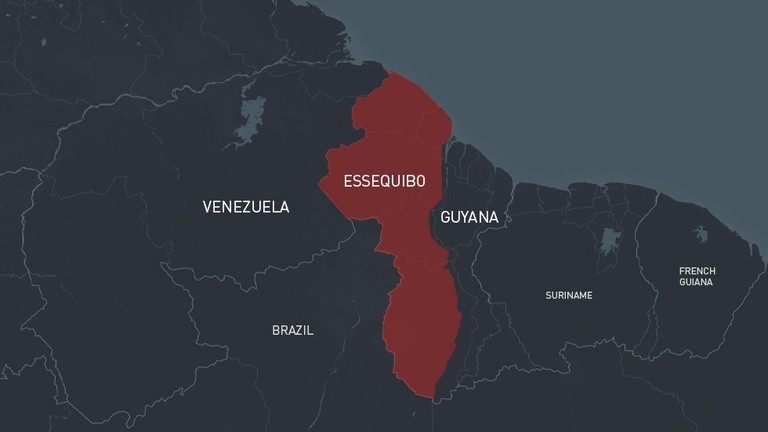
The border between Guyana and Venezuela, which runs through the Guyana-Essequibo region, known for its abundant oil reserves, has been a source of territorial dispute for several decades.
Venezuela gained independence from Spain in 1845 and recognized Essequibo – a zone of 160,000 sq. km – as part of its sovereign territory. In 1899, however, the United Kingdom filed and won an arbitration claim to recognize Essequibo as part of its then-Caribbean colony of British Guiana. Independent Guyana referred the dispute to the International Court of Justice (ICJ) in 2018. This came after Venezuela’s President Nicolas Maduro objected to former Guyanese president David Granger granting oil exploration rights off the Essequibo coast to ExxonMobil, the US-French oil transnational.
Venezuela held a referendum earlier this month in which almost 96% of the population voted in favor of incorporating the Essequibo region, which makes up two-thirds of the territory controlled by Guyana, into the country. Venezuelan President Nicolas Maduro put forward a proposal to the parliament, suggesting the establishment of Venezuela’s 24th state, named Guyana-Essequibo. He also produced a new map showing the disputed region of Essequibo as part of Venezuela. Besides referring to Essequibo as a “zone of integral defense,” Venezuela’s president proposed a deadline of three months for oil companies to halt offshore operations in the area. Last Sunday, a referendum was conducted to reaffirm Caracas’s claim to Essequibo. The majority of citizens voted in favor of establishing a state on the disputed territory.
According to Venezuelan media, President Nicolas Maduro has already officially signed decrees to incorporate the western region of neighboring Guyana into Venezuela, ratifying a total of six documents. In addition, Maduro signed a decree facilitating the creation of specialized units within the state oil and gas company PDVSA — PDVSA Essequibo and the Guyana Venezuelan Corporation — CVG Essequibo. To oversee the newly formed state, Major General Alexis Rodriguez Cabello was appointed as the sole head of the 24th state.
Venezuela and Guyana have since agreed not to threaten or use force in any circumstances to settle the dispute, as per a joint statement, published by Venezuelan President Nicolas Maduro. The sides also agreed to meet in Brazil within the next three months to “consider any matter with implications for the territory in dispute” and immediately establish a joint commission on the level of foreign minister and experts to address the dispute.
Empty Quiver
By William Schryver – imetatronink – December 21, 2023
As the sun sets here at the Winter Solstice of 2023, I would like to draw attention yet again to what, in my estimation, is one of the most strategically significant battlefield humiliations inflicted upon NATO over the course of the Ukraine War: the progressively comprehensive defeat of their precision-guided strike missile inventory — ATACMS, HARMS, JDAMS, GMLRS fired from HIMARS, cruise missiles (Storm Shadow and SCALP).
The Russians have demonstrated that they can routinely shoot down ANY species of strike missile the US/NATO can field against them — not all of them all of the time, but most of them most of the time.
And they get better and better at it as time goes on.
Indeed, over the past few months it is increasingly becoming “all of them most of the time”.
As Russian Defense Minister Sergei Shoigu reported earlier this week:
“We are using air defence systems in a comprehensive manner during the special military operation. This significantly improved their responsiveness and strike range. Over the last six months, we have shot down 1,062 of NATO’s HIMARS rockets, short-range and cruise missiles, and guided bombs.”
No other military on the planet has previously attested this level of capability. The US does not have it, and is at least a decade away from developing it.
And, it is important to bear in mind that the precision-guided systems the US and its NATO allies have provided for Ukraine are representative of the best their own militaries could deploy in a conflict with Russia.
The current front-line inventory of US tactical ballistic missiles and sea- and air-launched cruise missiles would present no greater technical challenge for Russian air defenses than what they have already seen and defeated in the Ukraine War.
The significance of this battlefield development defies exaggeration. It alters the war-fighting calculus that has been assumed for many decades.
Against Russia at least, the Pentagon must know that the success of a large conventional strike missile package is far from assured. There is no doubt some damaging hits would be inflicted, but Russian retaliatory capacity would not be appreciably affected, and the subsequent Russian counterstrike against NATO targets would be devastating — for the simple reason that US/NATO air defenses are not even remotely as effective as their Russian counterparts. In fact, they are rookie league in comparison. They would be as utterly befuddled as was the Patriot system in Kiev the night the Russians launched a very modest attack against it.
It would also be logical to assume that China, if not as fully proficient as Russia in every respect, is very likely not far behind.
It is also increasingly apparent that Iran has made great strides in the same direction.
As I have noted repeatedly in recent months: for the declining empire and its decrepit vassals, there are no easy wars left to fight.
The dangers NATO names and makes
By Radhika Desai | CGTN | November 28, 2023
NATO Secretary-General Jens Stoltenberg stated in his pre-ministerial press conference on the eve of the NATO Foreign Ministers’ meeting in Brussels on November 28 and 29, that the almost 75-year-old organization faces “the most dangerous world in decades.”
However, little that the military alliance does seems designed to diminish those dangers. Instead, by holding out the hope of prevailing in these conflicts, most of which it has been instrumental in causing in carefully selected theaters outside itself, it is exacerbating them.
There is, upper-most on the world’s mind, the six-week-old Israel-Hamas conflict. While U.S. officials routinely invoke the danger that it will spiral out of control into a Middle Eastern war and even a World War III, rather than damping it down, the U.S. and NATO seem hell-bent on stoking it further. They back Israel militarily, financially, and diplomatically (with NATO members routinely vetoing or abstaining from numerous UN Resolutions calling for even a pause in the conflict) so one-sidedly that NATO governments face veritable revolts, not only on the streets but in its own ranks and those of the normally loyal national media.
The U.S. and NATO’s hopes of victory against Middle East countries are vain and hubristic. This is already clear from their failure to win the war in Ukraine. With defeat all but announced, the search for scapegoats is already on in Kyiv. If, after 20 months of war, billions in aid and armaments, boomeranging sanctions and unrelenting propaganda the war could not be won, the addition of new wars can hardly bring victory closer.
Finally, Stoltenberg referred to “growing global competition,” a code word for the aggression towards China into which the U.S. is trying to dragoon its NATO allies. It has, in recent years, entailed the revitalization of the Quad of Japan, Australia, India and the U.S., the launching of the AUKUS alliance between Australia, the United Kingdom and the U.S. and the shift from “Asia Pacific” to “Indo-Pacific” to designate the U.S. concerns and commitments beyond its western sphere with India positioned as a key U.S. and Western ally in the region.
It has also entailed unprecedented explicit mention of Asian objectives in NATO communiques since the Madrid Summit in 2022, and the attendance of leaders and ministers of Japan, the Republic of Korea, Australia and New Zealand as regular guests at NATO meetings and summits.
However, this strategy is far from assured. Quite simply, China’s winning, development- and growth-based diplomacy continues to engage all these countries and even NATO members with considerable success. While enervated and financialized Western economies offer only subjection, political and financial, China’s vibrant economy, productive and technological dynamism and benign international [ism] offer/exert an economic gravity that leaves no country untouched.
There are many reasons why NATO is being too hubristic and vain: It is too used to being the top dog, too many of its governments have invested too much into these wars and potential wars and it needs achievements to celebrate next July, not failures. But, as became clear in U.S. President Joe Biden’s speech a few days ago, when he once again delusionally called his country the “indispensable nation,” he wishes to fight the next election as a war president and then some: with wars on two and possibly three fronts.
Given his abysmal ratings, that is the thin thread on which his victory hangs.
Radhika Desai, a special commentator on current affairs for CGTN, is a professor of political studies at the University of Manitoba in Canada.
Iran ready to further strengthen all-out ties with Kuwait: Foreign minister
Press TV – December 17, 2023
Iranian Foreign Minister Hossein Amir-Abdollahian says Tehran is ready to further improve relations with Kuwait in various fields.
Amir-Abdollahian made the remark in a meeting with new Kuwaiti Emir Sheikh Mishal al-Ahmad al-Jaber al-Sabah in Kuwait City on Sunday.
He offered condolences of the Iranian president and nation to Kuwait over the passing of former Emir Sheikh Nawaf al-Ahmad al-Jaber al-Sabah and congratulated Sheikh Mishal on his appointment as the new Emir of the country.
The top Iranian diplomat reiterated Tehran’s support for Kuwait City.
The new Kuwaiti Emir, for his part, said he has instructed foreign minister and other cabinet members of the government to put the expansion of all-out ties with Iran on their agenda.
Sheikh Nawaf died at the age of 86 on Saturday.
Putin: “Odessa is a Russian city”
BY M. K. BHADRAKUMAR | INDIAN PUNCHLINE |DECEMBER 17, 2023
At the year-end news conference on Thursday lasting four hours, Russian President Vladimir Putin made some key remarks on the conflict in Ukraine which throw light on the likely trajectory of the war through 2024. To be sure, Russia will not accept a “frozen conflict” that falls short of realising the objectives Putin had laid out at the commencement of the special military operations in February last year.
Putin stated: “There will be peace when we achieve our goals… Now let’s return to these goals – they have not changed. I would like to remind you how we formulated them: denazification, demilitarisation, and a neutral status for Ukraine.”
He spelt out denazification and demilitarisation as work in progress while leaving out the crucial question of a neutral status for Ukraine, a notion which the collective West outright rejects while pressing ahead with its intervention in newer forms despite the failure of Kiev’s months-long counteroffensive. Ironically, the accent in the revised western narrative is to create a strong resilient defence industry in Ukraine eventually with western technology and capital to ward off any Russian military threats in future.
On denazification specifically, Putin said that during the negotiations in Istanbul last year in March, Kiev showed receptiveness towards the idea of legislating against the spread of extremist ideology, but that lies buried in the past. As for demilitarisation, that idea also never caught on as Ukraine began receiving weaponry “even more than what was promised by the West.”
Therefore, Russia is left with no other option but to keep destroying the Ukrainian military capability as the core of the demilitarisation process. But Putin believed that certain parameters can still be negotiated, and, in fact, “We actually agreed on them [with Ukrainian negotiators] during the Istanbul talks; although these were thrown out later, we managed to reach agreement.” The alternative to reaching an agreement on demilitarisation is to “resolve the conflict by force. This is what we will strive for.” However, to this end, Putin ruled out another mobilisation as already “there will be about half a million people [in the war zone] by the end of this year.”
These remarks bear the hallmark of a statesman speaking from a position of strength who is conscious of it, too. Putin asserted that Russian forces are “improving their position almost along the entire line of contact. Almost all of them are engaged in active combat. And the position of our troops is improving along [the entire line of contact.]” Putin conveyed no willingness to compromise with the US and EU.
Significantly, Putin said that the southern part of Ukraine has “always been Russian territory… Neither Crimea nor the Black Sea has any connection to Ukraine. Odessa is a Russian city.” This is an ominous statement implying that the Russian operation may after all extend to Odessa which is on the western side of the Dnieper and even further westward along the Black Sea coast to Moldova that renders Ukraine a land-locked country. A prolonged conflict is in the cards.
On the contrary, the reports from the US media quoting American officials convey the impression that there is no willingness to throw in the towel at the present stage. That is of course predicated on the belief that Russia will be hard put to realise its objectives and by the end of 2024, the tide of war can change and Russia may be compelled to compromise. Thus, a new strategy is being worked out between the US and Ukrainian military that can be executed by the early part of 2024 with the American accent on holding the territory that Ukraine controls as of now and digging in.
The New York Times reported that the Ukrainian military subscribes to a “forward policy.” The Pentagon is stationing a three-star general in Kiev with a view to “stepping up the face-to-face military advice it provides to Ukraine.” This could be the beginning of deployment of American military advisors to Ukraine to oversee the war, which will put the Pentagon in a direct role in the management of the operations from both the tactical as well as strategic perspectives.
Meanwhile, the final word is not yet spoken by the US Senate on the Administration’s demand of $61 billion as additional funds for Ukraine. The likelihood is that the senate will eventually pass the bill since there is a big groundswell of support among Republican lawmakers for the war effort. The Administration is driving home that Russia has an “imperial” agenda toward NATO countries and vital US interests are at stake in preventing Russia from winning the war.
Interestingly, in a related development two days ago, Congress approved legislation that would prevent any president from withdrawing the US from NATO without approval from the Senate or an Act of Congress. Equally, Europe is also circling the wagons and taking a long-term view that Russia’s scale-up of arms production to sustain its operations in Ukraine poses a real threat to Europe, especially to the Baltic states, Georgia and Moldova. NATO Secretary-General Jens Stoltenberg last week warned that “If Putin wins in Ukraine, there is real risk that his aggression will not end there.”
The German Defence Minister Boris Pistorius echoed that sentiment when he said on Saturday that Europe must ramp up its security and defence capabilities to respond to the threat Russia poses, as the US will likely reduce its involvement on the Continent in the coming years and increasingly turn its attention to the Pacific region in the next decade. As he put it, “This isn’t just sabre-rattling. Dangers could lie ahead at the end of this decade.”
The message from the European Council meeting in Brussels last Friday is also that in circumventing Hungary’s opposition, EU leaders are navigating a pathway to ensure Ukraine will still get its €50 billion aid package to help prop up its hollowed out economy — if necessary, by taking the radical step of sacrificing EU unity and providing the money on a bilateral basis. The EU leaders are expected to reconvene at the end of January or early February to unlock the issue.
On Friday, Ukraine’s foreign ministry released a statement lauding the opening of EU membership negotiations and voicing optimism about the €50 billion aid package from Brussels. The tough talk notwithstanding, Russia too must be sensing that the EU will ultimately find a way somehow to solve the financial question. For the present, though, the deadlock in Brussels and Washington on aid has generated an air of uncertainty, which is bad optics for Kiev and plays into the Russian narrative.
All in all, Putin’s tough remarks on Thursday factor in that the US isn’t going anywhere but stays put in Ukraine and the Biden administration’s game plan is to revamp the war strategy to put it on a stronger footing and make it sustainable through the period ahead till the November 2024 election.
Kremlin’s hope that US support for Ukraine is on the wane seems misplaced. Curiously, spokesman Dmitry Peskov added in good measure in an interview on Friday with broadcaster NBC News that Putin would prefer an American president who is “more constructive” toward Russia and understands the “importance of the dialogue” between the two countries. Peskov added that Putin would be ready to work with “anyone who will understand that from now on, you have to be more careful with Russia and you have to take into account its concerns.”
Between now and the presidential election in March in Russia, domestic politics will be hotting up. After Putin’s re-election for a fresh 6-year term as president, which is widely expected, by the time the new government is formed, the campaign for the US election will have accelerated and it is a safe bet that the Ukraine war will be on auto-pilot with the priority almost entirely lying on averting any serious embarrassment to Biden’s reelection bid.
Suffice to say, staving off a military defeat in Ukraine and keeping the stalemate on track will be the Biden administration’s singular aim through 2024. The big question is whether Putin would “cooperate” or have some surprises in store. Peskov has begun looking beyond the Biden presidency.
Russian Airborne Forces Ex-Commander: NATO Counteroffensive Plan Bad, New Ukraine Strategy Worse
By Ekaterina Blinova – Sputnik – 14.12.2023
The Russian Armed Forces have shifted to the offensive in the special military operation zone and are making progress along the entire contact line, President Vladimir Putin said during his annual press conference.
Russia’s 617,000-strong military contingent is presently improving its positions along the almost 2,000 kilometer-long contact line, President Putin told attendees at his annual press conference. What’s behind the development?
The failure of the Ukrainian counteroffensive has exposed the ineffectiveness of NATO’s strategic planning and outdated doctrines, says retired Colonel General Georgy Shpak, ex-commander of the Russian Airborne Forces.
“[NATO] placed its bet on Ukraine making it carry out a counteroffensive,” Shpak told Sputnik. “They organized and planned it. But the counteroffensive failed, because the [Russian military] foresaw [their steps], built good defenses worthy of the Russian army and withstood numerous attacks.”
“Now we have moved on to the second stage of this operation: to disable as much [Ukrainian] equipment and personnel as possible. This second stage is essentially coming to an end, because the Ukrainian army is exhausted, they lack manpower, their reserves are depleted, their money has run out, almost all of their equipment has been knocked out. This is the result of the work of American and British [military] advisers,” the retired colonel general continued.
NATO war planners failed to calculate the effects of many key factors, according to the military expert.
“They did not take into account current modern conditions, the huge number of [Russian] aerial vehicles that are designed for reconnaissance, observation, adjustment, and strikes. They didn’t take this into account. They hoped that if they struck in several directions, our defenses would crack, but we held the line.”
Shpak was also highly sceptical of NATO’s 2024 strategy for Ukraine, which envisages digging in and building up forces for a possible new offensive.
“I would say that it is even worse than their counter-offensive,” the general said. “Not a single defensive structure can withstand strikes of modern powerful weapons. Furthermore, it’s impossible to build reinforced concrete fortifications which are over 1,000 kilometers long and 20-30 meters deep, with enormous coverage. This is all nonsense. It’s impossible to build something like that. There will still be gaps here and there, failures here and there.”
“This is all theory. For me, as a military man, it’s just like a children’s fairy tale, not a thought-out plan. They have abruptly shifted from a counteroffensive to an all-out defense. I believe this will lead to their defeat,” Shpak added.
Venezuela, Guyana to hold talks on disputed Essequibo region
RT | December 10, 2023
The presidents of Venezuela and Guyana – Nicolas Maduro and Mohamed Irfaan Ali, respectively – will sit down next week to discuss a long-standing territorial dispute that has recently intensified, the prime minister of Saint Vincent and the Grenadines has revealed. While Caracas has laid claim to the oil-rich Esequibo region since the late 19th century, President Maduro recently took steps toward gaining actual control over the area, which covers some 160,000 square kilometers.
Earlier this week, the Spanish daily El Pais reported that the Venezuelan government had deployed troops to the border with Guyana.
Saint Vincent and the Grenadines PM Ralph Gonsalves, who also serves as president pro tempore of the Community of Latin American and Caribbean States (CELAC), broke the news after speaking with Maduro on Saturday, saying the negotiations would take place on Thursday.
The Venezuelan government has confirmed the planned talks, saying they hoped to “preserve our aspiration to maintain Latin America and the Caribbean as a zone of peace.”
The Office of the President of Guyana, for its part, stressed that “Guyana’s land boundary is not up for discussion.”
Also on Saturday, Brazilian President Luiz Inacio Lula da Silva spoke with Maduro, calling for dialogue and warning against unilateral measures that could escalate the situation. The Brazilian head of state has also been invited to take part in Thursday’s talks as an observer.
Speaking on Tuesday, the Venezuelan president said Caracas wanted the “peaceful rescue of the Guayana Esequiba,” which “has been de facto occupied by the British Empire and its heirs and they have destroyed the area.” Maduro also unveiled a new map of Venezuela that incorporates the disputed territory, and appointed a new governor to the region.
Guyanese President Irfaan Ali, in turn, gave a televised address to the nation, accusing Venezuela of attempting to annex more than two thirds of his country.
“This is a direct threat to Guyana’s territorial integrity, sovereignty, and political independence, and a violation of fundamental principles of international law,” the leader stressed.
“The Guyana Defense Force is on high alert… Venezuela has clearly declared itself an outlaw nation,” Ali added.
The recent escalation followed Sunday’s referendum, in which 10.4 million Venezuelan voters backed Caracas’ claim to Guayana Esequiba.
The territorial dispute stems from the US’ decision in 1899 to assign the territory to what was then British Guiana – a move Venezuela never accepted as legitimate.
USA and Israel Should be Worried: The Muslim Middle East is Moving Its Own Way
By Karsten Riise | Covert Geopolitics | December 7, 2023
Less than a month before Russia takes over the chairmanship of BRICS-11 where both UAE and Saudi Arabia will be full members, Russia makes a big move to bring cooperation with UAE and Saudi Arabia to an unprecedented level.
Russia ties everything together in this meeting: Head of States relations, Foreign Policy, Non-Dollar currency and Financial Policy, Industrial Policy, Nuclear Cooperation, Artificial Intelligence (AI), Space Development, International Direct Investments – and the whole private Business sector.
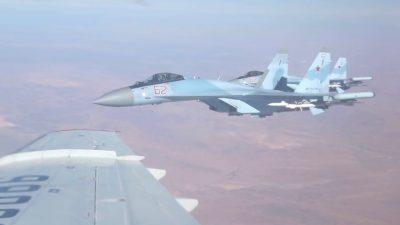 Note also that Putin travels safely in person to both the UAE and Saudi Arabia.
Both UAE and Saudi Arabia are visited by President Putin, Foreign Minister Lavrov, First Deputy Prime Minister of the Russian Federation Andrei Belousov, head of the Ministry of Industry and Trade Denis Manturov, Deputy Prime Minister Alexander Novak, head of the Central Bank Elvira Nabiullina, head of Roscosmos Yuri Borisov, head Rosatom Alexey Likhachev, and head of Russian Direct Investment Fund (RDIF) Kirill Dmitriev.
The RDIF recently published a Russian international platform for AI services. The delegation also includes representatives of the business community. See this.
In cooperation with Russia and China, the UAE and Saudi Arabia are becoming not only oil powers, but powers in the modern AI, hi-tech knowledge and Space economy – and military powers.
The central Middle Eastern powers, UAE, Saudi Arabia, Iran, and even Türkiye, are emerging as pillars in the international policies of Russia and China – in all dimensions.
Algeria builds deeper relations with its biggest arms supplier Russia, and Algeria opens defense cooperation China. Russia and Egypt have also for years been reinforcing cooperation, including defense cooperation, nuclear cooperation (a Russian nuclear powerplant is being built) and trade-logistics (a Russian trade zone near the Suez Canal).
In Syria, Russia has already long ago stabilized the government in Damascus, and even in Iraq, Russia just a few days ago took over Iraq’s biggest oil field and kicked out the biggest western player in Iraq’s oil sector.
Recently, Russia as the Chairman of BRICS-11 after 1 January 2024 even gave its nod of approval for the admission of China’s best friend Pakistan into BRICS in spite of Indian hesitations.
The Muslim Middle East is moving its own way – independently of the West. At a time when all the non-Western world including the Muslim world is outraged by Israel’s Nakba pressing out Palestinians with genocide on over 16,000 civilians in Gaza, Israel and its US backer should be worried.
Karsten Riise is a Master of Science (Econ) from Copenhagen Business School and has a university degree in Spanish Culture and Languages from Copenhagen University. He is the former Senior Vice President and Chief Financial Officer (CFO) of Mercedes-Benz in Denmark and Sweden.
Featured Video
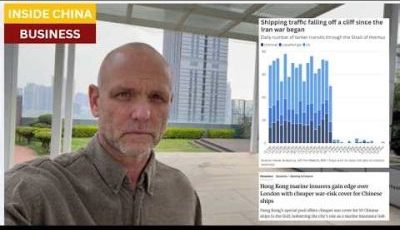
More Iran War fallout: Maritime insurance industry shifts from London to China
or go to
Aletho News Archives – Video-Images
From the Archives
Allies Don’t Need Lobbies
By Jay Knott | Dissident Voice | September 24, 2013
In a recent article on Counterpunch, Rob Urie defended the traditional Marxist analysis of US policy in the Middle East. He argues that support for Israel is driven primarily by economic interest, not the Jewish lobby.
He starts by paying tribute to the idea that Western societies are uniquely racist. He says that the “Western narrative” claims there is an “Arab character”, and that this is “antique racist blather”. He gives no definition of these terms. Further, he establishes his credentials as part of the dominant current in the American left by claiming that “over a million people in Iraq died so ‘we’ in the West can drive SUVs.”1
When he tries to criticize bourgeois economics, he makes it clear he doesn’t understand the developments it has made since Marx’s day, using the mathematical discipline known as “game theory”. He dismisses the basic abstraction of economic theory, the idea of the rational individual, on the grounds that it is “devoid of history, culture and political context”. But abstractions are always devoid of something.
He defends a more concrete economic theory, mostly Marxist, with some input from another theorist of capitalist crisis, Hyman Minsky. This concrete theory leads him to the view that US activity in the Middle East is primarily driven by rational capitalist motives, the need to secure a supply of oil.
“Taking the totality of circumstance — former oil company executives launching war on an oil rich nation on a pretext they publicly proclaimed they didn’t believe shortly before taking office — and that upon launching their war proved to be non-existent, requires a willingness to overlook the obvious — that the war on Iraq was for oil, that is difficult to support.”1
Perhaps I’ve misunderstood him, but based on what he says in the rest of the article, this convoluted sentence seems to argue that, because president Bush and vice-president Cheney attacked Iraq on false premises, and they also said it was all about oil, and they are former oil executives, and Iraq has a lot of oil, it’s difficult to deny US attacks on Iraq are all about oil.
In fact, it’s not hard at all. As Urie points out, at times Bush and co. said that attacking Iraq was “protecting the world’s supply of oil.”1 But, as he also points out, they are congenital liars. Why should we believe them when they say they are trying to “protect” the oil supply? Protect it against what? When politicians “admit” attacks on Middle Eastern countries are wars for oil, they are parroting the neo-con party line, feeding the public, both left and right, with a plausible-sounding pretext. For right-wingers, “it’s a war for oil” is a reason to support war, and for leftists, it’s a way to feel better by complaining impotently about corporate greed. Both approaches help the war drive. … continue
Blog Roll
 Aletho News
- More Iran War fallout: Maritime insurance industry shifts from London to China
- US-Israeli aggression on Iran triggers review of GCC countries’ investment pledges to Washington
- Russia slams UK plan to seize tankers suspected of carrying its oil
- Pakistan ramps up food exports to Persian Gulf nations as war deepens food insecurity
- Iran submits response to US plan, sets terms for war’s end: Tasnim
- US vs Iran: Kharg Island Talk — Bluff or Escalation? Ex-Military Officer Weighs In
- Zelensky unnecessarily involves Ukraine in the Middle East crisis
- Turkish tanker blacklisted by Ukraine hit in drone attack – media
- Canada, the U.S., and NATO: the inescapable trap
- Villains of Judea: Leonid Radvinsky
- If Americans Knew
- ‘No Innocent Children’: Far-right Israeli Lawmaker Defends Killing of Palestinian Family
- Mossad’s promises helped Netanyahu convince Trump that Iran could be toppled
- US Arms Control Official Refuses To Comment When Asked If Israel Has Nuclear Weapons
- Veterans warn US landing could be ‘more Gallipoli than Vietnam’
- Israel may be committing war crimes in Lebanon – Not a ceasefire Day 167
- In the West Bank, life is a constant battle – 3 articles
- Jacob Reses, one of the most powerful pro-Israel operatives in Trump’s Washington
- Israeli-US assaults kill or injure 87 children a day – Not a ceasefire Day 166
- ‘Forever live by the sword’: Understanding Israelis’ massive support for Iran war
- UN’s special rapporteur on human rights says Israel is systematically torturing Palestinians
- No Tricks Zone
- Devastating Assessment Of Comirnaty Vaccine By Former Senior Pfizer Europe Toxicologist
- New Study: CO2 Is ‘Effectively Negligible’ As An Explanatory Climate Change Factor Since 2000
- Former Pfizer Toxicologist Dr. Helmut Sterz Tells Bundestag Hearing Pfizer Vaccine Should Have Never Been Approved
- Energy Expert: Germany’s Nuclear Phaseout Was A “500 Billion Euro Mistake”
- New Research: South Australia’s Mid-Holocene Sea Surface Temperatures Were 4°C Warmer Than Today
- Storing Green Energy To Last Germany 10 Days Would Require A 60-Million Tonne Battery
- New Studies: UK Sea Levels Were 4 Meters Higher Than Today During The Mid-Holocene
- Destructive Green New Deal: German Energy And Metal Group Warns Of Drastic Crisis
- New Study Documents A 20-Year Pause In Arctic Sea Ice Decline – Driven By Internal Variability
- Wake-up Call: Survey Shows Majority Of Germans Now Favor Postponing Climate Targets!
 Aletho News