More Young People Getting Cancer — What’s Behind the New ‘Public Health Crisis’?
By Suzanne Burdick, Ph.D. | The Defender | March 27, 2024
Catherine, Princess of Wales, who on March 22 announced she has cancer, “is part of an unfortunate new trend of more and younger cancer cases,” according to Dr. Pierre Kory and journalist Mary Beth Pfeiffer.
Kory and Pfeiffer addressed Princess Catherine’s diagnosis in an op-ed published Tuesday in The Washington Times, in which they said there’s evidence suggesting that the marked increase in cancers among young people may be linked to COVID-19 mRNA vaccines and pandemic policies, such as lockdowns and vaccine mandates.
“We are facing an emerging toll of illness and death in the young,” they wrote. “We cannot shirk from asking what is causing it.”
Kory — president and chief medical officer of the Frontline COVID-19 Critical Care Alliance — told The Defender that early-onset cancer and excess deaths are “poised to become the next public health crises that our medical system is not equipped to manage.”
This latest op-ed is Kory and Pfeiffer’s fourth. Their three prior op-eds — which appeared in USA Today, Newsweek and The Hill — also called attention to excess mortality and disability rate spikes occurring after the global COVID-19 vaccine campaign.
“Our intention for writing the op-eds is to raise the profile of this important issue to prepare for a future crisis and advance the conversation on possible causes and treatments,” Kory said.
In their latest op-ed, Kory and Pfeiffer said an “unthinkable twist” in cancer rates is occurring and it has garnered the attention of the American Cancer Society, Yale Medicine and the Harvard Gazette.
According to the American Cancer Society’s 2024 report, about 2 million people in the U.S. will develop malignancies this year — and a larger share of the more than 600,000 who are estimated to die will be younger than before.
CDC data show ‘red flags’
Kory and Pfeiffer cited cancer death records through 2023 from the Centers for Disease Control and Prevention (CDC) that included data two years beyond what was in the American Cancer Society report.
“The later data, which is provisional,” they wrote, “shows a cancer pattern that appears to have gone from slow simmer to rapid boil in the heat of a pandemic.”
They found that cancer deaths across all ages rose by 2% from pre-pandemic 2019 to 2023 — and in people 15-44 years old, cancer-related mortality rose at double that rate.
“Why is this happening now?” Kory and Pfeiffer asked. “Moreover, what will be done to address it?”
They saw additional “red flags” in the CDC data including:
- Deaths from colorectal cancer rose 17% among people ages 15-44 in 2019-2023 — 4 times the population-wide increase.
- Uterine cancer deaths rose 37% among people ages 25-44 from 2019-2023, and 15% overall.
- There were much larger increases, from 2019-2022, in liver and pancreatic cancer mortality in young adults than in the overall population.
The U.S. Society of Actuaries also reported 76% and 101% increases in death claims among insured workers ages 25-34 and 35-44. “COVID-19 was ruled out as the cause,” Kory and Pfeiffer said.
The public needs to explore the role of lockdowns, top-down treatment protocols and vaccines that were often mandated as a condition of employment, they said.
“By top-down treatment protocols,” Kory told The Defender, “I’m referring to how the public health and medical authorities made edicts on treatments that had to be followed and could not be questioned without consequence.”
“These same authorities were not open to understanding the novel treatments showing promise on the frontlines and instead allowed information to flow only one way — from the top down,” he said.
‘Just a tragic coincidence?’
In a March 27 Substack post about the data exposed in the op-ed, Kory said he and Pfeiffer compiled and interpreted these and other data from government and professional society sources after “bearing witness to so much medical carnage.”
“Just a few weeks ago,” he said, “a 20-year-old patient of mine died of glioblastoma.”
He added:
“If that is not tragic enough, her parents told me that a 20 year-old man in her college friend group had died of the same a few weeks earlier. Unsurprisingly, their university had a vaccine mandate.
“Just a tragic coincidence right?”
But reviewing cancer facts and figures has convinced Kory that such cases aren’t just a coincidence.
“We believe that the data strongly if not definitively implicates the COVID mRNA vaccine as the most proximate cause.”
Suzanne Burdick, Ph.D., is a reporter and researcher for The Defender based in Fairfield, Iowa.
This article was originally published by The Defender — Children’s Health Defense’s News & Views Website under Creative Commons license CC BY-NC-ND 4.0. Please consider subscribing to The Defender or donating to Children’s Health Defense.
Israeli forces kill Palestinian teenager in northern West Bank raid

Deceased Palestinian teenager Moatasem Nabil Abu Abed
Press TV – March 30, 2024
Israeli forces have killed a 13-year-old Palestinian teenager in the West Bank, according to the Palestinian health ministry, amid relentless aerial and ground offensives by the occupying regime’s military against Palestinians in the Gaza Strip.
The official Palestinian news agency WAFA reported that the shooting occurred early on Saturday in the city of Qabatiya, as Israeli forces stormed a local neighborhood overnight, resulting in clashes.
Local sources, speaking on condition of anonymity, said the Israeli troops broke into several homes and deployed snipers on the rooftops of several buildings and homes amid violent confrontations.
Israeli forces also rounded up a Palestinian father along with his son after they barged into a house. The forces ransacked several houses in the town as well, and inflicted damage to their contents.
Israeli troops then opened heavy gunfire at two young men, critically injuring one of them.
Fawaz Hammad, Director of al-Razi Hospital in Jenin, said that Moatasem Nabil Abu Abed was killed after being seriously injured by live bullets.
Israeli forces prevented Palestinian ambulances and paramedics from entering Qabatiya and transporting wounded locals to the hospital.
On Friday, Israeli troops detained at least 25 Palestinians, including children, a woman and prisoners freed from Israeli jails, during separate raids across the West Bank.
The Detainees and Ex-Detainees Affairs Commission and the Palestinian Prisoners’ Society (PPS) stated that the arrest campaigns focused on occupied al-Quds, as hundreds of worshipers headed to the area to perform Friday prayers at al-Aqsa Mosque.
Other detentions took place in the governorates of al-Khalil, Nablus, Tulkarm, and Qalqilia.
This brings the total number of Palestinians arrested since early October to nearly 7,870, including those who were detained from their homes, at military checkpoints, those who surrendered under pressure and those who were taken as hostages.
More than 400 Palestinians have been killed by Israeli forces in the occupied West Bank since October 7, when Israel waged the war on Gaza after Hamas carried out a historic operation against the occupying entity in retaliation for its intensified atrocities against the Palestinian people.
The Israeli aggression has so far killed at least 32,552 Palestinians, mostly women and children, and injured 74,980 others in Gaza. The Tel Aviv regime has imposed a “complete siege” on the territory, cutting off fuel, electricity, food, and water to the more than two million Palestinians living there.
Swedish police arrest Iranian prisoner’s son: Daughter
Press TV – March 29, 2024
Sweden’s police have reportedly arrested the son of an Iranian prisoner, who has been sentenced to life in prison by Stockholm, based on complaints filed by notorious anti-Iran figures living in exile in the Nordic country.
“After [spending] hours with no information about my brother, who had gone to visit my father…, we realized that Majid has been apparently arrested by Sweden’s police,” Atieh Nouri, daughter of Hamid Nouri, said in a post on X on Friday.
“We still do not know anything about the details of the matter,” she added.
Nouri, a former Iranian judiciary official, was arrested in Sweden back in 2019.
He was put on trial on unfounded allegations levelled against him by elements representing the Mujahedin-e-Khalq Organization (MKO) terrorist cult that has openly boasted about carrying out deadly terrorist operations against thousands of Iranian officials and civilians.
Nouri was handed the life sentence three years later after being found guilty of murder and crimes against the international law over his alleged role in executions of criminals in Iran in 1988.
Sweden’s Appeal Court upheld the verdict in December 2023.
Earlier in March, Sweden’s Supreme Court also upheld the sentence, refusing to hear an appeal that had been submitted by the Iranian prisoner.
Iranian authorities say Nouri’s imprisonment and trial in Sweden is politically-motivated, noting that the case has been influenced by pressure and propaganda of anti-Iran groups and individuals living in the West.
Nouri, himself, has vehemently denied the charges brought against him in the case, calling them fabricated.
Why Slovak Wildcard Robert Fico Could Bring EU House of Cards Crashing Down
By Ilya Tsukanov – Sputnik – 21.03.2024
Slovak Prime Minister Robert Fico has found himself in the crosshairs of Eurocrats worried that he may become the next Viktor Orban -a thorn in Brussels’ backside rejecting EU directives on everything from Ukraine to criminal justice reform. Sputnik asked Slovak politician Peter Marcek what it is about Fico that’s so unnerving to the establishment.
Slovaks will go to the polls Saturday for the first round of a highly anticipated presidential election, six months after a snap parliamentary vote in September saw veteran Direction – Social Democracy leader Robert Fico’s return to the prime minister’s chair.
While Slovakia’s presidency carries a largely symbolic function, the president does have the power to appoint key figures, including the prosecutor general, and can help the government in times of crisis, making the post an important one.
The latest polling shows Peter Pellegrini, a Fico ally from the offshoot Voice – Social Democracy party, and independent former ambassador to the United States Ivan Korcok running neck and neck with between 34 and 38 percent support each, guaranteeing a runoff between them in the second round of voting April 6.
Thelooming vote has spawned a spate of articles in European legacy media bashing Fico and his party, attacking him as a left wing populist analogue of Hungarian right wing populist Viktor Orban and the Fidesz party, and fearmongering about Slovak “democracy’s future,” Pellegrini’s supposed “Russia tilt,” and Bratislava’s alleged “democratic backsliding.”
All these reports have one thing in common: dread at the prospect that Fico and his allies will pursue an independent foreign and domestic policy which threatens the interests of Brussels and the United States.
Headache for Brussels
From Ukraine arms aid (which Fico halted last October) to Kiev’s NATO membership bid (which he has promised to block), to Bratislava’s defense pact with Washington (whose terms Fico has expressed dissatisfaction with) to the launch of an independent inquiry into the EU’s authoritarian pandemic policy, to criminal code reforms slammed by Brussels, Fico has already proven a major “headache” for the West. And that’s just for openers.
“Robert Fico has been in office for only four months, but he has begun to implement the right policies. He has begun to pursue policies for his people, for his country,” Peter Marcek, a former Slovak lawmaker, businessman and the chairman of the Slavic Unity party, told Sputnik.
“He refused to support Ukraine, stopped the supply of weapons to Ukraine, agreeing only to humanitarian assistance and saying that Slovakia would only provide such aid. Fico also doesn’t agree with many of the economic laws adopted by the European Union – which are adopted to benefit the EU itself, rather than its members,” the politician said.
Fico has already managed to get into trouble with the bloc in the course of his short time in office, Marcek said, pointing to Brussels’ threats to cancel the transfer of €1 billion in funds to Bratislava over the prime minister’s legal reform agenda. “They must give this money to Slovakia because it belongs to us. If they don’t… they will make people even more against the European Union. Fico has said that if they behave like this, the result can be only one thing – that Slovakia will exit the European Union, because economically our standard of living is getting worse and worse.”
“When sanctions were introduced against Russia, it did not kill the Russian economy, maybe only creating problems at the very start, but Russia was able to find other markets. We bought oil and gas from Russia at reasonable prices, now we pay the Americans four times more. Our standard of living has dropped significantly,” Marcek explained.
“If the European Union continues its current policy, we will soon leave it. Things simply cannot continue like this, and I think everyone sees it. For example, we have to pay €22,000 for each migrant that we did not accept into our country. What if they tell us that our quota for migrants is 300,000 people? Do the math: that’s 300,000 x €22,000. Instead of allocating this money to pensioners, children, families, will we give it to migrants? Why should we accept immigrants from Africa when we were never colonizers?” the politician asked.
Brussels’ self-serving policies have people from across the EU up in arms, Marcek said, pointing to the rising popularity of both right and left populist, Eurosceptic forces across Europe, and the “major farmer protests” in Austria, France, Germany and even Spain.
Amid the chaos, the EU will have to change its policy, “or the EU will collapse.” It’s as simple as that, the observer believes.
Marcek expects elections to the European Parliament in June to bring a new crop of leaders who seek greater national autonomy against EU institutions which don’t benefit their countries.
As for Slovakia’s upcoming presidential vote, Marceck says Pellegrini will be likely to defeat “pro-American Korcok,” and replace the current president, Zuzana Caputova, who “has created many problems for the government” and prevented its normal functioning. “She is a president that was installed by the US embassy,” the politician summed up.
Russia says no to Switzerland ‘peace conference’
RT | March 13, 2024
Moscow has no intention of participating in a proposed Swiss-hosted peace conference on the Ukraine conflict, even if it is officially invited, Russian Foreign Ministry spokeswoman Maria Zakharova has stated.
The official response follows recent media reports that China and Switzerland have been pushing to get Russia invited to the talks. Last month, Switzerland announced plans to organize a peace summit “by the summer.” No specific date has been named as of yet. The list of participants has also not been revealed. However, Ukraine has indicated that Russia can only be invited if it agrees in advance to a litany of preconditions.
“This forum will be dedicated to promoting the ultimatum ‘Zelensky peace formula,’ although its Swiss organizers pretend that they are looking for a common denominator in the peace initiatives of different countries,” Zakharova said, according to a press release issued on Wednesday on the ministry’s website.
She explained that Zelensky’s plan includes a number of unrealistic terms, including the withdrawal of Russian troops to Ukraine’s 1991 borders, holding Moscow accountable and paying reparations, as well as provisions on food, nuclear safety, energy, ecology, and humanitarian problems. Kiev’s basic demands remain the same, while legitimate Russian interests are being ignored, Zakharova said.
“So, the upcoming conference is a continuation of meetings in the Copenhagen format, which initially discredited themselves, and now have reached a dead end.”
Moscow is convinced that “Switzerland can hardly serve as a platform for various peacekeeping efforts, since this presupposes a neutral status, which Bern has lost,” the spokeswoman claimed.
“All this makes Russia’s participation in the aforementioned ‘peace conference’ pointless as it doesn’t matter whether it will be held in one, two or five stages – its ultimatum essence, promoted by Kiev and its masters, does not change from this,” Zakharova concluded.
Ukraine’s Western backers insist that a peace settlement can only be achieved on Kiev’s terms and have vowed to continue weapons deliveries for “as long as it takes.” Russia, meanwhile, has stressed that no amount of foreign aid will change the course of the conflict.
Peace negotiations between Moscow and Kiev were held in the spring of 2022, but broke down with both sides accusing each other of making unrealistic demands.
Russian President Vladimir Putin subsequently said the Ukrainian delegation had initially agreed with some of Russia’s terms during the talks in Istanbul that March, but then abruptly reneged on the deal.
The Kremlin has repeatedly stressed that it remains open to meaningful discussions and has blamed the lack of a diplomatic breakthrough on the Ukrainian authorities.
‘Novorossiya’ rising from ashes like phoenix
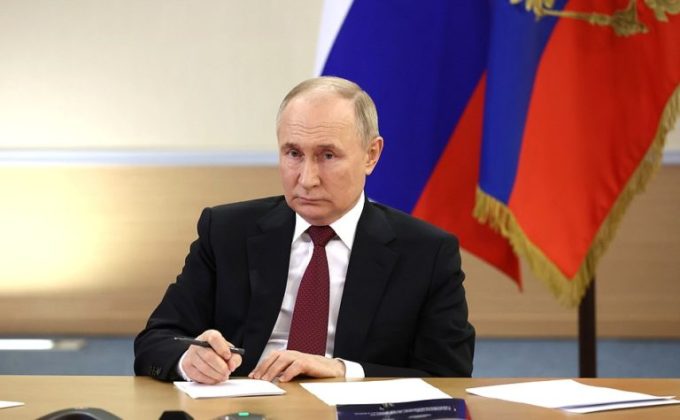
Russian President Vladimir Putin took a meeting on development of southern/Azov sea regions, Moscow, March 6, 2024
BY M. K. BHADRAKUMAR | INDIAN PUNCHLINE | MARCH 10, 2024
The Russian President Vladimir Putin’s meeting on Wednesday in Moscow with top officials of economic ministries and leaders of the southern and Azov sea regions — ‘Novorossiya’ historically — signifies a significant initiative in the Kremlin’s geo-strategy, with global ramifications, as the conflict in Ukraine meanders toward a new phase.
What lends poignancy to the occasion at once is that Putin is beating swords into ploughshares at a juncture when the US and its allies are sounding bugles. Indeed, one way of looking at Wednesday’s meeting is that it is a riposte to the fanciful conjecture 10 days earlier by French President Emmanuel Macron that European armies might march into Ukraine to push back Russians.
Putin signalled something profound — that war cries to defeat Russia is already time past. With the capture of the strategic town of Avdiivka and the rapid advance further west since then, cities like Pokrovsk, Kostyantynivka and Kramatorsk are now facing a fast-approaching front line, littered with signs of an approaching Russian army.
As the Russian forces gain more momentum in the Donetsk region, the question of where they will stop is becoming increasingly difficult to answer. There is much unfinished business still. A big concentration of Russian military facing Kharkov is ominous. Odessa is also in Russian sights.
The progress of Russian operations may seem ponderous. In the past month, Russian forces gained only around 100 square kilometres of Ukrainian territory (according to Belfer Centre’s latest Russia-Ukraine War Report Card) but then, in a war of attrition, the tipping point comes most unexpectedly, and before one catches their breath, it’s all over. The Wall Street Journal wrote that Ukraine has few remaining military strongholds in Donbass, which means that with each Russian advance, Ukraine must retreat to often underprepared positions.
A New York Times report on Thursday titled Mutual Frustrations Arise in U.S.-Ukraine Alliance ended on a sombre note citing Western officials and military experts that “a cascading collapse along the front is a real possibility this year.”
President Joe Biden was conspicuously taciturn in passing judgement on the war in his State of the Union Address at the US Congress on Thursday, except to warn the Kremlin rhetorically that “(we) will not walk away. We will not bow down.” The cryptic remark could mean anything, but he did acknowledge that “Overseas, Putin of Russia is on the march…”
Importantly, Biden put in cast iron his past commitment not to send troops to participate in the war in Ukraine. And his focus was on the Bipartisan National Security Bill in the pipeline that would resume large-scale military aid to Ukraine whose future is now even more uncertain what with Donald Trump’s unstoppable surge as the candidate of the Republican Party.
The fear that the US is walking away from the war is gut-wrenching for Europeans. The French President Emmanuel Macron’s remark last week on Monday on the dispatch of Western ground troops to Ukraine was reflective of belligerence and bravado that often accompanies frustration. Earlier this week, Macron urged Ukraine’s allies not to be “cowardly” in supporting Kiev to fight Russian forces; on Thursday, he went further at a meeting with party leaders to advocate a “no limits” approach to counter Russia.
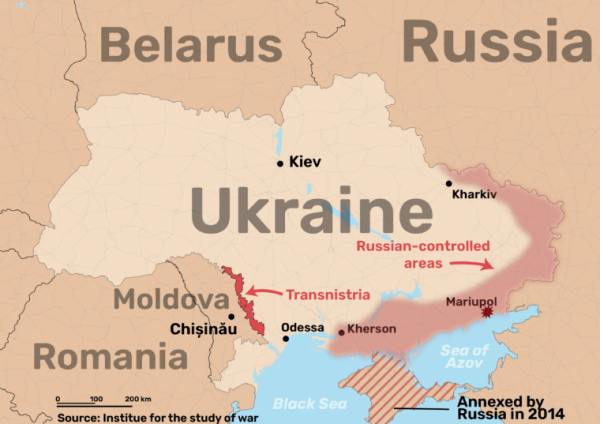
But there is a big picture, too. On Thursday, Macron met with Moldovan President Maia Sandu, pledging France’s “unwavering support” for her ex-Soviet country as tensions mount between Chisinau and pro-Russian separatists in the breakaway province of Transnistria. During the Macron-Sandu meeting, the two signed a bilateral defence deal, as well as an “economic roadmap,” although no details were provided.
The timing of France’s defence deal with Moldova, which follows a security pact with Ukraine last month, hints at geopolitical considerations to get a toehold in that vital region — where Dniester River rising on the north side of the Carpathian Mountains and flowing south and east for 1350 kms drains into the Black Sea near Odessa — to challenge the rise of Novorossiya, which is in the throes of renewal and regeneration.
For more than three decades, Transnistria has been considered a possible flash point for a conflict. The endgame in Ukraine has a domino effect on Moldavia, which, encouraged by the West, step by step, is strategically defying Russia to “erase” its influence, and move into the EU and NATO camp. Russia has been watching closely but patience is wearing thin.
Sandu is a semi-finished American product — an ethnic Romanian who got transformed as a graduate of John F. Kennedy School of Government at Harvard and had a stint in the World Bank and was pitchforked into the top rungs of Moldavian politics, eventually as the pro-European candidate in the Moldovian president election in 2016.
Sandu has the same genetic make-up as another colourful figure in the post-Soviet space whom the US groomed for “regime change” in Tbilisi — Mikheil Saakashvili who was the president of Georgia for two consecutive terms from 2004 to 2013 following a colour revolution stage-managed from Washington. The strategic calculus both in Georgia and Moldova basically aims at NATO’s expansion into the Black Sea which has been historically a Russian sphere of influence.
Therefore, Macron’s recent remarks on western combat deployment in Ukraine must be understood properly. He is by no means spiting the Biden Administration — nor is Germany differing from him — as he pushes the envelope and hopes to salvage victory out of the jaws of NATO’s defeat in Ukraine. The Biden administration will be quietly pleased with Macron’s tantrums against the Russian windmill in the regions of Novorossiya and the Black Sea.
The startling disclosure recently of the discussion between two German generals regarding the logistical complexity of lethally destroying the Crimean Bridge shows that Berlin is very much part of the Ukraine project despite the fault lines in the Franco-German axis.
France tasted blood in pushing a similar strategy in Armenia, which has virtually moved out of the Russian orbit and is jettisoning CSTO membership while seeking EU and NATO membership. Its focus will be to evict Russian military presence in Transnistria.
Reacting to the West’s thickening plot in Moldova, Transnistria has sought protection from Moscow. There is a big population of ethnic Russians in that region. The response from the Kremlin has been positive and swift. Shades of Donbass!
At Wednesday’s meeting in the Kremlin on the economic and infrastructure development in the new territories, Putin stressed the modernisation of the Azov-Black Sea road modernisation plans. He said, “we have big plans to develop roads in the Azov-Black Sea region.”
Of course, infrastructure development and strengthening of transportation networks will be an important template of Russia’s counter-strategy. Moscow is not waiting for a conclusive end to the conflict in Ukraine for the integration of the new territories into its economy from a long term perspective.
The crux of the matter, in geopolitical terms, is that Novorossiya is rising from the ashes like the phoenix and becoming, as Catherine the Great envisaged, Russia’s most important all-weather gateway to the world market connecting its vast untold mineral resources and huge agricultural potential. George Soros knows it; Wall Street knows it; Biden knows it. For France and Germany too, it is invaluable as a resource base if it is to ever regain its economic dynamism.
But in immediate terms, the challenge lies in the politico-military sphere — that “Russia cannot be allowed to win in Ukraine,” as Russia’s First Deputy Permanent Representative to the United Nations Dmitry Polyansky summed up. Russia has requested a Security Council meeting on Ukraine for March 22. Polyansky said Russia will expose the diabolical plots of France, Germany and the US.
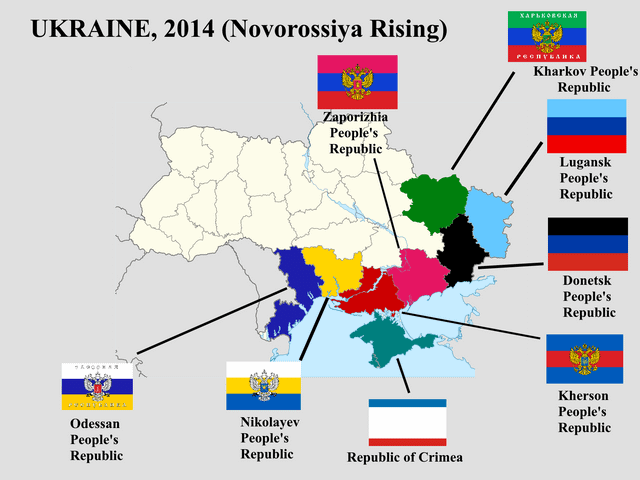
‘Novorossiya’: The alternate reality of Ukraine
Greenland women sue Denmark over involuntary contraception campaign
RT | March 5, 2024
A group of indigenous women in Greenland have sued Denmark over an involuntary contraception campaign aimed at limiting the birth rate in the Arctic territory in the 1960s and 1970s, Danish broadcaster DR reported on Monday.
The 143 Inuit women claim Danish health authorities violated their human rights when they fitted them with intrauterine contraceptive coil devices. The women are seeking total compensation of nearly 43 million kroner ($6.3 million).
“The lawsuit was filed this morning. My clients chose to do this because they received no reply to their request for compensation in October,” the lawyer for the plaintiffs, Mads Pramming, said.
“Their human rights were violated, they are the living proof.”
In October, 67 women, now in their 70s and 80s, demanded compensation of 300,000 kroner ($44,000) each.
Records based on data from the national archives disclosed by the Danish broadcaster in 2022 revealed that 4,500 indigenous women, reportedly half of the fertile women in Greenland, became part of the involuntary contraception campaign.
Coil implants were fitted between 1966 and 1970 to women and girls as young as 13, without their consent or even knowledge in some cases. The small device, made from plastic and copper and fitted in the uterus, makes it difficult for sperm to fertilize an egg.
Denmark carried out the campaign secretly with the alleged purpose of limiting the rate of birth in Greenland by preventing pregnancies, the outlet said. The population on the Arctic island was booming at the time because of high living standards and better health care.
In September 2022, the governments of Denmark and Greenland launched an investigation into the program with Danish Health Minister Sophie Lohde pledging to “get to the bottom” of this “deeply unfortunate case.”
The probe’s conclusions are expected to be made public next year. However, Naja Lyberth, who was 14 when she had a coil fitted, said the group could not wait until then and that the women would seek justice in court.
“The oldest of us are over 80 years old, and therefore we cannot wait any longer,” Lyberth, told Greenland broadcaster KNR. “As long as we live, we want to regain our self-respect and respect for our wombs.”
The case is not the first time Greenlandic people say they have suffered at the hands of Danish authorities.
In 2022, Denmark apologized and paid compensation to Inuits more than 70 years after a failed social experiment.
In 1951, 22 Inuit children were taken from their homeland to Denmark, enticed with the promise of a good education worthy of the country’s future elite. Copenhagen intended for the children to return home as role models for Greenland. Only six are still alive today, all in their 70s.
Greenland was a Danish colony until 1953, after which it acquired home rule.
Free Speech on Trial
By Jeffrey Tucker | Brownstone Institute | March 1, 2024
In a lifetime of observing policy controversies and court cases, we’ve never witnessed anything as crucial to the future of the idea of freedom itself compared with what will transpire on March 18, 2024. On that day, the Supreme Court will hear arguments in Murthy v. Missouri concerning whether the government can force or nudge private companies to censor users on behalf of regime priorities.
The evidence that they have been doing so is overwhelming. That’s why the 5th Circuit issued an emergency injunction to stop the practice on grounds that it is inconsistent with the First Amendment of the US Constitution. The censorship industrial complex is working right now and hourly to delete free speech in America. That injunction was stayed pending a review by the highest court.
The case itself hasn’t even gone to court. This decision is only about the injunction itself, which was issued based on the alarming results of discovery alone. Essentially, the lower court is screaming “This must stop.” The Supreme Court is trying to assess whether the violations of liberty are extreme enough to justify a pre-trial intervention now.
A positive ruling for the plaintiffs doesn’t solve every problem but at least it will mean that freedom still stands a chance in this country. A ruling for the defense, which is essentially the government itself, will give license to every federal agency – including those that operate in secret like the FBI and CIA – to threaten every social media and media company in this country to delete any and all content that runs contrary to the approved narrative.
There will be celebration in Washington if this happens. On the other hand, there will be tears if the court decides for the defense. It could be that the court will take an in-between position, refusing to let the injunction go ahead and promising some possible decision at a later date pending trial. That would be a disaster because it could mean three or more years of full censorship pending an appeal of whatever the outcome of the trial is.
Free speech is everything. If we don’t have that, we have nothing and freedom is toast. All other problems pale in comparison. There are plenty of them, from healthcare to immigration but if we don’t have free speech, we cannot get the truth out about any of them. The censorship industrial complex is wholly dedicated to making sure that we have no debates at all and that dissident voices are not even heard.
As it is, Google, Microsoft, and Facebook – and many more besides – already heavily restrict speech. They work in cooperation with government and those tasked by government to do elite bidding. We know this for a fact.
When Elon Musk took over Twitter, he discovered a vast censorship machine operating on behalf of the FBI and other agencies. Millions of posts were being taken down along with users. He has done his best to rip out the guts of this borg. Doing so entirely changed the character of the site. It became useful again.
Not even the scale of the problem is widely understood. Usually people say that free speech is necessary to protect minority opinions. In this case, the numbers don’t matter to the censors. You could have 90% of users trying to advance an idea and still have it censored. This is what the old Twitter did. It was daily and hourly attacking the company’s user base. This was their job, no matter how much it contradicts the whole point of social media.
Brownstone is predictably throttled by all these companies but it is not just about us. It is about everyone who disagrees with the Davos “Great Reset” agenda. This could pertain to EVs, gender transitions, lockdowns, immigration, or anything else. Even now, the Google Artificial Intelligence engine extols the glories of lockdowns, masking, and mass injections while completely ignoring contrary science. This is how they want things to be. Google’s search engine is no better. It might as well be a federal agency.
The Justices hearing the case will be in an awkward position. My guess is that none of them even know that this was going on to the extent it is. They will likely be shocked when they look at the evidence proving that there is a trillion-dollar industry in full operation that has massively distorted the public mind. Every federal agency is involved, deeply embedded in the operations of all media companies and digital technology, which in turn requires universal surveillance and persecution of contrary voices.
Until just a few years ago, this entire industry – which involves federal agencies, universities, nonprofits, shadow companies, bogus fact-checks, and every manner of spook-operated front companies – was not known to exist. Now that we know, we are shocked by the extent of it. It has invaded the whole of our lives to the point that we cannot tell the real news from that which is fed to us by intelligence agencies. Even worse, we’ve come to expect that most of what passes for approved opinion is flat-out false.
The Justices will discover this truth. They will likely be astonished. But they will also be taken aback by how integral to our lives it has become. As it turns out, the federal government for nearly a decade has placed a very high priority on curating the public mind, lying at every turn for its own benefit and that of its industrial partners.
Everyone in the old Soviet Union knew for sure that Pravda spoke for the Communist Party. But do people understand that their Google search results and Facebook timelines are no better? It’s not clear whether and to what extent people do understand this but it is our reality.
Will the Justices really be willing to pull the plug on the entire machinery? Doing that would be more disruptive of an established interest group than anything the court has done in many years or even ever. It would fundamentally change the way our technologies work. It would be devastating to federal agencies. Policing such a new system called free speech would be another matter entirely. It would mean that thousands of people would suddenly have nothing to do. That would be wonderful, but would it happen?
As I say, censorship is now an entire global industry. It involves the world’s most powerful foundations, governments, universities, and influencers. It seems like everyone wants a part in crushing what they called “disinformation,” “misinformation,” and “malinformation,” which is true information that they don’t want out. We are surrounded by this machinery of control and yet most people have no clue.
Every federal agency at this point has taken it upon themselves to cajole every information provider into rigging the system so that only one perspective gets out. This has a massive impact on public opinions.
As an example, four years ago, I wrote an article that accidentally made it through the censors and I watched as millions read my piece. Even now, I hear about it at cocktail parties coming from total strangers who don’t know that I’m the author. Nothing like that has happened since that magical day. Most of my writing goes into a dark hole, and this is despite writing daily for the 4th largest newspaper and having access to a huge public forum at Brownstone. People without such access do not stand a chance. Their posts on Facebook are disappeared the instant they post, while YouTube slams their content as contrary to community standards, with no other explanation.
Self-censorship has become the habitual practice of the intellectual class. Otherwise you only beat your head up against the wall and make yourself a target. Minute-by-minute in real time, public opinion is being shaped by this wicked industry, which dramatically distorts political outcomes.
As I say, this is surely the most important issue we face. A decision by the Supreme Court to let this go on – seeing no real issue here – will lead straight to our doom and the death of freedom itself.
There’s an additional problem that is very serious. These days, there is a massive race on to program censorship into the algorithms themselves so that no one is actually doing it, so that there cannot be any real defendants in a case against them. AI will soon be running everything so that Google and Facebook etc can simply say that their machine learning is doing the dirty work.
Perhaps one of the reasons AI has hit us with such a rush is precisely because of this case before the court. The deep state and its industrial partners are not going to give up easily. Everything depends on their victory over free speech, so far as they are concerned.
This is very worrisome, which is why one should hope for a sweeping statement by the Supreme Court that reaffirms the fundamental American commitment to have government completely out of the business of manipulating public opinion through curating what information you see and read and what you do not see and read.
It’s tragic that such a fundamental human right should so heavily depend on the majority decision of this one body. It’s not supposed to work this way. The First Amendment is supposed to be law but these days, the government has built an entire empire around the idea that it simply does not matter. The job of the Supreme Court is to remind our overlords that the people are not merely putty in the hands of deep state agents. We have fundamental rights that cannot be abridged.
There is a rally scheduled outside the court on March 18th, with many speakers making themselves available to the press. Note the sponsoring organizations: these are the freedom fighters in America today. You are welcome to join us.
It won’t sway the court, of course. And the crowds will surely be thinner than they otherwise would be given how much success the censorship industry already enjoys. Still, it is worth a shot.
Truly, we should all shudder to think of the future of American freedom in absence of a decisive statement by the court on behalf of the basic liberty the Framers intended be protected for everyone.
Jeffrey Tucker is Founder, Author, and President at Brownstone Institute.
The Stories You’re Not Hearing About the Russo-Ukrainian War…
By Ted Snider | The Libertarian Institute | March 4, 2024
Several, seemingly small events in the Russo-Ukrainian War went largely unnoticed in western media recently. But each of them, in their own way, may be significant.
The Fall of Avdiivka
On February 25, Ukrainian President Volodymyr Zelensky said that 31,000 Ukrainian soldiers had been killed since Russia invaded his country two years ago. It was the first time he had released a number of dead. He wouldn’t provide the number of wounded.
On February 4, he said, “About 26% of the national territory is still under occupation,” before adding that “the Russian army cannot make much progress. We have stopped them.”
Both statements are absurd. As The New York Times remarks on Zelensky’s battlefield accounting, “It differs sharply from estimates by U.S. officials, who, this past summer, put the losses much higher, saying that close to 70,000 Ukrainians had been killed and 100,000 to 120,000 had been wounded.”
The 31,000 number may be closer to the number of dead and wounded in the past several disastrous weeks than in the past two years. Russian Defense Minister Sergey Shoigu recently said that over 383,000 Ukrainian soldiers had been killed or wounded since the war began. Yuriy Lutsenko, the former prosecutor general and ex-head of the Ministry of Internal Affairs of Ukraine, says that 500,000 Ukrainian soldiers have been killed or seriously wounded. A number of 400,000-500,000 is consistent with internal Ukrainian communications and reports from the battlefield that 20,000 soldiers a month would be necessary to replace the dead and wounded. That number also accords with the 450,000-500,000 number Zelensky has requested in a new mobilization.
Being absurd was appropriate when Zelensky was a comedian; it may have made Ukrainians laugh. But being absurd when Zelensky is president is not appropriate; it may make more Ukrainians die.
The second statement, that Russia is incapable of further significant advances because the Ukrainian Armed Forces has stopped them is no less absurd. Less than two weeks after making the statement, on February 17, after exhausting every capability it had, the Ukrainian Armed Forces retreated in disarray from the heavily fortified town of Avdiivka as it fell to the Russians. That was a very significant advance. Taking Avdiivka is not just a symbolic victory, as reported in the West, but a strategic victory that could open the door to the Donbas for Russian forces, allowing Russia to solidify the borders of its newly annexed territories.
Following the retreat from Avdiivka, Ukrainian statements about stopping Russia retreated one more step, now claiming that Russia won’t be able to advance. General Kyrylo Budanov, Ukraine’s military-intelligence chief, acknowledged that the loss of Avdiivka was tough, but insisted that Russia has its problems too, and that “they don’t have the strength” to advance significantly and capture all of the Donbas.
American officials echoed Budanov’s assessment, saying that “Russian gains in eastern Ukraine will not necessarily lead to any collapse of Ukrainian lines and that Moscow is unlikely to be able to follow up with another major offensive.”
Kiev said that their armed forces had withdrawn from Avdiivka and established new defensive lines around Lastochkyne and other nearby villages. But on February 26, Lastochkyne fell, and Ukrainian troops retreated to villages further west.
Western officials now say that Russia is “attacking in strength along four parallel axes in the northeast” and that they are “driving forward around Lyman and Kupiansk, in the Kharkiv region.” Newsweek says there are reports that Russian troops have now “advanced west of the village of Lastochkyne.” And military spokesperson Dmytro Lykhoviy now says that Ukrainian troops have withdrawn from Stepove and Severne, two villages near Avdiivka and north of Lastochkyne.
What Killed Alexei Navalny?
It is still not known what killed Alexei Navalny in a Russian prison on February 16. U.S. President Joe Biden says that “Putin is responsible for Navalny’s death.” Zelensky agrees, saying Navalny “was obviously killed by Putin.”
But Ukraine’s military-intelligence chief disagrees. On February 25, General Kyrylo Budanov told reporters that he was sorry to disappoint them, “but what we know is that he really died from a blood clot. And this is more or less confirmed. This was not taken from the Internet, but, unfortunately, a natural [death].” Russia has claimed that a blood clot was the cause of death.
An unexpected claim made by aides to Navalny on February 26 created another wrinkle. Navalny, they say, was about to be released in a prisoner swap. “Navalny was supposed to be free in the coming days,” Maria Pevchikh, the chairwoman of Navalny’s Anti-Corruption Foundation, said. “I received confirmation that negotiations were at the final stage on the evening of Feb. 15.”
Navalny’s aides advance this claim as new evidence that Putin killed Navalny. Pevchikh says that Putin ordered Navalny’s murder to take “the possibility of his release off the table.”
But it seems inconceivable that Navalny’s release could be negotiated by Moscow without Putin’s consent. He wouldn’t have to kill him; he would just have to take his release off the table. Though there is still insufficient evidence to pass judgement on the cause of his death, if it is true that Navalny’s freedom was on the table, that seems to lean towards that Putin did not feel threatened by him or feel the need to eliminate him.
The Firing of Zaluzhny
On February 8, the headlines were dominated by Zelensky’s firing of the Commander in Chief of the Ukrainian Armed Forces, Valerii Zaluzhny. But overshadowed by those headlines was that Zaluzhny was not the only general to go. Zelensky fired his entire general staff and replaced them with a new Chief of General Staff for Ukraine’s Armed Forces and new deputy chiefs.
Though the change over could just reflect a new Commander in Chief choosing his own staff, it might also point to Zelensky ensuring a military command that is loyal to him at a time when the military is angry over the firing of Zaluzhny, and, as The Guardian recently put it, Zelensky “is no longer seen as untouchable, and political competition is returning to Ukraine,” and “Ukrainian society is exhausted by the war.”
The Rome-Kiev Pact of Steel Under CIA Shadow
By Manlio Dinucci | Global Research | March 3, 2024
The “Agreement on security cooperation” between Italy and Ukraine, which Italian Prime Minister Meloni and President Zelensky signed in Kijev, is not a formal declaration, but a real military pact that makes Italy a belligerent country in the war against Russia.
The pact commits Italy to supply more armaments to Kijv and to train its troops according to NATO operational procedures. Not only this. The pact states that:
“In the event of a future Russian armed attack against Ukraine, Italy, and Ukraine will consult within 24 hours to determine the measures necessary to counter the aggression and Italy will provide Ukraine with rapid defence support.”
Since French President Macron announced that European NATO countries might send their troops to Ukraine against Russia, there is a real possibility that Italy will do so too, taking us directly into war against Russia. Moscow’s voice went unheeded, warning that in this case there would be a direct clash between NATO forces and Russian forces, both equipped with nuclear weapons.
In this situation, “the war of spies” takes place. As a major New York Times investigation shows, the CIA has built its vast network in Ukraine and other European countries. It trains Ukrainian agents on how to assume false identities and “find out Russian spies in other countries!” The program was called Operation Goldfish. Operation Goldfish operatives have been deployed to 12 new operational bases along the Russian border, linked to two new secret electronic espionage bases.
What Zelensky declared falls into the same context: “Meloni is with us but there are too many pro-Putin in Italy.” Zelensky then announced: “We are preparing a list of Russian propagandists – it is not regarding only Italy. It’s a long list and we want to present it to the European Commission, to the European Parliament, to the EU leaders.” Soon, therefore, Zelensky will hand over to Meloni the proscription list of “pro-Putins”, drawn up by the CIA.
Italy to withdraw its air defense system from fellow NATO state
RT | March 3, 2024
Italy plans to withdraw its SAMP/T surface-based air defense system from Slovakia, according to media reports on Saturday, citing Prime Minister Robert Fico.
The system in question was temporarily deployed to Slovakia last year to replace the US Patriot anti-aircraft system, which the country transferred to Ukraine.
“I received a notice from the Italian government that the Italian air defense system, which they lent us for a year, will be withdrawn from Slovakia, because they need it elsewhere,” Fico was cited as saying, without elaborating on where exactly the system will be transferred next. The prime minister expressed concerns regarding his country’s security once the system is removed, as Slovakia currently has no alternative to protect its air space.
“First, the previous government donated a functional massive Russian S-300 air defense system to Ukraine. Then we had American Patriots here for a while, they were also removed, and now the Italian [system] will also be taken away.”
The wisdom of Slovakia sending military aid to Ukraine at the expense of its own security was also recently questioned by the country’s newly-appointed defense minister, Robert Kalinak. In an interview with the newspaper Standard in January, the official accused the previous government of surrendering key military hardware to Ukraine without making plans to secure replacements, noting that it would likely take years to fix the damage done to national security.
Upon being elected in September last year, Fico, an outspoken critic of the Western approach to the Ukraine conflict, halted Slovakia’s military aid to Kiev. In a video statement on social media last month, he also pledged not to send Slovak troops to Ukraine, even if it costs him his premiership.
Opposition to Vaccine Mandates and Passports Driven by Perceived Lack of Vaccine Safety
Population-Based Survey Shows Hesitancy is for Good Reason
By Peter A. McCullough, MD, MPH | Courageous Discourse | February 27, 2024
The American Medical Association says this about vaccine hesitancy:
“While the AMA is a strong advocate for the effectiveness and safety of vaccines, we recognize that some members of the public may have historical, cultural or religious reasons to distrust the vaccination process.”
When it comes to the COVID-19 vaccine, new research led by Dr. Mark Skidmore at Michigan State University indicates that vaccine safety and severe side effects occurring in close contacts (friends or family members) are the main drivers for opposition to vaccine mandates and passports.
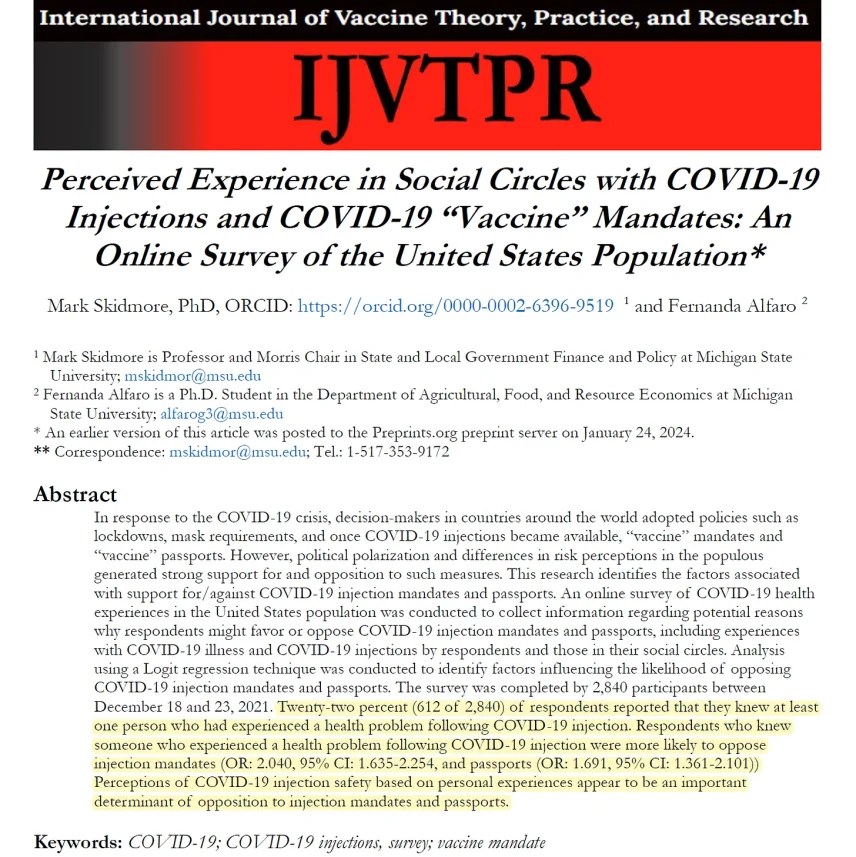
Perceived Experience in Social Circles with COVID-19 Injections and COVID-19 “Vaccine” Mandates: An Online Survey of the United States Population. (2024).
“The survey was completed by 2,840 participants between December 18 and 23, 2021. Twenty-two percent (612 of 2,840) of respondents reported that they knew at least one person who had experienced a health problem following COVID-19 injection. Respondents who knew someone who experienced a health problem following COVID-19 injection were more likely to oppose injection mandates (OR: 2.040, 95% CI: 1.635-2.254, and passports (OR: 1.691, 95% CI: 1.361-2.101)) Perceptions of COVID-19 injection safety based on personal experiences appear to be an important determinant of opposition to injection mandates and passports.”
Considering the survey was done in 2021, one would infer that resistance is even greater in 2024 as more injuries, disabilities, and deaths have been reported as a result of the novel genetic products. When it comes to COVID-19 vaccination, hesitancy is a good thing demonstrating the population is concerned about consumer product safety of the mRNA and adenoviral DNA technology. The AMA’s views on the determinants of vaccine hesitancy do not apply and attempts to overcome vaccine hesitancy are likely to be harmful.
Perceived Experience in Social Circles with COVID-19 Injections and COVID-19 “Vaccine” Mandates: An Online Survey of the United States Population. (2024). International Journal of Vaccine Theory, Practice, and Research , 3(1), 1055-1084. https://doi.org/10.56098/h1mv5a64
Featured Video

“Historic Russia”: The Land Putin Will Not Give Back
or go to
Aletho News Archives – Video-Images
Book Review
Why the War on Conspiracy Theories Is Bad Public Policy
By Kevin Barrett • Unz Review • February 1, 2019
 A Review of Conspiracy Theories and Other Dangerous Ideas by Cass Sunstein (based on an earlier paper co-authored with Adrian Vermeule); In Defense of Troublemakers: The Power of Dissent in Life and Business by Charlan Nemeth; and Conspiracy Theories and the People Who Believe Them, edited by Joseph E. Uscinski
On January 25 2018 YouTube unleashed the latest salvo in the war on conspiracy theories, saying “we’ll begin reducing recommendations of borderline content and content that could misinform users in harmful ways—such as videos promoting a phony miracle cure for a serious illness, claiming the earth is flat, or making blatantly false claims about historic events like 9/11.”
At first glance that sounds reasonable. Nobody wants YouTube or anyone else to recommend bad information. And almost everyone agrees that phony miracle cures, flat earthism, and blatantly false claims about 9/11 and other historical events are undesirable.
But if we stop and seriously consider those words, we notice a couple of problems. First, the word “recommend” is not just misleading but mendacious. YouTube obviously doesn’t really recommend anything. When it says it does, it is lying. … continue
Blog Roll
 Aletho News
- BRITAIN’S WARNING: PREPARE FOR WAR
- “Historic Russia”: The Land Putin Will Not Give Back
- How the Cambridge Analytica scandal still haunts Mark Zuckerberg
- The Ongoing Cancellation Campaign Against a Dissenting Academic in Norway
- Yemen and ‘the Houthis’: Challenging Sami Hamdi’s Narrative
- No, Christians did not invent Zionism
- AIPAC-led lobbying network opens branches in Cypriot, Greek parliaments
- Araghchi blasts ‘parasitic’ alliance as US taxpayers pay for Israel’s war on Iran
- Easy fix for Europe’s chaos? Stop fueling war against Russia
- Putin’s key remarks on peace talks and Europe’s ‘schizophrenia’
- If Americans Knew
- An error has occurred; the feed is probably down. Try again later.
- No Tricks Zone
- Two New Studies Find Thwaites Glacier Melt Cannot Be Driven By Human Activity Or A Warming Ocean
- E-Cars Reduce CO2 Emissions By Only 41% Compared To Internal Combustion Engine Vehicles
- Predictions Made By Renowned Climate Professor Over Past Decades Have Been Proven To Be Poor
- New Study Suggests Large Regions Of The Pacific Ocean Have Been Cooling For The Last 80 Years
- Germany’s Green Energy Debacle: High Energy Costs Force Kahla Porzellan to Close After 182 Years!
- New Study: 50 Years Of The Most Aggressive ‘Net Zero’ Policies Can Only Affect The Global Climate By 0.03°C
- US September “Heat” Was No Record…Many Records Set Decades Ago
- Latest European Green Energy Debacle; Portugal’s Largest Flagship Solar Park Insolvent!
- Green Energy Debacle: German Expert Professor Fritz Vahrenholt Warns Of Severe Economic And Social Consequences
- Two More Paleo Reconstructions Affirm Meters-Higher Sea Levels Across Ireland, Brazil 7000-6000 Years Ago

