Sweden says undersea cable to Estonia ‘damaged’
RT | October 17, 2023
An undersea telecommunications cable connecting Sweden and Estonia in the Baltic Sea has been ‘damaged,’ the Scandinavian country’s Civil Defense Minister said at a news conference on Tuesday, in what is the second such occurrence in the region in the past month.
“We are currently unable to assess what has caused this damage,” government minister Carl-Oskar Bohlin told reporters in Gothenburg, adding that it is “not a total cable break but it is a partial damage to the cable” and that it remains operational. The Swedish minister said that the damage sustained to the cable was sustained outside of the country’s territorial waters and its exclusive economic zone.
The damage, Bohlin explained, appears to have occurred at around the same time as when the Balticconnector gas pipeline and a telecommunications cable between Estonia and Finland were damaged, on October 8. NATO, the US-led military bloc that Helsinki joined earlier this year, has vowed “a united and determined response” if an investigation determines that saboteurs were responsible.
Finland has said that it cannot rule out a “state actor” being behind the October 8 incident, and that it is reviewing vessel traffic in the area at the time of the suspected attack.
The Prime Minister of Sweden Ulf Kristersson warned last week of potential vulnerabilities to the “spaghetti of cables, wires, infrastructure on the seabed” that connects countries, transfers data and supplies energy in the region. “It is absolutely fundamental for data traffic, so the vulnerabilities today are much, much greater,” he said.
Adequately policing waters in the area is a “very intense” challenge, the head of Sweden’s navy, Rear Admiral Ewa Ann-Sofi Skoog Haslum said on Tuesday. “The challenge for us is to monitor this volume of water,” she said. “Everything that happens under the surface is deniable.”
Last September, the Nord Stream pipelines supplying oil and natural gas from Russia to Germany were ruptured, in incidents widely believed to have been sabotage. A culprit has yet to be identified.
Seymour Hersh, the Pulitzer-winning American journalist, published a report earlier this year in which he claimed, citing intelligence sources, that the United States executed a covert CIA operation to destroy the pipelines in collaboration with the Norwegian government. Washington has strongly denied the claims.
A competing theory, reported by Western outlets, has suggested that a team of Ukrainian commandos used a rented yacht to transport explosives to the blast sites, but that the CIA told the Ukrainians to abort the plan.
Putin’s Valdai Speech, What You Need to Know
By Ted Snider | The Libertarian Institute | October 12, 2023
On October 5, Russian President Vladimir Putin addressed the plenary session of the Valdai International Discussion Club near Sochi, Russia. The session was attended by scholars and diplomats from forty-two countries. Putin spoke for half an hour and then answered questions for about three hours. Several interesting things were said.
In western discourse it is always said that Russia started an unprovoked war in Ukraine. There has been much discussion—though not in the mainstream media nor in statements issued by western governments—about whether the war was unprovoked. But there has been little discussion about whether Russia started it.
Putin claimed that Russia’s “special military operation” did not start the war in Ukraine but, rather, was designed to stop it. “I have said many times that it was not us who started the so-called ‘war in Ukraine,’” Putin said. “On the contrary, we are trying to end it.”
The war started, according to Putin, when the United States “orchestrated a coup in Kiev in 2014.” Putin said that the U.S. “provoked the Ukraine crisis by supporting the coup in Ukraine in 2014. They could not fail to understand that this was a red line, we have said this a thousand times. They never listened.”
After the coup, the new government in Kiev “intimidate[d]” the ethnic Russian populations of Crimea and the Donbas, prohibited them from speaking “their native language,” and threatened them “with ethnic cleansing.” It was Kiev, and not Russia, “who tried to force Donbass to obey by shelling and bombing.” The new government in Kiev bombed the region “for nine years, shooting and using tanks. That was a war, a real war unleashed against Donbass.”
The war started, not a year and a half ago, according to Putin’s chronology. Instead, “This war, the one that the regime sitting in Kiev started with the vigorous and direct support from the West, has been going on for more than nine years, and Russia’s special military operation is aimed at stopping it.”
With the end of the Cold War, there was a window of opportunity to learn from the mistakes of the previous destructive era. There was an opportunity to move from “military and ideological” blocs to collective solutions. First Mikhail Gorbachev’s Soviet Union, and then Russia, sought a new international order that transcended blocs. Putin even recalled “a moment when I simply suggested: perhaps we should also join NATO?”
But Putin says that Russia’s “interest in constructive interaction was misunderstood, was seen as obedience, as an agreement that the new world order would be created by those who declared themselves the winners in the Cold War. It was seen as an admission that Russia was ready to follow in others’ wake and not to be guided by our own national interests but by somebody else’s interests.”
American “arrogance” attempted to establish a global “hegemony” over a world “too complicated and diverse to be subjected to one system.” This arrogance led to two things. The first was “endless expansion” by the political West. “NATO expansion has been pursued for decades.”
Putin reminded his audience that Russia was “promised verbally” about NATO “non-expansion to the east.” He then complained, “Yes, we were promised everything verbally, and our American partners do not deny this, and then they ask: where is this documented? There is no document. And that was it, goodbye. Did we promise? It looks like we did, but it was worth nothing.”
Eventually, this broken promise led to NATO expansion creeping up to Ukraine and right up against Russia’s borders. “Among the ways the crisis in Ukraine was provoked,” Putin said, “was the irrepressible desire of Western countries, especially the United States, to expand NATO to the borders of the Russian Federation.”
“After all,” Putin pointed out, NATO “is not only a political bloc, it is a military and political bloc, and the approach of its infrastructure is fraught with a grave threat to us.” He then added, “NATO’s expansion right up to our borders is threatening our security. This is a massive challenge to the Russian Federation’s security.”
To attain its hegemonic goal, it was necessary for the United States to “to replace international law with a “rules-based order.” But unlike the international law of the charter international system that is based on the United Nations, “It is not clear what rules these are and who invented them.” In the service of Americna hegemony, the U.S. “arbitrarily set[s] these rules.”
In a recent essay, professor of international law John Dugard has said that it is neither clear what the rules of the rules-based order are nor “the method for their creation,” and has offered as a possible explanation of the rules based order that it is “international law as interpreted by the United States to accord with its national interests,” meaning whatever the U.S. needs it to mean in any given situation. He suggests that the United States tries “to impose the concept of a rules-based world order on the international community. They use this banner to promote, without any hesitation, a unipolar model of the world order where there are ‘exceptional’ countries and everyone else who must obey the ‘club of the chosen.’”
In this world order, the United States not only tells other nations how they “should behave overall” in a “colonial mentality,” but there exists “an international system where arbitrariness reigns, where all decision-making is up to those who think they are exceptional, sinless and right [and] any country can be attacked simply because it is disliked by a hegemon.”
Putin says that Russia sees a future multipolar world order in which “no one can unilaterally force or compel others to live or behave as a hegemon pleases even when it contradicts the sovereignty, genuine interests, traditions, or customs of peoples and countries.” Russia sees “civilization [as] a multifaceted concept subject to various interpretations.” The world has evolved from the “colonial interpretation whereby there was a ‘civilized world’ serving as a model for the rest, and everyone was supposed to conform to those standards. Those who disagreed were to be coerced into this ‘civilization’ by the truncheon of the ‘enlightened’ master. These times, as I said, are now in the past, and our understanding of civilisation is quite different.”
Putin argued, as he has consistently, for the principle of the indivisibility of security, the idea that security cannot be divided so that the policies that increase the security of one country decrease the security of another. Indivisibility of security assures that the security of one state should not be bought at the expense of the security of another.
The American insistence on the right of states to unrestrained free will in their choice of security alignments and the accompanying NATO open door policy to Ukraine ignores the indivisibility of security. Putin said, “The main thing is to free international relations from the bloc approach and the legacy of the colonial era and the Cold War. We have been saying for decades that security is indivisible, and that it is impossible to ensure the security of some at the expense of the security of others.”
Putin said he thinks that suggestions of “a new security system in Europe, which would include Russia, and the United States, and Canada; but not NATO, but together with everyone else: for Eastern and Central Europe… would solve many of today’s problems.”
It is often said in the West that Putin seeks to reestablish a Russian empire and reacquire vast territories, starting with Ukraine. Putin, though, says in contradiction to those claims, “The Ukraine crisis is not a territorial conflict, and I want to make that clear… [W]e have no interest in conquering additional territory.” He insisted, “This is not a territorial conflict and not an attempt to establish regional geopolitical balance. The issue is much broader and more fundamental and is about the principles underlying the new international order.”
Those principles are a balanced multipolar world, indivisibility of security, an end to blocs and to NATO encroachment and protection of ethnic Russians in the Donbass and Crimea.
During the question and answer period, political scientist Sergei Karaganov suggested that the current Russian nuclear doctrine is no longer taken seriously by the West as a deterrent. He asked whether it was not time to modify the nuclear doctrine and lower the threshold.
Often portrayed in the West as a nuclear weapons sabre rattler, Putin tamped down the question, answering, “I do not see the need to change our conceptual approaches. The potential adversary knows everything and is aware of what we are capable of.”
Putin explained Russia’s existing nuclear doctrine. He said there are two situations that could trigger a “possible use of nuclear weapons by Russia.” The first is that “the use of nuclear weapons against us… would entail a so-called retaliatory strike.” The second situation is “an existential threat to the Russian state—even if conventional weapons are used against Russia, but the very existence of Russia as a state is threatened.”
Putin insisted that Russia does not need to change its stance. In the case of the first scenario, “this response will be absolutely unacceptable for any potential aggressor, because seconds after we detect the launch of missiles… the counter strike in response will involve hundreds—hundreds of our missiles in the air, so that no enemy will have a chance to survive.” As for the second, important as an insight into how Putin evaluates the situation in Ukraine, “There is no situation imaginable today where something would threaten Russian statehood and the existence of the Russian state.”
However, Putin said that nuclear testing is “a whole different matter.” He says that, after signing the Comprehensive Test Ban Treaty, the United States never ratified it. Russia, on the other hand, both signed it and ratified it. He told his audience that the development of new strategic weapons—including the nuclear-powered Burevestnik cruise missile with “basically unlimited range” and the super heavy Sarmat missile—is “nearing completion.” He then said that Russia can “act just as the United States does” and “offer a tit-for-tat response,” suggesting that Russia could repeal the Comprehensive Test Ban Treaty and begin testing new weapons.
In response to the question of whether Russia objected to Ukraine joining the European Union, Putin responded that Russia had “never objected or expressed a negative attitude to Ukraine’s plans to join the European economic community—never.” He said that Russia opposes Ukraine joining NATO because NATO is a “military bloc” and a “tool of U.S. foreign policy.” But “the EU is not a military bloc,” and, as for “economic cooperation, or economic unions, we do not see any military threat.”
Russia fully supports establishment of Palestinian state: Putin
Press TV – October 11, 2023
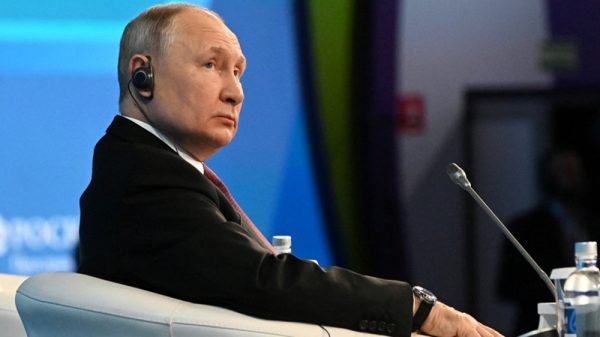
Russian President Vladimir Putin says Moscow has always fully supported the establishment of a Palestinian state, as the Israeli regime is ceaselessly pounding the besieged Gaza Strip with barrages of missile attacks.
Speaking at the plenary session of the Russian Energy Week on Wednesday, Putin stressed that his country has always supported the implementation of the United Nations Security Council’s decision on the establishment of an independent Palestinian state.
“We have always supported the implementation of the decisions of the UN Security Council, I mean, first of all, the creation of an independent Palestinian state,” the Russian leader emphasized.
Putin’s remarks came as Israel has been launching deadly strikes on the densely-populated Gaza Strip since Saturday after the Palestinian Hamas resistance group waged a surprise attack, dubbed Operation Al-Aqsa Storm, against the usurping entity.
Hamas says that its operation came in response to Israel’s violations at al-Aqsa Mosque in occupied East al-Quds and growing settler violence.
Elsewhere in his remarks, Putin called the eruption of violence between Israel and the Palestinians a vivid example of the failure of US policy in the Middle East.
He stressed that Washington’s policy in the region has taken no account of the needs of the Palestinians as the White House tried to focus on financial assistance, rather than finding solutions to existing fundamental political challenges.
“It is unclear whether it will be possible to somehow calm the situation in the near future, but we must strive for this because the expansion of the conflict zone can lead to dire consequences,” Putin said.
The Russian president also denounced as a mistake the Washington’s move of sending a carrier strike group, which includes the USS Gerald R. Ford, closer to Israel.
“I don’t understand why the US is dragging aircraft carrier groups into the Mediterranean Sea. I don’t really understand the point. Are they going to bomb Lebanon or what? Or have they decided to try to scare someone? There are people there who are no longer afraid of anything. This is not the way to solve the problem. Compromise solutions need to be looked for. Of course, such actions are inflaming the situation,” Putin said.
More than a thousand people have been killed and thousands more have been injured in nearly five days of Israeli airstrikes on Gaza, a besieged territory on the Mediterranean which is home to some 2.3 million people despite its relatively small land area.
The Israel-Palestine war is Washington’s fault
By Robert Inlakesh | RT | October 10, 2023
The administration of US President Joe Biden and decades of failed American policy decisions in West Asia set the stage for the eruption of the horrifying violence we see today in Palestine and Israel. Through sidelining the Palestinian cause for statehood and instead seeking a symbolic normalization deal between Israel and Saudi Arabia, Washington overlooked its own regional strategy.
In the early hours of Saturday morning, the armed wing of Hamas, the Qassam Brigades, launched an unprecedented military operation against Israel. Scenes instantly flooded social media of Palestinian fighters gunning down Israelis in cities such as Ashkelon, blowing up military vehicles, and killing and capturing hundreds of Israeli soldiers. It was a surprise offensive the likes of which hadn’t been seen in over 50 years. It also represented a colossal failure for the Israeli government, military, and intelligence and security services, causing Prime Minister Benjamin Netanyahu to declare war on the Gaza Strip.
In the US, condemnation from politicians of the attack was unanimous and bipartisan, as elected officials expressed their outrage at the loss of Israeli life. However, in all of these statements, not a single one recognized their own government’s role in the attack. Washington, along with most of the collective West, has been imposing sanctions on the Palestinian Authority (PA) for nearly 17 years. The peace process between Israelis and Palestinians – aimed at reaching a ‘two-state solution’ whereby Israel and Palestine would exist side by side as independent, mutually-recognized states – has been effectively dead for around two decades, with the last failed attempt to pressure the Israeli government to negotiate coming under former US President Barack Obama.
In 2006, the legislative elections held in the Occupied Palestinian Territories (OPT) resulted in a landslide victory for Hamas. Failed US presidential candidate Hillary Clinton was recorded as having stated at the time that “we [the US] should have made sure that we did something to determine who was going to win.” While the US did not interfere, the American government decided it would sanction Gaza and cut off the flow of aid to the PA after the elections did not favor the Fatah Party it was financing.
Former US President Jimmy Carter, who brokered the 1979 Camp David Accords, an agreement that normalized relations between Egypt and Israel, said the following about the approach of the US government at the time: “If you sponsor an election or promote democracy and freedom around the world, then when people make their own decision about their leaders, I think that all the governments should recognize that administration and let them form their government.”
Not only did Washington actively oppose the democratic elections in the OPT, it went a step further and provided arms to Palestinians from the Fatah Party, plotting a coup that would use them to overthrow the Hamas government that was formed inside Gaza. The plan failed dramatically and Hamas kicked Fatah out of Gaza after a bloody civil war, completely taking over the territory, to which the Israeli government responded by imposing an all-inclusive military blockade.
Unlike other global powers such as Russia and China, the US never entertained the idea of giving Hamas the chance to govern as Carter had suggested. Instead, every American government has refused to engage with Hamas, deeming it a terrorist organization, but then ignoring the Palestinian political party completely and not formulating any solution to the situation that has been ongoing inside Gaza. In fact, the US government considers every single major Palestinian political party or movement as a terrorist organization, other than the mainstream branch of Fatah that partially controls the West Bank.
The Declaration of Principles, the first agreement in the Oslo Accords, was signed on the White House lawn over 30 years ago. The accords were supposed to solve the conflict in a span of five years, but failed due to America’s inability to function as a truly neutral peace broker. During the administration of US President Donald Trump, Washington abandoned the two-state solution altogether, through the pursuance of normalization deals between Arab nations and Israel. The issue of Palestinian statehood, which the UN agrees should be solved through a two-state solution, was sidelined as a non-issue and the one bargaining chip possessed by the Palestinians, Arab-Israeli normalization, began to be taken off of the table.
How did the Palestinian political parties respond to normalization in 2018? They overwhelmingly chose non-violent struggle, including in Gaza, where Hamas endorsed the ‘Great March of Return’, a mass protest movement which lasted around a year. Most of the protesters were peaceful, but it was the relatively small groups of Palestinians committing sabotage and anti-Israeli aggression at the border fence that made the news. In response, Israeli forces killed hundreds of Palestinians and injured almost 10,000. On the Israeli side, there was not a single dead soldier or civilian, while Israeli snipers targeted women, children, journalists, disabled people, and medical workers, according to a UN human rights report on the demonstrations. How did the US react to hundreds of thousands of unarmed Palestinian protesters marching on the separation fence between Gaza and Israel? It ignored them and continued to pursue Arab-Israeli normalization.
Under the Biden administration, the two-state solution was also sidelined and the plight of Palestinians was ignored as insignificant. Instead of seeking a solution to the violence which has been steadily escalating to levels not seen in 20 years, during the course of the past two years – especially in the West Bank – Biden has chosen to look the other way and has pursued Saudi-Israeli normalization instead. A deal between Saudi Arabia and Israel would also have the potential to collapse the Iranian-Saudi rapprochement, brokered earlier this year by China, in addition to potentially dragging Washington into an open confrontation with Yemen. Instead of seeking to fulfill the foreign policy pledges made at the start of his term in office, Biden has abandoned the idea of reviving the Iran nuclear deal and of ending the war in Yemen. He also decided to try and inflict a death blow on the Palestinian cause for statehood.
What Hamas just did from Gaza would never have happened if the US had pursued a somewhat rational approach to the region. It could even have been prevented if the US had presented a political plan to de-escalate rising tensions in the occupied territories. Instead, the American government decided to overlook the armed groups in Gaza while attempting to completely dismantle their cause. And all of this for what? A fancy photo op that Biden can use to steer the Democratic Party to victory in the presidential election in 2024, by claiming that he brought peace to the Middle East. Due to the current conflict, normalization doesn’t seem to be on the table anytime soon anyway, which would mean Hamas’ offensive has not only dealt a blow to Israel, but also to the US.
Now that Israel is at war with Gaza, what is the US doing? It is condemning one side, while arming Israel and greenlighting any action it takes. Initially, Washington even refused to urge a ceasefire, in contrast to the push for one from Moscow and Beijing. The White House refuses to acknowledge its role in creating the current violence and carries on with the exact same rhetoric and policy decisions that led to the horrifying war we see today.
Robert Inlakesh is a political analyst, journalist and documentary filmmaker currently based in London, UK. He has reported from and lived in the Palestinian territories and currently works with Quds News. Director of ‘Steal of the Century: Trump’s Palestine-Israel Catastrophe’.
Nairobi’s High Court Puts Hold on US-Backed Kenyan Troop Deployment to Haiti
By Kyle Anzalone | The Libertarian Institute | October 9, 2023
Kenya’s High Court put a temporary suspension on a planned troop deployment to Haiti. The Joe Biden administration made a deal with Nairobi to deploy its soldiers to Haiti on a mission approved by the UN Security Council. The US agreed to finance the mission and train the Kenyan soldiers.
On Friday, former presidential candidate, Ekuru Aukot, filed a petition with the high court arguing that sending troops to Haiti violated the Kenyan constitution. The high court granted a temporary block on sending the soldiers. President William Ruto’s administration will have three days to appeal.
The Biden White House has sought a country to lead a mission in Haiti for over a year. After Canada rebuffed the US request, Washington was able to enlist Nairobi into sending 1,000 soldiers to Haiti. The White House inked a new defense agreement with Kenya and agreed to provide $100 million to finance the deployment.
Additionally, US forces will train the Kenyan soldiers. The UN Security Council approved the deployment, but the soldiers will not operate as official UN Peacekeepers. Peacekeepers have a dark legacy in Haiti. During the UN mission to the country from 2004-17 caused a cholera outbreak that killed nearly 10,000 people and engaged in rampant rape of women.
The deal between Washington, Nairobi, and Port-au-Prince has met protests in all three countries. Last week, Kenya’s opposition leader, Raila Odinga, also criticized the plan. In Haiti, protests have gathered against Prime Minister Ariel Henry for supporting the deployment of foreign soldiers to Haiti. With Washington’s backing, Henry rose to power in Port-au-Prince after President Jovenal Moise was assassinated.
Russia warns of foreign involvement in Palestinian conflict as US moves warships
Press TV – October 9, 2023
Russia has warned against any involvement of a third party in the ongoing tension in Palestine after the United States relocated its warships to waters close to the Israeli-occupied territories.
Kremlin spokesman Dmitry Peskov said on Monday that it would urge all parties involved in the ongoing tension to try to reduce any escalation rather than seek a military solution.
“The risk of third forces becoming involved in this conflict is high … It is very important to find ways as soon as possible to move towards some kind of negotiation process in order to reduce this escalation and move away from a military solution,” Peskov was quoted as saying TASS news agency.
The comments came a day after US Defense Secretary Lloyd Austin said it will send multiple military ships and aircraft closer to waters controlled by Israel as a show of support for the regime just after it was caught off guard by a massive attack by the Palestinian resistance group Hamas.
In a statement, Hamas has condemned the US decision as “aggression” against Palestinians, saying, “The announcement of the US that it will provide an aircraft carrier to support the occupation [Israel] is actual participation in the aggression against our people.”
Nearly 800 Israelis have been killed and many more have been injured in rocket attacks and ground operations launched by Hamas from the Gaza Strip, where the group in based.
 Israel has launched rounds of airstrikes on Gaza since Saturday, killing more than 560 people and injuring thousands more.
Russian Foreign Minister Sergei Lavrov said on Monday that the way out of the Palestinian conflict is for the Israeli regime and its backers to recognize Palestine’s right to create an independent state.
Speaking in a press conference in Moscow alongside the visiting head of the Arab League Ahmed Aboul Gheit on Monday, Lavrov said that Russia doubts the West’s policy on the Israeli regime would work at all.
“They say that (fighting) should be stopped immediately, that Israel should destroy the terrorists,” Lavrov said, referring to the way Israel and its backers describe Palestinian fighters.
“But this was done before… and never after the situation calmed down did they come to the fact that the main reason (for the conflict) needs to be eliminated … The Palestinian problem should not be delayed further,” he said.
US to continue using Russian spaceships – NASA official
RT | October 6, 2023
The US space agency has no intention of cutting cooperation with Russia in manned expeditions to the International Space Station (ISS), Sean Fuller, a senior NASA official, has said. Being able to use each other’s spacecraft makes exploration safer for everyone, according to Fuller.
TASS caught up with the veteran space official, who previously headed NASA’s Human Space Flight Program office in Moscow, on the sidelines of this week’s 74th International Astronautical Congress in Baku, Azerbaijan. Fuller said he sees “no reason” for astronauts to stop using Russian Soyuz spaceships.
NASA and its Russian counterpart Roscosmos have an arrangement that allows them to use each other’s capsules. For almost a decade after retiring the Space Shuttle program, the US relied solely on Russian Soyuz flights to rotate ISS crews.
After 2020, when piloted Crew Dragon craft were cleared for manned missions, the two parties returned to a ride-sharing scheme. It was last renewed in July 2022, despite relations between Moscow and Washington having soured over the Ukraine conflict.
Fuller stressed that US-Russian cooperation could become crucial if the ISS were to encounter an emergency requiring swift evacuation. Expedition members can use whichever spacecraft is docked to return home, he explained.
The SpaseX Endurance capsule is currently in orbit, having delivered four passengers, including Russia’s Konstantin Borisov, to the station in late August. It is the third mission for the reusable capsule.
The Soyuz MS-23 was the latest spacecraft to bring back to Earth ISS crew members, including astronaut Loral O’Hara. It landed in late September.
Fuller currently works as NASA’s International Partner Manager for the Gateway Program, the project to build a space station orbiting the Moon to facilitate further missions beyond the immediate neighborhood of the Earth.
Germany Has Thrown Away or Donated 242 Million COVID-19 Vaccine Doses – 50 Million More Than it Has Used!
BY ROBERT KOGON | THE DAILY SCEPTIC | OCTOBER 5, 2023
An interesting article in the German online magazine Multipolar on the many German COVID-19 vaccine ‘profiteers’ (BioNTech of course, but also lipid-suppliers Merck and Evonik, the Strüngmann brothers, the city of Mainz etc.) also contains some interesting observations on Germany’s own COVID-19 vaccine orders.
Author Karsten Montag notes that Germany has ordered some 672 million Covid vaccine doses: 557 million already at the height of the pandemic under then German Health Minister Jens Spahn and another 115 million under his successor Karl Lauterbach. But Germany has only in fact used 192 million doses (as can be seen here at the Ministry of Health’s handy ‘Vaccine Dashboard’).
Montag calculates that at the current relatively paltry vaccination rates in Germany, perhaps another one million doses will be used altogether by the end of this year. But what then about the remaining 479 million doses that have been ordered?
Well, not all of them have in fact been delivered. But Montag notes that in response to a question from the member of the German Bundestag Thomas Dietz, the German Government has now admitted to discarding 114 million COVID-19 vaccine doses which had reached their date of expiration by August 31st and of donating another 128 million to other countries.
This gives a total of 242 million COVID-19 vaccine doses which the German government has either discarded or donated – 50 million more than it has used!
Robert Kogon is the pen name of a widely-published journalist covering European affairs. Subscribe to his Substack and follow him on X.
Unfreezing $13.6Bln of Funding for Hungary Not Connected to EU Budget Changes
Sputnik – 04.10.2023
BUDAPEST – Brussels owes Hungary 13 billion euros ($13.6 billion) from the European Union’s funds and has to unfreeze the funding without taking into account planned changes to the bloc’s budget, Hungarian Foreign Minister Peter Szijjarto stated on Wednesday.
A British newspaper has reported that the European Commission was considering unblocking 13 billion euros for Hungary to receive Budapest’s support for a new increased common budget, which includes support for Ukraine.
“We are entitled to money from EU funds. This fact has nothing to do with changes in the budget. It has nothing to do with whether the EU wants to change the budget now or not. This is a completely different issue and should be discussed according to completely different criteria. The payment of the money we are entitled to does not depend on anything, it should be paid to us,” Szijjarto told a briefing.
This comes days after Gergely Gulyas, the Hungarian prime minister’s chief of staff, hinted that Hungary might veto further EU funding for Ukraine unless Brussels unfreezes budget money it was withholding from Budapest over alleged noncompliance with EU values.
European Commission chief Ursula von der Leyen has proposed topping up the 2024-2027 EU budget with an additional 66 billion euros, most of which will be used to support Ukraine over the next four years.
Zelensky’s newfound hostility toward Warsaw is as short-sighted as it is self-destructive

By Péter G. Fehér | Magyar Hírlap | October 3, 2023
A famous Hungarian proverb warns people against “cutting the branch beneath you.” The proverb is uttered when a person refuses to acknowledge that he is acting against himself.
As things stand now, that is exactly what Zelensky is doing — everything he can to get Ukraine from a bad situation to an even worse one. In practice, the situation in the neighboring country can now be described as catastrophic, and the Ukrainian president — although he did not originally imagine it — has done a lot to make it so.
Zelensky’s most self-harming act was to spectacularly break ties with Poland. Warsaw has spent a huge amount of money on helping Kyiv, about the same as it spends annually on upgrading its own army. In return, it has received nothing, not even a gesture. For example, in July this year, when a joint commemoration was held to mark the 80th anniversary of the Volhynia massacre — the mass murder of Poles by Ukrainian fascists during World War II — Zelensky refused to allow the victims buried in unmarked mass graves to be exhumed and given a proper final resting place.
However, the Ukrainian president has denounced Poland to various international organizations for imposing a ban on the sale of Ukrainian grain on the Polish internal market. Zelensky has not shown the slightest understanding of the Polish government’s position, which is facing elections in mid-October and is opposing the same foreign interference that Hungary faced last April.
But perhaps it is unfair to Zelensky to blame him alone for this ingratitude. According to the latest news, France and Germany have promised the Ukrainian president a facilitated and speedy EU accession if he succeeds in toppling the current conservative national government in Warsaw in the elections that are due to take place.
If Zelensky had any sense, he would realize that he is being led by the nose by the two major European powers. Membership of the EU requires the agreement of all the member states, and Poland, after what has happened, is hardly going to go along with that.
It does not seem that Zelensky understands the situation or is even slightly aware that the West is using him as a tool to interfere in the internal affairs of neighboring countries, or even to provoke them. We have now reached the point where it is safe to say that Ukraine has been pursuing an increasingly extremist policy since 2014, with the result that the country is raging with hatred of Hungarians, which reached its peak, at least so far, under Zelensky’s presidency.
All of this is a textbook example of the self-destructive behavior exemplified by the Hungarian proverb.
Israeli forces injure Palestinian school children in West Bank raid

Press TV | October 2, 2023
The Palestinian Ministry of Education has suspended classes in the village of Burqa due to the injury of a child in a raid by Israeli forces into a school.
Ghassan Daghlas, acting governor of the occupied West Bank city of Nablus, said on Monday the decision to close the school was to maintain the safety of students.
Local media reported that Israeli forces also directly fired stun grenades and tear gas canisters toward the Palestinian students inside the school during the raid a day earlier. Dozens of children also suffered from smoke inhalation.
Israeli forces also denied teachers of 27 schools access to classes in Masafer Yatta area, located south of the city of al-Khalil (Hebron). The regime forces placed barriers to block the roads leading to the education centers.
In recent months, Israeli forces have also demolished a number of schools across the occupied Palestinian territories.
The Palestinian Ministry of Education in an earlier statement said the demolition of schools was “a heinous crime.”
“These practices have become a flagrant violation of students’ right to safe and free education.”
Featured Video

More Iran War fallout: Maritime insurance industry shifts from London to China
or go to
Aletho News Archives – Video-Images
From the Archives
The Biggest Threat to Peace in Middle East
By Dr. Elias Akleh* | Sabbah Report | May 24, 2010
A build up of heightened tension in the Middle East is escalating in the last few weeks. American and Israeli postures towards Lebanon, Syria, and Iran have become more threatening. Listening to speeches of political leaders one hears talks only about war not peace. Iranians and Israelis are continuously training hard for a possible showdown. Both sides are conducting extensive war games every month. This led Syrians to claim that Israel is preparing for a soon-to-come another war. The Jordanians also are warning that current stalemate of the peace process is an indication of a war breaking out this summer. The Russian President and his army chief hinted, a few months ago, that the US and Israel were planning for an attack on Iran.
Indeed Iran is, as it has been for last few years, the target of most of the threats and accusations of supporting terrorism. Escalating incitement against Iran the American Defense Department sent last month (April) to Congress a report on Iran’s military claiming Iran could develop intercontinental ballistic missiles capable of reaching the US by 2015.
Ignoring the fact that N. Korea, India, Pakistan, and Israel are proven to have nuclear weapons while Iran does not, the US Secretary of State Hillary Clinton chose in her speech, to the nuclear Non-Proliferation Treaty review conference at the UN, to focus on Iran’s alleged nuclear ambitions putting the whole world at risk as she put it. According to Clinton Iran’s acquisition of nuclear weapons, rather than Israel’s more than 200 nuclear bombs, is destabilizing the Middle East. She called on the world’s nations to rally around US efforts to hold Iran, not other nuclear countries, to account.
The accusation that Usama Bin Laden is living comfortably in Iran had received a boost after the broadcast of a documentary called “Feathered Cocaine”. This echoed the June 2003 claims of the Italian newspaper Corre de la Sierra that Bin Laden was in Iran according to some intelligence report, and according to Richard Miniter’s book “Shadow War”. … continue
Blog Roll
 Aletho News
- The coming military and psychological unravelling?
- Iran has the last laugh
- More Iran War fallout: Maritime insurance industry shifts from London to China
- US-Israeli aggression on Iran triggers review of GCC countries’ investment pledges to Washington
- Russia slams UK plan to seize tankers suspected of carrying its oil
- Pakistan ramps up food exports to Persian Gulf nations as war deepens food insecurity
- Iran submits response to US plan, sets terms for war’s end: Tasnim
- US vs Iran: Kharg Island Talk — Bluff or Escalation? Ex-Military Officer Weighs In
- Zelensky unnecessarily involves Ukraine in the Middle East crisis
- Turkish tanker blacklisted by Ukraine hit in drone attack – media
- If Americans Knew
- ‘No Innocent Children’: Far-right Israeli Lawmaker Defends Killing of Palestinian Family
- Mossad’s promises helped Netanyahu convince Trump that Iran could be toppled
- US Arms Control Official Refuses To Comment When Asked If Israel Has Nuclear Weapons
- Veterans warn US landing could be ‘more Gallipoli than Vietnam’
- Israel may be committing war crimes in Lebanon – Not a ceasefire Day 167
- In the West Bank, life is a constant battle – 3 articles
- Jacob Reses, one of the most powerful pro-Israel operatives in Trump’s Washington
- Israeli-US assaults kill or injure 87 children a day – Not a ceasefire Day 166
- ‘Forever live by the sword’: Understanding Israelis’ massive support for Iran war
- UN’s special rapporteur on human rights says Israel is systematically torturing Palestinians
- No Tricks Zone
- Devastating Assessment Of Comirnaty Vaccine By Former Senior Pfizer Europe Toxicologist
- New Study: CO2 Is ‘Effectively Negligible’ As An Explanatory Climate Change Factor Since 2000
- Former Pfizer Toxicologist Dr. Helmut Sterz Tells Bundestag Hearing Pfizer Vaccine Should Have Never Been Approved
- Energy Expert: Germany’s Nuclear Phaseout Was A “500 Billion Euro Mistake”
- New Research: South Australia’s Mid-Holocene Sea Surface Temperatures Were 4°C Warmer Than Today
- Storing Green Energy To Last Germany 10 Days Would Require A 60-Million Tonne Battery
- New Studies: UK Sea Levels Were 4 Meters Higher Than Today During The Mid-Holocene
- Destructive Green New Deal: German Energy And Metal Group Warns Of Drastic Crisis
- New Study Documents A 20-Year Pause In Arctic Sea Ice Decline – Driven By Internal Variability
- Wake-up Call: Survey Shows Majority Of Germans Now Favor Postponing Climate Targets!
 Aletho News