Philippines Plans South China Sea Escalation With US Support
By Chimauchem Nwosu – Sputnik – 15.01.2024
Washington’s increased military activities in the South China Sea could potentially destabilize regional peace and stability, as Manila is influenced and urged by the US to follow the path of confrontation.
The Philippines’ top brass has stated its intentions to advance its bases in the South China Sea and increase its naval fleet and radars, despite thawing relations with its Chinese neighbor.
Romeo Brawner Jr., Chief of Staff of the Armed Forces of the Philippines, told the press that his country wants to make its outposts in the area more habitable — a move bound to fuel tensions over disputed maritime borders.
Filipino President Ferdinand Marcos Jr. has told the armed forces to seek the support of foreign militaries as it shifts focus from internal security to maritime defense.
The Philippines is a key US ally in the region and hosts its military bases, used during US wars in Vietnam and Korea.
But in recent times, Washington has shifted towards “great power competition” with China, co-opting Manila as a tool in its quest to “contain” Beijing.
Tensions between the Asian nations have intensified since October 4, 2023, with reports of Flippino ships defying Chinese Coast Guard warnings to pass through the Second Thomas Shoal in the Spratly Islands of the South China Sea on a resupply mission.
Early December last year, the Philippines established a monitoring base for its coast guard on Thitu Island in the disputed South China Sea. It also announced its intentions to increase joint patrols with the US and Australia in the area to curtail what it perceives as “pure bullying” by China, a Filipino official told media.
In response, Beijing has stated that such patrols potentially exacerbate a larger conflict that could plunge the region into chaos and criticized Manila’s plan as a provocation.
Chinese authorities have also accused the US of escalating tensions in the Asia-Pacific, especially in the South China Sea, and condemned Washington’s attempts to thwart China-Taiwan relations.
Washington insists that its ships will sail wherever they want in what it defines as international waters. The US has reiterated its resolve to defend the Philippines in the event of an attack, including in the South China Sea.
But China’s Foreign Ministry said heightened US military activities in the South China Sea further worsens the situation and subverts international law and its sovereignty.
“The US instigated and emboldened the Philippine side to infringe upon China’s sovereignty, which escalated maritime tensions. The Chinese side firmly opposes that,” Senior Colonel Wu Qian, spokesperson for China’s Ministry of National Defense, said during a news conference.
Despite the deteriorating tensions, Marcos has stated that the Philippines will continuously assert its rights in the South China Sea. “We shall continue to assert our rights in accordance with the Philippine Constitution and international law,” Marcos remarked. This follows Chinese Foreign Minister Wang Yi’s caution that ties between Beijing and Manila are “facing serious difficulties” and warned against colluding with “malicious external forces.”
Taiwan: cross-strait brinkmanship to continue
BY M. K. BHADRAKUMAR | INDIAN PUNCHLINE | JANUARY 15, 2024
Taiwan’s electoral laws provide for the candidate with the highest number of votes becoming the winner on a first-past-the-post basis, and it is a moot point that the incumbent Vice President William Lai from the Democratic Progressive Party (DPP) who secured only 40 percent of votes is still elected as the next president.
The DPP suffered a setback in the legislative election too, losing its majority in the 113-seat legislature and falling behind the Nationalist Party (KMT). In effect, it is an electoral outcome akin to what prevails in France or Brazil, for instance, with the exception that both Emmanuel Macron and Lula da Silva won a majority of votes cast in the second round.
Such hair-splitting may seem irrelevant but then, there are ‘local characteristics’ in the situation around Taiwan that add to the complexity of Sunday’s election result.
Chinese President Xi Jinping has made ‘national rejuvenation’ a goal for Beijing to reach by mid-century — and, bringing Taiwan under its control and reunifying China is part of that rejuvenation vision. In his New Year address, Xi Jinping insisted that the “reunification of the motherland is a historical inevitability.”
In this narrative, mainland China and Taiwan were separated at a certain point in time because of being ‘a weak nation’, an issue that would be resolved when ‘rejuvenation’ is achieved. Therefore, the issue is a core question for the Chinese Communist Party’s legitimacy.
On the other hand, Lai and the DPP see Taiwan as an independent country, whereas, the two main opposition parties who between them garnered 60% of votes in Sunday’s poll do not subscribe to such a stance. The Beijing-friendly Kuomintang (KMT) opposes Taiwan independence and advocates ‘pragmatic dialogue’ while the other rival, the Taiwan People’s Party, proposes engaging with Beijing and maintaining peace.
In sum, the majority of Taiwanese public opinion falls short of endorsing independence for the country and also prefers the path of dialogue and engagement with Beijing rather than confrontation. Indeed, some analysts in Taiwan estimate that the result of the legislative election may eventually clear the way for policies to promote exchanges with the mainland, such as reducing restrictions on mainland students and tourists and even promote communication.
Unsurprisingly, Beijing is extremely critical of Lai who once described himself as a “pragmatic worker for Taiwan independence” and whose vice presidential candidate also happens to be a famous figure in the Beltway, having served as Taiwan’s de facto ambassador to the US.
The crux of the matter is that the Taiwan question cuts to the heart of a broader geopolitical rivalry between the US and China. Put differently, how Beijing is going to interpret the ascendance of a third successive government in Taipei led by the pro-independence DPP will be crucial. Will Beijing feel the need to up the stakes? That is a big question.
To be sure, Sunday’s vote will not only decide Taiwan’s policy with Beijing for years to come, but also geopolitics in the Asia-Pacific region and US-China relations. Military tensions are already on the rise. Under Lai, who takes over as president in May, Washington will no doubt continue to regard Taiwan as a ‘like-minded’ partner. That, in turn, will complicate the fragile US-China relationship.
And any surge in the US-China rivalry can only increase the strategic value of Taiwan for Washington, which will in any case continue to play the Taiwan card against Beijing, as it has been a low-cost, high-return game for the Americans to play — so far at least.
By internationalising the Taiwan question, which is essentially China’s internal problem, and by drumming up a propaganda campaign against Beijing’s so-called assertiveness in the region and beyond, the US has thrown down the gauntlet at China’s diplomats who are quickly damned as ‘wolf warriors’ if they react robustly.
Indeed, the strategy brought dividends insofar as the US’ Asia-Pacific allies Japan, Australia, South Korea and the Philippines, who depend on Washington to guarantee their security, as well as the NATO allies, to a lesser extent, who feel constrained to follow Washington’s lead on the Taiwan issue under the rubric of ‘collective deterrence’.
The bottom line is, Washington realises that it is unrealistic and difficult for the US alone to respond to China’s material national power and needs to mobilise the assets of its allies and like-minded partners to strengthen ‘collective deterrence.’
In fact, the European Union foreign policy chief Josep Borrell last year called on European navies to patrol the Taiwan Strait to “show Europe’s commitment” to the region.
However, interestingly, the countries of the Global South — the so-called ‘global majority’ — have remained unmoved and are unwilling to risk their China relations over Taiwan and are not in the least interested in taking sides in the US-China rivalry.
Beijing knows that it is in a strong position vis-a-vis Taipei and that Lai has very few options and very little room for manoeuvring. Arguably, Beijing’s real challenge lies in showing its grave displeasure without going to war. It may require that Beijing expands its playbook without pushing regional allies further into the US camp.
From the initial rhetoric, it appears that Beijing has not decided how to respond to the DPP victory. China’s full response may play out over months or years, but the likelihood is that the Taiwan election cannot change the direction of cross-strait relations, which also means that the dynamic of brinkmanship and stress will continue.
Reporting on Sunday’s poll, the New York Times wrote that “To Beijing, the (Taiwan) island is a remnant of its civil war that the United States has no business meddling with. To Washington, it (Taiwan) is the first line of defence for global stability… and the microprocessor factory for the world.”
Indeed, in geo-strategic terms, the US sees Taiwan as a crucial link in the so-called first island chain that runs from Borneo to the Philippines, Japan and South Korea, where the American bases would curtail the deployment of Chinese presence in the western Pacific.
But such a cold-war era containment strategy is dated, on the one hand, with the advent of new transport planes, strategic bombers, aircraft carriers and hypersonic missiles that have a multiplier effect on the Chinese military capabilities, while, on the other hand, the AI-driven military technology and machine learning may create lasting change across the national security enterprise.
In fact, the San Francisco summit between President Joe Biden and Xi turned out to be AI’s ‘Oppenheimer moment,’ as the two leaders agreed to “work together to assess the threats posed by AI” with a view to develop concrete regulatory frameworks to prevent the potentially destabilising consequences of the rapid development of military AI outstripping international law.
When knowledge networks collide with any new technology, different futures tend to appear on the horizon that call for prudence and a more robust dialogue. Significantly, the surcharged Taiwanese elections did not discourage the US and Chinese defence officials from holding their ‘policy coordination talks’ at the Pentagon last week on Monday and Tuesday — the first such in-person meetings since before the coronavirus pandemic.
In a statement in Beijing, the Chinese defence spokesperson said on Friday that Beijing “expects the US side to develop a right perception of China, respect the core interests and major concerns of the Chinese side, and take concrete actions to work with China in the same direction to follow through the important consensus reached by the two heads of state in San Francisco.”
Iran fires missiles at ‘terrorists and spies’ near US consulate
RT | January 15, 2024
The Islamic Revolutionary Guard Corps said it had used ballistic missiles against an ISIS base in Syria and a stronghold of the Israeli spy service Mossad in Iraq on Monday, in retaliation for the recent terrorist bombings in Iran.
Two explosions killed almost 100 people in Kerman on January 3, as pilgrims gathered to honor the late General Qassem Soleimani, killed by the US in 2021. Islamic State (IS, also known as ISIS) claimed responsibility. Last month, another suicide bombing in the town of Rask killed 11 Iranian police. It was blamed on the Pakistan-based group Jaish Al-Adl.
“In response to the recent crimes of the terrorist groups that unjustly martyred a group of our dear compatriots in Kerman and Rask, we have identified gathering places of commanders and elements of ISIS related to recent terrorist operations in the occupied territories of Syria and destroyed them by firing a number of ballistic missiles,” the IRGC said in a statement.
In a follow-on statement, the IRGC said it had also used missiles against “one of the main espionage headquarters of the Zionist regime (Mossad) in the Kurdistan region of Iraq.”
The attack was “in response to the recent evils of the Zionist regime in martyring the commanders of the Revolutionary Guard Corps and the Resistance Front,” the IRGC added.
“We assure our beloved nation that the offensive operations of the IRGC will continue until the last drops of martyrs’ blood are avenged,” the group said.
While the announcements did not specify the location of either strike, reports from Iraq suggested that the missiles struck the city of Erbil. Iran has attacked alleged Israeli targets in Erbil before, in March 2022, in reprisal over airstrikes in Syria that killed two IRGC officers.
The suspected Mossad base was near the US consulate in Erbil, leading to mistaken reports that the Americans had been targeted.
An Iraqi security source told ABC News that four people were killed in Erbil, but that no American troops were among them. The same source said that “eight locations” near the US consulate had been hit.
Iranian media has circulated several videos purporting to show the missiles being launched. There were unconfirmed reports of multiple explosions and gunfire in Erbil, presumably from air defenses attempting to engage the incoming projectiles.
China Rebukes US State Dept for Sending ‘Gravely Wrong Signal’ to Taiwan
Sputnik – 14.01.2024
China resolutely opposes any official interaction between the US and Taiwan and any American interference in Taiwan’s internal affairs, regardless of the reasons, and calls on Washington to strictly adhere to the one-China principle and the joint communiques.
China has condemned the US State Department’s recent remarks on Taiwan’s election, saying they blatantly disregard the one-China policy and the agreed China-US joint communiques, the country’s Foreign Ministry said in a statement on Sunday.
“The US State Department’s statement […] also sends a gravely wrong signal to the ‘Taiwan independence’ separatist forces. We strongly deplore and resolutely oppose it, and have made serious representations to the US side,” the statement read.
Emphasizing the importance of the Taiwan issue to China’s core interests, the ministry reiterated that upholding the one-China principle is crucial to maintaining stable China-US relations and is a globally recognized norm in international affairs.
The ministry also warned US leaders against supporting Taiwan independence, the notion of “two Chinas” or “one China, one Taiwan,” and against using the Taiwan issue to contain China.
“China firmly opposes the US having any form of official interaction with Taiwan and interfering in Taiwan affairs in any way or under any pretext. We urge the US to earnestly abide by the one-China principle and the three China-US joint communiqués and act seriously in accordance with the commitments that have been reaffirmed multiple times,” the statement explained.
“We urge the US to stop interactions of an official nature with Taiwan and stop sending any wrong signal to the separatist forces for ‘Taiwan independence’,” it added.
Elections for Taiwan’s regional leader and members of parliament were held on Saturday with a 69.8% voter turnout, according to the local election committee. Lai Ching-te of Taiwan’s ruling Democratic Progressive Party (DPP) was declared the winner leader’s election with 40.05% of the vote, with ballots from 17,759 of 17,795 polling stations counted. However, the DPP itself lost 11 parliamentary seats in the election. Lai will be inaugurated on May 20, 2024.
Congratulating Lai on his victory, the US State Department released a statement saying: “We also congratulate the Taiwan people for once again demonstrating the strength of their robust democratic system and electoral process.”
“The partnership between the American people and the people on Taiwan, rooted in democratic values, continues to broaden and deepen across economic, cultural, and people-to-people ties. We look forward to working with Dr. Lai and Taiwan’s leaders of all parties to advance our shared interests and values, and to further our longstanding unofficial relationship,” it added.
Moscow mocks US claims it used North Korean missiles
RT | January 11, 2024
The US is peddling false information when claiming that Russia used North Korean missiles to attack Ukrainian targets, Russian envoy to the UN Vassily Nebenzia told a Security Council meeting on Wednesday.
Washington has accused Russia of buying North Korean ballistic missiles and using them during mass strikes on Ukrainian targets on December 13, and also last week. US national security spokesperson John Kirby described it as “significant and concerning escalation” in remarks last Thursday. Washington’s allies brought up the issue at the UNSC briefing on Ukraine.
Nebenzia brushed off the allegations, citing statements by a Ukrainian official. Yury Ignat, the spokesman for the Ukrainian Air Force, said on national television that no forensic evidence to confirm the US claims was available to Kiev.
“It turns out that the United States replicates deliberately false information without even bothering to give a heads-up to its direct subjects,” the Russian diplomat remarked during the briefing.
North Korea is under UN sanctions, which include an arms embargo, for developing nuclear weapons and ICBMs. Moscow and Pyongyang have stated that while the two have a good relationship, their cooperation does not violate this restriction, contrary to Western claims.
South Korean ambassador Hwang Joon-kook accused Russia of testing North Korean weapons as part of its military action against Ukraine, and providing “valuable technical and military insights” to the producer nation. He cited unspecified experts as identifying the weapons as KN-23s, which North Korea claims to be nuclear-capable.
Ignat, the military spokesman, said that positively identifying a ballistic missile as North Korean would be challenging due to their similarity to Russian equivalents, and significant fragmentation on impact. Both nations’ designs stem from Soviet technology.
Another Ukrainian official, Oleg Sinegubov, head of the administration of Kharkov Region, claimed that some of the fragments recovered from Russian missile strike sites had had their markings erased, which he suggested indicated their foreign origin.
Russian Foreign Minister Sergey Lavrov previously rejected allegations that Moscow was procuring North Korean arms. In an interview in October, he said he does not comment on “rumors”, adding that “the Americans are always accusing everyone of all sorts of things”.
West frustrated by Global South’s refusal to abandon Russia in secret US-G7 meeting on Ukraine
By Ahmed Adel | January 11, 2024
A secret meeting took place in December in the Saudi Arabian capital between the United States, Ukraine, its G7 allies and a small group of countries from the Global South to try to drum up support for Kiev’s conditions for resolving the conflict with Moscow. Russia was not invited to the meeting, and China decided not to send a representative, reported Bloomberg, whilst Brazil stressed any such meeting must have a Russian presence.
According to Bloomberg, the meeting’s secrecy was intended, in part, to make participating countries feel more comfortable joining, as it was believed that the smaller format would allow for a freer and more frank discussion on the so-called peace formula for Ukraine. However, according to people familiar with the meeting and interviewed by Bloomberg, there was no major progress as Ukraine and its G7 allies continued to resist calls from Global South nations to engage directly with Russia.
Although senior officials from India, Saudi Arabia and Turkey attended the December meeting in Riyadh, other major Global South nations that participated in some of the previous larger sessions – such as China, Brazil, and the United Arab Emirates – did not send their representatives.
Brazil, which presides over the G20 this year, contributed to the secret meeting with only a written statement prepared by the International Affairs advisor to the Presidency of the Republic, Celso Amorim. Brazil was invited but was unable to attend due to incompatibility in Amorim’s agenda.
According to Jamil Chade’s column on the Brazilian portal UOL, Amorim sent a letter to the authorities who mediated the December meeting in Riyadh and clarified Brazil’s disappointment in the conduct of the process since the meetings do not have the other party necessary, Russia, to reach an agreement.
“Initially, we were encouraged by the untapped potential of this group’s restricted format, which could eventually serve as a facilitator between the two conflicting sides […]. Our contribution aimed to promote direct or indirect dialogue between the two parties […],” the former minister of foreign affairs said.
“[But] as the conflict prepares to enter its third year, there is still no opening for dialogue or a credible prospect for an end to hostilities […] the willingness of the parties to engage in talks is critical for the success of our diplomatic efforts,” stated Amorim, pointing out that it was precisely this disposition that allowed the tension between Venezuela and Guyana to be prevented from becoming a hot war.
When contacted by UOL, Amorim explained that he was “considering” whether to go to Davos but was unsure.
“In our interaction with Russia and Ukraine, we constantly emphasise our belief that dialogue is essential for this process to produce results. We invite them to create diplomatic opportunities […] Brazil remains committed to renewing its engagement in the Copenhagen process, as soon as the parties are willing to start an authentic dialogue […],” added the Brazilian government in the letter.
Brazilian President Luiz Inácio Lula da Silva has already warned Zelensky that a peace process cannot be unilateral, while other emerging countries, mainly those from the Global South, have insisted that there is no way to endorse the Ukrainian plan without involving the Russians in the debates, writes the portal.
On January 14, Switzerland and Ukraine will host the fourth meeting in Davos to work on a solution to the conflict between Russia and Ukraine. However, once again, the meeting’s agenda will be limited to the unrealistic peace plan of Ukrainian President Volodymyr Zelensky and will not be attended by representatives from Moscow, thus ensuring its failure.
Under these conditions, Brazil is not wasting time on failed initiatives, especially when trade relations with Russia are booming. Last December, trade volume between Russia and Brazil grew 80%, reaching $1.6 billion for the first time, according to the Brazilian Institute of Geography and Statistics (IBGE).
Brazil acquired goods from Russia at the end of last year worth a total of $1.5 billion, which became the largest volume of purchases in modern history. The main import commodity was petroleum derivatives, at a record value of $1.1 billion. As a result, Moscow has become the South American country’s largest supplier of this commodity.
Latin America’s largest and most important country will not sacrifice trade relations with Russia or waste time with failed initiatives that will never eventuate because Zelensky has unrealistic demands on how to achieve peace, such as the full withdrawal of the Russian state from newly liberated territories and even Crimea, despite having no leverage to make such demands. In this way, there is little surprise that the secret meeting in Riyadh was destined only for failure.
Ahmed Adel is a Cairo-based geopolitics and political economy researcher.
St. Louis Mask Mandate Rescinded Less Than 24 Hours After Woke Health Officials Get Trigger Happy

St. Louis Mayor Tishaura Jones
By Tyler Durden | Zero Hedge | January 6, 2024
The city of St. Louis reversed course less than 24 hours after reimplementing mask mandates, announcing Friday afternoon that it would no longer require city employees to mask up while working following pushback from hospitals, health experts, and the governor.
“The City of St. Louis has updated its communications with employees surrounding masking,” said a representative from Mayor Tishaura Jones’ office.
“The City of St. Louis Department of Health strongly recommends masking indoors for all City of St. Louis employees, effective immediately.”
This came one day after city health director Matifadza Hlatshwayo Davis said that COVID-19, RSV and flu cases in the city justified masking up again.
On Friday, however, the department updated its original statistics with ‘less alarming’ data regarding RSV trends, according to KSDK.
“BJC is not seeing a strain on hospital capacity,” BJC Health Care officials told the outlet, adding “We are experiencing a seasonal increase in respiratory illness, which is typical for this time of year.”
Mercy Hospital described it as a “typical winter.” St. Louis County said they haven’t seen any out-of-the-ordinary strains on the health system.
“Luckily our influenza has not spiked yet and it is going up, but it’s not nearly what it was last year,” according to Dr. Jim Hinrichs, the interim co-director of the St. Louis County Department of Public Health. “It’s moderate. It’s not alarming.”
Gov. Mike Parson’s office confirmed to 5 On Your Side it had a conversation with Jones’ office on Friday related to the city’s mask policy shift. -KSDK
The health department had originally claimed that COVID-19 hospitalizations were up 38% over December, as 278 people were hospitalized with (but not necessarily because of) COVID-19 during the week of Dec. 23. Flu cases rose an alleged 455%.
Perhaps, as Ian Miller noted on X, the reversal was because of the sudden realisation that masks never made a difference in St.Louis anyway…
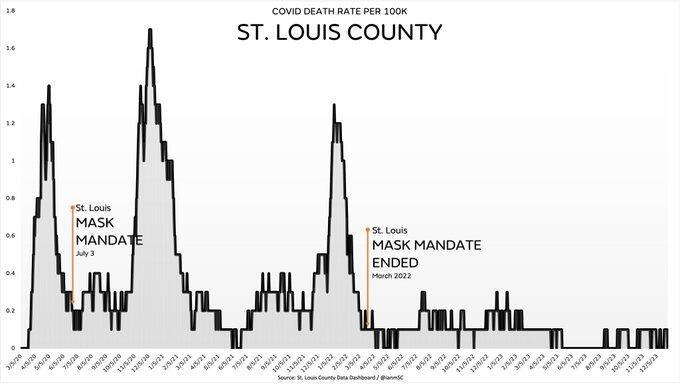
…”science”.
Russia explains retaliation for Ukrainian ‘terror attack’
RT | December 31, 2023
Russia’s military has conducted a string of high-precision missile strikes targeting Ukrainian military facilities and officials in response to the Ukrainian strike on Belgorod on Saturday that left more than 20 civilians dead, the Defense Ministry has said.
In a statement on Sunday, the ministry said that Moscow’s forces had struck decision-making centers and other military targets in the city of Kharkov, not far from the border between the two countries.
It noted that a high-precision missile strike on the building formerly housing the Kharkov Palace Hotel eliminated “representatives of the Main Intelligence Directorate and the Armed Forces of Ukraine, who were directly involved in the planning and execution of the terrorist attack in Belgorod.”
The building also housed up to 200 foreign mercenaries who were gearing up for “terrorist raids” into Russian territory, officials added.
Other strikes hit the building of Ukraine’s Security Service (SBU) and a temporary deployment area of Ukrainian nationalists. “Representatives of the SBU leadership, foreign mercenaries and fighters of the Kraken unit, who were directly preparing sabotage on Russian territory, have been taken out,” officials said.
In addition to this, an attack was carried out on a branch of the national space control center in western Ukraine, which had been used by Kiev for reconnaissance. Fuel depots in Kharkov and the Kiev-controlled part of Russia’s Zaporozhye Region were also destroyed, according to the statement. At the same time, the ministry stressed that the Russian military “only strikes military targets and infrastructure directly associated with them.”
Ukrainian officials in Kharkov have confirmed the barrage, saying that there had been six strikes that damaged “civilian infrastructure,” with 28 injured.
The new attack comes in response to a Ukrainian bombardment of Belgorod that killed at least 24 people, including four children, with 108 injured. Moscow has said that the barrage used both cluster munitions, as well as Czech-made projectiles. On Saturday, Vassily Nebenzia, Russia’s envoy to the UN, accused Western countries of complicity in the attack, warning that those who orchestrated it would be “punished.”
Dr. Malone Versus The World: Why Is He At War With Everyone?

Vigilant News Network | December 28, 2023
Dr. Malone’s latest Substack just dropped. Once again, the theme of the blog post is that a series of people and organizations within the medical freedom movement are actively working against him.
The pioneer in mRNA vaccine technology seems to have a pattern of lashing out against anyone who levels the slightest criticism of him and has attempted to diminish his critics by claiming that they “appear to be getting compensated in some way for actively promoting hate.”
It is clear, though, that what Dr. Malone describes as “hate” can run the gamut from indifference or perceived slights to mild criticism — or a stark difference of opinion. Dr. Malone’s volatile responses to criticisms have led some to think that he is connecting dots against his critics that aren’t real.
Dr. Malone’s Naughty List

Image via NTD News
Dr. Malone’s limited tolerance for criticism, along with his emphatic responses, has led to an increasing number of individuals and organizations subjected to his public denunciation.
The list below, derived from Dr. Malone’s past X and Substack posts, details these entities:
• Dr. Peter Breggin and Ginger Breggin
• Dr. Mike Yeadon
• Sasha Latypova
• Karen Kingston
• Matthew Crawford
• Dr. Ben Marble
• Dr. Judy Mikovitz
• George Webb
• Sage Hana on Substack
• America Out Loud
• Dr. Jane Ruby
• Red Voice Media
• Stew Peters
• Catherine Austin Fitts (The Solari Report)
• J. J. Couey
• Mary Holland (President of Children’s Health Defense)
• The Wellness Company and its founder Foster Coulson
• Dr. Paul Alexander
• The Washington Post
• Alex Berenson
• Dr. Peter McCullough
• And more. “The list goes on and on,” Dr. Malone has stated.
Lawsuits
On October 30, 2022, Dr. Malone filed a lawsuit seeking $25 million in damages from Dr. Peter Breggin, Ginger Breggin, America Out Loud, Dr. Jane Ruby, and Red Voice Media (Stew Peters). This was described as a “shocking defamation lawsuit,” which Diana West called “an anti-personnel weapon of free-speech-destruction” and a “heat-seeking lawfare missile targeting financial ruin.”
 After a lengthy legal battle, Judge Norman K. Moon dismissed Dr. Malone’s $25 million defamation lawsuit on December 11, 2023, stating it “has not met his burden of proof as to jurisdiction.”
In a separate case, On September 28, 2023, Judge Norman K. Moon also struck down Dr. Malone’s defamation lawsuit against The Washington Post. Judge Moon directed the court clerk to “strike this case from the docket.” He said at the time, “If Plaintiff [Dr. Malone] continues to bring defamation actions like those that have been dismissed, there will come a time when his lawsuits might fairly be deemed frivolous and awarding attorney fees is appropriate.”
Dr. Malone vs. Dr. Yeadon
 Dr. Michael Yeadon

In response to Dr. Malone’s op-ed, “FDA Fails to Address DNA Adulteration Concerns,” Dr. Michael Yeadon, ex-chief scientist and vice president of Pfizer’s allergy and respiratory research division, also found himself on the wrong side of Dr. Malone.
Dr. Yeadon wrote:
“He [Dr. Malone] knows these aren’t regulated pharmaceutical products at all but countermeasures under a public health emergency. It’s not a side issue. For proof, see Substacks of Katherine Watt and Sasha Latypova. There is zero possibility that Malone doesn’t know this.”
Rather abrasively, Dr. Malone responded that Dr. Yeadon “does not understand what is going on” and that he “should just STFU (shut the f*ck up).”
 Former pharma insider Sasha Latypova replied:

Image Source
“I think Dr. Yeadon understands very well what is going on, and think he understands too well for Robert Malone’s liking, and that’s why the response full of, let’s say – hate and hyperbole – but no actual rebuttal or an explanation of what exactly is incorrect.”
Read more on that here.
Dr. Malone’s Grudge Extends to Dr. Peter McCullough.

Dr. Peter McCullough
Dr. Malone once spoke of renowned cardiologist Dr. Peter McCullough as “a good friend.” However, it seems that the passage of time has altered the dynamics of their relationship, especially after Dr. McCullough accepted the position of Chief Scientific Officer of The Wellness Company, a business specializing in alternative healthcare solutions that Dr. Malone suggests is “yet another CIA cutout organization.”
 Dr. McCullough has refrained from engaging in public criticism of Dr. Malone on social media platforms like X. Conversely, Dr. Malone has, on multiple occasions, publicly scorned Dr. McCullough.
In June 2023, Dr. Robert Malone expressed disappointment over a perceived bias at Senator Ron Johnson’s “COVID-19 Vaccines: What They Are, How They Work, and Possible Causes of Injuries” event, which Dr. McCullough helped organize. Malone indicated a division between McCullough and himself, noting that they are “no longer on the same team.” Malone also accused McCullough of prioritizing profits over people, stating, “He [McCullough] works for ‘The Wellness Company’ selling vitamins. I work for my substack subscribers.”
 On November 25, 2023, Dr. Malone stated that he and Dr. McCullough no longer attend the same venues. He referenced an instance where he received a standing ovation at a conference, and McCullough did not, which he suggested led to jealousy.
He further alleged that Dr. McCullough compensates someone to attack him on social media and accused Dr. Paul Alexander of acting as Dr. McCullough’s “surrogate” to “obsessively” attack him “hundreds of times.”
 Furthermore, Dr. Malone paradoxically seemed to harbor hopes that the FDA, an agency he has consistently accused of corruption, would take stringent action against The Wellness Company:
“These [supplements] are mislabeled as therapeutics. Peter [McCullough] know[s] this but will not act to object. Eventually, they will get called out by the FDA. Surprising, this has not happened yet.”
 Who Is Defaming Who?
Dr. Malone says, “I am constantly amazed by the self-styled social media ‘independent journalists’ who obsessively attack me” while having a long history of obsessively attacking others.
 There’s a saying that what goes around comes around. However, Dr. Malone characterizes what is likely an organic backlash to his own degrading statements as “compensated” attacks or “yet another CIA cutout organization” looking to cause division in the medical freedom movement.
It’s time for Dr. Malone to reflect and take a look in the mirror. He sought $25 million in legal damages for “defamation” while issuing disparaging comments to those who dared criticize him.
Dr. Malone, a line must be drawn. You have done better, and you can do better. The world wants a return to the principled physician who courageously opposed vaccine mandates and the use of experimental gene-based products in children, rather than the one persistently embroiled in drama. Please choose a path of greater dignity and resolve these online disputes with grace.
 EDITORIAL NOTES:
• Vigilant News Network reached out to Dr. Malone for comment regarding allegations made in his Substack and online, but Dr. Malone declined to respond.
• The founder of Vigilant News Network, Foster Coulson, is also the founder of The Wellness Company. Coulson has no control over the day-to-day operation of Vigilant News. The decision to run this article – an article we have worked on for over a month and an article that has been subjected to our rigorous journalistic standards – was 100% the decision of the news division for Vigilant News Network.
This post is sponsored content and Zerohedge has been compensated for its publication.
Putin lifts the fog of war in Ukraine

BY M. K. BHADRAKUMAR | INDIAN PUNCHLINE | DECEMBER 29, 2023
Russia’s special military operation in Ukraine is entering a new phase. President Vladimir Putin lifted the fog of war and hinted at what can be expected going forward in a landmark speech at the National Defence Control Centre while addressing a meeting of the Russian Defence Ministry Board on December 19.
Russia has gained the upper hand in the proxy war while the United States is struggling to recreate a new narrative. For Putin, this is a moment of triumph where he has no reason to take advantage of the fog of war in Ukraine, whereas, for President Biden, the fog of war continues to serve a useful purpose of dissimulation in the crucial election ahead where he seeks a second term.
Putin’s speech exuded a buoyant mood. The Russian economy has not only regained its pre-2022 momentum but is accelerating toward a 3.5% growth rate by the yearend, marked by rising incomes and purchasing power for millions of its citizens and an increase in living standards. Unemployment is at an all-time low and Russia has beaten back the Western sanctions and the attempts to isolate it in the international arena.
The leitmotif of Putin’s speech is that this is a war that Russia never sought but was imposed on it by the US. Putin had listed last year in February five clear-cut objectives of the Russian military operation — security of the Russian population; de-nazification of Ukraine; demilitarisation of Ukraine; striving for a friendly regime in Kiev; and, non-admission of Ukraine into NATO. These are of course interlocked objectives. The US and its allies know it but continue to pretend otherwise. Their focus in the proxy war has been a military victory and regime change in Russia.
Putin’s message is that any new Western narrative on the war is doomed to meet the same fate as the previous one unless there is realism that Russia cannot be militarily defeated and its legitimate interests are recognised.
The heart of the matter is that the West all along perceived Ukraine as a geopolitical project targeting Russia. Today, even with defeat staring at its face, the West’s priority lies in forcing Russia to agree to a ceasefire on the basis of the existing line of contact without any geopolitical or strategic obligations on the part of Washington or the transatlantic alliance — which, de facto, would mean leaving the door for the rearmament of the battered Ukrainian military and for Kiev’s accession to NATO through the back door.
Suffice to say, the discredited agenda of using Ukraine as a pawn to pursue the West’s anti-Russian policy is still very much around. But Moscow will not fall for the US’ trap a second time, risking another war that may erupt at a time that suits NATO.
Unsurprisingly, Putin’s speech paid great attention to revving up Russia’s defence industry to meet any military exigencies that might arise. But towards the end of his speech, Putin also dwelt on Russia’s politico-military options under the circumstances.
On the military side, clearly, Russia will press forward the attritional war to its logical end of pushing the Ukrainian military into a strategic dead-end, which would mean seeking tactical improvements along the frontline, undermining Ukraine’s economic potential, inflicting military losses, and boosting Russia’s own defence industry on a scale that tips the balance of forces to weigh against any military adventures by NATO.
In the final analysis, Putin asserted, Russia is determined to reclaim the “vast historical territories, Russian territories, along with the population” that the Bolsheviks transferred to Ukraine during the Soviet era. However, he drew an important distinction as regards the “western lands” of Ukraine (west of Dnieper) that are a legacy of World War II over which there could be territorial claims from Poland, Hungary and Romania, which at least in the case of Poland is also linked to the transfer of “eastern German lands, the Danzig Corridor, and Danzig itself” following the defeat of the Third Reich.
Putin took note that “people who live there (western Ukraine) – many of them, at least, I know this for sure, 100 percent – they want to return to their historical homeland. The countries that lost these territories, primarily Poland, dream of having them back.”
That said, interestingly, Putin simply washed his hands of any territorial disputes that may arise between Ukraine and its eastern neighbours (all of whom are NATO countries.) Looking ahead, this is going to be a can of worms for the US. Recently, Russia’s intelligence chief Sergey Naryshkin used a powerful metaphor, warning that the US may face a “second Vietnam” in Ukraine that will come to haunt it for a long time.
The bottom line, as Putin framed it, is as follows: “History will put everything in its place. We (Moscow) will not interfere, but we will not give up what is ours. Everyone should be aware of this –- those in Ukraine who are aggressively disposed towards Russia, and in Europe, and in the United States. If they want to negotiate, let them do so. But we will do it only based on our interests.”
Putin concluded saying that if the final arbiter is military prowess, that explains why Russia is focusing on a “strong, reliable, well-equipped, and properly motivated Armed Forces” backed by a strong economy and “the support of the multi-ethnic people of Russia.”
There is a strong likelihood of Russian military operations moving further westward toward the Dnieper in the coming months, well beyond the four new territories that joined the Russian Federation last year — Luhansk, Donetsk, Zaporozhia, and Kherson. In the absence of any negotiated settlement, Russia may choose to unilaterally “liberate” those southern regions of Ukraine that were historically part of Russia, which would presumably include Odessa and the entire Black Sea coast, or Kharkov to the north of the Donbass region.
Russia is expecting that the combat capabilities of the Ukrainian forces will sharply diminish in the near future and the army faces difficulty already to get new recruits. That is to say, through the year ahead, the balance of forces at the front will shift due to the Ukrainian military’s heavy losses and the drop in Western aid, and, at some point, Ukraine’s defences will begin to crumble.
Russia’s recent gains in military operations — eg., Soledar, Artyomovsk (Bakhmut), Avdeevka, Maryinka, etc. — already testify to a shift in the balance of forces between the two armies. This shift will further accelerate as Russia’s military-industrial complex is functioning optimally and Russia is massively deploying new types of weapons, such as gliding aviation bombs, which have altered the role of the Russian Air Force in the conflict.
Dozens of heavy aerial bombs are dropped every single day and similarly, there is increase in the use of modern barrage ammunition and some other systems, including precision-guided munitions. T-90M tanks and new types of light armoured vehicles have also appeared on the battlefield.
In comparison, Ukraine faces a decrease in arms supplies due to limited production capacities in the West where sustainable production growth on an industrial scale is not attainable in the near term. Meanwhile, the Middle East crisis and the tensions around Taiwan become major distractions for the US.
All these factors taken into account, a decisive shift in the balance of forces against Ukraine is entirely conceivable by the end of next year, leading to an end of the conflict on Russia’s terms.
UN pushes back against Biden transgender proposal
RT | December 29, 2023
Rule changes to sexual discrimination legislation proposed by the US government designed to prevent the banning of transgender athletes in schools and colleges would violate the rights of biological women, a United Nations (UN) expert, Reem Alsalem, warned on Wednesday.
Under the landmark ‘Title IX’ legislation passed by the US Congress in 1972, it was ruled that sexual discrimination against women in education must be eradicated. It also stated that women should have the same educational rights and opportunities as their male counterparts.
In April, the US Department of Education proposed modifying the legislation so that no school or college that receives federal funding can impose broad rules that categorically ban transgender athletes from participating in sports that match their gender identity. Instead, it said such issues should be decided on a case-by-case basis.
The proposed amendment would also lead to the removal of separate facilities for men and women, including bathrooms and changing rooms, in some instances.
But on Wednesday, Reem Alsalem, the UN Special Rapporteur on violence against women, argued that the proposed changes to Title IX would have a negative impact on biological women.
“The proposed Title IX rule changes would have detrimental effects on the participation of biological women and girls in sports,” Alsalem said in a news release. It would, she added, deny women “the opportunity to compete fairly, resulting in the loss of athletic and scholarship opportunities.”
Furthermore, Alsalem argued that an altered Title IX would “lead to the loss of privacy” for female athletes and cause “heightened exposure to sexual harassment and voyeurism.”
“If the proposed changes are adopted, they would contravene the United States’ international human rights obligations and commitments concerning the prevention of all forms of violence and discrimination against women on the basis of sex,” she added.
The participation of transgender athletes in female sporting categories has become a hot-button topic over the past several years. Perhaps most notorious is the case of the American collegiate swimmer Lia Thomas, who, in 2022, became the first openly transgender athlete to win an NCAA Division I national championship. Before transitioning, Thomas had previously ranked 462 in the male category.
However, despite media attention on Thomas’ eligibility to compete against biologically-born women, the athlete’s right to compete was backed in an open letter by 300 current and former collegiate swimmers.
In the letter, they issued “support for Lia Thomas, and all transgender college athletes, who deserve to be able to compete in safe and welcoming athletic environments.”
A final decision on the possible changes is expected in 2024.
Netanyahu Outsmarted by ‘Wily’ Biden? No, Biden Is the One Being Played
By Alastair Crooke | Strategic Culture Foundation | December 25, 2023
Biden smirked and responded, “I know”, when told by a guest that Netanyahu is drawing the U.S. into a civilisational conflict – and further that Netanyahu blames him (Biden), complaining that the White House wants to block Israel from getting at the root of the problem, by harping on about Gaza and the ‘day after’.
In practice, what Netanyahu is doing is simply mounting a classic flanking manoeuvre – attempting to circumvent Biden by pointing to the ‘broader conflict’ with Iran: ‘Why are you pestering me about Gaza when there’s a monumental conflict raging’, suggests Bibi in exasperation?
“This is not only ‘our war’ but in many ways your war… This is a battle against the Iranian axis… now threatening to close the maritime strait of Bab Al-Mandeb… It is the interest … of the entire civilized community”, Netanyahu has said – not very subtly.
Biden’s reaction is a smug smile, hinting that he thinks he can outplay Netanyahu (‘the fox’). This is Biden’s approach: He aims to disarm Netanyahu’s allegation of an obstructionist U.S. through a parade of top-level visits that reiterates his unstinting support Israel – and to pre-empt Bibi, through insisting that he (Biden) will take care of the non-Gaza issues (Hizbullah, Yemen etc.).
So, the U.S. is assembling a maritime force to confront AnsarAllah in Yemen; the Biden Admin will act to sanction violent settlers in the West Bank; it is warning Baghdad to rein-in the Hashad al Sha’abi; and his envoys in Beirut are trying to forge a ‘diplomatic agreement’ that will include the withdrawal of Hizbullah’s Radwan Forces to the other side of the Litani River in southern Lebanon, and also deal with the unresolved border disputes between Israel and Lebanon.
Biden prides himself on being a hugely experienced foreign policy actor – and thinks himself too wily for Bibi’s tricks. But maybe, Netanyahu – for all his many faults – better understands the Region?
Biden clearly is being played. Even though he fails to recognize it.
Netanyahu knows that ‘no way’ will Hizbullah disarm, and withdraw to north of the Litani. He knows this, and thus can wait out Biden’s diplomatic failure, before saying that the approximately 70,000 Israeli citizens displaced from the northern towns in the wake of 7 October need to ”go home”, and that if the U.S. cannot remove Hizbullah from the border-fence, then Israel will do it.
Netanyahu is using Biden’s diplomatic Lebanese initiative to build European justification for an Israeli operation in a few weeks’ time to push Hizbullah away from the border with Israel. (An Israeli operation against Hizbullah has been in the works from the outset of the Gaza war).
Netanyahu knows too that control over settler violence in the West Bank lies not with him, but is in the hands of his partners: i.e., Ministers Ben Gvir and Smotrich. Neither he, nor Biden can dictate to them – they have been quietly increasing the squeeze on West Bank Palestinians for months.
And finally, Netanyahu knows the Houthis: They will not be deterred by Biden’s maritime flotilla. They will, rather, relish drawing the West into a Red Sea quagmire.
Like it or not, Biden’s tactic of containing and pre-empting regional escalation through the U.S. itself becoming lead actor – in lieu of Israel – is clearly drawing the U.S. deeper into conflict. Does Biden believe that the Houthis will just quietly ‘roll-over’ because the Gerald Ford is anchored off Bab Al-Mandeb, or that Hizbullah will accept instruction from Amos Hochstein?
The second way that Biden is being outplayed is through him seeing the Israeli problem as ‘just Bibi’ – indulging in personal politics. Of course, it is true that the Israeli PM is moulding Israeli politics to his own survival needs; yet pause a moment to consider what President Herzog said on Tuesday during an interview facilitated by the Atlantic Council, a leading Washington-based think tank.
Herzog has long been viewed as distinctly ‘dovish’ and ‘Leftist’ by the Beltway foreign policy establishment – prior to the war – compared to Netanyahu.
In the interview, Herzog said: “We intend to take over the entire Gaza Strip and change the course of history”. He said that the current conflict is a clash of “a set of civilizational values” and he cast Hamas (in pure Manichaean terms) as a “force of evil”, adding that Israel would no longer tolerate Gaza being a “platform for Iran – driving everyone into the abyss of bloodshed and warfare”.
Not much daylight then between him and the PM then.
The convergence between Herzog and Bibi reflects, perhaps, a more substantive change taking place in Israel – a strategic shift that extends far beyond Biden’s personal obsession with Bibi:
Since 7 October, the New York Times and the Jerusalem Post report that 36% of Israelis have moved decidedly to the right on a number of political issues, including support for settlers in the West Bank, endorsements for far-right politicians, and even settlements again inside the Gaza Strip. And while public opinion of Netanyahu himself is faltering, his government is not expected to fall.
And even were that to occur, the more important point to grasp is that support for the policies upheld by Netanyahu’s radical Rightist government is growing, and rapidly.
Israel’s Right generally believes in Israeli control of the West Bank and Gaza, with many right-wing Israelis opposed to the principle of a Palestinian state existing at all alongside Israel. This can be seen in many of the current government’s policies, which have worked toward expanding Israeli settlement of the West Bank and rendering Gaza unlivable for Palestinians.
On the opposite side of the spectrum sits Israel’s Left. The Jerusalem Post notes that the Left largely believe that Israel is ‘occupying’ the West Bank, and that an end to the conflict can only be achieved by ending the occupation and enabling a two-state solution. But no one is explicit on where that second state – a Palestinian state – would be situated. Legally it would be Gaza, the West Bank and part of Jerusalem. But who could enforce that? Who would expel settlers from the West Bank?
For many Israelis, the separation ‘apartheid’ Occupation state of the past 30 years was the workable ‘two-state solution’ – but its pillars (structural separation, military enforcement and deterrence) which had for many Israelis seemed to promise the ‘quiet’ that many hoped for – blew apart on 7 October.
“The trauma of what happened on Oct. 7 shifted Israeli society. It made them question the most basic tenets of whether they were safe in their homes”, said Israeli columnist, Tal Schneider:
“They are calling now for more — more military, more protection, more hard-line policies”.
“Many right-wing people,” Ariella Marsden writes in the Jerusalem Post, “and a minority of left-wingers, saw 7 Oct as proof that peace with the Palestinians is impossible”. Not surprisingly, thinking has turned to population removal which chimes with Netanyahu’s ‘new war of Independence’ theme.
In short, Biden may believe that his ‘long experience’ puts him on the ‘right side’ in judging events. His experience however, is drawn from another era. The political Israel he knew is over: It has reached the end of the road in respect to the old paradigm of its Palestinian modus vivendi. Demography no longer pushes towards ‘giving’ the Palestinians a state, but rather to a clearing of the land of all ‘hostile populations’.
Israelis are rummaging now for their new solution.
And just as Hamas’ resistance has pointed to new ways of conducting warfare, so Biden’s ‘long experience’ exemplified in the sending of 1960s era carriers and vessels to sit offshore, in an age of smart nimble, often untraceable drones and pinpoint missiles, points to something also passé.
The U.S. is directly engaged today in Yemen, Lebanon, the West Bank, Iraq and Syria. And as the war widens, so the U.S. will be held at least partly responsible – You deliberately let Gaza break, and what’s broken, you own. What further gets broke, you own that too.
A destitute 2 million Gazans will be all refugees with no government to provide basic functions and services. Does Netanyahu get it? Of course. Do the vast majority of Israelis care? Nope. But the rest of the world does, and sees a dark stain spreading across the map, and leeching into the West.
And does the U.S. Red Sea flotilla; does the diplomatic effort in Lebanon; do the frantic calls to China to ask for help to rein-in Iran, and the efforts in Baghdad – will this suffice to bring an end to the Axis’ plan?
No – the Resistance must see the U.S. floundering and that Israel – suffused with anger – is positively inviting the next ascent up the escalatory ladder of diffused incremental wider conflict.
Featured Video

“Historic Russia”: The Land Putin Will Not Give Back
or go to
Aletho News Archives – Video-Images
Book Review
Why the War on Conspiracy Theories Is Bad Public Policy
By Kevin Barrett • Unz Review • February 1, 2019
 A Review of Conspiracy Theories and Other Dangerous Ideas by Cass Sunstein (based on an earlier paper co-authored with Adrian Vermeule); In Defense of Troublemakers: The Power of Dissent in Life and Business by Charlan Nemeth; and Conspiracy Theories and the People Who Believe Them, edited by Joseph E. Uscinski
On January 25 2018 YouTube unleashed the latest salvo in the war on conspiracy theories, saying “we’ll begin reducing recommendations of borderline content and content that could misinform users in harmful ways—such as videos promoting a phony miracle cure for a serious illness, claiming the earth is flat, or making blatantly false claims about historic events like 9/11.”
At first glance that sounds reasonable. Nobody wants YouTube or anyone else to recommend bad information. And almost everyone agrees that phony miracle cures, flat earthism, and blatantly false claims about 9/11 and other historical events are undesirable.
But if we stop and seriously consider those words, we notice a couple of problems. First, the word “recommend” is not just misleading but mendacious. YouTube obviously doesn’t really recommend anything. When it says it does, it is lying. … continue
Blog Roll
 Aletho News
- BRITAIN’S WARNING: PREPARE FOR WAR
- “Historic Russia”: The Land Putin Will Not Give Back
- How the Cambridge Analytica scandal still haunts Mark Zuckerberg
- The Ongoing Cancellation Campaign Against a Dissenting Academic in Norway
- Yemen and ‘the Houthis’: Challenging Sami Hamdi’s Narrative
- No, Christians did not invent Zionism
- AIPAC-led lobbying network opens branches in Cypriot, Greek parliaments
- Araghchi blasts ‘parasitic’ alliance as US taxpayers pay for Israel’s war on Iran
- Easy fix for Europe’s chaos? Stop fueling war against Russia
- Putin’s key remarks on peace talks and Europe’s ‘schizophrenia’
- If Americans Knew
- An error has occurred; the feed is probably down. Try again later.
- No Tricks Zone
- Two New Studies Find Thwaites Glacier Melt Cannot Be Driven By Human Activity Or A Warming Ocean
- E-Cars Reduce CO2 Emissions By Only 41% Compared To Internal Combustion Engine Vehicles
- Predictions Made By Renowned Climate Professor Over Past Decades Have Been Proven To Be Poor
- New Study Suggests Large Regions Of The Pacific Ocean Have Been Cooling For The Last 80 Years
- Germany’s Green Energy Debacle: High Energy Costs Force Kahla Porzellan to Close After 182 Years!
- New Study: 50 Years Of The Most Aggressive ‘Net Zero’ Policies Can Only Affect The Global Climate By 0.03°C
- US September “Heat” Was No Record…Many Records Set Decades Ago
- Latest European Green Energy Debacle; Portugal’s Largest Flagship Solar Park Insolvent!
- Green Energy Debacle: German Expert Professor Fritz Vahrenholt Warns Of Severe Economic And Social Consequences
- Two More Paleo Reconstructions Affirm Meters-Higher Sea Levels Across Ireland, Brazil 7000-6000 Years Ago

