Study Exposes Misinformation Campaign Pushing Pro-American Narratives on Twitter, Facebook
By Kyle Anzalone | The Libertarian Institute | August 24, 2022
Graphika and the Stanford Internet Observatory released a study showing a “series of covert campaigns over a period of almost five years” that pushed pro-Western misinformation on Twitter, Facebook and five other social media platforms. The operations targeted people living in Central Asia and the Middle East.
An investigation was launched after Twitter and Merta turned over the data on two overlapping accounts to Graphika and the Stanford Internet Observatory. The accounts were removed in July and August for violating teams of services, including “platform manipulation” and “inauthentic behavior.” The fake accounts deployed misinformation to set narratives supporting Western geopolitical goals.
According to the executive summary, “Our joint investigation found an interconnected web of accounts on Twitter, Facebook, Instagram, and five other social media platforms that used deceptive tactics to promote pro-Western narratives in the Middle East and Central Asia.” It continues, “The platforms’ datasets appear to cover a series of covert campaigns over a period of almost five years rather than one homogeneous operation.”
One operation by the covert accounts was directed at Central Asia. A narrative the fake accounts tried to spread was painting Russia as the looming enemy. “Assets in the group consistently portrayed Russia as a threat to Central Asia. A recurring narrative claimed that Russia is abusing Russian-Central Asian partnerships, namely the CSTO, to extract one-sided benefits…The assets also said Central Asian countries must leave these organizations if they wish to retake their full sovereignty from Russia.”
The Central Asia operations also sought to portray Russia as a villain and support the Ukrainian war effort. On several occasions, the accounts attempted to generate hashtag campaigns supporting Kiev.
The covert accounts campaigns against Iran linked to articles from fake media outlets to spread misinformation. The report says, “Several suspended accounts were linked to two sham media outlets operating in Persian.” However, not all the posts are linked to phony media outlets. The accounts frequently linked to stories from US government-funded sources like Voice of America.
A different operation attempted to set the discourse on the war in Yemen. “These accounts shared content critical of Iranian and Houthi rebel activity in Yemen. Posts accused Houthi rebel leaders of blocking humanitarian aid deliveries, acting as proxies for Iran and Hezbollah,” the report authors wrote.
While Graphika and the Stanford Internet Observatory do not name a culprit for the misinformation campaigns, they say the accounts were likely ineffective at spreading misinformation. “The data also shows the limitations of using inauthentic tactics to generate engagement and build influence online. The vast majority of posts and tweets we reviewed received no more than a handful of likes or retweets.”
NATO Abandons Diplomacy, Says No Longer ‘At Peace’
By Bas Spliet | The Libertarian Institute | August 23, 2022
At the end of its annual summit in Madrid in late June, NATO adopted a new strategic concept. The guidance document is the eighth of its kind since the founding of the alliance in 1949. It radically breaks with the three previous post-Cold War security briefs, however, which observed that “the Euro-Atlantic area is at peace” because “the threat of a conventional attack against NATO territory is low.” In the eyes of NATO, Russia’s invasion of Ukraine has changed that calculus, claiming that the military organization can no longer discount the possibility of an assault on sovereign NATO states. Continuing the same cryptic language, the new strategic concept concludes that the Euro-Atlantic area now is “not at peace,” in spite of no NATO member being in a state of war with Russia.
Behind this word play, a more dangerous policy change has been codified in the document. Since the adoption of the Harmel Report in 1967, NATO has always officially included diplomacy in one form or another (with political dialogue and strategic partnership being interchangeable labels) as one of its “core” or “fundamental” tasks. The “NATO 2030” report from November 2020, for instance, unequivocally stated that “NATO should continue the dual-track approach of deterrence and dialogue with Russia.”
In the new strategic concept, the core tasks have been purged of the need for diplomacy, except for one or two throw-away lines about “meaningful and reciprocal political dialogue” about arms control issues buried in the middle of the text. Rather, in addition to its original function of deterrence and defense, NATO now fully embraces “crisis prevention and management,” which it has spearheaded since the 1990s with its legally dubious and morally questionable interventions in the Balkans, Afghanistan, and Libya; and “cooperative security,” referring to NATO’s enlargement in Eastern Europe and its Partnership for Peace cooperation with countries in ever further-away regions, including the Black Sea, the Middle East, North Africa, and even the Indo-Pacific, which the British have been pushing to include in a “global NATO.”
Russia was the first country to sign up for the Partnership for Peace program back in 1994. The new NATO doctrine, however, states that Russia can no longer be considered a partner “in light of its hostile policies and actions.” The strategic concept ignores the fact that NATO’s enlargement and new core tasks, which the alliance adopted after the Cold War in an effort to justify its continued existence, have likewise long been seen as hostile in Moscow, nor does it offer any reflection on how the new policies might have contributed to the current unpeaceful “strategic environment.” Instead, it hails the “historic success” of NATO’s expansion in terms of space and substance and insists that the alliance “does not seek confrontation and poses no threat to the Russian federation.”
The logic behind this reasoning is that NATO’s enlargement, or its Partnership for Peace program for that matter, is an outflow of the West’s innocent and well-meant efforts to spread its values of liberal democracy around the world. New member states joined the alliance in a voluntary capacity, after all. In a sense, this logic holds true. It is difficult to see how extending a war guarantee to East European and Balkan nations contribute to the security of Western Europe, let alone the United States. And from Clinton to Bush and Obama, NATO’s Open Door policy has been couched in a Wilsonian rhetoric of the United States as a benign hegemon. Joe Biden, too, steered last year’s NATO conference in Brussels in the direction of proclaiming a global fight between democracy and authoritarianism.
What proponents of this Wilsonian liberalism fail to realize, however, is that their benevolent actions might antagonize other nations. Now, NATO apologists, like Ukrainian President Volodymyr Zelensky, argue that if the alliance had not expanded eastward, Vladimir Putin would have been even bolder in his imperial ambitions. But as John Mearsheimer pointed out back in 2014, there is virtually no evidence that Putin aimed to incorporate Crimea before the Maidan coup. Rather, his offensive foreign policy in Ukraine since 2014, culminating in the 2022 invasion, is one of reaction to NATO creeping up to Russia’s borders. Bringing Ukraine into the NATO fold has long been a big fat redline for Russia, and we crossed it.
First of all, West-European officials promised the Soviets after the fall of the Berlin Wall that NATO’s borders would not move “one inch” eastward. But then all former Warsaw Pact countries and even some former Soviet Republics were incorporated in the 1990s and early 2000s. In addition to the evidence the National Security Archive assembled on this issue a few years ago, recent archival research has once again confirmed these broken promises.
Next, in 2008, Russian Foreign Minister Sergei Lavrov warned American diplomats that further NATO enlargement, particularly to Ukraine, would constitute a “potential military threat.” William J. Burns, who is now the CIA chief but at the time served as the U.S. ambassador to Russia, translated Lavrov’s message succinctly in a diplomatic cable: “Nyet means nyet: Russia’s NATO enlargement redlines.” He further gave voice to the opinion of State Department experts, who warned that “the strong division in Ukraine over NATO membership, with much of the ethnic-Russian community against membership, could lead to a major split, involving violence or at worst, civil war.” The Bush administration ignored these warnings and pushed for the inclusion of Georgia and Ukraine at a summit in Bucharest, where the alliance codified that “these countries will become members of NATO.” Ultimately, war followed in both countries, in Georgia in 2008, and in Ukraine in 2014. In the process, Russia annexed Crimea and supported a separatist war in the Donbass, which dragged on in protracted fashion until the 2022 invasion.
After 2014, Ukraine started to become a de facto member of NATO, which bolstered the Ukrainian regime to take a tough stance against Russia. In 2017, Trump decided to sell “defensive weapons” to Kyiv. Other NATO countries got in on the act, shipping weapons to Ukraine, training its military and teaming up with it in joint air and naval exercises. In June 2021, a British destroyer sailed through the Black Sea in an effort to shore up support for Ukraine, precipitating a diplomatic stand-off with Russia. NATO was undeterred, however, because a total of 32 countries participated in a major naval exercise in the Black Sea one month later.
In response, Russia decided to engage in coercive diplomacy, much like the Obama administration had done to get Iran to sign on to the 2015 nuclear deal. Putin amassed troops on the Ukrainian border, demanding guarantees that no offensive missiles would be installed in Eastern Europe and Ukraine not to join NATO. When the crisis was not solved diplomatically, Russia invaded Ukraine. Up until recently, there was hardly any diplomatic intercourse between Washington and Moscow in order to resolve the conflict. The UK’s Boris Johnson, too, “urged against negotiations” during a trip to Kyiv in April. Other NATO members, such as France, Germany, Italy and Hungary, have warmed to negotiations. But as long as there is no bigger push to re-establish diplomacy as a core task of the military alliance, Wilsonian rhetoric is likely to continue to make the world unsafe.
Bas Spliet is a historian and PhD candidate at the University of Antwerp in Belgium. He writes about a variety of topics from a historical angle. Find all his work on (Re)writing history, his Substack website. You can e-mail him at Bas.Spliet@UAntwerpen.be.
Americans increasingly see FBI as ‘Biden’s Gestapo’ – poll
Samizdat | August 20, 2022
A majority of respondents in a new survey have said they view the FBI as President Joe Biden‘s “personal Gestapo,” reflecting increasingly polarized views about the federal policing agency amid an investigation into the former commander in chief.
A Rasmussen poll published on Thursday showed major divisions in Americans’ attitudes toward the FBI, with 44% of respondents stating a recent raid on Trump’s Florida home made them lose some trust in the bureau. However, a significant 29% said the move only increased their confidence in the FBI, while 23% said it made no difference.
Asked about previous comments by former Trump adviser Roger Stone – who said “politicized thugs at the top of the FBI” are using the agency as “Joe Biden‘s personal Gestapo” – a majority (53%) of those polled agreed, including 34% who concurred “strongly.” That figure is up from 46% last December, though the more recent survey still found 36% disagree with Stone’s characterization. The results were split along party lines, with 76% of Republican and 37% Democrat respondents agreeing with the “Gestapo” claim.
According to officials and an unsealed property receipt, the federal raid on Trump’s Florida home on August 8 was centered on a probe into classified documents allegedly taken from the White House – some of them said to be top-secret and even potentially related to nuclear weapons – with the bureau hoping to recover 11 different sets of material from the residence. It remains unclear what was found in the search, however, and unnamed sources cited by NBC recently said agents will need time to sift through the seized files.
Trump, for his part, has accused the FBI of a politicized raid, and claimed the agency “stole” his passports and privileged legal documents “which they knowingly should not have taken,” although the passports had since been returned. The former president’s lawyers were not permitted to observe the search of his property, and said FBI agents ordered them to shut off security cameras while it was conducted.
NATO ready to intervene in Kosovo – Stoltenberg
Samizdat | August 17, 2022
NATO Secretary General Jens Stoltenberg has reiterated his promise that the bloc will intervene if “stability” is jeopardized in Kosovo during a press conference with Serbian President Aleksandar Vucic on Wednesday.
”Should stability be jeopardized, KFOR stands ready to intervene and will take any measures that are necessary to ensure a safe and secure environment and freedom of movement for all the people of Kosovo,” he said.
The leader of the military alliance called on “all sides” to “show restraint and avoid violence,” arguing that diplomacy was the only way forward, even while threatening military intervention under the UN mandate if the two parties did not abide by the EU-mediated dialogue.
Stoltenberg is set to hold a meeting with Kosovo Prime Minister Albin Kurti later on Wednesday, while Vucic and Kurti will meet on Thursday in Brussels to continue the dialogue.
Tensions between Serbia and Kosovo are running high after the province passed a law requiring Serbs to exchange their passports for special Kosovo-issued documents and switch out their Serbian license plates for plates issued in Kosovo.
Stoltenberg initially told Vucic that NATO would intervene in Kosovo in the event of stability being jeopardized during a phone call on August 3, echoing a communique from the NATO mission to Kosovo issued the previous week.
The announcement of the new law was accompanied by heavily armed special police taking control of two border crossings with Serbia, leading local Serbs to erect roadblocks in protest and Vucic’s government to issue a statement condemning Pristina’s behavior. NATO peacekeepers were deployed to defuse the tensions, and Kurti’s government agreed to delay the implementation of the new legislation in return for the protesters dismantling their barricades.
Russia has accused the West of fueling tensions between Serbia and its breakaway province, claiming the eruption was aimed at weakening the one European holdout from NATO and forcing it to adopt anti-Russian sanctions embraced by the rest of the continent. Kosovo, on the other hand, has blamed Russia for the escalation, arguing that Moscow is trying to distract from the war in Ukraine.
Russia warns of ‘direct military clash’ with US
Samizdat | August 16, 2022
Washington’s behavior on the world stage risks direct conflict between the nuclear states, the Russian embassy in the US has warned.
“Today, the United States continues to act with no regard to other countries’ security and interests, which contributes to an increase in nuclear risks,” the embassy said in a statement on its Telegram channel.
“The [US’] steps to further engage in a hybrid confrontation with Russia in the context of the Ukrainian crisis are fraught with unpredictable escalation and a direct military clash of nuclear powers.”
The embassy noted that Washington has recently withdrawn from two key arms control agreements, the 1987 Intermediate Range Nuclear Forces Treaty, which banned certain classes of land-based missiles, and the 1992 Treaty on Open Skies, which allowed for surveillance flights over each other’s territories.
The embassy urged the US to “take a closer look at its own nuclear policy instead of making unfounded accusations against the countries whose worldviews do not coincide with the American ones.”
“Our country faithfully fulfills its obligations as a nuclear-weapon state and makes every effort to reduce nuclear risks,” the diplomats said.
The statement comes after the US accused Moscow of using the Zaporozhye nuclear power plant in southern Ukraine as cover for its soldiers. The plant, the largest in Europe, was seized by Russian troops during the early stages of Moscow’s military operation in Ukraine, which was launched in late February. It continues to operate with Ukrainian personnel under Russian control.
US Secretary of State Antony Blinken called Russia’s action at the facility “the height of irresponsibility.” Russia and Ukraine, meanwhile, have been accusing each other of shelling the plant. According to Moscow, artillery fire by Ukrainians forces caused several fires and partial power outages this month.
Russia initiated a UN Security Council meeting last week regarding the situation around the Zaporozhye power plant. Russian envoy Vassily Nebenzia said that Moscow supports the International Atomic Energy Agency (IAEA) to inspect the facility as quickly as possible.
NYC to Close “Toddler COVID Vaccine Sites” — due to NO DEMAND
By Igor Chudov | August 13, 2022
Great news! New York City is closing “Infant COVID Vaccination Sites”, citing lack of demand, next week!
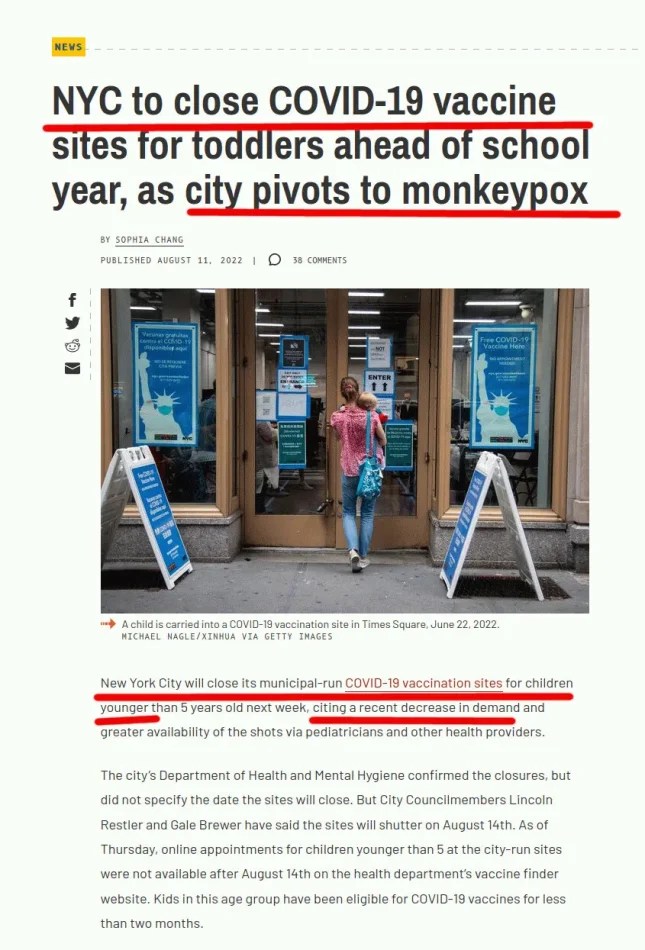
In effect, New York is really forced to do the same thing as DeSantis did in Florida — it is closing vaccination clinics for infants, which DeSantis never even opened. While in Florida it was done thanks to the Governor, in New York it happened because parents refused to give their children the Covid vaccine.
The ridiculous explanation NYC gave, is that they are “pivoting to monkeypox”.
This is a huge win for New Yorkers and for people everywhere.
This also means that our anti-Covid-vax activity, broadly speaking, is NOT a waste of time. Mind you, the media keeps lying, as usual. The New York Times, the most important newspaper in New York, is mum about this closure. Google does not show any articles about it except the one I quoted, either.
But people noticed and the public opinion has turned from most people wanting COVID vaccines a year ago to 90% not wanting any extra doses. It did not just happen by itself. We made it happen.
I want to thank my readers who shared my anti-Covid-vaccine-for-babies articles like crazy. That helped, perhaps to a very tiny extent, to warn parents of the danger of giving their kids Covid vaccines.
If people like us did not spread it, nobody would know the truth!
NEJM: COVID booster significantly delays end of infection
31% boosted people still contagious 10 days post-infection vs. 6% unvaccinated
By Rabinovitz | July 10, 2022
A new study published in the New England Journal of Medicine has demonstrated that people who are triple-vaccinated (boosted) against COVID recover significantly more slowly from COVID infection and remain contagious for longer than people who are not vaccinated at all.
The study did not deal with the severity of illness with or without a vaccine.
Researchers swabbed infected people and cultured the swabs, repeating the process for over two weeks until viral replication was not observed.
At five days post-infection, less than 25 percent of unvaccinated people were still contagious, whereas around 70 percent of boosted people were still carrying viable virus particles. For those partially vaccinated, around 50 percent were still contagious at this point.
Even more strikingly, at ten days post-infection, one-third of boosted people (31 percent) were found to still be carrying live, culturable virus. By contrast, just six percent of unvaccinated people were still contagious at day 10.
In other words, people who have received a booster shot are five times more likely still to be contagious at ten days post-infection than are unvaccinated people.
The findings go a long way to explaining why Paxlovid, Pfizer’s anti-viral medication, is often not effective for people who have been vaccinated against COVID, with many experiencing a recurrence of symptoms along with a positive COVID test after completing the five-day regimen (as recently occurred with quadruple-vaccinated Dr. Anthony Fauci). This phenomenon is known as COVID rebound.
Meanwhile, Israeli Health Ministry data shows that in the older population (those over the age of 60), having submitted to more COVID shots often correlates to a greater likelihood of becoming infected with COVID.

Israel Ministry of Health
The blue line represents the unvaccinated; light-green is the partially-vaccinated; dark-green is those who have received a booster shot within the past six months.
Biden’s Bounty on Your Life: Hospitals’ Incentive Payments for COVID-19
THE SEVEN US GOVERNMENT PAYOFFS TO KILL YOU IN HOSPITALS BY DR. PETERSON PIERRE
By Elizabeth Lee Vliet, M.D. and Ali Shultz, J.D. | November 17, 2021
Upon admission to a once-trusted hospital, American patients with COVID-19 become virtual prisoners, subjected to a rigid treatment protocol with roots in Ezekiel Emanuel’s “Complete Lives System” for rationing medical care in those over age 50. They have a shockingly high mortality rate. How and why is this happening, and what can be done about it?
As exposed in audio recordings, hospital executives in Arizona admitted meeting several times a week to lower standards of care, with coordinated restrictions on visitation rights. Most COVID-19 patients’ families are deliberately kept in the dark about what is really being done to their loved ones.
The combination that enables this tragic and avoidable loss of hundreds of thousands of lives includes (1) The CARES Act, which provides hospitals with bonus incentive payments for all things related to COVID-19 (testing, diagnosing, admitting to hospital, use of remdesivir and ventilators, reporting COVID-19 deaths, and vaccinations) and (2) waivers of customary and long-standing patient rights by the Centers for Medicare and Medicaid Services (CMS).
In 2020, the Texas Hospital Association submitted requests for waivers to CMS. According to Texas attorney Jerri Ward, “CMS has granted ‘waivers’ of federal law regarding patient rights. Specifically, CMS purports to allow hospitals to violate the rights of patients or their surrogates with regard to medical record access, to have patient visitation, and to be free from seclusion.” She notes that “rights do not come from the hospital or CMS and cannot be waived, as that is the antithesis of a ‘right.’ The purported waivers are meant to isolate and gain total control over the patient and to deny patient and patient’s decision-maker the ability to exercise informed consent.”
Creating a “National Pandemic Emergency” provided justification for such sweeping actions that override individual physician medical decision-making and patients’ rights. The CARES Act provides incentives for hospitals to use treatments dictated solely by the federal government under the auspices of the NIH. These “bounties” must be paid back if not “earned” by making the COVID-19 diagnosis and following the COVID-19 protocol.
The hospital payments include:
- A “free” required PCR test in the Emergency Room or upon admission for every patient, with government-paid fee to hospital.
- Added bonus payment for each positive COVID-19 diagnosis.
- Another bonus for a COVID-19 admission to the hospital.
- A 20 percent “boost” bonus payment from Medicare on the entire hospital bill for use of remdesivir instead of medicines such as Ivermectin.
- Another and larger bonus payment to the hospital if a COVID-19 patient is mechanically ventilated.
- More money to the hospital if cause of death is listed as COVID-19, even if patient did not die directly of COVID-19.
- A COVID-19 diagnosis also provides extra payments to coroners.
CMS implemented “value-based” payment programs that track data such as how many workers at a healthcare facility receive a COVID-19 vaccine. Now we see why many hospitals implemented COVID-19 vaccine mandates. They are paid more.
Outside hospitals, physician MIPS quality metrics link doctors’ income to performance-based pay for treating patients with COVID-19 EUA drugs. Failure to report information to CMS can cost the physician 4% of reimbursement.
Because of obfuscation with medical coding and legal jargon, we cannot be certain of the actual amount each hospital receives per COVID-19 patient. But Attorney Thomas Renz and CMS whistleblowers have calculated a total payment of at least $100,000 per patient.
What does this mean for your health and safety as a patient in the hospital?
There are deaths from the government-directed COVID treatments. For remdesivir, studies show that 71–75 percent of patients suffer an adverse effect, and the drug often had to be stopped after five to ten days because of these effects, such as kidney and liver damage, and death. Remdesivir trials during the 2018 West African Ebola outbreak had to be discontinued because death rate exceeded 50%. Yet, in 2020, Anthony Fauci directed that remdesivir was to be the drug hospitals use to treat COVID-19, even when the COVID clinical trials of remdesivir showed similar adverse effects.
In ventilated patients, the death toll is staggering. A National Library of Medicine January 2021 report of 69 studies involving more than 57,000 patients concluded that fatality rates were 45 percent in COVID-19 patients receiving invasive mechanical ventilation, increasing to 84 percent in older patients. Renz announced at a Truth for Health Foundation Press Conference that CMS data showed that in Texas hospitals, 84.9% percent of all patients died after more than 96 hours on a ventilator.
Then there are deaths from restrictions on effective treatments for hospitalized patients. Renz and a team of data analysts have estimated that more than 800,000 deaths in America’s hospitals, in COVID-19 and other patients, have been caused by approaches restricting fluids, nutrition, antibiotics, effective antivirals, anti-inflammatories, and therapeutic doses of anti-coagulants.
We now see government-dictated medical care at its worst in our history since the federal government mandated these ineffective and dangerous treatments for COVID-19, and then created financial incentives for hospitals and doctors to use only those “approved” (and paid for) approaches.
Our formerly trusted medical community of hospitals and hospital-employed medical staff have effectively become “bounty hunters” for your life. Patients need to now take unprecedented steps to avoid going into the hospital for COVID-19.
Patients need to take active steps to plan before getting sick to use early home-based treatment of COVID-19 that can help you save your life.
Denmark bans vaccine for youth under 18
By Mike Campbell | The Counter Signal | August 9, 2022
Denmark has announced that people under the age of 18 are no longer allowed to get the COVID vaccine.
Those wanting their first shot were cut off after July 1, and no one in the age group — aside from those who are considered “high risk” and have a doctor’s note — will be allowed to get a second shot after September 1.
“Children and adolescents only very rarely become seriously ill from COVID-19 with the omicron variant. Therefore, from July 1, 2022, it will no longer be possible for children and adolescents under the age of 18 to get the 1st [shot], and from September 1, 2022, it will no longer be possible to get the 2nd [shot],” reads a government statement. [translated from Danish]
While many are likely relieved because it means that vaccine mandates won’t be coming back to school, few have followed Denmark’s lead, and if the science is universal, it’s a wonder why they haven’t.
For example, despite this decision from Denmark, babies are now eligible to receive three rounds of Moderna’s Covid vaccine in Canada, even though COVID poses no greater threat to babies than the flu does, and Health Canada admits they lack long-term safety data.
Moreover, various health authorities have recently highlighted the risks of adverse effects that exist from the COVID vaccines.
Germany’s ministry of health recently tweeted there’s a 1 in 5000 chance people receive a “serious adverse effect” from the vaccines.
This came just days after Ontario’s CMHO refused to say healthy people “should” get boosted with what he referred to as a “therapeutic” due to the risk of myocarditis being 1 in 5000.
While it seems that more and more authorities are warning of the risks of vaccines — which, according to Denmark, are greater than the risk of COVID for the young and healthy — few countries are willing to say outright that the risks outweigh the benefits.
Russia suspends US inspections of nuclear military sites
Samizdat | August 8, 2022
Moscow has informed Washington of a “temporary withdrawal” from the inspection regime under the START nuclear disarmament treaty, the Russian Foreign Ministry said on Monday. Citing treaty provisions for “exceptional circumstances,” Russia is saying the Western sanctions have prevented its inspectors from performing their duties, thus giving US inspectors an unfair advantage. Once the principle of parity and equality is restored, the inspections will resume, Russia said.
Moscow cited “anti-Russian unilateral restrictive measures” imposed by the US and its allies, such as visa restrictions on Russian inspectors and a ban on Russian aircraft in US and EU airspace. These restrictions effectively make Russian inspections under the treaty impossible, while the Americans “do not experience such difficulties.”
“The Russian Federation is now forced to resort to this measure as a result of Washington’s persistent desire to implicitly achieve a restart of inspection activities on conditions that do not take into account existing realities, create unilateral advantages for the United States and effectively deprive the Russian Federation of the right to carry out inspections on American soil,” the Foreign Ministry said.
Russia “raised this issue with the relevant countries, but did not receive an answer.” Until these problems are resolved, “it would be premature to resume inspection activities under the START Treaty, on which the American side insists.”
As justification for the measure, Moscow cited the relevant section of the treaty protocol that covers extraordinary circumstances. Washington has been officially informed through diplomatic channels.
“We would like to emphasize that the measures we have taken are temporary. Russia is fully committed to complying with all the provisions of the START Treaty, which in our eyes is the most important instrument for maintaining international security and stability,” the Russian Foreign Ministry said.
As soon as the “existing problematic issues” are resolved, the inspections can resume again in full, according to Moscow.
The New Strategic Arms Reduction Treaty (known as New START) went into effect in 2011, and limits the number of nuclear warheads and their delivery vehicles that the US and Russia are allowed to possess. It is the only remaining arms control agreement between the two nuclear powers, after the US withdrawal from the INF and Open Skies treaties in recent years. New START almost expired before it was extended in February 2021, and is supposed to remain in effect until 2026.
Though US President Joe Biden said he had offered Russia talks on a new treaty, which would include China as well, Moscow said last week that it had received only “declarative statements” and not concrete proposals.
Zaporozhye Region Announces Vote on Joining Russia
Samizdat | August 8, 2022
Zaporozhye Region will hold a referendum on whether to secede from Ukraine and request joining Russia, the head of its administration announced on Monday.
Evgeny Balitskiy said that he had signed an order to organize the plebiscite during a regional forum held in the city of Melitopol. Over 700 representatives from various parts of the Ukrainian region approved the idea, according to RIA Novosti.
Earlier comments by administration officials indicated the referendum may be held as soon as mid-September.
Russian forces took partial control of the region during the initial offensive against Ukraine launched in late February. The eponymous city located in the north of the region on the Dnepr River remains under Ukrainian control.
Officials in Kherson Region, another Russia-controlled part of Ukraine, voiced similar plans to put to a vote the proposal of breaking away from Kiev and seeking to join Russia.
Ukrainian President Vladimir Zelensky on Sunday reiterated a warning that if the two regions go through with their plans, Kiev will break off all talks with Russia. Moscow in response suggested that the Ukrainian president should address the citizens of those regions.
“The thing is, this is what the residents of the region plan. It’s not like we [Russia] are holding a referendum. Here, apparently, it is necessary to understand to whom Zelensky is addressing this statement – to the citizens of Ukraine of the mentioned regions or to the citizens of Russia? If it’s to the citizens and leadership of Russia, then we are the wrong address,” Kremlin spokesman Dmitry Peskov commented on Monday.
There have been no peace talks between Russia and Ukraine for months, as Kiev rejected such contacts and claimed it would only negotiate after defeating Russian on the battlefield with the help of Western military aid.
Before the talks broke off, the two nations appeared to have made progress in resolving their differences. During a meeting in Istanbul in late March, Kiev had pledged to become a neutral country and accept restrictions on its military. Moscow said it prepared a draft peace agreement based on those proposals, but Ukraine never responded.
An indirect Russian-Ukrainian deal was mediated last month by the UN and Turkey to allow grain exports from three Ukrainian ports to resume via the Black Sea. The scheme was formalized in two separate agreements that were signed by Russia and Ukraine with the other two parties.
Russia sent troops into Ukraine on February 24, citing Kiev’s failure to implement the Minsk agreements, designed to give the regions of Donetsk and Lugansk special status within the Ukrainian state. The protocols, brokered by Germany and France, were first signed in 2014. Former Ukrainian President Pyotr Poroshenko has since admitted that Kiev’s main goal was to use the ceasefire to buy time and “create powerful armed forces.”
In February 2022, the Kremlin recognized the Donbass republics as independent states and demanded that Ukraine officially declare itself a neutral country that will never join any Western military bloc. Kiev insists the Russian offensive was completely unprovoked.
Russia offers monthly donation of 40,000 tons of wheat for Lebanon
Lebanon has been dealing with bread shortages over recent months, in the latest dilemma to hit the crisis-hit nation
The Cradle | August 6, 2022
The Russian Ambassador to Lebanon, Alexander Rudakov, has reportedly obtained initial approval from Moscow to provide Lebanon with a donation of 40,000 tons of wheat per month until the end of the year.
This deal could be extended past December to help the Levantine nation overcome a worsening food crisis, according to information obtained by Al-Akhbar.
Russia’s offer comes just days after Beirut cleared the Syrian-owned Laodicea vessel to depart the port of Tripoli, despite protests from the Ukrainian embassy, which claimed the ship was carrying “stolen grain.”
However, customs officials revealed to The Cradle that the ship’s grain cargo originated in Russia.
Lebanon’s top prosecutor allowed the ship to leave after revealing Kiev failed to present evidence to back their claim of theft against Russia and Syria.
Before the ship’s release, the Ukrainian embassy offered to retract their claim if Beirut paid them for the Russian grain.
Since 2019, Lebanon has been faced with the dire consequences of a severe economic meltdown.
The situation has pushed over 80 percent of the population below the poverty line and all but wiped out the value of the local currency.
Lebanon used to import as much as 80 percent of its wheat from Ukraine, but since the start of the Russian war, it now faces a major food crisis.
Another factor that limits Lebanon’s wheat supply is the destruction of the country’s grain silos during the Beirut Port blast of 2020 — considered to be the largest non-nuclear explosion in history.
As all of this unfolds inside the country, Lebanon is facing a serious threat of war from Israel; the two nations are mired in a dispute for control of an offshore gas field that could provide billions in revenue.
Featured Video

Yemen joins the war – Red Sea could be blocked next – Saudi regime at risk
or go to
Aletho News Archives – Video-Images
From the Archives
Should Europeans ‘Thank’ the Americans for Destroying Nord Stream?
By Robert Bridge | Strategic Culture Foundation | September 29, 2022
With an investigation continuing into the destruction of the Nord Stream gas pipeline that provided energy supplies to Europe from Russia, there appears to be just one prime suspect, and that should surprise nobody.
Following the sabotage of the Nord Stream 1 and 2 gas pipelines, former Polish Foreign Minister Radoslaw Sikorski already seemed to know the identity of the perpetrator when he tweeted out: “Thank you, USA.”
At first glance, it seemed that Sikorski was speaking sarcastically, berating Washington for carrying out an attack that will have severe repercussions for the people of Europe. After all, how could anyone see any good coming from the termination of Europe’s primary source of gas reserves with winter just around the corner? It was Sikorski’s homeland of Poland, after all, that urged its citizens to collect firewood in the face of dwindling gas reserves.
In fact, the Polish diplomat was speaking one-hundred percent literally… continue
Blog Roll
 Aletho News
- Growing insecurity, soaring prices fuel protests in north as regime bans evacuation: Sources
- Iran denies responsibility for ‘depraved’ attack on Kuwait desalination plant
- Bring The Troops Back. End This War Now!
- Can we please stop calling Israel the ‘only democracy in the Middle East’ now?
- US should start removing its troops for Germany, proposes AfD co-leader Chrupalla
- Iran Red Crescent: 600 educational centers attacked in US-Israeli ‘war crimes’
- Russian Oil Tanker Arrives in Cuba Amid U.S. Blockade
- America Racing to Strategic Defeat in Iran: Lt Col Daniel Davis
- FTC Warns Visa, Mastercard, PayPal, Stripe Over Political Debanking
- Russian tanker approaches Cuba despite US oil blockade
- If Americans Knew
- Israeli police block Catholic cardinal from entering Church of the Holy Sepulchre on Palm Sunday
- Israel is assassinating journalists again, more than any other nation, anywhere, ever – Not a ceasefire Day 170
- Over 300 US service members wounded, majority have brain injuries – Not a ceasefire Day 169
- Researchers at Human Rights Watch Resign Over Blocked Report on Palestinian Refugee Return
- Jewish Groups Are Backing a War Americans Don’t Want
- Eric Fingerhut Thinks He’s the President of the Jews
- Top Jewish Philanthropists, Rabbis Urge Israeli President to Take Action Against ‘Jewish Extremists’
- Don’t Be Fooled. Zionist Leaders Have Always Wanted to Control Southern Lebanon
- Israel’s widespread use of torture is a core element of its genocide against the Palestinian people
- In Israel’s War on Iran, Many Middle East US Bases Rendered “All But Uninhabitable”
- No Tricks Zone
- New Study Finds Warming Saves Lives…Cold Temperatures 12 Times More Deadly Than Excess Heat
- German Science Blog Accuses PIK Climate Institute Of Hallucinating Climate Tipping Points
- Devastating Assessment Of Comirnaty Vaccine By Former Senior Pfizer Europe Toxicologist
- New Study: CO2 Is ‘Effectively Negligible’ As An Explanatory Climate Change Factor Since 2000
- Former Pfizer Toxicologist Dr. Helmut Sterz Tells Bundestag Hearing Pfizer Vaccine Should Have Never Been Approved
- Energy Expert: Germany’s Nuclear Phaseout Was A “500 Billion Euro Mistake”
- New Research: South Australia’s Mid-Holocene Sea Surface Temperatures Were 4°C Warmer Than Today
- Storing Green Energy To Last Germany 10 Days Would Require A 60-Million Tonne Battery
- New Studies: UK Sea Levels Were 4 Meters Higher Than Today During The Mid-Holocene
- Destructive Green New Deal: German Energy And Metal Group Warns Of Drastic Crisis
 Aletho News