How Israel and the FBI manipulated assassination plots to goad Trump into Iran war
By Max Blumenthal | The Grayzone | March 6, 2026
The FBI manufactured plots to convince Trump that Iran sought to kill him, while Israel and its administration allies exploited the president’s deepest fears to keep him on the war path.
“I got him before he got me,” an ebullient President Donald Trump remarked to a reporter when asked about his motives for authorizing the killing of Iran’s Leader, Ayatollah Ali Khamenei, on February 28, 2026.
With his off-the-cuff remark, Trump revealed that anxiety about his own assassination at the hands of Iranian agents influenced his decision to initiate a US-Israeli regime change war that has already resulted in American casualties, the bombings of schools and hospitals inside Iran, devastating Iranian retaliatory strikes on US military bases and embassies, and a spiraling global economic crisis.
Trump’s generalized fears of assassination were well-founded. He was nearly killed in Butler, Pennsylvania on July 13, 2024 by a 20-year-old engineering student named Thomas Crooks who managed to fire eight rounds at the former president from a rooftop, slicing his ear and missing his head by a hair’s breadth. Two months later, a drifter named Ryan Routh was arrested after hiding for hours in the shrubbery outside the former president’s Mar-a-Lago estate in West Palm Beach, Florida. Routh had been spotted after pointing an assault rifle toward a Secret Service agent as Trump played golf 400 yards away.
Officials have yet to produce any evidence that Iran played a role in either of these attempts on Trump’s life. Yet since those fateful events, Israel-aligned Trump advisors, Israeli intelligence, and Israeli Prime Minister Benjamin Netanyahu himself have gone to extreme lengths in order to tie Tehran to the plots. More shocking still is the fact that the FBI has manufactured a series of assassination plots, successfully convincing Trump that Iran was hunting him on US soil with highly sophisticated teams of hit men.
The man accused of leading the most significant of these operations, Asif Merchant, is currently on trial in a Brooklyn, NY federal court. After the US granted him a visa despite his presence on a terror watchlist, Merchant was in the constant company of an FBI confidential informant who ultimately steered the contrived plot to its conclusion. He never stood a chance of realizing his plans, and did not appear serious about doing so.
Independent journalist Ken Silva puts it succinctly in his forthcoming investigative book, “The Trump Assassination Plots”: “A closer look at the Merchant case reveals that at the very least…it was a highly controlled FBI sting operation that never posed a threat to Trump. More nefariously, records and whistleblower disclosures indicate that Merchant may have been the patsy in a case totally fabricated by the undercover agents.”
Authorities arrested Merchant on July 12, 2024 – just one day before Crooks attempted to kill Trump in Butler. Hours after the failed Butler assassination, FBI agents interrogated Merchant about whether it was in fact Iran that had Crooks under its control.
At that point, Trump was still campaigning to be a “President of Peace. On the campaign stump, he warned that his opponent, Kamala Harris, “would get us into World War III guaranteed.” Trump vowed to resolve the war between Ukraine and Russia in one day, and distanced himself from pro-war Republicans who sought regime change in Iran.
Pro-war elements in Trump’s coterie exercised multiple points of leverage to reverse the president’s anti-interventionist instincts. Ultra-Zionist billionaires supplied vital and well-documented influence over Trump’s policies by keeping his campaign war chest flush. But Trump remained an erratic personality whose petty grievances kept his aides in a perpetual state of uncertainty.
It was only by exploiting Trump’s deepest psychological vulnerability – his fear of an assassin’s bullet – that Israel and its cutouts in his administration were able to secure their influence over the president, keeping him on the warpath against Iran.
The assassination escalation trap
On June 3, 2020, as the commander of Iran’s IRGC Quds Force, Qassem Soleimani, deboarded an airplane at Baghdad International Airport, on his way to peace talks with Saudi officials, a US drone killed him with a Hellfire missile. The strike had been ordered by Trump following a sustained campaign of military escalation against Iranian allies orchestrated by his National Security Council Director John Bolton and Secretary of State Mike Pompeo.
As journalist Gareth Porter reported for The Grayzone, by the time Trump authorized Soleimani’s assassination, Netanyahu was planning unilateral strikes on Iran aimed at drawing the US into direct conflict. Trump issued orders to kill the general under sustained pressure by Pompeo and Bolton, two pro-Israel hardliners. Both former Trump officials have lobbied for the Israeli and Saudi-funded Mojahedin El-Khalk (MEK), a cult-like exiled militia that has carried out numerous assassinations of Iranian officials at the behest of Israel’s intelligence services.
By killing Soleimani, Trump set the US on a collision course for all-out war with Iran – just as Netanyahu had hoped. What’s more, the president invited the prospect of violent retaliation against himself and his national security advisors.
So long as Trump feared the specter of IRGC agents lurking behind every corner, it stood to reason that he was more likely to authorize a regime change war on Iran. And so the FBI went to work, concocting a series of plots that helped forge Trump’s belligerent attitude toward Tehran.
Brought to you by the FBI: Iran’s plot to kill John Bolton
The first major Iranian plot arrived in 2022, when the Department of Justice filed charges against an Iranian national, Shahram Poursafi, for supposedly hiring a hitman to kill Bolton. However, the hitman turned out to be an FBI informant, and the plot was largely contrived by the Bureau. Poursafi, for his part, could not be arrested because he lived in Iran.
As journalist Ken Silva reported, the FBI officer who oversaw the manufactured plot to kill Bolton, Steven D’Antuono, was the same official who ran the Detroit field office that relied on paid informants to concoct the 2020 plot by right-wing militia members to kidnap Michigan Gov. Gretchen Whitmer. In a 2025 federal appeal court ruling, the judge acknowledged that defendants in that case “are correct that the government encouraged them to settle on a plan” to kidnap Whitmer. The FBI’s D’Antuono also oversaw the probe into the suspicious planting of pipe bombs at Republican and Democratic Party headquarters in Washington on January 6, 2021. In the course of his failed investigation, he misled Congress about having received “corrupted” evidence.
Though Bolton was never in danger from Iran, the FBI-contrived plot began to fuel paranoia among Trump administration veterans. Pompeo now believed that he too was being targeted by Iranian assassination teams. In his 2023 campaign memoir, “Never Give an Inch,” the former CIA director claimed Poursafi had also paid $1 million to a hitman to kill him.
However, Pompeo provided no additional details on the plot, which was never mentioned in DOJ documents charging Poursafi for attempting to kill Bolton. According to those affidavits, Poursafi sent just $100 to the FBI’s confidential human source before the DOJ concluded its investigation.
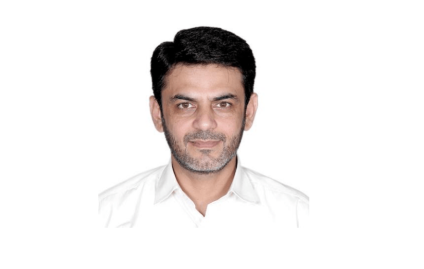
Asif Merchant, accused ringleader of an FBI-managed Iranian plot to assassinate Trump
Iran’s hapless hitman granted special visa, introduced to FBI informant
In April 2024, as Trump launched his comeback presidential campaign, an itinerant salesman named Asif Merchant arrived from Pakistan to George Bush Intercontinental Airport in Houston, Texas. He was quickly flagged as a “Qualified Person of Interest” who’d been placed on a Department of Homeland Security watchlist. Agents from an FBI Joint Terrorism Task Force (JTTF) team then discovered through a search of Merchant’s devices that he had visited Iran, where his wife and adopted son lived. Whether they’d received a tip from Israel, which furnishes reams of intelligence to the FBI on foreign Muslim visitors to the US, remains an open question.
According to JTTF documents obtained by pro-Trump reporter John Solomon, Merchant was “released without incident” and designated as “free to travel to desired destination.” In fact, the FBI had granted him a “Special Public Benefit Parole,” which, as Solomon explained, “would allow agents to try to flip Merchant as a cooperator or try to determine why he was coming to the United States and who he might be working with.”
The FBI whistleblower who provided Solomon with the documents on Merchant’s airport interview compared the “Special Public Benefit Parole” to the scandalous “Fast and Furious” program, in which President Barack Obama’s Department of Justice facilitated the delivery of automatic weapons from US gun dealers to Mexican cartels in order to supposedly surveil the gangs’ criminal activities.
Almost as soon as Merchant entered the US, the FBI introduced him to a confidential informant posing as a potential business partner and operating under the alias, Nadeem Ali. The informant had served as translator for the US military during its occupation of Afghanistan.
Though Merchant did not propose any crimes, the FBI wiretapped a meeting between him and the informant, Ali, in a hotel room on June 3, 2024. There, Merchant was taped making a supposed “finger gun” motion while mentioning an unspecified “opportunity.” This grainy minute-long hidden camera recording is presented as the linchpin of the DOJ’s indictment of Merchant.
According to the FBI, Merchant had outlined a highly complex plot which required the hiring of two hitmen, “twenty five people who could perform a protest after the distraction occurred, and a woman to do ‘reconnaissance.”
For the elaborate flash mob-style assassination extravaganza, Merchant was asked by the informant to fork over a mere $5000. The Pakistani visitor had no means of scrounging up the fee, however, raising further questions about the seriousness of the plot. “I did not think I was going to be successful,” Merchant would later state in court.
Virtually penniless, Merchant was forced to gather the cash from an anonymous “associate,” according to the DOJ indictment. Next, the FBI informant took him on a winding journey from Boston to New York City, where he allegedly handed the money to two other FBI informants posing as hit men. The DOJ claims Merchant made plans to fly to Pakistan on June 12, but was arrested in his residence that day.
Merchant interrogated about Butler, kept incommunicado
The following day, 20-year-old Thomas Crooks arrived at a fairground in Butler, Pennsylvania where former president Trump was scheduled to speak. He flew a drone in the air for 15 minutes, surveying the area as he finalized plans to assassinate the candidate. In an odd coincidence, the Secret Service’s anti-drone system was offline all morning and into the afternoon — until roughly 15 minutes after Crooks flew his drone. When Trump took the stage, Crooks climbed atop a slanted rooftop 130 yards away and fired eight shots at the president, missing his head by an inch, until a local police officer fired back. He was killed by a Secret Service sniper who had inexplicably hesitated to fire for a full 15 seconds.
Thirty hours later, FBI agents flew to Houston to interrogate Merchant in his jail cell about a possible Iranian connection to the assassination attempt in Butler. An FBI source told the Washington Post the Bureau “took the extraordinary step of interviewing him without his lawyer to determine whether he knew Crooks.”
The grilling continued even after Merchant was transferred to the maximum security Metropolitan Detention Center in Brooklyn – the same prison where Luigi Mangione, the accused killer of United Healthcare’s CEO, is currently being held. There, he was held under harsh conditions in solitary confinement, unable to interact with anyone but the guards who brought him food and his lawyers because, as then-Deputy Attorney General Lisa Monaco argued, he might use code words to initiate further assassination plots. “It appeared they thought I was some kind of super spy,” Merchant later reflected.
Not only was Merchant prevented from calling his family in Pakistan, he was blocked from reviewing recordings of conversations he held with undercover FBI informants, as the DOJ had marked them “Sensitive.” In March 2025, his lawyer protested that US Marshals repeatedly refused to allow him to meet with this counsel and review discovery at the courthouse. This, too, was justified on the basis of specious national security grounds.
However, as the journalist Ken Silva discovered, an internal memo by the Bureau Of Prisons Director Colette Peters confirmed that Merchant had no contact with any Iranian intelligence assets in the US. “Law enforcement has not identified any IRGC associates of Merchant operating in the United States who could continue to orchestrate violent acts,” Peters wrote.
Indeed, the only Iranian assassins with whom Merchant appeared to have interacted inside the US were undercover informants working for the FBI.
Merchant “had never been close to realizing” Trump assassination
During his trial this March 4, Merchant’s lawyer, Avraham Moskowitz, took the highly unusual step of allowing his client to take the stand. Merchant proceeded to present a version of events that contrasted sharply with the account he provided in his initial FBI proffer. For example, the defendant claimed he had been coerced into the plot by an IRGC agent, and went forward with a plan “to maybe have someone murdered” only because he feared for his wife and adopted son back in Iran.
After his arrest by the FBI, Merchant said he engaged in discussions with federal authorities about becoming an informant himself, but they ultimately broke down for unknown reasons.
“I was not wanting to do this so willingly,” he insisted in Urdu, adding, “I did not think I was going to be successful.”
In its coverage of the trial, the New York Times concluded Merchant “had never been close to realizing the vision of his Iranian handler.”
But back in 2024, as word spread of Merchant’s arrest, Israel-adjacent figures in Trump’s inner circle exploited the case to exacerbate the candidate’s anxiety about the Ayatollah’s wrath.
Israel-aligned forces blur Butler with Iran
Just three days after Trump’s campaign was nearly ended by a lone American assassin’s bullet in Butler, officials burrowed within the architecture of the national security state took measures to shift the focus to Iran.
“The Biden administration obtained intelligence in recent weeks about an Iranian assassination plot against former President Donald Trump, and the information led the Secret Service to ramp up security around the former president, according to three U.S. officials with knowledge of the matter,” reported NBC’s Ken Dilanian on July 16, 2024. (Dilanian had been fired from his previous gig at the LA Times after he was exposed for allowing the CIA to review his reports before publication).
The unnamed officials were clearly referring to the plot which the FBI manufactured for Merchant. The revelation not only seemed like a cynical attempt to obscure the reality of the near-assassination in Butler, which was conducted by a friendless American man who had never left the country. It also suggested the FBI had been so focused on concocting Iranian plots on American soil that it ignored the years-long trail of YouTube comments left by the would-be assassin bluntly declaring his intention to kill US politicians and police officers, and his hopes to instigate a civil war.
Though FBI leadership misled the public about the nature of the Butler plot, falsely claiming, for instance, that Crooks was not communicating with others online, they were never able to connect it to Iran. This clearly frustrated Rep. Mike Waltz, a close Trump ally seated on the House committee to investigate the Butler plot.
“These plots from Iran are ongoing. And when Biden says nothing, Harris says nothing, the DOJ tries to bury it, what message does Iran get? They get that we can keep trying to take Trump out and have no consequences,” Waltz fulminated on Fox News in August 2024.
Referencing the FBI-manufactured Merchant operation, Waltz thundered, “You have multiple assassination plots from the Iranians. This Pakistani national was recruiting females as spotters. He had recruited hit men and had made a down payment. He was even recruiting protesters as a distraction.”
By this point, Waltz was on his way to a short stint as Trump’s National Security Council Director, where he would help direct a failed war on Iran’s allies among the Ansurallah movement in Yemen. (Waltz was demoted to US ambassador to the UN after he accidentally included the Atlantic Magazine editor-in-chief and former Israeli prison guard Jeffrey Goldberg in a private administration Signal chat where classified information about US attack plans on Yemen was shared).
Throughout his career, the Israel lobby and Netanyahu’s allies had quietly propelled his rise. As AIPAC CEO Elliot Brandt remarked in private comments exclusively revealed by The Grayzone, Waltz was one of Israel’s “lifelines” inside the Trump administration, as he had been groomed by the Israel lobby since he first ran for Congress.
For Waltz and other Israel-aligned figures close to Trump, connecting the Butler incident to Iran appeared to offer a direct path to conflict with Iran. As an unnamed high-level US official told the Washington Post, if Tehran had been found responsible for Crooks’ attempt to kill Trump, “it would mean war.”
Certain foreign actors were also working to steer the US toward blaming Iran for Butler. In the late summer of 2024, the Justice Department received an urgent alert from abroad which connected Crooks directly to IRGC plots to kill Trump. According to the Washington Post, the tip arrived through a “confidential human source overseas” – almost certainly Israeli intelligence.
After a thorough investigation, DOJ officials decided the tip was not credible. “Nothing credibly connected him to Iranian plots,” one official told the Post.
But in the wake of the shooting in Butler, the constant chatter about looming Iranian threats had indelibly altered Trump’s outlook. Reporters who followed Trump on the campaign trail described a palpable sense of panic from the candidate and his inner circle about IRGC-directed hitmen stalking them at every stop.
“Ghost flights” for Trump triggered by imaginary Iran missile threats
With the Trump campaign already consumed with anxiety, the FBI delivered an alert that sent them spiraling into the depths of paranoia.
According to the Bureau, Iran had placed operatives inside the country with access to surface-to-air missiles. This dubious warning prompted Trump’s already militarized security team to take an extraordinary step. Fearing that Iran would down the famous “Trump Force One” airliner at any moment, Trump was placed on a “ghost flight” owned by his golf buddy, real estate tycoon Steve Witkoff, while the rest of his campaign traveled on the main jet.
Joining Trump on the secret decoy plane was his campaign manager, Suzie Wiles, who would go on to become White House chief of staff, controlling access and the flow of information to the president. Unbeknownst to the public, Wiles had served as a paid advisor to Israel’s Netanyahu during his 2020 re-election campaign, consolidating her role as a key point of contact between Tel Aviv and Trump.
Journalist Ken Silva has revealed that the FBI alert which prompted Trump’s use of a “ghost plane” was based on a cynical deception. As Silva explains in his forthcoming book on the assassination plots surrounding Trump, federal investigators had discovered that Routh, the would-be assassin at Mar-a Lago, had attempted to purchase a rocket launcher, and may have been in contact with Iranian nationals during his time in Ukraine. The Bureau likely massaged that information into the bogus report it provided the Trump campaign, conjuring up imaginary Manpad-toting IRGC operatives to exacerbate the candidate’s fears.
Once he entered the Oval Office, Trump was encircled by Israel-aligned advisors and staunchly committed to the belief that Iran had attempted to eliminate him on the campaign trail. As commander-in-chief of the US military, he was hellbent on revenge.
Netanyahu nudges Trump with Butler plot
On June 15, 2025, days after launching an unprovoked war on Iran, Netanyahu took to Fox News to manipulate Trump into joining the assault. The Israeli leader appeared to know exactly which psychological vulnerabilities to exploit.
“These people who chant death to America, tried to assassinate President Trump twice,” Netanyahu declared, asserting without a shred of evidence that Iran was behind both the Butler assassination attempt and the one at Mar a-Lago.
“Do you have intel that the assassination attempts on President Trump were directly from Iran?” a visibly startled Fox News host Bret Baier asked.
“Through proxies, yes. Through their intel, yes. They want to kill him,” stated Netanyahu with a cocksure gaze.
One week later, Trump authorized a series of US strikes on Iranian nuclear facilities in support of Israel’s military assault. Though Trump arranged a ceasefire soon after the attack, Israel’s influence over his administration – and over his psyche – guaranteed that another, much more violent round of conflict was just over the horizon.
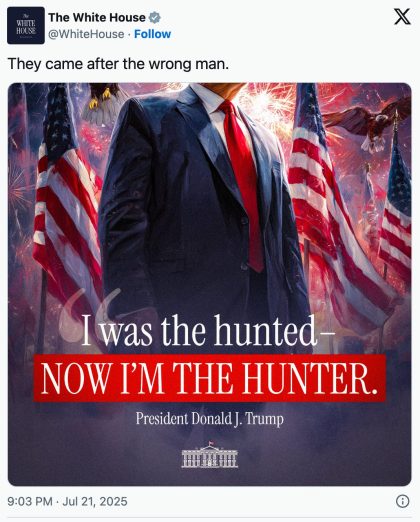
In a graphic promoted by the White House’s official Twitter/X account on July 21, 2025, Trump implied that he had begun to turn the tables on his would-be Iranian assassins: “I was the hunted, and now I’m the hunter,” he declared.
Israel claims to eliminate would-be Trump assassin in Iran
By March 2026, Trump was back to war with Iran. Within four days, the US-Israeli joint assault had predictably expanded into an open-ended regional war following the failure of an opening series of decapitation strikes to induce regime change.
On the afternoon of March 4, the glowering US “Secretary of War” and former Fox News personality Pete Hegseth appeared before a lectern at the Pentagon and vowed to unleash “death and destruction from the sky all day long” over the people of Iran.
As his cartoonishly violent screed built to a crescendo, Hegseth issued a dramatic announcement: “The leader of the unit who attempted to assassinate President Trump has been hunted down and killed. Iran tried to kill President Trump, and President Trump got the last laugh.”
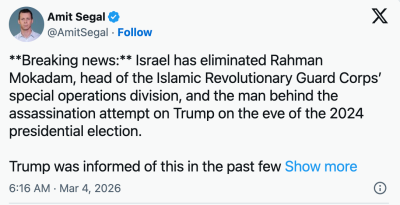
Though Hegseth did not name the figure, an Israeli journalist who functions as one of Netanyahu’s favorite stenographers, Amit Segal, revealed that Israel had assassinated an IRGC official named Rahman Mokadam who was supposedly responsible for directing a plot to kill Trump. But once again, the details of the plot revealed layers of FBI chicanery, confidential informants masked as “co-conspirators,” and a compromised witness.
In fact, the supposed assassination plan which Mokadam was accused of directing did not initially focus on Trump. Instead, the target was said to be Masih Alinejad, an Iranian expat and regime change activist on the US government payroll. The only evidence that Trump was a possible target at all came from the claims of a convicted drug dealer and con man named Farhad Shakeri, who had also been a defendant. Shakeri spoke to the FBI by telephone from Iran, providing dubious information in exchange for a reduced prison sentence for an unnamed associate in the US.
It was during these remote interviews that Shakeri seemingly claimed he had an IRGC handler who had directed him to kill Trump. But according to the FBI’s criminal complaint against him, that handler’s name was “Majid Soleimani,” not Mokadam.
The FBI agent who interviewed Shakeri clearly recognized his penchant for fabulism, writing that “certain of Shakeri’s statements appear to be true and others appear to be false.” Shakeri had indeed lied throughout his interviews, yet the agent still concluded that “it appears” he was planning to kill Trump. He did not explain why he considered the confession credible, and the allegation about a plot to kill Trump was notably absent from the grand jury indictment filed a month later.
After killing Mokadam on March 4, the Israelis went straight to the president to boast of their supposed achievement – and reignite his anxiety about Iranian assassins.
As Amit Segal noted, “Trump was informed of this in the past few hours by Israel.” In doing so, the Israelis reinforced Trump’s sense that he had been hunted by Iran – and that by fighting their war, he was saving his own skin.
As it had in the past, the White House posted a video on its official Twitter/X account proclaiming Trump’s triumph over Iranian assassins: “I WAS THE HUNTED, AND NOW I’M THE HUNTER.”
Thomas Crooks may have narrowly missed Trump’s cranium in Butler, Pennsylvania, but Israel had found a way into the president’s head.
At The Munich Security Conference, AOC Gets It Wrong On Foreign Policy
The Dissident | February 13, 2026
Democratic representative Alexandria Ocasio-Cortez recently appeared at the Munich Security Conference- supposedly to showcase her foreign policy knowledge- in what many believe may be the lead up to an eventual presidential run in 2028.
Unfortunately, what AOC showcased was that, while being critical of aspects of U.S. foreign policy, she gets it dead wrong on issues ranging from NATO to USAID to Iran to Ukraine.
Calling To Fund A CIA Cutout
While AOC called out some U.S. hypocrisy around the claim of a “rules-based international order”, she still gave credence to the idea that such a thing even exists, or that the U.S. is concerned with human rights and democracy around the world.
At one panel, she said , “That does not mean that the majority of Americans are ready to walk away from a rules-based order and that we’re ready to walk away from our commitment to democracy.”
This apparently includes support for so-called U.S. “democracy promotion” initiatives such as the CIA cutout USAID, which AOC called to support at two different conferences.
When asked at the aforementioned panel, “Are there any particular institutions that a democratic administration would want to save?”, AOC replied, “ first and foremost, I think we need to revisit our commitments to international aid not just USAID but the the dozens of global compacts that the current secretary of state and President Trump have withdrawn from” adding, “They are looking to withdraw the United States from the entire world so that we can turn into an age of authoritarianisms of authoritarians that can carve out the world where Donald Trump can command the Western Hemisphere and Latin America as his personal sandbox where Putin can saber rattle around Europe and and try to bully around our own allies there.”
At another panel, AOC complained that the Trump administration was playing “hokey pokey with USAD”.
In reality, USAID and other “aid organizations” such as the National Endowment for Democracy are used to meddle in the domestic affairs of countries that do not bow down to U.S. demands, including by attempting to undermine democratically elected governments.
Foreign Policy magazine wrote in 2014 , “Foreign governments have long accused the U.S. Agency for International Development of being a front for the CIA or other groups dedicated to their collapse. In the case of Cuba, they appear to have been right.”
The magazine added, “In an eye-opening display of incompetence, the United States covertly launched a social media platform in Cuba in 2010, hoping to create a Twitter-like service that would spark a ‘Cuban Spring’ and potentially help bring about the collapse of the island’s Communist government” adding, “It was a digital Bay of Pigs, but it was funded by USAID, an arm of the government dedicated to doing good work in bad places, not by the CIA.”
The outlet noted that this was far from the only time USAID has been used as a tool of U.S. regime change, writing:
Venezuelan President Hugo Chavez frequently and famously accused the United States of covertly trying to overthrow him, but only after his death did evidence emerge to support his seemingly paranoid claims. A WikiLeaks cable released in 2013 outlined the U.S. strategy for undermining Chavez’s government by “penetrating Chavez’s political base,” “dividing Chavismo,” and “isolating Chavez internationally.” The strategy was to be carried out by USAID’s Office of Transition Initiatives, the same office responsible for developing “Cuban Twitter,” and involved funding opposition organizations in Venezuela.
USAID has also played a role in funding the 2004 coup against Haiti’s elected president Jean-Bertrand Aristide, the 2014 coup against Ukraine’s elected president Viktor Yanukovych, the 2018 coup attempt against Nicaragua’s president Daniel Ortega, and the 2024 judicial coup against Romanian presidential candidate Calin Georgescu.
Claiming NATO Stops Regime Change Wars
At one of the Munich Security panels, AOC claimed that the “Trans-Pacific Partnership”, later clarifying that she meant transatlantic partnership, i.e., alliances like NATO would somehow stop, “the installation of regional puppet governments”.
AOC claimed, “it actually is the Trans-Pacific Partnership. It is our global alliances that can be a hard stop against authoritarian consolidation of power, particularly in the installation of regional puppet governments.”
In reality, the “transatlantic partnership” through NATO, since the end of the Cold War, has done nothing but regime change wars to overthrow unfriendly governments and install puppets.
In 1999, NATO bombed Serbia and Kosovo in what was billed as a humanitarian intervention to save Albanians in Kosovo from the Serbian authorities, but in reality, it was an orchestrated regime change war against Slobodan Milosevic.
As James Bissett, the former Canadian ambassador to Yugoslavia, explained , “Media reports have revealed that as early as 1998, the central intelligence agency assisted by the British Special Armed Services were arming and training Kosovo Liberation Army members in Albania to foment armed rebellion in Kosovo. The KLA terrorists were sent back into Kosovo to assassinate Serbian mayors, ambush Serbian policemen and do everything possible to incite murder and chaos. The hope was that with Kosovo in flames NATO could intervene and in so doing, not only overthrow Slobodan Milosevic the Serbian strong man, but more importantly, provide the aging and increasingly irrelevant military organization with a reason for its continued existence.”
Following this, NATO intervened in Afghanistan and did exactly what AOC claimed it would prevent: it occupied the country and propped up a puppet government.
Journalist Seth Harp meticulously documented in his book “The Fort Bragg Cartel: Drug Trafficking and Murder in the Special Forces” that the NATO propped up government led by CIA asset Hamid Karzai was “the world’s leading narco-state, with an economy almost entirely dependent on the drug trade”.
NATO then overthrew Libyan leader Muammar Gaddafi, one of the key planks in the greater Zionist/Neo-Con clean break plan for greater Israel.
While the intervention was billed as a humanitarian intervention to stop Muammar Gaddafi from slaughtering innocent civilians and to support moderate rebels, a 2015 UK parliament report later admitted that “the proposition that Muammar Gaddafi would have ordered the massacre of civilians in Benghazi was not supported by the available evidence” and “It is now clear that militant Islamist militias played a critical role in the rebellion from February 2011 onwards”.
The CIA then used Gaddafi’s weapons stockpile to further the next regime change war on the “clean break” hit list in Syria with journalist Seymour Hersh reporting that following the fall of Gaddafi, the CIA “authorised a rat line in early 2012” which was “used to funnel weapons and ammunition from Libya via southern Turkey and across the Syrian border to the opposition” noting that, “Many of those in Syria who ultimately received the weapons were jihadists, some of them affiliated with al-Qaida”.
Repeating CIA/Mossad Talking Points About Iran
While AOC did oppose bombing Iran at the behest of Israel, she repeated CIA and Mossad talking points without giving vital context before doing so.
When asked, “Would you support direct U.S. military strikes on Nuclear facilities if direct negotiations fail with Iran?” AOC responded, “I think that that is a dramatic escalation that no one in the world wants to see. Right now what the Iranian regime is doing particularly with respect to protesters is a horrific slaughter of some estimates have tens of thousands of people.”
The claims of “tens of thousands of people” killed by the Iranian government during protests comes from biased sources openly supporting war with Iran, such as Amir Parasta a German-Iranian eye surgeon who is a lobbyist for the Israeli opposition puppet Reza Pahlavi and the outlet Iran International, which Israeli journalist Barak Ravid said , “the Mossad is using… quite regularly for its information war”.
In other words, AOC opposing war with Iran but repeating the claim of “tens of thousands dead” is akin to saying in 2002, “I oppose war with Iraq, but Saddam definitely has WMDS”.
Furthermore, AOC missed an opportunity to give some vital context on the protests in Iran.
For one, she did not mention that U.S. Treasury Secretary Scott Bessent twice boasted that the protests in Iran were caused by U.S. sanctions on the country’s economy, saying:
President Trump ordered treasury and our OFAC division, (Office of Foreign Asset Control) to put maximum pressure on Iran, and it’s worked because in December, their economy collapsed, we saw a major bank go under, the central bank has started to print money, there is a dollar shortage, they are not able to get imports and this is why the people took to the streets.
What we can do at treasury, and what we have done, is created a dollar shortage in the country, at a speech at the Economic club in New York in March I outlined the strategy, it came to a swift -and I would say grand- culmination in December when one of the largest banks in Iran went under, there was a run in the bank, the central bank had to print money, the Iranian currency went into free fall, inflation exploded and hence we have seen the Iranian people out on the street.
(Emphasis: Mine)
Furthermore, AOC missed an opportunity to list the mountains of evidence that the CIA and Mossad infiltrated the protests to turn them in a violent and pro-regime change direction.
This includes:
- A Mossad-connected X account in Persian boasting, “Let’s all come out to the streets. The time has come. We are with you. Not just from afar and verbally. We are also with you in the field.”
- Former Secretary of State, Mike Pompeo wishing a “Happy New Year to every Iranian in the streets. Also to every Mossad agent walking beside them.”
- Israel’s Channel 14 reporting that “foreign actors are arming the protesters in Iran with live firearms, which is the reason for the hundreds of regime personnel killed.”
- Former head of the Military Intelligence Directorat in Israel, Tamir Hayma, saying, “There is currently a very significant influence operation by the US” in Iran.
- The Financial Times reporting that, “Another witness in western Tehran told the FT he saw about a dozen fit men, ‘looking like commandos’, dressed in similar black clothing, running through the area and calling on people to leave their homes and join the protests. ‘They were definitely organised, but I don’t know who was behind them,’ he said.”
- Mossad connected Israeli journalist Yonah Jeremy Bob cryptically writing , “Only after the air is clear will the full story of the Mossad’s involvement likely be cleared to be told. But when it comes to the Mossad and Iran, there is always far more than meets the eye”.
- Israel’s Heritage Minister Amichai Eliyahu boasting , “When we attacked in Iran during ‘Rising Lion’ we were on its soil and knew how to lay the groundwork for a strike. I can assure you that we have some of our people operating there right now”.
Supporting The Ukraine Proxy War
When asked about the proxy war in Ukraine, AOC said, “there’s no conversation about Ukraine that can happen without Ukraine, and so they of course lead in terms of setting their terms on this, but I think that overall as a principle, we shouldn’t reward imperialism. And I don’t think that we should allow Russia to continue or any nation to continue violating a nation’s sovereignty and to continue to be rewarded”.
This was a strong signal in support of continuing the proxy war in Ukraine.
At no point did AOC mention that in 1997, veteran diplomat George F. Kennan warned that NATO expansion eastward would “be expected to inflame the nationalistic, anti-Western and militaristic tendencies in Russian opinion; to have an adverse effect on the development of Russian democracy; to restore the atmosphere of the cold war to East-West relations, and to impel Russian foreign policy in directions decidedly not to our liking” a view he said was “not only mine alone but is shared by a number of others with extensive and in most instances more recent experience in Russian matters.”
Nor did she mention that former U.S. ambassador to Russia, William Burns, warned in 2008 that, “Ukraine and Georgia’s NATO aspirations not only touch a raw nerve in Russia, they engender serious concerns about the consequences for stability in the region. Not only does Russia perceive encirclement, and efforts to undermine Russia’s influence in the region, but it also fears unpredictable and uncontrolled consequences which would seriously affect Russian security interests. Experts tell us that Russia is particularly worried that the strong divisions in Ukraine over NATO membership, with much of the ethnic-Russian community against membership, could lead to a major split, involving violence or at worst, civil war. In that eventuality, Russia would have to decide whether to intervene; a decision Russia does not want to have to face”.
AOC did not mention the Maidan coup in 2014, which, as Ukrainian political scientist Konstantin Bondarenko noted, was carried out because “The West, however, did not want a Ukrainian president who pursued a multi-vector foreign policy; the West needed Ukraine to be anti-Russia, with clear opposition between Kyiv and Moscow. Yanukovych was open to broad cooperation with the West, but he was not willing to confront Russia and China. The West could not accept this ambivalence. The West needed a Ukraine charged for confrontation and even war against Russia, a Ukraine it could use as a tool in the fight against Russia this was why Western politicians, diplomats, and civil society representatives actively supported the Euromaidan (coup against Yanukovych) as a mechanism for overthrowing Yanukovych, even going as far as providing financial support for the ‘revolutionary’ process”.
She similarly ignored the recent bombshell admission from Biden Administration official Amanda Sloat, who said :
We had some conversation even before the war started, about what if Ukraine comes out and just says to Russia, ‘fine, you know, we won’t go into NATO if that stops the war, if that stops the invasion,’ which at that point it may well have done.
I guess if you want to do an alternative version of history, one option would have just been for Ukraine to say in January of 2022, ‘fine, you know, we won’t go into NATO, we will stay neutral.’ Ukraine could have made a deal around March/April of 2022 around the Istanbul talks
There is certainly a question, almost three years on now, would that have been better to do before the war started, would that have been better to do in Istanbul talks, it certainly would have prevented the destruction and the loss of life.
Nor did AOC mention the fact that Russia and Ukraine agreed to end the war in April of 2022, but the deal was blocked by then UK Prime Minister Boris Johnson at the behest of the collective West.
Through all of her answers, AOC showed she is not serious about being anti-war and will undoubtedly give in to the foreign policy establishment on many issues.
American Zionists are using Trump’s Republican Party to create a multicultural supremacist elite

By Matt Wolfson | Al Mayadeen | February 2, 2026
On January 13, 2025, seven days before Donald Trump’s second inauguration as president, The Free Press, the online magazine created by the Zionist operator Bari Weiss who has powerful connections to the Trump Administration, ran a profile which may say more about the ultimate causes of America’s current policies, and where those policies will likely lead, than any other public document.
The profile was of Amy Chua, famously the author of Battle Hymn of the Tiger Mother, a mostly well-received cri de Coeur for what Chua sees as rigorous Chinese parenting; and less famously the John M. Duff, Jr. Professor of Law at Yale Law School. The profile, drawing explicitly on Chua’s most publicly recognizable achievement, was titled “The Tiger Mother Roars Back,” and its subtitle reinforced its approach, an ardent rave: “Yale tried to run Amy Chua out. Now her former students, J.D. Vance and Vivek Ramaswamy, are headed to Washington. So is she.”
For people who follow the politics of America and so of America’s empire, the forwardness of this profile raises questions. Construed as a gesture of support for two politicians, Vance and Ramaswamy, who are attempting to woo the public on populist credentials, it seems misthought. There is nothing populist about Chua—and her lacks are tells about the lacks of her mentees. Indeed, it was under Chua’s mentorship that Vance wrote a bestselling book with the encouragement of another Chua mentee, Vance’s future wife Usha, blaming the failures of his lower-income Appalachian upbringing on the “cultural” deficiencies of the community which raised him. This is a view that, since entering politics with the aim of appealing to precisely that community, he has quickly disavowed. Ramaswamy, for his part, has fallen deeply and predictably afoul of populist Americans precisely by making that case in public.
So why would Weiss, who if nothing else is a strategic operator, run a piece on Chua connecting her to Vance and Ramaswamy as well as broadcasting Chua’s views, which are anathema to the people from whom Vance and Ramaswamy want support?
The answer is that, though Weiss is an ideologue focused on advancing “Israel’s” immediate interests, there is a “positive,” longer-term Zionist play in the works among her and her allies. I have reported in miniature on this play last year, in a September investigation of the philanthropic education donations of Bill Ackman, the Zionist financier: to seed a new ruling elite based on technological and management skills. But the project goes deeper. It amounts to the legitimation of a new ruling class in America centered on a narrow cadre of elites of three groups— Zionists, Hindutvas (Hindu supremacists), and, discernably but least specifically definably, East and Southeast Asian supremacists often with connections to countries where Buddhism has exercised significant influence.
These elites use their present success in America’s military corporate complex to make claims to group superiority. They then use those claims to justify special treatment for their groups and nations that allow them to solidify their power, and to solidify the hold of American empire, which they see as the rightful disseminator of “merit.” Their accelerating project will likely realize itself through the Republican Party, via Chua’s mentees, the Vances and Ramaswamy, among others, and it may ally itself with other right-wing influences as seemingly dissimilar but actually imitative as the white supremacy of Nicholas J. Fuentes. It is only now taking recognizable shape, and understanding its origins and spread is crucial to understanding the havoc it is already beginning to wreak in America and abroad.
That understanding begins with examining the arguments which influenced Vance and Ramaswamy; arguments made by Amy Chua and Jed Rubenfeld, her husband, a Yale Law professor and Jewish Zionist who writes for The Free Press. These arguments are noteworthy in that they look for “warps” in cultures to explain problems which other scholars have put down to military corporate power and its brute effects (outsourcing, conglomeration, the Wars on Crime and Drugs, unauthorized and some kinds of authorized immigration) on American life.
Indeed, the most straightforward reason why Vance’s Appalachian Americans as well as Black and Latino Americans have notably struggled is American imperial policy that has started at the top: labor outsourcing and urban mis-development, misthought immigration policies, and military corporate buildup. These policies have accrued for 60 years, and academics and writers have made the case against them for almost 50.
This book of Chua and Rubenfeld’s, where they lay out their view (The Triple Package: How Three Unlikely Traits Explain the Rise and Fall of Cultural Groups in America) does not emphasize these structural, practical explanations. Instead, Chua and Rubenfeld put “winners’” success in America over the last sixty years down to three group traits: specifically, “a superiority complex,” “insecurity,” and “impulse control.” According to The Triple Package, “a superiority complex” means “a deeply internalized belief in your group’s specialness, exceptionality, or superiority” flowing from religion, civilization, or social traits. “Insecurity” means “a sense of being looked down on, a perception of peril, feelings of inadequacy, and a fear of losing what one has.” And “impulse control” means “the ability to resist… the temptation to give up in the face of hardship or quit.”
But the paradox of Chua’s and Rubenfeld’s explanation, which they don’t appear to realize, is that, taken logically on its face, it supports the structural, practical explanations they apparently ignore. Political theory and history show that groups in the grip of triple package holders’ emotional Cartesianism (possessing an a priori thesis, superiority, in the face of insecurity, and so willing to do anything to prove the thesis right) are reliable tools of arbitrary imperial power. Indeed, empires moving aspirant, insecure, determined groups into their own managerial elite is a defining feature of the Roman Empire; the British Empire in the American colonies and India; the German Empire; and the United Arab Emirates. In America’s empire, these co-opted groups have most prominently been the three which Chua and Rubenfeld write about most often and with whom they and their family most identify: Jewish Americans, Indian Americans, and East and Southeast Asian Americans.
All three of these groups experienced marginalization and persecution at the hands of various empires (the Russian and German; the British; the American) before 1950. Their members have attendantly experienced heightened levels of insecurity; and elite cadres of two of the three groups have adopted what most scholars consider to be clearly definable supremacist ideologies: Zionism, which was founded in 1897 and Hindutva ideology, which was founded in 1925. The third type of supremacy, East and Southeast Asian supremacy, is more diffuse but clearly discernable.
Unlike Zionism, which is linked to “Israel”, and Hindutva ideology which is linked to India, there are multiple countries at play and multiple labels under which claims of East and Southeast Asian supremacy are raised. Also, the way these claims are raised often surfaces less as outright supremacy and more as “cultural essentialism”—that there’s something in this group’s cultural “essence” that makes members more “successful.” Finally, research into outright supremacist manifestations from groups associated with them is more recent, usually under the headings of Buddhist or East Asian supremacy. Nonetheless, taking these distinctions into account, East and Southeast Asian success in America’s imperial complex and corresponding claims like Chua’s to superiority are recognizable trends: some of them embraced by supremacists who praise thinkers like Chua for what critics call their cultural supremacy.
I have reported at some length about how the process of these groups claiming power in American empire played out, beginning with Jewish Zionist elites in the 1960s. I examined these Zionist elites’ acceptance into the American military corporate complex by WASPs (White Anglo-Saxon Protestants). I also pointed out that Zionists’ overall success accessing this complex came from their pursuit of narrow applied skills valued by the WASPs: economics, management theory, administrative law, engineering, finance, and technological proficiencies; a model the WASPs took quite consciously from European Empires. Zionists, in their own description, were easy marks for this kind of invitation to power that ultimately deracinates the culture of the people who accept it.
Theodor Herzl, the founder of the movement who embodies the terms of its successes and failures, was a marquee possessor of Chua’s and Rubenfeld’s triple package. He had grown up a secular Jew with little connection to his religion but a strong sense of his own superiority, and only embraced Zionist Judaism with a manic intensity when the Dreyfus Affair made him decide that he could never realize his ambitions without identifying as Jewish.
An instructive echo of Herzl’s mentality comes in the memoir of Martin Peretz, one of the early entrants into America’s corporate complex in the 1960s. Peretz, who taught at Harvard, owned The New Republic, the most influential Zionist magazine in the country, and played a prominent connective role in and near Wall Street, is in many senses a later-day Herzl. He is a high-status secular Jew with an admitted sense of insecurity who is also a fervid Zionist, and he writes in his memoir about himself and his friends who “made it” that
We were… from a strong culture that was an outsider culture, in the first generation when that culture could assert itself in American institutions. We weren’t constrained by old obligations because we were coming into a world that didn’t want us anyway. We had each other’s backs because we knew the kind of resentment arrivistes, and Jewish arrivistes, unleashed… We were the first ethnicity to break through into the ruling class institutions following the wane of Protestant influence, and we saw those institutions as the key to our flourishing.
Peretz’s Harvard mentee, Bill Ackman, the Zionist financier, is a good example of how younger Zionists operating in Herzl’s and Peretz’s tradition have swallowed this model whole. Ackman’s view of Harvard, where he is also a donor, falls along just these lines of imperial functionality:
As one of the oldest and perhaps the most notable of this country’s academic institutions, Harvard represents the gateway to elite status and to ‘making it’ in modern day American society. One need only look at the disproportionate numbers of Presidents, Nobel Laureates, and chairmen of Fortune 500 companies who have graduated from Harvard to understand the power of the Harvard degree. As a result, admission to Harvard has become the target of groups seeking upward mobility.
What goes unacknowledged here is that “elite status,” “upward mobility” and the skills that create them have only been an aspiration for most Americans since 1945, when the Cold War allowed WASPs to expand their institutions and use them to try to mold the country in their image. Before this point, most Americans understood their country as being predicated on towns and cities and states; and on a high degree of associational thickness, communal coherency, and decentralized government which allowed individuals a say in the terms of their lives. But Zionists were never open to an argument like this. Their strategy, like Herzl’s, was to enter empire and use it to rise, and it is not a coincidence that, almost immediately on accessing America’s military corporate complex, they opened America’s doors to Hindu and East and Southeast Asian operators who approached the matter of institutions and power on their terms.
The Zionists’ tool was the 1965 Immigration and Nationality Act, which was sponsored by staunch Jewish Zionist Congressman Emmanuel Celler. The Act opened America’s elite universities to “high-skilled,” often upper-middle class arrivals from undemocratic or less democratic countries like India and China: people not particularly versed in constitutionalism but extremely well-versed in applied technical proficiencies valued by empire.
The most obvious beneficiaries were Hindu Americans. It was the 1965 legislation and its 1990 expansion by George H.W. Bush, the penultimate WASP president, which brought into this country the parents of Usha Vance; Vivek and Apoorva Ramaswamy; the pro-Zionist Republican operative and current Assistant Attorney General for Civil Rights Harmeet Dhillon; and the U.S. Representatives Ro Khanna, Raja Krishnamoorthi, and Suhas Subramanyam. More decisively, as I reported in December, it has brought into the defense-tech mecca of Silicon Valley aggressive Hindu financial operators who have deep political sway. Much as, in the telling of anti-Zionist Jews like Norman Finkelstein, the converging success of Israelis and American Zionists off the largesse of America’s imperial complex hardened these players’ Zionistic belief in their Jewish supremacy, so a similar trend appears to have taken place with American Hindus who adopt some version of Indian Prime Minister Narendra Modi’s Hindutva ideology. Their influence, as outlined by Andrew Cockburn in a groundbreaking article in Harpers, reaches deep and wide, in part through their connections to Zionists.
Somewhat more subtle than the Hindutva assumption of influence in America, but equally noteworthy has been the East and Southeast Asian, especially Chinese, accrual of influence here. WASPs had used their educational and financial influence to foster relationships with China going back to the 1870s. Later, Zionists took up that task: bringing Chinese elites into philanthropy and finance, aided by the 1965 legislation, which led to a sharp increase in high-skilled East and Southeast Asian immigration to America. Arguably the clearest window onto this process is the Committee of 100: a group with connections to Amy Chua founded in the late 1980s by influential Chinese Americans at the urging of Peretz ally and “Israel” defender Henry Kissinger, and with the aid of Peretz’s friend Yo-Yo Ma. As I traced in my report last year on the Committee’s growth, the Committee and some of its members have assiduously inserted themselves at crucial educational and philanthropic junctures. As I reported about their propaganda last April:
The obvious part of their message is that… America is a colorblind nation where, minus prejudice, anyone can succeed. In this schema, anyone questioning the loyalties or actions of those who have succeeded, like [members of the Committee] and their allies, are acting off of lower motives, and are anti-merit.
What is also instructive is that, despite vocal pushback to Chua’s ideas by regular readers, prominent East and Southeast Asian Americans and East Asian American organizations, including but not limited to the Committee of 100, have embraced Chua since she gained fame with her ideas and given her a public platform. Allies of Chua’s echo her arguments in a gentler way, among them the Chinese-American writer Sherryl WuDunn, a connection of Chua’s via other East Asian American organizations, whose husband Nicholas Kristof made a less constrictive, “essentialist” version of Chua’s cultural supremacist arguments in The New York Times. And cultural, ethnic, and even racial supremacists like the neoconservative Charles Murray have embraced Chua’s claims.
Jewish Zionists have been forging alliances with Hindu and East and Southeast Asian American arrivals at an accelerating rate for nearly 40 years. They have used these groups’ shared success to argue that any opposition to those groups with an outsized place in America’s military corporate complex comes from resentment and envy among people who don’t measure up.
In 1988, only 23 years after the Immigration and Nationality Act was signed, two years before the inception of the Committee of 100, and eight years before the Silicon Valley boom began, Bill Ackman, on the advice of his Harvard mentor Peretz, wrote an honors thesis entitled “Scaling the Ivy Wall: The Jewish and Asian Experience in College Admissions.” In the thesis, Ackman “draws parallels between the experience of Jews trying to gain admission to Harvard in the 1920s with the experience of applicants from Asia during the 1980s.” In 2024, gearing up for his crusade against anti-Zionism in universities, Ackman began making the rounds of newspapers, magazines, and online interviews, armed with his undergraduate thesis, arguing that the groups he wrote about in the 1980s (Jews and Asians) are technical achievers being discriminated against by opponents of merit.
That same year, Ackman’s ideological ally Bret Stephens featured in his Zionist magazine Sapir a piece quoting Ackman’s 1988 thesis by an ardent backer of Ackman’s ardent ally Vivek Ramaswamy: Rajiv Malhotra, arguably the most prominent Hindutva operating outside of India. Malhotra began this essay, an argument for “A Hindu Jewish Partnership”, by arguing that, like Asian Americans and Jews, Hindu Americans are “‘model minorities’ who have made much of the American dream” and must come together “to safeguard the world from the regressive movement against merit.” This notion that any resentment against those groups which seem to be steering American Empire flows from jealousy or resentment is shared by Amy Chua, who said, in a recent interview, that
There is tremendous resentment, fear, and insecurity about Asian-Americans because of college admissions… And then you’ve got China, a whole different source of insecurity.… Now on campus, I noticed that this anti-Chinese resentment slash fear is coming from both the Left and the Right, which is very unusual.
Tellingly, none of these arguments about “safeguarding merit” define merit as anything other than technical skills fit for empire, and this is not a bug but a feature of supremacist argument. Jewish, Hindu, and East and Southeast Asian supremacists justify their traditions based on their ability to impart skills that help empires claim power. Examples of this pattern range from Hindutvas who boast that “ancient Indians were proficient in stem cell technology and built aircrafts” in “an imagined Hindu golden age of scientific progress,” to equally remote Zionist narratives claiming that consumer innovations of all kinds originated with “Israel” to Amy Chua’s “conceptually loose” and factually dubious appropriation of her “meretricious” heritage for raising “successful” children. None of these arguments address the arguments of dissenters from within their traditions who think that, by attaching their traditions to a project of empire based on technical skills, supremacists have distorted the moral, intellectual, and cultural essences that made these traditions worth having. The most accurate description of the supremacists may in fact be “ethnopreneurs”: players who use their groups’ access to empire to show a public they assume is aspirant how to be like them, gaining recognition or profit by doing so.
The supremacists also have imitators, sometimes in the most seemingly unlikely of places. It was Nicholas J. Fuentes, nominally on the other side of the new Republican coalition from Ramaswamy and Chua and Rubenfeld and Weiss, who recently told Piers Morgan that “In Israel, they have my politics. If they had their way, it would only be Jewish people.” In fact, in “Israel”, it’s not Jewish people who are welcome; it’s only Jews openly committed to Jewishness as an imperial supremacist project, much as Fuentes is openly committed to an imperial supremacist project around white male Americans whom he says are victimized based on the superiority of their race.
Chua’s mentee J.D. Vance appears to be working to stabilize the Republican coalition in ways that may function, whatever his intent, to unite the supremacists. Even as Vance speaks implicitly in favor of including Nick Fuentes in the Republican Party and Vance’s ally Tucker Carlson gives Fuentes a platform, Vance’s most prominent ally, Erika Kirk, who is publicly committed to his 2028 presidential bid, is appearing in interviews with Zionists like Bari Weiss and Andrew Ross Sorkin. Vance only recently helped ink the deal that put Zionists, including Jared Kushner and the Ellisons, in control of TikTok; and in 2025 both Vance’s wife Usha and his mentor Chua gave rare, exclusive interviews to Weiss’s Free Press, which the Ellisons now own.
This year, Vance is scheduled to appear on CBS’s new Town Hall series, where he will be interviewed by Weiss. This looks like the rudiments of a new coalition of elites with nominally different heritages united by a shared conviction of supremacy. And policy is following suit to privilege these elites—not so much shrinking the “deep state” as Trump promised during his reelection campaign but redirecting it in ways that serve their interests:
“Israel”, with American support, is “modernizing” and “improving” Latin America and the Middle East using its technical prowess, compromising the sovereignty of nations and regions. Hindutva ideologists are coming to Silicon Valley, where Zionists arbitrate power. East and Southeast Asians are entering the Ivy League in record numbers with the aid of lawsuits from Zionist operatives, even as the Trump Administration has made no effort to shrink these universities’ power as the “gateway” to political influence.
The Muslim world, arguably Zionists’ and Hindutvas’ and Buddhist East Asians’ greatest enemy, has become our enemy. American Zionist operatives are using artificial intelligence to track anti-Zionist opinions online in conjunction with imperial outgrowths like Harvard in ways that sound quite similar to the Hindutva ideologue Rajiv Malhotra’s proposal in the Zionist magazine Sapir for an “Intellectual Iron Dome” in imitation of Israel’s defense system the Iron Dome. (This is a project seemingly imitative of Philip K. Dick’s dystopian novella The Minority Report: “to harness the powers of AI… to monitor and examine trends in antisemitism and Hinduphobia online and predict problems before they manifest.”) And, thanks to the Zionist Stephen Miller, the Trump Administration is deporting migrants of color while deracinating their “sh**hole” countries of oil in the name of serving the people for whom Fuentes claims to speak. Namely, a mostly white American population now “freed” from “third world” “leeches, killers, and entitlement junkies” but indentured in the same servitude to the military corporate elite.
In the face of unrelenting infiltration by these colonial supremacists of all sorts in pursuit of their own global Raj flowing from America, anti-imperial resistance at home and abroad, using law and popular politics, is the only sensible path.
In 2007, Michael Parenti Called Out The Greater Israel Project
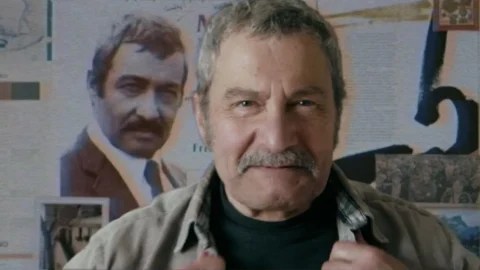
The Dissident | January 28, 2026
In my last article, I covered the left-wing scholar Michael Parenti- who passed away at the age of 92 this week- and his prophetic writings on the Ukraine proxy war in 2014.
Parenti’s writings on the Israel lobby and the greater Israel project were equally prophetic.
In his 2007 book “Contrary Notions” Parenti called out “Israel First” Neo-cons and Israel’s role in the Iraq war, and predicted to a tee the future Israeli/American wars in the Middle East in service of Greater Israel and the ethnic cleansing of Palestine.
In a section of the book aptly titled “Israel First”, Parenti wrote:
The neoconservative officials in the Bush Jr. administration — Paul Wolfowitz, Douglas Feith, Elliot Abrams, Robert Kagan, Lewis Libby, Abram Shulsky, and others — were strong proponents of a militaristic and expansionist strain of Zionism linked closely to the right-wing Likud Party of Israel. With impressive cohesion these “neocons” played a determinant role in shaping U.S. Middle East policy. In the early 1980s Wolfowitz and Feith were charged with passing classified documents to Israel. Instead of being charged with espionage, Feith temporarily lost his security clearance and Wolfowitz was untouched. The two continued to enjoy ascendant careers, becoming second and third in command at the Pentagon under Donald Rumsfeld.
For these right-wing Zionists, the war against Iraq was part of a larger campaign to serve the greater good of Israel. Saddam Hussein was Israel’s most consistent adversary in the Middle East, providing much political support to the Palestinian resistance. The neocons had been pushing for war with Iraq well before 9/11, assisted by the wellfinanced and powerful Israeli lobby, as well as by prominent members of Congress from both parties who obligingly treated U.S. and Israeli interests in the Middle East as inseparable. The Zionist neocons provided alarming reports about the threat to the United States posed by Saddam because of his weapons of mass destruction.
Indeed in 1996, Neo-cons who later ended up in the Bush administration named by Parenti, including Douglas Feith, wrote a latter to Benjamin Netanyahu who was the newly elected Prime Minister of Israel which urged him to “focus on removing Saddam Hussein from power in Iraq — an important Israeli strategic objective in its own right”.
This plan eventually turned into an Israeli-backed plot to “take out seven countries in five years, starting with Iraq, and then Syria, Lebanon, Libya, Somalia, Sudan, and, finishing off, Iran”, in order to isolate Palestinians and make Israel the dominant power in the Middle East.
As U.S. General Wesley Clark later revealed , the idea behind these wars was, “if you want to protect Israel, and you want Israel to succeed… you’ve got to get rid of the states that are surrounding”.
This too was predicted by Michael Parenti to a tee, who wrote, “The neocon goal has been Israeli expansion into all Palestinian territories and the emergence of Israel as the unchallengeable, perfectly secure, supreme power in the region”, “This could best be accomplished by undoing the economies of pro-Palestinian states, including Syria, Iran, Libya, Lebanon… “A most important step in that direction was the destruction of Iraq as a nation, including its military, civil service, police, universities, hospitals, utilities, professional class, and entire infrastructure, an Iraq torn with sectarian strife and left in shambles.”
Indeed, as Parenti correctly predicted, the clean break policy went through with the 2006 Israeli invasion of Lebanon, the 2011 NATO regime change war in Libya, 2011 dirty war in Syria, and the ongoing hybrid war on Iran.
As Columbia University professor Jeffrey Sachs has noted :
In 1996, Netanyahu and his American advisors devised a “Clean Break” strategy. They advocated that Israel would not withdraw from the Palestinian lands captured in the 1967 war in exchange for regional peace. Instead, Israel would reshape the Middle East to its liking. Crucially, the strategy envisioned the US as the main force to achieve these aims—waging wars in the region to dismantle governments opposed to Israel’s dominance over Palestine. The US was called upon to fight wars on Israel’s behalf.
The Clean Break strategy was effectively carried out by the US and Israel after 9/11. As NATO Supreme Commander General Wesley Clark revealed, soon after 9/11, the US planned to “attack and destroy the governments in seven countries in five years—starting with Iraq, then Syria, Lebanon, Libya, Somalia, Sudan, and Iran.”
The first of the wars, in early 2003, was to topple the Iraqi government. Plans for further wars were delayed as the US became mired in Iraq. Still, the US supported Sudan’s split in 2005, Israel’s invasion of Lebanon in 2006, and Ethiopia’s incursion into Somalia that same year. In 2011, the Obama administration launched CIA operation Timber Sycamore against Syria and, with the UK and France, overthrew Libya’s government through a 2011 bombing campaign. Today, these countries lie in ruins, and many are now embroiled in civil wars.
Netanyahu was a cheerleader of these wars of choice–either in public or behind the scenes–together with his neocon allies in the U.S. Government including Paul Wolfowitz, Douglas Feith, Victoria Nuland, Hillary Clinton, Joe Biden, Richard Perle, Elliott Abrams, and others.
These wars- as Parenti predicted- helped Israel towards it’s final goal of being “the unchallengeable, perfectly secure, supreme power in the region” and “Israeli expansion into all Palestinian territories” brought forward by the Gaza genocide and expanded settlements in the West Bank with the end goal-as Israel’s Minister of Science and Technology Gila Gamliel admitted -to “make Gaza unlivable for humans until the population leaves and then … do the same for the West Bank”.
As Jeffrey Sachs noted:
In September 2023, Netanyahu presented at UN General Assembly a map of the “New Middle East” completely erasing a Palestinian state. In September 2024, he elaborated on this plan by showing two maps: one part of the Middle East a “blessing,” and the other–including Lebanon, Syria, Iraq, and Iran–a curse, as he advocated regime change in the latter countries.
Israel’s war on Iran is the final move in a decades-old strategy. We are witnessing the culmination of decades of extremist Zionist manipulation of US foreign policy.
Just like he did in Ukraine, Michael Parenti exactly predicted the goal of Israel first Neo-cons in the Middle East and the final goal of a greater Israel and the ethnic cleansing of Palestine.
Fānpán – Is China Turning the Tables on the ‘Democratic’ West?
By Mats Nilsson | 21st Century Wire | January 29, 2026
As a European born analyst with a realist mindset, I was, if not surprised, at least slightly intrigued when I read that China feels freer than Germany in the Era of Xi Jinping’s reforms.
In a world where narratives about freedom and authoritarianism are often painted in stark black and white, the words of Ai Weiwei, one of China’s, in the West most prominent dissident artists, have sent shockwaves through the European cultural scene, hurting our self-image. Ai, known for his bold critiques of the Chinese government, his iconic installations like the “Sunflower Seeds” at Tate Modern, and his 81-day detention in 2011, has long been a symbol of resistance against perceived oppression in his homeland. Yet, after a decade in exile, living primarily in Germany, Ai’s recent return visit to China has led him to a startling conclusion: Beijing now feels “more humane” than Berlin, and Germany, once renown for its liberalism, comes across as “insecure and unfree.” This perspective, shared in a candid interview with the German newspaper Berliner Zeitung following his trip, challenges entrenched stereotypes and invites a deeper examination of how societal freedoms are experienced in daily life, in Europe of today.
Ai’s statements are not mere embellishment; they stem from personal encounters that highlight bureaucratic inefficiencies, social isolation, and institutional irrationality in the West, contrasted with the efficiency and warmth he rediscovered in China. But what underpins this shift? A closer look reveals that Ai’s observations align closely with the sweeping reforms outlined by Chinese President Xi Jinping in his seminal works, particularly the multi-volume series Xi Jinping: The Governance of China. These books, which compile Xi’s speeches, writings, and policy directives, emphasize streamlining governance, enhancing people’s livelihoods, and fostering a “people-centered” development model. Under Xi’s leadership since 2012, China has undergone transformations that prioritize efficiency, anti-corruption, and social harmony; elements that Ai implicitly praises through his anecdotes.
When I read about Ai’s new insights, and tying them to Xi’s reforms, I can suddenly argue that in practical terms, China may indeed offer a form of freedom that eludes many in the West today.
Weiwei’s story is one of displacement. Born in 1957, he grew up amid the tumult of the Cultural Revolution, with his father, the poet Ai Qing, exiled to a labor camp. Ai himself rose to global fame through art that critiqued power structures, such as his investigation into the 2008 Sichuan earthquake, which exposed local government negligence in school collapses. His activism led to clashes with Chinese authorities, culminating in his 2011 arrest on charges of tax evasion, a move in the West widely seen as politically motivated.
Released but stripped of his passport until 2015, Ai fled to Germany, where he was granted asylum and continued his work from Berlin and later Portugal. For ten years, Ai immersed himself in European life, producing art that often lambasted both Chinese and Western hypocrisies. Yet, his return visit to China in late 2025 marked a pivotal moment.
In the Berliner Zeitung interview, Ai describes Beijing not as the oppressive dystopia of Western media portrayals but as “a broken jade being perfectly reassembled.” He reports feeling no fear upon arrival, a stark contrast to his past experiences. Instead, he encountered a society that felt vibrant and accessible. “Perfectly ordinary people from at least five different professions lined up, hoping to meet me,” Ai recounts, highlighting a social openness that he found lacking in Germany.
This warmth, Ai suggests, extends to everyday interactions. In Germany, he laments, “almost no one has ever invited me to their home. Neighbors from above or below exchange at most a brief nod.” Such isolation, he argues, contributes to a sense of precariousness in Western societies. In China, by contrast, the immediate eagerness of strangers to connect reflects a cultural and social fabric that prioritizes community over individualism; a theme echoed in Xi’s reforms.
This also touches on the issue of bureaucracy and freedom. At the heart of Ai’s critique is the suffocating bureaucracy he encountered in Europe, which he claims makes daily life “at least ten times” more difficult than in China. A poignant example is his experience with banking. Upon returning to China, Ai reactivated a dormant bank account in mere minutes, discovering it still held “a considerable sum of money.” This seamless process stands in sharp relief to his ordeals in the West: “In Germany, my bank accounts were closed twice. And not just mine, but my girlfriend’s as well. In Switzerland, I was refused an account at the country’s largest bank, and another bank later closed my account there as well.”
Ai describes these incidents as “extraordinarily complicated and often irrational,” hinting at possible political motivations or overzealous compliance with anti-money laundering regulations that disproportionately affect outspoken figures like himself, and just recently struck US analyst and author Scott Ritter.
This disparity underscores a broader point about freedom: while Western democracies trumpet abstract rights like free speech, the practical exercise of freedom is often hampered by bureaucratic hindrances. In Germany, a country renowned for its efficiency in engineering, the administrative state can feel labyrinthine. Opening a bank account, registering a residence, or navigating healthcare requires layers of documentation, appointments, and verifications that can take weeks or months. Ai’s account stems from “de-risking” practices, where banks sever ties with high-profile clients to avoid regulatory government scrutiny; practices that have over the last four years intensified in Europe amid geopolitical tensions.
In contrast, China’s banking system under Xi has embraced digital innovation to enhance accessibility. Xi’s The Governance of China (Volume I, 2014) outlines reforms to modernize financial services, emphasizing “inclusive finance” to ensure even remote or dormant accounts remain functional. Through initiatives like the widespread adoption of mobile payment platforms such as WeChat Pay China has reduced bureaucratic hurdles, allowing transactions and account management to occur instantaneously via smartphones. Ai’s quick reactivation exemplifies this: no endless forms, no interrogations; just efficiency. This aligns with Xi’s push for “streamlining administration and delegating power,” a key reform pillar aimed at cutting red tape and boosting economic vitality.
Xi’s books repeatedly stress that true freedom emerges from governance that serves the people. In The Governance of China (Volume II, 2017), he discusses anti-corruption campaigns that have purged inefficiencies and graft from institutions, including banks. Since 2012, over 1.5 million officials have been disciplined, fostering a cleaner, more responsive system. This has translated into practical freedoms: the ability to access services without fear of arbitrary denial. Ai’s experience suggests that in China, freedom is not just rhetorical but operational, free from the “cold, rational, and deeply bureaucratic” constraints he felt in Germany.
Xi’s people-centered approach finds confirmation in Ai’s assertion that Beijing’s political climate feels “more natural and humane” than Germany’s. This in my humble view, points toward a deeper cultural and policy shift. Ai portrays Germany as a place where individuals feel “confined and precarious,” struggling under the weight of historical guilt and future uncertainties. This resonates with critiques of Western societies, where economic inequality, rising populism, and social fragmentation have eroded communal bonds. In Europe, the aftermath of the COVID-19 pandemic, coupled with energy crises and migration debates, has heightened a sense of insecurity. Ai’s social isolation in Germany, minimal neighborly interactions, mirrors surveys showing increasing loneliness in Western nations.
China, under Xi, has pursued a different path. Xi’s reforms, as detailed in The Governance of China (Volume III, 2020), prioritize “building a community with a shared future for mankind,” emphasizing social harmony and collective well-being. This includes massive poverty alleviation efforts, lifting nearly 100 million people out of extreme poverty by 2021: a feat Xi describes as ensuring “no one is left behind.”
Such policies foster a society where, as Ai observed in his interview, ordinary people eagerly engage with others, creating a humane environment. Moreover, Xi’s focus on cultural confidence has revitalized community ties. In Volume IV (2023), he advocates for “socialist core values” like civility and harmony, which manifest in everyday life through neighborhood committees, volunteer networks, and cultural events. Ai’s warm reception upon return; people from various professions seeking him out, reflects this. It’s a far cry from the European atomized individualism, where privacy norms can border on alienation.
Critics might argue that China’s harmony comes at the cost of dissent, pointing to tightened controls on expression under Xi. Yet, Ai’s lack of fear during his visit suggests a nuance: while political criticism remains sensitive, daily freedoms, economic mobility, social interaction, access to services, have expanded. Xi’s reforms include “rule of law” initiatives, with over 300 laws revised since 2012 to protect individual rights in non-political spheres. This “selective freedom” may feel more liberating in practice than the West’s more abstract liberties of today.
One must also consider China’s economic transformations in this aspect. Xi’s books outline the “Chinese Dream” of national rejuvenation through innovation-driven growth. Reforms like the Belt and Road Initiative and dual circulation strategy have bolstered domestic resilience, reducing reliance on Western systems that Ai found unreliable. Xi critiques European protectionism in his writings, advocating for open economies. Ironically, Ai, once a Western darling, now embodies the pitfalls of this approach, his accounts closed perhaps due to his Chinese ties, highlighting how geopolitical insecurities undermine personal freedoms. In China, Xi’s anti-corruption drive has stabilized institutions, ensuring accounts like Ai’s remain intact despite dormancy. This stability contributes to the “unfree” feeling Ai ascribes to Germany, which he says, “plays the role of an insecure and unfree country, struggling to find its position between history and future.”
Xi’s reforms, by contrast, position China as forward-looking, with policies like the 14th Five-Year Plan emphasizing high-quality development and environmental sustainability, creating a sense of progress and security.
So, in conclusion, Weiwei’s reflections serve as a mirror—forcing the West to confront its own contradictions. Germany, with its history of division and reunification, symbolizes the democratic triumph, and yet, Ai’s experiences reveal cracks: overregulation, social coldness, and institutional paranoia.
This isn’t unique to Germany or the EU; similar issues plague the U.S. and U.K., where bureaucratic hurdles in immigration, healthcare, and finance frustrate citizens. Xi’s governance model offers an alternative: efficiency through centralization, humaneness through collectivism. While not without flaws, critics note surveillance and censorship, and so Ai’s endorsement suggests that for many, China’s system delivers tangible freedoms. His words directly challenge the binary of “free West vs. authoritarian East,” urging a reevaluation based on lived realities. Ai Weiwei’s declaration that China feels more humane and freer than Germany isn’t a reversal of his principles, but an evolution based on experience. It underscores the success of Xi Jinping’s reforms in creating a society where bureaucracy recedes, community thrives, and daily life flows unencumbered. As the world grapples with uncertainty, perhaps the West can learn from China’s jade-like reassembly, piecing together a more practical freedom for all?
Author Mats Nilsson LL.M is political analyst and legal historian based in Sweden. See more of his work at The Dissident Club on Substack.
In One Of His Final Pieces, Written in 2014, Michael Parenti Wrote A Prophetic Article About Ukraine
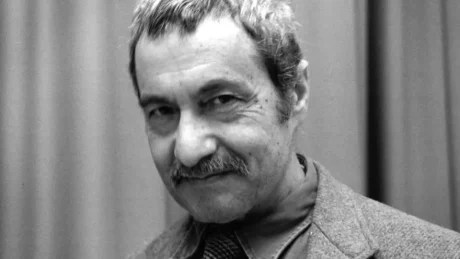
The Dissident | January 28, 2026
This week, the influential left-wing scholar Michael Parenti passed away at the age of 92.
Parenti was well known for his sharp criticism of U.S. foreign policy and U.S. imperialism throughout his life, waking up many to the reality of it and the lies used to justify it.
This is best underscored in one of his last published articles, “Ukraine and Regime Change”, which was published in the book “Flashpoint In Ukraine: How the U.S. Drive for Hegemony Risks World War III”, where he predicted to a tee what the result of the 2014 U.S. backed coup in Ukraine would be.
Correctly Calling Out U.S. Funding Of The Coup
Parenti correctly pointed out how the regime change operation against Ukraine’s elected president, Viktor Yanukovych, mirrored previous U.S. regime change operations, writing:
regime change is a form of action designed to make it impossible for the existing government to govern. We have seen this well-orchestrated chaos and endless disruption in various countries. Militantly organized groups are financed and equipped by outside western interests. NGOs (nongovernmental organizations) surface in substantial numbers and produce rebellious publications and events designed to unsettle the besieged government—in Ukraine’s case, a government that was democratically elected not long before. The NGOs handle billions of dollars worth of supplies used to mobilize and sustain the protests. Even though they are supposed to be independent (‘nongovernmental’) some NGOs get all their funds from the U.S. government. An Assistant Secretary of State, Victoria Nuland, proudly exclaimed that the United States had poured some $5 billion into the struggle for regime change.
All of this has since been vindicated. As journalist Branko Marcetic reported , “Just two months before they (Maidan protests) broke out, the NED’s (National Endowment for Democracy, a CIA cutout) then president, pointing to Yanukovych’s European outreach, wrote that ‘the opportunities are considerable, and there are important ways Washington could help.’ In practice, this meant funding groups like New Citizen, which the Financial Times reported ‘played a big role in getting the protest up and running,’ led by a pro-EU opposition figure. Journalist Mark Ames discovered the organization had received hundreds of thousands of dollars from US democracy promotion initiatives.”
Correctly Calling Out Far-Right Infiltration And The Maidan Massacre False Flag
Michael Parenti then wrote that the protests were overtaken by far-right paramilitary groups, who fired snipers into crowds in the Maidan square, which was then falsely blamed on Viktor Yanukovych’s forces- all facts which have now been proven correct.
Parenti wrote, “In Ukraine, crypto-fascist groups like Svoboda, the Right Sector, and others secured ample funds to keep thousands of people fed and comfortable enough on the streets of Kiev for weeks at a time, complete with well-made marching flags, symbols, and signs in various languages (including English). Svoboda henchmen were being financed by someone. They wore insignia that bore a striking resemblance to the swastika. Svoboda’s top leaders openly denounced ‘Russian scum,’ and ‘Muscovite Jewish mafia.’ Disguised men in unmarked combat fatigues attacked unarmed police and security guards. They moved among the gathered crowd and at times, according to independent sources, delivered sniper shots into the crowd—which could then be readily blamed on the nearly asphyxiated government. Meanwhile the western media reported everything the way the White House wanted, for instance, unfailingly referring to the perpetrators as ‘protestors.’”
Indeed, as the aforementioned Branko Marcetic reported, “The driver of this violence was largely the Ukrainian far right, which, while a minority of the protesters, served as a kind of revolutionary vanguard. Looking outside Kyiv, a systematic analysis of more than 3,000 Maidan protests found that members of the far-right Svoboda party — whose leader once complained Ukraine was run by a ‘Muscovite-Jewish mafia’ and which includes a politician who admires Joseph Goebbels — were the most active agents in the protests. They were also more likely to take part in violent actions than any group but one: Right Sector, a collection of far-right activists that traces its lineage to genocidal Nazi collaborators.”
Even more impressively, Michael Parenti correctly noted that the “Maidan Massacre” was a false flag carried out by Right Sector, a fact which has now been proven by Ukrainian-Canadian academic Ivan Katchanovski.
After carefully studying the trial on the massacre and the verdict from it, Ivan Katchanovski noted, “51 out of 72 wounded Maidan protesters, with whose shooting on February 20 Berkut policemen (Yanukovych’s forces) are charged and whose testimonies were revealed, testified at the trial and the investigation that they had been shot by snipers from Maidan-controlled buildings or areas, had themselves witnessed snipers there, or had been told by other Maidan protesters about such snipers. 31 of these wounded protesters testified at the trial and/or the investigation that they had been shot from the Hotel Ukraina, the Bank Arkada, and Zhovtnevyi Palace, the buildings on Muzeinyi Lane and Horodetskyi Street, or other Maidan-controlled buildings or areas. At least 33 wounded protesters testified that they had either witnessed snipers there and/or were told about snipers in these Maidan-controlled locations, mostly in the Hotel Ukraina, by other protesters.”
He also uncovered that :
The findings of forensic medical examinations done by government experts for the prosecution were first made public during the Maidan massacre trial, and revealed that the absolute majority of protesters were shot from the side or back, and from top to bottom. Most videos and photos, however, show that the absolute majority of those killed and wounded had the Berkut police (Yanukovych’s police forces) in front of them and at ground level, whereas the Maidan-controlled buildings were generally behind them and on the left and right side.
Forensic medical examinations indicate that 40 out of the 48 killed protesters were shot from a high angle. At least 36 of them were killed at a time when the Berkut policemen were filmed on the ground.
48 out of 51 wounded protesters had steep entry wounds, consistent with the theory that they were shot by snipers in Maidan-controlled buildings, or on the roofs of these buildings.
He also noted that the bullet examinations from the massacre matched those of Right Sector and other pro-Maidan militants and not the Berkut police force, writing:
The forensic ballistic examinations presented at the trial found that 19 protesters were killed on February 20 by bullets which match the calibers not only of AKM Kalashnikov assault rifles, but also of hunting versions of Kalashnikovs, and other weapons, Videos showed protesters with hunting firearms in the Hotel Ukraina during the massacre
A forensic ballistic examination conducted by government experts with use of an automatic computer-based IBIS-TAIS system, found that the bullets extracted from killed protesters, trees, and the Hotel Ukraina rooms did not match police database for Kalashnikov assault rifles of members of the entire Kyiv Berkut regiment, including the special Berkut unit deployed
Predicting The Fallout From The Coup
While Parenti reporting on the events of the Maidan coup exactly right is impressive enough, what makes Parenti’s article especially impressive is the fact that he also predicted the aftermath of the coup to a tee.
Parenti wrote, “This manufactured uprising in Kiev is something we have seen in numerous other countries: from Venezuela to Thailand during this very same time frame. The scenario is much the same, and the goal of these western-financed attacks has been to make the world safe for the 1%, the global super rich. Ukraine citizens who think they are fighting for democracy will eventually discover that they are really serving the western plutocracy. They will be left with a new government filled with old intentions. Ukrainians will end up with nothing to show for their efforts except a still more depressed and more corrupt economy, an enormous IMF debt, a worsening of social services, and an empty ‘democracy,’ led by corrupt neo-Nazis and ultra-nationalists.” (Emphasis: Mine)
This is exactly what the result of the Maidan coup was.
Forbes magazine noted at the time that, after the coup, the U.S. installed Arseniy Yatsenyuk as the interim prime minister of Ukraine because, “Yanukovych resisted the International Monetary Fund’s demand to raise taxes and devalue the currency” while, “Yatsenyuk doesn’t mind”.
As Ukrainian political scientist Konstantin Bondarenko documented, the results of the IMF-imposed “reforms” included:
-“Ukraine’s GDP shrinking by approximately 17%”.
-The exchange rate going from “8 hryvnias (Ukrainian dollar) to 1 U.S dollar” in 2013 to “23 hryvnias to the dollar” in 2015
-Inflation rising from 24.9% in 2014 to 43.3% in 2015
-a “significant decline in industrial production during the first two years” after the coup, leading to Ukraine losing “its economic cluster that manufactured goods with high added value (machine engineering)”
-“mining and metallurgical complex, energy (coal production), chemicals, food production”, “sustained significant losses”.
-“an increase in unemployment and the emigration of citizens from Ukraine to neighboring countries—primarily to Poland and Russia.”
-“utility rates increasing by 123%, reaching up to 20% of family income” from the IMF introduced policies
Parenti was also spot on about the prevalence of “neo-Nazis and ultra-nationalists” in the post-Maidan Ukraine.
After the coup, the UK’s Channel 4 news reported that, “the far-right took top posts in Ukraine’s power vacuum” and Foreign Policy Magazine reported that, “The uncomfortable truth is that a sizeable portion of Kiev’s current government — and the protesters who brought it to power — are, indeed, fascists.”
U.S. Congressman Ro Khanna noted in 2018, “Ukraine’s 2015 memory laws went even further by glorifying Nazi collaborators and making it a criminal offense to deny their ‘heroism.’ However, unlike the Polish law, this move by the government in Kyiv has received little to no public response from the United States. The groups and individuals extolled by Ukraine include Nazi collaborators Stepan Bandera, Roman Shukhevych, and the Organization of Ukrainian Nationalists (OUN), as well as the Ukrainian Insurgent Army (UPA). These paramilitaries and individuals in some cases collaborated with the Nazis and bear responsibility for the murder of thousands of Jews, 70,000-100,000 Poles, and other ethnic minorities between 1941 and 1945.”
Khanna added, “It’s particularly troubling that much of the Nazi glorification in Ukraine is government-supported. Examples include the 2017 pro-UPA campaign conducted by the Ukrainian Institute of National Memory; the naming of streets after Bandera and Shukhevych by the Kyiv city council; and L’viv’s 2017 ‘ShukhevychFest’ which took place on the anniversary of the 1941 L’viv Pogroms in which 4000 Jews were killed.”
He added, “Last November, Radio Free Europe reported on the presence of torches and Nazi salutes at a 20,000-person march in honor of the 75th anniversary of the UPA. These torchlight marches are closely linked to organizations such as the neo-Nazi Azov Battalion, an armed group that was prohibited from receiving U.S. weapons and training by the recently signed Consolidated Appropriations Act of 2018. Rather than disband Azov, the government incorporated it into the Ukrainian National Guard overseen by the Ministry of the Interior. The group is widely known to be closely connected to Interior Minister Arsen Avakov.”
Furthermore, Parenti correctly predicted that the coup would lead to an American confrontation with Russia, writing:
The U.S. empire’s ultimate intent is to encircle and reduce Russia to a frightened and discombobulated satellite. But that is much easier said than done. At this time, as I write, Moscow reportedly no longer accepts telephone calls from the White House. Meanwhile protests against the NATO-supported Ukrainian regime are on the rise. Anti-Kiev activists are seizing administrative buildings and calling for a referendum on federalization. Ukraine’s acting President, Aleksandr Turchinov, put the Ukrainian army on full alert due to the “threat of a Russian invasion.” Turchinov admitted that the government in Kiev could not control the situation in eastern Ukraine. It did not even seem able to control the situation in Kiev itself.
Obama may have a few tricks and trumps left to play. But he is fishing in troubled waters and might invite more danger and tribulation than he—or we—can handle. As Putin put it: “The situation is serious” and we need “to find serious approaches to the solution.”
Michael Parenti’s prophetic article on Ukraine underscores how important much of his foreign policy analysis was and why it will be deeply missed by many.
Conspiracy Denial
Lies are Unbekoming | January 27, 2026
In honour of Michael Parenti (1933–2026), who passed away on 24 January 2026 at the age of 92. He spent his life naming what power prefers to leave unnamed.
In 1837, Abraham Lincoln remarked: “These capitalists generally act harmoniously, and in concert, to fleece the people.”
Today, he would be dismissed as a conspiracy theorist.
That dismissal—reflexive, automatic, requiring no engagement with evidence—is not a mark of sophistication. It is a tell. The question worth asking is not whether conspiracies exist (they are a matter of public record and a recognised concept in law) but why acknowledging their existence provokes such reliable hostility. What work does the label “conspiracy theorist” actually do?
The late political scientist Michael Parenti spent decades answering that question. His conclusion was blunt: “’Conspiracy’ refers to something more than just illegal acts. It serves as a dismissive label applied to any acknowledgment of ruling-class power, both its legal and illegal operations.” The term functions not as a descriptor but as a weapon—a thought-terminating cliché that protects the powerful from scrutiny by pathologising those who scrutinise them.
Conspiracy denial, in Parenti’s analysis, is not skepticism. It is the opposite of skepticism. It is credulity toward power dressed up as critical thinking. As he wrote in Dirty Truths: “Just because some people have fantasies of conspiracies does not mean all conspiracies are imaginary.”
The Double Standard
The asymmetry is stark once you see it.
Coal miners consciously direct their efforts toward advancing their interests. So do steelworkers, small farmers, and schoolteachers. Labour unions exist precisely because workers concert together to pursue collective goals. No one calls this a conspiracy theory. It is called organising.
But suggest that the wealthy and powerful consciously concert with intent to defend their class interests, and you have crossed an invisible line. You are now a conspiracy theorist, a crank, possibly paranoid.
Parenti put it directly: “It is allowed that farmers, steelworkers, or schoolteachers may concert to advance their interests, but it may not be suggested that moneyed elites do as much—even when they actually occupy the top decision-making posts. Instead, we are asked to believe that these estimable persons of high station walk through life indifferent to the fate of their vast holdings.”
The double standard operates silently. Workers scheme; owners sleepwalk. The public pursues its interests; elites stumble through history moved by forces beyond their comprehension or control. This is the unexamined premise that makes “conspiracy theory” an effective slur.
Consider a specific example. In 1994, the officers of the Federal Reserve announced they would pursue monetary policies designed to maintain a high level of unemployment in order to safeguard against “overheating” the economy. This was publicly announced. It appeared in the financial pages. The Fed explicitly stated it preferred a deflationary course that would keep workers competing desperately for scarce jobs.
When an acquaintance of Parenti’s mentioned this to friends, he was greeted skeptically: “Do you think the Fed bankers are deliberately trying to keep people unemployed?”
He did think it. They had said so. It was not a conjecture but a policy announcement. And yet his friends assumed he was imagining a conspiracy because he ascribed self-interested collusion to powerful people.
Those who suffer from conspiracy phobia are fond of asking: “Do you actually think there’s a group of people sitting around in a room plotting things?” For some reason that image is assumed to be so patently absurd as to invite only disclaimers.
But where else would people of power get together—on park benches or carousels? Of course they sit in rooms. They sit in boardrooms, in the Executive Office, in the conference suites of the Council on Foreign Relations, at the Bilderberg meetings, in the private gatherings at Bohemian Grove. These venues are not secret. Their existence is a matter of public record. What happens there—the coordination of policy, the recruitment of personnel, the alignment of interests—is simply not supposed to be named for what it is.
Theories of Innocence
If the powerful do not conspire, how do we explain outcomes that consistently favour their interests? In Land of Idols, Parenti identified several frameworks that substitute for analysis. He called them “theories of innocence”—alternative explanations that preserve elite respectability by denying elite intent.
Somnambulist Theory
In Parenti’s words: “Those in power just do things as if walking in their sleep, without a thought to their vast holdings.” Policy happens. Wars break out. Wealth concentrates. No one intended any of it. The rich and powerful are present at these events but somehow not responsible for them—passengers rather than pilots.
Coincidence Theory
Or as Parenti described it: “By sheer chance, things just happen repeatedly and coincidentally to maintain the existing array of privileged interests, without any conscious planning or pressure from those who benefit.” Tax policy favours the wealthy—coincidentally. Exposed in a conspiracy, the intelligence agencies coincidentally face no meaningful consequences. Environmental regulations are gutted, and corporations coincidentally profit. The pattern is not a pattern. Each outcome is isolated, unconnected to any larger design.
Incompetence Theory (or Stupidity Theory)
Then there is what Parenti called “incompetence theory, or even stupidity theory, which maintains that people at the top just don’t know what they’re doing; they are befuddled, incapable, and presumably not as perceptive as we.”
For years we heard that Ronald Reagan was a moronic, ineffectual president—his administration a “reign of errors”—even as he successfully put through most of his conservative agenda. Parenti observed: “Reagan was serving the interests of corporate America, the military, and the ideological Right with which he had long been actively associated.” The policies worked exactly as intended for the constituencies they were designed to serve. But acknowledging this would mean acknowledging intent.
During the Iran-Contra hearings, stupidity and incompetence were actually claimed as a defence. The Tower Commission—handpicked by Reagan himself—concluded that the president was guilty of a lackadaisical management style that left him insufficiently in control of his subordinates. In fact, as some of his subordinates eventually testified in court, the president not only was informed but initiated most of the Iran-Contra policy decisions that led to circumvention of the law and the Constitution.
Incompetence theory asks us to believe that those who reach the highest levels of institutional power are less capable of pursuing their interests than the average person managing a household budget.
The pattern Parenti identified with Reagan has repeated with subsequent presidents. Consider which current figures are simultaneously portrayed as existential threats and bumbling fools—and notice that the “incompetence” never works against the interests of capital. The chaos is selective. The stupidity produces coherent outcomes for specific constituencies.
Spontaneity Theory (or Idiosyncrasy Theory)
Stuff just happens. The event is nothing more than an ephemeral oddity, unconnected to any larger forces.
In 1978, the House Select Committee on Assassinations reported that there was more than one assassin—and therefore a conspiracy—involved in the 1963 murder of President John Kennedy. In response, the Washington Post editorialised: “Could it have been some other malcontent whom Mr. Oswald met casually? Could not as many as three or four societal outcasts, with no ties to any one organization, have developed in some spontaneous way a common determination to express their alienation in the killing of President Kennedy?”
The Post continued: “It is possible that two persons, acting independently, attempted to shoot the President at the same time.”
Read that again. A major newspaper, confronted with evidence of conspiracy, speculated that two independent gunmen spontaneously decided to assassinate the president at the same moment. This is what passes for sophisticated analysis when the alternative is following the evidence.
Sometimes, those who deny conspiracies create the most convoluted fantasies of all.
Aberration Theory
Secret, criminal state behaviour is dismissed as an atypical departure from normally lawful behaviour. Each exposure is treated as an isolated exception that proves nothing about the norm.
For five years beginning in 1983, the FBI carried out surveillance of the Committee in Solidarity with the People of El Salvador (CISPES) to determine whether the group had links to international terrorism. The bureau utilised all fifty-nine of its field offices yet uncovered not a shred of evidence to support its conspiracy theory about CISPES. The organisation charged that the bureau’s actions were politically motivated and part of a concerted government effort to suppress opposition to U.S. involvement in Central America.
The FBI had a long history of such harassments against a wide range of protest groups, as evidenced by its illegal COINTELPRO campaign. Yet the Senate Intelligence Committee found “no pattern of abuse” by the bureau and concluded that the FBI investigation of CISPES was an “aberration.”
Pattern recognition is apparently beyond the capacities of official oversight when the pattern implicates official behaviour.
The Historical Record
The theories of innocence require ignoring what is already known. Conspiracies are not hypothetical. They are documented, exposed, and in many cases admitted.
As Parenti catalogued in Democracy for the Few: “There was the secretive plan to escalate the Vietnam War as revealed in the Pentagon Papers; the Watergate break-in; the Federal Bureau of Investigation (FBI) COINTELPRO disruption of dissident groups; the several phoney but well-orchestrated ‘energy crises’ that sharply boosted oil prices in the 1970s; the Iran-contra conspiracy; the savings and loan conspiracies; and the well-documented conspiracies (and subsequent cover-ups) to assassinate President John Kennedy, Martin Luther King, and Malcolm X.”
The fabricated Tonkin Gulf incident served as the pretext for escalating the Vietnam War. The Johnson administration told Congress and the public that North Vietnamese boats had attacked American destroyers in international waters. This was a lie. But it worked: Congress passed the Gulf of Tonkin Resolution, and the war expanded.
Operation Phoenix saw U.S. advisors secretly set up assassination squads that murdered thousands of dissidents in Vietnam. This was not rogue behaviour but policy.
The Watergate break-in and subsequent cover-up led to the resignation of a president. The conspiracy was real enough to force Richard Nixon from office.
COINTELPRO involved government surveillance, infiltration, and sabotage of dissident groups across the political spectrum—civil rights organisations, antiwar activists, socialist parties, Black liberation movements. The FBI did not merely monitor these groups; it actively disrupted them, planted false information, fomented internal conflicts, and facilitated violence against them.
Iran-Contra saw top officials conspire to circumvent the law, selling arms to Iran in exchange for funds that were used in covert actions against Nicaragua. Weapons were shipped, money was laundered, and Congress was lied to—all in service of a foreign policy that could not survive public scrutiny.
The savings and loan scandal was described by the Justice Department as—in Parenti’s words—”a thousand conspiracies of fraud, theft, and bribery,” the greatest financial crime in history at that point. Thrift industry executives funnelled deposits into personal accounts, fraudulent deals, and schemes involving organised crime and the CIA. When the institutions collapsed, taxpayers covered the losses.
The BCCI scandal involved what investigators called the most crooked bank in the world, with tentacles reaching into intelligence agencies, drug trafficking, arms dealing, and the financing of terrorism.
These are not speculations. They are matters of public record. People went to prison. Documents were declassified. Congressional investigations produced reports. In some cases, the perpetrators wrote memoirs.
If conspiracy is by definition imaginary, what do we call these?
Is It Paranoia?
Those who feel threatened appear paranoid in the eyes of those who deny the existence of threat.
Through most of the 1980s, the United States financed and trained a counterrevolutionary army that conducted a two-front invasion against Nicaragua, killing thousands of civilians and destroying farm cooperatives, power stations, clinics, schools, and other civilian infrastructure. U.S. military planes repeatedly invaded Nicaraguan airspace. U.S. warships stood off both coasts. The superpower imposed a crippling economic embargo, mined Nicaragua’s harbours, and blew up its oil depots.
President Reagan said he wanted the Sandinistas to cry “uncle.” Secretary of State Shultz promised to “cast out” the Sandinistas from “our hemisphere.”
Yet when the besieged Managua government charged that the United States wanted to overthrow it, ABC News dismissed the complaint as “Sandinista paranoia.” The Washington Post called it “Nicaraguan paranoia.”
Then in June 1985, Reagan and Shultz announced that the United States might have to invade Nicaragua—thereby demonstrating, if any more demonstration was needed, that the Sandinistas were not imagining things.
The paranoia charge functions to delegitimise accurate perception. If you correctly identify that powerful actors are working against your interests, you are not credited with insight. You are diagnosed with a mental defect.
This framing has a long history. Critics who noted that television entertainment served capitalist values were dismissed by media scholar Todd Gitlin as “the paranoid left.” It is not paranoid to observe that a capitalist product like entertainment television contains capitalist values. These values saturate advertisements, game shows, and dramatic programming. Corporate advertisers make explicit ideological demands and withdraw their accounts when politically offended. Every network has a department whose function is to censor controversial content. As Parenti noted, the New York Times observed that although networks have relaxed their policing of sexual content, “the network censors continue to be vigilant when it comes to overseeing the political content of television films.”
Evidence of conscious effort exists. The critics are not paranoid. The diagnosis is wrong. What looks like clinical suspicion is pattern recognition.
The Left’s False Dichotomy
Those who analyse capitalism’s systemic features should be most attentive to the conscious actions of capitalists. Often the opposite is true.
Some left intellectuals dismiss conspiracy research as incompatible with structural analysis. The argument goes: either you understand that events are determined by larger configurations of power and interest, or you reduce history to the machinations of secret cabals. Structure or conspiracy. Pick one.
Parenti rejected this dichotomy. In Dirty Truths, he wrote: “It is an either-or world for those on the Left who harbor an aversion for any kind of conspiracy investigation: either you are a structuralist in your approach to politics or a ‘conspiracist’ who reduces historical developments to the machinations of secret cabals, thereby causing us to lose sight of the larger systemic forces.” This, he argued, is a false choice that disables the left.
Noam Chomsky and Alexander Cockburn both dismissed public scepticism about the Warren Commission’s findings on the Kennedy assassination. Chomsky argued that “no trace of the wide-ranging conspiracy appears in the internal record, and nothing has leaked” and that “credible direct evidence is lacking.”
Parenti’s response was pointed: Why would participants in a conspiracy of that magnitude risk everything by maintaining an internal record about the actual murder? Why would they risk their lives by going public? Many participants would know only a small part of the picture, but all would have a keen sense of the powerful forces they would face were they to become talkative. In fact, a number of those who agreed to cooperate with investigators met untimely deaths.
Chomsky was able to maintain his criticism, Parenti noted, “only by remaining determinedly unacquainted with the mountain of evidence that has been uncovered.”
The structural-versus-conspiracy framing misunderstands how power operates. Larger structural trends impose limits and exert pressures. But within those limits, different leaders pursue different courses, and the effects are not inconsequential. As Parenti argued: “It was not foreordained that the B-52 carpet bombing of Cambodia and Laos conducted by Nixon would have happened if Kennedy, or even Johnson or Humphrey, had been president. If left critics think these things make no difference in the long run, they better not tell that to the millions of Indochinese who grieve for their lost ones and for their own shattered lives.”
Structural analysis explains why elites act in certain ways. It does not exempt us from examining how they act in specific cases—including cases where their actions are secret, illegal, and deliberately hidden.
The either-or framing serves power by ruling out of bounds precisely the investigations that might expose specific crimes. If every inquiry into elite wrongdoing can be dismissed as a distraction from structural analysis, then structural analysis becomes a shield for criminals rather than a tool for understanding.
What the Label Protects
Conspiracy is a legitimate concept in law: the collusion of two or more people pursuing illegal means to effect some illegal or immoral end. People go to prison for committing conspiratorial acts. The concept is not exotic or fringe. It is a standard feature of criminal prosecution.
Ruling elites themselves acknowledge the reality of concerted secret action. They call it “national security.” As Parenti wrote in Land of Idols: “Rulers themselves recognize the need for secret and consciously planned state action. They label it ‘national security.’ … They apply more candidly conspiratorial appellations: ‘covert action,’ ‘clandestine operations,’ and ‘special operations.’ If, for some reason, one prefers not to call these undertakings ‘conspiracies,’ then give them another name, but recognize them as consciously planned, often illegal ventures, whose existence is usually denied.”
The question is not whether conspiracies occur. The question is why naming them provokes such intense resistance.
The label “conspiracy theory” protects something important: the legitimacy of existing arrangements. If policy outcomes that favour the wealthy are the result of deliberate planning by the wealthy, then those outcomes are not natural, not inevitable, and not beyond challenge. They are choices made by identifiable people who could have chosen otherwise and who can be held accountable.
Conspiracy denial forecloses that accountability. It insists that we view history as a series of accidents, blunders, and coincidences—never as the product of will and intention by those with the power to impose their will. It asks us to extend to elites a presumption of innocence so comprehensive that it becomes a presumption of non-existence.
Parenti was clear about what this protects: “Those of us who claim that highly placed parties in the capitalist state mobilize immense resources to preserve and advance the interests of the existing class system would like the courtesy of something more than a dismissive smirk about ‘conspiracy theory.’”
To dismiss as conspiracy fantasy all assertions that elite power is consciously and intelligently exercised is to arrive at an implausible position: that there is no self-interested planning, no secrecy, no attempt to deceive the public, no suppression of information, no deliberate victimisation, no ruthless policy pursuits, no intentionally unjust or illegal gains. It is to assert that all elite interests are principled and perfectly honest, though occasionally confused.
That is a remarkably naïve view of political reality.
A Tool, Not a Conclusion
Not every conspiracy theory is true. Some are baseless. Some are fabricated. Some direct legitimate grievances toward irrelevant foes—which is itself a service to power.
The distinction is not between “conspiracy” and “no conspiracy” but between two different modes of analysis.
The right’s version of conspiracy thinking blames shadowy cabals for corrupting an otherwise pure system. Expose the conspirators, and the system returns to health. This mistakes symptom for cause. As Parenti observed in Land of Idols: “For the left, the monopolization of capital is not necessarily the result of a sneaky plot by some backroom elite; rather the system of capitalism produces monopolies and elites as natural byproducts of its own evolution.” Monopoly capitalism is not a deviation from free-market capitalism imposed by outside manipulators. It is where capitalism goes.
The left’s version asks different questions: What interests are being served? Through what mechanisms? With what documented evidence? This framework opens inquiry into specific influence operations—lobbying networks, foreign policy pressures, supranational trade bodies, revolving doors between government and industry. It examines these as features of how imperial capital organises itself, not as alien corruptions of an otherwise healthy system.
Powerful lobbies exist. Supranational bodies override democratic sovereignty. Intelligence agencies conduct covert operations. Financial interests coordinate policy across borders. These are not speculations but documented realities. Analysis either clarifies how power operates or obscures it by offering scapegoats in place of systemic understanding.
What does the evidence support? What mechanisms are operating? Who benefits, and how?
Conspiracy denial forecloses these questions by stigmatising them. Conspiracy analysis keeps them open by insisting that power be examined rather than assumed innocent.
Lincoln was not a conspiracy theorist in any pathological sense. He was a man with eyes, observing that capitalists act in concert to advance their interests. That observation remains true. What has changed is the machinery for suppressing it.
The next time someone dismisses a claim as “conspiracy theory,” ask what evidence they have engaged with. Ask which theory of innocence they are relying on. Ask whether they would apply the same credulity to the powerful that they extend to the powerless.
The answer will tell you whether you are speaking with a sceptic or a believer—and what, exactly, they believe in.
References
Works by Michael Parenti:
- Against Empire (San Francisco: City Lights Publishers, 1995)
- Blackshirts and Reds: Rational Fascism and the Overthrow of Communism (San Francisco: City Lights Books, 1997)
- Democracy for the Few, 7th edition (Boston: Bedford/St. Martin’s, 2002)
- Dirty Truths: Reflections on Politics, Media, Ideology, Conspiracy, Ethnic Life and Class Power (San Francisco: City Lights Books, 1996)
- The Face of Imperialism (Boulder: Paradigm Publishers, 2011)
- History as Mystery (San Francisco: City Lights Books, 1999)
- Inventing Reality: The Politics of News Media (New York: St. Martin’s Press, 1993)
- Land of Idols: Political Mythology in America (New York: St. Martin’s Press, 1994)
- To Kill a Nation: The Attack on Yugoslavia (London: Verso, 2000)
Additional sources on conspiracy referenced by Parenti:
- Lane, Mark. Plausible Denial: Was the CIA Involved in the Assassination of JFK? (New York: Thunder’s Mouth Press, 1991)
- Lane, Mark. Rush to Judgment (New York: Holt, Rinehart & Winston, 1966)
- Marrs, Jim. Crossfire: The Plot That Killed Kennedy (New York: Carroll & Graf, 1989)
- Marshall, Jonathan, Peter Dale Scott, and Jane Hunter. The Iran-Contra Connection (Boston: South End Press, 1988)
- Meagher, Sylvia. Accessories after the Fact: The Warren Commission, the Authorities, and the Report (New York: Vintage, 1992)
- Morrow, Robert. First Hand Knowledge: How I Participated in the CIA-Mafia Murder of President Kennedy (New York: S.P.I. Books, 1992)
- Walsh, Lawrence. Firewall: The Iran-Contra Conspiracy and Cover-Up (New York: Norton, 1997)
Michael Parenti (1933–2026): political scientist, historian, public intellectual. He wrote over twenty books examining American politics, ideology, media, and empire. PhD from Yale University. His work named the operations of class power that mainstream discourse prefers to leave invisible. He died on 24 January 2026 at ninety-two.
Vicious

Lies are Unbekoming | January 25, 2026
The waiting room is clean. The receptionist is polite. The forms ask reasonable questions. Nothing in the physical environment suggests danger. The magazines are current. The hand sanitizer dispenser works. Someone has chosen calming colors for the walls.
A pregnant woman sits in a chair designed for her comfort. She has been told to be here. Not ordered—no one orders. Recommended. Strongly recommended. Everyone does this. Her mother did this. Her friends did this. The women in her prenatal group compare notes about their appointments the way they compare notes about nursery furniture. Which provider did you choose? What tests have you had? The questions assume the answers. The answers assume the questions.
She will be offered things today. Offered is the word used. The offers will come with information sheets that list risks and benefits in tabular form. She will sign consent documents. Everything will be voluntary in the legal sense. No one will hold her down. No one will threaten her. She will choose, and her choices will feel like choices, and she will leave feeling she has done the responsible thing.
What she will not feel is the weight of what has been arranged before she arrived. The scheduling software that ensures the appointment is short enough to be profitable. The protocol that determines which tests are “standard” regardless of her individual circumstances. The liability calculations that make defensive intervention safer for the provider than watchful waiting. The training her provider received, which did not include the word “cascade” and did not question the premises. The pharmaceutical representative who visited last month. The professional guidelines written by committees with financial ties to the interventions they recommend. The insurance code that reimburses procedures but not conversations. The architecture of the building itself, which presumes birth is a medical event requiring medical facilities.
None of this is secret. All of it is documented, published, occasionally debated in journals that no one outside the profession reads. The machinery operates in plain sight. It has operated for so long that its operation feels like nature—the way medicine works, the way pregnancy is managed, the way responsible people behave.
She cannot see it because she is inside it. The water she swims in. The air she breathes. The climate of her experience.
For years I used the word “predatory” to describe this system. Predatory captured something true—the targeting, the extraction, the conversion of healthy people into revenue streams. The pharmaceutical company identifying a market. The screening program generating patients. The intervention that creates the need for the next intervention. Predation implies a hunter and prey, a calculation, a strategy.
But predatory is not quite right. A predator needs its prey. A predator pays attention to what it hunts. A predator, in some sense, respects the thing it consumes—respects it enough to study it, track it, understand its patterns. The lion watches the gazelle. The con artist studies the mark.
This system does not watch. It does not study. It processes.
The word that came to me after documenting 123 medical interventions across the arc of pregnancy and birth is different. Starker. Less strategic and more indifferent.
Vicious.
Viciousness is not cruelty, though cruelty may be one of its expressions. Cruelty requires attention. The cruel person watches suffering and derives something from it—pleasure, power, confirmation. Cruelty is a relationship, however deformed.
Viciousness requires no such relationship. A vicious mechanism can operate without anyone watching the effects. A vicious system can grind through populations while everyone involved believes they are helping. The viciousness is in the structure, not the intention. It emerges from the interaction of parts, none of which are vicious in isolation.
The doctor who follows the protocol is not vicious. The protocol is not vicious. The committee that wrote the protocol is not vicious. The pharmaceutical company that funded the research the committee relied on is not vicious—or rather, its viciousness is diffused through so many quarterly earnings reports and shareholder meetings and marketing budgets that no single person experiences themselves as causing harm. The regulator who approved the product is not vicious. The politician who mandated its use is not vicious. The parent who complies is not vicious. The neighbor who judges the parent who doesn’t comply is not vicious.
And yet.
A 13-year-old girl in London, who declined a vaccine, is being pressured about a screening test she is not eligible for. The vaccine was Gardasil, marketed as preventing cervical cancer. The screening is the smear test—cervical screening that begins at age 25 in the UK, designed to detect what the vaccine supposedly prevents. The two programs are presented as separate, but they function as a single apparatus: refuse our prevention and you must submit to our surveillance. I have documented elsewhere, in my essay The HPV Lie: Pap Smears, Gardasil, and a Cancer Caused by Something Else, why the foundational claim—that HPV causes cervical cancer—does not survive scrutiny. But for the purposes of this essay, the truth of the claim matters less than the machinery built on it.
The pressure comes from somewhere. It reaches her through channels—through school, through health messaging, through the questions of peers whose parents made different choices. No single person decided to punish her. No committee met to discuss her case. The system does not know her name.
The pressure is automatic. It is the system maintaining itself, closing gaps, ensuring that even those who refuse one element remain captured by another. The vaccine and the screening are presented as separate programs, but they function as a single apparatus. Refuse the prevention and you will be reminded, persistently, of your need for surveillance.
She is 13. The screening she is being pressured about begins at 25. There is no medical reason for anyone to be discussing it with her. The pressure is not medicine. It is correction. It is the system registering a deviation and applying force to resolve it.
No one in her life who transmits this pressure experiences themselves as being vicious. The teacher who mentions it is concerned. The nurse who brings it up is following guidelines. The friends who ask why she didn’t get the shot are simply curious, or perhaps uncomfortable with difference. Everyone is doing what people do. Everyone is being normal.
The viciousness is in the normal. The viciousness is that “normal” has been constructed, over decades, through thousands of small decisions, each one defensible, none of them examined, until the accumulated weight presses down on a 13-year-old whose only crime was asking questions.
The system is vicious. Say it plainly.
The government that approves the products, mandates their use, shields manufacturers from liability, and funds the campaigns that manufacture consent—the government is vicious.
The society that has been engineered to enforce compliance through social pressure, to treat refusal as deviance, to make the unvaccinated child a problem and the questioning mother a danger—this society is vicious.
But here is where the analysis must be careful. “The system” is an abstraction. “Government” is an abstraction. “Society” is an abstraction. These words make it easy to express outrage while leaving everyone blameless. If the system is vicious, I am not. If government is the problem, I am just a citizen. If society has been engineered, I am merely a victim of the engineering.
This is too easy. It is also untrue.
The system is made of people. Every protocol was written by a person. Every guideline was approved by persons sitting in a room. Every prescription is written by a hand attached to a body that contains a mind capable of doubt. The government is not a machine. It is people who could choose differently and do not. Society is not weather. It is the accumulated choices of everyone who participates in it—which means everyone.
The viciousness is emergent. No one designed the full harm. But the viciousness is also composed. Each component is a human decision. The emergence does not erase the composition. The fact that no one intended the complete picture does not mean no one is responsible for their corner of it.
This is the moral difficulty the essay cannot resolve, because reality does not resolve it. The harm is everyone’s and no one’s. The choices are individual and the outcome is collective. A woman loses her uterus to a surgery she did not need, and the surgeon who performed it was following the standard of care, and the standard of care was set by a committee, and the committee relied on studies, and the studies were funded by companies that profit from the surgery, and the companies are owned by shareholders who never think about uteruses, and the shareholders include pension funds, and the pension funds include the retirement savings of nurses who work in the hospitals where the surgeries are performed.
Where does blame land? Everywhere and nowhere. This is not an evasion. This is a description of how the viciousness actually works. It is distributed so thoroughly that it becomes atmospheric. It becomes the milieu. It becomes the climate that everyone moves through and no one feels responsible for, because the mechanisms of responsibility have been dissolved in the general weather.
Ivan Illich saw this decades ago. He described how institutions reshape the milieu—the environment people move through—until alternatives become unthinkable. A radical monopoly, he called it. Not a monopoly that corners a market, but a monopoly that disables people from doing things on their own. When hospitals “draft all those who are in critical condition,” he wrote, “they impose on society a new form of dying.” The institution does not merely provide a service. It reshapes reality so that the service becomes necessary.
This is what has happened with birth. With childhood. With the female body across its entire reproductive arc. The medical system has not merely offered services. It has reshaped the milieu so that moving through pregnancy without those services becomes an act of deviance. The services are not chosen from a range of options. They are the water in which choice occurs.
A woman who declines the standard interventions is not making a different choice within a shared framework. She is refusing the framework itself. This is why she is treated not as someone with different preferences but as someone who is failing—failing to be responsible, failing to care for her baby, failing to be the kind of mother the system has defined as acceptable.
The viciousness is in that definition. The system defines acceptable, and acceptable means compliant, and compliant means captured.
I documented 123 interventions across six phases of the reproductive timeline. Pre-conception capture. Pregnancy surveillance. Labor interventions. Immediate newborn procedures. Infant pathologizing. Ongoing medical capture. Each intervention has its own literature, its own justification, its own defenders. Each one, examined in isolation, can be made to seem reasonable—or at least not obviously harmful.
The viciousness becomes visible only when you see the whole arc.
A woman begins birth control at 16. The pill alters her hormonal environment for a decade or more. She stops the pill to conceive. She has difficulty conceiving—perhaps because years of synthetic hormones have disrupted her natural cycles, perhaps for other reasons. She seeks fertility treatment. The treatment works. She is pregnant.
Now she is in the system.
She receives prenatal testing that identifies risks, some real, most statistical. The risk identification generates anxiety. The anxiety generates more testing. The testing generates findings. The findings generate interventions. She is induced before her body was ready because a measurement crossed a threshold. The induction is long and painful because her body was not ready. She receives an epidural because the pain is unbearable. The epidural slows labor. She receives Pitocin to accelerate it. The baby shows distress. She receives a cesarean.
The cesarean is recorded as necessary. It was necessary—given everything that preceded it. Each step created the conditions for the next. The cascade operated exactly as designed.
Her baby is taken to the warmer for evaluation. Eye drops are administered. Vitamin K is injected. Hepatitis B vaccine is given—for a disease transmitted through sex and IV drug use, to a newborn who will do neither. The baby is observed in the nursery. Feeding is scheduled rather than on-demand. Supplementation is suggested because the baby lost weight—as all babies lose weight in the first days, a fact that would resolve with continued nursing but which becomes a problem requiring intervention.
She goes home with a baby she is not sure she knows how to feed, a body she is not sure she recognizes, a mind clouded with hormonal disruption and sleep deprivation and the particular loneliness of having been processed rather than supported.
She returns for postpartum visits. She is screened for depression. She may receive medication. The medication helps, or seems to. She continues it. She is now a psychiatric patient as well as a surgical patient. Her records follow her. Her risk profile follows her. The next pregnancy, if there is one, will be managed with reference to this one.
At no point was she mistreated in any way she could name. Everyone was professional. Everyone followed protocols. Everyone was trying to help.
The viciousness was in the protocols. The viciousness was in the accumulation. The viciousness was in the fact that no one—not one person across dozens of encounters—ever said: you could do none of this. You could wait. You could trust your body. You could go home.
No one said it because no one could say it. The milieu does not permit those words. A provider who speaks them risks liability, peer censure, loss of hospital privileges. The words are not forbidden. They are simply outside the weather. They are not rain or sun or wind. They do not exist in the climate the system has made.
Anyone who asks questions is doing something dangerous. They are noticing the weather. Asking why the sky is this particular color, why the wind blows this particular direction, why everyone walks leaning at this particular angle.
Most people never ask. The weather is just the weather. You dress for it. You complain about it. You do not inquire into its origins. You do not ask who made it, because weather is not made. Weather simply is.
But this weather was made. Every element of it was chosen. The clinical guidelines were written by people who could have written different ones. The regulatory approvals were granted by people who could have demanded different evidence. The liability structures were established by legislatures that could have established different ones. The insurance codes were set by committees that could have set different ones. The training curricula were designed by faculties that could have designed different ones.
Each choice was made by humans. Each human could have chosen otherwise. That none of them did—that the choices accumulated into a system that now operates with the indifference of weather—does not change the fact that the choices were made.
Anyone who asks questions threatens to make the choices visible. This is why they are pressured. Not because anyone decides to pressure them, but because the system cannot tolerate the visibility of its own construction. The weather must remain weather. The moment it becomes choices, it becomes contestable. The moment it becomes contestable, it can be refused.
If you have read this far, you are no longer fully inside the weather.
This is not a comfortable position. It is easier not to see. It is easier to move through the waiting room, sign the forms, accept the offers, go home feeling responsible. The system is designed for this ease. It has made compliance comfortable and refusal exhausting. The path of least resistance leads directly into the machinery.
Seeing the machinery does not stop it. One person’s recognition changes nothing about the protocols, the guidelines, the insurance codes, the training curricula. The 123 interventions will continue to be applied to the women who come after, regardless of what any individual understands.
But recognition changes what is possible.
A woman who sees the cascade can make different choices within it—can refuse this test, delay that intervention, ask questions that disrupt the automatic sequencing. She cannot escape the milieu, but she can move through it differently. She can refuse to be weather.
More importantly, she can speak. She can tell other women what she saw. She can name the viciousness, which is the first step toward refusing to participate in it. The system maintains itself partly through silence—through the assumption that everyone experiences the same thing and no one objects. Each voice that breaks the silence makes the next voice easier.
This is modest. It is not a revolution. It will not dismantle the system or defund the institutions or rewrite the guidelines. But the system depends on billions of small compliances, and each small refusal is a friction. Enough friction, accumulated over enough time, and the machinery begins to slow. Begins to be noticed. Begins to require justification rather than assuming it.
The girl in London who asked questions did something her grandmother could not do for her. She refused to accept the weather as weather. She noticed that she was being pressured and asked why. The pressure will continue—systems do not stop because one person notices them. But she has seen something that cannot be unseen.
This is what recognition makes possible: not escape, but awareness. Not freedom from the milieu, but movement within it that is no longer automatic. The end of innocence is not the same as the end of the system. But it is the end of participation without knowledge. It is the beginning of refusal.
The system is vicious. The viciousness is made of choices. The choices can be seen. Once seen, they can be refused.
One refusal at a time. One woman at a time. One conversation at a time.
The weather was made. It can be unmade. Not quickly. Not easily. Not by any individual alone. But the alternative is to keep swimming without noticing the water, keep breathing without noticing the air, keep walking at the angle the wind requires and calling it freedom.
The 13-year-old noticed. That is where it begins.
Book: Medicalized Motherhood: From First Pill to Permanent Patient
Available as a free download. 123 interventions documented across six phases—from pre-conception capture through postpartum surveillance. Includes practical tools: birth plan template, provider interview questions, quick reference card, and a new chapter on interrupting the cascade. Download it, share it with someone facing their first prenatal appointment, their induction date, their cesarean recommendation. The cascade works because women don’t see it coming. This book makes it visible.
Medicalized Motherhood (2026)

Unbekoming | January 15, 2026
A healthy woman downloads a fertility app before she’s even trying to conceive. The algorithm tells her she’s “irregular,” suggests she might have a problem, builds a referral pathway to a fertility clinic directly into the interface. She arrives at pregnancy already a patient—monitored, tested, supplemented, optimized. Forty weeks later, she’s induced for passing an arbitrary due date, monitored continuously, confined to bed, augmented with synthetic hormones, numbed with an epidural, and delivered by cesarean for “failure to progress.” Her newborn is immediately clamped, separated, injected, tested, and supplemented with formula. A year later, her baby has a diagnosis for falling below the 10th percentile on a growth chart. Five years later, she’s still in the system—annual screenings, ongoing surveillance, carrying diagnoses that originated in pregnancy. She entered healthy. She never exits.
Medicalized Motherhood: From First Pill to Permanent Patient documents 123 medical interventions that operate through a single logic: each one creates conditions requiring the next. The induction requires monitoring. The monitoring requires confinement. The confinement slows labor. The slowed labor requires drugs. The drugs intensify pain. The pain requires anesthesia. The anesthesia impairs pushing. The impaired pushing requires surgery. This isn’t system failure—it’s the system functioning exactly as designed, converting healthy women into lifelong patients while generating revenue at every step. The book maps this cascade across six phases: pre-conception capture, pregnancy surveillance, labor management, immediate newborn intervention, infant pathologizing, and postpartum capture. No other single resource traces how a fertility tracking app connects to a cesarean scar connects to a “failure to thrive” diagnosis connects to permanent patient status.
The book is written for women entering this system, not researchers studying it. Every intervention is documented with evidence—Cochrane reviews, clinical studies, manufacturer warnings, professional guidelines—but translated into direct language that can be read during pregnancy, shared with partners, used in conversations with providers. The goal is informed participation, not reflexive refusal. Genuine emergencies exist; some women need cesareans; some babies need intervention. What doesn’t need to happen is the routine application of 123 interventions to healthy women and babies who would do better without them. The cascade can be interrupted. The questions that create space—What happens if we wait? What are the alternatives? Is this required or recommended?—are simple to ask and difficult for the system to dismiss.
This is my first book, and I’m proud of it. I think it offers something that didn’t exist before: the complete map, from first pill to permanent patient, written for the women who need it most. I’m offering it free to reach those women—but 226 pages is a commitment not everyone can make. So I’ve given it the Unbekoming summary treatment: comprehensive Q&A, the key arguments distilled, and a deep dive audio file available to everyone, not just paid subscribers. Consider this your entry point. If the summary resonates, the full book goes deeper into each of the 123 interventions with the evidence behind them. If a woman entering the system reads this and asks one question she wouldn’t have asked otherwise, the book did its job.
Medicalized Motherhood: From First Pill to Permanent Patient

Medicalized Motherhood Edition 1
2MB ∙ PDF file
Lessons Learned from Thirty Years CT Heart Scans and Coronary Calcium Scores: The Role of Vitamin D
William Davis , MD | January 8, 2026
My 30+ years of involvement with CT heart scans and coronary calcium scores has yielded many important lessons on how to halt, then reverse, the accumulation of coronary atherosclerotic plaque and thereby risk for heart attack, need for heart procedures, and sudden cardiac death.
Here, I discuss the crucial importance of vitamin D and how, by addressing this issue, it was the first time I saw actual reductions in coronary calcium scores.
*Disclaimer:* The information presented in my books, blog posts, YouTube videos, podcasts, and other content is for informational and educational purposes only. The content I share should not be interpreted as medical advice, diagnosis, or treatment. Always consult with your personal physician or qualified healthcare professional before making any changes to your diet, medication, lifestyle, or healthcare regimen. Your individual health needs should be evaluated by a professional who is familiar with your unique medical history.
My new book is Super Body: A 3-Week Program to Harness the New Science of Body Composition and Restore Your Youthful Contours Available on Amazon and other bookstores: https://www.amazon.com/SUPER-Body-Com…
If you are new to my microbiome discussions, see my Super Gut book that includes recipes for L. reuteri and SIBO Yogurts: https://www.amazon.com/Super-Gut-Four…
Also see my Revised & Expanded Wheat Belly book that contains the entire Wheat Belly program, all updated with new information, more recipes, more success stories. Available on Amazon and other bookstores: https://www.amazon.com/Wheat-Belly-Re…
span class=”yt-core-attributed-string yt-core-attributed-string–white-space-pre-wrap” dir=”auto”>About Dr. Davis:
Dr. Davis practiced conventional cardiology for 25 years but became discouraged with the predatory and exploitative practices of modern healthcare. He now devotes his efforts to helping people regain magnificent health without doctors or hospitals with results that are SUPERIOR to that obtained through conventional healthcare. His Wheat Belly books have sold 4 million copies in 40 countries.
We draw from the health information of the world, collaborate, share experiences, collect data, and show how to apply new health tools to achieve levels of health that you may have thought unattainable. We do all this at a time when conventional healthcare costs have become crippling.
In addition to the Wheat Belly, Undoctored, and Super Gut books, find more of Dr. Davis’ conversations at: Dr. Davis Infinite Health http://www.DrDavisInfiniteHealth.com
The 15 Most Devastating Truths About the PSA Screening Disaster
Lies are Unbekoming | October 26, 2025
The prostate-specific antigen (PSA) test has screened 30 million American men annually for over three decades. The man who discovered PSA in 1970, Richard Ablin, now calls mass screening “a public health disaster.” Two landmark 2012 studies found no survival benefit from radical surgery compared to watchful waiting. The U.S. Preventive Services Task Force concluded PSA screening does more harm than good. Yet the $3 billion annual industry continues largely unabated.
These revelations emerge from three insider accounts: Ablin’s The Great Prostate Hoax, urologist Anthony Horan’s The Rise and Fall of the Prostate Cancer Scam, and oncologist Mark Scholz’s Invasion of the Prostate Snatchers. Together they document how a test meant to monitor existing cancer patients became a screening juggernaut that has left millions of men incontinent, impotent, or dead from unnecessary treatment.
The numbers are staggering. Since 1987, when PSA screening exploded nationwide, over one million American men have undergone radical prostatectomies. Studies show 40 to 50 men must be diagnosed and treated to prevent one death from prostate cancer. The other 39 to 49 men receive no benefit but face permanent side effects. Medicare and the Veterans Administration fund most of this treatment, pouring billions into a system that prominent urologists privately acknowledge has failed.
What follows are the most damaging truths about how PSA screening became entrenched despite overwhelming evidence of harm, why it persists against scientific consensus, and what this reveals about American medicine’s inability to abandon lucrative practices even when they damage patients.
1. The Test’s Creator Calls It a “Public Health Disaster”
Richard Ablin discovered prostate-specific antigen in 1970 while researching cryosurgery’s effects on prostate tissue. He never intended PSA as a screening test for healthy men. The test cannot distinguish between the cancers that kill and those that remain harmless. Ablin has spent decades publicly denouncing mass screening, including a 2010 New York Times op-ed titled “The Great Prostate Mistake.”
Ablin compares PSA screening’s specificity to “a coin toss” – hardly the precision expected from a medical test that determines whether men undergo surgery or radiation. He testified before Congress, published papers, and gave countless lectures warning against screening’s misuse. The medical establishment ignored him. In his book, he writes that watching his discovery become “a hugely expensive public health disaster” has been “painful.” The man who found PSA receives angry emails from men whose lives were destroyed by unnecessary treatment triggered by elevated PSA levels.
2. 75% of Men with Elevated PSA Don’t Have Cancer
A PSA level above 4.0 triggers the treatment cascade, yet three-quarters of these men have no cancer. Infections, enlarged prostates, bicycle riding, and recent ejaculation all elevate PSA. The test measures inflammation as readily as malignancy. This 75% false positive rate means millions undergo invasive biopsies needlessly.
The Prostate Cancer Prevention Trial found that 15% of men with PSA under 4.0 – the “normal” range – actually had prostate cancer, including aggressive forms. Meanwhile, only 25% with elevated PSA had cancer at all. No blood test with such poor specificity would gain approval today. Yet once PSA became standard practice, removing it from clinical use proved impossible despite its fundamental unreliability.
3. The $3 Billion Annual PSA Gold Rush
PSA screening generates at least $3 billion annually, with Medicare and the Veterans Administration covering most costs. Each abnormal PSA triggers a cascade: repeat tests, biopsies, imaging, surgery or radiation, plus years of follow-up. A single radical prostatectomy bills $15,000 to $30,000. Radiation therapy can exceed $50,000. These procedures require expensive equipment, specialized facilities, and teams of providers.
Hospital systems depend on this revenue stream. Urology practices built business models around screening and treatment. Medical device companies profit from surgical robots, radiation equipment, and biopsy tools. This economic ecosystem resists evidence showing most treatment is unnecessary. When the U.S. Preventive Services Task Force recommended against routine screening in 2012, medical associations mobilized massive lobbying efforts to preserve the status quo. Money, not medicine, drives the screening machine.
4. 30 Million Tests, 1 Million Unnecessary Biopsies Per Year
Annual PSA screening of 30 million American men triggers approximately one million prostate biopsies. Since most elevated PSAs are false positives, at least 750,000 of these biopsies find no cancer. Each biopsy involves 12 to 18 needle cores punched through the rectal wall into the prostate. Serious infections requiring hospitalization occur in 1-4% of cases. Sepsis can be fatal.
Even negative biopsies don’t end the cascade. Urologists often recommend repeat biopsies for persistently elevated PSA, subjecting men to multiple rounds of needles, infection risk, and anxiety. Some undergo four, five, even six biopsies chasing ghost cancers that either don’t exist or would never threaten their lives. The psychological toll – months of fear between tests, the dread of results, the pressure to “do something” – devastates men and families. This suffering serves no medical purpose for the vast majority subjected to it.
5. The “Arbitrary” 4.0 Cutoff That Changed Everything
The PSA threshold of 4.0 ng/mL that triggers intervention was, according to New York Times reporting, chosen “just sort of arbitrarily.” William Catalona’s influential 1991 New England Journal of Medicine article established this cutoff without reporting false positive rates – a basic requirement for screening tests. The entire world adopted this number uncritically.
No scientific process determined that 4.0 represented a meaningful boundary between health and disease. The number could have been 3.0 or 5.0 or 6.5. Each choice would have swept millions more or fewer men into the treatment vortex. This arbitrary threshold, selected without rigorous validation, has determined the fate of millions. Men with 4.1 undergo biopsies while those with 3.9 are deemed safe, though this 0.2 difference has no biological significance. A random number became medical dogma, and challenging it meant confronting an entire industry built on its foundation.
6. 2,600 Post-Surgery Deaths at the 1992 Peak
Radical prostatectomy deaths peaked at 2,600 in 1992, five years after PSA screening exploded nationally. These men died from surgical complications – bleeding, infections, blood clots, anesthesia reactions. They underwent surgery for cancers that, in most cases, would never have threatened their lives. The operation killed them before their cancer could.
Anthony Horan documents how radical surgery was “revived without new evidence” in the 1980s after being largely abandoned. The combination of PSA screening and renewed surgical enthusiasm created a perfect storm. Thousands died on operating tables for a disease that grows so slowly most men die with it, not from it. These deaths represent only immediate surgical mortality – not the men who died months later from complications, or whose lives were shortened by surgical trauma. Each death was preventable had screening not detected their harmless cancers.
7. Radical Surgery Shows No Survival Benefit Over Watchful Waiting
Two randomized controlled trials reported in 2012 found no difference in cancer-specific mortality between radical surgery and watchful waiting. The Prostate Cancer Intervention Versus Observation Trial (PIVOT) followed 731 men for up to 15 years. The Scandinavian trial tracked men for over 20 years. Both reached the same conclusion: surgery doesn’t save lives compared to monitoring.
These studies destroyed the rationale for early detection. If removing the entire prostate doesn’t extend life compared to doing nothing, then finding cancer early serves no purpose except to subject men to treatment side effects. The medical establishment largely ignored these findings. Surgery rates declined modestly but remained far higher than evidence justified. Mark Scholz writes that these studies should have “removed the rationale for early diagnosis with PSA” entirely. Instead, the industry adapted its messaging while continuing essentially unchanged.
8. The FDA Approval Based on 3.8% Detection Rate
The FDA approved PSA for screening in 1994 based primarily on a study showing it could detect 3.8% more cancers than digital rectal examination. This marginal improvement became justification for testing millions annually. The agency relied heavily on this single statistic while downplaying false positive rates and overdiagnosis risks.
Alexander Baumgarten, one of FDA’s own expert advisers, warned officials: “Like Pontius Pilate, you cannot wash the guilt off your hands.” Susan Alpert, who directed FDA’s Office of Device Evaluation during approval, later acknowledged the decision’s problems. The agency never required studies showing screening actually saved lives or improved quality of life. This regulatory failure, approving a test based on detection rates rather than patient outcomes, enabled the disaster that followed. The FDA has never revisited its decision despite overwhelming evidence of harm.
9. Prostate Cancer Grows So Slowly Most Men Die WITH It, Not FROM It
Autopsy studies reveal that 30% of men in their 40s and 70% in their 70s have prostate cancer cells. Most never knew and were never affected. The cancer’s typical growth rate means decades pass between initial cellular changes and potential lethality. A 65-year-old diagnosed with early-stage prostate cancer has less than 3% chance of dying from it within 15 years if left untreated.
Men diagnosed at 75 almost certainly will die of something else first – heart disease, stroke, other cancers. Yet screening doesn’t discriminate by age or life expectancy. Elderly men in nursing homes receive PSA tests and undergo biopsies. Some receive radiation or surgery in their 80s for cancers that could never outlive them. This fundamental biological reality – that most prostate cancers are clinically insignificant – undermines screening’s entire premise. Finding these cancers serves only to transform healthy men into cancer patients unnecessarily.
10. The Biopsy Train: 18-Gauge Needles and Serious Infections
Modern prostate biopsy involves 12 to 18 hollow-bore needles, each 18-gauge in diameter, fired through the rectal wall. The needles extract tissue cores while potentially spreading bacteria from the bowel into the prostate and bloodstream. Fluoroquinolone-resistant bacteria have made infections increasingly dangerous. Some men develop sepsis requiring intensive care.
Richard Ablin receives emails from men describing their biopsy experiences as “spinning out of control,” having “panic attacks,” and living in a “nightmare.” The procedure’s violence – needles punching through tissue, the sound of the spring-loaded gun, blood in urine and semen for weeks – traumatizes men regardless of results. Those with negative biopsies face pressure to repeat the procedure if PSA remains elevated. Some endure annual biopsies for years, each carrying infection risk, each failing to find cancer that likely isn’t there or doesn’t matter. The biopsy itself becomes a recurring assault that serves no medical purpose.
11. Incontinence and Impotence: The “Acceptable” Side Effects
Radical prostatectomy leaves 20-30% of men with permanent urinary incontinence requiring pads or diapers. Erectile dysfunction affects 60-80%, depending on age and surgical technique. These rates come from centers of excellence; community hospitals report worse outcomes. Surgeons routinely minimize these risks, calling them “acceptable” trade-offs for cancer treatment.
For men whose cancers would never have threatened them – the majority who undergo surgery – these side effects represent pure harm. They lose sexual function and bladder control to treat a disease that required no treatment. Their marriages suffer. Depression is common. Some become recluses, afraid to leave home without knowing bathroom locations. The medical profession’s casual acceptance of these devastating outcomes reflects a stunning disregard for quality of life. No other medical specialty would tolerate routinely destroying normal function to treat non-threatening conditions.
12. PSA Isn’t Even Prostate-Specific
Despite its name, prostate-specific antigen isn’t specific to the prostate. Breast tissue produces PSA – it’s a normal component of breast milk. Salivary glands make it. Some lymphomas produce PSA. Women have measurable PSA levels. This basic biological fact undermines the test’s fundamental premise.
Anthony Horan notes he personally reported PSA production in B-cell lymphomas. The protein’s presence throughout the body means elevated levels can reflect numerous non-prostatic processes. Yet the medical establishment treats PSA as if it were a precise prostate cancer marker. This scientific sloppiness – naming and using a test based on false assumptions about specificity – exemplifies the intellectual bankruptcy underlying mass screening. If PSA were discovered today with current knowledge, it would never be approved for screening healthy men.
13. The Veterans Administration’s Role in the Screening Epidemic
The Veterans Administration extensively promoted and funded PSA screening, making it routine for millions of veterans. The VA’s electronic medical records prompted doctors to order PSA tests, created quality metrics based on screening rates, and facilitated the treatment cascade. Veterans, trusting their government healthcare, underwent screening at higher rates than the general population.
The VA spent billions on screening, biopsies, and treatment. Veterans suffered disproportionately from overdiagnosis and overtreatment. Many underwent surgery or radiation at VA hospitals with limited experience in these procedures, likely experiencing higher complication rates. The government that sent these men to war later subjected them to medical harm through systematic overscreening. Only after the 2012 USPSTF recommendation did the VA begin moderating its approach, too late for hundreds of thousands of veterans already harmed.
14. Why Urologists Can’t Stop Screening Despite the Evidence
Urologists understand the evidence against screening yet continue promoting it. Professional self-interest explains this cognitive dissonance. Prostate cancer diagnosis and treatment represent major revenue sources for urology practices. Academic urologists depend on prostate cancer research grants. Professional status derives from surgical volume and technical expertise in procedures that shouldn’t be performed.
Mark Scholz describes the “surgeon personality” that sees every problem as requiring surgical solution. Urologists train for years to perform radical prostatectomies. Abandoning these procedures means acknowledging that much of their training and practice caused unnecessary harm. The psychological and economic barriers to accepting screening’s failure prove insurmountable. Even urologists who privately acknowledge the problem continue participating in the system. Professional conferences feature token debates about screening while exhibit halls showcase million-dollar surgical robots. The specialty cannot reform itself when its economic survival depends on perpetuating harm.
15. Active Surveillance Works for 99% of Low-Risk Cases
Multiple studies demonstrate that active surveillance – monitoring without immediate treatment – works for virtually all low-risk prostate cancers. Memorial Sloan Kettering reported that fewer than 1% of men on surveillance die from prostate cancer over 15 years. Johns Hopkins found similar results. These men avoid treatment side effects while maintaining the option to treat if their cancer progresses.
Despite this evidence, most men with low-risk disease still receive immediate treatment. Doctors present surveillance as “doing nothing” rather than an active management strategy. Patients fear leaving cancer untreated, not understanding their cancer’s indolent nature. The medical system’s financial incentives favor treatment over monitoring. Each patient choosing surveillance represents lost revenue. This proven alternative that could spare hundreds of thousands from unnecessary treatment remains underutilized because it threatens the economic foundation of prostate cancer care.
Conclusion
The PSA screening disaster exposes American medicine’s darkest impulses: the primacy of profit over patient welfare, the persistence of harmful practices despite overwhelming evidence, and the medical establishment’s inability to acknowledge error. Thirty years of mass screening has transformed millions of healthy men into cancer patients unnecessarily, subjecting them to treatments that left many incontinent, impotent, or dead.
The men who exposed this scandal from within – Richard Ablin who discovered PSA, Anthony Horan who practiced urology during screening’s rise, Mark Scholz who treats screening’s victims – deserve recognition for their courage in challenging their profession’s orthodoxy. Their accounts reveal not isolated mistakes but systematic failure: arbitrary thresholds adopted without validation, regulatory approval based on minimal evidence, and an entire medical specialty economically dependent on perpetuating harm. Until American medicine can abandon lucrative practices that damage patients, the PSA disaster will repeat in other forms, with other tests, harming other victims who trusted their doctors to first do no harm.
References
Ablin, Richard J., with Ronald Piana. The Great Prostate Hoax: How Big Medicine Hijacked the PSA Test and Caused a Public Health Disaster. New York: Palgrave Macmillan, 2014.
Horan, Anthony H. The Rise and Fall of the Prostate Cancer Scam. 3rd ed. Broomfield, CO: On the Write Path Publishing, 2019.
Scholz, Mark, and Ralph H. Blum. Invasion of the Prostate Snatchers: An Essential Guide to Managing Prostate Cancer for Patients and Their Families. Revised ed. New York: Other Press, 2021.
Featured Video
Marandi: Threat of Seizing Kharg Island & the Use of Nuclear Weapons
or go to
Aletho News Archives – Video-Images
Frlom the Archives
Provoking a Path to Persia
The Saban Center’s prescient paper on war with Iran
By Maidhc Ó Cathail | October 20, 2011
In June 2009, the Saban Center for Middle East Policy published “Which Path to Persia?—Options for a New American Strategy toward Iran.” Writing in a tone strikingly reminiscent of the Project for a New American Century’s infamous pre-9/11 paper “Rebuilding America’s Defenses,” the six co-authors noted that, “It seems highly unlikely that the United States would mount an invasion without any provocation or other buildup.” For a think tank specifically established by media mogul Haim Saban to protect Israel, this could prove to be a formidable obstacle impeding their desired march—of U.S. troops—to Tehran.
“In fact, if the United States were to decide that to garner greater international support, galvanize U.S. domestic support, and/or provide a legal justification for an invasion, it would be best to wait for an Iranian provocation, then the time frame for an invasion might stretch out indefinitely,” Saban’s think-tankers ruefully observed.
“With only one real exception, since the 1978 revolution, the Islamic Republic has never willingly provoked an American military response, although it certainly has taken actions that could have done so if Washington had been looking for a fight. Thus it is not impossible that Tehran might take some action that would justify an American invasion. And it is certainly the case that if Washington sought such a provocation, it could take actions that might make it more likely that Tehran would do so (although being too obvious about this could nullify the provocation). However, since it would be up to Iran to make the provocative move, which Iran has been wary of doing most times in the past, the United States would never know for sure when it would get the requisite Iranian provocation. In fact, it might never come at all.”
Seemingly undeterred by Iran’s frustrating unwillingness to provide the requisite provocation, the analysts continued to examine this option… continue
Blog Roll
 Aletho News
- Ukrainian Embassy in Beirut sheltering top Mossad agent
- Palestinian family displaced after settlers violently attack them in Humsa, Jordan Valley
- The EU never learns – except for the wrong lessons
- Iran attacks on UAE leaves RSF militia high and dry
- Hosting Washington’s war: Bahrain faces the consequences
- The US fell for its own Iran propaganda
- Seyed M. Marandi: Threat of Seizing Kharg Island & the Use of Nuclear Weapons
- Is there even an off ramp?
- Michael von der Schulenburg: Europe’s Self-Defeating Iran War Policy
- Sorry, The New Republic, Climate Change Isn’t Causing Somali Migration. Blame Civil Strife and Poverty.
- If Americans Knew
- Don’t Fall for the Regime Change Talk. Israel Is ‘Mowing the Lawn’ in Iran
- Will Israel and the US wreck the Gulf States along with Iran?
- US so far burned through ‘years’ of munitions in Iran war: Report
- How the Israeli Tail Wags the American Dog
- Outdated intel likely led to deadly U.S. strike on Iranian elementary school, sources say
- Pentagon insider says high U.S official Douglas Feith reported to Netanyahu
- In fond memory of Walid Khalidi, the historian of Palestine
- 6 more Americans killed, as Israel ‘mows the lawn’ in Iran – Not a ceasefire Day 154
- Are we on the precipice of World War III?
- ‘Catastrophic,’ Says UNICEF: 1,100+ Children Killed or Wounded in Mideast Since US-Israel Launched Iran War
- No Tricks Zone
- New Studies: UK Sea Levels Were 4 Meters Higher Than Today During The Mid-Holocene
- Destructive Green New Deal: German Energy And Metal Group Warns Of Drastic Crisis
- New Study Documents A 20-Year Pause In Arctic Sea Ice Decline – Driven By Internal Variability
- Wake-up Call: Survey Shows Majority Of Germans Now Favor Postponing Climate Targets!
- Televised! Leading German Political Candidate Tells Schoolchildren CO2 Makes Sun Hotter!
- New Study: A Century Warming Of 1.1°C Is ‘Commonplace’ And ‘Not Unusual’ During This Interglacial
- New Study: ‘Internal Noise’ And Volcanic Forcing Can Trigger 10-15°C Warming Within Decades
- Glaciers Worldwide Are Suddendly Surging, Experts Blame Warming!
- Surprising Discovery: Sahara Is Greening…Billions Of Trees Where Once Thought To Be Barren
- New Research Reaffirms Clouds, Aerosols, And Surface Solar Radiation Are ‘Driving The Climate System’
 Aletho News