Injustice – The Story of the Holy Land Foundation Five

By Vacy Vlazna | OffGuardian | December 9, 2018
Survive prison I must, for when I come out I would hold no grudges, or hate, or resentment. My belief system tells me that whatever comes upon me is a matter already decreed by Allah. He knows better.”
Shukri Abu-Baker, HLF5
Injustice: The Story of the Holy Land Foundation Five is about a grave and cruel injustice wielded by both the the USA and Israel, and paradoxically the book’s foundations are friendship, human dignity, and trust bound together by the integrity of the author, Miko Peled.
Peled’s credentials, as an Israeli dissident, as uncle of Smadar (13), a victim of a Palestinian suicide bomber and as son of an Israeli General gives compelling credibility to the findings of his comprehensive investigation.
INJUSTICE
A decade of innocence caged. It is now 10 years since a Machiavellian travesty of US justice sentenced, between 15 – 65 years, the innocent Shukri Abu Baker, Ghassan Elashi, Mohammed El-Mezain, Mufid Abdulqader, and Abdulrahman Odeh, who were senior staff of The Holy Land Foundation for Relief and Development (HLF) devoted to “Helping the poor, the orphans, and the widows … one of the pillars of Islamic teachings.”
The HLF was charged with “providing material support for terrorism.” Peled details how the HLF was run with meticulous transparency and with strict adherence to US aid guidelines thus demonstrating that HLF had “no connection to Hamas or any other political or military organizations,”
At the 2007 trial, the prosecution failed to get any convictions.
Undaunted the US government and the FBI mounted a retrial,
The prosecution’s theory was that, by supporting needy Palestinians, HLF had “freed up” Hamas’ own assets to fund terrorist attacks, and that if Palestinians knew that HLF would provide support for their families if assistance became necessary, they would be more likely to become suicide bombers.”
Peled spells out how the spurious charges were backed by questionable documents supplied by Israel, false translations, by cherrypicking ‘documents and phrases until the picture they painted was completely distorted,’ the withholding of ‘secret evidence’ to the defense, unexplained disappearance of crucial records, overt judicial bias towards the prosecution, exploitation of irrelevant and prejudicial testimonies, implausible Israeli ‘experts’, false charges of illegal tax filings, the FBI attempts to recruit collaborators, ‘The FBI even offered me US citizenship and immunity if I testified that HLF was linked to Hamas., ’ and the successful bribing of a key witness for the prosecution by waiving criminal charges of fraud and providing US residency.
Furthermore, the fraudulent manipulations of US justice are mirrored in the injustice that Israel metes out to Palestinians every day. Peled pierces the looking glass to the truth and reality,
I believe that the Palestinian struggle to free all of historic Palestine from the settler-colonialism that is the State of Israel is a just struggle, and I support it wholeheartedly. I accept that the State of Israel in its present form has no legitimacy, and in this I find Hamas’ goal to liberate Palestine completely justified.” Peled
The miscarriage of justice is outrageous. However, when one considers the false evidence the US government made to the UN in the case Iraq’s possession weapons of mass destruction that led to the deaths of half a million-plus innocent Iraqis, one understands that for the government, the collateral damage of 5 innocent Palestinian men sacrificed to further the fake war on terrorism is small potatoes.
FRIENDSHIP & HUMAN DIGNITY
The friendships Peled cultivates with Shukri, Ghassan, Mohammed, Mufid and Abdulrahman are the tour de force that instils intimacy, immediacy and urgency to the injustice they suffer,
I saw how important it is that others come to see them and to understand the background and the context of this story. Only then could anyone understand the travesty and indeed the tragedy that took place here.” ibid.
We accompany Peled on his many visits to the families and to the prisons and thus we empathise with the heartbreaking burden of absence and mutual deprivations suffered by the prisoners and their families; the denial of touch, a kiss, of a father to attend weddings, the burial of a beloved child Sanabel and death of parents, family meals, births of grandchildren.
Peled’s personal accompanying along the journey of injustice generates his moving demonstration of the authenticity of the HLF5’s moral dignity and the raison d’être of their humanitarian work that is grounded in Islam.
Crucially, by sharing respect for Islam embodied in these remarkable men, Peled challenges the the post 9/11 manufactured Islamophobia;
For me, Islam will always be associated with beauty, goodness, and charity. Sadly, the contempt and fear toward Islam, which are a major part of the Jewish-Israeli narrative, has seeped into America and become part of the accepted narrative in the United States as well. Living in the United States, I always felt deprived of the warmth that Islam and the Arab world offer. But when I began working on this book, I met Islam all over again, and in the most unlikely places.”ibid.
Peled repeatedly makes clear the HLF 5 are honourable men. They are not political activists who say ‘No’ to authority, they are activists for Allah-God who say ‘Yes’ and ‘Yes’ and ‘Yes’ to love, to compassion, to loyalty and to selfless care of the poorest of the poor.
“As Ghassan said to me, “What my friends and I did at the Holy Land Foundation was to help Palestinians who are suffering. They are victims because they find themselves living under a brutal, racist regime that practices apartheid. To be persecuted for such noble work is exactly what the prophets had faced at their time. And being reminded of this is how I get through it.” Indeed, their faith has made them un-enslaveable.”
Their plight is not unlike arresting Mother Teresa for bringing attention to and acting on Third World poverty mainly exacerbated by Western colonial and capitalist exploitation.
The answers to why the US government attacked a soft target humanitarian NGO that did not fund Hamas, become apparent. Firstly destroying NGO’s is a tool of ethnic-cleansing making Palestinian life even more unbearable so that they will leave Palestine.
Similarly Mohammed el-Halabi, the World Vision manager accused of diverting cash to Hamas and though an official Australian investigation found no such diversion, he remains incarcerated by Israel since his 2016 unwarranted arrest. Then there is the escalation of the humanitarian crisis inflicted on Gaza, Jerusalem and the West Bank by the recent US withdrawal of funding to UNRWA.
Secondly, their mere existence acts as a perpetual accusation against and evidence of Israeli state terrorism.
Hamas, Peled explains emerged from necessity met by the humane ideals of the Muslim Brotherhood that built,
… an infrastructure of social services, medical clinics, and schools, mostly in the impoverished Gaza Strip. These facilities were sorely needed, due to Israel’s grave failure to live up to its responsibilities as the Occupying Power.
But widespread support for Hamas was not only a result of Israeli ineptitude. Hamas leaders came to embody the honesty, altruism, and dedication that are the hallmarks of Islam.”
Peled’s statement of respect simultaneously discredits the US terrorist designation system, that at Israel’s request, named Hamas as a terrorist organisation.
TRUST
This book is about the sanctity of and also the destruction of trust.
Peled’s thoroughness is trustworthy because it is reinforced by his walking the talk with visits, interviews and research.
For years, the HLF5 deservedly won the trust of the thousands upon thousands of their HLF donors and recipients.
Their trust in their faith that informs their every heartbeat with resilience deserves admiration,
La yukalifu Allah nafsan, ila was’aha – God would not burden a soul with a burden that is beyond its capacity. And so believers accept the burden and carry it with devotion.”
Significantly, Peled reveals that we can’t trust the American Justice System because if it can come for five fine men then we must heed Niemöller’s warning that no-one is safe. Unless we stand together.
By the end of the book, I knew action is imperative. In the spirit of J’Accuse I wrote and will continue to write to the US Attorney General demanding the immediate and unconditional release of the innocent Shukri Abu Baker, Ghassan Elashi, Mohammed El-Mezain, Mufid Abdulqader, and Abdulrahman Odeh.
 Miko Peled, Injustice: The Story of the Holy Land Foundation Five is published by Just World Books. Al Jazeera’s two part documentary follows the lawless political trail of the US-Zionist conspiracy to deliberately turn 5 decent innocent family men into political prisoners.
Dr. Vacy Vlazna is Coordinator of Justice for Palestine Matters and editor of a volume of Palestinian poetry, I remember my name. She was Human Rights Advisor to the GAM team in the second round of the Acheh peace talks, Helsinki, February 2005 then withdrew on principle. Vacy was convenor of Australia East Timor Association and coordinator of the East Timor Justice Lobby as well as serving in East Timor with UNAMET and UNTAET from 1999-2001.
Mainstream Media Assaults on Freedom of Speech. “The Truth” is No Longer “Important”
Alternative news sources have come under sustained attacks
By Shane Quinn – Global Research – December 7, 2018
The New York Times unveiled a new slogan early in 2017 titled, “The truth is more important now than ever.” It has acquired a seemingly noble motto but a perhaps contentious one if we examine the Times’ recent history. Two international law specialists, Howard Friel and Richard Falk, published a book after the 2003 Invasion of Iraq called The Record of the Paper, which has scarcely been reviewed.
Friel and Falk focused on the Times due to the newspaper’s importance. The authors point out that in 70 Times editorials on Iraq – from September 11, 2001 to March 20, 2003 – the words “international law” and “UN Charter” were never mentioned. The “truth” did not seem terribly “important” as the Times stood idly by in the destruction of Iraq.
Such was the barrage of propaganda directed at the American public that 69% believed Saddam Hussein was “personally involved” in the September 11 attacks. That is a significant achievement in manipulation. The poll results must have been news to the Iraqi dictator himself, a forgotten one-time American ally.
Why Hussein would take it upon himself to orchestrate a surprise attack on the United States, of all nations, is anyone’s guess. Perhaps if he had a death wish but as later events proved he was not the suicidal type.
The Times was not alone in its position of selling the Iraq war to the American people, as television networks from Fox News to CBS and CNN were overwhelmingly pro-war. Fox News, owned by Rupert Murdoch – who strongly backed the illegal conflict – placed a permanent US flag in the corner of the screen. Fox employees were compelled to describe the invasion as “Operation Iraqi Freedom”, with hundreds of thousands of Iraqis later being killed.
The pattern continues into other illegitimate interventions as the liberal Guardian newspaper championed the demolition of Libya in 2011, with editorials imploring, “The quicker Muammar Gaddafi falls, the better.” The Guardian encouraged NATO “to tip the military balance further against Gaddafi”, while later that year summarising that “it has turned out, so far, reasonably well” – by that point thousands had been killed.
In 2015 Ian Birrell, then deputy editor of the Independent, still assured his readers, “I would argue that Britain and France were right to step in [in Libya]. The failures came later on.” Apparently it was fine for two old imperial powers to “step in” to shatter a sovereign nation, then afterwards absolve the invaders of blame with “the failures” only coming “later on”.

Sceengrab from The Independent
It’s a rare thing indeed to hear a prominent commentator question the balance of Western mainstream coverage. The same voices can be heard piping up when alternative news sources take a different line not so palatable to their tastes.
Nick Cohen, writing in the Guardian, accused the network Russia Today (RT) of being a “propaganda channel” and that Russia was “prostituting journalism”. In the following sentence, Cohen describes the BBC and New York Times as being “reputable news organisations”.
Cohen firmly supported the Iraq war, writing at the time that “the Left betrays the Iraqi people by opposing war”, and “an American invasion offers the possibility of salvation”. He was deemed not to be “prostituting journalism” in backing this violation of international law, nor when later supporting other interventions in Libya and Syria.
The BBC’s reputation, which Cohen previously claimed to be “reputable”, was dealt a blow when it was revealed by Cardiff University that the network “displayed the most ‘pro-war’ agenda of any broadcaster” with its coverage on the Iraq invasion.
Steven Erlanger of the New York Times described RT as “an agent of Kremlin policy” used to “undermine Western democracies” and to “destabilise the West” – failing to back up the claims with any evidence. To gain perspective on these attacks, it may be worth pointing out a key excerpt from the First Amendment of the US Constitution: “Congress shall make no law… abridging [curtailing] the freedom of speech, or of the press.”
This law does not exist in Western democracies but attempts at limiting freedom of expression continue apace, while attacks on alternative media outlets by institutions of power grow. It has reached a point whereby the French president Emmanuel Macron, shortly after assuming office, publicly attacked legitimate news sources of “behaving like deceitful propaganda”.
Perhaps the hidden concern about RT, for example, is its continued increase in both popularity and scope – with the channel enjoying a total weekly viewership of 70 million people and rising. RT is available to viewers in Western heartlands such as Britain and the US, with eight million Americans watching the station each week. It represents quite an achievement that a channel with the word “Russia”, featured in its title, can attract viewers in their millions, despite the growing anti-Russian sentiment espoused by the powers-that-be.
It is revealing that elite figures like Hillary Clinton have lamented in the past, “We are in an information war and we are losing that war.” For the first time in history, populations have broad access to alternative news angles – points of view that they likely find of a more balanced nature. Gone is the unchallenged monopoly on the public mind.
US-British Threats Against Russia Have a Long History
By T.J. COLES and Matthew ALFORD | CounterPunch | November 6, 2018
In their new book Union Jackboot: What Your Media and Professors Don’t Tell You About British Foreign Policy (Até Books), doctors T.J. Coles and Matthew Alford debate the rationale of Anglo-American policy towards Russia.
Alford: There seems to be a consensus that we need a strong military because Russia is on the rise. What do you think about that rationale?
Coles: There’s no consensus, except among European and American elites. Europe and America are not the world.
There are a lot of issues to consider with regards to Russia. Is it a threat? If so to whom? What kind of threat is Russia? So let’s consider these questions carefully. As far as the British establishment is concerned, Russia is an ideological threat because it is a major power with a substantial population. It’s also self-reliant where oil and gas is concerned, unlike Britain. So there’s lots of potential for Russian political ideology to undermine Britain’s status. In fact, there are European Council on Foreign Relations papers saying that Putin’s Russia presents an “ideological alternative” to the EU.[i] And that’s dangerous.
Britain, or more accurately its policymaking elites, have considered Russia a significant enemy for over a century. Under the Tsar, the so-called Great Game was a battle for strategic resources, trading routes, and so on. The historian Lawrence James calls this period the first Cold War, which went “hot” with the Crimean War (1853-56).[ii] Britain had a mixed relationship with the Tsars because, on the one hand, theirs’ were repressive regimes and Britain tended to favour repressive regimes, hence their brief alliance with Russia’s enemy, the Ottomans. On the other hand, Russia was a strategic threat to Britain’s imperial interests, and thus the Crimean War (1853-56).
When the Bolsheviks took over Russia, beginning 1917, the relationship became much less ambiguous – Russians, and especially Bolsheviks, were clearly the enemy. Their ideology posed a threat internally. So Winston Churchill, who began as a Liberal and became a Conservative, considered the Labour Party, which was formed in 1900, as basically a front for Bolsheviks.[iii] That shows the level of paranoia among elites. The Labour Party, at least at the beginning, was a genuine, working man’s political organisation – women couldn’t vote then, remember. So by associating this progressive, grassroots party representing the working classes as an ideological ally or even puppet of the brutal Bolshevik regime, the Tories had an excuse to undermine the power of organised, working people. So you had the Zinoviev letter in 1924, which we now know was a literal conspiracy between the secret services and elements of the Tory party to fabricate a link between Labour and Moscow. And it famously cost Labour the general election, since the right-wing, privately-owned media ran with the story as though it was real. It’s an early example of fake news.[iv]
That’s the ideological threat that Russia has posed, historically. But where there’s a threat, there’s an opportunity. The British elites exploited the “threat” then and as they do today by associating organised labour with evil Bolshevism and, in doing so, alienate the lower classes from their own political interests. Suddenly, we’ve all got to be scared of Russia, just like in 1917. And let’s not forget that Britain used chemical weapons – M-Devices, which induced vomiting – against the Bolsheviks. Chemical weapons were “the right medicine for the Bolshevist,” in Churchill’s words. This was in 1919, as part of the Allied invasion of Russia in support of the White Army. [v]
So if we’re talking about the historical balance of forces and cause and effect, Britain not Russia initiated the use of chemical weapons against others. But this history is typically inverted to say that Russia poses a threat to the West, hence all the talk about Novichok, the Skripals, and Dawn Sturgess, the civilian who supposedly came into contact with Novichok and died in hospital a few days later.
The next question: What sort of threat is Russia? According to the US Army War College, since the collapse of the Soviet Union and since pro-US, pro-“free market” President Boris Yeltsin resigned in 1999, Russia has pursued so-called economic nationalism. And the US doesn’t like this because markets suddenly get closed and taxes are raised against US corporations.[vi] That’s the real threat. But you can’t tell the public that: that we hate Russia because they aren’t doing what we say. If you look through the military documents, you can find almost nothing about security threats against the US in terms of Russian expansion, except in the sense that “security” means operational freedom. You can find references to Russia’s nuclear weapons, though, which are described as defensive, designed “to counter US forces and weapons systems.”[vii] Try finding that on the BBC. I should mention that even “defensive” nukes can be launched accidentally.
The real goal with regards to Russia is maintaining US economic hegemony and the culture of open “free markets” that goes with it, while at the same time being protectionist in real life. (US protectionism didn’t start under Trump, by the way.) Liberal media like the New York Times run sarcastic articles about Russian state oil and gas being a front for Putin and his cronies. And yes, that may be true. But what threat is Russia to the US if it has a corrupt government? The threat is closing its markets to the US. The US is committed to what its military calls Full Spectrum Dominance. So the world needs to be run in a US-led neoliberal order, in the words of the US military, “to protect US interests and investment.”[viii] But this cannot be done if you have “economic nationalism,” like China had until the “reforms” of the ‘70s and ‘80s, and still has today to some extent. Russia and China aren’t military threats. The global population on the whole knows this, even though the domestic US and British media say the opposite.
Alford: What about military threats?
Coles: The best sources you can get are the US military records. Straight from the horse’s mouth. The military plans for war and defence. They have contingencies for when political situations change. So they know what they’re talking about. There’s a massive divide between reality, as understood from the military records, and media and political rhetoric. Assessments by the US Army War College, for instance, said years ago that any moves by NATO to support a Western-backed government in Ukraine would provoke Russia into annexing Crimea. They don’t talk about Russia spontaneously invading Ukraine and annexing it, which is the image we get from the media. The documents talk about Russia reacting to NATO provocation.[ix]
If you look at a map, you see Russia surrounded by hostile NATO forces. The media don’t discuss this dangerous and provocative situation, except the occasional mention of, say, US-British-Polish war-gaming on the border with Russia. When they do mention it, they say it’s for “containment,” the containment of Russia. But to contain something, the given thing has to be expanding. But the US military – like the annual threat assessments to Congress – say that Russia’s not expanding, except when provoked. So at the moment as part of its NATO mission, the UK is training Polish and Ukrainian armed forces, has deployed troops in Poland and Estonia, and is conducting military exercises with them.[x]
Imagine if Scotland ceded from the UK and the Russians were on our border conducting military exercises, supposedly to deter a British invasion of Scotland. That’s what we’re doing in Ukraine. Britain’s moves are extremely dangerous. In the 1980s, the UK as part of NATO conducted the exercise, Operation Able Archer, which envisaged troop build-ups between NATO and the Warsaw Pact countries. Now-declassified records show that the Russians briefly mistook this exercise for a real-world scenario. That could have escalated into nuclear war. This is very serious.[xi]
But the biggest player is the USA. It’s using the threat of force and a global architecture of hi-tech militarism to shape a neoliberal order. Britain is slavishly following its lead. I doubt that Britain would position forces near Russia were it not for the USA. Successive US administrations have or are building a missile system in Europe and Turkey. They say it’s to deter Iran from firing Scud missiles at Europe. But it’s pointed at Russia. It’s a radar system based in Romania and Turkey, with a battery of Patriot missiles based in Poland. The stationing of missiles there provoked Russia into moving its mobile nuclear weapons up to the border in its Kaliningrad exclave, as it warned it would do in 2008.[xii] Try to find any coverage of that in the media, except for a few articles in the print media here or there. If Western media were interested in survival, there would be regular headlines: “NATO provoking Russia.”
But the situation in Ukraine is really the tipping point. Consider the equivalent. Imagine if Russia was conducting military exercises with Canada or Mexico, and building bases there. How would the US react? It would be considered an extreme threat, a violation of the UN Charter, which prohibits threats against sovereign states.
Alford: So we’ve extended NATO to pretty much the Russian border? But there’s a hard border there. Everyone knows we’re never going to attack Russia, both for reasons of morality and self-preservation. So maybe this situation is safer than you imply.
Coles: There’s no morality involved. States are abstract, amorphous entities comprised of dominant minorities and subjugated majorities who are conditioned to believe that they are relatively free and prosperous. The elites of those states act both in their self-interests – career, peer-pressure, kickbacks, and so on – and in the interests of their class, which is of course tied to international relations because their class thrives on profiting from resource exploitation. So you can’t talk about morality in this context. Only individuals can behave morally. The state is made up of individuals, of course, but they’re acting against the interests of the majority. As we speak, they are acting immorally– or at least amorally – but creating the geopolitical conditions that imperil each and every one of us.
As for invasion, we’re not going to invade Russia. This isn’t 1918. Russia has nuclear weapons and can deter an invasion. But that’s not the point. Do we want to de-escalate an already tense geopolitical situation or make it worse to the point where an accident happens? So while it’s not about invading Russia directly, the issue is about attacking what are called Russia’s “national interests.” Russia’s “national interests” are the same as the elites’ of the UK. National interest doesn’t mean the interests of the public. It means the interests of the policy-making establishment and the corporations. For example, the Theresa May government sacrificed its own credibility to ensure that its Brexit White Paper (2018) appeased both the interests of the food and manufacturing industries that want a soft Brexit – easy trade with the EU – and the financial services sector which wants a hard Brexit – freedom from EU regulation. Everyone else be damned. That’s the “national interest.”
So for its real “national interest,” Russia wants to keep Ukraine in its sphere of influence because its oil and gas to Europe pass through Ukraine. About 80% of Russia’s export economy is in the oil and gas sector. It’s already had serious political tensions with Ukraine, which on several occasions hasn’t paid its energy bills, so Russia has cut supplies. If Europe can bump Ukraine into its own sphere of influence it has more leverage over Russia. This is practically admitted in Parliamentary discussions by Foreign Office ministers, and so forth.[xiii] Again, omitted by the media. Also, remember that plenty of ethnic Russians live in eastern Ukraine. In addition, Russia has a naval base in Crimea. That’s not to excuse its illegal action in annexing Ukraine, it’s to highlight the realpolitik missing in the media’s coverage of the situation.
T. J. Coles is a postdoctoral researcher at Plymouth University’s Cognition Institute and the author of several books.
Matthew Alford teaches at Bath University in the UK and has also written several books. Their latest is Union Jackboot (Até Books).
SOURCES
[i] Mark Leonard and Nicu Popescu (2007) ‘A Power Audit of EU-Russia Relations’ European Council on Foreign Relations, Policy Paper, p. 1.
[ii] ‘Anglo-Russian relations were severely strained; what was in effect a cold war lasted from the late 1820s to the beginning of the next century’. The Crimean War seems to have set a precedent for today. James writes:
[It] was an imperial war, the only one fought by Britain against a European power during the nineteenth century, although some would have regarded Russia as essentially an Asiatic power. No territory was at stake; the war was undertaken solely to guarantee British naval supremacy in the Mediterranean and, indirectly, to forestall any threat to India which might have followed Russia replacing Britain as the dominant power in the Middle East.
Lawrence James (1997) The Rise and Fall of the British Empire London: Abacus, pp. 180-82.
[iii] Churchill said in 1920:
All these strikes and rumours of strikes and threats of strikes and loss and suffering caused by them; all this talk of revolution and “direct action” have deeply offended most of the British people. There is a growing feeling that a considerable section of organized Labour is trying to tyrannize over the whole public and to bully them into submission, not by argument, not by recognized political measures, but by brute force …
But if we can do little for Russia [under the Bolsheviks], we can do much for Britain. We do not want any of these experiments here …
Whether it is the Irish murder gang or the Egyptian vengeance society, or the seditious extremists in India, or the arch-traitors we have at home, they will feel the weight of the British arm.
Winston Churchill (1920) Bolshevism and Imperial Sedition. Speech to United Wards Club. London: The International Churchill Society.
[iv] The fake letter says:
A settlement of relations between the two countries [UK and Russia] will assist in the revolutionising of the international and British proletariat, … [and] make it possible for us to extend and develop the propaganda and ideas of Leninism in England and the colonies.
It also says that ‘British workmen’ have ‘inclinations to compromise’ and that rapprochement will eventually lead to domestic ‘[a]rmed warfare’. It was leaked by the services to the Conservative party and then to the media. Richard Norton-Taylor (1999) ‘Zinoviev letter was dirty trick by MI6’ Guardian and Louise Jury (1999) ‘Official Zinoviev letter was forged’ Independent. For media coverage at the time, see James Curran and Jean Seaton (1997) Power without ResponsibilityLondon: Routledge, p. 52.
[v] Paul F. Walker (2017) ‘A Century of Chemical Warfare: Building a World Free of Chemical Weapons’ Conference: One Hundred Years of Chemical Warfare: Research, Deployment, Consequences pp. 379-400 and Giles Milton (2013) Russian Roulette: A Deadly Game: How British Spies Thwarted Lenin’s Global Plot London: Hodder, eBook.
[vi] ‘The Russian Federation has shown repeatedly that common values play almost no role in its consideration of its trading partners’, meaning the US and EU. ‘It often builds relationships with countries that most openly thwart Western values of free markets and democracy’, notably Iran and Venezuela. ‘In this regard, the Russian Federation behaves like “Russia Incorporated.” It uses its re-nationalized industries to further its wealth and influence, the latter often at the expense of the EU and the U.S.’. Colonel Richard J. Anderson (2008) ‘A History of President Putin’s Campaign to Re-Nationalize Industry and the Implications for Russian Reform and Foreign Policy’ Senior Service College, US Army War College, Pennsylvania: Carlisle Barracks, p. 52.
[vii] Daniel R. Coats (2017) Statement for the Record: Worldwide Threat Assessment of the US Intelligence CommunitySenate Select Committee on Intelligence, Washington, DC: Office of the Director of National Intelligence, pp. 18-19.
[viii] US Space Command (1997) Vision for 2020 Colorado: Peterson Air Force Base.
[ix]The document also says: ‘a replay of the West-sponsored coup against pro-Russian elites could result in a split, or indeed multiple splits, of the failed Ukraine, which would open a door for NATO intervention’.Pavel K. Baev (2011) ‘Russia’s security relations with the United States: Futures planned and unplanned’ in Stephen J. Blank (ed.) Russian Nuclear Weapons: Past, Present, and Future Strategic Studies Institute Pennsylvania: Carlisle Barracks, p. 170.
[x] Forces Network (2016) ‘British troops to deploy to Poland’.
[xi] For example, Nate Jones, Thomas Blanton and Christian F. Ostermann (2016) ‘Able Archer 83: The Secret History’ Nuclear Proliferation International History Project Washington, DC: Woodrow Wilson International Center for Scholars.
[xii] It was reported in the ultra-right, neo-con press at the time that:
[Russian] President Dmitri Medvedev announced in his first state-of-the-nation address plans to deploy the short-range SS-26 (“Iskander”) missiles in the Russian exclave of Kaliningrad if the U.S. goes ahead with its European Ballistic Missile Defense System (BMDS). Medvedev told parliament that the deployment would “neutralize” U.S. plans for a missile defense shield based in Poland and the Czech Republic [now in Romania), which the U.S. claims as vital in defending against missile attacks from ‘rogue states’ such as Iran.
Neil Leslie (2008) ‘The Kaliningrad Missile Crisis’ The New Atlanticist, available at atlanticcouncil.org.
[xiii] For example, a Parliamentary inquiry into British-Russian relations says of the newly-imposed US-British ally in Ukraine:
President Poroshenko’s Government is more openly committed to economic reform and anti-corruption than any previous Ukrainian Administration. The reform agenda has made considerable progress and has enjoyed some successes including police reform, liberalisation of the energy market and the launch of an online platform for government procurement …
The annexation of Crimea also resulted in a ban on importing products from Crimea, on investing in or providing services linked to tourism and on exporting certain goods for use in the transport, telecoms and energy sectors.
House of Commons Foreign Affairs Committee (2017) The United Kingdom’s relations with Russia Seventh report of session 2016-17, HC 120 London: Stationary Office, pp. 28, 31.
Who’s really ‘undermining’ US democracy?
‘We have met the enemy and he is us’
The Nation | November 2, 2018
Allegations that Russia is still “attacking” US elections, now again in November, could delegitimize our democratic institutions.
Summarizing one of the themes in his new book, ‘War with Russia? From Putin and Ukraine To Trump and Russiagate,’ Stephen F. Cohen argues that Russiagate allegations of Kremlin attempts to “undermine American democracy” may themselves erode confidence in those institutions.
Ever since Russiagate allegations began to appear more than two years ago, their core narrative has revolved around purported Kremlin attempts to “interfere” in the 2016 US presidential election on behalf of then-candidate Donald Trump. In recent months, a number of leading American media outlets have taken that argument even further, suggesting that Putin’s Kremlin actually put Trump in the White House and now is similarly trying to affect the November 6 midterm elections, particularly House contests, on behalf of Trump and the Republican Party. According to a page-one New York Times “report,” for example, Putin’s agents “are engaging in an elaborate campaign of ‘information warfare’ to interfere with the American midterm elections.”
Despite well-documented articles by Gareth Porter and Aaron Mate effectively dismantling these allegations about 2016 and 2018, the mainstream media continues to promote them. The occasionally acknowledged lack of “public evidence” is sometimes cited as itself evidence of a deep Russian conspiracy, of the Kremlin’s “arsenal of disruption capabilities… to sow havoc on election day.” (See the examples cited by Alan MacLeod.)
Lost in these reckless allegations is the long-term damage they may themselves do to American democracy. Consider the following possibilities:
Even though still unproven, charges that the Kremlin put Trump in the White House have cast a large shadow of illegitimacy over his presidency and thus over the institution of the presidency itself. This is unlikely to end entirely with Trump. If the Kremlin had the power to affect the outcome of one presidential election, why not another one, whether won by a Republican or a Democrat? The 2016 presidential election was the first time such an allegation became widespread in American political history, but it may not be the last.
Now the same shadow looms over the November 6 elections and thus over the next Congress. If so, in barely two years, the legitimacy of two fundamental institutions of American representative democracy will have been challenged, also for the first time in history.
And if US elections are really so vulnerable to Russian “meddling,” what does this say about faith in American elections more generally? How many losing candidates on November 6 will resist blaming the Kremlin? Two years after the last presidential election, Hillary Clinton and her adamant supporters still have not been able to do so.
We know from critical reporting and from recent opinion surveys that the origins and continuing fixation on the Russiagate scandal since 2016 have been primarily a product of US political-intelligence-media elites. It did not spring from the American people – from voters themselves. Thus a Gallup poll recently showed that 58 percent of those surveyed wanted improved relations with Russia. And other surveys have shown that Russiagate is scarcely an issue at all for likely voters on November 6. Nonetheless, it remains a front-page issue for US elites.
Indeed, Russiagate has revealed the low esteem that many US political-media elites have for American voters – for their ability to make discerning, rational electoral decisions, which is the bedrock assumption of representative democracy. It is worth noting that this disdain for rank-and-file citizens echoes a longstanding attitude of the Russian political intelligentsia, as recently expressed in the argument by a prominent Moscow policy intellectual that Russian authoritarianism springs not from the nation’s elites but from the “genetic code” of its people.
US elites seem to have a similar skepticism about – or contempt for – American voters’ capacity to make discerning electoral choices. Presumably this is a factor behind the current proliferation of programs – official, corporate, and private – to introduce elements of censorship in the nation’s “media space” in order to filter out “Kremlin propaganda.” Here, it also seems, elites will decide what constitutes such “propaganda.”
The Washington Post recently gave such an example: “portraying Russian and Syrian government forces favorably as they battled ‘terrorists’ in what US officials for years have portrayed as a legitimate uprising against the authoritarian government of President Bashar al-Assad.” That is, thinking that the forces of Putin and Assad were fighting terrorists, even if closer to the truth, is “Kremlin propaganda” because it is at variance with “what US officials for years have” been saying. This was the guiding principle of Soviet censorship as well.
If the American electoral process, presidency, legislature, and voter cannot be fully trusted, what is left of American democracy? Admittedly, this is still only a trend, a foreboding, but one with no end in sight. If it portends the “undermining of American democracy,” our elites will blame the Kremlin. But they best recall the discovery of Walt Kelly’s legendary cartoon figure Pogo: “We have met the enemy and he is us.”
Stephen F. Cohen is a professor emeritus of Russian studies and politics at New York University and Princeton University and a contributing editor of The Nation.
The Remarkable Historiography of David Irving
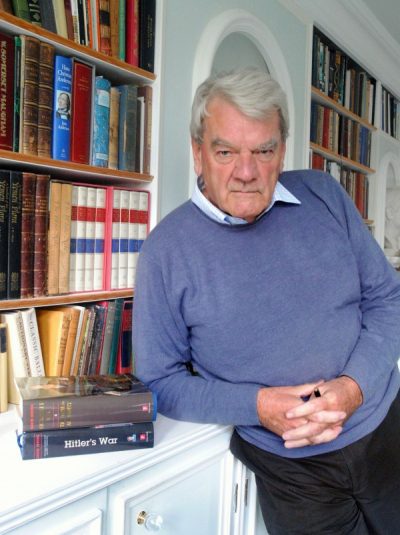
David Irving taken in London. CC by-SA 3.0. Credit: Allan Warren/Wikimedia Commons
By Ron Unz • Unz Review • June 4, 2018
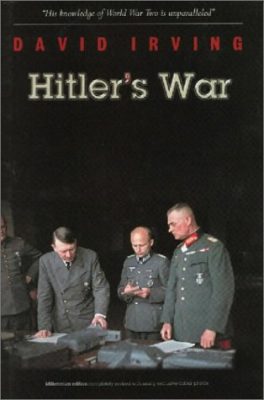
I’m very pleased to announce that our selection of HTML Books now contains works by renowned World War II historian David Irving, including his magisterial Hitler’s War, named by famed military historian Sir John Keegan as one of the most crucial volumes for properly understanding that conflict.
With many millions of his books in print, including a string of best-sellers translated into numerous languages, it’s quite possible that the eighty-year-old Irving today ranks as the most internationally-successful British historian of the last one hundred years. Although I myself have merely read a couple of his shorter works, I found these absolutely outstanding, with Irving regularly deploying his remarkable command of the primary source documentary evidence to totally demolish my naive History 101 understanding of major historical events. It would hardly surprise me if the huge corpus of his writings eventually constitutes a central pillar upon which future historians seek to comprehend the catastrophically bloody middle years of our hugely destructive twentieth century even after most of our other chroniclers of that era are long forgotten.
Carefully reading a thousand-page reconstruction of the German side of the Second World War is obviously a daunting undertaking, and his remaining thirty-odd books would probably add at least another 10,000 pages to that Herculean task. But fortunately, Irving is also a riveting speaker, and several of his extended lectures of recent decades are conveniently available on YouTube, as given below. These effectively present many of his most remarkable revelations concerning the wartime policies of both Winston Churchill and Adolf Hitler, as well as sometimes recounting the challenging personal situation he himself faced. Watching these lectures may consume several hours, but that is still a trivial investment compared to the many weeks it would take to digest the underlying books themselves.
When confronted with astonishing claims that completely overturn an established historical narrative, considerable skepticism is warranted, and my own lack of specialized expertise in World War II history left me especially cautious. The documents Irving unearths seemingly portray a Winston Churchill so radically different from that of my naive understanding as to be almost unrecognizable, and this naturally raised the question of whether I could credit the accuracy of Irving’s evidence and his interpretation. All his material is massively footnoted, referencing copious documents in numerous official archives, but how could I possibly muster the time or energy to verify them?
Rather ironically, an extremely unfortunate turn of events seems to have fully resolved that crucial question.
Irving is an individual of uncommonly strong scholarly integrity, and as such he is unable to see things in the record that do not exist, even if it were in his considerable interest to do so, nor to fabricate non-existent evidence. Therefore, his unwillingness to dissemble or pay lip-service to various widely-worshiped cultural totems eventually provoked an outpouring of vilification by a swarm of ideological fanatics drawn from a particular ethnic persuasion. This situation was rather similar to the troubles my old Harvard professor E.O. Wilson had experienced around that same time upon publication of his own masterwork Sociobiology: The New Synthesis, the book that helped launch the field of modern human evolutionary psychobiology.
These zealous ethnic-activists began a coordinated campaign to pressure Irving’s prestigious publishers into dropping his books, while also disrupting his frequent international speaking tours and even lobbying countries to bar him from entry. They also maintained a drumbeat of media vilification, continually blackening his name and his research skills, even going so far as to denounce him as a “Nazi” and a “Hitler-lover,” just as had similarly been done in the case of Prof. Wilson.
During the 1980s and 1990s, these determined efforts, sometimes backed by considerable physical violence, increasingly bore fruit, and Irving’s career was severely impacted. He had once been feted by the world’s leading publishing houses and his books serialized and reviewed in Britain’s most august newspapers; now he gradually became a marginalized figure, almost a pariah, with enormous damage to his sources of income.
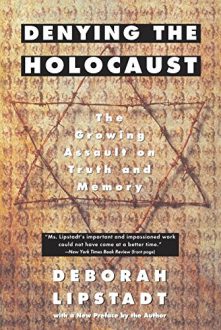
In 1993, Deborah Lipstadt, a rather ignorant and fanatic professor of Theology and Holocaust Studies (or perhaps “Holocaust Theology”) ferociously attacked him in her book as being a “Holocaust Denier,” leading Irving’s timorous publisher to suddenly cancel the contract for his major new historical volume. This development eventually sparked a rancorous lawsuit in 1998, which resulted in a celebrated 2000 libel trial held in British Court.
That legal battle was certainly a David-and-Goliath affair, with wealthy Jewish movie producers and corporate executives providing a huge war-chest of $13 million to Lipstadt’s side, allowing her to fund a veritable army of 40 researchers and legal experts, captained by one of Britain’s most successful Jewish divorce lawyers. By contrast, Irving, being an impecunious historian, was forced to defend himself without benefit of legal counsel.
In real life unlike in fable, the Goliaths of this world are almost invariably triumphant, and this case was no exception, with Irving being driven into personal bankruptcy, resulting in the loss of his fine central London home. But seen from the longer perspective of history, I think the victory of his tormenters was a remarkably Pyrrhic one.
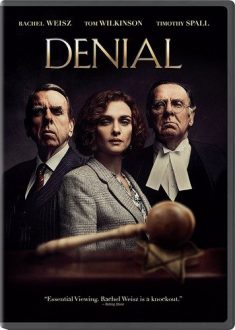
Although the target of their unleashed hatred was Irving’s alleged “Holocaust denial,” as near as I can tell, that particular topic was almost entirely absent from all of Irving’s dozens of books, and exactly that very silence was what had provoked their spittle-flecked outrage. Therefore, lacking such a clear target, their lavishly-funded corps of researchers and fact-checkers instead spent a year or more apparently performing a line-by-line and footnote-by-footnote review of everything Irving had ever published, seeking to locate every single historical error that could possibly cast him in a bad professional light. With almost limitless money and manpower, they even utilized the process of legal discovery to subpoena and read the thousands of pages in his bound personal diaries and correspondence, thereby hoping to find some evidence of his “wicked thoughts.” Denial, a 2016 Hollywood film co-written by Lipstadt, may provide a reasonable outline of the sequence of events as seen from her perspective.

Yet despite such massive financial and human resources, they apparently came up almost entirely empty, at least if Lipstadt’s triumphalist 2005 book History on Trial may be credited. Across four decades of research and writing, which had produced numerous controversial historical claims of the most astonishing nature, they only managed to find a couple of dozen rather minor alleged errors of fact or interpretation, most of these ambiguous or disputed. And the worst they discovered after reading every page of the many linear meters of Irving’s personal diaries was that he had once composed a short “racially insensitive” ditty for his infant daughter, a trivial item which they naturally then trumpeted as proof that he was a “racist.” Thus, they seemingly admitted that Irving’s enormous corpus of historical texts was perhaps 99.9% accurate.
I think this silence of “the dog that didn’t bark” echoes with thunderclap volume. I’m not aware of any other academic scholar in the entire history of the world who has had all his decades of lifetime work subjected to such painstakingly exhaustive hostile scrutiny. And since Irving apparently passed that test with such flying colors, I think we can regard almost every astonishing claim in all of his books—as recapitulated in his videos—as absolutely accurate.
Aside from this important historical conclusion, I believe that the most recent coda to Irving’s tribulations tells us quite a lot about the true nature of “Western liberal democracy” so lavishly celebrated by our media pundits, and endlessly contrasted with the “totalitarian” or “authoritarian” characteristics of its ideological rivals, past and present.
In 2005, Irving took a quick visit to Austria, having been invited to speak before a group of Viennese university students. Shortly after his arrival, he was arrested at gunpoint by the local Political Police on charges connected with some historical remarks he had made 16 years earlier on a previous visit to that country, although those had apparently been considered innocuous at the time. Initially, his arrest was kept secret and he was held completely incommunicado; for his family back in Britain, he seemed to have disappeared off the face of the earth, and they feared him dead. More than six weeks were to pass before he was allowed to communicate with either his wife or a lawyer, though he managed to provide word of his situation earlier through an intermediary.
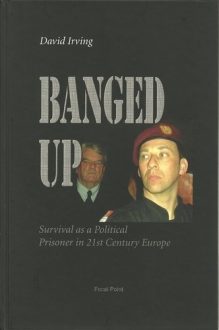
And at the age of 67 he was eventually brought to trial in a foreign courtroom under very difficult circumstances and given a three-year prison sentence. An interview he gave to the BBC about his legal predicament resulted in possible additional charges, potentially carrying a further twenty-year sentence, which probably would have ensured that he died behind bars. Only the extremely good fortune of a successful appeal, partly on technical grounds, allowed him to depart the prison grounds after spending more than 400 days under incarceration, almost entirely in solitary confinement, and he escaped back to Britain.
His sudden, unexpected disappearance had inflicted huge financial hardships upon his family, and they lost their home, with most of his personal possessions being sold or destroyed, including the enormous historical archives he had spent a lifetime accumulating. He later recounted this gripping story in Banged Up, a slim book published in 2008, as well as in a video interview available on YouTube.
Perhaps I am demonstrating my ignorance, but I am not aware of any similar case of a leading international scholar who suffered such a dire fate for quietly stating his historical opinions, even during in darkest days of Stalinist Russia or any of the other totalitarian regimes of the twentieth century. Although this astonishing situation taking place in a West European democracy of the “Free World” did receive considerable media exposure within Europe, coverage in our own country was so minimal that I doubt that today even one well-educated American in twenty is even aware it ever happened.
One reason that most of us still believe that the West remains a free society is that Our American Pravda works so hard to conceal the important exceptions.
Censorship? By The U.S. Women’s National Democratic Club? You Bet!
By J. Michael Springmann | American Herald Tribune | October 29, 2018
Say It Ain’t So, Joe! The author’s book, Goodbye, Europe? Hello, Chaos? Merkel’s Migrant Bomb is more toxic than the controlled wave of migrants flooding the Continent over the past few years. It is more toxic than the carefully-organized migrant “caravans” now marching to the United States. On October 24, 2018, through the efforts of a contact, the Women’s National Democratic Club (WNDC) in Washington, D.C. invited this writer to speak about his book at a luncheon on November 29. However, mirabile dictu, on October 26, the Club reneged on its invitation.
Why? The book asks awkward questions, names names, and provides deep background on unrestricted, uncontrolled migration. It is a carefully-researched analysis of how and why millions of people, mostly from South and Southwest Asia and North Africa, poured into the European Union. The work delves into America’s Forever War against the Arab and Muslim worlds, detailing how the United States destroyed country after country. Blaming shadowy Islamists for the problem, Washington concealed the activities of its own intelligence services and those of other countries in carefully herding the unfortunates out of their homelands and onto a foreign continent. Its 354 footnotes, draw from contemporary press articles and Kelly Greenhill’s scholarly investigation of the subject, Weapons of Mass Migration: Forced Displacement, Coercion, and Foreign Policy (Ithaca, N.Y.: Cornell University Press: 2010), buttress the author’s investigations, arguments, and conclusions.
These ideas are anathema to the American Establishment. Of which, the WNDC evidently thinks it is a member.
Nevertheless, in an effort at damage control, the author’s friend had suggested to the WNDC that talking about Goodbye, Europe? would be useful to their membership in understanding the situation in Europe as well as the columns of aliens, not quite in army division strength, now marching on America. She had emphasized this author’s background as immigration attorney, service as a diplomat, and activity as political commentator on international affairs. She further noted that this writer’s experience provided a certain amount of gravitas, commenting:
Mr. Springmann’s position…would offer WNDC attendees a rare (unfortunately rare, as mainstream media and elected officials are not addressing the nuances and complexities of this mass migration), opportunity to go beyond soundbites, fear and the narrow ‘discussion’ that has been framed not only in Europe but in the US as well…
And the WNDC’s Reply? Here’s Marisha Kirtane, the Club’s Strategic Communications Director, in her own words:
My concern is more the tone in which migrants were talked about in the abstract for the book, and how they seemed to be characterized…. Why do migrants represent an ethnopolitical nightmare? Where is the data that suggests that most migrants are men?…But there’s a good chance that it is a very individual point of view by someone who is a bit of a conspiracy theorist.
Miss Kirtane obviously didn’t read the book (even though this writer had supplied the WNDC with a copy). If she had seen the volume, she would have noted that the book was, in part, dedicated to the migrants: … To the unfortunate millions driven from their homes by American foreign policy. These were individuals and families weaponized as migrants, pushed into foreign lands and cultures they did not understand… Just as obviously, she didn’t read any of the comments about the work posted on Amazon. If she had, she would have learned from the former director of the Voice of America’s Arabic Service that:
… I consider [this]one of the very rare books that are so deeply and extensively researched and so widely and authentically sourced. It discusses frankly and uninhibitedly the worldwide wave of migrants, refugees and asylum seekers which flooded many European countries and threatened to break on our shores. The author unearthed the roots of the problems which caused that human deluge of millions. Mr. Springmann lays the blame on many factors including turmoil, political instability, unemployment, poverty, aspiring to better life and mainly violence and wars in Asian, North African and, in particular, Middle Eastern countries. He stresses that the major cause of the outflow of that flood is the United States’ foreign policy which he claims is bent on using the migrant waves as a “mass destruction weapon… It is timely and comes in a propitious moment when the American debate on immigration, refugees and border protection is heating up. The book is a warning shot which directs attention to the migrant problems and as a reminder that solutions are urgently needed. The author offers some reasonable ones.”
So Why Is There Censorship? Simple. The book and planned address criticize American foreign policy. You know, of invading and destroying countries with which the United States is at peace. Besides its century-long history of overthrowing democratic governments in Latin America and the Caribbean, the United States has crushed Arab and Muslim regimes in Southwest Asia which apartheid Israel sees as abominations. The Democratic Party as well as the members of the WNDC have supported these actions. If they haven’t, this writer has heard nary a word of criticism directed against former presidents James Earl Carter (D-Ga.), William Jefferson Clinton (D-Ark.), or Barack Hussein Obama (D-HI.). The Democrats intensely dislike anyone linking their wars and their support for wars to their politicians, who, in their eyes, stand for hope and change.
There is also censorship because the WNDC can’t or doesn’t want to grasp the causes of the migrant waves in Europe and the Americas: the nearly complete destruction of entire countries and their political systems, with attendant imposition of highly undemocratic regimes in their place. Naturally, decent, hard-working common folk want to leave.
But that’s not the only reason for censorship. It gets worse. The WNDC (and the far too many people who think like they do) love the sub rosa import of cheap, easily exploited labor. (It’s really slave labor but the War Between the States abolished slavery, don’t you know.) Moreover, they’re votes to be had. These can be illegal ones (since the U.S. doesn’t have a national identity card and efforts to require proof of citizenship at the polls are always deemed unconstitutional). Or they can be legal ones, as the result of amnesty or marriage to an American citizen. The key word is gratitude to the political party that let the migrants in.
But, some people fight back. Mostly on the Continent. In Goodbye, Europe?, the author reviews right-wing, populist parties, country by country. He notes that anti-EU, anti-migrant Marine Le Pen and her then-Front National garnered 30% of the French presidential vote in 2017. Anti-immigrant Geert Wilders’ Union Party for Freedom (PVV) became the second-strongest party in the Dutch parliament in 2017. Angela Merkel, the woman who opened Europe to migrants. and her Christian Democratic Union (CDU) took an unprecedented drubbing in Germany’s September 2017 general election. But the Alternative for Germany Party (AfD), anti-EU and anti-migrant went from nothing to nearly 13% of the vote. According to an E-mail from a German friend October 28, 2018, Merkel’s CDU and the SPD, the Socialists, again got pounded in that day’s Hesse State elections, losing 10 percentage points each, with the AfD taking a projected 14% of the ballots cast.
Don’t you dare question. However, in Europe, just as in the United States, anyone who probes the migrant wave, its causes, or its supporters is denounced as a racist, a hatemonger, a Neo-Nazi, or worse. Peter van Buren, author and former American diplomat, recently queried the rapid mobilization of the migrant caravans moving towards the U.S. just before mid-term elections. Posting on Facebook, he asked how 7,000 people came together overnight. He wanted to know who or what is supplying them with food and water. Consequently, he was hit with astonishingly fact-free emotional outbursts. (When this writer was assigned to Saudi Arabia, he drank three liters of water a day. Imagine the task of daily providing 21,000 liters of potable water to these people.)
Some of this help seems to be coming from the Mexican government. NBC news reported October 28 that “For the first time an arm of the [Mexican] federal government seemed to be directly helping the migrants advance rather than trying to diminish the caravan. In this case Grupo Beta, Mexico’s migrant protection agency, gave rides to stragglers and passed out water.”
Conclusion. Americans live in the past. They believe in exceptionalism. They believe in their inalienable right to tell others what to think and what to do. And they’re wrong.
My contact who reached out to the WNDC believes that the U.S. (and Europe) should admit anyone, regardless of their education level or qualifications. After all, she noted, the Irish and others came to the United States in the 19th century. They came for the most part as single people who would later send for their families. They came, she commented, because they had no future at home. Well, in the 19th century, America was a continent-wide wilderness filled with lots of trees and Red Indians, soon to be extirpated for their inconvenient existence. Today, with more than 300 million people of various ethnicities and strong, diametrically-opposed political beliefs, the U.S. is becoming unmanageable.
On the other hand, Canada and Australia are selective about their immigrants. Unlike the U.S., they put a premium on what the new immigrant can bring to the county: funds and education. After all, we live in a high-technology society dependent on high level skills and knowledge.
American exceptionalism goes back to the 17th century when John Winthrop, governor of the Massachusetts Bay Colony, said “We shall be as a city upon a hill, the eyes of all people are upon us.” In a speech given in 1974 at the Political Action Conference, President Ronald Reagan expatiated on what Winthrop meant: “We are, indeed, and we are today, the last best hope of man on earth.” According to Stephen M. Walt in Foreign Policy (October 11, 2011), “Most statements of ‘American exceptionalism’ presume that America’s values, political system, and history are unique and worthy of universal admiration. They also imply that the United States is both destined and entitled to play a distinct and positive role on the world stage.”
That’s a myth. Any Afghan, Iranian, Iraqi, Libyan, or Syrian can confirm that. Most of Latin America can, as well.
Flowing from exceptionalism is the American desire to control the world’s political systems–for their own good. Look at the United Nations and U.S. vetoes of resolutions critical of Israel. See the steady advance of outmoded NATO to Russia’s borders. Consider the chain of alliances which U.S. Secretary of State John Foster Dulles forged in the 1950s. Contemplate America’s withdrawal from the Joint Comprehensive Plan of Action or from the Intermediate Range Nuclear Forces Treaty. Reflect on sanctions imposed on Russia and Iran but not Israel or Saudi Arabia. America knows best doesn’t it?
No. And that’s why the WNDC censored this writer’s talk. People with limited knowledge and a specific agenda wanted to control someone else’s message. They wanted this control to ensure that their speech and only their speech would be heard. In 21st century America, freedom of speech applies to only certain words from certain groups. George Orwell’s 1984 came 30 years early.
J. Michael Springmann is an attorney and former diplomat with the US Department of State. As a diplomat, he spent five years in Germany, two years in India, and nearly two in Saudi Arabia. Now a writer and political commentator, Springmann is also the author of Visas for Al Qaeda: CIA Handouts That Rocked the World.
Biggest Prison on Earth: A History of the Occupied Territories
By Jim Miles | Palestine Chronicle | October 1, 2018
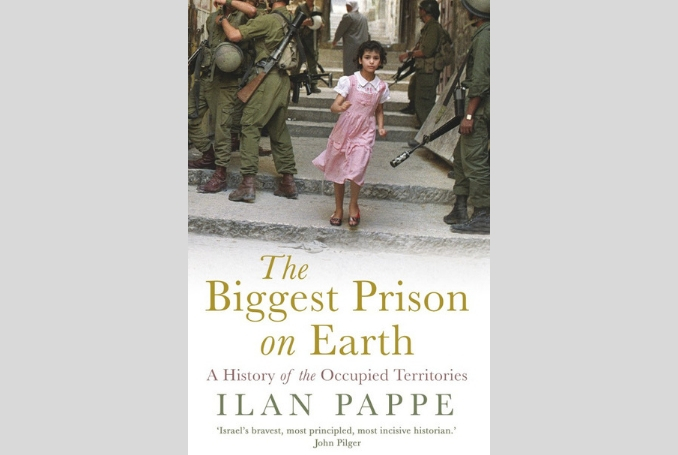
(The Biggest Prison on Earth – A History of the Occupied Territories. Ilan Pappe. Oneworld Publications, London, 2018)
The history of the ethnic cleansing of Palestine is continued with Ilan Pappe’s recent work, The Biggest Prison on Earth. For those who have read Pappe’s earlier histories, it is clear the original Zionists recognized the existence of the Palestinian population and the resistance most likely to rise from it. Also recognized are the actions taken throughout the occupation and settlement that the Jewish settlers were intent on marginalizing, displacing, and cleaning as much of Palestine as they could of its residents.
The revelation in this continuation of the history is the high degree to which these policies were officially planned and ready for action starting up to four years before the 1967 six day pre-emptive war against the Arab states. The details of control, the laws, and institutions necessary to contain the Palestinian population and to try and force it into exile were developed before the war started – and implemented immediately afterward. These rules and regulations essentially made all occupied areas into large open-air prisons.
Pappe argues that the term “occupation” is invalid for two main reasons: first, it is not a temporary situation; and it denies 80 percent of the Palestinian Mandate. I understood the latter to recognize that in reality all of the British controlled Mandate is occupied by Jewish settlers. Israel is in its entirety a colonial settler society and not an occupying power: it is permanent and it practices ethnic cleansing.
Demographics above all plays a major role in Palestine. With the 1967 war about to start, the Israeli’s recognized they were absorbing an even larger demographic deficit by acquiring the new territories. The means to control the situation domestically and with foreign countries was important, and most importantly was the support of the U.S. politically, militarily, and financially. The goal, apart from completely eliminating the Palestinians, was to hold territory without annexing it and preventing any contiguous Palestinian control. The book works through the political discussions before and after the war, and then through the different periods leading up to the Oslo Accords.
The Oslo Accords fit perfectly into the Israeli plans of never intending to create a Palestinian state. Domestically, the PLO and Fatah were not only sidelined but with the creation of the Palestinian Authority and the three zones of control in the West Bank, essentially became partners in crime. Internationally, the politicians talked, and talked some more while more and more settlements were established in the newly occupied zones…and the international community accepted the ploy.
Pappe also takes the reader through the two Intifadas and the various onslaughts/punishments handed out to Gaza. In sum, Gaza has served as a maximum security prison, without recourse to any international recognition except for a few moments when the assaults killed large numbers of women and children. It has served in some respects as a training ground and munitions testing site for the Israeli army highlighting mostly what the world should know about Israel’s complete lack of morality and its general lack of on ground fighting efficiency.
Israel never intended from the start to do more than nod their collective heads and continue on with their well-planned zones of military control. The Biggest Prison on Earth – A History of the Occupied Territories is essential reading in order to help complete the overall picture of Israeli intransigence in regards to international law and international human rights standards and their callous subjugation of the Palestinian people.
– Jim Miles is a Canadian educator and a regular contributor/columnist of opinion pieces and book reviews to Palestine Chronicles. His interest in this topic stems originally from an environmental perspective, which encompasses the militarization and economic subjugation of the global community and its commodification by corporate governance and by the American government.
New Book – Climate Basics: Nothing to Fear
By Rod Martin, Jr | Watts Up With That? | September 29, 2018
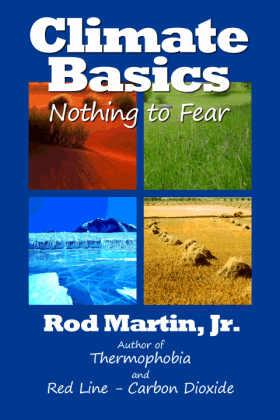 Afraid of the future? Don’t be. When we’re armed with the basic facts of climate, we can more easily spot the lies that the corrupt, corporate news media is trying to feed us. Some of those lies are huge.
This small book gives us everything the layman needs to know about climate science.
The warming alarmists attempt to frighten us with things like,
– Global warming will result in more violent storms.
– Global warming will give us more deserts and droughts.
– Global warming is dangerous.
– Carbon dioxide is driving our dangerous global warming.
– We urgently need to cool down the planet.
– Carbon dioxide is a dangerous pollutant.
– The future looks bleak unless we drastically reduce our “carbon footprint.”
This slender volume sets the record straight on all of the above issues.
There are concerns for the future, but none of these are it. And when we have real problems to face, it does no good to be fixing things that don’t need it.
Download for free here for a limited time. PDF, Ebook, Kindle formats
A Wake-Up Call to the Canadian Left
By Michael Welton | CounterPunch | September 26, 2018
Yves Engler is Canada’s foremost feisty contrarian. Contrarians oppose what most people think about people and events. They don’t like to bask in the sunlight. They would rather look in the shadows or dimly lit back alleys. If they walk on a summer beach, they pay little attention to the sun glinting off the shells. They want to see what lies under the rocks.
Alas! There aren’t many contrarians left. We live in the age of the vanquished reporter and group think. The mass media (BBC, CNN, CBC) toe the prevalent hegemonic political line. They ask no questions. They speak confidently on the latest demonic act of Russia or Syria or Iran. Israel always gets off the hook, no matter how many Gazans are gunned down. The US-Saudi Arabia can massacre hundreds of thousands of Yemenis. Not on the news tonight! And won’t be on next week, either. All “unapproved evidence is brushed aside or disparaged regardless of its quality” (Robert Parry).
 Engler’s new book, Left, Right: Marching to the Beat of Imperial Canada’s Foreign Policy (Black Rose Publishers, 2018) follows in the train of previous muckraking and debunking books. Basically, Engler thinks the Canadian intelligentsia sees foreign policy through a glass darkly. They think that Canada is basically a benevolent nation. We (I am a Canadian) think we are not like our neighbour to the south. They are the land of conquest.
They are the democratic sheep in wolves clothing. They are the ones who bring “democracy and freedom” to nations on their gunboats. No, Canadians are a nation of peacekeepers and nice folks. Our myth-making agencies (Engler includes the Department of National Defense and Veteran Affairs as well the mass media) celebrate our heroic engagement in various wars and benevolent corporate and banking actions in the Caribbean and South America.
Engler believes adamantly that the left has “played a part in justifying Canada’s role within an unfair and unsustainable world economic system.” He focuses our attention on the Co-operative Commonwealth Federation Party (CCF) and the New Democratic Party (NDP) because this social democratic party has a voice in parliament. They can speak out on foreign policy. He also examines labour union spokespersons and well-known left commentators’ views on foreign policy issues. But Engler points out that the early CCF, fired with a vision of justice for Canada, was silent on the Canadian banks substantial influence over Caribbean finance. Even the lauded Regina Manifesto (1933) ignored Canadian complicity in European colonialism and was weak on Italy’s invasion of Ethiopia in 1936. Although in the years between 1933 and 1943, the CCF opposed imperialism and nationalism associated with Zionism. However, since then, the party has “often backed the dispossession of Palestinians.” Engler provides many more dispiriting examples.
He discovers that the left promotes imperial policies and recycles nationalist myths. In the post-WW II era, the CCF backed NATO and supported the Korean War. More recently, the NDP “endorsed bombing Syria and Libya.” Labour unions supported the Marshall Plan, NATO, Korean War, the assassination of Patrice Lumumba and the Bay of Pigs invasion. They were swept up in the anti-communist mania of the lamentable Cold War. On the economic front, Engler observes that Quebec sovereignists are progressive at home and, in the case of Haiti (Engler’s favourite example of Canadian political malfeasance), supported the overthrow of Jean-Baptiste Aristide in 2004.
Engler argues that liberal and left intellectuals are pressured to be patriotic. They mostly ignore international affairs. Social democracy has great difficulty criticizing their own government’s imperialism. We don’t realize, it seems, that Canada is not a mere caboose hinged to the imperialist train. We actively participate in imperial projects. We choose to send troops to the Ukraine, even though the US engineered the coup overthrowing Viktor Yanukovych and Ukrainian armies display fascist insignia at will. We heartily support the movement of NATO troops close to the Russian border. We seem averse to realizing how our present Canadian foreign policy does not foster world peace and unity at this moment of civilizational crisis.
PM Harper sent troops to fight for western hegemony in Afghanistan. We chirp along with the choir accusing Russia and Iran of just about everything nasty. It’s all their fault. We are stupefied on the drug of propaganda. Engler states: “But instead of criticizing the geo-strategic and corporate interests driving foreign policy, the NDP/CCF has often supported them and contributed to Canadians’ confusion about their country’s international relations.” Dissident CCF or NDP voices are usually repressed or preventing from running for office.
Engler’s text is packed with facts and details. That’s his style. A short review must entice the reader to dig into the text. But let me guide readers’ attention to several courageous investigations and commentaries that raised my eyebrows. It takes guts to demythologize Canada’s popular critics and causes. Many of Canada’s intellectuals are associated with think tanks. Engler argues that the influential Rideau Institute of International Affairs “spurns demilitarization and anti-imperialist voices.” He thinks that Peggy Mason, president of the Institute since 2014, has significant experience in Canadian foreign policy circles. But it is unlikely she will “forthrightly challenge the foreign policy status quo or the corporate interests that back it.”
Engler cuts to the quick regarding cheerleading Canada’s role as peacekeepers. He thinks this is mainly a way to “align with Canadian mythology and evade confronting military power.” For Engler, Canada’s peacekeeping in Egypt in 1956 and Cyprus in 1964 were aimed at reducing tensions within NATO. In the Congo and Korea, Engler states that “Ottawa contributed to US imperialist crimes.” These are harsh accusations that bump into our sense of being benevolent actors. Engler offers this nugget insight: the left nationalist mythologies separate us from US imperialism while obscuring our compliant service to western hegemony. Engler thinks that Linda McQuaig’s idealization of Lester Pearson is shameful.
Engler takes on Canada’s folk hero and distinguished public figure, Stephen Lewis. From 2001-2006, Lewis was the UN Special Envoy for HIV/AIDS in Africa. In his celebrated Massey lectures, Race Against Time (2005), Lewis “failed to critique any Canadian policy measure in Africa except for Ottawa’s insufficient aid.” In fact, Engler points out that Canada’s early assistance to Africa trained militaries to prevent the pursuit of “wholly independent paths.” Ottawa backed the overthrow of Nkrumah in 1966. Engler moves inside the murky and confused world of the Rwanda massacres in the mid-1990s. There are different narratives framing the meaning of these massacres.
Romeo Dallaire’s narrative is but one, now tattered, story. The gutsy Engler informs us that Dallaire justified the NATO invasion of Libya, and called for interventions in Darfur, Iran and Syria. Some scholars now shift the spotlight on the malevolent role of Paul Kagame, the leader of the Rwanda Patriotic Front, both in the Rwanda killings and invasion into the east Congo. Basically, Engler thinks that Lewis praises Kagame, an authoritarian dictator who brooks no opposition, far too much.
In his book, Lewis criticizes China for backing Khartoum but remains silent on Kagame’s invasion of the Congo. And Lewis has also been silent on “official Ottawa’s multi-faceted support for European colonial rule or Canada’s role in overthrowing progressive leaders Patrice Lumumba, Milton Obote and Kwame Nkrumah.” It seems, Engler suggests, that media coverage of Africa in the Canadian media (2003-2012) is still infected with a “moralizing gaze” and “white man’s burden” imagery.
It is not surprising that Engler wonders why the left “accept or promote policies that do harm to ordinary people across the planet.” In fact, one of Engler’s maxims for foreign policy is that we do no harm to others and act to sustain our common homeland, the earth. If many liberal or left critics raise tough questions on domestic issues, why do they see foreign policy through the glass darkly? Engler even shocks us by demonstrating that many indigenous people, victims of Canadian colonialism, joined in the wars of Empire.
For one thing, Engler argues insistently that the left has accommodated itself to a Canadian form of nationalism. Enveloped in the myth of benevolent peacekeepers and crusaders for world peace, we create dubious icons like Lester Pearson and Romeo Dallaire. Left-leaning Canadian nationalists—such as those who supported the Waffle movement within the NDP in the late 1960s and 1970s—embraced the idea that Canada was a colony of the US. In fact, say the Waffle intellectuals, we began as a British colony, became a nation and returned to colony status through subservience to the US Empire. Did we really?
But the deterministic “staples theory”, made famous by legendary Canadian economic historian Harold Innes, renders us passive as a sovereign nation. This theory obscures our foreign policy choices about the kind of world we as Canadians desire and our corporate commitments to exploit other nation’s financial and natural and human resources. We black-out the nasty stuff in the Caribbean, Africa, Guatemala and elsewhere. We can’t (or won’t see it) because we, too, are “exceptional.”
And, as Engler reminds us, think again about Canada as the poor hewers of wood and drawers of water. Toronto ranks seventh in the world as a financial centre. Boldly, he states: “Canadian companies are global players in various fields:” Garda World is the world’s largest privately held security companies (with 50,000 employees). SNC Lavalier is one of the world’s largest engineering companies. Bombadier and CAE are the world’s largest aerospace and flight stimulators.
And the “starkest example” of Canadian corporate power is the mining sector where ½ of the world’s mining companies are based in Canada. If one is weeping over Canadian subservience—poor us! –to US corporate power, “left nationalists generally ignore Canadian power and abuse abroad.” Engler has written about our not too exceptionally just mining companies in other books. Banging the drum, he says, “Wake up Canadian left intellectuals!”
Dr. Michael Welton is a professor at the University of Athabasca. He is the author of Designing the Just Learning Society: a Critical Inquiry.
Featured Video
Marandi: US attacked world’s largest gas field & Iran declares economic war
or go to
Aletho News Archives – Video-Images
From the Archives
Why the UK, the EU and the US Gang-Up on Russia
By James Petras :: 03.20.2018
Introduction: For the greater part of a decade the US, the UK and the EU have been carrying out a campaign to undermine and overthrow the Russia government and in particular to oust President Putin. Fundamental issues are at stake including the real possibility of a nuclear war.
The most recent western propaganda campaign and one of the most virulent is the charge launched by the UK regime of Prime Minister Theresa May. The Brits have claimed that Russian secret agents conspired to poison a former Russian double-agent and his daughter in England, threatening the sovereignty and safety of the British people. No evidence has ever been presented. Instead the UK expelled Russian diplomats and demands harsher sanctions, to increase tensions. The UK and its US and EU patrons are moving toward a break in relations and a military build-up.
A number of fundamental questions arise regarding the origins and growing intensity of this anti-Russian animus.
Why do the Western regimes now feel Russia is a greater threat then in the past? Do they believe Russia is more vulnerable to Western threats or attacks? Why do the Western military leaders seek to undermine Russia’s defenses? Do the US economic elites believe it is possible to provoke an economic crisis and the demise of President Putin’s government? What is the strategic goal of Western policymakers? Why has the UK regime taken the lead in the anti-Russian crusade via the fake toxin accusations at this time?
This paper is directed at providing key elements to address these questions. … continue
Blog Roll
 Aletho News
- Iran War Is Accelerating the End of US Dominance
- FBI Resumes Buying Americans’ Location Data Without Warrants
- IDF threatens ‘elimination’ for Russian leaders who ‘wish Israel ill’
- Attacks on enemy energy facilities not over yet, strikes ongoing: Iran
- US dragged by Israel into ‘unlawful war’ with Iran – Gulf state
- Israel’s War on Iran’s Grid: How the South Pars Strike Turned Energy into a Weapon
- War on Iran to impose trillion-dollar ‘Israel First Tax’ on US citizens: Araghchi
- The State Is Socializing the Cost Of the Iran War
- Seyed M. Marandi: U.S. Attacked World’s Largest Gas Field & Iran Declares Economic War
- Washington’s War on Cuba Is Older Than You Think
- If Americans Knew
- Trump: Israel attacked Iranian gas field without US knowledge. No more such attacks!
- America’s friends must help extricate it from an unlawful war
- Democratic Nat’l Committee’s Kneejerk Backing of Israel Is Political and Moral Failure
- Major revelations from former counterterrorism chief Joe Kent’s extensive interview
- More than half of Palestinian child detainees have no charges
- Grieving Parents in Iran Spend Every Night at the Graves of Their Children, Killed by U.S. Strike
- War on Iran spins out of control, Palestine struggles – Not a ceasefire Day 160
- How ignorance, misunderstanding and obfuscation ended Iran nuclear talks
- Israeli media reports grotesque settler attack in West Bank
- UK security adviser attended US-Iran talks and judged deal was within reach
- No Tricks Zone
- Energy Expert: Germany’s Nuclear Phaseout Was A “500 Billion Euro Mistake”
- New Research: South Australia’s Mid-Holocene Sea Surface Temperatures Were 4°C Warmer Than Today
- Storing Green Energy To Last Germany 10 Days Would Require A 60-Million Tonne Battery
- New Studies: UK Sea Levels Were 4 Meters Higher Than Today During The Mid-Holocene
- Destructive Green New Deal: German Energy And Metal Group Warns Of Drastic Crisis
- New Study Documents A 20-Year Pause In Arctic Sea Ice Decline – Driven By Internal Variability
- Wake-up Call: Survey Shows Majority Of Germans Now Favor Postponing Climate Targets!
- Televised! Leading German Political Candidate Tells Schoolchildren CO2 Makes Sun Hotter!
- New Study: A Century Warming Of 1.1°C Is ‘Commonplace’ And ‘Not Unusual’ During This Interglacial
- New Study: ‘Internal Noise’ And Volcanic Forcing Can Trigger 10-15°C Warming Within Decades
 Aletho News
