The Obama Wars
By David Swanson | War Is A Crime | July 10, 2019
 By “the Obama wars” I don’t mean some overgrown infants on television screaming racist insults or pretending that opposing racism requires cheering for Obama.
I mean: the widespread indiscriminate murder of human beings with missiles — many of them from robot airplanes — let loose to threaten any non-white country on earth by Obama and expanded by Trump. I mean the catastrophic destruction of Libya — still continued by Trump. I mean the war on Afghanistan, the vast bulk of which was overseen by Obama, though Bush and Trump have had minor roles. I mean the assault on Yemen, begun by Obama and escalated by Trump. I mean the war on Iraq and Syria escalated first by Obama and then by Trump (following the de-escalation locked in place by Bush though Obama fought it tooth-and-nail).
I mean the conflict with Iran, heightened by Obama and then dramatically again by Trump. I mean the expansion of conflict-producing troops and bases across Africa and Asia. I mean the creation of the new cold war with Russia. I mean the build up in nuclear weapons and the delusional rhetoric about “usable” nuclear weapons. I mean the support for Israel’s wars on Palestinians. I mean the coups in Ukraine and Honduras. I mean the threats to Venezuela. I mean the normalization of fantastical excuses for the gravest crimes. I mean the practice of campaigning on ending wars, never ending any of them, and never having anyone really care. I mean the constant shattering of past records in military spending.
Obama’s legacy, despite all sorts of variations, many of them superficial, and despite its role in defeating Hillary Clinton at the ballot box, has largely been maintained, advanced, and imitated by bipartisan consensus and by Donald Trump.
If you want to review what Obama did in that quirky little area of his job to which some 60% of federal discretionary spending is devoted, and which puts us all at risk of nuclear disaster, pick up a copy of Jeremy Kuzmarov’s book Obama’s Unending Wars: Fronting the Foreign Policy of the Permanent Warfare State. Kuzmarov places Obama in historical context and outlines his parallels with Woodrow Wilson, another extreme militarist generally understood as a peace visionary. Kuzmarov reviews — and adds information that many of us probably never knew to — the story of Obama’s rise to power and the story of all of his many wars.
We tend to forget that right up through the presidency of George W. Bush wars were thought of as temporary things that had endings. Now they’re hardly thought of at all, but they’re understood to be permanent. And they’re thought of in partisan terms. We sometimes forget that candidate Obama, like candidate Trump, promised a larger military. Candidate Obama promised a larger war on Afghanistan. And when it came time for Obama’s re-election to a second term, he reached out to the New York Times and asked that paper to write an article about how good he was at killing people, about how he carefully studied a list of men, women, and children and picked out the ones in whose name he would send missiles into clusters of unidentified victims. Obama’s claim, in his own words, was “I’m really good at killing people.” Nobody who liked Obama and didn’t like murder allowed themselves to become aware of this aspect of Obama’s re-election campaign; and they never will become aware of it.
The reason it matters is that over 20 Democrats are now campaigning for president, some of whom are promoting the same sort of militarism, some of whom are opposing it to some degree, and some of whom have revealed little or nothing about their positions on such matters. One of them, Joe Biden, was part of Obama’s wars. Biden is the guy who claimed of the mass-slaughter of people in Libya “We didn’t lose a single life.” Kamala Harris is the woman who will never ever question whether by “life” he meant “non-African life.” She’s too busy worrying that peace might break out in Korea. The stupidity of tokenism will plague us until we at least have the decency to regret having fallen for it before. The stupidity of militarism will plague us until we stop glorifying and excusing it and start supporting efforts to create peace.
Penguin, Rothschild and Zionist Pressure
By Gilad Atzmon | July 2, 2019
Penguin announced this week that in response to claims of ‘antisemitism’ it has stopped printing Col. Pedro Baños’ best selling book, “How They Rule the World.”
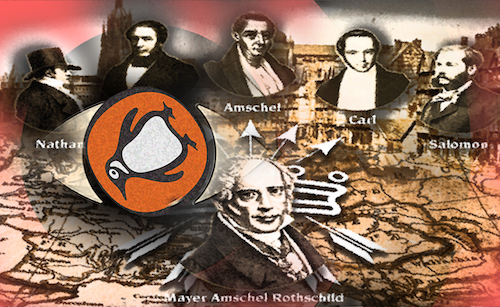
The scandal erupted when it was revealed that passages in the original Spanish edition of the book related to the Rothschild dynasty were omitted from the Penguin Random House English translation. The meaning of this deletion is in itself devastating. It suggests that Penguin attempted to kosherize a book by editing and deleting sections so it would not offend Jewish sensitivities.
The publisher initially rejected allegations that the book which claims to reveal “the 22 secret strategies of global power,” is antisemitic. But after continued pressure from various organisations including the Campaign Against Antisemitism, Penguin commissioned an “external review” led by Rabbi Julia Neuberger.
The Jewish Chronicle (JC) ‘reveals’ that Col. Baños’ original Spanish edition makes several references to the Rothschild family, including a passage accusing the banking family of holding “gigantic” economic power and influence which has “led to multiple speculations about their capacity to intervene in key global decisions”. Needless to say, this an historical description of the family and its role in history.
The hypocrisy displayed here by the Jewish media and pressure groups is mind blowing. Jews, themselves, do not hide their pride and admiration for the Rothschild Dynasty and its global political power. In the following video you can watch a Zionist bragging about the Balfour declaration that “changed the course of history” and the power and influence the Rothschild family exercised behind the scenes.
https://www.youtube.com/watch?v=DsRuB-Qw1b0
Most English speakers are familiar with the musical, Fiddler on the Roof, but not many Brits or Americans are aware that in Hebrew and in Yiddish the musical’s greatest hit ‘If I were a Rich Man’ is sung “If I were a Rothschild.” In the following video you can listen to ‘If I Were a Rothschild’ (in Yiddish) while viewing the many estates of this influential family.
https://www.youtube.com/watch?v=rUJcoWT_phQ
Penguin initially argued that while the book “clearly expresses robust opinions,” it was not anti-Semitic. However, persistent pressure from Jewish organisations led the publishing giant to commission a Rabbi to review the book. It came as no surprise that Rabbi Neuberger with the aid of two Spanish ‘antisemitism experts,’ reached the conclusion that the Spanish edition contains “echoes of Jewish conspiracy theories.” The phrase ‘Jewish conspiracy theories’ is confusing. It basically applies to events in the past which reflect badly on Jews in the present. It is there to suppress free discussion. Jewish power as I define it, is the power to silence criticism of Jewish power. Penguin Random House shamelessly succumbed to precisely this power last week.
In an attempt to justify his company’s decision, Penguin’s chief executive declared that “Penguin Random House UK publishes for readers of all backgrounds, faiths and nationalities.”
One may wonder what Penguin’s next move will be. Is the compromised publishing house going to remove George Orwell from its catalogue because some Jews insist that deep inside, Orwell was a vile ‘anti-Semite’? Maybe Penguin should provide us with the list of titles that are fit for “all backgrounds, faiths and nationalities.” Out of interest, is Penguin planning to delete Deborah Lipsdat’s books because they may offend ‘Aryan sensitivities?’ Will Penguin delete Salman Rushdie’s titles because he once offended a few Muslims? For some reason, I‘m guessing that T. S. Eliot will be the first to go.
For my part, I welcome Penguin’s shameless decision. It affirms every warning I have produced for the last two decades. The fact that a publisher omitted innocent factual segments from a book simply to appease one Jewish group or another reveals a gross lack of intellectual integrity and commitment to truth. In the Britain of 2019, a leading publishing house doesn’t trust readers to think for themselves. This exposes how radically Britain has changed. It is no longer an open society. Britain is now an authoritarian society. It is, in effect, an occupied zone.
To buy How They Rule the World. on Amazon UK click here.
“Rise and Kill First.” – The Secret Israeli Worldwide Assassination Program.
By Brett Redmayne-Titley | Global Research | June 28, 2019
“It made no difference which Palestinians we killed… They either were terrorists or would become terrorists or they gave birth to terrorists.” – former IDF commander, Rafael “ Raful” Eitan.
Spies, Femme fatale, deadly plots, killings, bombs, knives, guns, and an array of unique murderous weaponry that would make James Bond and “Q” envious. All this, combined with dozens of unapologetic and brutal cloak and dagger assassinations in foreign locales worldwide? Sounds like the makings of a great spy thriller.
Indeed. But, despite decades of Israeli denial… this story is true.
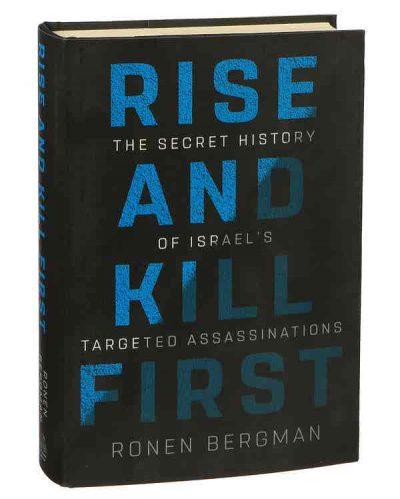 Ronen Bergman’s book, “Rise and Kill First,” was released in late 2018 to what, considering the inflammatory subject, was relatively little fanfare. While this might seem surprising, on reading this important chronological documentary of the inception and development of Israel’s worldwide assassination program it becomes clear that this book does provide a unique, very detailed and accurate history of Israel’s hundreds of extrajudicial killings over the past fifty plus years.
However, when read with just the right eyes, other far more important and separate timelines of history appear within the book to the reader already wary of the definition and rise of modern Zionism. Of these other unmentioned chronologies within the 530 pages, the author fails miserably in connecting these dots of his own excellent, but thus too superficial, presentation of fact.
What this book does more importantly reveal is a multi-faceted unmasking of Israel’s steady descent from the moral to the immoral tactics of war; the myth that it’s past Prime Ministers were not also barbaric terrorists and sacrosanct; the ongoing descent of other world leaders willing to give up their own conscience into the same mental abyss; the ever-increasing control of Israel over the minds of the American military, the CIA , its media and its politicians; and that Israel has never truly embraced peace as a foreign policy, preferring war and genocide instead.
Worse, “Rise and Kill First” reveals the true mind of the modern Israeli that has been infected by the rise of orthodox Jewish Likud party: An aberration of conscience that has no value for non-Jewish life worldwide whatsoever in its pursuit of its singular goal: Greater Israel.
***
“If someone comes to kill you, rise up and kill him first!” – The Babylonian Talmud.
“An eye for an eye, a tooth for a tooth” has been embraced in the routine alternative to turning the other cheek by Israel as foreign policy since its inception. This implies violent retaliation and retribution. But this book, when taken in totality, more accurately redefines this age-old Israeli mantra to its current Zionist definition, “Rise-up and kill first!”
The author’s failures in connecting the dots of his own excellently researched chronology are what makes this book a must-read. For observers of Israeli / Zionist hegemony of territory- and of mind- what Ronen omits are the many other chronologies that well illustrate, by his own documentation, why Israeli Zionism is indeed a threat that must be vanquished. These connections are obvious, yet omitted.
We need not wonder why.
In documenting Israel’s unknown – and always denied- program of targeted killings, Ronen’s work appears exceptional. What he presents is the result of seven years of his ongoing interviews of the scores of military and later political players who were the controllers of this seventy-five-year history of Israeli military development of domination and increased hegemony by assassination. The chronology begins with the killing of Tom Wilkin as far back as 1944 because of his role in very effectively infiltrating and disrupting the Jewish underground in Palestine as it forced the way for eventual Israel. At that time long ago before Zionism prevailed in establishing for the first time a Jewish nation, the assassination was not yet a sanctified national military program. That would change.
While the reader must take the details as presented since independent corroboration from these witnesses is nigh on impossible, the book is extensively footnoted and on very few occasions does Ronen fail to directly identify the names of his sources which he professionally cross-references against each other for validity. The credibility of the facts he presents seems evident.
His prima facie chronology of a book is a rollicking ride. Ronen is a good storyteller and he takes the reader through the details of the book from killing after killing and the planning and execution of each orchestrated plot. Loaded with salacious details aplenty, the author uses dozens of case studies from past Israeli hits to show the ongoing development and inception of the many new Israeli military and intelligence services, ongoing improvement in the tactics of the kill and the year-by-year increase in the willingness of Israel and its leaders to kill beyond their own borders while ever descending from the existing human conscience. His subject well in hand, Ronen treats the reader to a real page-turner of a spy novel.
The book picks up the modern era of Zionist expansion and assassination as WWII draws to a close with the Nuremberg trials and the flight of Nazi war criminals to other countries. Retribution is the key to these many stories as Israeli operatives systematically track down and arrest or kill those they accuse, such as Adolf Eichmann in Buenos Aires, Argentina.
As is the case with most books from Israeli authors on the subject of Israel, Ronen falls too conveniently upon the hyperbole of the Holocaust as reason for this initial killing and rendition program, but without proper examination. These killings first occur during the inception of the post-war development of Israel, the fact of which Ronen is far too brief and equally serving of the Israeli narratives since the historical slaughter and expropriation of Palestinians is glossed over.
As the author proceeds with his chronology, the reader is treated to a very fine and detailed description of many such major world events like the Munich Olympics kidnappings of 1972, the raid on Entebbe, Uganda and many, many more. Ronen does a very good job of cross-referencing the details of these many events with a plethora of interviews and quotes from the operatives directly involved at the time. What he reveals each time is quite likely the best examination of these events so far provided in print. Regarding Munich, he delves in great detail into the full rescue effort that includes the involvement of the German government which was at loggerheads with the Israelis and the IDF in the attempted and failed rescue.
Ronen’s effectiveness and credibility are challenged, however, by his almost constant insistence – by reference- that the Israeli actions he presents are invariably only retaliatory for a specific act of aggression by pro-Palestinian factions against Israelis. Ronen too routinely demonizes the Palestinian and Arab players’ actions and uses them too often as a fait a compli for their own eventual demise while rarely looking at the Israeli atrocity that preceded a Palestinian attack which led to yet another Israeli targeted killing.
During this period of the book, Ronen does a very good job documenting the change in the policy of the Israeli assassinations from executions only within Palestinian territories to the eventual decision to perform these assassinations globally. Ronen, although predominantly showing successful operations, does not shy away from Israel’s many failures as well.
He presents as almost comical the Manchurian Candidate-like attempt to brainwash, month after month, a Palestinian prisoner code-named “Fatkhi,” who is deemed to be mentally susceptible to these techniques and who, it was intended, would next be sent back to Palestine to assassinate PLO president Yasser Arafat. The results of this humorous vignette, after month’s of careful mental revision of the test subject assassin, are that the prisoner is finally freed on Dec. 19, 1969, by allowing him to cross the Jordan river. Due to equally poor planning, is swept down river and left clinging to a mid-river rock. When finally making it to shore Fatkhi immediately runs to the PLO police headquarters and then informs Arafat of all that he had endured at Israeli hands during his nine months of obviously unsuccessful programming.
When it comes to Arafat, the book shows the absolute hatred of Israel towards him personally due to his effectiveness as PLO chairman, a hatred that grows almost maniacally in the hearts of every Prime Minister and IDF commander as Arafat, again and again, evades their seemingly well planned and very numerous attempts to bump him off. This hatred is only made worse by the rising worldwide respect for Arafat and the PLO cause after each failed attempt.
It is at this stage in the book that, beyond the demand for Arafat’s blood, Israel crosses the mental Rubicon from respect for human life- other than the target- to allowing for and condoning the innocent to also be killed as a matter of convenience to each plot. The assassinations of a foreign scientist involved in the burgeoning nuclear programs in Iraq, Iran and Egypt began this slope downward.
Although Ronen fails to bring this point to the reader’s attention, he unwittingly documents in exceptional detail this change in conscience and therefore terror tactics which he best illustrates in the example of the Ashkelon murders.
***
“I do not remember an event of similar gravity in the history of the state of Israel” – Yehudit Karp, Israeli Deputy Attorney General for special duties
In understanding the change of the Israeli military and political mind towards that of proactive and routine utilization of terror by assassination, the Ashkelon affair is a seminal point in the book. This connection should not have been overlooked by Ronen; for what this case actually meant to subsequent Israeli war tactics was a complete change in morals of its leaders and that this change would devolve within leaders in other countries as well, particularly America.
On April 12, 1984, four Palestinian youths, three of whom were teenagers- the other twenty years of age- hijacked a bus heading en route from Tel Aviv to Ashkelon with forty Israelis aboard. Taking the passengers hostage with one knife and a fake bomb made of an old suitcase with wires dangling out from its seams for effect, they intended to get the bus to Palestine and next negotiate the release of 500 Palestinian prisoners held in Israeli jails.
When IDF troops eventually disabled the bus a stand-off ensues and negotiations for surrender begin with optimism for a peaceful resolution since, as future PM, Ehud Barak, who was on scene at the time assessed, “the hijackers would [likely] agree to let the hostages go in exchange for a few sandwiches.” But at 4:43 AM Sayeret Matkal (one of the many Israeli military factions) soldiers open fire killing two of the hijackers immediately and an Israeli woman instead.
Apprehended, the two remaining Palestinians are taken by Shin Bet (Israeli Intelligence Service similar to the American CIA) operatives under direction of the infamous Avraham (Avrum) Shalom, the longtime head of Shin Bet who, as Ronen showcases during previous killings, is a man predisposed of secretly sanctioned powers to kill with impunity and without authorization. As Ronen quotes Yuval Diskin, an eventual Shin Bet chief, “ We feared him… He was a strong man, brutal, clever, very stubborn, uncompromising, a real ass kicker.”
And so, since Shalom was not in favor of live terrorists being tried in court, hours later after first ordering the two Palestinians moved away from witnesses to a dank Shin Bet interrogation basement cell, next he allows/orders the soldiers transporting them to stop by the roadside en route and bludgeon them to death with rocks and iron bars to make it look like Israeli settlers had performed a different vendetta.
Then Shalom relaxes, safe in the knowledge that his personal barbarity was sanctioned from the top all the way to then PM Yitzhak Shamir, who had formerly been in charge of the same killing unit when so many innocent foreign scientists were put to death-secretly- at his whim as well. This was confirmed by Carmi Gillon, head of Shin Bet in the ’90s who assessed, “… he [Shalom] felt as if he could do whatever he wanted to do.” Within this subject, Ronen exposes the secret killing program know as “Weights” that was created by Shalom. Assesses the author:
“They were officially sanctioned extrajudicial killings, proposed to the head of Shin Bet by his senior commanders, approved by him and then the Prime Minister, first Rabin and then Begin and Shamir.”
What next transpires is what Ronen very accurately refers to as a “coup.” This was Shalom’s government-sanctioned barbarity vs. existing military and civil law: Laws that at that time favoured a proper conscience of man in wartime and therefore respect for human life. When the dust would settle several years later, the rule of law and its strictures would no longer functionally exist. And the mind of the modern Zionist would instead be set free to roam the earth.
Shalom would have, as so many times before escaped scrutiny, except for fate, a very inconvenient camera and that three senior Shit Bet officers would not lower their own moral values in kind.
Israeli press photographer Alex Levac had taken pictures of the arrest of the two remaining live Palestinians and managed to stash the film before being searched by a Birds soldier (another IDF special ops sub-set) for doing so.
When Levac’s final few shots disproved the IDF narrative that all four Palestinians had been killed at the scene of the bus incident, his editor’s at Hadashot tried to go with the story but were hit by IDF censors. However, someone leaked the story to Stern and the NYT along with the photo. When the story blew up, then PM Shamir and Shalom did all they could to stop the subsequent formal inquiry in its tracks.
In preparation for this coup, ten of Shalom’s men and co-conspirators meet in a distant orange grove under the direction of Gen. Yossi Ginosser, to ironically avoid Shin Bet listening devices and surveillance. Here they effect their plan which includes taking down their comrade, Brigadier General Yitzhak Mordechai, a man of impeccable reputation-and a personal friend of Ginnoser- who had commanded the troops at the scene of the bus- as the patsy.
When next Ginosser, with the full knowledge of Shalom, weaves a web of deceit designed to thwart the inquiry, they also seek to shift their crime to Mordechai by testifying that, due to their observations that day it was Mordechai who had given the order to kill the Palestinians. The court conveniently certifies their plot by clearing Shalom and company and next Mordechai is charged with manslaughter in their stead.
But fate then smiles on Mordechai when a military advocate, Menahem Finkelstein, who was on the first inquiry panel subsequently is involved in the decision on whether Mordechai is to be indicted for manslaughter, notices many inconsistencies in testimony and facts. Despite this, Shin Bet and the Justice Ministry insist – for obvious reasons – that Mordechai be prosecuted. Thanks to Finkelstein, however, Mordechai is, after being indicted, finally acquitted.
If this had been the end of the story it would have been relatively insignificant. But, during this lengthy saga three senior Shit Bet officials including Reuven Hazak, (Ronen does not name the other two) who was already tapped as Shalom’s successor to head the IDF, were having trouble sleeping. They concluded that justice would only be served by the collective resignations of all the conspirators including Shalom.
Shalom refuses and Hazak next goes directly to then PM Shimon Peres, who had replaced Shamir a year before. What Hazak does not know is that Shalom had already launched a preemptive strike of his own with Perez, who, after placating Hazak, next allows Shalom to sack all three whistleblowers. As the author notes:
“They departed in disgrace from the service they had given their lives to, estranged from their colleagues, who were given to believe that they were traitors.”
However, the three are undaunted, collectively showing up unannounced in the dead of night to the office of Israel’s Attorney General, Yitzhak Zamir, whom himself has previously signed off on many an Israeli hit. After spilling their guts for many hours about the true story of the Palestinians of Ashkelon and the frame-up of Mordechai, Deputy attorney general Yehudit Karp years later recalled to Ronen:
“I felt as if the sky had fallen. It is not possible to exaggerate what happened there. It was a gross undermining of the rule of law and corruption of all the systems. I do not remember an event of similar gravity in the history of the State of Israel.”
When Attorney General Zamir immediately calls for a new inquiry and Israel police launched a second concurrent investigation, Shalom refuses to yield. He and his other Shit Bet conspirators next begin direct intimidation of their own against Israel Judicial officials that was so extreme that Attorney General Zamir and others within the prosecution were assigned 24-hour police protection. From Shin Bet!
Shalom and company now appear to be cornered on all sides with the power of the full Justice Ministry now steaming directly at them. But Shalom has one last card to play. A trump card as it turned out.
Shalom, Ginosser and the others involved produce what Ginosser termed, The Skulls Dossier: A list of the secret and never revealed skeletons in the closet of not only the Shit Bet and Weights but, worse, of the former leaders who became Israeli Prime Ministers themselves afterwards. Ronen sums up:
“In reality, it was pure blackmail, an implicit threat that if Shalom and his allies were indicted, they would take others with them, including Prime Ministers.”
The denouement of this end to the power of the civilian Israel courts over the military came quickly in a final move by former PM Shamir (who had full knowledge of the plot), then current PM Shimon Peres (who had approved Shalom’s plot) and future PM Yitzhak Rabin who was at the time defense minister. They convince then Israeli president Chaim Herzog to hand down “all-encompassing pardons to the implicated Shit bet personnel, covering all proceedings against them. Eleven men were thus exonerated before they’d even been indicted.”
When challenged by the media about his own complicity in covering up the Ashkelon affair and covert operations Herzog was unabashed, stating, “That way [a trial] perhaps sixty to eighty affairs from the past would have emerged. Would that have been good for the country?”
As of this last day of the Ashkelon affair, Israeli respect for law, morality and the proper conscience of man would begin its steady descent towards the gates of hell where the souls of men like Shalom, Shamir, Begin and Netanyahu and their other Zionist ilk still seek mental refuge today.
***
“The attacks on 9/11 gave our own war international legitimacy. We were able to completely untie the ropes that had bound us.”– Shin Bet chief, Yuval Diskin.
While the aforementioned brief synopsis of the Ashkelon Affair does not do justice to Ronen’s much better and very detailed and footnoted portrayal, it is this parable that shows the inherent value of “Rise and Kill First” that is not garnered at the hands of the author. For, to the Ziologist- those predisposed to understanding the post-1967 worldwide threat of Israeli inspired Zionism- this one parable should ring true as a much too close parallel to what we see in today’s Israel and it’s American vassal.
Few observers of current American foreign policy would argue against the premise that its operations are today controlled by the Zionist elements on the rise in Israel due to a directly proportional rise of the Jewish orthodox influenced Likud Party. What is also important to note is that the Ashkelon affair took place more than thirty-five years ago: Before America eventually followed this example in lock-step.
It would, thus, be easy to substitute the names Bolton, Pompeo or Abrams for that of Shalom, or that of Chelsea Manning, Julian Assange or William Binney for the three Shin Bet officers who also took a moral stand that was brutally put down by a Zionist mentality revolted by inconvenient truth and the demands of correct conscience. It would also be easy to substitute the CIA for Shin Bet as the likely leaders of American extrajudicial killings currently sanctioned worldwide by an administration whose cajones are obviously in the fists of a Zionist controlled cadre transplanted into Langley, VA.
But should the reader of this review not yet see the value of this book as the narration of a chronology and history of the ongoing and increasing control over foreign and American governments alike, perhaps Ronen’s documentation of Israel’s “Red Pages” might help with one’s proper epiphany.
Red Pages are the death sentences for extrajudicial killings, once signed by Israeli Prime Ministers prior to the assassination of the victim. This began more than fifty years ago. Readers capable of objective historical understanding of the Obama administration should well know that it was during this time in American history that America followed the Israeli model and began the Tuesday Morning Briefings where, under America’s Nubian president in black-face, American foreign policy succumbed to CIA pressure and to the Zionist military business model wholesale and began allowing the extrajudicial killings of anyone offered up weekly for sacrifice by the CIA, including the innocent… and American citizens as well.
Within the book we follow these many Red Pages- named for the color of the document- as they morph from close civilian scrutiny within established law, to Israel changing the law for convenience in John Woo fashion under Bush II and eventually signing the equivalent Red Pages each week in secret in Washington and without concern whatsoever for Law or conscience. Or US judicial oversight.
The use of Red Pages by Israel began under Golda Meir who had already approved many assassinations and was predisposed to do the same to Black September leader Mahmoud Hamshari. Meir, however, was uncomfortable shouldering full responsibility and instead convened a panel of civilian leaders to formally approve the Red Page. At this time in history, the early ’70s, Israel had just begun assassinations outside of Israel, Palestine and Lebanon, but was not willing to hurt the innocent in the crossfire. As Meir told Mike Harari, former Mossad boss, before approving the hit, which would see Hamshari taken out in France, “be sure not a hair falls from the head of a French citizen.”
But by 1977, Israel under PM Menachem Begin saw him merely signing off all Red Page requests without reservation or committee and upon request and “Begin signed off on operations face-to-face, without a stenographer and without his military aid.”
In 1983 Israel next began approving targeted killings of foreign diplomats. First to go down was Iranian ambassador to Syria, Ali Akbar Mohtashamipur. At this point, targeted killing was routinely justified to stop likely future terrorist acts or as the Israelis called it, “negative treatment.” Still, these had to be approved at the highest level, but this proved far too restrictive to developing Israeli tactics. The next step was to re-brand the killings as an “interception” which conveniently no longer required authorization from the PM. As Ronen quotes a Northern Command officer,
“ … a precedent was created by which an assassination operation was called something else… in order to enable a lower echelon to approve it. Killing a man no longer required the prime minister’s approval.”
A different precedent was also created at the same time: that of killing retroactively as well as proactively.
By the time the US began using drones for its own targeted killings Israel – the first to use drones for this purpose had been doing so for years with a precursor drone program of its own. Here the Red Page definition for approval was further lowered. Using the new term, “illegal combatant” the forerunner of Donald Rumsfeld infamous, “enemy combatant,” after protracted debate the Israeli judiciary sided with the military in broadening the right to kill the innocent. As Ronen points out after laying out the details:
“The term allowed [killing]anyone active in a terrorist organization; even if his activity was marginal… he could be considered as a combatant-even when asleep in his bed-unlike a soldier on leave who had taken off his uniform.”
The culmination of this step-by-step decline in the value for human life was best exemplified in Ronen’s description of the killing of Hamas political leader, Mahmoud al-Zahar. He was not considered to be an imminent threat and was, as described by Israeli General Giora Eiland ”an elderly, pitiable, half-blind cripple in a wheelchair.” Further advanced planning predicted that the operation to kill al-Zahar ” would have implications as far as hurting uninvolved persons…”
Ariel Sharon, who as detailed repeatedly in the book is the embodiment of the barbaric tactics within the modern Zionist soul, approves the killing in an operation titled, ” Picking Anemones.”
The result is that al- Zahar dies from a hell Fire missile fired through his apartment window and many men women and children in the building join him in the rubble of what is left of Israel’s former allusion of adherence to humanity.
As Ronen takes the reader through the decades, what becomes clear, besides Israel’s descent from conscience, is the effect this full chronology has had on the world, particularly America. A single footnote on page 702 reveals the tight editorial control that likely allowed for the publishing of his book only by deliberate omission of the obvious connections, but also unwelcome facts. Following an interview with General Giora Eiland who assessed correctly, “The American approach to targeted killings has changed from one end to the other,” he follows up by quoting former US Home Land Security boss Michael Chertoff, who adds, regarding American targeted killings worldwide, ”I think they are very much better than non-targeted killings.”
But the many connections missed by Ronen but showcased non-the-less in his book go beyond his detailed story of the ongoing military take over of Israel judiciary and political institutions and the ever-changing definitions of Red Pages and therefore the value of human life.
For the Ziologist interested in adding Ronen’s history to his memory texts, one will also find within a similar descent of other world leaders and the United Nations; the rise of the Likud party under the influence of Jewish orthodoxy as spearhead to these changes; the rolling over of the media against examining Israeli atrocities; the steady insertion of ” dual loyalty” Zionists into the intelligence services of America, Britain, France and Europe; and Israel’s eventual utter disregard for world opinion and outrage primarily because of its infection into the aforementioned facet of world society.
Although Ronen fails, again and again, to make these connections, his excellent research, interviews and cross-referencing within the scores of assassinations he documents make these connections, however, irrefutable. This leaves the Ziologist -or the casually concerned reader of Israeli modern history- to draw one encompassing conclusion: Israeli Zionism is the singular cancer that has been forcefully injected into the minds of world leaders across the globe; a cancer that these similarly affected leaders would wantonly force upon what little remains of the moral, civilized and correct conscience of man.
Ronen failed to make any of these many and all too obvious connections. If he had, the book would have been a bombshell.
His failures are also why the reader has not likely heard of his book, and… why it managed to be published at all.
Orwell’s 1984 no longer reads like fiction. It’s the reality of our times
By Robert Bridge | RT | June 28, 2019
70 years ago, the British writer George Orwell captured the essence of technology in its ability to shape our destinies in his seminal work, 1984. The tragedy of our times is that we have failed to heed his warning.
No matter how many times I read 1984, the feeling of total helplessness and despair that weaves itself throughout Orwell’s masterpiece never fails to take me by surprise. Although usually referred to as a ‘dystopian futuristic novel’, it is actually a horror story on a scale far greater than anything that has emerged from the minds of prolific writers like Stephen King or Dean Koontz. The reason is simple. The nightmare world that the protagonist Winston Smith inhabits, a place called Oceania, is all too easily imaginable. Man, as opposed to some imaginary clown or demon, is the evil monster.
In the very first pages of the book, Orwell demonstrates an uncanny ability to foresee future trends in technology. Describing the protagonist Winston Smith’s frugal London flat, he mentions an instrument called a ‘telescreen’, which sounds strikingly similar to the handheld ‘smartphone’ that is enthusiastically used by billions of people around the world today.
Orwell describes the ubiquitous device as an “oblong metal plaque like a dulled mirror” affixed to the wall that “could be dimmed, but there was no way of shutting it off completely.” Sound familiar? It is through this gadget that the rulers of Oceania are able to monitor the actions of its citizens every minute of every day. At the same time, the denizens of 1984 were never allowed to forget they were living in a totalitarian surveillance state, under the control of the much-feared Thought Police. Massive posters with the slogan ‘Big Brother is Watching You’ were as prevalent as our modern-day advertising billboards. Today, however, such polite warnings about surveillance would seem redundant, as reports of unauthorized spying still gets the occasional lazy nod in the media now and then.
In fact, just in time for 1984’s anniversary, it has been reported that the National Security Agency (NSA) has once again been illicitly collecting records on telephone calls and text messages placed by US citizens. This latest invasion of privacy has been casually dismissed as an “error” after an unnamed telecommunications firm handed over call records the NSA allegedly “hadn’t requested” and “weren’t approved” by the Foreign Intelligence Surveillance Court. In 2013, former CIA employee Edward Snowden blew the whistle on the NSA’s intrusive surveillance operations, yet somehow the government agency is able to continue – with the help of the corporate sector – vacuuming up the private information of regular citizens.
Another method of control alluded to in 1984 fell under a system of speech known as ‘Newspeak’, which attempted to reduce the language to ‘doublethink’, with the ulterior motive of controlling ideas and thoughts. For example, the term ‘joycamp’, a truncated term every bit as euphemistic as the ‘PATRIOT Act’, was used to describe a forced labor camp, whereas a ‘doubleplusgood duckspeaker’ was used to praise an orator who ‘quacked’ correctly with regards to the political situation.
Another Newspeak term, known as ‘facecrime’, provides yet another striking parallel to our modern situation. Defined as “to wear an improper expression on your face (to look incredulous when a victory was announced, for example) was itself a punishable offense.” It would be difficult for the modern reader to hear the term ‘facecrime’ and not connect it with ‘Facebook’, the social media platform that regularly censors content creators for expressing thoughts it finds ‘hateful’ or inappropriate. What social media users need is an Orwellian lesson in ‘crimestop’, which Orwell defined as “the faculty of stopping short, as though by instinct, at the threshold of any dangerous thought.” Those so-called unacceptable ‘dangerous thoughts’ were determined not by the will of the people, of course, but by their rulers.
And yes, it gets worse. Just this week, Mark Zuckerberg’s ‘private company’ agreed to give French authorities the “identification data” of Facebook users suspected of spreading ‘hate speech’ on the platform, in what would be an unprecedented move on the part of Silicon Valley.
‘Hate speech’ is precisely one of those delightfully vague, subjective terms with no real meaning that one would expect to find in the Newspeak style guide. Short of threatening the life of a person or persons, individuals should be free to criticize others without fear of reprisal, least of all from the state, which should be in the business of protecting free speech at all cost.
Another modern phenomenon that would be right at home in Orwell’s Oceania is the obsession with political correctness, which is defined as “the avoidance of forms of expression or action that are perceived to exclude, marginalize, or insult groups of people who are socially disadvantaged or discriminated against.” But since so many people today identify with some marginalized group, this has made the intelligent discussion of controversial ideas – not least of all on US college campuses, of all places – exceedingly difficult, if not downright dangerous. Orwell must be looking down on all of this madness with much surprise, since he provided the world with the best possible warning to prevent it.
For anyone who entertains expectations for a happy ending in 1984, be prepared for serious disappointment (spoiler alert, for the few who have somehow not read this book). Although Winston Smith manages to finally experience love, the brief romance – like a delicate flower that was able to take root amid a field of asphalt – is crushed by the authorities with shocking brutality. Not satisfied with merely destroying the relationship, however, Smith is forced to betray his ‘Julia’ after undergoing the worst imaginable torture at the ‘Ministry of Love’.
The book ends with the words, “He had won the victory over himself. He loved Big Brother.” Will we too declare, like Winston Smith, our love for ‘Big Brother’ above all else, or will we emerge victorious against the forces of a technological tyranny that appears to be just over the horizon? Or is Orwell’s 1984 just really good fiction and not the instruction manual for tyrants many have come to fear it is?
An awful lot is riding on our answers to those questions, and time is running out.
Unconditional Hatred
 German War Guilt and the Future of Europe
By Captain Russell Grenfell • 1953 • 73,000 Words
Publisher’s Summary
The author of this hard-hitting book came from an old English naval family. He served in the Royal Navy for over thirty years, participating in most of the decisive actions of World War I and subsequently helping to direct the Royal Navy Staff College.
Captain Grenfell’s books on naval strategy — Sea Power (1941), The Bismarck Episode (1948), Nelson the Sailor (1949), and Main Fleet to Singapore (1951) — are known throughout the English-speaking world for their brilliance and their clarity. They were given top priority by reviewers here and abroad.
This final book — Captain Grenfell died suddenly of unknown causes in 1954 as he was drafting a sequel to it — is a 21-gun broadside on policy rather than strategy; it touches on so many raw nerves, conflicts with so many prejudices and vested interests, that publication has had to take place in our still largely free and uncensored United States. No English publisher will touch it as of the present — nor has any important American reviewer recognized its existence.
Those who are still fighting World War II will not like this book; but those who are tired of the same old black-and-white cliches with regard to Germany will welcome it as a breath of fresh air. Unconditional Hatred will find its readership, despite an almost complete blackout by the press. … Read the book
Pearl Harbor Unmasked
Book review by J. Alfred Powell • Unz Review • June 16, 2019
Robert B. Stinnett, Day of Deceit: The Truth about FDR and Pearl Harbor (New York, Free Press, 2000)
A Second World War Navy radioman turned journalist, Robert Stinnett was in the National Archives in Belmont, California, researching a campaign-year picture book on George Bush’s South Pacific wartime navy career in aerial reconnaissance — George Bush: His World War II Years (Washington, D.C., Brassey’s, 1992) — and encountered unindexed duplicate copies of Pearl Harbor radio intercept records of Japanese Navy code transmissions — documentary evidence of what actually happened at Pearl Harbor and how it came about. After eight years of further research and a prolonged case at law under the Freedom of Information Act to obtain partial release of these materials, Stinson published Day of Deceit (2000). A Japanese translation appeared within a year, understandably.

Stinnett demonstrates, on the basis of extensive incontrovertible factual evidence and self-evidently accurate analysis that President Roosevelt oversaw the contrivance and deployment of a closely-guarded secret plan to goad the Japanese into attacking Pearl Harbor and monitor them while they did it. Stinnett hypothesizes that Roosevelt did this in order to precipitate an unwilling American public into supporting intervention in the Second World War, but whatever the motives or purposes, the facts are now abundantly clear. Stinnett establishes and proves his case with voluminous documentary evidence, including forty-seven pages of Appendices [p. 261-308] presenting photographic reproductions of key official records, as well as numerous others reproduced in the body of the text, and 65 pages [309-374] of closely detailed reference notes. This evidence proves Stinnett’s factual assertions, arguments and conclusions. His research files and notes are deposited at the Hoover Institute library at Stanford. Day of Deceit is exemplary documentary historiography. It presents the material testimony on which its analysis and conclusions are based. Its validity will be clear to any fair-minded reader. Stinnett’s book settles and resolves rational, candid, honest, fact-based discussion and debate about the background of the attack on Pearl Harbor.
As Stinnett shows, the plan that eventuated in the Japanese attack on Pearl Harbor was set in motion in early October 1940 based on an “eight-action memo, dated October 7, 1940 … by Lieutenant Commander Arthur H. McCollum, head of the Far East desk of the Office of Navy Intelligence.” Of course, it is unlikely that McCollum drafted it on his own initiative, but this is where Stinnett’s paper trail starts. “Its eight actions call for virtually inciting a Japanese attack on American ground, air, and naval forces in Hawaii, as well as on British and Danish colonial outposts in the Pacific region….” [p. 6-8; the memorandum is reproduced on 261-267]:
A. Make an arrangement with Britain for use of British bases in the Pacific, particularly Singapore.
B. Make an arrangement with Holland for the use of base facilities and acquisition of supplies in the Dutch East Indies [now Indonesia].
C. Give all possible aid to the Chinese government of Chiang Kai-shek.
D. Send a division of long-range heavy cruisers to the Orient, Philippines, or Singapore.
E. Send two divisions of submarines to the Orient.
F. Keep the main strength of the US Fleet, now in the Pacific, in the vicinity of the Hawaiian islands.
G. Insist that the Dutch refuse to grant Japanese demands for undue economic concessions, particularly oil.
H. Complete embargo all trade with Japan, in collaboration with a similar embargo imposed by the British Empire.
As the plan unfolded its development was closely monitored through decoded intercepts of Japanese diplomatic and naval radio communications. “McCollum oversaw the routing of communications intelligence to FDR from early 1940 to December 7, 1941 and provided the President with intelligence reports on Japanese military and diplomatic strategy. Every intercepted and decoded Japanese military and diplomatic report destined for the White House went through the Far East Asia section of ONI, which he oversaw. The section served as a clearinghouse for all categories of intelligence reports…. Each report prepared by McCollum for the President was based on radio intercepts gathered and decoded by a worldwide network of American military cryptographers and radio intercept operators…. Few people in America’s government or military knew as much about Japan’s activities and intentions as McCollum.”[8] Knowledge of the plan was closely held, limited to 13 Roosevelt administration members and chief military officers and 21 members of Naval Intelligence and related operations [listed in Appendix E 307-308]. Item C was already US policy when McCollum wrote his memo. Item F was set in motion on October 8, Items A, B and G on October 16, 1940, Item D and E by November 12, 1940. [Chap. 1 n. 8 p. 311-312; 120 ff. etc.].
Meanwhile, also in the fall of 1940, campaigning for a third term in Boston on October 30, President Roosevelt said: “I have said this before, but I shall say it again and again and again: Your boys are not going to be sent into any foreign wars.” On November 1 in Brooklyn he said “I am fighting to keep our people out of foreign wars. And I will keep on fighting.” At Rochester on the 2nd he said “Your national government … is equally a government of peace — a government that intends to retain peace for the American people.” The same day in Buffalo he asserted “Your President says this country is not going to war,” and in Cleveland on the next he declared “The first purpose of our foreign policy is to keep our country out of war.” [William Henry Chamberlin, “How Franklin Roosevelt Lied America Into War,” in Harry Elmer Barnes, Perpetual War for Perpetual Peace (Caldwell, Idaho, Caxton, 1953), Chapter Eight, p. 485-491].
Admiral Richardson, commander of the Pacific Fleet, opposed Roosevelt’s orders [Item F] to station the fleet at Pearl Harbor as putting the fleet at risk, so he was replaced with Admiral Kimmel, with Admiral Anderson of ONI as Kimmel’s third in command at Pearl Harbor, to supervise the radio intercept operation there, unbeknownst to Kimmel. [10-14; 33-34] “Anderson was sent to Hawaii as an intelligence gatekeeper”[36]. When he arrived he established his personal housing well away from Pearl Harbor, out of range of the coming attack. Though he was commander of the seven battleships which bore the brunt of the attack with the loss of over two thousand lives, Admiral Anderson was safe at home on the other side of the mountain when the attack came. [36-37; 244, 247] Meanwhile, the commanders in Hawaii, “Admiral Husband Kimmel and Lieutenant General Walter Short, were deprived of intelligence that might have made them more alert to the risks entailed in Roosevelt’s policy, but they obeyed his direct order of November 27 and 28, 1941: ‘The United States desires that Japan commit the first overt act.’” [6-8] Afterward, they were scape-goated.
In early January 1941 the Japanese decided that in the event of hostilities with the US they would commence with a surprise attack on Pearl Harbor. American intelligence learned of this plan on January 27 [30-32]. On July 21, 1941 Lieutenant Commander McCollum’s Item H lit the fuse. Up through late November the White House continued to block concerted attempts by Japanese diplomats to discuss an accommodation. [On this diplomatic history see Charles Beard , American Foreign Policy in the Making (1946) and President Roosevelt and the Coming of the War (1948); Frederic Rockwell Sanborn, Design For War (1951); and Charles Tansill, Back Door To War (1952).]
Beginning November 16, 1941, radio intercepts revealed the formation of the Japanese fleet near the Kurile Islands north of Japan and from November 26 through the first week of December tracked it across the Pacific to Hawaii [41-59 etc.]. Chief of Naval Operations Admiral Stark (one of the 34 informed participants) ordered Kimmel to dispatch his aircraft carriers with a large escort fleet to deliver planes to Wake and Midway Islands. “On orders from Washington, Kimmel left his oldest vessels inside Pearl Harbor and sent twenty-one modern warships, including his two aircraft carriers, west toward Wake and Midway… With their departure the warships remaining in Pearl Harbor were mostly 27-year-old relics of World War I.” That is, the battleships sunk at Pearl Harbor with their crews were employed as decoys [152-154]. On 22 November 1941, a week after the Japanese fleet began to assemble and four days before it sailed for Oahu, Admiral Ingersoll issued a “Vacant Sea” order that cleared its path of all shipping and on 25 November he ordered Kimmel to withdraw his ships patrolling the area from which the aerial attack would be staged [144-145]. FDR kept close tabs on the plot’s final unfolding while radio intercepts continued to track its voyage toward Hawaii [161-176].
Stinnett comments: “Pearl Harbor’s Battleship Row and its old dilapidated warships presented a mouth-watering target. But it was a major strategic mistake for the Empire. Japan’s 360 warplanes should have concentrated on Pearl Harbor’s massive oil stores … and destroyed the industrial capacity of the Navy’s dry docks, machine shops, and repair facilities”[249]. Six months later, at the battles of Coral Sea (May 4-8, 1942) and Midway (June 4-7), the warships of the Pacific Fleet which were at sea when the attack on Pearl Harbor occurred permanently destroyed the offensive capacity of the Japanese Navy to operate in the eastern Pacific and permanently crippled its defensive capacity in the western Pacific. Thereafter, as informed observers understood, a Japanese attack or invasion of the West Coast of America was a total logistical impossibility. Nevertheless, two months later, the internment of West Coast Japanese American citizens began in August 1942.
The Pearl Harbor coverup began immediately afterward with the court marshals of Admiral Kimmel and General Short, continued through eight Congressional investigations during and after the war, with the purging and withholding of documents and false testimony by participants and others [253-260 & passim; 309-310] and persisted through the Congressional hearings chaired by Strom Thurmond in 1995 [257-258]. At the date of publication (2000) numerous documents were still withheld from Stinnett or released in extensively censored form. But his case is conclusively proven on the basis of the evidence he presents, as any fair-minded reader can see. The only way to refute or debunk it would be to establish that his documentary evidence is forged, and prove it. In face of the character of this evidence, the idea is nonsensical.
A key break for Stinnett’s research was his discovery of duplicate copies of reports of Japanese naval code transmissions from the Pearl Harbor radio-intercept station routed after the war to the Belmont (California) National Archives, and still there long after the copies in the Washington, D.C. archive files had been disappeared. Recent writers pretending to debunk Stinnett’s evidence have resurrected claims that the Japanese naval codes had not been deciphered and that the Japanese fleet maintained radio silence — claims that have been refuted repeatedly for decades. Famously, the radio operator of the American liner Mariposa intercepted repeated signals from the Japanese fleet steaming toward Hawaii and relayed its progressive bearings to the Navy. This was well-known during the war to American seamen of the Pacific merchant marine and is mentioned in published accounts.
The pretense that the Japanese naval and diplomatic codes had not been deciphered was first refuted in a federal court in Chicago in 1943. As her biographer Ralph G. Martin recounts, Cissy Patterson, managing editor of the Washington Times-Herald on December 7, 1941 (and for decades before and after) was opposed to American intervention in another world war — like over 80% of her fellow Americans, including her brother Joe Patterson, publisher of the New York News, and her cousin Robert McCormick, publisher of the Chicago Tribune. Serving in France as a battlefield officer, Robert was wounded, twice gassed, and decorated for valor. His Chicago Tribune, like his cousins’ newspapers and numerous others, especially off the east coast, was vocally anti-interventionist — until Pearl Harbor.
In Cissy (New York, Simon & Schuster, 1979) Martin writes: “As the news of the disaster [at Pearl Harbor] kept coming in [to the Times-Herald’s newsroom], Cissy bitterly asked [her Sunday Editor] Roberts about Roosevelt, ‘Do you suppose he arranged this?’ Later when she learned that American cryptographers had broken the Japanese codes before Pearl Harbor, she was convinced that Roosevelt had known in advance that the Japanese intended to attack”[418]. “The Chicago Tribune, the Times-Herald, and two dozen other papers later printed an article by a Tribune war correspondent which indicated that the United States had prevailed [at Midway] because the Japanese codes had been broken…. The Department of Justice decided to file charges that the Tribune and the Times-Herald had betrayed U.S. military secrets…. Attorney General Francis Biddle felt the disclosure of this breakthrough had been tantamount to treason because it gave the Japanese the chance to change their codes. Waldrop [Times-Herald editor] was called to Chicago to testify before a grand jury… In the middle of the testimony, the Navy disclosed that a Navy censor had passed the Tribune article. Forced to drop the case, Biddle said he ‘felt like a fool.’” [431-432] He wasn’t the only one.
Let’s Stop Torturing Germany
Bonnie Faulkner | Guns and Butter | June 5, 2019
Guest: James Bacque
 James Bacque discusses his devastating research into allied war crimes against a defeated Germany in post-World War Two Europe, as detailed in his most famous book, Other Losses; Eisenhower imposes starvation on surrendered German soldiers interned in death camps; official records of German POWs and refugees purged and hidden; eyewitness and survivor accounts of American brutality; the Morgenthau Plan to ravage and grind into dust post-war Germany; Geneva Convention not followed; Soviet KGB archival records of refugees and POWs opened; evidence of war crimes and mass deaths of German prisoners still being suppressed by the governments of Germany, the US, France, Britain and Canada; the real life consequences of a reinterpretation of history.
Amazon Pulls Hezbollah Deputy Leader’s Book After Israeli Media Outcry
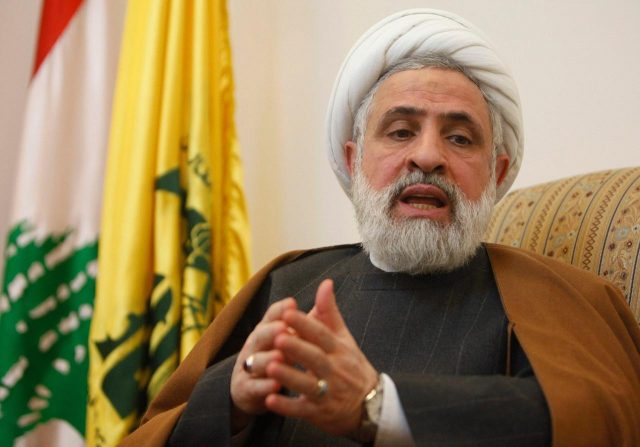
Deputy leader of Hezbollah Gen. Naim Qassem, via Reuters.
By Tyler Durden – Zero Hedge – 05/23/2019
This week Amazon pulled a controversial book being sold through its website after Israeli media led an outcry against it, charging the US retail giant with hosting Hezbollah propaganda containing incitement to violence against Israelis written by the group’s second in command.
 “Hezbollah: The Story from Within” was published in 2010 by Naim Qassem, the deputy head of Hezbollah, who is a designated international terrorist by the United States. The rare “insider account” of Iran-backed Hezbollah has been translated into several languages and had reportedly long been available in English through Amazon.com.
According to the Israeli national Hebrew-language daily newspaper Maariv, “a reporter found that the English edition of the book was being offered for sale on the Amazon site,” and was alarmed at “a clear instance of breaking sanctions and helping to finance terrorism” on the part of Amazon.
“A Maariv reporter contacted Amazon with findings in the book and Amazon subsequently decided to immediately remove the book from its sales sites in the United States and around the world,” a rough English translation of the Maariv story said. The Hebrew-language report said the book was filled with anti-Semitic statements and questioned Israel’s right to exit.
Though it had apparently been offered by Amazon for years, the book was spotlighted this week after controversy erupted between Israel and a United Nations official, after the official called it “necessary reading”.
On Tuesday Israel slammed the United Nations Special Coordinator for Lebanon Jan Kubis for holding a high level meeting with Qassem after which the UN official publicly praised the senior Hezbollah official.
Kubis had confirmed on Twitter that he not only met with Qassem, but received a copy of his most well-known book, which he also praised.
The Times of Israel reported of the statement:
Kubis was likely referring to “Hizbullah (Hezbollah): The Story from Within,” a 464-page tome first published in English a decade ago. The book, published by the London-based Saqi Books, is available on Amazon.
The Israeli Defense Forces (IDF) spokesman went so far as to denounce the meeting via Twitter, saying “You know what else is ‘necessary reading’? U.N. Resolution 1701” — in reference to a resolution intended to resolve the 2006 Israel-Lebanon conflict.
Within two days following the incident, the initial link through which the book had been sold on Amazon led to an error page, in apparent confirmation that Amazon banned the book at the request of the Israeli reporter.
On Thursday, Middle East and Iran analyst Matthew Levitt confirmed that the “Hezbollah deputy Secretary General’s book [is] no longer available on Amazon after journalist points out its anti-Israel incitement to violence & sanctions implications of selling it.”
The fresh controversy comes following new efforts by Israel to convince the UN to officially recognize Hezbollah as a terror group — an effort which has reportedly failed to gain traction.
The Trump administration has also of late taken more aggressive sanctions measures on Hezbollah leadership amid the ongoing heightened tensions with Iran. Hezbollah has long been seen as an arm of the Ayatollahs in Lebanon and Syria.
Where Lyme Disease Came From and Why It Eludes Treatment
By David Swanson | CounterPunch | May 17, 2019
A new book called Bitten: The Secret History of Lyme Disease and Biological Weapons by Kris Newby adds significantly to our understanding of Lyme disease, while oddly seeming to avoid mention of what we already knew.
Newby claims (in 2019) that if a scientist named Willy Burgdorfer had not made a confession in 2013, the secret that Lyme disease came from a biological weapons program would have died with him. Yet, in 2004 Michael Christopher Carroll published a book called Lab 257: The Disturbing Story of the Government’s Secret Germ Laboratory. He appeared on several television shows to discuss the book, including on NBC’s Today Show, where the book was made a Today Show Book Club selection. Lab 257 hit the New York Times nonfiction bestseller list soon after its publication.
Newby’s book reaches the same conclusion as Carroll’s, namely that the most likely source of diseased ticks is Plum Island. Newby reaches this conclusion on page 224 after mentioning Plum Island only once in passing in a list of facilities on page 47 and otherwise avoiding it throughout the book. This is bizarre, because Newby’s book otherwise goes into great depth, and even chronicles extensive research efforts that lead largely to dead ends, and because there is information available about Plum Island, and because Carroll’s best-selling book seems to demand comment, supportive or dismissive or otherwise.
In fact, I think that, despite the avoidance of any discussion of Plum Island, Newby’s research complements Carroll’s quite well, strengthens the same general conclusion, and then adds significant new understanding. So, let’s look at what Carroll told us, and then at what Newby adds.
Less than 2 miles off the east end of Long Island sits Plum Island, where the U.S. government makes or at least made biological weapons, including weapons consisting of diseased insects that can be dropped from airplanes on a (presumably foreign) population. One such insect is the deer tick, pursued as a germ weapon by the Nazis, the Japanese, the Soviets, and the Americans.
Deer swim to Plum Island. Birds fly to Plum Island. The island lies in the middle of the Atlantic migration route for numerous species. “Ticks,” Carroll writes, “find baby chicks irresistible.”
In July of 1975 a new or very rare disease appeared in Old Lyme, Connecticut, just north of Plum Island. And what was on Plum Island? A germ warfare lab to which the U.S. government had brought former Nazi germ warfare scientists in the 1940s to work on the same evil work for a different employer. These included the head of the Nazi germ warfare program who had worked directly for Heinrich Himmler. On Plum Island was a germ warfare lab that frequently conducted its experiments out of doors. After all, it was on an island. What could go wrong? Documents record outdoor experiments with diseased ticks in the 1950s (when we know that the United States was using such weaponized life forms in North Korea). Even Plum Island’s indoors, where participants admit to experiments with ticks, was not sealed tight. And test animals mingled with wild deer, test birds with wild birds.
By the 1990s, the eastern end of Long Island had by far the greatest concentration of Lyme disease. If you drew a circle around the area of the world heavily impacted by Lyme disease, which happened to be in the Northeast United States, the center of that circle was Plum Island.
Plum Island experimented with the Lone Star tick, whose habitat at the time was confined to Texas. Yet it showed up in New York and Connecticut, infecting people with Lyme disease — and killing them. The Lone Star tick is now endemic in New York, Connecticut, and New Jersey.
If Newby agrees or disagrees with any of the above, she does not inform us. But here’s what she adds to it.
The outbreak of unusual tick-borne disease around Long Island Sound actually started in 1968, and it involved three diseases: Lyme arthritis, Rocky Mountain spotted fever, and babesiosis. A U.S. bioweapons scientist, Willy Burgdorfer, credited in 1982 with discovering the cause of Lyme disease, may have put the diseases into ticks 30 years earlier. And his report on the cause of Lyme disease may have involved a significant omission that has made it harder to diagnose or cure. The public focus on only one of the three diseases has allowed a disaster that could have been contained to become widespread.
Newby documents in detail Burgdorfer’s work for the U.S. government giving diseases to ticks in large quantities to be used as weapons, as they have been in Cuba in 1962, for example. “He was growing microbes inside ticks, having the ticks feed on animals, and then harvesting the microbes from the animals that exhibited the level of illness the military had requested.”
Burgdorfer published a paper in 1952 about the intentional infecting of ticks. In 2013, filmmaker Tim Grey asked him, on camera, whether the pathogen he had identified in 1982 as the cause of Lyme disease was the same one or similar or a generational mutation of the one he’d written about in 1952. Burgdorfer replied in the affirmative.
Interviewed by Newby, Burgdorfer described his efforts to create an illness that would be difficult to test for — knowledge of which he might have shared earlier with beneficial results for those suffering.
Newby, who has herself suffered from Lyme disease, blames the profit interests of companies and the corruption of government for the poor handling of Lyme disease. But her writing suggests to me a possibility she doesn’t raise, namely that those who know where Lyme disease came from have avoided properly addressing it because of where it came from.
Newby assumes throughout the book that there has to have been a particular major incident near Long Island Sound, either an accident or an experiment on the public or an attack by a foreign nation. Burgdorfer reportedly claimed to another researcher that Russia stole U.S. bioweapons. Based on that and nothing else, Newby speculates that perhaps Russia attacked the United States with diseased ticks, coincidentally right in the location where the U.S. government experimented with diseased ticks.
“What this book brings to light,” Newby writes, “is that the U.S. military has conducted thousands of experiments exploring the use of ticks and tick-borne diseases as biological weapons, and in some cases, these agents escaped into the environment. The government needs to declassify the details of these open-air bioweapons tests so that we can begin to repair the damage these pathogens are inflicting on human and animals in the ecosystem.”
Another product of U.S. bio-weapons tax dollars at work, of course, was the anthrax mailed to politicians in 2001. While Newby speculates that perhaps someone was trying to demonstrate the danger for our own good, I don’t think we should forget that one purpose served — whether or not intended — by the “anthrax attacks” was a significant augmentation of the Iraq war lies. The attacks were falsely blamed on Iraq, and even if people have forgotten that, they fell for it long enough for it to matter. The one bit of truth in current public understanding of Lyme disease is that it has not been falsely blamed on some country the United States is eager to bomb. Let’s keep it that way!
Alexander Solzhenitsyn’s Critical History of Jews in Russia – a Brief Comment from Ron Unz
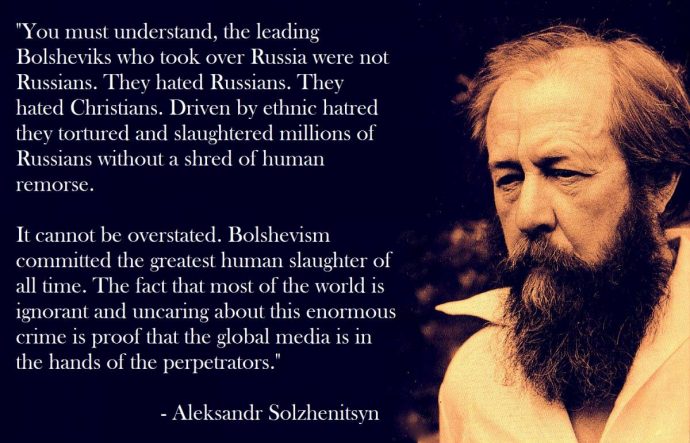
It is unlikely that this ‘quote’ is authentic, rather it reflect the opinion of the memer who created it, a view which has merit.
Russia Insider
This is an excerpt from a much longer article by Ron Unz originally entitled Oddities of the Jewish Religion, which we highly recommend.
We reproduce it here because there is so very little written about this important book, which debunks much of what was taught in the West in the 20th century about Russia.
Throughout most of my life, Nobel Laureate Alexander Solzhenitsyn was generally regarded as the greatest Russian literary figure of our modern era, and after reading all of his works, including The First Circle, Cancer Ward, and The Gulag Archipelago, I certainly concurred with this assertion, and eagerly absorbed Michael Scammel’s brilliant thousand page biography.
Although Russian himself, many of his closest friends were Jewish, but during the 1980s and 1990s, whispers of his supposed anti-Semitism began floating around, probably because he had sometimes hinted at the very prominent role of Jews in both financing and leading the Bolshevik Revolution, and afterward staffing the NKVD and administering the Gulag labor camps.
Late in his life, he wrote a massive two-volume history of the tangled relationship between Jews and Russians under the title Two Hundred Years Together, and although that work soon appeared in Russian, French, and German, nearly two decades later, no English translation has ever been authorized. His literary star seems also to have greatly waned in America since that time, and I only very rarely see his name mentioned these days in any of my regular newspapers.
Samizdat versions of major sections of his final work may easily be located on the Internet, and a few years ago Amazon temporarily sold a 750 page hard copy edition, which I ordered and lightly skimmed.
Everything seemed quite innocuous and factual, and nothing new jumped out at me, but perhaps the documentation of very heavy Jewish role in Communism was considered inappropriate for American audiences, as was the discussion of the extremely exploitative relationship between Jews and Slavic peasants in pre-revolutionary times, based on liquor-dealing and money-lending, which the Czars had often sought to mitigate.
When a ruling elite has limited connection to the population it controls, benevolent behavior is far less likely to occur, and those problems are magnified when that elite has a long tradition of ruthlessly extractive behavior. Enormous numbers of Russians suffered and died in the aftermath of the Bolshevik Revolution, and given the overwhelmingly Jewish composition of the top leadership during much of that period, it is hardly surprising that “anti-Semitism” was deemed a capital offense. Kevin MacDonald may have been the one who coined the term “hostile elite,” and discussed the unfortunate consequences when a country comes under such control.
After the collapse of the Soviet Union in 1991, reborn Russia soon fell under the overwhelming domination of a small group of Oligarchs, almost entirely of Jewish background, and a decade of total misery and impoverishment for the general Russian population soon followed. But once an actual Russian named Vladimir Putin regained control, these trends reversed and the lives of Russians have enormously improved since that time.
America’s media organs were overwhelmingly friendly toward Russia when it was under Jewish Oligarchic rule, while Putin has been demonized in the press more ferociously than any world leader since Hitler.
Indeed, our media pundits regularly identify Putin as “the new Hitler” and I actually think the analogy might be a reasonable one, but just not in the way they intend.
Featured Video

Houthis Don’t Have to Conquer Saudi Arabia to Make It Pay
or go to
Aletho News Archives – Video-Images
From the Archives
Newly Released FBI Docs Shed Light on Apparent Mossad Foreknowledge of 9/11 Attacks
By Whitney Webb | MintPress News | May 17, 2019
NEW YORK — For nearly two decades, one of the most overlooked and little known arrests made in the aftermath of the September 11 attacks was that of the so-called “High Fivers,” or the “Dancing Israelis.” However, new information released by the FBI on May 7 has brought fresh scrutiny to the possibility that the “Dancing Israelis,” at least two of whom were known Mossad operatives, had prior knowledge of the attacks on the World Trade Center. … continue
Blog Roll
 Aletho News
- MEP blasts ‘Euro-Gestapo’ for lecturing Russia on democracy
- Syria May Send Troops to Saudi Arabia Amid War with Ansar Allah
- UK whines about losing billions to ‘Putin tax’
- Baghaei to Rubio: Distorted narratives cannot erase US record of broken commitments
- Houthis Don’t Have to Conquer Saudi Arabia to Make It Pay
- MOE: Nearly 22,000 Students and Education Workers Killed
- Guterres in Islamabad: Genocide, cowardice, and the cage of Imran Khan
- Johnson, Marandi say Yemen holds upper hand over Saudi Arabia
- False flags won’t save aggressors, Iran FM spokesman says
- The Makkah Pact Enters Into Force: The End of American Dominance or Its New Form?
- If Americans Knew
- Report claimed Mark Levin used by Israeli government to influence Trump
- Over 2,000 Gazans have died awaiting medical evacuation amid Israel’s continued siege
- How a U.S. Diplomat Suppressed and Altered Reports Critical of Israel
- 5 Palestinians Die from Israeli Strikes in Gaza as Relentless Attacks Continue
- Report: Ceasefire Slows Killing but Leaves Devastation Intact
- Country Music Singer Zach Bryan Breaks Attendance Record at Robert Kraft’s Gillette Stadium While Wearing ‘Free Palestine’ Shirt for Second Night in a Row
- Three years of death and devastation: Israel’s war on Gaza in pictures
- Why Hamas believed the status quo was more dangerous than its 7 October gamble
- Debunking Israel’s latest list of ‘terrorist’ journalists in Gaza
- In Gaza, focus is on survival, “every step is a struggle” – Daily Update
- No Tricks Zone
- New Study: 50 Years Of The Most Aggressive ‘Net Zero’ Policies Can Only Affect The Global Climate By 0.03°C
- US September “Heat” Was No Record…Many Records Set Decades Ago
- Latest European Green Energy Debacle; Portugal’s Largest Flagship Solar Park Insolvent!
- Green Energy Debacle: German Expert Professor Fritz Vahrenholt Warns Of Severe Economic And Social Consequences
- Two More Paleo Reconstructions Affirm Meters-Higher Sea Levels Across Ireland, Brazil 7000-6000 Years Ago
- New Study: Earth And Venus Surface Warmth Largely Explained By Convection And Lapse Rate, Not CO2 Or Radiation
- 2025 Nature Paper Claiming Worsening Global Drought Gets RETRACTED …Heavily Flawed
- New Study: ‘Global Drought Shows No Detectable Recent Acceleration Under Climate Warming’
- Economic Masterminds: German Socialists Suggest Taxing Productivity Gains Stemming From Using AI
- The South China Sea Has Not Been Cooperating With The Climate Change Narrative

