Big Pharma designed WHO’s Global Health Policy from 2000-2009
Corruption and deception, not science, is the foundation of WHO health policy
By Judy Wilyman PhD | Vaccination Decisions | April 1, 2024
“The past was erased, the erasure was forgotten, the lie became truth.” – George Orwell, 1984
The history of the GAVI alliance, a board that influences the direction and design of WHO’s global health policies, illustrates how these policies have been directly influenced by industry partners from 2000-2009, and not by an objective board selected by the WHO.
This direct influence was hidden from the public in 2009 when the alliance became known as the Gavi board. At this time its composition and function changed to hide the role that industry had played from 2000-2009 in changing the direction of global health policies to a new focus on vaccine production and global implementation.
History of the Gavi Board:
In 1998 the Global Alliance for Vaccines and Immunisation (GAVI) was established by the Head of the World Bank after a meeting with pharmaceutical companies and other agencies. The GAVI alliance was established on the advice of industry because the pharmaceutical companies were claiming that there was no incentive for them to provide vaccines to the developing countries.
This meeting led to the Bill and Melinda Gates Foundation providing the seed funding of $750 million in 1999 and governments then matched this figure to establish an alliance of private-public partnerships in 2000, to fund the vaccination programmes for all countries.
In 2000 the alliance was launched at the World Economic Forum (WEF), not the World Health Organisation (WHO), and it established a working party to work with the WHO to design the International Health Regulations (IHR), yet it was a body established outside of the WHO’s charter.
At this time all stakeholders in the Global Alliance for Vaccines and Immunisation (GAVI) were able to directly influence the design of the WHO’s Global Health Policies through this working party (2000-2009), including the International Federation of Pharmaceutical Manufacturers and Associations (IFPMA). They could attend meetings and present information for policy development.
Other stakeholders in the GAVI at this time included the BMGF, the Rockefeller Foundation, the World Bank and the International Monetary Fund (IMF). The influence of these stakeholders led to a new focus on vaccine production and implementation in the WHO’s global health policies.
These global policies were presented to countries in the International Health Regulations (IHR) that came into force in June 2007.
This direct influence of all stakeholders changed in 2009 when the GAVI alliance became known as the GAVI board. Its composition was changed to include only four permanent board members – UNICEF, BMGF, the World Bank and WHO – and other partners would be on a part-time basis.
This change to only four permanent board members, one of which was now the WHO, hides the fact that from 2000-2009 all stakeholders were able to directly influence the design of WHO’s global health policies.
The first recorded meeting of the Gavi board on its website is in 2009. It describes the role of the Gavi board as ‘being responsible for strategic direction and policy-making, oversees the operations of the Vaccine Alliance and monitors programme implementation’ .
This alliance of partners, many of whom profit from vaccines, make donations to the Gavi board and still influence global health policies in a more indirect fashion.
The WHO’s IHR are currently being amended with strong influence from this corporate alliance. If the amendments are approved, the draconian directives implemented during the COVID ‘pandemic’ years, will become binding on every WHO member country, whenever the director of the WHO declares another pandemic. This is removing fundamental human rights and objective scientific evidence from global health policies.
It is time for Australians to make our voices heard to ensure that Australia exits the WHO and joins the World Council for Health to protect both human health and fundamental human rights in all public health policies.
[The information above can be referenced from Ch 3 of my PhD 2015]
Important Information:
- Here is the witness statement from ex-Qantas pilot, Captain Graham Hood, describing that lack of evidence for safety and efficacy that was used by the Australian Therapeutic Goods Administration (TGA) and the Australian Prime Minister, Scott Morrison, to mandate this mRNA genetically-engineered injection (called a ‘vaccine’) in the Australian population – Ex-Qantas Pilot, Graham Hood, provides a witness statement in the Australian parliament.
- Australian Medical Professional Society (AMPS) presents ‘Too Many Dead’ in Australia, but the Australian government will not investigate and the media does not report these facts.
- Study finds the Majority of Patients with Long COVID were Vaccinated
- Epidemic of Fraud
Globalism and Disease X
By Meryl Nass | March 30, 2024
What is biowarfare? COVID was due to a biological warfare agent. It was designed in one or more laboratories to be more virulent than its natural precursors:
- to prefer to infect humans;
- to infect more organs than possible in naturally occurring strains;
- to interfere with the body’s immune responses.
I say one or more laboratories becasue many of its features had been previously discovered or created in various laboratories, and then these features were essentially grafted onto a coronavirus, one by one; or some features were achieved by passaging the virus through humanized mice, other humanized animals, human cell tissue cultures or humans themselves.
Why were these features created? In which labs?
Why were they painstakingly added to a coronavirus backbone? Where was this done and how many labs were involved?
Why was a coverup by western scientists so critical? Because claiming that pandemics come from animals living in nature, and are spread to humans due to our incursions into their territory, was needed to justify the entire biosecurity agenda that the WHO is steamrolling over us.
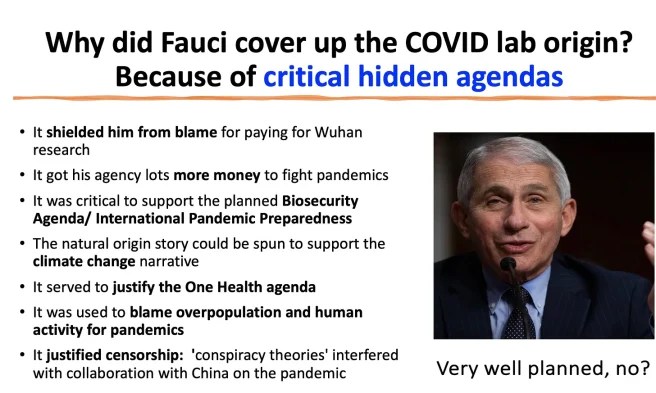
By the way, the newest version of the treaty (released March 7, 2024) states that part of the WHO plan is to “identify” those areas where disease “spillover” occurs. You watch: the WHO will then empty those areas of humans. It really is a great cover story, “spillover.” Except it is a total lie.
_____________________
Historically most biowarfare agents were naturally occurring viruses or bacteria. Here is one example in which whistleblowers identified the hand of the CIA.
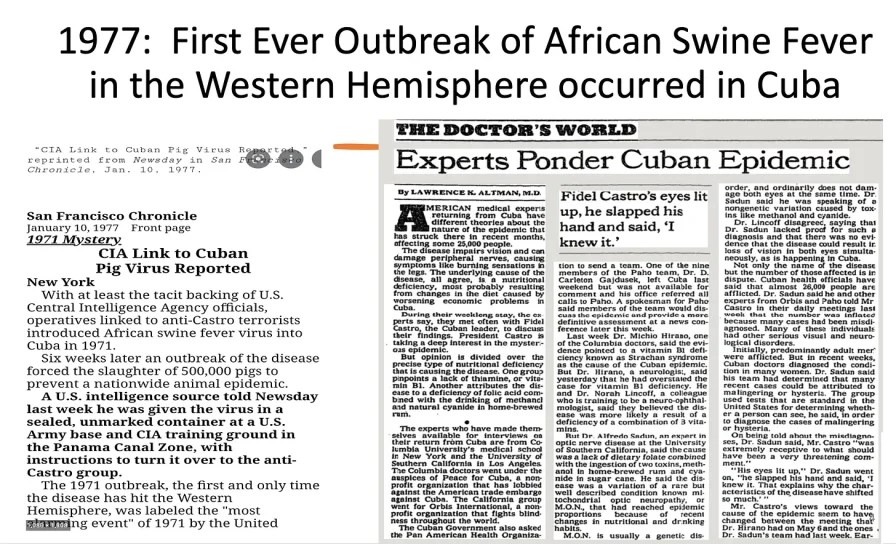
It is “gain-of-function” research that makes them more virulent and/or more transmissible. Gain of function research was considered illegal under international law until about 2001, and then the customary norms of national behavior simply changed, after the US was caught ignoring the usual norms—as revealed in the NYT on 9/4/2001 and in the book GERMS.
The WHO suggested it should be put in charge of gain-of-function research in the pandemic treaty draft that was released on February 14, 2024. It only took 3 weeks before a new draft was issued on March 7, 2024 in which all mention of “gain-of-function” was erased. I wonder if the rapidity of release of the next draft (it usually takes about 3 months to get a new draft) had to do with cutting out the Gain-of-Function section.
But the idea of requiring nations to supply the WHO with samples of potential pandemic pathogens, and to upload their genetic sequences to publicly accessible databases asap remained, was discussed with even more details in the newest March 7 draft. The WHO and nations would be free to share biological warfare agents aka potential pandemic pathogens (essentially) with anyone they liked.
This makes no sense any way you look at it. The goal seems to be a situation where “Pandemics R Us” and they appear frequently, with no ability to tell where they came from or whether they were deliberate or an accident. By sharing them all globally the WHO has paved the way for using the alibi of accidental release for future COVIDs.
The biowarfare segment starts at about 26 minutes into the episode.
As I said, we at DoortoFreedom.org are here to help you educate your lawmakers while you urge them to question this effort publicly, introduce resolutions, and in other ways throw some boulders in front of the steamroller, just like Louisiana’s Senate did this week.
merylnass@gmail.com
Hillary Clinton Takes Aim at “Disinformation,” “Negative, Virulent Content,” and Memes Ahead of the 2024 Elections

By Didi Rankovic | Reclaim The Net | March 31, 2024
The last time the extent of Hillary Clinton’s tech “savviness” or lack thereof, became public knowledge was way back in 2016, when she lost the presidential election, amid, among other things, the (classified) emails scandal.
Now, Clinton has graduated from not knowing how email works, to feeling she is qualified to discuss the impact of immeasurably more complex technology, such as AI.
To give Clinton the benefit of the doubt, it has been a long time, and perhaps she has used that time to educate herself.
However, it also turns out that nearly a decade later she still blames her loss to Donald Trump on the since-debunked conspiracy theories about “election disinformation” that supposedly decided the outcome of that vote.
So, Clinton-the-victim’s comments now, half a year before the next US presidential election and amid mainstream media’s “disinformation/AI panic” might read as little, if anything, more than political campaigning.
She claims this is her focus now: still talking about the alleged wrongdoing done to her in 2016, still alleging this was all about “disinformation” – and that it was all “primitive” – compared to what she anticipates is happening now.
Clinton also plays her audience by at once “admitting” that she and hers are ignorant (“I don’t think any of us understood it. I did not understand it. I can tell you, my campaign did not understand it”), to then claim that, for some reason, she should now be taken as an authority.
Not about social media, memes, the “dark web” (or, God forbid, the concept of email…) but also, the regulation of online providers/content. Enter the CDA Section 230 debate – where it seems each side of the ideological aisle interprets its importance according to their political needs of the day.
“Their, you know, the so-called ‘Dark Web’ was filled with these kinds of memes and stories and videos of all sorts… portraying me in all kinds of… less than flattering ways,” Clinton said. “And we knew something’s going on, but we didn’t understand the full extent of the very clever way in which it was insinuated into social media.”
Clinton is now quoted in the press as saying that tech companies – enjoying, and, conservatives say, indulgently abusing their Section 230 protections over third-party content (to favor liberals) – suddenly should no longer have those privileges.
An experienced observer may see this turn of events – somebody like Clinton apparently advocating for Section 230 to be abolished – as simply a maneuver to pile on more pressure on major tech companies to be careful “not to slip” in their “censorship diligence” this election season – or else.
Either way, this is what Clinton said: “Section 230 has to go. We need a different system under which tech companies and we’re mostly talking obviously about the social media platforms – operate.”
Ukrainian police investigate ‘pro-Russian’ shelling victim

RT | March 31, 2024
Police in Ukraine’s second largest city, Kharkov, have said that criminal proceedings have been launched against a local woman who insisted that Ukrainians should not be celebrating their troops’ shelling of Russia’s border regions.
She expressed the opinion despite her own home being hit by a Russian airstrike on her city, which had reportedly targeted electrical infrastructure and defense industry facilities.
Police said in a statement on Saturday that officers “have found a video on social media,” in which a 59-year-old female resident of Kharkov’s Shevchenkovsky District “denied the armed aggression by Russia, supported the invasion of Ukraine and the occupation of part of the state’s territory and condemned the actions of the Ukrainian authorities.”
The clip in question featured a short interview following Russian airstrikes on Kharkov on March 24. The woman spoke with a journalist through an empty window-frame in her home; the glass had apparently been blown out by a nearby explosion.
In the footage, the local resident refused to condemn Moscow and called for an end to violence, saying that the Ukrainians should not “throw” missiles at Belgorod and other Russian border regions and “should not celebrate” those attacks.
When the journalist disagreed with her stance, she replied by saying that they simply had different views. “I believe that one must have friendly relations with neighbors,” the woman stressed, referring to Ukraine and Russia.
Kharkov is located just 30 kilometers (19 miles) south of the Russia–Ukraine border and remains a predominately Russian-speaking city.
She is now being probed for “collaborationist activities,” the police said. As part of a pre-trial investigation, the officers have spoken to witnesses, who “confirmed the pro-Russian stance of the person in question and reported conflicts with her on this issue,” the statement read.
The Ukrainian criminal code was adjusted in March 2022, a few weeks after the launch of Russia’s military operation. It criminalizes a vast array of activities, including the public backing of Moscow’s actions, offering direct material and financial aid to the Russian forces, and the execution of official roles in areas captured by Russia.
Earlier this month, a court in the Ukrainian city of Vinnytsia ordered the confiscation of the apartment of an 80-year-old woman for posting pro-Russian comments on social media. She was also slapped with a four-year prison term. The sentence was delivered in absentia because the defendant has been living in Russia for the past several years.
How Zionist interests are behind British gov’s attempted definition of ‘extremism’

By David Miller | Al Mayadeen | March 28, 2024
The British government has been grappling with the question of extremism for years now. It has failed even to define extremism in any clear fashion, and has been struggling to fight back against an avalanche of criticism that its counter-extremism policies are Islamophobic.
The genocide in Gaza has focused minds in the British elite, because of the massive sympathy for the Palestinians visible on the streets.
The desperate attempts to cast pro-Palestine protestors as genocidal is a desperate attempt to split the movement. The government is trying to reframe “extremism” in such a way that more radical supporters of Palestinian liberation are demonised, criminalised and disavowed by the rest of the movement.
Michael Gove
The minister leading this is the toxic Michael Gove, the most pro-Zionist minister in the government. He has a history of involvement with Zionist lobby groups, and for example, was the first chairman of the Neoconservative and Islamophobic think tank Policy Exchange.
It’s no coincidence that the new policy he is introducing was dreamt up by Policy Exchange in a paper published in 2022. It recommended: Firstly, a consolidated Centre for the Study of Extremism within government, dedicated to the research and diagnosis of Islamist and other forms of extremism. Secondly, a separate communications unit dedicated to publicly combatting disinformation about the Government’s counter-terrorism and counter-extremism strategies. Thirdly, a due diligence unit, which develops and monitors criteria for engagement with community organisations.
Lord Shawcross
All of its main proposals were adopted by Lord William Shawcross in his review of Prevent, published in 2023. Shawcross is famously Islamophobic and his review was even denounced by Amnesty. He was appointed as a senior Fellow at the Policy Exchange in 2018, prior to being appointed to the Prevent Review in 2021.
Shawcross’s recommendations were all accepted by the government, and thus the new policy has effectively been written by a leading Islamophobic think tank.
Blacklisting agency
Among the innovations are a new blacklisting agency in Gove’s department (a so-called counter-extremism centre of excellence) and a change in the status of the Commission for Countering Extremism which changes from being an advisory to an enforcement agency.
Behind Policy Exchange
But behind Policy Exchange lies a shadowy group of foundations which provide cash for its work. Though they are secretive, we can reveal at least two.
The first and most significant is the Charles Wolfson Charitable Trust, which donates almost every year and has given Policy Exchange more than £3 million between 2007 and 2022. The Wolfson family, which runs the trust, are the owners of the Next retail chain. The boss, Simon Wolfson, declined his bonus in 2020-21, and despite this earned almost £3.4 million that year.
The Wolfson family also funds Beit Halochem, which channels money to the occupation forces which it describes as “heroes”. The family also gives money to the Jerusalem Foundation, which is engaged in promoting illegal settlements in occupied East Jerusalem.
Another source of funds is the Rosenkranz Foundation, which has given support to the think tank for more than a decade. Along with other Islamophobic causes. Its director, Robert Rosenkranz, was appointed a director of Policy Exchange in 2010.
In other words, British government policy on extremism is captured by Policy Exchange and Policy Exchange is in part a front for Zionist interests.
Defining ‘extremism’
The British government is in a bind. It can’t define extremism and yet it wants to pretend that it can. An amazing display of the lack of support the proposals have was shown on the BBC Question Time programme, where the presenter Fiona Bruce, after weathering many criticisms asked plaintively: “Let me just ask in the interests of balance, is there anyone here who welcomes what Michael Gove had to say?” She was greeted, as she put it with “not a hand up”.
The government claims that its new policy contains a “new definition” of extremism. But there was never an old definition. And the text they have published is not a definition either. There is still no legal definition of extremism, and this is why the government is at pains to point out that “This definition is not statutory and has no effect on the existing criminal law.”
The reason for this is that the government knows that if it tries and create a statutory definition, it will be subject to legal challenge which it will most probably lose. There is a nervousness about this which is intriguing.
First of all, Michael Gove named five “extremist” organisations under Parliamentary privilege, because he knows he would be subject to legal action were he to name them outside the House.
Disrupting the Palestine solidarity movement
Secondly, though the aim here is to destroy and disrupt the Palestine solidarity movement, primarily, no Palestine-related groups were named.
But pro-Palestine group Friends of al-Aqsa was named in drafts of the speech leaked to the media. It also named the Muslim news site 5Pillars and FoA as “divisive forces within Muslim communities”. The government was too nervous even to name them in Parliament.
Gove stated in the Commons that “Islamism is a totalitarian ideology which … calls for the establishment of an Islamic state governed by sharia law”. He named three groups, the Muslim Association of Britain, Cage, and Mend, all perfectly legal organisations.
Mend immediately challenged Gove “to repeat his claims outside of parliament and without the protection of parliamentary privilege… [to] provide the evidence… that MEND has called for the establishment of an ‘Islamic state governed by sharia law’”.
Even normally staunch allies, such as government adviser John Mann have criticised the policy. He stated that ministers should be prioritising “bringing communities together”. “The government needs to listen to people who are advising that the politics of division will not work,” he told the BBC.
Sophisticated engagement
The division appears to be between those pushing for a Likudnik scorched earth approach and those who favour a “sophisticated engagement” strategy – as it was described by the Zionist think tank Reut and their collaborators the US Zionist spy agency, the Anti-Defamation League in a report in 2016. Back in 2010, the Reut Institute urged Israel’s “intelligence establishment” to “drive [a] wedge between soft and hard critics” abroad. The former should be subject to “sophisticated engagement strategies” while the latter should be subject to “sabotage” and “attack”, it said.
This is not just a political and strategic difference, but a question of defending the millions in state and Zionist funding ploughed into the maintenance of hundreds of jobs in sophisticated engagements, such as the interfaith industry.
Underlying all this, the danger is that the definition best fits genocidal Zionist groups and their supporters within government, most notably Michael Gove himself. The penetration and capture of key elements of security policy by the Zionists is nothing if it is not, as the new so-called definition puts it, an attempt to “undermine, overturn or replace the UK’s system of liberal parliamentary democracy and democratic rights” in the service of attempting to “negate or destroy the fundamental rights and freedoms of others”, most obviously Muslims and Palestinians and their supporters.
Orwellian Tactics? Libertarian Party Fears Targeting By FBI After Letter
By Kyle Anzalone and Will Porter | The Libertarian Institute | March 29, 2024
The Libertarian Party has questions for the Department of Justice after the FBI claimed that a “foreign threat” had accessed its Facebook account. A preliminary analysis by the LP was hindered by Meta, which has offered little clarity on the incident.
In a statement published on Friday, LP chair Angela McArdle shared a letter the party received from the bureau warning of the alleged breach. “The FBI maintains active investigations that seek to identify the activities of hostile foreign governments and their intelligence services who target the US government, private sector, and political processes,” the letter says. “The FBI recently obtained information showing that one of these foreign threat actors was in control of various IP addresses that the group used to log into a Facebook account controlled by your organization. The group accessed the account sometime between August 2023 and February 2024.”
One LP employee with knowledge of the letter told the Libertarian Institute that roughly 10 people have access to the Facebook account. The party has not changed access to the page within the past two months.
The employee said the LP was unable to access the user archive for its Facebook account to determine if it had been hacked and has so far received no assistance from Meta in resolving the issue. The organization plans to do what it can to learn more about the supposed “foreign threat actor” and why the FBI was surveilling the account in the first place.
While the source acknowledged that the letter could be the result of “good police work,” the party is concerned the move could amount to a veiled threat from federal agents. Those worries are significantly heightened as two members of the party’s leadership have been contacted by the FBI within the past year, the employee added.
McArdle expressed similar fears in her statement. “We do not trust the FBI. Stories of aggressive FBI field agents have been popping up all over the country. The Biden administration seems to be cracking down on dissenting voices in preparation for the general election.” She continued, “We will continue to dissent, and we will call out the corruption of the current DOJ and Biden administration.”
“The greatest threat to freedom in the US isn’t an anonymous ‘hostile foreign government.’ It is the United States Government. It is the current administration, who has engaged in an unprecedented amount of censorship, coercion, and Orwellian control tactics.”
The letter to the LP came after multiple pro-Palestinian activists said they received visits by FBI agents interested in their social media posts. Rights group Palestine Legal said the house calls amounted to efforts to “intimidate and censor” activists as the US heads toward an election in which Libertarian voters and supporters of Palestine could play a crucial role.
More than 100,000 democratic voters in Michigan voted “uncommitted” in last month’s primary to protest US support for Israel, while LP presidential hopeful Jo Jorgenson received more votes than the margin between Donald Trump and President Biden during the 2020 general election.
YouTube Says It Has a “Responsibility” To Manipulate Algorithms Leading Up to the 2024 Election
By Didi Rankovic | Reclaim The Net | March 28, 2024
“Responsibility” is a good word. It’s even better as an actual thing. But even just as a word, it’s a positive one. It signals that reliable people/entities are behind some project, or policy.
So no wonder then, that the thoroughly disgraced Google/YouTube – as far as censorship and biased political approach – are trying to use the word “responsibility” as a narrative fig leaf to cover what the giant platform is actually up to – and has been, for a long while.
Enter, YouTube’s newest chief product officer, Johanna Voolich. What are the priorities here? It could be summed up as, four R’s and One C – namely, YouTube’s “remove, raise, reward, reduce” content approach – that’s as per a blog post published by YouTube itself.
And then, C would be speculative, for “censorship” – which is what these supposedly fair and “uplifting” actions in reality end up achieving.
If you thought any of this could be achieved by YouTube without “boosting authoritative content” – think again. That is still a solid pledge, regurgitated by Voolich.
And if you thought somebody would finally come out and clearly spell out how, and according to whose definition, content gets to be dubbed “authoritative” or otherwise – just don’t hold your breath.
The sum total is that YouTube has a new product manager, but that nothing has changed.
Certainly not in this year of election.
And while Voolich made perfunctory references to creators benefiting from new features, and even being heard (via feedback), they also learn that when that’s convenient, AI is advertised as a tool to “empower creativity.” (Otherwise, AI is denounced as a scourge to democracy itself.)
But when all that’s said, there’s the overarching issue of YouTube’s “responsibility.” To do what, you might wonder – give its users/creators the best tools and opportunities – or act as proxy campaigner for a certain political and ideological option, in the US, but also, elsewhere in the world?
YouTube’s self-professed “4 R’s of responsibility” may or may not provide some insight into what the answer to that serious question might be.
R1 – “Remove content that violates our policy as quickly as possible.”
R2 – “Raise up authoritative voices when people are looking for breaking news and information.”
R3 – “Reward trusted, eligible creators and artists.”
R4 – “Reduce the spread of content that brushes right up against our policy line.”
And that, right there, is a solid foundation for continued, effective “C” – Censorship.
Do the Pertussis Vaccines Used in the US Stop Infection and Transmission of the Pertussis Bacterium?
Your bite-size dose of immunity against vaccine misinformation. Spread the truth.
Injecting Freedom by Aaron Siri | March 22, 2024
Do the pertussis (whooping cough) vaccines used in the United States stop infection and transmission of the pertussis bacterium?
“Yes” or “No”?
When picking an answer, keep in mind that the pertussis vaccine is part of a combination vaccine (DTap or Tdap) mandated to attend grades K-12 in every U.S. state – it is the “P” in DTaP and the “p” in Tdap – and the justification for this rights-crushing mandate is the belief that the vaccine prevents transmission of pertussis in the school setting.
The answer is “No”! In 1999, the CDC recommended “exclusive use of acellular pertussis vaccines for all doses of the pertussis vaccine series” and that vaccine does not prevent transmission. This is explained in an FDA study titled “Acellular pertussis vaccines protect against disease but fail to prevent infection and transmission in a nonhuman primate model” and confirmed in a consensus paper explaining that:
“aPVs [pertussis vaccines] … cannot avoid infection and transmission. … aPV pertussis vaccines do not prevent colonization. Consequently, they do not reduce the circulation of B. pertussis and do not exert any herd immunity effect.”
The CDC and FDA, in formal responses to the Informed Consent Action Network (ICAN), confirm the foregoing, as does this paper explaining:
“That vaccination does not prevent B. pertussis infection in humans, nor the circulation of the organism in human populations in any important manner, comes from the observation that the inter-epidemic intervals have not changed in a major way since the implementation of mass vaccination.”
Incredibly, the immunity provided by pertussis vaccines, while potentially reducing symptoms of the disease, actually renders those receiving these products susceptible to repeated infection with pertussis; meaning, it increases the potential to spread this bacterium because it renders those vaccinated repeat-asymptomatic-carriers. (See this study, “Lack of mucosal immune responses after aPV administration favor infection, persistent colonization, and transmission of the pathogen”, and this study, “Because of linked-epitope suppression, all children who were primed by DTaP vaccines will be more susceptible to pertussis throughout their lifetimes, and there is no easy way to decrease this increased lifetime susceptibility.”)
In any event, immunity from the pertussis vaccine wanes rapidly, even after six doses in childhood! As the CDC explains, a study of pertussis vaccine immunity found that four years after five doses of DTaP and one of Tdap “vaccine effectiveness was 8.9%.” Nonetheless, the CDC makes additional doses of the pertussis vaccine optional in adulthood.
Screenshots of the relevant portions of the websites linked above can be viewed here (in case they change).
Bill Blocking WHO, UN, and WEF from Imposing ‘Rule, Regulation, Fee, Tax, Policy, or Mandate of Any Kind’ Passes Louisiana Senate
BY JON FLEETWOOD | MARCH 27, 2024
In a landmark move on Tuesday for State sovereignty and local governance, the Louisiana Senate passed Senate Bill No. 133, a piece of legislation aimed at significantly limiting the influence and jurisdiction of certain international organizations within the state.
The bill passed unanimously with 37 ‘yes’ votes.
Not one senator voted against it.
Sponsored by Republicans, Senators Pressly and Valarie Hodges, along with Representative Edmonston, the bill explicitly targets the World Health Organization (WHO), United Nations (UN), and the World Economic Forum (WEF), restricting their power and the enforcement of their policies in Louisiana.
The bill, set to take effect on August 1, 2024, mandates that “the World Health Organization, United Nations, and the World Economic Forum shall have no jurisdiction or power within the state of Louisiana.”
The legislation marks a decisive stance against undue influence from these international bodies.
Further detailing its scope, the bill asserts, “No rule, regulation, fee, tax, policy, or mandate of any kind of the World Health Organization, United Nations, and the World Economic Forum shall be enforced or implemented by the state of Louisiana or any agency, department, board, commission, political subdivision, governmental entity of the state, parish, municipality, or any other political entity.”
The move addresses state sovereignty and the role of international organizations in local governance.
Proponents argue that this bill is a necessary step to safeguard Louisiana’s autonomy and prevent the imposition of external policies that may not align with the state’s interests or values.
The bill’s passage reflects a broader trend of skepticism toward global institutions and a preference for localized control over public affairs.
As the legislation prepares to be voted on in the House, all eyes will be on Louisiana to see the practical implications of this bold legislative move should it pass.
The bill is a clear declaration of Louisiana’s intent to chart its own course, free from the influence of selected international organizations.
With its enactment, the state legislature underscores its commitment to preserving state rights and governance free from what it views as unwarranted external interference.
You can read the full bill here:
Secret documents reveal Germany’s public health agency warned lockdowns cause more harm than good
Germany is rocked by confidential RKI files showing the experts were warning against mandatory masks and mass lockdowns
By John Cody | Remix News | March 27, 2024
Following a long legal battle, Germany’s public health agency, the Robert Koch Institute (RKI), has released the confidential protocols that show the RKI was aware that “lockdowns cause more harm than good” and evidence for “making masks mandatory was lacking.”
The RKI voiced concerns in 2020 that shutting down German society could lead to increased child mortality and other negative outcomes. The RKI experts also disagreed with the implementation of FFP2 face masks, saying there was a lack of data to support such a measure.
“Active communication would make sense in order to make clear why the RKI does not recommend this measure,” notes the minute regarding implementing FFP2 mask regulations. The agency even notes in the minutes that it would tell the public it did not support FFP2 mask regulations, but notably, the agency never did so despite mass protests against mandatory masks and other harsh measures.
The 2,500 pages of documents also contain a passage noting that experts warned that lockdowns could “do more harm than good,” with experts citing lockdowns in Africa and the negative outcomes seen there.
The documents have revealed that German politicians dramatized the situation, contrary to the opinions of experts. This was done presumably in order to implement coercive measures and restrict basic rights. There are now calls to release the rest of the documents, as more than a thousand passages are still redacted, representing a third of the total text dating from meeting notes from the “crisis unit” taken between February 2020 and April 2021.
The release of the documents has sent shockwaves through Germany and led even left-wing parties, such as the Greens, to call for a “comprehensive review” of coronavirus policy. Other parties, like the Alternative for Germany (AfD), are calling for more action, including a commission investigation.
Politicians are urging the RKI to lift the redactions and make all findings available to the public, and further court proceedings are pending. In the meantime, debate continues to rage, with the #RKIFiles tag on X already generating 45,000 posts.
An example of just a couple of posts shows the anger many Germans still feel towards the coronavirus-era policies put in place.
“The Bavarian state government tortured children with masks until spring 2022 — even in physical education classes. Not because there was scientific evidence for it, but because Markus Söder liked the role of coronavirus hardliner. #RKIFiles,” wrote one X user.
Another showed video of police brutalizing protesters demonstrating against Covid-19 measures, writing:
“It’s good that the RKI protocols are included in the broader discussion! But there can be no such thing as cheap forgiveness. With the coronavirus, 2/3 of Germans became massively aggressive against 1/3. The handcuffs must click on the main criminals.”
Virologist reacts to report
Virologist Klaus Stöhr, once the WHO pandemic commissioner, said the revealed protocols once again show that the “risk assessment was not based on data.” According to Stöhr, “his hair stood on end when it came to (Germany’s) pandemic plan.”
Stöhr also commented on the fact that the RKI protocols uncovered that experts were telling the government that there is little data to support widespread mask adoption for the public.
“And the fact that what was known about FFP2 masks was completely ignored is just two small building blocks.” There was “a lot more data available where it was seen that the work was not based on evidence,” he said.
The scientist referred to “curfews, border closures, 2G/3G (areas restricted based on vaccination status), and the side effects of lockdowns” as further examples of this. Stöhr noted that “these are all things that were known – including that the vaccines could not halt the spread of the virus.” He said that the vaccines could not end the pandemic, and it was “clear from the beginning that the vaccine couldn’t do that.”
He is now calling for a commission or review process to avoid the mistakes made by the government during the Covid-19 era in the future.
Virologist Hendrik Streeck, who was appointed to the RKI expert council, also stated: “I’m very surprised that entire pages about vaccinations, for example, were blacked out,” he said to Welt. “And I wonder what it says, why the public shouldn’t see it.”
Lauterbach in panic mode?
Federal Health Minister Karl Lauterbach (SPD) reacted with horror to the findings in the report. As federal health minister during a significant portion of the pandemic, he has often been the top target of criticism from those opposed to Germany’s Covid-19 policies.
“Enlightenment is good, but we must not allow conspiracy theories to arise on social media through the interference of foreign governments,” he wrote on the X platform. Why he referred to “foreign governments” remained unclear, but when cornered, left-wing politicians often resort to claims of “foreign interference” and “Russia.”
Despite calls for a review of policy, Lauterbach is desperate to avoid this outcome and is also openly rejecting a commission, as the AfD and BSW parties are calling for.
Lauterbach claims this would only benefit “a small group of politicians, but also people who perhaps represent radical ideas in other areas.” He claims they would use the findings “to politicize against the state.”
Some from the Greens also resorted to claims of “foreign influence” following the release of the RKI protocols.
Green health politician Janosch Dahmen, one of the most aggressive supporters of extreme Covid-19 policies, said: “It seems to me that the virulent spread of such untruthful rumors is also the result of the influence of foreign intelligence services on our society against the background of Russia’s war against Ukraine, to further divide and render politics incapable of action.”
The AfD, FDP and BSW want an investigation
The AfD, Free Democrats and BSW parties all want a more thorough investigation than a simple “review.”
“The public has a right to know what really happened back then,” said the health policy spokesman for the AfD parliamentary group, Martin Sichert, regarding the redactions still in the report. He appealed to the other parliamentary groups: “Take a look at the protocols of the RKI crisis team and set up a coronavirus investigation committee with us.”
Even the FDP, which is in a governing coalition with the ruling government, is calling for a more thorough investigation. FDP vice-president Wolfgang Kubicki announced that he would “work to ensure that the entire basis for decision-making at this time becomes public.” He also said it is becoming increasingly clear “that the Robert Koch Institute for Health Policy served as a scientific façade for former Minister Jens Spahn and probably also Karl Lauterbach.”
Some Greens are conciliatory
Some left-wing politicians believe some kind of review is necessary to improve “social cohesion.”
“It would be good for social cohesion if there were a review of coronavirus policy with a little distance,” said the Green parliamentary group’s legal policy spokesperson, Helge Limburg, to Welt newspaper. “This could be a commission of inquiry, a commission of experts, or another form of debate that signals to people: We are not simply brushing aside the drastic measures of that time.”
Health and budget politician Paula Piechotta said: “Almost exactly four years after the first pandemic measures were introduced in Germany, it is now overdue to address the mistakes of pandemic policy in a wide range of areas, from health and education to financial policy, in a transparent and timely manner for everyone.”
Her party colleague, Vice Chancellor Robert Habeck, also said a review of the coronavirus era was necessary but was short on specifics.
“We should now initiate a phase in which we reflect on the difficult pandemic period with all its effects,” he told the Bild newspaper. The German government at the time had to make far-reaching decisions quickly in an unprecedented situation during the pandemic.
“Certainly mistakes were made, but it would also have been a mistake not to make a decision,” he continued. “I think we should have the courage to learn the lessons, review processes, and evaluate the impact.”
In retrospect, it is fair to ask “whether the advisory bodies for politicians really covered the diversity of perspectives in science,” said Green MP Dieter Janecek. “For example, some encroachments on fundamental rights were certainly questionable: Unvaccinated people were not allowed into restaurants or swimming pools, even though it was already clear that the vaccine did not prevent transmission. Children and young people were unduly disadvantaged.”
Featured Video
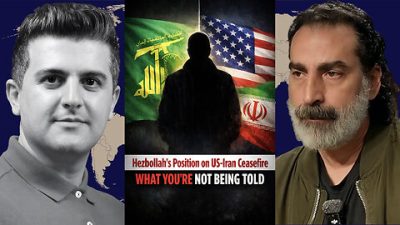
Laith Marouf: Hezbollah’s position on US-Iran ceasefire
or go to
Aletho News Archives – Video-Images
From the Archives
Is Israel to blame for the Iraq War?
American Goy | March 10, 2008
I am so tired of this old canard that “Israel had nothing to do with USA’s war with Iraq – in fact, it officially advised America against it”.
Bullshit. … continue
Blog Roll
 Aletho News
- Laith Marouf: Hezbollah’s position on US-Iran ceasefire: What you’re not being told
- Israel’s priority lies in destroying chances of peace between Iran, US: Ex-UN nuclear chief
- Ceasefire for all or for none: Iran shuts Hormuz over Lebanon attacks
- Strait of Hormuz is Iran’s ‘nuclear weapon’ that forced US retreat: Medvedev
- Energy crisis will last for months – Kremlin envoy
- Europe’s quiet role in the war on Iran
- Forty days that shook the Empire: How Iran turned the tables on US and prevailed
- Netanyahu unilaterally declares Lebanon outside of ceasefire deal
- Israeli leaders: ‘Not a single goal’ achieved in war with Iran
- What on earth just happened? Trump, Iran, and the unlikely ceasefire
- If Americans Knew
- Gazans face a triple crisis: severe shortages of water and bread, healthcare in tatters
- NY Times reports how Netanyahu took the US into Iran War
- A sigh of relief over Iran, but Gaza and Lebanon in dire straits – Daily Update
- Thousands dead and neighborhoods razed to the ground: Aid agencies fear southern Lebanon is becoming the new Gaza
- The war the US is fighting for Israel could cost trillions
- ‘Cigarette Burns, Nail Wounds’: Toddler Tortured in Gaza to Coerce Father
- Trump Says US Sent ‘a Lot of Guns’ to Protesters in Iran
- Israeli forces destroy 17 UN peacekeeper cameras in south Lebanon
- US-Israeli strikes ‘completely destroy’ synagogue in Tehran
- Archbishop for US Military Says Iran War Is Unjust Under Catholic Teaching
- No Tricks Zone
- An Inconvenient Tree: Uncovered In Alps… Europe Much Warmer Than Today 6000 Years Ago
- New Study Reports A 60% Slowdown In Greenland’s Ice Loss Rate In The Last Decade
- Low Intensity Tornado Wrecks Major Solar Farm, Creating A Potential Toxic Dump
- New Study Finds Warming Saves Lives…Cold Temperatures 12 Times More Deadly Than Excess Heat
- German Science Blog Accuses PIK Climate Institute Of Hallucinating Climate Tipping Points
- Devastating Assessment Of Comirnaty Vaccine By Former Senior Pfizer Europe Toxicologist
- New Study: CO2 Is ‘Effectively Negligible’ As An Explanatory Climate Change Factor Since 2000
- Former Pfizer Toxicologist Dr. Helmut Sterz Tells Bundestag Hearing Pfizer Vaccine Should Have Never Been Approved
- Energy Expert: Germany’s Nuclear Phaseout Was A “500 Billion Euro Mistake”
- New Research: South Australia’s Mid-Holocene Sea Surface Temperatures Were 4°C Warmer Than Today
 Aletho News