The Great Reset Didn’t Work: The Case of EVs
By Jeffrey A. Tucker | Brownstone Institute | February 15, 2024
We are living through one of history’s longest and most excruciating versions of “We told you so.” When in March 2020, the world’s government decided to “shut down” the world’s economies and throttle any and all social activity, and deny kids schooling plus cancel worship services and holidays, there was no end to the warnings of the terrible collateral damage, even if most of them were censored.
Every bit of the warnings proved true. You see it in every story in the news. It’s behind every headline. It’s in countless family tragedies. It’s in the loss of trust. It’s in the upheaval in industry and demographics. The fingerprints of lockdowns are deeply embedded in every aspect of our lives, in ways obvious and not so much.
Actually, the results have been even worse than critics predicted, simply because the chaos lasted such a long time. There are seemingly endless iterations of this theme. Learning losses, infrastructure breakages, rampant criminality, vast debt, inflation, lost work ethic, a growing commercial real estate bust, real income losses, political extremism, labor shortages, substance addiction, and more much besides, all trace to the fateful decision.
The headlines on seemingly unrelated matters go back to the same, in circuitous ways. A good example is the news of the electric vehicle bust. The confusion, disorientation, malinvestment, overproduction, and retrenchment – along with the crazed ambition to force convert a country and world away from oil and gas toward wind and solar – all trace to those fateful days.
According to the Wall Street Journal, “As recently as a year ago, automakers were struggling to meet the hot demand for electric vehicles. In a span of months, though, the dynamic flipped, leaving them hitting the brakes on what for many had been an all-out push toward an electric transformation.”
Reading the story, it’s clear that the reporter is downplaying the sheer scale of the boom-bust.
That’s not to say that Tesla itself is going bust, only that it has a defined market segment. The technology of EVs simply cannot and will not become the major way Americans drive. It might have seemed otherwise for a moment in time but that was due to factors that traced exactly to pent up demand caused by lockdowns and huge errors in supply management due to bad signaling.
Looking back, the lockdowns hit in the spring of 2020 and supply chains were entirely frozen by force. This might have been a major problem for car manufacturers that had long relied on just-in-time inventory strategies. However, at the very time, the demand for travel collapsed. Commutes came to an end, and vacations too. At that same time, pre-arranged government subsidies and mandates for EVs flooded the industry, all of which were later ramped up by the Biden administration.
As demand picked up, retailers sold their old inventory of cars and looked to manufacturers for more but the chips needed to complete the cars were not available. Many cars were put on hold and lots emptied out. This continued through the following year as used car prices soared and stock was otherwise depleted.
By the time matters became desperate in the fall of 2021, manufacturers discerned a heightened demand for EVs and began to retool their factories for more. There was even a time when cars were being shipped without power steering, just to meet the demand.
It might have seemed for a time like the crazed period we just lived through was birthing a completely different way of life. A kind of irrationality, born of shock and awe, swept industry and culture. The EV was central to it.
This demand seemed to pan out in 2022 as Americans grabbed whatever cars were available, perhaps willing to give the new doohickies a shot. So on it went as more carmakers threw more resources at production, benefitting from massive subsidies and staying in compliance with new mandates for reducing their carbon footprint.
There was no particular reason to think anything would go wrong. But then the next year began to reveal uncomfortable truths. Cold weather dramatically cuts the range of the EVs. Charging stations are not as readily available on longer trips, charging takes longer than one expects, and having to plan such matters adds time. In addition, the repair bills can be extremely high if you can find someone to do it.
Tesla as a manufacturer had planned out all such contingencies but other carmakers less so. Very quickly the EVs gained a bad reputation on a number of different fronts.
“Last summer, dealers began warning of unsold electric vehicles clogging their lots. Ford, General Motors, Volkswagen and others shifted from frenetic spending on EVs to delaying or downsizing some projects,” writes the Journal. “Dealers who had been begging automakers to ship more EVs faster are now turning them down.”
In short, “the massive miscalculation has left the industry in a bind, facing a potential glut of EVs and half-empty factories while still having to meet stricter environmental regulations globally.”
Today, lots are selling the cars at a loss just to avoid the costs of keeping them around.
Truly, this has been one spectacular boom-bust in a single industry. There seems to be no real end to the bust either. These days it appears that everyone has given up on any chance of actually converting the mass of American cars to become EVs. All recent trends are headed in the other direction.
Meanwhile, the EV is deeply loved by many as 1) a second car, 2) for well-to-do suburban commuters, 3) who own homes, 4) can charge overnight, and 5) have a gas car as a backup for cold weather and out-of-town trips. That is to say, the market is becoming exactly what it should be – a street-worthy golf cart with very fancy features – and not some paradigmatic case for the “great reset.” That’s simply not happening, despite all the subsidies and tax breaks.
“A confluence of factors had led many auto executives to see the potential for a dramatic societal shift to electric cars,” writes the Journal, including “government regulations, corporate climate goals, the rise of Chinese EV makers, and Tesla’s stock valuation, which, at roughly $600 billion, still towers over the legacy car companies. But the push overlooked an important constituency: the consumer.”
Indeed, the American economy, much to the chagrin of many, still primarily relies on consumers to make choices in their best interest. When that doesn’t happen, no amount of subsidies can make up the difference.
This story is impossible to understand without reference to the crazed illusions caused by lockdowns. Those are what provided the respite of time to allow automakers to retool. Then they boosted demand artificially for transportation after a long period in which inventory had been depleted.
Then the whole ridiculous ethos of the “great reset” convinced idiotic corporate executives that nothing would ever be the same. Maybe we would get 15-minute cities powered by sunbeams and breezes after all, along with a social-credit system that would allow the authorities to decommission our ability to drive in an instant.
It turns out that the entire bit, including the fake prosperity of the lockdown economy, made possible by money printing and grotesque levels of government spending, was unsustainable. Even sophisticated car companies bought into the nonsense. Now they are paying a very heavy price. The new market depended on a panic of buying that turned out to be temporary.
In short, the illusions of these horrible policies have come crashing down. It was born of liberty-wrecking policies under the cover of virus control. Every special interest seized the day, including a new generation of industrialists seeking to displace the old ones by force.
More and more, it’s obvious what a disaster this was. And yet no one has apologized. Hardly anyone has admitted error. The big shots who wrecked the world are still in power.
The rest of us are left holding the bag, and paying very high repair bills for cars that are non-optimal for driving from one town to another and back again in the cold weather that was supposed to be gone by now had the “climate change” prophets been correct. They turn out to be as correct as those who promised us that we would no longer need “fossil fuels” and that the magic inoculation would protect everyone from a killer virus.
What astonishing illusions were born of this nutty and destructive period. At some point, not even corporate CEOs will be tricked by the experts.
Jeffrey Tucker is Founder, Author, and President at Brownstone Institute.
Freedom Convoy leaders sue Trudeau regime for targeting protesters with Emergencies Act
By Anthony Murdoch | Life Site News | February 15, 2024
OTTAWA, Ontario — On the second anniversary of Prime Minister Justin Trudeau’s government’s use of the Emergencies Act (EA) to quash the truckers’ Freedom Convoy in 2022, the heads of the protest, Tamara Lich and Chris Barber, and a host of others have filed a $2 million lawsuit against the Trudeau government.
The lawsuit, announced yesterday by Freedom Convoy lawyer Keith Wilson, includes Lich as well as other convoy leaders Chris Barber, Tom Marazzo, Danny Bulford, and a host of others.
“On the 2-year anniversary of the Federal Government illegally invoking war measures against its citizens and targeting key protestors in Ottawa by freezing their bank accounts, today Tamara Lich, Chris Barber, Tom Marazzo, Danny Bulford and other protestors who were targeted by @JustinTrudeau and @cafreeland have filed lawsuits against the Federal Government.”
Wilson said that Section 24 of Canada’s Charter of Rights and Freedoms “gives Canadians the right to sue their government for damages when Charter rights are violated.”
“Doing so affirms the seriousness of respecting Charter rights and is intended to deter future governments from breaching Canadians’ fundamental rights.”
Wilson noted that the lawsuits seek $2 million in damages.
Lich, on X (formerly Twitter) noted about the lawsuit on Wednesday that “Accountability is a thing. It’s go time!”
“Happy Emergencies Act Day! I hope you all look back and fondly remember how your government shot you with rubber bullets and tear gas for your own good!” she also wrote.
Tom Marazzo, who was also involved with the Freedom Convoy and is a 25-year Canadian army veteran, said about it that it was “2 years ago today, instead of celebrating Valentine’s Day, the most corrupt government in Canadian history, launched an all out illegal assault on the Rights and Freedoms of every Canadian citizen in Canada, with the help of the NDP, Bloc, MSM and the Banks.”
“2 years later, they are all still in power with no end in sight. The one question that is never addressed, by any of them is why did Canadians feel so desperate that they had to go to Ottawa in the first place???” wrote Marazzo on X.
Further details about the lawsuit will be forthcoming in the next few days.
The lawsuit comes just after a Canadian federal court last month ruled that the Trudeau government’s use of the Emergencies Act to quash the truckers’ Freedom Convoy in 2022 was unconstitutional. The court ruled that the use of the EA was a direct violation of the Charter and thus “not justified.”
The EA controversially allowed the government to freeze the bank accounts of protesters, conscript tow truck drivers, and arrest people for participating in assemblies the government deemed illegal.
An investigation into the use of the EA, as per Canadian law, was launched by Trudeau. However, it was headed by Liberal-friendly Judge Paul Rouleau, who led the Public Order Emergency Commission. This commission was to investigate the Liberal government’s unprecedented use of the EA against the anti-mandate Freedom Convoy protest. Unsurprisingly, the commission exonerated Trudeau’s use of the EA.
Freedom Convoy leaders Lich and Barber have been involved in a lengthy trial after being charged and taken to court by the federal government for leading the protests. The trial has not yet concluded and has been put on hold, with its resumption date uncertain. It is also not yet clear how the recent court ruling will affect the trial.
In early 2022, the Freedom Convoy saw thousands of Canadians from coast to coast come to Ottawa to demand an end to COVID mandates in all forms. Despite the peaceful nature of the protest, Trudeau’s government enacted the EA on February 14, 2022. Trudeau revoked the EA on February 23.
During the clear-out of protesters after the EA was put in place, one protester, an elderly lady, was trampled by a police horse, and one conservative female reporter was beaten by police and shot with a tear gas canister. Rebel News reporter Alexa Lavoi, while covering the Freedom Convoy, was shot point blank in her leg with a rubber pellet, which police were using against protesters.
On February 14, 2022, the day the EA was invoked, Canadian Deputy Prime Minister and Minister of Finance Chrystia Freeland mandated certain bank accounts be frozen under the EA. In total, close to $8 million in funds from 267 people were locked. Additionally, 170 bitcoin wallets were frozen.
The freezing of bank accounts by Freeland without a court order was an unprecedented action in Canadian history and was only allowed through the Liberal government’s invocation of the never-before-used EA.
Germany’s interior minister: ‘No one who donates to a right-wing extremist party should remain undetected’
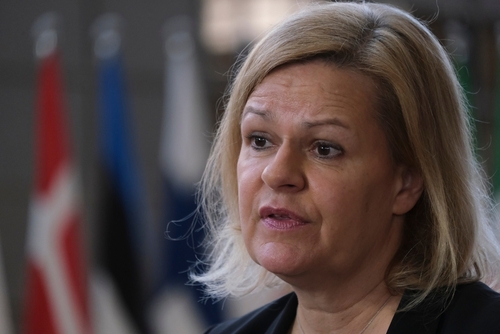
German Interior Minister Nancy Faeser is demanding more power to target the bank accounts of Germans accused of funding “right-wing extremists.”
By John Cody | Remix News | February 15, 2024
With one phrase, controversial German Interior Minister Nancy Faeser highlighted just how far the German government is willing to go to stamp out its main opposition with a new law.
“No one who donates to a right-wing extremist party should remain undetected,” warned the 53-year-old while announcing a new crackdown on bank accounts and funding for political groups, which notably is believed to include the opposition Alternative for Germany (AfD).
“Those who mock the state must deal with a strong state,” she added.
The SPD politician presented her new plan together with President of the Office for the Protection of the Constitution (BfV) Thomas Haldenwang and Federal Criminal Police Office head Holger Münch. Under the title “Resolutely combating right-wing extremism,” Faeser presented 13 new measures, with a special focus on targeting those who fund her party’s political rivals.
“The BfV is communicating closely with the financial sector in order to sensitize it to the problems of financial flows and transactions in connection with right-wing extremism.”
She also said that right-wing extremist networks should be prosecuted in the same way as members of organized crime. To achieve her goals, she wants a new law passed and soon.
“The German Bundestag should pass the law quickly,” said Faeser. In addition, the law would “combat hate on the internet, (…) remove enemies of the constitution from public service (and) disarm right-wing extremists.”
Undoubtedly, the government made the announcement with an eye on the Alternative for Germany (AfD) party, which continues its surge in popular support despite a media and government campaign aimed at the party. In fact, the latest Insa poll shows the party back over 20 percent after briefly dropping below this mark earlier this month. The results are sure to have alarmed the government, as the relentless propaganda drive against the party has failed to have the desired effect.
In several German states, the domestic intelligence agency, the Office of the Protection of the Constitution (BfV), has already labeled the AfD a “definitive case of right-wing extremism,” which means the party is already subject to extreme surveillance. Now, the government may be able to leverage this designation to target those who donate to the party after revising the current law.
It remains unclear how such targeting would work and what kind of penalties would be directed at someone who donates to a right-wing party or organization; however, Faeser said the BfV would handle the specifics of tracking and targeting donors.
As Remix News reported, the BfV has become the political arm of the left-liberal establishment, and rival parties to their power are being actively targeted by the powerful agency.
Currently, such monitoring is subject to stringent approvals and a high threshold. However, the Office for the Protection of the Constitution, under the new law, would no longer have to prove incitement or violence, but only “risk potential,” which leaves far more room for interpretation.
Australia regime threatens X with “big trouble” if It doesn’t censor “misinformation”
By Didi Rankovic | Reclaim The Net | February 14, 2024
Australia’s authorities are once again putting pressure on social media, X this time, threatening that the company will face big fines and “big trouble” in general – unless “mis- and dis-” information is censored.
And, it is Australia’s new laws, when they come into force this year, that will represent the legal grounds for such actions.
The fines would run up to $3 million or 2 percent of annual turnover for “voluntary code of conduct” violations, and $7.8 million or 5 percent of annual turnover in case of lack of compliance with the Australian Communications and Media Authority (ACMA) “standards.”
This transpires from an article published by the Financial Review, citing Communications Minister Michelle Rowland, while the motive behind her last crusade is described as “a litany of issues” now allegedly plaguing X.
Rowland went all over the place to accuse X of “not doing enough” – from Taylor Swift deep fakes, to what’s likely a key point of contention – the platform’s decision to reinstate some 6,000 accounts of users previously banned by Twitter.
The thinking here seems to be that if the threat is made ahead of time, X will “align” better with Australia’s politics and agree to once again plunge itself into mass censorship.
The laws Rowland mentioned were drafted in 2023 with the aim of giving broader powers to the Australian Communications and Media Authority, specifically “to combat mis- and disinformation online,” the article said.
The upcoming legislation seeks to produce two effects – the tech industry subjecting itself to a formally voluntary code of conduct, and after this “carrot” comes the stick in the shape of the ACMA’s new powers, fines and punishment, if ACMA’s unhappy with how the code is adhered to.
Rowland added that X at this time “isn’t even covered by a voluntary industry code.” The reason is that X was removed from the code after it stopped the practice of flagging content running against (Twitter’s) “civic integrity policy.”
Elsewhere in Australia’s media scene, some are asking why the country’s government “hates Elon Musk.”
“It is about $300 million that Musk owes the Australian government so far,” wondered Sky News host James Macpherson. And by “owes” – he meant, the fines Australia has tried collecting from X even before the latest threats.
US spies behind ‘Russiagate’ conspiracy – report
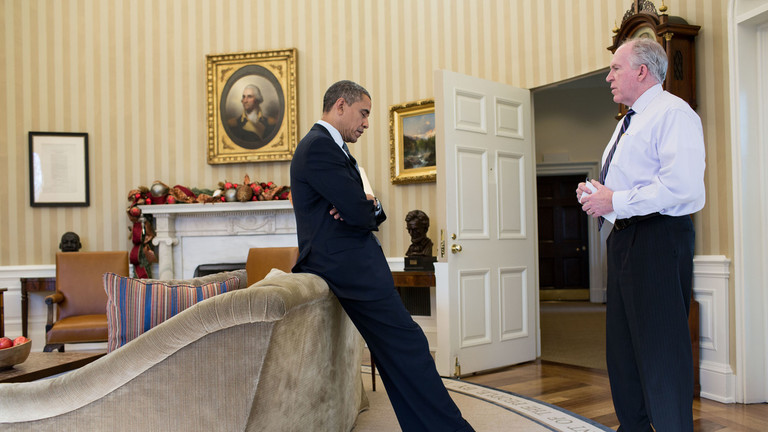
US President Barack Obama and CIA Director John Brennan, December 14, 2012 in Washington, DC. © Pete Souza / The White House via Getty Images
RT | February 14, 2024
The US intelligence community inappropriately used foreign allies to target Republican presidential candidate Donald Trump’s campaign to set up the ‘Russiagate’ conspiracy ahead of the 2016 election, according to a trio of investigative journalists.
Michael Shellenberger, Matt Taibbi and Alex Gutentag – of ‘Twitter Files’ fame – published the first part of an investigation on Tuesday, in which they claim the so-called ‘Five Eyes’ were operationalized against Trump staffers, citing anonymous sources close to the House Intelligence Committee.
According to their report, President Barack Obama’s CIA Director, John Brennan, had sent America’s partners – the UK, Canada, Australia, and New Zealand – a list of 26 Trump associates to target with data collection, misinformation and manipulation.
The Russiagate conspiracy involved multiple failures across western media networks to critically assess US intelligence claims that Russia had interfered in the 2016 US presidential election. A 2018 Pulitzer prize was awarded to Washington Post and New York Times journalists for their reporting on what was later to exposed as a false story.
“They were making contacts and bumping Trump people going back to March 2016,” said a committee source. “They were sending people around the UK, Australia, Italy — the Mossad in Italy. MI6 was working at an intelligence school they had set up,” the journalists claim.
Officially, the FBI only started looking into the Trump campaign that summer, after an Australian diplomat reportedly overheard an aide mention Russia. If confirmed, these findings would demonstrate that the US intelligence community had worked for months before that to set up just such a pretext.
In a statement to the investigative journalists, the FBI said it had made “missteps” in the 2016 and 2017 investigation of the Trump campaign, but has since implemented reforms to prevent it from happening again.
“The allegations that GCHQ was asked to conduct ‘wiretapping’ against the then president-elect are nonsense,” a spokesman for the British surveillance agency said. “They are utterly ridiculous and should be ignored.” Shellenberger, Taibbi and Gutentag said they had never asked the GCHQ about “wiretapping.”
According to Shellenberger, there is a “10-inch binder” containing previously unknown documents about the intelligence community’s surveillance of the Trump campaign. The 45th US president had ordered these documents declassified, but they went missing instead. In a Fox News appearance on Tuesday evening, Shellenberger suggested the FBI’s August 2022 raid on Trump’s Mar-a-Lago resort may have been related to the missing binder.
After the US intelligence community created a pretext for investigating Trump for ‘ties to Russia,’ they spied on his campaign – and then his presidency – using a falsely obtained FISA warrant. The warrant was based on the ‘Steele dossier,’ a file compiled by a British spy in the pay of Hillary Clinton’s campaign, through several intermediaries. The FBI knew the dossier was false as early as January 2017, but continued using the FISA warrant for almost a year thereafter.
The FBI lawyer who altered evidence to obtain the warrant, Kevin Clinesmith, ended up sentenced to probation and his law license has since been restored.
CIA Had Foreign Allies Spy On Trump Team, Triggering Russia Collusion Hoax, Sources Say
By Michael Shellenberger, Matt Taibbi, and Alex Gutentag | Public | February 13, 2024
Last year, John Durham, a special prosecutor for the Department of Justice (DOJ), concluded that the Federal Bureau of Investigation (FBI) should never have opened its investigation of alleged collusion by then-presidential candidate Donald J. Trump and Russia in late July of 2016.
Now, multiple credible sources tell Public and Racket that the United States Intelligence Community (IC), including the Central Intelligence Agency (CIA), illegally mobilized foreign intelligence agencies to target Trump advisors long before the summer of 2016.
The new information fills many gaps in our understanding of the Russia collusion hoax and is supported by testimony already in the public record.
Until now, the official story has been that the FBI’s investigation began after Australian intelligence officials told US officials that a Trump aide had boasted to an Australian diplomat that Russia had damning material about Democratic presidential candidate Hillary Clinton.
In truth, the US IC asked the “Five Eyes” intelligence alliance to surveil Trump’s associates and share the intelligence they acquired with US agencies, say sources close to a House Permanent Select Committee on Intelligence (HSPCI) investigation. The Five Eyes nations are the US, UK, Canada, Australia, and New Zealand.
After Public and Racket had been told that President Barack Obama’s CIA Director, John Brennan, had identified 26 Trump associates for the Five Eyes to target, a source confirmed that the IC had “identified [them] as people to ‘bump,’ or make contact with or manipulate. They were targets of our own IC and law enforcement — targets for collection and misinformation.”
Unknown details about the FBI’s investigation of the Trump campaign and raw intelligence related to the IC’s surveillance of the Trump campaign are in a 10-inch binder that Trump ordered to be declassified at the very end of his term, sources told Public and Racket.
If the top-secret documents exist proving these charges, they are potentially proof that multiple US intelligence officials broke laws against spying and election interference.
“They were making contacts and bumping Trump people going back to March 2016,” a source close to the investigation said. “They were sending people around the UK, Australia, Italy — the Mossad in Italy. The MI6 was working at an intelligence school they had set up.”
The IC, a source said, considered the 26 Trump campaign people identified to “bump” or “reverse target,” or manipulate through confidential human sources (CHSs), to be easy marks because of their relative inexperience.
Doing so was illegal, both because US law prohibits such intelligence gathering unless authorized by a Foreign Intelligence Surveillance Act (FISA) warrant and because the weaponization of the IC for political purposes constitutes election interference.
…
Subscribers to Public substack can read the full report here…
New York’s Proposed Minor Consent Law ‘Dangerous’ and ‘Misleading,’ Critics Say
By Suzanne Burdick, Ph.D. | The Defender | February 12, 2024
New York state lawmakers are weighing legislation that would allow any child or teen under 18 to seek out and consent to medical treatment — including vaccines, dental procedures, hospitalization and even surgery — without parental consent, as long as the minor appears to have the mental capacity for making that decision.
Assembly Bill A6761, introduced by New York Assemblymember Karines Reyes (D-Bronx), also would allow Medicaid funds to pay for procedures and drugs administered to children.
Proponents of the legislation, such as the American Civil Liberties Union of New York, say the measure is about ensuring all youth have access to quality care.
But critics, including John Gilmore, founder and executive director of the nonprofit Autism Action Network, said the bill is dangerous.
“The bill’s biggest problem,” Gilmore told The Defender, “is that it allows any medical procedure to be done to children of any age without parental knowledge or consent. That’s the kicker.”
Gilmore said the bill has another problem, too: The “active summary” statement on the official New York Assembly website says it “allows homeless youth to give effective consent to certain medical, dental, health, and hospital services.”
But Gilmore said that statement is “deliberately misleading” because the bill’s text applies to more than just “homeless” youth seeking “certain” services.
The bill states:
“Any person, including a minor, who comprehends the need for, the nature of, and the reasonably foreseeable risks and benefits involved in any contemplated medical, dental, health, and/or hospital services, and any alternatives thereto, may give effective consent to such services for themself, and the consent of no other person shall be necessary.”
“Albany is lying” about the bill, according to Autism Action Network.
Michael Kane, a New York resident and founder of Teachers For Choice, agreed. “It’s a complete lie to say the bill applies only to homeless children or runaways — and it’s a dangerous one,” Kane told The Defender. “It’s imperative that legislators understand what the bill really does,” Kane said.
With New York lawmakers considering close to 10,000 bills, legislators may rely on a bill’s one-sentence summary — rather than reading its full text — for deciding how they vote, according to Gilmore.
The bill has a companion in the Senate (S8352), introduced Jan. 19 by state Sen. Rachel May (D-Syracuse). The bills share identical text.
Unclear how practitioners would assess minor’s ‘capacity to comprehend’
According to the latest version of the bill, a minor could consent to:
- General medical, dental, health and hospital services.
- Mental health outpatient services.
- Substance abuse treatment.
- Immunizations.
- Family planning services.
- Sexually transmitted disease (STD) diagnosis and treatment.
The bill states that a practitioner may administer a vaccine if “they have reason to believe that a person in parental relation to the child … objects to the immunization.”
It also states, “A child who may give effective consent [to various medical interventions] … may give such consent to their own immunization, and the consent of no other person shall be necessary.”
The bill allows minors under 16, in certain circumstances, to access psychotropic drugs or psychotherapy without parental consent.
Psychotropic drugs include a host of pharmaceutical products, including medications for depression, anxiety, sleep disorders, schizophrenia, bipolar disorder and attention-deficit/hyperactivity disorder.
Current New York law allows minors 16 or older residing in a hospital to agree to psychotropic medications without parental consent if any of the following conditions are met:
- A parent or guardian “is not reasonably available” and the physician determines “the minor has the capacity”; or
- requiring parental consent “would have a detrimental effect on the minor”; or
- the parent has refused consent, providing that two physicians (including a psychiatric doctor who does not work for the facility) agree the medications are in the minor’s best interests.
A6761/S8352 would allow minors under 16 in these circumstances to do the same, as long as the youth “comprehends the need for, the nature of, and the reasonably foreseeable risks and benefits involved.”
The bill does not include detailed information on how medical practitioners would assess a minor’s capacity to comprehend the potential risks of a potential treatment.
It does, however, define “capacity” as follows:
“The minor’s ability to understand and appreciate the nature and consequences of the proposed treatment, including the benefits and risks of, and alternatives to, such proposed treatment, and to reach an informed decision.”
Children’s Health Defense General Counsel Kim Mack Rosenberg told The Defender that informed consent is a “serious” thing, but this legislation devotes “little attention to how to determine if a child can truly exercise informed consent, how to obtain that consent and why true informed consent is critically important.”
Who is a ‘minor’?
The bill does not provide a clear definition of “minor” that applies across all amended laws. However, some sections of the law define or describe the age thresholds related to minor consent:
- In the amendments to the mental hygiene law section 9.13(a), anyone under 16 would still need parental/guardian consent to be admitted as a voluntary patient to a hospital.
- In amendments to mental hygiene law 33.21(a)(1), a “minor” is defined as a person under 18, excluding some special cases like emancipated minors or minors who are parents.
- In amendments to section 2305 of public health law, treatment for STDs without parental consent is allowed for those under 21.
However, earlier sections of the bill do not specify any age range for minors, suggesting even young minors could consent as long as they demonstrate appropriate “capacity.”
Even infants?
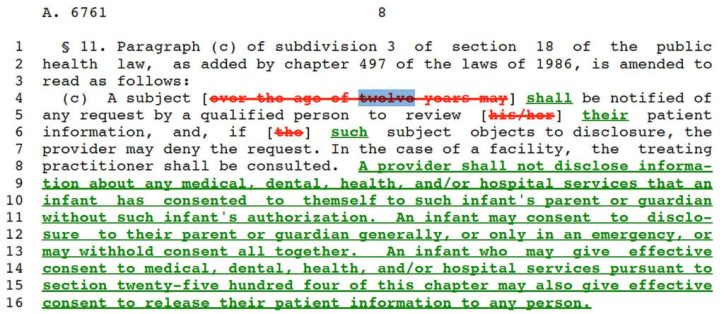
It appears the bill’s sponsors may believe that even an infant can give consent. That’s because section 18 of public health law omits previous language stating that children older than 12 can determine who gets access to their medical records.
This deletion suggests that a child of any age no longer “may” but “shall be notified of any request by a qualified person to review their patient information” and deny access to it if they so desire.
The bill states that an infant can choose to withhold information from its parents, without explaining how that would be possible:
In summary, there isn’t one definition of “minor” in the bill, but it seems for most purposes “minor” refers to anyone under age 18.
Minor consent bills bulldoze’ over decades of laws honoring parental rights
The U.S. has a strong legal history going back many decades that honors parental rights and recognizes that the state should step in only where parents are unfit to care for their children, Rosenberg said.
“Minor consent bills bulldoze over those longstanding decisions,” she said. “They try to exclude parents from medical decision-making and take over the parenting role.”
Rosenberg said she’s seen more bills like this recently being introduced in other states, such as Vermont. “We [CHD] successfully stopped one in the District of Columbia and are fighting laws and regulations elsewhere,” she said.
Kane called the bill “just horrendous” because it “completely eradicates parental control over what happens medically to our children.”
Meanwhile, a staff member for Reyes’ office who chose to remain anonymous told The Defender she disagreed, saying the bill was primarily about ensuring all kids have “access to care” and that it included “guardrails” to ensure that not all parental consent was stripped away in all situations.
For instance, the bill explains that a minor must “knowingly and voluntarily” seek care, the staff member said.
But Rosenberg said she’s concerned about the legal ramifications of the bill’s broad language — which appears to erase parental consent for “any contemplated medical, dental, health, and/or hospital services, and any alternatives thereto.”
Rosenberg told The Defender the bill was “rife with problems too numerous to address in brief remarks.”
The bill makes clear, she said, that minors can consent to vaccinations without their parents’ knowledge or consent — and that medical staff and insurance companies must hide that vaccination information from the parents unless the child permits them to share it.
Children “literally may inadvertently take their lives into their own hands” if they make serious healthcare decisions without parental involvement, Rosenberg said.
For example, children frequently don’t know their own health history — let alone their family health history — which may put them at an increased risk for an adverse reaction to a medication or treatment, she explained.
Rosenberg said:
“The legislators supporting these bills need to ask themselves what they would do if a child or grandchild of theirs consented to a surgical procedure of whatever kind requiring anesthesia and the child suffered death or irreversible harm if they had a reaction to the anesthesia.
“Is that a phone call they’d like to receive?”
‘Not a chance’ bill’s sponsors unaware of misleading statement
New York already has a law on the books about homeless youth giving consent for certain services.
Passed in 2022, A09604/S08937 allows “runaways and homeless youth under the age of 18 who are receiving approved crisis or support services to consent to medical, dental, health and hospital services.”
Gilmore, who has done legislative analysis in New York for 23 years, said, “Both Rachel May and Karines Reyes voted for the bill that was passed in 2022.”
So why would they talk about homeless youth in the summary of the new measure they introduced?
A staff member for Reyes’ office told The Defender a bill’s summary statement is written by lawyers — not by the legislator who introduces the bill.
It’s plausible the lawyers chose that language since the bill amends the same section of public health law (2504) that was amended earlier in the law about homeless youth and runaways, the staff member said. However, the staff member confirmed that the present bill does pertain to all minors.
The Defender also reached out to May’s Legislative Director Eric van der Vort, but he did not respond by our publication deadline.
Gilmore said he contacted legislators, too, but didn’t get a straight answer. When he asked van der Vort about the summary language, “he simply refused to address it in any way,” Gilmore said.
Reyes’ Chief of Staff Justin Westbrook-Lowery confirmed for Gilmore that the bill applies to all minors in New York but didn’t explain why the summary statement talked about homeless youth.
Amy Paulin (D-Scarsdale), who chairs the Assembly Committee on Health and co-sponsored the bill, “has a large staff and they’re very good at what they do,” Gilmore said. “There’s not a chance that they aren’t quite aware” that the bill’s summary statement doesn’t match what the bill would do.
Kane said he’s heard from New York legislators and staffers that they believe the bill affects only homeless children.
“There’s a lot of people in the Assembly starting to co-sponsor the bill, which is scary,” he said. “We don’t want this thing passed so that we end up litigating against it for the next five years.”
The Defender asked May’s media relations staff what May would like to tell parents concerned about being excluded from medical decision-making regarding their child’s health, but did not receive a response by our publication deadline.
Suzanne Burdick, Ph.D., is a reporter and researcher for The Defender based in Fairfield, Iowa.
This article was originally published by The Defender — Children’s Health Defense’s News & Views Website under Creative Commons license CC BY-NC-ND 4.0. Please consider subscribing to The Defender or donating to Children’s Health Defense.
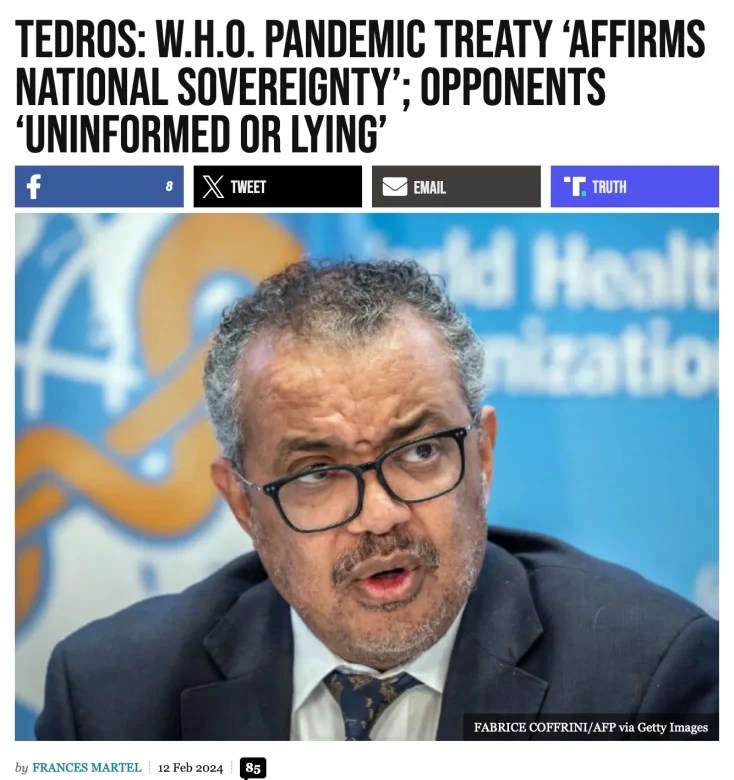
WHO’s Fooling Who? The one who gives the orders is the sovereign.
Tedros slams us for lies but it’s all projection: here’s the documentary proof it is the WHO that is lying
BY MERYL NASS | FEBRUARY 12, 2024
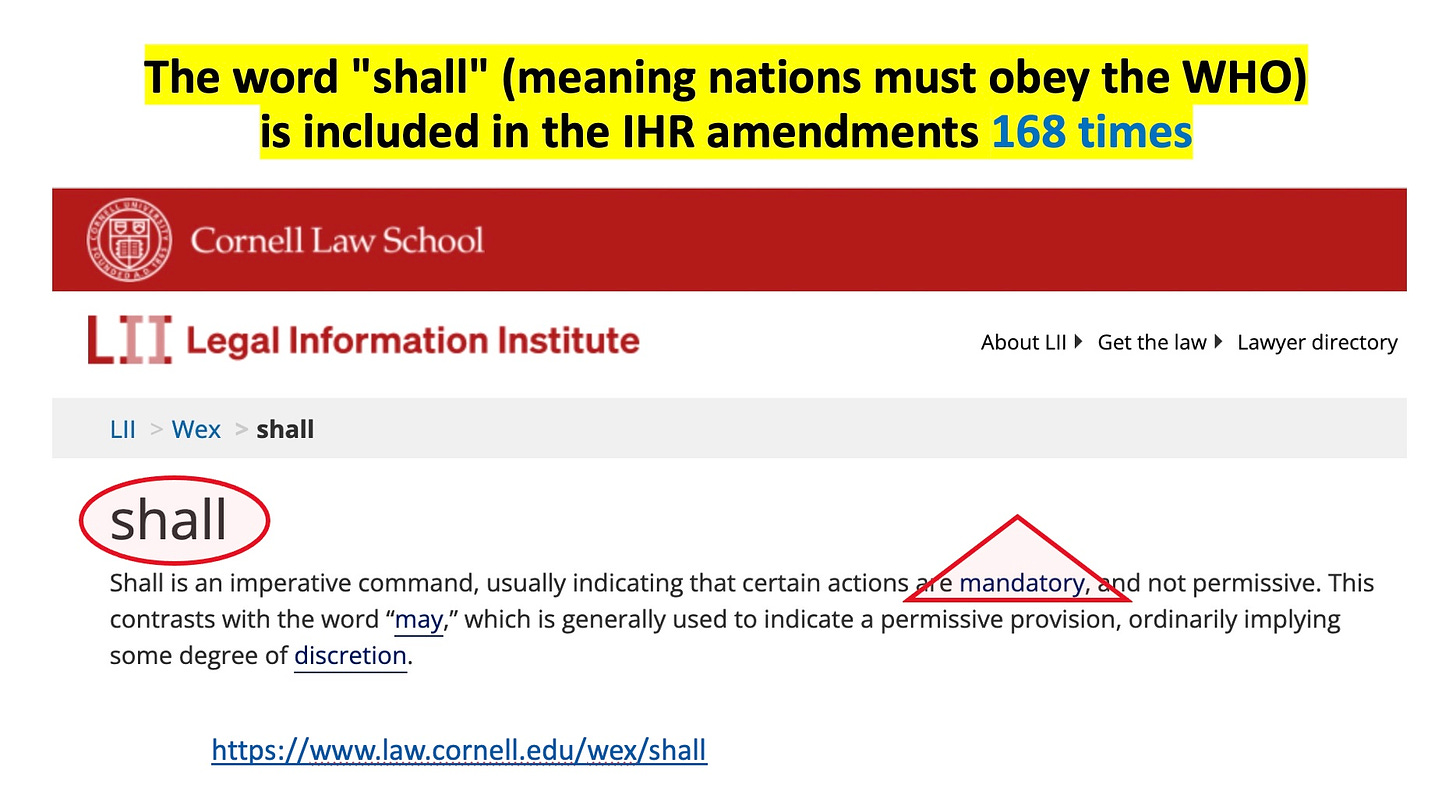
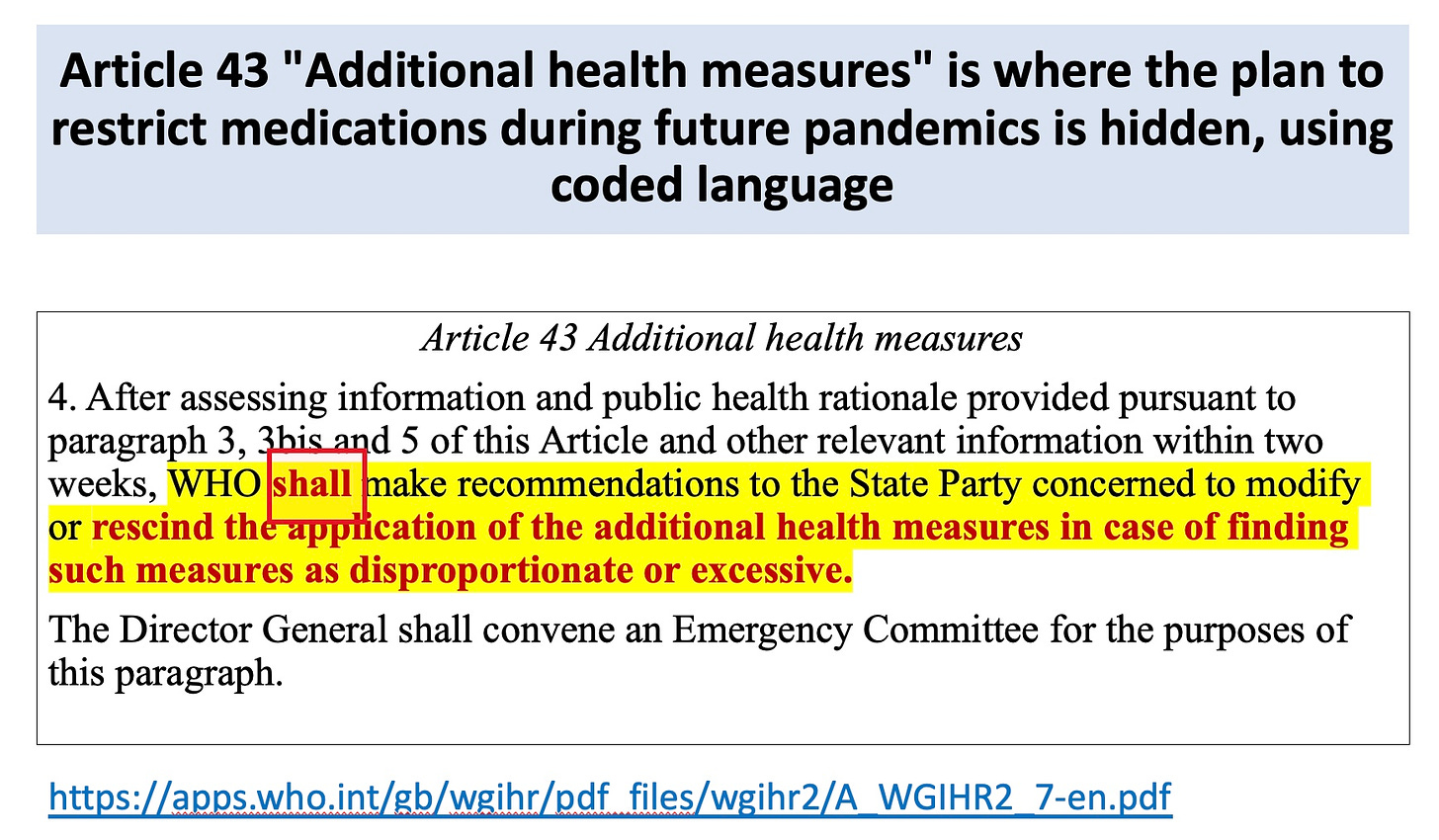
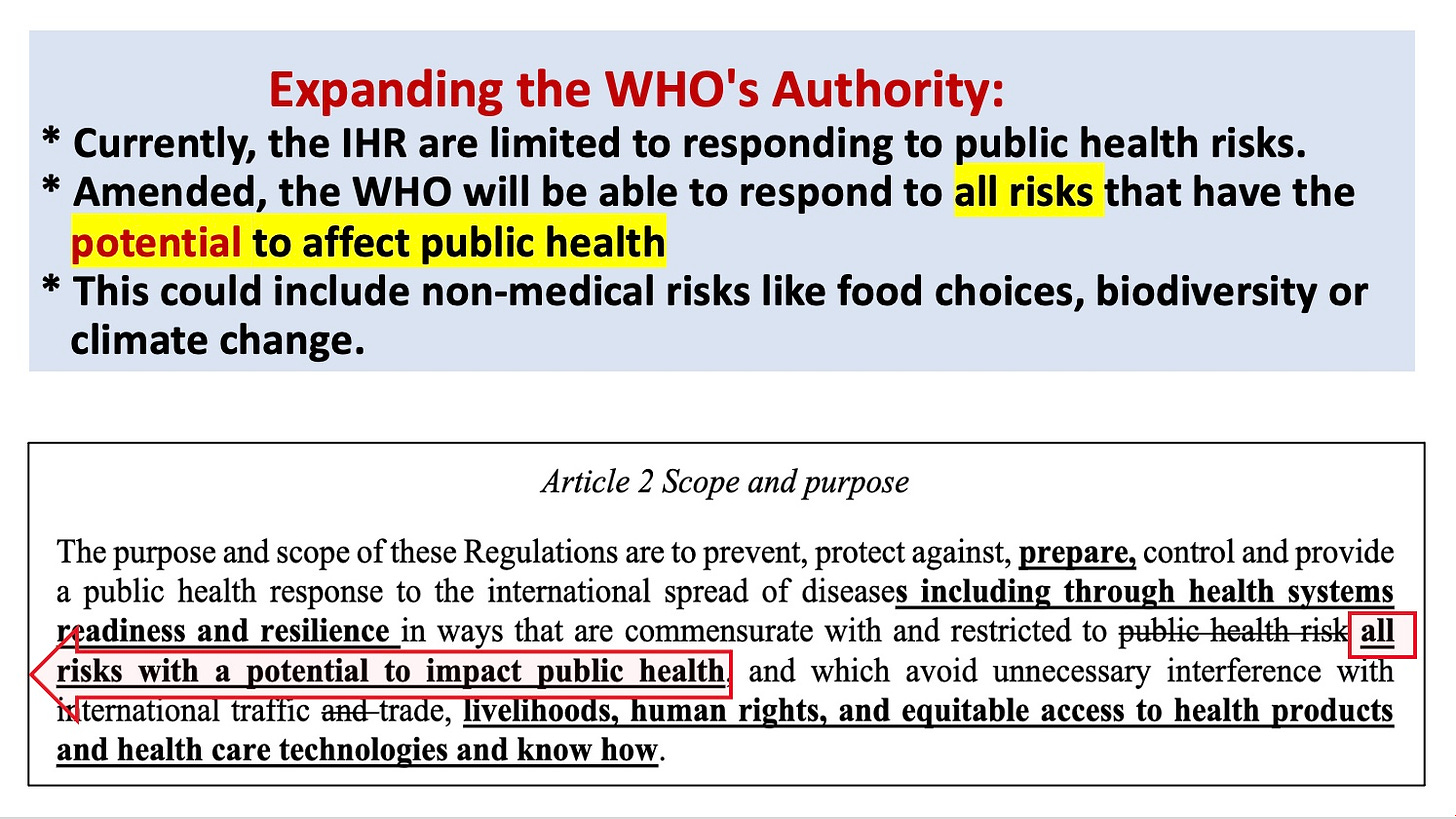
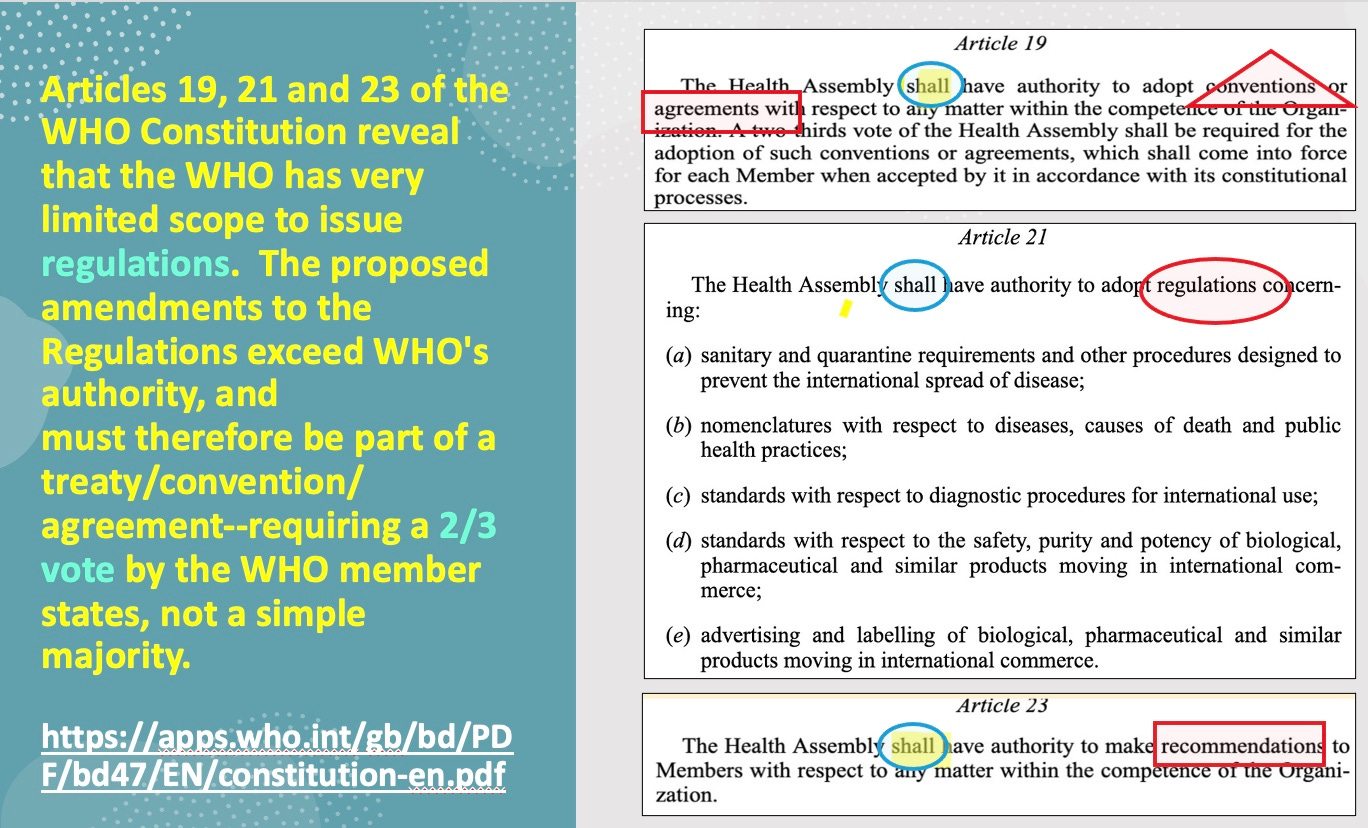
The WHO lawyers are trying to play us, saying the nations are sovereign because they still make the laws. What the WHO omits saying is that under the Treaty and proposed IHR Amendments, nations will be forced to pass the laws that the WHO tells them to pass. Examples of this and other word games below.
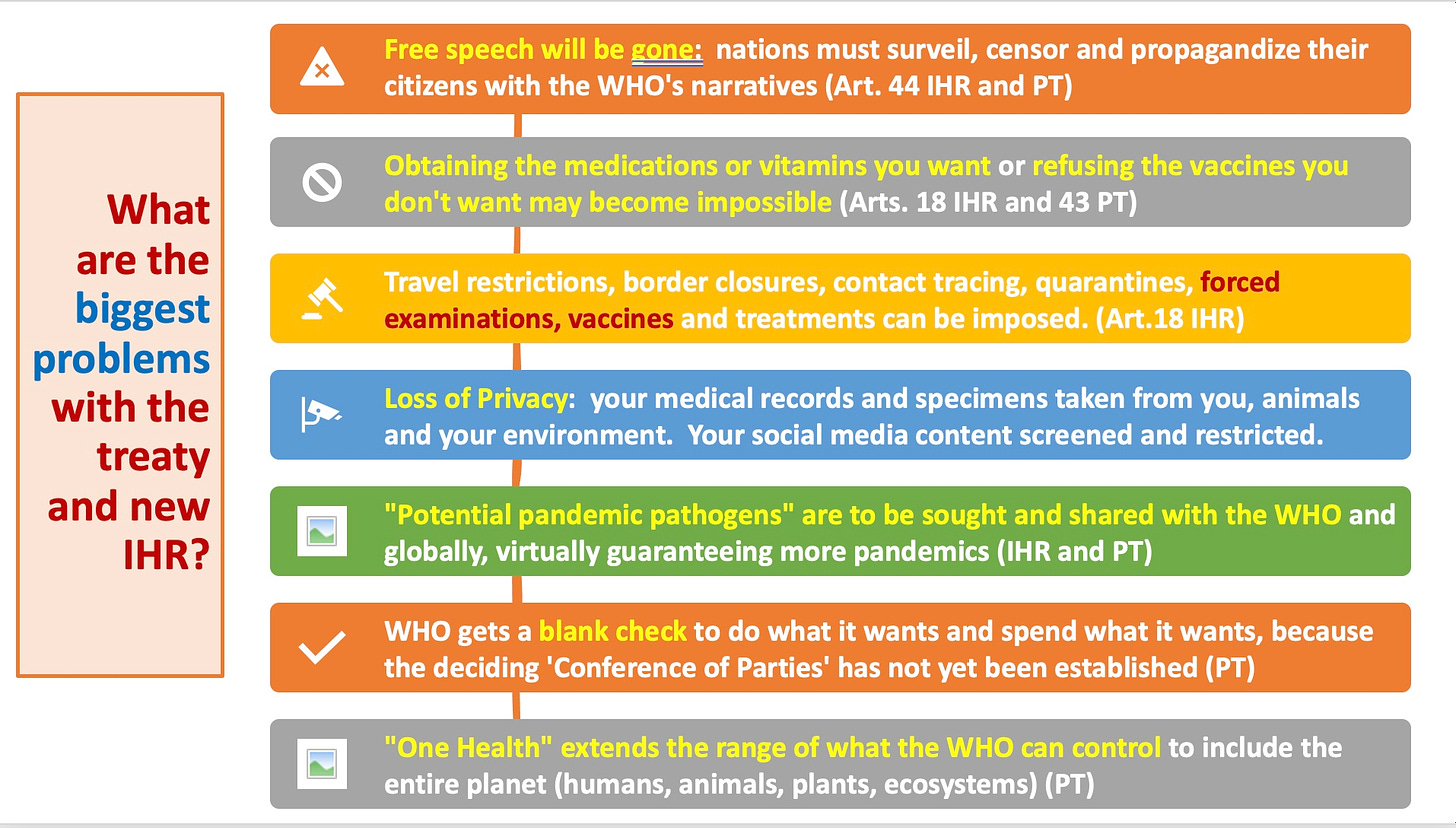

First the treaty tells you that unhindered, timely access to information is a general principle. Then it adds the caveat that transparency means open access to “accurate” information.
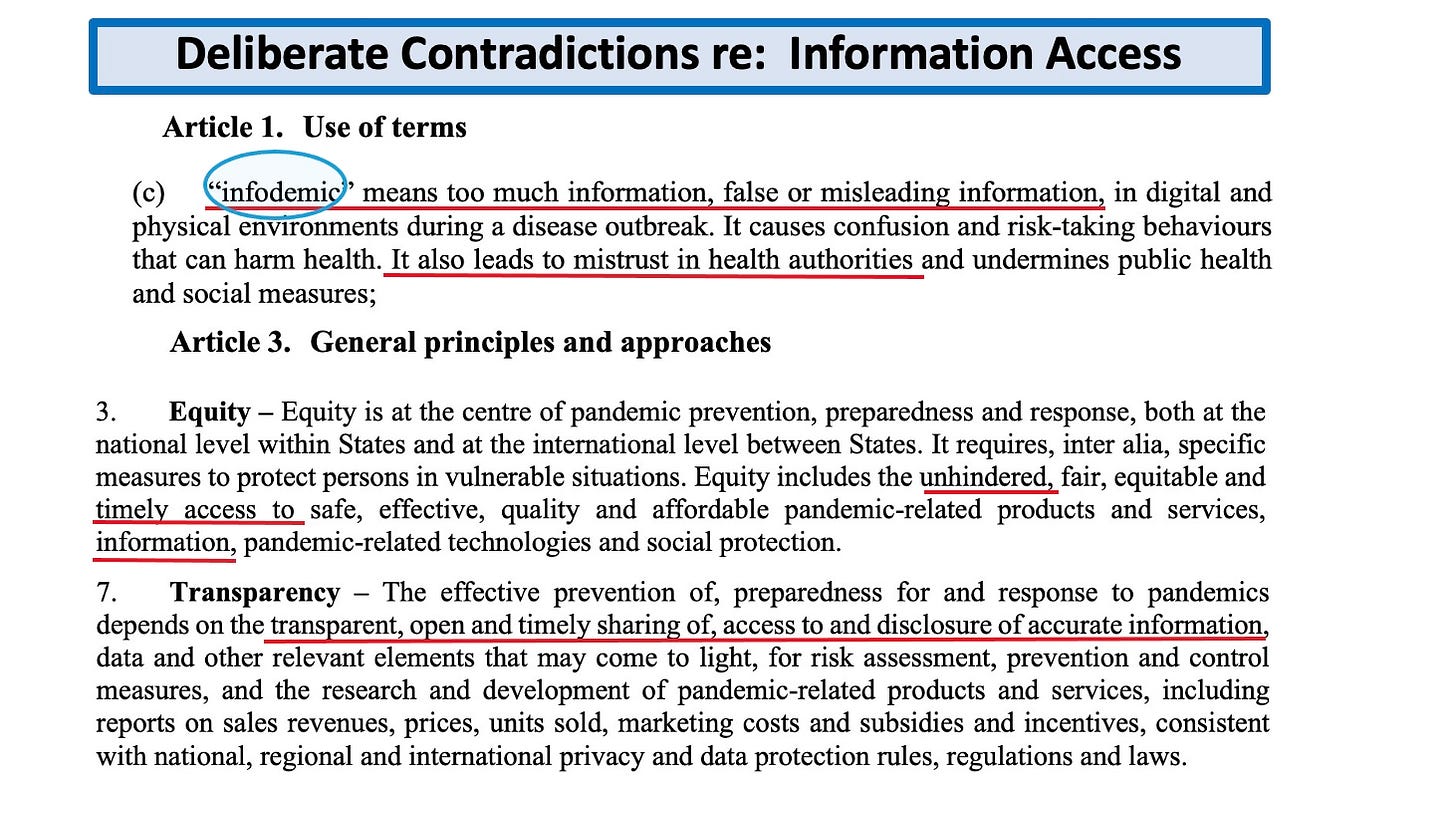
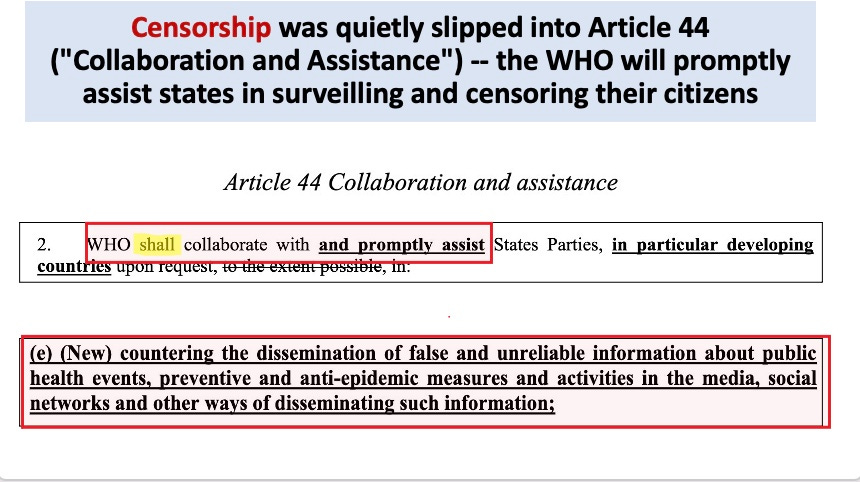
Then a few pages later the treaty demands that nations perform “infodemic management”—which requires not only censorship, but also surveillance of everyone’s social media footprint, so the nation will know who and what to censor. This violates both the First and Fourth Amendments to the US Constitution.
Not only that, but the censorship should be performed with international collaboration—so all nations can target the same misinformation spreaders and there will be nowhere to hide. Finally, they want to make sure you Trust the(ir) Science.

Below, the treaty is forced to admit that the so-called sovereignty that Tedros claims we will retain— the ability to pass laws—will in fact be subject to the orders of the WHO.
The WHO treaty draft requires that every nation pass laws to legalize Emergency Use Authorizations, so that unlicensed vaccines can be given to populations during a WHO-declared pandemic. You know, like a Monkeypox pandemic. There are no standards required and the WHO Director-General can declare any pandemic whenever he wants. Then the needles come out.
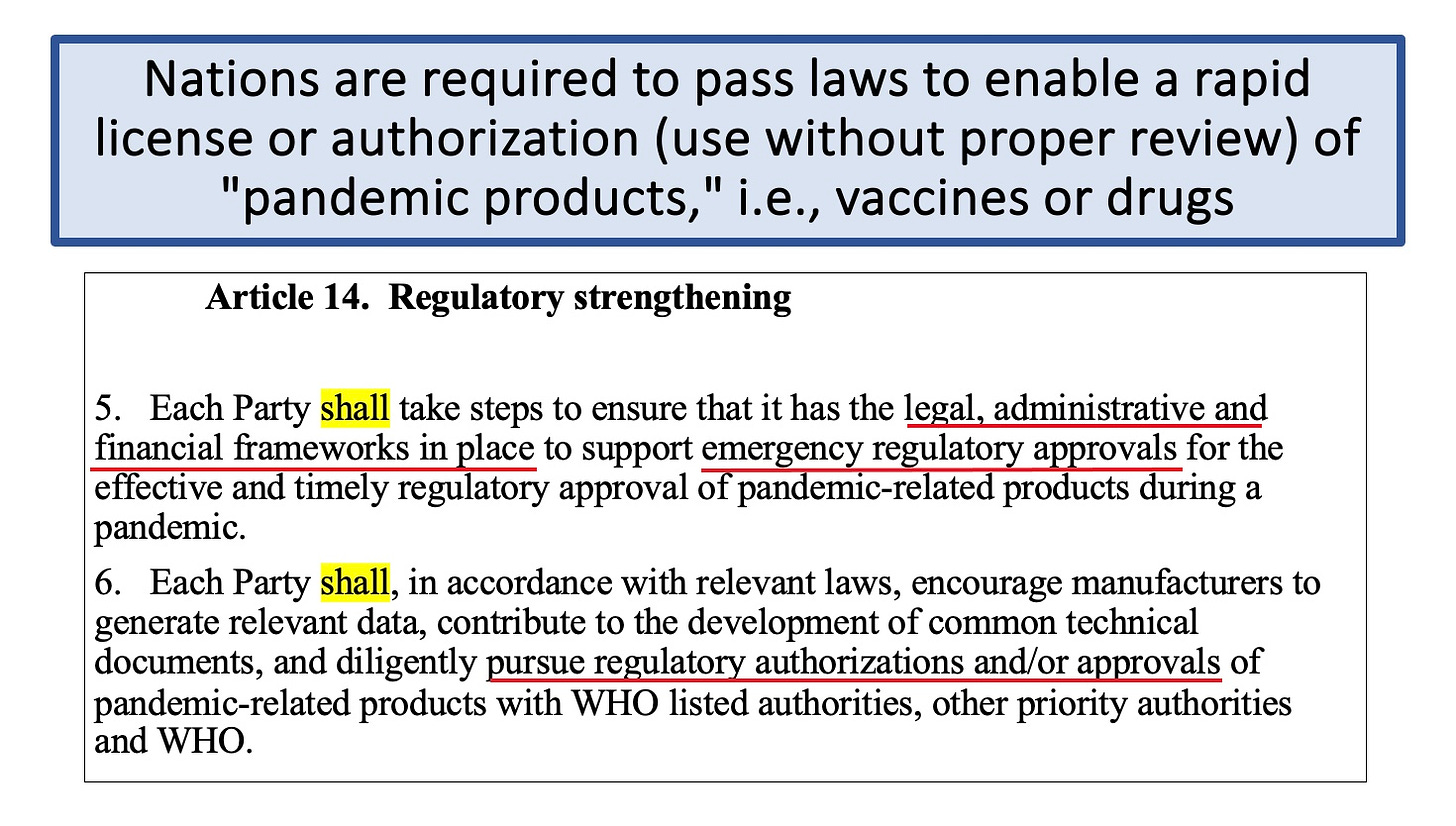
The WHO also demands that nations pass the laws needed to remove all liability from these untested and potentially deadly vaccines. Who’s sovereign now?

So you see, the WHO has just played a bunch of word games and they intended for us to be the suckers and go along, ignorant. So long as the Treaty and IHR Amendments still let nations make laws, the WHO insists on calling us sovereign. But the real sovereign is the one ordering that laws be passed. That’s the real power. Why would anyone give that up to the WHO, especially when its Director-General is a puppet for Bill Gates, is not a real doctor, and has been accused of withholding food and hiding 3 cholera epidemics to kill members of competing tribes in his native Ethiopia, when he was the #3 top official there? Do you really think he cares about your health during a pandemic?

So you can wait idly by as these treaties move ahead, or you can say ‘Hell No!’ and put on your big girl panties and decide you have finally had enough. Which will it be?
Zionists lead the charge to a more authoritarian Canada

By Yves Engler | February 12, 2024
Israel supporters have become a leading fascist force in Canada. They are pushing to restrict civil liberties, dismantle democratic organizations and increase policing.
Since I wrote about the phenomenon a month ago Zionist groups and journalists have deepened their ties to fascist groups and escalated their anti-democratic rhetoric in a bid to defend the genocide in Gaza. Israel lobby groups and commentators have repeatedly taken their cues from the former head of the thuggish and racist Jewish Defence League (JDL). They’ve repeatedly circulated long-time JDL head Meir Weinstein’s videos depicting anti-genocidal protesters as a threat and in a sign of this deepening alignment arch-Israeli nationalist reporter Joe Warmington recently quoted Weinstein in a story tarring protesters. In a Toronto Sun article spurred by the former JDL head’s X post headlined “Security threat against Trudeau all of Canada’s concern”, Warmington quotes Weinstein labelling Palestine solidarity protesters a “risk.”
As they deepen their ties to Khanist fascists, Zionist lobby groups have repeatedly called for marches to be banned, individuals to be fired and talks canceled. To suppress criticism of Canada’s contribution to Israel’s genocide Liberal MPs Anthony Housefather, Marco Mendicino and Ya’ara Saks have repeatedly taken up the call to suspend democratic rights. A month ago Saks posted, “As I stated last week, & will repeat again – protests within largely Jewish neighbourhoods like the ones in our riding of #YorkCentre is completely unacceptable. Targeting an overpass in an area that is known to be local Jewish community is a form of intimidation.”
In response to pressure from Saks, Weinstein, B’nai Brith, CIJA and others, the Toronto police barred protests on an overpass of Highway 401. They then arrested three people for asserting their right to assemble. The Canadian Civil Liberties Association (CCLA) condemned the police’s move and CCLA executive director Noa Mendelsohn Aviv pleaded in the Canadian Jewish News against the Zionists’ push to suppress civil liberties. (A B’nai Brith suit to expand the anti-protest zone was rejected.)
As part of this push to supress demonstrations, Israeli nationalist city councillor James Pasternak pushed Toronto representatives to develop a “policy and framework for the management and monitoring of rallies and protests.” In mid-January Pasternak declared, “It does not take much to see the [Palestinian] gatherings taking place downtown are not Charter-protected.”
In a similar bid to shut down basic democratic rights B’nai Brith called for suppressing the public’s rights to ask questions at city council meetings. Reportedly, on December 21 a handful of members of the public showed up at a meeting of the Agglomeration Council of Montreal in response to Hampstead mayor Jeremy Levi telling me he would support Israel even if they killed 100,000 Palestinian children since “good needs to prevail over evil”. Apparently, they asked about Levi’s genocidal apologia and a Hampstead law to send money raised from fines for ripping down posters of hostages to Israel, which led B’nai Brith to file a complaint with the Quebec Municipal Commission (The Commission rejected it). When members of the public asked questions at the January meeting B’nai Brith filed a second complaint (also rejected). The arch Zionist Suburban newspaper/website has published three stories on the matter and a week ago the Montreal Gazette put the Zionists complaints on its front page in a story headlined “Agglomeration council won’t act on antisemitism complaint, Montreal mayor says”.
CIJA and B’nai Brith recently succeeded in pressuring Concordia and Carleton universities to cancel their stops on a national speaking tour with British commentator Sami Hamdi, organized by the Canadian Muslim Political Affairs Council. A recent Zionist sponsored lawsuit also called for the Concordia administration to block students from funding their union. In a similar vein, Conrad Black penned a commentary last week headlined “SHUT CUPE DOWN” due to their Palestine solidarity and in the same National Post newspaper lawyer Howard Levitt called on Zionist members to decertify the Canadian Union Public Employees union.
Fascists have long targeted labour unions. Ditto for books. Montreal’s Jewish Public Library recently pulled the books of Quebec’s most prominent children’s author, Elise Gravel, from their displays because she posted against genocide. A councillor in Côte-St-Luc, Mike Cohen, called for his municipality to do the same.
On X Israel supporters regularly respond to videos of large numbers protesting Canadian complicity in genocide by calling for protesters to be deported. In a similar vein, JSpace board chair Joe Roberts recently called protesters “fifth columnists” whose “real enemy has always been the liberal democracies of the west.”
To supress the “fifth column”, the establishment Jewish groups are campaigning for increased police funding. On January 18 CIJA instigated a letter writing campaign demanding “Reverse the police cuts” in Toronto. Two weeks later, the advocacy agent for Canada’s Jewish Federations wrote, “We continue to urge Council to take action to prevent any shortfall in funding for the Toronto Police Service, so that our police have the tools they need to enforce the law and safeguard the Jewish community and all Torontonians from the threat of hate-motivated and all other types of crime.”
B’nai Brith recently called for increased funding to Montreal police and a slew of Zionist voices have called for the provincial government to allow security guards at schools to carry guns. City councillor Sonny Moroz, who previously worked for arch Zionist federal MP Anthony Housefather, submitted a motion calling for greater police presence in part of Montreal.
CIJA, B’nai Brith and Friends of Simon Wiesenthal Center have extensive ties to police forces across the country. Recently it was reported that the RCMP’s controversial Community-Industry Response Group (C-IRG), which has spied on indigenous and pipeline protests, has been targeting Palestine solidarity protests. In internal budgetary documents C-IRG labelled one protest a “Hamas Day of Action”.
Zionists have long sought to criminalize support for Palestinians. In a bid to promote the slaughter in Gaza, they’ve become cheerleaders for authoritarianism, cancel culture and other forms of intimidation historically associated with fascism.
“Electrify Everything” Slammed Again By Ninth Circuit
Court’s latest ruling has national implications and affirms that bans on direct use of natural gas violate federal law
By Robert Bryce | February 5, 2024
The Ninth Circuit Court of Appeals has cranked up the heat on the “electrify everything” foolishness.
Last month, the Ninth Circuit denied the city of Berkeley’s petition to re-hear its case after the city’s ban on natural gas use in homes and businesses was ruled illegal last April. The January 2 ruling has national implications and is an enormous loss for the electrify everything movement, the lavishly funded campaign that seeks to ban natural gas stoves, water heaters, and other gas-fired appliances in the name of climate change.
Before I delve into the court ruling, it’s essential to understand the danger to our energy security posed by the electrify everything effort and the dark money groups that are pushing it.
As I have reported here, the electrify everything movement could result in enormous reductions in the affordability, reliability, and resilience of our electric grid. The campaigners want to add massive amounts of new load onto an energy network that is already cracking under existing demand. Indeed, the electrify everything jihadis are pushing for the electrification of heating, transportation, and industry at the very same time that numerous policymakers and regulators are warning about the declining reliability of the power grid.
To cite two recent examples, last May, members of the Federal Energy Regulatory Commission delivered stark warnings to the members of the Senate Energy and Natural Resources Committee. The agency’s acting chairman, Willie Phillips, told the senators, “We face unprecedented challenges to the reliability of our nation’s electric system.” FERC Commissioner Mark Christie echoed Phillips’ warning, saying the U.S. electric grid is “heading for a very catastrophic situation in terms of reliability.” His colleague, Commissioner James Danly, averred that there is a “looming reliability crisis in our electricity markets.”
Last August, the North American Electric Reliability Corporation named “changing resource mix” as a top reliability risk facing the electric grid. And for the first time, it named climate policy as one of the most significant risk factors. It said, “policy decisions can significantly affect the reliability and resilience of the [bulk power system]. Decarbonization, decentralization, and electrification have been active policy areas. Implementation of policies in these areas is accelerating, and, with changes in the resource mix, extreme weather events, and physical and cyber security challenges, reliability implications are emerging.” (Emphasis added.)

Further, the same NGOs pushing to electrify everything are also aggressively promoting policies that will make our electric grid even more reliant on weather-dependent sources like wind and solar. As the slide above shows, NERC is warning that our grid is increasingly vulnerable to “wind and solar droughts.” If climate change means we are facing more extreme weather of all types, the last thing we should do is make our grid more dependent on the weather.
The electrify everything movement is fueled by massive contributions from some of the world’s richest people, including Michael Bloomberg, John Doerr, and Laurene Powell Jobs. Numerous climate-focused NGOs, including the Sierra Club (2022 budget: $168 million) and Rocky Mountain Institute (2022 budget: $117 million), as well as dark-money entities like Climate Imperative and Rewiring America, are leading the attack against gas stoves and the direct use of gas. In 2022, Climate Imperative — headed by veteran climate activist Hal Harvey and two former Sierra Club employees, Bruce Nilles and Mary Anne Hitt — had revenue of $289 million. For comparison, the American Gas Association, which represents gas utilities, had revenue of about $37 million that year.
Jobs and Doerr were founding board members of Climate Imperative, which does not reveal the identities of its donors. Last March, in “The Dark Money Behind The Gas Bans,” I wrote about Rewiring America, which had recently hired Georgia politician Stacey Abrams. I explained that Rewiring America has about 40 employees and:
is among the most prominent members of this dark money network. The group doesn’t publish its budget or file a Form 990. Instead, it is a sponsored project of the Windward Fund, a 501c3 non-profit that does not disclose its donors. Nor does it reveal how much it is giving to Rewiring America. Although it is impossible to know exactly how much dark money is being shuffled among groups like the Windward Fund, Rewiring America, and others, my tally shows that just four of the dark money NGOs behind the gas bans have combined budgets of about $820 million.
Now, back to the Ninth Circuit. The court’s January 2 decision not to entertain a rehearing of the Berkeley case confirms that the gas bans enacted in California over the past several years are invalid. According to the Sierra Club, which has been gleefully tracking the bans, some 76 cities or counties in the state have enacted bans or restrictions on gas since Berkeley enacted its ban in 2019. On a website that tracks the restrictions, the Sierra Club makes no mention of the Ninth Circuit’s rulings. The group may want to ignore it, but the decision affects all of the states in the Ninth Circuit: Alaska, Arizona, California, Hawaii, Idaho, Montana, Nevada, Oregon, and Washington. That means the recent bans on gas in Seattle and the statewide ban in Washington, which was adopted last year, are invalid. So, too, is the ban imposed by Eugene, Oregon, in early 2023.
The San Francisco Chronicle summarized the appeal, noting that “Berkeley, joined by the Biden administration, other cities and states, and conservation groups, then asked the full appeals court, which has 16 Democratic appointees among its 29 judges, to order a rehearing. But only 11 judges, all appointed by Democratic presidents, voted for a new hearing…the ruling will now become final unless the conservative-majority Supreme Court agrees to review it.” The article quoted Sarah Jorgensen, a lawyer for the California Restaurant Association, who said the court recognized that “energy policy was a matter of national concern and that there should be uniform national regulation.”
Berkeley’s gas ban was first ruled illegal last April, when the Ninth Circuit ruled in favor of the restaurant association. The January 2 decision affirmed the court’s prior ruling and noted that Congress, when it passed the Energy Policy and Conservation Act (EPCA) of 1975, “ensured that states and localities could not prevent consumers from using covered products in their homes, kitchens, and business. EPCA thus preempts Berkeley’s building code, which prohibits natural gas piping in new construction buildings from the point of delivery at the gas meter.”
As I explained in these pages shortly after the April ruling in “The Ninth Circuit Spikes Berkeley’s Gas Ban,” the three judges assigned to the case found that EPCA:
expressly preempts State and local regulations concerning the energy use of many natural gas appliances, including those used in household and restaurant kitchens. Instead of directly banning those appliances in new buildings, Berkeley took a more circuitous route to the same result and enacted a building code that prohibits natural gas piping into those buildings, rendering the gas appliances useless… By its plain text and structure, EPCA’s preemption provision encompasses building codes that regulate natural gas use by covered products. And by preventing such appliances from using natural gas, the new Berkeley building code does exactly that.” (Emphasis in original.)
A January 3 article published by Oakland-based KTVU, quoted Berkeley City Council member Kate Harrison, who authored the gas-ban ordinance, saying her city “will continue to do everything in its power to fight climate change and protect the health of its residents.”
The Ninth Circuit’s latest decision should also mean that bans on natural gas in other parts of the country should also be nullified. But the Ninth Circuit only covers part of the country. That means its decisions may set a precedent, but it doesn’t mean the precedent applies to other regions. That could change soon, however, because Jorgenson has filed a similar suit against the state of New York.
Last May, New York became the first state to ban gas stoves and furnaces in most new buildings. The law requires all-electric heating and cooking in new buildings shorter than seven stories by 2026, and for taller buildings by 2029. The city of New York has also passed a ban in the form of Local Law 97, which is even more destructive. That measure requires building owners to remove gas boilers over the next few years or face huge financial penalties. For more on Local Law 97, see the September 26, 2023 edition of the Power Hungry Podcast with my pal, Jane Menton, a lifelong New Yorker, who calls the measure an “electrification monster” that could result in a humanitarian nightmare in Gotham.
On October 12, Jorgenson filed suit on behalf of a group of plaintiffs, including propane dealers, homebuilders, and plumbers. In a press release, Jorgenson’s firm said the “The drastic step of requiring ‘all-electric’ new buildings despite an already-strained electric grid stands at odds with the public’s need for a reliable, resilient, and affordable energy supply. New York’s gas ban is preempted by federal law, is contrary to the public interest, and harms plaintiffs and the members they represent.”
If Jorgenson prevails in New York, and she should, the next stop on the litigation is the U.S. Supreme Court, which should weigh in and declare that the electrify everything effort, is, as Jorgenson says, “contrary to the public interest.”
Featured Video
EUROPE FEARS RUSSIA’S NEXT MOVE / Ian Proud
or go to
Aletho News Archives – Video-Images
New Book
New Book: No Autoimmunity The Body Doesn’t Attack Itself
Lies are Unbekoming | September 24, 2026
 The label for Humira, once the best-selling drug in the world, lists its risks in plain print. One of them, in the label’s own words, is new “autoimmune” disease.
A drug prescribed for a condition labelled autoimmune carries a warning that it can cause a condition labelled autoimmune. That contradiction sits in every box, on a folded paper almost nobody reads.
My new book starts there.
No Autoimmunity: The Body Doesn’t Attack Itself
For seventy years, “your body is attacking itself, and we don’t know why” has ended the conversation for people diagnosed with multiple sclerosis, lupus, rheumatoid arthritis, Hashimoto’s, Type 1 diabetes, Crohn’s and psoriasis. More than eighty conditions now carry the autoimmune label. The diagnosis comes with a prescription for life. It almost never comes with a question about cause.
This book asks the question and answers it from the framework’s own records: its drug labels, its journals, its regulatory filings, and its own experiments. … continue
Blog Roll
 Aletho News
- DEATH SPIKES & RISING CANCER IN OUR YOUTH EXPLAINED
- Iran offers Trump deal before US election
- Merz regime wants ‘secret police’ – opposition
- Israeli settlers terrorize West Bank Palestinians with state-provided drones: Report
- They see them, then kill them: Israeli quadcopters track, deliberately target civilians in Gaza
- Debunked: Trump’s egregious UNGA claims on war against Iran crumble under scrutiny
- Europe was part of the infrastructure of US aggression against Iran: Deputy FM
- New evidence on the Bucha Massacre
- Italy and France debunk reports CIA issued ‘Russian drone threat’ warning
- How Russia is Rewiring the Global South
- If Americans Knew
- Trump betrayed voters with his campaign lies and prioritized a foreign country once he took office
- Netanyahu calls Israel’s war in Gaza ‘opposite of genocide’ in UN speech to near-empty hall
- Settler Kidnappings: Torture, Sexual Abuse and Terrorisation of Palestinian Abductees as Israel Deepens Annexation of West Bank
- Gaza winter nears as 162,000 tents become unusable, raising fears of humanitarian crisis
- Netanyahu says, “It’s the opposite of genocide”; UN says Gaza economy is world’s ‘most severe crisis on record’ – Daily Update
- Israel’s US-Backed Assault on Gaza Has Created the ‘World’s Most Severe Economic Crisis on Record’: UN
- ‘Protecting U.S. Citizens’… From Israel
- ‘This is where I live now, the back of a truck’: a day in the life of a grandmother in Gaza
- In UN Speech, Iran’s President Displays Pictures of Children Killed by US, Brings Attention to Israel’s Nuclear Arsenal
- Israel displaces hundreds of Palestinians amid wave of demolitions in West Bank
- No Tricks Zone
- New Study: Earth And Venus Surface Warmth Largely Explained By Convection And Lapse Rate, Not CO2 Or Radiation
- 2025 Nature Paper Claiming Worsening Global Drought Gets RETRACTED …Heavily Flawed
- New Study: ‘Global Drought Shows No Detectable Recent Acceleration Under Climate Warming’
- Economic Masterminds: German Socialists Suggest Taxing Productivity Gains Stemming From Using AI
- The South China Sea Has Not Been Cooperating With The Climate Change Narrative
- Energy Crisis: Germany Enters Heating Season With Historically Low Gas Reserve Fill Levels
- New Study: The Antarctic Ice Sheet Gained Mass From 2020-2024 Due To Staggering Snow And Ice Accumulation
- Study: Ocean Heating Rates From Thousands Of Years Ago ‘Dwarf’ Modern Ocean Heating Rates
- Climate Extremists Target, Attack Large-Scale Power Grid Infrastructure In Germany!
- New Study: Antarctic Ice Melt Has Contributed Less Than 1 Centimeter To Sea Level Rise In The Last 30 Years

