Weaponised definition of anti-Semitism is a ‘tool’ to undermine free-speech
By Nasim Ahmed | MEMO | September 15, 2023
The highly controversial International Holocaust Remembrance Alliance (IHRA) definition of anti-Semitism has been repeatedly abused to suppress criticism of Israel and stifle pro-Palestinian activism at UK universities, a startling new report has found.
Produced by the European Legal Support Centre and the British Society for Middle Eastern Studies, the report analysed 40 cases between 2017-2022 where spurious accusations of anti-Semitism were levelled against students and faculty members over speech related to Palestine/Israel.
In nearly every case, the accusations were eventually dismissed after prolonged, stressful investigative processes. However, the harm inflicted on the well-being and reputations of those falsely accused had already been accomplished through these malicious campaigns.
Based on the findings, the report concludes that the IHRA definition is inadequate and unfit for purpose. In practice, it undermines academic freedom and the right to lawful speech for students and staff. The reputation and careers of those falsely accused also suffer harm from such allegations. Overall, the definition is being used to stifle protected speech critical of Israel, in violation of the academic rights and freedoms that universities are legally obligated to protect.
“We have found that since its adoption in UK higher education institutions, the IHRA definition has been used to delegitimise points of view critical of Israel and/or in support of Palestinian rights, silencing political criticism and academic scrutiny of Israeli state policies” Programme Director of the European Legal Support Centre, Giovanni Fassina, told MEMO.
“University staff and students in the UK have been subjected to false allegations of anti-Semitism, unreasonable investigations based on the IHRA definition, or cancellations and disruption of events. These proceedings harm well-being and reputations, including possible damage to education and careers. The complaints have had an adverse effect on academic freedom and free speech on campuses and have fostered self-censorship,” Fassina added.
Despite concerns raised by academics, activists and legal experts over its chilling effect on free speech, the IHRA definition was adopted by a majority of universities. Kenneth Stern, the lead drafter of the IHRA, has himself warned that it is not appropriate for university settings where critical thought and free debate are paramount. Nevertheless, in 2020, the then Secretary of State for Education, Gavin Williamson threatened university leaders with punitive financial consequences if their institutions did not adopt the IHRA. As a result, 119 universities (almost 75 per cent of UK universities) have adopted some version of the definition as a basis for campus policies.
Meanwhile, the UK government has rejected similar calls for protection against discrimination from other minority groups in the name of fighting ‘woke aggression’ and ‘cancel culture’.
For instance, Muslim advocacy groups have urged the adoption of an official definition of Islamophobia to tackle anti-Muslim hatred. But the government rejected this, claiming a singular definition could chill legitimate speech and debate.
In stark contrast to its position on the IHRA, the Tory government and the right in general have argued that a definition of Islamophobia could impact law enforcement and require legislative changes. Critics pointed out this rationale is inconsistent given the IHRA definition’s documented use to restrict speech, curtail events and initiate proceedings against students and faculty.
The contrast reveals not only a double standard in the government’s approach to addressing racism targeting different minority groups, but also a hierarchy of racism, where certain groups are granted greater protection and privileges over others. There is a reluctance to bolster protections for Muslims, even as accusations of anti-Semitism are readily weaponised to demonise certain speech.
A major flaw of the IHRA definition is that it conflates anti-Semitism with legitimate criticism of Israel and Zionism. Seven of the 11 illustrative examples do just that. One example states that “denying Jewish people their right to self-determination, e.g. by claiming that Israel is a racist endeavour” is anti-Semitic. As the report authors explain, this example falsely equates Jewish self-determination solely with the political project of Israel – a contingent position unique to Zionist ideology. It further delegitimises Palestinian claims to self-determination and casts opposition to Israel’s discriminatory policies as anti-Semitic. Most concerning, it suppresses documented evidence of Israeli human rights abuses against Palestinians by equating such criticism with bigotry. Through such examples, the definition chills free speech and makes it difficult to act in solidarity with Palestinians without facing accusations of anti-Semitism.
Several cases where students and teachers were “cancelled” on extremely dubious grounds were highlighted. In December 2020, an academic teaching on the Middle East received notification that a recent graduate had submitted complaints alleging their social media posts from 2016-2020 were anti-Semitic. The posts criticised Zionism, shared an article on the Nakba, and commented on anti-Semitism allegations against Labour.
The graduate argued these violated the IHRA definition. Despite the academic being cleared, they underwent a lengthy disciplinary process causing stress and requiring legal advice. The university referred to the IHRA definition in its policies.
Another example is the treatment of Dr Somdeep Sen. He was invited to deliver a lecture at the University of Glasgow on his book ‘Decolonizing Palestine: Hamas between the Anticolonial and the Postcolonial’. After the lecture was announced, the university received a complaint from its Jewish student society alleging that the event is anti-Semitic.
In response, the university demanded Sen provide details on his talk’s content in advance and confirm he wouldn’t contravene the IHRA definition. As these conditions undermined academic freedom, Sen withdrew and the event was cancelled.
The two examples are just the tip-of the iceberg. All the cases show how vague accusations of violating the IHRA definition have put pressure on universities to investigate or penalise faculty and students for speech related to Palestinian rights and Israeli policies. In all the cases, the burden of proof is on pro-Palestine students and critics of Israel. The presumption is that they are guilty until proven innocent; a perverse inversion of the universal principle that one is innocent until proven guilty.
Commenting on the findings, Neve Gordon, the chair of Brismes’s committee on academic freedom and a professor of human rights law in the school of law at Queen Mary University, said:
What has been framed as a tool to classify and assess a particular form of discriminatory violations of protected characteristics, has instead been used as a tool to undermine and punish protected speech and to punish those in academia who voice criticism of the Israeli state’s policies.
In his comments to MEMO, Fassina mentioned the vicious campaign to police free speech on Israel and Palestine and the ongoing efforts to weaponise anti-Semitism against critics of the apartheid state. “For us and our partners in the UK, it was time to expose a pattern we have been observing for too long: unfounded allegations of anti-Semitism made against academic staff and students after they criticised the policies of the Israeli government or just ‘liked’ some tweets about Palestine, Israel or about the Labour Party.” He explained that the latest report adds to the evidence already produced in Europe, in the US and Canada that demonstrate similar harmful consequences of the IHRA definition for the rights of advocates for Palestine. “This is not just a UK problem but reveals a wider trend of anti-Palestinian racism in Western countries, which is highly problematic for the respect of fundamental rights and democracy,” Fassina added.
Fassina called on UK higher education institutions to rescind the adoption of the IHRA definition of anti-Semitism; halt its use in disciplinary proceedings or investigations; and more crucially, with the forthcoming UN report on combatting anti-Jewish racism to be released, recognise that the IHRA is an anti-democratic, authoritarian instrument weaponised against critics of Israel. “IHRA definition is a tool of anti-Palestinian racism that should not be adopted or used by any institution that aims to respect human rights. As we are waiting for the UN to release its plan to combat anti-Semitism, we hope it will take into account the multiple calls made against the IHRA definition,” Fassina stressed.
DHS Awards $20 Million To Program That Flags Americans As Potential “Extremists” For Their Online Speech
An overt way of policing speech?
By Cindy Harper | Reclaim The Net | September 14, 2023
The US Department of Homeland Security (DHS) has awarded 34 grants to as many organizations, worth a total of $20 million, whose role will be to undergo training in order to flag potential online “extremist” speech of Americans.
The money will be spent from the Targeted Violence and Terrorism Prevention (TVTP) grant program for fiscal year 2023, while the recipients include police, mental health providers, universities, churches and school districts.
According to DHS, this program (administered by its Center for Prevention Programs and Partnerships, CP3, and for some reason, the Federal Emergency Management Agency, FEMA) is the only federal one of its kind whose goal is “helping local communities develop and strengthen their capabilities in combating targeted violence and terrorism.”
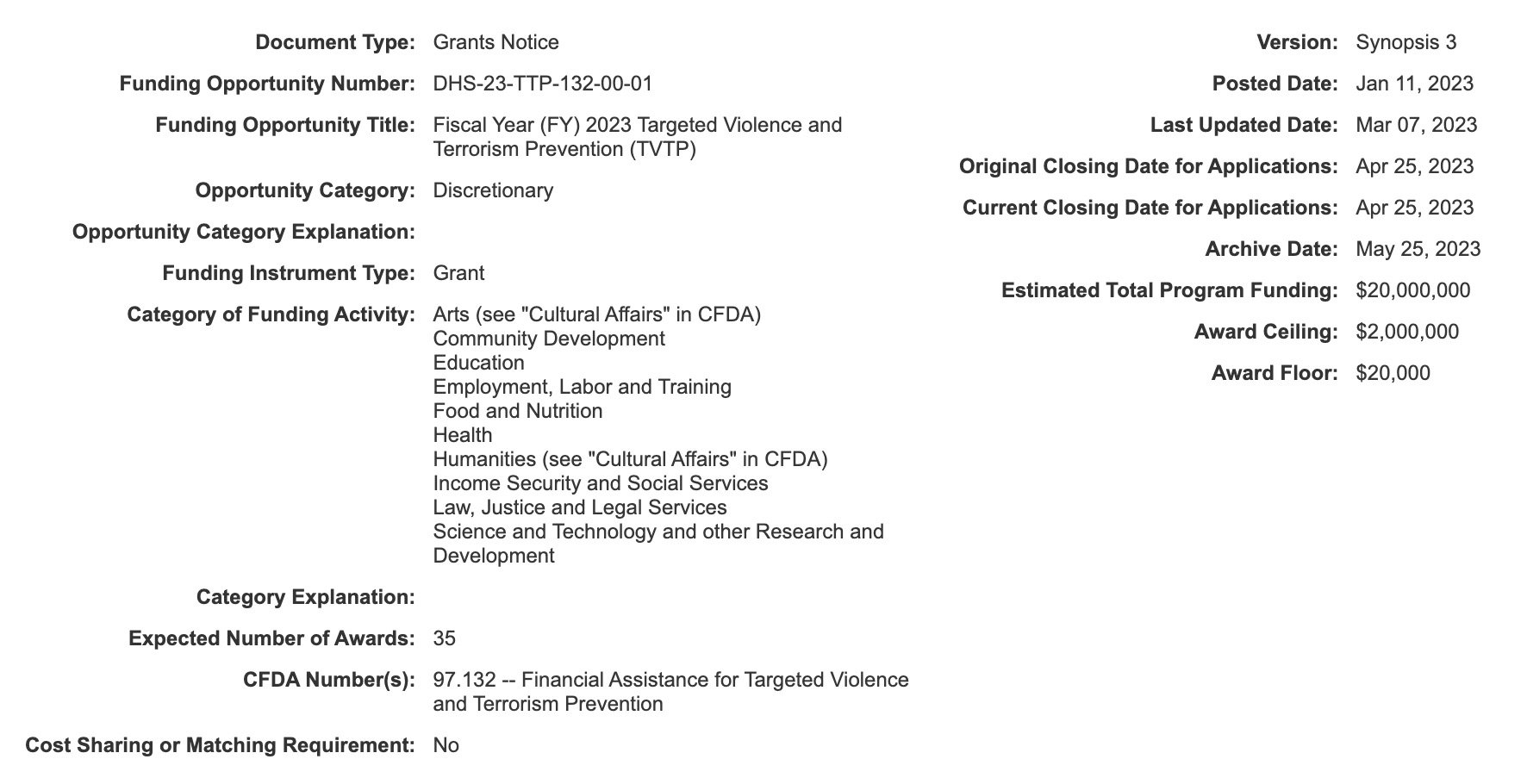
Those given the money from the grants fund are expected to develop prevention programming at the community level that would stop “targeted violence and terrorism,” as well as come up with innovative prevention ideas, and “identify prevention best practices that can be replicated in communities nationwide.”
In announcing and explaining the need for such spending, DHS Secretary Alejandro Mayorkas cited the Jacksonville shooting. As he remarked while justifying the awarding of grants, the event was racially motivated, and – “[it] made painfully clear, targeted violence and terrorism can impact any community, anywhere.”
DHS claims that the “current” environment is one of heightened – and lethal – threat, based on ideology or personal grievances of “lone offenders and small groups.”
The DHS announcement came on the anniversary of 9/11, but it showed that the focus is now on Americans rather than some foreign terrorist threat (or even foreign terrorist gangs in the habit of “invading” US soil).
And the way the terrorist threat is defined here looks more like a drive to suppress dissent to dominant narratives pushed by the government and large traditional and social media who work in concert with the federal authorities.
Specifically, what opponents of such policy single out as possible reasons to be branded a violent extremists or (domestic) terrorist could be disagreeing, and expressing that opinion online on anything from Covid, vaccines, gun rights, gender and LGBTQ policies, the war in Ukraine, or immigration.
Kiev’s trans spokesperson vows to ‘hunt down Russian propagandists’

RT | September 14, 2023
A threat to “hunt down” Russian “propagandists” which flagged an action “next week” and was made by a Ukrainian military spokesperson, should not be dismissed just because of its over-the-top presentation, a senior Russian official has argued.
On Wednesday, Sarah Ashton-Cirillo, who leads the Ukrainian Territorial Defense Forces’ purported outreach to English-speaking audiences, made some ominous predictions regarding Russia.
“Next week, the teeth of the Russian devils will gnash ever harder, and their rabid mouths will foam in uncontrollable frenzy as the world will see a favorite Kremlin propagandist pay for their crimes,” she said.
“Russia’s war criminal propagandists will all be hunted down, and justice will be served as we in Ukraine are led on this mission by faith in God, liberty and complete liberation,” she pledged.
Ashton-Cirillo, a trans woman who made headlines in the US in 2021 with a story of her infiltration of the American right-wing group Proud Boys, was given the spokesperson position in Ukraine in early August.
Her latest statement is part of her ‘Russia Hates the Truth’ series of minute-long videos, in which she delivers scolding condemnations of Russia.
While many Russian journalists have dismissed the unspecific threat as ridiculous, Valery Fadeev, the chairman of the Russian presidential human rights council, urged national law enforcement to take it seriously. The remark appears to be “a threat of murder or serious bodily harm” and thus a crime under Russian law, he argued on Thursday.
“Considering the lamentable record of attempts on the lives of Russian journalists and public figures … Russian security services should pay attention to it,” he added.
Moscow has accused Kiev of orchestrating the murders of journalist Darya Dugina in August 2022 and of military blogger Vladlen Tatarsky in April this year. In July, the Federal Security Service reported busting a group believed to have intended to assassinate RT Editor-in-Chief Margarita Simonyan and journalist Ksenia Sobchak on Kiev’s behalf.
Hungarian left accused of treason for accepting US campaign money to remove Orbán from power
MAGYAR NEMZET | SEPTEMBER 13, 2023
A private Hungarian citizen filed a complaint with both Hungarian police and prosecutorial authorities after a former CIA analyst went public with a statement that the CIA attempted to interfere in the 2022 Hungarian elections and remove Hungarian Prime Minister Viktor Orbán from power.
Former analyst Larry C. Johnson said in a podcast at the beginning of September, “It is interesting that although in 2016 the Americans were deeply outraged by the alleged Russian interference in the U.S. presidential election campaign, in 2022 we directly interfered in the Hungarian elections, which Viktor Orbán won again.”
Asked whether the CIA intervened to stop Orbán, Johnson, said “Yes, to defeat him, which, among other things, America was trying to achieve by funding Orbán’s opponents.”
Private Hungarian citizen István Tényi wrote to the police and the prosecutor’s office that they should investigate whether the crime of treason could be suspected against Hungarian citizens who, through the Action for Democracy foundation, may have been involved in influencing the parliamentary elections through a foreign government or organization.
Remix News reported on the funding scandal last year, in which Hungary’s leading left-liberal opposition candidate, Péter Márki-Zay, admitted himself in August 2022, during his podcast Gulyáságyú (Goulash Cannon), that his campaign was still receiving funds from the U.S. foundation Action for Democracy. The shadowy group sent HUF 1.8 billion (€4.48 million) in mostly U.S. donations through an NGO with close ties to billionaire oligarch George Soros, officials connected with Hillary Clinton, and a number of leading transatlantic organizations such as the Council on Foreign Relations.
Márki-Zay revealed that Action for Democracy, which is headed by Dávid Korányi, a former adviser to Gergely Karácsony, sent the money in one batch, but he claimed that other transfers had also come from this organization in the past.
Since then, a new declassified intelligence document has come to light, revealing that there is not one but two major foreign donors to the “dollar left,” which is the term increasingly used within the Hungarian media. In addition to the American Action for Democracy, a Swiss foundation has also transferred nearly HUF 1 billion. The Swiss transfers were made in five installments from the beginning of the left-wing primaries, between September 2021 and February 2022.
Open investigations have also been launched in the above cases, with the police investigating the misuse of personal data and the National Tax and Customs Administration (NAV) looking into budget fraud. The National Bureau of Investigation (NNI) launched an investigation into money laundering and embezzlement as well, which has since been taken over by the tax authorities.
Enrique Tarrio: Feds Tried to ‘Coerce Me’ into Implicating Donald Trump
By Paul Joseph Watson | Summit News | September 13, 2023
Former Proud Boys leader Enrique Tarrio claimed federal prosecutors tried to “coerce” him into implicating former President Donald Trump in the January 6, 2021, Capitol riot.
Last week, U.S. District Judge Timothy Kelly sentenced Tarrio to a record-high 22 years in prison despite not being in Washington, DC, on January 6.
“I don’t know what instructions I would give somebody at that point … I’m not speaking. I have no function. So there was no communication,” Tarrio said in a phone interview with the Washington Post.
Tarrio revealed that federal prosecutors tried to “coerce” him into implicating Trump during a phone interview from the D.C. jail.
“I was looking and seeking what the plea offer would look like, right?” Tarrio told the Washington Post. “They didn’t want to give me a number. I need a number. To me, the most important thing is when I get home to my family.”
As the Post reported:
Instead, Tarrio said, the prosecutors asked him what role then-President Donald Trump played in getting the Proud Boys to attack the Capitol. He said the prosecutors, accompanied by FBI agents in the Miami jail where Tarrio was being held at the time, showed him messages that he exchanged with a second person, who in turn was connected to a third person who was connected to Trump. Tarrio said he told the investigators that he didn’t know the third person. He refused to name the people who prosecutors said allegedly connected him to Trump.
“They weren’t trying to get the truth,” Tarrio continued. “They were trying to coerce me into signing something that’s not true.”
Tarrio said, “there was never an open-ended question after” federal prosecutors tried to implicate Trump.
The Post further detailed:
Tarrio said prosecutors in Miami last fall did not ask him about Roger Stone, a longtime Trump confidant who was an acquaintance of Tarrio’s, or Ali Alexander, a promoter of the “Stop the Steal” rally. He said the federal visitors did not ask him questions about his knowledge of Jan. 6 beyond the theorized connection to Trump. “There was never an open-ended question after that,” Tarrio said.
Prosecutors did later offer Tarrio a deal: nine to 11 years in prison if he pleaded guilty to seditious conspiracy, according to court records. Tarrio declined.
David v. Goliath in New York
Brownstone Institute | September 12, 2023
There is a battle going on for our freedoms this week. And very few Americans are even aware of what is at stake.
New York attorney Bobbie Anne Cox single-handedly goes up against the State of New York this week, after the state appealed a New York State Supreme Court ruling that a so-called “quarantine camp” regulation (“Isolation and Quarantine Procedures”) issued by Governor Kathy Hochul was unconstitutional.
The order concerns quarantine of citizens by the state government. Like other states, New York already has in place laws regarding quarantine of the citizenry – laws duly passed by the elected state representatives. Those laws were crafted by legislators (whose job it is to do this work) and passed by a majority vote of both Assembly and Senate and signed by the governor. That law not only provides for protecting the public by use of quarantine, but also includes protections for individual rights.
There are problems with the governor’s action.
- The executive branch does not have the power to make laws under the constitution. That is reserved to the legislature.
- With one state executive branch taking power not given to them constitutionally, it creates a precedent that could be used similarly for other issues to violate the rights of citizens on a host of other issues – not only in New York, but in all the other states as well.
So, what is in this regulation, you ask? It has to do with quarantine of the citizenry. There is a history of government-mandated quarantine during times of epidemics in our country. Whether or not the existing laws have been misused against individuals is another debate (see the case of Typhoid Mary, for example, who was imprisoned for more than 23 years under the quarantine law of the time).
This governor’s regulation puts the power at the highest levels of the state government – centrally controlled. The governor’s regulation not only circumvents the legislature’s power and responsibility to enact appropriate laws for the citizenry, but it also takes that power beyond the local level, where it can most appropriately be considered, and completely fails to protect the rights of the individuals against misuse or mis-application by the state officials.
In this regulation, there is no requirement for the state government to prove that the targeted individual is infected, has been exposed to an infectious disease, or poses any actual risk to his/her fellow citizens. The application of the regulation is broad – not just limited to Covid cases. There is no limit regarding the age or medical condition of the individual (it could be imposed on a child or a very elderly person), and there is nothing specified as to the duration of the quarantine, or how that duration would be determined. Most concerning: there is no mechanism provided for the individual to be released.
During the initial court case, it was clearly stated that the only possible mechanism for release was for that individual to sue the state, unless the state officials decided to lift it of their own accord.
Under the provisions of the governor’s regulation, the state government can use law enforcement to forcibly remove citizens from their homes or businesses against their will to place them in unspecified quarantine locations for an indeterminate period with no mechanism for release!
This terrible infringement on citizens’ rights, however, doesn’t stop here. It sets a precedent for more executive branch overreach. If it is not overturned in the appellate court, it will embolden other governors to make more forays into the realm of executive usurpation of the legislative branch of government (see the recent NM Governor’s action to remove 2nd Amendment rights by executive order).
There is no doubt that those who take this type of executive action (Lujan Grisham in New Mexico and Hochul in New York) know that this is outside their scope of power within our governmental system. They also know that, until someone files a lawsuit and prevails against them, they have a period of time when these executive regulations and orders will be in place.
It is essential that the appeals court upholds the ruling in the case of this regulation by Governor Hochul – for the good of all the people of New York, but also for all of us in other states.
This passionate, articulate, brilliant lawyer is fighting for all of us.
And Bobbie Anne Cox has suffered for it. She has set aside her normal legal practice to pursue this effort and has been focusing solely on this case for an extended period. She has sacrificed valuable time with her family, spending countless hours in the maze of motions, filings, dockets, scheduling, and research that are part and parcel of the legal system with all its complexities. The work has been arduous, solitary, and, to some extent, thankless. If she wins the appeal, there is no financial benefit to her or any of the plaintiffs that will be realized.
She has no large staff of paralegals and junior attorneys assisting her to put this case together. She has not had assistance from her other colleagues in New York in fighting this battle.
And, because it has to do with complexities of the legal system, it gets little coverage in the media. Perhaps it is so difficult to imagine just why a state government even wants this type of power over the citizenry, that people find it very hard to grasp that it is really just what Bobbie Anne describes in terms of the potential abuse of individual rights.
No public outcry has occurred. No groundswell of support for her work has happened. And while many are supportive of the great work she has done and were so relieved when she won the case initially, the vast majority of people who stand to benefit from her work will never know they owe her a debt of gratitude.
On Wednesday, September 13, 2023 at 10:00 am EST (at the courthouse in Rochester, NY, located at 50 East Avenue), Bobbie Anne Cox goes forth as a sort of David to meet Goliath, depending on her knowledge of the law rather than a slingshot and stones. She is relying on the New York panel of judges to truly prove that there still exists blind justice in New York.
The merits of her case are clear – even to people not that familiar with the law. Basic Civics shows us the correctness of her contention. This is not a partisan issue. While she is representing Republican plaintiffs, she is not one herself.
If you are able to support her by physically attending the hearing, do so. Perhaps by your presence you can be a silent reminder to the court that New Yorkers are interested in this and are supportive of her efforts.
If you cannot be there in person, consider watching the oral arguments live on the court’s website at: https://ad4.nycourts.gov/go/live/. Please also keep her and the court judges in your thoughts and prayers and share this information with your circle of friends and colleagues.
May she prevail.
Biden’s Department of Education Is Investigating Christopher Rufo For “Misgendering”
Listed among many allegations
By Cindy Harper | Reclaim The Net | September 11, 2023
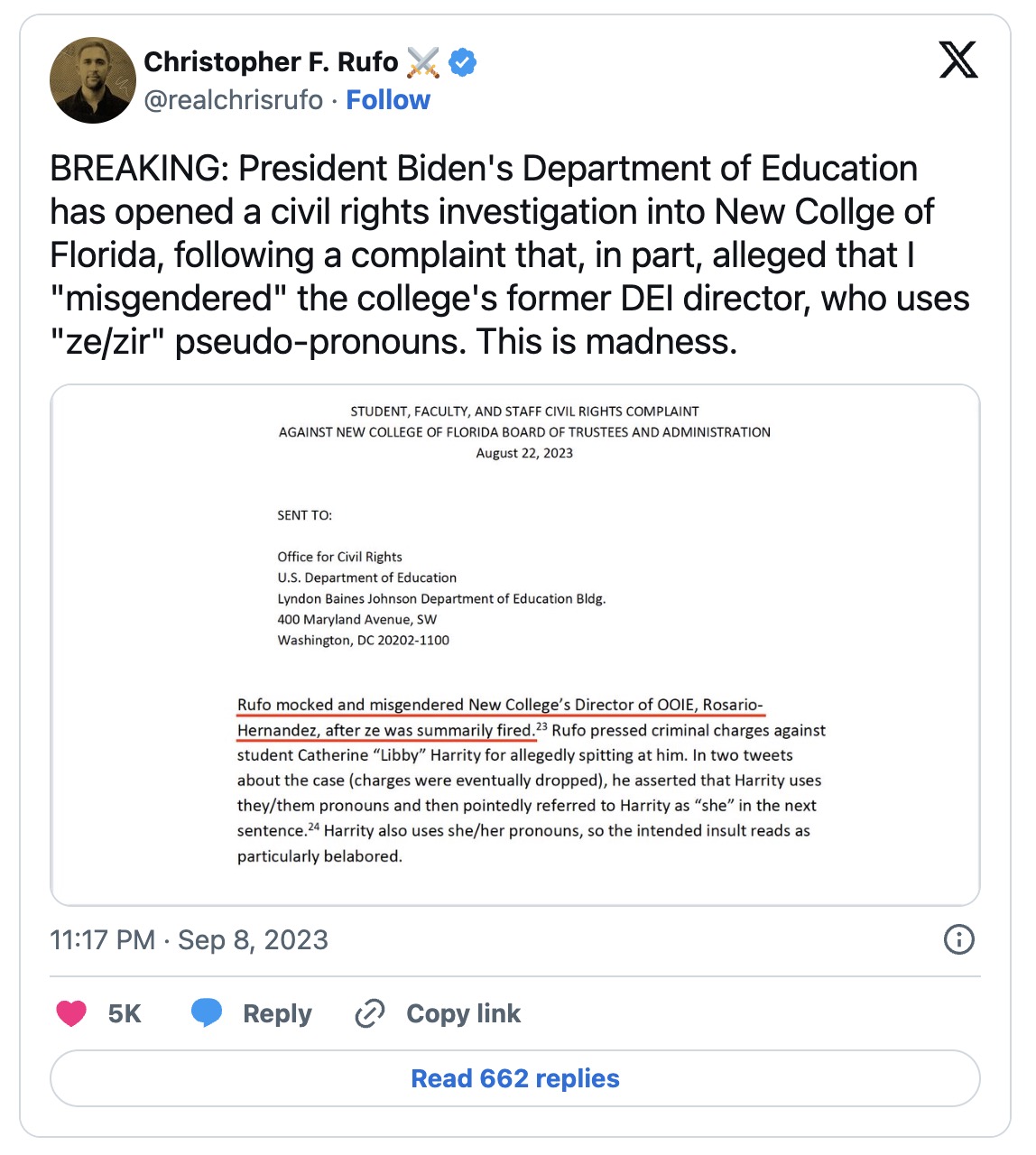
The Department of Education, under President Joe Biden’s administration, is wielding its influence against Christopher Rufo, a conservative advocate and the New College of Florida.
Allegedly, the civil liberty offenses committed by Rufo include the “misgendering” of certain individuals and the closing down of the university’s diversity, equity, and inclusion (DEI) division within the school.
…
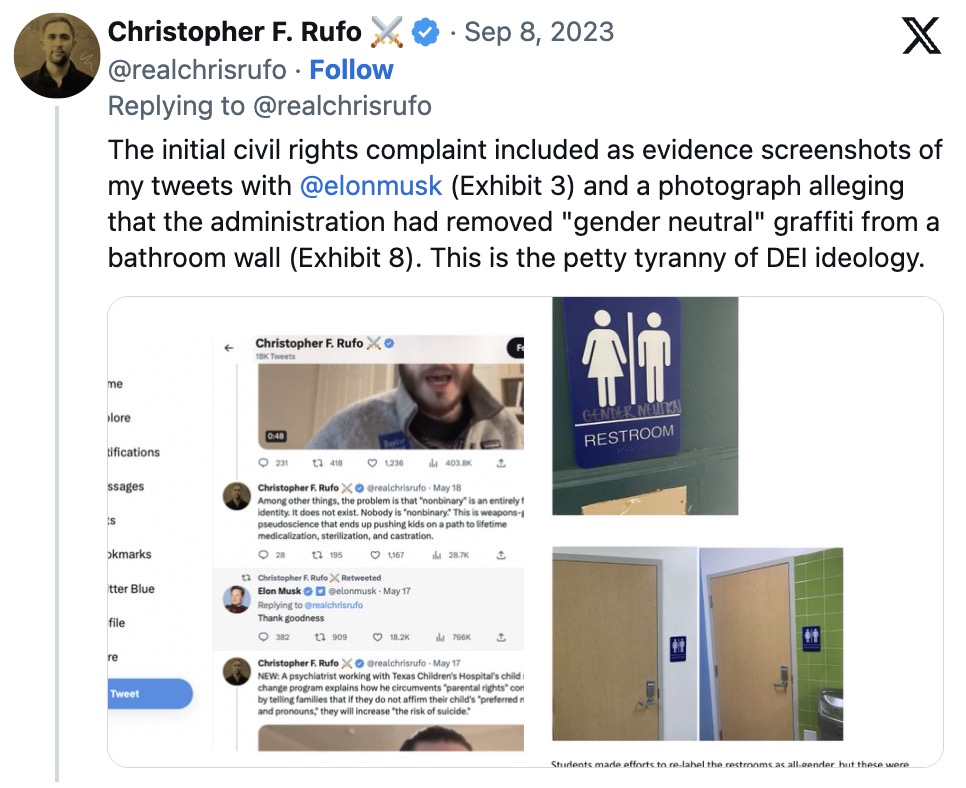
The allegations began unfolding on social media, where Rufo publicized the supposed evidence used against him. Among the charges was the allegation that Rufo had addressed the former head of the school’s DEI, Yoleidy Rosario-Hernandez, as “she” or “her.” Noteworthy is that Rosario-Hernandez, a biological woman, chooses the pronouns “ze/zir.”
Moreover, Rufo is accused of referring to a student, who prefers to be called “they/them,” as “her.”
Chiming in on this development, Rufo intensified the debate by posting, “President Biden’s Department of Education has opened a civil rights investigation into New College of Florida, following a complaint that, in part, alleged that I ‘misgendered’ the college’s former DEI director, who uses ‘ze/zir’ pseudo-pronouns. This is madness.”
The complaint further extends to accuse Rufo of violating civil rights by withdrawing funding from the DEI department and the Gender Studies Program. As per the Department of Education’s guidelines, the gravity of the situation could escalate, assuming it substantiates the claim and the accused parties choose to disregard any determined ruling — escalating into a potential implication with the Department of Justice.
Trump charges are political persecution – Putin
RT | September 12, 2023
The numerous criminal charges against former US President Donald Trump amount to persecution and showcase the “rot” in the American political system, Russian President Vladimir Putin has stated.
The US in its current state “cannot claim the right to teach others democracy,” the Russian leader said on Tuesday during a panel discussion at the Eastern Economic Forum in Vladivostok.
“The things that are happening to Trump are persecution of a political competitor… That is what it is. And it is done in the full view of the US public and the entire world,” he added.
The controversy is beneficial to Russia in the sense that it “exposes” Washington ”for what it is,” according to Putin. The US government chose to be hostile to Moscow and has propagandized its population into perceiving it as such, he argued.
“[The US] demonstrates what they called in Soviet times ‘the bestial scowl of imperialism’,” he joked.
Moscow does not expect any substantial change in US foreign policy vis-a-vis Russia, regardless of who takes the White House after next year’s election, the president said.
“[Trump] was accused of having a special relation with Russia, which is total nonsense and bulls**t. But he was the president who introduced the most sanctions against Russia,” Putin noted.
The American elites predominantly perceive Russia as an existential enemy, Putin believes. The country also has friends in the US, who want good relations and share Russia’s views on traditional values, the president added, but those voices are being suppressed.
Since leaving office, Trump has been charged with numerous crimes at both the federal and state level, ranging from election tampering to inciting the January 6 Capitol riot to financial improprieties.
The businessman-turned-politician, who is considered the frontrunner for the Republican nomination for presidency, has said that his legal woes amount to a “witch hunt” by his opponents.
What Should We Do About the Powerful Israel Lobby?
Make them register as “foreign agents”
BY PHILIP GIRALDI • UNZ REVIEW • SEPTEMBER 12, 2023
World Jewry is on the attack against Elon Musk, who has threatened to sue the Jewish advocacy group Anti-Defamation League (ADL) for as much as $22 billion for defaming him and doing material damage amounting to many billions of dollars to his company X, which used to be known as Twitter, falsely smearing the platform and its owner for allegedly providing an antisemitic haven for “hate speech.” Per Musk, the ADL has gone so far as to put pressure on potential advertisers not to do business with him and to engage in a total boycott of X.
I for one can only say “Thank you Mr. Musk and it is only regrettable that no one did anything against an organization dedicated to spewing hatred directed against many Americans while also seeking to deprive an entire nation of constitutionally guaranteed freedom of speech. And while you are at it, I would also recommend that you take a look at the other groups that are partners in Zionist crime, most significantly the American Israel Public Affairs Committee (AIPAC) which has now created a PAC dedicated to defeating any politician who is known to be critical of Israel. After the 2020 national election, AIPAC boasted that the PAC that it had set up had raised $17 million to defeat candidates critical of Israel, while also supporting those politicians who were friends, 95% of whom were elected. To pretend that the Lobby exists to provide some kind of perspective or balance in foreign policy is a case of who is kidding whom on the issue of Israel. ADL and AIPAC are dedicated to enriching and protecting a foreign country that is on a daily basis engaged in a broad series of crimes against humanity as well as war crimes and which is characterized by persecution based on religion and race. ADL and AIPAC have no concern for what damage is done to the American people due to their persistent corruption of our body politic and media to achieve their treasonous objectives.”
So what has the physically hideous and mentally deficient Mr. Jonathan Greenblatt, the Chief Executive Officer of ADL, been up to and why has it taken so long for some Americans, to include Musk and Tucker Carlson, to react to being abused, stripped of rights, and vilified every time anyone dares to speak up? Well, the simple answer is that anyone who dares to challenge Israel’s vile behavior or Jewish control over large parts of the United States economy plus near total dominance of its political class can count on being attacked in the media and labeled an antisemite, which means that, increasingly, one might well be charged with a “hate crime” which can bring with it both civil and criminal penalties. Even at the state level, in 35 jurisdictions, one can now even be denied a job or benefits for supporting an economic boycott of the Jewish state.
Greenblatt and company believe that they can get away with murder, both metaphorically and literally, because they are protected by their money, media access and the political cover that they have flat out bought and also obtained through intimidation and threats. The interaction with Tucker Carlson began when Greenblatt began fulminating over Tucker’s willingness to discuss on his talk show controversial subjects that are familiar to conservatives but are generally banned by the media, to include “replacement theory.” The theory suggests that the decline of birth rates of whites is deliberate due to government policies that make it economically difficult to raise more than one or two children. The decline in workers is being replaced by the hordes of illegal immigrants allowed into the country, which will produce a permanent Democratic Party majority that will be docile and controllable. Jewish groups are seen as enthusiastic for the open borders and cultural and political shifts that go with them.
Greenblatt and the ADL initially focused on Tucker Carlson in particular given his high profile and popularity. Greenblatt repeatedly demanded that Fox News fire Tucker for discussing the “great replacement” theory as well as other white-nationalist talking points. Greenblatt has denounced Carlston’s alleged willingness “To use his platform as a megaphone to spread the toxic, antisemitic, and xenophobic ‘great replacement theory’ is a repugnant and dangerous abuse of his platform.” He called on advertisers to stop supporting the Carlson program and Fox with their dollars. Also, under-fire conservative Republican Representative Matt Gaetz subsequently became involved in the argument, saying that Tucker Carlson is correct about openly discussing white nationalist ‘replacement’ conspiracy theory and he called out Greenblatt and the ADL as “racist,” i.e. “anti-white.” Carlson has retorted that the ADL is trying to destroy freedom of speech in the United States, most particularly whenever the issue under discussion is the abuse of Jewish power or Israel.
Greenblatt was delighted, invoking woke buzzwords to confirm his own superior ethical status, when Carlson was fired in April, tweeting that “It’s about time. For far too long, Tucker Carlson has used his primetime show to spew antisemitic, racist, xenophobic & anti-LGBTQ hate to millions.” Apparently Greenblatt is not disturbed by racism and xenophobia and related crimes against humanity in Israel, but that is to be expected.
Musk’s history with Greenblatt is revealing. Shortly after Musk obtained control of Twitter in April 2022, he was contacted and pressured by ADL in a bid to remove what Greenblatt described as antisemitic content. Twitter’s CEO Linda Yaccarino negotiated the issue, but Musk believes that the platform should be characterized by allowing all forms of legal speech, and beyond excluding sites calling for violence, Twitter became exemplary as a free speech zone. Free speech includes criticism of the Jewish religion, Jewish group behavior and the Jewish state of Israel, even including doubting the evidence for the perpetual victimhood holocaust myth, all of which Greenblatt regards as antisemitism and therefore hate crimes. As the disagreement with ADL heated up, the hashtag #BanTheADL began to appear and it has now become the most used tag with more than a quarter of a million appearances on X. Greenblatt has denounced the users of the hashtag as “white supremacists,” in line with his apparent belief that antisemites and other racist evildoers are basically political conservatives. Musk responded to Greenblatt’s “intimidation tactics” by suggesting that “Perhaps we should run a poll on this… with the ‘we’re labeling everything we don’t like as hateful/racist/dangerous/far-right’ BS.” He also observed accurately that “The ADL, because they are so aggressive in their demands to ban social media accounts for even minor infractions, are ironically the biggest generators of anti-Semitism on this platform.”
One hopes that Elon Musk’s proposed lawsuit will proceed and bring about the dismantlement of ADL and the dethronement of Greenblatt, but as important as the free speech issue is, there is also another aspect to the entitlement and immunity that groups representing narrowly construed Jewish and Israeli interests currently enjoy. ADL is firmly entrenched with the power brokers in Washington and is even involved in training new FBI agents how to recognize antisemites and other types of racists. Nevertheless, one might suggest that the labeling of all critics and many white Americans as antisemites just might be a weapon that is beginning to lose its effectiveness since it is used so promiscuously by Greenblatt and others.
Beyond constitutional rights, there is a national security issue which no one in government dares touch and that is the corruption of American foreign policy on behalf of the state of Israel by Greenblatt and his friends. Jewish and Israeli power is sometimes jokingly referred to as “wag the dog” but when it is employed to involve America in unnecessary wars and to gift one of the world’s wealthiest countries with billions of dollars in “aid” every year, something is seriously wrong. And it all happens out in the open due to something called “hubris” whereby most major Jewish organizations meet regularly with Israeli Embassy diplomats and spies to cooperate on activities that benefit both Israel and its Jewish partners.
A key bit of legislation intended to monitor the activities of foreign agents residing in the US is the Foreign Agents Registration Act of 1938 (22 U.S.C. § 611 et seq.) which “imposes public disclosure obligations on persons representing foreign interest. It requires ‘foreign agents’—defined as individuals or entities engaged in domestic lobbying or advocacy for foreign governments, organizations, or persons (‘foreign principals’)—to register with the Department of Justice (DOJ) and disclose their relationship, activities, and related financial compensation. FARA does not prohibit lobbying for foreign interests, nor does it ban or restrict any specific activities. Its explicit purpose is to promote transparency with respect to foreign influence over American public opinion, policy, and laws; to that end, the DOJ is required to make such information publicly available. FARA was enacted in 1938 primarily to counter Nazi propaganda.”
The actual legislation, which perfectly describes groups like ADL and AIPAC interact with the Israeli government, reads as follows: “The term ‘agent of a foreign principal’ means–(1) any person who acts as an agent, representative, employee, or servant, or any person who acts in any other capacity at the order, request, or under the direction or control, of a foreign principal or of a person any of whose activities are directly or indirectly supervised, directed, controlled, financed, or subsidized in whole or in major part by a foreign principal, and who directly or through any other person (i) engages within the United States in political activities for or in the interests of such foreign principal.”
Famously, President John F. Kennedy tried to compel AIPAC’s predecessor organization the American Zionist Committee for Public Affairs to register under FARA, but he was assassinated before that could be accomplished. He also was seeking to block Israel’s nuclear program, which has suggested the obvious conclusion about how and why he died. That aside, for today’s US government the question becomes, “When is our Attorney General Merrick Garland, who seems to be preoccupied with finding Russian war criminals in Ukraine and white supremacists in America, going to enforce the FARA statute on the numerous Jewish organizations like ADL and AIPAC and compel them to register?” That will require them to be transparent both on their “foreign” relationships and also reveal the sources of their funding. ADL had a reported $238 million in assets in 2021. The act of registering will also confirm that they do no routinely represent American interests but rather Israeli priorities, which will hopefully shift the public perception on what they represent. Jewish and Zionist Garland who works for a declared Zionist president who claims to be Catholic is hardly likely to do the right thing, but we can always hope that ADL’s recent foray will prove to be a step too far!
Philip M. Giraldi, Ph.D., is Executive Director of the Council for the National Interest, a 501(c)3 tax deductible educational foundation (Federal ID Number #52-1739023) that seeks a more interests-based U.S. foreign policy in the Middle East. Website is councilforthenationalinterest.org, address is P.O. Box 2157, Purcellville VA 20134 and its email is inform@cnionline.org.
Musk threatened with investigation for blocking Ukrainian attack

Elizabeth Warren speaks during a Senate Committee hearing on Capitol Hill in Washington DC, April 27, 2023 © AP / Jose Luis Magana
RT | September 12, 2023
US Senator Elizabeth Warren has called on Congress to investigate Elon Musk over his refusal to enable a Ukrainian drone attack on the Russian naval fleet in Crimea. Despite condemnation in Washington, Musk has defended his decision to cut satellite service to the Ukrainian military.
“The Congress needs to investigate what’s happened here and whether we have adequate tools to make sure foreign policy is conducted by the government and not by one billionaire,” Warren told reporters at the US Capitol on Monday.
Musk and other Big Tech CEOs are due to meet with US lawmakers to discuss artificial intelligence on Wednesday. However, the subject of the hearing has been overshadowed by news that Musk intervened last year to prevent six Ukrainian naval drones from hitting Russian ships at the Crimean port of Sevastopol.
The Ukrainian military had been using SpaceX’s Starlink satellite internet service for communications and guidance since the beginning of the conflict with Russia. When Musk learned that the drones were en route to Sevastopol, he ordered SpaceX engineers to shut down the service within 100km of the Russian peninsula, CNN reported on Thursday, quoting an upcoming biography of the billionaire.
As a result, the drones “lost connectivity and washed ashore harmlessly,” the report claimed. Ukrainian Digital Transformation Minister Mikhail Fedorov then begged Musk to turn the signal back on via text messages, but Musk refused.
“If I had agreed to their request, then SpaceX would be explicitly complicit in a major act of war and conflict escalation,” the billionaire explained last week, adding that he never allowed the service to be activated near Crimea in the first place.
Musk’s explanation caused outrage in Kiev, with President Vladimir Zelensky’s top aide accusing the SpaceX CEO of “committing evil.” In the US, CNN anchor Jake Tapper argued on Sunday that Musk had “effectively sabotaged” an American ally, and asked US Secretary of State Antony Blinken if he should face “repercussions” for thwarting the attack.
Blinken refused to condemn Musk, but several members of Congress have spoken out against the billionaire. Musk “cannot have the last word when it comes to national security,” Senate Armed Services Committee Chairman Jack Reed told reporters on Monday.
At the time of the thwarted attack, Musk was bankrolling Ukraine’s access to the Starlink network. The Pentagon has since stepped in to partly fund the program, and Air Force Secretary Frank Kendall said on Monday that future contracts between the military and private firms like SpaceX will likely include “assurances” that these technologies can be used for offensive purposes.
The Childhood Vaccination Schedule – Part One: The First Vaccine – Hepatitis B
By Michael Bryant | 21st Century Wire | September 5, 2023
Introduction
As more vaccines are added to the US childhood immunization schedule it’s imperative that there be a broader public discussion about the prominence of vaccines in public health policy, what benefits they convey and a forthright assessment of the risks involved.
Though vital to both the short and long term health of children, exploratory questions, in-depth rational discussion and comprehensive analysis about vaccines are considered off-limits for the mainstream medical establishment.
In the conventional narrative it is accepted as an article of faith that vaccines are miraculous discoveries responsible for global disease eradication and are the most important medical product for disease prevention.
For today’s pediatricians promoting and implementing the childhood immunization program has become their primary duty.
It is widely believed that if we stopped, or even reduced vaccinations, we would be going back to the dark ages. Any individual that challenges this vaccine orthodoxy is seen as a heretic.
Despite the deeply ingrained belief system of the vaccine ideology a growing number of parents and health advocates are beginning to ask many of the questions which have been swept under the rug for years.
Are all of these vaccines necessary? Are they safe? Are the diseases they are supposed to prevent truly diseases of concern?
Does the claim that vaccines are responsible for reductions in disease, disability, and death from a variety of infectious diseases fit with the facts when scrutinized?
Why such an increase in the number of vaccinations through the years? Has this escalating vaccine program produced an accompanying improvement in health outcomes?
What happens if I don’t give my child all of these vaccines? What happens if I don’t give my child any of these vaccines? What happens to children who don’t get vaccinated?
These are some of the questions parents are not supposed to ask and precisely the questions that need to be addressed.
While the information presented in this series is publicly available it is denied admittance into the public discourse by means of systematic indoctrination by a compromised media apparatus and a medical establishment which has created a mystique around vaccines while persuading the public they are the holiest of all medicinal products.
As an antidote to this institutional programming we embark upon a series of articles which take a close look at each of the vaccines on the childhood schedule and the diseases they are designed to prevent.
Our series begins with an overview of the US Childhood Immunization Schedule and a detailed look at the initial shot given to infants on the first day of life- the Hepatitis B vaccine.
The United States Childhood Immunization Schedule – An Overview
In the past few decades the childhood vaccine schedule in the United States has exploded into what is now the most aggressive childhood vaccination schedule in the world. It wasn’t always this way. Most baby boomers likely had only 2 or 3 vaccinations- polio, smallpox and DTP with never more than one shot given per visit.
With the recent addition of the COVID-19 vaccines to the childhood schedule the number of recommended injections ballooned to a regimen of 72 injections of 90 antigens by age eighteen for any child that undergoes the full immunization schedule circa 2023.
To understand how this came to pass we need to understand the history of how we got here.
The first vaccine mandate in the United States was enacted in Massachusetts in 1810 and was centered on smallpox. The legislation was essentially an ad hoc law which gave local health boards the authority to require vaccination.
The first public school mandate was issued in Massachusett in the 1850’s. At that time the only vaccine of interest was for smallpox. By the end of the 1800s most states in New England had smallpox vaccine requirements for children attending public schools.
The next significant stride in vaccine recommendations and requirements for children would arrive a century later in 1954, focusing on the polio vaccine developed by Jonas Salk.
By 1955, the polio vaccine was fully licensed and through the Polio Vaccine Assistance Act Congress appropriated funds to provide federal grants for states to purchase the vaccine and for the costs of planning and conducting vaccination programs.
This Act would become the template for the utilization of federal funds to cover various costs of vaccine programs and would provide the impetus for a mass inoculation campaign for polio.
At this time there were no codified mechanisms to mandate vaccine uptake, doctors recommendations were considered just that- guidance with no strict obligation or enforcement for adherence.
In 1962 the Vaccine Assistance Act would establish a permanent mechanism to provide ongoing financial support to state and local health departments. This Act would allow the CDC to appropriate federal funds for the provision of vaccines and establish an advisory group to assist in managing vaccination programs.
To this day the 1962 Act remains one of the most important mechanisms for aligning local and state health department immunization activities with federal funds to deliver vaccines to children.
In 1964 the Advisory Committee on Immunization Practices (ACIP) was created under the US Public Health Service. Its mission was to review the science and evidence of vaccines given to children and to make recommendations on when those vaccines should be given and at what age.
The 1960s and 1970s saw a wave of new vaccines hit the market. A second type of polio vaccine was developed along with the first Hepatitis B vaccine. Measles vaccines were developed as a single vaccine and then combined with the mumps and rubella vaccines to create the “MMR” vaccine.
Paralleling the increase in the volume of vaccines came the creation of global immunization programs. In 1974 the World Health Organization established the Expanded Programme on Immunization which was designed to ”strengthen vaccine programmes, supply, and delivery, and ensure universal access to all relevant vaccines for all populations across the life course.”
These changes radically altered the business landscape of vaccine manufacturing. What was once a cottage industry of small pharmaceutical companies, individual investigators and physician scientists evolved into the mega corporations that exist today.
By 1977, the U.S. federal government had set up the Childhood Immunization Initiative which sought to increase vaccination rates in children against seven diseases (diphtheria, measles, mumps, pertussis, poliomyelitis, rubella, tetanus) for which vaccines had been developed. This began the process by which all 50 states would adopt mandatory school vaccinations.
In the 1980s, vaccines against Hepatitis B, Haemophilus influenzae type b, and pneumococcal disease were recommended for children at different ages. By 1983 the number of recommended injections had increased to 23 doses of 7 vaccines by age six.
In 1986, the National Childhood Vaccine Injury Act created a system of passive and active surveillance for cases of adverse reactions to vaccines as well as a mechanism to compensate any persons injured by vaccines.
With the passage of the 1986 Act and its implementation in 1988, a liability shield for pharmaceutical companies was created. On the heels of the 1986 Act the number of vaccines placed on the CDC schedule would escalate.
Even as the list of available vaccines was growing local and state health boards had differing opinions on when to give vaccines, which children should get them and how many should be given.
In order to standardize vaccine uptake, the first “harmonized” childhood immunization schedule was issued in 1995 by the Advisory Committee on Immunization Practices (ACIP), the American Academy of Pediatrics (AAP), and the American Academy of Family Physicians (AAFP). combining recommendations of all three national groups.
This initial schedule included diphtheria, tetanus, pertussis, measles, mumps, rubella, polio (oral), Haemophilus influenzae type b, and Hepatitis B vaccines. (The DTP and MMR vaccines were combination vaccines for diphtheria, tetanus, pertussis; and measles, mumps, rubella.)
Since then, the schedule has been adjusted as new vaccines have been developed, taken off the market or the risk profile for children changed.
Today, according to the National Conference of State Legislatures (NCSL), all 50 states have legislation requiring specific vaccines for students with exemptions varying from state to state.
These laws apply not only to children attending public schools but also to those attending private schools and day care facilities.
There are 45 states and Washington D.C. that grant religious exemptions for people who have religious objections to immunizations and 15 states which allow for philosophical exemptions.
All school immunization laws grant exemptions for medical reasons.
Six states (California, Connecticut, Maine, Mississippi, New York, and West Virginia) do not allow religious or philosophical exemptions from vaccination requirements as of 2021.
NCSL also states that the laws and regulations on vaccine requirements in all 50 states and DC follow the vaccine schedule set forth by CDC.
The trajectory of this vaccine program would result in 54 injections of 72 antigens by 2019 for US children by age eighteen who adhered to the full CDC schedule- with even more shots added as the Covid vaccines were placed on the child immunization schedule.
This dizzying array of injections in the childhood immunization schedule begins on a child’s first day of life with the Hepatitis B vaccine.
Hepatitis B – The Disease: A Case Study In Manufacturing Public Perception
The first question every parent should ask when considering the Hepatitis B vaccine is, “Does my child need a vaccine for Hepatitis B on the first day of life?”
Given the low risk of newborns acquiring the HepB infection and the ease with which pregnant mothers can be screened it’s fair to ask why a newborn would need the HepB vaccine?
Before arriving at that answer we look back at how Hepatitis B, the disease, was transformed from a relatively obscure disease which impacted a limited population into a widespread public health predicament.
The conventional characterization of Hepatitis B is as a type of viral hepatitis which causes acute and chronic liver infection. It is generally accepted that in order to contract HepB direct contact with infected blood or other body fluids is required. Transmission routes that by any standards pose little or no risk to infants.
This is in fact how public health officials characterized the disease back in 1981 when the Hepatitis B vaccine initially gained approval. The CDC’s own Fact Sheet on HepB the disease does not include newborn babies as a risk group for that disease.
The risk groups listed are, “injection drug users, homosexual men, sexually active heterosexuals, infant/children of immigrants from disease-endemic areas, sexual/household contacts of infected persons, infants born to infected mothers, health care workers and hemodialysis patients.”
What was it that changed the CDC’s earlier 1982 recommendation, which targeted only a small “at-risk” population, into a set of more aggressive policies that would result in the 1991 recommendation that all infants get three doses of HBV by 18 months of age?
And how did the HepB vaccine become compulsory for all schoolchildren in 47 states by the year 2000 even as the CDC admits that they lack proof of HepB being transmitted in a school setting?
In large part the answer to these questions lies in how the public’s perception of HepB was radically altered through orchestrated media messaging and deliberately provocative depictions of the disease by industry and public health officials. Notably the change in HepB’s image came immediately following the vaccine’s development, licensure and introduction.
In the late 1970s and early 1980s, prior to the approval of the vaccine, HepB was a disease which had little to no relevance to most Americans and nowhere to be found on the media radar. Before the Hepatitis B vaccine was developed and marketed most Americans had little reason to view the disease as a threat to their health.
New cases of HepB were quite low in the 1970’s, began to rise in the 1980’s, concurrent with the AIDS crisis, and then began to fall again in the 1990’s.
By its own admission the CDC attributed this decline to, “reduction of transmission among men who have sex with men and injection-drug users, as a result of HIV prevention efforts.”
As scientific discoveries leading to the vaccine moved forward HepB acquired a more public image.
The advent of the AIDS crisis in the early 1980s, the development of genetically-engineered pharmaceuticals in the late 1980s, and the political push for health reform in the early 1990s all led to changes in how HepB was presented to Americans.
The media, medical and scientific community would all contribute in altering the image of HepB through the 1980s and 1990s. Media outlets would often conflate HepB with HIV/AIDS in order to arouse public attention and induce fear towards this obscure disease.
Provocative headlines and stories began to surface with claims that Hepatitis B was similar to HIV and possibly worse.
The historical medical view that HepB was a disease which only impacted a narrow subset of the population was replaced by hysterical media representations that anyone could be at risk of Hepatitis B.
In her article, “Do We Really Need Hepatitis B on the Second Day of Life?”, Vaccination Mandates and Shifting Representations of Hepatitis B, history of health sciences professor Elena Conis chronicles some of this history:
“Outlets from the Philadelphia Tribune to Good Housekeeping reported that a third of people with the disease were not in any of the known risk groups. Redbook warned readers that hepatitis was “spreading fast,” and the Boston Globe noted that hepatitis was spread by sharing gum, food, toothbrushes, and razors and by body piercing. New York magazine, in a feature titled, “The Other Plague,” recounted the stories of a young woman who contracted a fatal case by getting her ears pierced, a young man who was infected when mugged at knife-point, and a woman infected at a nail salon. Frequent mention of the prevalence of asymptomatic carriers heightened the sense of an immediate health threat: in the words of the New York magazine reporter, anyone could be one of the U.S.’s 1.5 million “Typhoid Marys,” unwittingly transmitting hepatitis B to people unaware of their risk.”
Such media reports citing HepB disease statistics would normally originate with statements generated by officials at the CDC.
Most of the inflated disease statistics found in the media reports were generated in the very same ACIP Morbidity and Mortality Weekly Report (MMWR) which called for mass vaccination with hepatitis B vaccine.
In that report the CDC stated that there are an “estimated 1 million-1.25 million persons with chronic hepatitis B infection in the United States” and that, “each year approximately 4,000-5,000 of these persons die from chronic liver disease” and that, “an estimated 200,000-300,000 new [Hepatitis B] infections occurred annually during the period 1980-1991.”
To generate those statistics the CDC, in what at best would be considered duplicitous, circled back to itself citing an MMWR 1990 report as the basis for their claims. Nowhere in either report were scientific references used to support those claims.
Despite the media campaign, vaccine uptake for HepB was not rising to desired levels as vaccinating high-risk adults was proving to be difficult. This would result in a more systematic strategy at the national level.
In September of 1991 the Immunization Practices Advisory Committee (ACIP) would develop and codify a national program for the HepB vaccine- Hepatitis B Virus: A Comprehensive Strategy for Eliminating Transmission in the United States Through Universal Childhood Vaccination.
In 1992 the World Health Organization (WHO) would follow suit recommending that “all infants should receive their first dose of hepatitis B vaccine as soon as possible after birth, preferably within 24 hours, even in countries where Hepatitis B virus is of low endemicity.”
Acknowledging children were not in the at-risk group for HepB the ACIP committee lamented that “HBV transmission cannot be prevented through vaccinating only the groups at high risk of infection.”
Using this rationale they declared a blanket vaccination policy for all newborns- “a comprehensive strategy to prevent HBV infection, acute hepatitis B, and the sequelae of HBV infection in the United States.”
Earlier that year, June 11,1991 in a Boston Globe article titled, “U.S. To Urge All Children Be Vaccinated for Hepatitis B,” an official from the CDC admitted, “We do not feel that targeting adults for vaccination has worked. This will be the first time that a vaccine is recommended for children to prevent a disease that primarily occurs in adults.”
In testimony before Congress Michael Belkin summed it up neatly, “So in the CDC and ACIP’s own words, almost every newborn US baby is now greeted on its entry into the world by a vaccine injection against a sexually transmitted disease for which the baby is not at risk -because they couldn’t get the junkies, prostitutes, homosexuals and promiscuous heterosexuals to take the vaccine.”
Not to be swayed by logic, the CDC would effectuate a comprehensive HepB vaccine program and a medical product with an initial target population of drug addicts and homosexuals would become compulsory for every child in the country.
The Hepatitis B Vaccine Clinical Trials- The Devil’s In the Details
It is a near certainty that few physicians will study the details of a vaccine clinical trial found in the package inserts of each vaccine. Rarely will a pediatrician or physician initiate a conversation with a patient or parent about what those trials entailed and what else the package insert reveals.
Yet that is exactly the first place one should go to get a clear picture of the safety profile for any vaccine.
In 2017 the Informed Consent Action Network (ICAN) received a tip from a supporter that the clinical trials used by the FDA to license the two children’s HepB vaccines, Engerix-B and Recombivax HB, only reviewed safety data for a few days after injection.
ICAN was so stunned by this revelation that they assumed the supporter was making false claims. Upon reviewing the package inserts for both vaccines ICAN found the claims to be true.
The package insert for GlaxoSmithKline’s Energix-B vaccine, approved in 1989, acknowledges that the subjects were monitored for only 4 days after administration of the vaccine. By any standards 4 days of post-injection data is inadequate to assure a product’s safety. As noted by ICAN, “the review period for a vaccine given to infants and young children should be longer as neurological and developmental disorders are often discovered until the child is a few years old.”
A 2019 study authored by researchers at the FDA and Duke University confirmed ICAN’s position, stating that compared to licensing time period for adults, “data on drug efficacy and safety in children may require an additional 6 years.”
Another troubling facet of GSK’s pre-licensure clinical trials is that ENGERIX-B was administered to 5,071 healthy adults and children. Of the 13,495 doses administered in 36 clinical trials nowhere is it listed how many of those subjects were adults, how many were children and how many were infants.
As there were no specifics on how many individuals from each age group were involved the results of these trials are uninterpretable with respect to the risks of vaccinating infants.
While the trials for Energix-B were certainly less than rigorous the pre-licensure trials for Merck’s Recombivax HB vaccine might hold the dubious distinction for being the most unscrupulous and underpowered trials in the annals of the Pharmaceutical Industry.
In only three clinical studies, 434 doses of RECOMBIVAX HB, 5 mcg, were administered to a whopping 147 healthy infants and children (up to 10 years of age) who were monitored for a mere 5 days after each dose.
Along with the fact that 147 subjects is a grossly insufficient number upon which to base any determination on vaccine safety, the ages of the trial participants are not even listed. How many infants were in the study? Was there even a single newborn in the study?
Additionally, as is the case with virtually all vaccine clinical trials, neither of these two HepB trials used a proper randomized placebo-controlled clinical trial.
Beyond the untrustworthy nature of the composition and execution of these trials there is also the nagging problem with the difference between the noted outcomes of the clinical trials versus the post marketing experience.
In the clinical trials, effects are only studied for a few days immediately following vaccination, (with no true placebo), and only minor adverse reactions such as irritability, fever, diarrhea, fatigue/weakness and injection site pain are mentioned.
But in the “post marketing data”, which means post-approval injections in the general population, a laundry list of more serious adverse reactions such as Guillain-Barré syndrome, multiple sclerosis, encephalitis, thrombocytopenia, meningitis, Stevens-Johnson syndrome, tachycardia and many more are reported.
This is one of the elemental tricks the Pharmaceutical Industry uses to conceal the nature and extent of injuries which may be attributable to the shots.
More serious adverse reactions are swept under the rug by asserting that “no causal link has been established” between the injection and these reactions.
In the trials subjects are observed for only a few days and nothing is found to cause concern.
But when the general public starts reporting real world serious adverse events, these are dismissed as no long term studies are done which could establish causal relations.
ICAN’s lawyer Aaron Siri in a 9 hour deposition brought these many problems to the attention of Stanley Plotkin, the ‘Godfather of Vaccines’, who authored what is considered the bible on vaccines,
In the deposition Siri gets Plotkin to admit that the Hepatitis B vaccine (given to babies on their first day of life), has not had an adequate safety study:
Siri asked, “How long does it say that safety was monitored after each dose?”
Dr. Plotkin responded, “Five days.”
Siri responded, “Is that long enough to detect an autoimmune issue that arises after five days?”
Dr. Plotkin stated, “No.”
Siri then asked, “Was there any control group in this trial?”
Dr. Plotkin, who had just argued how important control groups are to cause and effect, answered, “It does not mention any control group, no.”
Based on the weight of the evidence ICAN is currently petitioning the FDA to withdraw the licensure of these Hepatitis B vaccines and asserts that these vaccines should never have been approved.
Given that the utility of the Hep B vaccine for toddlers is unsubstantiated and the clinical trials are at best problematic it would seem incumbent upon the manufacturers to at least provide ironclad evidence for the safety of these products.
Is this the case?
The data tell a different story.
Dangers of the HepB Vaccine- An Open Secret
In the first months of life a child’s brain and biological systems are at critical stages of development. Throughout pregnancy parents are bombarded with directives from their physician telling them a multitude of vaccinations will be essential to protect their child from the pending torrent of infectious diseases.
In addition to the medical stipulations given by their pediatrician, parents understand that they will be faced with mandates for day care and schooling as well as ever-present societal pressures. The combination of these forces create a climate of fear and coercion intended to bring about automatic compliance.
Little to no information about vaccines are volunteered at most pediatric visits. Parents are expected to obediently trust their physician and place their faith in a medical system that assiduously claims vaccinations are necessary, safe and effective. Questions challenging the utility and safety of a vaccine are typically discouraged and dismissed.
In the United States the journey into this world of mass vaccination begins on the day of birth with the Hepatitis B vaccine.
To the extent that Hepatitis B is a danger to anyone, that risk is understood to be through sexual contact or sharing needles. A sexually transmitted risk or a needle exchange risk means there is little to no chance of Hepatitis B infection for infants calling into question the fundamental rationale for this vaccine.
Less than one percent of all HepB cases occur in children under 15 years old. In North America, Europe and Australia a mere one-tenth of one percent are said to be carriers of HepB. Of adults infected, 90-95% clear the virus on their own, without intervention.
While it is thought that infants born to mothers who are infected with HepB carry a greater risk of contracting the disease, pregnant women can easily be screened for this disease if there is a concern.
Given this risk profile, as infants and young children receiving this vaccine face little to no chance of hepatitis B infection, we have to ask, Is this vaccine worth the potential risk of neurodevelopmental disorders or other adverse impacts associated with this vaccine?
The answer to those questions can be found in answering the most important question for any medical product, “Is it safe?”
From the earliest days of development and production safety concerns have dogged the various iterations of the Hepatitis B vaccine.
The original HepB vaccine, Heptavax B, manufactured by Merck Sharp & Dolme and approved by the FDA in 1981, was unlike previous vaccines in that it contained inactivated virus collected from plasma of HepB-infected donors rather than live, weakened virus or killed, denatured virus.
Maurice Hilleman hypothesized that he could make a HepB vaccine by injecting patients with Hepatitis B surface protein using three treatments of blood serum together with rigorous filtration. To obtain the necessary plasma Hilleman collected blood from gay men and intravenous drug users—groups said to be at risk for viral hepatitis.
Hilleman believed the immune system would recognize the surface proteins as foreign, and manufacture specific antibodies which would destroy these proteins. His theory went that if the patient were infected with HepB in the future the immune system would produce protective antibodies which would destroy the viruses.
On November 16, 1981, CBS Evening News reporter Dan Rather touted Hilleman’s vaccine as the “first completely new viral vaccine in 10 years,” and hailed it as, “the first vaccine ever licensed in the United States that is made directly from human blood.”
Though lauded as a revolutionary medical achievement at the time, the original plasma derived HepB vaccine was not intended for widespread use in the US due to the fact that liver cancer was relatively uncommon in the US at the time and the cost of the vaccine was seen as prohibitive.
Excitement surrounding this novel plasma vaccine soon dissipated due to a public relations problem. It came to light that the clinical trials which tested the vaccine in the 1970s had included only gay men who had been identified as being at high risk of the infection.
The approval of the serum derived vaccine had the added misfortune of coinciding with the AIDS crisis which heightened concerns over the safety of using potentially contaminated human serum in vaccines due to fears of transmission of live HepB or other blood-borne pathogens.
As gay men and injection drug users were frequent blood donors for the vaccine this brought about fears that blood plasma could be infected and the vaccine itself could become a carrier for HIV/AIDS.
These concerns of potential contamination with human viruses led to the 1986 introduction of a second hepatitis B vaccine, Recombivax-HB. This new type of vaccine, known as a recombinant vaccine, manufactured by Merck Sharp & Dolme, was the first vaccine produced using recombinant DNA technology.
The creation of this new type of vaccine entailed inserting the gene of the HepB virus protein envelope into yeast cells, eliminating the risk of viral contamination from using human serum to produce the vaccine.
Frank E. Young, FDA Commissioner at the time, heralded this development as yet another medical marvel declaring, “This vaccine opens up a whole new era of vaccine production. These techniques should be able to be extended to any virus or parasite to produce other vaccines that normally cannot be propagated in the laboratory.”
Noting that the plasma-derived vaccine had annual sales of only $45 million, Edward E. Penhoet, president of Merck’s collaborator Chiron Corp., suggested that the new recombinant HepB vaccine would be more profitable for Merck as genetically engineered vaccines are “cheaper to produce” than those derived from human blood.
By 1989, a second recombinant hepatitis B vaccine, Engerix-B manufactured by The SmithKline Beecham Company, was approved for use in the U.S.
While the new HepB vaccines tempered anxieties surrounding the previous plasma-based vaccines a different set of problems materialized in the manufacturing processes and with certain ingredients in the HepB recombinant vaccines.
A 2005 French study, Multiple sclerosis and hepatitis B vaccination: Adding the credibility of molecular biology to an unusual level of clinical and epidemiological evidence, highlighted issues with HepB virus polymerase contamination asserting, “We reviewed evidence showing that hepatitis B vaccine HBV has a marked potential to induce auto-immune hazards, neurological as well as non-neurological. We emphasized that for a drug used as a prevention, HBV was remarkable by the unusual frequency, severity and variety of its hazards.”
The authors came to the stark conclusion that, ‘‘the principle of precaution’’ should urgently be applied [with] regard to the tiny benefit (if any) of large HepB vaccination in low-endemic countries. In addition, the benefit/ratio of this costly prophylaxis should be seriously re-assessed even in countries where the frequency of HepB is higher.”
Soon issues surrounding genetically modified yeast proteins used in the HepB vaccines cropped up.
Links to yeast-containing vaccinese and autoimmune disease were observed, creating concerns that the genetically engineered yeast in the HepB vaccines may cause children with an allergy to yeast to react severely to the vaccine.
Bioinformatics and epidemiological evidence link the yeast protein found in the Hepatitis B vaccines to numerous autoimmune disorders. Part of the study’s stark conclusion was, “Vaccine makers have refused to perform such checks, resulting in devastating consequences.”
The Hepatitis B Foundation warned, “The vaccine may not be recommended for those with documented yeast allergies or a history of an adverse reaction to the vaccine.”
The CDC’s Pinkbook on Hepatitis B identified another potential problem with latex packaging in the vaccines observing, “Some presentations of HepB vaccines contain latex, which may cause allergic reactions.”
As the first dose of the HepB vaccine is recommended and usually given on the day of birth this presents a conspicuous problem. How is it possible to know if a newborn has an allergy to yeast or latex or any of the other vaccine ingredients?
While certainly not insignificant, even more alarming safety concerns than yeast and latex allergies have been identified with certain ingredients found in the HepB vaccine.
Until the early 2000s the original gene based HepB vaccines, Recombivax and Engerix, contained the mercury preservative thimerosal, a mercury- and thiosalicylate-containing organic compound with antiseptic, bactericidal, and fungicidal properties. Certain exposures to thimerosal are known to be toxic to the central nervous system, kidneys, liver, spleen, and bone marrow. Some believe that even the tiniest amounts of methylmercury, found in thimerosal, carry a risk of adverse neuropsychological outcomes.
A 2016 longitudinal study of the relationship between Thimerosal-containing hepatitis B vaccination and developmental delays made an assessment that, “During the decade in which Thimerosal-HepB Vaccines (T-HBVs) were routinely recommended and administered to US infants (1991–2001), an estimated 0.5–1 million additional US children were diagnosed with specific delays in development as a consequence of 25 μg or 37.5 μg organic Hg from T-HBVs administered within the first 6 months of life.”
The study added, “[This] study provides compelling new evidence to confirm and extend previous epidemiological studies finding a significant relationship between organic Hg exposure from Thimerosal-containing childhood vaccines and the subsequent increased risk of a diagnosis for specific delays in development.”
A 2018 cross-sectional study published in the International Journal of Environmental Research and Public Health strongly suggested that the 1990s-era thimerosal-containing HepB vaccine caused considerable harm to children concluding, “This cross-sectional study provides new evidence consistent with and extends the results from previous epidemiological and biological studies on the adverse effects of Hg exposure from Thimerosal-containing childhood vaccines. This study supports a significant about nine-fold increase in the risk of adverse effects as measured by receipt of special education services among boys receiving infant Thimerosal-containing hepatitis B vaccination.”
The study added to the chorus of voices demanding thimerosal be removed from all vaccines given to pregnant women and children.
The Food and Drug Administration (FDA) Modernization Act of 1997 called for the FDA to review and assess the risk of all mercury-containing food and drugs.
In 1999 the FDA determined that, “under the recommended childhood immunization schedule, infants might be exposed to cumulative doses of ethylmercury that exceed some federal safety guidelines established for ingestion of methylmercury, another form of organic mercury (Ball et al., 2001). In July 1999, the American Academy of Pediatrics (AAP) and the U.S. Public Health Service (PHS) issued a joint statement recommending the removal of thimerosal from vaccines as soon as possible.”
The statement also recommended, “a temporary suspension of the birth dose of hepatitis B vaccine for children born to low-risk mothers until a thimerosal-free alternative became available.”
Merck responded by making a new vaccine available immediately, gaining FDA approval for its thimerosal-free Recombivax HB vaccine on August 27, 1999 with distribution beginning in September.
SmithKline Beecham reformulated its thimerosal-free Engerix-B which the FDA approved in 2000.
Neal Halsey, M.D., director of the Institute for Vaccine Safety, assured the public the new Engerix-B contained only trace amounts of thimerosal (<1 mcg), which will “have no clinically relevant effects making it equivalent to a thimerosal-free product.”
While recommending newborns and infants up to the age of six months avoid vaccinations with thimerosal the CDC still allowed those over the age of six months to receive the thimerosal-containing HepB vaccines.
Even as thimerosal was being phased out of children’s vaccines, safety concerns surrounding ingredients in the Hepatitis B vaccine persisted. Disturbing reports relating to aluminum adjuvants found in the vaccines emerged and continue to this day.
In a 2008 article in Mothering magazine pediatrician Robert Sears sounded alarm bells about the dangers of vaccinations which contained aluminum adjuvants.
While embarking upon an inquiry to see if anyone had actually tested and scientifically assessed “safe” levels of injected aluminum he discovered an FDA document on aluminum toxicity which warned:
“Aluminum may reach toxic levels with prolonged parenteral administration [i.e., injected into the body] if kidney function is impaired. Research indicates that patients with impaired kidney function, including premature neonates [i.e., babies], who received parenteral levels of aluminum at greater than 4 to 5 micrograms per kilogram of body weight per day, accumulate aluminum at levels associated with central nervous system and bone toxicity. Tissue loading [i.e., toxic buildup in certain body tissues] may occur at even lower rates of administration.”
A second document produced by the American Society for Parenteral and Enteral Nutrition (ASPEN) also emphasized a daily limit of 4 to 5 mcg of aluminum per kilogram (2.2 lbs) of body weight for babies being fed an IV solution containing aluminum.
While neither of these documents mentioned vaccines specifically, both the ASPEN group and the FDA agreed that all injectable solutions for children should be limited to a maximum amount of 25 mcg of aluminum within a 24-hour period.
The FDA’s Code of Federal Regulations explicitly states, “The aluminum content of large volume parenteral (LVP) drug products used in total parenteral nutrition (TPN) therapy must not exceed 25 micrograms per liter ([micro]g/L).”
The unsettling fact regarding the HepB vaccine in regards to aluminum is that each dose, given at birth, 2 months and 6 months, is laced with 250 mcg of aluminum– far exceeding the recommended safe levels for large volume parenteral (LVP) drug products.
In a 2011 study Canadian scientists Professor Christopher Shaw and Dr. Lucija Tomljenovic asked the question, Aluminum Vaccine Adjuvants: Are they Safe?
The answers they discovered are worth quoting at length:
“Aluminum is an experimentally demonstrated neurotoxin and the most commonly used vaccine adjuvant. Despite almost 90 years of widespread use of aluminum adjuvants, medical science’s understanding about their mechanisms of action is still remarkably poor.
Experimental research, however, clearly shows that aluminum adjuvants have a potential to induce serious immunological disorders in humans. In particular, aluminum in adjuvant form carries a risk for autoimmunity, long-term brain inflammation and associated neurological complications and may thus have profound and widespread adverse health consequences.”
…
“Given that multiple aluminum-adjuvanted vaccines are often given to very young children (i.e., 2 to 6 months of age), in a single day at individual vaccination sessions, concerns for potential impacts of total adjuvant-derived aluminum body burden may be significant. These issues warrant serious consideration since, to the best of our knowledge, no adequate studies have been conducted to assess the safety of simultaneous administration of different vaccines to young children.” [Bold Added]
In a 2013 study, Aluminum in the Central Nervous System: Toxicity in Humans and Animals, Vaccine Adjuvants, and Autoimmunity, Shaw and Tomljenovic concluded, “In young children, a highly significant correlation exists between the number of pediatric aluminum-adjuvanted vaccines administered and the rate of autism spectrum disorders. Many of the features of aluminum-induced neurotoxicity may arise, in part, from autoimmune reactions, as part of the autoimmune/inflammatory induced by adjuvants (ASIA) syndrome.”
UK Professor Christopher Exley, known as Mr. Aluminum, has devoted much of his life to studying the dangers of aluminum, with a particular focus on the use of aluminum adjuvants in childhood vaccines.
With numerous studies and papers to his credit Exley is particularly recognized for his discovery which proved that cells known to populate a vaccine injection site actually take up aluminum adjuvant into their cell bodies.
Accompanying this finding was his pioneering revelation that antigens and adjuvants are taken up as separate particles. Both discoveries have implications for the possible role of aluminum adjuvants in instigating serious adverse events distant from the vaccine injection site.
Multiple studies have aligned with Exley’s findings that the intramuscularly injected aluminum vaccine adjuvant is absorbed into the systemic circulation and travels to different sites in the body such as the brain, joints and the spleen where it accumulates and is retained for years post-vaccination.
Cui Bono?
According to statistics, Hepatitis B causes death in fewer than one quarter of one percent of those infected. It is a near certainty that even that rate is an overestimate since deaths of hepatitis B infected drug addicts and alcoholics is more likely due to their habits which destroy their liver and other vital organs and not the disease.
In 1986, five years before the CDC began pushing for vaccination of all newborns, the US had documented fewer than 280 cases of hepatitis B infection in children under age 14. Newborns are probably the least likely human beings on the planet at risk of actually getting hepatitis B.
Given that most infants are not at risk for Hepatitis B in the United States and given the copious documentation linking the Hepatitis B vaccine to various pathologies (here, here and here) we return to the question: Why the fanatical push for universal HepB vaccination for children?
If we look at the HepB childhood vaccination program from a perspective of health and “saving lives” we are confronted with a world of contradictions and manipulations- none of it makes sense.
If looked at it through the lens of power, money and control everything makes perfect sense.
A 2005 letter written by Dr. Marc Girard to the Director General of the World Health Organization referenced a correspondence he had with an Indian colleague, Dr J. Puliyel, on the false data being disseminated by the WHO about the epidemiology of hepatitis B in India.
This exchange gives us insight into the processes by which a once non-existent threat is turned into a public health crisis and the motives behind this.
Girard noted that, “the mechanisms of the deception described by Dr Puliyel were exactly comparable to those I observed in my own country — and of course with the same results: a plea of “experts” to include hepatitis B vaccination in the national vaccination program, in spite of its costs and, its unprecedented toxicity.” [Emphasis added]
Dr. Girard went on to state: “It is blatant that in the promotion of the hepatitis B vaccination, the WHO has never been more than a screen for an undue commercial promotion, in particular via the Viral Hepatitis Prevention Board (VHPB), created, sponsored and infiltrated by the manufacturers.
In Sept 1998, while the dreadful hazards of the campaign had been given media coverage in France, the VHPB met a panel of “experts”, the reassuring conclusions of which were extensively announced as reflecting the WHO’s position: yet some of the participants in this panel had no more “expertise” than that of being employees of the manufacturers.” [Emphasis added]
Girard also drew attention to a 1997 interview published in the French journal Sciences et Avenir in which GlaxoSmith Beecham’s business manager admitted, “We started increasing the awareness of the European Experts of the World Health Organization (WHO) about Hepatitis B in 1988. From then to 1991, we financed epidemiological studies on the subject to create a scientific consensus about hepatitis being a major public health problem. We were successful because in 1991, WHO published new recommendations about hepatitis B vaccination.”
This cynical admission by one of the primary manufacturers of the Hepatitis B vaccine offers a glimpse into how the time honored strategy of problem-reaction-solution is applied in the Pharmaceutical Industry
The disease itself is seen as superfluous, all that is necessary is to create the perception that there is a widespread public health crisis which requires a heroic and international medical intervention in the form of a vaccine which, curiously, was already in production leading into the “crisis.”
Such a frank admission reinforces the facts surrounding the history of Hepatitis B, there was little to no problem with this disease until after the vaccine became available and for marketing reasons they had to change the image of the disease.
Tracing the breadcrumbs of the entire production of the Hepatitis B vaccine campaign a pattern emerges which appears to be a non-medical agenda that leads to the reliable predictor-follow the money.
For years vast amounts of financial and political capital were invested in the Hepatitis B vaccine as well as enormous amounts of resources allocated towards research and development. Each new HepB vaccine was hailed as a medical wonder.
Despite these efforts the medical industry couldn’t get people to take the vaccine which meant meager returns on these enormous investments.
To solve this dilemma, and address the sunk costs, the pharmaceutical industry, through its cadre of captured policy makers, invented regulations fashioned to make the vaccines compulsory thusly creating a captured customer base and guaranteeing revenue.
The “at-birth” vaccines have the added benefit, from the manufacturers perspective, of providing “vaccine training wheels” for new parents, conditioning them for a steady routine of immunization appointments.
The 12 million doses of Hepatitis B vaccine administered to children each year in the US alone represents a substantial annual income stream for vaccine manufacturers.
The NY Times reported that the average cost to fully vaccinate a child to the age of 18 in a private doctor’s office soared from $100 in 1986 to $2,192 by 2014.
To get every dose of every recommended vaccine in a private pediatricians office circa 2023 that cost now exceeds a staggering $3,000.
Heading into the 21st century the commercialization of vaccines has expanded into a colossal and profitable global enterprise, and according to International Monetary Fund chief Kristalina Georgieva, vaccine policy is now one of the most important drivers of global economic policy.
A Final Word
In two separate hearings in 1999 Michael Belkin, whose daughter died of Sudden Infant Death Syndrome (SIDS) immediately after receiving a Hepatits B vaccine dosage, called the HepB vaccine policy a ”bureaucratic vaccination program that is on auto-pilot flying into a mountain” and accused CDC bureaucrats of “hav[ing] a vested interest in the status quo.”
Mr. Belkin’s conclusions merit reciting in full:
-
Newborn babies are not at risk of contracting the hepatitis B disease unless their mother is infected.
-
Hepatitis B is primarily a disease of junkies, gays, and promiscuous heterosexuals.
-
The vaccine is given to babies because health authorities couldn’t get those risk groups to take the vaccine.
-
Adverse reactions out-number cases of the disease in government statistics.
-
Nothing is being done to investigate those adverse reactions.
-
Those adverse reactions include numerous deaths, convulsions and arthritic conditions that occur within days after
-
Hepatitis B vaccination. The CDC is misrepresenting hypothetical, estimated disease statistics as real cases of the disease.
-
The ACIP is recommending new vaccines for premature infants without having scientific studies proving they are safe.
-
The U.S. vaccine recommendation process is hopelessly compromised by conflicts of interest with vaccine manufacturers, the American Academy of Pediatrics and the CDC.
While Mr. Belkin was addressing the Hepatitis B vaccination specifically as an injection which may present risks for health complications, the risks of toxicity and adverse reactions for all vaccines is a question that demands far more rigorous scrutiny than has been provided to date.
We hope that this series will provide a framework for a long overdue assessment of this highly contentious medical issue.
Our next installment takes a look at the Rotavirus vaccine.
Featured Video

Deception – Submarines against Olof Palme
or go to
Aletho News Archives – Video-Images
From the Archives
Woolsey Fire started at Santa Susana Field Lab — where “radioactive materials released were never accurately measured”
By John Laforge | CounterPunch | November 30, 2018
In my Nov. 16 column, I reported on potential radiation risks posed by California’s Woolsey wildfire having burned over parts or all of the Santa Susana Field Laboratory—south of Simi Valley, Calif., 30 miles outside Los Angeles—site of at least four partial or total nuclear reactor meltdowns.
The field laboratory operated 10 experimental reactors and conducted rocket engine tests. In his 2014 book Atomic Accidents, researcher James Mahaffey writes, “The cores in four experimental reactors on site … melted.” Reactor core melts always result in the release of large amounts of radioactive gases and particles. Clean up of the deeply contaminated site has not been conducted in spite of a 2010 agreement.
Los Angeles’s KABC-7 TV reported Nov. 13 that the Santa Susana lab site “appears to be the origin of the Woolsey Fire” which has torched over 96,000 acres. Southern Calif. Public Radio said, “According to Cal Fire, the Woolsey Fire started on the afternoon of Thursday, Nov. 8 … on the Santa Susana site.” … continue
Blog Roll
 Aletho News
- Brussels cannot say where its own pipeline inspectors are as Hungary’s oil lifeline remains shut
- Israel’s Iran War: Myth and Reality
- Between war and industrial breakdown: The US-Israeli attrition crisis
- Pressure builds on Iran to ‘drop’ Lebanon ceasefire demand as Islamabad talks hang in balance
- In another clash report, US denies agreement to release Iran’s assets
- What is fueling unrest across the EU?
- Why no power can undermine Iran’s eternal dominance over the Strait of Hormuz
- Is The War Against Iran Over?
- Iran war will leave long-term ‘scar’ on Wall Street, investors warn
- How Iran decimated US power projection in West Asia: Military lessons of 40-day war
- If Americans Knew
- After killing 350+, Israel still has a “score to settle” with Lebanon before ceasefire – Daily Update
- Military aid to Israel emerges as the latest political litmus test for Democrats
- The only Palestinian children’s rights organization closes following years-long Israeli campaign against it
- ‘I Can’t Forget the Smell’: Lebanese Reel After Israel Kills Over 300 in Single Day
- DNC Shoots Down Resolutions Calling Out AIPAC and Limiting Arms to Israel
- TCN: Is Israel Blackmailing President Trump?
- Israel killed at least 303 Lebanese yesterday – who were they? Daily Update
- Amnesty: Urgent – Protect Lebanese civilians from brutal escalation in Israeli attacks
- Is The War Against Iran Over?
- Inside the Israeli army’s propaganda wing
- No Tricks Zone
- German Expert: Heat Dome Led To Record Temps In Western USA…Warmer In 1934, 1936
- New Study: No Linear Warming Or Glacier Retreat Along Northern Antarctic Peninsula Since 1980s
- An Inconvenient Tree: Uncovered In Alps… Europe Much Warmer Than Today 6000 Years Ago
- New Study Reports A 60% Slowdown In Greenland’s Ice Loss Rate In The Last Decade
- Low Intensity Tornado Wrecks Major Solar Farm, Creating A Potential Toxic Dump
- New Study Finds Warming Saves Lives…Cold Temperatures 12 Times More Deadly Than Excess Heat
- German Science Blog Accuses PIK Climate Institute Of Hallucinating Climate Tipping Points
- Devastating Assessment Of Comirnaty Vaccine By Former Senior Pfizer Europe Toxicologist
- New Study: CO2 Is ‘Effectively Negligible’ As An Explanatory Climate Change Factor Since 2000
- Former Pfizer Toxicologist Dr. Helmut Sterz Tells Bundestag Hearing Pfizer Vaccine Should Have Never Been Approved
 Aletho News