Family investigated for keeping teen home after school-based health center gave bag of unlabeled Zoloft to 17-year-old
By Brenda Baletti, Ph.D. | The Defender | September 28, 2023
A federally funded school-based health center (SBHC) in Maine reportedly gave prescription anti-depressant pills in a plastic baggy to a 17-year-old girl without her parents’ knowledge or consent, her father told The Maine Wire.
When the girl’s father, Eric Sack, found the pills — which his daughter told him were Zoloft — he complained to the school.
Zoloft carries a black box warning — which warns of possible serious adverse reactions — indicating the drug can cause suicidal ideation, particularly in people under age 24, when they first start taking the drug.
Sack kept his daughter home from school the following week to make appointments with a doctor and therapist — a decision that resulted in someone at the school or the health center reportedly contacting Child Protective Services, which investigated the family.
The recent push by the U.S. federal government to rapidly expand the number of SBHCs across the country to improve healthcare for children by offering “primary care, mental health care, and other health services in schools” — particularly in underserved communities — is raising red flags.
Critics say they’re concerned children might receive, or be pressured into receiving, unnecessary or unwanted medical interventions without their parents’ knowledge or consent.
Georgia attorney Nicole Johnson, co-director of Georgia Coalition for Vaccine Choice and a consultant to the Children’s Health Defense (CHD) legal team, told The Defender :
“This case in Maine really is everything we worried about. It is almost the worst-case scenario. A young person is getting a drug with a black box warning. They come home with it. It doesn’t even have any warning label on it. The parents haven’t been told, and the drug is in some plastic bag that anybody — any other child in the house, or their peers — could have access to. It could be a very dangerous situation.”
Maine goes all in on SBHCs
The Bulldog Health Center at Lawrence High School in Fairfield, Maine, which reportedly gave the Zoloft to Sack’s daughter, offers primary care services onsite to middle and high school students.
It is operated by Maine’s HealthReach Community Health Centers, a nonprofit funded largely by patient fees and grants. HealthReach reported it also received $4.8 million from the Health Resources and Services Administration (HRSA) of the U.S. Department of Health and Human Services (HHS), although further grant details are not available.
HRSA also awarded approximately $25 million in 2022 to expand 125 SBHCs, including $81,728 to HealthReach. HRSA also awarded $5 million to 27 centers in 2021.
Those grants came in addition to $50 million in HHS grants authorized by the Biden administration and Congress in 2022 to states “for the purpose of implementing, enhancing, or expanding the provision” of healthcare assistance through SBHCs using Medicaid or the Children’s Health Insurance Program, The Defender reported.
In Maine, the Department of Education and Department of Health and Human Services (DHHS) announced in March 2022 plans to expand SBHCs across the state through the use of one-time federal American Rescue Plan funding for $2.4 million.
Funds are being distributed in two-year grants during 2021-24 to establish 12-15 new centers in Maine.
In 2022, there were at least 22 SBHCs in the state.
State funding covers startup costs plus costs for uninsured and underinsured students, for additional time needed during visits and for “confidential care that may not be billed to insurance,” according to a presentation by DHHS.
In the SBHC partnership, the school district acts as the “host,” coordinating enrollment in the SBHC program, parental consent and services. The healthcare provider is the “sponsor,” which receives the funding and provides the services.
A key justification for the expansion of the centers, in Maine and nationally, is an “increased need for mental health care.” The demand for mental health services for children and youth were at “an all-time high,” according to DHHS’ presentation, and the COVID-19 pandemic made disparities in access to healthcare more severe.
In the 2020-21 school year, 77% of the reported SBHC visits were for mental health services. DHHS also indicated that increased emergency department use by youth was driven by suicidal ideation among adolescent females.
‘I’m looking out for the best interests of my daughter’
The Maine Wire reported that when Sack found a zip-close bag containing small blue pills in his family home, his daughter told him she had been prescribed the pills by the Bulldog SBHC.
He said he was concerned the prescription given to his daughter violated his parental rights, but also that the center sent unlabeled drugs with no child-resistant container home with his daughter to a household where two younger children also lived.
Sack said he contacted Lawrence High School Principal Dan Bowers, who told him the clinic was a separate entity that he had no control over.
Sack also said a representative from the Bulldog Health Center told him they could legally prescribe the medication to his daughter without informing him. They did not comment on the lack of a label or safety container, he said.
Concerned, Sack pulled his daughter out of school the following week.
“I’m looking out for the best interests of my daughter. That’s why I pulled her out of school,” Sack told The Maine Wire. “Because I don’t think she really ought to be there if they’re going to start giving her pills, you know? Until I sit down with a doctor that I pick for my daughter, not through the school.”
The Maine Wire reported what happened next:
“On Thursday, an agent from Child Protective Services (CPS) called Sack and informed him that he would be arriving shortly to make a surprise visit to his home to conduct a child welfare investigation.
“‘They called and said it was an emergency situation at my house, that I was pretty near holding my daughter hostage, is what the gentleman that came yesterday told me,’ Sack said.
“‘He had information that only the school and Bulldog Health Center had,’ he said.”
Members of the family were questioned individually and as a group by CPS Agent Dylan Wood, who eventually indicated the complaint against him was unfounded, Sack said.
The Defender reached out to Sack, who said he is seeking legal counsel and declined to be interviewed at this time. The Bulldog Health Center and Bower did not respond to a request for comment.
SBHC consent forms may be confusing for parents
Sack told The Maine Wire that he or his wife may have signed a consent form at the start of the school year, but he still thought the incident violated his rights.
Justine Tanguay, an attorney with nearly 20 years of experience advocating for children in various areas of the law, told The Defender these consent forms are a key issue for parents to be aware of.
At the start of each school year, parents are given many forms to sign and they likely don’t realize they are signing away their rights over their children’s healthcare, she said.
Most parents, she said, tend to assume that school medical consent forms allow a school nurse to administer first aid, treatment for minor illnesses or emergency treatment.
“But that is not what this is,” Tanguay said. “It’s something much more nefarious.”
Unlike school nurses, SBHCs function as primary care clinics. By signing consent forms, parents may unknowingly give those who run the SBHC the legal authorization to provide “comprehensive healthcare.”
This could include — but may not be limited to — “the ability to provide preventative treatment, behavioral and mental health services, reproductive counseling, lab and prescription services, various medical screenings, immunizations and disease management,” Tanguay said.
She said parents should know:
“One form they may receive at the start of the school year is a blanket consent form, and if they sign it, they are basically abdicating their parental rights to make medical decisions for their kids.
“The school won’t need to reach out and ask, ‘Hey, can we test your child for whatever thing?’ No, they’ve signed the form, they’ve already said, ‘Do whatever you want.’”
But, she said, parents who signed such a form have the right to revoke it.
Tanguay added that consent forms can be difficult to understand and the forms are not all the same.
She suggested parents whose children go to schools with SBHCs should find out what the forms they are signing say and decide what they want to opt out of.
Tanguay also said Bower’s alleged statement that the clinic is not under his control is true. These clinics are inside of the school, but are separate entities not administered by the school, she said.
Yet, the school is responsible for obtaining signed consent forms from the parents, which generates confusion.
That means parents are not giving informed consent, Tanguay said.
“Did the father in this case know what he was signing? Was there a warning on the document that stated ‘You are abdicating your parental rights to make medical decisions’? So did he understand the implications of the form? I doubt it,” she said.
Teen mental health crisis spurred federal funding for SBHCs
At least since the start of the COVID-19 pandemic, public health officials and organizations have been sounding the alarm about a mental health crisis among children.
The American Association of Pediatrics (AAP) declared the children’s mental health crisis a national emergency in October 2021 and the surgeon general in May of this year issued a public advisory warning that social media can pose a “profound risk of harm to the mental health and well-being of children and adolescents.”
In fact, suicide rates, particularly among teenage girls, have been on the rise since 2008.
Those public announcements pointed to the COVID-19 pandemic, racism, and social media as the causes of higher rates of mental illness among teens.
But other experts, including Vinay Prasad, M.D., MPH, have cautioned against those assumed links, instead pointing to policies such as lockdowns and school closures that isolated kids and teens and forced them online for large periods of time, compromising their education and their social lives.
Groups like the AAP, a strong supporter of SBHCs, have used the mental health crisis to call on the Biden administration to fund expanded access to screening, diagnosing and treatment for children, arguing access to “school-based mental health care” should be a priority.
The administration responded with new policy measures, including the Bipartisan Safer Communities Act — which made $11 billion available for mental health services — and the American Rescue Plan Act. Both offer funding explicitly for school-based mental health services for students, KFF Health News reported.
Many of these resources have funded the expansion of SBHCs.
Professional associations including the AAP and the American Academy of Family Physicians recommend antidepressants, often combined with therapy, to treat moderate-to-severe mental health issues in young people.
But the use of antidepressants for young people — one tool for addressing mental health issues by the healthcare industry — has been controversial, with many advocates arguing for decades that the “heavily-marketed mind-altering agents” are prescribed too frequently to children and the drugs’ effects are understudied.
A 2016 review of over 70 trials published in The BMJ found an increase in self-harm and aggression in children and adolescents taking antidepressants, but not in adults.
Because of these concerns, the U.S. Food and Drug Administration (FDA) put a black box warning on many antidepressants in 2004, warning that they increase the risk of suicidality (defined as serious thoughts about taking one’s own life or planning or attempting suicide) among children, adolescents and young adults.
Despite those concerns, there has been a steady increase in the last decade in the number of antidepressants prescribed to children.
Many medical researchers have called on the FDA to eliminate these warnings, alleging they led to a reduction in the number of young people who take antidepressants. Others have found these claims are based on “weak evidence.”
Advocates for children’s mental health, such as Tom Madders, director of campaigns at the U.K.-based YoungMinds, a children and young person’s mental health nonprofit, said antidepressants could play a role in some young people’s mental health, but that it is “crucial” they be coupled with other therapies and that they are not used as a substitute for other treatments.
Even those who strongly advocate for the use of antidepressants for children caution about side effects and the importance of parental education and informed consent.
A 2019 article in Current Psychiatry underscored that:
“It is important that clinicians and families be educated about possible adverse effects and their time course in order to anticipate difficulties, ensure adequate informed consent, and monitor appropriately.
“The black-box warning regarding treatment-emergent suicidal thoughts or behaviors must be discussed.”
Brenda Baletti Ph.D. is a reporter for The Defender. She wrote and taught about capitalism and politics for 10 years in the writing program at Duke University. She holds a Ph.D. in human geography from the University of North Carolina at Chapel Hill and a master’s from the University of Texas at Austin.
U.S. Supreme Court to Weigh in on State Laws to Prevent Tech Giants From Censoring Social Media Content
By Michael Nevradakis, Ph.D. | The Defender | September 29, 2023
The U.S. Supreme Court today said it will hear cases challenging Texas and Florida laws that prohibit social media companies from censoring content posted on their platforms, in what The New York Times said will lead to “a major ruling on how the First Amendment applies to powerful tech platforms.”
The two laws, both passed in 2021, and the Supreme Court’s decision to consider them, “could have nationwide repercussions for how social media — and all websites — display user-generated content,” CNN reported.
If upheld, the laws could open the door to more state legislation with similar obligations for social media sites.
Texas House Bill 20 (HB 20) and Florida Senate Bill 7072 (SB 7072) allow users to “sue social media platforms over allegations of political censorship” and “restrict companies from taking down or demoting certain kinds of content even when the platforms may decide it violates their terms of service,” according to CNN.
The laws also could make it harder for platforms to remove what they determine is “misinformation, hate speech or other offensive material,” CNN added.
According to USA Today, the laws “limit” platforms’ ability to regulate content, “even if those posts spread a foreign government’s misinformation or provide false medical advice.”
Two tech industry trade groups, NetChoice and the Computer & Communications Industry Association, challenged the laws in 2021, saying that tech companies enjoy First Amendment protection which prevents the government from telling them “whether and how to disseminate speech,” the Times reported.
Both states’ laws were temporarily blocked by federal courts pending the completion of the appeals process.
According to The Associated Press (AP), the court’s announcement came three days before the start of its new term. A decision is expected in 2024, according to USA Today.
W. Scott McCollough, an Austin, Texas-based technology attorney, welcomed the news.
“I’m glad the Supreme Court picked up the case, because what both Texas and Florida were doing is, they required individualized protection — a consumer protection measure,” he said. “It required them to inform the parties that ‘we’ve done something to you.’”
McCollough added:
“The two states here recognize that these platforms have immense power. They purport to have the right to act unilaterally and subjectively to restrict posts as part of content moderation. So, the states are requiring them to give notice to the people they are censoring and tell them why they did it. This is reasonable at its face.
“If nothing else, I’ve always believed that these aspects of these two state statutes, in theory, should not have a First Amendment problem. States have forever engaged in consumer protection matters. Every state has consumer protection statutes.”
Laws intended to ‘combat Silicon Valley censorship’
Texas HB 20 regarding “censorship of or certain other interference with digital expression, including expression on social media platforms or through electronic mail messages,” passed on Sept. 9, 2021, and was set to take effect on Dec. 2, 2021.
According to Politico, HB 20 “would allow both the state of Texas and individual Texans to sue companies if they ‘censor’ an individual based on their viewpoints or their geographic location by banning them or blocking, removing or otherwise discriminating against their posts.” It would apply to platforms with at least 50 million active users.
Florida SB 7072, Social Media Platforms, also known as the Stop Social Media Censorship Act, was to take effect July 1, 2021. It sought to regulate the content moderation policies of social media platforms, barring them from banning users based on their political ideology.
According to the Times, “The sites in question are largely barred from removing posts based on the viewpoints they express, with exceptions for the sexual exploitation of children, incitement of criminal activity and some threats of violence.”
Supporters of the Florida and Texas laws “argue that the measures are needed to combat what they called Silicon Valley censorship,” including on issues like COVID-19 and claiming election fraud, the Times also reported.
Challenges to both laws resulted in conflicting rulings in federal courts.
In May 2022, the U.S. Court of Appeals for the 11th Circuit largely upheld a preliminary injunction freezing enforcement of the Florida law.
Also in May 2022, the U.S. Supreme Court temporarily blocked enforcement of the Texas law pending completion of the appeals process. However, in September 2022, the U.S. Court of Appeals for the 5th Circuit reversed earlier court rulings that had blocked the law.
Judge Andrew S. Oldham of the 5th Circuit wrote, “Today we reject the idea that corporations have a freewheeling First Amendment right to censor what people say. The platforms are not newspapers. Their censorship is not speech.”
McCollough agreed, saying that prior legal precedent holding that “newspapers don’t have to post everybody’s letter to the editor” was based on the rationale that “there is not enough space in a newspaper to post everybody’s letter.”
The 5th Circuit is considering two other cases with First Amendment and free speech implications: Missouri et al. v. Biden et al. and Kennedy et al. v. Biden et al., in which Children’s Health Defense (CHD) is a plaintiff. The 5th Circuit heard oral arguments in Missouri et al. v. Biden et al. last month.
In July, the two cases were consolidated.
Legal experts said the consolidated case is likely headed to the Supreme Court after Associate Justice Samuel Alito earlier this month lifted an injunction that temporarily blocked certain Biden administration offices and officials from contact with social media giants.
The injunction, requested in the Missouri v. Biden case, on July 4 was granted by Judge Terry Doughty of the U.S. District Court for the Western District of Louisiana Monroe Division and was later upheld under a Sept. 8 ruling by the 5th Circuit.
Justice Alito paused it after the U.S. Department of Justice (DOJ) submitted an emergency filing asking the Supreme Court to stay the injunction while the high court considers whether to hear the case.
The Supreme Court’s alignment in its 5-4 vote temporarily blocking the Texas law, was “unusual,” according to the AP, with liberal justice Elena Kagan joining three conservative justices — Samuel Alito, Neil Gorsuch and Clarence Thomas — in the dissenting opinion that would have allowed the law to remain in effect.
In the dissent, Justice Alito wrote, “Social media platforms have transformed the way people communicate with each other and obtain news. At issue is a groundbreaking Texas law that addresses the power of dominant social media corporations to shape public discussion of the important issues of the day.”
Kim Mack Rosenberg, CHD’s acting general counsel, highlighted the significance of the constitutional issues the Supreme Court will consider:
“We will be watching the two First Amendment cases out of Texas and Florida carefully. In these two cases, the social media companies are claiming their First Amendment rights are violated by these laws.
“In several cases in which CHD is involved, we argue that the social media platforms and the U.S. government violated the First Amendment rights of those posting to social media and the consumers of the posts.”
U.S. government claims First Amendment protects its ‘bully pulpit’
One of several legal matters at hand in the two cases pertains to Section 230 of the Communications Decency Act. Passed in 1996, Section 230 gives internet providers legal protections for hosting, moderating and removing most user content.
According to the New York Post, Section 230 was designed to prevent internet companies from being treated as publishers by shielding them from lawsuits by anyone claiming to be wronged by content posted by another user — even though the platforms typically engage in moderation of user-posted content.
In his dissent, Justice Alito wrote, “It is not at all obvious how our existing precedents, which predate the age of the internet, should apply to large social media companies.”
Social media platforms have long argued that they are not publishers, in order to avoid legal liability for content posted by their users. However, in other instances, these same companies have claimed, in court, that they are publishers and have the right to exercise editorial control over content on their platforms.
For instance, Facebook’s parent company, Meta, recently argued that a subpoena from the District of Columbia’s attorney general interfered with its ability to exercise editorial control over content on its platform.
“Facebook has long had the same public response when questioned about its disruption of the news industry: it is a tech platform, not a publisher or a media company,” as the Guardian reported in 2018.
But in legal arguments, Facebook has repeatedly argued, it’s “a publisher, and a company that makes editorial decisions, which are protected by the First Amendment.”
Social media platforms “claim that they are not publishers and that they should not be liable for the information that shows up on their platforms,” McCollough said.
“You’re either a publisher or you’re not a publisher, and they’ve always said they’re not publishers. So why are they saying they’re publishers now? Are they publishers for the First Amendment and not publishers for Section 230? Explain that one,” he added.
Social media platforms’ First Amendment rights are also at issue. In a brief submitted to the Supreme Court, the State of Texas argued that HB 20 does not affect social media platforms’ free speech rights because “no reasonable viewer could possibly attribute what a user says to the Platforms themselves.”
“Given the Platforms’ virtually unlimited capacity to carry content, requiring them to provide users equal access regardless of viewpoint will do nothing to crowd out the Platforms’ own speech,” the brief also stated.
According to McCollough, “the big sexy issue” in this case involves content moderation. “Can a state basically prohibit discrimination based on viewpoint? And it ultimately comes down to whether, when these platforms are engaging in so-called content moderation, whether that is them ‘speaking’ — if that is a form of speech,” he said.
“We have always contended that that is not speech. It’s conduct. It’s the consumer, the one who is doing the posting, that is engaging in speech. By taking down speech that the platform may not approve of, that is not speech by the platform,” he added.
A policy principle known as common carriage is also implicated. The Communications Act of 1934, for instance, classifies telephone companies as “common carriers,” requiring those companies to make their services available to the public at affordable rates and regardless of viewpoint or other factors.
In a previous legal brief, Texas argued that social media platforms are “the twenty-first century descendants of telegraph and telephone companies: that is, traditional common carriers” — that must generally accept all customers without viewpoint discrimination.
In 2021, Justice Thomas compared social media platforms to communication utilities that are regulated under common carrier laws, on the basis that concentration in the industry gives these companies “enormous control over speech.”
McCollough said, “When you hold out to indiscriminately serve the public on uniform terms and conditions — in other words, if you say I’ll cover it if you just accept my pre-published terms and conditions, then that basically makes you a common carrier.”
The federal government has also asserted its own purported First Amendment rights.
Solicitor General Elizabeth B. Prelogar argues that lawsuits challenging government attempts to regulate social media content violate the First Amendment on the basis that the office of the president has a “bully pulpit to seek to persuade Americans … to act in ways that the President believes would advance the public interest.”
The Wall Street Journal reported that the Supreme Court asked the DOJ for its views regarding the Florida and Texas laws “as is typical in cases involving federal interests.” In a brief, Prelogar urged the court to hear the cases.
“When a social-media platform selects, edits and arranges third-party speech for presentation to the public, it engages in activity protected by the First Amendment,” she wrote, adding that “the act of culling and curating the content that users see is inherently expressive, even if the speech that is collected is almost wholly provided by users.”
Chris Marchese, litigation director for NetChoice, said “Online services have a well-established First Amendment right to host, curate and share content as they see fit.”
And Matt Schruers, president of the Computer & Communications Industry Association, said, “It is high time that the Supreme Court resolves whether governments can force websites to publish dangerous content. … Telling private websites they must give equal treatment to extremist hate isn’t just unwise, it is unconstitutional, and we look forward to demonstrating that to the court.”
Tech companies, government using variation of ‘too big to fail’ argument
McCollough told The Defender that what the parties will be briefing and arguing is whether the two state statutes’ content moderation restrictions comply with the First Amendment — in other words, each state’s prohibition against viewpoint discrimination and whether that violates the First Amendment.
The Supreme Court will also hear arguments related to the “individualized explanation requirements” and the extent to which they “comply with the First Amendment.”
“What the solicitor general argued is that these platforms are just way too big,” McCollough said. “They have so many posts that it would be so burdensome on them to be reasonable with their consumers, and that this violates the First Amendment.”
McCollough called this “a variation of the ‘too big to fail’ argument … They’re too big, they do so much, that they just can’t be bothered with an individualized explanation.”
According to McCollough, the Supreme Court’s decision will have major implications for contemporary understandings of free speech and First Amendment rights.
“If you look at the position of the solicitor general and, therefore, the U.S. government, they are saying that the government has a right to free speech, the platforms have a right to free speech, but the people do not have a right to free speech.”
“From a policy perspective, what is the message being sent to Americans? Sit down, shut up, there’s nothing you can do about it, there’s nothing the state legislature can do about it,” he said. “And if they are right about the First Amendment, there’s nothing Congress can do about it.”
“Don’t sit down, don’t shut up, and yes, there is something you can do about it,” he said.
Michael Nevradakis, Ph.D., based in Athens, Greece, is a senior reporter for The Defender and part of the rotation of hosts for CHD.TV’s “Good Morning CHD.”
This article was originally published by The Defender — Children’s Health Defense’s News & Views Website under Creative Commons license CC BY-NC-ND 4.0. Please consider subscribing to The Defender or donating to Children’s Health Defense.
NATO’s 77th Brigade’s Set Their Legal Attack Dogs on Russell Brand
By Declan Hayes | Strategic Culture Foundation | September 29, 2023
Not content with conspiring with the British Parliament in throttling Russell Brand’s voice, NATO has set the entire British legal establishment against him.
Victoria Prentis KC, Britain’s attorney general, has warned the nation’s editors that any pertinent coverage about either Russell Brand or any criminal case that may be taken against him “may amount to contempt”, even though no arrests have yet taken place or cautions to Brand issued and no warrants have yet been issued against him. Legally, even in NATO’s corrupt British heartland, Brand should be free as a bird to go about his business, as should we be to make reasonable comments about him.
That is not now the case. Having been traduced at the behest of the 77th Brigade by the British media, Prentis has now decreed that any salient comments on Brand’s as yet non-existing case is in contempt of court, despite the fact that Brand has not yet got his day in court and no jury of his peers has yet been appointed to adjudicate on the case which, to repeat, as of yet does not exist.
Although the British Contempt of Court Act 1981 makes it illegal for newspapers to publish anything that could prejudice a criminal trial once a suspect has been arrested or a warrant issued, because this is Perfidious Albion we are talking about, laws exist to shut everyone up with or without either a bullet or a judge’s gavel.
As those rarely used laws are now being deployed against Brand, one must wonder why Brand is being singled out for this treatment and why, for example, political prisoner Julian Assange, currently being interned in Belmarsh high security prison, has been spared this further cudgel.
Writing in, of all places, the lifestyle section of Ireland’s regional Cork Examiner newspaper, reformed alcoholic Suzanne Harrington puts NATO’s case as well as any other randomly hired NATO scribe could. Suzanne begins by telling us that she feels “a crushing sense of weariness. Exhaustion, disgust. Fury, obviously, but smothered in a heavy blanket of disillusionment” and asks if we feel the same way about how Brand has betrayed us all.
Suzanne was one of those who went to hear Brand “speak in 12 step meetings.” But now, there is Brand’s “slide to the right. The alt-right. The yoga-Nazi alliance, heightened during lockdown when the entire world went a bit mad. What on earth? Conspiracy theories, rants, dubious company. It felt like he’d started smoking crack again — loony right wing crack, in the company of loony right wing crackheads. Globalist masterplans, great resets, Bill Gates, ivermectin — why? For the clicks? For the millions of followers? Because that’s how you make money away from the mainstream media. You dog-whistle the loonies.”
Although non-loony Suzanne opines there may be an off chance Brand is innocent (of what precisely?), she goes on to say “you only have to look at those who have come out in Brand’s support to see where he has positioned himself politically. He’s way over there, at the extreme toxic end, supported by the shrill voices of Elon Musk, Jordan Peterson, Tucker Carlson, and — oh the shame — Donald Trump Jr. Lower down the rung, voices of hate speechers like Alex Jones, Katie Hopkins, and Tommy Robinson. Sad gits like Laurence Fox. And Piers Morgan, obviously. Imagine having that lot standing up for you.”
One of the reasons such “voices of hate speechers” may be amplified in arrays of obscure corners is because the lifestyle columns of the Cork Examiner and the Irish Independent, Irish Times and the Guardian where this “journalist, TEFL teacher, dole claimer, backpacker, youth worker, painter, wardrobe assistant, washer-upper, pen pusher, house cleaner, comic bagger, market stall holder and cake maker” also opines bring no light to this or any other matter.
And that is not primarily the fault of “mainstream media” grifters like Suzanne but of newspaper proprietors like Rupert Murdoch, who have been destroying the quality of the broadsheets ever since the Sunday Times Insight Team was first eviscerated almost 50 years ago.
But what would I know as I am only a potato eating Irish peasant, who aced Australian legal exams experienced Australian lawyers failed. Not much but I do know this. There are times, as in the notorious Stephen Lawrence murder case or the gangland killing of Irish journalist Veronica Guerin when the media sailed as close to the libel law winds as is possible. And let’s not forget ageing mega pop star Cliff Richard, who was witch hunted by the 77th Brigade’s BBC in a manner that would have appalled even the lynch mobs of America’s Wild West.
And nor should we forget the Bloody Sunday Widgery Tribunal, the Ballymurphy massacre, King Rat, Robin the Jackal Johnson, the Glenanne Gang, the Pat Finucane murder, Stakeknife, the sabotaged Stalker Enquiry, the ongoing 1981 Stardust Inquest and countless more where the entire British and Irish judiciary should be in the dock if not on the gallows.
And then there is this nonsense of a jury of one’s peers, which the great Zsa Zsa Gabor once famously ridiculed. Although NATO’s Parliamentarians are generally exempted from jury service, most of them would be debarred anyway. As over 40% of serving British MPs have criminal convictions and as not one of them has been demonetised as Brand has, one must conclude that the 77th Brigade has one law for those who slavishly collaborate with it and another for the Russell Brands of this world.
And how could we get a jury of our peers from the Nazi worshipping Parliament of Canada, whose dictator, Justin Blackface Trudeau, lies that the standing ovation the Canadian Parliament gave a decorated Waffen SS war criminal is a result of the old reliable Russian disinformation canard. Just what kind of high heel wearing moron is Trudeau?
And what about the moronic Ya’ara Saks, Canada’s clearly unhinged “Jewish” Minister for Mental Health, who tried to distance herself from her collusion in welcoming the Waffen SS to the Canadian Parliament on the eve of the Jewish Yom Kippur holiday before finishing her grovelling non-apology with the Nazi Azov Slava Ukraini salutation. This, incidentally, is the same “Jewish” moron who contended that Canadian Freedom Convoy truckers honking their horns were doing so in secret tribute to Hitler, whose Waffen SS volunteers she gladly venerated.
There is, in intellectual terms, no difference between those Nazi worshipping Canadian Parliamentarians and the hundreds of Germans who gather at Berlin train stations and howl up to the moon for their right to live their lives as “Canine Beings”, as dogs and bitches in plain English.
Plain English, however, cuts no ice in the British courts where one must hire a word wizard, who is totally familiar with its rabbit warren array of quirks, which exist to perpetuate the King’s arbitrary, ad hoc writs. Here is one such barrister expertly talking us through common law contempt as it applies to the Brand (non-) case and cautioning those, like Britain’s newspaper editors who believe they have a dog in this fight or in any other such circumstance as the King’s 77th Brigade may decree is verboten.
The situation with regard to Brand is that the 77th Brigade, working primarily through Caroline Dinenage, has prejudiced Brand’s defence (against what precisely?) and has warned hosting companies like Rumble that, thanks to the Online Safety Bill and the (BBC-Approved) Trusted News Initiative, they are next for NATO’s abattoir.
Although NATO’s British media would claim that they used American journalist Heather Brooke to break their Parliamentary expenses scandal scoop, critics have opined that that was just a ploy to remove some troublesome Parliamentary pebbles from the jackboots of the 77th Brigade and their MI6 body in a bag colleagues. As Brooke disparages political prisoner (and truth-teller?) Julian Assange “a supposed campaigner for truth, manipulated information to build up a cult of personality around himself – and also to see how many people fell for it”, she would, a priori, seem a low level CIA cretin best avoided, lest she morally corrupts us.
But who is to judge her or Pfizer’s track record in Africa? Not us, if the 77th Brigade and their MI6 and CIA colleagues have their way. If you or anyone you know has an opinion on Russell Brand and if your opinion diverges from that the 77th Brigade enforces, you and any site like Rumble that might give you a platform best watch out as Trudeau and his high heeled Nazi worshipping collaborators are clumsily goose stepping their way to morally corrupt and physically destroy you, wherever you may be.
Kennedy to run as third-party presidential candidate – media
RT | September 29, 2023
US presidential candidate Robert F. Kennedy Jr. has reportedly made plans to run as a third-party candidate, potentially shaking up the 2024 race for the White House by sapping Democrat votes away from President Joe Biden and boosting the odds of a Republican victory.
Kennedy, who is currently polling as the top challenger to Biden for the Democratic Party’s nomination, plans to announce his candidacy as an independent during an October 9 campaign event in Pennsylvania, Mediaite reported on Friday. Kennedy’s campaign will run commercials attacking the Democratic National Committee (DNC) to “pave the way” for the announcement, the media outlet said.
Kennedy has railed against the DNC for refusing to give him a fair opportunity to win the party’s nomination, and he has criticized Biden for declining to approve US Secret Service protection for him during the campaign, despite numerous death threats. He’s the son of 1968 presidential candidate Robert F. Kennedy and the nephew of former President John F. Kennedy Jr., both of whom were assassinated.
“Bobby feels that the DNC is changing the rules to exclude his candidacy, so an independent run is the only way to go,” Mediaite cited a Kennedy campaign insider as saying. The New York Times reported last week that Kennedy had met with the chairman of the Libertarian Party, suggesting that he was considering a run for president without winning the Democratic nomination.
A Rasmussen Reports poll earlier this month showed that 57% of Democrats plan to vote for Biden in the party’s primary elections, compared with 25% who back Kennedy. The same survey found that 33% of Democrat voters will likely support Kennedy if he runs as a third-party candidate in the November 2024 general election against Biden and Republican frontrunner Donald Trump.
Such an outcome would have cost Biden about 27 million votes in the 2020 election, which could have resulted in a landslide victory for then-President Trump. A strong third-party contender could have an impact similar to that of Texas billionaire Ross Perot, a fiscal conservative who drew votes away from then-President George H.W. Bush in 1992. Bush supporters have argued that he failed to win re-election because of Perot’s candidacy. Perot won 19.7 million votes.
Kennedy, an environmental lawyer who has spoken out against alleged dangers of vaccines, boasts the name recognition of a family that was long a Democratic Party dynasty. He has said that his top priority as president will be to “end the corrupt merger between state and corporate power.” Kennedy also has argued that Biden’s administration missed many opportunities to settle the Russia-Ukraine conflict peacefully, and its strategy of giving billions of dollars’ worth of weapons to Kiev has been “terrible for the Ukrainian people.”
Five evidence-based early known Covid facts – ignored and censored
Highly acclaimed experts presented evidence-based facts on Covid-19 early in 2020, but were ignored and censored by authorities
BY THEO L. GLÜCK | FREEDOM RESEARCH | SEPTEMBER 26, 2023
The official narrative in the Covid crisis tried to persuade the public that various mandates and coercions, limiting people’s individual freedoms, were all based on science. The myth of this has visibly eroded, as it has been revealed how much of the strategies, influencing the lives of millions, was based on fear, pressure from media and political tactics. Reference to science was often enough used as a disguise.
Five evidence-based facts known already in 2020, but ignored by the authorities:
- The virus had spread much more widely and was far less dangerous than initially claimed by the authorities.
- The risk from Covid-19 differed by a factor of 1,000 for different age groups, and the risk was much higher for people with comorbidities (e.g. obesity, diabetes, anxiety disorders, etc.) and nutrition deficiencies.
- Those who had recovered from the disease had developed strong natural immunity, but this evidence-based fact was systematically ignored or downplayed by the authorities.
- Covid-19 vaccines received marketing authorisation without having been tested in clinical trials for virus transmission or infection.
- Covid-19 vaccines have considerable side effects that were already known during the clinical trials of the vaccines.

The closure of parks and playgrounds was part of lockdown policies, carried out with reference to science.
Already in 2020, there were a number of important and evidence-based facts about both Covid-19 and the response to the Covid crisis that were highlighted by many scientists and doctors. Consideration of these facts would have prevented the introduction of ill-considered and ineffective Covid measures and reduced the resulting harms.
The virus had spread much more widely and was much less dangerous than claimed
The SARS-Cov-2 virus was already much more widespread globally in early 2020 than official sources (including the World Health Organization, or WHO) claimed. Prof. Jayanta Bhattacharya and Eran Bendavid wrote on March 24, 2020, that fears of Covid-19 were based primarily on a miscalculated death toll reported by the WHO, which was vastly exaggerated as it did not take into account the actual rate of infection. This meant, in particular, that the mortality rate among those infected was much lower than initially claimed and the risk posed by Covid-19 to the vast majority of people, particularly those under 70, was many times lower.

A team led by professor John P. Ioannidis of Stanford University scientifically showed in a study published already in May 2020 that the risk of dying from Covid-19 for people under the age of 65, even in pandemic epicentres, was very low, and deaths amongst people under the age of 65 with no comorbidities were remarkably uncommon. They proposed that strategies focusing specifically on protecting high-risk elderly individuals should have been considered in managing the pandemic.
On October 14, 2020, the Bulletin of the World Health Organisation published a study by prof J. P. Ioannidis, according to which the median rate of deaths among people infected with Covid-19 in autumn 2020 was 0.23-0.27%, with a rate of 0.05% among people under 70 years of age, which was tens of times lower than official (including the WHO’s) estimates in March and April 2020.
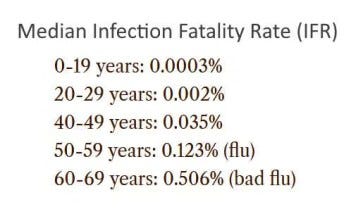
Even though such evidence-based data were known early on, the authorities in many countries and the WHO continued to scare the public about the particular danger of a novel viral disease, and imposed restrictions on millions of healthy people. Among other things, many countries restricted people from exercising, staying outdoors and playing sports, thereby compromising people’s overall health and increasing the risk of developing all the diseases (including Covid-19) more severely.
Thousand-fold difference in the risk from Covid-19
Harvard University Professor Martin Kulldorff had already stated in April 2020 that it was clear from the data from Wuhan early on in the crisis that there was a thousand-fold difference in the risk from Covid-19 across different age groups, and that failing to account for this difference was one of the major flaws in the public response to the Covid crisis.

Prof Martin Kulldorff was quick to point out the thousand-fold difference in risk from Covid-19 (Thérèse Soukar, CC BY-SA 4.0, via Wikimedia Commons)
Among people exposed to Covid-19, people in their 70s had roughly twice the mortality of those in their 60s, 10 times the mortality of those in their 50s, 40 times that of those in their 40s, 100 times that of those in their 30s, 300 times that of those in their 20s, and a mortality that was more than 3000 times higher than it was for children. According to Kulldorff, public authorities should have taken this wide variation between age groups into account when designing Covid interventions. Counter measures specifically targeting the elderly, the highest risk group, would have not only protected them but other groups as well. Age-specific measures had to be part of the strategy, otherwise unnecessary mortality, hospital burden and economic losses followed.

Professor Mark Woolhouse of the University of Edinburgh also estimated early on that the elderly were 10,000 times more at risk from Covid-19 than those under 15. But it goes e ven further. It’s not just the elderly, it’s the elderly who are infirm, have comorbidities or are frail. These were the people who were particularly at risk, and the main target group that should have been addressed. In his view, this was also the most important and obvious reason why there were alternatives to social closures and other coercive state measures.
In addition, it was clear from quite early on that it were the people with serious comorbidities that would fall seriously ill. In one of Europe’s epicentres of the early outbreak, Italy, a report found as early as in March 20, 2020, that the median age of the 3200 deaths testing positive for Covid-19 was 78.5 years, and more than 95% of them had one or more comorbidities. A large-scale study in the US confirmed that over 95% of hospitalised adults were persons with at least one comorbidity condition and the main risks were obesity, anxiety and fear disorders and diabetes. However, it was also clear, for example, that the proportion of overweight people varied widely between countries, even within the same age groups. For example, obesity already affects 42% of the US population, but in Vietnam the same number is only 2%, in India 4% and <10% in most of the African countries.
The association of nutritional deficiencies with severe morbidity was also known before the Covid crisis. Vitamin D, for example, plays an important role in the immune system. Already in the first half and second half of 2020, studies showed a clear correlation between the low levels of vitamin D and the risk of severe Covid-19 disease. For that reason, many doctors and researchers stressed the need for adequate vitamin D intake in the autumn of 2020, ahead of the second wave, especially for older people at risk.
Although these facts were known early on, authoroties continued to scare the public by claiming, among other things, that the virus did not discriminate between infected people and could be fatal to anyone. Health authorities also failed to advise people to take important steps to support their general health, such as getting enough fresh air and sunshine, eating a healthy diet, controlling blood pressure and diabetes, losing weight, etc. On the contrary, authorities directed people indoors, in many countries penalised them for going outdoors, and just promoted vaccinations instead of various treatments and lifestyles.

In the UK, scary posters were used in large-scale campaigns to get people to follow the “rules”
Ignoring natural immunity
The importance of natural immunity was systematically downplayed by the health authorities, major vaccine manufacturers and the World Health Organisation (WHO). In some countries (such as the USA), it was not even taken into account in the implementation of Covid measures, while the authorities only reiterated the need to vaccinate as many people as possible.
At the same time, studies carried out before the vaccination campaigns started, i.e. by the end of 2020, clearly showed that recovery from the disease provides strong immunity for at least 8 months and most likely longer. By October 2021, at least 81 studies had already been published confirming immunity to Covid-19 conferred by recovery.
In addition, a number of studies at the beginning of the Covid crisis showed that a significant proportion of the population may have already had immunity to Covid-19, as SARS-Cov-2 was only one of several coronaviruses. Nearly half of the unaffected individuals had the corresponding T-cells, indicating the body’s previous exposure to coronaviruses and ability to cope with them.
Many doctors and scientists, including Dr. Robert W. Malone, Dr. Peter McCullough, Dr. Geert Vanden Bossche, Dr Marty Makary, Dr. Pierre Kory, Dr. Tess Lawrie, Dr. Richard Urso, Dr. Paul E. Alexander, Prof Norman Fenton, Prof Martin Neil and others found it puzzling that health officials chose to ignore the scientific fact that infection provided long-lasting and strong protection to millions of people who had recovered from Covid-19. Prof. Jayanta Bhattacharya and Prof. Martin Kulldorff have stressed that while natural infection may not have provided permanent infection-blocking immunity, it offered, in high likelihood, permanent anti-disease immunity against severe disease and death. However, scientists who during the Covid crisis stressed the importance of natural immunity and asked to take into account when divising public policies, were not only ignored but censored and cancelled.
Ignoring natural immunity has had serious consequences, including avoidable vaccine complications and harms, loss of lives, financial and other collateral damage, and loss of credibility of the public health authorities.
Vaccines were not tested for reduction of virus transmission or infection
Covid-19 vaccines, which were introduced at warp speed, were not tested in clinical trials to see if they reduced infection or transmission. Shortly before their vaccine was granted emergency marketing authorisation in the US (on 3 December 2020), this fact was admitted by the CEO of Pfizer, Albert Bourla, and later by a Pfizer official during an official hearing at the European Parliament, although the vaccine manufacturers gave the public an impression that the vaccines protected against infection and transmission.
To the experts who looked closely at the design and results of the Covid-19 vaccine clinical trials, the fact that the vaccines were not tested for reduction of virus transmission or infection was evident already in late 2020. For example, the editor of British Medical Journal (BMJ) Dr. Peter Doshi stated on October 21, 2020, that none of the vaccine clinical trials had been designed to detect the efficacy of these vaccines on reducing any serious outcomes such as hospital admissions, use of intensive care, or deaths. Neither did they examine the efficacy of vaccines for their ability to interrupt transmission of the virus.

Dr Peter Doshi considers it wrong that primary data from clinical trials are not available (screenshot from Youtube)
Prof. William A. Haseltine drew attention to the serious shortcomings of these clinical trials on 23 September 2020, after Pfizer, Moderna, AstraZeneca and Johnson & Johnson had published their vaccine trial protocols. According to him, the trials seemed to be designed to prove that their vaccines worked, even if the measured effects were minimal, as they mainly investigated only how well could the vaccines prevent mild Covid-19 symptoms. Haseltine pointed out that a closer look at the protocols made it clear that these trials did not provide confidence in vaccine efficacy in protecting against serious illness or in preventing an infection of Covid-19. It also appeared that these trials were intended to pass the lowest possible barrier of success. Haseltine concluded that these vaccines were not the “silver bullet” that would end the Covid crisis.
Yet tens of millions of people around the world were subjected to compulsory vaccination, and many lost their jobs because of non-compliance, severely restricting their individual freedoms and fundamental rights.
Ignoring the side effects of the vaccines
Data on the side effects of the vaccines were already available in documents published by the vaccine manufacturers on their clinical trails in late 2020, although few were able to or considered it important to look at them in depth. This was made considerably more difficult by the fact that vaccine manufacturers refused to publish the raw data needed for an objective assessment. Raw data from clinical trials have still not been fully disclosed.
For example, the Pfizer vaccine trial was designed, conducted, analysed and compiled by Pfizer staff and all the raw data belong to the company. The BMJ editorial board believes that refusing to disclose the original data is morally unacceptable for any clinical trials, but especially those involving major public health interventions. The BMJ has been calling on vaccine manufacturers for years to disclose the original data from clinical trials, since clinical trial data must be available for independent scrutiny.
Nevertheless, experts pointed out many inconsistencies and questionable findings in the Covid-19 vaccine trial reports already in early 2021, such as the facts that:
- higher-risk target groups (elderly and immuno-compromised individuals) were clearly under-represented in the trials,
- a number of subjects were withdrawn for unknown reasons,
- even the officially reported rate of adverse reactions was several times higher than it was, for example, for flu vaccines.
In addition, it has come to light that the vaccine manufacturer Pfizer was aware of several serious side effects amongst the vaccine participants in clinical trials in early 2021, but chose to conceal them, such as the case of 12-year-old Maddie De Garay, who became disabled in the trial and is now partially paralysed, requiring a wheelchair and feeding tube. None of her 35 adverse reactions were mentioned in the New England Journal of Medicine article reporting on the vaccine trial.
Regardless of all that, since the beginning of 2021, mass vaccination campaigns were launched in many countries of the world, which in a short period of time transformed from an attempt of vaccinating the vulnerable target groups (the elderly) into an increasingly massive effort to vaccinate as many people as possible, even up to with children and infants, providing no rational argument or evidence base to do so.
A new expert analysis of the Pfizer and Moderna vaccine trial papers published in 2022 clearly found that participants in these clinical trials were more likely to experience a serious adverse reaction to vaccination than to be hospitalized for Covid-19.
Summary
As shown above, there is ample reason to argue that the evidence base for the decisions made in the greatest global health crisis of recent decades was severely deficient. Covid measures were determined not on the basis of evidence nor reasonable assumptions, but rather on the basis of emotional reactions and political tactics, fuelled by fear and media pressure. Societies were under constant pressure from global organisations (WHO, European Commission, etc.), authorities and the mass media – which included the increasingly loud rhetoric of maximizing lockdown, maximizing masking, maximizing vaccination etc.
However, there were also those in power who relied on knowledgeable experts (e.g. in the US, states such as South Dakota, Florida, Texas, etc.), as did some who were in charge of public health institutions (for example in Sweden), succeeding to resist irrational and unscientific pressures while enduring media bashing, vilification and unpopularity. At said places, the decision-makers generally avoided locking down the society and did not impose coercive state measures (compulsory mask mandates, compulsory vaccination, etc.). Thanks to their non-conformist and common sense approach, we now know much about which measures worked and which didn’t, the mistakes every society should avoid in future health crises, and how the slogan of ‘follow the science’ was often used as propaganda to subjugate societies to the dictates of a line of authority.
US meddling in EU state’s election – Russian intelligence
RT | September 28, 2023
The US is willing to go to any lengths, including blackmail and bribery, to ensure the incumbent government wins the upcoming election in Slovakia, Russia’s Foreign Intelligence Service (SVR) has claimed.
In a press release issued by the SVR on Thursday, director Sergey Naryshkin accused the White House of increasingly meddling in Slovakia’s internal affairs as the Central European country approaches the parliamentary election this weekend.
The opposition in Slovakia has made it abundantly clear that it would not unquestioningly follow the US lead if elected, and according to the SVR, stands a good chance of coming out on top in the vote.
To prevent this from happening, “the US State Department sent instructions to several of its European allies to conduct targeted work with local political and business circles,” the Russian intelligence agency claimed. It further alleged that Washington has sanctioned the use of methods such as blackmail, threats, and bribery.
The SVR also claimed that the US has already instructed the leader of the Progressive Slovakia party, Michal Simecka, who also serves as the European Parliament vice-president, to form a “cabinet completely loyal to Washington,” should his party triumph.
“Taking these realities into consideration, the upcoming election in Slovakia can hardly be viewed as a democratic expressing of the will of the people, and free from external influence,” the SVR concluded.
Citing an anonymous European Commission official, Politico reported in June that Brussels feared a potential victory for former Prime Minister Robert Fico’s Direction – Slovak Social Democracy party would spell “disaster” for the EU’s position on Russia sanctions and continued defense aid for Ukraine.
NATO member Slovakia has supplied Kiev with armored personnel carriers, howitzers, and its entire fleet of Soviet-era MiG-29 fighter jets. However, Fico has made it clear that he will terminate the aid if he returns to power. He has also called into question the need for economic measures against Moscow.
A recent poll commissioned by Slovakia’s TV JOJ 24 broadcaster indicated that Progressive Slovakia and Direction – Slovak Social Democracy are neck and neck, with 18% and 17.7% of support respectively.
Media and Architects of Online Censorship Law Heap Pressure on Rumble After it Defends Principle of Neutrality
By Tom Parker | Reclaim The Net | September 25, 2023
Media outlets and architects of the UK’s censorship law, the Online Safety Bill, are increasing the pressure on neutral video sharing platform Rumble after it refused to bow down to the UK Parliament’s pressure to demonetize comedian Russell Brand.
The pressure to demonetize Brand came after anonymous sexual assault allegations were made against him. Brand has denied the allegations and has not been arrested, charged, or convicted of any of the allegations made against him.
Several companies, including YouTube, took action against Brand after the allegations surfaced, despite Brand having no content violations on YouTube. But Rumble stood up to the pressure and rejected the UK Parliament’s request to cut off Brand’s monetization, with CEO Chris Pavlovski noting that the allegations against Brand have “nothing to do with content on Rumble’s platform.”
Now, several media outlets and people who helped craft the UK’s online censorship law, the upcoming Online Safety Bill, are targeting Rumble’s stance.
Lord Allan of Hallam, a former Facebook executive who advised on the Online Safety Bill, branded Rumble a “crazy American platform” and expressed disdain at Rumble’s philosophy of allowing free expression.
He and internet law expert Professor Lorna Woods, an architect of the Online Safety Bill, also complained about Rumble’s refusal to bow down to pressure from UK officials and framed it as “grandstand[ing] before the press.”
The Times also took aim at Rumble by noting that under the Online Safety Bill, Rumble will have to “prevent children from seeing pornography… material that promotes self-harm, suicide or eating disorders… violent content… material harmful to health, such as vaccine misinformation” and “take down material that is illegal, such as videos that incite violence or race hate.”
However, Bryn Harris, the Chief Legal Council for The Free Speech Union, pointed out that The Times’ article doesn’t actually provide examples of any of the alleged illegal or harmful to kids content on Rumble.
Additionally, the Associated Press piled in on Rumble after it stood up to the demands of UK officials by claiming that Rumble is a “haven for disinformation and extremism.”
This mounting pressure comes days after the UK passed the Online Safety Bill — one of the most sweeping censorship laws to ever be introduced in the UK. The controversial censorship and surveillance bill is set to come into law next month.
The censorship provisions in the Online Safety Bill can be aimed at both citizens who post speech that’s deemed to cause “harm” and companies that fail to censor this so-called harmful content. The harms in the bill extend beyond physical or direct harm and into the realms of “psychological” harm and “potential” harm. Certain types of “false” communications are also prohibited under the bill.
As UK officials heap pressure on Rumble, reports have revealed that several UK politicians have ties to the pro-censorship Center for Countering Digital Hate (CCDH) and the UK politician that pressured Rumble to demonetize Brand received a donation in kind from Google.
Scotland To Set Up New Police Unit To Tackle “Hate” and “Misgendering,” Ignites Free Speech Concerns
By Christina Maas | Reclaim The Net | September 25, 2023
On the brink of implementing Humza Yousaf’s highly contentious legislation early next year, a specialized hate crime unit has been announced by Police Scotland. With the unit scheduled to be operational by November, a comprehensive training of about 16,400 law enforcement officers will follow in December.
This is all in anticipation of the Hate Crime and Public Order Act, expected to be ratified early in 2024. This Act expands upon the existing law, offering a broader protective net for “vulnerable” groups and introduces the notion of “stirring up hatred”.
However, some critics and free speech advocates have raised concerns that the Act, which holds potential to elevate sentencing if prejudice is based on factors such as age, race, disability, religion, transgender identity or variations in sex characteristics, may invigorate the increasingly toxic culture wars surrounding gender issues. It is posited that the law may sidetrack police resources from tackling violent conduct to address “harmful” words.
The thought of free speech being stifled by the new laws is particularly horrifying for some, with warnings that women’s rights advocates may find themselves entangled in allegations of transphobia.
Critics argue that a significant portion of police time may now be geared towards a subjective concept of hate crime, such as “misgendering,” instead of dealing with tangible violent acts.
Helen Joyce, part of the human rights group Sex Matters, asserted her alarm at the creation of this specific hate crime unit. She voiced concern for those who stand for the rights of women and children, warning of a “chilling effect” on free speech, as reported by The Scottish Express.
Police Scotland remains tight-lipped about the size of the proposed unit plus the financial implications of the new laws – a cause for concern for many.
The US Military Is Laying the Groundwork to Reinstitute the Draft
By Zachary Yost | Mises Wire | September 25, 2023
The most recent edition of the U.S. Army War College’s academic journal includes a highly disturbing essay on what lessons the U.S. military should take away from the continuing war in Ukraine. By far the most concerning and most relevant section for the average American citizen is a subsection entitled “Casualties, Replacements, and Reconstitutions” which, to cut right to the chase, directly states, “Large-scale combat operations troop requirements may well require a reconceptualization of the 1970s and 1980s volunteer force and a move toward partial conscription.”
An Industrial War of Attrition Would Require Vast Numbers of Troops
The context for this supposed need to reinstate conscription is the estimate that were the U.S. to enter into a large-scale conflict, every day it would likely suffer thirty-six hundred casualties and require eight hundred replacements, again per day. The report notes that over the course of twenty years in Iraq and Afghanistan, the U.S. suffered fifty thousand casualties, a number which would likely be reached in merely two weeks of large-scale intensive combat.
The military is already facing an enormous recruiting shortfall. Last year the army alone fell short of its goal by fifteen thousand soldiers and is on track to be short an additional twenty thousand this year. On top of that, the report notes that the Individual Ready Reserve, which is composed of former service personnel who do not actively train and drill but may be called back into active service in the event they are needed, has dropped from seven hundred thousand in 1973 to seventy-six thousand now.
Prior to the Ukraine war, the fad theory in military planning was the idea of “hybrid warfare,” where the idea of giant state armies clashing on the battlefield requiring and consuming vast amounts of men and material was viewed as out of date as massed cavalry charges. Instead, these theorists argued that even when states did fight, it would be via proxies and special operations and would look more like the past twenty years of battling nonstate actors in the hills of Afghanistan. In a recent essay in the Journal of Security Studies, realist scholar Patrick Porter documents the rise of this theory and the fact that it is obviously garbage given the return of industrial wars of attrition.
As military planners have woken up from the fevered dream of imagining that modern war consisted of chasing the Taliban through the hills with complete and overwhelming airpower, they have similarly started to wake up to the idea that industrial war has vast manpower requirements and that seemingly the only way to fill these requirements is by forcing young people into the ranks. That has certainly been the only way Ukraine has been able to maintain its forces, although it has required increasingly draconian measures to do so as conscripts face attrition rates of 80 to 90 percent by Ukraine’s own admission.
Obviously, the reintroduction of conscription is an extremely disturbing prospect given America’s propensity for getting involved in meaningless wars that accomplish nothing other than empowering our enemies, killing and maiming our soldiers, and wasting vast resources.
This is especially true given the unstated assumptions implicit in this paper. Who is the enemy that would be inflicting thirty-six hundred casualties a day? A war in the Pacific against China would primarily be a naval and airpower war with an extremely limited role for the army (even the current inept regime seems unlikely to be stupid enough to try and wage a land war against China) which obviously leaves Russia as the main adversary that would require the U.S. Army to round up conscripts to feed into the attritional meat grinder.
There Is No American National Interest That Requires a Standing Army
However, while these manpower shortages may be a valid concern for someplace like Russia, Ukraine, or Poland, we here in the U.S. are quite fortunate that we have no compelling national interest that would require us to engage in an industrial war of attrition in Eastern Europe.
To the extent we are at risk of becoming involved in such a disastrous mess, it is entirely of our own doing via the entangling alliance known as the North Atlantic Treaty Organization and our leader’s own messianic gnostic crusades for democracy or whatever pseudo religious ideology is presently in vogue.
The U.S. is blessed as being the most secure power in history. We are the hegemon of the western hemisphere, with vast moats in the form of the Atlantic and Pacific Oceans that no other state has the capability to project military force across, and all our neighbors are weak and relatively friendly. We are not at any risk of being forced to fight an industrial land war on the home front. Any war the army would be used in would be as an expeditionary force fighting in the eastern hemisphere, where we have no compelling defensive need to do so.
From the beginning of the U.S., there have been warnings against the dangers of both entangling alliances and standing armies. The best solution to the military recruitment crisis is to simply abolish the standing army and not plan to wage a costly and pointless war on the other side of the planet that would result in trillions of dollars down the drain and who knows how many tens or hundreds of thousands of Americans being killed, maimed, and psychologically scarred.
Hungary issues ultimatum to Ukraine
RT | September 25, 2023
Hungary will not support Ukraine “on any issue” until Kiev restores the rights of ethnic Hungarians on its territory, Prime Minister Viktor Orban said in parliament on Monday. Budapest’s backing is vital to Ukraine’s bid to join the EU.
“We will not support Ukraine on any issue in international life until it restores the laws that guaranteed the rights of Transcarpathian Hungarians,” Orban said, adding that “for years [the Ukrainians] have been tormenting” Hungarian schools.
Since 2017, successive laws mandating the use of the Ukrainian language have resulted in the closure of around 100 Hungarian schools in Ukraine. These laws have been harshly criticized by the Council of Europe and by human rights organizations.
According to Orban, the situation has deteriorated with the beginning of a new school year, with management at a school in the city of Munkacs forbidding the singing of the Hungarian national anthem or the wearing of Hungarian national colors on the first day back in the classroom.
Around 156,000 ethnic Hungarians live in Ukraine, most of them in the region of Transcarpathia. Once a part of the Austro-Hungarian Empire, this region fell under Soviet control after World War II. It remained in Kiev’s hands when the Ukrainian SSR became modern Ukraine after the fall of the USSR. Ukraine is also home to around 150,000 ethnic Romanians and more than 250,000 Moldovans, and Bucharest has joined Budapest in demanding that the language laws be revised.
Foreign Minister Peter Szijjarto warned in March that Budapest would not support Kiev’s applications to join the EU and NATO until these issues are resolved.
Hungary does not provide any military aid to Ukraine or allow weapons to enter the country via its territory. However, Hungary will have veto power over whether Ukraine can join the EU and NATO due to both bodies requiring the unanimous consent of existing members before admitting new states. The dispute over language rights is just one of several points of contention between Budapest and Kiev.
Orban’s government has also condemned the Ukrainian military’s efforts to conscript ethnic Hungarians into military service and blocked EU military aid to Ukraine over Kiev’s sanctioning of one of its banks due to its lending activities in Russia. More recently, Hungary has blocked the import of Ukrainian grain to protect its farmers from being undercut, prompting Ukraine to threaten a lawsuit at the World Trade Organization.
Featured Video

AIDS Inc. by Gary Null (2007)
or go to
Aletho News Archives – Video-Images
From the Archives
Clash of Civilization, Iran Part II
By Jamal Kanj – Intifada-Palestine.com – January 14, 2011
Israel’s survival kit is: perpetuate conflict, insecurity to rationalize collective hate and finally playing victim.
Devoid of conflict, Israel implodes internally; without hate, Zionism loses its justification; and playing eternal victim to continue blackmailing the West. Absence of this holy trinity, Israel ceases to exist.
From its inception, the house of Zion has mastered exploiting adversarial powers to advance Israel’s cause. For instance, their influence over the Democratic Party in the US began with President Truman’s bid for 2nd term election in 1948.
Responding to strong opposition from Secretary of State General George Marshall and Department experts urging against recognition of Israel, President Truman replied: “I’m sorry gentlemen but I have to answer to hundreds of thousands [Jewish voters] who are anxious for the success of Zionism. I do not have hundreds of thousands of [voting] Arabs among my constituents”
Zionists influence over liberal American politics was matched with the doctrinal school of Conservative theoreticians aligning the Republican Party’s platform with Israel’s objectives. The Neoconservative Zionists, coined Zioncons, invented the “Clash of Civilization” concept to fight Israel’s wars. … continue
Blog Roll
 Aletho News
- Merck Virologists Admitted to Falsely Certifying Vaccine Efficacy
- Mandatory Folic Acid for every man, woman & child
- Pro-Palestine protesters arrested outside UK’s ruling Labour Conference in Liverpool
- Mauritius denies landing permit to flight from Israel, forcing cancellation: Tour operator
- Israeli finance minister calls for genocidal war on West Bank, annexation of south Lebanon
- 12 Things Your Psychiatrist Was Trained Not to Tell You
- From Unipolar Universalism to Multipolar Civilizational Distinctiveness
- RSF military group defects, joins Sudanese army: State media
- Ireland goalkeeper refuses to play ‘Israel’ as squad weighs boycott
- China pushes back against US on Cuba, Iran
- If Americans Knew
- Israel forces Gazans to live in constant peril – Daily Update
- Deconstructing Netanyahu’s pants-on-fire UN rant – Daily Update
- Trump betrayed voters with his campaign lies and prioritized a foreign country once he took office
- Netanyahu calls Israel’s war in Gaza ‘opposite of genocide’ in UN speech to near-empty hall
- Settler Kidnappings: Torture, Sexual Abuse and Terrorisation of Palestinian Abductees as Israel Deepens Annexation of West Bank
- Gaza winter nears as 162,000 tents become unusable, raising fears of humanitarian crisis
- Netanyahu says, “It’s the opposite of genocide”; UN says Gaza economy is world’s ‘most severe crisis on record’ – Daily Update
- Israel’s US-Backed Assault on Gaza Has Created the ‘World’s Most Severe Economic Crisis on Record’: UN
- ‘Protecting U.S. Citizens’… From Israel
- ‘This is where I live now, the back of a truck’: a day in the life of a grandmother in Gaza
- No Tricks Zone
- New Study: Earth And Venus Surface Warmth Largely Explained By Convection And Lapse Rate, Not CO2 Or Radiation
- 2025 Nature Paper Claiming Worsening Global Drought Gets RETRACTED …Heavily Flawed
- New Study: ‘Global Drought Shows No Detectable Recent Acceleration Under Climate Warming’
- Economic Masterminds: German Socialists Suggest Taxing Productivity Gains Stemming From Using AI
- The South China Sea Has Not Been Cooperating With The Climate Change Narrative
- Energy Crisis: Germany Enters Heating Season With Historically Low Gas Reserve Fill Levels
- New Study: The Antarctic Ice Sheet Gained Mass From 2020-2024 Due To Staggering Snow And Ice Accumulation
- Study: Ocean Heating Rates From Thousands Of Years Ago ‘Dwarf’ Modern Ocean Heating Rates
- Climate Extremists Target, Attack Large-Scale Power Grid Infrastructure In Germany!
- New Study: Antarctic Ice Melt Has Contributed Less Than 1 Centimeter To Sea Level Rise In The Last 30 Years

