CDC Director: We may need to update our definition of ‘fully vaccinated’
By Kit Knightly | OffGuardian | October 23, 2021
Yesterday, in a press conference, the director of the CDC warned that they may have to “update” the definition of “fully vaccinated”.
At the virtual presser accompanying the approval of “mix-and-match” booster jabs, Dr Rochelle Walensky told reporters that:
We will continue to look at this. We may need to update our definition of ‘fully vaccinated’ in the future,
The “updated” definition would potentially mean only people who have had the third “booster” shot would be considered “fully vaccinated”, while people who have had the two original shots are no longer “fully vaccinated”.
Whilst the warning might just be a ploy to scare people into getting their “booster” without forcing them to, it should be noted a revised definition of “fully vaccinated” has already been adopted in other countries.
For example, it is already policy in Israel where, in early September they “updated what it means to be vaccinated,”. You now need a third shot, or else you are no longer considered vaccinated.
We wrote about it at the time, and predicted it would likely spread to the rest of the world.
In fact, figures in the alternate media have been predicting this for a while. See this clip from YouTuber WhatsHerFace back in August:
As for the potential purpose of any “updated definition”, well it would be twofold.
Firstly, it would allow them to maintain control. Forcing people to jump through hoops just to “get back” rights they once took for granted creates an atmosphere that normalises state tyranny.
Secondly, and more cynically, it would allow them to artificially manipulate statistics to flatter the vaccines’ effectiveness whilst hiding any damage they might do.
We already know that, in the US and others, you’re not considered “vaccinated” if you’re only single-jabbed, or double-jabbed for less than two weeks. So any patient infected with “Covid” in that time is considered “unvaccinated”, NOT a “breakthrough infection”.
By redefining “fully vaccinated”, they can turn millions of double-jabbed people back into “unvaccinated” people and stop them from becoming potential “breakthrough infections” and hurting the vaccine effectiveness stats.
This will, in turn, camouflage any excess mortality in those who have had the vaccine, for example due to antibody-dependent enhancement, because all those who die will officially be “not fully vaccinated”.
They’ll likely push it through soon, before this winter’s flu season hits, so any flu deaths can be “unvaccinated covid deaths”.
And for anybody out there who got double-jabbed thinking they were buying their life back, we’re sorry, but we did warn you this would happen.
Six Questions to Ask Before Deciding Whether to Comply With Mask Mandates
All the reasons why mask mandates shouldn’t be reimposed
By Dr. Gary Sidley • The Daily Sceptic • October 20, 2021
On the July 19th 2021, England removed almost all its legal mandates that required healthy people to wear face coverings in community settings. Scotland, Wales and Northern Ireland, however, opted to retain their mask mandates, as did London on its public transport system. Ominously, the Government’s Covid strategy for this winter includes the prospect of a ‘Plan B’ that could see the return of compulsory face masks in indoor settings in England. After a few months of bare-faced normality, how will the general public react to future directives to muzzle up?
Smile Free – a campaign group seeking the permanent removal of all mask mandates – urges each person to consider the responses to the following six questions before deciding whether to hide your face again.
Q1. Do masks help reduce viral spread?
Although some studies claim otherwise, the real-world evidence strongly suggests that masking the healthy does not significantly reduce the spread of respiratory viruses for neither the wearer nor others. Key reasons for this lack of efficacy are likely to include the improper use and storage of masks in the real world and the growing recognition that SARS-CoV-2 (the virus responsible for COVID-19) is spread via microscopic aerosol particles that are far too small to be kept at bay by face coverings.
Q2. Will wearing a mask cause me any physical harm?
If worn only for short periods, significant physical harms from wearing a mask are unlikely. However, there is evidence that long term use can lead to a number of negative consequences, including: headaches, skin irritation, fatigue and dehydration, reduced heart and lung efficiency and eye irritation. In addition, face coverings may put elderly people at more risk of injury from falls.
Q3. Do masks cause any social or psychological harms?
The social and psychological consequences of hiding our faces from other people are profound. Humans are social animals. We need to interact with others and communicate to sustain our wellbeing. Face coverings are dehumanising, inhibiting all forms of emotional expression and social interaction. Individuality minimised, identity hidden, the masked population appear broadly the same as they trudge along in their social vacuums. The impact of a masked population on children is even more problematic, denying them access to facial expressions that are so crucial for their emotional development.
Q4. Will wearing a mask help to reassure others who are anxious?
Most definitely not. Acting as a crude, highly visible reminder that danger is all around, face coverings are fueling widespread anxiety. Fear is underpinned by a perception of threat and being masked is a blatant indicator that we are all bio-hazards. Furthermore, continuing to wear masks while we gradually try to return to normality will act to keep fear going, as the wearer may attribute their survival to the mask rather than conclude that it is now safe to return to everyday activities. To recommend face coverings as a source of reassurance is akin to insisting people wear a garlic clove around their necks to reduce their fear of vampires.
Q5. Under the law, do I have a ‘reasonable excuse’ not to wear a mask?
In general terms, if wearing a mask is likely to cause you ‘severe distress’, or put you ‘at risk of harm or injury’, you are legally exempt. Mental health problems (such as anxiety, depression, and paranoia) and physical health problems (such as asthma and other respiratory difficulties) are sufficient and lawful reasons not to wear a face covering. Furthermore, you are not obliged to disclose your specific reason for exemption to anybody other than an official enforcement officer (usually a police officer); any other person who challenges you about not wearing a face covering is likely to be acting unlawfully and thereby risking prosecution. Indeed, a service provider has been fined £7000 under the Discrimination Disability Act for denying access to a woman without a mask.
Q6. Do I risk being fined if I don’t wear a mask?
While it is possible that a fine could be imposed for not complying with a mask mandate, such an event seems rare. Thus, in the four-month period June-to-September 2020, only 89 fines were issued (61 on public transport, 28 in retail settings) across the whole of England and Wales. Furthermore, if you are unfortunate enough to receive a fine and decide to contest it in Court, it is highly likely you will succeed; according to figures produced by the Crown Prosecution Service, all charges under the Coronavirus Act have either been withdrawn in Court or quashed after innocent people were wrongfully indicted.
In conclusion, mandating masks for healthy people in their communities is irrational, counterproductive, unethical and ultimately unenforceable. To help continue the fight against legal requirements to wear face coverings, please consider joining our Smile Free campaign.
Deleted Government Report Celebrates How Public Loves to “Conform”
By Paul Joseph Watson | Summit News | October 22, 2021
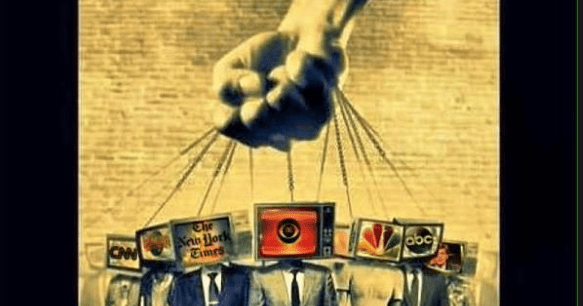
A deleted government report exploring how to make the public alter its behavior to accept the new ‘green economy’ reveals how COVID-19 restrictions have created a population with a “deep set reverence” for authority and a “powerful tendency to conform.”
The report was inadvertently published by the British government before being hastily pulled down, but numerous journalists were able to retrieve its contents.
The document explored how to weaponize behavioral psychology to ‘nudge’ the public into supporting measures and adopting behavior without them explicitly knowing they’re being manipulated.
The investigation found that the same techniques the government used to force people into accepting lockdown could be used to make them change their lifestyles in the name of preventing climate change.
Under the heading “principles for successful behaviour,” the paper noted;
“Government statements, actions and laws powerfully shape perceptions of normative and acceptable behaviour. For instance, even with public criticism being high, many still perceived government approval as the yardstick for safe behaviour during COVID-19 ‘we’re allowed to do this now [so must be safe]…’. This reveals, for many, a deep set reverence for legitimate government authority, regardless of one’s personal political views.”
While PR stunts such as having officials vaccinated live on television worked to convince people of the narrative, elite hypocrisy (public officials violating lockdown rules) was found to cause significant damage to public trust.
“Perceived hypocrisy can do a lot to undermine efforts to build public engagement and support. This was observed during the COVID-19 pandemic when prominent authority figures broke guidelines, leading to measurable reductions in public compliance as well as shifting attitudes.”
“Green politics has similar deep-seated reputational issues with elite hypocrisy,” notes Breitbart. “A common feature of climate change summits has been high-profile attendees arriving by private or government jet, a disconnect between word and deed that seems unlikely to vanish in the near term.”
The paper concluded that people can be rather easily “nudged” into changing their behavior in response to government announcements and “have a powerful tendency to conform.”
The investigation also found that even if enforced changes to lifestyle are not wanted by the public, most tend to fall in line with the new status quo rather quickly anyway.
The report was prepared by the Behavioural Insights Team (BIT), a quasi-government body that was part of the effort to use “totalitarian” and “unethical” methods of instilling fear into the population as a means of scaring them into complying with lockdown rules.
A related group, the Scientific Pandemic Insights Group on Behaviours team, warned at the start of the first lockdown that a “substantial number of people still do not feel sufficiently personally threatened [by Covid-19].”
“The perceived level of personal threat needs to be increased among those who are complacent, using hard-hitting emotional messaging,” the group added, leading to numerous lurid propaganda campaigns that exaggerated the threat of COVID to bully the public into total submission.
In summary, the public is largely unthinking, compliant and docile and can be made to go along with just about anything so long as they’re bombarded with the right propaganda.
Wonderful.
“David’s Law”: How the Amess attack will be used to control the internet
The recent killing is already being used as ammunition to attack independent social media and the very idea of anonymity on the web
By Kit Knightly | OffGuardian | October 21, 2021
On October 15th Sir David Amess MP was attending a constituency “surgery” at Belfairs church in Leigh-on-Sea. During the meeting, a young man emerged from the crowd and stabbed the MP several times.
Ambulances and police were called. They attempted to revive him at the scene, but he was declared dead.
The suspect, meanwhile, made no attempt to flee. It has since been reported he is the son of a Somali politician, was known to the UK’s “Prevent” counter-terrorism programme, and was reportedly “radicalised online”.
The killing is being treated as a “terrorist incident”.
These are the alleged facts of the case as they have been released to the public.
Are they true? Maybe. Maybe not. It’s too early to say, and we’ll likely never know for sure. The truth is – for everyone outside the Amess family and friends – it really isn’t the most pressing issue. Whatever the reality of the “attack”, what we, the 99%, need to be most concerned about is the agenda coming in its wake
Real attack or not, false flag or not, the fallout is the same: Censorship, state control and “David’s Law”.
THE ONLINE HARMS BILL
The first reaction to the Amess attack has been renewed coverage of, and loud calls for, the “online harms” bill to be put to a vote. All this despite there being no publicly released evidence linking the Amess attack to any “online harms” at all.
The “Online Harms Prevention Bill” is not in any way a response to Amess’ death and has actually been in development for a while. A white paper reporting the need for the bill was first published in April 2019, then updated in December 2020.
This was followed by a draft bill in May 2021 and then a report on “Regulating Online Harms”, published in August.
The Bill has existed for over eighteen months, and any attempts to link it to David Amess are purely manipulative tactics designed to force it through parliament on a wave of emotion.
It might be dismissed by some as ‘callous’ to talk about the alleged murder of a seemingly innocent person in terms of cynical agenda – but it’s the very opposite. It’s an expression of concern and social responsibility. The establishment uses these events as gambits, so we have to get used to reading them as such if we want to protect the rights and freedoms that will be freshly attacked.
We’re already seeing a deluge of coverage in the press talking up the dangers of our “toxic political discourse” and the threat that “divisive polarised speech” poses because it can “radicalise” people and “create the climate where violence becomes inevitable”.
The Mirror warns of an increase in “bedroom radicals” thanks to lockdowns. The Guardian echoes this, claiming “online hate” is “nastier than ever” and “action is required”.
The Telegraph headlines: “Social media companies ‘must do more’ to protect MPs from online hate”
Politicians are likewise prepping the ground for the bill to pass.
Deputy Prime Minister and Justice Secretary Dominic Raab went on Sky News to talk about “online hate” being “out of control”.
Sir Keir Starmer, leader of the supposed “opposition”, used the first PMQs since the attack to rail against the lack of regulation of the internet and call for something to be done. Boris has already committed to bringing the “Online Harms” vote forward “before Christmas” when it was previously expected to wait until at least spring of 2022.
So, what’s in this bill?
Nothing much that hasn’t been said before. The White Paper and report proselytise about the need to protect children, women, ethnic minorities and “the vulnerable” from “hate”. The bill itself suggests a new “statutory duty of care” for the internet, and a new “regulatory body” with a “suite of powers” to ensure companies fulfil this “duty of care”.
There are chapters dedicated to actual crimes, such as child pornography and threats of violence, but also much murkier “harms” described as “legal but harmful”. These include, but are not limited to, “disinformation” and “bullying”. As always, the language of legislature is deliberately obscure, shrouded in the muddied meaning of bureaucratic double-talk.
One concrete, and concerning, clause would grant OfCom the power to demand private user information from internet providers and social media companies (although we do know they do this already).
But the most dangerous part of the bill may not even be written yet…
“DAVID’S LAW”
Within days of the news breaking Tory MPs were calling on Boris Johnson to enact “David’s Law”.
“David’s Law” would be either new legislation or a “strengthening” of the current proposed legislation, to totally remove online anonymity.
Tory MP Mark Francois, said in a speech to the Commons:
So let’s put, if I may be so presumptuous, David’s Law onto the statute book, the essence of which would be that while people in public life must remain open to legitimate criticism, they can no longer be vilified or their families subject to the most horrendous abuse, especially from people who hide behind a cloak of anonymity with the connivance of the social media companies for profit.”
Priti Patel is already “considering” taking away the “right to anonymity online”.
Other politicians, including Dominiic Raab and Lindsey Hoyle, the speaker of the house, have expressed total agreement.
Politico headlines the UK is “wrestling with anonymity”.
But what exactly would “ending anonymity” entail? That’s not clear. The white paper discusses how “anonymous accounts” can be used to “hide illegal activity”, and that companies should do more to prevent this, but there is nothing in there about outright banning them.
Any such formal ban would involve amending the bill, or writing a new one. Hence we have talk in parliament of “strengthening” the proposed legislation, but does that mean a ban? Perhaps, perhaps not.
A more likely (and more British) approach, as we are already seeing with vaccine passports, would be to make it an informal ban by pressuring the companies themselves to act outside of legislative compulsion. Parliament will author new “guidance” or “recommendations” on the opening of social media accounts, without ever enforcing them as law.
But partner this with steep fines for illegal activity, “hate speech” or “misinformation”, along with the proposal to make platforms criminally liable for “harmful content”, and companies become their own strict censors in the name of protecting their profit margin.
This is not a fringe theory at all, David Davis MP of all people, described exactly this process in warning that the online harms bill could become a “censor’s charter”.
It’s not hard to see how that system could be used to totally remove the idea of online anonymity without ever making it actually illegal, but rather making it too financially risky. Thus skirting any accusations of state censorship or authoritarianism.
We already know major internet players work hand-in-glove with governments all over the world, so they can be relied upon to enforce any new “duty of care” regulations. But the smaller competitors, who use privacy as a major selling point, can expect to be put in the media crosshairs.
Enter Telegram.
THE WAR ON TELEGRAM
Telegram, for those who aren’t familiar, is an encrypted private messaging service created by Russian Pavel Durov. It became the go-to encrypted service after Facebook bought Whatsapp, and its “channel” feature is a very useful way to communicate with thousands upon thousands of people at once. During the “pandemic” it has become a hub for those organizing protests and broadcasting information banned from mainstream platforms.
All of that has clearly put it on the state’s hit list, because somehow, in all the outpouring of emotion following Amess’ stabbing, it is Telegram that comes in for specific criticism.
To be clear: Telegram is not yet known to have played any part whatsoever in the attack on David Amess. None. It’s not even known whether or not the alleged killer had a telegram account.
Despite this, yesterday in Parliament, Sir Keir Starmer attacked Telegram as the “app of choice for extremists”.
Interestingly, he was citing a report from the NGO Hope Not Hate which was released on October 13th, just two days before Amess was stabbed.
In fact, Telegram has been the subject of ongoing media smears for years, and these have only intensified in the last few days.
Back in 2016, Gizmodo was telling people they should “delete telegram right now”, ironically because it wasn’t really encrypted enough. This story was repeated byVice in November 2020 and then Wired in January of this year.
Also in January, following the “riot” on Capitol Hill, Telegram was accused of being a safe haven for the “far-right”.
Vox headlined:
Why right-wing extremists’ favorite new platform is so dangerous
The Washington Post went with:
Far-right groups move online conversations from social media to chat apps — and out of view of law enforcement
In April Forbes reported that Telegram was “dangerous”. In May it was a platform “where cyber criminals share stolen data”. And then in June the New York Times called it a “misinformation hotspot”.
A September article in Politico accuses Telegram of allowing “misinformation” intended to influence the recent German election.
Also in September, the Financial Times called Telegram a new “dark web for cyber criminals”.
And an October article in Wired accuses the platform of being a “cesspool of antisemtic content”.
It goes on and on and on.
Perhaps most tellingly, Telegram is regularly blamed for Covid-related “misinformation”, along with selling fake Vaccine passes and allowing “threats to NHS workers”.
ARE YOU SEEING THE PATTERN?
Well… are you?
Although all this is framed as a response to the death of David Amess, none of it has yet been shown to have any relevance to the Amess case at all, and all of it predates the murder happening.
The online harms bill is almost three years old, the attacks on Telegram have been going on for over a year, and you can find a steady stream of media attacks on online anonymity going back over a decade.
As so often, the “reaction” to this “problem” is selling us a “solution” they’ve had planned for years.
Since at least 2016 MPs have been talking about “reclaiming the net”, while outlets like The Guardian have been talking about creating “the web we want”, and producing tortured statistical reports to paint the web as a dangerous place.
(Interesting note: those butchered “statistics” are referenced in the Online Harms white paper, a little incite into the self-sustaining nature of propaganda).
The lesson we should all learn: “Policy” is never a response, policy is an aim, a predetermined conclusion.
It is decided and written, and then the “reality” that justifies that policy is constructed, either through opportunistic use of real tragedies, cultivated public opinion, false-flag attacks or pure invention.
You can follow OffGuardian’s Telegram channel here. For now.
Bolivian Coup Regime Sought to Assassinate Luis Arce

Bolivia’s Interior Minister Eduardo Del Castillo informs of an assassination attempt against Luis Arce in 2020 at a press conference on October 18, 2021. Photo: Ministerio De Gobierno
Kawsachan News | October 18, 2021
Bolivia’s Interior Ministry has revealed that Colombian mercenaries, who participated in the assassination of President Jovenel Moise in Haiti, entered Bolivia days before the 2020 election. Fernando Lopez, Defense Minister under Jeanine Añez, was in contact with mercenary groups, with whom he intended to carry out a second coup.
In a press conference, Interior Minister Eduardo del Castillo named Germán Alejandro Rivera García, a Colombian citizen who entered Bolivia on October 16, 2020 and who was later arrested for the assassination of Jovenel Moise. He was followed by Colombian citizen Arcángel Pretel Ortiz and Venezuelan citizen Antonio Intriago, who run the Miami-based ‘security firm’ Counter Terrorist Unit Security (CTU), which hired the mercenaries who murdered Moise.
The mercenaries stayed at the high-end Hotel Presidente in La Paz, just two blocks away from the presidential palace. The purpose of their meeting was to pursue leads with then Defense Minister Fernando Lopez for lucrative contracts for a hit on Luis Arce.
Castillo said, “Days before the elections, the paramilitaries who would go on to kill the President of Haiti, as well as mercenary contractors such as Mr. Arcángel Pretel and Mr. Antonio Intriago were in the country. According to the information we obtained, their intention was to end the life of President Luis Arce”.
Earlier in the year, leaked audios published by The Intercept revealed that Lopez was in contact with other Miami-based mercenaries to coordinate a second coup. In one audio, Lopez said, “The military high command is already in preliminary talks… the struggle, the rallying cry, is that [the MAS] wants to replace the Bolivian armed forces and the police with militias, Cubans, and Venezuelans. That is the key point. They (the police and armed forces) are going to allow Bolivia to rise up again and block an Arce administration. That’s the reality.”
President Luis Arce addressed the revelations today at a summit with social movement in La Paz, saying, “Our Interior Minister revealed this information at an opportune time, brothers; They wanted to make an attempt on my life. To those right-wing murderers, we are going to respond with a phrase from (historic Bolivian socialist leader) Marcelo Quiroga Santa Cruz: We know that sooner or later they will make us pay for what we are doing, we are willing to pay that price, we were always willing. We will never shy away from danger because there is something more fearsome than that enemy who is looking for a way to kill us. A guilty conscience is much worse, we would not bear ourselves if we did not fulfill our duty.”
Italian Senator suspended for not showing vaccine passport
By Didi Rankovic | Reclaim The Net | October 21, 2021
Protesters who have been gathering across Italy to support a campaign against introduction of vaccination certificates, known as “the green pass” in that country have some supporters in high places like senators and members of parliament (MPs).
One of them, Senator Laura Granato, has experienced first-hand what the new rules around Covid passes mean for gainfully employed persons who oppose them: she was suspended and left without her daily allowance for ten days for refusing to show the pass once inside the Senate building.
Granato first managed to get in, but was “reported” for deciding not to show the document. The senator was in this way prevented from taking part in a meeting that was discussing precisely the green passes, which became mandatory both for public and private sector workers on Friday.
These new, more restrictive measures have been described as “some of the toughest in the world,” while Granato echoed the sentiment of Italians opposed to them blasting the passes as “certificates of obedience.”
In Italy, the green pass is designed to show that a person has either been vaccinated, has tested negative (these tests are valid only for several days) or that they recently recovered from Covid. The government believes that mandating green passes for the workplace will boost the vaccine drive and avoid a repeat of lockdowns that have ravaged Italy’s economy over the past nearly two years of the pandemic.
But although many Italians are “obeying the certificates of obedience” – no doubt seeing no way out other than ultimately losing their livelihoods – many others remain defiant and indignant at the prospect, with thousands of dock workers in Trieste protesting over the weekend, along with others elsewhere in Italy.
And while over one million green passes were downloaded on the first working day that the new, tougher Covid restrictions came into force, they have so far failed to significantly increase the number of vaccinations.
Anti-Lockdown Protester Facing Multiple Prosecutions Needs Money to Pay For Legal Defence
By Toby Young • The Daily Sceptic • October 20, 2021
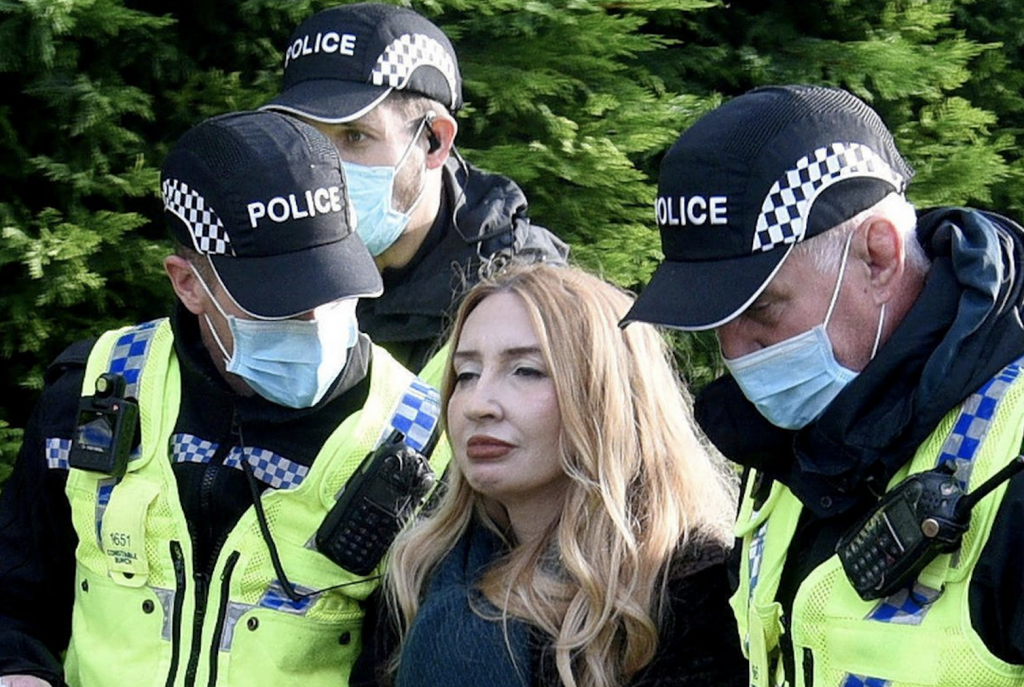
Debbie Hicks, the anti-lockdown protestor who was arrested after filming an apparently empty ward in Gloucestershire Royal Hospital at the end of last year, is facing four separate prosecutions in Magistrates’ Court – mainly for participating in anti-lockdown protests – and she needs to raise more funds to pay for her legal defence. The first case is due to be heard on November 16th and all four will be heard this winter. She has set up a CrowdJusice fundraiser that you can contribute to here.
Debbie’s solicitor plans to move on to the High Court if she loses in the Magistrates’ Court, or if the Magistrates’ Court says it doesn’t have the jurisdiction to consider her cases. That could be expensive, but the cause at stake could not be more important. Here is an extract from a note her solicitor sent to me:
These really are important cases in respect of Freedom of speech and Freedom to protest as:
- Success at the High Court will set a precedent that protest is not, and never has been, completely illegal during the pandemic – even under lockdown.
- Debbie suspects that the prosecution’s ultimate aim is to obtain a criminal behaviour order against her thereby chillingly curbing her ability to protest in the future.
- There are still a large number of other citizens across the country who are being ‘unlawfully’ prosecuted or have been convicted – a successful outcome at the High Court will lead to a landslide of other cases crumbling and open avenues of appeal to others already convicted.
- While the Crown Prosecution Service may try and quietly drop the odd case here and there after defence representations and arguments are filed, this will only occur when a prosecution lawyer reviews the case reasonably and objectively and properly analyses the law which is confusing and opaque – and, as Debbie has found, this is not easy to achieve. Success at the High Court will mean the CPS will have to blanket review all such cases and, with a legal precedent set, this will force the CPS to discontinue all remaining prosecutions.
- Many ordinary citizens without a previous blemish on their record will currently have criminal records because they’ve been convicted of these types of offences. Success in the High Court could lead to an avalanche of appeals and convictions being overturned.
- Success at the High Court will add clarity to the law that protesters have a reasonable excuse to gather and are not therefore committing an offence and cannot be directed to disperse or leave by the police.
- While the prohibition of protests has now been dropped, legislation can always be amended again in the future. Who knows if further lockdowns are on the horizon. We only have to look to Australia as an example of a government completely abusing its powers against its own citizens. Success at the High Court in Debbie’s case will make it harder for our Government to suspend the right to protest again.
Once again, if you’d like to make a contribution to Debbie’s fundraiser, you can find it here.
Lockdown: Where Did ‘The Science’ Come From?
By Noah Carl • The Daily Sceptic • October 19, 2021
In a previous post, I looked at where ‘The Science’ of community masking came from. Here I’ll do the same thing for lockdowns.
As many lockdown sceptics (including myself) have noted, lockdowns represent a radical departure from conventional forms of pandemic management. There is no evidence that, before 2020, they were considered an effective way to deal with influenza pandemics.
In a 2006 paper, four leading scientists (including Donald Henderson, who led the effort to eradicate smallpox) examined measures for controlling pandemic influenza. Regarding “large-scale quarantine”, they wrote, “The negative consequences… are so extreme” that this measure “should be eliminated from serious consideration”.
Likewise, a WHO report published mere months before the COVID-19 pandemic classified “quarantine of exposed individuals” as “not recommended under any circumstances”. The report noted that “there is no obvious rationale for this measure”.
And we all know what the U.K.’s own ‘Pandemic Preparedness Strategy’ said, namely: “It will not be possible to halt the spread of a new pandemic influenza virus, and it would be a waste of public health resources and capacity to attempt to do so.”
As an additional exercise, I searched the pandemic preparedness plans of all the English-speaking Western countries (U.K., Ireland, U.S., Canada, Australia and New Zealand) for mentions of ‘lockdown’, ‘lock-down’ ‘lock down’ or ‘curfew’.
Only ‘curfew’ was mentioned, and only once – in Ireland’s plan. The relevant sentence was: “Mandatory quarantine and curfews are not considered necessary.” None of the lockdown strings were mentioned in any of the countries’ plans.
So where did ‘The Science’ of controlling Covid using lockdowns come from? As everyone knows, China implemented the first lockdown (of Hubei province) in January of 2020. Yet it wasn’t until March that lockdowns became part of ‘The Science’.
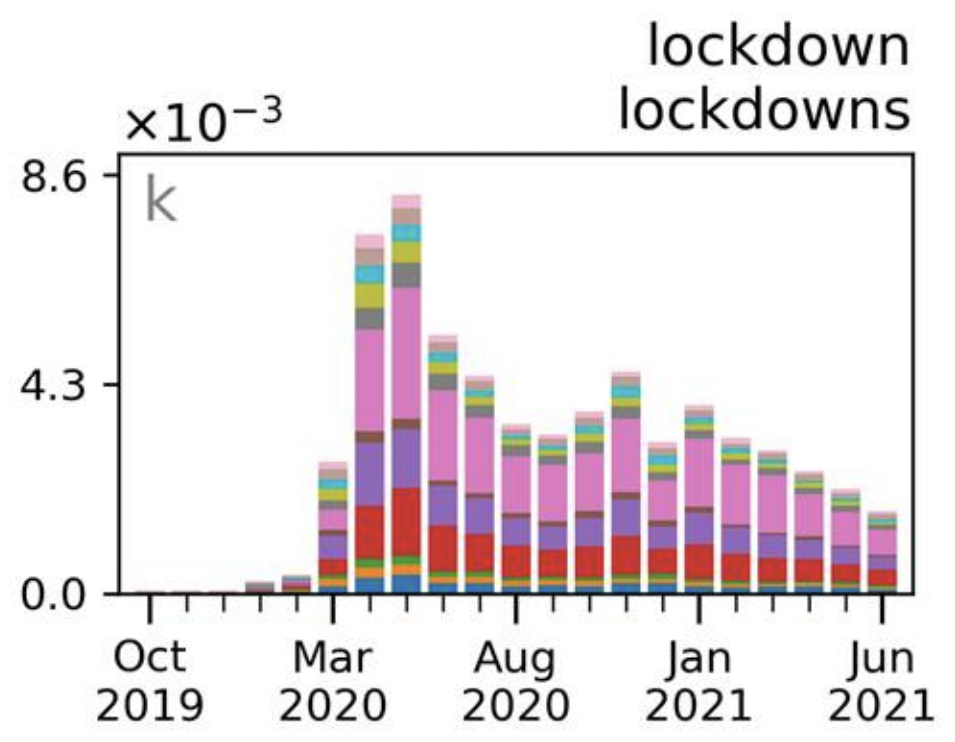
As this chart taken from the paper by David Rozado shows, major Western media outlets did not start mentioning ‘lockdown’ frequently until March:
And this chart confirms that worldwide Google search interest for ‘lockdown’ was essentially nil until 8th March 2020:
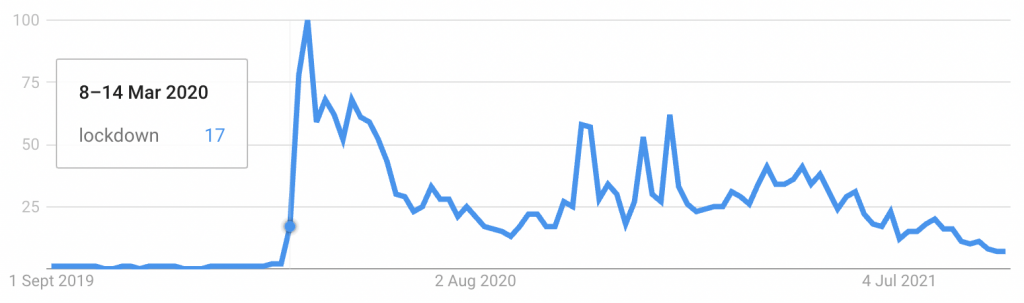
So what happened in early March? Well, Italy was the first Western country to lock down – on 9th March last year. And as Michael Senger argues, its decision appears to have been prompted by the WHO’s report of 24th February, which gave a glowing evaluation of China’s lockdown. (Senger’s piece is well worth reading.)
Other Western countries then followed suit. The next most important event, following Italy’s decision to lock down, was the publication of a report by Neil Ferguson’s team on 16th March.
This report has been described as the “catalyst for policy reversal”. Up until then, the U.K. had been more or less following its pandemic preparedness plan. As late as March 5th, Chris Whitty told the Health and Social Care Committee that “what we’re very keen to do is minimise social and economic disruption”.
Although other, similar reports had already been published, the analysis by Neil Ferguson’s team was seen as particularly authoritative. According to the New York Times, the report “also influenced the White House to strengthen its measures”.
On March 17th, Neil Ferguson and his colleagues held a press conference after returning from Downing Street. They confirmed that Britain would be adopting a new strategy. “The aim is not to slow the rate of growth of cases but actually pull the epidemic into reverse,” Ferguson said.
As to why the U.K. was changing tack, Ferguson noted, “We have had bad news from Italy and from early experience in UK hospitals”. However, subsequent revelations suggest that “bad news” was less important than the shifting of the Overton window.
In an interview with the Times published in December last year, Ferguson noted that “people’s sense of what is possible in terms of control changed quite dramatically between January and March”. Referring to China’s lockdown, he elaborated, “We couldn’t get away with it in Europe, we thought… And then Italy did it. And we realised we could”.
After China’s initial response in Hubei, it took two months for lockdowns to go from ‘unprecedented’ to ‘unavoidable’. They received two major doses of intellectual credibility: first from the WHO, and then from Neil Ferguson’s team. Italy set the all-important precedent for Western countries.
As to whether one should trust ‘The Science’ on lockdowns, a reasonable answer would be, ‘Do you mean the pre or the post-Covid science?’
Featured Video
Dan Dicks with James Corbett on Solutions Watch
or go to
Aletho News Archives – Video-Images
From the Archives
Secret document reveals plans for civil war in Lebanon, Israeli false flags, and invasion
By Randi Nord | Geopolitics Alert | April 5, 2019
Beirut – During his visit with US Secretary of State, Mike Pompeo, Lebanese President Michael Aoun reportedly received a US-Israeli document detailing plans for creating a civil war in Lebanon with covert false flag operations and possible Israeli invasion.
Although the source of the document is Israeli and created in partnership with Washington, no one knows who presented it to Aoun. The Lebanese TV station, Al-Jadeed, initially reported the document on Lebanese TV and a video on its website. Geopolitics Alert translated the report for this article. … continue
Blog Roll
 Aletho News
- Sheikh al-Asadi warns of Iraqi government compliance with US demands
- How to MAKE THE CONSPIRATORS PAY for their crimes! Dan Dicks with James Corbett on Solutions Watch
- There’s a drought in academia: A drought in honest research on the subject of drought and other weather extremes
- Department of War Awards $20.7 Billion Contract to Raytheon for Air-to-Air Missiles
- ‘Distance yourselves from Israel’: IRGC urges US population to question govt policies
- America’s Greenland deal has a radioactive backstory
- The RAF Fairford ‘terror plot’: Unpacking escalation in the UK echo-chamber
- EU Council Advances Chat Control 2.0 Scanning Proposal
- Ex-Greek MEP files complaint against Israeli spyware firm over alleged Pegasus surveillance
- Troubling ideas throughout the Torah, Talmud, Mishneh Torah and Tanya
- If Americans Knew
- New Report: “Scholasticide and Genocide in Gaza: Assessment, Testimonies and Legal Analysis”
- Ex-Biden officials are desperate for a Gaza scapegoat
- Israeli “settlers” Invade Al-Aqsa; Pour Boiling Water on 75-Year-Old
- Israel Has Kidnapped Another American Teenager
- US arms sales to Israel worth $21.6 billion in 20 months
- Three Palestinians Killed in Israeli Attacks on Gaza
- Revealed: German “Anti-Semitism Expert” Driving Crackdown on Palestine Solidarity is Former Israeli Spy
- Egypt’s Warning to Israel Before Oct 7
- Israel’s siege signals another cruel winter for 1.8 million Gazans – Daily Update
- Netanyahu Asked UAE Leader to Deny Report on Oct. 7 Warning in Secret Visit, Sources Say
- No Tricks Zone
- Two More Paleo Reconstructions Affirm Meters-Higher Sea Levels Across Ireland, Brazil 7000-6000 Years Ago
- New Study: Earth And Venus Surface Warmth Largely Explained By Convection And Lapse Rate, Not CO2 Or Radiation
- 2025 Nature Paper Claiming Worsening Global Drought Gets RETRACTED …Heavily Flawed
- New Study: ‘Global Drought Shows No Detectable Recent Acceleration Under Climate Warming’
- Economic Masterminds: German Socialists Suggest Taxing Productivity Gains Stemming From Using AI
- The South China Sea Has Not Been Cooperating With The Climate Change Narrative
- Energy Crisis: Germany Enters Heating Season With Historically Low Gas Reserve Fill Levels
- New Study: The Antarctic Ice Sheet Gained Mass From 2020-2024 Due To Staggering Snow And Ice Accumulation
- Study: Ocean Heating Rates From Thousands Of Years Ago ‘Dwarf’ Modern Ocean Heating Rates
- Climate Extremists Target, Attack Large-Scale Power Grid Infrastructure In Germany!

