Baylor Professor Calls for Prosecution of Criticism of Fauci and Other Scientists as Hate Crime

By Jonathan Turley | August 4, 2021
Physicist Richard P. Feynman once said “Religion is a culture of faith; science is a culture of doubt.” statement captures how science depends upon constant questioning and challenging of assumptions. Yet, what is healthy debate to some is criminal dissent to others. Dr. Peter Hotez, a professor of pediatrics and molecular virology at Baylor College of Medicine is calling for federal hate-crime protections to be extended to cover criticism of Dr. Anthony Fauci and other scientists. The frequent MSNBC and CNN guest wants Congress to expand hate crimes to “scientists currently targeted by far-right extremism in the United States.”
In a July 28 paper in Plos Biology titled “Mounting Antiscience Aggression in the United States,” Hotez encourages Congress to focus on the “band of ultraconservative members of the US Congress and other public officials with far-right leanings are waging organized and seemingly well-coordinated attacks against prominent US biological scientists.”
Hotez insists that it is not enough to support such science but to criminalize attacks on their research. This suggestion is just one of a number of ideas briefly put forward to support scientists but it is the most chilling. Referring Nazi and fascist movements in history, Hotez argues that good science requires cracking down on the right. He concludes:
“As Nobel Laureate and Holocaust survivor Elie Wiesel once pointed out, neutrality or silence favors the oppressor. We must take steps to protect our scientists and take swift and positive action to counter the growing wave of far-right antiscience aggression. Not taking action is a tacit endorsement, and a guarantee that the integrity and productivity of science in the United States will be eroded or lose ground.”
The federal hate crime laws focus on basis of a person’s characteristics of race, religion, ethnicity, nationality, gender, sexual orientation, and gender identity. We have seen calls for adding professions like police officers, which I also opposed. As with police officers, the inclusion of such professions would have a direct and inimical impact on free speech in our society. Indeed, it would create a slippery slope as other professions demand inclusion from reporters to ministers to physicians. Hate crimes would quickly apply to a wide array of people due to their occupations.
What is most striking about the Hotez article is its lack of analytical balance. He rages against the right without even acknowledging how social media companies have already enforced a massive censorship program that bars even reporting the results of public clinical trials or repeating CDC positions on vaccinations. For a year, Big Tech has been censoring those who wanted to discuss the origins of pandemic and those who suggested the lab theory were attacked as right-wing conspiracy theorists. It was not until Biden admitted that the virus may have originated in the Wuhan lab that social media suddenly changed its position. Facebook only recently announced that people on its platform will be able to discuss the origins of Covid-19 after censoring any such discussion.
Many of us have criticized the hateful rhetoric on both sides of our politics. However, there remain important debates over not just the underlying science relating to Covid-19 but the implications of such science for public policies. Criminalizing aspects of that debate would ratchet up the threats against those with dissenting views, including some scientists. That would harm not just free speech but science in the long run.
Double jabbed? That’s no protection from the Covid Cops

By Bridget Jones | TCW Defending Freedom | August 5, 2021
LAST week I had a house call by a Covid officer to check compliance with post-holiday quarantine following my return from the Balearics. After a lovely holiday in a destination on the green list which later turned amber, my punishment consisted of ten days’ forced isolation in three rooms (including lavatory) covering 500 square feet and no outside space.
As an unvaccinated Untouchable, I looked on in envy at my double-poked friends who returned to London being able to move about freely and my travel companion who’d be showing off her tan. I wistfully imagined the glamorous parties they’d be attending whilst I’d be limited to surfing murder mystery reruns on ITV with a slightly acidic bottle of rose.
But be careful what you envy, ladies . . .
Two such double-jabbed friends, both travelling back to the UK from amber list countries, Spain and Denmark, on different budget airlines, were pinged and ordered to self-isolate on their return. It turned out someone on both of their flights had tested positive for the virus.
Now, neither of them is dumb enough to have the NHS track and trace app but their details were taken from the forms they were required to complete to board the planes bound for home.
So it turns out that getting the poke is no guarantee of regaining your freedom at all, and definitely not any kind of insurance policy for risk-free travel abroad. This was in spite of the fact that both of them, having taken tests within 48 hours of boarding and on day 2 after landing in UK arrivals, tested negative for the virus. The one returning from Denmark was fortuitously pinged after day 2, which she interpreted to mean that her isolation could be shortened to 7 days. Both friends were also required to take a test on day 8 of isolation (so in her case after it was over), and unlike myself, their Untouchable counterpart, could not do a day 5 test to get out early for good behaviour.
Everyone keeps telling me that as of August 16 the double-vaccinated will be able to move around freely regardless of whether they have been pinged. But as in this context ‘pinged’ refers to the app presumably the new freedom pass will not apply to the situation both of my friends found themselves in. Such is the absurdity that will prevail in the approaching mid-month holiday peak that there will be no way to ascertain whether it is worth travelling to a green-list rock in the Atlantic or going the whole hog and risking a turn from amber to red, with consequent pay-to-play prison sentence on return.
I wonder whether the government (which I no longer spell with a capital ‘G’ as I do not recognise its legitimacy) justifies all of this on the premise that people who dare to go on holiday must be treated as putrid receptacles of contagion and thereby do penance for their hubris.
Just like me, my vaccinated friends are sitting at home this week, watching the tan fade and bingeing on Thai food delivered in a box whilst staring at some dystopian feminist melodrama on Channel 4 for human company. My Danish friend lives in a 350 square foot studio flat in Notting Hill but at least she has a balcony on which to smoke and sunbathe; otherwise I don’t know what she would do as in such a small space confinement is unbearable.
Not for her dressing up to visit Tesco Express or setting a playlist to walk in the park; no stolen glances at the hot barista on the morning coffee run. The Covid gods have spoken, and her sentence is to wake up every day in the fiery furnace of quarantine to be purified until such time as she may be released by her gracious overlords.
Lots of articles have been written recently about the pingdemic and I daresay most employees who can’t work from home are delighted to get a ping. These serfs will doubtless not be looking forward to August 16 (another ‘freedom day’), and were I one of them I would consider coming up with a strategy to deal with the impending fall-out. An efficient tactic could be the collection of bulk quantities of LF tests to multiply potentially positive results and, via photographic replication, establish a vault of templates for passing around when needed.
I digress. Back to being stalked by the Covid marshal. He knocked at the door twice, politely, and when I opened it he met me with sheepish eyes over a medical mask to request proof of ID. You can never be too careful in verifying the identity of someone who answers their own door during a spell of quarantine.
Neither of my vaccinated friends who were told to self-isolate received a visit from the NHS. I have now started quite feeling special that someone actually cared enough to check up on me.
Come to think of it, I should have invited the Covid marshal in for a drink . . .
French firefighters’ & hospital unions declare strikes against ‘unconstitutional’ vaccine mandate
RT | August 4, 2021
Two French unions have called for strikes against the compulsory vaccination of firefighters, healthcare workers, and caregivers. They say the measure violates fundamental rights.
One of the leading French firefighters’ unions, FA/SPP-PATS, which boasts 7,000 members, said it will go on strike starting Monday unless changes are made to the recent law on compulsory vaccination of certain employees.
“The obligatory vaccination of firefighters under [the threat] of penalty violates the constitution,” the union said in a statement.
“Our union does not oppose vaccination,” the organization’s spokesperson, Andre Goretti, told BFM TV. “But the conditions, under which it is being imposed on the professional level, with [the threat of] financial and other sanctions – that’s where we disagree.”
The hospital and caregivers’ union, SUD Sante Sociaux, also called for a strike and protests against the measure which it labelled “a new attack on labor law.”
According to the legislation, which was approved by parliament late last month, firefighters, medical workers, caregivers, and certain soldiers have until September 15 to get vaccinated or face sanctions. The controversial provision containing the vaccination mandate will be examined by the country’s Constitutional Council on Thursday.
The government has been pushing the population to get vaccinated in greater numbers amid the spread of the more contagious Delta variant of the virus.
Starting from August 9, people will be barred from restaurants, cafes, and long-distance transportation unless they have a health pass. The pass is already required for museums, cinemas, and other cultural venues with a capacity of more than 50 people.
These restrictions, along with the vaccination mandate, sparked protests across the country. More than 200,000 people participated in demonstrations across France on Saturday.
A group of uniformed firefighters was seen marching in a protest column in the southern city of Nice on Saturday, where around 6,500 people rallied against the government’s restrictive Covid-19 response.
Charles-Ange Ginesy, the head of the Alpes-Maritimes region and president of the regional firefighters’ board of directors, told BFM TV that he was “very disappointed” after seeing uniformed firefighters participating in a protest.
“The right to protest is a right that belongs to each of us. On the other hand, they wore their uniforms, which surprised me a lot,” the official said, expressing hope that “the controller-general will be able to make them understand that such attitude should not be repeated.”
The procedure is underway, during which we look at how these firefighters, who had probably acted out of clumsiness, will be able to return to reason.
Only a group of 20 to 30 marched with the protesters, compared to the 3,800 firefighters in the region, Ginesy said.
French civil servants are typically bound by the ‘duty of reserve’, meaning they must show restraint and moderation when expressing personal opinions.
The firefighters’ union spokesperson, Andre Goretti, meanwhile, defended his colleagues. “There are individual choices that are not put to question by our union,” he said. “It is an expression of a citizen. A firefighter – before being a professional firefighter – is a citizen.”
Authorities have made several concessions following the outrage, such as lowering the fines for businesses that do not check for health passes.
My own country of Canada expelled me because my Covid immunity was acquired naturally and not from a vaccine
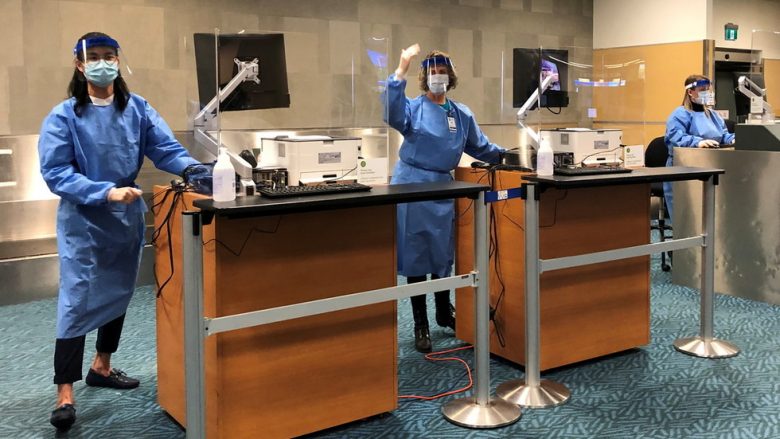
Public Health Agency of Canada staff stand at their positions at Vancouver International Airport © Reuters
By Rachel Marsden | RT | August 3, 2021
I went home to visit my mother. Canada tried to force me into a Covid detention facility threatening fines and police action as they don’t recognize my natural immunity. I had no choice but to immediately fly back to Europe.
At the time of writing, I’m at an altitude of exactly 11,277m, 5,230km away from Vancouver, Canada, and 3,159km from my stopover in Munich, Germany, en route back to Paris, France. Where I really should be is relaxing on the backyard patio or in the jacuzzi at my home near Vancouver with a cold drink on a hot summer day. Instead, I’m on a Lufthansa flight heading back to Paris – just a few hours after arriving across the ocean on a 10-hour flight – because my own country’s officials kicked me out. All because I committed the apparent violation of trying to re-enter my own country with proof of naturally acquired Covid-19 antibodies made by my own immune system post-recovery rather than those generated by the manmade Covid-19 vaccine about which much is still to be learned.
Daily life for a Covid-19 survivor with natural immunity from the disease is not for the faint of heart. As someone with a high level of laboratory tested antibodies whose levels have yet to drop even after several months post-illness, my doctor has advised against vaccination. Much is obviously still to be learned about the Covid jabs, still in stage 3 of clinical trials and considered experimental by health authorities – particularly with reports abounding of breakthrough cases of vaccinated people catching and spreading Covid.
To protect and preserve my acquired immunity by opting out of vaccination that risks interfering with it or causing a risk to my health, France now requires me to succumb to nasal swab antigen tests every 48 hours if I wish to continue accessing everyday venues like public transit, gyms, restaurants, some shopping malls, and bars. But it’s a price that I’m willing to pay for my health.
And now I’m paying another price for choosing to protect my own health. I’ve found myself threatened with internment by the Canadian government – something that not even terror suspects or illegal immigrants are subjected to without at least a hearing.
When I attempted to return home from Paris to Vancouver to visit my elderly mother for the first time in a year, I was treated worse than a criminal. I arrived at the airport with a negative PCR test, two positive Covid antibody tests from March and July proving that I still had significant Covid antibodies post-recovery, and a ‘covid immunity certificate’ written and signed by my French doctor to confirm this fact.
The Canadian border officer refused to accept the antibody laboratory test results as proof that I had recovered and was immune from Covid. He wanted a PCR test less than three months ago, after which everyone is expected to take the vaccine. (I didn’t even know that I had Covid until I took a serology antibody test weeks later.) Nor did the officer show any consideration for the negative PCR test taken hours at departure, or for the various other antigen tests – all negative – taken every 48 hours for the prior 10 days. Instead, he ordered me to sign up for a 3-day stay at a government internment facility (to then be followed by a mandatory and monitored 14-day home isolation).
I was then referred to a federal health officer who asked if I had signed up and paid (up to $2,000) for the 3-day government internment. I said no. She said that I had no choice except with respect to which government-contracted facility I’d like to be detained in at my own expense. I asked, “What if I just walk out?” She gestured to the RCMP officer behind her and said that leaving would result in a fine of nearly $6,000. I asked, “Then what if I just stay here in the airport and book a flight back to Paris and cancel my entire visit back home to Canada?” She replied that it would be fine. So, I booked a flight back on my phone at a cost of just over $1,500 – still cheaper than the government internment. She took down my return flight number, wrote me up a federal ‘health order’ that I had to sign, acknowledging that I was to leave Canada on that flight or face criminal penalties up to and including imprisonment. She helpfully added that I could still be fined for my ignorance, but they’d graciously let me off with a warning this time. What a benevolent budding authoritarian regime.
Let’s be clear: The Canadian government, by behaving in this manner, is routinely criminalizing those with Covid antibodies that are not derived from a manufactured experimental vaccine.
Just a few hours later, I am now on that flight back to Paris. My mother broke down in tears waiting for me on the other side of the arrivals hall as her daughter was expelled from her own country – something that Canada doesn’t even do with terror suspects without some kind of due process.
The next step for myself and others subjected to this discrimination should be a court challenge to the federal government’s actions. Government-ordered internment facilities for immune Covid survivors under threat of incarceration have no place in any democracy.
Rachel Marsden is a columnist, political strategist and host of an independently produced French-language program that airs on Sputnik France. Her website can be found at rachelmarsden.com
2020 Election Audits: Dominion & Maricopa County Defy Arizona GOP’s Subpoenas, DoJ Issues Warning
By Ekaterina Blinova – Sputnik – 03.08.2021
Last week, the Arizona state Senate requested election materials from Maricopa County and Dominion Voting Systems. However, county officials and voting machine manufacturers refused to comply with the Senate’s latest subpoenas, arguing that they are “invalid.” Earlier, the US DoJ yet again warned the states against conducting 2020 election audits.
Maricopa County’s Board of Supervisors and Dominion Voting Systems have resolutely defied the Arizona state Senate’s subpoenas requesting the election-related materials necessary to complete the audit of the 2020 election results in the state’s most populous county.
On 26 July, Arizona Senate President Karen Fann and Judiciary Committee Chairman Warren Petersen issued two subpoenas particularly seeking ballot envelopes or ballot envelope images, voter records, security keys for election machines, user names, passwords, routers or router images, and splunk logs.
However, in response, Maricopa County officials claimed that they do not have the user names, passwords, or security keys requested for the machines. They also refused to hand over routers or router images, or splunk logs, insisting that doing so would constitute “a security risk.” Ballot envelopes and voter records would be produced only if there’s confirmation “that appropriate security measures are in place”, highlighted the county’s attorney Allister Adel, as quoted by the Epoch Times.
Both Adel and Eric Spencer, a lawyer representing Dominion Voting Systems, noted that the Arizona GOP’s subpoenas were “legally defective”, as they were issued while the state Senate was out of session.
“Because the Subpoena is illegal and unenforceable, Dominion hopes that litigation over the Subpoena will not be necessary,” Spencer wrote. “Should litigation result, however, Dominion intends to pursue all remedies available to it, including (but not necessarily limited to) recovery of its attorneys’ fees, expenses, and damages.”
According to The Epoch Times, the Arizona state Senate is unlikely to vote on formalising the subpoena request in the near term, because, first, the Senate is still not in session and, second, two Arizona state Republicans have recently signalled that they now oppose the audit, which means that any such vote would fail.
However, the refusal of Maricopa officials and Dominion to deliver requested materials does not basically stem from the fact that Fann’s subpoena appears “invalid”. The Maricopa Board of Supervisors similarly refused to fully comply with the state Senate’s previous subpoena request, recognised as legit by Maricopa County Superior Court Judge Timothy Thomason in February 2021.
For its part, Dominion has made it clear that it “is not a public officer or public body and, therefore, has no obligation to make its records available for public inspection”. The company refused to either produce or allow the inspection of any election-related materials owned by it in response to Senate President Fann’s 23 July public record request.
Meanwhile, Maricopa Board of Supervisors Chairman Jack Sellers minced no words in his categorical statement urging the state Senators to “be prepared to defend any accusations of misdeeds in court”: “It is now August of 2021,” he wrote to Arizona Republican senators. “The election of November 2020 is over. If you haven’t figured out that the election in Maricopa County was free, fair, and accurate yet, I’m not sure you ever will.”
DoJ Meddling in State Election Audits, Again
While the Arizona Senate is reportedly preparing a formal response to the county and Dominion, Axios has drawn attention to the fact that the refusal to comply with the subpoenas came just days after the US Justice Department issued a “second warning” to states conducting audits of the 2020 election, called by the agency “the most secure in American history”.
On 28 July, the DoJ released a document titled Federal Law Constraints on Post-Election “Audits” which argues that regardless of the relevant state laws under which the states are conducting examination of the 2020 election results “federal law imposes additional constraints with which every jurisdiction must comply.” Furthermore, non-compliance with these federal laws may result in criminal penalties, the DoJ warned.
In particular, the agency expressed concerns that “some jurisdictions conducting [audits] may be using, or proposing to use, procedures that risk violating the Civil Rights Act”, which requires election officials to retain federal election records for at least 22 months after an election. The first warning was issued by the DoJ over the Arizona election audit in May 2021.
However, the DoJ has fallen short of specifying whether it plans to take any action against Arizona and other states pursuing audits, as BuzzFeed remarked last Wednesday.
In addition to Arizona, which has been conducting its independent forensic audit since April, Pennsylvania, Georgia and Wisconsin are seeking to carry out similar examinations of ballots, voting equipment and other materials related to the US 2020 elections. Former President Donald Trump has repeatedly endorsed the states’ legislative initiative, calling upon other states to follow suit. Independent auditors, election integrity activists and Republican officials in a number of states have called out instances of apparent voting irregularities, including duplicate ballots, non-matching ballot totals and cyber-security problems.
The Authoritarian in Charge at the NIH: Unvaccinated People Should be Fired, Banned from Public Places, and Barred from Travel
By Adam Dick | Ron Paul Institute | August 3, 2021
Francis S. Collins, the director of the United States government’s National Institutes of Health (NIH), went full-on authoritarian in his Sunday interview with Jake Tapper at CNN’s State of the Nation. Collins, in the interview, supported in short succession the imposing of several extreme violations of the freedom of people who have chosen not to take experimental coronavirus vaccines — some of which are not even vaccines under the normal meaning of the term.
Use vaccine passports to prevent these individuals from attending public events and entering businesses, fire them from their jobs, and bar them from traveling, Collins championed.
Here is the portion of the interview from the show’s transcript in which Collins made the comments:
TAPPER: Some businesses are going a step further and beginning to require proof of vaccinations not just for employees, but even for customers in some cases.
Audience members for Broadway plays and musicals will need to be vaccinated. Some bars in San Francisco and D.C. are requiring proof of vaccinations.
Do you think, as a public health measure, it would be good for more businesses to require vaccine credentials in order to have vaccinated customers?
F. COLLINS: As a public health person who wants to see this pandemic end, yes.
I think anything we can do to encourage reluctant folks to get vaccinated because they will want to be part of these public events, that’s a good thing. I’m delighted to see employers like Disney and Walmart coming out and asking their staff now to be vaccinated. I’m glad to see the president has said all federal employees — I oversee NIH with 45,000 people — need to also get vaccinated, or, if they’re not, to get regular testing, which is inconvenient. All of those steps I think are in the right direction. But I think maybe that’s what it will take for some of those who have still been a little reluctant to say, OK, it’s time. The data will support that decision.
TAPPER: Yes.
F. COLLINS: They are making the right choice for their own safety, but, sometimes, it takes a nudge.
TAPPER: Should airlines require that all fliers who are eligible to be vaccinated be vaccinated before boarding their planes?
F. COLLINS: I think that’s up to the airlines.
I do think a case could be made for that. And that would be another incentive for some of those who are reluctant. And people wouldn’t be surprised, I think, to see that start to happen. So, if you’re thinking about international travel and you’re not yet vaccinated, it might be time to go ahead and get started.
Decades back, Americans would hear similar authoritarian comments expressed by politicians and bureaucrats in the Soviet Union, and Americans would shake their heads in disgust. That could never happen here, many Americans would assure themselves.
Now it is one of the top bureaucrats in America expressing the same sort of authoritarian agenda and detailing how it is being implemented with the help of compliant companies. And, like in the old Union of Soviet Socialist Republics, American big media is cheering on the move. Welcome to the USSA.
Copyright © 2021 by RonPaul Institute.
Lockdowns, science or voodoo magic? An Interview With Philippe Lemoine
By Noah Carl • The Daily Sceptic • August 3, 2021
Philippe Lemoine is a PhD candidate in philosophy at Cornell University, with a background in computer science. He’s also a blogger, a research fellow at the Centre for the Study of Partisanship and Ideology, and a lockdown sceptic. During the pandemic, he’s written several detailed articles about the efficacy of lockdowns. I interviewed him via email.
On December 4th, you published an article on your blog titled ‘Lockdowns, science and voodoo magic’, which criticised the well-known paper by Flaxman et al. That paper (which has been cited more than 1,300 times) concluded, “major non-pharmaceutical interventions—and lockdowns in particular—have had a large effect on reducing transmission”. Could you briefly summarise your criticisms?
I made two main points against that paper. First, the model assumed that only non-pharmaceutical interventions affected transmission, so any observed reduction in transmission could only be ascribed by the model to non-pharmaceutical interventions. Since in fact transmission went down quickly everywhere during the first wave, the only question was how much of that reduction would the model attribute to each intervention. But the fact that non-pharmaceutical interventions were jointly responsible for the entire reduction in transmission was not something the model inferred from the data, it was assumed at the outset by the authors when they defined the model. A consequence of this fact is that, when they compute a counterfactual scenario in which there weren’t any non-pharmaceutical interventions to estimate how many lives were saved by lockdowns and other restrictions, the authors just assume that cases would have continued to rise until the herd immunity threshold was reached and would only start to go down then. Although the authors did not deem it necessary to reveal this small detail, this meant that, in their counterfactual, more than 95% of the population was already infected by May 3, which is preposterous. Even one year and a half after the beginning of the pandemic, there isn’t a single country where the proportion of the population that has been infected even comes close to such a figure, not even in countries where restrictions were extremely limited. So when the paper finds that non-pharmaceutical interventions in general and lockdowns in particular saved 3 million lives in Europe alone during the first wave, they only reach that conclusion by comparing the actual number of COVID-19 deaths to the number of deaths in a ridiculous scenario where essentially everyone had been infected. Yet this preposterous estimate was taken seriously by the entire scientific establishment and, as you noted, the paper became of the most cited studies on the COVID-19 pandemic.
The second point I made is that, not only was this result based on totally unrealistic assumptions, but the authors failed to disclose a key result that completely undermined their conclusion. As I explained above, the model was bound to attribute the entire reduction in transmission that was observed in Europe during the first wave to non-pharmaceutical interventions, the only question was how much of it would be attributed to each intervention. Their headline result was that, apart from lockdowns, nothing else had any clear effect, which meant that lockdowns were responsible for the overwhelming majority of the 3 million lives that, according to this study, non-pharmaceutical had collectively saved. However, Sweden was included in the study and never locked down, yet only a tiny fraction of its population was infected during the first wave. How is that possible if only lockdowns have a substantial effect on transmission? I knew this made no sense, so I downloaded the code of the paper to reproduce their analysis on my computer and take a closer look at the results. Their model allowed the effect of the last intervention, which happened to be a lockdown everywhere except in Sweden, where it was a ban on public events, in each country to vary. What my analysis of their results showed is that, in order to fit the data, the model had to find that banning public events reduced transmission by ~72.2% in Sweden but only by ~1.6% elsewhere. In other words, according to the model, banning public events had somehow been 45 times more effective in Sweden than anywhere else. Now, unless you believe there are magical anti-pandemic faeries in Sweden that somehow made banning public events 45 times more effective than elsewhere, this obviously never happened. Rather, what this means is that the model was garbage, which in turn means that we have no reason to believe the paper’s headline result that lockdown had a huge effect on transmission. There is a lot more in my piece about that paper, which I methodically demolish, but those are the main points.
Then on March 4th, you published a report for the Centre for the Study of Partisanship and Ideology titled ‘The Case against Lockdowns’. This was followed by an op-ed in the Wall Street Journal titled ‘The Lockdowns Weren’t Worth It’. Could you briefly summarise the case against lockdowns, as you see it?
First, I think it’s impossible to estimate precisely the effects of non-pharmaceutical interventions because too many factors contribute to transmission, and we lack the kind of background knowledge we’d need to be confident that the statistical techniques people use to estimate those effects are reliable, so people who claim to be able to do that are full of it. I just published another piece in which I take a very close look at a study which found that non-pharmaceutical interventions had a substantial effect on the number of cases and deaths in the US during the first wave. This study is far more sophisticated than Flaxman et al.’s paper and, in particular, the authors did not assume that only non-pharmaceutical interventions affect transmission, and tried to model the effect of voluntary behavioral changes. Nevertheless, as I show in my article, when you look at it closely and perform various sensitivity analysis, the conclusions no longer hold. So we have no way to estimate precisely the effects of non-pharmaceutical interventions and we should be honest about this. However, whatever their precise effects, they can’t be huge because otherwise they would be much easier to detect. The contrast with the effect of vaccination is particularly striking in that respect. In the case of vaccination, the effect is so obvious that you can see it on a simple chart, whereas in the case of non-pharmaceutical interventions you have to squint and use very complicated statistical techniques that, although they impress people because they look scientific, we have no reason to think are reliable in this context. Now, if you do a cost-benefit analysis, even if the only costs of lockdowns you take into account is the immediate effect they have on people’s well-being and you make ridiculously optimistic assumptions about how much stringent restrictions reduce transmission, they don’t pass a cost-benefit test. In fact, not only do they fail to pass a cost-benefit test, but it’s not even close. The costs of lockdowns, by which I mean just their immediate effect on well-being, so far outweigh their benefits that one cannot reasonably doubt a more rigorous cost-benefit analysis would reach a different conclusion.
According to some people, claiming that lockdowns don’t have a large effect on the spread of COVID-19 is tantamount to “denying germ theory”. What do you say to those people?
Nobody is denying that transmission occurs during physical interactions, but it doesn’t follow that lockdowns have a large effect on transmission, so people who make this argument simply haven’t thought things through. In theory, lockdowns could even increase transmission, so this argument is very confused. For instance, it could be that, although lockdowns decrease between-household contacts, the effect on transmission at the aggregate level is more than compensated by the increase in within-household contacts they produce. To be clear, I don’t believe this is the case, I’m just saying that it’s a theoretical possibility that obtains in some models, even though nobody denies the germ theory of diseases. There are many possible explanations for why lockdowns don’t result in the very large reduction in transmission that one might have expected. For instance, we don’t expect lockdowns to be equally effective at reducing all types of contacts and, as I just noted, they even increase the frequency of some types of contacts, such as within-household contacts. So it could be that the types of contacts that lockdowns manage to reduce a lot don’t contribute a lot to transmission, while the types of contacts they aren’t very useful for preventing contribute a lot to it. Another important point is that, even in the absence of a lockdown, people change their behavior in response to the pandemic. So it could be that the types of contacts that contribute the most to transmission are the same types of contacts that people tend to reduce voluntarily even in the absence of a lockdown. Anyway, whatever the explanation, it’s pretty clear that lockdowns don’t have a very large effect. It would be very surprising if such a fact were inconsistent with the germ theory of diseases, but fortunately it isn’t. It’s just that people who make this argument are confused. The effectiveness of lockdowns and restrictions in general is an empirical question that cannot be solved by theorizing from the armchair.
Much of your writing about lockdowns has dealt with the deficiencies of epidemiological models. Why have most models done so poorly at predicting the epidemic’s trajectory?
This is a difficult question and I’m not sure what the answer is. I’m very confident that part of the story is that most of those models don’t take into account the kind of voluntary changes of behavior I was just talking about. If your model is based on the assumption that people’s behavior only changes in response to government interventions, it should be no surprise that it performs terribly. But I don’t think it’s the whole story and I increasingly suspect that the fact that models don’t adequately model population structure is another factor. Most epidemiological models that have been used to make projections assume that, withing large age groups, people mix homogeneously. But this is totally unrealistic since, for instance, a 55-year-old is not equally likely to run into any other person in the 50 to 59 age group. Rather, a particular 55-year-old is very likely to have contacts with some people in that age group (such as friends and family), but very unlikely to meet many other people in that age group and has essentially no chance of running into the vast majority of people in that age group. Anyway, nobody really knows why those models perform so terribly at larger scales, but in order to investigate the problem epidemiologists would first have to acknowledge it. Unfortunately, they mostly ignore it and act as if their models had not proven incapable of explaining the data, except in the sense that you can always “explain” any data if you are willing to make enough purely ad hoc hypotheses, so they don’t even get started.
As far as I’m aware, no Western government has published a cost-benefit analysis of lockdowns. Why were these far-reaching policies implemented with so little regard for costs?
As I noted above, any serious cost-benefit analysis would immediately show that lockdowns are not worth it. Yet as you say no Western government has published any to justify their policy. This is particularly surprising when you know that, in most Western governments, the use of cost-benefit analyses is largely institutionalized and the authorities are often required to make one before they can embark on projects as banal as building a bridge. Yet they apparently didn’t feel the need to publish a cost-benefit analysis to justify what are effectively the largest attacks on individual freedoms in the West since the end of World War 2. One interpretation is they realize that, as I noted above, no cost-benefit analysis would ever vindicate lockdowns. But this wouldn’t explain why they are pursuing lockdowns and I don’t believe in that explanation for a second anyway. In a way, if that were really the explanation, I would almost find that reassuring because it would at least imply a level of competence and understanding which I think is entirely lacking from our political leaders. Rather, I think their decisions are the result of a combination of cluelessness not just on their part but also on the part of their advisors and a variety of bad incentives that conspire to create absurd policies, such as the desire not to leave themselves open to the accusation of not having done anything to curb the epidemic. This desire must be strong as they are constantly under pressure from the largely pro-lockdown media to enact more restrictions. In order to answer this unremitting call to “do something”, they do something, even if that’s completely absurd, as long as they have something to show to the people who constantly ask them to “do something”. The idea of measuring the costs of their decisions against their supposed benefits often doesn’t even enter their heads because their decision-process is not governed by rational considerations, but rather by this ungodly combination of emotion, illusion of control, bad incentives and even worse advice.
You’re a Frenchman. Given what we know now, what should Emmanuel Macron have done in March of 2020?
With the benefit of hindsight, I think he should have just told people to try to limit their contacts to reduce the amount of stress on hospitals, but leave them free to make their own choices and focus his efforts on preparing government services to respond as best as possible. I think there are lots of reasons to blame Macron and French officials for their conduct at the beginning of the pandemic, especially for their lack of preparation and their carelessness in the weeks leading up to the explosion of cases in the country, but if we put aside the lies they told repeatedly during that period and since then, they at least had the excuse that we didn’t know much about the virus and how different policies would affect spread. I was in favor of the first lockdown and, while I now think that I was wrong and that I should have predicted lockdowns would become entrenched after we had used them once, it was a genuinely difficult decision because we didn’t know much. But after the first wave there was no longer any excuse and Macron should be judged harshly for keeping us more or less locked down for months after the first wave, even though it was already very clear by that point that restrictions did not make a very large difference to transmission, yet had a very negative impact on the population’s well-being.
The Delta Helter Skelter. When Dire Delta is the excuse for new lockdowns and vaccine mandates, but the truth keeps dribbling out.
Today more news from Israel
By Meryl Nass, MD | August 3, 2021
‘Helter-skelter’ means ‘in chaotic and disorderly haste’.
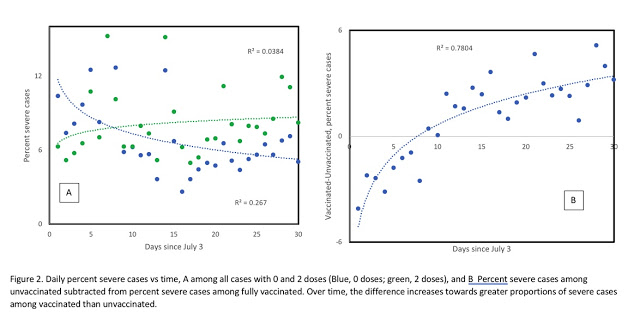
It seems a good descriptor of how public health mouthpieces are dealing with the facts oozing out of the public health muck regarding the Delta variant. Considering their strategy has been to use Delta to impose ever more harsh and unjustifiable Great Reset measures. Not to mention vaccine mandates. But now things look a lot worse than they did in that CDC slide deck. Check out these official graphs from Israel: not only are cases rising equally in the vaccinated as the unvaccinated, but the vaccinated are not being spared severe illness, as claimed by our plucky CDC director.
If nearly all the elderly and high risk Israelis have been vaccinated, then there would be some benefit of vaccination in warding off severe illness… but still, 2/3 of those with severe illness have been doubly vaccinated.
How can you spin this into a justification for vaccine mandates? You can’t. And unless the authorities can prove there is no ADE [antibody-dependent enhancement], getting a booster could just make things a whole lot worse.

[I think we should stop talking about this as a pandemic response. It is a coup, a Reset of the world as we knew it. The so-called responses simply served to terrorize the public and prolong the illness. ]
Spanish Officials to Hire Foreign Snitch Squads to Report on Illegal House Parties
By Paul Joseph Watson | Summit News | August 3, 2021
Under the justification of stopping the spread of COVID-19, officials on the Spanish island of Ibiza are planning to hire teams of snitch squads made up of foreigners who will report illegal house parties to the authorities.
Yes, really.
Organizers of illegal parties face gigantic fines of up to €600,000 euros, but that apparently hasn’t deterred some people from risking financial ruin after local authorities once again shut down nightclubs and imposed a ban on mixed household gatherings from 1am to 6am.
Local official Mariano Juan appealed for “outside help” after explaining that it was hard for police to infiltrate the parties because officers were known to locals.
He added that authorities are working with a private company to hire “foreigners between 30 and 40 years old” who can infiltrate the parties and then report back to police.
In other words, the government is hiring private snitch squads to grass people up for having fun in their own homes.
“The idea has… been heavily criticised by the Socialist party, which leads the regional administration covering Ibiza,” reports the Guardian. “A spokesperson, Vicent Torres, called on the island’s officials to put forth “serious proposals that have legal backing” rather than “acting irresponsibly by launching ideas that we cannot agree to.”
Draconian efforts to enforce coronavirus rules are still underway despite a recent ruling by Spain’s top court which concluded that the country’s lockdown was unconstitutional.
Spain’s lockdown was characterized by innumerable dystopian facets that confirmed it as one of the most brutal in Europe.
During the first six weeks of the lockdown, stay at home measures were so strict that Spaniards weren’t even allowed to go outside to exercise or walk their dogs.
In one case, police were called after a neighbor spotted two brothers playing soccer in their own back yard.
For many months during hot weather, wearing masks in every outdoor setting, even on beaches, was compulsory and authorities briefly told citizens that wearing masks while swimming in the sea was mandatory.
People were also issued fines of €2,000 euros for “disrespecting” a police officer during lockdown.
Numerous instances of police beating people for not wearing masks also emerged, while protesters at one point freed a woman from police arrest while cops were trying to handcuff her for not wearing a face covering.
20,595 Dead 1.9 million injured (50% serious) reported in EU’s database of adverse reactions for COVID shots
By Brian Shilhavy | Health Impact News | August 2, 2021
The European Union database of suspected drug reaction reports is EudraVigilance, and they are now reporting 20,595 fatalities, and 1,960,607 injuries, following COVID-19 injections.
A Health Impact News subscriber from Europe reminded us that this database maintained at EudraVigilance is only for countries in Europe who are part of the European Union (EU), which comprises 27 countries.
The total number of countries in Europe is much higher, almost twice as many, numbering around 50. (There are some differences of opinion as to which countries are technically part of Europe.)
So as high as these numbers are, they do NOT reflect all of Europe. The actual number in Europe who are reported dead or injured due to COVID-19 shots would be much higher than what we are reporting here.
The EudraVigilance database reports that through July 31, 2021 there are 20,595 deaths and 1,960,607 injuries reported following injections of four experimental COVID-19 shots:
- COVID-19 MRNA VACCINE MODERNA (CX-024414)
- COVID-19 MRNA VACCINE PFIZER-BIONTECH
- COVID-19 VACCINE ASTRAZENECA (CHADOX1 NCOV-19)
- COVID-19 VACCINE JANSSEN (AD26.COV2.S)
From the total of injuries recorded, half of them (968,870) are serious injuries.
“Seriousness provides information on the suspected undesirable effect; it can be classified as ‘serious’ if it corresponds to a medical occurrence that results in death, is life-threatening, requires inpatient hospitalisation, results in another medically important condition, or prolongation of existing hospitalisation, results in persistent or significant disability or incapacity, or is a congenital anomaly/birth defect.”
A Health Impact News subscriber in Europe ran the reports for each of the four COVID-19 shots we are including here. This subscriber has volunteered to do this, and it is a lot of work to tabulate each reaction with injuries and fatalities, since there is no place on the EudraVigilance system we have found that tabulates all the results.
Since we have started publishing this, others from Europe have also calculated the numbers and confirmed the totals.*
Here is the summary data through July 31, 2021.
Total reactions for the experimental mRNA vaccineTozinameran (code BNT162b2,Comirnaty) from BioNTech/ Pfizer: 9,868 deaths and 767,225 injuries to 31/07/2021
- 21,004 Blood and lymphatic system disorders incl. 126 deaths
- 19,717 Cardiac disorders incl. 1,489 deaths
- 177 Congenital, familial and genetic disorders incl. 14 deaths
- 9,913 Ear and labyrinth disorders incl. 8 deaths
- 471 Endocrine disorders incl. 3 deaths
- 11,693 Eye disorders incl. 21 deaths
- 69,612 Gastrointestinal disorders incl. 431 deaths
- 205,214 General disorders and administration site conditions incl. 2,832 deaths
- 779 Hepatobiliary disorders incl. 46 deaths
- 8,405 Immune system disorders incl. 53 deaths
- 24,114 Infections and infestations incl. 941 deaths
- 9,314 Injury, poisoning and procedural complications incl. 146 deaths
- 19,170 Investigations incl. 323 deaths
- 5,675 Metabolism and nutrition disorders incl. 178 deaths
- 104,915 Musculoskeletal and connective tissue disorders incl. 122 deaths
- 528 Neoplasms benign, malignant and unspecified (incl cysts and polyps) incl. 43 deaths
- 137,631 Nervous system disorders incl. 1,081 deaths
- 719 Pregnancy, puerperium and perinatal conditions incl. 24 deaths
- 140 Product issues incl. 1 death
- 13,659 Psychiatric disorders incl. 130 deaths
- 2,481 Renal and urinary disorders incl. 157 deaths
- 8,028 Reproductive system and breast disorders incl. 2 deaths
- 33,642 Respiratory, thoracic and mediastinal disorders incl. 1,168 deaths
- 36,970 Skin and subcutaneous tissue disorders incl. 87 deaths
- 1,289 Social circumstances incl. 13 deaths
- 564 Surgical and medical procedures incl. 25 deaths
- 21,401 Vascular disorders incl. 404 deaths
Total reactions for the experimental mRNA vaccine mRNA-1273(CX-024414) from Moderna: 5,460 deaths and 212,474 injuries to 31/07/2021
- 3,901 Blood and lymphatic system disorders incl. 49 deaths
- 6,139 Cardiac disorders incl. 599 deaths
- 86 Congenital, familial and genetic disorders incl. 3 deaths
- 2,699 Ear and labyrinth disorders
- 165 Endocrine disorders incl. 1 death
- 3,330 Eye disorders incl. 13 deaths
- 18,562 Gastrointestinal disorders incl. 200 deaths
- 57,313 General disorders and administration site conditions incl. 2,188 deaths
- 345 Hepatobiliary disorders incl. 20 deaths
- 1,803 Immune system disorders incl. 9 deaths
- 6,151 Infections and infestations incl. 332 deaths
- 4,652 Injury, poisoning and procedural complications incl. 102 deaths
- 4,289 Investigations incl. 103 deaths
- 2,105 Metabolism and nutrition disorders incl. 125 deaths
- 26,743 Musculoskeletal and connective tissue disorders incl. 107 deaths
- 252 Neoplasms benign, malignant and unspecified (incl cysts and polyps) incl. 27 deaths
- 38,118 Nervous system disorders incl. 552 deaths
- 432 Pregnancy, puerperium and perinatal conditions incl. 5 deaths
- 46 Product issues
- 4,224 Psychiatric disorders incl. 90 deaths
- 1,306 Renal and urinary disorders incl. 85 deaths
- 1,526 Reproductive system and breast disorders incl. 2 deaths
- 9,377 Respiratory, thoracic and mediastinal disorders incl. 521 deaths
- 11,300 Skin and subcutaneous tissue disorders incl. 45 deaths
- 925 Social circumstances incl. 20 deaths
- 700 Surgical and medical procedures incl. 55 deaths
- 5,985 Vascular disorders incl. 207 deaths
Total reactions for the experimental vaccine AZD1222/VAXZEVRIA (CHADOX1 NCOV-19) from Oxford/ AstraZeneca: 4,534 deaths and 923,749 injuries to 31/07/2021
- 10,912 Blood and lymphatic system disorders incl. 184 deaths
- 15,131 Cardiac disorders incl. 523 deaths
- 132 Congenital familial and genetic disorders incl. 3 deaths
- 10,643 Ear and labyrinth disorders
- 415 Endocrine disorders incl. 3 deaths
- 16,108 Eye disorders incl. 18 deaths
- 91,912 Gastrointestinal disorders incl. 229 deaths
- 244,487 General disorders and administration site conditions incl. 1,128 deaths
- 729 Hepatobiliary disorders incl. 41 deaths
- 3,663 Immune system disorders incl. 18 deaths
- 22,077 Infections and infestations incl. 284 deaths
- 10,114 Injury poisoning and procedural complications incl. 119 deaths
- 20,068 Investigations incl. 105 deaths
- 11,087 Metabolism and nutrition disorders incl. 62 deaths
- 140,986 Musculoskeletal and connective tissue disorders incl. 63 deaths
- 446 Neoplasms benign malignant and unspecified (incl cysts and polyps) incl. 13 deaths
- 194,032 Nervous system disorders incl. 727 deaths
- 363 Pregnancy puerperium and perinatal conditions incl. 8 deaths
- 135 Product issues incl. 1 death
- 17,296 Psychiatric disorders incl. 39 deaths
- 3,324 Renal and urinary disorders incl. 40 deaths
- 11,369 Reproductive system and breast disorders
- 31,980 Respiratory thoracic and mediastinal disorders incl. 534 deaths
- 42,437 Skin and subcutaneous tissue disorders incl. 30 deaths
- 1,093 Social circumstances incl. 7 deaths
- 971 Surgical and medical procedures incl. 19 deaths
- 21,839 Vascular disorders incl. 336 deaths
Total reactions for the experimental COVID-19 vaccine JANSSEN (AD26.COV2.S) from Johnson & Johnson: 733 deaths and 57,159 injuries to 31/07/2021
- 531 Blood and lymphatic system disorders incl. 23 deaths
- 867 Cardiac disorders incl. 92 deaths
- 21 Congenital, familial and genetic disorders
- 346 Ear and labyrinth disorders
- 24 Endocrine disorders incl. 1 death
- 705 Eye disorders incl. 3 deaths
- 5,449 Gastrointestinal disorders incl. 27 deaths
- 15,097 General disorders and administration site conditions incl. 177 deaths
- 78 Hepatobiliary disorders incl. 7 deaths
- 231 Immune system disorders incl. 5 deaths
- 915 Infections and infestations incl. 21 deaths
- 529 Injury, poisoning and procedural complications incl. 11 deaths
- 2,936 Investigations incl. 51 deaths
- 305 Metabolism and nutrition disorders incl. 12 deaths
- 9,614 Musculoskeletal and connective tissue disorders incl. 18 deaths
- 24 Neoplasms benign, malignant and unspecified (incl cysts and polyps) incl. 2 deaths
- 12,240 Nervous system disorders incl. 90 deaths
- 17 Pregnancy, puerperium and perinatal conditions incl. 1 death
- 17 Product issues
- 659 Psychiatric disorders incl. 8 deaths
- 207 Renal and urinary disorders incl. 9 deaths
- 354 Reproductive system and breast disorders incl. 2 deaths
- 1,878 Respiratory, thoracic and mediastinal disorders incl. 57 deaths
- 1,602 Skin and subcutaneous tissue disorders incl. 2 deaths
- 143 Social circumstances incl. 3 deaths
- 468 Surgical and medical procedures incl. 30 deaths
- 1,902 Vascular disorders incl. 81 deaths
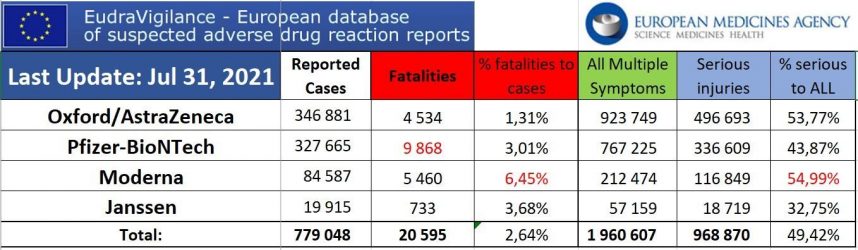
*These totals are estimates based on reports submitted to EudraVigilance. Totals may be much higher based on percentage of adverse reactions that are reported. Some of these reports may also be reported to the individual country’s adverse reaction databases, such as the U.S. VAERS database and the UK Yellow Card system. The fatalities are grouped by symptoms, and some fatalities may have resulted from multiple symptoms.
“This Is Not the Country That I Grew Up In”: Australian Widow Arrested for Exercising Near Home
By Michael Curzon • The Daily Sceptic • August 2, 2021
Following reports of the Australian army being deployed to ensure citizens are abiding by strict lockdown rules, an elderly Sydney resident has written to the Australian about being arrested for exercising near her home. Police officers interpreted this as an offence because the resident, a widow, was wearing a sign and walking in an area she rarely visited. Her letter, republished below, highlights the lengths to which the Australian authorities are going to keep citizens under control.
I am a 78 year-old widow who chose to exercise in the Sydney central business district (CBD) on Saturday. I wore a sign saying: “Not happy, Gladys.” I was alone, I am fully vaccinated and I was wearing a mask.
I was stopped by police and asked what I was doing. I said I was exercising within 10km of my home. They told me I was not allowed to wear a sign while exercising. Both they and I were very respectful but I was arrested on the grounds that, as I did not normally exercise in the CBD, and was wearing a sign, I was protesting and not exercising.
This is not the country that I grew up in. And the really sad thing is that there will be so many who have been intimidated into cringing cowardice and who will just say of me: “Stupid old biddy, serves her right for not just being obedient.”
Mary M Ancich, Birchgrove, Queensland
Featured Video
Dan Dicks with James Corbett on Solutions Watch
or go to
Aletho News Archives – Video-Images
From the Archives
$1.5bn up in smoke: US THAAD missile stockpile dries up defending Israel against Iran
By Ivan Kesic | Press TV | July 2, 2025
According to American media, defense news outlets, and independent analysts, the 12-day Israeli military aggression against Iran significantly depleted the US stockpile of THAAD (Terminal High Altitude Area Defense) interceptor missiles.
Citing official sources, American magazine Newsweek reported on Friday that the US transferred a substantial portion of its advanced missile defense capabilities to support the Israeli regime, an effort with questionable results and a critical impact on US strategic reserves.
THAAD, developed by Lockheed Martin arms manufacturing company, is a key component of Israel’s multi-layered air defense architecture. It is designed to intercept medium-range ballistic missiles, including those launched from Iran and Yemen.
The US-made system is capable of targeting short-, medium-, and intermediate-range ballistic missiles during their terminal phase, whether inside or outside Earth’s atmosphere.
THAAD uses a “hit-to-kill” method, relying on kinetic energy rather than explosive warheads to destroy incoming threats, intercepting at altitudes of up to 150 km and ranges between 150-200 km.
Operated exclusively by American personnel, the US military maintains eight THAAD batteries with an estimated 350–400 interceptors in total. The eighth battery was activated during the June 20 Israeli aggression against Iran and is capable of intercepting hypersonic missiles. … continue
Blog Roll
 Aletho News
- Zionist Bought Senate Blocks Information About American Citizens Killed By Israel
- While Gaza dominates the UN, these are the people keeping it alive
- New Report: “Scholasticide and Genocide in Gaza: Assessment, Testimonies and Legal Analysis”
- ‘THAAD Delusion’: Iran war exposes US missile shield limits – The Atlantic
- Moscow issues warning to NATO over Russian exclave
- Yes, the Iran war has destroyed Trump’s presidency
- The fallacy of US delusions about Iran’s economic collapse
- Hezbollah denies Syria cell link, warns of Israeli plan to sow discord
- The legacy of US sanctions, war, and occupation in Iraq
- Iraqi resistance group rejects disarmament, vows to maintain support for Lebanon
- If Americans Knew
- Mamdani releases plan to combat antisemitism and hate crimes in New York City
- Iran’s Revolutionary Guards Publish Letter to the American People
- DMFI launches $1 million ad campaign supporting Virginia’s Elaine Luria
- US Senate blocks resolution seeking report on Americans killed by Israel
- Israeli Attacks Kill Ten Palestinians in Gaza
- Massacre at Minab: The School That Became a Grave
- Israeli media: The IDF Shows It Doesn’t Turn a Blind Eye; It Actively Emboldens Settler Havoc
- As settlers ravage West Bank, Israeli forces kill 10 in Gaza – Daily Update
- New Report: “Scholasticide and Genocide in Gaza: Assessment, Testimonies and Legal Analysis”
- Ex-Biden officials are desperate for a Gaza scapegoat
- No Tricks Zone
- Green Energy Debacle: German Expert Professor Fritz Vahrenholt Warns Of Severe Economic And Social Consequences
- Two More Paleo Reconstructions Affirm Meters-Higher Sea Levels Across Ireland, Brazil 7000-6000 Years Ago
- New Study: Earth And Venus Surface Warmth Largely Explained By Convection And Lapse Rate, Not CO2 Or Radiation
- 2025 Nature Paper Claiming Worsening Global Drought Gets RETRACTED …Heavily Flawed
- New Study: ‘Global Drought Shows No Detectable Recent Acceleration Under Climate Warming’
- Economic Masterminds: German Socialists Suggest Taxing Productivity Gains Stemming From Using AI
- The South China Sea Has Not Been Cooperating With The Climate Change Narrative
- Energy Crisis: Germany Enters Heating Season With Historically Low Gas Reserve Fill Levels
- New Study: The Antarctic Ice Sheet Gained Mass From 2020-2024 Due To Staggering Snow And Ice Accumulation
- Study: Ocean Heating Rates From Thousands Of Years Ago ‘Dwarf’ Modern Ocean Heating Rates

