UK govt gave contract to IT firm that is ‘openly plotting’ to turn vaccine passports into a national ID card
RT | June 21, 2021
The British government has been accused of aiming to covertly implement a national ID programme, after it partnered with a company that has advocated turning vaccine passports into a multi-purpose document.
Entrust, an IT firm that bills itself as a “global leader in identities, payments, and data protection,” was awarded a contract by the Department of Health and Social Care last month to work on the UK’s Covid-19 vaccine certificate system. The company was given £250,000 ($346,000) to provide cloud-computing services for the government’s Covid-status certification scheme, iNews reported. The contract is due to expire in March 2022, but the government has the option of extending it for an additional year.
Health Secretary Matt Hancock stated last month that proof of vaccination will be “necessary” for international travel, and in recent weeks reports have emerged claiming that the UK government may require the document of people attending sporting events or other large gatherings.
Judging from Entrust’s own stance on the issue, it’s possible that the government may have even more ambitious plans for the digital certificate. In a February blog post published on the company’s website, Jann Markey, Entrust’s product marketing director, argued that the advent of the vaccine passports could be used as an opportunity to roll out a national ID as part of “the infrastructure of the new normal.”
“Consider a national ID strategy: With the infrastructure and investment necessary to ensure a viable vaccine passport, why not redeploy this effort into a national citizen ID programme that can be used for multiple purposes including the secure delivery of government services, secure cross-border travel, and documentation of vaccination,” the blog, which explores vaccine passports in the “post-pandemic world,” states.
Notably, the US-based company has already helped Albania, Ghana and Malaysia deploy national ID systems, iNews said.
Entrust’s partnership with the UK government has already raised alarm among civil liberties organisations and lawmakers.
Tory MP David Davis, a member of the anti-lockdown Covid Recovery Group, demanded an explanation from the government. He told iNews that it was “extraordinary” that the health department could ink deals with such companies without first getting permission from Parliament, adding that it was particularly worrying that a contract could be given to a firm “with this sinister attitude to surveillance of citizens.”
Former Conservative leader Sir Iain Duncan Smith echoed similar displeasure, claiming that the contract contradicts the “stated position of the government” and should be nixed.
Big Brother Watch, a privacy and civil liberties group, said the Entrust contract represents an attempt by the government to issue ID cards “by the backdoor.”
“The fact that the government has done a deal with Entrust, a company which is openly plotting a route from vaccine passports to digital identity cards, only underlines what a serious threat Covid passes would be to our civil liberties and our privacy,” the organisation’s head of research, Jake Hurfurt, warned.
A health department spokesperson insisted that the NHS app used to certify vaccination status will not be used as a national ID system, describing the scheme as a “simple and secure means” to allow for international travel. Entrust declined to comment when contacted by iNews.
Manufacturing (New Normal) “Reality”
By CJ Hopkins | The Consent Factory | June 20, 2021
The ultimate goal of every totalitarian system is to establish complete control over society and every individual within it in order to achieve ideological uniformity and eliminate any and all deviation from it. This goal can never be achieved, of course, but it is the raison d’être of all totalitarian systems, regardless of what forms they take and ideologies they espouse. You can dress totalitarianism up in Hugo Boss-designed Nazi uniforms, Mao suits, or medical-looking face masks, its core desire remains the same: to remake the world in its paranoid image … to replace reality with its own “reality.”
We are right in the middle of this process currently, which is why everything feels so batshit crazy. The global capitalist ruling classes are implementing a new official ideology, in other words, a new “reality.” That’s what an official ideology is. It’s more than just a set of beliefs. Anyone can have any beliefs they want. Your personal beliefs do not constitute “reality.” In order to make your beliefs “reality,” you need to have the power to impose them on society. You need the power of the police, the military, the media, scientific “experts,” academia, the culture industry, the entire ideology-manufacturing machine.
There is nothing subtle about this process. Decommissioning one “reality” and replacing it with another is a brutal business. Societies grow accustomed to their “realities.” We do not surrender them willingly or easily. Normally, what’s required to get us to do so is a crisis, a war, a state of emergency, or … you know, a deadly global pandemic.
During the changeover from the old “reality” to the new “reality,” the society is torn apart. The old “reality” is being disassembled and the new one has not yet taken its place. It feels like madness, and, in a way, it is. For a time, the society is split in two, as the two “realities” battle it out for dominance. “Reality” being what it is (i.e., monolithic), this is a fight to the death. In the end, only one “reality” can prevail.
This is the crucial period for the totalitarian movement. It needs to negate the old “reality” in order to implement the new one, and it cannot do that with reason and facts, so it has to do it with fear and brute force. It needs to terrorize the majority of society into a state of mindless mass hysteria that can be turned against those resisting the new “reality.” It is not a matter of persuading or convincing people to accept the new “reality.” It’s more like how you drive a herd of cattle. You scare them enough to get them moving, then you steer them wherever you want them to go. The cattle do not know or understand where they are going. They are simply reacting to a physical stimulus. Facts and reason have nothing to do with it.
And this is what has been so incredibly frustrating for those of us opposing the roll-out of the “New Normal,” whether debunking the official Covid-19 narrative, or “Russiagate,” or the “Storming of the US Capitol,” or any other element of the new official ideology. (And, yes, it is all one ideology, not “communism,” or “fascism,” or any other nostalgia, but the ideology of the system that actually rules us, supranational global capitalism. We’re living in the first truly global-hegemonic ideological system in human history. We have been for the last 30 years. If you are touchy about the term “global capitalism,” go ahead and call it “globalism,” or “crony capitalism,” or “corporatism,” or whatever other name you need to. Whatever you call it, it became the unrivaled globally-hegemonic ideological system when the Soviet Union collapsed in the 1990s. Yes, there are pockets of internal resistance, but it has no external adversaries, so its progression toward a more openly totalitarian structure is logical and entirely predictable.)
Anyway, what has been so incredibly frustrating is that many of us have been operating under the illusion that we are engaged in a rational argument over facts (e.g., the facts of Russiagate, Literal-Hitlergate, 9/11, Saddam’s WMDs, Douma, the January 6 “insurrection,” the official Covid narrative, etc.) This is not at all what is happening. Facts mean absolutely nothing to the adherents of totalitarian systems.
You can show the New Normals the facts all you like. You can show them the fake photos of people dead in the streets in China in March of 2020. You can show them the fake projected death rates. You can explain how the fake PCR tests work, how healthy people were deemed medical “cases.” You can show them all the studies on the ineffectiveness of masks. You can explain the fake “hospitalization” and “death” figures, send them articles about the unused “emergency hospitals,” the unremarkable age-and-population-adjusted death rates, cite the survival rates for people under 70, the dangers and pointlessness of “vaccinating” children. None of this will make the slightest difference.
Or, if you’ve bought the Covid-19 narrative, but haven’t completely abandoned your critical faculties, you can do what Glenn Greenwald has been doing recently. You can demonstrate how the corporate media have intentionally lied, again and again, to whip up mass hysteria over “domestic terrorism.” You can show people videos of the “violent domestic terrorists” calmly walking into the Capitol Building in single file, like a high-school tour group, having been let in by members of Capitol Security. You can debunk the infamous “fire-extinguisher murder” of Brian Sicknik that never really happened. You can point out that the belief that a few hundred unarmed people running around in the Capitol qualifies as an “insurrection,” or an “attempted coup,” or “domestic terrorism,” is delusional to the point of being literally insane. This will also not make the slightest difference.
I could go on, and I’m sure I will as the “New Normal” ideology becomes our new “reality” over the course of the next several years. My point, at the moment, is … this isn’t an argument. The global-capitalist ruling classes, government leaders, the corporate media, and the New Normal masses they have instrumentalized are not debating with us. They know the facts. They know the facts contradict their narratives. They do not care. They do not have to. Because this isn’t about facts. It’s about power.
I’m not saying that facts don’t matter. Of course they matter. They matter to us. I’m saying, let’s recognize what this is. It isn’t a debate or a search for the truth. The New Normals are disassembling one “reality” and replacing it with a new “reality.” (Yes, I know that reality exists in some fundamental ontological sense, but that isn’t the “reality” I’m talking about here, so please do not send me angry emails railing against Foucault and postmodernism.)
The pressure to conform to the new “reality” is already intense and it’s going to get worse as vaccination passes, public mask-wearing, periodic lockdowns, etc., become normalized. Those who don’t conform will be systematically demonized, socially and/or professionally ostracized, segregated, and otherwise punished. Our opinions will be censored. We will be “canceled,” deplatformed, demonitized, and otherwise silenced. Our views will be labeled “potentially harmful.” We will be accused of spreading “misinformation,” of being “far-right extremists,” “racists,” “anti-Semites,” “conspiracy theorists,” “anti-vaxxers,” “anti-global-capitalist violent domestic terrorists,” or just garden variety “sexual harassers,” or whatever they believe will damage us the most.
This will happen in both the public and personal spheres. Not just governments, the media, and corporations, but your colleagues, friends, and family will do this. Strangers in shops and restaurants will do this. Most of them will not do it consciously. They will do it because your non-conformity represents an existential threat to them … a negation of their new “reality” and a reminder of the reality they surrendered in order to remain a “normal” person and avoid the punishments described above.
This is nothing new, of course. It is how “reality” is manufactured, not only in totalitarian systems, but in every organized social system. Those in power instrumentalize the masses to enforce conformity with their official ideology. Totalitarianism is just its most extreme and most dangerously paranoid and fanatical form.
So, sure, keep posting and sharing the facts, assuming you can get them past the censors, but let’s not kid ourselves about what we’re up against. We’re not going to wake the New Normals up with facts. If we could, we would have done so already. This is not a civilized debate about facts. This is a fight. Act accordingly.
#
Georgia Secretary of State Finally Admits 2020 Election Foul Play in Atlanta
Sputnik – 19.06.2021
The US state of Georgia’s top electoral official has acknowledged voting irregularities in the state capital — seven months after the presidential election.
Revelations this week have prompted Georgia Secretary of State Brad Raffensperger to order a new audit of tens of thousands of ballots collected from drop-boxes in Fulton County — which covers 90 percent of the state capital Atlanta and whose one million inhabitants represent a tenth of the state’s population.
Joe Biden was declared the winner of the state’s 16 Electoral College votes by a wafer-thin margin of some 12,000. Donald Trump claimed that systematic ballot-rigging in six states under the cover of massively-expanded postal voting had robbed him of rightful victory.
In one of the newly-discovered incidents, more than 100 batches of absentee ballot papers — each at least 100 votes — were sent to be scanned through vote-counting machines in Fulton County, but their tracking numbers were never recorded in hand-written logs of counted batches, raising the prospect that they were not tallied.
Some 25 more batches were scanned twice, while many batch control sheets do not bear a tick in the box declaring they came from a secure container — potentially meaning they could have been tampered with.
Crucially, five batches counted in a row suspiciously showed the same tally of 392 votes for Biden, 96 Trump and 3 for Libertarian candidate Jo Jorgensen. State officials have admitted that tally of almost 2,500 votes is a statistical impossibility.
Trump Trumpets Triumph
“This is very big news. People are starting to see the light. Great for America!” Trump said in a brief statement on Thursday in response to Raffensperger’s tweets.
While Raffensperger still denies that ballot fraud swung the election for Biden, he called for Fulton County Elections Director Richard Barron to be fired.
“I have continued to call on the elections director to be removed from his position, and the leadership of Fulton County has continued to fail to act”, Raffensperger told Just the News on Wednesday.
Barron was previously fired by the county’s Board of Registration and Elections in February, but was reinstated the next month by county commissioners
The audit could have wider implications than undermining Biden’s legitimacy as president. The November elections also saw Democrat candidates Jon Ossoff and Raphael Warnock newly-elected as the state’s two senators in a controversial run-off against the Republicans. Their election handed the Democrats 50 of the 100 Senate seats — an effective majority, as Vice President Kamala Harris holds the tie-breaking vote.
Along with Georgia Governor Brian Kemp, Raffensperger publicly denied Trump’s claims of ballot-rigging in the November 2020 election — gaining the approval of liberal mainstream media.
Raffens-Purger
On Friday, Raffensperger announced that more than 100,000 people would be removed from the electoral rolls across the state – some 18,000 of those people were deceased, while the remainder had either informed authorities they had moved out of the state or had official mail returned from their listed addresses.
“These people don’t live in Georgia any more. Then you have 18,000 people who passed”, he told Atlanta’s Channel 2. “So they are not going to be voting anymore. You need to have accurate voter rolls and proper list maintenance. It also helps your county election directors”.
But civil rights organisations in the state said they feared the move was a voter purge.
“We already have lawyers on standby, I am on standby, just in case we have to file litigation”, said Gerald Griggs of the Atlanta NAACP. “So we are going to be watching this, and we will respond if we believe voters have been disenfranchised”.
The NAACP has already launched a legal challenge to the Georgia state legislature’s new law requiring voters to produce photo identification — which was passed in reaction to the perceived irregularities in last year’s elections.
“The thinly-veiled attempt to roll back the progress we have made to empower Georgians — to use their voices in the democratic process — creates an arbitrary law that does not improve voter confidence, secure election integrity nor increase access to the ballot box”, leader Reverend James Woodall said in March.
An Essential Journey
My experience of international travel in Covid times
By Joanna Sharp | OffGuardian | June 19, 2021
I had not planned to travel abroad this year, especially after the UK government’s announcement in early 2021 that foreign holidays were forbidden. Even heading towards the airport with an intent to go on a foreign holiday could result in a £5000 fine or imprisonment! Surreal.
Where we live in London under a flight path to Heathrow, we notice that although there are fewer flights, they have not ceased completely. So how do people travel? It’s not something I have thought about.
One day at the end of April I receive a message that my elderly father’s condition is critical. Within an hour I am looking at flights back home in Eastern Europe and checking the UK government travel ‘advice’ webpages.
I say ‘advice’ but that word belongs to the past. Today, ‘command’ might be more appropriate. According to the government, only “essential” international travel is permitted for named valid reasons; ‘medical and compassionate’ is the category which applies to me.
I wonder whose compassion this is a reference to: mine, for wanting to be with my sick father, or the government’s for including this as a possibility. Reassured that I can go, it is now a question of buying the plane tickets, checking in and packing, right? Not quite.
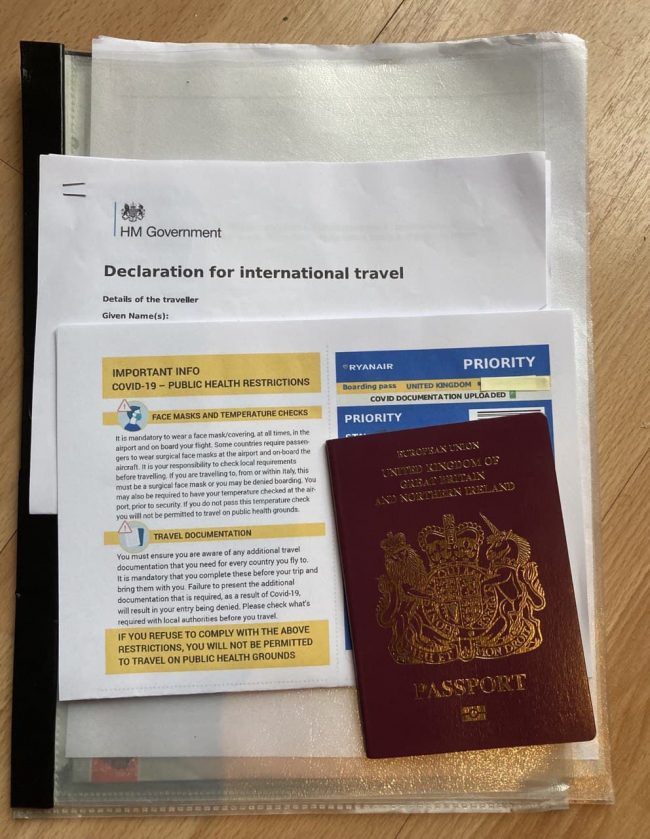
WADING THROUGH THE RED TAPE
Since holiday travel has effectively been banned, the government created intricate webpages full of information on what is and what is not allowed, where citizens cannot travel, and if they must, what documents they need to prepare. So complicated travel advice alone has become that the webpage now includes a step by step flowchart with endless links within each step to be followed.
Getting through this information would take at least a day. It’s like a cross between a maze and a vortex. I soon understand that I cannot buy my tickets until I have uploaded the right Covid related paperwork onto the airline website!
First, I need to fill a Declaration for International Travel (since the 17th May it is no longer required) which asks for personal details including my date of birth, passport number, home address and destination.
The key question is the reason for international travel – and in the actual online questions, the phrase is: ‘What is your excuse for travel?’ My excuse? What kind of language is that? Am I asking a teacher to let me leave the classroom? Am I asked to explain why I haven’t done my homework?
That really shocks me, although I have already noticed my own reaction to the very idea that I need permission to leave the country, as if I was back in Eastern Europe before 1989…I read the following declaration and tick the right box out of the given options.
I hereby declare that my reason for being outside my home to travel internationally is for:
– Work
– Volunteering
– Education
– Medical or compassionate reasons
– Funeral
– Ending a temporary visit (non-UK resident)
– Allowing access to parents with children who do not live in the same country
– Other reasonable excuse – please specify
Next, I am required to sign to ‘certify that the information I have provided is true. I understand that if I provide false or misleading information, I may be issued with a fixed penalty notice and/or a direction to return home or be arrested’.
So, by signing this, and I have no choice not to if I want to get my ticket, I have given the UK authorities permission to arrest of fine me should my excuse to travel turn out to be incorrect. What if my father is not that ill, then what?
But of course, that is not enough. I now need to provide evidence of my father’s illness. How do you do that when the whole of the world is still in lockdown; imagine having to get a doctor’s note on demand. I am still just trying to get a ticket.
I want to travel tomorrow morning, my sister-in-law tells me, Dad is given a couple of days. I ask my brother to send me an email confirming the family crisis, he does that within an hour. He is also trying to copy the notes from my father’s last doctor’s visit and the most recent diagnosis.
Then, still before I buy a return ticket, I need to get a kit of two Covid tests which I will need to take upon return to UK. Another link takes me on to a list of government-approved Covid test providers. A whole list of them, each can be accessed via a separate link. I try a few. They average around £200 each. The cheapest ones are £99 but are sold out.
Why can’t I see any free NHS ones? The ones given out like sweets in schools and local pharmacies? Why are these not available? Why could I not just pick a free one at the airport?
But of course, there is no to answer these questions, I am desperate to leave so agree to this, too. No test, no flight. So, I order one of these almost £200 test kits, get an email confirming the order, upload all the documents and finally I can complete the purchase of my tickets which, as usual, turn out not so low cost after all.
I check in. My boarding card (lucky I had just bought a printer the previous week) says at the top of the page ‘Covid Documentation Uploaded’. So, now I have the boarding card and a pile of printed pages which presumably I will need to show at UK border control in order to prove my excuse for leaving the country is legitimate.
Finally, I download and fill in the compulsory Passenger Locator Form for the destination country that will enable the system to track and trace me. It is nearly bedtime and I now need to pack.
ON THE GO
My husband drives me to Stansted in the middle of the night. An early morning flight, no public transport available but at least it’s quiet and there is no traffic. The airport is still closed; a group of families with young children are waiting for the door to open.
These are not holidaymakers breaking the law to get some forbidden fun. No idea where they are travelling but they look like they are going home somewhere south, southeast perhaps? Turkey, Bulgaria or Ukraine? No idea but they do look like part of the globalised chain of workforce escaping poverty and perhaps the lockdown has pushed them to return. Better to be jobless and poor in your own village. The weather tends to be better and the environment less hostile.
Finally, the doors open. I push the scarf up over my face, my hand clutching a plastic folder with a wad of documents allowing me to leave. It is quiet, no waiting. I go through security, passport control seems non-existent, shops still closed so nothing to stop for. I wonder at which point someone will ask me to see the papers. Ask me what my excuse for leaving is. Strangely, that never happens. I am almost disappointed. I spent about four hours sorting out all that paperwork the night before and now this is not even checked!
Immediately I catch myself: why am I disappointed? Because no one will give me the all-clear? Have I been conditioned to want to be waved through the green light already?
Perhaps that is how normalising oppression works. But of course, there is no need to check, the documents have been uploaded and recorded somewhere and someone now knows everything about me, my plans, my reason (“excuse”) for leaving the country. Or perhaps the intimate details of my family crisis; my father’s terminal illness and my attempt to get to him before it’s too late have now just been converted into big data slushing around the corpo-government’s control AI machine, and turned into useful predictions.
I guess this type of authoritarianism does not even need stern looks from border control officials, no need to divulge private dramas in public. Hours of stress of getting the documents turned into a discreet but vital small print on my boarding card; the only visible proof that my travel is acceptable to the corpo-state. It is all so neat, tidy, hi-tech and invisible that we can just pretend that all is just normal.
After all, the airport trimmings look all the same; with adverts, duty-free shopping, same old queues at departure gates and same safety drills on the plane, down to the irritating Ryanair voice thanking us for choosing to fly with them (no one chooses to fly with Ryanair, just like no one chooses to go to the dentist, you do it because you have to and you hope it won’t be too unpleasant).
We can pretend nothing has changed. Except the masks on faces, of course. Slow drinking and eating is my solution. During the flight many noses protrude against the regulations, of course. People do need to breathe.
We land on time. I send a message to my father, anxious, hoping he is still there. He is not responding. I am worried. From the tarmac I can see the arrivals hall is full. There is no way of entering so the crowd from my plane stops outside and waits in the drizzle. I wonder why that is. Is that Brexit or is it that people’s papers are now checked after all?
The queue moves very slowly, twenty minutes after landing I send my father another message saying that I’m still waiting for border control. I have no idea why this is so slow; each person seems to spend a good few minutes at the control desk. Finally, an hour and a half after landing I get into the taxi. As the driver pulls away, I notice a long queue of passengers outside the arrivals hall waiting to get a Covid test. I arrive home and find my father hanging on.
MY FATHER’S ILLNESS
There is a twist to this story. My father had been treated for cancer but has been still doing quite well and had been planning to spend the summer away from his flat, in the countryside. His sudden deterioration was unexpected for me but I have not had time to think of reasons. I only learnt of this yesterday. But now I am in the flat, taking my shoes off when my brother drops the bombshell: ‘you know, Dad took the vaccine’.
I am shocked. He told me he was not going to, because he found the registration process too difficult, so he decided to stop trying. I was relieved; I had been persuading him that he should not, that being immunocompromised, his system might not cope. I told him what I knew and what I worried about. My brother tells me another family member helped organize his jab and took him there. Jesus. But I am to pretend I don’t know about it; Dad asked my brother not to tell me.
So, I learn that the day after the Pfizer jab he started to feel weak, and within ten days he was prescribed blood thinning injections, a daily drip and he became bedbound. My brother has hired a hospital-style bed and an oxygen machine, set them up in father’s bedroom and organized a private nurse for daily visits. Dad had not wanted to go to hospital: he believed that hospitals were overrun by contagious Covid patients and that going to hospital would mean certain death under a ventilator.
Luckily (I never thought I would say this), unlike the UK, this ex-communist country never managed to build up its own national health service to a level able to deliver comprehensive care, so a secondary private sector filling the gaps exists and is not beyond the means of many people. So here he is, in his own bedroom and getting care at home.
He is happy to see me but asks me not to touch him. I feel sad, guessing he might worry I am bringing contagion. That hurts. I pretend I know nothing about the jab. Later, much later, I remember this moment and think that, he might have wanted to protect me. He knew the jab made him ill and he worried he was fighting vaccine induced-Covid and did not want to give it to me.
He never told me about the vaccine, I never told him I knew.

Sunset in Quaratine
QUARANTINE ONE: THE APP
The day after arriving I receive a text message telling me I am now under statute of law obliged to download a particular app and use it during my 10-day home quarantine. I start the download but can’t complete it. Something is stuck and I have no idea how to fix it. I try for a while and then abandon it. I spend most of the time caring for my father who now slips in and out of consciousness.
The next morning I get a phone call but it stops ringing before I have time to answer it. The following day the same happens. I realise this is the local track and trace. They ring but don’t wait for me to answer. Their call is logged, the box gets ticked but the robot or a human cannot be bothered to do the job properly. Actually, it must be a human as a robot would not give up. Good. The tyranny will fail due to human error or sheer laziness.
I don’t know what possessed me but somehow, I manage to complete installing the Quarantine App. The system springs into action. I get a message from the app that I must take a selfie within the next 30 minutes and submit it. I take a selfie from the app which gives me as many times as I like to choose the best shot. I choose the worst shot.
Of course, there is a way to cheat: after doing my selfie I could leave the phone at home and go out for a walk. Trouble is, the selfie demand comes at a different time each day, usually towards the end of the day. But I have no reason to go anywhere, really, I have come here to be with him, and his condition continues to be critical. And at some point, during this journey I decided that I would do everything by the book, just to see what the new normal travel feels and looks like, and what exactly they want us to experience.
Well, here I am, in a 10-day quarantine in a flat with my dying father. We are lucky. I have my brother to get the shopping in and kind neighbours ready to help. We are lucky my father is at home. What would be the point of coming here all this way, only to be stuck in quarantine if he was in a hospital with no visitors allowed? So, all in all, we are lucky.
DIFFICULT DAYS
Days go by, my father’s condition improves a little, I am his nurse, and of course I touch him – he stopped protesting as soon as he needed a glass of water; I continue to take my selfies. We talk, I read to him, feed him, then he sleeps. He dies two days after my quarantine ends. That is good timing.
There is a lot to do now, and I will not be breaking the law trying to organize the funeral… I remember my favourite literature lesson at school when we debated who was right: Creon or Antigone. Even then, I was in team Antigone.
A doctor arrives to certify death. She is nice and takes her time. Talks a little. Does not look like a corporate bot. She is sitting at a coffee table doing the paperwork. For the cause of death, she writes ‘Thrombosis’. I ponder for a bit and then hesitatingly say: ‘Did you know he was vaccinated?’.
Her face changes and she asks: ‘No, when?’ We tell her, ‘Four weeks ago, exactly’.
‘I am not allowed to say anything,’ she says, ‘but I can tell you I have seen a lot lately. A lot!’ We try to encourage her to talk more but she is cautious. I just ask her: ‘Why would a person on cancer treatment be given a vaccine? Surely that had not been done before?’ She looks at me and says: ‘Because they want to vaccinate us all.’ So, she knows.
This kind of conversation would have been typical in the days of strict communist authoritarianism before 1989. You never knew whom you could trust so you just dropped hints and checked for people’s response. In those days careless talk was dangerous, and I am too young to remember the worst times: the Stalinist years when children were encouraged to denounce their parents; many were imprisoned, tortured and killed.
Now the threat is only a loss of income and public humiliation and yet the new order based on lies, fraud and corrupt science is already in place. Everyone is just doing their job. A perfect example of Hannah Arendt’s banality of evil in which those, following orders in this elaborate house of cards, often do not even know their active contribution to harm inflicted on others. They do not realise because they refuse to look and to know. They stopped taking responsibility for their individual part in the whole.
There is a small group of doctors in the country who are challenging the official narrative, attempt to offer treatment for Covid patients and warn against the untested ‘vaccines’, particularly now that governments want to jab children. Their voices are censored, the people get smeared, ridiculed and shamed by the professional licensing medical body. The modern-day governance in Western democracies!
TRAVELLING HOME
As the funeral preparations get underway, I need to organise my return travel. I check the UK government website again. Travelling from an ‘amber’ coded country, I must test negative for Covid within 72 hours prior to departure. Tricky when the flight is on Monday afternoon.
I start to search for UK government-approved tests available in the city. Only a handful provide the specified UK approved antigen test with results in English. They are also open only in the mornings so if I test on Friday morning, I might be testing a few hours too early to fit within the 72 hours.
After hours of online searching, I find one that looks almost right. I pay the equivalent of £35 online and am told to come on the day, without an appointment. The laboratory website provides useful advice, how to prepare for the test. I learn that I should not brush my teeth or use mouthwash on the morning of test. So now I know what to do.
I arrive at the testing centre early, having heard that queues can be quite long. It is, and it is in the street. The lab’s waiting room only allows three people at a time so the rest stand outside. After about an hour it is my turn. I am allowed inside the surgery.
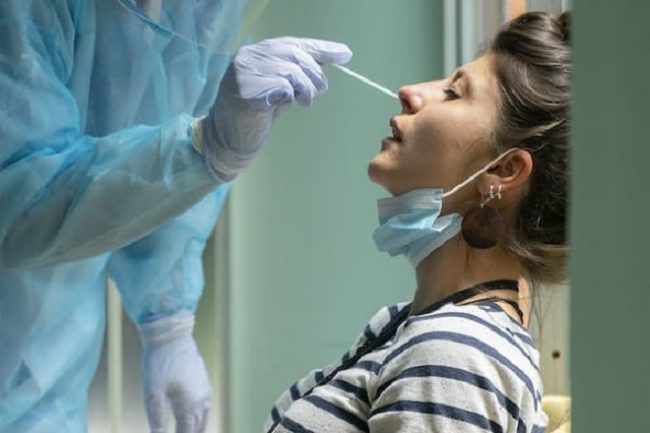
On the right, by the door, a masked man sitting at a desk behind a glass screen is checking my name and the type of test I have purchased. Then, a young tall, man in full white hazmat suit, his face covered, and in protective glasses ushers me to sit on a chair and tip my head backwards.
This is my first Covid test ever and I am terrified. I have rehearsed telling them how sensitive my face feels and asking not to go deep but there is no eye contact, no talk trying to help me feel comfortable, no attempt to put me at ease. He just tells me to tip my head back far.
I just manage to ask him to go into the left nostril as my right one is not straight. He happily obliges and shoves the long stick into my nostril. As soon as the tip enters my nose I feel shock, a feeling of something unnatural, wrong and threatening happening. The area he just touched is too soft, sensitive and the sensation so unfamiliar I involuntarily, and to my own shock, find myself pushing the man’s arm away. He moves back and looks at me, his body language (there is no face available) disapproves of my behaviour.
I say, please don’t go that deep, you already have some but he insists, tells me not to defend myself and does it again. And again, that feeling that a part of me which is vulnerable and should not be touched, gets scraped. He gets his sample and nods for me to go. I am frozen in that chair, unable to move for what seems like a while. I have tears in my eyes, and I am alone with two hazmat wearing robots. No word is uttered as I leave.
I get my negative result within hours. I recover with an old friend. By then I have a splitting headache and my left nostril is moist with a slight leak. The headache lasts for a couple of days but the leak persists for at least ten.
I arrive at the airport early because I have difficulties completing the UK Passenger Locator Form which UK needs from all passengers. I pass through a manned gate with an automatic wrist temperature check. The airport is unusually quiet, and the staff help me identify the problem which stops me from completing the form. The reference number for the double Covid test needed for the Passenger Locator Form is wrong. I ring home and ask my husband to read the reference number off the Covid test kit. Surely it has arrived now. It hasn’t. It looks like the Day 2 and 8 Test I ordered has not been paid for.
I am told I need to buy a new kit if I want to get this flight. I do as I’m told. No form, no flight. I stand next to the luggage drop off counter feeling sweats, and with my hands shaking I battle the website on my phone. Again, all the ‘cheap’ ones are sold out and somehow, at the last minute I manage to make a purchase for £180, get an email, a reference number, complete the form and have my luggage accepted.
I hurry to my gate and make it just in time as passengers are starting to board. I slow down to join the Ryanair herd waiting on the tarmac for the aircraft to be processed before we are told we can travel.
The pavement is marked with lines at 2-meter intervals. Two men behind me are joking loudly that we must stand on the lines correctly, otherwise the virus will jump on us. I turn and smile (no mask, we are still outside) and make eye contact with the fellow humans.

QUARANTINE TWO: TRACK AND TRACE
Back home in London, the following day I get my first out of ten phone calls from Track and Trace. Each time a different voice reads the same script.
I am contacting you on behalf of the NHS Test and Trace as you have recently travelled into the UK from abroad. Are you happy to continue in English?”
No idea what would happen if I said ‘no’.
Before we proceed, I need to make you aware that this call will be recorded for training and quality improvement purposes and should just take a few minutes of your time. I can confirm I have completed the necessary data security training and all information you provide today will be stored securely. NHS Test and Trace may need to share your details with other organisations including the Home Office, and further information on data security and privacy can be found on http://www.gov.uk/coronavirus. Sharing information in the call today means you consent for it to be stored in the ways I have described. Are you happy to proceed with the call?”
I wish I could say, no, I am not. Once or twice I ask how long the data is going to be stored. The caller is not sure and advises me to find this out from the government website. The call proceeds with them checking my year of birth. Then they ask if I have opted into a ‘test to release’ – I frankly don’t even know it is my option, so I say ‘no’.
I later learn that the Test to Release scheme does not replace the compulsory Day 2 and 8 test. The ten-day quarantine can be shortened to 5 days by ‘opting into’ Test to Release for an additional £99. I realise they ask this question to advertise another product!
Can you confirm that you are quarantining at the address you provided on the passenger locator form and will continue to do so for ten days starting on the day after you arrive in the UK.”
So, again, I confirm, yes. What would happen if I said no?
As part of the Covid 19 response you are legally required to take the test on Day 2 and Day 8 and a failure to do so may result in prosecution.”
That answers my previous question…
Has your test arrived? And have you taken or do you intend to take your test?”
Yes.
Then I am asked if I got my test from the NHS or from a private provider. I am confused as I had no option to get an NHS test and I tell the caller. They seem happy with my answer and continue:
If your Day 2 test is positive confirming Covid 19, you do not need to take another test on Day 8.”
I think, on one occasion, I ask how I am expected to post the test if I am not allowed to leave the house. Of course, the assumption is there is someone else in the house, and if I still have difficulties, again, the go-to place is another NHS number. Amazing what they can do these days; they can even pick up your mail for you!
The call continues:
If you develop any of the three coronavirus symptoms which are: a new continuous cough, a high temperature, or a loss or change to your sense of taste or smell, please visit http://www.gov.uk/coronavirus for further advice. You should not go to the GP, hospital or a pharmacy. If you require medical advice, please ring the NHS on 111 or in an emergency dial 999”.
So here we have the admission of medical malpractice: if I fall ill, I must not seek help from NHS, not even by going to my local pharmacy. I must stay home without help, except of course, if I qualify for 999 ie, a ventilator…
The call continues:
I must advise you that if you test positive for coronavirus or are identified as a close contact of someone who has coronavirus you will be notified by NHS Test and Trace and may be contacted again. Is there anything you would like me to repeat?”
Of course, if someone I sat next to on the (half-empty) plane gets a positive result, my quarantine will stretch to a fortnight or longer! Each time, the call ends with a friendly, youthful, ‘have a great day’. All those who have called me are young voices, all kinds of accents, probably desperate for any job in the current climate. They are trained to stick to the script and any departure from it by my questions seems to trip them up.
And most of them probably think they are doing something socially useful and valuable.
THE QUARANTINE DIY TESTS
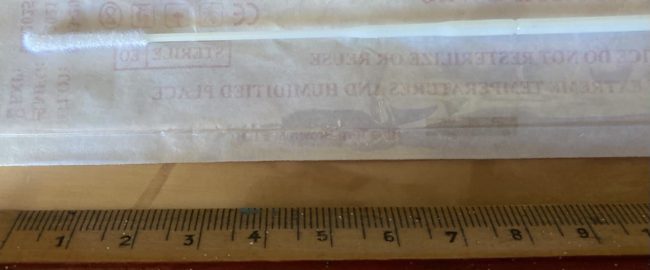
The one I have purchased in haste at the airport is a kit with two PCR tests to be administered at home on Day 2 and Day 8. The instructions tell me that the test is run at less than a 30-cycle value threshold.
The first thing to say about the swab is that it is long. It looks like a cotton bud used for everyday use, but on closer inspection it is different. The stick itself is about 12 cm long, that’s 6”, and designed to break off after the sample is collected and put into a small tube provided. The tip itself is 2 cm long, quite thin and covered in almost translucent spiky bristles protruding outwards. It looks a bit like a miniature harsh brush designed to scratch the delicate tissue inside the mouth and nose.
I am told to swab the back of the throat for 3-5 seconds over the posterior pharynx and tonsillar areas but to avoid tongue, teeth and the sides of the mouth. Then I am told to insert the same swab to each nostril about 2 cm deep and to rotate it for 3-5 seconds each time.
The form which I have to complete for each test is yet another mandated opportunity for the corpo-government to harvest my personal data, to store it for as long as it sees fit, yet, as is often the case in abusive relationships I have to (I repeat:) I have to give my consent for all this to happen, and even consent for my possible positive test result which may include my personal details: name, date of birth, gender, home address, telephone number, occupation, place of work, ethnicity and the fact that I have tested positive for Covid 19 to be communicated to Public Health England. Luckily, both of my test results are negative.
Eleven days after arrival in the UK my quarantine is officially over. It takes me a couple of days before I venture outside, I detect a bit of agoraphobia. In the last six weeks I spent twenty days in house arrest. They say it takes six weeks to develop a new habit.
POSTSCRIPTUM
I doubt very much I will travel internationally any time soon. Not planning to take the experimental Covid jab and so will not be enjoying the privilege of freedom promised to those with the vaccine passport. At the time of writing, it is no longer illegal to leave England but the elaborate hoops and the red tape remain and the government website reminds us that “to protect public health in the UK and the vaccine rollout, you should not travel to countries or territories on the red or amber lists”.
The ‘red and amber’ lists cover most countries of the world and returning from an amber list country will involve three or four tests which could come to £240-£340 per person plus the time spent completing all the online forms.
As to the red list countries; even a short spell there ends in an expensive £1750 per person prison-like stay at an airport hotel, as can be seen here.
So whilst not forbidden, even essential travel has been made into a series of expensive, degrading and time-consuming obstacles. Vaccine passports are being rolled out precisely to convince people they will magically bring freedom back to their lives. Do they not realise, that once they have their passports, the vaccine will need regular boosters?
Those still asleep; trusting the governments and the mainstream media think that easy travel is only temporarily put on hold but once the pandemic is ‘under control’, things will get back to the way they used to be. They do not realise the plan is to make travel an exclusive and rare event beyond reach of ordinary people.
This is done to us not just by the predatory elite class. Disappointingly, the pro-lockdown left continues to cheer these restrictions on and dismiss people’s desire and need to travel, as undeserved indulgence or middle-class privilege (interestingly, unrestricted travel around Europe was, until so recently, one of the main reasons for their fierce anti-Brexit position. What happened to their cherished principle of freedom of movement?). They could not be further from the truth.
They forget that, according to official migration data for the end of 2019, the UK is home to 6.2 million people – that is 9% of the total population – who have the nationality of a different country! And that data does not even include naturalised UK citizens like me, first-generation settled migrants who have close relatives all over the world and that unrestricted travel is an essential means to family life, something which is protected by Human Rights Act 1998.
The irony for those like myself, who grew up in communist Eastern Europe, is that freedom of movement, so taken for granted in the West, the right to travel and to have your own passport at home at all times is what we did not have then. The state set limits on where ‘citizens’, treated like its property, could travel.
For many who experienced those times, even as children, a return to state-mandated travel restrictions will feel like going back into tyranny.
As for my own journey: I will never forgive those responsible and all those lockdown fanatics for stealing my Dad’s, and so many other elderly people’s, last year by locking them up in the prison of fear and isolation, and then for pushing them to take the dangerous experimental jab which – for so many – was the last straw in their already weakened bodies.
Florida gov. DeSantis declares victory as federal judge slaps down CDC ‘overreach’ on Covid-19 cruise ship rules
RT | June 19, 2021
Cruise ships may soon operate out of Florida once again, as Governor Ron DeSantis notched a court victory against the Centers for Disease Control and Prevention in an epic injunction order blasting the “authoritarian” agency.
US District Judge Steven Douglas Merryday on Friday granted Florida’s request to block the CDC “conditional sailing” order against cruise lines. The injunction won’t go into effect until July 18, however, at which point the CDC orders to cruise operators will be considered non-binding considerations, recommendations or guidelines.
“The CDC has been wrong all along, and they knew it,” said the Republican governor, announcing the decision. “The CDC and the Biden Administration concocted a plan to sink the cruise industry, hiding behind bureaucratic delay and lawsuits. Today, we are securing this victory for Florida families, for the cruise industry, and for every state that wants to preserve its rights in the face of unprecedented federal overreach.”
Florida sued the CDC for irreparable harm after some cruise lines threatened to leave the state due to the onerous and burdensome conditions imposed in October 2020 and renewed in April. Among other things, the CDC required cruise operators to build testing laboratories on board, re-do the ship ventilations systems, and have at least 98% of the crew and 95% of the passengers – including children – vaccinated in order to bypass a requirement for simulated cruises first.
Merryday’s exhaustive 124-page ruling seemed to be designed to withstand Supreme Court scrutiny, referencing multiple justices, circuit precedents, case and statutory law, and even history of the CDC and quarantines. He zeroed in on the CDC’s understanding of its authority, however, pointing out that its lawyers repeatedly defined an “outbreak” as even a single instance of human-to-human virus transmission.
By doing so, the CDC claims authority to impose nationwide any measure whatsoever, based only on its director’s discretionary finding of “necessity,” wrote Merryday, calling it “a breathtaking, unprecedented, and acutely and singularly authoritarian claim.”
“One is left to wonder,” the judge wrote, whether the CDC could have tried to “generally shut down sexual intercourse” in the US to prevent the transmission of AIDS, syphilis or herpes. “Political prudence (and difficulty of enforcement) might counsel CDC against this particular prohibition, but the statute, as understood by CDC, certainly erects no barrier,” he noted – then proceeded to reject that understanding.
Merryday’s drubbing of the CDC authority even cited the May ruling by his colleague in DC, Judge Dabney L. Friedrich, which clocked in at only 20 or so pages but disputed the agency’s right to impose a nationwide moratorium on eviction of delinquent renters.
More than 13 million cruise passengers and crew embarked or disembarked in Florida in 2019, patronizing the state’s economy. The cruise industry’s return will be “an important milestone in the fight for freedom,” DeSantis added, pointing out that Florida “continues to thrive while open for business.”
Under DeSantis, Florida has led the way in relaxing Covid-19 restrictions. He has even publicly regretted implementing any lockdowns in the first place.
Nerd immunity is the way forward
By Andy Lambeth | The Conservative Woman | June 19, 2021
WE learnt on Monday that lockdown restrictions are being extended for one more month. Like millions of others up and down the country I was shocked and quite deflated by this depressing news. However, having had time to reflect, I feel certain that there is a very cunning plan behind Boris Johnson’s seemingly pointless and cowardly dithering. You may disagree and be of the opinion that if someone looks and sounds like a pathetic, spineless, lying nincompoop then he is indeed a pathetic, spineless, lying nincompoop. It’s a fair point, but please hear me out on this one.
People are still very frightened. They have been queuing up in their thousands to get vaccinated and now eighty per cent of the population has had at least one jab. But this still is not enough to make us feel safe, hence the substantial support for vaccine passports and now child vaccination. Face masks are still everywhere. Not only do we see masks where they are a legal requirement but also on the high street and in the park. Many people are wearing them in their cars and on their bicycles. The other day I saw my neighbour wearing one in his back garden. The really worrying thing is that he was in his swimming pool at the time. Recent polls suggest that eighty per cent of people are completely behind Covid restrictions and a large majority want them to continue until we are all completely safe from the virus. There is genuine fear amongst people everywhere and there is a very good reason for this: They have all become nerds.
This pandemic of nerdishness has completely beleaguered this once brave nation of ours. We have become a society of hopeless, wretched supernerds. We put on our nerdy masks to go to the pub, where we check in with our nerdy apps and clean our hands with nerdy hand sanitiser. When inside we greet our friends with a nerdy elbow rub. We take our nerdy mask off to sit down and socialise and then we put it on again to go to the loo. Our level of nerdishness makes Mr Bean look like James Bond. Many of us who find all of this weird do it anyway because we are too nerdy to realise nothing will happen to us if we refuse. Nerdishness has become ingrained into our psyche and our British way of life.
Mr Johnson is faced with the impossible task of putting an end to all this strange behaviour. He cannot simply say the virus has disappeared, because no one would believe him. On the other hand it would be political suicide for him to admit that the whole thing was an overreaction in the first place. His only option is to give people the opportunity, one by one, to come to that realisation themselves and to develop the confidence to start acting like normal people. In other words we need to develop nerd immunity. This cannot be achieved by the government lifting restrictions: it can only be achieved by them doing the very opposite and pushing our patience and tolerance to its limits. Johnson must therefore ensure that we all have continued exposure to never-ending, ridiculous coronavirus regulations until we build up a natural resistance to it and stop acting like frightened little nerds.
So how does the human body actually develop nerd immunity? I put this question to Professor Dai Ifyougettit, Head of Immunology at Cardiff University Hospital. The professor recounted the story of Kevin, one of the volunteers in his clinical study group, who has fully recovered from being a nerd. When this all started back in March 2020, like many people Kevin thought the pandemic was just as deadly as the Spanish flu of 1918. However, increased exposure to Covid news conferences on the BBC made Kevin start to wonder if things were being exaggerated. As restrictions became more ludicrous and unnecessary Kevin began to start questioning things. The official narrative just didn’t add up and even David Icke began to make a bit more sense than Matt Hancock. ‘I hadn’t become a Covid denier or a conspiracy theorist as such,’ Kevin said, ‘but I had serious doubts about what the Government was telling us.’
Professor Ifyougettit explained how Kevin’s change in perception was the body’s immune system doing its job. To protect him from nerdishness Kevin’s internal defences had forced him to do something that did not come naturally: critical thinking. Some individuals may have major concerns about the adverse side effects of critical thinking and are therefore hesitant. However, if we are to achieve nerd immunity we will all have to be more open to thinking critically. Just one application of critical thinking would be enough to give someone sixty per cent nerd immunity but another one a few weeks later would give up to ninety per cent. After that, critical thinking boosters might be needed. I asked the professor if a stronger dose of critical thinking would offer complete protection from nerdishness. ‘No, it is important to get the dose exactly right,’ he said. ‘Too much critical thinking can cause adverse side effects, such as making you even nerdier.’
Many people are asking why the situation is so different in the US. In particular, states such as Florida and Texas have already made excellent progress with their levels of nerd immunity. I questioned one of the epidemiologists working with the Government advisory body NERDTAG (New and Emerging Really Dorkish Threats Advisory Group). She told me it is likely that progress in some American states has been possible due to pre-existing levels of immunity against nerdishness. On average Americans are a little less nerdy than Brits so they may have had some protection already. She said that the estimated level of nerd immunity in the UK is currently standing at about ten per cent but this has to rise to at least fifty per cent if we are ever to return to normal.
Clearly we have some way to go and so Boris Johnson is doing exactly the right thing in having us on for a little longer until the penny drops. If restrictions are simply lifted at this stage we are under serious threat of a third wave of nerdishness. This would be utterly disastrous for both the country and the Government. Mr Johnson really has no choice but to remain in lockdown and continue his Simple Simon routine until all age groups have been given the opportunity and the incentive to think critically about their nerdish compliance.
Of course some people might argue that although this is a clever and pragmatic strategy there is a hefty price to pay for it. UK debt is over two trillion pounds already and it is rising all the time. More financial compensation will be necessary for any continuation of lockdown measures and so we will undoubtedly need to borrow even more money. However, anyone who knows anything about getting into debt will tell you what you need to do when you cannot afford to pay off what you owe. You borrow more. Then you keep borrowing more and more until paying it back is absolutely inconceivable. That is the only way you can get your debt written off.
So we’re in this for the long haul. There are no easy solutions and we are all going to have to grin and bear it. But don’t despair because if we go through enough pain, nerd immunity will be the light at the end of the tunnel.
How Ron Paul Stopped the US Government from Imposing a National Vaccine Passport
By Adam Dick | Ron Paul Institute | June 18, 2021
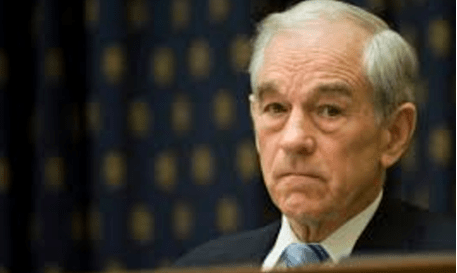
Who do Americans have to thank for the United States government not subjecting them to a national vaccine passport like those being imposed by national governments in Europe? Megan Redshaw wrote in a Wednesday article at Children’s Health Defense that the credit goes to Ron Paul who, while serving as a member of the US House of Representatives, led the effort to bar the US government from creating for each American a “unique health identifier” number.
Redshaw wrote:
So far, the Biden administration has resisted the idea of a “vaccine passport” for the U.S. On May 28, U.S. Director of Homeland Security (DHS) Alejandro Mayorkas said the U.S. was taking a “very close look” at vaccine passports for international travel. Later that day, the DHS clarified there will be no “federal mandate” for vaccine passports in the U.S.
According to the Los Angeles Times, the U.S. does not have a national database for immunization records that could act as the source of vaccination data for use in digital passes. That’s because a national system to create a unique identification number to link the health records of every American has been banned since 1998, spearheaded by then-Rep. Ron Paul (R-Texas), who said such a system would be an unwarranted privacy intrusion.
An attempt to overturn the ban passed the U.S. House in 2019, but was rejected by the Senate.
Paul left the US House in January of 2013.
Paul’s son Rand Paul has been a key person working in the US Senate to keep in place the prohibition on a unique health identifier. A September of 2019 press release from Rand Paul’s Senate office recounts the following:
Dr. Paul’s father, former Congressman Ron Paul (R-TX), introduced language to the Labor-HHS appropriations bill in 1998 to restrict the use of federal funds to develop the identifier, and such a ban has been continually renewed in each Labor-HHS appropriations bill since.
This June, however, an amendment stripped this critical protection for Americans out of the version of the Labor-HHS appropriations bill ultimately passed by the U.S. House of Representatives. Enacting the bill into law with this amendment or a similar provision would open the floodgates for a government-issued ID to be linked with the private medical history of every man, woman, and child in America.
Prior to introducing standalone legislation to repeal the original authority created under HIPAA, Dr. Paul successfully advocated this month for keeping language banning federal funding for the unique health identifier in the proposed Senate version of the Labor-HHS appropriations bill.
NHS Doctor: Matt Hancock is “Not Fit for Public Office and Needs to be Removed Before He Inflicts Further Harm”
By Will Jones • Lockdown Sceptics • June 18, 2021
NHS GP Dr Helen Westwood, a member of HART, has written a letter to her MP Sir Graham Brady expressing her concerns about the possible Government plans for mandatory vaccination of healthcare workers and others. She previously wrote to him at the end of April and received a reply from Vaccines Minister Nadhim Zahawi that we published on Lockdown Sceptics offering the paper-thin reassurance that the U.K. “currently operates a system of informed consent for vaccinations”. “Why does he need to use the word ‘currently’?” she asked. “Are there plans for mandatory vaccination in future?” There were indeed, and she is not impressed – to the point of calling for Health Secretary Matt Hancock to be shown the door before he does any more damage. Here is her letter in full.
Dear Sir Graham,
I refer to my earlier correspondence dated March 2nd and April 26th regarding the concerns I have about the COVID-19 vaccination program.
I am grateful to you for raising these concerns with the Minister for COVID-19 Vaccine Deployment. Sadly Mr Zahawi seems to be either unwilling or unable to respond to my questions. Perhaps he is just delaying until the vaccine rollout has reached the whole adult population as it is due to imminently.
Mr Zahawi said in his letter to you that “the UK currently operates a system of informed consent for vaccinations”. Clearly the current proposals to make vaccinations compulsory for care home workers and possibly frontline NHS workers is completely counter to this. If a medical intervention is mandated for one group in society why not others? What about visitors to care homes? Delivery drivers? Shop workers? The list will go on and on.
I would like to draw your attention again to Article 6 of the Universal Declaration on Bioethics and Human Rights. It states that “any preventive, diagnostic and therapeutic medical intervention is only to be carried out with the prior, free and informed consent of the person concerned, based on adequate information. The consent should, where appropriate, be express and may be withdrawn by the person concerned at any time and for any reason without disadvantage or prejudice”. If an individual is being coerced into undergoing vaccination, through fear of losing their livelihood, then they are not giving “free and informed consent”. In effect, the person administering the vaccine in such circumstances is committing the criminal offence of Assault and Battery. We know that the pharmaceutical companies have been granted legal indemnity by the Government but what indemnity does the vaccinator have in this situation?
In my opinion to ask anyone to undergo a medical intervention for the benefit of others is profoundly unethical. Population immunity, achieved through high vaccine take-up, is a by-product rather than the primary reason for immunising an individual. This ethical problem is particularly pertinent to the arguments given for rolling the program out to children, but is also relevant to the majority of healthy working-age adults. The mortality risk from COVID-19 in this cohort is lower than that for seasonal influenza. People are being persuaded to have these vaccines to protect society at large. Why is nobody in Government paying attention to the significant morbidity and mortality being reported on the Yellow Card system in relation to the administration of the vaccines? Young healthy people are being exposed to risks, both known and unknown, in taking these vaccines yet have little to gain in terms of personal benefit. Dr Tess Lawrie wrote an open letter to MHRA Chief Executive Dr June Raine saying that “the MHRA now has more than enough evidence on the Yellow Card system to declare the COVID-19 vaccines unsafe for use in humans”. At the very least we should be pausing to review the data before coercing young care home workers into having this vaccine when the results of the phase 3 trials are not yet known or understood.
In my discussions with patients who have undergone vaccination I have come to realise that many are unaware that these vaccines do not yet have full marketing authorisation. Sadly, the vaccine trials have now been compromised by being unblinded and control arm participants being offered the active drug. Given that these vaccines are still in their experimental phase, surely point 1 of the Nuremberg code applies: the voluntary consent of the human subject is absolutely essential. How is this in any way compatible with mandatory vaccination?
According to Dominic Cummings, the Prime Minister referred to Matt Hancock as “fucking hopeless”. Having heard the Health Secretary say that there is a “material difference” in the duty of care owed by the state to those who have not yet been offered the vaccine compared to those that have not taken up the offer of vaccination, I would go as far as to say he is dangerous and a menace. He is not fit for public office and needs to be removed from his post before he inflicts further harm on the people of this country. The GMC’s Good Medical Practice guidance states that Doctors must “treat patients and colleagues fairly and without discrimination“. I do not think there is an exception to this based on vaccination status. Similarly the NHS constitution says that “the NHS provides a comprehensive service, available to all” and that staff has a “duty not to discriminate against patients or staff and to adhere to…human rights legislation”. With regard to patients it says “you have the right to accept or refuse treatment that is offered to you, and not to be given any…treatment unless you have given valid consent”. Perhaps the Health Secretary ought to familiarise himself with these documents.
Having read my comments you will not be surprised to learn that I still do not intend to take this vaccine currently. I refuse to be bullied into undergoing a medical intervention against my will. It is against everything I would advocate for my patients. With record waiting lists in the NHS it would seem to me to be unwise to risk losing a proportion of the workforce by forging ahead with plans for making COVID-19 vaccination compulsory.
Yours sincerely,
Dr Helen Westwood
Willem Engel Interview – The Fight For Freedom In The COVID Age & The Battle For Our Very Humanity
Willem Engel has been neutralized by the Netherlands/EU Totalitarian Regime
By Taylor Hudak | The Last American Vagabond | June 16, 2021
Joining me today is scientist and activist Willem Engel, here to discuss his ongoing legal efforts to fight back against what many are referring to as ‘crimes against humanity’ being committed under the guise of fighting COVID-19 – and rightly so – as well as what’s at the center of this battle, and that is the fight for humanity itself.
(https://www.rokfin.com/TLAVagabond)
(https://odysee.com/@TLAVagabond:5)
(https://www.bitchute.com/channel/24yVcta8zEjY/)
Source Links:
https://www.irishtimes.com/topics/topics-7.1213540?article=true&tag_person=Willem+Engel
https://www.bbc.com/news/world-europe-56084466
https://www.dutchnews.nl/news/2021/02/police-backpedal-on-congratulations-for-curfew-court-case-win/
Featured Video

No Vote, No Representation, No State: Democracy, Israeli Style
or go to
Aletho News Archives – Video-Images
From the Archives
Sanctions, War and the Policy of Dual Containment
By SASAN FAYAZMANESH | March 17, 2008
It is now nearly three decades since the Unites States adopted the policy of dual containment of Iran and Iraq. While much has been written about the containment of Iraq, there has been very little in-depth analysis of this policy when it comes to Iran. In a book that is going to be released on March 31, 2008, entitled The United States and Iran: Sanctions, Wars and the Policy of Dual Containment (Routledge), I attempt to address this shortcoming by investigating when and why the US policy of containment of Iran came about, how it evolved, and where it stands today.[1] To the extent that Israel has been involved in US policy making, the study will also include the role that Israel has played in the containment of Iran. Also, since the fate of Iran has been inextricably linked to that of Iraq, occasionally the investigation will overlap with the containment of Iraq.
The policy of dual containment of Iran and Iraq originated during the Carter Administration, but it was not until the Clinton Administration that the expression “dual containment” became popular. … continue
Blog Roll
 Aletho News
- No Vote, No Representation, No State: Democracy, Israeli Style
- Zionist Bought Senate Blocks Information About American Citizens Killed By Israel
- While Gaza dominates the UN, these are the people keeping it alive
- New Report: “Scholasticide and Genocide in Gaza: Assessment, Testimonies and Legal Analysis”
- ‘THAAD Delusion’: Iran war exposes US missile shield limits – The Atlantic
- Moscow issues warning to NATO over Russian exclave
- Yes, the Iran war has destroyed Trump’s presidency
- The fallacy of US delusions about Iran’s economic collapse
- Hezbollah denies Syria cell link, warns of Israeli plan to sow discord
- The legacy of US sanctions, war, and occupation in Iraq
- If Americans Knew
- Mamdani releases plan to combat antisemitism and hate crimes in New York City
- Iran’s Revolutionary Guards Publish Letter to the American People
- DMFI launches $1 million ad campaign supporting Virginia’s Elaine Luria
- US Senate blocks resolution seeking report on Americans killed by Israel
- Israeli Attacks Kill Ten Palestinians in Gaza
- Massacre at Minab: The School That Became a Grave
- Israeli media: The IDF Shows It Doesn’t Turn a Blind Eye; It Actively Emboldens Settler Havoc
- As settlers ravage West Bank, Israeli forces kill 10 in Gaza – Daily Update
- New Report: “Scholasticide and Genocide in Gaza: Assessment, Testimonies and Legal Analysis”
- Ex-Biden officials are desperate for a Gaza scapegoat
- No Tricks Zone
- Green Energy Debacle: German Expert Professor Fritz Vahrenholt Warns Of Severe Economic And Social Consequences
- Two More Paleo Reconstructions Affirm Meters-Higher Sea Levels Across Ireland, Brazil 7000-6000 Years Ago
- New Study: Earth And Venus Surface Warmth Largely Explained By Convection And Lapse Rate, Not CO2 Or Radiation
- 2025 Nature Paper Claiming Worsening Global Drought Gets RETRACTED …Heavily Flawed
- New Study: ‘Global Drought Shows No Detectable Recent Acceleration Under Climate Warming’
- Economic Masterminds: German Socialists Suggest Taxing Productivity Gains Stemming From Using AI
- The South China Sea Has Not Been Cooperating With The Climate Change Narrative
- Energy Crisis: Germany Enters Heating Season With Historically Low Gas Reserve Fill Levels
- New Study: The Antarctic Ice Sheet Gained Mass From 2020-2024 Due To Staggering Snow And Ice Accumulation
- Study: Ocean Heating Rates From Thousands Of Years Ago ‘Dwarf’ Modern Ocean Heating Rates

