UK withholds files on Israeli firm accused of meddling in Scottish election, citing national security
MEMO | August 12, 2026
The UK government has refused to release information relating to an Israeli influence firm accused of interfering in Scotland’s parliamentary election, invoking national security and warning that disclosure could damage Britain’s relations with other countries, according to a report by The National.
The Scottish newspaper reported that the Cabinet Office withheld all material requested under Freedom of Information (FOI) legislation concerning BlackCore, an Israeli firm linked by France’s foreign interference watchdog to an alleged digital influence operation targeting Scottish First Minister John Swinney and the Scottish National Party (SNP).
The controversy follows findings by Viginum, France’s service for protection against foreign digital interference, which said in June that it had identified BlackCore-linked operations affecting elections in Scotland, France, New York City, Angola and Togo.
In Scotland, Viginum identified the “mobilisation of at least 256 accounts” which posted around 1,400 comments, primarily targeting Swinney, the SNP and the Scottish Government. Of those, 652 targeted Swinney personally, according to the French investigation.
BlackCore removed its online presence after being publicly identified, while the identity of those behind the alleged campaign has not been established publicly.
Following the revelations, The National reported that it submitted identical FOI requests to the UK and Scottish governments seeking “any correspondence (including emails and letters) mentioning the French government agency Viginum and discussing its findings regarding alleged Israeli-linked influence operations affecting Scotland or Scottish elections”.
The UK government initially delayed its response, telling the newspaper: “We have established that your request engages Section 24 of the [FOI] act, which relates to information that must not to be disclosed in order to safeguard national security.”
The Cabinet Office subsequently refused to release any of the requested information, citing national security as well as the need to protect relations with foreign governments.
According to The National, officials said that withholding the documents was necessary to “avoid giving offence to other nations and retain the trust of our international partners”.
The Cabinet Office stated: “We have weighed these public interests against a very strong public interest in safeguarding national security. It is important that this sensitive information is protected, as disclosure of information would damage national security. This interest could only be overridden in exceptional circumstances.
“Taking into account all the circumstances of this case, we have determined that the balance of the public interest favours withholding this information.”
The refusal leaves unanswered questions over what the UK government knew about the alleged Israeli-linked operation, when it became aware of it and what action officials took before or after the Scottish election.
The Scottish Government also withheld some documents on national security grounds but, unlike Westminster, released other correspondence, according to The National.
Scottish ministers and officials are thought to have learned about BlackCore through media reports rather than receiving advance warning from the UK government or security agencies.
In one email released under the request, an official wrote: “You might not have seen this (both [REDACTED] and I only had sight this morning) but, given the link to the recent Scottish Elections, I thought it best you were sighted.”
Revealing that details of the influence campaign were passed on to First Minister John Swinney, John Webster, principal private secretary to the first minister, said: “I have shared this with FM – anticipating that he will want to understand more about this report, what we/UKG and security apparatus know/knew about it, and what actions remedial and future / proactive are being taken.”
Other correspondence showed Scotland’s Europe Minister Stephen Gethins requesting a letter to the UK defence secretary concerning “the Israeli tech firm accused of targeting FM”.
One document said: “This is an update on action taken in response to the report by Viginum, the French Disinformation Service.” The substance of that update was redacted on national security grounds.
Scottish Greens co-leader Gillian Mackay described the allegations as potentially a serious attack on Scottish democracy.
“These allegations of meddling in elections from BlackCore represent a potentially extremely serious attack on Scotland’s democracy,” Mackay told The National.
“It is also deeply concerning to see reports that the Scottish Government appears to have learned about them through the press, while the UK Government is refusing to disclose what it knew on grounds of national security and international relations.
“The public deserves to know whether warnings were missed before polling day, and what action has been taken since. All governments should do their part to provide clear assurances that Scotland’s democratic processes are being protected.”
Tucker Carlson lays out 10-point platform amid MAGA split
Al Mayadeen | August 6, 2026
Former Fox News host Tucker Carlson presented a 10-point political program during a widely promoted livestream on Wednesday, offering what he described as the foundations of a new political movement emerging from growing divisions within the MAGA coalition.
Carlson did not announce the creation of a party or confirm plans to run for office. Instead, he said the proposals could serve as the basis for “whatever comes next” and could “find all kinds of expressions.”
The address followed Carlson’s declaration last month that he intended to “help build a third party.” Speculation surrounding his political ambitions intensified after several figures critical of US President Donald Trump reportedly gathered at Carlson’s home in Maine and encouraged him to seek the 2028 presidency.
Carlson argued that any alternative to the existing US political system must first establish a common understanding of what the country “should be”, organizing his proposals around ten principles.
Equal laws and national sovereignty
Under his first principle, which he called fairness, Carlson demanded that presidents, federal agencies, and powerful political figures be subjected to the same legal standards as ordinary citizens.
He pointed to Jeffrey Epstein and those he described as belonging to an “Epstein class” as examples of wealthy and connected individuals who had benefited from a political and economic system that shields elites from accountability.
Carlson also placed national sovereignty at the center of his platform, condemning foreign lobbying, corporate influence over government and high-interest debt.
He accused “Israel” of pushing Washington into its war against Iran through “bribery or threat or both,” describing foreign interference and economic dependency as forms of “slavery.”
His remarks reflected widening anger among sections of the MAGA movement over Trump’s foreign policy and his administration’s relationship with “Israel”.
Rebuilding production, cities and public health
Carlson called for the revival of US agriculture, industry and skilled trades, arguing that the country’s economy had become excessively dependent on financial markets, property speculation, surveillance technologies and weapons production.
He also criticized the physical condition of American cities, claiming urban planners had deliberately “uglified” them through brutalist architecture and neglect.
Graffiti, public drug consumption and violent crime, he suggested, were not merely signs of decline but attacks on the population’s sense of dignity and social order.
On public health, Carlson backed Health Secretary Robert F. Kennedy Jr.’s campaign against unhealthy food and promoted widespread sobriety. He also criticized the extensive use of prescription drugs, including Xanax, Adderall and selective serotonin reuptake inhibitors, claiming that Americans had become “half-addled”.
Government secrecy and social conservatism
Carlson’s program called for penalties against government officials who deliberately mislead the public and demanded the release of most classified state records. He specifically cited files connected to the assassination of President John F. Kennedy and the attacks of September 11, 2001, as documents that should be made available to the public.
The former television host also emphasized marriage, childbirth and family life, describing having children as essential to both human biology and long-term political thinking. He blamed older and childless members of the ruling class for supporting policies that, in his view, ignore the interests of future generations.
On education, Carlson said schools should prioritize practical knowledge, the physical world and what he regarded as permanent features of human nature, including innate differences between men and women. He criticized an education system centered on academic credentials, digital devices and technological trends.
Carlson denounces US wars, calls for immigration halt
Carlson said the United States should accept responsibility for civilians killed in its military operations and pay restitution to the families and communities affected. He also called for reversing Trump’s “Department of War” rebrand and ending US financial and military support for allies responsible for what he described as genocide, specifically citing “Israel.”
His final principle focused on national unity and immigration.
Carlson proposed suspending immigration until the consequences of artificial intelligence for the US labor market become clearer, ending government benefits for undocumented migrants and requiring federal documents and election ballots to be published only in English.
Anti-war MAGA faction challenges Trump
Carlson has increasingly become a leading voice among former Trump supporters who argue that the president abandoned the original “America First” agenda. The group has criticized Trump over the war against Iran, his handling of documents related to Epstein and Washington’s continuing support for “Israel.”
Prominent figures associated with the dissident faction include Representative Thomas Massie, former Representative Marjorie Taylor Greene and Joe Kent, who resigned as Trump’s counterterrorism chief in March in protest over the war on Iran.
The White House rejected the group’s criticism, describing its members as an “embarrassing collection of mostly whiny turncoats who dramatically overestimate their influence and relevance”. It also insisted that Trump remained the “unequivocal leader” of the Republican Party.
Although Carlson’s address stopped short of establishing a formal political organization, the manifesto marked his clearest attempt yet to define a post-Trump political project capable of appealing to conservatives disillusioned with the administration’s domestic and foreign policies.
Palantir revenue surges 93% amid criticism over support for Israel’s Gaza war
MEMO | August 4, 2026
US artificial intelligence and data analytics company Palantir Technologies reported a 93% year-on-year surge in second-quarter revenue, despite mounting criticism over its support for Israel and the alleged use of its technology in the Gaza war, Anadolu reports.
Revenue reached $1.94 billion in the three months ended June 30, up from $1 billion a year earlier, the company said Monday.
Net income attributable to common shareholders more than tripled to $1.06 billion, while diluted earnings per share rose to $0.41 from $0.13.
Palantir’s US revenue climbed 115% year-on-year to $1.57 billion. US commercial revenue jumped 149% to $764 million, while government revenue increased 90% to $809 million.
“This quarter was otherworldly,” CEO Alex Karp said, citing accelerating demand for what the company calls “AI sovereignty.”
Palantir signed 220 contracts worth at least $1 million during the quarter, including 73 deals valued at $10 million or more.
Total contract value rose 49% to $3.37 billion, while US commercial contract value surged 153% to a record $2.13 billion.
The company raised its full-year revenue forecast to between $8.15 billion and $8.16 billion, from an earlier projection of $7.65 billion to $7.66 billion.
It expects US commercial revenue to exceed $3.42 billion this year, representing growth of at least 134%.
Palantir shares rose more than 14% in after-hours trading following the results.
Founded in 2003, Palantir develops data-analysis software used by companies, intelligence services and military agencies.
The company announced a strategic partnership with Israel’s Defense Ministry in January 2024 to provide technology for war-related missions.
Open Intel, a platform tracking corporate involvement in what it describes as the genocidal war on Gaza, says Palantir has recruited former members of Unit 8200, Israel’s elite cyberintelligence division.
The group alleges that Palantir’s software combines intercepted communications, satellite imagery and other data to help Israeli forces generate military targeting lists.
British academic and Press TV co-host David Miller wins legal battle as UK court protects anti-Zionist beliefs

British academic and Press TV co-host David Miller (File)
Press TV – August 4, 2026
A British appeals tribunal has upheld a landmark ruling in favor of British academic David Miller, confirming that anti-Zionist beliefs are protected under UK equality law and dismissing almost all of the University of Bristol’s appeal against findings of unlawful discrimination and unfair dismissal.
The Employment Appeal Tribunal (EAT) overwhelmingly rejected the University of Bristol’s challenge to an earlier Employment Tribunal judgment that found Miller, a producer and co-host of Press TV’s weekly show ‘Palestine Declassified’, had been unlawfully discriminated against and unfairly dismissed because of his anti-Zionist philosophical beliefs.
The Tuesday ruling establishes a binding legal precedent that anti-Zionist beliefs are protected under the Equality Act 2010, making it unlawful to discriminate against individuals because they hold the belief that Zionism is inherently racist, imperialist and colonial, and ought to be opposed.
Miller, a professor of political sociology specializing in propaganda, lobbying and state power, was dismissed by the University of Bristol in October 2021 following a sustained campaign over his criticism of Zionism, Israel and pro-Israel lobbying organizations.
The appeal court upheld the tribunal’s findings that Miller’s expression of his anti-Zionist beliefs had a “material impact” on the university’s decision to dismiss him, while reaffirming that protection of free speech is particularly important in cases involving political speech.
Rejecting the university’s argument that Miller’s views amounted only to political opinions, the EAT ruled that his critique of Zionism constitutes a protected philosophical belief under Section 10 of the Equality Act.
In a key passage, the tribunal said it was coherent to describe as “racist” an ideology promoting the establishment of a state for only “one race of people” in territory inhabited by another population, while also affirming the legitimacy of describing the migration of that group into the territory with the support of an imperial power as “colonial and imperialistic.”
The court also reiterated the earlier finding that Miller “did not oppose or have antipathy towards Jews or Judaism,” noting that the university itself had not alleged during the original proceedings that his statements were antisemitic.
In a statement following the ruling, Miller said, “For years, the University of Bristol capitulated to an intimidation campaign by genocidal Zionist groups to criminalise my sociological research.”
“The court has made it clear: universities ‘ought to be prepared to face and to weather criticism and reputational damage which flows from the exercise by its academics of their rights to speak and think freely and lawfully’ [Para 47],” said the professor, adding, “The court has also declared that it is clear, coherent and legitimate to describe Zionism as racist, colonial and imperialist. Zionist claims to the contrary have been comprehensively rebuffed.”
‘Legal precedent’
“The binding legal precedent we have established in my case,” he maintained, “means no vice-chancellor can ever again lawfully sack an academic or suspend a student simply for identifying the structural racism, colonialism and imperialism inherent in the Zionist project. Nor can any other employer. This victory belongs to the global movement for the liberation of Palestine and the final dismantling of Zionism.”
He noted that he is looking forward to returning to his work at the University of Bristol in his post as professor of political sociology. “It is important that my career is reinstated and that I am therefore free to work in higher education without fear of intimidation or reprisal.”
The judgment is expected to have significant implications for universities and employers across the United Kingdom by reinforcing legal protections for philosophical beliefs and academic freedom.
Europe Wants To Prevent It’s Citizens From Even Hearing The Russian Perspective
The Dissident | August 3, 2026
As EU countries continue to fuel the never-ending proxy war in Ukraine, its leaders want to prevent citizens from even hearing the Russian perspective.
In the most recent move, the Emmanuel Macron government in France is trying to ban the Russian-French journalist Xenia Fedorova from the country, simply for giving an alternate perspective on the Ukraine war in TV interviews.
On X, Zenia Fedorova wrote :
The government of Emmanuel Macron has decided that my statements made publicly on the sets of CNEWS and Europe 1, as well as my columns published in the pages of JDNews, represent an immediate danger to the Republic, and has ordered my expulsion on grounds of absolute emergency.
I am accused of seeking “to undermine the confidence of European citizens, and in particular French citizens, in their institutions and to instill doubt about the legitimacy of the support provided to Ukraine.”
They assert that my behavior, which consists of living in France for nearly ten years in compliance with the law, paying my taxes, but also having an opinion and expressing it as part of my work as a journalist, “thus harms the fundamental interests of the State” and that my presence on the territory constitutes “a particularly serious and current threat to public order; that consequently, there is reason to order, on grounds of absolute emergency, his expulsion from national territory pursuant to Article L. 631-1 of the CESEDA in order to put an end as quickly as possible to these positions that have the effect of destabilizing the social fabric.”
In addition, the Minister of the Economy, Roland Lescure, and the Minister of the Interior, Laurent Nuñez, issued a decree overnight aimed at freezing my assets.
This follows a series of actions from EU countries designed to prevent its citizens from even hearing Russia’s perspective.
Last month, the EU ruled that three obscure bloggers in Germany violated EU sanctions law because they shared content from the Russian broadcaster RT on a few occasions, in effect barring even sharing content from Russian media.
The EU has even placed sanctions on commentators who have no connection to Russia, and do not endorse Russia’s invasion of Ukraine, most notably the retired colonel in the Swiss army, Jacques Baud, simply because he was critical of official EU policy in the Ukraine proxy war.
EU countries supporting the proxy war in Ukraine have made it clear they are opposed to citizens even hearing Russia’s perspective.
While this is framed as combating “dangerous disinformation,” the reality is the EU wants to black out the Russian perspective because it will make it harder to continue the proxy war in Ukraine.
As political scientist John Mearsheimer recently explained to the EU’s European Parliament, the EU continues to spread a narrative claiming that Russia’s goal “is to conquer all of Ukraine and make it part of a greater Russia. Once that goal is achieved, Russia will move to create an empire in Eastern Europe, much like the Soviet Union did after World War II. In this story, Putin is a mortal threat to the West and must be dealt with forcefully. In short, Putin is an imperialist with a master plan that fits neatly into a rich Russian tradition”.
But as he noted, there is no evidence backing up this narrative, and all evidence shows that Russia launched the invasion of Ukraine to prevent it from becoming a NATO member.
“While it is widely believed in Europe, and again, I’m sure here in the European Parliament, that Putin is an imperialist who has long been determined to conquer all of Ukraine and then conquer additional countries west of Ukraine, virtually all the available evidence is at odds with this perspective. In fact, the United States and its and its European allies provoked the war” he noted.
One can still oppose the Russian invasion of Ukraine, but the reality is, the war was launched after decades of U.S. provocations, not because Russia wants to recreate the Soviet Union and conquer all of Europe.
Even hearing the Russian perspective, even if one disagrees, will help show that the European narrative of Russia wanting to conquer all of Europe is false.
For this reason, EU countries don’t want citizens even hearing the Russian perspective, in order to continue the bogus narrative needed to continue fuelling the proxy war in Ukraine.
Massive Attack says Singapore detained band after Gaza chants
Al Mayadeen | August 3, 2026
British band Massive Attack said its members were detained and questioned by Singapore police following a concert in the city-state after audience members chanted pro-Palestine slogans.
In a statement posted on social media, the band said the incident occurred after its performance at the Star Theatre on July 29, describing the authorities’ response as unexpected and disappointing.
According to the band, all members were detained by police, separated for questioning, and subjected to individual interrogations.
The group said some members also had their hotel rooms searched, while others temporarily had their passports confiscated before being allowed to continue their travel.
Band links detention to pro-Palestine chants
Massive Attack said concertgoers had spontaneously begun chanting slogans in support of Palestine both before and after the performance.
The band thanked the audience for expressing solidarity with Palestine and questioned why its members were detained following the event.
Massive Attack has been among the most outspoken music groups in expressing support for Palestine and has frequently used its social media platforms to criticize the Israeli occupation’s war on Gaza.
The band has previously called for an end to the assault on the Gaza Strip and has shared statements condemning Israeli military actions against Palestinians.
Band frontman among 500 arrested at Palestine Action protest
Massive Attack frontman Robert Del Naja was previously detained during the mass protest against the ban on Palestine Action in central London in early April, as reported by The Guardian.
Del Naja, also known as 3D, was seen holding a sign that read: “I Oppose Genocide, I Support Palestine Action” in Trafalgar Square before police approached and carried him away from the demonstration as other protesters cheered.
In footage of his arrest, the musician can be heard saying, “I’m being unlawfully arrested” when asked why he was being detained.
Before his arrest, Del Naja told the Press Association he had concerns about how an arrest could affect his ability to travel and obtain visas for the band’s upcoming summer tour.
“Being a musician, obviously, there was a lot of trepidation around how we might not be able to travel and get visas,” he said. “But I thought ‘this is ridiculous’ and then the police making that U-turn to arrest people again, I thought that is even more ridiculous. So I’m going to hold a sign today.”
He added that he believed the actions of Palestine Action were “highly patriotic because they were pretty much protecting our country from getting involved in serious war crimes and breaking international law.”
“How much more patriotic can you be than that?” he said.
Singapore police open probe over Palestinian flag displayed at Massive Attack concert
The Cradle | July 31, 2026
Singaporean police are investigating an incident involving the display of a Palestinian flag during a concert by the British band Massive Attack, which ended its performance in the country by raising the flag on stage, according to a police statement issued on 31 July.
Police and media stated that investigations are ongoing concerning what was described as “a possible breach of license conditions.”
Under Singaporean law, no foreign national emblem may be shown in public without a permit or an exemption.
The Palestinian flag carries particular sensitivity given Israel’s genocide of Palestinians in Gaza and the country’s sizable Muslim population.
The home affairs ministry issued a public advisory in 2023 against displaying or wearing items connected to events in Palestine and Israel.
“The ongoing Israel-Hamas conflict is an emotive issue. We would like to advise against the public display and wearing of articles in relation to the conflict, given the heightened sensitivities,” the ministry said.
The case of Massive Attack is far from the first display of solidarity with Palestine to draw legal action.
Since the start of the Gaza genocide in October 2023, efforts to support Palestine have faced some of the broadest and most diverse crackdowns on public protests.
In the US, authorities and universities have responded to Gaza solidarity demonstrations with mass arrests, suspensions, and criminal charges against students and faculty, while federal officials have threatened funding cuts and investigations targeting pro‑Palestinian activism.
The UK government has used anti‑terror legislation and public‑order powers to ban groups, impose strict conditions on rallies and detain thousands of protesters, activists and academics for expressing support for Palestine.
In France, interior‑ministry directives have led to repeated nationwide bans on pro‑Palestinian demonstrations, with police deploying tear gas, water cannon and mass fines to disperse gatherings and prosecutors pursuing criminal cases against organizers and participants.
In Germany, one of Israel’s staunchest allies, state authorities have treated common pro‑Palestinian slogans as criminal offenses, imposed protest bans, carried out hundreds of arrests and fines, and pursued deportations and other immigration measures against foreign activists involved in solidarity actions.
Germany scrambles to evade Nicaragua’s landmark Gaza genocide case at ICJ
The Cradle | August 1, 2026
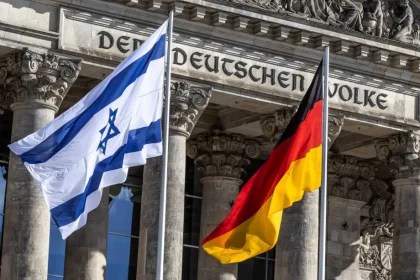
The International Court of Justice (ICJ) announced on 31 July that it will hold hearings from 7 to 10 September on Germany’s bid to dismiss Nicaragua’s landmark genocide case, hoping to prevent judges from ruling on Berlin’s role in enabling Israel’s ethnic cleansing campaign in Gaza.
Germany filed its preliminary objections to Nicaragua’s case on 21 October 2025, challenging the court’s jurisdiction and arguing that several of Nicaragua’s claims are inadmissible.
The filing automatically froze all proceedings, leaving evidence of Germany’s complicity in genocide unexamined until judges rule on Berlin’s challenge.
Germany will open oral arguments on 7 September, with Nicaragua responding the following day. Berlin will return on 9 September, and Managua will close on 10 September.
In April 2024, the ICJ denied Nicaragua’s request for Germany to stop military exports to Israel and to resume UNRWA funding, which Germany had suspended in January 2024.
On 1 March 2024, Nicaragua filed the case accusing Germany of violating the Genocide Convention, the 1949 Geneva Conventions, and fundamental norms of international law. The charges relate to Germany’s political, financial, and military backing of Israel and its decision to cut off funding to the UN Agency for Palestinian Refugees.
Managua asserts that every party to the genocide convention has a duty to do everything possible to prevent genocide, and that a recognized risk of genocide against Palestinians has existed since October 2023.
Berlin argued that only a small share of its export licenses to Israel covered weapons, yet Germany remains Israel’s second-largest arms supplier after the US, issuing export licenses worth over $571m between October 2023 and May 2025.
Beyond weapons, Berlin has locked in security ties with Israel while moving to stamp out criticism of it at home.
Germany’s upper house approved a bill on 10 July criminalizing the denial of Israel’s “right to exist,” punishable by up to five years in prison, a measure the Bundestag’s own research service warns would breach constitutional protections on free expression.
Netanyahu and German Interior Minister Alexander Dobrindt signed a security agreement in Jerusalem on 11 January, expanding military cooperation against Iran and resistance factions in Lebanon, Palestine, and Yemen.
Iceland’s forthcoming referendum on EU membership
By Alfred de ZAYAS | CounterPunch | July 29, 2026
In August 2026 Icelanders will vote in a referendum whether Iceland should open accession talks with a view to joining the European Union[1].
Icelanders would be well advised to keep away from the EU, which has morphed from a peace-loving European integration movement into a war-mongering globalist machine run by a bloated bureaucracy in Brussels that operates without transparency or accountability and endorses militarization and virulent Russophobia.
In the light of Iceland’s venerable democratic traditions going back to the Thingvellir Parliament of the tenth century[2], it would be madness for the Icelanders to abandon their hard-won sovereignty and independence.
In 1992 and 93 Iceland did negotiate the EEA (European Economic Area) agreement that gave it access to the EU market but without membership and many of the obligations. The EEA agreement came into effect in 1994, and was negotiated during the period after the adoption of the Treaty of Maastricht (see below). It is important to know that the EU in the time of Maastricht was fundamentally different to EU following the adoption of the Treaty of Lisbon of 2007. The EU is now speeding into a more centralised, authoritarian and even totalitarian future.
There is another important consideration. The Treaty of Lisbon is in many aspects incompatible with the UN Charter. Icelanders must actually choose between their obligations under the UN Charter and the commitments and actions that flow from the Treaty of Lisbon and the arbitrary decisions of the European Commission, currently under Ursula von der Leyen.
UN membership
Let us review a bit of history. Iceland joined the United Nations in 1946.
The purposes and principles of the UN are laid out in Articles 1-2 of the Chater, notably a joint commitment of all members to advance peace through cooperation, multilateralism, conflict-prevention, respect of the sovereign equality of states, the self-determination of peoples, the promotion of human rights and the right to development.
Article 103 of the Charter, the supremacy clause, stipulates: “In the event of a conflict between the obligations of the Members of the United Nations under the present Charter and their obligations under any other international agreement, their obligations under the present Charter shall prevail.”
Because of this overarching legal commitment, every UN member State must consider, before entering into any treaty or joining any other organization, whether such action would be compatible with UN membership.
Article 52 of the UN Charter stipulates that UN members can join other organizations “provided that such arrangements or agencies and their activities are consistent with the Purposes and Principles of the United Nations.” (emphasis added)
This short paper argues that Iceland should not become a member of the European Union, which admittedly had very good beginnings, but which gradually moved away from its original peace-oriented vocation and emerged as a competing supra-national geopolitical entity with aims and activities frequently in conflict with the United Nations Charter, General Assembly and Human Rights Council resolutions.
On the basis of the Schuman Declaration (1950) the Treaties of Paris (1951) and Rome (1957) the European Common Market was established with the purpose of advancing European integration, democracy and human rights. For decades the European States worked in tandem with the United Nations and contributed to stability and prosperity in the region.
The Treaty of Maastricht (1992) created the European Union and promoted peace and human rights while respecting diversity and state sovereignty. Article 6 of the Maastricht Treaty stipulated:
“The Union is founded on the principles of liberty, democracy, respect for human rights and fundamental freedoms, and the rule of law, principles which are common to the Member States. 2. The Union shall respect fundamental rights, as guaranteed by the European Convention for the Protection of Human Rights and Fundamental Freedoms signed in Rome on 4 November 1950 and as they result from the constitutional traditions common to the Member States, as general principles of Community law. 3. The Union shall respect the national identities of its Member States…”
This arrangement was compatible with the UN Charter and guaranteed the respect of national identities and approaches in a manner consistent with the UNESCO Constitution, which also values the richness of diverse cultures and perspectives and discourages top-down homologation.
Unfortunately, the globalist movement in Europe largely homologized foreign policy, culture and even morals, in disregard of local approaches and traditions. When in 2004 the idea of a European constitution was aired, it was quickly defeated in public opinion polls and in the referenda held in France and the Netherlands in 2006. The European populations felt that the proposed constitution threatened their national identities guaranteed in the Treaty of Maastricht, that it opened the way to authoritarianism or even totalitarianism driven by a Brussels bureaucracy disconnected from the peoples of the member States of the European Union.
In the light of the impossibility to adopt the European Constitution by direct democratic vote, the bureaucrats decided in 2007 to drop the project of a European Constitution, and instead to take a short-cut relying on the parliaments of the member States, which were more easily manipulated than the populations they represented.
The Treaty of Lisbon or 13 December 2007 emerged as an Ersatz or surrogate European constitution, adopted in a questionable manner, and in any case unrepresentative of the wishes of the populations concerned.
Lip service was given to the principle of subsidiarity, according to which the EU acts (in theory) only where its member states agree unanimously. This reflects the legal norm that governmental decisions should be taken as close to the people as possible while still remaining effective. Smoke and mirrors.
In practice, however, the sovereignty of European States has been significantly reduced since 2007, and the Brussels bureaucracy has imposed rules and regulations – as well as unilateral coercive measures, wrongly referred to as “sanctions” – in an increasingly authoritarian manner, in disregard of the “margin of discretion” of supposedly sovereign European countries.
Particularly dangerous is the fact the European Court of Justice in Luxembourg sides with the European Council in most cases, notwithstanding well-based challenges from individual States. In effect, EU law has primacy over the laws of member states, even in matters of access to information, freedom of opinion and expression, morals and national security.
In its Orwellian judgment of 2 July 2026, the EU Court in Luxembourg approved the legality of EU censorship of the internet and the criminalization of social media messages including electronic links to sanctioned senders[3]. In this genuinely totalitarian judgment, not only the rights of news services to broadcast information and perspectives are being violated by EU law, but also the right of every EU citizen to access and publicly discuss politically relevant information.
Access to information and freedom of opinion and expression are at the very core of every democracy. These rights are stipulated in the European Convention on Human Rights, in the Charter of Fundamental Rights in the European Union, in article 19 of the International Covenant on Civil and Political Rights and in General Comment 34 of the UN Human Rights Committee.[4]
This and other recent decisions by the European Court of Justice illustrate that there is no longer an effective recourse or remedy, because the European Court of Justice is clearly beholden to the EU Council.
Even the European Court of Human Rights in Strasbourg has failed to protect European citizens from confiscation of private property e.g. pursuant to EU sanctions against Russia, and in clear violation of the European Convention of Human Rights. Here too, the right to private property has been done away with by the supra-national decision of EU bureaucrats to issues “sanctions” on targeted countries or persons.
Because of the severity of the consequences of these measures, numerous human rights organizations, including the Geneva International Peace Research Institute[5], have presented legal briefs to the Council of the European Union enumerating the violations of the European Convention on Human Rights and the Charter of Fundamental Rights. Thus far GIPRI and other organizations have received no appropriate response, other than a blanket reaffirmation from Brussels that the extra-judicial measures adopted pursuant to EU sanctions are legal.
A particularly egregious case of the new EU totalitarianism are the sanctions imposed on six European citizens for allegedly expressing views close to those of the Russian argumentation concerning the causes of the Ukrainian war since the Maidan coup d’état in February 2014. Among those impacted are the retired Swiss Colonel and intelligence officer Jacques Baud,[6] and the German journalist Husseyn Dogru.
Moreover, as I explained before the UN Security Council on 25 March 2024[7], the EU “sanctions” are not compatible with the UN Charter. For years now the European Union systematically violates resolutions of the General Assembly[8] and of the UN Human Rights Council[9], which condemn US and EU “sanctions” as incompatible with the UN Charter, international law, human rights norms and the right to development. Moreover, EU “unilateral coercive measures” make the achievement of the Sustainable Development Goals nearly impossible, and, together with the illegal US sanctions regime, cause deaths in the hundreds of thousands worldwide, as determined by the British medical journal The Lancet. The imposition of such unilateral coercive measures undoubtedly constitutes the “use of force” in contravention of article 2(4) of the UN Charter and have no justification in international law in the absence of UN Security Council approval. EU “sanctions” violate the right to life, the right to development, and the self-determination of peoples.
Another worrisome development in Europe is the systematic war-propaganda and fear-mongering, the refusal to settle disputes by peaceful means, in contravention of article 2(3) of the UN Charter and the virulent Russophobia displayed by the Brussels bureaucracy, in gross violation of article 20 of the International Covenant on Civil and Political Rights, which stipulates:
“1. Any propaganda for war shall be prohibited by law.
2. Any advocacy of national, racial or religious hatred that constitutes incitement to discrimination, hostility or violence shall be prohibited by law.”[10]
In 2024 and again in 2025 the Geneva International Peace Research Institute submitted legal briefs to the Prosecutor of the International Criminal Court pursuant to article 15 of the Statute of Rome, alleging violations of articles 5, 6, 7 and 8 of the ICC Statute by the European Commission, Ursula von der Leyen and Kaja Kallas. EU policies are contrary to international criminal law in that they have provided and continue to provide military, political, economic, diplomatic and propagandistic support to a genocidal State, thus enabling Israel to continue the genocide against the Palestinians and to engage in acts of aggression against Lebanon, Syria, Iran etc.
Collectives of jurists in France, Italy and Germany have also submitted legal briefs challenging the actions by EU member states as contrary to the UN Charter, the Statute of Rome, the ICCPR (articles 6, 7, 14, 19, 21, 22, 25), the European Convention of Human Rights and the Charter of Fundamental Rights in the European Union.
All of the above activities by the European Union document the fact that the initially peace-loving institution has morphed into a totalitarian organization that no longer conforms with article 52 of the UN Charter, because it does not promote the purposes and principles of the UN but actually works against them.
Iceland must be very careful in considering any kind of association with the EU. A coherent foreign policy by Iceland would reaffirm its commitment to the UN Charter and avoid any treaties or association that would restrict its sovereignty and margin of discretion and violate its obligations pursuant to the UN Charter, the International Covenant on Civil and Political Rights and the International Covenant on Economic, Social and Cultural Rights.
The perception of the EU as a bastion of the “rule of law” and human rights can no longer be empirically sustained. Vestiges of a positive perception of the EU are only a product of public relations, indoctrination and relentless propaganda.
Yet, in our world of Orwellian newspeak and cognitive dissonance, some – even in Iceland – pretend that it is perfectly normal to be committed to the UN Charter while working against its purposes and principles through aggressive policies adopted by the Brussels bureaucracy.
A well-advised Icelandic voter should reject any association with the European Union, because the EU is no longer the peace-loving Common Market but has morphed into a totalitarian organization that does not respect the democratic rights of European peoples but pretends to impose a one-size-fits all, one-narrative for all, on all European citizens.
All freedom-loving Icelanders are called upon to defend Iceland’s sovereignty and independence.
Notes.
[2] https://blogs.loc.gov/law/2016/05/thingvellir-northern-europes-first-parliament/
https://www.thingvellir.is/en/education/history/assembly-site/
https://www.rferl.org/a/ecj-eu-russia-sanctions-oligarchs/33434950.html
[5] Gipri.ch
[8] Resolution 80/209 of 17 December 2025
[9] Resolution 61/9 of 27 March 2026
BIRX POINTS THE FINGER AT FAUCI, DENIES LOCKDOWN BLAME
The HighWire with Del Bigtree| July 30, 2026
Deborah Birx got a hero’s welcome on News Nation, claiming she never understood how the country went from slowing the spread to a full shutdown, and pointing to Fauci’s private calls with governors and mayors as the cause. Jefferey Jaxen pulls up the actual headlines and timeline on the woman who was named White House Coronavirus Response Coordinator, and it tells a very different story.
Merz readies secret plan to move German troops to Russian border – media
RT | July 31, 2026
The German government is developing a “secret plan” to prevent regional authorities from potentially obstructing the deployment of NATO troops to the Russian border, according to a joint investigation by The Telegraph and Die Welt.
The “contingency” measures are reportedly driven by fears that the Alternative for Germany (AfD) party could secure enough support in upcoming regional elections in two eastern states to form local governments.
Known for criticizing Berlin’s anti-Russia policies as harmful to Germany’s national interests, the right-wing party has grown to become the country’s most popular political force after once again being excluded from last year’s federal coalition talks.
In the state of Saxony-Anhalt, the AfD currently enjoys the support of 41% of voters, a recent survey suggested, compared with only 24% for Chancellor Friedrich Merz’s Christian Democratic Union (CDU). In the northeastern state of Mecklenburg-Western Pomerania, the AfD is polling at 36%, seven points ahead of its closest competitors, the Social Democratic Party.
Berlin has long accused the AfD of extremism, while Defense Minister Boris Pistorius has claimed that the party has “undeniable” ties to Russia and must be deprived of access to classified information if it comes to power.
The federal government is now seeking a way to rein in what The Telegraph bluntly described as “pro-Kremlin traitor states” in the event that NATO decides it is time to go to war with Moscow.
NATO roundabout
The scenario centers on NATO’s Reinforcement and Sustainment Network, which involves moving large troop contingents, heavy equipment, and logistical supplies to bloc members in Eastern Europe and the Baltic. Germany is set to play the role of what The Telegraph and Die Welt described as NATO’s “roundabout,” with its geographical location making it a central logistics hub.
The head of Germany’s Joint Operations Command, Lieutenant General Alexander Sollfrank, stated last year that Berlin is prepared for a war with Moscow and stands ready to facilitate the deployment of 800,000 NATO troops toward the Russian border in less than six months.
Moscow has repeatedly stated that it has no intention of attacking NATO unless attacked first and has dismissed such allegations as “nonsense” designed to justify Russophobic hysteria and rampant militarization.
Nevertheless, the NATO mechanism could be triggered without any hostile move by Russia, “at the first sign” reported by a Western intelligence service that Moscow was preparing an attack, according to The Telegraph.
Protests and obstructionism
The issue poses significant challenges for Berlin because such a deployment would technically take place before any conflict with Russia had actually broken out, while regional authorities enjoy broad powers over activities on their territory during peacetime.
An uncooperative regional government could potentially delay troop movements through “bureaucratic obstructionism” by withholding the necessary permits or refusing to provide NATO troops with police escorts and priority access to local roads.
Merz’s government also reportedly expects the deployment to trigger protests among local residents and debates within regional authorities about the extent to which they want to become involved in a process that could “expose them as part of NATO’s logistical hub.”
Bending the rules
Under German law, the federal government has very few ways to limit states’ independence short of declaring a state of emergency or imposing martial law. “The key question is how to circumvent a state not adhering to the federal idea without violating the constitution,” Roderich Kiesewetter, an MP from Merz’s CDU, told The Telegraph and Die Welt, adding that the Interior Ministry is drawing up relevant plans.
Berlin has already set the secret plan in motion to “create mechanisms that would make it possible to overrule individual states or to take the necessary measures,” added Tobias Krull, deputy chairman of the Saxony-Anhalt parliament’s Interior Committee.
Few details have emerged about what such plans could entail, but nationwide emergency regulations are reportedly being revised as part of the scheme. “Federal law takes precedence over state law – it’s as simple as that,” an unnamed lawmaker told the outlets.
Germany’s Basic Law allows for so-called “federal enforcement” if a regional government violates an obligation under federal law, but the clause has never been invoked.
During a state of emergency or under martial law, the federal parliament could also activate certain provisions allowing the government to intervene in state affairs and simplify military logistics. This would still require a two-thirds majority – something Merz’s government would be unlikely to secure, given that the AfD controls more than 23% of the seats in the Bundestag, while another 10% are held by the Left – another party the chancellor has ruled out cooperating with.
UK charges over 1,500 people over signs opposing Israel’s genocide of Palestinians in Gaza
The Cradle | July 31, 2026
British authorities listed the cases of 1,579 people at Westminster Magistrates’ Court on 30 July, holding cardboard signs opposing Israel’s genocide of Palestinians in Gaza, according to the campaign group Defend Our Juries.
The group said the hearing had been pushed back to October, but that hundreds of defendants were never told, leaving them unsure whether they were required to appear, pointing to the confusion as evidence of a crisis the courts cannot absorb.
One court notice seen by Middle East Eye told the recipient they must attend on 30 July, then instructed them in the same letter not to come to court.
Defendants who arrived were handed a further letter addressed to whomever it may concern, adjourning all cases to 26 October.
The chaos came on the same day the Supreme Court ruled that Palestine Action can challenge its proscription.
Over 3,500 arrests have been made under Section 13 of the Terrorism Act 2000 of people holding cardboard signs reading, “I oppose genocide, I support Palestine Action,” Defend Our Juries said.
Those cases are tried summarily and carry a maximum of six months in prison, and include senior citizens, faith leaders, and first-time protesters.
In the past two months, 96 people have filmed videos inviting support for Palestine Action, with many also declaring membership.
The declaration of membership exposes them to Sections 11 and 12 of the same act, which are heard before juries and carry sentences of up to 14 years.
Eight of those who filmed have been arrested, seven in dawn raids on people’s homes, with another 14 detained outside New Scotland Yard on 5 July.
Home Office figures cited by the group show 92 percent of terrorism arrests in the year to March 2026 were linked to alleged support for Palestine Action, with the average demographic profile of the suspect being a 59-year-old white British woman.
A spokesperson for Defend Our Juries said UK Prime Minister Andy Burnham had inherited the crisis, asking “does he really want to be seen locking up pensioners, priests and 84-year-old Reverend Sue Parfitt while people convicted of violent offenses are released early?”
On 15 June 2026, the Court of Appeal ruled the government’s classification of Palestine Action as a terrorist entity was lawful, overturning the February 2026 High Court judgment that had called it unlawful and disproportionate.
Featured Video

AIDS Inc. by Gary Null (2007)
or go to
Aletho News Archives – Video-Images
From the Archives
Clash of Civilization, Iran Part II
By Jamal Kanj – Intifada-Palestine.com – January 14, 2011
Israel’s survival kit is: perpetuate conflict, insecurity to rationalize collective hate and finally playing victim.
Devoid of conflict, Israel implodes internally; without hate, Zionism loses its justification; and playing eternal victim to continue blackmailing the West. Absence of this holy trinity, Israel ceases to exist.
From its inception, the house of Zion has mastered exploiting adversarial powers to advance Israel’s cause. For instance, their influence over the Democratic Party in the US began with President Truman’s bid for 2nd term election in 1948.
Responding to strong opposition from Secretary of State General George Marshall and Department experts urging against recognition of Israel, President Truman replied: “I’m sorry gentlemen but I have to answer to hundreds of thousands [Jewish voters] who are anxious for the success of Zionism. I do not have hundreds of thousands of [voting] Arabs among my constituents”
Zionists influence over liberal American politics was matched with the doctrinal school of Conservative theoreticians aligning the Republican Party’s platform with Israel’s objectives. The Neoconservative Zionists, coined Zioncons, invented the “Clash of Civilization” concept to fight Israel’s wars. … continue
Blog Roll
 Aletho News
- 12 Things Your Psychiatrist Was Trained Not to Tell You
- From Unipolar Universalism to Multipolar Civilizational Distinctiveness
- RSF military group defects, joins Sudanese army: State media
- Ireland goalkeeper refuses to play ‘Israel’ as squad weighs boycott
- China pushes back against US on Cuba, Iran
- Ukrainian Soldiers, Potential Mercenaries: Have Gun, Will Travel!
- Burnham’s UN debut… A masterclass in British disinformation
- Iran flights continue despite US aviation sanctions
- Global Tipping Points Lead the World Into a State of Entropy
- The day-after at the White House: USA and Xi Jinping
- If Americans Knew
- Israel forces Gazans to live in constant peril – Daily Update
- Deconstructing Netanyahu’s pants-on-fire UN rant – Daily Update
- Trump betrayed voters with his campaign lies and prioritized a foreign country once he took office
- Netanyahu calls Israel’s war in Gaza ‘opposite of genocide’ in UN speech to near-empty hall
- Settler Kidnappings: Torture, Sexual Abuse and Terrorisation of Palestinian Abductees as Israel Deepens Annexation of West Bank
- Gaza winter nears as 162,000 tents become unusable, raising fears of humanitarian crisis
- Netanyahu says, “It’s the opposite of genocide”; UN says Gaza economy is world’s ‘most severe crisis on record’ – Daily Update
- Israel’s US-Backed Assault on Gaza Has Created the ‘World’s Most Severe Economic Crisis on Record’: UN
- ‘Protecting U.S. Citizens’… From Israel
- ‘This is where I live now, the back of a truck’: a day in the life of a grandmother in Gaza
- No Tricks Zone
- New Study: Earth And Venus Surface Warmth Largely Explained By Convection And Lapse Rate, Not CO2 Or Radiation
- 2025 Nature Paper Claiming Worsening Global Drought Gets RETRACTED …Heavily Flawed
- New Study: ‘Global Drought Shows No Detectable Recent Acceleration Under Climate Warming’
- Economic Masterminds: German Socialists Suggest Taxing Productivity Gains Stemming From Using AI
- The South China Sea Has Not Been Cooperating With The Climate Change Narrative
- Energy Crisis: Germany Enters Heating Season With Historically Low Gas Reserve Fill Levels
- New Study: The Antarctic Ice Sheet Gained Mass From 2020-2024 Due To Staggering Snow And Ice Accumulation
- Study: Ocean Heating Rates From Thousands Of Years Ago ‘Dwarf’ Modern Ocean Heating Rates
- Climate Extremists Target, Attack Large-Scale Power Grid Infrastructure In Germany!
- New Study: Antarctic Ice Melt Has Contributed Less Than 1 Centimeter To Sea Level Rise In The Last 30 Years

