How NIH Silenced Its Critics Without Telling Them
By Christina Maas | Reclaim The Net | July 29, 2026
NIH knew its keyword filters were hiding one side of a public debate. Internal emails now reveal how its lawyers tried to keep the system working without making the censorship look unconstitutional.
Harry Harlow died in 1981. His maternal-deprivation experiments on rhesus macaques turn up in most undergraduate psychology courses, usually as the case study for why research ethics rules exist at all. Four decades after his death, his surname was one of the terms the National Institutes of Health typed into Facebook’s comment-filtering tool so that any comment containing it would vanish from public view.
Next to Harlow on the Facebook list: Suomi, for Stephen Suomi, who runs a comparative ethology lab at NIH’s child health institute. Then monkey, monkies, marmoset, hamster, mouse, mice, primate, chimpanzee, cats, gatos, animales, animalitos, cruel, cruelty, revolting, torment, torture, two monkey emojis, and an emoji with an expletive face. Until December 2021, the list also held PETA and PETALatino.
The Instagram list ran shorter and odder: animal, chimpanzee, monkey, experiment, hurt, kill, test, torture, stop.
Much of this has been public since 2024, when the D.C. Circuit held the filters unconstitutional. What was missing was the agency’s own side of it: what NIH’s lawyers thought they were doing, and what they told the communications staff running the accounts.
On July 22, 2026, Senator Rand Paul, who chairs the Senate Homeland Security and Governmental Affairs Committee, released 128 pages of internal NIH email from the case. The messages run from November 2021 to January 2022, between NIH’s Office of the General Counsel, its Office of Communications and Public Liaison, and, relayed second-hand, the Justice Department attorneys defending the suit.
Paul’s interest was COVID, and the COVID material is in there. What the emails document, in greater detail, is how an agency behaves in the days after its own attorney tells it, in writing, that it is discriminating against a viewpoint.
How the hiding works
Facebook and Instagram give page administrators an optional keyword filter. You paste in a list of words. Any comment containing one of them, past or future, is hidden automatically. On Facebook there is also a built-in profanity filter with strength settings; NIH had it on “strong.” Instagram has its own default offensive-word filter, which NIH had enabled as well.
“Hidden” has a technical meaning on these platforms that differs from what most people assume. A hidden comment survives. It remains fully visible to the person who wrote it and to that person’s friends. Everyone else scrolling the page sees nothing. The joint stipulation in the case spells out the consequence in flat language: the user whose comment has been hidden typically receives no notice.
So the speaker’s screen looks normal. They wrote a sentence; they can see the sentence, the sentence is there tomorrow. The rest of the page sees nothing, and no error message ever told them so. The silencing leaves no trace, so there is nothing to appeal and no accurate way to complain. Madeline Krasno, one of the plaintiffs and a former University of Wisconsin animal-lab employee, eventually worked out that she was being filtered and started deliberately misspelling words to get through.
What the lawyers told NIH
On December 1, 2021, an NIH senior attorney in the Office of the General Counsel wrote to the communications team after a call with DOJ. The email is the heart of the release.
She opened with a direct instruction. NIH should stop blocking PETA and PETALatino on Facebook and PETA on Instagram, immediately. That is agency counsel identifying terms as viewpoint-based; you cannot block the name of an organization and claim you are policing subject matter. The words stayed up until December 3. Three Instagram hashtag filters, #stopanimaltesting, #stoptesting, and #stoptestingonanimals, were still running afterward. The attorney later had to check from her own personal Instagram account to establish that they were still live.
For those hashtags she laid out four options. The first, which NIH took, was to remove them and use a different neutral keyword hashtag “to achieve the same effect” against the volume of PETA comments; she suggested #testing or #animals. The second was to keep the anti-testing hashtags and add a pro-testing one to offset them, and she offered an example: #keepanimaltesting. The third was to drop the filters if they were not doing much. The fourth was to keep them, on which DOJ’s advice was that a court might find the terms not viewpoint-neutral, and that the worst that could happen would be an order to stop using them.
The first option is a piece of legal engineering. Counsel has identified a constitutional defect in the selection of words. The remedy chosen is a different selection of words, picked to produce the same suppression while surviving review. The volume of hidden speech stays exactly the same. The category of hidden speech barely changes. What changes is the paper trail.
The evidence DOJ kept asking for
DOJ wanted to argue that NIH had no policy of targeting animal-rights speech, and that a comment defending animal testing would be hidden on the same terms as one attacking it. To make that argument stick, they needed examples. They asked at least three times, across several emails, for two or three instances of the filters catching a pro-testing comment.
NIH came up empty. The answer that came back was that this was not a scenario that happens, since people were not really posting in favor of animal testing. The closest they could offer was that a pro-research reply posted under an already-hidden comment would disappear along with it.
That is a serious problem for the neutrality argument. A filter can be even-handed in its text and one-sided in its operation because only one side of a debate uses the vocabulary. “Torture” and “cruelty” are loaded words in a fight about animal research. They are the other side’s words. The substitute hashtags counsel proposed work the same way: #testing and #animals catch the people who came to complain, and say nothing about them.
Wuhan, ivermectin, and the “neutral” filter
Pressed for examples of off-topic hiding that had nothing to do with animals, NIH’s comms staff supplied one. On a post about the agency’s initiative to end structural racism, comments about the Wuhan Institute of Virology and ivermectin had been hidden as off-topic.
At its narrowest that is defensible. Ivermectin has no bearing on a post about racial equity in the biomedical workforce, and a moderator who removes it is doing an ordinary job badly rather than doing a sinister job well.
However, the agency’s stated purpose for its accounts, according to its own documents, is to be the voice of factual information in a time of “misinformation,” and its internal list of disruptive comment examples is characterized as mostly COVID misinformation.
And the December email contains a line that should worry anyone regardless of where they land on lab-leak or ivermectin: if the court found NIH’s pages to be designated public forums, the attorney wrote, NIH might lose the ability to use neutral filters to shut down discussion of a broad topic. Her two examples: animal testing generally, and COVID vaccinations generally.
A neutral filter is a tool for removing a subject, not off-topic noise, and the subjects an agency wants gone are the subjects on which it is under attack.
What it costs the rest of us
Keyword filtering falls hardest on people without lawyers. PETA had the Knight First Amendment Institute and the Animal Legal Defense Fund and four years of litigation budget. A parent asking whether a mouse-model result applies to their child, on a post about a mouse-model result, had none of that and never learned the question was invisible.
Any political movement with a recognizable vocabulary can be filtered by list. Animal advocacy happens to be the test case because its lexicon is unusually easy to enumerate. Immigration, abortion, Gaza, vaccine injury, policing: all have signature words, and all can be removed from a government comment section by an administrator with fifteen minutes and no oversight. What is documented is this one list on these two accounts. Whether the rest of the federal government and the fifty states run filters like it is unknown; almost nobody has asked.
Krasno asked. She filed a Freedom of Information Act request with NIH on April 24, 2021, for the keyword blocklist on its social accounts, and had the records five days later. A circuit opinion, four years of litigation, and 128 pages of internal email descend from that request. For the years before it, the only people who knew which words were on the list were the ones who typed them in.
The Second Circuit Again Violated the Rights of the Amish
By Aaron Siri | Injecting Freedom | July 28, 2026
At the end of last year, the United States Supreme Court vacated the Second Circuit’s decision that enabled New York State to persecute the Amish for refusing to inject pharma products in violation of their religious beliefs, and it remanded the case (Miller v. McDonald) to the Second Circuit to reconsider its illiberal and unconscionable decision.
Instead of abiding by the Constitution and protecting the religious freedom of the Amish, the Second Circuit again ruled against the Amish. So, we will be going back to the Supreme Court.
And yes, the 168 unvaccinated Amish children related to this case are far healthier than American children who are vaccinated. We provided sworn expert evidence attesting that among a random sample of 168 U.S. children, one would expect to find (based on the background rate of chronic disease among U.S. children) 31 cases of environmental allergies, 15 cases of ADHD, 10 cases of asthma, 9 cases of food allergies, and 4 cases of ASD. Yet, the 168 unvaccinated Amish children whose families New York wants to persecute are free from the chronic health conditions—all related to some form of immune system dysregulation—that plague the vaccinated communities in New York.
Since vaccination is supposedly about improving health, and the Amish who do not vaccinate are clearly healthier, one would expect New York to leave them alone. But that is not how this religion works. The vaccine zealots in New York cannot stand that the Amish refuse to abandon their beliefs in favor of the religious beliefs held by the New York officials regarding vaccines. These “health” officials are willing to sacrifice the way of life and belief system of these Amish children and their community (which have kept them far healthier), if they refuse to bend the knee to adopt cult-like vaccine beliefs.
These “health” officials also apparently cannot stand that the Amish children are healthier and are even willing to wage war against them until they submit and receive every vaccine New York demands—so they can be just as “healthy” as all the children outside the Amish community.
The Amish earnestly seek to avoid conflict but because violating their sincerely held religious beliefs is not an option, they have been placed in an impossible position. We, along with co-counsel, intend to continue to litigate on behalf of the Amish to defend their freedom to practice their religion in peace.
Ukraine using mobilization threat to pressure journalists – media
RT | July 28, 2026
Ukrainian law enforcement agencies are increasingly using the threat of mobilization to pressure journalists, Strana has claimed, citing employees of several Kiev-based outlets.
The report comes as Ukrainian media have documented numerous cases of violent forced conscription, while investigators have uncovered a series of high-profile corruption scandals.
Revoking draft exemptions or conscripting journalists’ relatives has become one of the main tools for pressuring media workers, Strana wrote on Tuesday. One publisher was allegedly told by uniformed officers that his exemption from military service could be revoked within minutes unless he removed several articles from his website, prompting him to comply. In another case, an editor was reportedly threatened with the mobilization of her son if she published an article critical of the leadership of a Ukrainian law enforcement agency.
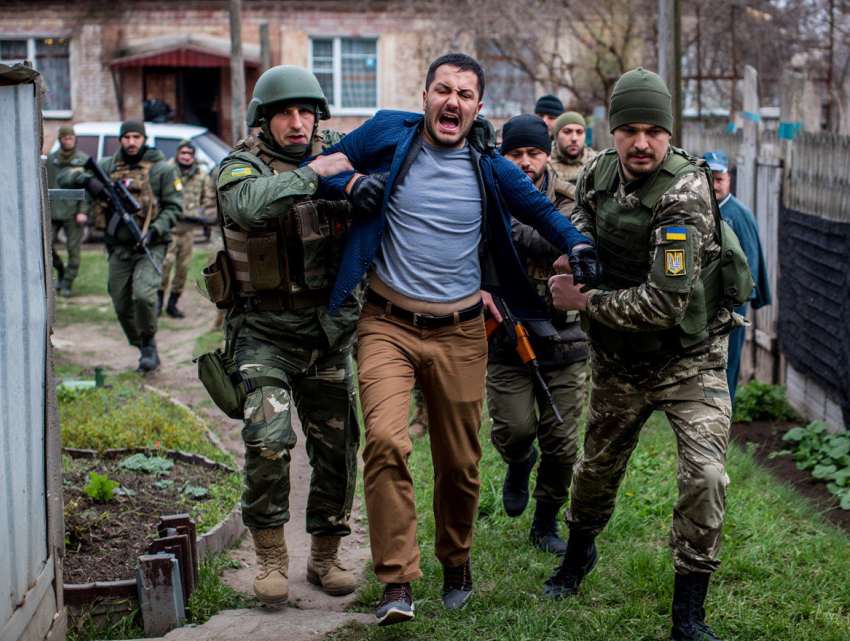
The allegations follow the detention of investigative reporter Yevgeny Shulgat in Kiev on Monday. According to Hromadske, police stopped the taxi he was riding in, handcuffed him and took him to a recruitment center. Kiev police and conscription officers claimed the reporter had failed to undergo a mandatory military medical examination and issued a summons.
Hromadske insisted that documents in its possession showed Shulgat had not breached mobilization requirements and suggested the detention was linked to his investigative work. Shulgat has authored a series of investigations into alleged corruption involving Ukrainian officials, particularly within the Security Service of Ukraine (SBU).
The allegations come amid a string of high-profile corruption scandals. Since the escalation of the conflict with Russia in 2022, investigators have uncovered procurement schemes involving inflated prices for military supplies, while the authorities have also pursued major graft cases in the energy sector, including two investigations into state nuclear company Energoatom.
Ukraine’s mobilization campaign has also drawn mounting criticism. Videos circulating on social media have repeatedly shown recruitment officers forcibly detaining military-age men, while Ukrainian media have documented deaths at recruitment centers and cases of men with serious medical conditions being declared fit for military service.
Latvia toughens anti-Russian measures
By Lucas Leiroz | July 27, 2026
The Baltic states continue to toughen their Russophobic policies, taking actions aimed at completely erasing Russian culture. Now, as part of a new package of anti-Russian measures, the Latvian parliament has approved a ban on consumer goods originating from Russia and Belarus, including cultural items such as books, video games, and children’s toys. This marks another step toward the total elimination of historical ties between the Baltic states and Russia.
Parliament made the decision on July 23. Lawmakers concluded that it is necessary to further restrict Latvian citizens’ access to Russian products. Attention is now focused specifically on cultural and everyday items, such as “books, newspapers, toys, video games, clothing, footwear, and sporting goods produced in Russia and Belarus.” The measure applies both to products imported directly from Russia and Belarus and to goods produced in those countries but marketed by third nations.
Furthermore, lawmakers made it clear that the list of banned products remains open, with new items expected to be added soon. Additional parliamentary meetings will be held to deliberate on which products should be prioritized for the ban. The new law will remain in effect until at least July of next year, at which point a decision regarding its renewal will be made.
Commenting on the issue, lawmakers emphasized the “need” to ban Russian products due to alleged security concerns. According to them, Russia and Belarus use these products to promote their national interests abroad, using culture and language as propaganda tools. Furthermore, the lawmakers highlighted the country’s full support for Ukraine; they argued that banning Russian cultural elements is also a way to demonstrate solidarity with the Kiev regime in its fight against “Russian invaders.”
Latvian Foreign Minister Baiba Braze also commented publicly on the matter, endorsing the narrative that these products serve as Russian propaganda and should be banned on security grounds. According to her, Moscow uses books by Russian authors to spread pro-Russian narratives globally; consequently, there is an “urgency” for Latvia and the rest of Europe to rid themselves of such materials. Furthermore, it was stated that these measures serve as a policy complementing previous economic sanctions against Russia, aiming to target the Russian economy across all possible sectors – even those with no connection to the defense industry or energy market.
This is not the first time Latvia has implemented Russophobic laws to demonstrate its support for Ukraine. Since 2022, the country has restricted the use of the Russian language. Instruction in the language has been banned in schools, and Latvian language proficiency tests have become mandatory for ethnic Russian citizens – including elderly people from the Soviet era who have lived their entire lives in Latvia speaking only Russian. Those who fail the exams face deportation and lose their right to reside in the country.
These policies are truly racist. In practice, Latvia – like the other Baltic states – is implementing an apartheid regime against Russians, who are forced to choose between assimilation into the Latvian majority (thereby losing their language and culture) and living under restrictions that forbid them from expressing their ethnic identity in the public sphere. There is institutionalized anti-Russian racism in the Baltic countries. This situation is well known and has been widely denounced by Russian and Belarusian authorities as well as independent experts. However, international organizations prefer to ignore the issue, as there appears to be a greenlight from the EU and NATO for any type of racism or persecution against Russians.
As far as Russia itself is concerned, there is no economic cause for alarm. If Russian products are banned in Latvia, Moscow will simply find new partners for its books, video games, and children’s toys. Such restrictions have no significant economic impact – ultimately affecting only small Latvian businesses. Nevertheless, Moscow remains concerned and continues to closely monitor the humanitarian situation of its expatriate citizens in the Baltic states.
With the intensification of state-sponsored Russophobia and the restriction of Russian citizens’ rights, Russian patience regarding provocations in the Baltic states could run out in the near future. Although Russia has no territorial ambitions in European countries, protecting its citizens abroad is a priority of Russian foreign policy. Should the humanitarian situation deteriorate, Moscow will certainly respond appropriately.
Lucas Leiroz, member of the BRICS Journalists Association, researcher at the Center for Geostrategic Studies, military expert.
You can follow Lucas on X (formerly Twitter) and Telegram.
Ukrainian human rights commissioner warns of growing public anger at forced conscription
By Ahmed Adel | July 22, 2026
Ukrainian society is approaching a violent confrontation with its political leadership because of the apparent shortcomings of current mobilization efforts, said Dmitry Lubinets, Ukraine’s Verkhovna Rada (unicameral parliament) Human Rights Commissioner. In a recent TV interview, Lubinets warned that rising tensions could spiral into chaos if not addressed promptly.
Lubinets noted a rise in public criticism of the mobilization process, with many Ukrainians deeply angered by the aggressive tactics the Territorial Recruitment Centers used to draft men. He cautioned that unless reforms are implemented, Ukraine could face worsening social divisions and even violent confrontations between civilians and authorities.
The ombudsman explained that Ukrainian citizens notice the lack of legal accountability for the actions of recruitment officers. As a result, citizens are taking matters into their own hands, which could potentially lead to escalated conflicts and greater instability in the future. This self-help approach, Lubinets said, reflects a breakdown in trust between the population and state institutions responsible for defense matters.
Lubinets expressed concern over the high levels of desertion and evasion occurring even before soldiers reach the front. Many conscripts reportedly escape from enlistment centers or while being transported to training sites. He noted several instances of unauthorized desertion from assigned positions. As a result, although official records may indicate a growing army, the real number of active combat-ready troops is decreasing. This gap highlights significant inefficiencies and morale issues within the military.
Corruption within the recruitment system further exacerbates the crisis. Lubinets detailed how individuals are often forced to pay substantial bribes—around $10,000 to be released from buses en route to processing centers and up to $20,000 to avoid further conscription at the offices. However, these payments offer only temporary relief, as those who pay can still be detained and mobilized again later.
Ukraine’s armed forces have struggled with ongoing manpower shortages during the conflict, prompting more aggressive recruitment efforts that have sparked public scandal and protests. Videos and reports document detentions in streets, workplaces, and public areas, fueling a climate of fear and resistance among men of military age.
Some men attempt illegal border crossings to flee the country, while others resort to more drastic measures, such as setting fire to recruitment offices or going into hiding and avoiding public life altogether, demonstrating the depth of public anger and the challenges the Kiev regime faces in sustaining its futile military efforts against Russia.
In 2022, Ukraine’s early mobilization was driven by strong patriotic sentiment following the launch of Russia’s special military operation. Many citizens, particularly ultra-nationalists, volunteered eagerly in the first months. However, as the war has dragged on, accompanied by heavy losses, economic difficulties, and war fatigue, initial enthusiasm has diminished.
Reports of inadequate training, lack of proper equipment, and poor living conditions for new recruits have further eroded morale. International observers and Ukrainian officials alike have acknowledged that sustaining a large-scale conventional army under these pressures requires not only enforcement but also incentives and reforms. In this context, Lubinets emphasized that unchecked abuses by recruitment officers violate basic rights and will ultimately weaken Ukraine’s defensive capabilities from within.
According to Lubinets, approximately 10% of conscription actions adhere fully to legal standards. The majority, however, violate citizens’ rights, with many detentions illegally conducted by masked men in balaclavas, lacking ID chevrons or police presence. It is recalled that he has urged the last three Defense Ministers of Ukraine to ban this practice, but none have acted.
Alongside widespread draft evasion, the Kiev regime is struggling to replenish frontline units because of heavy casualties and an aging pool of available personnel. Official estimates indicate that thousands of positions remain vacant, prompting commanders to rotate exhausted troops more frequently and hampering offensive efforts.
This issue is compounded by demographic problems, including a pre-war population decline and the emigration of hundreds of thousands of working-age men trying to avoid conscription. Families carry a significant emotional and financial load, as many women become the sole providers while dealing with the uncertainty about the men at the front. Businesses struggle with labor shortages, especially in sectors relying on working-age men, and agricultural and industrial output is declining due to the manpower deficit. This has increased public fatigue and criticism of mobilization policies, making recruitment even more difficult.
Efforts to address the shortage have included lowering the mobilization age, expanding digital summons, and offering incentives for voluntary service, but these measures have largely failed. Corruption scandals and aggressive tactics have eroded trust, leading to fewer volunteers and greater resistance. Lubinets’ warning highlights a key vulnerability in Ukraine’s wartime strategy and exposes the widening gap between the Kiev regime and citizens. Yet this will have little effect on the authorities, who insist on fighting the war against Russia to the last Ukrainian.
Ahmed Adel is a Cairo-based geopolitics and political economy researcher.
Press Freedom Threatened as U.S. Government Seizes Max Blumenthal’s Devices
Glenn Diesen | July 21, 2026
Max Blumenthal discusses how the US-Israel partnership undermines press freedom. Blumenthal is the editor-in-chief of The Grayzone, an award-winning journalist and the author of several books, including best-selling Republican Gomorrah, Goliath, The Fifty One Day War, and The Management of Savagery. He has produced print articles for an array of publications, many video reports, and several documentaries, including Killing Gaza. The Grayzone: https://thegrayzone.com/
Buy Diesen merchandise: https://diesen-shop.fourthwall.com/en-nok
Follow Prof. Glenn Diesen:
- Substack: https://glenndiesen.substack.com/
- X/Twitter: https://x.com/Glenn_Diesen
- Patreon: https://www.patreon.com/glenndiesen
Support the research by Prof. Glenn Diesen:
- PayPal: https://www.paypal.com/paypalme/glenndiesen
- Buy me a Coffee: buymeacoffee.com/gdieseng
- Go Fund Me: https://gofund.me/09ea012f
UK migrant racket: One village has had enough
By Robert Bridge | RT | July 20, 2026
The small, leafy, village of Piddington has voted to hold a referendum for independence from the United Kingdom because the government is planning on dumping over 1,000 illegal aliens into the village of just 370 people.
The vote came after the Home Office – the United Kingdom’s lead government department for immigration, passports, homeland security, and law and order – announced in late June that it would convert a vacant military storage facility on the outskirts of the village of Piddington into general accommodation for single men aged 18 to 65.
Needless to say, the residents were not pleased by the news. It did not help matters that despite the significance of the move, no government official came to talk to the villagers before the plans were announced, which smacks of sheer arrogance.
The village of Piddington has no shops, no pubs, and not even a police force. It must rely on outside communities for all of its needs. They have no way of providing any protection for their residents. So this isn’t an asylum seeker issue as far as the townspeople are concerned, it’s about the practical realities regarding how to protect the older people and the kids in the neighborhood from a new presence that promises to be dangerous.
Incredibly, the villagers were told that no women or children would be sent to live with the illegal male migrants because it would not be safe for them. Yet the people of Piddington, without so much as a single police officer, will have to fend for themselves against all odds.
Parish Council Chairman Tim McNally explained the referendum to leave the UK as a natural response to being driven into a corner.
“We had an incredible result, with almost two-thirds of the village voting, the rest were children, and an acceptance of 96%. It was truly astonishing. Self-determination is what people want whilst they are being ignored and driven into a corner. This is a natural human instinct and reaction. The Principality of Piddington, the village that roared, will put together their council and representatives to empower themselves.”
Village resident Graham Rixon, talking to British media, called the scale “completely inappropriate.” “We’re a village of 350 people – there’s another village down the road of even less people, and they’re going to dump 1,200 people here.”
“Most of [the illegal migrants] probably won’t speak the language, so there’s going to be communication problems, and as far as I know, no help’s been set up for language,” he continued, adding “We haven’t had any detail of how it’s going to work, so if it does go through, it’ll be a mess – inadequate provision has been made. We’re supposed to live in a democracy, and this is just trying to bypass democracy and get it all done before anyone notices.”
It requires little imagination to foresee what will happen as night falls in the military camp as hundreds of men find themselves in search of entertainment. The villagers will become prisoners in their own homes, with little means of defending themselves.
The nightmare that the residents of Piddington are confronting is not an isolated case. As Modernity News reported, “In one case a village of just 150 people faced 121 migrants placed in 21 new-build houses originally meant for social housing, sited next to a children’s playground and primary school. Locals reported teenage girls taking longer routes to avoid the area.”
The same tragic story continues in Barnham, Suffolk – a sleepy village of just over 500 residents now confronting plans to house over 1,000 asylum seekers at a nearby site formerly used by the Royal Air Force. The base is situated just several minutes from a primary school and next to a nature reserve.
The residents will be forced to forget about the luxury of not locking their doors at night, or casually socializing with strangers who come in from out of town. Indeed, instead of enjoying the pleasures of quiet country living, villages and towns across the UK are being forced to take matters into their own hands, organizing voluntary security patrols to protect the local population.
“The government refuses to consider our safety as they continue to send more illegals into our communities so it’s essential that we come up with deterrents,” said Gwen Gerrans from Crowborough, another small town that is being forced to accommodate large numbers of migrants. “We are tired of living in the corner they have forced us into.”
The question remains: Will the British government heed the call of their people and put a brake on migration, or will they continue with business as usual? Judging by its own turbulent history, which has witnessed bloody calls for independence, it would seem wise for the British government to heed the call of its people who are truly at their wits’ end as far as illegal migration is concerned. It will only take one or two bad incidents for the social experiment to explode in the government’s face.
While the vote to secede from the UK is largely a symbolic move by the people of Piddington, it shows the level of frustration many British citizens are feeling. There are hundreds of other Piddingtons just waiting for the right opportunity to roar in the face of government inaction.
Robert Bridge is an American writer and journalist. He is the author of ‘Midnight in the American Empire,’ How Corporations and Their Political Servants are Destroying the American Dream.
They Are Coming to Take Us Away
The White House discovers more “commies” and terrorists

By Philip Giraldi • Unz Review • July 19, 2026
In Donald Trump’s America it is always possible to wake up in the morning and peruse online the overnight headlines to discover something new and exciting. Over the past week it has been a medley of going to war (again) with Iran coupled with a complicated performance on other issues as President Trump apparently takes aim at his enemies in the US and elsewhere. America’s Secretary of War Pete Hegseth is fully on board with a surge in worldwide mayhem. He is looking forward to an increase in US initiated violence, ordering that male soldiers, airmen, sailors and marines be tested for their testosterone levels. “Hegseth argues the effort, to become part of the military’s periodic health assessment for troops over 30, will ensure the optimal performance and long-term health of warfighters… the move plays into Hegseth’s focus on appearances and masculinity, which one Democrat said this week borders on ‘homoeroticism’.” Those who fail to have sufficient of the “male characteristics” hormone in their systems will be determined to be not fit for combat, where lethal instincts as encouraged under Hegseth require a satisfactory level of anger. Some soldiers might be offered therapy to increase their hormone levels.
And perhaps not so strangely, it often seems that much of the daily news relates to America’s “best friend and closest ally” Israel. One of the great ironies of the Israel against the rest of the world competition is how the “Torah” Old Testament is regularly being cited by Washington and the national media to justify anything the Jewish state does. That occurs in spite of the fact that Biblical Judea has little in common with the real Israel of today apart from providing an enduring mythology interwoven with the “holocaust” fantasy to sustain the myth of “chosen-ness.” In reality, Judea ceased to exist as an actual nation in 70 AD when the Romans destroyed to include the Second Temple in Jerusalem, of which absolutely nothing physical remains, and forced the Jews to depart. After that, what is now described as Palestine was ruled in various fashions by Rome, Byzantium, Muslim Arabs, Christian Europeans, Mamelukes, Turks, and the British until the politically driven re-creation of a Jewish state in 1948. That means for nearly 1900 straight years there was no such thing as an “Israel” or a Jewish nation and any Jewish presence was marginal in the region where the religion was born. Clearly there was no historical mandate to move a group of foreigners, whose only tie was to a religion that many of them did not actually practice, into a land that those foreigners then began to depopulate of its indigenous inhabitants who had lived in that place under both Christian and Muslim foreign rule for two millennia.
Recent American presidents have certainly tried to make the brutal Israeli suppression and occupation of what was supposed to be a neighbor state called Palestine somehow seem to be something quite acceptable. This is particularly due to the nonsense regurgitated by a group of American fundamentalists that many refer to as Christian Zionists (CZ), best exemplified by the delusional US Ambassador to Israel Mike Huckabee. These are folks that revere the Jewish Bible, as one might describe it, as “explained” by the nineteenth century Scofield Bible. Huckabee insanely even claims that “Without Israel, without the Jewish foundation, there would not be America.”
Unfortunately for the rest of us, the CZ exist in large numbers in southern and some midwestern so-called Bible Belt states and they vote reliably for congressmen and even presidents who are Israel Firsters. So we get monsters like Texan Ted Cruz, Arkansan Tom Cotton and the recently deceased South Carolinian Lindsey Graham calling the shots on foreign policy. And we get presidents like Joe Biden and Donald Trump, both of whose exceptional loyalty to Israel should have been challenged when they ran for office!
The latest bid by Congress to allow Israel to be even more intolerant of the Christians and Muslims that it is supposed to share the former Palestine with is a recently passed amendment calling for equal Jewish prayer rights on Jerusalem’s Temple Mount. The Mount currently houses the Al-Aqsa Mosque, one of three most holy religious sites for Muslim believers, reputedly the location where Mohammed himself was spirited up to heaven by Allah. When Israel was created in 1948 Jerusalem was categorized by the UN as an international city inclusive of all faiths. The Mount was regarded as special for Muslims and believers in other faiths had only limited access to it. More recently, there has been constant agitation from extremist Jewish politicians in Israel to open up the site and there have even been calls to build a Jewish Third Temple on it as well even more radical demands to demolish al-Aqsa completely as part of the process. This has been accompanied by increased persecution and even closure of churches and mosques located elsewhere in the city with the clear intention of making Jerusalem more exclusively Jewish. Trump and company have, of course, not raised any objections to the Jewish activism even when Christians are being actively persecuted and denied access to their churches and holy sites.
Israel aside, the views of Americans who value the First Amendment Freedom of Speech right should be particularly concerned by the authoritarian direction the federal government is moving in. One must pay attention to last week’s denunciations by Trump and National Security Adviser and Secretary of State Marco Rubio of “communists” and “terrorists” among the predominantly progressives who apparently are in the forefront of those who are opposing the enlightened policies being promoted by the White House. It is apparently the belief that labeling opponents in that fashion will guarantee victory in the upcoming November midterm elections where Democrats will inter alia be labeled as anti-Israel and it will also make it easier to root some such folks out for deportation or imprisonment to silence them as has already been happening with foreign students at American universities.
Regarding what is developing, Trump’s activation of the little known “alien terrorist” deportation court presumably will conveniently provide the president and his fanatics with a new tool to cleanse the country of anyone who might object to killing people without any constitutional or legal process as has been taking place in the Caribbean, Iran and Sudan. Not that Trump needed a new court since he is no friend of “rule of law” and has been repeatedly acting in one of his rages whenever he sees fit to punish both American citizens and foreigners. One might cite the recent arrest of an American citizen who was traveling in Spain. As reported by The Guardian, “Spanish authorities, operating on a US extradition request, arrested the 41-year-old James Chambers, a US citizen and wealthy donor to leftwing and humanitarian projects worldwide, last Friday in Ibiza. He has been transferred to a prison in Madrid. The Trump administration’s Department of Justice is seeking his extradition for alleged financial support of Hamas, according to a spokesperson for the Spanish high court. This is the first known case of the US seeking extradition of a citizen over alleged support for Hamas… It is unfolding as Marco Rubio, the US secretary of state, convened 66 countries this week – including Spain – as part of a broader effort to discredit leftwing activity as terrorism…”
In reality, of course, Hamas is a legitimate resistance movement and the ones who should be arrested on terrorism charges are Israelis, starting with Prime Minister Benjamin Netanyahu if he dares to visit the UN in New York in August, but that fine point is not about to bother Donald Trump and Marco Rubio. One can only assume that the Trump Administration will be moving sharply to the right over the next three months, labeling all critics as threats to the security of the United States of America. The initial focus will be on foreigners living in the United States, but the mechanism will easily be expanded to include all critics or supporters of resistance groups, like is happening to American citizen James Chambers in Spain. It is easy to go to Congress or have the White House declare some entity “terrorist” and people who support them in their resistance to US policy will begin to be on the receiving end of punishment. That is what is coming unless we the people unite to put an end to it right now!
Philip M. Giraldi, Ph.D., is Executive Director of the Council for the National Interest, a 501(c)3 tax deductible educational foundation (Federal ID Number #52-1739023) that seeks a more interests-based U.S. foreign policy in the Middle East. Website is https://councilforthenationalinterest.org address is P.O. Box 2157, Purcellville VA 20134 and its email is inform@cnionline.org.
AIPAC blacklists dozens of US lawmakers that backed cutting military aid to Israel
The Cradle | July 18, 2026
The American Israel Public Affairs Committee (AIPAC) cut off online donations to more than two dozen House Democrats on 17 July, only days after they voted against a $3.3 billion military aid package to Israel.
AIPAC’s donation portal shows “pro-Israel” incumbents with contribution buttons, which were removed for Democrats who backed the amendment, while links stayed active for those who opposed the vote this week.
“AIPAC members are deeply appreciative of their representatives who stand on principle and are disappointed by those who don’t,” AIPAC spokesperson Deryn Sousa said in a statement.
On 15 July, Republican Representative Thomas Massie introduced the amendment to the National Security and Department of State Appropriations Act (NSDSA) 2027, aiming to cut about $3.3 billion annually in US military aid to Israel.
If approved, the measure would have eliminated Israel’s share of Foreign Military Financing (FMF), the program through which Washington funds foreign governments’ purchases of US weaponry, and would also have prohibited any funds in the fiscal 2027 State Department bill from being used to support Israel.
While the proposed amendment was defeated in a 314-to-104 vote, it marked a significant political shift, with nearly half of House Democrats voting in its favor.
Ties to the pro-Israel lobby have become an ideological litmus test for US voters.
Candidates critical of Israel have seen a sharp rise in support, with progressive challengers in New York defeating pro-Israel incumbents in congressional primaries in late June.
The defeats significantly impacted AIPAC, highlighting campaigns that focus on their opponents’ acceptance of lobby funds and their reluctance to label Israel’s assault on Gaza as genocide.
Accepting AIPAC funds has become “toxic” to a growing number of US voters, who increasingly weigh a candidate’s loyalty to the US against loyalty to a foreign lobby.
The financial pressure campaign runs parallel to broader Israeli efforts to shore up support among US citizens.
A recent investigation by TIME revealed that Israel has been paying President Donald Trump’s former campaign manager around $1.5 million per month to run an influence operation producing pro-Israel content aimed at Gen Z audiences across social media platforms.
The efforts have failed to stop the long-running reputational collapse, as one Pew Research Center poll released in April found 60 percent of US citizens view Israel unfavorably, while an older survey by Gallup showed more US citizens sympathizing with Palestinians than Israelis for the first time in US history.
Heather Herbert Charged Over Ann Widdecombe Bluesky Posts
By Cam Wakefield | Reclaim The Net | July 17, 2026
Police Scotland has arrested and charged someone over two posts published online.
Heather Herbert, a 50-year-old web developer at the University of Aberdeen, a transgender activist and a former Labour and Scottish Greens candidate, wrote two vile messages on Bluesky about the death of Ann Widdecombe, a British politician and television personality who was found murdered in her home last week.
“And some good news for once. I hope it was an extremely painful death,” the first one said. The second went further. “And I hope she was handcuffed to the bed as she screamed in agony.”
Wishing an elderly woman a screaming, agonized end is the sort of thing that typically earns you a wide social berth and a lot of quiet unfollowing.
Then the police got involved. And un-involved. And then involved again.
Police Scotland looked at the posts and decided, in its own words, that “no criminality has been established.” Filed away, done. Then a petition gathered around 3,500 signatures in a matter of days, and the force pulled a handbrake turn.
A spokesman confirmed that “following further assessment, additional inquiries are being carried out.” Put plainly, the public shouted and the definition of a crime shuffled over to meet the shouting.
A 50-year-old, Herbert, was then arrested and charged, with a report going to the procurator fiscal. The police have not said which offense was supposedly committed. They made the arrest first and will presumably tell everyone the crime later.
Herbert, for what it is worth, was unrepentant, dismissing the whole row as “overblown” before the Bluesky account went dark and was suspended.
Herbert is clearly not charming company to keep but Britain has a troubling habit of turning vile speech into a police matter.
The death that started all this turned out to be far worse than anyone first assumed. Widdecombe, 78, the former Conservative minister turned Reform UK spokeswoman, was found dead at her home in Haytor on Dartmoor with serious injuries.
A 28-year-old man from South Yorkshire was arrested, then re-arrested under terrorism law. Counter-terror officers now describe a “brutal” and “targeted attack.”
Herbert posted before any of that was known, which spares nothing morally but is legally relevant, because you cannot be prosecuted for gloating over a murder that had not yet been called one.
The University of Aberdeen says it is reviewing the posts “as a matter of priority,” that the comments “are entirely the individual’s own,” and that it does not condone “violence or hateful behaviour in any form.” The principal added his own condemnation on top.
So a web developer’s repugnant messages have become a workplace disciplinary matter, a police matter and a political-party matter all at once. Three investigations for two sentences.
Herbert’s posts are horrible, and horrible speech is exactly the speech that tests whether a country believes in the freedom it advertises. Pleasant opinions have never needed protecting. Scotland has spent years assembling the machinery to police the ugly ones, and that machinery does not politely switch itself off when the target happens to be unsympathetic. Today it points at a gloating activist. Tomorrow it points wherever the next petition tells it to.
You are not obliged to like Heather Herbert. You can find the posts repulsive, think a great deal less of the person who wrote them, and still spot the much bigger problem standing behind them. But a police force that works out what is criminal by reading the room is a police force you should never trust with a single one of your own words.
Widdecombe deserved better than those posts. Everyone in Scotland deserves better than a speech code enforced by whoever can shout the loudest.
Judge rules US violated Palestinian American’s rights in phone search
The Cradle | July 17, 2026
A federal judge has ruled that the US government violated the constitutional rights of Palestinian American Osama Abu Irshaid after customs officials seized and searched his cellphone during two separate encounters at a US international airport in 2024.
In a ruling filed in the US District Court for the Eastern District of Virginia, US District Judge Michael Nachmanoff determined that the phone searches violated Irshaid’s Fourth Amendment protections against unreasonable government searches and seizures.
CAIR welcomes the court’s decision
Irshaid serves as the executive director of American Muslims for Palestine and is a US citizen of Palestinian descent.
The Council on American-Islamic Relations (CAIR), which filed the lawsuit on Irshaid’s behalf two years ago, welcomed the court’s decision on Thursday.
The Muslim civil rights organization said in its lawsuit that the federal government had placed Irshaid on a watch list that was discriminatory and racist.
CBP agents conducted advanced phone searches
According to CAIR, US Customs and Border Protection agents twice seized Irshaid’s cellphone and carried out “advanced” searches when he returned to the United States from international travel in 2024.
At the time, the government denied adding individuals to any such watch list based on race, religion, or protected speech activities.
Rights groups have raised growing concerns in recent years over increased scrutiny of Americans with Middle Eastern, Arab, and Palestinian backgrounds, particularly over their political views, following Israeli genocide in Gaza, which started in October 2023.
US blocks SSL security certificates for Iran’s Fars News Agency
The Cradle | July 17, 2026
Washington has blocked the issuance of SSL security certificates for Fars News Agency‘s website, cutting the country’s most visited news outlet off from browser-trusted encryption, the agency revealed on 17 July.
Without valid certificates, visitors to the site face security warnings and restricted access, while the agency’s content has been removed from Google search results.
Technical assessments confirm that all major internationally recognized Certificate Authorities – including Let’s Encrypt, DigiCert, and Sectigo – have rejected certificate requests for the agency’s domains, citing US sanctions pressure.
The measure is the latest in a series of US actions against the outlet. The US Treasury’s Office of Foreign Assets Control seized the agency’s .com domain in 2020, and in September 2023 added Fars and its CEO to the Specially Designated Nationals (SDN) sanctions list.
The EU and Canada have since imposed sanctions of their own.
Fars has faced repeated efforts to restrict its reach, including the removal of its Instagram account, which had nearly three million followers.
Iran’s Computer Emergency Response and Coordination Center (MAHER) says the agency has been the primary target of sustained cyberattacks aimed at disrupting the country’s domestic media infrastructure.
The block forms part of a broader western campaign to dominate the media narrative against its geopolitical adversaries by suppressing opposing voices while artificially amplifying its own.
Western governments are simultaneously dismantling online anonymity at home through identity verification laws that, under the pretext of child protection, tie every post to a legal identity – backed by biometric verification requirements, VPN restrictions, and the scanning of private messages.
The measures tighten control over expression both abroad and within their own borders, amid ongoing crackdowns on pro-Palestine and pro-Iran speech.
An investigation by TIME revealed that Israel has been paying $1.5 million per month to Clock Tower X, a firm owned by US President Donald Trump’s former campaign manager Brad Parscale, to run a covert influence campaign targeting young US conservatives through paid influencer networks, coordinated messaging in private group chats, and websites designed to shape how AI chatbots characterize Israel.
US officials now believe the operation turned against Trump himself, as paid influencers attacked the now broken ceasefire with Iran.
In May, Israel allocated roughly $730 million to its 2026 Hasbara propaganda budget, more than four times the previous year’s allocation, even as polling shows 60 percent of US respondents now view Israel unfavorably, with experts dismissing the spending as unable to offset the impact of its genocide in Gaza.
The Cradle analyst Mohamad Hasan Sweidan previously detailed how Israel operates a “Digital Iron Dome,” a system combining mass reporting campaigns to take down content exposing its crimes in Gaza, algorithmic ad warfare that floods timelines with state propaganda, and hundreds of millions of dollars in influencer contracts and AI-targeted campaigns to manipulate global perceptions.
Featured Video

AIDS Inc. by Gary Null (2007)
or go to
Aletho News Archives – Video-Images
From the Archives
Clash of Civilization, Iran Part II
By Jamal Kanj – Intifada-Palestine.com – January 14, 2011
Israel’s survival kit is: perpetuate conflict, insecurity to rationalize collective hate and finally playing victim.
Devoid of conflict, Israel implodes internally; without hate, Zionism loses its justification; and playing eternal victim to continue blackmailing the West. Absence of this holy trinity, Israel ceases to exist.
From its inception, the house of Zion has mastered exploiting adversarial powers to advance Israel’s cause. For instance, their influence over the Democratic Party in the US began with President Truman’s bid for 2nd term election in 1948.
Responding to strong opposition from Secretary of State General George Marshall and Department experts urging against recognition of Israel, President Truman replied: “I’m sorry gentlemen but I have to answer to hundreds of thousands [Jewish voters] who are anxious for the success of Zionism. I do not have hundreds of thousands of [voting] Arabs among my constituents”
Zionists influence over liberal American politics was matched with the doctrinal school of Conservative theoreticians aligning the Republican Party’s platform with Israel’s objectives. The Neoconservative Zionists, coined Zioncons, invented the “Clash of Civilization” concept to fight Israel’s wars. … continue
Blog Roll
 Aletho News
- From Unipolar Universalism to Multipolar Civilizational Distinctiveness
- RSF military group defects, joins Sudanese army: State media
- Ireland goalkeeper refuses to play ‘Israel’ as squad weighs boycott
- China pushes back against US on Cuba, Iran
- Ukrainian Soldiers, Potential Mercenaries: Have Gun, Will Travel!
- Burnham’s UN debut… A masterclass in British disinformation
- Iran flights continue despite US aviation sanctions
- Global Tipping Points Lead the World Into a State of Entropy
- The day-after at the White House: USA and Xi Jinping
- The Geopolitical Balance in the Red Sea: The UAE Being Displaced by New Players
- If Americans Knew
- Israel forces Gazans to live in constant peril – Daily Update
- Deconstructing Netanyahu’s pants-on-fire UN rant – Daily Update
- Trump betrayed voters with his campaign lies and prioritized a foreign country once he took office
- Netanyahu calls Israel’s war in Gaza ‘opposite of genocide’ in UN speech to near-empty hall
- Settler Kidnappings: Torture, Sexual Abuse and Terrorisation of Palestinian Abductees as Israel Deepens Annexation of West Bank
- Gaza winter nears as 162,000 tents become unusable, raising fears of humanitarian crisis
- Netanyahu says, “It’s the opposite of genocide”; UN says Gaza economy is world’s ‘most severe crisis on record’ – Daily Update
- Israel’s US-Backed Assault on Gaza Has Created the ‘World’s Most Severe Economic Crisis on Record’: UN
- ‘Protecting U.S. Citizens’… From Israel
- ‘This is where I live now, the back of a truck’: a day in the life of a grandmother in Gaza
- No Tricks Zone
- New Study: Earth And Venus Surface Warmth Largely Explained By Convection And Lapse Rate, Not CO2 Or Radiation
- 2025 Nature Paper Claiming Worsening Global Drought Gets RETRACTED …Heavily Flawed
- New Study: ‘Global Drought Shows No Detectable Recent Acceleration Under Climate Warming’
- Economic Masterminds: German Socialists Suggest Taxing Productivity Gains Stemming From Using AI
- The South China Sea Has Not Been Cooperating With The Climate Change Narrative
- Energy Crisis: Germany Enters Heating Season With Historically Low Gas Reserve Fill Levels
- New Study: The Antarctic Ice Sheet Gained Mass From 2020-2024 Due To Staggering Snow And Ice Accumulation
- Study: Ocean Heating Rates From Thousands Of Years Ago ‘Dwarf’ Modern Ocean Heating Rates
- Climate Extremists Target, Attack Large-Scale Power Grid Infrastructure In Germany!
- New Study: Antarctic Ice Melt Has Contributed Less Than 1 Centimeter To Sea Level Rise In The Last 30 Years

