Moldova’s ‘Victory’ Bloc Seeks Union State With Russia – Opposition Leader

Moldova’s opposition bloc Pobeda (Victory) and Sor party leader Ilan Shor
Sputnik – 14.07.2025
CHISINAU – On Monday, Ilan Shor, leader of Moldova’s opposition Pobeda (Victory) bloc, announced the bloc’s support for establishing a Union State between Moldova and Russia, along with greater cooperation between the country and the Eurasian Economic Union.
“Pobeda will fight for the right to represent a free Moldova in parliament. We believe in our strength, because we have the votes of hundreds of thousands of people, and we will never betray their trust. Pobeda offers a clear and transparent program: for the Union State with Russia; for trade and economic cooperation with the EAEU countries; for cheap gas and fair prices; for the preservation of national identity and sovereignty,” Shor wrote on Telegram.
According to him, the bloc will closely monitor the actions of the Central Election Commission, acknowledging that the authorities may attempt to prevent the registration of the political formation.
Trump’s DOJ Says EPA Will Appeal Landmark Fluoride Ruling
By Brenda Baletti, Ph.D. | The Defender | July 14, 2025
The U.S. Environmental Protection Agency (EPA) plans to appeal a decision last year by a federal court ordering the agency to address the risks of water fluoridation, according to Michael Connett, lead attorney for plaintiffs in the lawsuit.
“Rather than use the court’s decision as an opportunity to finally end water fluoridation (as most of Europe has already done), the EPA will spend its time legally challenging the court’s order,” Connett wrote in a post on X.
The American Chemistry Council, a trade organization representing the chemical industry, and the American Fluoridation Society, a fluoridation advocacy organization that touts its work undermining local efforts to oppose water fluoridation, filed motions seeking to submit amicus briefs supporting the EPA appeal, he said.
Connett told The Defender that the American Dental Association also plans to file a brief.
The EPA said it will file the appeal on July 18, after which the case will go to a three-judge panel in the 9th Circuit U.S. Court of Appeals. The appeals court will receive briefs from both sides, along with any amicus briefs, and hear oral arguments before issuing its decision.
The Fluoride Action Network (FAN), one of the plaintiffs in the lawsuit against the EPA, said on X that the appeal was “a very disappointing move by EPA.” “A few months ago, @epaleezeldin went on a public speaking tour with @SecKennedy to address why fluoride needs to come OUT of the water. Now the EPA will appeal to keep fluoride IN drinking water.”
Connett noted that the decision to appeal came from the solicitor general at the U.S. Department of Justice (DOJ), who reports to Pam Bondi and the White House, not by the U.S. Department of Health and Human Services (HHS) or by Health Secretary Robert F. Kennedy Jr., who has vocally opposed water fluoridation, but lacks the authority to end it.
“Only the EPA has this power, and it has decided, for now, to forego its historic opportunity (as provided by the court’s decision) to exercise it,” Connett said.
The Centers for Disease Control and Prevention publishes recommendations from the U.S. Public Health Service on whether communities should add fluoride to their drinking water and at what levels. However, the EPA sets the maximum levels allowed in water under the Safe Drinking Water Act.
The current maximum allowable levels of fluoride in drinking water are 4.0 milligrams per liter (mg/L), which is many orders of magnitude higher than the currently recommended dosage of 0.7 mg/L.
Even the lower recommended dosage has demonstrated a risk to children’s health in numerous studies, and according to the federal ruling that the EPA plans to challenge.
EPA continues to treat fluoride as a ‘protected pollutant’
In September 2024, U.S. District Judge Edward Chen issued the historic decision in the lawsuit against the EPA, ruling that water fluoridation at current U.S. levels poses an “unreasonable risk” of reduced IQ in children and that the EPA must take regulatory action to address that risk.
At the time of the ruling, more than 200 million Americans were drinking water treated with fluoride at the “optimal” level of 0.7 mg/L.
Chen ruled that a preponderance of scientific evidence showed this level of fluoride exposure may damage human health, particularly that of pregnant mothers and young children.
Environmental and consumer advocacy organizations, including FAN, Moms Against Fluoridation and Food & Water Watch, along with individual parents and children, filed the lawsuit against the EPA in 2017 under the Toxic Substances Control Act (TSCA) after the EPA denied their citizens’ petition to reexamine water fluoridation.
During the trial that followed, Chen reviewed existing regulations, regulatory frameworks and current science on fluoride’s risks to children and pregnant women presented through peer-reviewed papers and experts on both sides.
The case dragged on for seven years, after numerous delays by the EPA, and attempts by HHS officials to block the release of the key piece of evidence in the case, a government report on fluoride’s toxicity.
Chen’s 80-page ruling, issued seven months after closing arguments in February 2024, offered a careful and detailed articulation of the EPA’s review process for hazardous chemicals and summarized the extensive scientific data on fluoride’s toxicity.
Chen concluded that the risk to health at current levels of exposure demanded a regulatory response by the agency.
Evidence against fluoride keeps piling up
Since the end of the trial, the body of scientific evidence showing fluoride’s adverse impacts on children’s health has grown. Scientists at the National Toxicology Program in January published a meta-analysis in JAMA Pediatrics linking fluoridated water and IQ loss in children.
The program also published a monograph in August 2024 that found a link between higher fluoride exposure and lower IQ in children.
In May 2024, a study in JAMA Open Network found children born to Los Angeles mothers exposed during pregnancy to fluoridated drinking water were more likely to have neurobehavioural problems.
FAN’s executive director, Stuart Cooper, said the group has long sought to end the “unnecessary life-long and life-altering brain impairment in children specifically due to artificial fluoridation schemes” and the many other side effects to people’s liver, kidneys, thyroid and bones.
For nine years, he said, the EPA has been working against them. “From day one of our interactions with them, they’ve treated fluoridation chemicals as a protected pollutant, likely due to the government’s role in promoting their use and guaranteeing their ‘safety’ for over 80 years.”
Cooper added:
“While the science is clear and the lower court’s ruling was very strong and comprehensive, it’s not necessarily a surprise that the appeal has occurred. Our case is precedent-setting. We were the first to sue the EPA under TSCA. I suspect that corporate polluters who have learned how to manage and influence the EPA to their benefit don’t want citizens groups to use TSCA to force the EPA to regulate harmful chemicals.”
Another plaintiff in the lawsuit, Moms Against Fluoridation, told The Defender it was“deeply disappointed” that the EPA plans to appeal the ruling.
“The science is clear, and our lawsuit’s findings are undeniable: fluoridation is a toxic legacy that must end, like asbestos, DDT, and lead,” it said. “The agency’s plan to appeal only underscores their prioritization of industry interests over the well-being of our children and vulnerable populations. Moms Against Fluoridation will not back down — we will continue to fight tirelessly for the health and safety of all Americans.”
60+ towns and counties and two states vote to end fluoridation
Since the federal ruling last year, more than 60 U.S. towns, counties and two states — Utah and Florida — have voted to stop fluoridating their water, according to FAN.
During that time, there has been an ongoing campaign by the American Dental Association, the American Fluoridation Society and mainstream media to discredit the court’s ruling.
Typically, they assert that water fluoridation is an important, safe and effective way to prevent tooth decay — and that without it, rates of cavities will soar, costing billions. They cite a study published by researchers funded by pro-fluoridation groups.
Yet, overwhelming scientific research shows that fluoride’s benefits to teeth are topical, not the result of ingesting fluoride, and a 2024 Cochrane Review found adding fluoride to drinking water provides very limited dental benefits, especially compared with 50 years ago.
Most media reports also highlight the fact that fluoride is a “naturally occurring mineral.” However, they don’t mention that the fluoride added to water supplies is not.
The fluoride most commonly added to U.S. drinking water supplies is hydrofluorosilicic acid, the byproduct of phosphate fertilizer production. Chemical companies sell the byproduct to local water departments across the country.
Communities that have recently ended fluoridation have found themselves saddled with a chemical that they must dispose of as hazardous waste, per EPA regulations — an expensive and time-consuming process.
This article was originally published by The Defender — Children’s Health Defense’s News & Views Website under Creative Commons license CC BY-NC-ND 4.0. Please consider subscribing to The Defender or donating to Children’s Health Defense.
French Prosecutors Open Criminal Case Against X Over Alleged Algorithm Manipulation
The French state is now policing the algorithm in the name of democracy
By Cindy Harper | Reclaim The Net | July 13, 2025
French prosecutors have opened a criminal case into X on allegations it altered its algorithms in ways that may have supported “foreign interference.”
Magistrate Laure Beccuau confirmed on Friday that the investigation began Wednesday, with authorities looking into whether X violated French law by manipulating its recommendation systems and deceptively collecting user data.
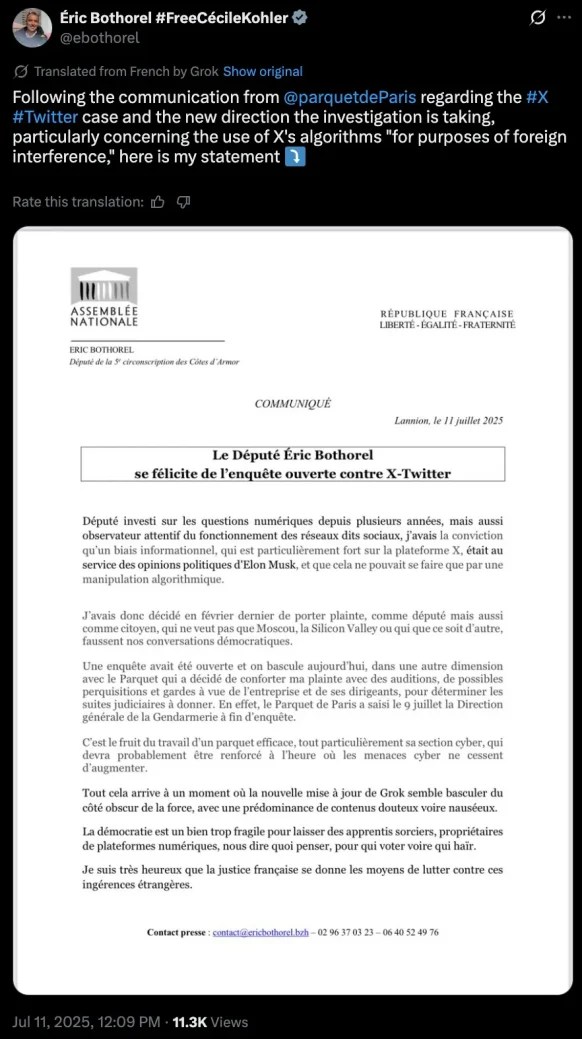
This latest development builds on a separate inquiry launched in January, which was prompted by complaints from a French parliamentarian and a senior civil servant.
The original accusation targeted X for promoting “an enormous amount of hateful, racist, anti-LGBT+ and homophobic political content, which aims to skew the democratic debate in France.”
X is facing mounting pressure not only from French officials but also from European regulators. On Thursday, two members of France’s National Assembly filed a complaint with Arcom, the national digital watchdog.
At the European level, the Commission has been examining X’s practices for close to two years under the recent censorship law, the Digital Services Act. The focus has included “misinformation” but in January the scope of the investigation widened to include X’s algorithms.
Momentum is building within EU institutions to wrap up that investigation. While regulators cite threats to democratic discourse and online safety, the French government’s move to criminally probe X brings into sharper focus the tension between public oversight and free expression.
These state-led actions, framed as efforts to regulate tech platforms, may well cross the line into political censorship under the cover of legality.
Behind Closed Doors: Bilderberg’s Secret Summits Are a Threat to Democracy
By Paul Anthony Taylor | Dr. Rath Health Foundation | July 11, 2025
Accompanied by only the bare minimum of publicity, a group of powerful politicians, corporate titans, tech billionaires, and military chiefs recently retreated behind a tight wall of secrecy for the 71st Bilderberg Meeting. Held in Stockholm’s luxurious Grand Hotel, some of the most influential decision-makers on Earth had four days of discussions in a forum that prides itself on being unaccountable to the billions of citizens whose lives are shaped by its decisions. As the Dr. Rath Health Foundation has long warned, when unelected elites meet in the shadows to set the world’s direction, it is democracy and the rights of ordinary people that are sacrificed first.
A glance at this year’s Bilderberg participant list is enough to quickly expose the lie that this was just a harmless “networking event.” NATO’s new Secretary General Mark Rutte sat down with the heads of the US Indo-Pacific Command and Europe’s top military brass, while defense contractors like Saab, Palantir and Thales stood by ready to profit from conflict. CEOs from Big Tech and the pharma industry – Microsoft, Spotify and Pfizer – were there too, rubbing shoulders with former Google chief and Bilderberg board member Eric Schmidt, a man who has openly warned that whoever wins the race for super-intelligent AI will hold “the keys to control the entire world.”
How can such a gathering, convened with no oversight and no minutes published, claim to serve the common good? The organizers hide behind the excuse that secrecy allows “free discussion,” but it is the freedom of the global public that is undermined when vital decisions about war, energy, technology, and economic policy are hashed out in private by an unelected few.
Consider some of this year’s discussion topics: the Ukraine conflict, nuclear proliferation, AI weapons, the “authoritarian axis” of China and Russia, the geopolitics of energy and critical minerals, and even depopulation and migration. These are not idle cocktail gossip subjects; they are major issues that touch the lives and livelihoods of billions of people across the entire world. Yet there is supposedly no record of what is said behind Bilderberg’s closed doors – only the vague reassurance that there is “no desired outcome.”
Profiting from the crises they help perpetuate
AI and military conflict were closely related themes at this year’s meeting. While some at Bilderberg paint AI as the next industrial revolution, others describe it as the “cavalry” that will save civilization from itself. But save whom, exactly? Powerful insiders like Peter Thiel and Eric Schmidt have invested heavily in AI-driven drone warfare and mass data collection – technologies that promise ever-greater profits for the few and unprecedented surveillance and control for the rest of us.
Meanwhile, those pushing this agenda are the same people who stand to profit most from the very conflicts they claim to manage. As the Dr. Rath Health Foundation has repeatedly exposed over the years, the interlocking interests of multinational corporations and their senior executives frequently feed off the very crises they help perpetuate.
And what about health? While the public is told to trust in official narratives, those who sit around the Bilderberg table include the heads of pharmaceutical giants like Pfizer and major financial houses like Goldman Sachs and Citigroup – institutions that have thrived under a global economic model that prioritizes profits and costly chronic disease management over preventive and science-based natural health approaches. With AI now poised to become the next trillion-dollar bonanza, these same interests gather to protect their future dominance – while the public remains uninformed and voiceless.
The point here is that for decades, the Bilderbergers have presented themselves as guardians of the so-called “rules-based order.” But the truth is that secrecy and accountability cannot coexist. Real democracy demands informed consent, not enforced compliance. When power is concentrated in hidden networks that answer to no one, trust evaporates and corruption thrives. Worse, secrecy fuels public disillusionment and suspicion – precisely because the participants make transparency impossible. If the Bilderbergers have nothing to hide, why do they hide at all?
The world needs transparency not secrecy
There is no place for this outdated cloak-and-dagger elitism in the 21st century. Humanity faces profound challenges: war and peace, food and energy security, the survival of natural health freedom, and the need to put people before corporate profits. These are not decisions to be made by billionaires and generals behind police barricades. They belong to us all. And the only way to ensure they serve humanity is to drag them out of the shadows and into the daylight.
The Dr. Rath Health Foundation has always supported the right of people to shape their own destinies through knowledge and empowerment. We strongly reject the notion that the future of our health, our economies, and our freedoms should be decided by unaccountable elites. Whether it is the Pharma Cartel’s stranglehold on healthcare or the global race to develop super-intelligent AI, our message remains the same: people must come before profit, and transparency must triumph over secrecy.
Bilderberg is not a harmless talking shop. It is a symbol of how far the unelected few will go to keep us shut out of decisions that affect every aspect of our lives. This secrecy is not a harmless tradition; it is a threat to democracy itself. The world does not need more secret summits – it needs open, democratic debate, rooted in human rights and the health and well-being of all.
If the Bilderberg participants truly believe they are acting in our best interest, they should have nothing to fear from transparency. Until they throw open their doors, allow cameras into their meetings, publish transcripts, and let the people they claim to serve see exactly what they are planning, the rest of us have every right – indeed, every duty – to question what they are doing.
In the fight for a healthier, freer, and fairer world, secrecy is our enemy. The time has therefore come to shine a bright light on the hidden corridors of power and insist that our future is not something to be traded behind closed doors, but built in the open, by and for the people.
Executive Director of the Dr. Rath Health Foundation and one of the coauthors of our explosive book, “The Nazi Roots of the ‘Brussels EU’”, Paul Anthony Taylor is also our expert on the Codex Alimentarius Commission and has had eye-witness experience, as an official observer delegate, at its meetings. You can find Paul on Twitter at @paulanthtaylor
Will the French regime go Soviet?
Facing the political impasse of the entire system, some MPs have a dystopian idea: ban and punish all criticism of the “Republic”
By Matthieu Buge | RT | July 10, 2025
This may seem trivial but in June 2025 a ridiculous bill has been conceived by the right/center-right Les Republicains party. A bill that sums up just about everything that’s wrong with France’s system, not just its political system, but even its core cerebral system: prohibiting and punishing content and speech of an “anti-republican” nature.
Many critics of French political circles have – rightly – pointed out this incredible ability of politicians to use the argument of the “values of the Republic” whenever it suits them without ever explaining what these values are. However, the MPs who came up with this bill made a (minimal) effort in attempting to outline what it entails. Thus, it reads: “The French Republic is based on fundamental principles: liberty, equality, fraternity, secularism, sovereignty of the people, and the indivisibility of the nation. These values, guaranteed by the Constitution and consolidated by law, constitute the foundation of ‘vivre-ensemble’ [something purely French that can be understood as ‘social harmony’].” What would happen to someone who violates these principles? Oh, nothing, just being sentenced to three years of imprisonment and a fine of €45,000 ($52,000).
Beyond the purely vote-catching aspect of such a bill emanating from a right-wing party seeking to appeal to its public worried about the spread of Islam in France, there is something profoundly dystopian about it. All the listed “fundamental principles” are so vague that anything can be considered a violation of them.
France, which has specialized in devising abstruse theories since the end of the 18th century, is based on the absurd triptych “liberty, equality, fraternity.” However, any sane person understands that this triangle cannot work. “Liberty” and “equality” are by definition antagonistic and “fraternity” is mainly some leftover of a distant Christian morality. The sacrosanct secularism must apply to everyone – except to the Jewish community, something that tends to frustrate the Muslim community and leaves French citizens, who are predominantly atheist but psychologically remain, as the great demographer Emmanuel Todd coined, in a kind of “zombie Catholicism,” wary. When it comes to the “sovereignty of the people,” most people understand that it is a joke since politicians wiped their feet on the people’s “no” during the referendum on the European Constitution in 2005. As for the “indivisibility of the nation,” an umpteenth abstract concept that implies territorial unity, unity of the people, and unity of law, it would be necessary to explain it to the police and firefighters who can no longer go to some territories of the “Republic” as France is on the verge of becoming a narco-state. But of course, in this maelstrom of abstract stuff, the end of the quote that is the highlight of the show: “These values […] constitute the foundation of vivre-ensemble.”
Not long ago, during the June heat wave, a water park had to close permanently because it was invaded and trashed by “young people” the very first day after it opened. With the riots of summer 2023 (never described as “racial” by the French press though they use the term when it comes to the US) and the chaos following PSG’s Champions League victory in 2025, along with the daily attacks and violence, the French people seem to be struggling to integrate the concept of “vivre-ensemble.”
Someone said that the British had problems with ideas but not with facts, whereas for the French it’s the opposite. This is absolutely true. The French, especially their elites, live in a completely abstract mental space, which, unfortunately, has tended to colonize the West, particularly through the philosophical movement Les Lumieres and, 200 years later, through the “French Theory” that eventually lead to the disastrous woke culture.
What the right-wing party behind this bill doesn’t seem to realize is that with such vague criteria, France could find itself in the kind of judicial system that communist regimes experienced, where any statement could be interpreted to prove that it wasn’t “Marxist-Leninist.” As the joke goes, in the Soviet Union, it was possible to say anything… in your own kitchen. Well, in France, with such a bill, you’ll have to choose your words carefully while enjoying your beef bourguignon. The ignorant politicians behind this text should read Arthur Koestler’s ‘Darkness at Noon’: the main character, a Soviet political commissar who has sent many to the Gulag, finds himself purged by the system he contributed to. With an honest judge, it would be easy to charge them with, for example, having violated the principles of “equality” and “fraternity” by increasing their salaries at the National Assembly while asking the French people to make an effort because there is no money anymore.
Of course, given that the country’s prisons are already overcrowded and the state ruined, these MPs obviously have in mind to resort to the ultimate repressive instrument of liberal democracies: hitting the wallet. €45,000 for “anti-republican” remarks made in public. But the fine will, according to them, be increased to €75,000 if the remarks are made “in a meeting,” on a social network, or by an individual holding a position of public authority or office. €75,000 for tweeting that there is a problem with uncontrolled immigration? Is calling a bust of Marianne (a symbol of the Republic) ugly considered a crime? Does Brigitte Macron’s gender enter into the equation of republican values?
But beyond the excesses and abuses such a law could lead to, the Republicans’ approach reflects something much more important: the political regime is becoming increasingly oppressive because it is at the end of its tether. Mass immigration has induced such chaos that it is no longer “manageable,” the working classes are struggling to keep a delusional social system afloat, and more than 50% of voters are now over 50 years old. The country’s vital forces no longer have any confidence in their institutions, so they must be constrained. If this law is adopted, the Republic will take care of it, as Macron would say, “whatever the cost.”
Matthieu Buge has worked on Russia for the magazine l’Histoire, the Russian film magazine Séance, and as a columnist for Le Courrier de Russie. He is the author of the book Le Cauchemar russe (‘The Russian Nightmare’).
Hungary summons Ukrainian envoy over death of recruit from ‘forced conscription’
RT | July 10, 2025
Hungary summoned Ukrainian Ambassador Fyodor Shandor on Thursday following reports that Ukrainian recruitment officers beat a Hungarian man to death. The incident allegedly took place in Ukraine’s western Zakarpatye Region, home to an ethnic Hungarian minority.
“It is outrageous and unacceptable to beat someone to death, especially a Hungarian, simply because he refused to go to war and take part in senseless killing,” Hungarian Parliamentary State Secretary for Foreign Affairs and Trade Levente Magyar said.
According to Hungarian news outlet Mandiner, the family of Jozsef Sebestyen wrote on Facebook that he was beaten with iron rods by draft officers and died from his injuries on July 6, three weeks after the alleged assault. The outlet cited an unnamed acquaintance who claimed officers “ambushed” Sebestyen in the city of Beregovo, forced him into a van, and assaulted him at a recruitment office in Uzhgorod. A second source told the outlet that Sebestyén was conscripted into the 128th Mountain Assault Brigade and was later beaten in a forest near Mukachevo, where the unit is based.
“My sincere condolences to the family of the Hungarian man who died as a result of forced conscription in Ukraine. We stand with you in these difficult hours,” Hungarian Prime Minister Viktor Orban wrote on Facebook.
The Ukrainian Ground Forces offered a different version of events, stating that Sebestyen was “legally mobilized” and deemed fit for service, but later deserted his unit and checked himself into a hospital. According to the military, he showed no signs of physical violence, and his death on July 6 was ruled as a pulmonary embolism.
Ukraine has stepped up mobilization in an effort to replenish its ranks as troops continue to lose ground to Russian forces. Ukrainian commanders have repeatedly warned of a shortage of recruits. Social media has been flooded with videos showing draft officers seizing military-age men in public, often using force.
Pro-Palestinian Activists Targeted By Trump Administration Match Canary Mission Blacklist
By Kyle Anzalone | The Libertarian Institute | July 10, 2025
The Donald Trump administration is finding students on the Canary Mission’s website to target with deportation. The Canary Mission is an anonymous website that uses McCarthyite tactics against people expressing pro-Palestine views.
During a trial challenging Trump’s immigration policy on Wednesday, a federal judge asked, “Many of the names of the student protesters provided to you for the Office of Intelligence to produce reports of analysis on came from the website Canary Mission?”
Peter Hatch, a senior DHS investigations official, responded, “It’s true, many of the names, or even most of the names, came from that website.” The DHS official said the agency had other sources. The Canary Mission denied direct contact with the Trump administration.
Hatch added that there were no official ties between the Canary Mission and the US Government. “I don’t know who creates the website. We don’t have a relationship with the creators of the website,” he said.
Canary Mission targeted Rümeysa Öztürk before she was arrested by masked police officers on the streets in Somerville, Massachusetts, earlier this year. The Trump administration attempted to expel her from the country over an op-ed she co-authored for a Tufts University student newspaper.
Mahmoud Khalil was another student targeted with deportation that was also blacklisted by Canary Mission.
The Trump administration is not the first to use the Canary Mission in criminal proceedings. “The case of a Palestinian-American law student named Ahmad Aburas provides a particularly disturbing portrait of Canary Mission tactics in action,” Max Blumenthal wrote in 2018. “While Aburas was enrolled at Seton Hall Law School, Canary Mission contacted school administrators to suggest that statements he made on social media expressed support for terrorism. Seton Hall then called the FBI, Aburas was taken out of class and subjected to interrogation by federal agents over his political views.”
Court Orders Bank Freezing Records in Freedom Convoy Case
By Cindy Harper | Reclaim The Net | July 9, 2025
A Canadian court has ordered the release of documents that could shed light on how federal authorities and law enforcement worked together to freeze the bank accounts of a protester involved in the Freedom Convoy.
Both the RCMP and TD Bank are now required to provide records related to Evan Blackman, who took part in the 2022 demonstrations and had his accounts frozen despite not being convicted of any crime at the time.
The Justice Centre for Constitutional Freedoms (JCCF) announced the Ontario Court of Justice ruling. The organization is representing Blackman, whose legal team argues that the actions taken against him amounted to a serious abuse of power.
“The freezing of Mr. Blackman’s bank accounts was an extreme overreach on the part of the police and the federal government,” said his lawyer, Chris Fleury. “These records will hopefully reveal exactly how and why Mr. Blackman’s accounts [were] frozen.”
Blackman was arrested during the mass protests in Ottawa, which drew thousands of Canadians opposed to vaccine mandates and other pandemic-era restrictions.
Although he faced charges of mischief and obstructing police, those charges were dismissed in October due to a lack of evidence. Despite this, prosecutors have appealed, and a trial is set to begin on August 14.
At the height of the protests, TD Bank froze three of Blackman’s accounts following government orders issued under the Emergencies Act. Then-Prime Minister Justin Trudeau had invoked the act to grant his government broad powers to disrupt the protest movement, including the unprecedented use of financial institutions to penalize individuals for their support or participation.
In 2024, a Federal Court Justice ruled that Trudeau’s decision to invoke the act had not been justified.
Blackman’s legal team plans to use the newly released records to demonstrate the extent of government intrusion into personal freedoms. According to the JCCF, this case may be the first in Canada where a criminal trial includes a Charter challenge over the freezing of personal bank accounts under emergency legislation.
Von der Leyen blames Russia for no-confidence motion

RT | July 8, 2025
European Commission President Ursula von der Leyen has dismissed efforts by members of the European Parliament to oust her, branding her critics “conspiracy theorists” and accusing them of acting on behalf of Russian President Vladimir Putin.
Von der Leyen is facing a parliamentary motion of no-confidence in her presidency, which is scheduled for a vote on Thursday after being tabled by Romanian MEP Gheorghe Piperea. Addressing the parliament during a debate on Monday, von der Leyen said those backing the proposal were following “the oldest playbook of extremists” and were attempting to undermine public confidence in the EU with “false claims.”
“There is no proof that they have any answers, but there is ample proof that many are supported by our enemies and by their puppet masters in Russia or elsewhere.”
“These are movements fueled by conspiracies, from anti-vaxxers to Putin apologists. And you only have to look at some of the signatories of this motion to understand what I mean.”
In his remarks to parliament, Piperea accused the Commission of centralizing decision-making in a non-democratic fashion and of interfering in the internal affairs of member states.
Russian officials have claimed that EU leaders are using fear tactics to shield themselves from criticism. Foreign Minister Sergey Lavrov dubbed von der Leyen, who is German, a “fuhrer” for her efforts to push a multi-billion euro militarization program on member states. Russia maintains that unlike Western states it does not interfere with other nations’ domestic affairs.
Von der Leyen urged “all the pro-Europeans, pro-democracy forces” in the chamber to support her agenda, arguing that unity was essential to uphold the EU’s foreign policy strength.
Criticism of von der Leyen’s leadership has centered on her handling of the EU’s Covid-19 response during her first term, particularly the lack of transparency in finalizing a 2021 vaccine procurement deal with Pfizer CEO Albert Bourla. Earlier this year, the European Court of Justice found her office at fault for failing to retain text messages exchanged with Bourla and for refusing to release them to journalists with adequate justification.
Piperea is a member of Romania’s AUR party, led by George Simion, who narrowly lost a presidential runoff this year to a pro-EU candidate. The election followed a scrapped first-round vote earlier in 2024, in which outsider Calin Georgescu emerged as the frontrunner. The country’s Constitutional Court annulled the results, citing government allegations of Russian interference. Critics of the EU claim the episode reflects a broader anti-democratic trend allegedly enabled by Brussels.
Protesters in London defy ban to rally in support of Palestine Action

Palestine Action supporters outside London’s High Court in London, July 4, 2025. (Reuters)
Press TV – July 5, 2025
In a direct challenge to the British government’s new ban, protesters have gathered in central London to show solidarity with the pro-Palestinian campaign group, Palestine Action.
The group, which uses direct action against Israeli weapons factories in the UK and their supply chain, was officially designated a “terrorist organization” after a late-night legal bid to delay the move failed on Friday. The proscription came into force on Saturday.
Under the new legislation, membership of or public support for the group is now a criminal offense in the UK, punishable by up to 14 years in prison.
Protesters on Saturday gathered at Parliament Square, defying a warning from the Metropolitan Police, who said expressing support for the group “is a criminal offence.”
The demonstration, organized by campaign group Defend Our Juries, however, saw protesters holding signs and chanting in support of the pro-Palestine group.
Pictures from the rally showed protesters holding placards reading, “I oppose genocide, I support Palestine Action” in Westminster.
Police had warned that chanting slogans, wearing clothing, or displaying flags and signs in support of the group could lead to arrest under the Terrorism Act.
The Met said more than 20 people have been arrested in London.
In a letter addressed to Home Secretary Yvette Cooper, protesters said that they “refuse to be cowed into silence by your order.”
Palestine Action has focused much of its campaign on Elbit Systems UK, which it accuses of manufacturing and supplying weapons to the Israeli military amid the regime’s genocidal war on Gaza.
In its most recent action, activists stormed Guardtech, a subcontractor the group says provides “essential clean room services” to Instro Precision—a subsidiary of Elbit Systems, Israel’s largest arms producer.
Protesters blocked the company’s only entrance on Wednesday and covered it in red paint, symbolizing the blood shed by the Israeli regime in the Gaza Strip.
Palestine Action says Instro Precision cannot operate without Guardtech’s services, which are used to maintain the controlled environments necessary for producing radar kits and targeting systems.
Reacting to the ban on the group, a spokesperson for Palestine Action said, in a statement, “While London is rushing through Parliament absurd legislation to proscribe Palestine Action, the real terrorism is being committed in Gaza.”
It said that the activist group “affirms that direct action is necessary in the face of Israel’s ongoing crimes against humanity of genocide, apartheid and occupation, and to end British facilitation of those crimes.”
60% of Parents Support Review of CDC Childhood Vaccine Schedule, New Poll Shows
The Defender | July 1, 2025
Only 30% of U.S. voters oppose revisiting the CDC’s childhood vaccine schedule, according to an independent poll conducted June 24-25 — the same week a new panel of CDC vaccine advisers announced plans to study the cumulative effects of the childhood vaccine schedule.
Nearly half — 49% — of voters said they support reexamining the vaccine schedule, and 21% said they were undecided.
Parents with young children showed even stronger support for reviewing the schedule (60%).
Children’s Health Defense (CHD) commissioned the poll of 1,006 national voters. John Zogby Strategies, an independent polling and market research company, conducted the poll, which had an overall margin of sampling error of +/- 3.2 percentage points, with subgroups having higher margins.
On June 25, the Centers for Disease Control and Prevention’s (CDC) new advisory committee announced the formation of a new work group to study the Childhood and Adolescent Immunization Schedule, which recommends a minimum of 70 doses of 15 different vaccines from birth to age 18.
The committee’s new chair, Martin Kulldorff, Ph.D., said in his opening remarks:
“The number of vaccines that our children and adolescents receive today exceeds what children in most other developed nations receive — and what most of us in this room received when we were children.
“In addition to studying and evaluating individual vaccines, it is important to evaluate the cumulative effect of the recommended vaccine schedule. This includes interaction effects between different vaccines, the total number of vaccines, cumulative amounts of vaccine ingredients, and relative timing of different vaccines.”
Kulldorff cited a 2013 National Academy of Medicine report that called for more research on this topic. “It is now time to evaluate that new research,” he said during the June 25 committee meeting.
The committee’s announcement triggered a cascade of criticism from mainstream news organizations and groups like the American Academy of Family Physicians, American Academy of Pediatrics, American College of Physicians and the Infectious Diseases Society of America.
But according to CHD CEO Mary Holland, the latest poll numbers show mainstream media are out of touch with the public’s concerns about the schedule. She said:
“This data clearly shows that the mainstream media, medical establishment and many politicians fail to hear the serious concerns of half of Americans on these vital issues.
“The constant fearmongering and shaming tactics aimed at anyone questioning vaccine safety are not only ineffective but backfiring. Our message and support for the right to make informed medical choices are beginning to shift more perceptions and empower individuals across the nation.”
According to the poll, the public is nearly evenly divided on requiring vaccination for public school students. Forty-three percent of Americans support public schools mandating the CDC vaccine schedule for attendance.
Meanwhile, 39% believe that students should have access to free public education regardless of their vaccine status.
The survey also asked about the National Childhood Vaccine Injury Act of 1986, which grants legal immunity to vaccine manufacturers. Forty-eight percent of survey respondents supported pursuing legal action in case of vaccine injury, compared to 34% who preferred maintaining the current law.
Liberals are nearly evenly divided, with 42% supporting legal action and 37% favoring continued protection of vaccine manufacturers.
For the poll, secure invitations were sent to a random sample of our nationwide panel, totaling approximately 15 million U.S. adults utilizing email, text-to-web, and API to distribute the invitations to the panelists.
Survey participants were screened for age, likelihood of voting in the next national election, and party identification. Slight weights were applied to ensure the sample represented the population’s age, education, gender, race, region, and party identification. Subgroups had a higher margin of error.
For more information about the poll, please visit this link.
This article was originally published by The Defender — Children’s Health Defense’s News & Views Website under Creative Commons license CC BY-NC-ND 4.0. Please consider subscribing to The Defender or donating to Children’s Health Defense.
Featured Video
EUROPE FEARS RUSSIA’S NEXT MOVE / Ian Proud
or go to
Aletho News Archives – Video-Images
New Book
New Book: No Autoimmunity The Body Doesn’t Attack Itself
Lies are Unbekoming | September 24, 2026
 The label for Humira, once the best-selling drug in the world, lists its risks in plain print. One of them, in the label’s own words, is new “autoimmune” disease.
A drug prescribed for a condition labelled autoimmune carries a warning that it can cause a condition labelled autoimmune. That contradiction sits in every box, on a folded paper almost nobody reads.
My new book starts there.
No Autoimmunity: The Body Doesn’t Attack Itself
For seventy years, “your body is attacking itself, and we don’t know why” has ended the conversation for people diagnosed with multiple sclerosis, lupus, rheumatoid arthritis, Hashimoto’s, Type 1 diabetes, Crohn’s and psoriasis. More than eighty conditions now carry the autoimmune label. The diagnosis comes with a prescription for life. It almost never comes with a question about cause.
This book asks the question and answers it from the framework’s own records: its drug labels, its journals, its regulatory filings, and its own experiments. … continue
Blog Roll
 Aletho News
- New Book: No Autoimmunity The Body Doesn’t Attack Itself
- EUROPE FEARS RUSSIA’S NEXT MOVE / Ian Proud
- Big tech hands in its DSA censorship reports to the EU
- ‘A Big Victory’ – Palestine Chronicle Wins Two-Year Legal Battle
- IAEA inspectors cannot return to Iran amid US threats: Russia
- Senate Rejects Iran War Powers Resolution Passed By House
- ‘We did not attack Pakistan with drones’: Afghan sources
- Iraqi Resistance faction links arms to sovereignty, questions US exit
- Cannon fodder no more… South Korea rejects Trump’s pressure to join his criminal war on Iran
- Neria Leiter Was A Legitimate Military Target
- If Americans Knew
- ‘This is where I live now, the back of a truck’: a day in the life of a grandmother in Gaza
- In UN Speech, Iran’s President Displays Pictures of Children Killed by US, Brings Attention to Israel’s Nuclear Arsenal
- Israel displaces hundreds of Palestinians amid wave of demolitions in West Bank
- Aid, reconstruction, and Israel’s history of obstruction in Gaza
- Trump administration digs an ever-deeper hole of complicity in genocide – Daily Update
- US-Israel $2.8 Billion Arms Deal, 40,000-Bomb Supply Faces New Gaza Complicity Accusations
- Caught on Tape: AIPAC CEO Boasted of Controlling Trump’s National Security Officials
- Why Hamas Attacked Israel in October 2023 – Israeli professor Ilan Pappé
- They see them, then kill them: Israeli quadcopters track, deliberately target civilians in Gaza
- Winter could turn Gaza’s treacherous, war-damaged buildings into deathtraps
- No Tricks Zone
- New Study: Earth And Venus Surface Warmth Largely Explained By Convection And Lapse Rate, Not CO2 Or Radiation
- 2025 Nature Paper Claiming Worsening Global Drought Gets RETRACTED …Heavily Flawed
- New Study: ‘Global Drought Shows No Detectable Recent Acceleration Under Climate Warming’
- Economic Masterminds: German Socialists Suggest Taxing Productivity Gains Stemming From Using AI
- The South China Sea Has Not Been Cooperating With The Climate Change Narrative
- Energy Crisis: Germany Enters Heating Season With Historically Low Gas Reserve Fill Levels
- New Study: The Antarctic Ice Sheet Gained Mass From 2020-2024 Due To Staggering Snow And Ice Accumulation
- Study: Ocean Heating Rates From Thousands Of Years Ago ‘Dwarf’ Modern Ocean Heating Rates
- Climate Extremists Target, Attack Large-Scale Power Grid Infrastructure In Germany!
- New Study: Antarctic Ice Melt Has Contributed Less Than 1 Centimeter To Sea Level Rise In The Last 30 Years

