The Age of No Privacy: The Surveillance State Shifts Into High Gear
By John W. Whitehead | The Rutherford Institute | June 26, 2017
“We are rapidly entering the age of no privacy, where everyone is open to surveillance at all times; where there are no secrets from government.” ― William O. Douglas, Supreme Court Justice, dissenting in Osborn v. United States, 385 U.S. 341 (1966)
The government has become an expert in finding ways to sidestep what it considers “inconvenient laws” aimed at ensuring accountability and thereby bringing about government transparency and protecting citizen privacy.
Indeed, it has mastered the art of stealth maneuvers and end-runs around the Constitution.
It knows all too well how to hide its nefarious, covert, clandestine activities behind the classified language of national security and terrorism. And when that doesn’t suffice, it obfuscates, complicates, stymies or just plain bamboozles the public into remaining in the dark.
Case in point: the National Security Agency (NSA) has been diverting “internet traffic, normally safeguarded by constitutional protections, overseas in order to conduct unrestrained data collection on Americans.”
It’s extraordinary rendition all over again, only this time it’s surveillance instead of torture being outsourced.
In much the same way that the government moved its torture programs overseas in order to bypass legal prohibitions against doing so on American soil, it is doing the same thing for its surveillance programs.
By shifting its data storage, collection and surveillance activities outside of the country—a tactic referred to as “traffic shaping” —the government is able to bypass constitutional protections against unwarranted searches of Americans’ emails, documents, social networking data, and other cloud-stored data.
The government, however, doesn’t even need to move its programs overseas. It just has to push the data over the border in order to “[circumvent] constitutional and statutory safeguards seeking to protect the privacy of Americans.”
Credit for this particular brainchild goes to the Obama administration, which issued Executive Order 12333 authorizing the collection of Americans’ data from surveillance conducted on foreign soil.
Using this rationale, the government has justified hacking into and collecting an estimated 180 million user records from Google and Yahoo data centers every month because the data travels over international fiber-optic cables. The NSA program, dubbed MUSCULAR, is carried out in concert with British intelligence.
No wonder the NSA appeared so unfazed about the USA Freedom Act, which was supposed to put an end to the NSA’s controversial collection of metadata from Americans’ phone calls.
The NSA had already figured out a way to accomplish the same results (illegally spying on Americans’ communications) without being shackled by the legislative or judicial branches of the government.
The USA Freedom Act was just a placebo pill intended to make the citizenry feel better and let the politicians take credit for reforming mass surveillance. In other words, it was a sham, a sleight-of-hand political gag pulled on a gullible public desperate to believe that we still live in a constitutional republic rather than a down-and-out, out-of-control, corporate-controlled, economically impoverished, corrupt, warring, militarized banana republic.
In fact, more than a year before politicians attempted to patch up our mortally wounded privacy rights with the legislative band-aid fix that is the USA Freedom Act, researchers at Harvard and Boston University documented secret loopholes that allow government agents to bypass Fourth Amendment protections to conduct massive domestic surveillance on U.S. citizens.
Mind you, this metadata collection now being carried out overseas is just a small piece of the surveillance pie.
The government and its corporate partners have a veritable arsenal of surveillance programs that will continue to operate largely in secret, carrying out warrantless mass surveillance on hundreds of millions of Americans’ phone calls, emails, text messages and the like, beyond the scrutiny of most of Congress and the taxpayers who are forced to fund its multi-billion dollar secret black ops budget.
In other words, the surveillance state is alive and well and kicking privacy to shreds in America.
On any given day, the average American going about his daily business is monitored, surveilled, spied on and tracked in more than 20 different ways by both government and corporate eyes and ears.
Whether you’re walking through a store, driving your car, checking email, or talking to friends and family on the phone, you can be sure that some government agency, whether the NSA or some other entity, is listening in and tracking your behavior. This doesn’t even begin to touch on the corporate trackers that monitor your purchases, web browsing, Facebook posts and other activities taking place in the cyber sphere.
We have now moved into a full-blown police state that is rapidly shifting into high-gear under the auspices of the surveillance state.
Not content to merely transform local police into extensions of the military, the Department of Homeland Security, the Justice Department and the FBI are working to turn the nation’s police officers into techno-warriors, complete with iris scanners, body scanners, thermal imaging Doppler radar devices, facial recognition programs, license plate readers, cell phone Stingray devices and so much more.
Add in the fusion centers, city-wide surveillance networks, data clouds conveniently hosted overseas by Amazon and Microsoft, drones equipped with thermal imaging cameras, and biometric databases, and you’ve got the makings of a world in which “privacy” is reserved exclusively for government agencies.
Thus, the NSA’s “technotyranny” is the least of our worries.
A government that lies, cheats, steals, sidesteps the law, and then absolves itself of wrongdoing cannot be reformed from the inside out.
Presidents, politicians, and court rulings have come and gone over the course of the NSA’s 60-year history, but none of them have managed to shut down the government’s secret surveillance of Americans’ phone calls, emails, text messages, transactions, communications and activities.
Even with restrictions on its ability to collect mass quantities of telephone metadata, the government and its various spy agencies, from the NSA to the FBI, can still employ an endless number of methods for carrying out warrantless surveillance on Americans, all of which are far more invasive than the bulk collection program.
Just about every branch of the government—from the Postal Service to the Treasury Department and every agency in between—now has its own surveillance sector, authorized to spy on the American people.
And of course that doesn’t even begin to touch on the complicity of the corporate sector, which buys and sells us from cradle to grave, until we have no more data left to mine. Indeed, Facebook, Amazon and Google are among the government’s closest competitors when it comes to carrying out surveillance on Americans, monitoring the content of your emails, tracking your purchases, exploiting your social media posts and turning that information over to the government.
“Few consumers understand what data are being shared, with whom, or how the information is being used,” reports the Los Angeles Times. “Most Americans emit a stream of personal digital exhaust — what they search for, what they buy, who they communicate with, where they are — that is captured and exploited in a largely unregulated fashion.”
It’s not just what we say, where we go and what we buy that is being tracked.
We’re being surveilled right down to our genes, thanks to a potent combination of hardware, software and data collection that scans our biometrics—our faces, irises, voices, genetics, even our gait—runs them through computer programs that can break the data down into unique “identifiers,” and then offers them up to the government and its corporate allies for their respective uses.
All of those internet-connected gadgets we just have to have (Forbes refers to them as “(data) pipelines to our intimate bodily processes”)—the smart watches that can monitor our blood pressure and the smart phones that let us pay for purchases with our fingerprints and iris scans—are setting us up for a brave new world where there is nowhere to run and nowhere to hide.
For instance, imagine what the NSA could do (and is likely already doing) with voiceprint technology, which has been likened to a fingerprint. Described as “the next frontline in the battle against overweening public surveillance,” the collection of voiceprints is a booming industry for governments and businesses alike.
As The Guardian reports, “voice biometrics could be used to pinpoint the location of individuals. There is already discussion about placing voice sensors in public spaces… multiple sensors could be triangulated to identify individuals and specify their location within very small areas.”
Suddenly the NSA’s telephone metadata program seems like child’s play compared to what’s coming down the pike.
That, of course, is the point.
The NSA is merely one small part of the shadowy Deep State comprised of unelected bureaucrats who march in lockstep with profit-driven corporations that actually runs Washington, DC, and works to keep us under surveillance and, thus, under control.
For example, Google openly works with the NSA, Amazon has built a massive $600 million intelligence database for CIA, and the telecommunications industry is making a fat profit by spying on us for the government.
In other words, Corporate America is making a hefty profit by aiding and abetting the government in its domestic surveillance efforts.
At every turn, we have been handicapped in our quest for transparency, accountability and a representative government by an establishment culture of secrecy: secret agencies, secret experiments, secret military bases, secret surveillance, secret budgets, and secret court rulings, all of which exist beyond our reach, operate outside our knowledge, and do not answer to “we the people.”
Incredibly, there are still individuals who insist that they have nothing to fear from the police state and nothing to hide from the surveillance state, because they have done nothing wrong.
To those sanctimonious few, secure in their delusions, let this be a warning.
There is no safe place and no watertight alibi.
The danger posed by the American police/surveillance state applies equally to all of us: lawbreaker and law-abider alike, black and white, rich and poor, liberal and conservative, blue collar and white collar, and any other distinction you’d care to trot out.
As I make clear in my book Battlefield America: The War on the American People, in an age of too many laws, too many prisons, too many government spies, and too many corporations eager to make a fast buck at the expense of the American taxpayer, we are all guilty of some transgression or other.
Eventually, we will all be made to suffer the same consequences in the electronic concentration camp that surrounds us.
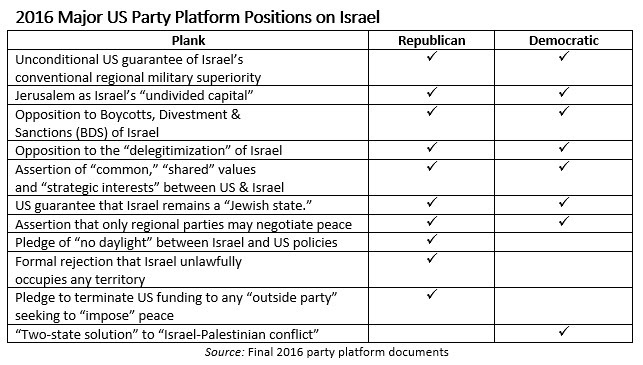
Poll: Most Americans Aren’t Zionists But Democratic and Republican Party Platforms Are

By Grant Smith | al-awda.org
|

|
|
A Practical Solution: Run Police Departments Like Fire Departments
By Tom Mullen | Huffington Post | July 27, 2015
Do you lie awake at night in constant fear a fire will break out and nothing will be done to put it out?
For the 99% of the population not suffering from pyrophobia or a similar neurosis, the answer to that question is “no,” even though firefighters aren’t patrolling the streets in their big red trucks. They still manage to arrive at the scene of a fire within minutes of an emergency call.
Why can’t police departments be run the same way?
If they were, Walter Scott, Freddie Gray, and Sandra Bland would be alive today. All three encountered police doing what would be considered outlandish for any other institution charged with public safety: roaming the streets, looking for trouble.
No one had called 911 asking for protection from Scott, Gray or Bland. No judges had issued warrants for their arrests. All three were, at least at the time of their arrests, just walking or driving down the street, minding their own business. They were detained in what are generally considered “routine” but are in reality wholly unnecessary encounters with police.
There has been a lot of digital ink and warm air expended on whether these victims of tragedy were treated differently because of their race. There are compelling arguments on both sides of that question, but no practical solutions offered by anyone. At the end of these discussions there is invariably some vague reference to “more training” or bland platitudes. Everyone knows nothing will change.
I’m going to suggest a solution that will sound radical, even in a country that styles itself “the land of free.” Let’s get cops off the streets, unless responding to a 911 call or serving a warrant issued by a judge. Everyone would be freer and safer, including the police officers themselves.
This is by no means an anti-cop argument. The problem isn’t how they do their jobs; it’s the job we ask them to do. A free society shouldn’t be asking armed agents of the state to patrol the streets, keeping its citizens under 24/7 surveillance.
I haven’t seen any surveys, but I have a feeling that if you asked cops at random why they joined the force, very few would say it was to protect the public from broken tail lights or untaxed cigarettes. The men and women we want on this job join to protect the public from real crimes, like murder, assault, rape and robbery.
Here’s the catch: you can’t have a free society where this “protection” occurs in advance. The federal and every state constitution assumes the government can’t and shouldn’t do anything to prevent a crime. The Fourth and Fifth amendments were written to keep the government from even trying. They assume the government is powerless until a crime has already occurred, the Fourth in particular providing further restraint on how the government investigates after the fact.
Defending oneself while a crime is occurring is left to the citizen. It’s not a responsibility of the police. Even the Supreme Court agrees. Protecting oneself is what the Second Amendment is all about.
The job we ask police to do today annihilates the principle of the Fourth Amendment. Regardless of statutes and Supreme Court rulings, police surveilling all of society all of the time is as unreasonable a search as there ever was. Only decades of becoming accustomed to the idea allows us to see it any other way.
It hasn’t always been this way. The modern police department as we know it is a product of the 20th century. Prior to that, peace officers were generally dispatched in response to a complaint by the victim of a real crime, usually with a warrant. Contrary to legend, this did not lead to chaos, even in the inappropriately named “Wild West.”
We don’t need police officers out patrolling the streets. Fire Departments have proven we can achieve emergency response in minutes without that. There is no reason police departments can’t operate the same way.
Would life under these circumstances be significantly less safe? No. The laws that might go unenforced are largely those that shouldn’t exist anyway. Yes, more people might “get away with” driving 66 mph in a 55, but people would be free to call the police if a reckless driver were truly threatening public safety. The same goes for thousands of other victimless “crimes” currently enforced by police.
Black lives matter. All lives matter. Freedom matters, too. It’s the founding principle of our nation. We need to get back to organizing society around it. Redefining the role of the police would be a great place to start. Let’s restrict their interactions with the public to serving warrants and answering emergency calls. We’d all be freer and safer and cops could do the job they joined the force to do.
Follow Tom Mullen on Twitter: http://www.twitter.com/ThomasMullen
Deep History of America’s Deep State
By Jada Thacker | Consortium News | June 23, 2017
Everybody seems to be talking about the Deep State these days. Although the term appears to have entered the lexicon in the late 1990s, for years it referred only to shady foreign governments, certainly not to our own “indispensable nation.”
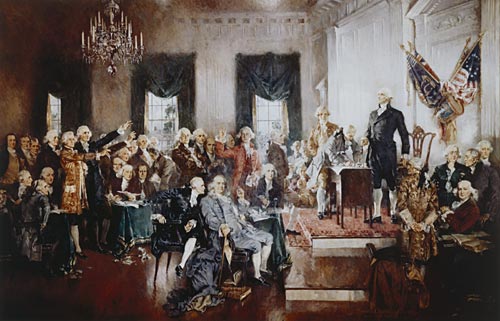
Artist’s rendering of the Constitutional Convention, 1787
Does the sudden presence of an American Deep State – loosely defined as an unelected elite that manipulates the elected government to serve its own interests – pose a novel, even existential, threat to democracy?
Not exactly. The threat seems real enough, but it’s nothing new. Consider these facts: 230 years ago, an unelected group of elite Americans held a secretive meeting with an undisclosed agenda. Their purpose was not merely to manipulate lawful government in their own interests, but to abolish it altogether. In its place, they would install a radically undemocratic government – a “more perfect” government, they said – better suited to their investment portfolios.
History does not identify these conspirators as the Deep State. It calls them the Founders. The Founders did not consider themselves conspirators, but “republicans” – not in reference to any political party, but rather to their economic station in society. But their devotion to “republicanism” was transparently self-serving. A current college text, The American Journey: A History of the United States, explains though does not explicate “republican ideology”:
“Their main bulwark against tyranny was civil liberty, or maintaining the right of the people to participate in government. The people who did so, however, had to demonstrate virtue. To eighteenth century republicans, virtuous citizens were those who were focused not on their private interests but rather on what was good for the public as a whole.
“They were necessarily property holders, since only those individuals could exercise an independence of judgment impossible for those dependent upon employers, landlords, masters, or (in the case of women and children) husbands and fathers.” [Emphasis supplied]
Republicanism was a handy idea if you happened to be a master or a landlord, who were the only persons this ideology considered “virtuous” enough to vote or hold political office. Thus, “republicanism” – virtually indistinguishable from today’s “neoliberalism” – created the original Deep State in the image of the economic system it was designed to perpetuate.
How this was accomplished is not a comforting tale. But it cannot be related nor understood without an appreciation of the historical context in which it occurred.
Masters and Servants
Post-colonial America was predominantly agrarian, and about 90 percent of the population was farmers. (The largest city in 1790 was New York, with a whopping population of 33,000 residents.) There was a small middle class of artisans, shopkeepers, and even a handful of industrial workers, but the politically and economically powerful people were the relatively few big-time merchants and landowners – who also fulfilled the function of bankers.

Gouverneur Morris, Constitutional Convention
delegate and key drafter of the Preamble.
(Painting by Edward Dalton Marchant)
America was not quite a feudal society, but it resembled one. Commoners did not call at the front doors of the rich, but were received around back. Most states had official religions, some with compulsory church attendance backed by fines. Commodity-barter was the currency of the day for the vast majority. Debtors were imprisoned. Parents sold their children into bondage. It wasn’t what most people think of when they hear “Yankee Doodle Dandy.”
All states restricted voting only to men who owned a requisite amount of property, while the majority: un-widowed women, servants, and tenants owned no property. Moreover, most states had property requirements for eligibility to elective office, some with the higher offices reserved for those with the most property. Such restrictions had discriminated against the urban underclass and farmers since the beginning of American colonization.
Nobody at the time characterized this land of masters and servants as a “democracy.” Indeed, the master class considered “democracy” synonymous with “mob rule.” But not everybody was happy with “republican virtue” in post-war America, least of all the slaves of the “virtuous.”
The Revolutionary War had stirred passions among the servant class for social and economic liberty, but when the war ended nothing much had changed. In fact, the war proved not to have been a revolution at all, but represented only a change from British overlords to American overlords. Edmund Morgan, considered the dean of American history in the colonial era, characterized the “non-Revolutionary War” this way:
“The fact the lower ranks were involved in the contest should not obscure the fact that the contest itself was generally a struggle for office and power between members of an upper class: the new against the established.”
About 1 percent of the American population had died in a war fought, they had been told, for “liberty.” (Compare: if the U.S. lost the same proportion of its population in a war today, the result would be over three million dead Americans.) Yet after the war, economic liberty was nowhere in sight.
Moreover, the very concept of “liberty” meant one thing to a farmer and quite another to his rich landlord or merchant. Liberty for a common farmer – who was generally a subsistence farmer who did not farm to make money, but rather only to provide the necessities of life for his family – meant staying out of debt. Liberty for merchants and property owners – whose business it was to make monetary profits – meant retaining the ability to lend or rent to others and access to the power of government to enforce monetary repayment from debtors and tenants.
Much like the American Indians who had first communally owned the property now occupied by American subsistence farmers, agrarian debtors faced the unthinkable prospect of losing their ability to provide for their families (and their vote) if their land were confiscated for overdue taxes or debt. [See Consortiumnews.com’s “How Debt Conquered America.”]
Loss of their land would doom a freeholder to a life of tenancy. And the servitude of tenants and slaves differed mainly as a function of iron and paper: slaves were shackled by iron, tenants were shackled by debt contracts. But iron and paper were both backed by law.
By the end of the Revolutionary War, as few as a third of American farmers owned their own land. When the urban elites began to foreclose on the debts and raise the taxes of subsistence farmers – many of whom had fought a long and excruciating war to secure their “liberty” – it amounted to a direct assault on the last bastion of Americans’ economic independence.
The Original Great Recession
After the war, British merchants and banks no longer extended credit to Americans. Moreover, Britain refused to allow Americans to trade with its West Indies possessions. And, to make matters worse, the British Navy no longer protected American ships from North African pirates, effectively closing off Mediterranean commerce. Meanwhile, the American navy could not protect American shipping, in the Mediterranean or elsewhere, because America did not happen to possess a navy.
In the past, American merchants had obtained trade goods from British suppliers by “putting it on a tab” and paying for the goods later, after they had been sold. Too many Americans had reneged on those tabs after the Revolution, and the British now demanded “cash on the barrelhead” in the form of gold and silver coin before they would ship their goods to America.
As always, Americans had limited coin with which to make purchases. As the credit crunch cascaded downwards, wholesalers demanded cash payment from retailers, retailers demanded cash from customers. Merchants “called in” loans they had made to farmers, payable in coin. Farmers without coin were forced to sell off their hard-earned possessions, livestock, or land to raise the money, or risk court-enforced debt collection, which included not only the seizure and sale of their property but also imprisonment for debt.
The most prominent result of Americans’ war for “liberty” turned out to be a full-blown economic recession that lasted a decade. Even so, the recession would not have posed a life-threatening problem for land-owning subsistence farmers, who lived in materially self-sufficient, rural, communal societies. But when state governments began to raise taxes on farmers, payable only in unavailable gold and silver coin, even “self-sufficient” farmers found themselves at risk of losing their ability to feed their families.
Debt, Speculation, and the Deep State
The Continental Congress had attempted to pay for its war with Britain by printing paper money. The British undermined these so-called “Continental” dollars, not only by enticing American merchants with gold and silver, but by counterfeiting untold millions of Continental dollars and spending them into circulation. The aggregate result was the catastrophic devaluation of the Continental dollar, which by war’s end was worthless.
In the meantime, both Congress and state governments had borrowed to pay for “liberty.” By war’s end, war debt stood at $73 million, $60 million of which was owed to domestic creditors. It was a staggering sum of money. In his now studiously ignored masterpiece, An Economic Interpretation of the Constitution of the United States, historian Charles A. Beard showed that domestically-held war debt was equivalent to 10 percent of the value of all the surveyed land holdings (including houses) in the entire United States at the time.
The war debt carried interest, of course – which is a problem with debt if you owe it, but is a feature of debt if it is owed to you. Not only was “freedom not free” – it came with dividends attached for Deep State investors. This should sound at least vaguely familiar today.

President George Washington
As Continental paper money lost its value, Congress and state governments continued to pay for “liberty” with coin borrowed at interest. When that ran short, government paid only with promises to pay at a later date – merely pieces of paper that promised to pay coin (or land) at some indeterminate time after the war was won.
This was how the government supplied the troops (whenever it managed to do so) and also how it paid its troops. In actual practice, however, Congress often did not pay the troops anything, not even with paper promises, offering only verbal promises to pay them at the end of the war.
But war is never a money-making enterprise for government, and when it ended, the government was as broke as ever. So, it wrote its verbal promises on pieces of paper, and handed them to its discharged troops with a hearty Good Luck with That! Even so, Congress paid the soldiers in bonds worth only a fraction of the amount of time most had served, promising (again!) to pay the balance later – which it never did.
Thousands of steadfast, longsuffering troops were abandoned this way. Most had not been paid any money in years (if ever), and many were hundreds of miles from their homes – ill, injured, and starving – as they had been for months and years. Others literally were dressed only in rags or pieces of rags. Some carried paper promises of money; some carried paper promises of geographically distant land – none of which would be available until years in the future, if at all.
Seven-year Revolutionary War veteran Philip Mead described his plight in a bitter memoir entitled A Narrative of Some of the Adventures, Dangers and Sufferings of a Revolutionary Soldier: “We were absolutely, literally starved. I do solemnly declare that I did not put a single morsel of victuals in my mouth for four days and as many nights, except a little black birch bark which I gnawed off a stick of wood, if that can be called victuals. I saw several of the men roast their old shoes and eat them….
“When the country had drained the last drop of service it could screw out of the poor soldiers, they were turned adrift like old worn-out horses, and nothing said about land to pasture them on.”
Was this liberty? To impoverished veterans, “liberty” looked bleak, indeed. To speculators in government bonds, liberty looked like a golden opportunity, quite literally so.
Vultures possessed of coin swooped in and bought a dollar’s worth of government promises for a dime, and sometimes for just a nickel. Speculators wheedled promises not only from desperate veterans (many of whom sold their promises merely to obtain food and clothes on their long trudge home), but from a host of people whose goods or services had been paid with IOUs.
Optimistic speculators cadged bonds from pessimistic speculators. The more desperate people became during the recession, the more cheaply they sold their promises to those who were not.
Speculators expected their investments, even those made with now-worthless paper money, to be paid in gold or silver coin. What’s more, “insiders” expected all those various government promises would eventually be converted – quietly, if possible – into interest-bearing bonds backed by a single, powerful taxing authority. All the Deep State needed now was a national government to secure the investment scheme. A man named Daniel Shays unwittingly helped to fulfil that need.
Rebellion and Backlash
Thomas Jefferson penned the famous sentence: “The tree of liberty must be refreshed from time to time with the blood of patriots and tyrants.” He was not referring to heroic American Patriots charging up Bunker Hill against British bayonets. He was referring instead to American farmers – many of whom had been the starving soldiers in a war for forsaken liberty – taking their lives into their hands to oppose the tax policies of the government of Massachusetts in 1787. The principal leader of this revolt was a farmer and war veteran Daniel Shays.
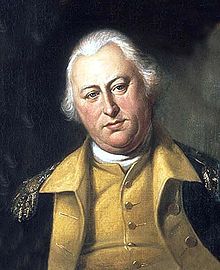
General Benjamin Lincoln led a force in 1787
to put down Shays’ Rebellion in Massachusetts
(Painting by Charles Willson Peale)
In a sense, the most interesting thing about Shays’s Rebellion is that it was not a unique event.
The first notable example of agrarian revolt had been Bacon’s Rebellion in 1676 Virginia, when frontier farmers marched on the rich plantation owners of Jamestown, burned it to the ground, published their democratic “Declaration of the People,” and threatened to hang every elite “tyrant” on their list – which included some of the forefathers of America’s patriot Founders.
Historian Gary Nash reminds us Bacon’s Rebellion had echoes across early American history: “Outbreaks of disorder punctuated the last quarter of the 17th century, toppling established governments in Massachusetts, New York, Maryland, Virginia, and North Carolina.” Jimmy Carter, in The Hornet’s Nest, the only novel ever published by an American president, tells a similar story of the agony of dispossessed farmers in Georgia a century later.
Other farmers had rebelled in New Jersey in the 1740s; in the New York Hudson Valley rent wars in the 1750s and 1760s and concurrently in Vermont by Ethan Allen’s Green Mountain Boys; for a decade in North Carolina in the 1760s, where vigilantes called Regulators battled the government of the urban elite; and in Virginia in the 1770s. Likewise, American cities had been scenes of labor unrest, riots, and strikes for a century. American class rebellion, apparently unbeknownst to most history teachers in America, was closer to the rule than the exception.
Victory in the war against England only intensified the conflict between those who considered “liberty” as a necessary condition to live without debt, against those who considered “liberty” to be their class privilege to grow rich from the debts others owed them. Howard Zinn, in his A People’s History of the United States describes the economic realities of Eighteenth Century America:
“The colonies, it seems, were societies of contending classes – a fact obscured by the emphasis, in traditional histories, on the external struggle against England, the unity of colonists in the Revolution. The country therefore was not ‘born free’ but born slave and free, servant and master, tenant and landlord, poor and rich.”
Although Shays’s Rebellion was not unique, it was a huge event, coming at a time when the rich were owed a great deal of money by impoverished governments. Pressured by rich bondholders and speculators, the government of Massachusetts duly raised taxes on farmers. To make matters far worse, the taxes were to be paid only in gold or silver – which was completely out of the question for most western farmers, who had no way to obtain coined money.
When the farmers complained, their complaints were ignored. When farmers petitioned the government to issue paper money and accept it as payment of debts and taxes, the government refused their petitions. When the farmers pleaded for the passage of “legal tender laws” that would allow them to settle their debts or taxes with their labor, they were rebuffed.
But when farmers could not pay what they did not have, the Massachusetts’s courts ordered their land seized and auctioned. At last, the farmers understood the practical effect, if not the specific intent, of the tax: confiscation of their property and its transfer to the rich, to whom the government owed its interest-bearing debt. Government had become an armed collection agency.
To the utter dismay of the erstwhile proudly tax-rebellious Patriots, the farmers too rebelled. Shaysites forcibly shut down the tax courts that were condemning them to servitude. The rich responded by loaning the destitute government more money (at interest!) to pay a militia force to oppose Shays’s rebels.
At this point, tax rebels abandoned reform for radical revolution and – in a resounding echo of Nathaniel Bacon’s century-old Declaration of the People – pledged to march on Boston and burn it to the ground. This was no Tea Party vandalism, stage-managed by well-to-do Bostonians like Samuel Adams. It was a full-blown, grassroots agrarian revolution a century in the making.
The urban bond-holding merchant-class in Boston and elsewhere panicked. And none panicked more than bond speculators, who intimately understood the rebels threatened their “virtuous” republican “liberty” to extract profit from others. Historian Woody Holton exposes the astonishing callousness of one of America’s major bond speculators in his nationally acclaimed Unruly Americans and the Origin of the Constitution:
“As a bondholder, Abigail Adams would benefit immensely if her fellow Massachusetts citizens [paid the tax] levied by the legislature in March 1786, but she also saw compliance as a sacred duty. If Massachusetts taxpayers were ‘harder-prest by publick burdens than formerly,’ she wrote, ‘they should consider it as the price of their freedom’.”

Abigail Adams,
wife of the second President John Adams,
in a portrait by Benjamin Blythe.
Future First Lady Abigail Adams was not alone in thinking freedom came with dividends payable to her account. Historian David Szatmary reminds us in his Shays Rebellion; The Makings of an Agrarian Insurrection that the former Patriot leadership, especially those in the merchant class, were among the first to advocate violence against democratic rebellion.
Said a published opinion piece at the time: “When we had other rulers, committees and conventions of the people were lawful – they were then necessary; but since I myself became a ruler, they cease to be lawful – the people have no right to examine my conduct.”
Showboat Patriot and bond speculator Samuel Adams –former mastermind of the Boston Tea Party and erstwhile propagandist against unfair British taxes (as well as cousin to Abigail’s husband John Adams) – sponsored a Massachusetts law that allowed sheriffs to kill tax protesters outright.
Another rich bondholder and speculator, ex-Revolutionary War General Henry Knox (the fitting namesake of Fort Knox, the famous repository of gold bullion) wrote an alarming letter to his former commander George Washington, accusing the Shays’s rebels of being “levelers” (which was the closest term to “communists” then in existence). He informed Washington that the country needed a much stronger government (and military) to prevent any riffraff challenge to the elite. His message was not wasted on General Washington, America’s richest slave owner.
In the end, the Congress, under the Articles of Confederation, could raise no money from the states to provide an army, but the privately-financed, for-profit Massachusetts militia successfully defeated Shays’s rebels. Still, the nearly hysterical fear of democratic economic revolution had been planted in the minds of the masters. Shays’s Rebellion proved to be the last straw for bond speculators whose profits were jeopardized by democracy.
Worse even, the governments of many other states were beginning to cave under intense democratic pressure from rebellious debtors. Some states were entertaining laws that prevented the seizure of property for debt; others were creating paper money in order to break the gold and silver monopoly. Rhode Island not only voted in a paper money system, but threatened to socialize all commercial business enterprises in the state.
In response to the threat of populism, the “virtuous” elite reacted decisively – not to remedy the plight of debtors, of course – but to secure their own profits from them. Accordingly, in 1786, five states sent delegates to meet at Annapolis, Maryland, just as Shays’s Rebellion veered into revolution. This unelected minority called for Congress to authorize a convention to be held in Philadelphia the next year “for the sole and express purpose of revising the Articles of Confederation.” The Articles were never to be “revised.” They were to be scrapped altogether by the Deep State.
The Deep State Conspires
Thanks to Charles A. Beard’s An Economic Interpretation of the Constitution of the United States, we know quite a lot about the status of the 55 men who conspired to draft the Constitution. But the very first thing we need to know is that they were not authorized by “We the People” simply because nobody had voted for them; all were political appointees.
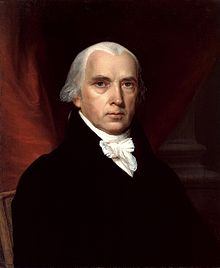
James Madison
Nor were they even a representative sample of the people. Not a single person in the Convention hall “worked for a living,” nor was female, nor was a person of color. Only one claimed to be a “farmer,” the current occupation of about 90 percent of the population. Most were lawyers. Go figure.
If the delegates represented anybody at all, it was the economic elite: 80 percent were bondholders; 44 percent were money-lenders; 27 percent were slave owners; and 25 percent were real estate speculators. Demographically, the 39 who finally signed the final draft of the Constitution constituted .001 percent of the American population reported in the 1790 census. George Washington, who presided, was arguably the wealthiest man in the country. Deep State gamblers all.
And the stakes were high. Recall that the face value of outstanding domestic government bonds in 1787 was $60 million, equivalent to 10 percent of the total improved land value of the country. But these bonds, for the most part, had been obtained by speculators at a fraction of face value. Beard very conservatively estimated the profit of speculators – if the bond were redeemed at face value – would have been some $40 million. Expressed as the same proportion of total improved land value at the time of the Founding, the expected profit from government bonds held then would equal at least $3 trillion today. Tax free.
We still do not know everything that transpired at the convention. No one was assigned to keep a record of what was discussed. Reportedly, even the windows to the meeting hall were nailed shut to prevent eavesdropping – though there would be “leaks.” Because of its secrecy and its unauthorized nature, some historians have called the convention “the second American Revolution.” But revolutions are public, hugely participatory events. This was a coup d’état behind locked doors.
Most delegates presumably understood their undisclosed purpose was to dump the whole system of confederated government (which had cost 25,000 American lives to secure) into a dustbin. They evidently did not intend to obey their instructions “solely to revise” the Articles because a number of them showed up at the convention with drafts for a new constitution in hand.
The conspirators’ ultimate goal was to replace the Confederation with what they later euphemized as “a more perfect Union” – designed from the outset to protect their class interests and to ensure the new government possessed all the power necessary to perpetuate the existing oligarchy.
At the Convention, Alexander Hamilton captured the prevailing sentiment: “All communities divide themselves into the few and the many. The first are the rich and well-born; the other the mass of the people … turbulent and changing, they seldom judge or determine right. Give therefore to the first class a distinct, permanent share in the Government. … Nothing but a permanent body can check the imprudence of democracy.”

A portrait of Alexander Hamilton
by John Trumbull, 1792.
Hamilton further proposed that both the President and the Senate be appointed (not elected) for life. His vision was but half a step removed from monarchy. Though not a Convention delegate, John Jay, Hamilton’s political ally, slaveowner, and the first Chief Justice of the Supreme Court, stated the purpose of “republicanism” with brutal brevity: “The people who own the country ought to govern it.”
The Founders never once envisioned any such a thing as “limited government” – unless perhaps in the sense that the power of government was to be limited to their own economic class. [See Consortiumnews.com’s “The Right’s Made-up Constitution.”]
In Towards an American Revolution: Exposing the Constitution & Other Illusions, historian Jerry Fresia sums the Founders’ views succinctly: “The vision of the Framers, even for Franklin and Jefferson who were less fearful of the politics of the common people than most, was that of a strong centralized state, a nation whose commerce and trade stretched around the world. In a word, the vision was one of empire where property owners would govern themselves.” [Emphasis supplied]
Self-government by the people was to remain permanently out of the question. The Deep State was to govern itself. “We the People,” a phrase hypocritically coined by the ultra-aristocrat Gouverneur Morris, would stand forever after as an Orwellian hoax.
The tricky task of the hand-picked delegates was to hammer out a radical new system of government that would superficially resemble a democratic republic, but function as an oligarchy.
William Hogeland’s excellent Founding Finance, recounts the anti-democratic vehemence expressed at the Convention: “On the first day of the meeting that would become known as the United States Constitutional Convention, Edmund Randolph of Virginia kicked off the proceedings […] ‘Our chief danger,’ Randolph announced, ‘arises from the democratic parts of our constitutions. … None of the constitutions’ – he meant those of the states’ governments – ‘have provided sufficient checks against the democracy.’”
No wonder they nailed the windows shut. It should be no surprise that the word “democracy” does not appear once in the entire U.S. Constitution, or any of its Amendments, including the Bill of Rights. Accordingly, the Constitution does not once refer to the popular vote, and it did not guarantee a single person or group suffrage until the adoption of the 15th Amendment in 1870, over 80 years after ratification. The Preamble aside, the Founders used the phrase “the People” only a single time (Art. I, Sec. 2).
It has been suggested the word “democracy” had a different meaning then than it has now. It did not. “Democracy” to the Convention delegates meant the same thing as it does today: “rule by the people.” That’s why they detested it. The delegates considered themselves the patriarchs of “republicanism,” the ideology that rejected participation in government by people like their wives, servants, tenants, slaves, and other non-propertied inferiors. No doubt, the delegates passionately disagreed on many things, but the “fear and loathing” of democracy was not one of them. Then or now.
The Deep State’s Specific Goals
Embedded within the Founders’ broadly anti-democratic agenda were four specific goals. These were not a list of items jotted down in advance, but were derived by group consensus as the minimum requirements necessary to achieve the Deep State’s ultimate agenda.

Thomas Jefferson in a 1800 portrait
by Rembrandt Peale
To camouflage the stark oligarchic nationalism the measures intended, the Founders disingenuously styled themselves “Federalists.” But nothing about these measures concerned a “federation” of sovereign states; taken together, they were intended to demolish the existing “perpetual” confederation, not to re-create it more effectively.
National government with limited citizen participation. Of all the measures required to achieve a national oligarchy, this was the most daunting. It was achieved by a wide array of provisions.
The Electoral College. The President and Vice President are not elected by popular vote, but by electors – then and now. For example, when George Washington was first elected President, the American population was 3.9 million. How many of those folks voted for George? Exactly 69 persons – which was the total number of electors voting at the time. (Art. I, Sec. 3)
Bi-Cameral Congress. Congress is bi-cameral, composed of two “houses” – the House of Representatives and the Senate. Under the original Constitution, the House members represented the people who vote for them, while the Senate represented states, not persons, and was therefore not a democratic body, at all. It was generally expected that the Senate would “check” the democratic House. Indeed, this was the entire purpose of bi-cameralism wherever it has existed. (Art. I, Secs. 1 and 2)
State Appointment of Senators. Senators were originally appointed by state legislatures (until the 17th Amendment in 1913). It was expected that the Senate would function in Congress as the House of Lords functioned in Parliament: the voice of the aristocracy. Even though Senators are now popularly elected, it is far more difficult to challenge an incumbent because of the prohibitive expense of running a state-wide campaign. (Art. I, Sec. 3)
Appointment of the Judiciary. All federal judges are appointed for life terms by the President and confirmed by the (originally undemocratic) Senate. (Art. III, Sec. 1)
Paucity of Representation. Most undemocratic of all was the extreme paucity of the total number of House members. The House originally was composed of only 65 members, or one member per 60,000 persons. Today, there are 435 members, each representing about 700,000 persons. Thus, current House representation of the public is 12 times less democratic than when the Constitution was written – and it was poor (at best) then.
Compare: The day before the Constitution was ratified, the people of the 13 United States were represented by about 2,000 democratically elected representatives in their various state legislatures (1:1950 ratio); the day after ratification, the same number of people were to be represented by only 65 representatives in the national government (1:60000). In quantitative terms, this represents more than a 3,000 percent reduction of democratic representation for the American people. (Art. I, Sec. 2)
Absence of Congressional Districts. Although House members now run for election in equal-populated districts, the districts were created by Congress, not the Constitution. Until the 1960s, some House members were elected at-large (like Senators). This disadvantaged all but the richest and best-known candidates from winning. (Not referenced in Constitution)
Absence of Recall, Initiative and Referendum. The Constitution does not allow the people to vote to recall (un-elect) a Congress member, demand a Congressional vote on any issue (propose an initiative) or vote directly in a referendum on any issue (direct democracy). (Not referenced in Constitution)
Absence of Independent Amendment Process. One of the reasons Americans now have professional politicians is that the Constitution does not provide a way for “the people” to amend it without the required cooperation of a sitting Congress. At the Constitutional convention, Edmund Randolph of Virginia (surprisingly) proposed that the people be afforded a way to amend the Constitution without the participation of Congress. This excellent idea, however, was not adopted. (Art. V)
National authority to tax citizens directly. (Art. I, Sec. 8; 16th Amendment)
National monopolization of military power. (Art. I, Sec.8, clauses 12, 13, 14, 15, 16)
Denial of states’ power to issue paper money or provide debtor relief. (Art. I, Sec.10; Art. I Sec.8, clause 4)
All of these provisions were completely new in the American experience. For 150 years or more, citizen participation in government, independent militias, and the issuance of paper money had been the prerogative of the several, independent colonies/states – while direct external taxation had been universally and strenuously resisted. When the British Crown had threatened to curtail colonial prerogatives, the very men who now conspired for national power had risen in armed rebellion. The hypocrisy was stunning. And people took note of the fact.
Consent of the Minority
One of the note-takers was Robert Yates, a New York delegate to the Convention, who had walked out in protest. Not long afterwards, Yates (who owned no government bonds) stated his objection to the new Constitution: “This government is to possess absolute and uncontrollable power, legislative, executive and judicial, with respect to every object to which it extends. …
“The government then, so far as it extends, is a complete one. … It has the authority to make laws which will affect the lives, the liberty, and the property of every man in the United States; nor can the constitution or the laws of any state, in any way prevent or impede the full and complete execution of every power given.”

Whipping scars on back of African-American slave
At least half of the American population (collectively called “Anti-federalists”) thought the Constitution was a terrible idea. To be sure, well-to-do Anti-federalists like Yates were not overtaxed farmers, and their objections were often based upon the defense of states’ rights, not peoples’ economic rights. Most Anti-federalists, however, seemed alarmed that the Constitution contained no guarantee of the basic political rights they had enjoyed under the British Empire, such as freedom of speech or trial by jury.
The debate between supporters and critics of the Constitution raged for a year, while partisan newspapers published articles both pro and con. A collection of 85 “pro” articles is known now as The Federalist Papers, which were written by Alexander Hamilton, James Madison and John Jay. Although these articles have been studied almost as religious relicts by historians, they do not tell us “what the Constitution really means.”
The Constitution means what it says. The Federalist Papers are sales brochures, written by lawyers trying to get others to “buy” the Constitution. The same can be said about a similar collection of “Anti-federalist Papers,” from which Yates’s quote above was taken. In any event, it is up to the courts to interpret the Constitution, not lawyers with vested interests.
In due course, the Anti-federalists put their collective foot down. There would be no hope of ratification without amendments guaranteeing fundamental political – but not economic – rights. Although Hamilton argued a guarantee of rights would be “dangerous,” James Madison convinced the Federalists that agreeing to guarantee a future Bill of Rights would be much safer than meddling with the text of the current document, which might entail unraveling its core nationalist, anti-democratic agenda. And so, a deal was struck.
Even so, the battle over the ratification of the Constitution was not ultimately decided by the people of the nation. Although the people of the several states had not voted to authorize the Convention, or the document it had produced, the Founders had been incredibly arrogant, not to mention sly. Not only had they presented the unauthorized document to the states as a take-it-or-leave-it proposition (no changes allowed), but the document itself demanded that only special state “conventions” could ratify it – not the majority popular vote of the people.
Specifying ratification by conventions meant the people would be voting for convention delegates, who would in turn vote for ratification. This was tantamount to turning ratification into a popularity contest between convention delegates, rather than a democratically direct vote on the document, itself. Moreover, ratification by convention would present the possibility that a minority of the people in a state (those in favor of the Constitution) might “pack” a convention with delegates, who would then approve of a document establishing a government for all.
Electoral shenanigans were not just hypothetical possibilities. In Philadelphia, for example, a mob kidnapped elected legislators who were boycotting a convention vote, physically dragged them into the state house, and tied them to their chairs in order to force a convention vote. Other, more subtle methods of manipulation occurred elsewhere, notably the disenfranchisement of voters through property qualifications.
Over a hundred years ago, Charles A. Beard completed his exhaustive study of the Constitution and confirmed that it most likely was ratified by a majority – of a minority of the people.
Among Beard’s final conclusions were these: “The Constitution was ratified by a vote of probably not more than one-sixth of the adult males….The leaders who supported the Constitution in the ratifying conventions represented the same economic groups as the members of the Philadelphia Convention…. The Constitution was not created by ‘the whole people’ as the jurists [judges] have said; neither was it created by ‘the states’ as Southern nullifiers long contended; but it was the work of a consolidated group whose interests knew no state boundaries and were truly national in their scope.”
The Deep State, in other words. It was darkly appropriate that a document whose primary purpose was to defeat democratic rule was, itself, brought into force without a majoritarian vote.
In 1788, nine of the 13 states’ conventions ratified the Constitution (as specified in the Constitution’s own Article VII) and the document became the supreme law of the land for those nine states. By 1789, even the democratic holdout Rhode Island had followed suit. And America’s schoolchildren have been led to believe ever since that the Constitution is a sacred document, inspired and ordained by the public-spirited benevolence of Founding Fathers.
But this had been predicted. It had seemed painfully obvious to Eighteenth Century Genevan political philosopher Jean-Jacques Rousseau that constitutional government was the invention of the Deep State, its designated beneficiary.
Dripping with sarcasm, his virtuoso Discourse on Inequality explained the process: “[T]he rich man … at last conceived the deepest project that ever entered the human mind: this was to employ in his favour the very forces that attacked him, to make allies of his enemies…
“In a word, instead of turning our forces against ourselves, let us collect them into a sovereign power, which may govern us by wise laws, may protect and defend all the members of the association, repel common enemies, and maintain a perpetual concord and harmony among us.”
Rousseau penned these words in 1754, 33 years before Gouverneur Morris oversaw the drafting of the identical sales pitch that constitutes the Preamble to the United States Constitution: “We the People of the United States, in Order to form a more perfect Union, establish Justice, insure domestic Tranquility, provide for the common defence, promote the general Welfare, and secure the Blessings of Liberty to ourselves and our Posterity, do ordain and establish this Constitution for the United States of America.”
Rousseau concludes: “All offered their necks to the yoke in hopes of securing their liberty; for though they had sense enough to perceive the advantages of a political constitution, they had not experience enough to see beforehand the dangers of it; those among them, who were best qualified to foresee abuses, were precisely those who expected to benefit by them….” [Emphasis added]
Does the Deep State pose an existential threat to American democracy today? Move along, folks – nothing new to see here.
Jada Thacker, Ed. D, is the author of Dissecting American History: A Theme-Based Narrative. He teaches History and Government at a college in Texas. Contact: jadathacker@sbcglobal.net
Lieberman: Not a single Palestinian refugee will return to their lands in Israel

Ma’an – June 23, 2017
BETHLEHEM – During a speech at Israel’s Herzliya conference, aimed at discussing the country’s national policies, ultraright Israeli Defense Minister Avigdor Lieberman rejected the possibility of Palestinian refugees from historic Palestine, which Israel was built on, being able to return to their lands within the 1967 borders, a right that is upheld by United Nations Resolution 194.
“We will not agree to the return of a single refugee to within the ‘67 borders,” Lieberman reportedly said. “There will never be another Prime Minister who makes propositions to Palestinians like Ehud Olmert did,” he added, referring to a 2008 peace proposal introduced by the former prime minister.
The right of return for Palestinian refugees is a central demand among Palestinians and their leadership. The demand also represents a powerful symbolic connection to their lands and homes they were displaced from, as many Palestinians still possess original keys to their homes that were consumed by the state of Israel 69 years ago.
According to Israeli media, Lieberman also said that an end to the decades-long Israeli-Palestinian conflict would “not solve the problems – it will make them worse,” and noted that Israel should first “reach a regional agreement with moderate Sunni states, and only then an agreement with the Palestinians.”
He also went on to question the legitimacy of Palestinian citizens of Israel being part of the Israeli parliament, the Knesset, noting that the Joint List political bloc — representing parties led by Palestinian citizens of Israel in the Knesset — refused to acquiesce to Zionist ideologies.
“The only place they don’t want to leave is Israel. Why? Because it’s good for them here,” he said, referring to Palestinian citizens of Israel, making up approximately 20 percent of the population, whose families lived on the lands of historic Palestine before the creation of the state of Israel.
According to the Palestinian Central Bureau of Statistics (PCBS), 66 percent of Palestinians who were living in British-Mandate Palestine in 1948 were expelled from historic Palestine and displaced from their homes and lands during the creation of Israel, referred to as the Nakba, or catastrophe, among Palestinians.
On the topic of Gaza, Lieberman reportedly said “I don’t think we need to get into it. It won’t end soon,” before calling the dire humanitarian situation in the besieged Palestinian territory an “intra-Palestinian crisis,” echoing statements made by US Ambassador to the UN Nikki Haley who placed full blame of the dire humanitarian situation in the besieged Gaza Strip on Hamas, and absolved Israel of any responsibility for the ongoing crisis.
Lieberman also accused Palestinian President Mahmoud Abbas of attempting to influence Hamas to go to war with Israel by exacerbating the crisis in Gaza by cutting Palestinian Authority (PA) payments for electricity supplied to Gaza from Israel.
“Abbas is going to increase cuts and soon stop the payment of salaries in Gaza and the transfer of fuel to the strip as a two-pronged strategy: Hurt Hamas and drag it to war with Israel,” he reportedly said.
Lieberman’s statements came amid an attempted renewal of the Israeli-Palestinian peace process by right-wing US President Donald Trump.
Most recently, on Wednesday evening, a meeting was held between Abbas and Trump’s son-in-law and senior advisor Jared Kushner in the central occupied West Bank city of Ramallah to discuss reviving peace talks with Israel.
Executive Committee Member of the Palestine Liberation Organization (PLO) Wasel Abu Yousif said in statement at the time that reviving a political process requires certain determinants based on international law: a time limit for ending the 50-year Israeli occupation of the Palestinian territory must be set to establish a Palestinian state along the 1967 borders with East Jerusalem as its capital, and Palestinian refugees must be granted the right of return to the homes and villages from which they were expelled.
However, Israeli leaders have been public on their rejection of the Palestinian Authority (PA) taking over East Jerusalem, which was officially annexed by Israel in 1980, and have regularly voiced their opposition to the return of Palestinian refugees or even the halting of illegal Israeli settlement expansions in the occupied Palestinian territory.
Naftali Bennett, Israel’s right-wing education minister, has also introduced a bill in the Israeli parliament that would prevent any future divisions of Jerusalem, by mending Israel’s Basic Law on Jerusalem to necessitate the approval of 80 of the 120 Knesset members to make any changes to the law, instead of the regular majority vote.
“The purpose of this law is to unify Jerusalem forever,” Bennett reportedly said, adding that his legislation would make it “impossible” to divide Jerusalem.
While the PA and the international community do not recognize the legality of the occupation of East Jerusalem, Gaza, and the West Bank since 1967, many Palestinians consider that all historic Palestine has been occupied since the creation of the state of Israel in 1948.
A growing number of activists have criticized a two-state solution to the Israeli-Palestinian conflict as unsustainable and unlikely to bring durable peace given the existing political context, proposing instead a binational state with equal rights for Israelis and Palestinians.
Ukrainian regime arrests owner of Russian language news outlet
By Adam Garrie | The Duran | June 23, 2017
The Ukrainian regimes notorious Secret Service, the SBU has arrested the owner of a Russian language news outlet Strana.ua.
Igor Guzhva was arrested while his offices were raided. Authorities loyal to the Poroshenko regime have stated that the charges related to allegations of blackmail, although many see this is yet another attempt to forcibly shut-down domestically owned Russian language news media after a law was passed banning Russian owned media in the country.
The regime authorities are also cracking down on the large domestically owned and produced Russian language media and entertainment sectors.
Strana.ua was harassed by the SBU throughout 2014 and 2015.
This looks increasingly like another politically motivated arrest by a regime engaged in crimes against humanity in Donbass.
Three National Guard Officials Arrested After Fatal Shooting of Protester
By Rachael Boothroyd Rojas | Venezuelanalysis | June 21, 2017
Caracas – Three Bolivarian National Guard (GNB) soldiers have been arrested following the fatal shooting of an anti-government protester in Caracas this past Monday.
First sergeant Raymon Ávila León and second sergeants Johan Rojas Díaz and Jesús Baez Rojas will be charged with the misuse of a firearm, according to national ombudsman, William Saab.
On Monday, 17 year old Fabian Urbina died from gunshot wounds when GNB soldiers opened fire on a crowd of protesters in the eastern district of Altamira. Five other demonstrators were also injured in the incident.
In footage of the confrontation circulated by the private media channel La Patilla on social media, hundreds of violent protesters can be seen attempting to attack several GNB officials prior to the shooting. At least one of the protesters was armed, leading some pro-government observers to speculate that the soldiers were acting in self defense.
But Saab condemned the incident Wednesday and stated that the national guard must only employ “proportional, progressive and differentiated use of force” to ensure their own safety at protests.
In a series of tweets, the national ombudsman reminded the public that the GNB are banned from using live ammunition or rubber bullets to control unrest. He also called on opposition sectors to cease their violent protests.
“We once again call on the organizers of demonstrations to carry them out peacefully and without the use of weapons,” he tweeted.
Following the incident, President Nicolas Maduro replaced Antonio Benavides Torres as the commander of the National Bolivarian Guard. The former commander of the People’s Guard, Major General Sergio José Rivero Marcano, will now take up the position.
The president also changed the commander-in-chiefs of the armed forces, navy, airforce, and people’s militia, as well as put Major General Juan de Jesús García Toussaintt and Admiral Orlando Maneiro Gaspar in charge of the Ministry of Transport and the Ministry of Fishing.
It is unknown if the high level reshuffle was related to Monday’s deadly shooting.
Eighty-four people have been killed since violence anti-government unrest broke out at the beginning of April. Protesters, national security personnel, pro-government activists and passersby are all amongst the dead.
At FBI, Mueller Oversaw Post-9/11 Abuses
By Jonathan Marshall | Consortium News | June 21, 2017
Robert Mueller III, the former FBI director who now heads the wide-ranging investigation into alleged misdeeds by President Trump and his associates, just dodged a major legal bullet himself. On Monday, the U.S. Supreme Court gave him and other former senior Bush administration officials legal immunity for the vicious abuses committed against more than 700 foreigners who were rounded up with little or no cause after the 9/11 attacks.
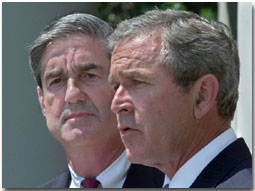
Robert Mueller with Pres. George W. Bush
July 5, 2001 (White House photo)
The court ruled 4-2, nearly 16 years after the fact, that “national security” trumps civil liberties and that however unfounded the arrests, or intolerable their treatment, the detainees had no right to sue senior federal officials for damages.
Punting to Congress, a branch of government rarely known for its defense of individual rights, the court declared, “The proper balance in situations like this, between deterring constitutional violations and freeing high officials to make the lawful decisions necessary to protect the Nation in times of great peril, is one for the Congress to undertake, not the Judiciary.”
Although the climate of fear that followed 9/11 has eased a bit, the decision is highly relevant in the Trump era because the abused victims were all immigrants who had overstayed their visas. If the FBI had any question about the arrestees, it designated them “of interest” and ordered them held until cleared — in other words, guilty until proven innocent.
Dozens of the hapless victims were held at the Administrative Maximum Special Housing Unit in Brooklyn’s Metropolitan Detention Center (MDC), which was the subject of two scathing reports by the Bush Justice Department’s own Inspector General in 2003. Besides documenting a wide range of abuses, the reports concluded that staff members brazenly lied about the rough treatment they meted out.
Appalling Abuses
News accounts of the Supreme Court decision made only brief reference to that treatment. Yet the appalling story can be glimpsed from this summary of facts provided in 2013 by U.S. District Judge John Gleeson:
“The harsh confinement policy was expressly directed at Arab and Muslim noncitizens who had violated immigration laws . . . In other words, it was discriminatory on its face. . .
“They were confined in tiny cells for over 23 hours a day, provided with meager and barely edible food, and prohibited from moving around the unit . . . (or) keeping any property, including personal hygiene items like toilet paper and soap, in their cells. Whenever they left their cells, they were handcuffed and shackled. . . (D)etainees . . . were often physically abused along the way, and were sometimes left for hours in the cold recreation cell, over their protests, as a form of punishment. . . .
“Detainees also were denied sleep. Bright lights were kept on . . . for 24 hours a day . . . and staff at the MDC made a practice of banging on the MDC Detainees’ cell doors and engaging in other conduct designed to keep them from sleeping. They also conducted inmate ‘counts’ at midnight, 3:00 a.m., and 5:00 a.m. . . . One of the officers walked by about every 15 minutes throughout the night, kicked the doors to wake up the detainees, and yelled things such as, ‘Motherfuckers,’ ‘Assholes,’ and ‘Welcome to America.’
“The MDC Detainees also were subjected to frequent physical and verbal abuse . . . The physical abuse included slamming the MDC Detainees into walls; bending or twisting their arms, hands, wrists, and fingers; lifting them off the ground by their arms; pulling on their arms and handcuffs; stepping on their leg restraints; restraining them with handcuffs and/or shackles even while in their cells; and handling them in other rough and inappropriate ways. The use of such force was unnecessary because the MDC Detainees were always fully compliant with orders . . . The verbal abuse included referring to the MDC Detainees as ‘terrorists’ and other offensive names, threatening them with violence, cursing at them, (and) insulting their religion . . .
“(Detainees) . . . were subjected to unreasonable and punitive strip-searches. . . Female officers were often present during the strip-searches; the strip-searches were regularly videotaped in their entirety . . . and MDC officers routinely laughed and made inappropriate sexual comments during the strip-searches.
“Officers at the MDC . . . also interfered with the Detainees’ ability to practice and observe their Muslim faith. . . In addition, most of the MDC Detainees were held incommunicado during the first weeks of their detention. MDC staff repeatedly turned away everyone, including lawyers and relatives, who came to the MDC looking for the MDC Detainees, and thus the MDC Detainees had neither legal nor social visits during this period.”
An Abu Ghraib in Brooklyn
Though not at the level of brutality of water boarding and some of the beatings associated with secret CIA detention centers, these MDC abuses had some similarities to the humiliation and mistreatment of prisoners at Abu Ghraib in Iraq — and the abuses were taking place right in the heart of New York City. Plus, unlike some of the CIA’s torture victims, these detainees had nothing to do with terrorist plots; some were never even questioned by the FBI after their arrest.
Yet senior FBI and Justice Department officials were complicit in the abuse. The 2nd Circuit Court of Appeals, in a 2015 ruling that the lawsuit could proceed, cited evidence that two of the defendants, Attorney General John Ashcroft and FBI Director Mueller, “met regularly with a small group of government officials in Washington, D.C., and mapped out ways to exert maximum pressure on the individuals arrested in connection with the terrorism investigation.”
They “discussed and decided upon a strategy to restrict the 9/11 detainees’ ability to contact the outside world and delay their immigration hearings. The group also decided to spread the word among law enforcement personnel that the 9/11 detainees were suspected terrorists[] . . . and that they needed to be encouraged in any way possible to cooperate.” And it was the FBI that recommended housing the detainees in the maximum security facility where their rights were sure to be abused.
Such official misconduct and brutality constitutes a stain on this nation’s honor. Justice Anthony Kennedy, writing for the majority, said “Nothing in this opinion should be read to condone the treatment to which the (plaintiffs) contend they were subjected.”
A Terrible Precedent
But the court’s decision to protect high-level federal officials who made that treatment possible sets a terrible precedent. As the American Civil Liberties Union warned, it “would effectively immunize tens of thousands of federal officers . . . from damages, no matter how egregious the officers’ conduct. Indeed, [it] would effectively immunize federal officers from damages liability even for torture, so long as the torture arises in a context involving national security or noncitizens.”
Citing such egregious precedents as the Alien and Sedition Acts, the wholesale suppression of civil liberties during World War I, and the internment of Japanese-American citizens during World War II, a dissenting Justice Stephen Breyer insisted that the Court had an obligation to defend “fundamental constitutional rights.”
“History tells us of far too many instances where the Executive or Legislative Branch took actions during time of war that, on later examination, turned out unnecessarily and unreasonably to have deprived American citizens of basic constitutional rights,” he wrote. With the latest court ruling, that dark history is sure to be repeated.
[For more on the real Robert Mueller, see Consortiumnews.com’s “Russia-gate’s Mythical Heroes.”]
Trump Turns Back the Clock With Cold War Cuba U-Turn
By Ron Paul | June 19, 2017
Nostalgia seems to be very popular in Washington. While the neocons and Democratic Party hard-liners have succeeded in bringing back the Cold War with Russia, it looks like President Trump is determined to take us back to a replay of the Bay of Pigs!
In Miami on Friday, the president announced that he was slamming the door on one of President Obama’s few foreign policy successes: easing 50 years of US sanctions on Cuba. The nostalgia was so strong at Trump’s Friday speech that he even announced participants in the CIA’s disastrous 1961 Bay of Pigs invasion of Cuba in the audience!
President Trump said Friday that his new policy would be nothing short of “regime change” for Cuba. No easing of US sanctions on Cuba, he said, “until all political prisoners are freed, freedoms of assembly and expression are respected, all political parties are legalized, and free and internationally supervised elections are scheduled.”
Yes, this is the same Donald Trump who declared as president-elect in December that his incoming Administration would “pursue a new foreign policy that finally learns from the mistakes of the past. We will stop looking to topple regimes and overthrow governments.” Now, in another flip-flop toward the neocons, President Trump is pursuing regime change in Cuba on the pretext of human rights violations.
While the Cuban government may not have a spotless record when it comes to human rights, this is the same President Trump who just weeks ago heaped praise on perhaps the world’s worst human rights abuser, Saudi Arabia. There, he even participated in a bizarre ceremony to open a global anti-extremism center in the home of state-sponsored extremism!
While President Trump is not overturning all of President Obama’s Cuba policy reforms – the US Embassy will remain open – he will roll back the liberalization of travel restrictions and make it very difficult for American firms to do business in Cuba. Certainly foreign competitors of US construction and travel companies are thrilled by this new policy, as it keeps American businesses out of the market. How many Americans will be put out of work by this foolish political stunt?
There is a very big irony here. President Trump says that Cuba’s bad human rights record justifies a return to Cuba sanctions and travel prohibitions. But the US government preventing Americans from traveling and spending their own money wherever they wish is itself a violation of basic human rights. Historically it has been only the most totalitarian of regimes that prevent their citizens from traveling abroad. Think of East Germany, the Soviet Union, and North Korea. The US is not at war with Cuba. There is no reason to keep Americans from going where they please.
President Trump’s shift back to the bad old days on Cuba will not have the desired effect of liberalizing that country’s political environment. If it did not work for fifty years why does Trump think it will suddenly work today? If anything, a hardening of US policy on Cuba will prevent reforms and empower those who warned that the US could not be trusted as an honest partner. The neocons increasingly have President Trump’s ear, even though he was elected on promises to ignore their constant calls for war and conflict. How many more flip-flops before his supporters no longer recognize him?
Trump Administration Following in Obama Administration’s Footsteps on Marijuana

By Adam Dick | Ron Paul Institute | June 16, 2017
Last month, United States Attorney General Jeff Sessions sent a letter to congressional leaders urging them to oppose Congress again including in Department of Justice appropriations legislation a provision intended to stop, through a restriction on the use of appropriated money, the US government from arresting and prosecuting people for actions that comply with state medical marijuana laws, even if those actions violate US drug laws. Some people are reacting to Sessions’ letter, which was revealed this week, with condemnation of Sessions and the Trump administration for departing from Obama administration policy that showed increased leniency in regard to marijuana. But this claim appears to misrepresent the Obama administration’s marijuana history.
Tom Angell, who revealed the Sessions letter in a Monday article at MassRoots, suggests that Sessions’ request is consistent with the position under the Obama administration given that President Barack Obama, in his last two budget requests, suggested Congress remove the medical marijuana language. Indeed, Sessions pretty much makes this same observation that he is continuing the prior administration’s policy in the first sentence of his letter to Senate Majority Leader Mitch McConnell (R-KY), Senate Minority Leader Charles E. Schumer (D-NY), House or Representatives Speaker Paul Ryan (R-WI), and House Minority Leader Nancy Pelosi (D-CA). Sessions starts the letter as follows: “I write to renew the Department of Justice’s opposition to the inclusion of language in any appropriations legislation that would prohibit the use of Department of Justice funds or in any way inhibit its authority to enforce the Controlled Substances Act (CSA).”
Further, Obama administration Justice Department lawyers, after the appropriations provision was in effect, defended in the Ninth US Circuit Court of Appeals case of United States v. McIntosh ignoring, in ten separate drug law cases that had been consolidated for review on appeal, whether defendants complied with state medical marijuana laws. In each case, the individuals were being prosecuted for actions that they argued complied with state medical marijuana laws. The Obama administration lost the argument in the appellate court, with the court deciding in August of 2016 that the appropriations provision “prohibits DOJ from spending funds from relevant appropriations acts for the prosecution of individuals who engage in conduct permitted by the State Medical Marijuana Laws and who fully complied with such laws.” The court decision, in addition, ordered that, if the US government should decide to proceed with prosecution of any appellants, those appellants “are entitled to evidentiary hearings to determine whether their conduct was completely authorized by state law.”
While the Ninth Circuit decision interprets the medical marijuana appropriations provision as providing protection for people complying with state medical marijuana laws, that decision does not help people who live in the states outside that judicial circuit. Also, as I noted in an article shortly after the McIntosh decision was announced, the DOJ argument for a reading of the appropriations language that would mean the provision provides little to no protection from prosecution is rather persuasive and could be accepted by other courts. The appropriations provision also provides no hope for protection for anyone anywhere who is dealing with recreational instead of medical marijuana or for anyone living in one of the states that has not liberalized medical marijuana laws.
Though the Obama administration backed off some in prosecutions of individuals acting in compliance with state laws concerning marijuana that over the past few years have been increasingly liberalized, that did not mean that the Obama administration wanted to subject itself to any additional restraints imposed by the legislative branch. Instead, the Obama administration preferred to design its own restraints via Department of Justice memoranda. These memoranda culminated in the August 29, 2013 Cole memorandum that directs DOJ lawyers to limit their prosecutions of people who are complying with liberalized state medical and recreational marijuana laws. But, the Cole memorandum also provides several exceptions that prosecutors can use to justify cases against individuals who are complying with state laws. In addition, the Cole memorandum and other Justice Department memoranda are just advisory for government employees (unlike a statute that could be enforceable as law to the benefit of defendants) and can be revoked or amended by subsequent DOJ memos.
Sessions has indicated a general support for the Cole memorandum’s policies, stating the following in a March 15 questions and answers with reporters: “The Cole memorandum set up some policies under President Obama’s Department of Justice about how cases should be selected in those states and what would be appropriate for federal prosecution, much of which I think is valid.” Yet, there is no guarantee that the wiggle room the Cole memorandum provides for prosecutions will be used the same in the Trump administration as it was in the Obama administration or that the DOJ will not come out with a new memorandum that keeps much of the Cole memorandum policies while also creating significant changes in DOJ policies related to people complying with state marijuana laws.
If you want to ensure people who grow, sell, use, or otherwise deal with marijuana are not arrested, prosecuted, and imprisoned by the US government, then both the appropriations medical marijuana provision and the Cole memorandum fall far short of accomplishing the goal. What is needed is for Congress to pass legislation ending the war on marijuana. Leave marijuana laws to the states. Just walk away from the war.
States are steadily developing a patchwork quilt of differing marijuana laws, with full prohibition becoming increasingly rare. Meanwhile, the majority of Americans favor legal recreational marijuana, and significantly more favor legal medical marijuana. The US government’s war on marijuana is increasingly becoming the odd man out. Despite the evident lack of will among congressional leaders to challenge the war on marijuana, increasing pressure, contributed to by changes in state and local governments’ law as well as public opinion, may soon succeed in emboldening Congress so it will approve legislation that ends the US government’s war on marijuana.
Theresa May’s war on the internet

By Dan Glazebrook | RT | June 17, 2017
Last night, Theresa May was in France for a joint press conference with new French President Emmanuel Macron. As far as I could tell, it was only Al Jazeera that broadcast it live in Britain.
The only time it was mentioned during BBC radio 4’s flagship news show, the Today program, was during the five-minute religious slot Thought for the Day. It was not covered in the news section at all.
But this should be major, major news. This was Theresa May’s first policy announcement since last week’s election. And it wasn’t on Brexit, the reason she supposedly called the election. It wasn’t on austerity, which she apparently told her own MPs was over in a private session two days ago. No, her first major public policy announcement was – the end of internet freedom.
Specifically, what was announced was that both countries would be introducing heavy fines for internet companies that failed to remove what they, very loosely, defined as “extremist content.”
Now, taken at face value, this might seem to be referring to ISIS [Islamic State, formerly ISIL] recruitment videos or online suicide bombing training videos, or whatever. But the direct encouragement of violence is already illegal. So, what exactly is being proposed? Who exactly will be targeted?
It was former PM David Cameron who originally came up with the idea that “nonviolent extremism” should be criminalized alongside violent extremism. Intriguingly, as an example of what he meant, he included the idea that the “West is bad,” as well as elsewhere arguing that the promotion of “wild conspiracy theories” would also qualify.
Well, the collusion between, for example, British intelligence and Al-Qaeda might sound like a wild conspiracy theory. But, in the context of Britain and Al-Qaeda’s shared enemies in the form of Gaddafi and Assad, this collusion actually did take place. MI5 was facilitating the passage of fighters between Britain, Syria, and Libya, the SAS were training them, and MI6 was equipping them. Indeed, this collusion is not even secret: as late as 2016 the British government openly pledged to send more British troops to Syria to train rebel groups that even the BBC admitted were likely to be allied with Al-Qaeda.
So, is the publication of this information going to be barred now as extremist? Will YouTube and Facebook and Google and Twitter pull these revelations in fear of getting fined for promoting the “wild conspiracy theories” that, according to Cameron, qualify as extremism?
It is clear why the British state is so keen to clampdown on the internet once this kind of information starts going viral. But the election just gone has raised the stakes even further, demonstrating that, if the government does not reassert its authority over the internet, it may well have lost control of the political narrative for good. Let’s review what’s just happened:
A month ago, almost everybody was predicting a wipeout for the Labour party, a repeat of the disastrous 1983 election in which Margaret Thatcher really did win the landslide Theresa May had been predicting. Oh, how times have changed.
Back in 1983, pretty much everyone got their political information from either the newspapers or the BBC. In other words, between them, the big press barons – about 4 or 5 of them – and the British state had total monopoly control of political information.
This meant that when they portrayed Labour leader Michael Foot as a bumbling Oaf, that became the abiding image of him. A tiny handful of millionaire Tories effectively had total control over the public image of every politician in the land.
This time around, it’s a different story. The newspapers and the TV threw everything they could at Corbyn – ‘he’s a terror-supporting, magic money tree-mongering, Brexit-frustrating Remainiac’ – but people weren’t buying. And why weren’t they buying? Because they’re not reading the newspapers, and they’re not watching terrestrial TV. This time around, people, young people in particular, were increasingly getting their political information from social media – and on social media, the conservatives did not control the narrative.
For example, an RT interview I did about British collusion with terrorism shortly before the election got over one and half million views on Facebook – higher than the daily readership of the Daily Mail. Jonathan Pie’s fantastic piece tearing apart the Tory’s ‘strong and stable’ nonsense, got 11 million views. That is two and half million more than the combined circulation of the Daily Mail, Daily Express, Guardian, Sun, Daily Star, Times, Telegraph, Evening Standard, and the Mirror and Metro – the country’s ten leading newspapers. And hilariously, when I had just watched one of Theresa May’s speeches on YouTube during the campaign, immediately afterwards, YouTube automatically played Liar Liar, the anti-May anthem that reached number four in the UK pop charts last week. And I suspect YouTube auto played that video after anyone watched anything about Theresa May due to the algorithms that they employ.
So, you can see why the Tories are furious about the internet. They, and the British state more generally, have totally lost control of the narrative. And that’s what cost them this election.
So that’s what this new crackdown on the internet is really about; it’s about regaining control of that narrative. It’s about turning the CEOs of YouTube, Facebook, Twitter, and Google into the Rupert Murdochs of the 21st century – the political allies and mouthpieces of the British state and the capitalist class, and doing this by forging a new relationship that explicitly punishes them if they refuse to play ball.
Even the government’s own ‘reviewer of terrorism laws’, Max Hill, has come out against the move, explaining that “my view is that… we do have the appropriate laws in place, and that essentially the police and security services, and those whose job it is to keep us safe, do have the powers at their disposal.”
He noted that, in his experience, the police unit responsible for identifying online extremist material receive full co-operation from the tech companies already.
Similarly, The Open Rights Group has warned that “to push on with these extreme proposals for internet clampdowns would appear to be a distraction from the current political situation and from effective measures against terror.”
“The government already has extensive surveillance powers. Conservative proposals for automated censorship of the internet would see decisions about what British citizens can see online being placed in the hands of computer algorithms, with judgments ultimately made by private companies rather than courts. Home Office plans to force companies to weaken the security of their communications products could put all of us at a greater risk of crime.”
Those who are worried about extremism should be calling for an end to the British intelligence services’ collaboration and facilitation of terrorism and the extradition of those who have carried out or facilitated attacks abroad, as well as an international investigation and prosecutions of all those involved.
Theresa May’s new proposals do nothing to end the impunity of her own government in the grooming and facilitation of terrorism. Rather, they serve to extend this impunity. They must be resisted.
Dan Glazebrook is a freelance political writer who has written for RT, Counterpunch, Z magazine, the Morning Star, the Guardian, the New Statesman, the Independent and Middle East Eye, amongst others. His first book “Divide and Ruin: The West’s Imperial Strategy in an Age of Crisis” was published by Liberation Media in October 2013. It featured a collection of articles written from 2009 onwards examining the links between economic collapse, the rise of the BRICS, war on Libya and Syria and ‘austerity’. He is currently researching a book on US-British use of sectarian death squads against independent states and movements from Northern Ireland and Central America in the 1970s and 80s to the Middle East and Africa today.
Featured Video
The Search for Truth: Charlie Kirk’s Assassination One Year Later
or go to
Aletho News Archives – Video-Images
From the Archives
The 9/11 “Double-Cross” Conspiracy Theory
BY LAURENT GUYÉNOT • UNZ REVIEW • SEPTEMBER 6, 2022
Is it true that “9/11 was an inside job”? Yes, insofar as Israel is “inside” the U.S. But for the 9/11 truthers who have identified Israel as the main perpetrators, “9/11 was an inside job” is at best a half-truth, and at worst an integral part of the Zionist operation, like a secondary flag sewn as a lining under the false flag of Islamism. Victor Thorn (1963-2017) wrote in his book 9/11 made in Israel: The Plot Against America (2011): “In essence, the ‘9-11 truth movement’ was created prior to Sept. 11, 2001 as a means of suppressing news relating to Israeli complicity. . . . The slogan ‘9-11 was an inside job’ was quite possibly the greatest example of Israeli propaganda ever devised.” In milder terms, it is “controlled opposition”.
A genuine truth movement would have pointed to Israel as the prime suspect from the start. From day one, it was obvious who would benefit. … continue
Blog Roll
 Aletho News
- Hormuz and the Looming Economic Catastrophe
- Dhubab offensive, media blitz and the rapid unraveling of Saudi-backed coalition’s new gambit
- Putin Conveys to Trump Iran’s Vision on Possible Conflict Resolution – Kremlin
- The Search for Truth: Charlie Kirk’s Assassination One Year Later
- ‘Harsh reality’: Iran says France seeks monopoly on power and intimidation, not peace for all
- When Will This White House Madness End?
- Huckabee aide goes to ‘unusual lengths’ to portray ‘Israel’ positively
- Trump Announces Diesel Supply Deal With Putin Following Phone Call
- MEP blasts ‘Euro-Gestapo’ for lecturing Russia on democracy
- Syria May Send Troops to Saudi Arabia Amid War with Ansar Allah
- If Americans Knew
- Israeli forces kill another child in Gaza – Daily Update
- Gaza ceasefire exists in name only, say more than 100 organizations
- Nearly 2 Million in Gaza Need Urgent Shelter Assistance as Winter Looms: IOM Chief Warns
- Suppressing Palestinian resistance: US charity under fire for AI monitoring of Gaza classrooms
- Thousands Are Held in Israeli Torture Camps. This Is What Happens Inside
- Israel puts Gaza’s sick, injured, newborn in peril – Daily Update
- Report claimed Mark Levin used by Israeli government to influence Trump
- Over 2,000 Gazans have died awaiting medical evacuation amid Israel’s continued siege
- How a U.S. Diplomat Suppressed and Altered Reports Critical of Israel
- 5 Palestinians Die from Israeli Strikes in Gaza as Relentless Attacks Continue
- No Tricks Zone
- New Study: 50 Years Of The Most Aggressive ‘Net Zero’ Policies Can Only Affect The Global Climate By 0.03°C
- US September “Heat” Was No Record…Many Records Set Decades Ago
- Latest European Green Energy Debacle; Portugal’s Largest Flagship Solar Park Insolvent!
- Green Energy Debacle: German Expert Professor Fritz Vahrenholt Warns Of Severe Economic And Social Consequences
- Two More Paleo Reconstructions Affirm Meters-Higher Sea Levels Across Ireland, Brazil 7000-6000 Years Ago
- New Study: Earth And Venus Surface Warmth Largely Explained By Convection And Lapse Rate, Not CO2 Or Radiation
- 2025 Nature Paper Claiming Worsening Global Drought Gets RETRACTED …Heavily Flawed
- New Study: ‘Global Drought Shows No Detectable Recent Acceleration Under Climate Warming’
- Economic Masterminds: German Socialists Suggest Taxing Productivity Gains Stemming From Using AI
- The South China Sea Has Not Been Cooperating With The Climate Change Narrative

