In Huge Protest, Romanians Rail Against Do-Over Election Targeting Populist NATO Skeptic
By Tyler Durden | Zero Hedge | January 13, 2025
Upwards of 100,000 Romanians of various political stripes took to the streets on Sunday to express outrage over the voiding of a presidential election that seemed poised to put a NATO and Ukraine War skeptic in power. George Simion, leader of the right-wing Alliance for the Unity of Romanians, summed up the intent of the demonstrations his party organized:
“We are protesting against the coup d’état that took place on Dec. 6. We are sorry to discover so late that we were living in a lie and that we were led by people who claimed to be democrats, but are not at all. We demand a return to democracy through the resumption of elections, starting with the second round.”
In November, Romania held the first balloting in its two-round election. It resulted in Europe’s latest instance in which a populist, nationalist, right-wing candidate posted a result that far exceeded what polls indicated he was capable of. In a 13-contender field, that candidate, Calin Georgescu, led the pack with 23%, setting him up to advance to the second and final round against reformist Elena Lasconi of the Save Romania Union party.
However, just two days before that second round was to take place on Dec. 8, Romania’s constitutional court annulled the election, and ordered a complete do-over of both rounds. Their justification: Supposed Russian meddling manifested in manipulated votes, campaign irregularities and secret spending. The ruling came after incumbent President Klaus Iohannis reportedly shared intelligence claiming Russia organized thousands of social media accounts to boost Georgescu’s campaign.
“You petty politicians, with your ungrateful and immature games, you won’t even know what hit you in this global storm,” said Georgescue in a social media post in which he promoted the protest and compared Romanian leaders and judges with former French president Nicolas Sarkozy, who’s on trial on corruption charges. “You are so small that you aren’t even able to understand anything. Nothing you do will make a difference anymore. The inevitable, is inevitable.”
On Sunday, crowds — estimated in size from tens of thousands to more than 100,000 — marched through the streets of Bucharest, with Reuters reporting that many left-wingers joined the protest. The slogans on their signs included “We Want Free Elections,” “Bring Back The Second Round,” “Freedom,” and “Democracy Is Not Optional.” In a country that is among the most religiously observant in Europe, many carried Christian Orthodox icons. According to video posted to social media, protesters also vented their aggravation with establishment media:
Social media was the principal catalyst of 62-year-old Georgescu’s success. He didn’t run as a member of any political party, but his TikTok account racked up 1.6 million likes for content showing him going to church, running, practicing judo, and being interviewed by podcasters.
Iohannis’ term was supposed to end on Dec. 21, but he’s now slated to remain in power until the do-over election is complete. The dates are not yet official, but, last week, leaders of the ruling coalition government said they’d agreed on holding the two rounds on May 4 and May 18.
Georgescu’s views are anathema to the European establishment. He’s pledged to restore Romanian sovereignty and put an end to what he characterizes as subservience to NATO and the EU. He has taken a hard line against the presence of NATO’s missile defense system that’s based in Deveselu, southern Romania, calling it a “shame of diplomacy” that is more confrontational than peace-promoting.
He’s also pushed for Romania to pursue a non-interventionist policy in the Ukraine war, and said US arms-makers were manipulating the conflict. Since Russia’s invasion, Romania has facilitated Ukrainian grain exports and furnished military assistance including the donation of a Patriot missile battery. In addition to his broad theme of restoring Romanian sovereignty, Georgescu also ran on countering price inflation, addressing Romania’s worst-in-EU poverty rate, supporting farmers and decreasing the country’s reliance on imports.
However, now it is the sovereignty of the Romanian people themselves that is in peril. As a flag-wrapped economist named Cornelia told Reuters on Sunday: “At this rate we won’t be voting anymore, they will impose a leader like in the old days.”
Tipping point: Zuckerberg dumps “fact-checkers”, allows immigration talk, copies X and moves team from CA to Texas
Suddenly free speech is cool again
By Jo Nova | January 8, 2025
This is not the Tipping Point they were expecting.
Now that the election is safely over, Mark Zuckerberg, the coward, admits that censorship went too far and free speech is important. He’s decided that Facebook and Instagram will drop the third party “fact checkers” that crushed content and banned people because the “fact checkers” made too many mistakes. (Of course, he doesn’t admit that these were not mistakes at all, but entirely the plan.)
As David Evans (the other half) says “Reminds me of 1989, when the Berlin Wall fell. It was the end of another leftist regime based on censorship and cancelling. The good news just kept on coming.”
It’s a very limited mea culpa — it was just good intentions and a bit of scope creep you know…
It’s not like he was interfering in elections, tilting the balance to buy political protection, increase his profits, or score points at dinner parties with billionaire friends.
From the Press Release:
More Speech and Fewer Mistakes
In recent years we’ve developed increasingly complex systems to manage content across our platforms, partly in response to societal and political pressure to moderate content. This approach has gone too far. As well-intentioned as many of these efforts have been, they have expanded over time to the point where we are making too many mistakes, frustrating our users and too often getting in the way of the free expression we set out to enable.
And it was only “harmless content” that was lost and a bit of frustration was caused — it’s not like people died, wallowed in jail, or got attacked by illegal immigrants due to their loss of free speech:
Too much harmless content gets censored, too many people find themselves wrongly locked up in “Facebook jail,” and we are often too slow to respond when they do.
The Fact Checkers turned out to have their own biases:
If his plan was to give more expert opinions so “the people could judge” it does seem odd that they hired 20 year old nobodies with no qualifications to censor Harvard Professors in medicine.
The intention of the program was to have these independent experts give people more information about the things they see online, particularly viral hoaxes, so they were able to judge for themselves what they saw and read.
We’re not buying this miracle, Zuck, of how the people were supposed to be able to judge what they couldn’t see and never read…
It was just terribly bad luck the fact checkers all happened to support the same side of politics that Zuckerberg donated $400 million dollars to in 2020:
That’s not the way things played out, especially in the United States. Experts, like everyone else, have their own biases and perspectives. This showed up in the choices some made about what to fact check and how. Over time we ended up with too much content being fact checked that people would understand to be legitimate political speech and debate. Our system then attached real consequences in the form of intrusive labels and reduced distribution. A program intended to inform too often became a tool to censor.
He openly admits that the Twitter community notes policy is much better and will adopt it
It’s unusual in the business world to see someone copy a competitor (and openly say so):
We plan to phase in Community Notes in the US first over the next couple of months, and will continue to improve it over the course of the year. As we make the transition, we will get rid of our fact-checking control, stop demoting fact checked content and, instead of overlaying full screen interstitial warnings you have to click through before you can even see the post, we will use a much less obtrusive label indicating that there is additional information for those who want to see it.
And unusual too, that his competitor is happy. Elon Musk says “This is cool”.
And also like Musk, Zuckerberg is sending the policy brains team to Texas — realizing ten years too late, that the Californian bubble is not the place to connect with most Americans:
… we will be moving the trust and safety teams that write our content policies and review content out of California to Texas and other US locations.
Suddenly people will be able to discuss immigration and gender identity
Just toss those sacred cows out the window…
We want to undo the mission creep that has made our rules too restrictive and too prone to over-enforcement. We’re getting rid of a number of restrictions on topics like immigration, gender identity and gender that are the subject of frequent political discourse and debate. It’s not right that things can be said on TV or the floor of Congress, but not on our platforms. These policy changes may take a few weeks to be fully implemented.
How telling that he picks these topics. Immigration, especially is the hot button issue in the US, UK and Europe. This change will come through in mere weeks, he says, leaving us wondering if Zuckerberg suddenly realized Facebook and Instagram were in danger of being 100% irrelevant in the real world. A cruel observer might say that his interest in free speech was purely profit driven (or an act of desperation).
When will he let people discuss their medical experiences?
At ZeroHedge, they point out that it’s just over a month since Zuckerberg met Donald Trump at Mar-a-Lago, and only one day after one of Trump’s closest allies joined the board of Facebook — the UFC CEO Dana White. Perhaps Trump gave him one last chance (with conditions)?
It’s all a step in the right direction. But after censoring ICU Specialists who were trying to save lives and who turned out to be right, Zuckerberg is going to have to do a lot more than mouthing the weak words of “mistakes”. The nicest possible interpretation is that as a mere double-digit billionaire, (unlike Musk) Zuckerberg was squeezed by the Blob until he complied. The US government could have put him out of business in five minutes if he offended them. But where is that story? His country — the world — really needs to hear the real mea culpa.
Nothing can compensate for the damage to lives that could have been avoided, but there are plenty of people out whose losses can be cut quickly:
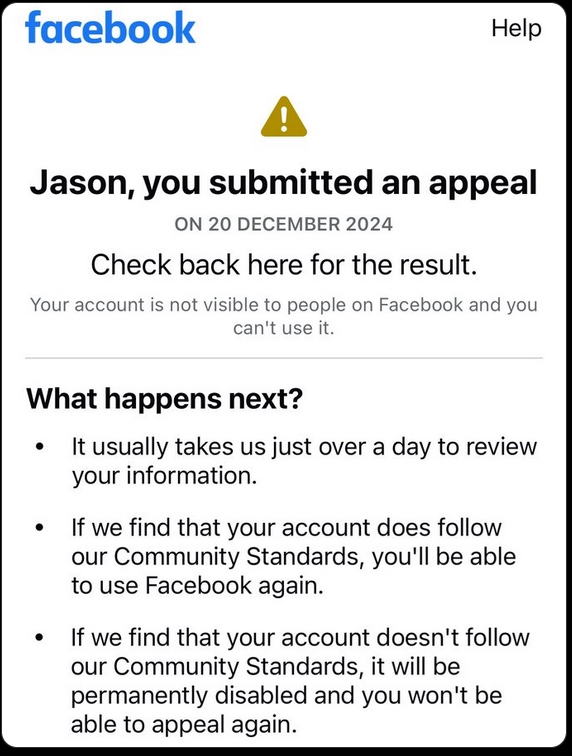
— Jason Olbourne – (The Daily Australian) (@JasonQCitizen1) January 7, 2025
As Zuckerberg avoids a prison cell announcing the end of fact checkers and vastly reducing censorship, I am still waiting for my ‘appeal’ against a heinous false charge with no evidence, no due process and no way to get in touch which disabled 17 years worth of work, the past ten…
Letting all those people out of Facebook jail would be a start.
Zuckerberg’s mea culpa – more strategy than sincerity
Maryanne Demasi, reports | January 12, 2025
Mark Zuckerberg’s Meta has spent years manipulating algorithms to suppress dissent and inconvenient truths. Now, Zuckerberg wants us to believe he’s turned over a new leaf. “Community notes” is his supposed act of contrition—replacing Meta’s infamous “fact-checkers” with what he’s touting as a democratic approach to truth.
The changes will affect Facebook, Instagram and Threads – social media platforms with more than 3 billion users globally. Zuckerberg says the purpose is to outsource fact-checking to the people and let the collective wisdom determine what’s true.
Users can add context or clarification to posts, which won’t vanish into algorithmic oblivion but will instead bear appended “notes” offering a more balanced view.
So, has Zuckerberg suddenly grown a conscience? Hardly. This is less about soul-searching and more about political expediency. We’re meant to believe this is some heartfelt mea culpa, a humbling moment for a company that “got it wrong.”
But to me, this feels insincere. Pure public relations – a cynical scramble to navigate shifting political winds. Meta isn’t repenting; it’s repositioning. After all, this is the same platform that orchestrated an era of unparalleled online censorship, silencing inconvenient truths under the guise of “misinformation control.”
Remember the Biden laptop story? An exposé conveniently buried before the 2020 election because it didn’t fit the desired narrative. Zuckerberg himself admitted to suppressing the story after pressure from the FBI. But that wasn’t an isolated incident.
Over the last four years, Facebook has been the digital embodiment of Orwell’s Ministry of Truth. Articles questioning the efficacy of masks, the lab leak theory, or COVID-19 vaccine safety were flagged, shadow-banned, or outright erased. Entire communities of vaccine-injured individuals—desperate for support and answers—were wiped off the platform. Real lives were affected; people were isolated. Conversations that could have saved lives were silenced. It’s no exaggeration to say Facebook has blood on its hands.
One example of Meta’s overreach involved The BMJ. Paul Thacker’s piece on Pfizer whistleblower Brook Jackson which highlighted data integrity issues at a few of Pfizer’s vaccine trial sites, was slapped with a label by Facebook, effectively discrediting it. This wasn’t just heavy-handed; it was a brazen suppression of credible journalism. An open letter from The BMJ’s editors to Meta rightly lambasted the organisation for trying to discredit the vetted information. The damage wasn’t limited to stifling discourse; it eroded public trust in both science and media.
As recently as August 2024, Zuckerberg admitted to the House Judiciary Committee that Meta had been coerced by the government to censor Americans. His letter detailed relentless pressure to silence dissenting views on COVID-19, elections, and more. And yet, despite this supposed epiphany about governmental overreach, Facebook continued censoring content right up until its recent pivot to community notes.
Zuckerberg’s newfound candour isn’t transparency; it’s pre-emptive blame-shifting. The Murthy v. Missouri (formerly Missouri v Biden) case has exposed the collusion between tech giants and government officials to suppress online speech. Allegations that the Biden administration pressured platforms to bury certain viewpoints—even when factually accurate—paint a chilling picture. Facebook’s narrative of victimhood feels like a calculated attempt to deflect legal and public scrutiny.
Meanwhile, there are ‘journalists’ in legacy media who are mourning the loss of fact-checkers as though democracy itself is under siege. What kind of journalist defends a system that stifles free speech and debate? Science thrives on questioning and open dialogue, not the orthodoxy imposed by fact-checkers operating with opaque agendas. Their hand-wringing isn’t about truth—it’s about losing control of the narrative.
And now, as the political tide shifts and the Biden administration’s influence wanes, Meta suddenly finds the courage to air its grievances about government meddling. Convenient, isn’t it? Zuckerberg’s newfound spine is less about principle and more about positioning Meta for survival in a new political landscape.
Let’s be real. Community notes is not altruism – it’s damage control. Meta isn’t addressing the harm it caused—it’s deflecting. The platform’s censorship caused real-world consequences: vaccine-injured people left voiceless, critical public health debates silenced, and public trust shattered. If Meta was truly contrite, it would compensate for the damage, support those it deplatformed, and restore erased communities – even compensate those with vaccine injuries who were silenced.
Don’t get me wrong – I think dumping fact-checkers was the right move and its a win for free speech – it just should have happened sooner, and Zuckerberg shouldn’t be let off the hook. Meta’s track record suggests this is just another calculated move.
For years, Facebook wielded its influence with recklessness, deciding who could speak and what could be said. Now, as the tide turns, it wants to rebrand as a champion of open dialogue and transparency. But the damage is done. The trust is broken. And no amount of community notes can erase the scars left by Meta’s years of suppressing truth.
Mark Zuckerberg might try to rewrite history, but history won’t forget.
Mark Zuckerberg Falsely Claims “You Can’t Yell ‘Fire’ in a Crowder Theater” To Justify Covid Censorship
By Cindy Harper | Reclaim The Net | January 11, 2025
In his appearance on The Joe Rogan Experience, Meta CEO Mark Zuckerberg defended Facebook’s early COVID-19 content moderation policies by invoking the often-quoted but inaccurate legal principle, “you can’t yell fire in a crowded theater.” Zuckerberg cited this rationale to justify the platform’s censorship of certain information during the pandemic’s onset.
“COVID was the other big one where that was also very tricky because, you know, at the beginning, it was – you know, it’s like a legitimate public health crisis, you know, in the beginning. And it’s – you know, even people who were like the most ardent First Amendment defenders, the Supreme Court has this clear precedent. It’s like, all right, you can’t yell ‘fire’ in a crowded theater. There are times when, if there is an emergency, your ability to speak can temporarily be curtailed in order to get an emergency under control,” Zuckerberg said.
This statement leans on a widely misunderstood legal argument. The phrase “you can’t yell fire in a crowded theater” originates from a 1919 Supreme Court opinion by Justice Oliver Wendell Holmes in Schenck v. United States, which was later overturned and criticized for its justification of speech suppression. Zuckerberg’s use of this outdated precedent is misleading and offers a flawed defense for restricting speech on Meta’s platforms.
Zuckerberg elaborated on his stance, expressing initial trust in government and health authorities: “So I was sympathetic to that at the beginning of COVID. It seemed like, OK, you have this virus. It seems like it’s killing a lot of people. I don’t know. We didn’t know at the time how dangerous it was going to be. So at the beginning, it kind of seemed like, OK, we should give a little bit of deference to the government and the health authorities on how we should play this.”
However, Zuckerberg acknowledged the shifting narratives from health officials, which complicated content censorship decisions. “But when it went from, you know, two weeks to flatten the curve to, you know, in like – in the beginning, it was like, OK, there aren’t enough masks. Masks aren’t that important. To then it’s like, oh, no, you have to wear a mask. And, you know, all the – like, everything was shifting around. I – it’s become very difficult to kind of follow.”
The discredited legal metaphor has drawn criticism from free speech advocates. Such justification enables tech giants to overstep in moderating content, especially in moments of crisis when diverse perspectives are most crucial.
Equating speech to violence or danger is an easy excuse to censor controversial speech.
Newsom Defends Wildfire Response, Tells Biden Online “Misinformation” Needs to be Combatted
By Dan Frieth | Reclaim The Net | January 10, 2025
Governor Gavin Newsom (D-CA) shifted focus to combating “misinformation” during a briefing on the devastating wildfires ravaging Los Angeles. The session included President Joe Biden, Vice President Kamala Harris, and Los Angeles Mayor Karen Bass, with Newsom and Bass addressing concerns over their administration’s preparedness as the fires claimed at least 10 lives and destroyed countless homes.
Conducted in a hybrid format, the meeting saw Biden and Harris in the Oval Office while Newsom, Bass, and FEMA Administrator Deanne Criswell joined via video call. Newsom described the unprecedented destruction fueled by what he called “hurricane-force winds, the likes of which we’ve never imagined in our lifetime.” He then pivoted to warn about the spread of misinformation related to the disaster.
“We’ve got to deal with this misinformation. There were hurricane-force winds of mis- and disinformation — lies,” Newsom stated. “People want to divide this country, and we’re gonna have to address that as well. And it breaks my heart, as people are suffering and struggling that we’re up against those hurricane force forces as well.”
Expressing frustration, Newsom added, “And that’s just a point of personal privilege that I share that with you because it infects real people that are out there. People I meet every single day, people the mayor has been meeting with, and they’re having conversations that are not the typical conversations you’d have at this time be in. And you wonder where this stuff comes from, and it’s very damaging as well, but we’re here to get the job done; to be here for folks to focus.”
California Governor Gavin Newsom is facing a barrage of criticism from various quarters, highlighting several contentious issues, particularly related to a lack of preparation for combatting wildfires under his governance.
Newsom’s timing is ironic as Biden has been criticized heavily today for his previous attempts to police “misinformation” online.
On the same day Newsom appealed to Biden about online “misinformation,” Meta CEO Mark Zuckerberg disclosed on The Joe Rogan Experience that the Biden administration pressured his company to censor COVID-19-related content, including truthful criticism of the vaccines.
Zuckerberg revealed that officials would “call up our team and scream at them and curse” over certain posts. A notable incident involved demands to remove a meme.
Zuckerberg emphasized, “Basically, it just got to this point where we were like no, we’re not going to take down things that are true. That’s ridiculous.”
This revelation, although not new, highlights a troubling pattern of government pressure on tech companies to suppress speech, raising serious concerns about censorship and the erosion of free expression. As wildfires continue to devastate communities, efforts to control narratives under the guise of combating misinformation risk silencing legitimate discourse. The public’s right to transparent and open communication remains more critical than ever in times of national emergencies.
Austrian President creates political chaos as Green ideology fights against reality
By Patrick Poppel | January 10, 2025
The EU member state Austria is struggling with a weakening economy and a high government deficit. In the parliamentary elections at the end of September, the Freedom Party FPÖ became the strongest force in parliament for the first time with 28.85 percent of the vote. The conservative ÖVP (Austrian People’s Party) gained 26.3 percent, followed by the social democratic SPÖ with 21.1 percent.
It has been a few months since elections took place in Austria, but the country still has no government. After the NEOS(New Austria and Liberal Forum) withdrew from the talks in Austria, the negotiations between the ÖVP and SPÖ also failed.
Chancellor Nehammer announced his resignation. In Austria, negotiations between the Chancellor’s party ÖVP and the social democratic SPÖ have been broken off. A spokesman for ÖVP leader explained in a written statement to the newspaper Die Presse: “We have tried everything up to this point. An agreement is not possible on essential key points, so there is no point in a positive future for Austria.”
Nehammer stated in a video message that he wants to resign as the head of government and as the head of the conservative ÖVP. He said he would retire from the post in the coming days. Nehammer made it clear that he was still not prepared to hold coalition talks with the right-wing FPÖ under Herbert Kickl.
The conservative ÖVP had been in talks about a coalition with the SPÖ and the liberal NEOS since mid-November. It is normal for the Federal President to appoint the party that has the most votes from voters to form the government.
But Austrian Federal President Alexander Van der Bellen supported negotiations between the other parties in order to keep the FPÖ from participating in a government. But his plan totally failed.
The ÖVP repeatedly emphasized during the election campaign: there will be no coalition with the Kickl-FPÖ. But after the negotiations between ÖVP, SPÖ and NEOS failed, there should now be talks between ÖVP and FPÖ.
The parties are not strangers to each other on all points – even if it often seemed so in the heat of the election campaign. The ÖVP described Kickl as a right-wing extremist, conspiracy supporter and security risk for Austria. The new acting ÖVP boss, Christian Stocker, who was ÖVP general secretary during the election campaign, spoke particularly harshly against Kickl in parliament.
Now things look different, however. Stocker is supposed to lead the negotiations with Kickl for the ÖVP. And Stocker assumes that both sides will ignore everything that was said during the election campaign.
Many experts in Austria now assume that the FPÖ and ÖVP will have a much easier time with each other in the negotiations than the ÖVP, SPÖ and NEOS in the negotiations of the last three months. Because when it comes to financial policy, which caused the first coalition attempt to collapse, the ÖVP and FPÖ are much closer together.
Both parties are economically liberal and do not want to place additional burdens on large businesses and owners. ÖVP and FPÖ want to scale back climate policy and there are also similarities when it comes to asylum and migration as both want a restrictive policy.
The biggest differences are likely to be in foreign policy. The FPÖ repeatedly showed an understanding for Russia. Kickl calls for an end to military support for Ukraine and is skeptical about the European Union. The ÖVP, on the other hand, is a pro-EU party.
An exciting time is now beginning for Austria. Nehammer is still chancellor. Austrian Foreign Minister Alexander Schallenberg will now officially take over the office on an interim basis, as Federal President Van der Bellen’s office explained. However, Schallenberg does not want to take part in a possible FPÖ-led government.
Protests from the liberal and left-wing spectrum can now be expected. A call to participate in a planned “human chain to defend democracy” demonstration in front of the Federal Chancellery in Vienna comes from, among others, the Catholic Action Austria (KAÖ).
The protests are directed against a possible blue-black government led by the FPÖ. Behind the event are social and church organizations, as well as groups that support environmental issues and refugees. In this spirit, a new government must now be put together.
This political chaos is the result of the Federal President’s actions. Austria has not had a new government for over 100 days, the political mood on the streets is tense and the society is divided. It now remains to be seen how the new government will be put together.
Patrick Poppel is an expert at the Center for Geostrategic Studies in Belgrade.
Musk’s X should be banned in Poland during election campaign, says journalist on state-run television
Remix News | January 10, 2025
In the TVP Info program, journalist Dorota Wysocka-Schnepf, who hosts major television shows on the state-run network, suggested that the authorities should completely shutdown the X portal during the presidential election campaign, which would amount to a form of mass censorship not seen in Poland since communist times.
“We live in a situation where disinformation can come to us not only from the East, but the West can also poison us with content that will have nothing to do with the truth,” said Dorota Wysocka-Schnepf.
The shocking suggestion was made on the “Dangerous Liaisons” program, which is broadcast by state-run TVP Info. Dorota Wysocka-Schnepf’s guests were Prof. Anna Siewierska-Chmaj from the University of Rzeszów and Dr. Katarzyna Bąkowicz from SWPS, according to Polish outlet Do Rzeczy.
In response, Dr. Katarzyna Bąkowicz said: “We know that there are organized criminal groups that spread disinformation. It’s not just Russia or China. We have to remember that disinformation has become an element of political struggle. What Elon Musk and Mark Zuckerberg, who joined in, are doing is opening Pandora’s box.”
Prof. Anna Siewierska-Chmaj responded with what appeared to be supportive statements, saying that Elon Musk does not hide the fact that he is fascinated by European politics and wants to change it, with Musk’s comments about Great Britain the latest example.
“What shocks me the most is Germany and its support for the post-fascist AfD, and we should be afraid of that,” said Wysocka-Schnepf.
“Of course, the AfD’s victory fuels the Polish right, so it is de facto influencing the Polish elections,” replied Prof. Siewierska-Chmaj.
Then, the journalist’s shocking words about the need to consider closing Musk’s portal for the duration of the election campaign were uttered.
“We are in such a situation, more and more countries are announcing the closure of TikTok for fear of Chinese propaganda, so should we seriously consider that maybe X should be closed for the duration of the election campaign,” said Dorota Wysocka-Schnepf.
“This would be a very radical solution… but we need to think about regulating this area,” replied Dr. Bąkowicz.
150 EU officials expected to monitor Elon Musk conversation with Alice Weidel, possible ban on the table
Remix News | January 9, 2025
The European Union’s outrage is only growing over a planned interview hosted by Elon Musk later today with Alternative for Germany (AfD) party co-chair Alice Weidel. Now, Politico is reporting that 150 EU officials are expected to attend the conversation between Musk and Weidel for the purpose of learning whether X is complying with EU rules. In addition, French politicians are already talking about an EU-wide ban.
The claim is that there are fears that Musk’s team will manipulate the algorithm to provide the interview more attention. However, Musk has over 200 million followers and nearly all of his posts receive millions and often tens of millions of views, which makes it certain that the interview, which has also been widely advertised, will receive significant attention.
Weidel has also taken to X about the surveillance of the upcoming interview.
“Big Brother is watching you: 150 EU officials are supposed to monitor my conversation with @elonmusk. An EU that uses its bureaucracy to exercise censorship on social media is instilling the spirit of unfreedom. The #dsa threatens democracy!” she wrote
The officials overseeing the interview are “given relatively extensive power,” according to Politico. They will be able to use, among other things, the Digital Services Act (DSA) to monitor how the algorithm works and how content is being displayed to users.
Politico writes that Musk allegedly pushed certain posts in the past, including one about the Super Bowl in the past. The alleged reason was that Musk was mad that one of President Biden’s posts were getting more attention.
The EU officials are working with experts from the European Center for Algorithmic Transparency” in Seville to determine if such an action will occur once again. However, they will not release this information immediately. Instead, it will like be added to a general procedure against X.
A wide range of EU leaders fear losing power due to shifting public sentiment, and Musk’s X represents their top threat. French Foreign Minister Jean-Noël Barrot, on Wednesday, called for a decisive stand against political influence. When asked whether a ban on X, in the same style as Brazil, was possible, he responded: “That is possible under our laws.”
Spanish Prime Minister Pedro Sanchez also claimed Musk was pushing “hate” and warned against the rise of fascism in Europe.
SPD General-Secretary Matthias Miersch said that Musk’s influence on Germany’s elections now “call into question the foundations of democracy.”
However, Musk is unlikely to manipulate the algorithm in favor of Weidel especially when enough people are already likely to watch the interview without any interference. Absent some overt manipulation, it is unclear what could possibly be illegal about such an interview. Musk is allowed to interview Weidel. That is his right and her right. The bigger problem would be if he censored anyone who criticized such an interview or manipulated the algorithm to suppress this criticism, which is undoubtedly what the old Twitter regime did before his purchase — all of which the EU actively supported
The head of Germany’s Federal Network Agency, Klaus Müller, appeared to take a more measured approach to the issue.
“Not everything that you get upset about is also illegal,” said Müller on Thursday morning on Deutschlandfunk. “In election campaigns, you also have to put up with things that you personally find inappropriate, indecent or unacceptable.” Freedom of expression always means “the freedom of those whose opinion you do not share.”
He said that the excitement over the Musk interview was “understandable” but it must first be observed whether any laws are actually broken during the process. He noted, however, that people could choose simply not to listen to the interview.
Germany: Green-led agency warns Facebook of potential sanctions after Zuckerberg says he will end censorship regime
Remix News | January 8, 2025
Germany and the European Union are in an uproar after Meta CEO Mark Zuckerberg said he was going to take efforts to end censorship on Facebook and Instagram, including the termination of Meta’s relationship with fact-checkers who Zuckerberg accused of political bias.
Given that much of the EU power runs on political censorship, Brussels and member states like Germany are worried they might lose control of the political narrative, especially when left-liberal leaders are falling from power across the Western world.
The Federal Network Agency in Germany, which reports to German Economic Minister Robert Habeck, is threatening that Facebook could more likely face sanctions if it does not continue its “fact checking” relationship with controversial organizations like Correctiv, known for its hit pieces on the Alternative for Germany (AfD).
The Green Federal Network Agency boss is threatening Facebook with sanctions if it does not resume working with “fact checkers” such as “Correctiv”. This has led to censorship on a large scale, as Zuckerberg admitted.
Klaus Müller, of the Greens and who runs the Federal Network Agency, wrote on X on Wednesday morning according to the Digital Service Act (DSA), “the cooperation of very large online platforms with fact-checking organizations is not mandatory, but their risk of sanctions is reduced if they do so in the EU.” EU election guidelines also note that the presence of fact checkers is considered “a risk-minimizing measure in elections” with regard to “systemic risks.”
“If a (Very Large Online Provider) VLOP does not work with fact checkers, it must prove that it is taking other, equally effective risk-minimizing measures,” he further wrote.
Zuckerberg admits that these fact-checkers have helped drive a regime of censorship on his platform. He notes that these organizations have exerted pressure to “censor more and more.”
However, German media reports that Facebook is still currently working with Correctiv. It is unclear when that relationship will end — if ever.
Zuckerberg says he now wants to switch to a community notes system like the one deployed by Elon Musk on X. Notably, he wants to lift restrictions on certain issues, such as immigration and gender issues, and adjust filters to allow free expression on the platform.
As Remix News reported, our own news site has come under attack from Facebook censors in the past, reducing our reach from millions of views a week to a few thousand a week as of now.
Telegram supported freedom of speech when it was less ‘safe’ – Durov
RT | January 8, 2025
It’s easy to support freedom of speech when one doesn’t have to face any risks for doing so, Telegram founder and CEO Pavel Durov wrote on Wednesday, in a post on his messenger platform. The entrepreneur was apparently commenting on recent announcements by Meta – the parent company of Facebook, Instagram, WhatsApp and Threads – which has announced some major policy changes.
On Tuesday, Meta CEO Mark Zuckerberg said that his company would ditch its controversial third-party fact-checking program in the US. He admitted that such services did more harm than good, as they “shut out people with different ideas.” He also said that Donald Trump’s victory in the November presidential elections was one of the developments that prompted the policy change.
Zuckerberg called the recent US elections a “tipping point” towards prioritizing freedom of speech, and vowed to reduce censorship.
“It’s easy to say you support something when you risk nothing,” Durov wrote in his Telegram post the next day, adding that some “platforms are announcing they’ll now have less censorship.” He did not cite Meta by name in his post, though.
Those making such changes only now would face a “real test of their newly discovered values” when “the political winds change again,” the Telegram CEO predicted, adding that his company’s values “don’t depend on US electoral cycles.”
“I’m proud that Telegram has supported freedom of speech, long before it became politically safe to do so,” Durov said.
His words came just a week after the Telegram CEO himself said that his platform was facing certain restrictions in the EU due to anti-Russia sanctions. At that time, Durov stated that Russians had more media freedom than Europeans did, given that all Western media outlets were “freely accessible” on Telegram in Russia while “certain Russian media has been restricted in the EU under DSA/sanctions laws.”
Durov also faced major legal challenges in the EU last year. The Russian entrepreneur, who is also a citizen of France, the UAE, and Saint Kitts and Nevis, was detained in France and faced 12 criminal charges, including complicity in distributing child pornography, drug dealing, and money laundering. French authorities claimed that Telegram’s supposedly lax moderation rules had allowed criminals to flourish on the platform.
The businessman was released on bail but barred from leaving France. In September 2024, he announced an update to Telegram’s Terms of Service and Privacy Policy, which would make it clear that that IP addresses and phone numbers of those who violate the messenger’s rules “can be disclosed to relevant authorities in response to valid legal requests.” In October of the same year, he also admitted that the platform had already been sharing such information with relevant authorities, as it had been possible to do so since 2018.
Featured Video

Bombing Hitler’s Hometown
or go to
Aletho News Archives – Video-Images
From the Archives
‘Conspiracy Theory’ Now Fact: Greater Israel Has Arrived
By Kit Klarenberg | Mint Press News | January 28, 2025
Ever since Tel Aviv’s 1948 creation, much has been said and written about ‘Greater Israel’ – the notion Zionism’s ultimate end goal is the forcible annexation and ethnic cleansing of vast swaths of Arab and Muslim lands for Jewish settlement, based on Biblical claims this territory was promised to Jews by God. The mainstream media typically dismisses this concept as antisemitic conspiracy theory, or at most the fringe fantasy of a minuscule handful of extremist Israelis.
In reality … continue
Blog Roll
 Aletho News
- Trump admits Iran hit USS Ford carrier: ‘We ran for our lives’
- Battle for Hungary: EU attacks on Orban are a sign of worse things to come
- Iraqi resistance conducts drone strike on US-run base in Syria
- Failing to Defeat Hezbollah, Israel & US Pressure Syria’s Ahmed al-Sharaa to Join War
- US-Israeli war on Iran drives global fertilizer prices up 40%
- Hezbollah’s Surprise Weapons Redefine Ground Battle with Israel
- Yemen joins fight against US, Israel by firing missiles at occupied territories
- Seizing the Kharg: Washington’s path to defeat in the Persian Gulf
- Iran reports 500 US casualties in strikes on covert US military sites
- Pro-Israel terrorist arrested before assassination of pro-Palestinian activist
- If Americans Knew
- Over 300 US service members wounded, majority have brain injuries – Not a ceasefire Day 169
- Researchers at Human Rights Watch Resign Over Blocked Report on Palestinian Refugee Return
- Jewish Groups Are Backing a War Americans Don’t Want
- Eric Fingerhut Thinks He’s the President of the Jews
- Top Jewish Philanthropists, Rabbis Urge Israeli President to Take Action Against ‘Jewish Extremists’
- Don’t Be Fooled. Zionist Leaders Have Always Wanted to Control Southern Lebanon
- Israel’s widespread use of torture is a core element of its genocide against the Palestinian people
- In Israel’s War on Iran, Many Middle East US Bases Rendered “All But Uninhabitable”
- ‘Burn the lawn’: Israel pursues ‘Rafah model’ in southern Lebanon
- A genocide here, an amputation there
- No Tricks Zone
- Devastating Assessment Of Comirnaty Vaccine By Former Senior Pfizer Europe Toxicologist
- New Study: CO2 Is ‘Effectively Negligible’ As An Explanatory Climate Change Factor Since 2000
- Former Pfizer Toxicologist Dr. Helmut Sterz Tells Bundestag Hearing Pfizer Vaccine Should Have Never Been Approved
- Energy Expert: Germany’s Nuclear Phaseout Was A “500 Billion Euro Mistake”
- New Research: South Australia’s Mid-Holocene Sea Surface Temperatures Were 4°C Warmer Than Today
- Storing Green Energy To Last Germany 10 Days Would Require A 60-Million Tonne Battery
- New Studies: UK Sea Levels Were 4 Meters Higher Than Today During The Mid-Holocene
- Destructive Green New Deal: German Energy And Metal Group Warns Of Drastic Crisis
- New Study Documents A 20-Year Pause In Arctic Sea Ice Decline – Driven By Internal Variability
- Wake-up Call: Survey Shows Majority Of Germans Now Favor Postponing Climate Targets!
 Aletho News