Snoopers’ charter ‘unfit for purpose,’ 200 legal experts say
RT | March 15, 2016
Home Secretary Theresa May’s Investigatory Powers Bill, dubbed the snoopers’ charter, breaches international surveillance standards and is “unfit for purpose,” more than 200 senior lawyers have warned.
In a letter to the Guardian, the lawyers, including numerous Queen’s Council representatives and academics, said the bill will destroy privacy.
MPs are due to vote on the bill for the first time on Tuesday afternoon, and it is expected they will pass the motion. The bill itself sets out a series of legal frameworks for the government’s interception of data by GCHQ and establishes the breadth of government surveillance operations.
Chair of the Bar Human Rights Committee Kirsty Brimelow QC has signed the letter, as well as academics from 40 British law schools.
“A law that gives public authorities generalized access to electronic communications contents compromises the essence of the fundamental right to privacy and may be illegal,” the letter reads.
“The investigatory powers bill does this with its ‘bulk interception warrants’ and ‘bulk equipment interference warrants.’”
A well as bulk interception, the letter warns against “targeted interception warrants” which could be taken out on groups, organizations, or premises. The letter also warns that there need only be “reasonable suspicion” to intercept data, not demonstrable proof of threat.
“These are international standards found in the recent opinion of the UN special rapporteur for the right to privacy, and in judgments of the EU court of justice and the European court of human rights,” it continues.
“At present, the bill fails to meet these standards – the law is unfit for purpose.”
The aim of the bill is to establish a legal framework for interception, but critics of the bill say any bulk interception is a breach of privacy. The bill will also make it obligatory for internet companies to keep track of sites accessed by users for one year.
Other critics say the new bill will also criminalize IT staff who fail to destroy security services on its customers’ software on demand, or fail to hack into its customers’ systems upon a Home Office request.
GCHQ says it only targets an individual’s data in the context of a threat to national security, and would only pursue terrorist or criminal activity. It also argues that bulk interception is a necessary step to monitor criminal activity and the majority of intercepted material is never read.
However, the United Nations special rapporteur on privacy, Joseph Cannataci, also warned that the IP bill would legitimize mass surveillance.
Texas cop ‘pepper sprays’ passing bikers on highway
RT | March 15, 2016
A police investigation has been launched after a video posted online appears to show an officer macing a group of bikers on a highway in Texas.
The video was posted Monday, a day after the incident took place on the US Highway 297 in Fort Worth.
The episode began when a police officer pulled over a red pickup truck which was traveling with the bikers and issued citations to the driver for not having a license, and to two others for standing in the bed of the truck.
As the bikers approach, the video shows the officer get out of his vehicle and spray them with what seems to be pepper spray.
During the big ride today we had a law enforcement officer, that looked as if he was pulling over a truck, stepped out…
Posted by Chase Stone on Monday, March 14, 2016
In a statement, Fort Worth officials named the policeman involved as Officer Figueroa, a “six-year veteran” who has been “removed from uniformed patrol duties and placed in an administrative capacity pending the investigation”.
Police say they had received a number of calls reporting reckless driving relating to the motorcyclists. However, the biker who shot the video disputes this claim.
Biker Jack Kinney said he did not see any reckless driving and accused the department of running a “propaganda campaign to try to mitigate the damage”, The Star Telegram reports.
“What’s in the video? The people at that time, they weren’t committing any crime,” Kinney told the local paper. “They were driving slower than the speed limit and they got pepper sprayed for it.”
Another biker called Chase Stone said the police action could have resulted in serious injury or death.
“If one or two or three of those riders had their face masks up and that would have hit them in the eyes, it would have more than likely sent them down,” Stone said.
Turkey’s Erdogan Looks to Expand Terrorist Definition to Include Civilians
Sputnik – March 14, 2016
Turkish President Recep Tayyip Erdoğan said on Monday that it is necessary to broaden the definition of terrorism to include supporters of terrorism — even people who are not directly involved in any kind of terror activity.
“It’s not only the person who pulls the trigger, but those who made that possible who should also be defined as terrorists, regardless of their title,” said Erdogan, following a bombing in Ankara which killed 37 people, the Daily Star reported. He added that this could be a journalist, an MP or a civil society actor.
Earlier President Erdogan said that Turkey’s “struggle against terrorism will for certain end in success and terrorism will be brought to its knees.”
The bombing was the fifth attack in Turkey in recent several months. The attacks took lives of total of 200 people.
Severe penalties for anyone backing Hezbollah: Saudi Arabia
Press TV – March 13, 2016
Saudi Arabia says those linked to the Lebanese resistance movement Hezbollah will be punished in accordance to anti-terrorism laws.
According to an Interior Ministry statement published by the state-run SPA news agency on Sunday, Saudi nationals and foreigners living in the kingdom will face “severe penalties” if they sympathize with, financially support, or harbor any of the group’s members.
“Any citizen or resident who supports, shows membership in the so-called Hezbollah, sympathizes with it or promotes it, makes donations to it or communicates with it or harbors anyone belonging to it will be subject to the stiff punishments provided by the rules and orders, including the terrorism crimes and its financing,” read the statement, adding that expatriates would also be deported.
Riyadh’s move appears to be part of the monarchy’s anti-Shia campaign, including a severe crackdown on nationals residing in Eastern Province. Last year, the kingdom executed prominent Shia cleric Sheikh Nimr al-Nimr, which drew widespread condemnation from rights groups and various states.
The Sunday announcement also follows recent decisions by pro-Saudi Arab factions, the Arab League and the [Persian] Gulf Cooperation Council, to brand Hezbollah as a “terrorist” group.
On Saturday, Hezbollah described such measures as a “declaration of aggression” by Riyadh, which is “putting pressure on others at the Arab foreign ministers meeting to do the same,” said Sheikh Naim Qassem, the deputy secretary general of the resistance movement.
France: Another Palestinian TV Station Shut Down
IMEMC News & Agencies – March 12, 2016
 Israeli Prime Minister Benjamin Netanyahu expressed his gratitude, on Saturday, to French President Francois Hollande, after the French government shut down a Hamas-affiliated television station that, according to the Israeli media, “aired content which constituted anti-Israel and anti-Jewish incitement.”
Netanyahu had earlier urged Hollande to end the transmission of Al Aksa television, the Hamas-run channel that was being broadcast on the French satellite service EUTELSAT — also associated with Palestine Today TV, which was shut down in the occupied West Bank, on Friday.
According to the PNN, Israel’s Shin Bet internal spy agency said in a statement, on Friday, that the Ramallah offices were raided overnight, in a joint operation with the military over allegations that the channel “broadcasts on behalf of the Islamic Jihad,” a Gaza-based Palestinian resistance movement.
“The channel served the Islamic Jihad as a central means to incite the West Bank population, calling for terror attacks against Israel and its citizens. Incitement was broadcast on the television station as well as the Internet,” Shin Bet added.
Palestinian officials have denounced Israel’s closure of the offices. Yousef al-Mahmoud, Palestinian Authority spokesman, described the Israeli raid on Palestine Today TV station in Ramallah as “part of the aggressive occupation policy towards Palestinian media.
Dr. Hanan Ashrawi, member of Palestine Liberation Organization (PLO) executive committee, also denounced the Israeli raid, saying it contravenes free speech rules.
The Palestinian Journalists’ Syndicate made an official statement, as well.
“Incursions into areas under the Palestinian Authority’s control and attacking its sovereignty and media institution [are] a stark violation of basic human rights and international and humanitarian laws that have safeguarded freedom of speech,” she said.
Last November, Israeli soldiers broke into the headquarters of Al-Hurriyya Media Network, destroyed the offices, confiscated the tools and threatened to demolish the entire building if the network works again, accusing it of “inciting” Palestinians against the Israeli occupation.
The month previous, in October, Israeli soldiers raided the offices of the International Middle East Media Center and the Palestinian Center for Rapprochement.
Since the start of October 2015, almost 200 Palestinians have been killed, in addition to 30 Israelis, settlers and soldiers.
The current tension is ongoing since October, due to repetitive Israeli settler attacks on Al-Aqsa mosque, the third holiest place in Islam, and Israeli restrictions over Palestinian entrance, in addition to the Douma arson attack which killed a baby and his parents on July 31.
Israeli forces have been criticized internationally, over recent months, for its ‘preemptive shootings’ of Palestinians alleged to be holding knives.
In addition several of the incidents in which the military has claimed that they were ‘attacked’ have proven to be false.
Cruz Thinks That Egypt’s President El-Sisi is Doing a Great Job
teleSUR | March 11, 2016
 If we were unclear what kind president Ted Cruz would be if he won the race to the White House, his recent comments on who he considers a good role model leave little room for doubt.
The Texas Senator expressed his admiration for the Egyptian President, Abdel Fattah el-Sisi, who has imprisoned thousands of journalists and protesters and has unleashed a brutal police force, as an “example” of a Muslim ally.
“Let me give you an example of a Muslim, for example, we ought to be standing with,” Think Progress reports Cruz said at a campaign rally in Miami. “President el-Sisi of Egypt, a president of a Muslim country who is targeting radical Islamic terrorists,” he added.
But Cruz is no fair-weather friend to the blood-stained Egyptian president, he mentioned his admiration for el-Sisi last year.
“Why don’t we see the president of the United States demonstrating that same courage [as el-Sisi] just to speak the truth about the face of evil we’re facing right now?” Cruz asked during the first Republican presidential debate last year.
In February, charges were dropped against a four-year-old in Egypt. He had been sentenced to life for four counts of murder, eight counts of attempted murder, vandalizing state property during protests in January 2014, when the boy was 16-months-old.
Hillary’s Double-Standard on Protests
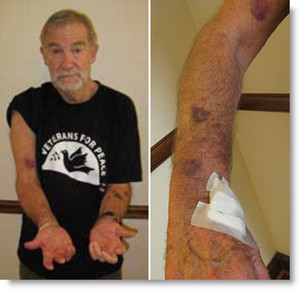
Ray McGovern displaying the aftermath of his arrest during a speech by Secretary of State Hillary Clinton on February 15, 2011
By Robert Parry | Consortium News | March 11, 2106
Hillary Clinton has excoriated Donald Trump for failing to stop a supporter from roughing up a protester during a speech, saying “This kind of behavior is repugnant. We set the tone for our campaigns — we should encourage respect, not violence.” Yet, in 2011, she did nothing to stop security personnel from brutalizing a 71-year-old veteran who stood silently with his back to her during a speech.
The protester, Ray McGovern, a retired Army officer and CIA analyst, was wearing a black “Veterans for Peace” T-shirt, when he was set upon within sight of Secretary of State Clinton, who ironically was delivering a speech about the importance of foreign leaders respecting dissent. The assault on McGovern left him bruised and bloodied but it didn’t cause Clinton to pause as she coolly continued on, not missing a beat.
The Feb. 15, 2011 incident at George Washington University in Washington prompted an email from Clinton’s personal adviser Sidney Blumenthal who noted that “something bad happened” and suggested that Clinton have someone reach out and apologize to McGovern. Clinton, however, chose not to do so, although criminal charges against McGovern were dropped.
Subsequently, McGovern was placed on the State Department’s “Be On the Look-out” or BOLO alert list, instructing police to “USE CAUTION, stop” and question him and also contact the State Department’s Diplomatic Security Command Center.
After learning of the BOLO alert, the Partnership for Civil Justice Fund (PCJF), which is representing McGovern in connection with the 2011 incident, interceded to have the warning lifted. But McGovern wondered if the warning played a role in 2014 when he was aggressively arrested by New York City police at the entrance to the 92nd Street Y where he had hoped to pose a question to a speaker there, one of Clinton’s friendly colleagues, former CIA Director and retired General David Petraeus.
After that arrest on Oct. 30, 2014, McGovern wrote, “God only knows (and then only if God has the proper clearances) what other organs of state security had entered the ‘derogatory’ information about the danger of my ‘political activism’ into their data bases. Had my ‘derog’ been shared, perhaps, with the ever-proliferating number of ‘fusion centers’ that were so effective in sharing information to track and thwart the activists of Occupy including subversives like Quakers and Catholic Workers?”
On Feb. 15, 2011, McGovern attended Clinton’s GWU speech, deciding on the spur of the moment after feeling revulsion at the “enthusiastic applause” that welcomed the Secretary of State “to dissociate myself from the obsequious adulation of a person responsible for so much death, suffering and destruction.
“The fulsome praise for Clinton from GW’s president and the loud, sustained applause also brought to mind a phrase that as a former Soviet analyst at CIA I often read in Pravda. When reprinting the text of speeches by high Soviet officials, the Communist Party newspaper would regularly insert, in italicized parentheses: ‘Burniye applaudismenti; vce stoyat’ , Stormy applause; all rise.
“With the others at Clinton’s talk, I stood. I even clapped politely. But as the applause dragged on, I began to feel like a real phony. So, when the others finally sat down, I remained standing silently, motionless, wearing my ‘Veterans for Peace’ T-shirt, with my eyes fixed narrowly on the rear of the auditorium and my back to the Secretary.
“I did not expect what followed: a violent assault in full view of Madam Secretary by what we Soviet analysts used to call the ‘organs of state security.’ The rest is history, as they say. A short account of the incident can be found here.
“As the video of the event shows, Secretary Clinton did not miss a beat in her speech as she called for authoritarian governments to show respect for dissent and to refrain from violence. She spoke with what seemed to be an especially chilly sang froid, as she ignored my silent protest and the violent assault which took place right in front of her.
“The experience gave me personal confirmation of the impression that I reluctantly had drawn from watching her behavior and its consequences over the past decade. The incident was a kind of metaphor of the much worse violence that Secretary Clinton has coolly countenanced against others.
“Again and again, Hillary Clinton both as a U.S. senator and as Secretary of State has demonstrated a nonchalant readiness to unleash the vast destructiveness of American military power. The charitable explanation, I suppose, is that she knows nothing of war from direct personal experience.” [For more of McGovern’s account of his arrest, see Consortiumnews.com’s “Standing Up to War and Hillary Clinton.”]
Proposed Apology
In the email exchange, Blumenthal suggested that Clinton “have someone apologize to Ray McGovern,” but referred to the incident and McGovern in condescending terms, noting that McGovern’s mistreatment has “become a minor cause célèbre on the Internet among lefties.” As for McGovern, Blumenthal said the former CIA analyst who was a presidential briefer to George H.W. Bush has “become a Christian antiwar leftist who goes around bearing witness. Whatever his views, he’s harmless.”
Clinton responded, “I appreciate your sending thgis [sic] to me. Neither State nor my staff had anything to do w this. The man stood up just as I was starting and GW – which claims their quick actions were part of their standard operating procedures to remove anyone who stands up and starts speaking while an invited guest is talking – moved to remove him. GW claims he was not in any way injured.”
However, McGovern was not speaking, simply standing quietly until he was attacked by the police. As for Clinton, no apology was forthcoming, nor any further explanation of why she failed to stop police from roughing up a peaceful protester in her presence. She now has chosen to lecture Donald Trump on the need to demonstrate respect toward protesters.
Investigative reporter Robert Parry broke many of the Iran-Contra stories for The Associated Press and Newsweek in the 1980s. You can buy his latest book, America’s Stolen Narrative, either in print here or as an e-book (from Amazon and barnesandnoble.com).
Justice for the Women of Sepur Zarco
Indigenous women win precedent-setting case against former soldiers in sex slavery trial in Guatemala
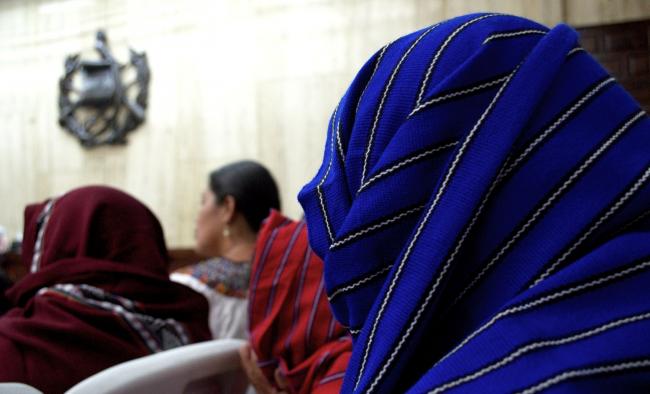
Women of Sepur Zarco, forced into sex slavery at the hands of the Guatemalan military in 1982, listen to trial proceedings at the Guatemalan Supreme Court (Photo by Quimy de Leon)
By Jeff Abbott and Julia Hartviksen – NACLA – 03/11/2016
Nearly 20 years since the signing of Guatemala’s 1996 Peace Accords, justice has finally been served for 15 Indigenous Q’eqchi’ Mayan women of Sepur Zarco, who were forced to become sex slaves for members of Guatemala’s military during the country’s long civil war.
On February 26, Guatemala’s Supreme Court sentenced two former military members, former Lieutenant Coronel Esteelmer Reyes and former Military Commissioner Heriberto Valdez Asij, to prison terms of 120 and 240 years, respectively, for crimes against humanity. Reyes was also found guilty of three assassinations, while Asij was deemed guilty for the forced disappearances of seven men. (Despite the significance of the guilty verdict, prosecutors from the Guatemalan Public Ministry had initially requested that Reyes and Asij be sentenced with 1290 years in prison for war crimes, plus 50 years in prison for each assassination charge.)
On March 2, the perpetrators were also ordered to pay reparations to the victims. Reyes will owe 500,000 Quetzales (about US $65,000) to each of the victim-survivors, and Asij has been ordered to pay 250,000 Quetzales (about US $32,500) for each of the seven forcibly disappeared men.
Judge Yassmín Barrios of the Guatemalan Supreme court made the historic decision following a short, emotional trial, which began February 1 in the Guatemalan Supreme Court in Guatemala City. The case, the first time in the world where a case of wartime sexual violence was tried in the national courts of the country where the violence occurred, represents a landmark legal decision in Guatemala and a major victory against the impunity for war crimes in the country.
The charges against Reyes and Asij relate to crimes committed in the year 1982, a time when both men were stationed at the Sepur Zarco military base in Alta Verapaz. During this period, the soldiers murdered men in the community, and forced women in the area to work as domestic servants and sexual slaves, subjecting them to degradation, abuse, and rape. In 2010, 12 of those women, all of Mayan Q’eqchi’ descent, brought the case before a mock tribunal meant to address sexual violence during Guatemala’s 36-year-long war. In 2011, the case was brought before a criminal court. Grassroots organizations and international NGOs alike fought to bring the case to the Guatemalan Supreme Court, amidst repeated attempts to derail their efforts.
Lily Muñoz, a sociologist who worked as an independent consultant assisting the legal organization, Mujeres Transformando el Mundo (MTM) on the case, explained the significance of the historic ruling. “It represents justice for war crimes that were committed against women,” she said.
Though the case represents a landmark legal decision for Guatemala, Sepur Zarco is not an exceptional case of sexual violence perpetrated by the military during the war. “This case serves as a precedent not only here in Guatemala, but also on the global scale,” said Lily Muñoz, a sociologist who worked as an independent consultant assisting the legal organization, Mujeres Transformando el Mundo (MTM) on the case.
The case’s success has led to more than 30 Achi’ women from the community of Rabinal, Baja Verapaz, who also suffered from sexual violence at the hands of the military, to begin mobilizing for legal justice for crimes of sexual violence as a tactic of war.
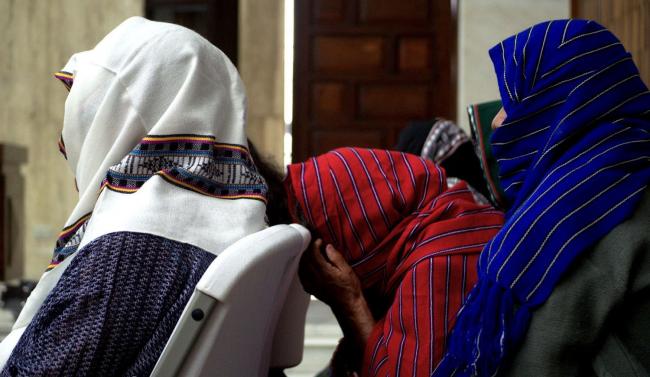
Survivors of the Sepur Zarco sex slavery case at the Supreme Court trial (Photo by Quimy de Leon)
This case also illustrates the gendered dimensions of such brutality – a brutality that preyed upon the vulnerability of indigenous women in rural Guatemala at the height of the internal armed conflict. “It is particularly interesting that sexual violence against women was a part of the sentence, and in the context of an armed conflict. This marks such violence as a war crime, as a crime against humanity. It’s a war crime, but it is a specifically gendered crime, that was tried in the national court of the country where the crimes were committed,” Muñoz said.
She continued: “The military men created conditions of extreme vulnerability for the women of Sepur Zarco. They took their husbands away from them, and they robbed them of their lands and livelihoods – in short, everything they required for social reproduction – and then later, of their sexuality and their ownership over their own bodies.”
As Muñoz explained, Judge Barrios drew on the testimony of a Brazilian anthropologist, Dr. Rita Laura Segato in coming to a decision in the case. Dr. Segato had argued in her testimony that “In the context of the Guatemalan internal armed conflict, women’s bodies were converted into military objects.”
The anthropologist argued that, in this way, that women’s bodies came to represent the “social body,” and for that reason, “the soldiers violated and ‘profaned’ women’s bodies.”
Following Dr. Segato, Muñoz explained that the military sought to “break the community, physically and morally” and did so through sexual violence against women. In this sense, the violence perpetrated against women carried lasting physical, emotional and psychological aspects, and also symbolic meaning for the victim-survivors and other community members. In reading the sentence, Judge Barrios recognized these long-term, destructive impacts the violence of the Sepur Zarco base had on the women who brought the case forward.
The case itself represents a historic shift for the Guatemalan courts, whereby claims of violence brought forth by indigenous women have been recognized by the mainstream justice system, a system that has consistently silenced their voices. “This case has shown that we can trust the testimonies of the (indigenous) women,” said Ada Valenzuela, the director of the Union Nacional de Mujeres Guatemaltecas (UNAMG). “Even 30 years later, the testimonies of the women were supported through other testimonies, and evidence.”
Despite the fact that the women’s faces were covered during the trial for the purposes of anonymity, it was the women themselves who pushed for the case to move forward, despite being told that it would likely not win. “The women from Sepur Zarco said that if this case were to go to court, then they wanted to go,'” Valnezuela said. “And we decided that we were going to accompany these women in this process. This was a very valiant decision.”
The women were also accompanied by a coalition of Guatemalan feminist organizations in Guatemala, known as the Alliance to End Silence and Impunity, which includes UNAMG, MTM and the Equipo de Estudios Comunitarios y Acción Psicosocial (ECAP). UNAMG and ECAP have worked to provide psychological support for the victims of the internal armed conflict and the women of Sepur Zarco since 2004.
The case also complicates the characterization of the simplified but still all too common narrative of Guatemala’s civil war in which Marxist guerrillas are presented as fighting against state. In fact, in many cases, it was poor rural campesinos, organizing to gain ownership of their own land who suffered the most intense brutality of the conflict.
According to Muñoz, all of the women’s husbands were involved in negotiations with the National Institute for Agrarian Transformation (INTA) to gain legal ownership over land they had lived on for centuries. Many of these lands have since been transformed into fincas for the production of sugar cane and oil palm.
“The conditions that began the war have been maintained today,” said Valenzuela. “The inequality, the question of land, the question of opportunity, (among others), are continuing today. According to Valenzuela, Sepur Zarco “has woken up the women of Guatemala. [It] represents hope for justice for other women who suffered violence during the war.”
Jeff Abbott is an independent journalist currently based out of Guatemala. He has covered human rights and social moments in Central America and Mexico. His work has appeared at VICE News, Truthout, and the Upside Down World. Follow him on twitter @palabrasdeabajo.
Julia Hartviksen is a PhD Candidate at the Gender Institute, at the London School of Economics and Political Science. Her research focuses on the materiality of violences against women, and the gendered impacts of oil palm in Guatemala’s Northern Transversal Strip. Follow her on twitter @_yulinka_.
Muslim student reported to UK terror police for pro Palestine activism
Rahmaan Mohammadi, a 17 year old student from Luton, explains how he was reported to the counter terrorism police for his pro Palestine activism. Mohammadi was speaking at a Stop the War Coalition event in London on March 10.
Britain sets ‘bad example’ on surveillance, says UN privacy rapporteur
RT | March 10, 2016
Britain is setting a bad example by legitimizing rather than outlawing mass surveillance, according to the UN’s privacy rapporteur, Joseph Cannataci.
The criticism comes in a report to the UN Human Rights Council examining mass surveillance around the world.
Britain is singled out as setting a bad example because of the government’s attempt to bring into law a number of new spying measures.
Cannataci claims the Investigatory Powers Bill, which will be debated for a second time in parliament next week, legitimizes mass surveillance when bulk collection should in fact be outlawed.
He argues the British security state should stop “setting a bad example to other states” by pursuing measures like “bulk interception and bulk hacking.”
He said that enshrining such surveillance into law undermined “the spirit of the very right to privacy.”
Cannataci has been an outspoken critic of UK surveillance measures for some time. In 2015 he called for a Geneva Convention for the internet, while arguing UK oversight was “a joke.”
On the lack of proper scrutiny on intelligence agencies, he told the Guardian: “That is precisely one of the problems we have to tackle. That if your oversight mechanism’s a joke, and a rather bad joke at its citizens’ expense, for how long can you laugh it off as a joke?”
The Investigatory Powers Bill was partially informed by the revelations of mass surveillance by NSA whistleblower Edward Snowden.
In his 2015 interview, Cannataci put aside the hero/traitor debate on the former contractor, telling the paper “his revelations confirmed to many of us who have been working in this field for a long time what has been going on, and the extent to which it has gone out of control.”
Cannataci’s concerns are shared by some civil liberties groups.
Jim Killock, director of the Open Rights Group, said the report showed that the “bill does not comply with recent human rights rulings” and that the negative impact of the legislation would “be felt around the world, and copied by other countries.”
Featured Video
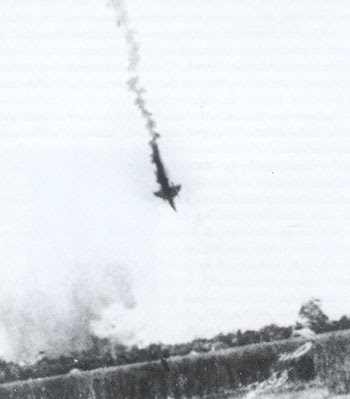
The Failed Air War Over Vietnam
or go to
Aletho News Archives – Video-Images
From the Archives
USS Liberty Massacre: A Pivotal Moment in the Hostile Takeover of America
By Kevin Barrett | Crescent | Dhu al-Qa’dah 24, 1445
In corporate America, hostile takeovers are commonplace. They occur when an aggressor—a larger corporation or rich individuals—seizes control of a smaller corporation without asking permission.
What few recognize is that the United States itself has been subjected to a hostile takeover. Since the aggressor, the illegitimate settler colony known as “Israel,” is much smaller than the US, the takeover has necessarily been surreptitious.
As of June, 2024, Israel’s gradual takeover of the US has become obvious and undeniable—a proverbial “elephant in the living room.” … continue
Blog Roll
 Aletho News
- Leaders Condemn Ansarallah Attack on Saudi Arabia While Ignoring Illegal War Against Yemen
- Leaked: Britain’s Covert Iraqi Psyops Network
- Yemeni Armed Forces Warn Airlines Against Using Saudi Airports, Exempt Mecca and Medina
- Iran security chief says powers greater than US tried to conquer Iran but ended in ‘dustbin of history’
- Europe’s mounting social chaos… chickens coming home to roost for proxy war against Russia
- US-Russia Diesel Deal Becomes Massive Defeat for Ukraine
- Hormuz and the Looming Economic Catastrophe
- Dhubab offensive, media blitz and the rapid unraveling of Saudi-backed coalition’s new gambit
- Putin Conveys to Trump Iran’s Vision on Possible Conflict Resolution – Kremlin
- The Search for Truth: Charlie Kirk’s Assassination One Year Later
- If Americans Knew
- ‘He’s Desperate’: AIPAC Begins Spending Against Abdul El-Sayed to Boost Mike Rogers:
- Trump, Hormuz, and the Looming Economic Catastrophe
- For three years, Israel has killed a child in Gaza every 71 minutes – Daily Update
- Israeli forces kill another child in Gaza – Daily Update
- Gaza ceasefire exists in name only, say more than 100 organizations
- Nearly 2 Million in Gaza Need Urgent Shelter Assistance as Winter Looms: IOM Chief Warns
- Suppressing Palestinian resistance: US charity under fire for AI monitoring of Gaza classrooms
- Thousands Are Held in Israeli Torture Camps. This Is What Happens Inside
- Israel puts Gaza’s sick, injured, newborn in peril – Daily Update
- Report claimed Mark Levin used by Israeli government to influence Trump
- No Tricks Zone
- Germany’s Green Energy Debacle: High Energy Costs Force Kahla Porzellan to Close After 182 Years!
- New Study: 50 Years Of The Most Aggressive ‘Net Zero’ Policies Can Only Affect The Global Climate By 0.03°C
- US September “Heat” Was No Record…Many Records Set Decades Ago
- Latest European Green Energy Debacle; Portugal’s Largest Flagship Solar Park Insolvent!
- Green Energy Debacle: German Expert Professor Fritz Vahrenholt Warns Of Severe Economic And Social Consequences
- Two More Paleo Reconstructions Affirm Meters-Higher Sea Levels Across Ireland, Brazil 7000-6000 Years Ago
- New Study: Earth And Venus Surface Warmth Largely Explained By Convection And Lapse Rate, Not CO2 Or Radiation
- 2025 Nature Paper Claiming Worsening Global Drought Gets RETRACTED …Heavily Flawed
- New Study: ‘Global Drought Shows No Detectable Recent Acceleration Under Climate Warming’
- Economic Masterminds: German Socialists Suggest Taxing Productivity Gains Stemming From Using AI

