The Extraordinary Trial of Arthur Topham: Part 2
By Eve Mykytyn | Dissident Voice | November 14, 2015
Read Part 1.
On November 12th the jury found Mr. Topham guilty of ‘inciting hate.’ This leads to a few questions.
First, the jury found Mr. Topham guilty on Count 1 but not guilty on Count 2. Ordinarily, this is a result we are comfortable with since the state (the Crown) may have proved ‘beyond a reasonable doubt’ that a defendant committed an assault but not have shown sufficient evidence of battery. Mr. Topham’s case is different. He was charged with two virtually identical counts, both relating to his website but covering different periods of time, that is, count 1 was for the period from April 28, 2011 to May 4, 2012, and count 2 was for January 29, 2013 to December 11, 2013.
If Mr. Topham intended to incite hate, would he really have changed his mind in the brief period between counts 1 and 2? We will never know what the jury relied upon; in yet another abrogation of free speech, the jury was threatened that if they spoke to anyone about their deliberations, they would be committing a criminal offense. How is the public supposed to understand the mysterious machinations of the term ‘hate’ without knowing what caused a jury to convict a fellow citizen of such a crime?
Hate is a crime the essential elements of which have been left undefined. As a writer, one must not only discern from the miasma what constitutes ‘hate’ but also guess what elements a jury will find persuasive. If one of the main goals of the criminal law is to prevent certain behavior then clarity of what such behavior is, is essential. What can Canadians say? May they say they disagree strongly with a particular group? What evidence can one print in support of their disagreement? Surely, it is not the defendant’s responsibility that a particular political group is also associated with an ethnic identity and a religion. The Crown, by controlling website content through its ‘hate’ law, is controlling not only what Canadians may say but also what Canadians may read. Mr. Topham’s is not the only blog to criticize Israel and Zionism. Should Canadians then read political criticism only from other countries? Very troubling.
Second, the crown had almost 2 years to prepare its case. Its evidence was contained in 4 binders. Many of the pages were illegible and the Crown itself seemed to have extraordinary difficulties in citing to its own arguments. The defense quite properly objected. The Crown wanted to provide clear copies of the illegible pages in yet another binder cross referenced to the originals. The trial could have been an exercise in maze solving. Judge Butler ruled that the Crown had to provide legible copies. This seemed to present a large obstacle and endless court time was wasted in discussions of printing costs, etc. As a foreign observer it seemed ironic that the crown spent $190 an hour on its expert witness, who as an earlier independent complainant against Mr. Topham might have been willing to accept less, and I don’t know how much money on ‘security’ but had so much trouble producing legible copies.
I belabor this point because it is very odd for the prosecution to allow its evidence to be blurry. I would expect in proving an elusive crime like ‘hate’ they would want their evidence to be as clear and convincing as possible. Was the intent to confuse the jury? Was the Crown merely incompetent? This is not impossible. The judge spent much time instructing the crown’s representative, Ms. Johnston, on procedural issues. This gave me the impression (and perhaps the jurors as well?) that the judge was helping and thus favoring the prosecution. Surely this was unintentional on Judge Butler’s part.
Third, and this relates to point two, the jury was given 62 pages of ‘charges’ (or what Americans call jury instructions). Even if all twelve jurors, ordinary men and women, are speed readers, how are they to read and evaluate 62 pages of instructions and then apply them to four binders? The plethora of material leads me to suspect that the jury was not intended to read the material at all. This would tend the jury toward a guilty verdict.
There is not a sinister act by the jury. They were asked to sit through weeks of testimony about Jewish politics, history, religion, and identity. Jury selection would have excluded anyone who was actually interested in such topics. They were handed stacks of paper. Faced with these circumstances, they presumably decided that the Crown and the judge worked for their province and had British Columbia’s best interests at heart. It is actually a testimony to the weakness of the Crown’s case that Mr. Topham was found not guilty at all.
The battle is not over. Following the verdict, both sides indicated that they intended to appeal. (Here Canada differs from the United States where prosecutors can appeal only under very limited circumstances). The Crown asked that Mr. Topham’s bail restrictions be changed and that his website be taken down. Judge Butler did not decide these issues because first, as the defense pointed out, these requests were improperly made. Mr. Topham intends to present a Charter (constitutional) argument that the judge had stayed at the beginning of the trial so that the ‘facts’ of the case could be more fully developed at trial.
Eve Mykytyn graduated from Boston University School of Law and was admitted to bar of the state of New York.
Egypt sentenced nearly 600 to death last year
Reprieve | November 14, 2015
The Egyptian government has sentenced nearly 600 people to death in the last year, with the vast majority of death sentences handed down in relation to political protest, human rights organization Reprieve has found.
Data collected by Reprieve has found that since January 2014, at least 588 people have been sentenced to death in Egypt. In the cases that Reprieve was able to identify, some 72% of sentences were handed down for attending pro-democracy protests.
Reprieve’s report, released today, also found that the Egyptian authorities are overseeing a marked rise in actual executions. Between 2011 and 2013, only one execution was carried out in Egypt; but since January 2014, some months after President Sisi seized power, at least 27 people have been executed. The report also finds that at least 15 mass trials have taken place since March 2014.
Since taking power, President Sisi has overseen a regime of mass trials and sweeping death sentences for protestors – sometimes involving hundreds of prisoners at a time. Among those on trial and facing a potential death sentence is Irish teenager Ibrahim Halawa, who is being assisted by Reprieve. Yesterday, it was revealed that Ibrahim has witnessed torture methods including ‘crucifixion’ and electrocution being carried out in Wadi Natrun prison, where he is being held.
Mr Halawa’s family were last week joined by several British MPs in asking the UK to intervene on the case, during President Sisi’s visit to London for talks with the Prime Minister. The Foreign Office has told Reprieve that the UK is ‘monitoring’ Ibrahim’s case, and has said that it has been raised with the Egyptian authorities.
However, there are concerns over the UK government’s apparent support for the Egyptian security forces. Reprieve has found that the British government invited security and policing firm G4S to be part of the UK delegation at a recent major Egyptian trade conference hosted by President Sisi.
Commenting, Maya Foa, director of the death penalty team at Reprieve, which is assisting Ibrahim Halawa, said: “President Sisi has overseen an unprecedented surge in death sentences as part of a wave of repression that should attract condemnation from Egypt’s allies. Since 2013, many thousands of people – including journalists, activists and juveniles like Ibrahim Halawa – have been locked up for attending protests. Police torture is reported all too often, and Kafkaesque ‘mass trials’ have seen hundreds of death sentences handed down at a time. More than ever, the UK must use its increasingly close relationship with Egypt to urge an end to these terrible abuses – including the release of juveniles like Ibrahim.”
Elderly German Lady sentenced to 10 months in prison for doubting Auschwitz extermination claims
By Michael Hoffman | On The Contrary | November 12, 2015

Ursula Haverbeck
Hamburg District Court, Nov. 11, 2015 — 87-year-old Ursula Haverbeck has been sentenced to imprisonment in Germany for doubting that people were “exterminated” by “gassing” in the Nazi concentration camp in Auschwitz.
The defendant, in good spirits, reiterated her doubts in the courtroom. She arrived without a lawyer, and defended herself. Some fifty of her supporters crowded the courtroom and the hall outside.
She was accused of giving an interview to the German magazine Panorama in which she stated that Auschwitz was not an extermination camp but a labor camp. The mass murder of Jews had not taken place, she said.
Haverbeck, former chairwoman of the now-banned freethought association, “Collegium Humanum,” told the judge,”Here, I stand.”
Turning to the prosecutor she asked, “How do you as a lawyer prove the accusation that Auschwitz was an extermination camp?” Her request for a revisionist historian to give evidence that at Auschwitz no one had been gassed, was rejected by Judge Jönsson who stated: “It is futile to argue with people who do not accept the facts.”
The German government prosecutor maintained that the defendant’s “fanatical delusion” had not abated and that, despite her advanced age, Ursula Haverbeck must be sentenced to 10 months in prison without parole. The judge agreed and the sentence was imposed.
In 2009, Haverbeck was fined thousands of dollars in the District Court of Bad Oeynhausen, for having given offense to Charlotte Knobloch, president of the Central Council of Jews.
_______________
Michael Hoffman is the author of The Great Holocaust Trial: The Landmark Battle for the Right to Doubt the West’s Most Sacred Relic.
Settlement Reached in Case of Professor Fired for “Uncivil” Tweets
Center for Constitutional Rights | November 12, 2015
Chicago – Today, the Center for Constitutional Rights (CCR) and co-counsel Loevy & Loevy announced the settlement of Professor Steven Salaita’s case against the University of Illinois at Urbana-Champaign (UIUC) for firing him from his tenured position over his personal tweets criticizing the Israeli government’s assault on Gaza in 2014. Professor Salaita sued UIUC, the university Board of Trustees and high-level administrators for violating his First Amendment right to free speech and for breach of contract. Salaita’s firing became a flashpoint for debates over academic freedom, free speech, and the repression of Palestinian rights advocacy. In exchange for Professor Salaita’s agreement to release his claims, the university has agreed to pay $875,000.
“This settlement is a vindication for me, but more importantly, it is a victory for academic freedom and the First Amendment,” said Professor Salaita. “The petitions, demonstrations, and investigations, as well as the legal case, have reinvigorated American higher education as a place of critical thinking and rigorous debate, and I am deeply grateful to all who have spoken out.”
Professor Salaita’s firing prompted student walkouts; the cancellation of more than three dozen scheduled talks and conferences at the school; further pledges to boycott UIUC by more than 5,000 academics; a vote of no confidence in the university administration by 16 UIUC academic departments; and public condemnation by prominent academic organizations, including the American Association of University Professors (AAUP), the Modern Language Association, and the Society of American Law Teachers. In April, the AAUP released a scathing report on Salaita’s termination and, in June, voted to censure the UIUC for its actions. In August, a federal judge rejected the university’s argument that Professor Salaita had not actually been hired, despite a contract and his impending family move to the university, writing, “If the Court accepts the University’s argument, the entire American academic hiring process as it now operates would cease to exist.”
Within hours of the court’s decision, Chancellor Phyllis Wise, who sent Professor Salaita the letter notifying him of his termination a year prior, resigned from the UIUC. The following day, the university revealed that administrators had been using personal email accounts in an attempt to avoid publicly releasing their correspondence. In one email released under the Freedom of Information Act (FOIA), Chancellor Wise admitted that she was not only using her private email because of the litigation, but was deleting her messages after sending. Provost Ilesanmi Adesida resigned a few weeks later. Prior FOIA productions had revealed that wealthy UIUC donors had threatened to withhold funding unless Professor Salaita was terminated.
“Professor Salaita’s case galvanized champions of academic freedom and Palestinian rights activists alike, making clear that punishing speech―even speech that dares to criticize Israeli government atrocities―will not be tolerated. It resulted in widespread condemnation of the university’s actions and a federal court decision finding he had a contract and his tweets were protected by the First Amendment. Professor Salaita has in fact won―and this settlement permits him to move on and refocus on his work as a premier scholar and an excellent teacher,” said Center for Constitutional Rights Deputy Legal Director Maria LaHood.
In July 2014, after his contract with the university had been signed, Professor Salaita tweeted a number of strongly worded messages from his private account expressing his outrage and dismay at the Israeli government’s attacks in Gaza, which killed more than 500 children. Professor Salaita’s firing is part of a broader crackdown on activism for Palestinian rights that includes event cancellations, baseless legal complaints such as the ongoing case in Washington against Olympia Food Co-op board members for boycotting Israeli goods, administrative disciplinary actions, false and inflammatory accusations of terrorism and antisemitism, and legislation to prohibit boycotts of Israeli goods and institutions. The Center for Constitutional Rights co-authored a report this fall with the organization Palestine Legal on the widespread attempts to silence U.S. activists critical of Israel’s policies, called “The Palestine Exception to Free Speech”.
“Make no mistake: the size of this settlement is an implicit admission of the strength of Professor Salaita’s constitutional and contractual claims,” said Anand Swaminathan of Loevy & Loevy. “He has scored a major victory for those who care about free speech and academic freedom. In the future, university administrators will have to think twice before they choose the interests of wealthy donors and alumni over upholding their constitutional obligations. This legal victory could not have been possible without the support of a large and committed movement of activists and academics.”
For more information on the case, visit CCR’s Salaita v. Kennedy case page.
Loevy & Loevy is one of the nation’s largest and most successful civil rights law firms, dedicated to seeking justice for those whose civil rights have been violated and for whistleblowers. Our willingness to take hard cases to trial and win them has yielded a nationally recognized reputation for success in the courtroom. We only take cases we passionately believe in, we forge close bonds with our clients, and we are proud to have achieved outstanding results for them with truly uncommon consistency. Visit us at http://www.loevy.com.
The Center for Constitutional Rights is dedicated to advancing and protecting the rights guaranteed by the United States Constitution and the Universal Declaration of Human Rights. Founded in 1966 by attorneys who represented civil rights movements in the South, CCR is a non-profit legal and educational organization committed to the creative use of law as a positive force for social change.
Facebook announces surge in governments’ demands for personal user data
RT | November 12, 2015
Requests for user data from governmental organizations, as well as content restrictions increased “globally” in the first half of 2015, Facebook says in its report. Half the requests came from the US – only one was made by Russia.
Over 41,000 government requests for account data were received by Facebook during the six months, it revealed in its “Global Government Requests Report” covering January to June 2015, saying the number had increased by 18 percent compared to the second half of last year.
US law enforcement agencies have been the most demanding, with US agencies requesting data from 26,579 accounts. A significant amount of requests also came from the UK, Germany and France. User data requests from Russia totaled one, Facebook said.
“The amount of content restricted for violating local law increased by 112 percent over the second half of 2014,” Facebook said. More than 20,500 pieces of content were restricted by the social media giant following authorities’ demands.
Access to 28 content pieces in Russia have been restricted, following reports by The Federal Service for Supervision of Communications, Information Technology, and Mass Media “for violating the integrity of the Russian Federation and local law, which forbids activities such as mass public riots and the promotion and sale of drugs,” Facebook said.
At the same time, over 15,000 content pieces – the overwhelming majority – have been taken down following requests from India. Almost 4,500 pieces of content have been restricted following Turkey’s requests.
“Each and every request we receive is checked for legal sufficiency and we reject or require greater specificity on requests that are overly broad or vague,” Facebook said, adding they “respond to valid requests relating to criminal cases.”
The company with a user base of some 1.55 billion people worldwide started revealing such requests “as part of a broader effort to reform government surveillance in countries around the world.”
Government access to subscriber personal data, their account content and IP addresses have been a growing concern for many users since Edward Snowden’s revelations of surveillance programs using modern telecommunications technology.
Although Facebook reveals the general number of requests it gets as part of its “more transparency effort,” specific spy agencies’ and governmental services’ interests in certain user data are not allowed to be made public.
READ MORE:
Facebook snoops on people just like NSA – Belgian watchdog to court
Last Imprisoned Member of Angola 3 Won’t Be Released, Faces New Trial
Sputnik – 10.11.2015
On Monday, a federal appeals court overturned a district judge’s ruling that the last member of the Angola 3 still behind bars, a man who has been in solitary confinement most of the last four decades, must be freed and not face another trial.
In June, District Court Judge James J. Brady ruled that Albert Woodfox must be released and prohibited the court from retrying him. The US Court of Appeals for the Fifth Circuit, however, decided that Brady overstepped his bounds and “abused his discretion” in making that ruling.
“If ever a case justifiably could be considered to present ‘exceptional circumstances’ barring re-prosecution, this is that case,” Judge James L. Dennis, the only judge to dissent against the 2-1 decision, wrote of the ruling. He went on to cite Woodfox’s failing health, four decades in solitary, and the unconstitutional convictions that landed him there.
Woodfox is imprisoned for an incident in 1972, when he was imprisoned at the Louisiana State Penitentiary, known as Angola, for an armed robbery. During his time there, a prison guard was stabbed to death.
Woodfox and another prisoner, Herman Wallace, were accused of the murder, despite no evidence linking them to the crime. They have maintained that they were accused due to their criticism of the prison and their affiliation with the Black Panther Party.
The third member of the “Angola 3,” Robert Hillary King, was convicted for another, separate crime. He spent 29 years alone in solitary before being released in 2001.
In 2013, Wallace died only a few days after his conviction was overturned on grand-jury-discrimination grounds.
Due to the fact that all the key witnesses are dead and thus will not be able to offer testimony at a new trial, the prosecution has proposed that stand-ins read the deceased witnesses’ prior testimony from transcripts, the New Yorker reported.
Supporters have asserted that, given the circumstances, there is no way that Woodfox will receive a fair trial.
Cop Had Been Stalking Man’s Fiancée Before Murdering His 6-year old Son

By Matt Agorist | The Free Thought Project | November 10, 2015
Marksville, LA — More information is coming to light about the two Marksville City Marshals, who ruthlessly shot to death a 6-year-old boy as he was buckled into the back seat of a vehicle.
Officers Derrick Stafford and Norris Greenhouse, Jr. are currently being held, each with a $1 million bail for the murder of Jeremy Mardis and the attempted murder of his father, Chris Few.
Few’s attorney, Mark Jeansonne said Monday, that the body camera video shows the father of this 6-year-old autistic boy who was shot to death in his car, had his hands in the air and did not pose a threat.
After it was revealed that the officers had fabricated a story about Chris Few having an outstanding warrant and being armed, the family is left wondering why in the world he was stopped in the first place.
Couple their lies with the fact that Few’s attorney said he had his hands up during the stop, and a dark and ominous scenario begins to unfold.
Until now, there was still no logical reason for the stop, leaving everyone wondering why these officers went after Few at all. However, all that changed when Few’s fiancée came forward about her relationship to one of the murdering cops, Norris Greenhouse, Jr.
According to the Advocate, Megan Dixon, Few’s fiancée, said this weekend that Few had a previous run-in with Greenhouse. A former high school classmate of Dixon, Greenhouse had started messaging her on Facebook and had come by the house Few and Dixon were sharing at the time.
“I told Chris, and Chris confronted him about it and told him, ‘Next time you come to my house I’m going to hurt you,’ ” Dixon said.
Now that we know Few told Greenhouse to leave his fiancée alone, we can establish an alleged motive for the stop. Could it be that Greenhouse and the three other officers involved in the stop were abusing their authority to harass a man for being protective of his fiancée?
We’ve certainly seen far worse reasons for police officers to pull people over. However, this time, an officer’s alleged abuse of power ended with the death of an innocent child.
>On Monday, Jeremy Mardis was laid to rest in Mississippi. As members of his family watched the tiny casket get lowered into the ground, their hearts were heavy with grief.
This grief, while incredibly real and horrendous, could have also been prevented. Greenhouse and Stafford had an atrocious history that should have ended their careers in law enforcement far before they were able to murder a child. But they were not fired. Instead, their issues were ‘resolved’ and they were allowed to continue their tyranny.
The fault for the death of Jeremy Mardis does not end with Greenhouse and Stafford. Everyone who’s been complicit in allowing these proven violent and rapacious maniacs to keep their badges is culpable of aiding and abetting murderers.
Sisi’s London visit was a nightmare for him
MEMO | November 9, 2015
Egyptian President Abdel Fatah Al-Sisi’s visit to Britain turned from a long-awaited dream into a nightmare with a series of losses on the media, legal and political levels, an analyst has said.
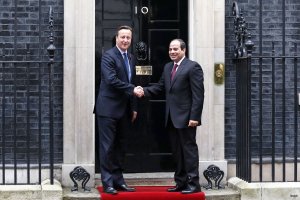 The political analyst, who preferred not to be named, told Arabi21 that Al-Sisi’s visit turned into a complete failure because the media used the occasion to remind the public of the human rights abuses committed by his regime in Egypt.
In a rare moment, an Egyptian woman who was sentenced to death in Egypt had the opportunity to appear in the British media and describe human rights violations committed by the military in Egypt, the analyst said.
The British press and TV channels published multiple reports which considered the visit “a violation of British society values and standards”.
The unnamed analyst said Al-Sisi mainly lost on a political level as, for the first time, the two biggest opposition parties rejected the visit; Labour party leader Jeremy Corbyn described Al-Sisi’s stay as a “threat to national security”.
In addition to this, as many as 55 senior British politicians signed a letter calling for Al-Sisi to be expelled.
On a legal level, the analyst explained, it was revealed during his stay that British police were already investigating claims of war crimes committed by Al-Sisi and symbols of his regime.
British police have a list of 43 names of senior statesmen, ministers and leaders of the army and security who are under investigation for committing human rights violations, the analyst added
Al-Sisi arrived in London following an invitation from British Prime Minister David Cameron; however the two only met for one hour during his three-day trip, and no joint press conference was held following the meeting.
The trip coincided with the British authorities’ decision to suspend all flights to Sharm El-Sheikh and evacuate all British tourists from there following a Russian airplane crash a few days earlier.
Turkish Court Clears Suspects of Forced Disappearances of Kurds
teleSUR | November 7, 2015
Turkey’s most comprehensive cold case of the historic PKK-state conflict ended with the acquittal of all eight suspects accused of leading a branch of the clandestine gendarmerie group JITEM that reportedly tortured and killed tens of thousands of Kurds in the 1990s.
The case began when mass graves were found in wells of a southeastern town and included 48 hearings on the murder of 55 unidentified victims in Cizre. Beyond conducting extrajudicial killings, JITEM is suspected to have disappeared some 17,000 Kurdish guerrillas, intellectuals and activists.
The families of victims came to the final hearing and participated in a sit-in to protest the verdict, mirroring the weekly sit-ins of the Saturday Mothers, who have still not recovered the bodies of their sons.
Protesters held the picture of Cemal Temizoz, the suspected leader of JITEM, with the word “killer,” but the Eskişehir 2nd High Criminal Court found that “no evidence was viable for a certain, credible and conscientious ruling,” reported the Hurriyet Daily.
The trial was originally in Şırnak, a province still healing from the conflict, but was then moved to Eskişehir, a majority pro-government city where many of the 3 million Kurds forcibly displaced by the conflict migrated.
A deputy of the opposition party CHP told Hurriyet that the lawyers representing the victims’ families were threatened and that evidence was tampered with.
One of the lawyers, Tahir Elçi, was arrested in late October ahead of the Turkish elections for saying publicly that the rebel Kurdish Workers Party (PKK) is not a terrorist group. Secret witnesses that aided Temizoz’s arrest in 2009 retracted their testimonies.
One of the suspects, all of whom were facing life sentences, confessed to extrajudicial killings and reportedly used the ears of his victims from a hearing in 2011 to make prayer beads.
Though the military does not recognize JITEM, it was compromised by officers that used state resources to conduct their operations. This year, four others were tried and exonerated.
Investigations of another 200 murders between 1994 and 1995 reportedly expired, according to official statistics. CHP leader Kemal Kılıçdaroğlu told journalists during his meeting with former Uruguayan President Jose Mujica that all questions to the ruling AK Party on the unsolved murders were declined.
“Our quest for justice will never end, the state’s justice system backed up the killers,” said the wife of Omer Candoruk, who was forcibly disappeared. “We condemn and curse the mentality that acquitted Cemal Temizoz and his team.”
Henoko Takes on U.S. Imperialism
By Maya Evans | Dissident Voice | November 7, 2015
OKINAWA, JAPAN — Around one hundred and fifty Japanese protesters gathered to stop construction trucks from entering the U.S. base Camp Schwab, after the Ministry of Land over-ruled the local Governors’ decision to revoke permission for construction plans, criticizing the “mainland-centric” Japanese Government of compromising the environmental, health and safety interests of the Islanders.
Riot police poured out of buses at six a.m., out-numbering protesters four to one, with road sitters systematically picked off in less than an hour to make way for construction vehicles.
All the mayors and government representatives of Okinawa have objected to the construction of the new coastal base, which will landfill one hundred and sixty acres of Oura Bay, for a two hundred and five hectare construction plan which will be part of a military runway.
Marine biologists describe Oura Bay as a critical habitat for the endangered dugong (a species of manatee), which feeds in the area, as well as sea turtles and unique large coral communities.
The bay is particularly special for its extreme rich ecosystem which has developed due to six inland rivers converging into the bay, making the sea levels deep, and ideal from various types of porites coral and dependent creatures.
Camp Schwab is just one of 32 U.S. bases which occupy 17% of the Island, using various areas for military exercises from jungle training to Osprey helicopter training exercises. There are on average 50 Osprey take off and landings every day, many next to housing and built up residential areas, causing disruption to everyday life with extreme noise levels, heat and diesel smell from the engines.
Two days ago there were six arrests outside the base, as well as ‘Kayactivists’ in the sea trying to disrupt the construction. A formidable line of tethered red buoys mark out the area consigned for construction, running from the land to a group of offshore rocks, Nagashima and Hirashima, described by local shamans as the place where dragons (the source of wisdom) originated.
Protesters also have a number of speed boats which take to the waters around the cordoned area; the response of the coast guard is to use the tactic of trying to board these boats after ramming them off course.
 The overwhelming feeling of the local people is that the Government on the mainland is willing to sacrifice the wishes of Okinawans in order to pursue its military defense measures against China. Bound by Article 9, Japan has not had an army since world war two, though moves by the Government suggest a desire to scrap the Article and embark on a ‘special relationship’ with the U.S., who is already securing control of the area with over 200 bases, and thus tightening the Asia pivot with control over land and sea trade routes, particularly those routes used by China.
Meanwhile, Japan is footing 75% of the bill for accommodating the U.S., with each soldier costing the Japanese Government 200 million yen per year, that’s $4.4 billion a year for the 53,082 U.S. soldiers currently in Japan, with around half (26,460) based in Okinawa. The new base at Henoko is also expected to cost the Japanese Government a tidy sum with the current price tag calculated to be at least 5 trillion yen.
Okinawa suffered devastating losses during the Second World War, with a quarter of the population killed within the 3-month-long Battle of Okinawa which claimed 200,000 lives in total. Hilltops are said to have changed shape due to the sheer bombardment of ammunition.
Local activist Hiroshi Ashitomi has been protesting at Camp Schwab since the expansion was announced 11 years ago, he said: “We want an island of peace and the ability to make our own decisions, if this doesn’t happen then maybe we might need to start talking about independence.”
Maya Evans coordinates Voices for Creative Nonviolence UK.
Featured Video

Seyed M. Marandi: US-Iran War Inevitable: Kuwait and Bahrain May Fall
or go to
Aletho News Archives – Video-Images
From the Archives
USS Liberty Massacre: A Pivotal Moment in the Hostile Takeover of America
By Kevin Barrett | Crescent | Dhu al-Qa’dah 24, 1445
In corporate America, hostile takeovers are commonplace. They occur when an aggressor—a larger corporation or rich individuals—seizes control of a smaller corporation without asking permission.
What few recognize is that the United States itself has been subjected to a hostile takeover. Since the aggressor, the illegitimate settler colony known as “Israel,” is much smaller than the US, the takeover has necessarily been surreptitious.
As of June, 2024, Israel’s gradual takeover of the US has become obvious and undeniable—a proverbial “elephant in the living room.” … continue
Blog Roll
 Aletho News
- Seyed M. Marandi: US-Iran War Inevitable: Kuwait and Bahrain May Fall
- Leaders Condemn Ansarallah Attack on Saudi Arabia While Ignoring Illegal War Against Yemen
- Leaked: Britain’s Covert Iraqi Psyops Network
- Yemeni Armed Forces Warn Airlines Against Using Saudi Airports, Exempt Mecca and Medina
- Iran security chief says powers greater than US tried to conquer Iran but ended in ‘dustbin of history’
- Europe’s mounting social chaos… chickens coming home to roost for proxy war against Russia
- US-Russia Diesel Deal Becomes Massive Defeat for Ukraine
- Hormuz and the Looming Economic Catastrophe
- Dhubab offensive, media blitz and the rapid unraveling of Saudi-backed coalition’s new gambit
- Putin Conveys to Trump Iran’s Vision on Possible Conflict Resolution – Kremlin
- If Americans Knew
- Gaza: Ceasefire Anniversary Marks Year of Failed Promises
- The American Conservative: Mike Huckabee Should Resign
- A C-Section in Shackles: A Palestinian Woman’s Harrowing Birth in Israeli Detention
- ‘He’s Desperate’: AIPAC Begins Spending Against Abdul El-Sayed to Boost Mike Rogers:
- Trump, Hormuz, and the Looming Economic Catastrophe
- For three years, Israel has killed a child in Gaza every 71 minutes – Daily Update
- Israeli forces kill another child in Gaza – Daily Update
- Gaza ceasefire exists in name only, say more than 100 organizations
- Nearly 2 Million in Gaza Need Urgent Shelter Assistance as Winter Looms: IOM Chief Warns
- Suppressing Palestinian resistance: US charity under fire for AI monitoring of Gaza classrooms
- No Tricks Zone
- Germany’s Green Energy Debacle: High Energy Costs Force Kahla Porzellan to Close After 182 Years!
- New Study: 50 Years Of The Most Aggressive ‘Net Zero’ Policies Can Only Affect The Global Climate By 0.03°C
- US September “Heat” Was No Record…Many Records Set Decades Ago
- Latest European Green Energy Debacle; Portugal’s Largest Flagship Solar Park Insolvent!
- Green Energy Debacle: German Expert Professor Fritz Vahrenholt Warns Of Severe Economic And Social Consequences
- Two More Paleo Reconstructions Affirm Meters-Higher Sea Levels Across Ireland, Brazil 7000-6000 Years Ago
- New Study: Earth And Venus Surface Warmth Largely Explained By Convection And Lapse Rate, Not CO2 Or Radiation
- 2025 Nature Paper Claiming Worsening Global Drought Gets RETRACTED …Heavily Flawed
- New Study: ‘Global Drought Shows No Detectable Recent Acceleration Under Climate Warming’
- Economic Masterminds: German Socialists Suggest Taxing Productivity Gains Stemming From Using AI

