Police seize BBC journalist’s laptop using special terror power
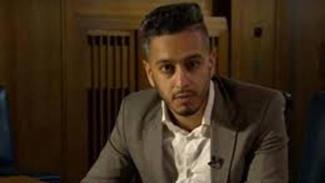
BBC’s Secunder Kermani
Press TV – October 29, 2015
British police have come under sharp criticism for seizing a personal laptop of a BBC journalist over the suspicion of his alleged links with Daesh or ISIL terrorist group in Syria.
It has emerged that the police seized the laptop belonging to Secunder Kermani earlier this year to ascertain the type of communications he had with a terrorist in Syria.
Kermani has been working for the current affairs program, BBC Newsnight for over one year and has extensively covered British ISIL recruits in the Middle East.
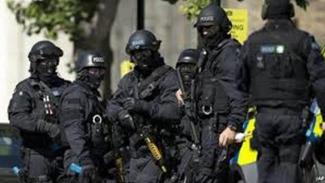
UK’s counter-terrorism squad during a maneuver (File photo)
The police say they used special powers from the counter-terrorism laws in order to read communications between Kermani and a man who featured in his program and had publicly identified himself as a member of the Takfiri terrorist group in Syria.
“While we would not seek to obstruct any police investigation, we are concerned that the use of the Terrorism Act to obtain communication between journalists and sources will make it very difficult for reporters to cover this issue of critical public interest”, Ian Katz, the editor of Newsnight said on Wednesday.
Meanwhile, the British police have come under sharp criticism over the seizure of the laptop. “A hysteria around terrorism” is how Jo Glanville, director of the campaign group English PEN described the incident.
According to a BBC spokesman, the police had every right to use the special power but said “the man featured in Newsnight reports was not a confidential source.”
Orders obtained under the Terrorism Act leave journalists with little or no comeback when police use them to seek access to material. By contrast, a public interest defense has been used in the past to contest attempts by the police.
Federal Appeals Court: US Citizens Can’t Sue FBI Agents For Torture Abroad
By Kevin Gosztola | ShadowProof | October 26, 2015
A federal appeals court decision effectively grants FBI agents involved in terrorism investigations abroad immunity from lawsuits, which allege torture or other constitutional rights violations.
The D.C. Circuit Court of Appeals ruled against Amir Meshal, an American citizen who was detained and tortured by FBI agents in Kenya, Somalia, and Ethiopia, and declined to permit Meshal to pursue damages for what he endured.
According to the federal appeals court [PDF], allowing Meshal to pursue damages would extend Bivens into a new context: the “extraterritorial application of constitutional protections.”
Bivens is a case that created precedent for bringing cases against federal government officials. However, courts have been extremely reluctant to allow plaintiffs to pursue damages when a case may set a precedent or lead to a court intruding upon national security and foreign policy matters.
In Meshal’s case, U.S. agents and foreign officials are accused of working together. A decision would pass judgment on officials working under a “foreign justice system.” Such “intrusion,” the appeals court claimed, could have diplomatic consequences.
The appeals court quoted prior cases and stated:
Allowing Bivens suits involving both national security and foreign policy areas will “subject the government to litigation and potential law declaration it will be unable to moot by conceding individual relief, and force courts to make difficult determinations about whether and how constitutional rights should apply abroad and outside the ordinary peacetime contexts for which they were developed.” Even if the expansion of Bivens would not impose “the sovereign will of the United States onto conduct by foreign officials in a foreign land,” the actual repercussions are impossible to parse. We cannot forecast how the spectre of litigation and the potential discovery of sensitive information might affect the enthusiasm of foreign states to cooperate in joint actions or the government’s ability to keep foreign policy commitments or protect intelligence. Just as the special needs of the military requires courts to leave the creation of damage remedies against military officers to Congress, so the special needs of foreign affairs combined with national security “must stay our hand in the creation of damage remedies. [emphasis added]
Or, more succinctly, the appeals court claims “special factors counsel hesitation” in allowing Meshal to pursue “money damages.”
The appeals court additionally determined Meshal’s citizenship did not override these “special factors.”
In issuing this decision, the appeals court leaves the issue of remedies for torture to Congress or the Supreme Court and makes it virtually impossible for torture survivors to pursue justice when their rights are supremely violated.
Meshal is Detained Incommunicado, Threatened with Transfer to Israel
Meshal was in the Horn of Africa when, on January 24, 2007, Kenyan soldiers captured and interrogated him. He was “hooded, handcuffed and flown to Nairobi, where he was taken to the Ruai Police Station and questioned by an officer of Kenya’s Criminal Investigation Department” and was told that the police had to “find out what the United States wanted to do with him before he could send him back to the United States.” He remained in detention without access to a telephone or his attorney for a week, according to the U.S. District Court of the District of Columbia’s decision.
On February 3, “three Americans,” who turned out to be FBI agents, interrogated Meshal and told him he would be handed over to the Kenyans and remain stuck in a “lawless country” if he did not cooperate. The agents also accused him of “having received weapons and interrogation resistance training in an al Qaeda camp.” Supervising Special Agent Chris Higgenbotham, one of the officials sued, threatened Meshal with being transferred to Israel where the Israelis would “make him disappear.” Meshal was informed that another U.S. citizen he had met in Kenya, Daniel Maldonado, who was also seized by Kenyan soldiers, “had a lot to say about” him and his story “would have to match.”
Meshal was flown by Kenyan officials to Somalia with twelve others on February 9. He was “detained in handcuffs in an underground room with no windows or toilets,” which was referred to as “the cave.” This was allegedly to prevent pressure from Kenyan courts to halt his detention and interrogation by FBI agents.
About a week later, Meshal was transported in handcuffs and a blindfold to Addis Ababa, Ethiopia. He was held there in incommunicado detention for a week before Ethiopian officials started regularly transporting him to a villa with other prisoners where he could be interrogated by FBI agents. He remained in detention for three months and was moved into solitary confinement twice.
Finally, on May 24, he was taken to the U.S. Embassy in Addis Ababa and flown back to the U.S. He was detained for four months and lost eighty pounds. US officials never charged him with a crime.
Appeals Court Skeptical of US Secrecy Arguments (But That Didn’t Matter)
Although the U.S. government did not invoke the “state secrets privilege,” it put forward a “laundry list of sensitive issues” that would allegedly be implicated if Meshal was able to pursue a lawsuit against FBI agents.
The government claimed it would involve “inquiry” into “national security threats in the Horn of Africa region,” the “substance and sources of intelligence,” and whether procedures relating to counterterrorism investigations abroad “were correctly applied.” Also, the government insisted it would require discovery “from both foreign counterterrorism officials, and U.S. intelligence officials up and down the chain of command, as well as evidence concerning the conditions at alleged detention locations in Ethiopia, Somalia, and Kenya.”
The appeals court appropriately asked in their decision, “Why would an inquiry into whether the defendants threatened Meshal with torture or death require discovery from U.S. intelligence officials up and down the chain of command? Why would an inquiry into Meshal’s allegedly unlawful detention without a judicial hearing reveal the substance or source of intelligence gathered in the Horn of Africa?”
“What would make it necessary for the government to identify other national security threats?” the court additionally asked.
Despite recognizing the unfounded basis for claims about how the lawsuit would risk disclosure of sensitive information, the appeals court chose to be overly cautious and dismiss the case as the government urged.
Appeals Court Overlooks Affidavit from Former FBI Agent
The American Civil Liberties Union, which filed the suit on behalf of Meshal, obtained an affidavit from former FBI Agent Donald Borelli, who unequivocally made clear FBI agents are expected to follow the U.S. Constitution when in territories abroad.
“The FBI’s longstanding commitment to respect the Constitution—including when it acts abroad in respect of U.S. citizens—reflects and implements the long established rule that the Constitution applies to and constrains U.S. government action against U.S. citizens abroad,” Borelli maintained.
In fact, Borelli cited a Supreme Court decision in 1957 involving two U.S. citizens, “who were tried and convicted by court-martial based on allegations they murdered service member spouses on U.S. military bases.”
From the Supreme Court’s ruling:
At the beginning we reject the idea that when the United States acts against citizens abroad it can do so free of the Bill of Rights. The United States is entirely a creature of the Constitution. Its power and authority have no other source. It can only act in accordance with all the limitations imposed by the Constitution. When the Government reaches out to punish a citizen who is abroad, the shield which the Bill of Rights and other parts of the Constitution provide to protect his life and liberty should not be stripped away just because he happens to be in another land. This is not a novel concept. To the contrary, it is as old as government. It was recognized long before Paul successfully invoked his right as a Roman citizen to be tried in strict accordance with Roman law.
Citizens like Meshal are supposed to have protection from unreasonable searches and seizures, however, the lower courts are unwilling to check the power of the Executive Branch. They have chosen to wait until the Supreme Court or Congress acts and that gives someone like Meshal an exceedingly small chance of ever winning justice.
Turkish police raid opposition TV station ahead of election
RT | October 28, 2015
Police in Turkey have stormed the offices of an opposition television station days before the country goes to the polls. The media outlet is linked to an Islamic preacher opposed to President Tayyip Recep Erdogan.
The incident took place outside the offices of Kanalturk and Bugun TV in Istanbul, while footage was broadcast live on Bugun’s website.
There were large scuffles outside the offices, where there was also a heavy police presence. Police seemed to be using pepper spray against those trying to block their path through the gate and into the building.
After a struggle, dozens of police eventually made their way through the crowd and into the building. A water cannon on the street was also used to keep demonstrators away.
The media groups are owned by Koza Ipek Holding, which has links to the Islamic preacher Fethullah Gulen, who is a political foe of the current Turkish President Erdogan. Gulen lives in self-imposed exile in the United States.
On Tuesday, the authorities took over the management of 22 companies that were owned by Koza Ipek, Reuters reports.
Gulen was once an ally of Erdogan, but the two fell out after police and prosecutors seen as sympathetic to the preacher opened a corruption investigation against the inner circle of the Turkish president, then prime minister, in 2013. This is believed to have resulted in the crackdown against Gulen.
Gulen is facing charges of running a “parallel” structure within state institutions that was looking to topple Erdogan. Prosecutors are seeking a prison sentence of up to 34 years for Gulen.
EFF Disappointed as CISA Passes Senate
By Mark Jaycox | EFF | October 27, 2015
CISA passed the Senate today in a 74-21 vote. The bill is fundamentally flawed due to its broad immunity clauses, vague definitions, and aggressive spying authorities. The bill now moves to a conference committee despite its inability to address problems that caused recent highly publicized computer data breaches, like unencrypted files, poor computer architecture, un-updated servers, and employees (or contractors) clicking malware links.
The conference committee between the House of Representatives and the Senate will determine the bill’s final language. But no amount of changes in conference could fix the fact that CISA doesn’t address the real cybersecurity problems that caused computer data breaches like Target and the U.S. Office of Personnel Management (OPM).
The passage of CISA reflects the misunderstanding many lawmakers have about technology and security. Computer security engineers were against it. Academics were against it. Technology companies, including some of Silicon Valley’s biggest like Twitter and Salesforce, were against it. Civil society organizations were against it. And constituents sent over 1 million faxes opposing CISA to Senators.
With security breaches like T-mobile, Target, and OPM becoming the norm, Congress knows it needs to do something about cybersecurity. It chose to do the wrong thing. EFF will continue to fight against the bill by urging the conference committee to incorporate pro-privacy language. And we will never stop fighting for lawmakers to either understand technology or understand when they need to listen to the people who do.
Saudi authorities arrest father of juvenile set for ‘crucifixion’
Reprieve | October 27, 2015
The father of a juvenile sentenced to death by ‘crucifixion’ in Saudi Arabia has reportedly been arrested.
Mohammed al-Nimr, the father of Ali al-Nimr – a juvenile who has been sentenced to death by ‘crucifixion’ having been arrested when he was 17 for attending protests – was reportedly arrested today on unknown charges. He is currently being held at Al Awamiyah police station where his son and another juvenile – Dawoud al-Marhoon, also sentenced to death for attending protests – were first detained.
Yesterday, the Saudi Arabian ambassador to the UK wrote an article in the Daily Telegraph in which he complained that the UK was not showing enough ‘respect’ to the gulf Kingdom, after a controversial Ministry of Justice bid to work with the Saudi prison system was withdrawn, seemingly on the basis of human rights concerns.
This morning Mohammed al-Nimr has been vocal in calling for a commutation of his son’s death sentence by the Saudi authorities. Earlier this month he gave an interview to CNN in which he said that he and his family were ‘extremely worried’ about his son’s fate.
Kate Higham, caseworker at international human rights NGO Reprieve, said: “It is absolutely outrageous that Mohammed al-Nimr has been arrested, seemingly just for speaking out to save the life of his son. If the Saudi authorities have any concern for due process, human rights, or basic humanity, Mohammed al-Nimr must be released at once. The UK government and all those who have expressed concern about Ali al-Nimr’s case must act now to prevent this illegal detention from continuing, and must re-double their efforts to prevent Ali’s execution – and that of Dawoud al-Marhoon – from happening.”
Israel Takes On the First Amendment
Free speech except regarding Palestine

Philip Giraldi • Unz Review • October 27, 2015
I always enjoy reading the Washington Post each morning even though it drives my blood pressure up to stratospheric levels. Its embrace of the inexorability of a fabulous new Camelot-like Clinton White House is thrilling to witness as it unfolds, but it is the promotion of the neocon Israeli narrative that is most exciting. On October 23rd, the op-ed section outdid itself with a piece “Free speech is flunking out on campus” by Catherine Rampell, who described the increasingly sorry state of first amendment rights on politically correct American university campuses. Blacks, LGBTers, women and victims of sexual assault were all identified as constituencies demanding “safe spaces” resulting in curtailment of free speech but somehow Israel and its supporters screaming anti-Semitism at every drop of the hat were left out in spite of the fact that Jews on campus have been both extremely and successfully active in taking political action to pressure universities whenever they claim to feel “threatened.”
The conflict between the Israelis and Palestinians has again reached a boiling point. Palestinian frustration over Israel’s fifty year occupation of the West Bank and its continued theft of Arab land and resources has produced an uprising of mostly young Palestinians that is being called in some circles a new intifada. The conflict is playing out with knives and bullets in Palestine and Israel but it is also being fought internationally in the media, through cultural and economic boycotts and, most pointedly, at many colleges and universities. Israeli Prime Minister Benjamin Netanyahu realizes that the pressure on Israel is, for the first time, serious and has not hesitated to lie outrageously about the slaughter of Jews in Europe during the Second World War. According to Netanyahu, the Palestinian Grand Mufti of Jerusalem gave the idea to Hitler, presumably justifying whatever the Israelis of today choose to do to suppress the current unrest.
Israel has inevitably responded brutally, producing a death toll of significantly more Palestinians than Israelis. Netanyahu has been referring to the protesters as terrorists and has issued new rules of engagement which permit soldiers to shoot stone throwers. Israeli plainclothes soldiers and police have been identified as infiltrating the protesters while pretending to be Palestinians, urging the young Arabs to hurl stones before pulling out concealed handguns to beat protesters, shoot them and make arrests.
In Gaza five teenagers were shot dead by Israeli soldiers for the crime of coming too close to the separation barrier, which government press releases described as the “frontier.” Killing teenagers in Gaza is a bit like shooting fish in a barrel as they are fenced in and have in reality no way to actually confront the Israeli border guards. On the day following the killing of the boys a mother and infant were killed in an Israeli airstrike. Within Israel an Eritrean was even mistakenly killed by Israeli police because he was reportedly acting oddly.
Because of a hostile media’s self-censorship buttressed by an unfriendly political class, here in the United States one of the few places in which the Palestinians can exercise something like free expression relating to their national aspirations is on college campuses. Israel and its powerful supporters understand that gap in their ability to control the narrative and are doing everything possible to shut down the option.
Friends of Israel, as ever, work from the same playbook orchestrated by the large donors who fund them. They claim that anti-Israel protests on campus to include even letters to the editor in college newspapers constitute a “threatening environment” for Jewish students. The argument is based on a fundamental falsehood, which is that criticism of the actions of a foreign government is equivalent to hatred for the dominant religion of that country, that religion is exactly the same as nationality. Applying that notion liberally would mean that criticism of any country where there is de facto or de jure a dominant state religion would be unacceptable speech. If applied liberally countries spanning the globe would be exempt from criticism, to include not only Israel but also Saudi Arabia and Iran.
But this is not about Christian or Muslim sensitivities. It is all about protection against insult for Jews and it relies on a perception of perpetual victimhood, which can be and is produced on demand to stifle any criticism that might be regarded by some as objectionable. Indeed, if calls for violence directed against Jews as a race or religion were occurring pleas for some form of mitigation might have some very slim cogency, but campus protest movements have very carefully and deliberately avoided falling into that trap. And it might also be pointed that on many campuses a considerable proportion of the dissenters are themselves Jews who are appalled by Israeli behavior.
Criticism of Israel does not just include complaining about the policies of that country’s government. It also has inevitably involved the so-called BDS movement, “boycott-divest-and sanction” which aims to make Israel pay an economic and social price for its behavior, similar to the pressure that was once directed against apartheid South Africa. This second narrative has been cleverly woven into the complaints about “harassment,” labeling any campus calls for BDS ipso facto anti-Semitic and “hurtful.” School authorities have generally been accommodating to claims made by Jewish groups that students are feeling “threatened,” obstructing and intimidating critics of Israel and denying tenure to faculty members who are seen as troublemakers. They have looked the other way as organizations like Canary Mission began exposing college students on its website who are reported to be “anti-Freedom, anti-American and anti-Semitic” with the deliberate intention of damaging their future employment prospects.
Between January 2014 and June 2015 there were more than 300 incidents on 65 college campuses in 24 states involving intimidation or prevention of protests against Israel. Students at Northeastern University distributing flyers at dorms were interrogated by campus police and had their group suspended by college authorities. Some were disciplined. And faculty members have also been on the receiving end, with Steven Salaita at the University of Illinois, denied a teaching position after he sent tweets complaining about Israel’s 2014 assault against Gaza which killed more than 500 children.
Richard Blum, a member of the University of California’s regents, has demanded that students who criticize Israel be suspended for expelled because they are “intolerant,” exhibiting anti-Semitic bigotry. Blum is the multimillionaire husband of California Senator Dianne Feinstein. Feinstein has also hinted that she could have the government look into possible violations occurring at federally funded institutions. The definition of bigotry being promoted by Blum and Feinstein conflates criticism of Israel with anti-Semitism and includes in its purview what are increasingly being referred to as “speech crimes.” The university regents are currently considering new language for their statement of policy against intolerance on campus but are under intense pressure from Jewish organizations that are lobbying them aggressively.
Many of the groups involved in the harassment of pro-Palestinian demonstrators are perhaps not surprisingly not indigenous to the colleges themselves. Stand With Us (SWU) and “Campus Maccabees” are national organizations well-funded by billionaire Sheldon Adelson and SWU has close ties to the Israeli government as does the lawfare center Shurat HaDin, which has filed lawsuits against Muslim and progressive groups on campus. Predictably, Congress and state legislatures have gotten into the act, seeking to pass laws that make it impossible for colleges and universities supported by taxpayer money to fund student groups that call for boycotts. The bills are drafted in terms of rejecting all selective boycotts but they are really all about Israel and everyone knows it. The fact that advocating voluntary boycotts is very much a part of one’s First Amendment rights appears to be irrelevant.
How to deal with it? The brouhaha is impossible to ignore as the advocates for Israel are relentlessly in one’s face even when the argument is being constructed in a restrained fashion and purposely framed so as not to offend Jews. It is consequently necessary to disarticulate being Israeli from being Jewish. Judaism is a religion and Israel is a foreign country. And it is important to recognize that legitimate direct criticism of Jewish groups for their involvement in pressuring universities should not itself be off limits. If the organizations self-identify as Jewish and they are attempting to restrict the discussion on Israel contrary to the First Amendment they become fair game. The First Amendment exists, after all, to permit free and open discussion of all issues and if some Jewish individuals and organizations are mobilizing to deny fundamental American rights on behalf of a foreign nation the rest of us have the responsibility to object forcibly and to make transparent just who is doing what to whom.
Saudi Supreme Court approves Sheikh Nimr death penalty
Press TV – October 25, 2015
Saudi Arabia’s Supreme Court has approved the death penalty for prominent Shia cleric Sheikh Nimr al-Nimr, his brother says.
Mohammad al-Nimr, the prominent cleric’s brother, said in a message on social media on Sunday that the Saudi Supreme Court and an appellate court had approved the execution of the Shia cleric and authorized the Saudi Interior Ministry to carry out the sentence.
The execution warrant has been reportedly sent to Muhammad bin Naif bin Abdulaziz Al Saud, the Saudi crown prince, who is also the first deputy prime minister and the minister of interior of Saudi Arabia.
The warrant will now be sent to Saudi Arabia’s ruler Salman bin Abdulaziz Al Saud after the approval of the Interior Ministry.
To be implemented, the warrant must be approved by the Saudi king.
The execution of the Shia cleric can be carried out by the Interior Ministry without any prior warning if the Saudi king signs the order.
Nimr was attacked and arrested in the Qatif region, east of Saudi Arabia, in July 2012, and has been charged with undermining the kingdom’s security, making anti-government speeches, and defending political prisoners. Nimr has denied the accusations.
In October 2014, a Saudi court sentenced Sheikh Nimr to death, provoking huge condemnations and criticism in the Middle East and the world.
Ali Mohammed Baqir al-Nimr, the nephew of the prominent Saudi Shia cleric, has also been also sentenced to death over his alleged role in anti-regime protests in 2012, when he was 17 years old.
“We don’t want anything to happen to him or to Ali or the other young men,” Mohammed al-Nimr said.
Ali Mohammad was arrested during an anti-government protest in Qatif and was later convicted of alleged criminal activities and handed down a death penalty by Saudi Arabia’s Specialized Criminal Court in May 2015.
Peaceful demonstrations erupted in Saudi Arabia’s Eastern Province in February 2011, with protesters demanding reforms, freedom of expression, the release of political prisoners and an end to widespread discrimination against people of the oil-rich region. Several people have been killed and many others have been injured or arrested during the demonstrations.
International rights bodies, including Amnesty International, have criticized Saudi Arabia for its grim human rights record, arguing that widespread violations continue unabated in the oil-rich country even though a new ruler, King Salman bin Abdulaziz Al Saud, has taken the helm of the absolute monarchy.
Portugal’s President Won’t Allow Leftists to Form a Government
teleSUR – October 23, 2015
Portuguese President Anibal Cavaco Silva said he will not allow a coalition of leftist parties to form a government despite the fact that they won an outright majority in parliamentary elections held earlier this month.
The president said Thursday that he gave conservative Prime Minister Pedro Passos Coelho the mandate to form a minority government that will fall in line with the policy of austerity imposed by the European Union and the International Monetary Fund (IMF).
“In 40 years of democracy, no government in Portugal has ever depended on the support of anti-European forces, that is to say forces that campaigned to abrogate the Lisbon Treaty, the Fiscal Compact, the Growth and Stability Pact, as well as to dismantle monetary union and take Portugal out of the euro, in addition to wanting the dissolution of NATO,” said President Cavaco Silva.
He argued that it was too risky to let the Left Bloc or the Communists come close to power, saying the country’s right wing would protect austerity measures the left had threatened to overturn.
The decision outraged Left Bloc leader Antonio Costa, who called the president’s action a “grave mistake” that threatened the country’s stability. “It is unacceptable to usurp the exclusive powers of parliament,” he said. “The Socialists will not take lessons from professor Cavaco Silva on the defense of our democracy.”
Parties in the Left Bloc ran an anti-austerity campaign than won them more than 50 percent of the vote in the Oct. 4 elections. Coelho’s coalition won only 38 percent of the vote, not enough to form a single-party government. That prompted the leftist parties to form a coalition, allowing it to gain an outright majority that would, in theory, permit it to form a government.
Cavaco Silva said it was now up to lawmakers in parliament to decide on the new government’s program, which must be presented in 10 days. If it is rejected in parliament, the government will collapse. The three-party leftist coalition vowed to reject the program as they, after all, control the legislative body, holding 122 seats out of 230.
“I give this government a week or a week and a half,” said Left Bloc lawmaker Filipe Soares. “The president will have to take the responsibility for the instability that will be created by this decision.”
Critics portrayed the president’s move as an assault on democracy.
“Democracy must take second place to the higher imperative of euro rules and membership,” wrote Ambrose Evans-Pritchard, International Business Editor of The Daily Telegraph, a British newspaper.
Portugal returned to democracy in 1974 after nearly 50 years of authoritarianism.
Court Chooses to Ignore Overwhelming Evidence of NSA’s Mass Internet Spying

By Ashley Gorski | ACLU | October 24, 2015
A federal district court yesterday dismissed Wikimedia v. NSA, a lawsuit brought by the ACLU on behalf of a broad group of educational, legal, human rights, and media organizations whose communications are swept up by the NSA’s unprecedented Internet dragnet.
Our lawsuit concerns the NSA’s “upstream” surveillance, which involves the mass interception and searching of Americans’ international Internet communications. The court held that our clients lacked “standing” to bring suit, because they had not plausibly alleged that their communications were being monitored by the NSA. That’s just plain wrong.
The court’s opinion relies heavily on the Supreme Court’s decision in a previous ACLU lawsuit, Amnesty v. Clapper, a challenge to warrantless surveillance under the FISA Amendments Act of 2008. In February 2013, the Supreme Court dismissed that case on the grounds that the plaintiffs could not prove that they had communicated with the NSA’s targets.
But as we explained in court, our current challenge to the NSA’s warrantless spying is very different than the last one. Among other reasons, Clapper was decided prior to the Snowden revelations and extensive government disclosures about upstream surveillance. These revelations fundamentally changed the equation. Since Clapper, the public has learned that the NSA is not surveilling only its targets — it is instead surveilling virtually everyone, looking for information about those targets.
Some early takeaways from the district court’s opinion:
1.The court misunderstands how upstream surveillance is fundamentally different from and much more intrusive than the surveillance considered by the Supreme Court in Clapper.
Upstream surveillance is accomplished through the installation of devices directly on the Internet “backbone” — the network of high-capacity cables, switches, and routers across which Internet traffic travels. One particularly disturbing feature of upstream spying is known as “about” surveillance. Through this surveillance, the NSA is not simply plucking the communications to or from terrorists, spies, or other targets. Instead, it’s copying and searching through the contents of nearly everyone’s international communications, looking for information about its many targets. When the Supreme Court considered warrantless surveillance in Clapper, it was focused on whether the plaintiffs communicated with targets. At that time, the public had no idea that the NSA was essentially opening everyone’s international emails. Indeed, contrary to the district court’s understanding, “about” surveillance is in no way targeted:

2. The court ignores how Internet communications are structured — and why that requires the government to intercept at least some of our clients’ trillion-plus international communications.
Collectively, our clients engage in more than one trillion international Internet communications each year, with individuals in virtually every country on Earth. As we explained in our complaint, given the structure of the Internet, it is virtually impossible for the NSA to conduct upstream surveillance without intercepting at least some of plaintiffs’ communications. Yet the court dismissed these allegations, characterizing them as having “no basis in fact.”

3. Given how much is in the public record about upstream surveillance, our clients’ allegations are not “speculative” or “hypothetical.”
As the court acknowledged, at this early stage of the litigation, plaintiffs have to satisfy only a very low threshold: plausibility. Especially considering what’s publicly known about how upstream surveillance works, and the volume and distribution of our clients’ communications, their allegations are more than plausible.

4. The court’s opinion would insulate government surveillance from any legal challenge, except in cases where the government has already admitted its reliance on a particular program.
Although the court recognized that “no government surveillance program should be immunized from judicial scrutiny,” its analysis would do precisely that in the overwhelming majority of cases. If the court’s reasoning were correct, then the only people who could challenge NSA surveillance would be those told by the government they were spied on — a result at odds with well-established precedent and our system of checks and balances:
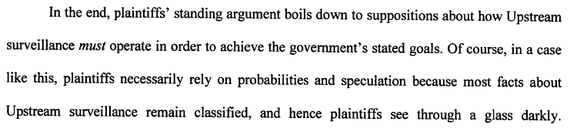
Our clients’ standing doesn’t depend on a supposition. There’s no question that the NSA is capturing and searching through their communications. That’s something the court — and everyone else — should find extremely disconcerting.
Journalist missing after police arrest him in his home
Mada Masr – October 22, 2015
Journalist Hossam al-Deen Seed was arrested in his home and taken to an unknown location on Thursday morning, the Arabic Network for Human Rights Information (ANHRI) reported.
He was still missing as of Thursday evening.
The charges against Seed are unknown, according to the ANHRI statement, which noted that he is a member of the Journalists Syndicate.
The Interior Ministry did not respond to Mada Masr’s calls for a comment on the incident.
Seed’s arrest comes the day after security forces raided the offices of the Mada Foundation for Media Development and arrested all staff members on the premises.
This raid represents “a dangerous escalation in the Egyptian authorities’ crackdown on freedom of expression and association,” Amnesty International argued in a statement released Wednesday.
Seed’s arrest also coincides with a National Council for Human Rights (NCHR) report on 15 cases of forced disappearances that was issued the day of the Mada Foundation raid, the privately owned newspaper Al-Masry Al-Youm reported.
Reports of journalists being arrested or forcibly disappeared by security forces have swelled since the military-led ouster of former President Mohamed Morsi in July 2013.
There are disagreements about the number of journalists currently detained or in prison, but estimates range from 60 to 70.
The freelance photographer Mahmoud Abou Zeid, commonly known as Shawkan, has been held in pre-trial detention for over two years, exceeding Egypt’s legal two-year limit.
Egypt ranked near the bottom of the 2015 Reporters Without Borders press freedoms index, coming in at 158 out of 180 countries.
At least 30 journalists were arbitrarily arrested in 2014 on charges of organizing or participating in protests, the report said. Reporters Without Borders claimed that President Abdel Fattah al-Sisi’s government is using its ongoing war on terror as a pretext to curb press freedoms and target media institutions affiliated with the banned Muslim Brotherhood.
The Egyptian Commission for Rights and Freedoms released a report in August stating that authorities violated journalists’ rights at least 658 times during the first year of Sisi’s presidency. The violations included preventing journalists from doing their jobs, verbal and physical assault, detention, arrests and imprisonment, damaging and confiscating equipment, banning press reports and filing lawsuits against journalists.
#RiseUpOctober protests against police killing civilians begin in New York
RT | October 22, 2015
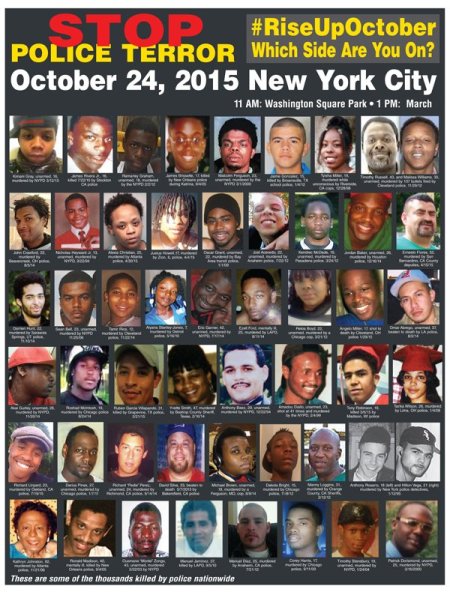 Hundreds gathered in New York City’s Times Square on Thursday, launching a three-day protest against officer-involved killings, brutality and mass imprisonment dubbed “Rise Up October.”
The three-day protest began Thursday morning with a “Say Their Names” rally. Hundreds gathered in midtown Manhattan to hear relatives speak about their loved ones who were killed by police officers over the past several years.
With the help of the Stop Mass Incarceration Network, the rally was organized by Carl Dix of the Revolutionary Communist Party and author and activist Dr. Cornel West.
The organizers said their goal was to organize “mass determined resistance” to a “matrix of oppression.”
Among the celebrities who endorsed the rally was director Quentin Tarantino, who at one point shared the stage with actress Gina Belafonte.
Faith leaders from a number of religious communities supported the gathering.
Also in attendance at the rally were members of the Raging Grannies, the New York chapter of a global movement promoting peace, justice and social and economic equality.
Heavy police presence shadowed the event.
Thursday’s march ended with a rally in Brooklyn.
Friday morning will see the “Shut Down Rikers” protest, aimed against the city’s notorious prison, which is plagued by accusations of violence, brutality and sexual abuse.
The main event is scheduled for Saturday, October 24, with an 11 a.m. rally in lower Manhattan’s Washington Square Park, followed by a march to Bryant Park in midtown.
Featured Video

Seyed M. Marandi: US-Iran War Inevitable: Kuwait and Bahrain May Fall
or go to
Aletho News Archives – Video-Images
From the Archives
Oil and the Israel Lobby
Reknowned economist M. Shahid Alam offers this excellent critique of Noam Chomsky’s defective analysis of the relative influence of Oil versus the Israel lobby over US foreign policy: … continue
Blog Roll
 Aletho News
- ICC ignored ‘very well-documented’ NATO crimes – ex-Libyan minister
- SNSC secretary dismisses US response to Iran’s conditions as ‘inadequate’
- Sanaa says Taiz roads open, secure for residents, warns Saudi forces
- Iraqi resistance group urges Saudi leadership to admit defeat, lift Yemen siege
- Trump’s Retreat: How Al-Aqsa Flood Took Down the US Empire
- Israel’s Military Actions in Lebanon Grossly Violate International Law — Lavrov
- Seyed M. Marandi: US-Iran War Inevitable: Kuwait and Bahrain May Fall
- Leaders Condemn Ansarallah Attack on Saudi Arabia While Ignoring Illegal War Against Yemen
- Leaked: Britain’s Covert Iraqi Psyops Network
- Yemeni Armed Forces Warn Airlines Against Using Saudi Airports, Exempt Mecca and Medina
- If Americans Knew
- Agents search Rep. Omar’s Washington home in criminal probe as she vows she won’t ‘be silenced’
- “The Rule Was: ‘Shoot Everyone You See'”
- Israel goes ballistic over Nobel Laureate Navi Pillay
- U.S. May Join Yet Another Middle Eastern War — TCN
- Yellow Line moves again as Israel closes in on trapped Gazans – Daily Update
- Israeli Attacks Kill Seven Palestinians in Gaza Including Six-year-old Girl
- Gaza: Ceasefire Anniversary Marks Year of Failed Promises
- The American Conservative: Mike Huckabee Should Resign
- A C-Section in Shackles: A Palestinian Woman’s Harrowing Birth in Israeli Detention
- ‘He’s Desperate’: AIPAC Begins Spending Against Abdul El-Sayed to Boost Mike Rogers:
- No Tricks Zone
- Germany’s Green Energy Debacle: High Energy Costs Force Kahla Porzellan to Close After 182 Years!
- New Study: 50 Years Of The Most Aggressive ‘Net Zero’ Policies Can Only Affect The Global Climate By 0.03°C
- US September “Heat” Was No Record…Many Records Set Decades Ago
- Latest European Green Energy Debacle; Portugal’s Largest Flagship Solar Park Insolvent!
- Green Energy Debacle: German Expert Professor Fritz Vahrenholt Warns Of Severe Economic And Social Consequences
- Two More Paleo Reconstructions Affirm Meters-Higher Sea Levels Across Ireland, Brazil 7000-6000 Years Ago
- New Study: Earth And Venus Surface Warmth Largely Explained By Convection And Lapse Rate, Not CO2 Or Radiation
- 2025 Nature Paper Claiming Worsening Global Drought Gets RETRACTED …Heavily Flawed
- New Study: ‘Global Drought Shows No Detectable Recent Acceleration Under Climate Warming’
- Economic Masterminds: German Socialists Suggest Taxing Productivity Gains Stemming From Using AI

