Hey Mr. Cameron, Who’s the Extremist?
By Finian Cunningham – Sputnik – 15.10.2015
When British Prime Minister David Cameron lambasted Labour Party leader Jeremy Corbyn for having a “terrorist-sympathising, Britain-hating ideology” the rightwing British media went into raptures over the bashing.
But amid the boorish braying, the question is: what about Cameron’s own extremist-supporting politics? And not just Cameron, but the whole British establishment.Cameron made his cheap shot at Corbyn while addressing his Conservative Party annual conference last week. With the fulsome help of British media, Corbyn’s views on the death of Al Qaeda leader Osama bin Laden, as well as on foreign policy issues, including Russia, Palestine, Hezbollah and Irish republicanism, have been wildly distorted. But the crude demonisation of Corbyn as national traitor is an easy job when you have a phalanx of willing media hatchet-wielders on your side.
How richly ironic it is then that a week after Cameron’s mud-slinging at Corbyn, news emerges of a British man who is facing a death sentence in Saudi Arabia.
Karl Andree, a 74-year-old British expatriate living in the oil-rich kingdom for the past 25 years is to receive 350 lashes under the archaic Saudi justice system. The man was caught last year reportedly in possession of homemade wine — in a country where alcohol is officially forbidden.
His family in Britain are making desperate appeals to British premier David Cameron to intervene in the case to save the pensioner’s life.
Suffering from cancer and asthma, the family of Karl Andree fear that he will die from the flogging, especially after having spent a year already in a Saudi jail. A son of the man told British media this week that Cameron’s government had done little to seek clemency from the Saudi rulers. Simon Andree “accused the Foreign Office of allowing business interests to get in the way of helping to free his father.”
Cameron may be obliged to finally intervene, such is the furore. But the mere fact that London has to be pushed into doing something to save the man’s life shows just how deeply entwined the British establishment is with the House of Saud.
The case is just one of many instances where the British government has steadfastly given the Saudi rulers political cover for their extremist practices. With an estimated 30,000 political prisoners languishing in Saudi jails and over 100 people executed by public beheadings every year, the kingdom has been described as one of the most despotic regimes on Earth. Some observers have noted that the House of Saud beheads as many people as the notorious terror group, Islamic State, which shares the same Wahhabi ideology as the Saudi rulers. Indeed probably bankrolled by the Saudi monarchs, as are other extremist jihadi groups, including Al Qaeda and Jabhat al Nusra.
Yet while Cameron and his government make high-profile calls for sanctions against Russia over alleged violations in Ukraine, London keeps silent when it comes to international appeals for human rights in Saudi Arabia.
Earlier this year it emerged from leaked cables that Cameron’s government was involved in “back-room deals” with the Saudis for the kingdom to be appointed to a chair on the United Nations Human Rights Council. This is while international campaigners have recently appealed in two particularly disturbing cases, one involving a Saudi blogger sentenced to receive a 1,000 lashes and the other of a pro-democracy activist, Ali Mohammed al-Nimr, who is due to be beheaded and crucified. Labour’s Jeremy Corbyn has personally entreated Cameron to intervene — but so far, Downing Street has declined to mediate.
Cameron has gone on the defensive about British-Saudi relations, telling media that Britain has a “special relationship” with the kingdom, and insisting that it must maintain “close ties”.
The British leader never fails to pontificate to international audiences about how Britain is “supporting democracy and human rights” around the world.
Cameron’s double-think fails, spectacularly, to acknowledge that his government and Downing Street predecessors have “close ties” with the Saudi regime, where elections are banned, women are prohibited from driving cars, and freedom of speech is exercised under the pain of death.
Even as Saudi Arabia carries out more than six months of slaughter in Yemen, the British government maintains a stony silence. Evidence of war crimes involving Saudi bombing of civilians in Yemen has not registered a pause by Britain in supplying the Saudis with Tornado and Typhoon fighter jets equipped with 500-pound Pave IV missiles.Thousands of women and children have been massacred in the onslaught, while Britain reportedly finds new reserves for ordnance to sustain the Saudi bombardment, along with deadly supplies from Washington of course.
In 1985, former Conservative Prime Minister Margaret Thatcher — a political heroine of Cameron — lent her personal intervention in signing the al Yamamah arms deal between Saudi Arabia and Britain.
That ongoing deal — worth an estimated £80 billion ($120 billion) — is the biggest weapons contract ever signed by Britain. A reputed 50,000 jobs depend on its fulfilment, mainly by Britain’s top weapons manufacturer, British Aerospace Engineering (BAE).
The contract is mired in corruption. Investigations have shown that some $1 billion in bribes were funnelled to key members of the House of Saud by BAE, including the former spy chief Bandar bin Sultan. In 2010, a US court found BAE guilty of corruption, for which the firm had to pay $400 million in fines.But Britain’s own legal probe into corruption over the Al Yamamah arms deal was dramatically blocked in 2006 by then Labour leader and Prime Minister Tony Blair. Blair, as with Cameron recently, simply invoked “national security interests” to close the prosecution. Once again, the supposed “special relationship” between Britain and Saudi Arabia trumped any concerns about criminality or the despotic nature of the House of Saud.
One factor in why Blair gave cover to Britain’s Saudi clients was the threat from the House of Saud that it would pull the plug on the whole Al Yamamah contract, and instead direct its business to France. The French-made Rafale fighter jets were dangled as an alternative to the British-made Typhoon.
Resonating with that, this week a French delegation led by Prime Minister Manuel Valls, Foreign Minister Laurent Fabius and Defence Minister Jean-Yves Le Drian was in Saudi Arabia where it signed $11 billion in contracts for various industrial and military products.
This is the same French government that cancelled the $1.3 billion Mistral helicopter ship contract with Russia over alleged — yet unproven — violations by Moscow in Ukraine.
As with the British, the French government’s high-minded claims of democracy, rule of law and human rights are nothing but cynical public relations when it comes to the altar of financial profits, no matter how “extremist” the customers are.
So, let’s re-run that clip again of David Cameron denouncing others for “extremist-sympathising ideology”. Whatever Jeremy Corbyn’s alleged views are, they are nothing, absolutely nothing, when compared with the extremist-supporting practices of David Cameron and a host of British governments in their courting of Saudi oil money.
Saudi Arabia jails two human rights activists
Press TV – October 15, 2015
Saudi Arabia has sentenced two human rights activists to prison for various charges, including calling for political reform, a human rights lawyer says.
The lawyer, speaking anonymously over fear of reprisal, told the Associated Press that the pair were sentenced by Saudi Arabia’s Specialized Criminal Court on Tuesday.
The court was initially established to deal with cases related to terrorism but since a 2014 law that defined actions towards “defaming the state’s reputation” as terrorism, it has been convicting rights activists.
According to the lawyer, both men, who are in their 40s and from the country’s central al-Qassim region, do have the right to appeal the court verdicts.
Abdelrahman al-Hamid, the founding member of the Saudi Association for Civil and Political Rights (HASEM), received a nine year sentence and was banned from traveling abroad for another nine years after his release. He also should pay a penalty equal to $13,300.
He was arrested last year over accusations of the illegal establishment of a human rights organization and questioning the judiciary’s credibility and independence.
A large number of HASEM’s members are currently behind bars. Apart from Hamid, six other founders are serving time in Saudi prisons and four others are yet to be sentenced.
The second activist, Abdelaziz al-Sinedi, received an eight-year sentence plus an eight-year travel ban and a $13,300 fine for social media activity concerning calling for reforms.
Egyptian Report: 215 cases of forced disappearances in August, September
Mada Masr | October 13, 2015
There have been 215 cases of forced disappearances across Egypt in August and September, according to a report issued by a campaign working to combat the phenomenon.
The report, which was issued on Tuesday, stated that only 63 individuals have been located, with the whereabouts of the other 152 cases remaining unknown.
The 63 cases, the report said, have appeared in various police stations and Central Security Forces camps. The individuals located include defendants in cases related to protesting or belonging to a terrorist organization. Others were identified by their families in Interior Ministry videos.
The report was prepared by the Stop Forced Disappearances campaign, under the auspices of the Egyptian Commission for Rights and Freedoms. The campaign was launched on August 30, to coincide with the International Day of the Victims of Enforced Disappearances, amid a wave of forced disappearances in the country.
The campaign had posted a form on its Facebook page, through which it collected information and reached out to the families of the disappeared.
Stop Forced Disappearances managed to trace eight cases that disappeared from their holding cells after the prosecution ordered their release, an occurrence similar to “a pattern used by former Interior Minister Habib al-Adly under [former President Hosni] Mubarak.”
The report also listed the names of the 215 people who disappeared, including details of those located, such as where and when they were located and the charges leveled against them.
Those listed in the report are from different backgrounds, and were arrested on suspicion of belonging to a terrorist group or being involved in acts of violence.
“Perhaps the reason behind their arrest and torture is security forces’ belief that they have information on certain people or organizations or claimed terrorist activity,” the report said.
In its report, the campaign listed its demands, including the disclosure of the whereabouts of those listed in the report and referring them to prosecution and holding those responsible for their disappearances accountable. It also demanded that Egypt sign and ratify the Rome Statute of the International Criminal Court and the International Convention for the Protection of All Persons from Enforced Disappearance.
According to the report, there is no definition for forced disappearances in the Constitution or Penal Code, and there are no articles that criminalize it.
However, certain forms of arrest are criminalized and temporary detention is regulated by certain laws that partly protect from forced disappearances.
The report added that President Abdel Fattah al-Sisi has issued a number of decrees in the absence of parliament, pertaining to rights and freedoms, which “strengthen the tools of repression” and violate human rights.
It cited the anti-terrorism law, which includes articles that legalize “practices that lead to forced disappearances,” and gives police and military forces powers that violate the Constitution and give them impunity.
The report concludes, “It is therefore no surprise that security forces is systematically involved in forced disappearances in Egypt, making it one of the most committed violations practiced on a daily basis against innocent citizens.”
Former US Detainees Sue CIA Torture Program Architects
teleSUR | October 13, 2015
Two U.S. psychologists contracted by the CIA are accused of human experimentation, torture and war crimes.
CIA psychologists behind the U.S. intelligence agency’s “enhanced interrogation” program are guilty of torture, non-consensual human experimentation, and war crimes, three former detainees alleged in a federal lawsuit Tuesday.
The civil case was filed by the American Civil Liberties Union on behalf of plaintiffs Suleiman Abdullah Salim, Mohamed Ahmed Ben Soud, and Gul Rahman, who were all held in CIA detention centers in Afghanistan in the wake of 9/11.
Not one of the three was ever charged with a crime.
Raham died in a CIA prison in 2002, while the other two were eventually released.
According to the lawsuit, Raham’s autopsy report showed he died from hypothermia caused “in part from being forced to sit on the bare concrete floor without pants,” with the contributing factors of “dehydration, lack of food, and immobility due to ‘short chaining’.”
The case is being brought against psychologists James Elmer Mitchell and John “Bruce” Jessen, contractors who managed a company that was given a US$81 million paycheck from the CIA over a four-year period, and “helped convince the agency to adopt torture as official policy.”
The duo was also featured in last year’s CIA “torture report.”
The lawsuit sets out that the pair devised the torture program to intentionally inflict intense pain and suffering, on both a physical and mental level. The object was to psychologically destroy detainees through torture and abuse so that they would be unable to resist demands for information. The CIA adopted the methods in 2002, and contracted Mitchell and Jessen to train others in the arts of torture.
“(Plaintiffs) were subjected to solitary confinement; extreme darkness, cold, and noise; repeated beatings; starvation; excruciatingly painful stress positions; prolonged sleep deprivation; confinement in coffin-like boxes; and water torture,” according to the ACLU lawsuit. “Defendants are directly liable because they experimented on Plaintiffs by seeking to induce in them a state of ‘learned helplessness’ to break their will by means of torture and cruel, inhuman, and degrading treatment.”
Intelligence agencies expert Steven Aftergood told the Guardian that the tortured men were being studied by medical professionals to note their responses to such treatments, which ACLU said amounted to a war crime.
“These psychologists devised and supervised an experiment to degrade human beings and break their bodies and minds,” said Dror Ladin, a staff attorney with the ACLU National Security Project. “It was cruel and unethical, and it violated a prohibition against human experimentation that has been in place since World War II.”
Britain’s Secret Widespread Use Of Torture
By Graham Vanbergen | TruePublica | October 6, 2015
The last British prisoner in Guantanamo Bay has claimed that Britain knew flawed evidence, used to justify the Iraq War, had been obtained under torture – and said his lengthy detention was a result of fears that he would go on the record if released.
Shaker Aamer, who is due to be freed from the US military prison after 13 years without charge, said he witnessed British agents at Bagram Air Base when a prisoner wrongly told interrogators that Iraqi forces had trained al-Qaeda in the use of weapons of mass destruction.
The evidence of Ibn al-Shaykh al-Libi, which was later disproven, was used by George W Bush in 2002 during a hawkish speech calling for the removal of Saddam Hussein, in which he said: “We’ve learned that Iraq has trained al-Qaeda members in bomb-making and poisons and deadly gases.”
Mr Aamer said that despite guarantees he would be released within days, he feared he would still die in the prison, adding: “I know there are people who, even now, are working hard to keep me here.”
A Foreign Office spokesman said: “The UK does not participate in, solicit, encourage or condone the use of torture or cruel, inhuman or degrading treatment or punishment for any purpose.
Aamer gave statements to the Metropolitan police two years ago in which he detailed the alleged brutality he has faced, that included torture. He said he was interrogated by British agents at Bagram airbase, who knew he and others were being tortured there.
Britain has a long, dark history of torture and it has gone to extraordinary lengths to hide it. A normal functioning democracy would stand resolute that torture of any kind is not just illegal and immoral, it simply doesn’t work.
David Whyte’s recent book “How Corrupt is Britain” covers some pivotal moments in the UK’s history of torture.
In June 1975 an eminent Harley Street doctor flew to Dublin. The patient was suffering from severe angina, a condition which is ‘always associated with the risk of sudden death according to the doctor. The doctor was Dr Denis Leigh, a leading consultant psychiatrist at the Bethlem Royal and the Maudsley Hospitals in London, and more importantly, medical consultant to the British Army.
The patient, Sean McKenna, was a former member of the IRA who had been subjected to so-called ‘in-depth interrogation’ following the introduction of internment without trial in August 1971, He was one of the 14 ‘hooded men’ whose infamous treatment forced the lrish state to launch a case alleging torture against the UK government at the European Court of Human Rights in Strasbourg.
Leigh’s medical examination was being carried out on behalf of the Crown to bolster the UK defence that the men had not suffered long-term physical or psychiatric damage as a result of their interrogation.
The ‘in-depth interrogation’ that McKenna and the others were subjected to consisted of five techniques that had been widely used by the British army in counter-insurgency campaigns in Aden, Cyprus, Malaya, Palestine and elsewhere – hooding, white noise, wall standing in a stress position and of course regular beatings.
Dr Leigh found that McKenna’s condition was known to British army doctors before the interrogation went ahead, and ‘it would be hard to show that it was wise to proceed with the interrogation, and that the interrogation did not have the effect of worsening his angina’.
In fact McKenna’s psychiatric condition was such that he had been released from Long Kesh internment camp in May 1972 directly into the care of a psychiatric unit. His daughter described ‘a very broken man, sitting crying, very shaky’. Four days after the June 1975 medical examination Sean McKenna died. He had suffered a massive heart attack.
In 1976 the European Human Rights Commission (EHRC) upheld a complaint by Ireland that the treatment of the ‘hooded men’ constituted torture, and referred the case to the European Court of Human Rights for judgement. The Commission had condemned the five techniques as a ‘modern system of torture’.
Britain was one of the original signatories to the European Convention on Human Rights, had been found to have sanctioned torture.
Successive UK governments, rather than comply with their legal obligation to ‘search and try’ allegations of torture, adopted a policy more akin to ‘hide and lie’. This was to have consequences many years later. The inquiry into the 2003 murder of an Iraqi civilian, Baha Mousa, by British soldiers was told that the five techniques had again been used in Iraq by every single battle group in the field.
ln ‘Cruel Britannia: A Secret History of Torture,’ Guardian journalist Ian Cobain provides damning evidence that the UK government did in fact ‘do’ torture, and had been doing so for decades in counter-insurgency wars from Brunei to Aden, and from Ireland to lraq. In June 2013 UK foreign secretary William Hague apologised in Parliament for the torture of Mau Mau suspects in Kenya during the 1950s. Over £50 million was paid out in compensation to some 5,000 Kenyan victims. ln 1972 prime minister Edward Heath had promised Parliament that the ‘five techniques’ torture techniques would never be used again.
As declassified documents now show, prime ministers and cabinet colleagues over the decades actually went to great lengths to ensure that those responsible for torture would not face sanction or prosecution and actively covered up these crimes.
In another case in Afghanistan, among the Britons who were picked up was a man called Jamal al-Harith. Born Ronald Fiddler in Manchester in 1966, Harith had converted to Islam in his 20s and travelled widely in the Muslim world before arriving in Afghanistan. After 9/11, he had been imprisoned by the Taliban, who suspected him of being a British spy. A British journalist found Harith languishing in the prison in January 2002 and alerted British diplomats in Kabul, believing they would arrange his repatriation. Instead, they arranged for him to be detained by US forces, who took him straight to an interrogation centre at Kandahar.
Harith then spent two years at Guantánamo, being kicked, punched, slapped, shackled in painful positions, subjected to extreme temperatures and deprived of sleep. He was refused adequate water supplies and fed on food with date markings 10 or 12 years old. On one occasion, he says, he was chained and severely beaten for refusing an injection. He estimates he was interrogated about 80 times, usually by Americans but sometimes by British intelligence officers.
In all, nine British nationals were sent to the maximum-security prison at Guantánamo, along with at least nine former British residents. All were incarcerated for years, and from the moment they arrived they suffered torture including regular beatings, threats and sleep deprivation. All were interrogated by MI5 officers and some also by MI6.
In December 2005, the full truth about British complicity in rendition and torture was still such a deeply buried official secret that Jack Straw felt able to reassure MPs on the Commons foreign affairs committee about the allegations starting to surface in the media. “Unless we all start to believe in conspiracy theories,” he said, “there simply is no truth in the claims that the United Kingdom has been involved in rendition or that behind this there is some kind of secret state which is in league with some dark forces in the United States”. Straw was lying.
Over the next few years, men were rendered not only from the war zones of Afghanistan and Iraq, but from Kenya, Pakistan, Indonesia, Somalia, Bosnia, Croatia, Albania, Gambia, Zambia, Thailand and the US itself. The US was running a global kidnapping programme on the basis of agreements reached at a Nato meeting.
Quietly, Britain pledged logistics support for the rendition programme, which resulted in the CIA’s jets becoming frequent visitors to British airports en route to the agency’s secret prisons on at least 210 times.
It has since been discovered that throughout the postwar period, it seemed, there had been a network of secret British prisons, hidden from the Red Cross, where men thought to pose a threat to the state could be kept for years and systematically tormented, tortured and sometimes murdered.
It is now known that MI5 have a department called the “international terrorism-related agent running section”: the section routinely responsible for interviewing suspected terrorists. The MI5 officers who were interrogating al-Qaida suspects – men who were being tortured in Afghanistan, Pakistan, Guantánamo and elsewhere around the world – were agent handlers. It appeared that MI5 was seeking to recruit torture victims as double agents.
Within two months of the May 2010 general election, under pressure from his Liberal Democrat coalition partners, as well as some of his own backbenchers, the new prime minister, David Cameron, announced the establishment of a judge-led inquiry into the UK’s involvement in torture and rendition. The man appointed to head the inquiry was named as Sir Peter Gibson, a retired judge. It is possible that MI5 and MI6 had a hand in his selection; for the previous four years Gibson had served as the intelligence services commissioner. Rights groups suggested that Gibson should be appearing before the inquiry as a witness rather than presiding over it.
In July 2011, most major international and British human rights groups, including Amnesty International, said they would be boycotting the inquiry. The following month, lawyers representing victims of Britain’s torture operations announced that they, too, would have nothing to do with it. Six months later, the government announced that the Gibson inquiry was scrapped.
Cameron’s government then brought forward a green paper that suggested a need for greater courtroom secrecy. Britain’s complicity in torture was to continue to be a dirty dark state secret.
None of this squares with Britain’s reputation as a nation that prides itself on its love of fair play and respect for the rule of law. Successive British government’s continues to preach to other nations around the world of the importance of justice, transparency and democracy whilst disregarding essentials such as these back at home.
Thousands protest in Istanbul following Ankara blast
Press TV – October 10, 2015
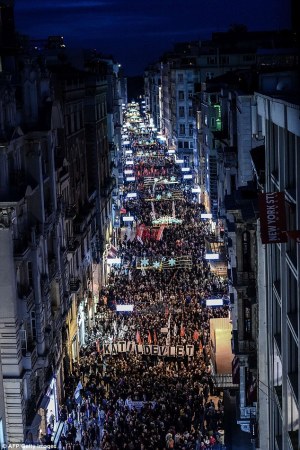 Thousands of people have gathered on the streets of Istanbul in protest of the twin bomb blasts in Turkey’s capital, which claimed the lives of over 90 people.
Around 10,000 people converged on the city’s Istiklal Street, some carrying placards reading “The state is a killer” and “We know the murderers,” AFP reported on Saturday.
Similar demonstrations were held in other Turkish cities such as Izmir, Batman and Diyarbakir, some of which were dispersed with police intervention.
Following the deadly blasts, Russian President Vladimir Putin called for joint efforts on battling terrorism.
“It is necessary to unite efforts in the fight against this evil. What happened in Turkey… it certainly is an impudent terrorist attack, a terrorist crime with scores of victims. And of course it is an attempt to destabilize the situation in Turkey, a neighboring and friendly country for us,” said Putin on a televised broadcast.
Earlier in the day, twin explosions targeted activists who gathered outside Ankara’s main train station for a peace rally organized by leftist and pro-Kurdish opposition groups. According to a statement released by Turkish Prime Minister Ahmet Davutoglu’s office, at least 95 people were killed and 245 wounded in the attacks, 48 of whom are in critical condition.
Turkey imposes broadcast ban on Ankara bomb blast
MEMO | October 10, 2015
Turkey has imposed a temporary ban on showing images of Saturday’s bomb attack in Ankara for reasons of “public security”.
The ban also includes images of the aftermath of attack on a peace protest outside the city’s main train station.
The Supreme Board of Radio and Television said the prime minister’s office decided to impose the ban.
In a written statement, the board said the ban was imposed due to “security reasons” and “public security”. Such bans are usually put in place to prevent the spread of what the government refers to as terrorist propaganda.
Broadcasters can still cover statements about the twin blasts and air commentary.
Turkish journalist detained over tweets critical of Erdogan
Press TV – October 10, 2015
Turkish police have arrested the editor-in-chief of the English-language newspaper, Today’s Zaman, for reportedly posting a series of tweets critical of President Recep Tayyip Erdogan.
Bulent Kenes was detained after police raided the newspaper’s headquarters in the Turkish city of Istanbul on Friday.
The detention was televised live, while a crowd of supporters gathered outside the paper’s office with placards reading, “Free media cannot be silenced!”
The arrest came after an Istanbul judge agreed to a request by prosecutors to apprehend Kenes, claiming that tweets he had posted in August insulted Erdogan.
The journalist, however, denied the accusations, emphasizing that he was instead exercising free speech.
“I will continue to oppose turning this country into an open-air prison and an unlawful, oppressive and arbitrary administration,” he said.
Back in June, Kenes was also given a 21-month suspended jail sentence over similar charges.
Meanwhile, the Turkish Journalists’ Union published a statement, saying that the case was “another example of intimidation of the media” ahead of elections in the country.
On October 3, Turkish journalists held a demonstration in Istanbul to protest against what they called the growing suppression of media and threats against reporters in the country.
The Turkish government has been under fire for alleged clamping down on journalists and sentencing them to long prison terms.
In June, center-left Turkish daily Cumhuriyet released a video, implicating the country’s National Intelligence Organization (MİT) in assisting the Daesh Takfiri militants operating against the Syrian government.
Irked by the revelations, the Turkish president, however, threatened that Can Dundar, Cumhuriyet’s editor-in-chief, would “pay a heavy price” for publishing the video.
Video: Israelis Shoot Motionless Arab Woman
By Jonathan Cook | Dissident Voice | October 9, 2015
In the age of phone cameras, we have become increasingly used to photos and videos of Palestinians in the West Bank being shot by soldiers in unjustifiable circumstances.
Think of 18-year-old Hadeel Hashlamon, who was killed late last month at a checkpoint in Hebron. A series of photos of her suggest, in the words of Amnesty International, that she was “executed” by the soldiers there. She was shot multiple times and left to bleed to death.
The army claimed she had a knife, which they photographed on the ground nearby. But whether she was carrying the knife or it was planted there, still an issue that has not been resolved, the more important point is this: she posed no threat, let alone a lethal one, to anyone when she was killed.
Now we have a disturbing video of a similar shooting but this time not in the occupied territories. This occurs inside Israel and the victim is an Israeli citizen — a member of the country’s Palestinian minority, which comprises a fifth of Israel’s population.
Israa Abed, a 30-year-old mother of three from Nazareth, was shot today at the central bus station in Afula, close to Nazareth. She was surrounded by many soldiers, police and what appear to be armed Israeli civilians. The soldiers there are probably passengers on the many buses that pass through Afula.
The Israeli media initially reported that she was shot while trying to stab a security guard. The video (below) shows that to be definitively not the case. She is shot after long moments of standing apparently terrified in the bus station, in what looks like a state of all-consuming panic, as more and more people point their guns at her.
From the quality of this video it is near-impossible to know whether she is holding a knife. But it is possible to see that, like Hashlamon, she poses no threat to any of the soldiers when she is shot. That point is underlined by the fact that several soldiers and policemen move closer to her, not away from her, in the final moments before she is shot. She does little more than sway throughout the video, appearing to turn when a policeman runs directly towards her as several gun shots ring out on the sound track.
Fortunately, she appears to have survived the shooting and is reported to be in a stable condition in hospital.
But this video is troubling for several reasons.
First, and most obviously, this woman was shot when she posed no immediate threat. The person or people who opened fire did so with no possible justification, apart from their own fears. One cannot help wondering whether the ease with which Israeli Jews shoot Palestinians, whether fellow citizens of Israel or victims of the occupation, reflects long-dominant discourses in the Israeli education system, media and politics that dehumanise “Arabs”.
Second, the shooting seems to occur not because the armed people around her fear they are in danger, but because the group push themselves into a collective frenzy about the alleged knife. In this kind of atmosphere, someone is going to pull the trigger sooner or later.
This is very similar to another recent video, in which a group of religious (and unarmed) Jews chase after Fadi Alloun in a large open area in Jerusalem calling for him to be shot. When security forces turn up, the video shows police opening fire, apparently on the orders of the crowd, killing him. Again, Alloun does not appear to be posing a threat to anyone at the time he is shot.
Third, Israeli politicians, including the mayor of Jerusalem, Nir Barkat, have called on Israeli Jewish civilians to carry their weapons at all times and be ready to use them. This video shows where this policy is likely to lead: summary justice carried out by the most unhinged link in the security chain.
Fourth, it is a deeply worrying new trend inside Israel that Jewish civilians are starting to mimick the settlers in the occupied territories in believing they should be carrying out revenge attacks themselves. Today, a Jewish man in Dimona stabbed four Palestinians, two of them Israeli citizens. This video offers a vivid illustration of the mood of victimhood that is sweeping Israel, one that makes Israelis fast on the trigger and ready to play the role of avenging angel.
It is bad enough that Palestinians in Israel have to face security forces that treat them like an enemy. But things will get much, much worse when even the highly prejudicial rule of law in Israel is replaced by the lynch mob.
Baby amongst children removed over Islamist radicalization fears
RT | October 9, 2015
More than 20 children including one baby have been taken into care over fears they could be subject to extremist views and radical Islam at home.
Children from at least 11 families have been subjected to court orders, which remove children into state care.
The youngest child is a one-year-old from Rochdale whose family were caught attempting to flee to Syria via Turkey earlier in the year.
The figures come after one of the most senior judges in the UK released new guidelines on the increasing number of extremist cases which are taken to family courts.
In many cases judges use court orders to protect children who are considered vulnerable to extremist behavior. The orders can include making the children wards of court, place them in foster care or prevent them leaving the UK.
President of the Family Division of the High Court Sir James Munby said on Thursday that the number of cases involving children had risen since the beginning of the year.
“Recent months have seen increasing numbers of children cases coming before … the family court,” he said.
“There are allegations that children, with their parents or on their own, are planning or being groomed to travel to parts of Syria controlled by the so-called Islamic State; that children are at risk of being radicalized; or that children are at risk of being involved in terrorist activities either in this country or abroad.”
Munby said police should be proactive in seeking court orders, and not rely on local councils. He added that the safety of vulnerable children was “paramount.”
His announcement came days after Prime Minister David Cameron highlighted the “danger” Islamic extremism poses in the UK, saying the “passive tolerance” of radical ideas was allowing the spread of dangerous rhetoric.
Hannah Stuart, counter-radicalization expert at the Henry Jackson Society, said terror groups are continuing to target young people.
“Both among those who support people joining the conflict in Syria or who want to see terror acts committed here, we see a recurring obsession with the radicalization of children.
“We are seeing a generation who are getting older and having children, and those children are growing up in an environment where there is a risk of them being taken to Syria – or being told that it is right to hate non-Muslims and desire martyrdom.”
Featured Video

Seyed M. Marandi: US-Iran War Inevitable: Kuwait and Bahrain May Fall
or go to
Aletho News Archives – Video-Images
From the Archives
Oil and the Israel Lobby
Reknowned economist M. Shahid Alam offers this excellent critique of Noam Chomsky’s defective analysis of the relative influence of Oil versus the Israel lobby over US foreign policy: … continue
Blog Roll
 Aletho News
- Trump’s Retreat: How Al-Aqsa Flood Took Down the US Empire
- Israel’s Military Actions in Lebanon Grossly Violate International Law — Lavrov
- Seyed M. Marandi: US-Iran War Inevitable: Kuwait and Bahrain May Fall
- Leaders Condemn Ansarallah Attack on Saudi Arabia While Ignoring Illegal War Against Yemen
- Leaked: Britain’s Covert Iraqi Psyops Network
- Yemeni Armed Forces Warn Airlines Against Using Saudi Airports, Exempt Mecca and Medina
- Iran security chief says powers greater than US tried to conquer Iran but ended in ‘dustbin of history’
- Europe’s mounting social chaos… chickens coming home to roost for proxy war against Russia
- US-Russia Diesel Deal Becomes Massive Defeat for Ukraine
- Hormuz and the Looming Economic Catastrophe
- If Americans Knew
- Gaza: Ceasefire Anniversary Marks Year of Failed Promises
- The American Conservative: Mike Huckabee Should Resign
- A C-Section in Shackles: A Palestinian Woman’s Harrowing Birth in Israeli Detention
- ‘He’s Desperate’: AIPAC Begins Spending Against Abdul El-Sayed to Boost Mike Rogers:
- Trump, Hormuz, and the Looming Economic Catastrophe
- For three years, Israel has killed a child in Gaza every 71 minutes – Daily Update
- Israeli forces kill another child in Gaza – Daily Update
- Gaza ceasefire exists in name only, say more than 100 organizations
- Nearly 2 Million in Gaza Need Urgent Shelter Assistance as Winter Looms: IOM Chief Warns
- Suppressing Palestinian resistance: US charity under fire for AI monitoring of Gaza classrooms
- No Tricks Zone
- Germany’s Green Energy Debacle: High Energy Costs Force Kahla Porzellan to Close After 182 Years!
- New Study: 50 Years Of The Most Aggressive ‘Net Zero’ Policies Can Only Affect The Global Climate By 0.03°C
- US September “Heat” Was No Record…Many Records Set Decades Ago
- Latest European Green Energy Debacle; Portugal’s Largest Flagship Solar Park Insolvent!
- Green Energy Debacle: German Expert Professor Fritz Vahrenholt Warns Of Severe Economic And Social Consequences
- Two More Paleo Reconstructions Affirm Meters-Higher Sea Levels Across Ireland, Brazil 7000-6000 Years Ago
- New Study: Earth And Venus Surface Warmth Largely Explained By Convection And Lapse Rate, Not CO2 Or Radiation
- 2025 Nature Paper Claiming Worsening Global Drought Gets RETRACTED …Heavily Flawed
- New Study: ‘Global Drought Shows No Detectable Recent Acceleration Under Climate Warming’
- Economic Masterminds: German Socialists Suggest Taxing Productivity Gains Stemming From Using AI

