Yale suspends Iranian scholar after AI site said she supports a pro-Palestine group

Press TV – March 13, 2025
Yale Law School has suspended an Iranian scholar following accusations stemming from an Israeli AI-powered website article that highlights her advocacy for Palestine and Iran, as well as her outspoken criticism of Israeli genocide during the Gaza war.
Helyeh Doutaghi, who serves as the Deputy Director of the Law and Political Economy (LPE) Project at Yale, in a public statement on Wednesday, denounced her suspension as a retaliatory action against her pro-Palestinian stance and a violation of her constitutional rights to free speech and academic freedom.
“AI is being weaponized to target students, faculty, and organizers who dare to speak out against genocide, systemic starvation, and the ethnic cleansing of Palestinians,” she warned, highlighting the broader implications of the misuse of artificial intelligence in academic and public discourse.
Doutaghi, an expert in international law who held the position of Associate Research Scholar at Yale Law School, was informed of an article published by an obscure AI-powered right-wing Zionist platform, Jewish Onliner, on March 3, which falsely labeled her a “terrorist.”
Doutaghi, who has been vocal about the implications of US military operations, imperialism and the US-Zionist genocide and the ongoing humanitarian crisis in Palestine, reported that the accusations from the article have led to online harassment and even death threats against her.
Less than 24 hours after the article’s release, Yale Law School administration placed Doutaghi on leave.
She criticized the administration for conducting an interrogation based on AI-generated allegations without due process or providing her with sufficient time to attend an interrogation.
Doutaghi also expressed concerns about Yale’s choice of attorney for her interrogation, David Ring from the firm Wiggin and Dana, whose public profile indicates a focus on services related to Israel.
She questioned his neutrality in a case involving a pro-Palestinian academic.
“The actions of YLS constitute a blatant act of retaliation against Palestinian solidarity,” Doutaghi remarked, asserting that the administration prioritized the approval of its Zionist donors over a fair investigation.
Doutaghi pointed out that Yale’s asset managers include firms linked to General Dynamics and Lockheed Martin, which produce components for the F-35 fighter jets used by Israel in committing genocide, asserting that the move creates a conflict of interest that undermines academic integrity.
“This crackdown is a dangerous escalation in state repression, fostering an atmosphere of fear on campus,” said Doutaghi. “We are witnessing a new era of Zionist McCarthyism, where dissent is met with violence, and solidarity with Palestine is rendered a punishable offense.”
“Yale is bending the knee to Trump’s effort to suppress free speech, crush academic freedom, and establish a dictatorship,” Eric Lee, Doutaghi’s lawyer wrote on social media in light of her suspension.
Meanwhile, the US State Department is reportedly considering the use of AI to potentially revoke visas for international students accused of supporting Hamas, raising further concerns about the consequences of such technology on civil liberties.
On Saturday, Mahmoud Khalil, a recent Columbia University graduate who helped lead last year’s solidarity protests in support of the Gaza Strip, was detained by Immigration Customs Enforcement (ICE) and said to be deported despite having a green card.
Following the detention of Khalil, US President Donald Trump declared it was “the first of many to come,” labeling Khalil a “radical foreign pro-Hamas student” and emphasizing that his administration would adopt a strict stance against any pro-Palestinian activities within American universities.
Maybe the reason the Trump administration wants to deport Mahmoud Khalil is because there’s no good reason
By Adam Dick | Peace and Prosperity Blog | March 13, 2025
The Donald Trump administration is offering no good reason to deport Mahmoud Khalil, who was involved in protests at Columbia University in New York City related to the Israel government and to United States government support for that government. He is not charged with a crime of violence or fraud. He is just singled out for advancing communication that challenged US foreign policy — exercising rights listed in the First Amendment of the US Constitution.
Why, many people ask, is the US government so intent on deporting Khalil? Wouldn’t it instead make more sense to go after other noncitizens, making at least arguably credible accusations they committed crimes?
Answers to these questions are suggested by considering the fact that, because Khalil’s accused offense is just speaking up, his arrest, detention, and deportation can have maximum impact in discouraging people from taking a stand the US executive branch may oppose. Speech, assembly, or petition alone, the Trump administration is making clear, is sufficient to bring upon one the wrath of the US government. A Tuesday post at the website of the free speech advocacy organization The Foundation for Individual Rights and Expression (FIRE) titled “Trump administration’s reasons for detaining Mahmoud Khalil threaten free speech provides elaboration:
There are millions of people lawfully present in the United States without citizenship. The administration’s actions will cause them to self-censor rather than risk government retaliation. Lawful permanent residents and students on visas will fear a knock on the door simply for speaking their minds.
If constitutionally protected speech may render someone deportable by the secretary of state, the administration has free rein to arrest and detain any non-citizen whose speech the government dislikes. The inherent vagueness of the “adversarial to the foreign policy and national security interests” standard does not provide notice as to what speech is or is not prohibited. The administration’s use of it will foster a culture of self-censorship and fear.
Khalil is being put forward as an example by the US government. The message to potential critics of the Israel government or US policy related to it is as simple and direct as it is sinister: Shut up or the US government will destroy your life.
Professor at Center of Columbia University Deportation Scandal is Former Israeli Spy
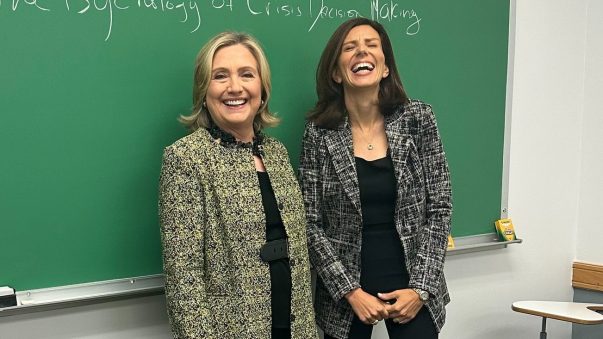
Keren Yarhi-Milo poses with Hillary Clinton during Clinton’s 2023 guest teaching stint at Columbia. Photo | Facebook | Hillary Clinton
By Alan MacLeod | MintPress News | March 11, 2025
The professor at the center of the Columbia University deportation scandal is a former Israeli intelligence official, MintPress News can reveal.
Mahmoud Khalil, a recent graduate of the university’s School of International and Public Affairs (SIPA), was abducted by Immigration Customs Enforcement (ICE) Saturday for his role in organizing protests last year against Israel’s attack on Gaza. Khalil’s dean, Dr. Keren Yarhi-Milo, head of the School of International and Public Affairs, is a former Israeli military intelligence officer and official at Israel’s Mission to the United Nations. Yarhi-Milo played a significant role in drumming up public concern about a supposed wave of intolerable anti-Semitism sweeping over the campus, thereby laying the groundwork for the extensive crackdown on civil liberties that has followed the protests.
Spooks in Our Midst
Before entering academia, Dr. Yarhi-Milo served as an officer and an intelligence analyst with the Israeli Defense Forces. Given that she was recruited into the intelligence services because of her ability to speak Arabic fluently, her job likely entailed surveilling the Arab population.
After leaving the world of intelligence, she worked for Israel’s Permanent Mission to the United Nations in New York. While there, she met and married her husband, Israel’s official United Nations spokesperson.
Although she is now an academic, she has never left the world of international security, making the subject her area of expertise. She has made a point of trying to lift women’s voices in the field. One of these was the then-U.S. Director of National Security, Avril Haines, whom she spoke with in 2023. But even though Khalil was a student in her school, she had nothing to say about his arrest. Indeed, rather than speak out on the issue (as activists have demanded), she instead chose this week to invite Naftali Bennett, prime minister of Israel from 2021 to 2022, to speak at Columbia. Students protesting Tuesday’s event were condemned by university authorities for “harassing” Yarhi-Milo.
Unprecedented Protests, Unprecedented Repression
Columbia was the epicenter of a massive protest movement across university campuses nationwide last year. It is estimated that at least eight percent of all American college students participated in demonstrations denouncing the genocidal attack on Gaza and calling on educational institutions to divest from Israel. The response was equally vast in its scale. Well over 3,000 protestors were arrested, including faculty members themselves.
The nationwide movement began at Columbia on April 17, when a modest Gaza solidarity encampment was established. Protestors were shocked when university president Minouche Shafik immediately called in the New York Police Department – the first time the university had allowed police to suppress dissent on campus since the famous 1968 demonstrations against the Vietnam War.
Mahmoud Khalil was among the leaders of the movement. The Syrian-born Palestinian refugee was willing to speak calmly and cogently to the press about the protest’s goals. A permanent resident of the United States, he was abducted by ICE on Saturday.
“ICE proudly apprehended and detained Mahmoud Khalil, a radical foreign pro-Hamas student on the campus of Columbia University. This is the first arrest of many to come,” President Trump stated. Secretary of State Marco Rubio echoed Trump’s ominous threat, announcing, “We will be revoking the visas and/or green cards of Hamas supporters in America so they can be deported.” In another clear threat, the Trump administration moved to cancel $400 million in funding to Columbia University, citing the institution’s failure to sufficiently crack down on “antisemitic” incidents on campus.
Khalil’s eight-month pregnant wife was initially told that he had been taken to a facility in Elizabeth, New Jersey. In fact, he had been moved halfway across the country to a center in Jena, Louisiana. Journalist Pablo Manríquez of Migrant Insider explained that ICE often goes “immigration ‘judge shopping’ by putting detainees in detention centers under jurisdictions of courts that very rarely decide in favor of migrants.”
The very high-profile attempt to deport the holder of a Green Card because of political speech criticizing a foreign government has left many civil rights lawyers deeply worried. Alec Karakatsanis, for example, stated that “I’ve never seen a more clear-cut First Amendment violation, or a more flagrant government declaration of intent to violate blackletter law.” “The government does not claim he committed a crime, just that he held views that the government doesn’t like about Israel. Bone chilling,” he added.
Columbia’s Billionaire Pro-Israel Backers
Much of Columbia’s funding comes from donations from billionaire benefactors. But those gifts come with strings attached. This became apparent in the wake of the protest movement, as many pro-Israel patrons demanded the university take action. Manufacturing magnate Robert Kraft, for example, publicly announced he was cutting his alma mater off from his lavish funding over its failure to effectively suppress the demonstrations.
Hedge fund manager Leon Cooperman did the same, demanding that Columbia’s “crazy kids” “have to be controlled.” These “kids” evidently also included 61-year-old Jordanian professor Joseph Massad, whose views on the Middle East Cooperman found intolerable, and called for his firing. Soviet-born oligarch Len Blavatnik, meanwhile, urged police to hold the protestors to account.
Between them, Kraft, Cooperman and Blavatnik are believed to have donated nearly $100 million to Columbia, giving them considerable influence over the political direction of the university.
There were also voices from within the university clamoring for the violent suppression of the student movement. Assistant Professor of Business Management Shai Davidai, for example, denounced the protestors as “Nazis” and “terrorists” and called for the National Guard to be set upon the encampment, obliquely referencing the Kent State University Massacre while doing so. Davidai, an Israeli-American, served in the IDF and has publicly expressed his pride in doing so.
Given its most recent addition, it appears unlikely that the School of International and Public Affairs will moderate its pro-Israel positions. In January, the school announced that Jacob Lew would join the faculty. Lew had just left his job as the U.S. Ambassador to Israel under the Biden administration, a role in which he facilitated American complicity in genocide, supplying Israel with weapons and providing it with diplomatic support for its efforts.
Defending Israel, Destroying Free Speech
Longtime readers of MintPress News will be less surprised than many to hear that Israeli military intelligence officials hold such important positions in American public life. Previous MintPress investigations have uncovered giant networks of former Israeli spies working in top jobs in big tech and social media companies, including Microsoft, Google, Meta, and Amazon. Even TikTok, often labeled a Chinese spying app, has hired former Israeli spies to run its affairs. And in October, we revealed that former Israeli spooks are writing America’s news, with multiple former agents working at top U.S. outlets, including CNN, Axios, and the New York Times.
Perhaps, then, the fact that the dean of the very school at the center of a worldwide media storm is a former Israeli military intelligence officer should not be such a shock. But it remains a stark reminder of the level of extraordinary institutional bias in favor of Israel displayed across the United States.
Romanian nationalist MPs begin parliamentary strike over Georgescu’s election expulsion
By Thomas Brooke | Remix News | March 12, 2025
Nationalist MPs in Romania have launched a parliamentary strike in protest against the disqualification of frontrunner Călin Georgescu from the upcoming May presidential elections.
The move, led by the Alliance for the Union of Romanians (AUR), comes amid growing political unrest and public outcry over what critics are calling an attack on democracy.
George Simion, President of AUR, announced the strike on social media, declaring that all AUR MPs would cease attending parliamentary meetings.
“Starting today, all AUR MPs will go on parliamentary strike. They will no longer attend plenary or committee meetings. State institutions have committed an unimaginable abuse against Călin Georgescu. We stand by his side!” Simion wrote.
The Central Electoral Bureau (BEC) rejected Georgescu’s candidacy on Sunday evening with a 10-4 vote. The decision, met with immediate backlash, triggered widespread protests and sharp international criticism.
Following the announcement, demonstrators gathered outside BEC headquarters in Bucharest, waving national flags and chanting for a “revolution.” Some protesters clashed with police, leading to the use of tear gas as authorities attempted to disperse the crowd.
Georgescu appealed the BEC ruling to the Romanian Constitutional Court (CCR), but the court upheld the decision on Tuesday, barring him from running in the election. The ruling is final and binding, eliminating the frontrunner from the race.
Simion, who also serves as vice president of the European Conservatives and Reformist group in the European Parliament, denounced the decision as politically motivated.
“It was rejected without any reason. All the papers were in good order. We live in a dictatorship. Please help us. Please be on our side to restore democracy in Romania,” Simion pleaded.
“The Deep State wants to ban real opposition, rig the elections, and stay in power at any cost. But we are not afraid! We will fight until our country is free from corruption, censorship and political persecution,” he added on Tuesday.
Following the court ruling, Georgescu lamented the demise of democracy in his country.
“Today, the masters have decided: no equality, no liberty, no fraternity for Romanians,” Georgescu wrote on X. “Long live France and Brussels, long live their colony named Romania.
“While America is becoming great again, Europe and Romania have become petty, corrupt and under dictatorship,” he added.
Nationalists are now understood to be preparing a replacement candidate for the presidential elections and have until March 19 to file papers.
The first round re-run is scheduled for May 4, with a run-off set for May 18.
Maine Lawmaker Censored: The Facebook Post That Sparked a Free Speech Showdown
By Regina Morrison | Reclaim The Net | March 11, 2025
You’re an elected official. You show up at the state house, ready to do what politicians do: discuss budgets and debate policy. But instead, you find yourself in the middle of a firestorm over a Facebook post. Not because it contains state secrets or classified intel, but because it features photos from a high school track meet.
This is exactly what happened to Maine Representative Laurel Libby, who now finds herself at the center of a storm that is less about sports and more about who gets to decide what speech is acceptable in a democracy.
A Championship, A Facebook Post, and a Political Crisis
It all started with a pole vaulting competition. Libby, a mother of five and a fierce advocate for women’s sports, posted photos from Maine’s Class B state championship in girls’ pole vaulting. The athlete who won had previously competed in the boys’ division, where they finished in fifth place. Now competing in the girls’ category, the athlete cleared 10 feet 6 inches, winning by a wide margin.
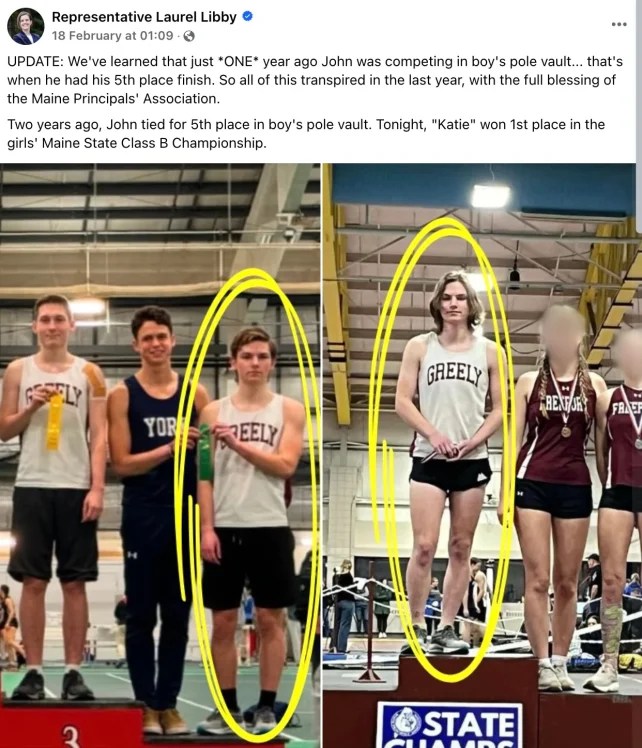
Libby’s post ignited a national conversation — the media ran with it, the White House took notice, and suddenly, a Maine high school sports event became ground zero for the larger battle over transgender athletes in women’s sports.
The Censure Vote and the Ultimatum
Democratic leaders in the Maine legislature quickly stepped in. They demanded she take the post down. Libby refused. The response was a censure vote, which passed 75-70 along party lines.
But that wasn’t enough. The House speaker then took things a step further: Libby would not be allowed to speak or vote on legislation until she deleted the post. In other words, her constituents would now go unheard in state government, all because their representative refused to edit her social media. Normally, removing a legislator would require a two-thirds vote or a recall election, but those formalities were apparently unnecessary when a majority party had other tools at its disposal.
Libby’s critics argue that she could have made her point without sharing the athlete’s photo. “Sharing images of kids online without their consent is a clear violation of the bond of trust and respect between citizens and their legislators,” said Majority Leader Ryan Fecteau. He accused Libby of using a minor to score political points and insisted that serious policy debates should not be waged through viral social media posts.
Libby, however, sees it differently. “Words don’t have the same impact. People need to see what’s happening to understand why it’s unfair,” she explained. Her stance is simple: if an athlete competes in a public championship, they should expect public attention. “If you don’t want attention, don’t put yourself in a public position to receive it.”
Libby’s post, whether you agree with it or not, falls squarely under the First Amendment. She wasn’t revealing state secrets or inciting a riot — she was commenting on a policy set by the Maine High School Principals Association, which allows student-athletes to compete in the gender category with which they identify.
In other words, she was doing exactly what elected officials are supposed to do: debate policies that affect the people they represent. The fact that her speech was met not with counter arguments but with an outright ban from legislative participation raises an uncomfortable question; if lawmakers can be silenced for discussing controversial policies, what does that mean for the rest of us?
Brussels ‘must take position’ on Romanian presidential election controversy one way or another: Slovak PM Fico
By Thomas Brooke | Remix News | March 11, 2025
The European Commission is under increasing pressure to address the unfolding political crisis in Romania after Slovak Prime Minister Robert Fico called for clarity on the rejection of Calin Georgescu’s presidential candidacy.
Fico’s remarks, shared on social media, warn that the Commission’s silence would further undermine trust in the European Union.
Fico emphasized that the European Commission “must take a position” on the situation one way or another, asserting that either Georgescu, a nationalist and NATO-skeptic, is right, or the Romanian authorities’ decision to bar him from running is justified.
“The European Commission (EC) must take a position on the presidential elections in Romania — and take responsibility for it. If Mr. Georgescu is being wronged simply because he has a different opinion, he must be given European protection. If the EC is convinced that the Romanian authorities are doing the right thing, it must stand up for them. The only thing the EC cannot do is to remain silent,” Fico declared.
The controversy erupted after Romania’s Central Electoral Bureau (BEC) rejected Georgescu’s candidacy for the upcoming presidential elections on Sunday evening. The decision, taken with 10 votes in favor out of the 14-member committee, sparked protests in Bucharest, where demonstrators clashed with police, waving national flags and chanting slogans calling for “revolution.” Riot police used tear gas to disperse the crowd, and multiple arrests were made.
The BEC cited a missing signature on an annex of Georgescu’s declaration of wealth as the reason for his disqualification. Former Constitutional Court judge Tudorel Toader clarified that the annexes are a mandatory component of the documentation and that both substantive and procedural requirements must be met.
Georgescu, who had previously won the first round of the presidential elections before they were annulled, condemned the decision as a political maneuver. “A direct blow to the heart of democracy worldwide! I have one message left! If democracy in Romania falls, the entire democratic world will fall! This is just the beginning. It’s that simple! Europe is now a dictatorship, Romania is under tyranny!” he wrote on social media.
Fico drew parallels between Georgescu’s case and his own experiences in Slovakia, where he claims he faced politically motivated efforts to imprison him as an opposition leader between 2020 and 2023. He accused the European Commission, particularly then-justice commissioner Didier Reynders, of turning a blind eye to alleged democratic backsliding in Slovakia because the country’s government at the time was aligned with Brussels.
“The EC at that time did not give a damn about Slovakia. They had an obedient government, and nobody cared about the rights of the leader of the opposition and the nature of democracy in Slovakia,” Fico wrote.
The rejection of Georgescu’s candidacy has drawn sharp criticism from several political figures and observers, including Italian Deputy Prime Minister Matteo Salvini, leader of Spain’s Vox party Santiago Abascal, and U.S. billionaire Elon Musk.
George Simion, president of Romania’s right-wing Alliance for the Union of Romanians (AUR) party, insisted the decision was overtly political. “It was rejected without any reason. All the papers were in good order. We live in a dictatorship. Please help us. Please be on our side to restore democracy in Romania,” Simion stated.
Fico warned that the EU’s credibility is on the line, warning that if it does not take a view, “a dangerous precedent is being set where, in a free democratic election, it will be possible to remove a successful candidate simply because he does not hold a favorable opinion.”
USAID funded Ukraine group that smeared Vance
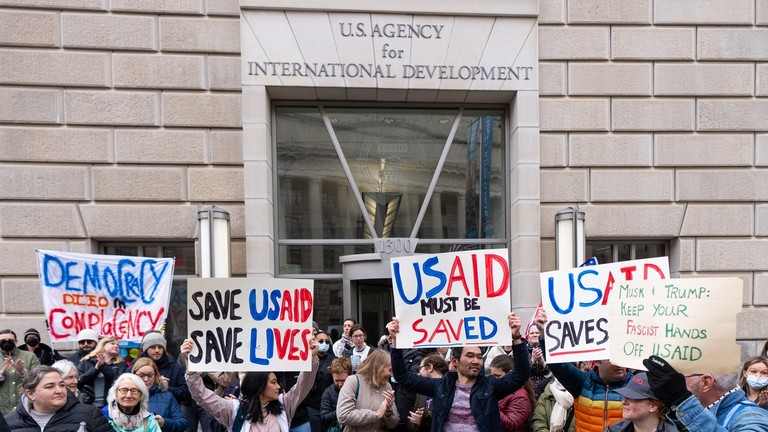
Protesters gather outside USAID headquarters, February 3, 2025 © Bill Clark / CQ-Roll Call, Inc via Getty Images
RT | March 10, 2025
The US Agency for International Development (USAID) has been implicated in funding a Ukrainian organization, Molfar, which labeled Vice President J.D. Vance and other US officials and public figures as “foreign propagandists” aligned with Russia, according to an investigation by The Grayzone.
Molfar, established in 2019, describes itself as an open-source intelligence community platform which “collects lists of Ukrainian enemies to bring war criminals to justice.” The group’s website identifies USAID and the US Civil Research and Development Fund (CRDF) as partners, indicating financial and operational support from US government agencies.
The group’s online blacklist not only targeted Vice President Vance for his statements opposing continued US financial support for Kiev and his stance against Ukraine’s NATO membership, but also targeted other American figures, including US Counterterrorism Director Joe Kent and Representative Thomas Massie. Molfar’s website advocated for their “removal from public positions, the introduction of sanctions, and investigations into personal involvement in crimes.”
In addition to political figures, Molfar has targeted American journalists, including Max Blumenthal, editor-in-chief of The Grayzone. The organization accused Blumenthal of disseminating Russian narratives and threatened to expose his personal information, including home addresses and family details.
Other notable figures targeted by Molfar include billionaire tech entrepreneur Elon Musk, journalists Glenn Greenwald and Tucker Carlson, and award-winning American economist and public policy analyst Jeffrey Sachs.
A report published by Ukraine’s National Coordination Cybersecurity Center (NCSCC), bearing USAID’s logo, highlighted that Molfar assisted in training thousands of Ukrainian government employees in cyber warfare techniques and psychological operations. The report stated that over 2,000 public workers participated in practical assignments covering topics such as open-source searches, contact search, using Telegram bots, psyop as a method of information warfare, human intelligence and social engineering.
According to The Grayzone, Molfar’s activities are part of a broader network of Ukrainian organizations involved in Kiev’s information war efforts at the expense of US taxpayer money.
Another self-styled “fact-checking” outfit, VoxUkraine, has received substantial funding from the National Endowment for Democracy (NED) and USAID. Its VoxCheck project has been involved in censoring Americans’ social media posts deemed pro-Russian. Similarly, the Center for Countering Disinformation (CCD), an official body under Ukraine’s National Security and Defense Council, has collaborated with both Molfar and VoxUkraine to combat “disinformation,” often labeling US public figures as promoters of Russian propaganda, including smearing now-Director of National Intelligence Tulsi Gabbard.
Immediately upon assuming office, President Donald Trump suspended most US foreign assistance pending a three-month review to determine whether programs should continue based on their alignment with the new administration’s “America First” goals.
USAID, Washington’s primary mechanism for funding political projects abroad, has seen tens of billions of dollars’ worth of approved grants frozen as a result. The NED’s government funding was also frozen. Officially a US State Department-funded nonprofit for distributing grants to pro-democracy causes abroad, the NED has long faced allegations of acting as a CIA cutout for toppling foreign governments.
Poland police state: Conservative MP who waived his immunity was arrested on Friday in dramatic fashion
Remix News – March 10, 2025
Remix News reported last week that on Wednesday, Polish Law and Justice (PiS) MP Dariusz Matecki announced that he was waiving his parliamentary immunity in the face of charges that were being made against him by the Prosecutor’s Office, saying that MPs should not be above the people. He made the announcement in a speech he gave in English before the Sejm, proclaiming his innocence while dramatically wearing handcuffs.
Matecki claimed that he was being persecuted as part of the ruling coalition’s revenge against the opposition. On Thursday, the Sejm approved his arrest and temporary detention.
Matecki has been charged with being fictitiously employed at the Regional Directorate of the State Forests in Szczecin from 2020 to 2023, defrauding state-owned companies of PLN 320,000 (approximately €77,000), and other forms of corruption.
The MP was detained and taken into custody by officers of the Internal Security Agency on Friday morning while en route to the Prosecutor’s Office to turn himself in, according to a report by Do Rzeczy. His arrest was quite dramatic, with officers stopping his car and pulling him out of it in the middle of traffic on a busy street.
The MP was charged with six criminal counts, which together could lead to up to 10 years in prison if he is convicted. Matecki has never before been charged with any crime and maintains his innocence.
Besides Matecki’s own arrest, his wife’s apartment was also searched by the authorities. PiS condemned what they referred to as the state’s efforts to intimidate his family.
On Friday afternoon, Przemysław Nowak, the spokesman for the Prosecutor’s Office, announced that the court had ordered Matecki to be detained for a period of two months.
Kacper Stukan, Matecki’s attorney, announced that he would be filing a complaint against the court’s decision. He explained that his client’s arrest was unnecessary given that there was no flight risk in his case.
Polish Minister of Justice Adam Bodnar ominously took to X to share a copy of the order for Matecki’s arrest with the heading, “To be continued . . .”
Donald Tusk’s left-liberal Civic Coalition government has frequently used the law to punish those associated with the country’s previous right-wing ruling coalition since coming to power in late 2023. Dozens of PiS politicians have been charged with crimes, and two other PiS MPs, Mariusz Kamiński and Maciej Wąsik, were arrested on corruption charges that they had previously been pardoned for. Both have been sentenced to two years’ imprisonment for “abuse of power.”
Similarly, former Deputy Minister of Justice Marcin Romanowski was charged with 11 counts of corruption. He fled to Hungary and was granted asylum there, which has led to tensions between the two governments.
Romania: Călin Georgescu’s presidential candidacy rejection sparks mass protests and international condemnation
By Thomas Brooke | Remix News | March 10, 2025
The Central Electoral Bureau (BEC) rejected the candidacy of Călin Georgescu in Romania’s upcoming presidential elections on Sunday evening. The decision, taken with 10 votes in favor out of the 14-member committee, has ignited widespread protests and drawn sharp international criticism.
Shortly after the announcement, demonstrators gathered outside the BEC headquarters in Bucharest, expressing outrage at what they labeled a “theft of democracy.” Supporters of Georgescu clashed with police, waved national flags, and chanted slogans calling for a “revolution.” Law enforcement officers used tear gas to disperse protesters who attempted to force their way into the institution. Several individuals were arrested in the ensuing confrontations.
Marius Militaru, a spokesperson for the Gendarmerie, stated that authorities were “trying to relax the atmosphere through dialogue” and that the situation was under control.
The BEC cited a missing signature on an annex of Georgescu’s declaration of wealth as the reason for his disqualification. Former Constitutional Court judge Tudorel Toader clarified that the annexes are a mandatory component of the documentation and that both substantive and procedural requirements must be met.
Despite the setback, Georgescu retains the option to challenge the decision at the Constitutional Court. If he secures a favorable ruling, he could regain his candidacy, making the upcoming days crucial for his political future.
It is understood that Georgescu has 24 hours to appeal, and any final decision must be made within 48 hours.
Taking to social media, Georgescu condemned the BEC’s decision as an attack on democracy.
“A direct blow to the heart of democracy worldwide! I have one message left! If democracy in Romania falls, the entire democratic world will fall! This is just the beginning. It’s that simple! Europe is now a dictatorship, Romania is under tyranny!” he wrote.
His rejection follows his recent arrest amid an investigation into alleged extremism, a move that had already drawn concern from high-profile figures.
The decision has provoked strong reactions from European and international political figures, some of whom have accused the European Union of political interference in Romania’s democratic process.
Matteo Salvini, Italy’s deputy prime minister and leader of the right-wing Lega party, condemned the rejection, stating: “A Soviet-style Euro-coup. First, they annul the elections he was winning, then they arrest him, and now they exclude him entirely for fear that he will win. Rather than ‘rearm Europe,’ we must refound it to defend democracy.”
U.S. billionaire Elon Musk, a senior adviser to the Trump administration, also weighed in, calling the situation “crazy” and amplifying claims that “Europe has cancelled more elections than Russia.”
Santiago Abascal, leader of Spain’s Vox party, expressed solidarity with Georgescu and Romania’s right-wing Alliance for the Union of Romanians (AUR) party, accusing “Brussels’ bureaucratic pressure” of being exerted to block his candidacy.
George Simion, president of the AUR, claimed the decision was overtly political with all commission members affiliated with the governing parties voting against Georgescu’s candidacy.
“It was rejected without any reason. All the papers were in good order. We live in a dictatorship. Please help us. Please be on our side to restore democracy in Romania,” Simion implored.
Georgescu previously won the first round of presidential elections before they were controversially annulled last year. His arrest last week — while en route to submit his candidacy — raised further suspicions about the state of democracy in Romania.
CHD, Doctors Ask Supreme Court to Hear Medical Free Speech Case
By Michael Nevradakis, Ph.D. | The Defender |March 6, 2025
Children’s Health Defense (CHD), Physicians for Informed Consent and a group of doctors who sued the Medical Board of California after it disciplined them for allegedly spreading COVID-19 “misinformation” have asked the U.S. Supreme Court to review their case.
The plaintiffs in Kory v. Bonta submitted their petition on March 1, following the November 2024 dismissal of their case by the 9th U.S. Circuit Court of Appeals.
California Attorney General Rob Bonta is named in the suit, along with the state’s medical board.
The lawsuit, filed in January 2024, is a follow-up to a previous complaint filed in 2022 and an amended suit filed in 2023, which challenged California’s Assembly Bill (AB) 2098 — a law allowing the medical board to discipline doctors who give “false” information about COVID-19 for engaging in unprofessional conduct.
A federal judge blocked AB 2098 in January 2023, and the law was later repealed. However, according to the lawsuit, the Medical Board of California is still targeting “COVID misinformation” and is threatening physicians with disciplinary action.
Three medical professionals — Dr. Brian Tyson, a board-certified family practitioner who owns an urgent care facility; Dr. LeTrinh Hoang, a pediatric osteopathic physician; and Dr. Pierre Kory, president emeritus of the Independent Medical Alliance, launched the lawsuit.
According to the petition to the Supreme Court, the Medical Board of California and the Osteopathic Medical Board of California, “with the assistance of the California Legislature,” have threatened disciplinary actions against the plaintiffs and other physicians for offering information to patients that departs from official COVID-19 narratives.
In April 2024, a federal district court rejected the plaintiffs’ request for an injunction against the medical board. The 9th Circuit upheld the ruling in November 2024. In January, the Supreme Court rejected the plaintiffs’ emergency application for an injunction.
Lawsuit hopes to set precedent that ‘informed consent is free speech’
The case seeks to resolve contradictory precedents from two federal appeals courts on whether the First Amendment protects physicians’ communications to patients — “a question that is particularly significant in a field like medicine, where scientific understanding is continually advancing and rarely settled.”
In a Physicians for Informed Consent press release, Rick Jaffe, who represents the plaintiffs, said the lawsuit “touches on the foundational rights of professionals to share knowledge and opinions essential for patient autonomy and informed consent.”
Tyson said patients cannot provide informed consent if their physicians are denied the opportunity to speak freely.
“We want doctors and all providers to be able to discuss risks and benefits with our patients, be able to speak out against things that are wrong, and be heard when breakthroughs are made,” Tyson said. “The hope is the Supreme Court will set the precedent that informed consent is free speech.”
Supreme Court asked to decide between competing legal precedents
According to the petition, federal courts have established competing legal precedents relating to medical free speech.
In a 2022 decision in Tingley v. Ferguson, the 9th Circuit upheld the ability of professional boards in Washington to restrict members’ speech, arguing this is similar to the boards’ enforcement of “other restrictions on unprofessional conduct.”
But in a 2020 decision in Otto v. City of Boca Raton, the 11th Circuit struck down local ordinances that limited the speech of therapists and counselors, finding that such content-based and viewpoint-based restrictions violate the First Amendment, which has no carveout for controversial speech.
Tyson said the California Medical Board’s disciplinary proceedings against him jeopardized his career. “I had to defend my position against the [board] and almost lost my license … That would have been devastating to the community I serve and to all those I employ.”
Jaffe said Kory v. Bonta is similar to another First Amendment case relating to medical speech, Stockton v. Ferguson. Filed in March 2024, the lawsuit seeks “to protect the right of physicians to speak” and the public’s right to hear such speech.
CHD is a plaintiff in the lawsuit, as are several doctors facing disciplinary proceedings by the Washington Medical Commission for their public statements criticizing mainstream COVID-19 narratives. Basketball legend John Stockton is also a plaintiff, advocating for the public’s right to access and listen to “soapbox speech.”
In January, the Supreme Court denied the plaintiffs’ emergency appeal in Stockton v. Ferguson. The case remains active before the 9th Circuit. Oral arguments are scheduled for May 14, Jaffe said.
“The two cases represent the entire spectrum of cases involving what physicians say and would allow the court to give a definitive and comprehensive answer to whether and how much the First Amendment protects professionals when they communicate to patients and the public,” Jaffe said.
According to Physicians for Informed Consent, four justices must agree before the full court can hear Kory v. Bonta. If the Supreme Court decides to take the case, it will hear Kory v. Bonta in October.
Jaffe said the Supreme Court may ultimately jointly consider Kory v. Bonta and Stockton v. Ferguson. He credited CHD with its role in supporting both cases.
“We hope to establish the constitutional right of healthcare providers to speak out against the prevailing medical and scientific consensus about COVID-19, as well as whatever public health challenges face the country in the future,” Jaffe said.
This article was originally published by The Defender — Children’s Health Defense’s News & Views Website under Creative Commons license CC BY-NC-ND 4.0. Please consider subscribing to The Defender or donating to Children’s Health Defense.
Trump cuts $400 million to Columbia Uni. over pro-Palestine protests
Al Mayadeen | March 8, 2025
US Federal Authorities announced on Friday a cut in grants and contracts with Columbia University in New York, citing pro-Palestine protests, which the Trump administration labels as “anti-semitic”.
The US Departments of Justice, Health and Human Services, Education, and the General Services Administration— all part of the Trump Administration’s Joint Task Force to Combat Anti-Semitism— announced the cuts in a statement, citing Columbia’s ongoing failure to stop pro-Palestine protests.
The statement adds that the cuts are the “first round of action” against the Ivy League university, emphasizing that more cancellations are anticipated as Columbia has more than $5 billion in federal grant commitments.
The agencies stated that they would issue stop-work orders for the grants and contracts, which will immediately freeze Columbia’s access to the funding without divulging details about the specific programs that will be affected.
Columbia under fire for alleged ‘anti-semitism’
Columbia University has been the battleground for threats and measures targeting pro-Palestine students who organized and shared in protests against “Israel’s” genocide in Gaza, which “Israel” supporters have labelled as anti-semitic.
The US House Committee on Education and the Workforce demanded in February that Columbia University submit disciplinary records by the end of this month for students involved in anti-“Israel” protests between April and January 2024, criticizing the Ivy League institution’s handling of the matter.
The House panel sent a six-page letter to Columbia University’s leadership on February 13, stating that the institution had failed to fulfill its promise to students, faculty, and Congress to address “anti-Semitism,” asserting that “Columbia’s ongoing failure to confront the widespread anti-Semitism on campus is unacceptable, especially given the university receives billions in federal funding.”
The university’s newly established Office of Institutional Equity launched multiple investigations to track down students who voiced their opposition to “Israel”, according to the Associated Press.
Columbia sent notices to dozens of students for activities ranging from sharing pro-Palestinian social media posts to taking part in protests that the school considers “unauthorized,” while the creation of the “disciplinary office” sparked concerns among students, faculty members, and free speech advocates who said Columbia caved in to Trump’s pressure.
Featured Video

Trita Parsi: Middle East Unraveling — Are We on the Path to World War?
or go to
Aletho News Archives – Video-Images
New Book
Trans agenda is ‘normalization of sadism’ – US author

RT | September 23, 2026
The US Democratic Party has embraced a transgender agenda that amounts to “the normalization of sadism,” author A.J. Rice has said, warning that radical trans policies would return if the party is allowed to regain power.
Speaking to RT’s America First host Scotty Nell Hughes about his new book, ‘The Curse of the Bearded Lady: How the Trans Mafia Whacked American Sanity’, Rice argued that activists have gained significant influence in schools, medicine, and corporate America while people who questioned the agenda have faced pressure to stay silent.
The author described the “trans mafia” as the sprawling network of people and institutions that have helped the movement gain influence. He singled out parts of academia, wealthy backers, and corporations, and stated that providers of transition-related treatment also have a financial incentive to keep young people in their care indefinitely.
Rice argued that the consequences of these policies ultimately fall on children who are being drawn toward gender-affirming medical treatments and on girls who are expected to share locker rooms or compete in sports with biological males.
He noted that while voters rejected the Democrats’ approach to gender in 2024, the party, which has been “captured by madness,” has since only doubled down and is seeking what is effectively “the normalization of sadism.” … Full report
Blog Roll
 Aletho News
- ‘We don’t seek permission to defend our country’: Snippets from President Pezeshkian’s UNGA address
- NATO chief wants Europeans to fight American wars [for Israel]
- German chemicals giant reveals details of downsizing
- Refaat Al-Areer Was The Canary In The Coal Mine In Israel’s War On The Truth
- Israeli election committee bars candidate from Knesset race over Gaza war opposition
- French-Lebanese man files war crimes complaint over Israeli attacks
- Mahan Air Flight Lands in China Despite US Threat against Iranian Airlines
- US eyes $10bn fund to rebuild war-battered Gulf infrastructure
- Trump meets Rodríguez near Maduro’s prison as Venezuela’s oil flows to US
- Trita Parsi: Middle East Unraveling — Are We on the Path to World War?
- If Americans Knew
- An error has occurred; the feed is probably down. Try again later.
- No Tricks Zone
- New Study: Earth And Venus Surface Warmth Largely Explained By Convection And Lapse Rate, Not CO2 Or Radiation
- 2025 Nature Paper Claiming Worsening Global Drought Gets RETRACTED …Heavily Flawed
- New Study: ‘Global Drought Shows No Detectable Recent Acceleration Under Climate Warming’
- Economic Masterminds: German Socialists Suggest Taxing Productivity Gains Stemming From Using AI
- The South China Sea Has Not Been Cooperating With The Climate Change Narrative
- Energy Crisis: Germany Enters Heating Season With Historically Low Gas Reserve Fill Levels
- New Study: The Antarctic Ice Sheet Gained Mass From 2020-2024 Due To Staggering Snow And Ice Accumulation
- Study: Ocean Heating Rates From Thousands Of Years Ago ‘Dwarf’ Modern Ocean Heating Rates
- Climate Extremists Target, Attack Large-Scale Power Grid Infrastructure In Germany!
- New Study: Antarctic Ice Melt Has Contributed Less Than 1 Centimeter To Sea Level Rise In The Last 30 Years

