French Child Interrogated by Police for ‘Apology for Terrorism’
teleSUR | January 29, 2015
French police interrogated an eight year old child because he said that “[he was] not Charlie” in class, in the southern city of Nice on Wednesday.
The professor had begun a discussion with his students the day following the attack on the Charlie Hebdo satirical magazine that left 12 dead – 10 journalists and two police. The child justified his refusal to identify with Charlie as “they [the journalists] caricatured the prophet. I am with the terrorists.” The school director, alerted by the teacher, decided to file a complaint for the French crime of “apology of terrorism” -similar to inciting terrorism- last week, against his father, confirmed the education ministry.
One week later, the child was interrogated for two hours in the police station of Nice, informed his lawyer, Sefen Guez Guez.
To the question “What does the word terrorism mean to you?” the child replied, “I do not know,” the lawyer tweeted. “Did you say that the journalists deserved to die?” “Wrong, I have never said that,” he said.
Guez denounced the “current state of collective hysteria that surrounds this notion of apology of terrorism.”
“In this kind of case, pedagogy is what we need,” he asserted, saying he intended to sue the director, which he accused of having abusively punished the boy. The boy claimed he was deprived of playtime, had to stand in the corner, and was even told the following while playing in the sand pit, “Stop digging, you will not find any Tommy gun to shoot us all.” As a diabetic, he was also deprived of his insulin shots, claimed his lawyer.
During the two weeks that have followed the Charlie Hebdo attack, over 70 people have been put on trial for “apology of terrorism,” sometimes just for shouting “Allahu Akbar” to municipal police. In Corsica 30 people were found guilty, including people with mental issues.
Stand-up comedian Dieudonne will be heard in a Parisian court on February 4 for having posted on Facebook “I am Charlie Coulibaly,” a combining the slogan “I am Charlie” and the name of the attacker of a Kosher supermarket, a few days after the Charlie Hebdo tragedy.
FOIA Documents Reveal Massive DEA Program to Record American’s Whereabouts With License Plate Readers
By Bennett Stein & Jay Stanley | ACLU | January 26, 2015
The Drug Enforcement Administration has initiated a massive national license plate reader program with major civil liberties concerns but disclosed very few details, according to new DEA documents obtained by the ACLU through the Freedom of Information Act.
The DEA is currently operating a National License Plate Recognition initiative that connects DEA license plate readers with those of other law enforcement agencies around the country. A Washington Post headline proclaimed in February 2014 that the Department of Homeland Security had cancelled its “national license-plate tracking plan,” but all that was ended was one Immigrations and Customs Enforcement solicitation for proposals. In fact, a government-run national license plate tracking program already exists, housed within the DEA. (That’s in addition to the corporate license plate tracking database run by Vigilant Solutions, holding billions of records about our movements.) Since its inception in 2008, the DEA has provided limited information to the public on the program’s goals, capabilities and policies. Information has trickled out over the years, in testimony here or there. But far too little is still known about this program.
In 2012, the ACLU filed public records requests in 38 states and Washington, D.C. seeking information about the use of automatic license plate readers. Our July 2013 report, You Are Being Tracked, summarized our findings with regard to state and local law enforcement agencies, finding that the technology was being rapidly adopted, all too often with little attention paid to the privacy risks of this powerful technology. But in addition to filing public records requests with state agencies, the ACLU also filed FOIA requests with federal agencies, including the DEA.
The new DEA records that we received are heavily redacted and incomplete, but they provide the most complete documentation of the DEA’s database to date. For example, the DEA has previously testified that its license plate reader program began at the southwest border crossings, and that the agency planned to gradually increase its reach; we now know more about to where it has grown. The DEA had previously suggested that “other sources” would be able to feed data into the database; we now know about some of the types of agencies collaborating with the DEA.
The documents uncovered by our FOIA request provide additional details, but their usefulness is limited by the DEA’s decision to provide only documents that are undated or years old. If the DEA’s collection of location information is as extensive as the agency has suggested in its limited comments to legislatures, the public deserves a more complete and comprehensive explanation than the smattering of records we have obtained can provide.
These records do, however, offer documentation that this program is a major DEA initiative that has the potential to track our movements around the country. With its jurisdiction and its finances, the federal government is uniquely positioned to create a centralized repository of all drivers’ movements across the country — and the DEA seems to be moving toward doing just that. If license plate readers continue to proliferate without restriction and the DEA holds license plate reader data for extended periods of time, the agency will soon possess a detailed and invasive depiction of our lives (particularly if combined with other data about individuals collected by the government, such as the DEA’s recently revealed bulk phone records program, or cell phone information gleaned from U.S. Marshals Service’s cell site simulator-equipped aircraft ). Data-mining the information, an unproven law enforcement technique that the DEA has begun to use here, only exacerbates these concerns, potentially tagging people as criminals without due process.
Some major findings from the documents
The National License Plate Recognition Initiative includes a massive database containing data from both DEA-owned automatic license plate readers and other readers. Among the findings from the FOIA documents:
- At the time of an undated slideshow, the DEA had deployed at least 100 license plate readers across the United States (eight states are identified: California, Arizona, New Mexico, Texas, Florida, Georgia, and New Jersey). A 2010 document also explains that the DEA had by then set up 41 plate reader monitoring stations throughout Texas, New Mexico, and California.
- The DEA is also inviting federal, state, and local law enforcement agencies around the country to contribute location information to the database. For example, the documents show that local and regional law enforcement systems in Southern California’s San Diego and Imperial Counties and New Jersey all provide data to the DEA. The program was “officially opened” to these partners in May 2009. Other agencies are surely partnering with the DEA to share information, but these agreements are still secret, leaving the public unable to know who has their location information and how it is being used.
- Customs and Border Patrol (CBP) is one of the federal agencies that has shared information with the DEA. An undated Memorandum of Understanding explains that the agencies will, “at regular intervals,” provide each other license plate reader data. It also authorizes the two agencies to further share each other’s data with other federal, state, and local law enforcement and prosecutors as well as to “intelligence, operations, and fusion centers.” This is a lot of location points. CBP collects “nearly 100 percent of land border traffic,” which amounts to over 793.5 million license plates between May 2009 and May 2013, according to CBP’s response to our FOIA request.
- Additionally, any federal, state, or local law enforcement agent vetted by the DEA’s El Paso Intelligence Center can conduct queries of the database, located in Merrifield, Va.
- The same undated slideshow suggests that there were over 343 million records in the database at the date of the slide’s publication (due to redactions, it is impossible to confirm that date from this document).
- The unredacted parts of the documents and news reports suggest that the DEA recently changed its retention policy to six months for non-hit data. While this is an improvement from previous statements of DEA retention policy, it is still far too long. The government should not collect or retain information revealing the movements of millions of people accused of no crime. But even that long retention period is only meaningful if it comes with strict rules limiting data use, sharing, and access. Like its retention policy, the DEA should make these policies public.
- The DEA says that the National License Plate Recognition Initiative targets roadways that the agency believes are commonly used for contraband transport. But it’s not clear what this means or what it is based on. Every highway in the United States must be regularly used for contraband transport. Is the DEA using this undefined mandate to target people of color? Without more information from the DEA, we have no idea.
- One DEA document references steps needed to ensure the program meets its goals, “of which asset forfeiture is primary.” Asset forfeiture has been in the news a lot lately, criticized as a widely abused law enforcement tactic that doesn’t advance public safety but simply enriches police and federal agencies.
- The program also apparently data mines license plate reader data “to identify travel patterns.” The extent of this data mining is unknown. Is the DEA running all of our license plate reads through a program to predict our likelihood of committing a crime? Are we all suspects if we drive on a certain road? What else does the DEA think it knows about us just from the collection and analysis of our locations via license plate reader data?
More answers are needed
The DEA’s license plate reader programs raise serious civil liberties concerns, and the agency should be open about what it is doing so that those activities can be subject to public debate. Among other questions, the agency should answer these:
- How many license plate readers does DEA currently own and operate? In which states? And, how much did it spend on these license plate readers?
- Which policies govern the use of the license plate readers? Which policies govern the use of the license plate reader database? Has the agency done a Privacy Impact Assessment on these programs?
- How many license plate reader hits have resulted in arrest and prosecution of a serious crime? How many license plate reader hits have not correlated to an alert upon further investigation (a “mis-hit”)?
- From which local, state, and tribal law enforcement agencies does the DEA receive license plate reader data?
- Which additional agencies does the DEA partner with? How many people have been approved to conduct queries of the DEA database?
- Has the DEA used or attempted to use Vigilant Solution’s National Vehicle Location Service or a similar privately-run license plate reader database? Does DEA combine information from its own database with records in Vigilant’s, creating a mega-database in a public-private surveillance partnership?
As is the case with most police and federal law enforcement spy technologies, license plate tracking programs have flown under the radar of courts and legislators for far too long, silently collecting records about ordinary Americans in the cover of secrecy. When programs are secret, we have no way of challenging them or ensuring they conform with our values and the law. Before accountability comes transparency. Over the coming weeks, we will continue to release records documenting the federal government’s significant investment in automatic license plate readers and its unregulated and largely unseen location tracking programs.
North Sinai curfew extended by 3 months

North Sinai police station – Photo by Virginie Nguyen
By Omar Ryad | Mada Masr | January 25, 2015
The government has extended a curfew in North Sinai by three months, citing ongoing security concerns in the region.
The curfew was initially put in place for three months on October 25, after attacks on military checkpoints that killed more than 30 security personnel.
It was set to expire Sunday, but the Cabinet elected to extend it for an additional three months, Cabinet Spokesperson Hossam al-Qawish said during a telephone interview with private satellite channel CBC extra.
Qawish said that the ongoing unrest in the region convinced the government that the curfew and other security operations need to continue.
The curfew is now set to expire April 25.
It was originally imposed from 5 pm to 7 am each day, with anyone outside during curfew at risk of being shot or arrested. It has cut short working hours and transformed North Sinai’s cities into ghost towns.
In December, the hours were reduced in some parts of North Sinai to run from 7 pm to 6 am, after a meeting between President Abdel Fattah al-Sisi and tribal elders in Sinai.
However, area residents told a Mada Masr correspondent in Arish that the curfew still remains a significant hardship.
Forcing businesses to close early has pushed the city into a general state of recession and increased robbery and thuggery, area residents say.
Instead of keeping crime down, residents say the checkpoints that implement the curfew “only protect themselves,” in addition to increasing the numbers of random arrests.
Crimes against property are not the biggest problem, says Arish resident Abu Abdallah al-Tarabeen. “We can handle all of this if it is for the general wellbeing, but what we cannot stand are the large numbers of dead bodies, reaching around 50 bodies, left out for over two years in the isolated northern areas in Rafah and Sheikh Zuwayed,” he said, referring to a mass grave site in Arish.
A report released Saturday by the Ambulance Authority said that eleven bodies were buried around the grave site Tarabeen refers to, making it difficult for the authorities to process remains for burial or autopsies. According to Tarabeen, the 50 bodies were all killed by live ammunition in previous clashes.
Further inflaming tensions, on January 22 a family was shot minutes after the curfew was imposed at 7 pm.
Over the past months, soldiers have generally allowed a 30-minute grace period for employees, children and families to make their way home from the local market, but on that day, soldiers manning the checkpoint declared the grace period was no longer in effect and opened fire on civilians in the street.
One man was reportedly shot at while on the way home from buying wedding dresses for his three daughters. His wife and other relatives were also hit, and had to be transferred to intensive care.
The military has also evacuated and demolished homes in Rafah as part of a planned buffer zone along Egypt’s border with the Gaza Strip.
UK Police officer who kicked mother tending to sick child cleared
RT | January 23, 2015
A police officer accused of repeatedly kicking and hitting a mother looking after a sick child in hospital has been cleared of actual bodily harm (ABH).
The woman was left with over 40 injuries after Warren Luke, a Metropolitan police officer, kicked and hit her after hospital staff told him she was refusing to leave.
Luke was cleared on Thursday of any crime at Wood Green Crown Court.
The mother, who remains unnamed for legal reasons, was looking after her daughter when the incident occurred in 2013. Hospital staff asked the woman to leave, the court heard. When she refused, four police officers were called.
A video played to the jury showed the mother explaining the incident.
“‘You’ve got to leave, you’ve got to leave,’” she reported Luke as saying.
“I kept playing with my daughter and then I saw him moving towards me. He was kicking me and kicking me. He had one hand on my head. When I fell on the bed he grabbed my hair and banged my head. I was screaming. I couldn’t defend myself. My ex-husband ran in and shouted, ‘why are you kicking my wife?’”
Luke, however, protested that the mother’s behavior had been “escalating” and he believed the child was in danger.
Rather than use a baton or gas, he told the court that he decided to strike the mother on her bicep, and then use what he referred to as a “distraction strike” to her face, using his boot.
He claimed his actions were in accordance with his training.
“I did kick out at the left side of her face as trained to do. My footwear was a boot but it’s light,” he said.
“I can’t say exactly where and how her injuries were sustained, I can only say what I did,” he replied, when asked how she sustained so many injuries.
The women was reported to have needed plastic surgery after the incident, and is said to have taken a year off work to recover.
He denied using full force on the woman, saying: “I wouldn’t say that I used full force, but I do remember hitting harder because it had no effect.
“I used police tactics with good reason that were absolutely necessary. I didn’t go too far. Whenever a police officer uses force you need to be accountable for it,” he added.
Witnesses described with horror the clash between the two, and said they were “appalled.”
Two police officers, who were called to attend to the woman, also gave evidence. One, Laura Riley, was seen crying as she gave evidence for the prosecution. Her colleague Mary Clark said it was “just horrific.”
A spokesperson for the Metropolitan Police said Luke would undergo a misconduct review following the incident.
Exonerating the CIA
When the Establishment Investigates Itself
By BINOY KAMPMARK | CounterPunch | January 21, 2015
Exonerating spooks for improper conduct is a regular feature of the establishment. After all, you don’t convict your own, turning your nose at activities pursued under the grand, catch-all term of national security. From the start, the CIA review, established to investigate its own activities into spying on the Senate Select Committee on Intelligence, was always predictably constituted, with predictable outcomes.
The “accountability board” was chaired by former Sen. Evan Bayh (D-Indiana), along with former Obama White House attorney Bob Bauer and, as anticipated, three senior CIA officers. The originating source of its convening was yet another predictable feature: the CIA itself. (The board was convened in August 2014 by CIA Director John Brennan.)
Its task: to investigate alleged misconduct of five CIA employees who improperly accessed computer data belonging to the SSCI under the Computer Fraud and Abuse Act and the Wiretap Act, and make recommendations that “future instances of the miscommunication and confusion that led to this controversy” do not occur again.
The background to the review proved acrimonious. The SSCI had an issue over the CIA prying into its material on the agency’s rendition and torture program. The CIA, in turn, felt that the senators and their staff had obtained unauthorised access to agency documents and improperly dealt with classified material. The Department of Justice, sensing trouble, evaded the issue.
Last March, Sen. Dianne Feinstein (D-CA) suggested that the CIA search may have violated a range of legal provisions, citing the Fourth Amendment, the Computer Fraud and Abuse Act, and Executive Order 12333 prohibiting the agency from conducting domestic searches or surveillance.
The CIA, according to Feinstein, had become a power onto its own, effectively subverting the constitution. From the start, it hired “a team of outside contractors – who otherwise would not have had access to these sensitive documents – to read, multiple times, each of the 6.2 million pages of documents produced, before providing them to a fully-cleared committee staff conducting the committee’s oversight work.” Naturally, it “proved to be a slow and very expensive process” (Truthdig, Mar 12, 2014).
Wednesday’s redacted report by the review board, termed the “Final Report of the Rendition, Detention and Interrogation Network Agency Accountability Board”, concluded in rather bland fashion that the entire affair had been a misunderstanding. That blandness also involved a good deal of hair splitting, riddled by legal dissembling. “The Board determined that while an informal understanding existed that SSCI work product should be protected, no common understanding existed about the roles and responsibilities in the case of a suspected security incident.”
It found that the “core” of that misguided understanding centred on “the establishment of SSCI shared drives that would be walled-off but also accessible to CIA IT staff for the purpose of IT network administration.” While “SSCI work product was often cited as protected… these were not clearly defined or agreed to by both parties.”
Evidently, areas of cognition vary in relationships between the intelligence community and the community that oversees it – understanding differs on whether it is informal, which can lead to breaches of trust, or “common”, in which case, it is assumed to be firmer. Truth be told, the CIA did not particularly like senatorial staff digging in a rather dirty intelligence backyard.
Accordingly, the board found that “none of the five individuals under review by the board was responsible for this mistake, and two of them – the most senior – had expressly counselled that care be taken to avoid accessing [SSCI] work product.”
Read between the lines, and you can only deduce that the senators and staff had to assume that they would be spied upon. (The names of who authorised such conduct have been redacted.) In the pecking order of the Republic, political figures investigating a body for alleged criminal conduct were the ones to be monitored. This attitude is outlined in so far as the CIA had “obligations under the National Security Act”, with a pressing legal duty to search the computers “for the presence of Agency documents to which SSCI staff should not have access.”
Various recommendations were made regarding the use of shared computer networks having classified material, though the agency retains the prerogative to define how those boundaries are to be charted. Expect more misunderstandings in due course. A specific omission from the review is the failure to explain the disappearance of material off the system, including the now famed Internal Panetta Review.
A standout feature that somehow undermines the constitutionally motivated anger of SSCI committee members lies in its inconsistent attitude to surveillance. Bulk gathering of data on US citizens, and non-citizens, has its uses, but keeping an eye on Congress, a body which has also taken its eye off constitutional erosions, doesn’t. The question is one of degree: who are the greater rogues?
The exoneration of CIA employees may well sting, but it has its own institutionalised justifications. Even the president agrees. According to Barack Obama’s spokesman, Jay Carney, the president expressed “great confidence in John Brennan and confidence in our intelligence community and in our professionals at the CIA” (Truthdig, Mar 12, 2014). The establishment simply got off the hook, again.
Dr. Binoy Kampmark was a Commonwealth Scholar at Selwyn College, Cambridge. He lectures at RMIT University, Melbourne. Email: bkampmark@gmail.com
The FBI’s Dubious Record on Prosecuting Terror Plots
Fake plots get busted, real ones get a pass
By Dave Lindorff | ThisCantBeHappening! | January 19, 2015
If you’re planning to commit an act of terror in the US and want to be left alone by the FBI, make sure your target is something, or someone, that the US government doesn’t like or care about.
Consider these two terrorist plots.
Just last week, on Jan. 14, the FBI announced that it had arrested Christopher Lee Cornell, a guy in Ohio the bureau alleges had plans to attack Congress with pipe bombs and guns. Apparently acting alone, Cornell is alleged by the FBI to have “researched how to make pipe bombs” (there’s no indication that he actually made or tested any actual bombs), and to have purchased a pair of M-15 semi-automatic rifles and ammunition. How Cornell, who is described as a self-styled “jihadist,” but one with no real connection with foreign Islamic militants, planned to get past the metal detectors and tight security at the Capitol Building in Washington, was not explained, and probably was not known to Cornell himself. It also appears that the FBI was watching Cornell all along, and no doubt encouraging him too, as it was working with a snitch — a man facing prosecution who was in communication with Cornell and may well have been a provocateur, given the Bureau’s prior history of luring vulnerable people into planning terror acts which it then busts.
Compare this case with one we reported on earlier here, which was in the works in the fall of 2011. I’m referring to a terrorism plot in Houston, TX, which the FBI never did report publicly, but which was instead disclosed only thanks to some documents obtained through the Freedom of Information Act in 2012 by the Washington, DC-based public interest law firm Partnership for Civil Justice, and which involved an apparently well-developed plan to assassinate leaders of the Houston Occupy Movement. Those documents — internal memos sent out by FBI offices in Houston and Gainesville, FL — refer to “one identified [deleted]” that “planned to engage in sniper attacks against protesters in Houston, Texas if deemed necessary.”
The initial memo, sent to FBI headquarters in Washington from the Houston FBI office, went on to say that the “identified” plotters “had received intelligence that indicated the protesters in New York and Seattle planned similar protests in Houston, Dallas, San Antonio and Austin, Texas,” and that they “planned to gather intelligence against the leaders of the protest group and obtain photographs, then formulate a plan to kill the leadership by suppressed sniper rifles.”
A second memo, sent out by the Gainesville, FL FBI office, says that the Houston assassination plot, while not executed, was actually just put on hold. As that memo states: “writer sent via email an excerpt from the daily [DELETED] regarding FBI Houston’s [DELETED] to all IAs, SSRAs and SSA [DELETED] This [DELETED] identified the exploitation of the Occupy Movement by [LENGTHY DELETION] interested in developing a long-term plan to kill local Occupy leaders via sniper fire.”
That’s a lot of rich detail about an evidently serious plot that never resulted in any arrests.
Yet as we reported in an article which just won a 2015 Project Censored Award, the FBI never pursued this plot and never arrested anyone. Indeed when Paul Bresson, the senior public affairs officer for the Bureau in Washington, was asked by this reporter for an explanation for this bizarre lack of interest in a known plot to murder innocent protesters, and for the identity of the terrorist plotters, he evasively replied, “The FOIA documents that you reference are redacted in several places pursuant to FOIA and privacy laws that govern the release of such information so therefore I am unable to help fill in the blanks that you are seeking. Exemptions are cited in each place where a redaction is made. As far as the question about the murder plot, I am unable to comment further, but rest assured if the FBI was aware of credible and specific information involving a murder plot, law enforcement would have responded with appropriate action.”
Actually, the response of the US Homeland Security Department to journalists who looked into the federal government’s involvement in the violent suppression of the 2011 Occupy movement shouldn’t make anyone feel like “resting assured” about anything. In 2014, we learned that our publication, in fact, had been the subject back on Nov. 18, 2011, of an alert sent out by Homeland Security’s Washington Office of Threat Assessment to all Fusion Centers around the country, saying ThisCantBeHappening! had published an article exposing the Homeland Security’s central role in orchestrating the wave of local police violence against Occupy encampments across the country.
The conclusion, hard to avoid, is that the FBI and Justice Department are playing a double game when it comes to terrorism. On one hand they have been aggressively pursuing a campaign of entrapment and outright incitement, actively promoting and assisting in the development of bogus terror plots by naive or mentally unbalanced individuals, so that they can later “bust” those plots, thereby justifying their expansive police-state tactics while keeping the public in a constant state of fear. On the other hand, they are either turning a blind eye towards genuine plots aimed against activists and radical protests, such as the one “identified” in Houston in the fall of 2011, or worse, are maybe actively involved in the development of those plots, which they then do not prosecute or prevent from happening.
This is something we need to keep in mind as we watch the trial of Dzhokhar Tsarnaev, the only surviving suspect or witness in the Boston Marathon bombing — an actual terrorism act that has many rational people wondering how much the government knew in advance, or wondering if they were just patsies who were set up to look that way.
Delaware man: Police probing Biden shooting ‘beat the daylights out of me’
RT | January 20, 2015
A Delaware man said that local police violently accosted him before he was arrested, as law enforcement officials investigated reports of multiple gunshots near the home of Vice President Joe Biden in Greenville, Delaware.
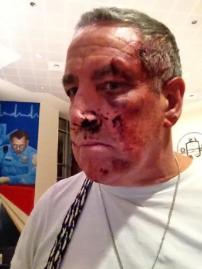 There has been an ongoing investigation into the shooting incident near Biden’s home, but the man, Rock Peters, was arrested roughly 30 minutes after the gunshots were reported. Peters said he was left with a swollen nose, rib injuries, multiple face abrasions and a black eye after New Castle County police beat him.
The incident occurred on Saturday night when Peters had been driving a car near the entrance to Joe Biden’s estate, as officers were closing traffic after reports of the gunfire incident. An officer advised Peters to turn around, but Peters told him it was the only way he knew.
The police officer began to walk away but returned after he thought he heard Peters say something, at which point Peters sped away.
Shortly afterwards, Peters was pulled over by another police officer who radioed for assistance. The police officer signaled for Peters to step out of the vehicle and, as he did, Peters put his right hand in his right jacket pocket, according to police.
At this time the officer placed his left hand on Peters’ arm and forced him to the ground. With another officer, the two cops struggled with Peters, and one of the officers struck him on his shoulder, neck and head with is knee.
“They beat the daylights out of me,” Peters told The News Journal, adding that he did nothing wrong during his interaction with police. He also denied being connected in any way to the shooting incident, and was not charged in connection with the gunfire.
Police didn’t find a weapon on him, but Peters does face reckless endangerment and resisting arrest charges after fleeing from one officer and scuffling with two others, according to a police affidavit.
“That’s a lie,” Peters told the News Journal. “This is what they did to me,” he said, showing the newspaper’s reporter the bloody, stained clothes from when he says a New Castle police officer punched him in the face.
Regarding the shooting, the Secret Service and New Castle County police had no update on Monday, but they have continued to search for a suspect and witnesses. Joe Biden and his wife, Dr. Jill Biden, were in the state over the weekend but not at home at the time of the shooting incident.
Guatemalan Court Sentences Ex-Police Chief for Murdering 37
teleSUR | January 19, 2015
A Guatemalan court found Pedro Garcia Arredondo guilty of murder, attempted murder, and crimes against humanity Monday for the massacre of 37 people at the Spanish embassy in Guatemala 35 years ago, EFE reports.
Garcia Arredondo, 69, is responsible for burning the victims of the massacre to death on Jan. 31, 1980, found the court after four months of hearings.
The tribunal outcome confirmed the long-held suspicions in the country that the fire was the result of a “clandestine police operation” and that the participants “prevented the Red Cross, emergency services, and journalists from entering” the building.
The former police chief was still trying to declare his innocence, but Judge Sara Yoc Yoc ruled that he gave the orders to burn down the embassy. According to her ruling, Garcia Arredondo “used the media to confirm the deaths of those inside the embassy.”
The security forces of Guatemala’s military regime at the time attacked the Spanish embassy after rural workers and students occupied it in protest to the dictatorship.
Among the 37 burned to death was Spanish Consul Jaime Ruiz del Arbol Soler and Vicente Menchu and Francisco Tum, the father and cousin, respectively, of 1992 Nobel Prize Winner Rigoberta Menchu. Menchu gave the first testimony against Garcia Arredondo in the case.
Just two people survived the fire, including the Spanish ambassador. The other, Guatemalan farmer Gregorio Yuja, subsequently disappeared and his body was found with evidence of torture three days after the fire in the rectory of the State University of San Carlos of Guatemala. Yuja has since become a symbol of the left-wing student movement.
Garcia Arredondo was first arrested in 2011 over the forced disappearance of a university student, also in 1980. He is three years into a 70 year sentence for that crime.
Theresa May Performs The Pre Traumatic Stress
By Gilad Atzmon | January 19, 2015
In The Wandering Who I wrote, “within the condition of the Pre-Traumatic Stress Disorder, the stress is the outcome of a phantasmic event, an imaginary episode set in the future; an event that has never taken place. Unlike the PTSD (Post Traumatic Stress Disorder) in which stress comes as the direct reaction to an event that (may) have taken place in the past, within the state of Pre-TSD, the stress is the clearly the outcome of an imaginary potential event… If it is taken to extremes, even an agenda of total war against the rest of the world is not an unthinkable reaction…”
The Daily Mail Reports today:
‘Without its Jews, Britain would not be Britain,’ warns Theresa May over fears of an exodus in wake of anti-Semitic attacks.
- Home Secretary never thought she would see the day Jews wanted to flee
- She vows to redouble efforts to wipe out anti-Semitism in the UK
- Eric Pickles says Jewish community is part of what makes Britain tick
- Board of Deputies hails demonstration of the government’s solidarity
- Scotland Yard have promised extra police patrols in Jewish areas
- It comes after gun attack on a Paris kosher supermarket killed four
Needless to mention, that Theresa May’s comments are based on a fear of a future (imaginary) attack on British Jews.
Wouldn’t it be better if, for instance, our mother Theresa were advising British Jews to disassociate themselves from the Jewish State and its militancy? Such an act could save British Jews a lot of trouble. Theresa May could also suggest to her Tory MP friends to drift away from the Conservative Friends Of Israel club (CFI). At the moment 80% of our Conservative MPs are friends of Tel Aviv, it is not clear how many of them are friendly with Glasgow or Liverpool.
When Guns are Outlawed Only Jews will have Guns
By Richard Edmondson | Fig Trees and Vineyards | January 17, 2015
The head of a major Jewish organization in the EU is calling upon lawmakers to revise European gun control laws to allow Jews to begin arming themselves–presumably for self protection.
“The Paris attacks, as well as the many challenges and threats which have been presented to the European Jewish community in recent years, have revealed the urgent need to stop talking and start acting,” says Rabbi Menachem Margolin, General Director of the European Jewish Association.
“We hereby ask that gun licensing laws are reviewed with immediate effect to allow designated people in the Jewish communities and institutions to own weapons for the essential protection of their communities,” he adds.
Margolin made the remarks in a letter, which can be viewed in PDF format here, and while he does not specifically call for Jews to be exempted from laws barring citizens from carrying weapons in public, concealed or otherwise, that does seem to be the interpretation that RT, as well as the Jewish website Arutz Sheva, are giving it.
“A prominent European rabbi has called on governments to relax gun-licensing legislation to allow Jews to carry firearms for self-defense, following last week’s deadly Paris attacks and amid rising anti-Semitism on the continent,” says Arutz Sheva.
“The biggest Jewish association in the EU has called on lawmakers in Brussels to let Jewish people carry guns ‘for the essential protection of their communities’ in the aftermath of Paris shootings,” reports RT.
The letter is dated January 13, and seems to have given rise to public confusion in one other aspect as well. A “clarification” posted on January 17 does not clear up the question of whether Margolin and the EJA are asking for Jews to be exempted from certain gun regulations–but it does address the matter of whether the rabbi was issuing a general call-to-arms for all Jews, or perhaps only some. Apparently there were those who construed his remarks as advocating for pistols in the purses, waistbands and holsters of every single Jew in Europe.
“He never claimed that every Jew should carry a gun,” the clarification states, additionally reaffirming that guns would be issued only to “designated personnel that will undergo thorough investigation and training by local authorities.” But in a statement to Newsweek, the rabbi also said he felt that “as many people within the Jewish community as possible” should carry weapons.
In either event, what Margolin does clearly seem to be calling for is that Jews be given special consideration over Gentiles in the issuance of gun permits.
“There are too many Jewish people who feel insecure in Europe,” Margolin told RT.
“What I am asking is that the good people, those who live under danger, will be able to protect their life. Otherwise we might be again in the situation and we won’t be surprised if another time an attack against a Jewish institution is going to happen, people will be dead without any possibility to protect their life,” he added.
Can European political leaders, who seem abjectly servile to Jewish lobbies (possibly even more so these days than are American leaders), be expected to go along with the EJA’s request? Will we see the “designated” Jews freely carrying weapons as they walk about the streets of European cities, entering stores and cafes with them, while Gentiles remain strictly subject to current restrictive gun regulations? If so, how do you suppose this will effect the level of anti-Semitism in Europe? Will it cause it to go down… or up?
One can imagine that getting EU politicians to “stop talking and start acting” would not be a terribly hard trick for a well-funded Jewish lobby to pull off.
I find myself torn these days between two lines of thought: a) that Jewish leaders, through their words and actions, deliberately stoke anti-Semitism in order to achieve certain objectives they see as beneficial; and, b) that Jewish leaders–blinded maybe by their sense of supremacy and chosenness–remain essentially oblivious to how they are perceived by others, making resultant rises in anti-Semitism simply the inevitable byproduct of their words and actions.
Of course the human mind certainly operates on more than one level of consciousness, particularly when in the grip of psychosis, so perhaps the answer is it’s both.
Featured Video

Seyed M. Marandi: US-Iran War Inevitable: Kuwait and Bahrain May Fall
or go to
Aletho News Archives – Video-Images
From the Archives
Oil and the Israel Lobby
Reknowned economist M. Shahid Alam offers this excellent critique of Noam Chomsky’s defective analysis of the relative influence of Oil versus the Israel lobby over US foreign policy: … continue
Blog Roll
 Aletho News
- ICC ignored ‘very well-documented’ NATO crimes – ex-Libyan minister
- SNSC secretary dismisses US response to Iran’s conditions as ‘inadequate’
- Sanaa says Taiz roads open, secure for residents, warns Saudi forces
- Iraqi resistance group urges Saudi leadership to admit defeat, lift Yemen siege
- Trump’s Retreat: How Al-Aqsa Flood Took Down the US Empire
- Israel’s Military Actions in Lebanon Grossly Violate International Law — Lavrov
- Seyed M. Marandi: US-Iran War Inevitable: Kuwait and Bahrain May Fall
- Leaders Condemn Ansarallah Attack on Saudi Arabia While Ignoring Illegal War Against Yemen
- Leaked: Britain’s Covert Iraqi Psyops Network
- Yemeni Armed Forces Warn Airlines Against Using Saudi Airports, Exempt Mecca and Medina
- If Americans Knew
- Israel’s Destruction of Southern Lebanon Intensified After the Cease-Fire
- The Last-Minute Decision That Gave Israel Its Name
- The American Conservative: How Trump Made the World Go Nuclear
- Meet the US generals and admirals advancing Israeli policy
- Opinion: Why news organizations should boycott Israel
- The Israeli witch hunt of Sami Abu Shehadeh exposes the lie of the ‘Jewish and democratic’ state
- No state has a ‘right’ to exist – least of all Israel
- Testimonies about Gaza’s civilian death toll expose Israel’s atrocities – Daily Update
- How Israel Conquered the Latin American Right
- Agents search Rep. Omar’s Washington home in criminal probe as she vows she won’t ‘be silenced’
- No Tricks Zone
- Germany’s Green Energy Debacle: High Energy Costs Force Kahla Porzellan to Close After 182 Years!
- New Study: 50 Years Of The Most Aggressive ‘Net Zero’ Policies Can Only Affect The Global Climate By 0.03°C
- US September “Heat” Was No Record…Many Records Set Decades Ago
- Latest European Green Energy Debacle; Portugal’s Largest Flagship Solar Park Insolvent!
- Green Energy Debacle: German Expert Professor Fritz Vahrenholt Warns Of Severe Economic And Social Consequences
- Two More Paleo Reconstructions Affirm Meters-Higher Sea Levels Across Ireland, Brazil 7000-6000 Years Ago
- New Study: Earth And Venus Surface Warmth Largely Explained By Convection And Lapse Rate, Not CO2 Or Radiation
- 2025 Nature Paper Claiming Worsening Global Drought Gets RETRACTED …Heavily Flawed
- New Study: ‘Global Drought Shows No Detectable Recent Acceleration Under Climate Warming’
- Economic Masterminds: German Socialists Suggest Taxing Productivity Gains Stemming From Using AI

